 Open Access
How does this oscillation play out in modern history, in the history of modern art that we date from the Impressionists, and in art today, which we call postmodern?
With Enlightenment’s appropriation of Christianity’s universal morality, and the post-Revolutionary’s bourgeoisie’s appropriation of Enlightenment values, transcendence is invested in the ideology of historical progress, whose orientation only, not its absolute value, was disputed by left and right wing dogmaticians. In Originary Thinking, Gans focuses on the Parnassian poets as illustrative of the artist’s internal exile from history and society, but the genuine transformation in esthetics operates in painting.
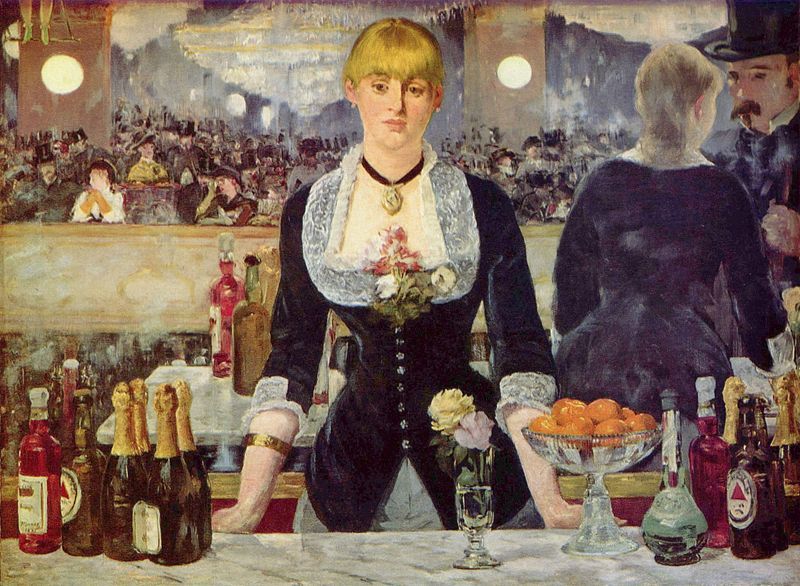 |
| 7. Manet, The Bar at the Folies Bergères |
The impressionists turned their backs on the narrative, heroic, and religious content that had occupied the scene of neoclassic art since the Renaissance in order to concentrate increasingly on formal aspects of representation: light, color, volumetric form, and evanescent shapes dispersed by light, and on compositional arrangement as a whole. The impressionists’ subject matter was emphatically contemporary life, what was going on around them: a railroad station or trestle, a boat, balcony, or bar scene. In Manet’s The Bar at the Folies Bergères (1882) the oscillation effected by the mirror–between center and margin, between neoclassic pyramidal structure and drift to the right, that is, between humans as subjects and objects of a gaze–is both theme and structuring principle of a purely immanent reality. Where customer’s gaze meets bar girl’s, the spectator’s gaze is thematized, made the object of reflection, literally, and the object of contemplation thereby, in the person of the customer to the right, so that we know that behind the girl is a mirror, symbol of iconic re-presentation, or painting. Viewing subject and viewed object are rival and complementary themes of the painting of which bottles and balcony are the pretext, the worldly occasion. Like Manet’s Olympia (1863) and his Railway (1872), this is a painting about looking, about seeing and being seen; it is about the human scene in all its immanence. No heroic or mythic or religious material is necessary to dignify its interest: it is good to see, the way fruit is good to eat. The client viewer’s gaze cuts across the painting diagonally, playing with the horizontal and vertical lines of the balcony in the background, that is peopled in a way that is less imposing, impressive than the bottles of wine in the foreground. The content of the artistic image is less important than the arrangement, announcing Cezanne’s still lifes.
The impressionists’ works notoriously diminish the hieratic significance of content in a way that laid the groundwork for moderns artists, “the first,” as Gans states, “to recognize that esthetic form was prior to any content, and could therefore be given whatever content one liked” (Originary Thinking 195)–or, as was soon the be the case with the likes of Kandinsky, Mondrian, Rothko, and Pollock, no content whatsoever. As Peter Schjeldahl has noted, we experience such works as “engulfing rather than addressing the eye” (80). The artists increasingly focus on relations internal to the scene of the canvas rather than the representation of anything in the world outside it. As more than suggested by the expression “action painting” for the canvases of Jackson Pollack, the work is itself an event.
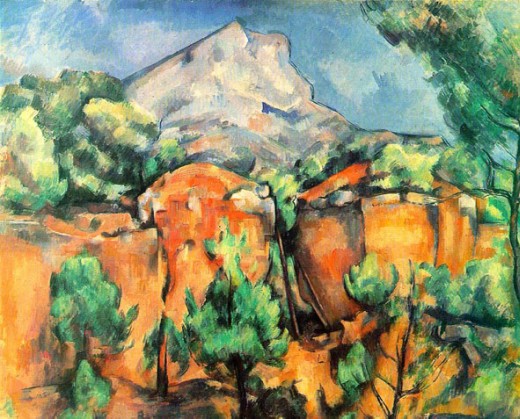 |
| 8. Cézanne, Le Mont Sainte-Victoire vu de la carrière Bibemus |
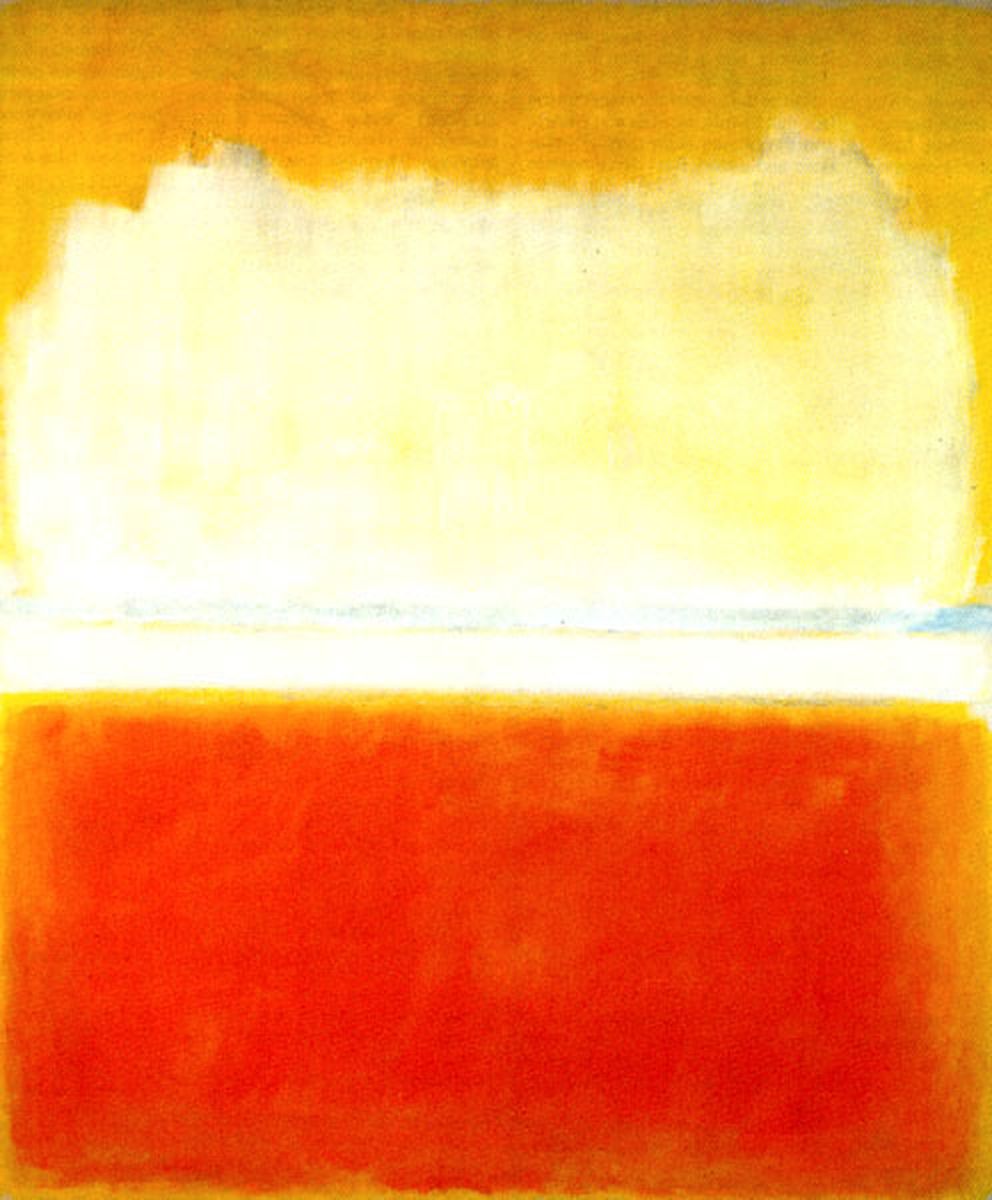 |
| 9. Mark Rothko, Yellow and Gold |
The famous twenty minutes that Cézanne devoted to each brushstroke in his landscapes of Mont Sainte-Victoire towards the end of his life testify to an oscillation between the “motif,” the object of his lingering gaze, and its representation on canvas. “Le Mont Sainte-Victoire vu de la carrière Bibemus” (1887) is mostly about masses of shape, color, effects of light, working towards “purely” formal composition. With Cézanne we experience Creation as a Work in Progress, in which the tension between icon or image and structure is at a maximum, though the painter’s fascination with la Mont Sainte-Victoire, which can be seen from myriad vantage points around Aix, made of it a symbol of verticality, height, dominance, transcendence. I don’t think it is stretching art-historical imagination to see variations on Cézanne’s efforts in the so-called abstractions of Rothko and Kelly, where color fields are jubilantly explored in the absence of any iconic representation. Color is not represented but presentified in a way that connects the fiat lux vocation of the painter with that of a divine creator.
 |
| 10. Ellsworth Kelly, Orange Field |
 |
| 11. Georges Braque, Woman with a Guitar |
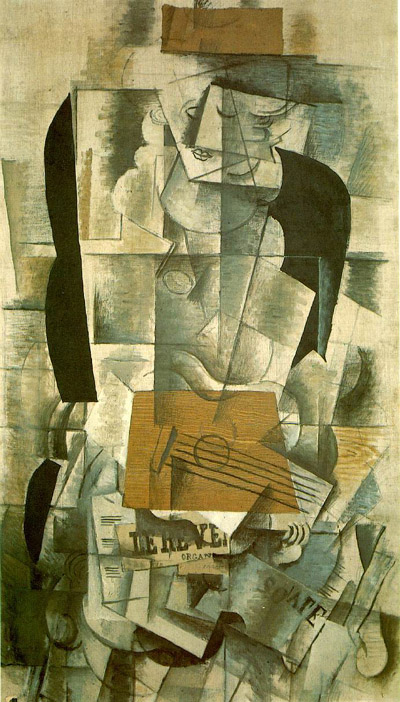
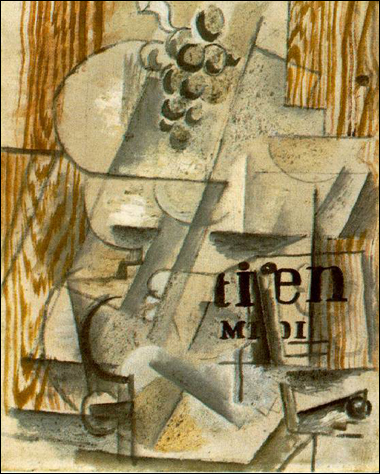
After Cézanne the movement towards abstraction, purely formal composition, is inevitable, as we customarily see in the pseudo-geometric experimentations of cubism. In Braque’s Woman with a Guitar (1913), the viewers gaze is meant to alternate between an experience of two and three dimensions on the painted surface as well as between recognizable fragments of visible reality and abstract, geometric configurations. For a short period, Picasso and Braque, working together in the same studio, suppress color altogether, along with their signature on the painting, as in this Fruit Dish (ca. 1912), as if to erase the intention of the artist as well from the scene of representation. As if emulating Christianity’s forward progress of institutional self-critique and disenchantment with its own hieratic authority, painting is on a path that will work itself out of a job, conspiring by mid-century in what Harold Rosenberg described as The Dedefinition of Art. Before surveying the impasses implied by those developments, we need to recall that the strange fact that Western art has a history that evolves over time to a point where it flirts with its own devolution is owed to its origin in the doctrine of the Incarnation, where divine revelation inserts itself in human time and in mortal flesh.
 |
| 12. Georges Braque and Pablo Picasso, Fruit Dish |
 |
| 13. Bruce Nauman, The True Artist Helps the World… |
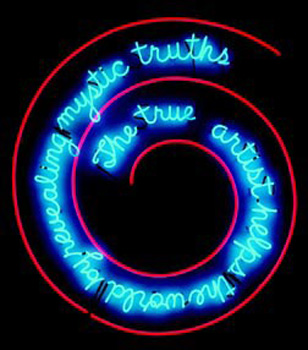
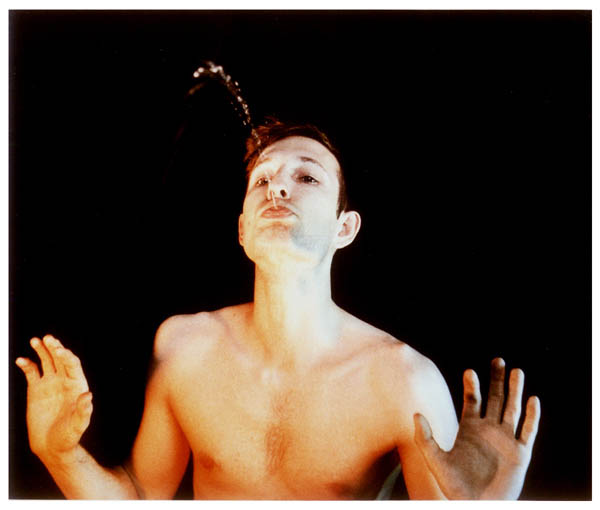
From cubism through abstract expressionism and its postmodern aftermath in minimalism, conceptualism, pop art and op art, this story is succinctly and tellingly summarized by Gans in the “Esthetic History” portion of Originary Thinking, where he remarks that “the inherent radicalism of the modern age made it imperative for each generation to announce a new departure, a new movement. . . . Each work must carry out the renewal of esthetic form ab ovo” (181). This fact is explicit in Bruce Nauman’s self-described efforts of “trying to understand what art is and what artists do” (in Tomkins 71): “I knew then,” he wrote in 1981, “that I’d have to start out every day and figure out what art was going to be” (Plagens 58). In “The True Artist Helps the World by Revealing Mystic Truths” (Window or Wall Sign 1967) he is less reticent in his claims—if he’s not just joking. A stark polarization of views greeted his 1994 traveling retrospective in our nation’s capital, in Madrid, at MOMA, with the New Yorker‘s Peter Schjeldahl declaring Nauman “the best–the essential–American artist of the last quarter century” and Time‘s Robert Hughes describing his work as “so dumb that you can’t guess whether its dumbness is genuine or feigned” (in Tomkins 74-75).
 |
| 14. Bruce Nauman, Self-Portrait as a Fountain |
These opposing views clearly reflect a fundamental oscillation within critical opinion itself about what, if anything, there is to admire or talk about; and this very ambiguity has become the hallmark of virtually every “new” artist on the scene. The essays by eminent critics collected in a recent volume entitled Critical Mess: Art Critics on the State of their Practice (Rubenstein, ed.) testify to the current exacerbation of this problem. In the third quarter of the last century, art production came to be seen in avant-garde circles like Artforum as discourse only. The art object is emphatically disdained as a source of esthetic experience in favor of the occasion to think about art, as well as about sundry social and political issues, an activity punctuated now and then by “infantile gestures of excremental desecration,” as noted in the Chronicle named “Sacrificing Culture” (No. 184, Oct. 9, 1999). Every avant-garde breakthrough proclaims itself a new origin—nonsensically—and not without doing intended violence to the viewers’ expectations.
As noted by Gans, twentieth-century art is hostage to an imperative of innovation and the public, concomitantly, to “the terroristic intention of the artist,” namely to the charge of philistinism if it does not submit to the “obligation to enjoy an avant-garde work” (Originary Thinking 194). Consequently, as Gans observes, “The esthetic must race to keep its paradoxical desire-objects out of the reach of the dynamic rationalization of the market, which is ever converting them into commodities of mass production” (191). Postmodernism can be described as the end of this race, with the artist’s jubilant declaration, in the person of Andy Warhol, that the market has won. As Gans writes: “The recognition of this inalterable dependency of art on the market is a defining trait of postmodernism” (182), an observation that echoes Jeff Koons’s comment at a 1980’s colloquium–his works have gone for the tens of millions at a time–that the “the market is the critic now” (in Critical Mess 102). As a Sotheby’s art expert notes more recently of artist-entrepreneurs, “a lot of artists today are succeeding on sound business principles” (in Thornton 38).
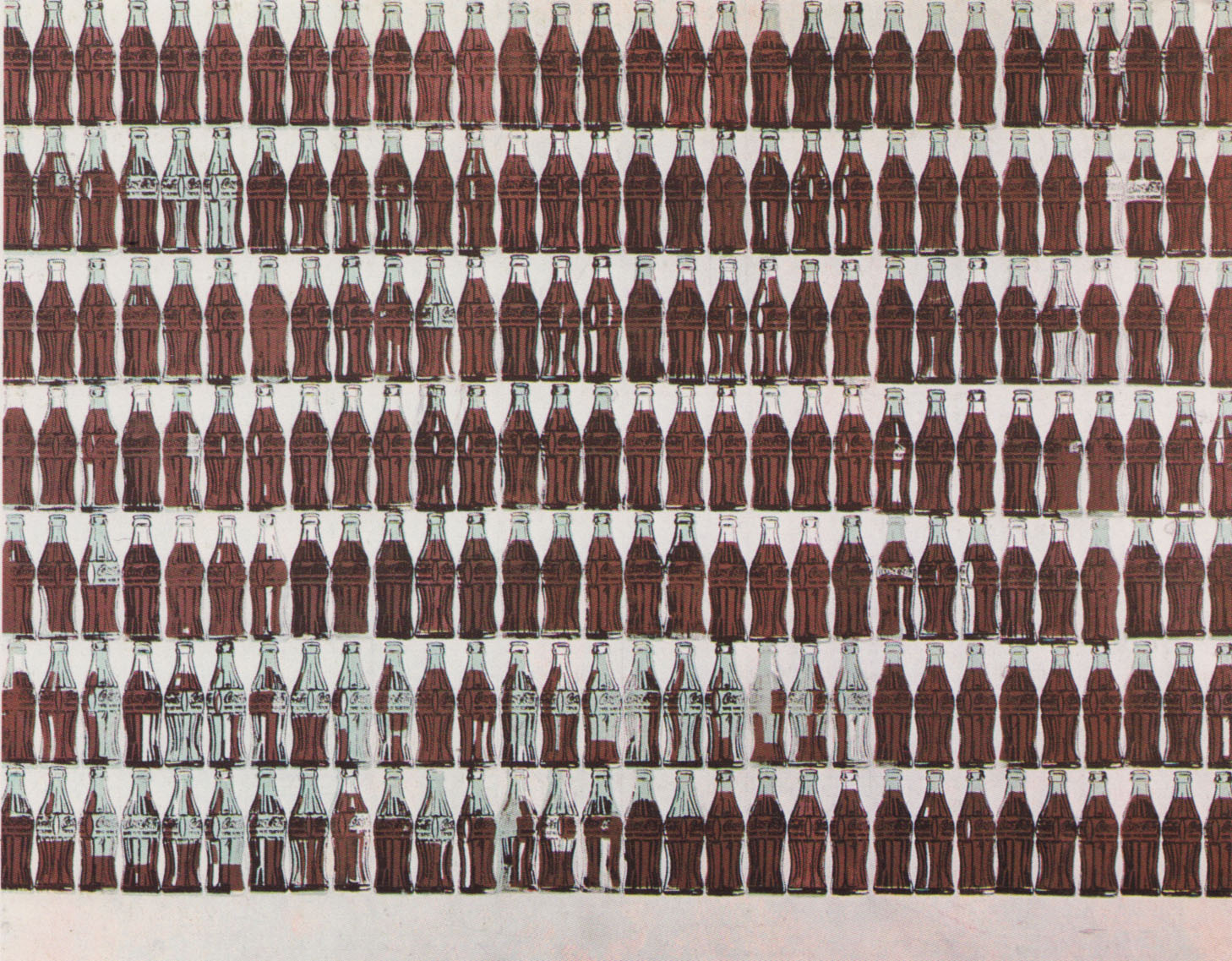 |
| 15. Andy Warhol, Coke Bottles |
As Warhol’s viewer contemplates the scrupulous representation of commodities available to every consumer, his or her attention hesitates ambivalently between the artwork as an object of veneration and as an item of consumption, “between the expressive gesture and the mechanical mark” [Buchloh in Michelson 22), his studio shrewdly taking an industrial cognomen as The Factory. In sum, the work itself oscillates thematically between deferral owed to the sacred center and gratification of appetite by those on the periphery, a difference by which the Chronicles frequently distinguish between high and pop art, while acknowledging their scandal-seeking postmodern conflation:
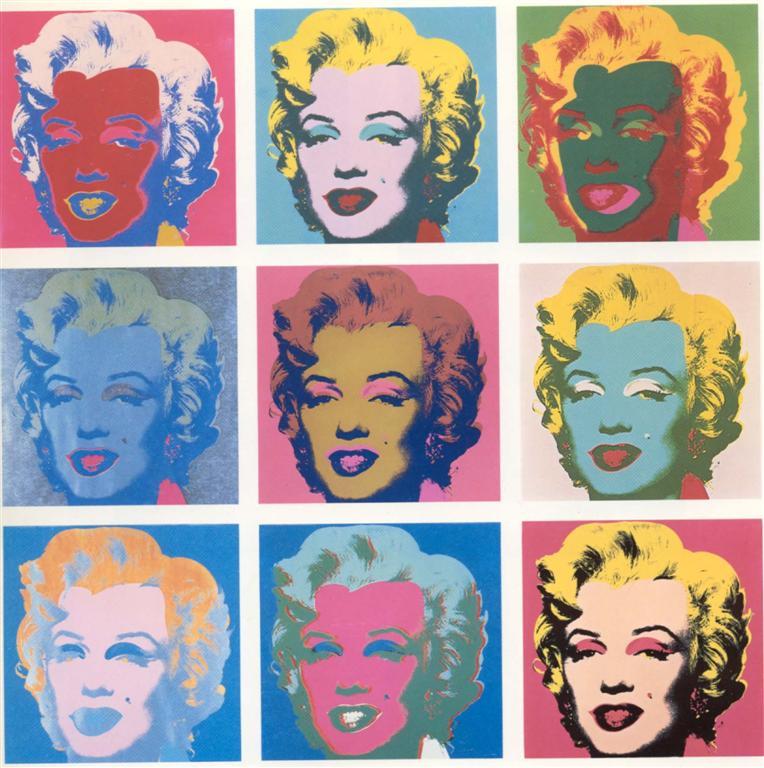 |
| 16. Andy Warhol, Marilyn |
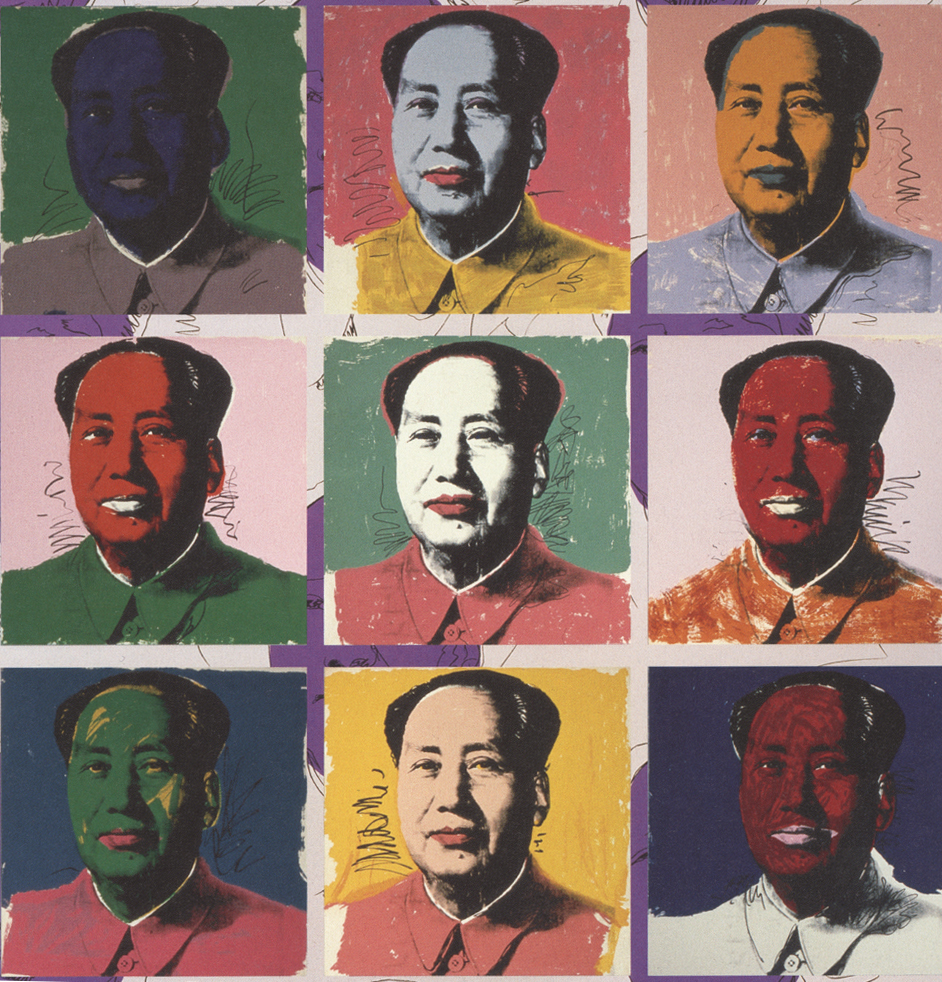 |
| 17. Andy Warhol, Mao |
Warhol’s transparent ploy is not merely to mock high art seriousness and the spectator’s anxious confusion about it; Duchamp, in his carefully disguised resentment of Picasso had already done that with his readymades, as did Rauschenberg and Johns explicitly in Duchamp’s wake. Warhol’s gambit is at once to explore and explode the structure of center and periphery in which art is born of the sacred. In his ubiquitous representations of violence–electric chairs, revolvers, icons of dead or deadly celebrities–we are reminded that he is not a Catholic for nothing.
The found object is replaced by the found image (Buchloh 95) whose puerile reinscription or serialization thematizes just that gesture, the ubiquity and non-entity of the art object, and where metallic surfacings insist on machine-like reproduction while gold background parodies the aura of the infinite we see in medieval art that is now claimed by the celebrity. This is itself a self-marketing ploy, of course, one of Warhol’s manyblagues. His actual position, as Hal Foster has noted (in Michelson 81), is in between icon and witness of the icono-idolatry of our image-consuming culture, oscillating between the paired roles of exhibitionist and voyeur, spectacle and spectator, which is to say, with Eric Gans, between the object and the sign that refers to it.
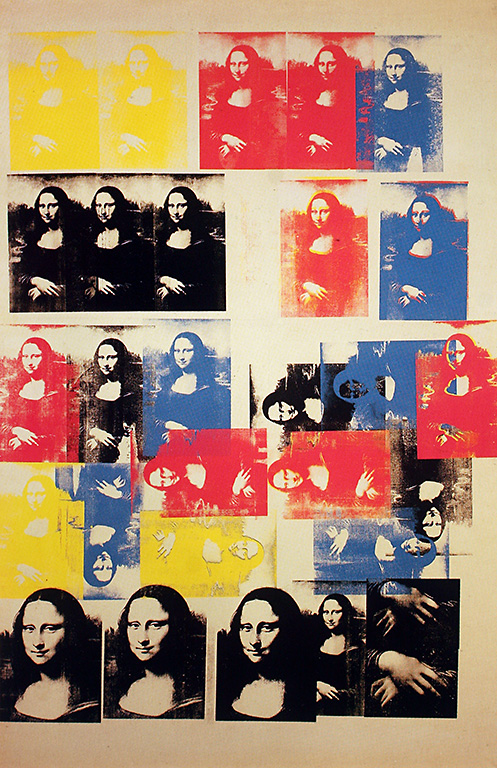 |
| 18. Andy Warhol, Mona Lisa |
With postmodern art, as exemplified by Warhol, oscillation now inhabits art’s content itself, as the undecidable difference between art and non-art, an ersatz version of sacred/profane divide that constitutes the originary scene of representation, which any number of art installations parody as an outlandish event:
When the traditional properties inherited from the ritual scene are discarded, we are forced to realize that the esthetic scene can operate without them, since it antedates the controlled world of ritual. The scandal of arbitrary esthetic content pays homage to the sacred, communal origin of the scene on which it is displayed. In discovering the general form of cultural scandal, modernism unearths, beneath the Aristotelian mimesis it rejects, the conflictual mimesis that is the driving force of the originary event. (Originary Thinking 195)
But the merely provocative intention of such postures simulating art’s violent origin is so transparent as not to bear much repetition. The art scene lately has been typified by the conversely glossy works of Jeff Koons, which proffer metallicized, and monumentally oversized, cartoonish castings of seaside flotation devices, action figures, or comic-book characters. Inflation is the new minimalism by virtue of a pendulum’s swing away from exhausted scandal seeking. The highly touted work of Murakami, whose name is everywhere printed with the circled “c” symbol of copyright, is an explicit homage to his revered Warhol. His latest installation includes within it, as part and parcel of it, a Louis Vuitton emporium; not a gift shop, but a proper store, where the very well-heeled spectator can purchase handbags and other tokens of ostentatiously trademarked prestige that the highly industrialized artist designed for the absurdly pricey maison de couture.
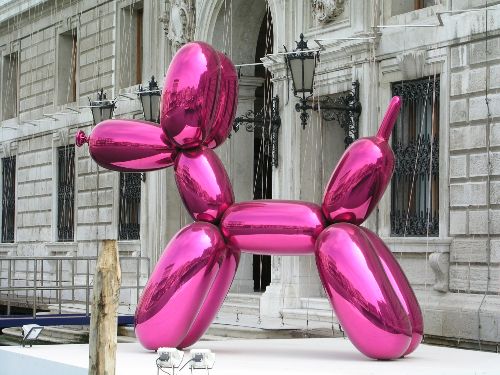 |
| 19. Jeff Koons, Balloon Dog |
 |
| 20. Jeff Koons, Tulips |
 |
| 21. Jeff Koons, Michael Jackson and Bubbles |
So my story ends with the unveiling of the long-awaited Takashi Murakami’s long-awaited Janus-faced Oval Buddha (2007), whose happy face grin mocks the Buddha’s enigmatic smile in a Disneyesque, glitzy mock-up of what in the Buddha’s own cultural context expressed blissful and sovereign indifference, transcendence in the form of withdrawal from the violence of the world. On its other side its mouth opens as a maw of teeth in a parody of the horror-movie monster which typically delights in snarfing down its spectators. In response to the unveiling, Sarah Thornton reports that an art world aficionado, spontaneously reaching down into the popular vernacular, otherwise known as the vulgar tongue, exclaims, in dead earnest, “unbefuckinglievable!” (214). The expletive is not merely an accident or incident of notoriously crude New Yorkese, nor merely the symptom of a degraded critical vocabulary; it is not a hapax legomenon, a one-off interjection, which we could dismiss as insignificant. Another observer exclaims in admiration “entertaining as Fuck!” (215). The impropriety of the taboo words is an implicit homage to prerogatives of the sacred as host to what is ultimately untouchable or unsayable or unrepresentable, except as the name-of-God pronounced at and as the originary scene of representation, and restated here as a more edgy or streetwise variant of “God damn!” or “I’ll be damned!” The exclamations are not declarative nor imperative, but expletive, an ostensive of sacralizing wonderment. It is not constative, but performative, despite the absence of ritual; it is therefore hyperbolic, outrageous, obscene because of that very absence; it is an interjection whose role, in the form of miscreant expression, is to reinject the sacred back into the art object, to infuse it desperately with hieratic significance, and thereby guarantee the “wow factor,” in the words that Thornton overhears in her attendance at the art scene, lacking which there is nothing worth seeing or saying anything about.
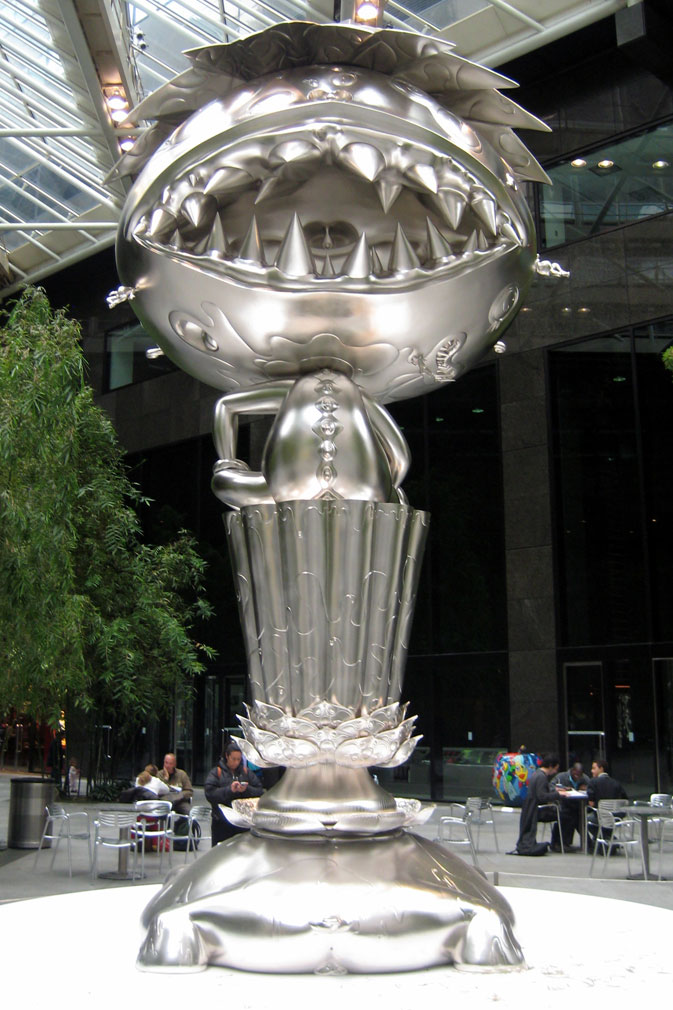 |
| 22. Takashi Murakami, Oval Buddha |
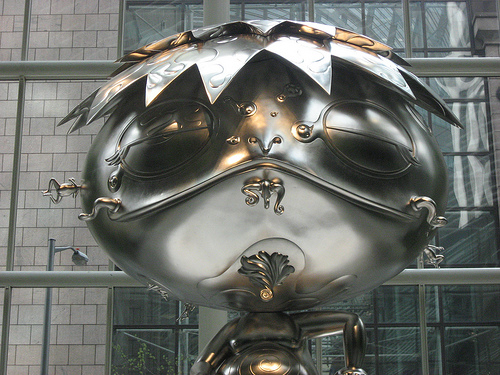 |
| 23. Takashi Murakami, Oval Buddha |
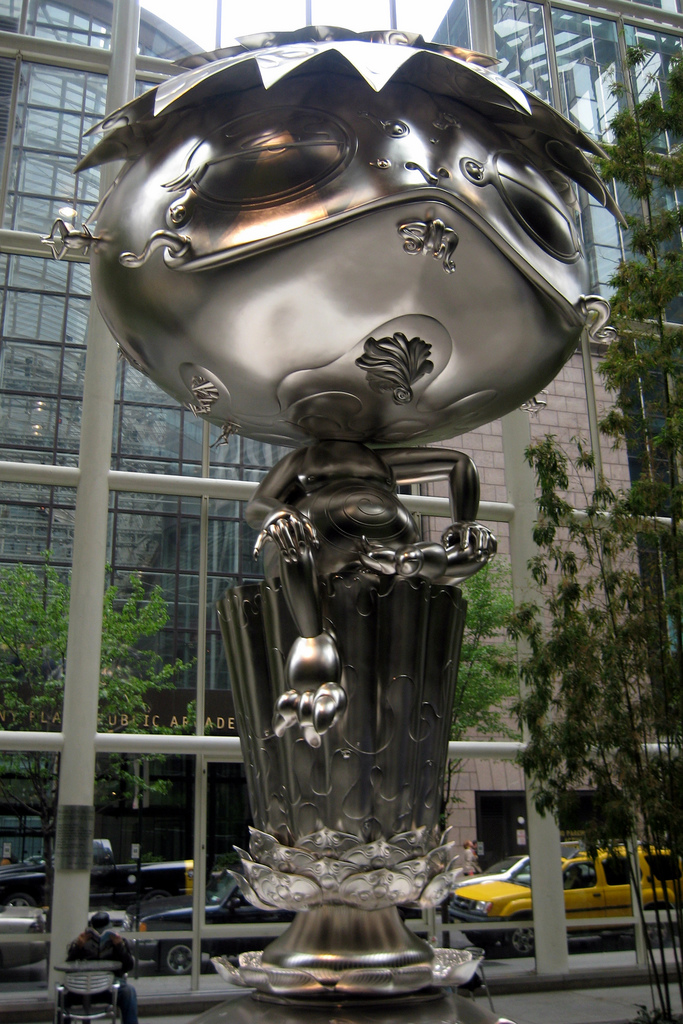 |
| 24. Takashi Murakami, Oval Buddha |
At this point, we begin to suspect that the F word is the mantra of postmodern or postpostmodern art appreciation. We hear it in the claims that Damien Hirst makes for his achievements: “I’m a fantastic phenomenal fucking colorist. It’s like, I’m a Bonnard, a Turner, a Matisse.” (in Mess 36). It is not likely that many people believe this, even if he does, and we cannot know that for sure, and it doesn’t matter. The anti-Warholian claim is meant to provoke public interest in his productions. Maybe he does believe it; anyone whose works command a 200 million dollar price tag, as his have in recent auctions, could believe in anything.
So the story ends where it begins. For belief itself, now strangely devoid of any specific content, formerly named as God, or genius, or beauty, or the sublime, all placeholders for the name-of-God, is what is at issue. Jean-François Lyotard has famously described the postmodern condition as having outlived confidence in a master narrative, in an overarching story that ensured significance to historical and cultural experience. Now every one gets to tell his or her own story. Everyone is the author of his or her own biography, conceived as the self-fashioning, minor masterpiece that we call a career (Gans, The Origin of Language 278), which is guaranteed by the open and egalitarian dynamics of the marketplace. Gans has argued nonetheless that all these stories follow basically the same narrative line, etched out by desire and the resentment that its frustration inspires, and by the rare but signal occasions when love surpasses or counters resentment.
Much of this is born out by our present financial crisis. Right now the entire market scene is in trouble worldwide, facing the possible collapse of the financial credit system, which we need to recall is essentially a credo, a belief system. And the art market has imploded as a consequence, because it has obeyed the same speculative dynamics, a revolving hall of mirrors in which each investment is modeled on that of another’s investment, and reciprocally onwards and upwards to what we call a speculative bubble. This is a telling metaphor, designating a structure bonded by the molecules at its circumference, its circumstanding, component members on the periphery, rather than by any substantial or material content. The centrality in the art world of auction houses like Christies and Sotheby’s as loci where art history is made by dollar signs discloses the mimetic rivalry driving up prices and sacralizing their targets by the only measurable standard that a market-driven culture has at its disposal. As Thornton remarks in another telling metaphor, “Even if the people here tonight were initially lured into the auction room by a love of art, they find themselves participating in a spectacle where the dollar value of the work has virtually slaughtered its other meanings” (39). Not “trumped,” as we might have expected, but “slaughtered”: yet another gesture, which I find inept, over the top, cheaply sensational, toward the sacred by evoking the violence it withholds.
 |
| 25. New York Times, Sunday Business Section, June 15, 2009 |
Today financial markets are flooded with toxic assets of no knowable, measurable value. Concomitantly art auctions, where collectors are used to bid competitively, mimetically, on presumably “priceless” art works, cannot garner an opening bid for the works of known masters. Speculators in CDOs, CDS’s, and other financial instruments of recent, unregulated concoction, and art spectators are wrapped in the same downward spiral of mimetic disbelief. The Mosaic ban on idolatry obtains, and we are witnessing the punishment that issues from its violation: according to many observers, we have theologized the market, with, among other fantasies, the idea that it is always smarter than its participants, that it, like Adam Smith’s invisible hand, is beneficently self-regulating and self-correcting for humanity’s benefit. What the Mosaic ban reveals about this particular idolatry is that it was always predicated on belief in another’s desire rather than on anything that could bind a community more substantially together, such as a desire for another’s welfare, as prescribed by Deuteronomy (6.5) and Leviticus (19.18). Now we know better, and an inchoate theory of behavioral economics, reminding us that the market’s creators and participants are humans, not statistical “figures,” is on the rise, though as long as it succeeds in ignoring the dynamics of desire and representation disclosed by GA, it probably won’t get very far in illuminating our present crisis. Not, at least, as far as La Fontaine, whose fables “La Montagne qui accouche” (“C’est promettre beaucoup? mais qu’en sort-il souvent? / Du vent.” ) and “La Grenouille qui se veut faire aussi grosse que le boeuf” (whose punch line is a lesson, a “morale” for bull markets: “La chétive pécore s’enfla / Si bien qu’elle creva” [See the puny yokel wax / So large he cracks]) tell us more about mimetically driven self-delusion than all Wall Street analysts put together. An astute New Yorker journalist has recently summarized this colossal mismanagement “in a few familiar words: debt, greed, hubris” (Paumgarten 44), while bringing up Margaret Atwood’s observation that “in Aramaic the words for ‘debt’ and ‘sin’ are the same” (49) and that the ubiquitous search for causes has all the earmarks of scapegoating (49-50). Elsewhere he describes the disaster in terms which resonate with–or shall we say in current art-criticalese: “reappropriate”–the emergent vocabulary of art appreciation, namely: “the call-and-response recapitulation of a giant variegated clusterfuck” (45). Go figure.
Works Cited
Arasse, Daniel. Histoires de Peintures. Paris : Gallimard, « Folios Essais », 2007.
Baschet, Jérôme. L’iconographie médiévale. Paris: Gallimard, « Folio Histoire », 2008.
Damisch, Hubert. L’Origine de la perspective. Paris : Flammarion « Champs », 1993.
Francastel, Pierre. La Figure et le lieu : l’ordre visuel du Quattrocento. Paris : Denoël-Gallimard, 1980.
Goodhart, Sandor. “Reading the Ten Commandments: Torah, Interpretation, and the Name of God.” In Sacrificing Commentary : Reading the End of Literature. Baltimore: Johns Hopkins UP, 1996.
Gans, Eric. The Origin of Language: A Formal Theory of Representation. University of California Press, 1981.
—–. Science and Faith: The Anthropology of Revelation. Savage, Md.: Rowman & Littlefield, 1990.
—–. Originary Thinking: Elements of Generative Anthropology. Stanford University Press, 1993.
—–. Chronicles of Love and Resentment. Nos. 184 223, 369, 370. Anthropoetics: https://anthropoetics.org/
Hart, David Bentley. Atheist Delusions : The Christian Revolution and its Fashionable Enemies. New Haven : Yale UP, 2009.
Michelson, Annette, ed. Andy Warhol. Cambridge, MA: MIT Press, 2001.
Paumgarten, Nick. “The Death of Kings: Notes from the Meltdown.” New Yorker. May 18, 2009: 40-57.
Plagens, Peter. “Nauman’s Own.” Newsweek. June 1, 2009: 58-59.
Rubenstein, Raphael, ed. Critical Mess: Art Critics on the State of their Practice. Lenox, MA: Hard Press, 2006.
Schefer, Olivier. “Religions de l’art et modernité. » In Traces du sacré. Paris : Centre Pompidou, 2008.
Schjeldahl, Peter. “Rough Stuff: A Francis Bacon retrospective at the Met.” New Yorker. June 1, 2009: 80-82.
Thornton, Sarah. Seven Days in the Art World. New York: Norton, 2008.
Tomkins. Calvin. “Western Disturbances: Bruce Nauman’s Singular Influence.” New Yorker. June 1, 2009: 67-75.