
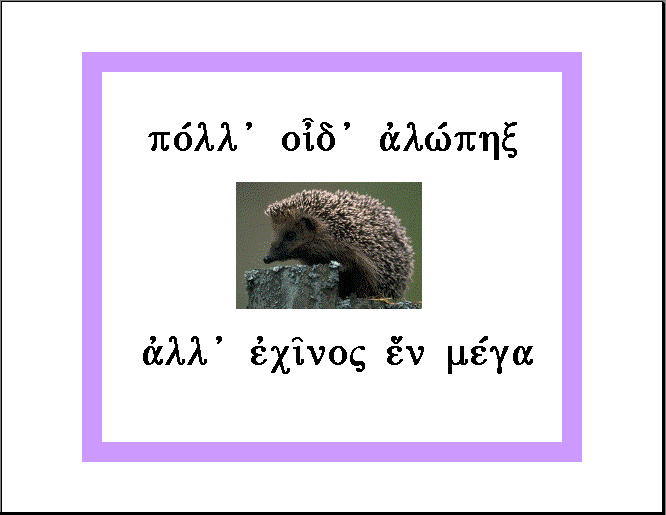
"The fox knows many things, but the hedgehog knows one big thing."
— Archilochus, as quoted by Isaiah Berlin
The Hedgehog
Isaiah Berlin’s celebrated essay The Hedgehog and the Fox (1953) drew on this fragment from the ancient Greek poet Archilochus to distinguish two types of intellectual temperament: foxes who pursue many different ends and never quite integrate them into a coherent whole, and hedgehogs who relate everything to a single organizing vision — one system, one central insight, from which all else follows. For Berlin, Tolstoy was a fox who wanted desperately to be a hedgehog; Dante, Plato, and Hegel were hedgehogs through and through.

Generative Anthropology is unapologetically a hedgehog discipline. Its one big thing is the originary hypothesis: the conjecture that all distinctively human phenomena — language, representation, the sacred, moral order — can be traced back to a single hypothetical originary scene in which the first sign was produced. From that single premise, GA pursues a remarkably wide range of literary, cultural, religious, and political questions. The hedgehog is our mascot because he captures this ambition exactly: not the modest accumulation of many small truths, but the patient unfolding of one.
The Hedgehog in the Pages of Anthropoetics
The metaphor has proven genuinely generative for Anthropoetics contributors. In “The Great Effects of Small Things: Insignificance and Immanence in Critical Theory” (AP VIII, no. 2, Spring 2003), Doug Collins examines the hedgehogs lurking inside several major philosophical projects — Nietzsche’s hedgehog, Derrida’s hedgehog, Pascal Quignard’s hedgehog — finding in each a concealed singular commitment beneath a surface of foxish range. Edmond Wright, in “How to Read Religious Poems Anthropoetically” (AP XXII, no. 1, Fall 2016), goes further and claims his own. Invoking the Erinaceus europaeus — the Common Hedgehog — by its scientific name, Wright asks what, precisely, this animal knows: his answer is “the analysis of the linguistic Statement that I have accepted as the most likely…” — a hedgehog of his own, nested inside the larger GA tradition. The metaphor, it turns out, has spines all the way down.
Henri Kipod

The hedgehog has a physical representative in the editorial offices as well. Henri Kipod — kipod being the Hebrew word for hedgehog — serves as the official mascot of Anthropoetics and Chronicles of Love and Resentment. He knows one big thing, and he is not saying what it is.