Author: staceymeeker

  • The Haunted Mansion and 〈Woman〉: Otherworldly Apparitions in the Modern Cities of Japan

    1. A Synopsis of “Sarayashiki” (aka “Dish Mansion”) Folklore

    Okiku, the heroine in Bunko Baba (1718-1759)’s Sarayashiki Bengiroku (aka “Sarayashiki” or “Dish Mansion”) (1758), along with Oiwa from Nanboku Tsuruya (1755-1824)’s Tokaido Yotsuya Kaidan (aka “Ghost Stories of Yotsuya”) (1825), Kasane and Otsuyu in Encho Sanyutei (1839-1900)’s Shinkei Kasanega Fuchi (aka “The Ghost of Kasane”) (1888) and Kaidan Botan Doro (aka “Tales of the Peony Lantern”) (1861), are all regarded as typical portrayals of Japanese ghosts. The folklore on which Sarayashiki Bengiroku was based is roughly summarized below.

    A young girl has entered a samurai house as a maid. The girl is commonly known as “Okiku”(1). Okiku’s master was bewitched by her beauty even though she continued to turn down his advances. Feeling rejected, the master grew hateful toward Okiku and decided to take vengeance on her with his equally jealous wife. One day, they accused Okiku of breaking one of the ten dishes which, as a set, had been a valuable family heirloom. As a punishment, the couple first gave her a violent beating then tossed her into a well in the garden after slashing her to death. From that day, the ghost of Okiku would rise from the depth of the well at night-time, counting “one dish, two dishes…” before disappearing again while shrieking the words “nine dishes!” The haunting drove the master and his wife to madness, and others to scatter. Eventually, the house became nothing but a deserted ruin.

     The essence of this folklore is inarguably embodied by the very scene of a brutally murdered ghost maid who appears nightly from the well to count dishes. Such depiction can be found in many Ukiyo-e (color paintings) from the Edo period, and has since become a conventional way of personifying Japanese ghosts(2).

    Sarayashiki, the Ghost of Okiku by
    Yoshitoshi Tsukioka (1839-1892)

    from Shinkei 36 Kaisen, 1889-1892

    2. The Propagation Pattern of “Sarayashiki”

    As evident in “Bancho Sarayashiki” from Tokyo and “Banshu Sarayashiki” from Hyogo, a number of regions in Japan have also conceived their own versions of the “sarayashiki” story(3).

    This nationwide propagation could have been spurred by the word “sarayashiki,” which had originally meant “a brand-new house.” In other words, these ghost stories may have been inspired by the idea of an ominous or cursed house that people created based on the fact that houses built on damp and barren lands do not last long.

    As Japan is indeed a country with an abundance of damp lands, such reasoning does appear to justify the wide dissemination of haunted mansion folklore. However, it offers no insight into why the image of a “dish-counting girl”(4) was also popularized. Hence, this presentation will focus on establishing a conceptual link between a <woman> and a <house> in an attempt to fill in this theoretical void.

    3. An Analysis of “Sarayashiki” Folklore – <Woman> and <House>

    First, it should be noted that almost all of these stories are set in a samurai house.  During the 17th century when “sarayashiki” folklore emerged, it was common for a samurai house to employ young girls from rural villages as maids. These girls were made to observe strict etiquette while carrying out a variety of laborious household and personal chores for the master. The resentment felt by a maid toward her master as a result of such class division and gender inequality has most likely given rise to “sarayashiki” folklore.

    Second, a well is a product of modern cities(5). It was a means to extract underground water on private or community land so that livelihood could be preserved in a densely populated urban area where the river had been contaminated. Therefore, by setting “sarayashiki” folklore in a samurai house, which is normally located in a city, a symbolic reference to urban civilization can be drawn.

    Furthermore, history has shown that, before the 8th century, ancient society performed rituals at wells, believing they were passages for Gods/Goddesses. In this sense, “sarayashiki” folklore could also be seen as a variant of “human pillar” tales. This so-called “human pillar” is a form of human sacrifice in which a person is buried alive at the foundation of a bridge or a house to prevent collapse. Traces of such black magic can be found throughout the ages in many different countries. For instance, England’s popular Mother Goose Nursery Rhyme, “London Bridge is Falling Down” has been thought to contain “human pillar” connotations. In other words, in order to safeguard the prosperity of the samurai house, a maid must be offered as a sacrifice on its ground along with a piece of heirloom. It is only unfortunate that, in this particular case, the intended “guardian angel” turned into an “evil spirit.” Also, when wells were used as ritual grounds in ancient society, people would also toss in some pieces of earthenware as sacred treasures. The use of a “family heirloom” in “sarayashiki” folklore is perhaps an apparatus to bring resonance to this distant memory.

    In any event, folklore in the form of a ghost story can be seen as the manifestation of a rebellion against class division and gender inequality, and the idea of “offering up a woman as sacrifice to house Gods” found in Japanese folk culture could very well be echoing the concept of “ritual sacrifice” described by René Girard. This prominent local pattern can be seen as manifesting what Girard defines as “a close relation between sex and violence, which is a common heritage of all religions” (56).

    Seiu Ito (1882-1961) “Nihon Keibatsu
    hu-zoku zushi,” 1951. Tokyo: Kokusho
    Kankokai, 2010

    4. “Sarayashiki” Folklore and the Haunted Mansion

    One might consider “sarayashiki” folklore, in which a ghostly voice counting “one dish, two dishes…” may be heard throughout the household, to be a variant of poltergeist tales. This is because the presence of a young woman is an essential element in popular depictions of a house haunted by poltergeist events. Young women are thought to possess hidden spiritual power which has the ability to conjure up spirits of the land. This supernatural undertone is made even stronger by “Okiku,” a name feared and avoided in pre-modern Japan as it can be shortened to “Kiku” (same pronunciation of “to listen” in Japanese language) and carries the meaning of “listening to the voice of Gods.” Hence, “sarayashiki” folklore is a justifiable form of poltergeist tale as it portrays a young woman with strong spiritual power being thrown into the passage to the Gods, who then comes back as a ghostly medium to haunt the entire household with her voice.

    Incidentally, another example of poltergeist tale can be found in a Tokyo urban legend, “Women of Ikebukuro,” which circulated up to the 1960s. The legend claims that whenever an investigation is carried out in a haunted household, one of its occupants was always a female from Ikebukuro. Haunting would be said to cease as soon as that particular female occupant is driven out of the house. The name “Ikebukuro,” meaning a “pocket-shaped pond” in Japanese, immediately lends itself to the imagery of a damp land. Even though it is now a busy metropolis, Ikebukuro was only a small town on the outskirts of Tokyo up until the 1960s. Having to struggle for survival in a big city like Tokyo, people believed that the hardship endured by these young women from a rural town may have unintentionally woken the spirit of the land and led to poltergeist events. As such, “Women of Ikebukuro” can be regarded as a modern version of “Okiku” from “Sarayashiki.”

    In recent years, haunted mansions have become a popular attraction in amusement parks across Japan. Themes from “Sarayashiki,” for example, the visual effects of a ghost appearing from a well or the sound of the ghost counting dishes are still widely utilized in these haunted mansions, as they represent a deep and fundamental horror to most Japanese people. It is also a reflection that this tale of resentment, in which a <woman> is sacrificed in a violent manner to the <house>, can still find sympathy among the general public today.

    Notes

    1. Apart from “Okiku,” names such as “Kame,” “Omasa,” and “Hana” were also used in other similar stories across Japan. The name “Okiku” had only garnered more recognition after Bunko Baba’s Sarayashiki Bengiroku (1758), which was set in Bancho in Edo, had become famous. See Yokoyama et al. and Ito. (back)
    2. A common depiction being a young beauty without feet rising from a well or a pool of water surrounded by ghost fire. This imagery is still used in modern sub-cultures. (back)
    3. An “Okiku Ido” (“The Well of Okiku”) can also be found in Himeji Castle, which is a World Heritage site, but this well is considered to have no actual connection to the “sarayashiki” folklore. (back)
    4. Some regional versions of the “sarayashiki” folklore do not involve a ghost that counts dishes. However, in order to explore the most typical portrayal of a Japanese ghost, this presentation has limited its scope of discussion to “Sarayashiki” with a “dish-counting girl.” (back)
    5. See Akita 169. (back)

    Works Cited

    Akita, Hiroki. A Cultural History of Objects and Humans 150: The Well. Tokyo: Housei University Press, 2010.

    Girard, René. Bouryoku to Seinarumono [Violence and the Sacred]. Trans. Yukio Furuta. Tokyo: Housei University Press, 1982. Trans. of La Violence et le Sacré. Paris: Grasset, 1972.

    Ito, Atsushi. Sarayashiki [aka “Dish Mansion”] Folklore. Tokyo: Umitori Shuppan, 2002.

    Yokoyama, Yasuko, Yosiyuki Iikura, Hidekazu Imai, Hajime Kurujima, Daisuke Washiba, and Tomonobu Hirosaka. Sarayashiki―the Ghost of Okiku and the Dish and the Well. Tokyo: Hakutaku Shuppan, 2015.

  • The Birth of a Myth: Civil War and Sacrifice in Early Meiji Japan

    1.      “Sacrifice” and “Gisei”

    In Japanese, the English word “sacrifice” is also expressed with a classical Chinese word “gisei (犠牲).” These words are a perfect match. It is because “犠gi” which is composed “牛 (cow) + 羊 (sheep as the most common offering) + 我(jagged spear to kill the offering)” means “a cow killed with a jagged spear as an offering to the Divine”, and then “牲sei” which is composed “牛 (cow) +生 (live)” means “a living cow for offering to the Divine.” It can be said that “gisei” is truly an appropriate word to translate”sacrifice.”

    写真,素材,無料,フリー,フォト,クリエイティブ・コモンズ,風景,壁紙,古代中国の青銅器, 武器, 鈎型兵器, 我型兵器, 鼎

    “我” shape spear(1)

    However, in contemporary Japanese, “gisei” means not only “sacrifice” but also “victim.” This usage, which differs from the original meaning, appeared at the end of the nineteenth century. For example, when a Japanese newspaper reported that the Chinese emperor sent a personal telegraph to the German emperor to grieve over the death of a German minster who had fallen a victim to the daggers of the Boxers (義和団) the year before, the article used “gisei” for “victim.”(2)

    It is clear that this “gisei” was not an offering dedicated to a divinity. In this way, its primary meaning in modern Japanese, which is different from the original meaning as “a sacred offering” to something great, is “the unfortunate death” of the blameless.

    2.     The birth of the modernized “gisei”

    yasukunihonden.jpg

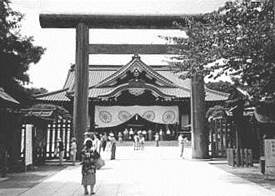
    The hall of worship in Yasukuni-jinja Shrine


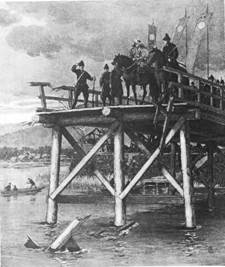
    GOSEDA, Hōryū “March-off of the General Prince Ninnaji”(3)

    One of the reasons the meaning of “gisei” changed essentially was due to the inundation of “gisei” in modern Japan. It could be called “the transformation of quantity into quality” (F. Engels)(4). Modern Japan suffered numerous civil wars and foreign invasions, such as the following: the Boshin civil war (1868 – 1869) between the pro-Shogunate army and the imperial New-government army, the Satsuma Rebellion (1877) which was the greatest and last civil war of the shizoku (the former samurai class), and several armed conflicts with China in Taiwan and Korea which resulted in the First Sino-Japanese war (1894 – 1895). These wars caused a number of casualties such as Japan had never experienced in the previous two centuries. Subsequently, fallen soldiers were regarded as brave men who had offered their lives on the altar of their country, and their spirits were enshrined together as a “Divine”(5) in Tokyo’s Shōkon-sha (東京招魂社) shrine (currently Yasukuni-jinja [靖国神社] shrine) by the Meiji State (1868 – 1945). They were literally “gisei” or “sacrifice” for the nation.

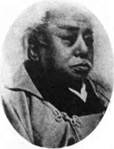
    FUKUBA Bisei(6)
    However, in reality, the Meiji State had no firm code of religious principle regarding this tutelary deity of the Empire of Japan. Not only Meiji statesmen but also Shinto priests had no concrete image of what this Divine was or what power it had. Furthermore, many Japanese intellectuals who had meritoriously contributed to establish the Meiji State were skeptical of religion, or firm atheists. The new tendency appeared among Shinto priests. For example, the priest Bisei Fukuba (福羽美静: 1831 – 1907), who had erected the first shrine (currently Kyoto Ryōzen Gokoku-jinja [京都霊山護国神社] shrine) for the spirits of loyalists in 1862, was involved in the following episode.

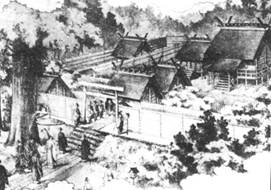
    Inner Ise Shrine(7)

    In 1868 when Emperor Meiji moved out of Kyoto to Tokyo, imperial families, nobles, and citizens of Kyoto were mostly opposed to this campaign. However, Fukuba strongly asserted a supporting argument, because he thought that the Emperor had to leave this old Capital to establish a new state. One evening, he received a letter from Ise-jingū (伊勢神宮) Shrine (enshrining Amaterasu-ōkami [天照大神] or the Divine ancestor of the Imperial Family) via Jingi-kan (神祇官: Department of Divinities), which read as follows: “the head of a torii (鳥居: an archway of Shinto shrine) in front of Inner Ise Shrine (内宮: Naikū) fell down. I [a priest of Ise-jingū] believe that this may be a sign because it happened just before the departure of His Majesty.” Because Fukuba guessed that it was a protest by adversaries, he disregarded this letter and said “essentially, there is no need to be afraid of the torii’s head falling. It was only an accident!”(8) What he was afraid of was not incurring Amaterasu’s displeasure due to having carried out this campaign but the disturbance of the people due to the suspension. He was quintessentially political.

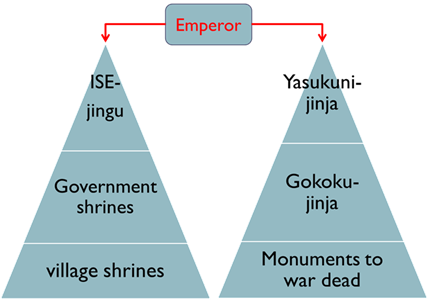
    Title: Two Hierarchies under the Emperor in State Shintoism

    Two Hierarchies under the Emperor in State Shintoism

    Such priests, who thought and acted politically, founded State Shintoism, which was one of the important pillars of the Meiji State which encompassed religion as a means of dominating the Japanese people. After all, what was honoured in the Shōkon-sha shrine was the act of dying for their country, not the person as an individual. Therefore, it served neither as comfort of the dead nor for the salvation of souls.

    Because the Meiji State founded State Shintoism with a political rather than a religious consciousness, the tendency of religious apathy appeared throughout the whole of modern Japanese society. Thus, “gisei” as a common word lost its original meaning to be given a new one as an unfortunate death which was nobody’s fault.(9) However, in modern Japan, “gisei” as “sacrifice” did not fade away; there were a lot of invisible “scapegoats” to maintain the community.

    3.     True “Sacrifices”

    It’s the simplest thing; there is no warfare without opponents. Hence, there were fallen soldiers in hostile country, but State Shintoism in modern Japan did not worship these spirits. This was an extraordinarily exceptional phenomenon in Japanese history. Traditionally, Japanese people had worshiped any spirits from either side after wars, because they believed that these worshiped spirits would bring not evil but good from ancient times.

    For instance, in 1191, Emperor Gotoba (後鳥羽) built a temple(10) to mourn the spirits of the Taira clan (平氏), who had been defeated in the Genpei War (源平合戦: 1180 – 1185)(11). Such acts could be found not only after civil wars but after foreign wars. In fact, a temple(12) was erected for the fallen soldiers of the Mongolian Amy which attacked Japan twice in the late thirteenth century.

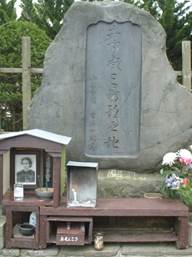
    A monument sacred to the memory of Toshizō Hijikata (erected in 1958)(13)

    However, after the Boshin civil war resulting in the fall of the Tokugawa Shogunate, those who were enshrined were only fallen soldiers of the winning camp; the souls of defeated soldiers were ignored by the Meiji State. Several decades after the war, some memorials for these obscure spirits were erected around old battlegrounds by relatives, but these memorials were completely different from the Shōkon-sha shrine and the spirits were forced to be social outcasts in the end.

    The Meiji State encouraged Japanese people to offer their lives to the Emperor by eliminating the spirits of adversaries as a warning to others. It can be said that these spirits which had been branded as “death in vain” contributed to establishing and maintaining the Meiji State in the background or literally in the underground. On this very spot, they were exactly “gisei” as scapegoat. It is through such sorting out and rejecting of spirits that the Meiji State spun a new myth as the ideology of the modern Tenō (Imperial) system.

    Closing remarks

    The following sentence appeared in the speech of U.S. President Barack Obama who visited Hiroshima in May, 2016.

    Atomic Bomb Dome in Hiroshima

    Nations arise telling a story that binds people together in sacrifice and cooperation, allowing for remarkable feats. But those same stories have so often been used to oppress and dehumanize those who are different.(14)

    There still remain countries or groups which treat the war dead as “sacrifices.” However, true “sacrifices” who are really offered to the Divinity called Nation are none other than those who are “oppressed and dehumanized” because of being “different.” The nation-state was founded on such a myth inscribed with “sacrifices” whether visible or invisible.


    Bibliography

    Books

    Engels, Friedrich. Dialektik der Natur. 1883. Marx , Karl & Friedrich Engels Werke. Berlin (DDR): Dietz Verlag, 1962. Band 20.

    Tōyōbunka-kyōkai [Society of the Eastern Culture]. The eighty years’ chronicle: Bakumatsu, Meiji and Taishō Japan. Tokyo: Tōyōbunka-kyōkai, 1933-1937. in 24 volumes. (東洋文化協会『幕末・明治・大正回顧八十年史』東洋文化協会、1933-1937年、全24輯)

    Yakumo, Tsuruma. An introduction of the national holidays. Osaka: Yaegaki-shoin, 1923. (八雲都留麻『大祭祝日略説』八重垣書院、1923年)

    Articles

    Fukuba, Bisei. “Arguments against the transfer of the capital to Tokyo.” Taiyō. Vol.4. No.9. 1898. (福羽美静「御東幸の反対論」、『太陽』4巻9号、1898年)

    Newspaper articles

    “Personal telegrams between the German Emperor and the Chinese Emperor” the morning edition of Asahi-shinbun. Octorber 24, 1900. (「独帝清帝の親電応酬」『朝日新聞』1900年10月24日東京朝刊)

    “Visit to Hiroshima: the full text of [U.S.] President Obama’s statement” the morning edition of Yomiuri-shinbun. May 28, 2016. (「広島訪問 オバマ大統領の声明全文」『読売新聞』2016年5月28日東京朝刊)

    Notes

    1. Photo by ©Tomo.Yun: “No.5307 A bronze ware of ancient China [China/Beijing],” http://www.yunphoto.net/jp/photobase/yp5307.html, Retrieved August 13, 2016. (back)
    2. “We are deeply grieved at the death of your Majesty’s Minister who fell a victim to a sudden uprising in China which our officers had not been able to suppress.” (“Exchanges of personal telegrams between Germany and Chinese Emperors” the morning edition of Asahi-shinbun. October 24, 1900. p. 2.) (back)
    3. Tōyōbunka-kyōkai [Society of the Eastern Culture]. The eighty years’ chronicle: Bakumatsu, Meiji and Taishō Japan. Tokyo: Tōyōbunka-kyōkai, 1934, vol.3. frontispiece 2. (back)
    4. “Des Umschlagens von Quantität in Qualität” (Friedrich Engels. Dialektik der Natur. 1883. Karl Marx & Friedrich Engels Werke. Berlin (DDR): Dietz Verlag, 1962. Band 20. S. 348.) (back)
    5. The reason why Divine is a singular form is that all their spirits were apotheosized not as a person but in one Divine. Therefore, each of their spirits is a part of a guardian deity of the country, and their personalities as individuals were effaced completely. (back)
    6. Tōyōbunka-kyōkai [Society of the Eastern Culture]. The eighty years’ chronicle: Bakumatsu, Meiji and Taishō Japan. Tokyo: Tōyōbunka-kyōkai, 1935, vol.17. p. 430. (back)
    7. Yakumo, Tsuruma. An introduction of the national holidays. Osaka: Yaegaki-shoin, 1923. p. 90. (back)
    8. Fukuba, Bisei. “Arguments against the transfer of the capital to Tokyo.” Taiyō. Vol. 4. No. 9, 1898. (back)
    9. Of course, the warfare was started by the government, especially The Constitution of the Empire of Japan (1889) prescribed in Article 13 as following; “The Emperor declares war, makes peace, and concludes treaties.” However, it was difficult for Japanese citizens to inquire into the responsibility of the government or Emperor in the Meiji State. (back)
    10. This was called Amida-ji Temple (阿弥陀寺: Shimonoseki City, Yamaguchi Prefecture), which is well-known as a stage of “Hoichi the Earless” in Lafcadio Hearn’s Kwaidan. However, it was destroyed due to “the Ordinance Distinguishing Shinto and Buddhism” (神仏分離令: 1868), and the Meiji State built a new shrine called Akama-jongu (赤間神宮) at the same place. (back)
    11. The warfare between the Taira clan and the Minamoto clan (源氏). After that, Minamoto no Yoritomo (源頼朝) established the Kamakura Shogunate. (back)
    12. This is Engaku-ji Temple (円覚寺: Kamakura City, Kanagawa Prefecture), which was a center of the movement to modernize Zen Buddhism in Japan. For example, Shaku Sōen (釈宗演: 1859 – 1919) went to U.S. to engage in missionary work, and his disciple Suzuki Daisetsu (鈴木大拙: 1870 – 1966) wrote numerous books in English to introduce Japanese culture, including Zen Buddhism, overseas. (back)
    13. Toshizō Hijikata (土方歳三: 1835-1869) was a great swordsman, the vice-commander of Shinsen-gumi (新撰組: Guards of Kyoto in Bakumatsu Japan). He joined the pro-Shogunate army, becoming an officer ranking with the army magistrate (陸軍奉行), and fell in the battle of Hakodate, which was the last stage in the Boshin civil war. This monument was moved to its present location in 1992. (back)
    14. “Visit to Hiroshima: the full text of [U.S.] President Obama’s statement” the morning edition of Yomiuri-shinbun. May 28, 2016. p.14. Incidentally, in the Japanese version of this speech translated by this newspaper, “gisei” appeared six times, although the U.S. President had used the word “sacrifice” once. This serves to show how ambiguous “gisei” is. (back)
  • Introduction to the 2016 Conference Issue

    We are pleased to serve as guest editors for the Fall 2016 conference issue of Anthropoetics. We would like to thank Eric Gans for this opportunity even as we acknowledge his very extensive assistance in preparing the issue.

    The 10th annual conference of the Generative Anthropology Society and Conference was held at Kinjo Gakuin University in Nagoya, Japan in June, 2016 under the theme “Cultural Universals, Cultural Specifics, and Globalization: On the Applicability of General Anthropology.” It was a very significant event for participants, a cross-cultural exchange truly worthy of the name. There was consistent excellence not only in the guest lectures, panel, symposium, and regular presentations, but also in the discussion periods and in the dialogue that continued into breaks and lunchtimes.

    We hope some of that spirit is captured in this issue. All papers herein were submitted by conference presenters. In fact, the number of papers submitted by participants was too large for a single issue, so several will be appearing in the Spring 2017 issue. Please note also that the text of Eric Gans’s brilliant plenary lecture, “Nagarjuna and Zeno: Paradox East and West” has already been published in two parts as Chronicles 515 and 516 in Chronicles of Love and Resentment.

    This issue puts the spotlight on papers with cross-cultural topics close to the conference theme. We are especially pleased in this issue to present submissions (the first bilingual contributions to the journal) from three participants who are professors in our own Department of Japanese Language and Literature. They represent the “Kinjo Occult Research Group,” an interdisciplinary association that pursues unconventional topics and regularly presents and discusses them in an informal setting on campus. Their participation in our conference, with insightful explorations into the mimetic dimensions of their research, was one of its highpoints—certainly the most impressive visually. Their studies are very welcome contributions to Anthropoetics.

    Aya Ryusawa examines the heroic narratives of scroll paintings from the Edo period, a mythology of the monstrous by which a local branch of the ruling Tokugawa clan sought to further legitimize their rule. Kenshin Kirihara presents an analysis of sacrificial dimensions in the foundation of modern Imperial Japan in the Meiji period, wherein state Shintoism was born. Military victims in this “peaceful” transition to modernity were selectively enshrined in what is now known as Yasukuni Shrine, which is now a continual point of contention in East Asian politics. Shoko Komatsu extends the mimetic analysis to folklore and modern urban legend as she examines the link between ghostly apparitions and victimization in the “Okiku” legends; behind many a ghost story, it seems, lies a tale of persecution.

    Our other three contributors are rooted in generative anthropology, nicely balancing the issue and reflecting the reality of the conference, which had a nearly equal focus on generative anthropology and mimetic theory. (René Girard’s memory was honored in a series of lectures generously supported by Kinjo Gakuin University’s Institute for the Study of Christian Culture.)

    Magdalena Złocka-Dąbrowska covers a vast range of myth and history (East and West) as she draws out points of contact between the anthropological vision of Georges Dumézil and Eric Gans. The prolific and equally wide-ranging Edmond Wright offers playfully serious reflections on language and religion before focusing on the luminous religious poetry of Gerard Manley Hopkins and Issa Kobayashi. Ian Dennis, one of generative anthropology’s leading lights, weaves together profound ruminations on Buddhism, romanticism, and the problematic of desire. His paper, focused as was Eric Gans’s lecture on the philosophy of Nagarjuna (via the study by Musashi Tachikawa, one of our featured lecturers), should perhaps be considered its equal in scope and insight.

    We hope that readers can enjoy and profit from these highly original papers, each in its own way extending mimetic theory or generative anthropology in new directions. We also remind readers to follow up this issue with the complimentary “sister” issue to appear in spring, which will feature several more papers from our Nagoya conference.

  • A Door to another World: The Imagination in Japanese Folkways and Religion

    The three papers in this section were presented by the Kinjo Occult Research Group at GASC 2016. Our group sets out to engage in interdisciplinary study without relying on a narrow definition of “occult”. We research how people in Japan, South Asia, and Oceania have verbalized and visualized awesome or terrifying presences which cannot be seen. In this session, three members of the Kinjo Occult Research Group who specialize in Japanese culture presented on the interaction between people in “this world” and presences in “another world”, such as monstrous figures or the dead.

    異界への扉:~日本の民俗と宗教に おける想像力~

    本稿は、 2016 6 18日に行 われたGASC2016 におけるセッシ ョン「異界への扉:~日本の民俗 と宗教における想像力~」の報告 である。
    本セッションは、金城学院大学 オカルト研究会のメンバーによっ て行われた。「金城学院大学オカ ルト研究会」は、主として日本、 南アジア、オセアニアを対象に、 狭義の「オカルト」の語義にとら われず、本来目には見えないとさ れていた恐怖/ 畏怖の対象が言 語化され、可視化されていった過程 を追う学際的な研究会である。本セ ッションでは、異界や死者との交流 をテーマとして、日本文化研究に携 わる3 名が発表を行った。

  • Cratos as Cognition: Gans and Dumézil in Dialogue on Language and Violence

    This paper will consider two complementary visions of culture and language: those of Georges Dumézil and Eric Gans. The mythographer Dumézil’s ideas mediated between ancient Indo-European writings and their linguistic and mythological universe, while Gans’s Generative Anthropology (GA) sees the deferral of violence through the exchange of signs as the essence of the human. Dumézil operated in the trans-disciplinary space between Indo-European comparative linguistics, comparative religion, a “new comparative mythology”(1) and half-a-dozen specialized philological disciplines. But it can be argued that in spirit his work is also close to anthropology. In turn, Gans’s anthropological understanding of the fundamentals of human culture helps deepen Dumézil’s vision. Indeed, I will argue that Gans’s scene of origin and the concept of the deferral of violence at the beginnings of culture and language, find their reflection in the textual forms collected, interpreted, and analysed by Dumézil.

    The central place in Dumézil’s discourse is held by his famous theory of the three social functions, a tripartite structural formula present already in his earliest articles(2), and later(3) developed into a fuller religious and social system that served as the primary instrument of his analysis of the Indo-European cultural tradition. Dumézil argued that throughout the Eurasian linguistic community, religion and society manifested a tendency to organize themselves into three functional categories: 1) sovereignty, subdivided into legal and magical types; 2) violence, force and military power, especially that of warriors; and 3) a more diffuse category, concerned with material well-being, the production of resources (to sustain life and abundance), sensual pleasure, wealth, food, and the flourishing of life. One may also define this system using notions from medieval tripartitio,(4) where the first function is that of the social group identified as oratores (that is: rulers, priests, kings and aristocracy in general). The second function would then refer to so called bellatores (that is knights and “military men”), while the third would be that of laboratores (meaning the servants and craftsmen; the lowest social groups related to the productive and economic sphere).

    Dumézil pioneered the insight that these priestly, warrior, and producing classes in ancient Indo-European societies saw themselves as ordained to fulfil particular tasks by virtue of their mythological origins. As in every other cultural tradition, that is, there was a mythological foundation, a set of narratives that announced and justified the presence of violence. These were to be found in the various generic spaces listed by one of Dumézil’s most important commentators, Jöel H. Grisward: “Myth and roman ! Myth and epopee! Myth and history!”(5)

    This paper will connect and compare the visions of Dumézil and Gans by reference to the concept of Cratos. We will associate Cratos first of all with the generative human cognition related to violence, and with violent actions themselves. Cognition, we will remind ourselves, is something deeper than knowledge, something hidden in human thoughts and minds, but at least partly discoverable (according, for example, to cognitive anthropology) through analyses of language and texts. Cratos, of course, is present as a myth in such texts as those of Hesiod and Aeschylus, and must also be thought of as a metaphor, a symbol or manifestation of cognition. But it is specifically a metaphor for violence and power, and for the knowledge of violence in the world.

    We will attempt to further unfold and define this broad, powerful but admittedly multidimensional concept in its various aspects as we proceed. Certainly, Cratos is everywhere, omnipresent in human actions, in all kinds of knowledge of the world (and thus in many texts). But its deepest layer is that of generative cognition, the starting point of all human cognition. Cratos, even as defined in ancient myths, generates all human activities, including the creation of language and culture.

    Generative cognition represents the primary human mind, and its existence in statu nascendi makes it reproducible, allowing for the production of particular knowledge about the causal structure of the world. It is the initial state of the mind and is programmed for the protection of human existence through representation, in the perennial situation which Gans describes as the “disparity between totality of culture, religion and representation on the one side and violence on the other.”(6) In response to the threat of mimetically generated violence, in the GA vision, humans protect themselves by deferring violence through a sequence of signs, a process prolonged indefinitely by imitation. To put this another way, reciprocal relations of the generative function of cognition built on violence and responding to its existence create cultural representations. These representations can then be sequenced according to Dumézil’s interpretation of the Indo-European mythical tradition. We shall therefore look for Cratos and its deep function of generative cognition in both Gans’s originary scene and in Dumézil’s trifunctional hypothesis. We will aim to show the basic arguments in Dumézil’s narratives in the context of Gans’s ideas, remembering that through the latter’s work and previously that of René Girard, violence became a scientific issue with regard to language and religion, even if it had already been an object of sustained inquiry in neighboring areas of the humanities and also distinctly in the works of Dumézil.

    Cratos in Human Culture

    Cratos, as we noted above, may be understood as a metaphor, specifically as a metaphoric figure of human violence and power, including military power. Indeed, we may term it a Conceptual Metaphor,(7) which shapes not just human communication, but also the way we think and act.(8)

    According to George Lakoff and Mark Johnson, metaphors may be easily transferred from the physical world to the realm of abstract reasoning and argumentation(9). In this context Cratos as a metaphor has a central position in human life. Indeed, Cratos as a metaphor directs and governs the content of the myths presented by Dumézil. Moreover, the myth of Cratos may be understood as a myth of experience, a result of the interactions of humans with their physical environment and other people. For Lakoff and Johnson, such myths imply comprehension and understanding—in fact ‘myth’ explicitly means self-comprehension and social understanding. It is worth noting that these ideas unite in Ward Goodenough’s approach, known as cognitive anthropology, where culture is understood as a conceptual system “one has to know or believe” and indeed to “learn.” Such a system is the end product of learning: “knowledge, in a most general, if relative, sense of the term.” Goodenough, a major player in the development of anthropological theory explains that “it is rather an organisation … of things that people have in mind, their models for perceiving, relating and otherwise interpreting them.”(10) In other words, myth as one of the oldest forms of culture is the representation of human knowledge and at the same time a form of human cognition.

    Lakoff and Johnson also assert that human nature forces human experience (which is repeatable) into the creation of such categories as human communication, mutual understanding, ritual, esthetic experience, and politics.(11) Such a causal sequence is comparable to Gans’s theory of myth in the origin of cultural representation(12) and in his scene of origin.(13) However, myths are understood by Gans as “narrative explanations” and elements “whose plausibility is derived from real experience.”(14) The word myth derives from the Greek mythos, which has a range of meanings from “word,” through “saying” and “story,” to “fiction.” We may note that the first two of these definitions work well with Gans’s theory that the origins of culture are coeval with the advent of speech and language, which indeed can be seen in many mythical scenarios, and notably in those cited by Dumézil. Dumézil creates his own narrative space by combining various analyses of Indo-Europeans myths, but this does not interfere with the view that mythical narrations are provided with their own dramatic structure and are passed on for ages from one generation to another, through what we usually know as popular knowledge. Myth is thus fundamentally important for the transfer of the long-turn structures and resultant social organization distinguished by Dumézil. It is perhaps worth recalling here Paul Ricœur’s observation that the mythical consciousness in primary civilizations is almost the same everywhere.(15) It expresses an “active memory,” that uses knowledge of the past to give significance to the present.(16) Ricœur also argues that a myth is not a false explanation by means of images and fables, but a “traditional narration which relates to events that happened at the beginning of time and which has the purpose of providing grounds for the ritual actions of men of today and, in a general manner, establishing all the forms of action and thought by which man understands himself in his world.”(17) This sense of myth as a traditional narration is also present in Dumézil’s works and could actually be understood, in Ricœur’s terms, as reflecting a universal mental state and as a cultural code defining the most basic actions of human beings.(18) We may add that myth hides something related to Heidegger’s concept of truth, which helps “the essence of the truth (aletheia) to be preserved and unforgotten,”(19) something deeply present, that is, in human cognition.

    Cratos, then, is a multivalent figure of myth occupying a realm intermediary between ordinary life and the ideal world, a dimension of particular significance to anthropology. In classical Greece, the myth of Cratos is quoted most frequently in the narratives of Hesiod(20) and Aeschylus(21) and can be related to the core idea of Gans’s theory and his analysis of the basic behaviors in which violent appetites, rivalries and conflicts are constantly present—latent, but potentially operative—but contingently capable of deferral by language and other cultural forms. Hesiod’s Theogony tells the origin of Cratos this way: “Styx, Ocean’s daughter, mingling with Pallas, bore Zelus (Rivalry) and beautiful-ankled Nike (Victory) in her house, and she gave birth to Cratos (Supremacy) and Bia (Force), eminent children [who are all] seated next to deep-thundering Zeus.” (22) Hesiod writes that “eternal Styx came first of all to Olympus with her own children . . . and Zeus honored her and gave her exceptional gifts. For he set her to be the great oath of the gods, and her sons to dwell with him for all their days.”(23) The siblings of Cratos, children of Pallas and Styx have significant features. Zelus is zeal but personifies emulation, eager rivalry, envy, and jealousy. Bia directly expresses force. All of them are wrestling with evil forces and all of them accompany Zeus to the end of their days. So I presume that Cratos among them is symbolically involved in the struggle to master the forces of evil—violence and hatred in different variants. In the Prometheus Bound of Aeschylus Cratos appears, indeed in the first line of the play, in a double structure, the pair Power and Violence (Bia and Cratos). (24) As Hesiod indicates in the Theogony, Cratos and his siblings live permanently with Zeus,(25) whom they follow wherever he leads them,(26) embodying his absolute power over the universe. In the version of Aeschylus, Bia and Cratos are even understood as fulfillments of the commands of Zeus.(27) The status of Cratos with regard to the enslavement of Prometheus, according to the will of Zeus and the other gods, is special. He mediates between the divine and humanity as the mastermind of the enslavement of Prometheus, in what became an allegory of violence itself, equated paradigmatically with human nature and active in social interactions since the beginning. One might well recall here the biblical phrase adopted by René Girard, in just this context: Cratos too represents something “hidden since the foundation of the world.”(28)

    Cratos had a much wider role in ancient Greece than that played by the deity Kratos. The Indo-European roots of Kratos (craft, crafty, Kraft, etc.) are well established, the word dealing always with the control of forces or power or violence. Kratos as kratu and kratia represent a semantic core of Cratos. The Greek (but also Germanic, and Slavonic) mythology speaks of the problem of controlling violence, deceit, and related forces. In Hellenistic Greek the verb krateô meant “getting a grip” and already was used by Homer in the sense of “control” (control of one’s emotions, eyes, and so forth). Still in Greek as kratu, it is the “power,” “authority,” even “the state” or what could be understood as the control of society by institutional violence. However, the main meaning was “getting power” (mainly in political sense). There is also another dimension of Cratos, where its lexeme appears in the notion of democracy (from demo-cratos), being connected to “order” and “rule” but with the sense of powerful authority rather than explicit violence. The word kratos (usually translated as “power” or “force”) is present in Vernant’s and Naquet’s Myth and Tragedy in Ancient Greece,(29) where we find a passage from Aeschylus’ Suppliant Women : ” the idea of kratos can be seen to oscillate between two contrary accepted meanings, unable to settle for the one rather than the other. On the lips of King Pelasgus kratos, associated with kurios [‘figure of authority’], refers to a legitimate authority, the control rightfully exercised by the guardian over whoever is legally dependent upon his power. On the lips of the Danaids [the Suppliant Maidens of the title], the same word, drawn into the semantic field of bia [‘violence’], refers to ‘brute force,’ constraint imposed by violence, in its aspect that is most opposed to justice and right.”(30) So we may suppose the main idea of Cratos to be involved with the struggle between brute force itself, and the control of it through legal authority, which is, however, also a form of suppressed violence.

    Even if Dumézil does not treat Cratos openly, he does deal with the issues we have been developing. First of all, his trifunctional system is “violent in its nature,” as a system of hierarchical order, a system of subordination of the second and the third function to the first. In fact, Cratos becomes a semantic link between the first and the second function, in other words it is power that is structured into authority in the process of social stratification. This means that Dumézil’s three-functional order is an expression of violence, controlled by the power of the first function and the power of all three functions in their unity. Dumézil speaks about trifunctional structure as an abstract prototype, a pattern for social relationships. He notes, for example, in the context of the development of Iran, that in order to rule royal power needs to control and arrange the three functions in harmony to produce a final syntheses,(31) “an ideal model [or] an easy and typical résumé of social relations.”(32) Here we may recognise the controlling function of power which builds the metaphoric image of Cratos. Dumézil’s theory stresses a rule of gradual transition from myth to the three functions, then finally to the establishment of the system of law. This is ultimately an explication of the process of creating a culture, and as such it shares much with the narrative of human social development suggested in Generative Anthropology.

    Dumézil in Gans’s World

    What we may call a search for “cognition from Cratos” as part of a “generative constitution” is implicit in both Gans’s and Dumézil’s discourses on language and culture. Cratos we may indeed see as the most general category in Dumézil’s study of Indo-European narratives, encompassing and cumulating most of his examples. And while cultural attempts to liberate humans from the powers of Cratos may be said to be the focus of Gans’s theory of the deferral of violence, they are also present, as I shall try prove, in Dumézil’s analysis of Indo-European civilizations. Noting how both of them thus open up lines of mutual reference, I will consider the deferral of violence as the human ontology that encompasses language and culture, understood from an anthropological perspective, and which replaces abstract philosophical analyses and comes closer to the foundations of the human. Actually, what Gans has elaborated as a Generative Anthropology affords new perspectives in a variety of fields in the humanities. His “originary thinking” and scenic logic can be applied to a great number of Dumézil’s analyses of Indo-European “textual survivals,” for example, notably at the beginning of his career, where he discussed many legends with constitutive elements of violence, analyses in which we may see strong commonalities with the approach charted by Gans.(33)

    Violence as a mythical construct, adopting various forms of expression, is present in many of Dumézil’s analyses of Indo-European texts. These cover distant languages and civilizations(34) dating back as far as Vedic, Zoroastrian, Greek, Roman and Old-Nordic times. Udo Strutyński argues that Dumézil thus “tries to resuscitate the consciousness of dead civilizations, to regain the truth in the old sense.”(35) This “great system-builder of past centuries,”(36) turning back to the most ancient preserved texts of human culture, becomes a “universalist of a sort”(37) who refers many times to the origins of Indo-European languages and civilizations.(38) Indeed he is, Strutyński notes, an “explorer of our origins.”(39) Gans for his own part writes about man’s “mysterious desire to know his own beginnings,” as a desire that “motivates [man’s] worldly interests.”(40) A return to our origins, furthermore, establishes conditions for a dialogue about the human itself.(41) However, for Gans these origins are in the statu nascendi of human language and culture and start with the emission of first human sign and the aborted gesture of appropriation. Dumézil is concerned rather with the earliest texts of the Proto-Indo-Europeans and with further ancient texts of their descendants, masterpieces of sacred and mythological narration. These texts already form an advanced narrative system and thus contain considerable potential for linguistic communication, corresponding to what Gans calls “Higher Linguistic Forms.”(42) Gans describes discourse as “the chief vehicle of culture and the most reliable witness of its historical achievements.”(43) All the texts analyzed by Dumézil—sacred lore, epic mythologies or legends—are examples of what Gans calls “discourse proprement dit [which] draws us into the domain of cultural-historical opacity in which the temporal nature of social experience must be lived out, albeit in reduced form, in the discursive-literary or philosophical-model.”(44) Dumézil’s analyses express the presence of social experience in a discursive-literary model, which Gans distinguishes as a cultural discourse from his minimal anthropological theory by affirming, for the purposes of his exposition, a choice of theory over discourse “or more precisely of human science over cultural hermeneutics.”(45)

    The foundation of Dumézil’s works is provided by a linguistic model,(46) constructed on the base of verba exponentia, and their social meanings. Verba exponentia are chosen by Dumézil to represent the Indo-European textual tradition and may constitute names of personal gods (e.g. Mithra, Varuṇa, Indra, Hera, Athena, Aphrodite), names of heroes (e.g. brothers Pandava, Camillus, Cuchulain), terms describing positions in society (e.g. rắj, rex, brahman, flamen Dialis, flamen Martialis, flamen Quirinalis, in the case of ordo sacerdotum), or all those, in short, who “had some importance for the [particular] community”(47) and for the whole Indo-European cultural matrix. Dumézil presents different lexemes involved in the process of ongoing, constantly performed comparisons of Indo-European categories from socio-religious-mythical spaces which are, according to their meaning, juxtaposed and structured in his trifunctional order, a conceptual structure often manifested in hierarchized terms (as we noted above). This results in a huge narrative edifice, explaining and commenting upon—that is to say analyzing—a great collection of Indo-European textual output, interpreted and schematized in a cultural discourse, which for Gans is “central, not marginal to human society.”(48) Moreover, Dumézil’s holistic comprehension of Indo-European culture involves a new, mediated discourse, modified however into an entelechy, an entirety of great complexity,(49) a constant, never-ending comment upon comments. Dumézil’s Indo-European Summa thus comprises an enormous discursive space united by the theory of trifunctional order and related to both social and divine worlds. These worlds define social strata, composed by three social functions, and according to their architect, form a great linguistic family. Dumézil’s research output starts with language, operates in language and composes a symbolic space of logos, specific to the humanities of his time. In Dumézil’s introduction to Mircea Eliade’s treatise on the history of religions, logos becomes a key notion of research where he declares that “it is under the sign of logos that research stands today.”(50) This symbolic confirmation of the central place of language in his discourse on culture corresponds to the key role of linguistic consciousness in Gans’s originary scene.

    Dumézil’s collection of old texts from the “Great Tradition”(51) equates to “high culture” as defined by Wilhelm Halbfass:(52) first of all Vedic, than Avestien, Roman, Greek, German (Celtic, Scandinavian, and Old-Nordic ). These constitute Dumézil’s logos, beginning in the Sanskrit and Hurrian language, extending to the Greek myths of the Aegean Sea and other legends collected in his field studies. Dumézil created two worlds: one which classified the oldest mythological systems of the Indo-European area based on religious and epic literature, and another elaborated by Quechua linguistic data he collected himself in the Peruvian region of Cusco or Caucasia (Nartes). He based his analysis mainly on ancient sources as well as, more rarely, on his own personal fieldwork. This resulted in interpretations mostly of sacred and normative texts, which represent “high cultures” and constitute a transformed version of previous oral tradition.(53)

    Strutynsky has claimed that Dumézil, being an analyst and master of synthesis, recognizes “inherently manifesting characteristic of Indo-European traits, traits that are structurally complex and display a conscious socio-religious ideology ….”(54) I want to deepen this perspective and add that Dumézil’s Indo-European narrative system, while containing the Indo-European ideological traits mentioned by Strutynsky, also presents mythology and theology(55) as basic components of Indo-European civilizations. His theory of three social functions, distilled from them, exposes the fact that social violence is deeply rooted in Indo-European societies. First of all we find these three functions clearly overlapping with the historically established social hierarchy, which also exists in divine societies, stratified in classes like a human society, where one group dominates the other groups, yet where a coherent entirety is formed. Such societies secure their existence through the hierarchical subordination of one class to the others.(56) The concept of social stratification and division into social classes is the epitome of violence itself. Upper classes rule, which always and everywhere means that mechanisms of control (understood in the widest sense) are used, while rivalry (inside each class and with the other classes) is constantly present. The very idea of dividing society into groups, fractions or classes involves violence in various more or less refined aspects and forms. But although subordination itself is violent by definition, at the same time it prevents total violence, Hobbes’s war of all against all.(57) To call a social position by a name is to give an original sign of its designation to the society.(58) It is to indicate a function for the members of the society and to give a sign to the society that stratification is already established. One may say that this “minimal violence” of giving a name assigns a meaning to particular social classes, protecting society from general, even total violence. In this sense, the theory of three social functions is the core and essence of the Indo-European cognition, of social-self-consciousness. For Dumézil, this “trifunctional” cognition applies in all Indo-European societies, which all imitate and repeat the same pattern. And the tripartite division has been inherited by contemporary societies, making Dumézil’s work a universal and a living theory. In the contemporary world, that is, we see the mimetic repetition of the three social functions—a legacy of its primary model—along with their inherent control of violence through violence. The best example of its relation to Gans’s (as well as Girard’s) concepts is the embodiment of violence itself in the nature and prominent role of the second function. I want to underline how deeply the violence is imbedded there and indeed to argue that the second function is violence itself.

    In Dumézil’s work we find numerous examples to help us understand the concept of Cratos in association with the second function, representing all kinds of violence and power but especially its military form. Dumézil found the second function of such a great importance that he devoted a considerable portion of his output to it. The function is a prevailing theme in, for example, Les mythes et dieux des Germains : Essai d’interprétation comparative (1938), Aspects de la fonction guerrière chez les Indo-Européens (1956), Les Dieux des Germains. Essai sur la formation de la religion scandinave (1959), Heur et malheur du guerrier: Aspects mythiques de la fonction guerrière chez les Indo-Européens (1969), and Archaic Roman Religion (1970). Nor may we forget the synthesis in Mythe et Épopée I.II.III (1995).

    Gans writes of the birth of literature as coinciding with regression in ancient social organization or economic decline.(59) Perhaps all epics in the Indo-European tradition, including those considered by Dumézil, are coincident upon such decline or disruptive change. In Mythe et Épopée I.II.III(60) Dumézil, as he surveys the Indo-European universe, spends considerable space on the “ideology of three social functions” with a particular emphasis on the median and central position of the second one. This is evident especially in his analyses of such epics as the Hindu Mahābhārata and Rāmäyaṇa, Homer’s Iliad and Odyssey, Virgil’s Aeneid, the Scandinavian Heimskringla, Poetic Edda and Prose Edda (by Snorri Sturlusson) and Gesta Danorum (by Saxo Grammaticus), but also in Cicero’s Republic, the Scythian legends, the Nart sagas and many others.

    In Dumézil’s analyses, the second function prevails in such texts and, in its metaphoric layer Cratos is central. I propose to find in Dumézil’s narrative collections two main categories representing the Cratos: 1) specific figures and 2) specific events. Perhaps Dumézil, as he concentrates on facts(61) in Durkheimian style, may be called, to use Bruno Latour’s words, one of the “Factish Gods.”(62) In any case, whatever the origin of these facts—and despite Latour’s notion of “factishes” which explores a way of respecting the objectivity of facts by reference to fetishes—Dumézil is convinced of their existence, and we want to show the power of these facts/fetishes as they manifest as figures and events.

    1) Figures. The most representative figures, as regards Cratos, are heroes and divinities. They include Mars (in Rome, the most prominent of the military gods in Roman religion; he is the power that drives wars—but ideally, wars that result in secure peace);(63) Thor (in Scandinavia, the god who wields the hammer, the bane of giants: he starts off as the “thunder-master”);(64) Indra (in India as a personification of a king of gods, but also of the warrior class);(65) Varuna (the sovereign as attacker, solemn, inspired, violent, awe-inspiring and military);(66) and Vayu (“brutal boxer”, representing the warriors-kṣatriya in India and Iran).(67) There are also a number of early Roman military leaders like Horatius (participant in the “superfluous violence of war”(68)); Tullus Hostillus, third king of Rome and a first conqueror, thus militaris rei institutor;(69) as well Marcus Furius Camillus, a wartime leader who held several military triumphs, was victorious against enemies whenever “the battles occur at daybreak,” and who was a dictator five times, granted the title of “second founder” (70) of Rome and, according to Tacitus, was “a member of the Furius family [who] had achieved military fame.”(71)

    2) Events. The second category representing Cratos are events connected with war and its violence. Many examples are to be found in the whole domain of the Indo- European linguistic and cultural area, beginning with Mahabharata, an epic modeled on Vedic patterns. Dumézil finds in this work “a mythical transposition of broad system of representation into the human world.”(72) Specifically, it features a transposition of myth into the narration of a great, almost mortal world crisis,(73) where we find a confrontation of “forces of Good and Evil up to destructive paroxysm”(74) and countless military conflicts.

    Other examples are related to some of the “principal events of Roman history.”(75) These include Rome’s first war, involving Romulus (a warrior king) and Remus, the twin sons of Mars and their fraternal rivalry over the establishment of the future town (The familiar narrative of this conflict involves the naming of the new town, the number of auspicious vultures seen, the murder of Remus by Romulus, the rape of the Sabines and a war with neighbours, when Titus attacks Rome,(76) with its final reconciliation when life regains harmony and a new, united society is created.)

    Parallel to these rich Hindu and Roman scenarios is the Scandinavian mythical tradition. Here too one may find a fully elaborated presentation of the three social functions, with the second function prevailing. This tradition brings us to the subject where I especially seek union of the concepts of Dumézil and Gans, and therefore warrants a fuller examination.

    The Scandinavian Example

    In Dumézil’s Indo-European mythical narratives we find also another sort of event: the “war of foundations.”(77) Such events exemplify a concentration of violence in tempore illo with the purpose of justifying human conflicts. These wars provide the “grounding” for new societies and make clear that there are no foundations without war. This kind of war shows up as a repetitive “formula” found in many different cultural areas(78) and expresses a cumulative explosion of acts of violence, usually as a longer process. The violence of such war is noted already in the first of Dumézil’s books to detail the three social functions : Mythes et dieux des Germains (1939),(79) and in its more elaborated version published in 1959, Les dieux des Germains.(80) It may be also indicated in some other books, including a collected version of differentiated, selected, mythical stories, published after Dumézil’s death. It is in Esquisses de mythologie,(81) however, that we find Dumézil’s fullest analyses of Scandinavian mythology, on the basis of The Poetic Edda and The Prose Edda . The second, military function, with a military code of violence, is present everywhere there, even in a description and remarks on the Scandinavian thing or governing assembly, the center of their cultural space. It is important to note that Dumézil shows us a picture which transmits the Edda‘s logic: that war is a kind of “bloody thing” and the “thing in the period of peace also resembles war,” that indeed the “debating population [in the thing] looks like and behaves as a fighting army.”(82) This clearly indicates that conflicts and fights as violent actions are always present in the social assembly, an insight that we can directly relate to Gans’s scene of origin. Violence, in short, defines social behavior—even a debate remains a fight. Discussing this issue, Dumézil refers to the findings of Jan de Vries, who shows the identity of the “god of battles” and “the god of law”(83) and strengthens the position of the second function, where battles and war become a law and constitute the social rule, on the pattern of rights prevailing among the society of Germanic gods.(84)

    Gans claims that the “literary texts of a society are very nearly the only effective source of our intuitive grasp of what life in such a society might have been like” and that “this intuition is a privileged path to anthropological truth.”(85) According to Dumézil, myth turns into epic and history, performing not a simple registration of facts, but a fixation into narrative form of the key values of the group.(86) So for Dumézil, as for Gans, it is texts, stories, extracts from great, mythical narratives telling us about epochal events—all kinds of wars, but especially foundational and eschatological wars—which reveal anthropological truth. Narratives of warfare establish what Gans describes as “the most primitive condition of value, [creating] a competitive arena in which individuals are measured against each other and where their usefulness to their social group knows no other ethical limitations.”(87) Likewise, in the mythical Indo-European literature assembled in Dumézil’s interpretative schemata (grouped into his second category), we find a sequence of military heroes who accumulated such value, creating, in Gans’s terms, a “market” for individual talent.(88) I would call it a “market” for signs of Cratos, in the sense that these extraordinary individuals are in many different ways correlated with violence, and as practitioners of the second function they expect and are given privileged places in society. They use or prevail over violence in accordance with the limits established by their society, limits designed to protect that society from chaos and disorder and to preserve a state of equilibrium, something which is of the first importance in Dumézil’s model, and which he expresses as a “harmony of three social functions.”(89)

    Dumézil analysed the Prose Edda (c. 1220 CE) of the Scandinavian patrician and erudite, Snorri Sturluson, who wanted to “rescue a store of images and periphrasis” of a “pagan mythology.”(90) Dumézil relates this text to Scandinavian eschatology, using a story which articulates the “god’s destiny,”(91) a global war of Ases and Vanes,(92) an example of violence in its extreme form. Snorri’s text speaks of constant wars intertwined with times of peace, during which preparations for the ultimate conflict are continuously made. This final war is called, Ragnarök (“the twilight of gods”), an event without winners and losers, but rather a time of cosmic destruction.(93) After Ragnarök “the world will be born again, full of brightness and greenery.”(94) This “first war of two armies in the world,”(95) was to be a war involving gods of magic and warriors (Ases), and gods of fecundity and peace (Vanes ),(96) where (as usual) the first two functions fight with the third one.

    Dumézil was persuaded of the reference of myths to actual geographic space, so he played the consonance of “Ases” in the mythical tale into the continent “Asia,” believing that the origins of Ases and Vanes were connected to the shores of the Black Sea and the Don River. He assumed that an actual war was fought there, where the migration began which eventually led to Scandinavia.(97) In his three functional optics, Dumézil attempts to explain mythical episodes, in their close conjunction. For him, the conflict between the Ases and Vanes is not a war in the “human sense,” but most of all a conflict between peoples of the same size, between two divine groups with different but complementary functions. He sees here the quest for reconciliation between representatives of different functions as a result of their previous separation. Reconciliation, indeed, is a powerful force in Dumézil’s interpretation of Scandinavian mythology.(98) In Gans’s terms, this force can be seen in the passage from the extreme of violence to the extreme of peace, an abrupt cessation of violence so memorable that it takes on the character of an event of special creative power.(99) “Generalized violence,” for Gans, “can only be experienced as crisis—a crisis practically unknown to the animal world—and the sudden end of this crisis, as an event, the reproduction of which in ensuing crises could not be other than a sedimentary form of representation because this reproduction involves at the very least the renewal of the presence of the community to itself.”(100)

    Looking at the text of the Prose Edda more specifically, we may note the passage quoted by Dumézil, from Snorri’s Ynglingasaga, “history of Ynglingar dynasty” (Chapter IV) about “Odin’s war with the people of Vanaland [on the each side of Don],”(101) which Dumézil names in his analysis as a “Decapitation and cutting up [of] Scandinavia.” The passage focuses on the violent war, the appearance of a victim and at the same time, the presence of sparagmos—an indispensable element of Gans’s anthropology:

    Odin went out with a great army against the Vanaland people; but they were well prepared, and defended their land; so that victory was changeable, and they ravaged the lands of each other, and did great damage. They tired of this at last, and on both sides appointed a meeting for establishing peace, made a truce, and exchanged hostages. The Vanaland people sent their best men, Njord the Rich, and his son Frey. The people of Asaland sent a man called Hone, whom they thought well suited to be a chief, as he was a stout and very handsome man; and with him they sent a man of great understanding called Mime. On the other side, the Vanaland people sent the wisest man in their community, who was called Kvase. Now, when Hone came to Vanaheim he was immediately made a chief, and Mime came to him with good counsel on all occasions. But when Hone stood in the Things or other meetings, if Mime was not near him, and any difficult matter was laid before him, he always answered in one way – “Now let others give their advice”; so that the Vanaland people got a suspicion that the Asaland people had deceived them in the exchange of men. They took Mime, therefore, and beheaded him, and sent his head to the Asaland people. Odin took the head, smeared it with herbs so that it should not rot, and sang incantations over it. Thereby he gave it the power that it spoke to him, and discovered to him many secrets. Odin placed Njord and Frey as priests of the sacrifices, and they became Diar of the Asaland people. Njord’s daughter Freya was priestess of the sacrifices, and first taught the Asaland people the magic art, as it was in use and fashion among the Vanaland people.(102)

    There are some points in this narrative to which I would call attention. In the first part of the above citation we find the classical motive of war between two groups of gods, which constitutes an example of the above-mentioned “war of foundations” in mythical, Scandinavian society. In reference to this motive, Dumézil assumes that we are not dealing with war in a human sense of the word but with a conflict between two groups with “different and complementary functions.”(103) This statement confirms his obvious conviction of the importance of social functions in Indo-European societies, but also reveals that conflict is itself inscribed in the nature of those functions, however “complementary” or even “harmonious” they may sometimes be. Following Gans, we might in fact recognize here a war in the “human sense,” with its displays of primarily military valor, reflecting “the first and most primitive criterion of value employed by the heroic society.”(104) As related to the world of the gods, however, the war described in the passage also contains elements of a kind of positional game, played out in the space of conflict and rivalry inherent to the hierarchical order of the three functions.

    The story shows us two societies who fight with each other, do considerable damage to each other’s countries and then, when they have had enough of destruction, exchange hostages. The exchange of hostages between two groups of gods remains the mechanism of uniting two communities, a principle described in theories of the gift articulated by Marcel Mauss and Bronisław Malinowski.(105) In this context Dumézil himself speaks about a “fusion” which generates a “complete community,”(106) and can be seen in operation throughout Scandinavian mythology. The next important narrative element involves the Vanaland ambassador Hone, and his helplessness in the management of the Ases: he is able to solve difficult matters only with help of his companion Mime. Hone’s noticeable and unacceptable behavior shows a disorder in the structure of governance in his society. First of all, a hostage (Hone) becomes a commander, which reverses the normal hierarchy and then secondly, Hone doesn’t perform his duties correctly. Both of these anomalies demand sanction, and the Vanes react by decapitating Mime. It seems that all the participants in this mythical scenario didn’t respect the superior rules that might have been available to them in a market-based system of ethical values.(107) The Vanes claimed that they sent to the Ases their most distinguished people for the exchange, while the Ases maintained that they also sent somebody who had everything needed—except this clearly wasn’t true. Gans argues that in ancient societies the modelled exchange occurs according to an “ethical structure” which precedes the exchange of goods, and encourages “the indefinite accumulation of values.”(108) But here such values—embodied in the choice of hostages—have been flouted. The choice of Hone suggests indeed a veritable abandonment of ethical values, undermining social order and finally demanding a sanction from society in the form of an act of extreme violence, a decapitation. In Dumézil’s terms this choice (and Hone’s subsequent abdication of the task of taking decisions) also means a violation of the ethical values of the first function, whose duty is to govern, as well as to control and observe the rules. Consequently, the improper behavior of a leader who could not fulfill the obligations of his adopted function has generated resentment, a source of violent action, and a prominent feature of Gans’s depiction of the human scene.(109) Resentment is visible in the behaviour of the Vanes in the irritation caused by the supposed deception of the Ases and explains the violence committed against Mime. Moreover, a victim, in this case Mime, becomes, as Gans notes, “a suitable outlet for purely destructive mimetic aggression,”(110) because of some visible sign of vulnerability.

    The next episode important for us involves an effect of the use of violence by the Vanes, a group defined by Dumézil as “gods of fecundity and peace”. After the decapitation, the detached head of Mime is given to the Ases, the “gods of magic and warriors.” In René Girard’s terms, we may understand Mime as being “selected as a single victim, on whom the violence of the entire group would be concentrated,”(111) a victim, or “scapegoat,” thus of mimetic rivalry and of the unanimity of murder/sacrifice, even if it is actually, in Gans’s modification of Girard’s scenario, the “pure form” of the language or sign that designates him that is “the only necessary element of the origin.”(112) In mythical narratives this unanimity constitutes a condition of the social order which emerges after an act of violence and may be restored again. In mythical terms, the death of this victim is thus a “founding murder.” The Vanes as a collective murdered the victim, initiating a passage from violence (also previously a “general” condition during the time of war) to a state of peace.(113) The reconciliation of the collective could have appeared, finally, as a grace bestowed by the victim.(114) Moreover we may call this murder an “original murder” related to—as Gans says— the “original event of culture” and at the same time the “origin of representation,” that which “gives a cognitive […] significance to […] the original victim. [It ] is the origin of […] the linguistic sign, the first instance of which occurs precisely in the representation of the victim within the original communal presence.”(115)

    Our story says that Odin took the decapitated head before the reconciliation of divine societies has started, rubbed it to protect it, uttered magic words over it, and gave it power to speak many secret words to him. We may suppose that this action establishes the collectivity of Vanes “as a community by giving it a language.”(116) Here, the decapitated head of Mime performs the function of the body of a victim who represents, as Gans says, a “sign” “created by the collectivity . . . at the same time creates it as a community.”(117) Furthermore, the veneration of victim’s head is a ritual behavior present already in the first moment after an act of violence immediately accompanied by another act, an act of speech. Odin’s speaking of magic words to the decapitated head, shows the primary position of speech as an “ostensive act” (as in Gans’s hypothesis of the originary scene) but also as a primary moment of return to life, a demonstration indeed of vital energy, and at the same time an manifestation of representation. Gans notes that “the scene of representation itself founds only one institution, that of language,”(118) but we may also characterize the emission of speech here as an affirmation of existence, and a ritual uttering of magic formulae. The episode illustrates Gans’s point that for primal societies (in anthropological sense) “all social interactions are mediated by cultural (that is ritual forms).”(119) But all such interactions, Gans argues, also recapitulate the original event. In this case, we can see how the originary scene is enhanced by ritual veneration, where Odin appoints Njǫrđr and Freyr as sacrificial functionaries, together with Freya, Njǫrđr’s daughter. Violence and ritual integrate the community and allow the whole system to be reborn. Dumézil calls this story a “myth of foundation,”(120) and calls Mime’s decapitated head the “head of the most wise man,” which was revived miraculously and kept its linguistic function.(121) Dumézil’s remark about the head coming back to life confirms Gans’s concept of scenic logic. The text narrates a repetition of a primary human function: what was first human—ritual sacrifice—is then displaced into, or figured as, a narrative of divine activity. If we call this verbal communication a discourse, we find a confirmation here too of the relationship between ritual and discourse, as described by Gans: “Discourse in its origin is not a rival, but a supplement to ritual.”(122) This relationship will also develop, however. Discourse will slowly replace ritual, and begins by providing a more satisfactory catharsis for its consumers by means of its representations and the explanations they can offer.(123)

    From the point of view of Girardian anthropology, the Scandinavian mythical tradition, discussed above, presents the victim, as “the first object of the attention of the community, […] the signifier of the entire process of crisis and resolution.”(124) At the start of his earliest monograph on Generative Anthropology, Gans summarizes Girard’s transcendental hypothesis as including: 3) “The event. Choice of an “emissary victim”; 4) “The victim’s body as the first signifier of the sacred” and 5) “The reproduction of the sign.(125) While Dumézil theorizes his three social functions as embodied in Indo-European myths, Gans at this stage eschews such an approach, declaring that he “can make no attempt to deal with mythographical and ethnological evidence.”(126) But in his next book he is already elaborating his hypothesis through an analysis of the Iliad and Odyssey.(127) These are of course points of reference for all literary epistemology (but presumably for mythography as well), and Gans uses them to isolate two opposing formulae for sublimating resentment,(128) features also present in many other mythological variants. The epics and all their components belong, Gans tells us, to the era of what he calls “high secular culture,”(129) which arises as soon as differentiated social structure begins to generate what he describes as resentment.(130) Epic episodes presented by Dumézil, however, also display an enormous number of actions generated by just such resentment. For Gans, “high culture becomes possible, not to say necessary, as soon as resentment comes to be perceived as a necessary social phenomenon.”(131) Greek secular culture, for example, “accepts the necessity of resentment as definitive.”(132) This analysis, we may say, directly complements, or indeed may explain Dumézil’s concentration on his trifunctional system, which controls and limits resentment through its hierarchy and the specified range for each function, creating a set of strongly protected boundaries and differences. This inherently violent stratification is policed by the violence of the second function and to a lesser degree by that of the first as well—violence is ultimately controlled by violence. Dumézil, like Gans, is nonetheless describing the human pursuit of harmony and peace, the need for which generates social structure itself.(133)

    All the events presented above show the inseparability and interrelation of many of the elements of Gans’s scenic model operating under the auspices of Cratos: the presence of total violence, the violence of the victim/sacrifice component, and the violence to be deferred by the appearance of speech acts and by the communal participation in ritual. As Gans concludes, commenting on Girard, “ritual sacrifice arises as a re-presentation of the original event.”(134) The original event includes the appearance of language, but by language Gans means all cultural forms of representation, basic and developed, elementary and matured. The term refers also to form embodied in a shape of poetry. That is why the last episode we will analyze, important from the point of view of Gans’s theory, is connected with an appearance of poetry as a developed form of language representation. Let us focus on another part of Dumézil’s analyses of the afore-mentioned Prose Edda of Sturlusson, entitled “Bragarœður” and often translated as “On Poetic Diction.” This part of the text relates to a sequence of events subsequent to the war between Ases and Vanes, where we find a significant conversation. An Aslander asks Bragi, “Where does the art of poetry come from?” and Bragi provides the following answer:

    These were the beginnings thereof. The gods had a dispute with the folk which are called Vanir, and they appointed a peace-meeting between them and established peace in this way: they each went to a vat and spat their spittle therein. Then at parting the gods took that peace-token and would not let it perish, but shaped thereof a man. This man is called Kvasir, and he was so wise that none could question him concerning anything but that he knew the solution. He went up and down the earth to give instruction to men; and when he came upon invitation to the abode of certain dwarves, Fjalar and Galarr, they called him into privy converse with them, and killed him, letting his blood run into two vats and a kettle. The kettle is named Ódrerir, and the vats Són and Bodn; they blended honey with the blood, and the outcome was that mead by the virtue of which he who drinks becomes a skald or scholar. The dwarves reported to the Æsir that Kvasir had choked on his own shrewdness, since there was none so wise there as to be able to question his wisdom.(135)

    Æsir and Vanir have met to put an end to the war between them and a treaty of peace has been agreed to and ratified by having each party spit into a jar. As a lasting sign of the amity thenceforward to subsist between the parties, the gods form Kvasir out of this spittle, and endow him with special attributes described. However, the dwarves Fjalar and Galar murder him, clearly motivated by resentment of his superiority—their explanation to Æsir speaks volumes—but nonetheless create a magical mead from his blood, carrying his gifts into futurity. Poetry is henceforth called “Kvasir’s blood.”(136)

    In this mythical scenario we may recognise not just a modelled scene of the origin of poetry, but also one of the origin of language and culture more generally, conditioned by the presence of violence and the omnipresence of Cratos. For Girard, this would doubtless be a clear-cut example of scapegoating and the subsequent transmutation of the victim into transcendent spiritual form. Gans, with his focus on the role of the sign and of representation, would perhaps take the analysis further, as poetry constitutes a developed form of representation and thus one of the means of deferring violence. Dumézil, who includes episodes from the war of Aslanders and Vanes in his general analysis of myths of violence, points out that a reconciliation and fusion of divine societies constitute proof of the existence of a “theory of composition,”(137) in the sense of an interconnected arrangement or composition of social structures, the function of which is to inhibit violence. Where it exists, in effective balance, texts will speak of a human or divine “harmonious society,” with peace and unity.

    Peace and unity, for Generative Anthropology, is expressed more modestly as a deferral of violence, a temporally limited state of harmony, originated and strengthened by poetry as part of a system of representation which was developed out of an initial violence. Let us recall that poetics comes from the Greek word poein which means “to make.” What was destroyed by violence is constructed, or reconstructed, by poetry. It is interesting to note that Martin Heidegger contends that “the essential beginning of poetry is “Mnemosyne,” i. e. “the primordial free salvation and preservation of Being, without which poetizing would even lack what is to be poetized.”(138)

    Conclusions

    The above considerations were intended to present the concept of Cratos as a cognitive and metaphoric understanding of human culture as originating in a deferral of violence and power. Dumézil’s selection of mythic narratives suggest that Cratos has been present in human consciousness from the very beginning. Its dominant meaning is confirmed by Greek tradition and its code is also present in early Scandinavian mythology, connected to even more ancient Indo-European cultural roots. Dumézil describes and analyzes events recorded in ancient mythology, which tend to corroborate Gans’s generative theory of culture. The comparison importantly reminds us that the origination of signs and the taming of violence are to be understood as parts of a cultural process that is transmitted and reflected in myth. Through his selection of texts and his interpretations, Dumézil gives myths a crucial place in our understanding of human development, from the scene of origin to the Indo-European world, with potential implications for every other culture world as well.

    Each myth discussed above reproduces the initial situation of the appearance of language and culture. It turns out that Gans’s scenic scheme appears deeply embedded in Dumézil’s chosen texts, texts which refer constantly to the problem of violence and power. From his assembled evidence, Dumézil outlines the three social functions, and registers the extra significance, prominence and strength of the second, the military function. He thus answers, albeit intuitively, important questions about the way violence is inscribed in the idea of hierarchy and about the domination of one function over the other. The social structure constituted by the three functions confirms Gans’s conceptual framework in Generative Anthropology: language and culture, ranging from the simplest to the most complex forms, is consecutive to the appearance of violence, whether immediately present, or deferred along with its associated inherent power. One has had to wait for Gans to elaborate the hidden message of Dumézil’s work.

    Dumézil presents a trifunctionality in which the second function of military violence is an intriguingly common factor. How could both violence and its wise control in the form of Cratos simultaneously co-exist in authority (or power)? He finds his answer in an ethical code that underlies the three functional formulae and expresses intuitive understandings embedded in long-term structures transmitted from ancient times. This is comparable to the ethical developments Generative Anthropology traces in the narrative of human history, where ancient principles of balance—of the egalitarian moral imperative established by the sharing of the first sign—are worked out in the ethics that respond to changing circumstances, as means are devised to try to keep the ever-present threat of rivalrous violence from destroying the human project.

    Cratos as violence and power is inscribed in human consciousness and cognition. From the beginning of humanity up to the present times, this consciousness/cognition has resulted and continues to result in the production of signs, language and culture, all of which contribute, paradoxically enough, to the deferral of violence. This works even with the simplest meanings, and even with those which thematize violence itself.

    Jean-Pierre Vernant and Pierre Vidal-Naquet said of Aeschylus that the great tragedian “was out to dramatize not history, but the present.”(139) This, too, is the goal of Generative Anthropology, even as it seeks the very earliest moments of human history. Contemporary culture does not lack for expressions of Cratos, the perennial symbol of controlled violence:

    https://en.wikipedia.org/wiki/Kratos_(God_of_War)

    Such simulacra of violence and power, exemplifying the cognition of the 21st Century but referring back to the ancient linguistic roots of kratu, thus gesture to a problem as old as human time, and to the ever-changing solutions to it we continue to devise.

    Notes

    1. C. Scott Littleton names Dumézil’s research fields as “The New Comparative Mythology”. See C. Scott Littleton, The New Comparative Mythology, Berkeley, Los Angeles, 1966. (back)

    2. See. Georges Dumézil, “Soukhmanti Odykhmantievitch, le paladin aux coquelicots”, [in]: Mélanges publiée en l’honneur de M.Paul Boyer, Paris Librarie Honoré Champion, 1925 p. 280-288. (back)

    3. See id.: “La préhistoire indo-iranienne des castes”. Journal asiatique, CCXVI, 1930, p. 109-130 and ” La préhistoire des flamines majeurs”, Revue de l’histoire des religions, CVIII, 1938, p. 188-220 , and his first book explicitly discovering three functions: Mythes et dieux des Germains. Essai d’interprétation comparative, Paris 1939. Most of books published throughout his career relate in one way or another to the theory of three social functions. (back)

    4. Dumézil retains a Germanic model of Rígsþula (rex-magnus, bellatores, laboratores) which was first adopted by Francs and later transposed by Alfred the Great to Anglo-Saxons in the form of : rex/oratores, bellatores, laboratories). See Georges Dumézil, Esquisses de mythologie, Édition Gallimard, Paris 2003, p. 261. (back)

    5. Jöel H. Grisward, Introduction. Il était trois fois [in] : Mythe et épopée, I,II,III Gallimard, Paris 1995, p. 16. (back)

    6. Eric Gans, The Origin of Language, University of California Press, Berkeley, London, 1981, p.14. (back)

    7. Udo Strutynsky, introduction : G.Dumézil, Camillus. A Study of Indo-European Religion as a Roman History, University of California Press, 1980, p. 2. (back)

    8. See George Lakoff, Mark Johnson, Metafory w naszym życiu,Wydawnictwo Altheia, Warszawa 2010, p. 29. (back)

    9. Ibidem p. 48-49, 119-128, 211-213. (back)

    10. Ward Goodenough, “Cultural Anthropology and Linguistics” : [in] Report of the Seventh Annual Roundtable Meeting on Linguistics and Language Study, edited by Paul L. Garvin, Washington , DC, Georgetown University, 1957, p. 167. (back)

    11. George Lakoff , Mark Johnson , Metafory w naszym życiu, , p. 296-297. (back)

    12. See Eric Gans, The End of Culture. Toward a Generative Anthropology. University of California Press, Berkeley, Los Angeles, London 1985, p. 125-126. (back)

    13. Ibidem. (back)

    14. Ibidem., p.142. (back)

    15. Paul Ricœur, Symbolika zła, Instytut Wydawniczy Pax, Warszawa, 1986, p.162. (back)

    16. Danièle Chauvain, Mémoire et myth : Questions de mythocritique. Dictionnaire, D.Chauvain, A. Siganos, Ph. Walter (ed.), Editions Imago, Paris 2005, p. 232. (back)

    17. Paul Ricœur, The Sybolism of Evil, trans. Emerson Buchanan, Beacon Paperback ed., Boston 1969 , p. 5. (back)

    18. See. Klaus Eder, “The cultural code of modernity and the problem of nature: a critic of the naturalistic notion of progress “[in]: Rethinking Progress. Movements, Forces and Ideas at the End of Twentieth Century, ed. by Jeffrey C. Alexander, Piotr Sztompka, Unwin Hyman, London 1990, p.67-89. (back)

    19. Martin Heidegger, Parmenides (transl. by A.Schuwer, R.Rojcewicz), Indiana University Press, Bloomington and Indianapolis 1992, p. 11. (back)

    20. Hesiod, Theogony, transl. by Richard S. Caldwell, Focus Classical Library, 1987, line 385-387. (back)

    21. Aeschylus, Prometheus, ed. by Bound, David Green and Richmond Lattimore, The University of Chicago Press, 1991, line 1-80. (back)

    22. Hesiod, Theogony. Works and Days Testimonials, ed. and transl. by Glenn W. Most, Harvard University Press, Cambridge, Massachusetts, London 2006, lines 383-404. (back)

    23. Ibidem. (back)

    24. Aeschylus, Persians, Seven Against Thebes, Suppliants, Prometheus Bound, edited and translated by Alan H. Sommerstein, Harvard University Press, Cambridge MA, London 2008, p.445-455 (line 1-85). (back)

    25. Zeus is pantocrator himself. (back)

    26. Hesiod, Theogony. Works and Days Testimonials, ed. and transl. by Glenn W. Most, Harvard University Press, Cambridge, Massachusetts, London 2006, line 388. (back)

    27. Ibidem, p. 445. (back)

    28. Matt. 13 :35. René Girard, Des choses cachées depuis la fondation du monde. Recherches avec Jean-Michael Oughourlian et Guy Lefort, Grasset 1978. (back)

    29. Simon Goldhill, The language of tragedy: rhetoric and communication [in]: The Cambridge Companion to Greek Tragedy , ed. by P.E.Easterling, Cambridge University Press, 1997, p. 136. (back)

    30. Ibidem. (back)

    31. Georges Dumézil, Esquisses de mythologie, Éditions Gallimard, Paris 2003, p. 1089. (back)

    32. Ibidem. (back)

    33. See, for example, Dumézil, Le crime des Lemniennes. Rites et légendes du monde égéen, P. Geuthner, Paris, 1924. To do more than gesture to the ways in which his and Gans’s studies reinforce each other, however, would be too much to undertake here. (back)

    34. Georges Dumézil speaks about ” Indo-European civilisation” or “Indo- European civilisations” as an entity in the meaning of “Indo-European culture” or “cultures”. (back)

    35. Udo Strutynsky, Introduction to : Georges Dumézil, Camillus. A Study of Indo-European Religion as Roman History, Berkeley 1980, p. 1. (back)

    36. Ibidem., p. 2. (back)

    37. Ibidem. (back)

    38. Georges Dumézil is mainly concentrated on language origins in the context of the Indo-European linguistic family and the internal relations of particular Indo-European languages ( Entretien avec Jacques Bonnet et Didier Pralon : Georges Dumézil, Paris 1981, p. 16). (back)

    39. « Georges Dumézil : explorateur de nos origines », entretien recueilli par Alain de Benoist, présentation de Jean Varenne, Le Figaro-dimanche, 29-30 avril, 1978. (back)

    40. Eric Gans, The Origin of Language, , p. 251. (back)

    41. Eric Gans, Signs of Paradox: Irony, Resentment, and Other Mimetic Structures, Stanford University Press, Stanford 1997, p. 6. (back)

    42. Eric Gans, The Origin of Language, , p. 126. (back)

    43. Ibidem., p.207. (back)

    44. Ibidem. p. 208. (back)

    45. Ibidem. (back)

    46. Dumézil was primary a philologist, inspired by linguistic studies of Michael Bréal, Ferdinand de Saussure, Antoine Meillet, Joseph Vendryes and also Émile Benveniste. He became a proponent of social understanding of linguistic facts. See J.-C. Milner, « Le programme dumézilien », in Le Magazine littéraire, N°229, avril 1986, p. 22 ; F. Dosse, Histoire du structuralisme, tome I : Le champ du signe, 1945-1966, Paris 1991, p. 56. (back)

    47. Georges Dumézil, Archaic Roman Religion, The University of Chicago Press, Chicago 1970, p. 103. (back)

    48. Eric Gans, The Origin of Language, , p.249. (back)

    49. Udo Strutynsky, Preface: Georges Dumézil, Camillus, , p. 3. (back)

    50. Ibidem. p. 7. (back)

    51. Milton Singer, When A Great Tradition Modernizes. An Anthropological Approach to Indian Civilisation, New York : Praeger, 1972 , p. 55-67. (back)

    52. See the definition in depth in Halbfass’s Indie i Europa, Wydawnictwo Akademickie Dialog, Warszawa 2008, p. 233. (back)

    53. See Wilhelm Halbfass, Indie i Europa, Wydawnictwo Akademickie Dialog, Warszawa, 2008. (back)

    54. Udo Strutynski, Preface: Georges Dumézil, Camillus. A Study of Indo-European Religion as a Roman

    History, Berkeley 1980, p. 34 . (back)

    55. See Chapter II : Magdalena Złocka-Dąbrowska, Analyse de l’œuvre de Georges Dumézil, un maître à penser, Wyd. Naukowe GRADO, Toruń 2013. (back)

    56. Joël Grisward, Introduction. Il était trois fois…,: Georges Dumézil, Mythe et Épopée, Quatro, Gallimard, Paris 1995, p. 10. (back)

    57. See Thomas Hobbes, Leviathan (ed. von Klenner, Hermann), Meiner Verlag, Hamburg 2005, p. 673. (back)

    58. See Eric Gans, The Origin of Language, p. 49. (back)

    59. Eric Gans, The End of Culture. Toward a Generative Anthropology, p. 239. (back)

    60. Georges Dumézil, Mythe et Épopée I.II.III, Éditions Gallimard, Paris, 1995. (back)

    61. See Georges Dumézil, L’héritage indo-européen à Rome, Paris 1949, p. 30; Heur et malheur du guerrier, Paris 1985, p. 11; Mythes et dieux des Indo-Européens, p. 16. (back)

    62. See Bruno Latour, On the Modern Cult of the Factish Gods, Duke University Press, 2010. (back)

    63. See especially : Jupiter, Mars, Quirinus I (Paris 1941), Naissance de Rome. Jupiter, Mars, Quirinus II (Paris 1944), Jupiter, Mars, Quirinus IV (Paris 1948), L’héritage indo-européen à Rome (Paris 1949), Déesses latines et mythes védiques (Bruxelles 1956 ), Idées romaines (Paris 1969). (back)

    64. See especially : G. Dumézil, Mythes et dieux des Germains, Paris 1939 ; Les dieux des Germains, Paris 1959; Myth et Épopée I.II.III, Éditions Gallimard, Paris 1995. (back)

    65. Already in 1934, Georges Dumézil described Indra as a “warrior of massacre” opposite to Varuna but as a royal god (Georges Dumézil , Ouranos-Varuna. Étude de mythologie comparée indo-européenne, Adrien- Maisonneuve, Paris 1934, p. 40) and in the next works Indra is presented as a warrior ( Georges Dumézil, L’idéologie tripartite des Indo-Européense, Bruxelles, 1958, p. 39-40 (back)

    66. Georges Dumézil, Mitra Varuna. Essai sur deux représentations indo-européennes de la Souveraineté, Press universitaires de France, Paris 1940, p. 44. This book elaborated already in 1937, before announcement of the theory of three social function ( in 1938) presents a concept of bi-partition of sovereignty but image of Varuna is also related to the second function. (back)

    67. Georges Dumézil, Mythe et Épopée I.II.III,op.cit., p. 75. (back)

    68. Georges Dumézil, Archaic Roman Religion, vol. I, The University of Chicago Press, Chicago 1970, p. 206. (back)

    69. Georges Dumézil, Aspects de la fonction guerrière chez les indo-Européens, Presses universitaires de France, Paris 1956, p. 15-61, L’idéologie tripartite des Indo-Européens, Latomus, Bruxelles, 1958, p. 83-86, Heur et malheur du guerrier, Presses universitaires de France, Paris 1969, p. 11-50. (back)

    70. Georges Dumézil, Camillus. A Study of Indo-European Religion as a Roman History, University of California Press, Berkeley, Los Angeles, London, 1980, p. 43. (back)

    71. Ibidem., p. 1. (back)

    72. Georges Dumézil, Mythe et Épopée I.II.III, op.cit., p. 246. (back)

    73. Ibidem. (back)

    74. Ibidem., p. 266. (back)

    75. Dumézil refers to the French Huguenot, Louis de Beaufort, tutor to the prince of Hess-Homburg and member of the Royal Society of London, who in a book published at The Hague in 1738 coordinated and amplified Roman sources and expressed all his doubts in this area. Dumézil bases his notices on Dissertation sur l’incertitude des cinq premiers siècles de l’histoire romaine ( new ed). With introduction and notes, by A. Blot (Paris, 1886); See: Georges Dumézil, Archaic Roman Religion with the Appendix on the Religion of the Etruscans, The University of Chicago Press, Chicago 1970, p. 3. (back)

    76. This story has many other explanations, including male-female conflict and competition what we may call as well a rivalry. (back)

    77. This subject belongs to the area of René Girard studies. See also the discussion on de origine regni by Jacek Banszkiewicz in : Polskie dzieje bajeczne mistrza Wincentego Kadłubka, Wydawnictwo Leopoldinum, Wrocław 1998, pp. 5-45. (back)

    78. Known from Scandinavian, Indian and also Slavic mythical history described in the early medieval chronicles (See. Jacek Banaszkiewicz, Polskie dzieje bajeczne mistrza Wincentego Kadłubka, Wydawnictwo Uniwersytetu Wrocławskiego, Wrocław 2002). (back)

    79. Presses universitaires de France, Paris, 1939. (back)

    80. Presses universitaires de France, Paris, 1959. English translation: Gods of the Ancient Northmen, University of California Press, Berkeley-Los Angeles, 1973. (back)

    81. Georges Dumézil, Esquisses de mythologie, Quarto Gallimard, Paris, 2003. (back)

    82. Georges Dumézil, Bogowie Germanów, Oficyna Naukowa, Warszawa 2006, p. 84-85. (back)

    83. Ibidem. p. 83. (back)

    84. See Georges Dumézil, L’idéologie tripartie des Indo-Européens, Latomus, Bruxelles, 1958. (back)

    85. Eric Gans, The End of Culture. Toward a Generative Anthropology, p. 228 (back)

    86. Jacek Banaszkiewicz, O Dumézilu i jego badaniach- bardzo krótko [in]: Georges Dumézil, Bogowie Germanów, Oficyna Naukowa, Warszawa 2006, p. XIII. (back)

    87. Eric Gans, The End of Culture. Toward a Generative Anthropology, p. 241. (back)

    88. Ibidem., p. 240. (back)

    89. Georges Dumézil, Esquisses de mythologie, p. 867. (back)

    90. Ibidem. (back)

    91. Georges Dumézil, Mythe et Épopée, I.II.III, p. 250. (back)

    92. This particular story appears many times in Dumézil’s books, already mentioned in: Mythes et dieux des Germains (1938, p. 93-105), Les dieux des Germains( 1959 ), p. 16-20, but also in Esquisses de mythologies (2006, p. 868-878). The above phrase comes from : Bogowie Germanów (2006, p. 16). (back)

    93. It has its Indian (Mahabharata) and Iranian (Avesta) equivalents. (back)

    94. Anna Załuska- Strömberg, Wstęp : Edda poetycka, Zakład Narodowy im. Ossolińskich, Wrocław 1986, p. XXVI. (back)

    95. Georges Dumézil, Gods of the Ancient Northmen, University of California Press, Berkeley-Los Angeles , 1973. p.16 Georges Dumézil, Bogowie Germanów, Oficyna Naukowa, Warszawa 2006, p.84-85. (back)

    96. Georges Dumézil, Esquisses de mythologie, Éditions Gallimard, Paris 2003, p. 867. (back)

    97. Ibidem., p. 868. (back)

    98. Ibidem. (back)

    99. Eric Gans, The Origin of Language, p. 14. (back)

    100. Ibidem., p. 13. (back)

    101. Georges Dumézil, Esquisses de mythologie, 867. (back)

    102. Ynglinga Saga, or the Story of the Yngling Family from Odin to Halfdon the Black, Saga I, Chapter IV, [in] : The Heimskringla or Chronicle of the Kings of Norway ( translated from the Icelandic of Snorro Sturleson by Samuel Laing, ESQ), Vol I, Longman, Brown, Green-Longman, London 1844, p.218-291. French version of the same text : Georges Dumézil, Esquisses de mythologie, p. 869- 870. (back)

    103. Georges Dumézil, Esquisses de mythologie, p. 869. (back)

    104. Eric Gans, The End of Culture, p. 240. (back)

    105. Voir especially: Marcel Mauss, Szkic o darze [in] Socjologia i antropologia, Wydawnictwo KR, Warszawa 2001, p. 182-190, and Bronisław Malinowski, Argonauci Zachodniego Pacyfiku: relacje o poczynaniach i przygodach krajowców z nowej Gwinei, Wydawnictwo Naukowe PWN, Warszawa, 2005. (back)

    106. Georges Dumézil, Esquisses de mythologie, op.cit., p. 869. (back)

    107. See Gans’s explication of these principles in The End of Culture, , p.240. (back)

    108. Ibidem. (back)

    109. Ibidem., p. 227-300. (back)

    110. Eric Gans, The End of Culture, p. 14. (back)

    111. Ibidem, p. 13. (back)

    112. This distinction is, at bottom, what differentiates Gans from Girard, for whom the victim himself was sufficient. The Origin of Language, p. 36. (back)

    113. Ibidem. (back)

    114. Ibidem. (back)

    115. Ibidem., p. 267. (back)

    116. Ibidem. (back)

    117. Ibidem. p. 20. (back)

    118. Eric Gans, The End of Culture, p. 40. (back)

    119. Ibidem., p. 228. (back)

    120. Georges Dumézil, Esquisses de mythologie, p. 873. (back)

    121. Ibidem. (back)

    122. Eric Gans, The Origin of Language, p. 228. (back)

    123. Ibidem. (back)

    124. Ibidem., p.13. (back)

    125. Ibidem., p. 10. (back)

    126. Ibidem., p. 13. (back)

    127. See Eric Gans, The End of Culture, pp. 226-268. (back)

    128. Ibidem., p. 254. (back)

    129. Ibidem., p. 239. (back)

    130. That is to say, social or explicitly human resentment, as opposed to the originary resentment of the first scene, which was directed at the suddenly unattainable object of desire itself, rather than at other members of the nascent community. (back)

    131. Ibidem. (back)

    132. Ibidem. (back)

    133. Ian Dennis points out the similarity here to Girard’s analysis of the ancient system of sacred differences and boundaries, which is also founded on violence, indeed on “scapegoating.” Both Girard and Dumézil offer clear-eyed depictions, in short, of the “oppressive” measures earlier human societies deployed to restrain rivalrous violence, and both scholars have been rewarded, in an era where human culture has developed the capacity to manage much freer movements of desire, with accusations of a sympathy for fascism. Such accusations are entirely unfair. Girard, for his part, attributes exactly our ability to see—and develop beyond—this system to the influence of Christianity. Dumézil and Gans offer comparable narratives. (Personal communication, August 2016.) (back)

    134. Ibidem, p. 12. (back)

    135. The Prose Edda, Skáldskaparmál, Snorri Sturluson, The Poesy of the Skalds, Poetical Diction, translated by Arthur Gilchrist Brodeur, 1916. Guðni Jónsson edition, Chapter I. French version of the same text in Georges Dumézil, Esquisses de mythologie, p.870. (back)

    136. Ibidem., p. 870-873. (back)

    137. “La guerre puis la fusion des Ases et des Vanes illustre une théorie de la composition, donc de la formation d’une société harmonieuse quelle qu’elle soit, humaine ou divine.” (Esquisses…p.874). (back)

    138. Martin Heidegger, Parmenides, trans. by André Schuwer and Richard Rojcewicz, Indiana University Press, Bloomington and Indianapolis 1992, p. 127. (back)

    139. Jean-Pierre Vernant, Pierre Vidal-Naquet, Myth and Tragedy in Ancient Greece, Zone Books, New York 1990, p. 259 (back)

  • “More Skilled Practitioners of Wanting”: Buddhism and Romanticism in the Market World

    “The Buddha,” notes R. F. Gombrich, “was not an essentialist. [He] . . . was interested in how things worked rather than in what they were.”(1) Buddhism, many commentators have argued, is pragmatic.(2) It teaches us how to live better, how to see more clearly; how, in the words of David Webster, to “become more skilled practitioners of wanting.”(3) Generative anthropologists may well hear in this last phrase the human project writ large—certainly the project of any and all of us who seek or at least entertain the possibility of human progress. The most consequential of all human innovations, the sign, is very precisely a praxis of safer and more productive wanting, a means of accommodating ever more wanting, and more having. More having and more wanting, of course, are not the terms in which Buddhist doctrines have traditionally been framed, to say the least, and to use GA to inquire into the nature of the skills Buddhism might be offering is to ask, in effect, how it co-exists with, or whether and in what ways it might contribute to, the ethical development of our own epoch.

    Buddhism’s trajectory through modernity, through a world increasingly dominated by the structure and practices of the market, does resemble those followed by other great faiths. Comparison—invidious or liberating as the case may seem—has irrevocably intervened. Where once, from the security of their discrete, pre-modern domains, the major religions offered means by which to apprehend the human condition in its ostensibly universal character, and the communal comforts and protections to be derived from such an apprehension, they have now been required to take their places as particularist options—individual and proprietary paths to salvation—or in more familiar terms, attributes of identity, postures of difference in a global market. Not, we should of course add, that any of them have ceased at the same time to be experienced by substantial populations in older or more fully embedded ways, in societies passing through a long transition which need never, in principle, be considered complete.(4) But even in the most isolated or defensive places, the brilliance of erstwhile certainty is shaded by, if not fully “gone gray” from the breath, the various breathings, of the Other.(5) Buddhism’s position is notable, however, in that it seems never to have been the sole religion in the countries in which it has been practiced—it has always been in competition and debate, which may have bearing on its eventual posture in the modern market. Where Constantine imposed,(6) Asoka famously tolerated, and indeed this most significant of early Buddhist converts may even be seen as anticipating the modern pluralist state with his doctrine of religious diversity, his aversion to sacrificial violence, and his conception of the role of political power as facilitating rather than restraining human desire.(7) And ever since, though it has had its reverses, Buddhism has been more adaptable than most,(8) its successes including the penetration of the Western reaches of that market, to which it has offered a prestigious, which is to say, effective set of differences.(9) Above all, and this is fairly widely understood, its particularly forceful rejection of worldly desire has modelled a potent serenity from within which to dominate modern humanity’s feverish struggles to avoid subjection.

    Prevailing in those struggles, fashioning a posture in that market, has also been the pragmatics of the set of practices and ideals generally referred to as Romanticism. And many more commentators have worked to understand and define the connections and commonalities between Buddhism and the Romantics than have, for example, those between the Romantics and Islam, or the Romantics and Confucianism. Indeed, this has been true more or less from the beginning of the relationship between the Western world and Buddhism, whose most important texts arrived in Europe during the Romantic period, and were indeed, by some accounts a crucial determinant of what Raymond Schwab memorably proclaimed its “Oriental Renaissance.”(10)

    Very broadly speaking, then, Romanticism and Buddhism have both offered modernity desirable postures or identities through a strategy of resisting desire or, more properly, as René Girard characterized it, resisting the mimetic contagion, the universal gravitational pull of the desires of other human beings.(11) In both cases, resistance has proceeded by a process of at least ostensible demystification, the assumption of a position of superiority and control, a personal denial of the power of desire.(12) This strategy, too, framed as paradoxical or, less sympathetically, as hypocritical or deluded—Girard’s mensonge romantique—has been quite widely understood. Not that it has always been given its due, by Girard or by others. The strategy can surely be characterized as having been genuinely productive of human good, as having reduced our suffering, whether we attribute that suffering to mediated or unmediated desire itself, or to the violence produced by desire. It has arguably contributed, in particular—and for all that some more radical confrontation with the truths of desire has been called for by the sages or ascetics—to the easing of anxieties and distresses attendant on the advent of market structure, and done so by charting a path which the Buddha called a “middle way” or Romantics often characterized as a striving to be in the social world, but not of it.(13)

    The case for the parallels, as well as differences, between the two would doubtless benefit from a fuller demonstration than is possible here, but let us offer a couple of hopefully suggestive comparisons. There might at first glance seem few less similar figures than the bodhisattva of compassion and a Byronic hero like the imperious Manfred of the English romantic poet’s 1819 play of the same name. Such a bodhisattva, as for example Avalokiteśvara in the Mahayana tradition, delays his own ascent to enlightenment until it can be shared by all humanity.(14) Indeed, their “awakening, or Bodhi . . . enables bodhisattvas to ‘leave the world’ while still remaining in it and to work with compassion towards the salvation of all beings.”(15) Lord Byron’s heroically alienated and transgressive protagonist, meanwhile, loudly and repeatedly proclaims his difference from the “herd” of other human beings. But in his famous final words, having found at last the mortal transcendence he has been seeking, Manfred turns back to the representative of the rest of us (an Abbot) not with his usual disdain, but with an expression and a gesture of surprising comfort. “Old man,” he says, taking his hand in unprecedented fellowship, “’tis not so difficult to die.”(16) This might, of course, be more vaunting, but may also be, more potently, an offer, a modelling of serenity and confidence, even an altruism. Here, let me show you: if you can finally purge yourself of socially mediated desire, if you are willing to stake all on the cause of autonomy, you too can be free, both of such desires and of the fears that always accompany them. Truly to live, to be in the world, is to be prepared thus to leave it, as I authenticate for you now with my own self-willed extinction.

    Or one might see the two postures combined, after a fashion, in Rudyard Kipling’s one great novel (of 1900): the Tibetan Buddhist lama who turns back from his own ostensible salvation, his long-sought sacred stream, to remain with and guide that other if later romantic seeker, that equally paradigmatic child of the global market, the “friend” indeed “of all the world,” its eponymous hero Kim. That the modern novel’s necessary irony whispers to us that Teshoo Lama’s belief is but a foible, a charming feature of an identity picked out of the world’s rich pageant of differences, doesn’t finally so much undercut as somehow amplify the nobility, the generosity of the action, and the value of its prospective human outcomes.

    There is a case, in short, for a deep and pragmatic compassion in both Romanticism and Buddhism. There are reasons to believe, however the effects are to be measured, that they have indeed offered operative ethics, better ways of wanting.

    All this we take, with the reader’s indulgence perhaps, as given, grounds for further inquiry. The remainder of this essay will look more closely at the approach to desire in both systems, their ethics, using the heuristic offered by GA. In particular, we will try to test an intuition that the core praxis or technique offered by both Buddhism and Romanticism is what might be called an aestheticization of experience.

    Many disclaimers are of course due, especially with regard to the scale of such generalizations. It should quickly be admitted that a deep familiarity with historical Buddhism, through the study of original texts or lived experience of Buddhist culture, is unavailable to the present discussion—we must work largely from easily accessible or common knowledge. And there are many Buddhisms, with a number of major streams of thought and practice—we must try to confine ourselves to features consistent to all or most of them, most particularly as they are received and able to exercise influence in the modern world. This perhaps amounts to conceding that we will deal here with something close to what Bernard Faure denigrates as “Neo-Buddhism,” a “sort of impersonal, flavorless and odorless spirituality” (139).(17) In justification for such a procedure, we can only appeal to the minimality of the GA hypothesis, as permitting one to ask at least the most basic questions about human experience of any kind. GA, too, is concerned with how things work. Human things.

    The aesthetic, like every other fundamental category of fully human experience, is established on GA’s hypothetical originary scene, as is human desire (as distinct from the appetitive impulses experienced across the sensate spectrum). Eric Gans defines aesthetic experience as “the oscillation between the contemplation of the sign representing the central object and the contemplation of the object as referred to by the sign.”(18) Aesthetic contemplation, however brief, aesthetic pleasure, however fleeting, contributed crucially to the deferral of appropriation and violence that enabled the human. Fully human desire is the primordially appetitive attraction to that object as mediated by the sign. Such mediation, even as it qualifies, defers and ultimately intensifies the appetitive or appropriative, refracting it into the broad spectrum of human wanting, is never entirely divorced from it, from mere appetite.

    Appropriative desire is thus, at least as hypothesized by GA, always part of the aesthetic experience; the aesthetic experience is always involved, paradoxically, with the desire to have. Paradoxically, because only by not—yet—having, may one experience beauty, but only that which can be experienced as beautiful, is desirable, ultimately or imaginably susceptible of appropriation. The human experience of such paradox is an unstable, restless shifting of attention, an oscillation. To end paradox, to achieve complete serenity let us say, is, must be, to still this oscillation, to abolish it. The experience of beauty is productive of pleasure but, in its paradoxical contingency, its alluring inaccessibility, it is also troubling. The greater the beauty, the more troubling. But might the experience of a beauty so great that it abolishes itself be different?

    It is perhaps useful to remind ourselves here that the distinction between the sacred and profane is also a product of the originary scene. The sacred center is established by the shared sign, in contrast with the profane periphery from which the sign is issued. Sacrality is a result of the competing desires for the object at the center, and of the potential violence inherent in those desires—experienced as a repulsive force exerted by the center. The experience of sacrality resembles but is distinct from the aesthetic experience in that the latter is of the inseparability of the sign and the object of desire—the object is at some level understood to be desirable in its connection to and because of the sign, and unattainable for the same reason—as Gans puts it, “oscillation between imaginary possession and recognized inviolability is characteristic of all aesthetic experience.”(19) The path to literal appropriation of that which occupies the sacred center runs through ritual, and culminates in the sparagmos or sacrificial feast, which enables appropriation but leaves memorable the locus of sacred centrality for re-deployment in deferring and then reconciling the potentially antagonist wantings of the future, in the community the completed process creates. But appropriation ends the aesthetic effect, which is inseparable from a suspended wanting that the sign intensifies as it sustains.

    I think this distinction matters when we turn our attention to Buddhism, where the question of sacrality as opposed to what I’m calling aesthetic contemplation has often seemed basic, even to the point where it has been debated whether Buddhism is indeed accurately to be called a religion at all.(20)

    Musashi Tachikawa helpfully conceptualizes the relationship of sacred and profane as that between “two poles of single unity . . . between which electricity flows. Even in the simplest religious phenomenon there exists the ‘direct current’ of human action in the form of the movement of energy between these two poles . . . . The ‘voltage’,” as he ingeniously extends the metaphor, “varies according to the form assumed by a particular religious act.” However, when there is no flow, no sense by anyone that the poles are different, one may no longer speak of a religious phenomenon.(21) And it is the character of Eastern thought, and Buddhist thought most rigorously, to deny a fundamental difference between sacred and profane, between, for example, delusion and enlightenment, man and Buddha, or conventional and ultimate truth.(22) Furthermore, “The sacred and profane are meaningless in the absence of human action.”(23)

    Into an intensified, oppressive but diffuse atmosphere of competition, frenzied appetite and impending violence, the emission of the first human sign flashes, the aborted gesture of appropriation, establishing a great and lasting polarization. This is the GA hypothesis, its version of what Mircea Eliade calls “hierophany”—the manifestation of the sacred.(24) The production of that sign, that pointing, is the first human action, creating the meaningful distinction between sacred and profane, activating the circuit. The alternating human actions of sign production and literal, sparagmatic appropriation sustain the polarity, keep the current of human experience running—we cannot do without the sacred, in the GA analysis, even where the word or concept designating it is absent.(25) Wherever there is centrality—that which converging human desires and the signs that create them designate—there is sacrality. Wherever there is centrality, there is a periphery, the profane. Wherever there is centrality, we may say, a wheel turns. Even the aesthetic oscillation of attention, repeating in individual consciousness the pulse of deferral and appropriation which animates the human scene, may be thought of as an action, virtual and invisible as it may be. The end of that action, again, is the end of oscillation. And because it is the action of the human mind created by the human sign that establishes them, the abolition of all differences, not merely the foundational difference of sacred and profane, is the necessary condition or indeed consequence of the end of all distinctly human action.(26)

    It is in this broader sense that I think we must understand the pursuit of unity that both Buddhism and Romanticism mandate, rather than merely, as it has often been framed, as a rejection of an arid Western philosophical dualism. Although no doubt the contention does play out in the philosophical dimension as well. But as with paradoxical aesthetic experience itself, the value or ethical productivity of this pursuit may lie in its processes rather than in any measurable achievement of its ostensible or formal goals.

    Romantic demystification involves the rejection of the validity, the centrality, of the public scene.(27) It denounces that scene as mere form, mere spectacle, in favour, for example, of Hamlet’s famous claim that “I have that within which passeth show.”(28) Lord Byron, one of the Danish prince’s better-known progeny, echoes his prototypical words in one of his own most celebrated passages, identifying even more explicitly the antagonistic character of the struggle between the public flow of desire and the private centrality of individual experience, whose power and authenticity is guaranteed by suffering, isolation, and victimhood.

    But I have lived, and have not lived in vain:
    My mind may lose its force, my blood its fire,
    And my frame perish even in conquering pain,
    But there is that within me which shall tire
    Torture and Time, and breathe when I expire;
    Something unearthly, which they deem not of,
    Like the remembered tone of a mute lyre,
    Shall on their softened spirits sink, and move
    In hearts all rocky now the late remorse of love.(29)

    Victorious victimhood, that is; heroic, not tragic suffering; towering, indeed commanding isolation. Of course, in a grammatical turn which has become almost the emblem of market society, there is no explicit antecedent for the pronoun “they” in this passage. None is needed. They, them, other people. Us. And indeed, don’t we love him now? We appreciate him, not in resentful rivalry as at first we might have done, but as remembered music, the tones of a lyre just now fallen mute. We see his beauty. We see the beauty of his posture. We too can have that beauty, the rapt aesthetic appreciation of others. That confidence, that serenity.

    The Byronic posture does not, of course, exhaust the range of Romantic responses to desire and the market world, of Romantic demystifications and denials. These have been fairly widely discussed, however, and we perhaps need not tarry here.(30)

    The Buddhist resistance, as noted, also proceeds through demystification. But Buddhism does not see the operation of desire in the socially mediated way that Hamlet and Byron, or for that matter, Girard and GA do. “They” do not feature so openly in its diagnosis of the human predicament. Rather, desire is deemed part of a broader illusion that Buddhism approaches through the foundational concept of dependent origination (paticca-samuppadda in Pali). This is, of course, an idea of great, indeed, potentially engulfing complexity. The Buddha, pragmatist that he was, warned against the attempt to formulate it in any metaphysical way.(31) For present purposes, perhaps the crucial element is the doctrine’s denial of causation, or at rate of any singular or distinguishable relations of cause and effect. Conditions, rather than agents, allow for the arising of other conditions.(32) Causation proceeds, can only proceed, from one unity to another—in one metaphor, “multiple fruit from multiple causes.”(33) Dependant origination is thus a vision of innumerable successive unities, a process, that permits no meaningful distinctions, no consistently extant things, no identities, only relationality. Buddhists plausibly point to the way this view of things anticipates developments in modern physics.(34)

    The ethical and aesthetic significance here is that in Buddhism desire, too, is denied any specificity of cause, very much—if implicitly—including the social nexus of mediation. Other people don’t cause desire, either in Girard’s vaguely osmotic way or, as GA has it, through the mediation of the sign. Nor, we might add, is there a first cause of desire, as GA’s punctual theory of human origination insists. Rather, there is a constant co-dependency, as it were, of such elements as ignorance, consciousness, sensation, craving, clinging—with a numerological referent of twelve: twelve nidanas, twelvefold path—but suggestive of indefinite extension.(35) These are sometimes called a “chain”—at least for the purposes of ordinary human consumption (and motivation), in the language of “conventional truth,” the Buddha’s compassionate concession to the limitations of human understanding.(36) But there are hints of the deeper or “ultimate truth” in their illustration as positions around the rim of the bhavachakra or symbolic wheel, with all its implications of motion without displacement, activity without fundamental change, a constant condition of birth and rebirth, of self-reinforcing human experiences, all recurring endlessly.

    Rather than a counsel of despair, however, dependant origination offers, in the very grasping of its totality, potential transcendence. This transcendence, however, the route to nibbana (or nirvana), is once again not something to be theorized and abstracted, but a matter of seeing and experiencing. One sees when one is no longer distracted by what GA might call the rivalries of identity, of mediated desire, by any or all of the mendacious and distracting inducements to craving and sensation. One sees when one is able to ignore the temporality implied by linear cause and effect, or for that matter, by deferral and appropriation. Transcendence involves, in the familiar exhortation of both Romantic and Buddhist, living in the present moment. Escaping the wheel.

    One may meditate. At any rate, action ceases. Wanting ceases, and thus also both explicit and imagined sacrificial appropriation. “In Buddhism,” points out Raffaele Pettazoni, “one suppressed the sacrifice to retain only the vigil.”(37) One waits and watches. Life itself suspended, or almost, one sees in a qualitatively different way, as in the paradigmatic lines of another important Romantic poet, William Wordsworth, surely evoking a liminal condition closely analogous to that sought for in Buddhism:

    . . . that blessed mood
    In which the affections gently lead us on,—
    Until, the breath of this corporeal frame
    And even the motion of our human blood
    Almost suspended, we are laid asleep
    In body, and become a living soul:
    While with an eye made quiet by the power
    Of harmony, and the deep power of joy,
    We see into the life of things.(38)

    With a “quiet” eye one sees, in Buddhism itself, not isolate causes and effects, but the autonomous creativity of everything at every moment. “Each dhamma,” asserts Nolan Pliny Jacobson, making what will perhaps seem to us now the inescapable comparison, each moment “inherits along innumerable lines, synthesizing the relevant qualities into a world that is creative in every cell. Each such organic unity is like a work of art in the wholeness it confers on every part, and the serenity the Buddhist finds in such ‘pulsations of experience’ is the same serenity the art lover finds in great art. The movement in this process of the ‘many’ into the eminent ‘one’ of the fulfilled now is the rhythm of the universe as an organic whole.”(39)

    “We Japanese,” according to one Buddhist of that nation, “do not believe in religion. We enjoy it!”(40)

    But in GA’s conception of the human, as we have said, such pleasure, such serenity or joy, is only one phase of an oscillation, at least in our encounter with human art, even the greatest we have thus far known. No doubt the apogee of religious experience, in any tradition, approaches and/or imagines transcending the limits of the human. And while GA may leave undecidable, as Eric Gans has repeatedly made clear, the question of our origin in either the human gesture or the divine word, on the originary scene the hypothesis is emphatic about the ineluctability of the paradox of aesthetic experience.(41) The trouble of art, that inviolability, definitively prevents a complete embrace of the moment-as-artwork, prevents the absolute “fulfillment” of now. One recalls the potent longing awakened by art-works which strongly affect us, a longing for the absolute and impossible fulfillment of the world of possibility they evoke, a longing for the art-work to continue, never age, never end—that dying strain, that beloved human face, that magical kingdom—even as we intuitively understand that such continuation, such violation of form, would destroy the beauty that awakened our desires in the first place. Not that originary thinking doesn’t allow us to develop important differences of degree. GA distinguishes between the poles of high and low art—the former emphasizing, or lengthening the contemplative phase of oscillated attention, the latter the moment of imagined consumption or appropriation of the object designated by the sign. Perhaps meditation is the experience of the highest of high arts, and nibbana the ultimate degree of art, an art that abolishes itself. Perhaps indeed art and even aesthetic experience itself are to be thought of as functioning like the raft, in the Buddha’s famous image for his teachings, which allows us to cross the river but is to be abandoned once we do.(42)

    Doubtless, then, the sign itself must also be left behind. For the important early Buddhist philosopher Nāgārjuna, the profane is to be associated with “linguistic proliferation.”(43) As Tachikawa summarizes his position, “action and mental defilements arise from ‘discriminating thought’. . . born of linguistic proliferation . . . the ‘division’ into diverse elements that is unavoidable in verbal expression.” Language, in short, is a system of differences, and if this sounds familiar, so also does Nāgārjuna’s “method of refutation,” which “was to negate the validity of propositions . . . by bringing to light the contradictions into which these propositions, expressed by language inevitably characterized by ‘expansion’ had to lapse,” leading the philosopher to such oracular or shall we say proto-deconstructionist utterances as “things do not arise” and a “traverser does not traverse.”(44) This second-century Derrida’s “relentless . . . determination to exhaust the subject under discussion is overwhelming” but, we are assured, “at the conclusion of this long and gruelling process to completely extinguish linguistic proliferation there awaits the perspective of a vision of emptiness in which ‘nothing exists (or everything is empty)’.”(45) Il n’y a pas de hors-texte?(46)

    In GA’s history of the human, of course, that first sign does nothing but proliferate, and the project Nāgārjuna pursues sounds in GA terms like the determined rolling back of that process, back and back, perhaps to the mere ostensive itself, and then to the pre- or post-human condition of stilled oscillation, the unified sacred and profane, the end of desire.

    Buddhism seeks, as other commentators on Nāgārjuna consistently assert, “to set free the sense of the real from its moorings in abstractions”(47) and the sign is, of course, the first and most consequential abstraction, inflicting in its deferral of appropriation that wound, that division or alienation from the intuitively “real,” mourned ever after in myriad ways by a humanity thus imprisoned in its own wanting. This is at bottom a mourning—we alluded to it above in the form of aesthetic longing—over the ineluctability of that which we may finally also call the paradox of desire, or broadly summarize, extending Freud’s great insight, as “the human condition and its discontents.”(48)

    How, then, to conclude, would or could an experience of beauty be so great as to abolish itself—or to abolish at any rate the paradox which makes it troubling? We must surely answer: by ceasing to oscillate. By becoming an experience exclusively of sign or, what may finally be no different, of referent. The problematic of inaccessibility is of course overcome when sign and object merge—when one can have the object as easily and completely as one possesses the sign, on one’s internal, virtual scene. Or, when the object’s solidity guarantees the satisfactions once merely beckoned to by the sign. One might add, the cessation of oscillation implies or must be accompanied by the cessation of human community, or at any rate, human community as understood as an ethical praxis necessitated by the mimetic and rivalrous character of desire. René Girard, contemplating the inexorable and to his mind inevitably violent operation of mimetic desire, once spoke of a community with no scapegoat, no outsiders, an entire society “with no outside” as the only possible solution.(49) A return, or leap forward, to a Christian universalism. The end of oscillation which would seem to be the final goal of Buddhist pilgrimage might also imply such a world. A community—if that is still the word—with no boundaries, nothing which is not and nothing which is the community. A world of process and no things, process and nothing.

    How might seeing or seeking this contribute to human betterment in the market world we currently experience? Can the model of an individually experienced transcendence of oscillation, call it even a personal “aesthetic apocalypse,” replace the communally acknowledged sacred in its life-preserving work?

    Eric Gans, in his own recent reflections on Nāgārjuna and Buddhism, does not put this question in explicitly aesthetic or oscillatory terms. Rather, the idea of Buddhist enlightenment at the end of linguistic proliferation demonstrates a “truly minimal” faith:

    Whereas in the West we insist on the object of consciousness (Husserl’s “consciousness is always consciousness of something”), Buddhism understands that the scene of representation itself, although it can only come into being occupied by a sacred object, does not need such an object to maintain itself. On the contrary, it is as an empty scene that it reveals itself in its minimal essence. Buddha-like understanding of the sacred is the enlightenment that empties, whether it be through paradoxical thought or meditation or the repetition of a mantra or by some other means, the phenomenal world of words and their meaning, leaving only the universal faith in shared meaning itself that connects all humanity. (Chronicle 516)

    This perspective, Gans generously suggests, in contrast with that of the ostensibly more violent West in the midst of its present convulsions of victimary resentment, might provide the market world its very means of survival, modelling the “solution of putting our object-desire away from us to let everyone share the universal human scene that offers humanity its one remaining chance of salvation.”(50)

    No doubt any thoroughgoing renunciation of mediated human desire, whether offered by Buddhism, Girardian Christianity, or Romanticism, if carried, universally, to its logical or literal conclusion, would indeed save humanity. Short of that, one would need to enter into comparative calculations of efficacy, measuring relative incidences of human violence, and trying to understand more fully than now we do the causes both of the continuation and, where it unquestionably has happened, of the diminishment of such violence.(51) This work too is well beyond the capacity of the current essay, and its prospect must bring us to a pause.

    We might only add that prominent amongst our premises has been the conviction that originary thinking is not apocalyptical thinking. As we note above, GA does not have a version of the human without sacrality, without the current running between the poles, without language, or the community of shared attention. It contemplates no replacements, only a long and perhaps never to be completed transition, a steady shifting of balances, emphases, experiences of mediation. A pursuit, a praxis that leads to the relative or even near-perfect attainment of serenity it can certainly comprehend, though. It must watch and weigh and indeed celebrate the contributions made by both Buddhism and the many strands of Romanticism to the safety and peace of modern human culture. It must treat with respectful agnosticism the experiences of transcendence to which they attest, confident that even at the utmost remove from the originary scene representations of such experiences continue to perform the functions of protecting and developing the human. From its minimal set of presuppositions, that is, originary thinking needs to remain maximally receptive to the variety of human solutions to the ever-changing problem of desire. This, we would argue, constitutes—is the extent of—the “faith” GA itself is able to offer the present world.

    Notes

    1. Quoted in David Webster, The Philosophy of Desire in the Buddhist Pali Canon (London: Routledge Curzon, 2005), 173. (back)

    2. See for example, the “Culama-lunka sutta” in which a man wounded by an arrow seeks answers to the question of its origins, its pedigree, its trajectory. Meanwhile, dryly observes the Buddha, he dies. J. P. Pathirana, Pragmatism in Buddhism (Nedimala, Sri Lanka: Buddhist Cultural Centre, 2003), 6. (back)

    3. The Philosophy of Desire in the Buddhist Pali Canon, 145. (back)

    4. “Human history may be described as the never-completable transition from the ritual system of distribution inaugurated on the originary scene to the market system, where no central authority is necessary to mediate between human beings beyond the universal human order of representation through signs.” Eric Gans, “The Free Market” (March 16, 1996), https://anthropoetics.org/views/view34.htm. (back)

    5. “O gods dethroned and deceased,” somewhat histrionically mourned Swinburne. He would certainly not be the last or the most bitter thus to greet a putative End of History. “Thou hast conquered, O pale Galilean; the world has gone gray from thy breath.” “Hymn to Proserpine” (1866). In the Buddhist context, one might note, amongst many others, the view of the noted philosopher Keiji Nishitani: “At present Buddhism exerts practically no influence on life in society . . . . [It] has turned into social habit, and has fallen into a state of inertia.” Quoted by Jan Van Bragt, in On Buddhism, Trans. Seisaku Yamamoto and Robert E. Carter (Albany: SUNY Press, 2006), viii. It is not the intention of the present essay to dismiss these and the multitude of other similarly themed laments accompanying the advent of modernity. We will, however, focus on that which still may be operative in our era. (back)

    6. Admittedly, the record is complicated, and Constantine seems to have been more transitional a figure than Christian memory usually presents, with one foot still in the pagan world and permissive of some variety of religious practice. Still, this “murderous egotist” as Jacob Burkhardt memorably called him, (The Age of Constantine the Great, trans. Moses Hadas, 1949, New York: Vintage, 1967, 293.) exhibited rather a Stalinist strain and actively intervened in theological debate, convening the Council of Nicaea and enforcing the Nicene Creed. The longer outcomes are also to be considered. The modern version of the empire he ruled is certainly still more Christian than Asoka’s India remains Buddhist. Holloway, R. Ross, Constantine and Rome (Yale UP, 2004), Ch. 1. (back)

    7. For a more detailed treatment of Asoka’s principles, see Romila Thapar, The Penguin History of Early India (London: Penguin 2002), 200-204. (back)

    8. For details of some of Buddhism’s historical adaptations, see Bernard Faure, Unmasking Buddhism (Oxford: Wiley-Blackwell, 2009) 20-22. Or, “compromises”: 37. (back)

    9. In support of the claims made in the last two sentences, one might point, from amongst numerous possible examples, to the capacity of one representative spiritual seeker of the late 20th-century, Leonard Cohen, simultaneously to engage Buddhism to the point of being ordained a monk, remain a practising Jew, and embrace the role of hyperbolically self-indulgent pop star with all the usual sexual, pharmaceutical and financial benefits. (For the typically messy details various sources might be consulted. For example, Ira B. Nadel, Various Positions: A Life of Leonard Cohen; Toronto: Random House, 1996; chapters 10 and 13.) This gifted celebrity-poet, one might say, emblematically incorporates the “various positions” of the modern market into a single, highly successful identity. But a significant source of his power has been his ability to remain detached from the commitments of desire, romantic or political, to which he at the same time has borne eloquent witness. At times this has involved the crafting of elegant rationalizations for the “me generation,” but at its best it has offered a profoundly humane perspective on the fervours of our day. (back)

    10. The Oriental Renaissance: Europe’s Rediscovery of India and the East, 1680-1880, 1950, Trans. Gene Patterson-King and Victor Reinking (New York: Columbia University Press, 1984). (back)

    11. The image is Jean-Michel Oughourlian’s. The Puppet of Desire, trans. Eugene Webb (Stanford: Stanford University Press, 1991), 4. (back)

    12. Eugene Webb usefully links the Girardian and Buddhist critiques of desire. “The goal of Buddhist practice is not to eliminate desire as such; it is to acknowledge it (to ‘note’ it as Buddhists sometimes say) without grasping and clinging, that is, without identifying with the desire . . . . Buddhist thought connects on a deep level with Girard’s, since Girard’s also has at its center the problem of identification.” Webb also points, however, to a crucial difference, the absence in Buddhist thought of an emphasis on the mimetic character of desire. “Girard, Buddhism, and the Psychology of Desire” in For René Girard: Essays in Friendship and in Truth, ed. Sandor Goodhart et al (East Lansing: Michigan State University Press, 2009), 153-54. (back)

    13. “I stood,” proclaims Byron’s paradigmatic Childe Harold, “among them, but not of them; in a shroud / Of thoughts which were not their thoughts.” Childe Harold’s Pilgrimage Canto III, Stanza 137 (1816). (back)

    14. For a brief description, see Peter Harvey, An Introduction to Buddhism: Teachings, History and Practices, 2nd ed. (Cambridge: Cambridge University Press, 2013), 176-78. Faure also provides a useful overview: Unmasking Buddhism, 34-35. (back)

    15. Faure, Unmasking Buddhism, 42. (back)

    16. Manfred: A Dramatic Poem, Act 4, Scene 3, 151. (back)

    17. Faure, amongst others, deplores exactly our procedure, calling it a “refusal to take the diversity of Buddhism as a living tradition seriously.” He distinguishes at least three fundamental forms: “Tibetan Buddhism, Zen and Theravāda.” Unmasking Buddhism, 7. At other points he speaks of a “Buddhist nebula” (18) and details the ways historical Buddhism has most frequently been experienced over its long tradition—versions in many ways at odds with the more philosophical and ascetic system encountered by Western students and devotees, and the main subject of the present essay (59-82). (back)

    18. Originary Thinking (Stanford: Stanford University Press, 1993), 117. (back)

    19. Originary Thinking, 118. (back)

    20. For a summary of this debate, see Faure, Unmasking Buddhism, 27-34. (back)

    21. An Introduction to the Philosophy of Nāgārjuna, Trans. Rolf W. Giebel (Delhi: Motilal Banarsidass, 1997), 9-10 (back)

    22. An Introduction to the Philosophy of Nāgārjuna, 6. (back)

    23. An Introduction to the Philosophy of Nāgārjuna, 10. (back)

    24. An Introduction to the Philosophy of Nāgārjuna, 7. (back)

    25. “. . . we cannot simply go without sacrality. . . . Sacrality, properly understood, is nothing other than the reverence for the personhood of what cannot simply be appropriated by our appetite.” Eric Gans, “On Celebrity” (September 6, 1997), https://anthropoetics.org/views/vw108.htm. (back)

    26. For the seventh-century Tibetan Buddhist scholar Candrakīrti, Tachikawa notes, “it was impossible to attain to nirvana as long as the world remained an object of cognition.” An Introduction to the Philosophy of Nāgārjuna, 186. (back)

    27. “With the metamorphoses of the neoclassical esthetic into the preromantic, the public scene inherited from ritual loses the sacred aura through which it had recalled to life the originary crisis. The romantic replaces the esthetic primacy of the public scene with the private.” Originary Thinking, 164. For definitions and development of the idea of the public and private scene, see the earlier chapters of this work. (back)

    28. Hamlet (1600-1601) 1.2.85. Gans (Originary Thinking 156-57) and Richard van Oort (Shakespeare’s Big Men: Tragedy and the Problem of Resentment; Toronto: University of Toronto Press, 2016; 57-96) have both illuminated this significant moment using a GA heuristic. (back)

    29. Childe Harold’s Pilgrimage, Canto IV (1818), Stanza 137. (back)

    30. Robert Sayre and Michael Löwy, to pick one example out of many, call Romanticism “opposition to capitalism in the name of precapitalist values” (“Figures of Romantic Anticapitalism” in G.A. Rosso and Daniel P. Watkins, eds., Spirits of Fire: English Romantic Writers and Contemporary Historical Methods; Rutherford, NJ: Farleigh Dickinson University Press, 1990; 26). For a GA-inflected discussion of the particular case of Byron, readers might consult the present author’s Lord Byron and The History of Desire (Newark: University of Delaware Press, 2009). (back)

    31. Buddhadāsa Bhikkhu, Paticcasamuppada: Practical Dependent Origination (Nonthaburi, Thailand: Vuddhidhamma Fund, 1992), 3-6. (back)

    32. For one fairly clear account of this difficult concept, see Harvey, 65-73. (back)

    33. Webster cites the fifth-century scholar Buddhaghosa, 148. (back)

    34. For a brief summary of the parallels, see Nolan Pliny Jacobson, Buddhism and the Contemporary World (Carbondale: Southern Illinois University Press, 1983), 59-61. The connection has not been without its controversies, however, as the debates following upon the publication of Fritjof Capra’s 1975 The Tao of Physics and other works following it its train might remind us. The fraught relationship between Buddhism and the enthusiasms of the “New Age” is worth a study in itself, and one for which GA might provide an ideal heuristic. But this exceeds our current purposes. (back)

    35. See Harvey, 66-67, for versions of the concept that continue “beyond link twelve.” This same author provides a brief summary of the nidanas, or “conditioning links,” 66-72. (back)

    36. The distinction between conventional and ultimate truth in Buddhism is foundational and discussed in many sources. One brief account is Harvey, 118. Faure applies the distinction to the present subject matter in a similar way: Unmasking Buddhism, 42. (back)

    37. Cited in Bernard Faure, The Red Thread: Buddhist Approaches to Sexuality (Princeton: Princeton University Press, 1998), 69. Eugene Webb raises the possible cultural and historical context of Buddhism’s non-sacrificial character, 154. (back)

    38. “Tintern Abbey” (1798), 37-49. (back)

    39. Jacobson, 43. This author devotes a full chapter (65-83) to “Nirvana: The Aesthetic Center of Life.” Despite protestations to the contrary, the experience described seems, certainly by comparison to that articulated by GA, largely of a mystical character, by definition unmediated by other human beings, and unambiguously joyous. In short, it imagines the goal of human progress as the capacity to remain forever in the contemplative, non-appropriative phase of the aesthetic. To escape desire completely. (back)

    40. Jacobson, 51. Emphasis added. (back)

    41. I am indebted, in the reflections immediately above, to Eric Gans for remarks made in Nagoya after the presentation of the first version of this essay. (back)

    42. Webster, 166. (back)

    43. Tachikawa, An Introduction to the Philosophy of Nāgārjuna, 6. (back)

    44. Tachikawa, 25. (back)

    45. Tachikawa, 25. (back)

    46. The similarity of Nāgārjuna and Derrida is indeed something of a truism. Faure, however, makes the comparison instead to Wittgenstein. Unmasking Buddhism, 31. (back)

    47. K. Venkata Ramanan, Nāgārjuna’s Philosophy: As Presented in the Mahā-Prajñāpāramitā-Sāstra (Tokyo: Charles E. Tuttle, 1966) 329-30. Also cited in Jacobson, 56. (back)

    48. See Civilization and its Discontents (Das Unbehagen in der Kultur), 1930. (back)

    49. “Interview with René Girard” by Bruce Bassoff, Denver Quarterly 13 (Summer 1978), 38. (back)

    50. “Nagarjuna and Zeno: Paradox East and West II” (July 9, 2016), https://anthropoetics.org/views/vw516.htm. Readers will want, of course, to assess the entire argument, as well note the personal way Gans has framed this final insight, using a detail from his uncle’s funeral. (back)

    51. The causes proposed by Stephen Pinker in The Better Angels of Our Nature: Why Violence Has Declined (New York: Viking, 2011) seem partial at best, inadequate at worst, even as his fundamental claim concerning the phenomenon itself is firmly supported by a broad array of research. (back)
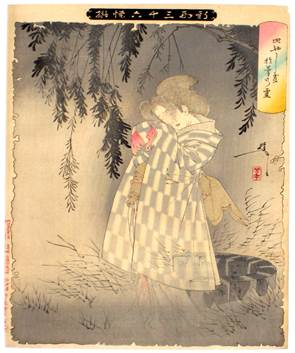
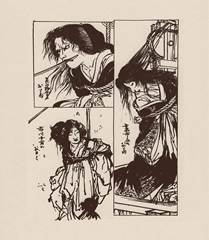
  • Anthropology, Humanistic and Empirical

    In answer to those who criticize Generative Anthropology for not being empirically based (and without going into the epistemological problems that this concept raises), I prefer to say that GA is a humanistic rather than a social-scientific anthropology. But terminological distinctions can take one only so far. Given the subject of next year’s GASC in Stockholm and the presence of cognitive scientists among the keynote speakers, this seems to be a propitious time to attempt to justify the epistemology and what I hesitantly call the methodology of GA where it differs from that of anthropology as an empirical social science.

    The crux of justifying to the scientific world the construction I have called the originary hypothesis is that those who call themselves social scientists, however much they are capable of speculating on the originary moments of their fields of study, consider as serious hypotheses only those that can be empirically tested in the laboratory or in the field. This distinction was brought home to me notably in the brief correspondence in which I engaged early in this century with Terrence Deacon, the author of The Symbolic Species (Norton, 1998), still the most important work on the neuroscience of human language. Deacon’s book includes a long chapter in which he speculates that the original impetus for language came from the conjunction of male hunting parties, a new proto-human activity, with the neotenous nature of our young, which obliges women to devote to their infants a qualitatively longer post-gestational period of intense care than female apes. In Deacon’s scenario, because the investment in children was so great, these hunters required a guarantee that their women remain faithful to them in their absence, assuring them that the children to whom they devoted their efforts were their own, and therefore conceived a ritual of marriage as the occasion for the first use of “symbolic” signs, in Deacon’s Peircean terminology.

    I wrote to Deacon praising his attempt to ground language in a social ritual, and saying a few words about my own work. He answered dismissively that these speculations were of no real importance—this despite the fact that the chapter in question was the longest in the book. Because Deacon is a laboratory researcher, as Michael Tomasello is in his own way, he could afford to distinguish between “serious” empirical statements and speculative ones. Thus we may confidently learn objective information about the operations of human language in the brain from the “serious” part of Deacon’s book, while regarding his speculative “originary hypothesis” as mere food for thought.

    Here then is the key point of divergence between a humanistic and a scientific anthropology. The point of GA is not to generalize from the analysis of hard data, because the origin of human culture, and indeed, that of any human cultural phenomenon, can never be qualified as “hard data.” Even if, as I suggested in a recent French chronique, we have no real basis for assuming that some divine metaphysic protects human thought from being simulated and perfected by mechanical means, the original human version of it is not simply algorithmic and can only be understood from an interactive, scenic perspective. For us, in a word, “speculation” is the nature of our science. The originary hypothesis is a heuristic, not a more or less accurate account of a discoverable event. But in our context, as opposed to Deacon’s, this makes it all the more indispensable. The point of a humanistic anthropology is to explain the emergence of the qualitative difference between animal and human communication and social organization, and this can be done only by bootstrapping the new human component into the hypothesis itself. The origin of the sign must be illustrated to be understood, and to do this, a fiction must be designed that offers a plausible scenario for this origin, without any hope in our present context (for who knows what historical equivalents of stellar spectroscopy may be discovered if our race lasts long enough) for empirical confirmation.

    As last week’s review of Tomasello’s A Natural History of Morality suggests, the separation between the human and the prehuman is not accessible to social science. The origin of the symbolic cannot be understood as a “natural” phenomenon; there is no “natural history of morality” any more than E. O. Wilson’s sociobiology suffices as the basis for a history of human social institutions. The claim that we are indeed biological or simply “natural” creatures is true enough, but about as helpful as the idea that Laplace’s demon’s presumed ability to predict all the universe’s future states demonstrates that we lack free will. At a certain point in his career, Tomasello discovered the distinctive human quality of joint shared attention, but he never fully grasped its unnaturalness. Once individuals can communicate their attentions, they can communicate their intentions, at which point emerges the phenomena of the sacred as the deferral of these intentions, whence significance as other than programmed appetitive attraction/repulsion, and the whole set of human symbolic institutions: rules, laws, customs, rites. None of these are “natural” nor can be derived from one-on-one “partner” relations, which would have been formalized in new ways by the existence of even the most elementary human systems of representation—as Deacon suggests in his marriage example.

    Is there a way around this impasse that might permit a mutually respectful dialogue between empirical human/social science and a humanistic anthropology? In the first place, GA is not a philosophical anthropology, however much its overall thrust is similar; it insists that its anthropological etiology of language itself be prior to any subsequent elaboration of concepts, moral or otherwise. Nor is GA tempted to dismiss religion, as in the passage I quoted in Chronicle 519 from Tomasello’s work. Rightly considered, the significant and the sacred are different ways of referring to the same phenomenon, and their divergent histories reflect a specialization among different aspects of this one phenomenon.

    Just as in an absolute sense, religious and nonreligious perspectives cannot be reconciled—one is either a man of faith or one is not, one “believes in God” or one does not—so one might say that one is either a believer in “hard science” or in the kind of humanistic science embodied in GA. Yet the point as I see it is not to abolish disagreement but to minimize it around a central core. I believe I have been able to do this with respect to the first dichotomy: most participants in GA activities are in fact religious believers, and to my knowledge, those who are nonbelievers are not hard-core atheists on the model of Richard Dawkins or the authors of books with titles like God Is Not Great. Girard was a believer and I am not, but our modes of thought appeal, on the highest level at least, to the same audience.

    The point of the originary hypothesis is to provide a plausible model of an event whose participants would begin as non-humans and would end as humans. Social scientists will no doubt snicker at so naïve an idea; nothing as significant as this transformation can take place all at once; many small steps are required, and so on and so forth. Well, no. There is a binary, absolute distinction between a creature that uses “symbolic” signs and one that does not, because the very use of such a sign is “binary”; either it is a sign or it is not. No doubt in the “real world,” the detection of this first moment would be impossible, and our choice, necessarily arbitrary: how exactly can we determine the first time that an “aborted gesture of appropriation” is understood as a sign? As Adam Katz has pointed out, we certainly can’t assume that even the “first” group of hunter-scavengers all began spontaneously to understand it in this way.

    But that is not the point. Just because the “binary” or “digital” phenomenon began in an unclear manner, what is important is that it began, and that its beginning was the inauguration of a new mode of communal communication. The originary hypothesis presents this change in a heuristic fashion, by eliminating empirical distractions and focusing on the significant element of the change. In contrast, a work such as the one I examined last week makes use of any concept it can find to break down the binary passage from prehuman to human, notably in the idea that “morality” first emerged as a relationship between pairs, presumably unmediated by signs. But in the absence of signs, there is no truly human communication, no moral idea, merely moral “attitudes.” And the same is true of any cultural phenomenon. Humans relate in twos only because they first relate to the whole—call it God or merely the human community—and language, which is the chief means of this communication, can only be understood as mediated by this whole. Even when I say “I love you” to my beloved, the signs I am using belong not to “us” but to the virtual community of language users.

    The originary hypothesis is not set in stone, and empirical evidence can certainly modify its terms, but not its fundamental binary structure. Philosophers know this—but philosophers are not anthropologists precisely to the extent that they are wedded to the declarative sentence, the proposition. Theologians too know this—but theologians are not anthropologists to the extent that the hypotheses of origin they offer are not minimal. Buddhism, as discussed in the recent Chronicles 515 and 516, comes no doubt as close as any religion gets to understanding the scene of (human) representation as the minimal requirement for being human. But GA is demonstrably the first attempt to wed the understandings of empirical anthropology, philosophy, and religion in accordance with Ockham’s razor to provide a minimalistic understanding of the passage from pre- to full humanity.

    In no sense does GA contradict Darwinian biology or any other element of scientific theory. Nor does it dictate in any way the prerequisites for the originary scene to take place. Girard’s idea of “more mimesis” is all that is minimally required; but the conditions under which this “more” reaches the point at which an entirely new mode of social interaction becomes necessary to the species’ survival must be discovered through empirical investigation, not deduced from the minimal scene itself.

    But these conditions are ultimately a secondary consideration. In the absence of an originary hypothesis, social science can never truly constitute its object, the human species, as a unique entity. As we have learned after decades of effort, apes cannot really be taught language, let alone religion and art. Or morality either, as Tomasello makes no bones about admitting. Thus humanistic anthropology is fundamentally necessary to understanding the emergence of the human in a way that empirical anthropology is not. The important thing is not to determine the exact moment at which this binary transition occurred, but to understand it ontologically as a binary transition, the introduction into the universe of a new way of relating to one’s fellow humans and to the world.

    Although the present appeal is unlikely to succeed where others have failed, my hope is that it will inspire others, the cumulative effect of which can erode the wall that separates our humanistic anthropology from that of social science. Historians of science have become familiar with the idea of “paradigm shifts” to explain “scientific revolutions.” It is time they took a step back and realized that the very idea of paradigms, that is, of thinking in symbolic terms about the elements of our experience, can be understood only as arising in an event that introduced into the world a mode of communication and interaction that had not previously existed, and whose moment of revolutionary change would never be forgotten.

  • Michael Tomasello’s A Natural History of Human Morality

    This Chronicle is the third in a series we might call “GA and the Rest” (Part I: Chronicle 444, Thomas Nagel’s Mind and Cosmos; Part II: Chronicle 490, Terrence Deacon’s Incomplete Nature), in which I examine books dealing with anthropologically related matters for which I think I can demonstrate that GA provides a qualitatively superior explanation.

    In the opening chapter of Science and Faith, written some thirty years ago, I pointed out the fallacy of the gradualism of the social science account of the origin of the human. Break down the emergence of the human into infinitesimal stages, and the radical nature of the split between humanity and other animal species dissolves in a cloud of dust. Natura non facit saltus, but there is a difference between making hypothetical transformations plausible and making them insignificant. Just as there is a solution de continuité between the most complex crystals and the simplest life-forms, so is there one between the most advanced apes and the simplest humans, and the theoretical recognition of this ontological split is all the more necessary when the new phenomenon we seek to describe is precisely “theoretical recognition” itself: the ability to think about events and their components by means of arbitrary or symbolic representation, an ability unique to our species, as years of frustrating chimp studies have borne out.

    The social science world remains blind to GA’s “new way of thinking.” The absence of GA or Girardian writings among the 250+ works in this volume’s bibliography comes as no surprise. What might strike even the casual reader as surprising, however, is that a social scientist who would dismiss GA as insufficiently empirical can produce a work about the origin of a foundational element of human culture in which the only empirical evidence comes from contemporary laboratory studies of ape and (human) child behavior. Although one might think that “human morality” is a cultural phenomenon whose operations in extant and historical elementary societies, about which a vast ethnographic literature is readily available, would be worth discussing, this book contains no reference whatever to specific ethnological data. The word ritual does not appear in the index and is used, I believe, just once in the book. As for religion, the unique consideration of it, on page 131 of this 163-page text, would be embarrassing in a freshman paper on Nietzsche:

    One way that leaders throughout human history have sought to legitimate themselves and their laws from a moral point of view is to claim that they have somehow been anointed by a deity or in some other supernatural way. The origins of religious attitudes in general are unknown, but one key aspect could have originated in the kind of agent-independent and group-minded thinking characteristic of modern humans, particularly when given a historical dimension, including ancestors and ancient traditions. Norms and institutions have a kind of abstract, almost supernatural existence and apply not just to particular individuals but to “anyone,” however that might be conceived. A major source of wonder in human experience is where are [sic] our venerated ancestors who founded our society, and indeed, a key foundation of a religious attitude is the veneration and worship of deceased ancestors and traditions whose spirit somehow lives on (Steadman et al, 1996). Leaders then took advantage of this attitude and claimed supernatural sources for their leadership. (My emphasis)

    Virtually every question in this paragraph is begged; note in particular the two somehows. Where did the “leaders” acquire their status? Where did they get the idea they were “somehow anointed by a deity”? How did they come to think of “deities” in the first place? What “one key aspect” of religion “could have originated in the kind of agent-independent and group-minded thinking characteristic of modern humans”? Is a reference to an article by Steadman et al sufficient to establish the “veneration and worship of deceased ancestors whose spirit somehow lives on“?

    Unfortunately, this atrociously written paragraph is all too typical of the book as a whole. A writer who can toss off “somehow anointed by a deity” can get from A to B by any means possible. In contrast with GA’s attempt at minimality, Ockham’s razor has been tossed out the window, and the beard has grown down to the floor. For the point here is not to minimize “imaginary entities” but exclusively to minimize the conceptual distance between the animal and the human by breaking it down into as many components as it takes. Explaining the emergence of religion on the basis of “group-minded thinking . . . including ancestors and ancient traditions” is purely vacuous, but it creates a pseudo-causal chain that allows us to dismiss the issue of religion as ultimately inconsequential, derivative of other vaguely alluded-to factors.

    What is sad is that in this work Tomasello never associates his most significant anthropological concept, the specific and specifying attribution to humans of joint shared attention and its companion, joint shared intentionality, which is structurally identical with the sign-relation as described in the originary hypothesis, with the scenic foundation of the human community. Instead, Tomasello insists on deriving group solidarity from solidarity with individual “partners,” a “second-person morality” that he claims only subsequently developed into a cultural relationship with a larger society.

    The first key step occurred hundreds of thousands of years ago, as a change in ecology forced early humans to forage together with a partner or else starve. This new form of interdependence meant that early humans now extended their sense of sympathy beyond kin and friends to collaborative partners. To coordinate their collaborative activities cognitively, early humans evolved skills and motivations of joint intentionality, enabling them to form together with a partner a joint goal . . . . . .

    In this way, participation in joint intentional activities—-engendering both the recognition of partners as equally deserving second-personal agents and the cooperative rationality of subordinating “me” to “we” in a joint commitment—created an evolutionarily novel form of moral psychology. . . . In the end, the result of all these new ways of relating to a partner in joint intentional activities added up for early humans to a kind of natural, second-personal morality. (4-5)

    No evidence whatever, paleontological or otherwise, is offered for this Rousseauean vision of proto-humans first establishing a “we” with a “partner” before forming social groups. The discussion of these hypothetical developments is rendered even more unclear by the unexplained introduction of elements previously absent from the discussion. For example:

    As modern human groups started becoming larger, they split into smaller bands that were still unified at the tribal level. A tribal-level group—call it a culture—competed with other such groups for resources, and so it operated as one big interdependent “we” . . . (5)

    The term tribe, which applies exclusively to human groups, had not previously appeared in the text. Where did “tribes” come from if their group solidarity is only now being established? Why is their split into “smaller bands” (clans?) of significance, since the whole tribe is now treated as a single “culture”? What, indeed, is a “culture” in this context, where not the least reference is made to any of its material or symbolic components?

    Animals are very good at pairwise relationships; only humans have collective all-one, center-periphery—which is to say, scenic— relationships. This idea is at the center of Girard’s anthropology. Although Girard never really deals with language, his conception of the social order is essentially symbolic; the symbolic-sacred center of the human community, whether we take it to be the “emissary victim” or the food animal in GA’s originary hypothesis, has the function of deferring (further) conflict, bringing peace through a collective interdiction. Tomasello’s version of cooperation never conceives that the breakdown of ape systems of control is prerequisite to the new human order. Like virtually all social-science constructions, his is purely additive; things just keep getting better and better. But to get to a new collective order from an old implies some form of crisis, be it Girard’s crise mimétique or the “little bang” of GA’s aborted gesture of appropriation. To finesse this transition by beginning gratuitously from a new form of “partnership” unattested in any empirical study is not a breakthrough in model construction, but merely a way of avoiding consideration of a critical event of origin.

    It is only on the very last pages of the text (161-2) that the author addresses what even he seems to feel that his readers may find surprising; his utter lack of reference to violence and conflict. Tomasello is perfectly correct to point out that even in wars, the vast majority of human interactions, those within the separate warring collectivities, remain bound by moral codes. But that is only because the moral organization of the individual societies themselves has deferred within each the tendencies to mimetic violence—what the burden of the book was, indeed, to explain. What is central to GA’s and Girard’s definition of the human, that humanity is the only species whose members pose a greater danger to each other than do the forces of nature, is altogether foreign to Tomasello’s understanding. His pseudo-Nietzschean (or is it Voltairean?) contempt for religion correlates with a total unawareness of the problematic of mimetic desire.

    This analysis need not be pursued further. The evident lack of intellectual rigor in the passages I have quoted should suffice to demonstrate that although this kind of cognitive science is capable of making valuable contributions to the study of specific practices involving human joint shared attention and joint intentionality, it cannot handle a more complex notion like morality that requires a totalizing view of human society. Thus although Tomasello’s original and most fruitful research focused on language, he never appears to think of associating the institution of morality with the emergence of human language. The symbolic domain here is limited to psychological categories such as “we” and “I,” and the reader has the impression that although the author is aware of the distinction between morality and animal drives, he is incapable of understanding the difference between a moral norm such as Kant’s categorical imperative and a moral attitude such as a feeling of guilt for wrongdoing.

    A final irony: in the penultimate paragraph of the book, Tomasello defends himself against what he calls the “criticism of too much rosiness” in positing “a sense of equivalence or equality among persons as foundational to human morality,” given that “it is only with the Enlightenment that social theorists in Western societies began promoting the idea of all individuals as in some sense equal” (162). Students of GA will recognize this “sense of equivalence” as what I have called the moral model, shared by all humans, that derives from the reciprocal exchange of the sign in the originary event. In justifying this “rosy” notion, Tomasello notes that hunter-gatherer societies “were by all indications highly egalitarian.” As the past tense implies, this is a claim about prehistoric societies, taken from C. Boehm’s Hierarchy in the Forest: The Evolution of Egalitarian Behavior (Harvard, 1999). But here for once the author could have found corroboration from the contemporary hunter-gatherer societies observed by ethnologists. Had Tomasello associated reciprocal morality with language and ritual practices in the cultural whole that defines human society, he might have avoided the speculative gradualism that allows him to discuss the origin of morality between “partners” independently of language and religious practice, and grasped the fundamentally scenic nature of the human social order.

    The barrier between the methodology exhibited in this book and that of the “humanistic science” of GA might seem insuperable, but this barrier is institutional rather than inherent in the ideas in question. No doubt constructions such as the scenic are foreign to Tomasello’s psychological universe, but that is due to a mindset in which any specifically human element is understood in terms of individual psychology. Yet language and other systems of representation are human precisely because they transcend one-on-one interactions; the (cultural) whole within which the sign is shared is more than the aggregate of the individuals involved. To use representation in the human sense is to enter a sign-world that cannot be reduced to the sum of its individual participants. This “humanistic” concept is not incompatible with the psychological concept of joint shared attention any more than Raymond Tallis’ idea of the pointing human hand is incompatible with GA’s originary hypothesis. Making the connection would require an openness to a new way of thinking, not a leap into the irrational.

    In a follow-up to this Chronicle, I will propose some grounds for a potential dialogue with those social scientists who might be willing to envisage enlarging their field of view to include GA.

  • Civilization in Crisis?

    It would be a tedious exercise to attempt to count the number of times in history, or even in the past century, that a “crisis of civilization” has been declared. The human has never been stable; once mimetic tension reaches the collective as opposed to the one-on-one (or several-on-several) level and must be mediated by the emission of voluntary, symbolic signs on a scene of representation, conflict cannot be securely prevented, only deferred. The anomalous configuration of the 2016 US presidential election has nonetheless led to more soul-searching than at any time since the Vietnam era, when the draft posed a direct threat to a new generation of college students who never expected to go to war.

    The question of whether to see the current crisis as fundamentally internal to Western Civilization or as posed by external powers, whether Russia, China, Iran, the Islamic State, or any combination of these, is a mere matter of emphasis, for clearly the rise of these other powers, some of which are pitifully weak by traditional military measures, reflects the retreat of the West, and in particular of the United States, from world leadership. The recent murders of police officers by black Americans mimicking the massacres of the jihadists, at least two of whom had in fact converted to some form of Islam, only demonstrates the increasing solidarity of the “enemies of Western Civilization.”

    The originary event, as Adam Katz has always emphasized, never leads to the symmetry of “perpetual peace.” All that can be achieved by the unanimity of the gesture of representation is that all suspend their efforts at appropriation, not that all become equally convinced of the sacrality of the central object of desire. And anthropologists point out that these egalitarian societies of “noble savages” are the most violent of all. The prohibition on consuming more than another stimulates each to be constantly on the lookout for anything that may seem to give an unfair advantage to his neighbor; in the absence of a formal judicial system, the threat of murder, followed by the threat of revenge, is constant. That the big-man later becomes able to impose his authority as a result of producing and distributing a surplus suggests that by concentrating the group’s resentment in the center, this authority, rather than violating a Rousseauean utopia, brings about a considerable reduction of violence. The progress of civilization here as at every level takes place through a fuite en avant that, by creating more effective means of deferral, lowers the general level of violence only by deferring an ever greater potential for it. And each time, we hope that what Girard calls after Clausewitz the montée aux extrêmes will be the last. In the years before 1914, there indeed seemed to be some hope of this—as there is yet today, seventy years after Hiroshima.

    The Left is obedience to the imperative to expose the products of discipline as stolen centrality.
    Adam Katz, GABlog, July 17, 2016

    Adam’s idea of the Left merits special consideration in this context. It is not a universal definition such as I have attempted by opposing the moral model of reciprocal equality to an ethic that rewards firstness in various guises for its contribution to the social order. Adam defines the Left by its delegitimation of differential rewards for what he calls “discipline,” by which he means the deferral of immediate satisfaction in the service of some socially useful goal—including the acquisition of skill in the arts, or even at games or sports, which allow others a vicarious experience of discipline. The point of this narrower definition is, I think, to define the Left in truly contemporary terms that stand in opposition to its earlier incarnations.

    At the historical origin of the Left, in the seating of the Assemblée Nationale in 1789, where the Right supported the king’s veto authority over the new constitution whereas the “patriots” of the Left opposed it, the point of contention was not discipline but institutionalized firstness in the traditional sense inherited from the big-men, kings, and emperors of old. No doubt the essential innovation of the big-man, as we learned from Marshall Sahlins, was precisely his exercise of discipline, both in producing more than the others and in restraining his consumption in order to accumulate a surplus. But the anger that precipitated the Revolution was aroused by the perception that rather than discipline, the Old Regime rewarded naked status without merit. The “bourgeois” and even the “proletarian” revolutions demanded that rewards be reserved for labor rather than the mere ownership of capital. As I pointed out in Chronicle 484, Marx’s “labor theory of value,” which strikes us as archaic today, made factory labor the lowest common denominator of human economic effort. In such work, “discipline” is essentially regimentation rather than learning an advanced skill, and therefore open to virtually any normal person—including women and children, as 19th-century factory owners were all too well aware.

    Thus Adam’s definition is not that of the Left throughout its “classical” history. The heart of the Old Left in the West, from the French Revolution to the Second World War, whether in its extreme (“communist”) or more moderate (“socialist”) forms, was the working class, however much these movements tended to be run by an upper-middle-class intellectual “vanguard.” The Left’s attitude toward discipline was a positive one, even if those who actually achieved power and wealth in the more rigid of these systems were very unlikely to have more than briefly begun, if that, their careers on the assembly line.

    I have always considered the Holocaust, with its Asian echo in the Japanese “racial” arrogance exemplified by the Nanking massacre, to be the catalyst of postwar victimary thinking, for which the SS-Jew world of the concentration camp provided the model for all asymmetrical relationships. But now that Trump’s candidacy and the Right in general is being assimilated, with very partial truth, to the racial essentialism of the Axis, we might do well to reflect on the reason for this specific focus during the economic crisis of the Depression. No doubt the West has always harbored a lingering envy of Jewish firstness; but why did the absolute denial of human solidarity, in both Germany and Japan, become so politically powerful at precisely this time?

    The anxiety behind bourgeois antisemitism was already present in Marx’s Reflections on the Jewish Question back in 1843; if in the bourgeois economy the Christians have “become Jews,” then the real Jews must have a considerable advantage. And by any measure of achievement or competence, the Jews when given half a chance have always done very well; Weimar Germany was no exception. Hence we can understand why the Nazis had to develop a racial mythology that assimilated the Jews not merely to “inferior” human beings but vermin. That the “Jewish privilege” that the Nazis could only attribute to the Jews’ “subhuman” status is analogous to the “white privilege” beloved of today’s victimary activists has been made clear by the ease with which Israel’s military and economic success has been translated into a far closer equivalent in the Middle East, not without bringing along a more vulgar form of the “racial” inferiority proclaimed by the Nazi Rassenpolitisches Amt—the Jews as descended from “apes and pigs.”

    Most significantly, both Germany and Japan had become by WWII, and after recovering from the war’s devastation remain to this day, world leaders in technologically sophisticated production; both prize efficiency and discipline. (I was struck by the degree to which our Nagoya conference schedule was observed nearly to the minute, when in the US, sessions running over by fifteen minutes or more are common.) The war was a revolt by two nations who saw themselves as the most disciplined and therefore the most deserving of domination in a world where one had suffered a humiliating defeat that could be explained away only by the “international Jewish conspiracy” described in the Protocols, and the other, the only industrialized country in Asia at the time, felt justified in imposing its “co-prosperity sphere” on its backward neighbors. It is generally accepted that, pound for pound, these nations fielded the best armies; their problem was that, fortunately for us, their opponents had many times their resources.

    Reaction to the Axis counter-example brought about the end of de jure ethnic-racial privilege within about 20 years of the war; Truman had already desegregated the US Army in 1948. With the victories of the civil rights movement and the movement of colonial liberation, each individual’s status would henceforth be determined, in principle at least, exclusively by his or her qualifications. The victimary “disparate impact” mentality that came into existence after these victories, and which Adam uses to define the (contemporary) Left, is one that refuses the criterion of discipline precisely because some people are better at discipline than others.

    Thus along with the “racist” bathwater of the “White man’s burden,” the victimary era has thrown out, with scarcely anyone even noticing it, the baby of firstness. For example, in all the critical assessments of Israel’s role in the “Palestinian-Israeli conflict,” the vast disparity in social productivity of the two sides goes entirely unmentioned; that the Palestinian Authority is riven by corruption and Gaza a brutal dictatorship oriented entirely toward the destruction of Israel, both of which survive only by extorting funds from Western and Middle-Eastern governments, whereas Israel, which with the world’s highest level of innovation per capita (despite the many Haredim who study Torah all day) has made countless contributions to human betterment, is never alleged as a point in its favor. The disciplines of modernity are on the contrary condemned as marks of Western “colonialism.”

    The failure of the Soviet Union was the final blow to those who believed that socialism was, as it falsely pretended to be, itself a triumph of discipline. With the demise of its utopian goal, the Western Left could see itself henceforth only in opposition to the world of the market. Instead of the disciplined efforts of each being evaluated by the benefits they bring to others, the victimary formula of “disparate impact” transforms every difference in individual outcomes into a collective injustice. The concrete goals demanded by activists are never more than temporary. The goal of the Left is less to win economic benefits than to denounce injustice, and thereby to deny legitimacy to objective criteria of success by demonstrating that they exemplify the ascriptive oppression whose archetypes are slavery and the concentration camp.

    One had only to listen to Bernie Sanders in the Democratic primary, mimicked less convincingly by Hillary Clinton, to hear expressed an absolute resentment of the market. Sanders explicitly claimed that not merely insider trading and other dishonest manipulations but the basic mode of operation of Wall Street is fraud. We should take this hyperbole seriously; it is the central kernel of the ideology of the postmodern victimary Left. It denounces the disciplines that function in the market as immoral: no one on Wall Street—and “Wall Street” is a synecdoche for the entire market economy—comes by his gains honestly. If for the old “Protestant Ethic” market success was a sign of God’s favor, it is now a mark of damnation.

    This combination of blanket condemnation of “capitalism” with a more specific attack on meritocratic testing allows the Left to fight for incremental “affirmative action” goals—I need only mention the proliferation of “diversity” deans/officers/trainers at all levels of university and corporate hierarchies—while maintaining in the background a critique of the market system as a whole that can never even conceivably be satisfied. Resentment must never be relaxed; its successes feed it as much as its failures. In this, the Western Left makes common cause with militant Islam, dismissing as irrelevant its supremacist final goal of world Islamization.

    Yet from a systems perspective independent of the will of the participants, it might be more useful to understand the real function of the victimary Left as permitting market society to perpetuate itself with a minimum of disturbance. By promoting an ideology wholly detached from discipline and that knows only what it is against, the Left need never renounce its activism. But by the same token, lacking a vision of structural change, it will never exact from the social order more than relatively minor symbolic concessions such as affirmative action hires, which can presumably be offset by improvements in technological productivity (as robotization can compensate for increases in the minimum wage) without threatening the fundamental mechanism of the market. In the administrative state, these “solutions” blend in seamlessly with environmental restrictions, endangered species considerations, consumer safety issues…, sufficiently satisfying its various victimary constituencies to permit the system to continue functioning.

    The fact that, left behind by the disciplinary meritocracy, both minority and white working-class neighborhoods, the latter facing a sharp increase in drug addiction, have become more dangerous and less economically viable despite these symbolic gains is the opposite of a problem, since the first group is thereby all the more attached to the Democratic welfare system, and the second, at least until Donald Trump came along, was increasingly isolated from the political process. Thus “capitalism” can survive indefinitely by disguising itself as a system of ascriptive oppression paying symbolic blackmail to its “victims.”

    To take this logic to its conclusion, we should be happy to put Hillary Clinton’s relatively unideological version of the Left in the place of Obama’s more consistently critical view of the Western enterprise; one may even imagine that had she been elected in 2008, the world might have become a somewhat less dangerous place. But in either case, the Achilles’ heel of the Left’s politics is its lack of resolve in the international arena. Its fundamental critique of the Western market system is not compatible with the steadfast defense, and particularly the military defense, of American and Western interests, for which more than symbolic sacrifices are required. Nonetheless, if this analysis is correct, the victimary may well be the only mode in which our increasingly meritocratic system can survive, now that, as I have been claiming, it has come to divide humans by symbolic ability rather than by external status.

    I hate to think of this quasi-conclusion as a defense of the Left, given that I fully agree with Adam that it is dependent on a social analysis that increasingly demands the limitation of freedom of speech and the criminalization of the expression of inconvenient truths. (At least so far, I don’t believe I risk prosecution by stating the situation in these terms.)

    For example, for inviting to their convention the parents of victims of Benghazi and of crimes committed by illegal aliens, the New Republic called the GOP the party of death. Have they ever called Black Lives Matter a cult of death? Yet these were truly innocent victims, unlike Michael Brown who continues to be described as a martyr even after his police killer was acquitted on the strength of testimony by black eye-witnesses. It is one thing for a street demonstration to yell slogans, but that a formerly distinguished publication can commit such enormities reflects the increasingly Orwellian perspective of today’s Left.

    But was BS of one kind or another not equally dominant in the distant past, when ritual was the primary mode of social cohesion? As Girard liked to say, in a world “without God,” we worship idols. Today as at the first human scene, the primary purpose of symbols is not to tell the truth, but to permit human survival. If the conditions I have described are indeed necessary to the survival of modern society, with its vast proliferation of truth-seeking symbolic processes that permit the constant evolution of science and technology, we can only hope that a space will always remain for humanistic truth-telling in the shadow of victimary “correctness.”

    But let us not give up too soon. There may yet be a constituency for restoring a relatively peaceful equilibrium between moral equality and firstness. In its absence, I doubt that the West will find the strength to defend its very existence from the “violent extremism” that menaces it a little more each day.

  • The Administrative State and the Victimocracy

    Back in 1948, Dwight Waldo coined the expression “administrative state” to refer to the concentration of authority, including effectively both legislative and judicial powers, in the executive in the form of bureaucratic agencies, as occurred widely under the New Deal. In the US in recent years, the proliferation of executive regulations has far outstripped that of laws enacted by Congress, and unsurprisingly the two houses of Congress, in principle the repository of the popular will, enjoy the lowest favorability ratings of any part of the government.

    Despite the popularity of Bernie Sanders’ “socialism,” the administrative state is the effective governing mode of the Western Left. Rather than administering directly the “means of production,” the state prefers to regulate them, increasingly assimilating the corporations of the private sector to the status of public utilities. This offers an inexhaustible source of power that can reach to the lowest levels of daily activity over which the Constitution originally guaranteed the jurisdiction of the states and their legislatures. An illustrative example is the series of “Dear Colleague” letters to schools and universities issued by the Department of Education concerning such things as the evidence required for sexual harassment and lately, bathroom policies for transgender students.

    Because these regulations are promulgated by “experts” rather than elected officials, they lend the politicians in charge of the administrative state a veneer of rationality that allows them to deny the resentment that is the basis for victimary politics. To give a recent example, the New York Times on Sunday June 26, in an article discussing the impact of “Brexit” on the presidential election, blithely and non-editorially states: “[Hillary Clinton] offers reasonableness instead of resentment.” This opposition is later elaborated as that between Clinton as a “pragmatic internationalist” and the “nationalist anger” of the other side. Clearly no true argument is possible between “reasonableness” and “resentment.” The location of resentment exclusively on the Right is the obverse side of the promotion of victimary activism against “white privilege” and the like, a propos of which the word resentment is never to be found in the media.

    The question of how this “reasonable” approach based on “expert knowledge” is somehow associated with the rabid forms of political resentment illustrated in Chronicle 514 (where the jihadist Orlando shootings were blamed on the NRA and Christian “homophobia”) may be the key to understanding the current political evolution of liberal democracy. One would think that the very notion of expertise implies meritocracy and the careful determination of qualifications, as opposed to the “disparate impact” approach indispensable to victimary thinking, where the inferior standing of any minority group by any criterion is considered prima facie proof of its victimization by the “privileged.”

    No doubt victimary triumphs in themselves are largely symbolic—although this symbolism sometimes has serious consequences, as when the pressure on banks to issue loans to minority home-owners catalyzed the recent recession. It is because the victimary is largely symbolic that it is most rampant on the quads of college campuses. But the ideological symbolism is crucial, particularly under Obama, who gets 95+% of the black vote out of ethnic pride rather than any help he has given to black people, and more generally, critical to maintaining contempt for the enemy. The executive-administrative state is thereby given a justification to bypass Congress and, when caught with its pants down, simply walk away from its problems, either blaming the first available Republican, as in the Flint scandal, or simply forgetting about the matter, as with the Lois Lerner IRS (non-)scandal or the VA hospital scandal (which still remains largely unresolved), not to speak of the various depredations of the EPA or CPSC, or of Hillary’s own peccadilloes.

    Thus does “reasonable” progressive politics seamlessly blend with the most extreme victimary positions. One can imagine the kind of work these agencies would perform under a President Sanders. I am glad to admit that Hillary’s instincts are not really “progressive” to this extent, but her focus-group approach to politics and simply the red-hot passions of the Left that she must rely on to be elected make it difficult to imagine that her “reasonableness” will not be fully in thrall to the political.

    It is all too easy to counter resentment with resentment, and I wish there were a more Christian or even rabbinical way to make these points. The victimary inverts the Christian promotion of humility; “the last shall be the first” is in the future tense rather than meant to apply to our worldly lives, providing the “victims” with a license to act with shameless arrogance—as real Christian victims, like those exemplary black churchgoers in Charleston, know they should never do. Arrogance is never a virtue, although at times violence is unavoidable.

    But it would be foolish to limit ourselves merely to the moral dimension of the problem. The cultivation of victimary arrogance was, for good and for evil, the mechanism that drove the French and other revolutions. Was the French, the Russian, the Chinese Revolution a Good Thing? History doesn’t answer such questions unambiguously.

    I believe that the victimary arrogance of the Left at the present moment is dependent on a factor that I have discussed several times without pretending to be able to calculate its quantitative effect: that of modern, intelligent automation, which as I have claimed is in the process of effecting the first essential separation within humanity by severing the common symbolic link (as expressed in religious and civil ritual) among the social classes. For the first time, a whole segment of the population, more or less the “Belmont” of Charles Murray’s Coming Apart, has been detached from the “common folk,” not simply by privilege as in the past, but by the ability to use symbols. GA takes this more seriously than the workaday anthropologies we live with because GA takes seriously the definition of humans as users of language. In particular the split occurs most sharply in language’s least “humanistic,” most narrowly symbolic function: the pure empty tokens of mathematics, the ability to manipulate which becomes increasingly a qualification for the higher forms of work (“STEM”). Perhaps (true) affirmative action can work to bring the two sides together, but as Murray’s book, which deliberately excludes racial minorities from consideration, suggests, this is certainly not to be solved by attacking “white privilege” or putting (often black) policemen on trial for “racist” brutality.

    The point is to understand that the heat of all these resentful thoughts is meant to make us forget the “cold light of reason,” which tells us that only some as yet undiscovered form of human engineering will make those currently in the (former) “working class” capable of handling the symbolic activities of tomorrow’s industrial society. Without falling into economic determinism, I think one can say that the world’s current ills, from radical Islam to the sclerosis of the administrative state in Europe and increasingly, the US, all in one way or another reflect the persistent inequalities that depend more and more not on “privilege” but on qualifications, and ultimately, on native abilities, albeit enhanced by the more nourishing childhoods characteristic of the Belmont class. Huxley’s Brave New alpha-epsilon categories, contemporaries of the word robot invented for Capek’s RUR, seem to be proving eerily prophetic. Save, of course, that as bearers of the moral model of reciprocal human equality, we cannot condone a hierarchy of this sort, so that when it manifests itself in some domain of the social order, it must be denied by all means at our disposal.

    Perhaps the unexpected Brexit success will mark a turning point in what has appeared up to now to be the uninterrupted triumphant progress of the victimocracy together with the administrative state. Brexit is the rejection not only of the rigidity of the economic restrictions imposed by Brussels but of the fecklessness of Europe’s immigration policy, its increasing favoring of the Palestinians over Israel (including the European Parliament giving a standing ovation to Abbas’ recent speech accusing Israel of poisoning Palestinian wells) simply because Israel is a successful nation whose existence the Palestinians have learned that they need only deny to maintain a hereditary victimary classification, and its deathly fear of “Islamophobia,” ultimately far more paralyzing than even the American fear of “racism,” which permitted for example the horrible Rotherham scandal to go on for years—how many times have you seen this linked to the Brexit vote?

    Yet one implies the other; the bureaucratic rigidity of Brussels is not simply techo- but victimocratic, because Western technocracy can only define itself against all forms of Western political hegemony. The more its functions depend on symbolic intelligence, the more the West bends over backward to deny the national-ethnic-“racial” basis of its culture, whether it be in the Cologne mayor’s abjurgation to local women to dress in fashions more acceptable to Muslims or Western corporations and universities’ concern with “diversity.” The scurrilous language generated by the Brexit vote among Remain partisans—this diatribe by Bernard-Henri Lévy, “BHL” to the French, is a particularly juicy specimen—proves the voters’ point better than anything I can say. If Britain’s vote moved a presumably decent humanitarian to this kind of prose, the West’s conscience must be in the process of a genuine sea-change.

    Is this enough to justify a vote for Trump in November? Time will tell; but I for one would be willing to take some risks, as the British public has done, in the service of rolling back a bit of the administrative victimocracy we increasingly live under. This is surely among other things one more proof that, however right Francis Fukuyama may have been about the ultimate triumph of liberal democracy, this triumph by no means constitutes the “end of history.” Within the framework of liberal democracy there is clearly plenty of history left to be worked out, perhaps as much and more than we have already lived through. Provided we don’t blow ourselves up first, of course.