Author: staceymeeker

  • Qui perd gagne

    The expression qui perd gagne (“he who loses, wins”) provides the central theme of Sartre’s three-volume psychobiography of Gustave Flaubert, the “family idiot” who became the most important French novelist of the nineteenth-century, and notwithstanding his bourgeois life style, France’s leading exemplar of the pure artist. The epileptic fit that ensured Gustave’s release from the obligation to pursue his professional studies only confirmed his childhood intuition that to win as a writer he had to lose as a bourgeois, even as a bourgeois man of letters. Having renounced a “literary career” like that of his friend Maxime du Camp, Flaubert devoted himself uncompromisingly to narrative art, spending five years or more on each of his novels, where Balzac had composed the 99 titles of the Comédie humaine (plus much else) in 20 years. Flaubert found fame by being contemptuous of fame, and unlike the more ambiguous Marcel Proust, his resentment of bourgeois success left him untouched by snobbery. The snob cannot afford to want to lose; he will abandon one game only for the sake of one more prestigious. For Flaubert, aside from family loyalties, the only game worth playing was that of art. Yet, as Pierre Bourdieu astutely saw, it was just this anti-bourgeois posture, however uncalculated, that was rewarded with respect and even popularity by the bourgeois public. The era when Emma Bovary can dream of decorating her home and herself with ideas from Parisian magazines generates a market for an art that will denounce the new world of consumption before it can be tempted by it.


    The question I would like to ask here is whether GA is itself a mode of qui perd gagne, or in the terminology of card games, of misère. Just as Flaubert’s art is that of the eternal idiot de la famille, perhaps the simplest explanation for the limits and strengths of GA is the Bronx Romanticism at its root. I have explained elsewhere how this ultimate hedgehog theory that traces humanity to a single scene embodies the Bronx Romantic’s need to remain as close as possible to the adolescent fount of the totality of adult possibilities.

    I would submit that GA is optimally, if not deliberately, designed to perpetuate as long as possible the deferral of its public visibility. By the very fact of calling itself an anthropology, it guarantees the suspicion both of social and biological scientists, for whom it is not “real” science, and of humanists, to whom it looks like a fellow humanist trying to sound scientific. Neither I nor anyone else in the GA community has the authority to use the term anthropology.

    Deliberate or not, the strategy of deferral has served over the years to protect GA’s emergence as “a new way of thinking.” To seek a place in the mainstream would be to face constant polemics; GA’s obscurity has allowed its core ideas to evolve in tranquility. But now that GA has begun to venture into the public sphere—a phenomenon marked in 2007 by the publication of Adam Katz’ The Originary Hypothesis and the Vancouver “GA Thinking Event”—it might seem time for the misère to come to an end.

    I will propose two avenues for GA’s insertion; first, the traditional academic one of textual analysis as a mode of cultural self-reflection; and second, the public debate over the role of religion in humanity’s self-understanding. No doubt, at a given time there is never more than one real controversy; insulated by the immense institutional inertia of university life, current academic debates over the place of culture in advancing social justice may be considered as slow-motion variants of the more pugnacious battle between Darwinists and believers that in turn reflects the anxieties that surround the role of religion in today’s globalizing community.


    The postmodern trend of victimary thinking remains well established in the academic world. Although this trend was shaken momentarily by the events of 9/11, given the absence of further successful attacks on American soil, the lessons of the new, “post-millennial” era are being absorbed only very slowly into our cultural life. Nonetheless, after a run of nearly fifty years, victimary thought’s anti-establishment claims no longer excite the critical-minded, while from a practical professional standpoint, its agenda is now so securely embedded in both the form and content (the “canon”) of cultural analysis that new departures arouse few anxieties. Indeed, the various postmodern disciplines are increasingly preoccupied with strategies of integration rather than mere confrontation; slowly but inexorably, they must deal with the fact that there is no “next stage” beyond liberal market society.

    To take an example close to home: in the past decade, my own department has been transformed beyond recognition by a new focus on the “Francophone” world of France’s former colonies; UCLA has become arguably the premier university in the country, if not the world, for Francophone studies. Next year, four professors out of thirteen will be specialists in this field in which there were none a mere dozen years ago. Meanwhile, already in 2002, my colleague Françoise Lionnet and I held a little joint GA-Postcolonial conference. The GA content was, admittedly, more symbolic than real, but the conference’s very existence testifies to the lack of tension aroused by GA within a field initially defined by the colonisé‘s resentment of the colon. One might conclude from this that, all other things being equal, a GA-oriented post-colonial Ph. D. dissertation would not be a disadvantage in the job market. For the moment, this conclusion remains purely speculative.

    Can it be demonstrated that tracing the fundamental characteristics of the human to a hypothetical originary event makes us better readers of texts? The truly significant question is whether GA fulfills its claim of offering a new and better explanation of the origin and persistence of language, religion, and art. If this is the case, then it is worth everyone’s effort to extend the originary hypothesis to the specific problems of cultural analysis; conversely, each adaptation will enrich the minimal theory with a deeper understanding of humanity’s historical possibilities. GA’s hypothetical human ontology makes the “hermeneutic circle” between originary thinking and cultural analysis more than an abstract epistemological construct on the Gadamerian model; analysis and synthesis cooperate in the open-ended yet grounded creation of a theory of the human.


    In the hypothetical originary scene, the nascent human community survives only because it is able to defer immediate appetitive satisfaction and agree on a common “meaning.” Our hypothetical originary event belongs to the broad category of situations that fall under the rubric of “the Prisoner’s Dilemma,” in which the separate members of a group must be dissuaded from opting for “defection,” despite a preferable immediate payoff matrix, in the interest of safeguarding the greater reward to be reaped by the group as a whole.

    The current debate over religion has revived the Enlightenment polemic between the religious and naturalistic-atheistic etiologies of three apparently irreducible categories of being—the universe as a whole, life on Earth, and human self-consciousness—of which the last is critical, as it provides our knowledge of itself as well as the others. In the present state of the controversy, the participants prefer dispute to debate, refusing to specify the subject of their argument in such as way as to generate a virtual community of debaters. In Prisoners’ Dilemma terms, each group prefers the narrow rewards of defection to the global payoff of mutual confidence.

    The originality of the originary hypothesis lies in explaining humanity’s defining trait, the origin of language/religion/representation/culture, as its solution to the Prisoners’ Dilemma brought about by the decay of pecking-order primate hierarchy. The hypothesis is germane to the religious debate because the current controversy is implicitly centered on this very same origin. GA’s account of the generation of transcendence from immanence offers the parties to this debate a parsimonious shared heuristic, whether they are disposed to consider it as adequate (naturalists/atheists) or as requiring supplementation by extra-natural forces (supernaturalists/theists). The empiricist counter-claim that a “naturalist” account of human origin will eventually emerge from the discoveries of neurology, ethology, genetics, etc., is not only irreconcilable with the conviction of religious believers that human origin is not accessible to the methods of natural science, but forces the uniquely transcendental nature of human representation into the mold of genetic selection, making the eventful appear uneventfully from the uneventful, and the conscious, unconsciously from the unconscious.


    As the originary hypothesis suggests by analogy, it is only in a moment of crisis analogous to the originary event it hypothesizes that any heuristic—the solution proposed by each of the various religions being, at the very least, a heuristic—can impose itself on the participants as the necessary means of achieving the deferral of violence through representation. The dialogue de sourds between the omnipotence of God and the universal validity of Darwin parallels the struggles taking place in the real world. Today the crucial instance of the Prisoners’ Dilemma in the political domain is posed by the extension to the entire globe of liberal, market-based democracy. Contrary to current cliché, recent history does not refute the idea that liberal democracy is the system into which all other sociopolitical systems eventually flow. Yet this seemingly ineluctable movement constantly generates resentful incentives to “defection”—traditionalism, utopianism, nihilism—that the liberal-democratic system must struggle to convert to participation within it. Arguably, these resentments will eventually, if only after violent delay, metamorphose into entries in the political-cum-economic marketplace. Physical destruction itself, in the form of terrorism, is a candidate for such absorption, on the condition that it not go “too far.”

    If the battle between God and Darwin, like that between Islam and the West, is not (as the European intelligentsia believes) a conflict between reason and superstition, but a phase in an ultimate movement of integration—one that, ironically enough, has progressed further in the United States than elsewhere—then the possibility of a minimalist diminution of polemical violence in the first case cannot but provide a model for a similar pacification in the second.

    The argument that, ultimately, the world must turn to GA or perish cannot be empirically demonstrated; it can be persuasive only en situation in the intellectual crisis it attempts to resolve. The liberal values of the West can conquer the world spiritually as well as materially only if these values can be shown to reflect the minimal core of humanity, purged of all traces of geohistorical particularism. As the Western world’s most placeless place, the Bronx is minimality’s most credible homeland.


  • Ancient Human Sacrifice on China’s Periphery

    This bronze vessel, its location and approximate date, indicates a continuation of human sacrifice in south-west China into the Western (also Former) Han Dynasty (206BCE-25CE). Already five centuries have passed since the teachings of Kong Fuzi made human sacrifice obsolete, and several centuries have elapsed without any notable evidence of human sacrifice at the state level. Confucianism, a socio-political philosophy based on etiquette, ritual know-how, and learning made human sacrifice obsolete, as the state no longer needed blood sacrifice to impose political authority and social cohesion. Animal sacrifice, however, continued as an important imperial ritual until the collapse of imperial China in 1911.

    This vessel was made and used by the kings of a non-Han-Chinese ethnic group mentioned in Chinese chronicles as the Dian. The Dian occupied a sizable territory in what is now Yunnan Province until taken over by the Han-dynasty Emperor Wudi in 109BCE. The discovery of a Chinese golden seal in 1956 testifies to a kind of tributary relationship imposed by the Han. Chinese chroniclers described the Dian men as coiling their hair on the head-top; they said that the Dian lived off the crops they planted every year in their fields and that they were dispersed in towns and villages. Dian bronze vessels and other implements unearthed since the 1930s and 40s, but especially in the 50s and 70s, revealed a wealth of information about the Dian.

    We learn from these excavations that the Dian used seashells as a means of exchange and as symbols of wealth and power. We also learn that oxen were not used to plough the fields nor to pull carts, but as sacrificial domestic animals, sources of food, and symbols of property, wealth, and power, whence their appearance on the lids of bronze vessels made to contain seashells. There are also war scenes, slaves weaving, and oxen sculpted on the lids. Numerous bronze weapons were unearthed: spears, dagger axes, swords, arrow-holders, helmets, arm-armors, leg-armors, helmets, arrowheads, crossbows, shields.

    We discovered in these excavations bronze-cast domestic tools such as cooking utensils, kettles, wine cups, jars, ladles, cauldrons, rice steamers, bowls, needles, ear-cups, tables, mirrors, massage-pillows, weaving tools, and ornaments such as bracelets. There were also tools, such as bronze axes, sickles, chisels, choppers, awls, and fish-hooks. Of special interest to us are the musical instruments such as bronze drums, bells, and reed pipes that were excavated. Though most of these items were made of bronze, there are also stone and iron ware, as well as gold and silver ware, jade, agate, turquoise. A house model, looking like a Vietnamese house, was discovered in a bronze coffin unearthed in 1963. All of these were replicas of daily instruments, which were buried with the dead kings.

    Some of these vessels came in the shape of drums, hence the likelihood that they were used in rituals and prayers for fertility, as well as receptacles for seashells. Bronze drums must have been important implements calling the people to battle, sending them messages, and used in funeral and banquets. These bronze vessels reveal to us the religious ceremonies and beliefs and the existence of a slave-based economy, and that bronze vessels and implements were buried with the dead and were most likely symbolic instruments of socio-political power. The Dian were illiterate, transmitting important cultural information to the next generations through sculpted oxen and ritual proceedings such as we find on some unearthed vessels. These vessels carried important messages, statements about legitimate political authority and economic wealth.

    Furthermore, we learn from these vessels the extraordinary casting skills the Dian had acquired at an unknown date from the Chinese. Some of their vessels, especially the one under investigation here, but also the ones with sculpted oxen, are masterpieces of Dian casting.

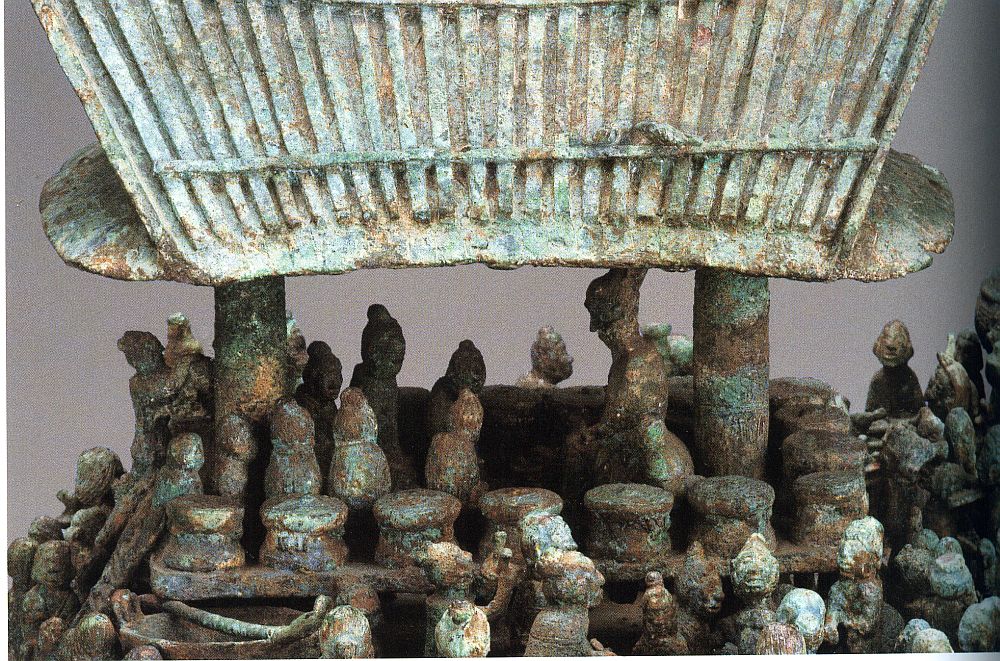
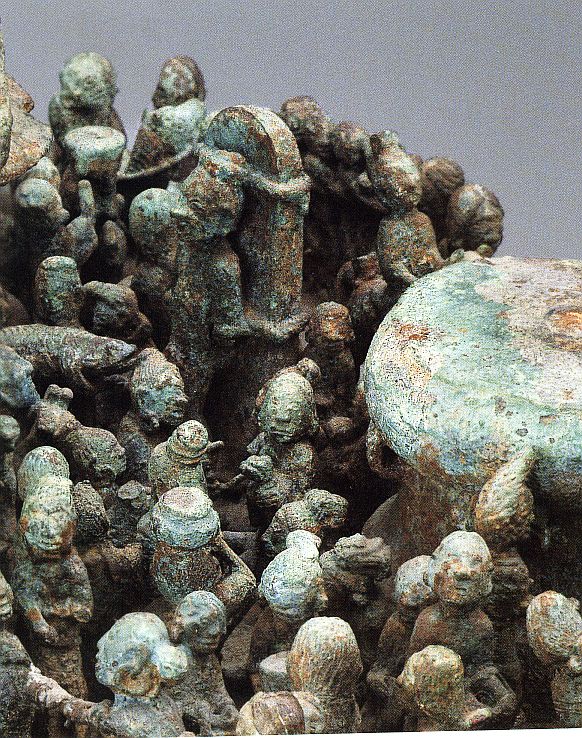
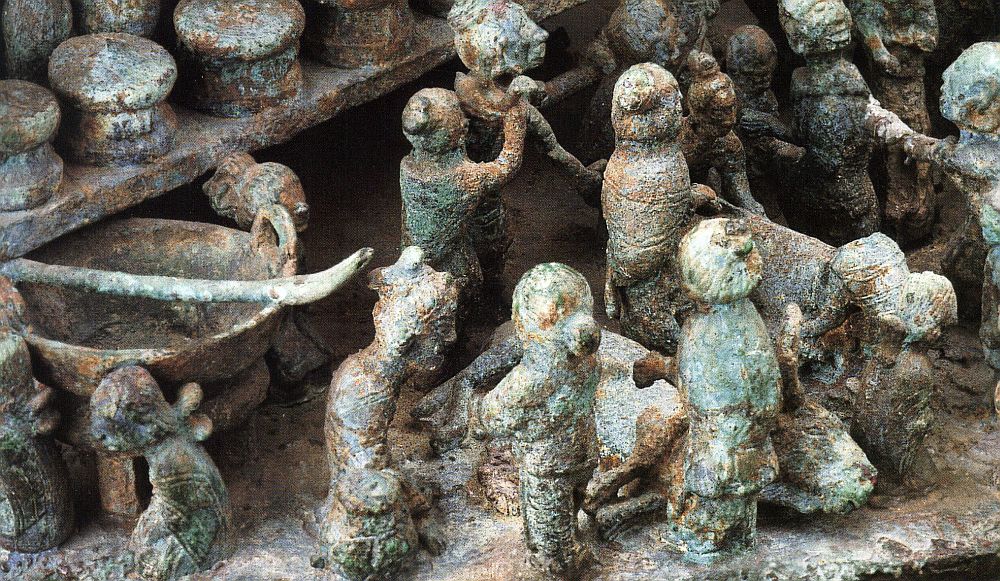
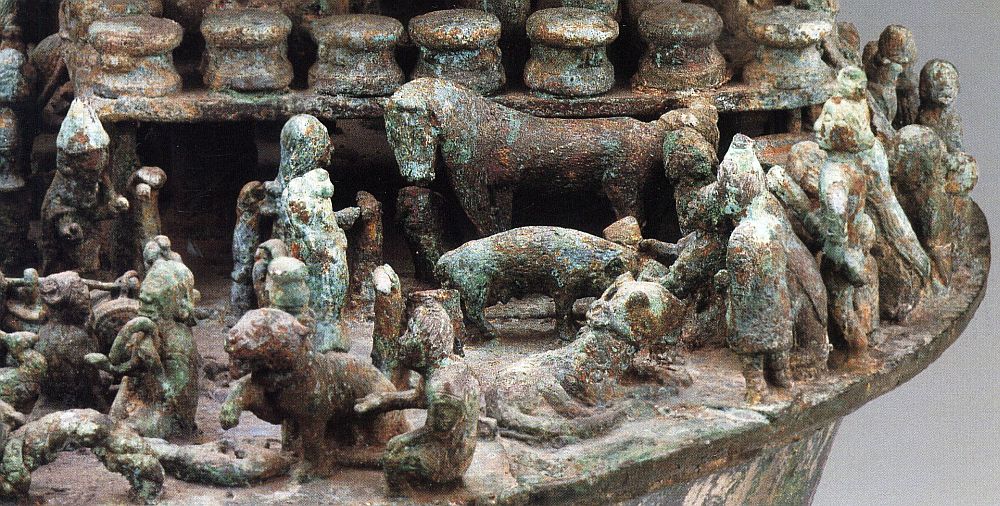
    The bronze vessel under investigation here was unearthed at Mt. Shizhai in Jinning County, Yunnan Province, in 1956 (pit no. 12). Shaped in the form of a drum, it is 53cm high; the lid measures 32 cm in diameter and 29.5cm at the bottom. It depicts on the lid a scene of human sacrifice, animal sacrifice, and communal feasting. The scene contains 129 persons, domestic animals such as horse, pig, rabbits, dogs, and a fish. The vessel stands on the feet of a dog, a domestic animal, and comes with tiger-shaped handles. The scene can be divided into four segments:

    1. Communal feast under the roof
    2. Preparation for sacrificing a human tied to an ancestral shrine, a kind of sculpted rock or stele
    3. Cutting the meat of domestic animals and cooking
    4. Feeding wild animals

    Let us look closely at these four segments:

    In Plate 1, the king sits on top under a roof facing away from the to-be-sacrificed man. He is the only one who sits in a chair. There are eight persons who offer him food. They all sit on their heels in the dirt. The roofed area is the center of the sacrificial event.

    In plate 2, there are many men carrying weapons and instruments of punishment. A naked man is tied to a sculpted rock, possibly the king’s ancestral shrine.


    In plate 3, cooks prepare domestic animals–an ox and a pig–placing the meat into a large cauldron with a ladle on top. The food is offered to the king and the people under the roof.

    In 4, we see a tiger, a leopard, and a snake. The tiger is about to devour a dog. We do not know who will get the horse and the pig in the rear. Tigers and leopards are symbols of power. Furthermore, there are musicians and people who present tribute.

    It is difficult to determine the provenance of the victim. Looking at his facial features, he seems different from the others, perhaps a Central Asian captive.

    How are we to interpret this event? A few assertions can be made, perhaps not with a hundred percent certainty, but as strong possibilities. This vessel symbolizes socio-political authority in more than a single dimension. The vessel is a shell container, a symbol of economic wealth and power. It is shaped in the form of a drum, an important ritual instrument and political tool. It depicts on the lid a sacrificial ritual with the king as the chief ritualist. The victim is tied to the ancestral shrine. This is also where he is going to be killed, undoubtedly as a way to pay respect to the ancestors, thanking them for a good year or as a prayer for a good year to come. At the same time, it is an important social event, consolidating the community under the worldly and religious authority of the king. What will happen to the victim’s body is unknown; is it distributed among the people? Are certain parts given to specific recipients? Who gets the head? who eats the heart? Or is it equally divided as in numerous sacrificial rituals elsewhere? Who if anyone drinks the blood? Is any part of the body conserved as a kind of trophy? All these are of course open questions.

    The point I would like to suggest is that this sacrifice reminds us of the human sacrifices at the altars of Shang and Chou-dynasty emperors I discussed in my Anthropoetics article, “Archaic Chinese Sacrificial Practices in the Light of Generative Anthropology” (December 1995). It is a symbol of power, very much like the shells it contains, the musical instrument it depicts, and some of the animals depicted on it: tigers and leopards. This vessel was also important enough a symbol of royal power that it was buried with the king.

    We know that human sacrifice and cannibalism were widely practiced in pre-literate societies and that they were not local but universal cultural phenomena. To prove that the ancient Chinese also participated in this culture, which has much in common with the GA position about the violent origin and early development of human civilization, was what prompted me to write this article.

  • Benchmarks (Anthropoetics XIV, no. 1)

    This issue combines articles drawn from three papers delivered at the GA Summer Conference on the theme of “Esthetic History and the Knowledge of the Human,” held at Chapman University in June, with two other items. The three conference participants, Peter Goldman, Adam Katz, and Richard van Oort, have now among them published a total of sixteen articles in Anthropoetics. Peter’s paper, on Antonioni’s Blow Up and postmodern esthetics, and Richard’s, on Kenneth Burke’s writings on Shakespeare, deal with esthetic history in the usual sense of the term, while Adam’s challenging paper applies the lessons of originary grammar to what might be called a political esthetic. Herbert Plutschow, another frequent contributor to Anthropoetics, gives us an illustrated description of a fascinating archaeological find: a Chinese bronze vessel depicting human sacrifice. And we welcome a new contributor, Edmond Wright, whose study of Gregory Bateson’s linguistic epistemology draws some interesting rapprochements between Batesonian thought and GA.

    About Our Contributors

    Peter Goldman is Associate Professor of English at Westminster College in Salt Lake City, where he teaches Shakespeare, Renaissance literature, and composition. He attended Eric Gans’s seminar on Generative Anthropology in 1997. His publications include articles on English Renaissance and Reformation literature and mimetic theory. Currently he is working on a book entitled Shakespeare and the Problem of Iconoclasm.

    Adam Katz is the editor of The Originary Hypothesis: A Minimal Proposal for Humanistic Inquiry, a recently published collection of essays on Generative Anthropology. He teaches writing at Quinnipiac University in Connecticut, and is presently at work on a new book on and in originary thinking tentatively titled Beginnings in the Middle: Originary Grammar, Remembering Firstness and Retrieving the Ostensive in Modern Semiosis.

    Richard van Oort is Assistant Professor of English at the University of Victoria. His book The End of Literature: Essays in Anthropological Aesthetics is forthcoming from the Davies Group Publishers.

    Herbert Plutschow, a member of the Anthropoetics editorial board, was born in Zurich, Switzerland and was educated in Switzerland, England, Spain, France, and the U.S.A; he received his PhD in Japanese Literature from Columbia University. He is Professor Emeritus of Asian Languages & Cultures at UCLA and Dean of International Humanities, Josai International University, Japan. His major publications are Chaos and Cosmos – Ritual in Early and Medieval Japanese Literature (1990); Japan’s Name Culture (1995); Matsuri – The Festivals of Japan (1996); Portraits of Japanologists (2000, in Japanese). Another book, The Tea Master, appeared in 2001.

    Edmond Wright holds degrees in English and philosophy and a doctorate in philosophy. He is a member of the Board of Social Theory of the International Sociological Association, and was sometime a Fellow at the Swedish Collegium for the Advanced Study of the Social Sciences, Uppsala.  He has edited The Ironic Discourse (Poetics Today, 4, 1983), New Representationalisms: Essays in the Philosophy of Perception (Avebury, 1993), Faith and the Real (Paragraph, 24, 2001), and The Case for Qualia (MIT Press, forthcoming, May 2008), and has co-edited with his wife Elizabeth The Zizek Reader, (Blackwell, 1999) and is author of Narrative, Perception, Language, and Faith (Macmillan, 2005).  Over sixty articles of his have appeared in the philosophical journals.  He has also published two volumes of poetry.

  • Blowup, Film Theory, and the Logic of Realism

    1. Introduction

    Film poses a unique problem for aesthetics by virtue of its historical novelty. Considering the broad overlap between film and more traditional arts such as narrative and drama, we might question whether a separate aesthetic theory for film is really necessary. But a theory of film is required to the extent that film can be justified as a distinct aesthetic mode. Formally, cinema can be identified fairly simply as the display of moving images upon a screen. Aesthetically, the question is considerably more complicated. Aesthetics, of course, is centrally concerned with questions of form, but it also involves our reception of those forms, which introduces an anthropological dimension.

    Eric Gans, following André Bazin, has linked the invention of film to the desire for realism(1)—a notoriously problematic term in aesthetics. My goal is to try to understand the logic of realism, which I agree with Gans is central to film aesthetics. In order to do so, it will be necessary to begin with the most basic question of visual images, considering the distinction between the visual and verbal, as well the role of perception in meaning. I then move to the more historically specific question of photographic and film images. Finally, I examine the problem of film realism as exemplified in Michelangelo Antonioni’s film Blowup.

    2. Image and Word

    Film, like painting, is essentially visual in nature. Historically, of course, almost all films are accompanied by sound, even so-called silent films. But it’s possible to have a film without sound, while a film without images is by definition not a film at all. How do images mean, and what is the aesthetic of the image? Within the context of human culture, an image is a sign or signifier (I use the two terms synonymously) and can be approached in semiotic terms. Understood thus, the relevant distinction is between the visual image and the word, the figural and the linguistic. What are the significant differences between visual and verbal signs? This seemingly obvious distinction proves surprisingly difficult to pin down.

    The most immediate difference between words and images is that images physically resemble that to which they refer, while words do not. C.S. Peirce classifies signs as iconic, indexical, and symbolic (“Logic as Semiotic”). The iconic sign appears to be “natural,” to have a relationship with its referent which is instinctively understood. Signs in airports and international locations therefore often use line drawings rather than words. The symbolic sign, on the other hand, bears a purely conventional relationship to its referent. Terrence Deacon, the biological anthropologist, develops Peirce’s distinction in a sophisticated way, arguing for the radical difference between animal communication systems and human language (59-101). For Deacon, what distinguishes the symbolic from the iconic is not simply the lack of physical resemblance between sign and referent, but rather the way that the meaning of a symbolic sign depends upon its relationship to the larger language system—which is why teaching chimpanzees language proves to be so difficult and time-consuming. It’s the classic hermeneutic problem: in order to understand individual signs, one must understand the system of signs; but one can learn the system only through the interpretation of individual instances. The brain of a child, Deacon points out, is uniquely adapted to resolving this difficulty; or rather, language is uniquely adapted to human ontogeny (102-142).

    Deacon argues that symbolic reference is qualitatively different from iconic or indexical reference, a claim that would seem to support a primary distinction between words and images, insofar as images are iconic while words are symbolic. But there are significant exceptions here. Words may be directly mimetic, as in the case of onomatopoeia, words that imitate sounds. And not all images are mimetic; even an iconic image may have symbolic aspects that are conventional and require knowledge of cultural codes. An iconic sign, therefore, may be simultaneously symbolic. Furthermore, Deacon points out, the same sign can sometimes be interpreted as iconic, indexical, or symbolic depending upon the context.

    At the originary scene, Gans hypothesizes that the first sign is linguistic: a gesture, perhaps accompanied by a word.(2) As a gesture, it may have had an indexical or mimetic dimension, as with American Sign Language, which is symbolic but can sometimes be interpreted iconically or indexically by non-speakers. Formally, the first sign begins as an indexical gesture of appropriation, but when aborted it is then intended and recognized in a revolutionary way. The revolution is in the intention and interpretation, rather than the form as such.

    Gans associates iconic signs with what he calls the imperative form of culture, in which figural representations (e.g., an image or a mask) are used within a ritual context to summon the presence of the sacred being (End of Culture 112-120). On the evolution of signs, he writes,

    the formal ostensive sign that represents the central object in its presence is inadequate to substitute for it in a reproduction of the scene. The absent object is “supplemented” by material elements that reproduce something of the sensuous effect of the originary crisis. The temporal-peripheral elements of music and dance recreate, as Girard has remarked, the rhythm of theagon, the “fearful symmetry” of the potential conflict that must be deferred. Ritual also includes synchronic representation of the central being itself in drawing, mask, statue. However formalized, these are material figures, not pure signs. They are, to use C. S. Peirce’s term, iconic, resembling their referent in more or less detail. (Chronicles #86)

    Iconic and indexical signs in ritual are not purely symbolic. Music, dance, and miming recreate the effects of mimetic crisis and resolution, inducing a more or less conditioned response. The linguistic sign, on the other hand, is not an imitation but a representation, a deferral of the mimetic tendencies of indexical signs.(3)

    At the same time, however, we must recognize that the iconic and indexical signs of ritual are essentially cultural; bird songs or mating dances, for example, are another category altogether, instinctual rather than conscious/intentional in the human sense. Moreover, the “material figures” of ritual are sacred, the salient feature of human language. Significantly, the first clear tokens of human culture are iconic (and symbolic) figures such as the cave paintings. All human signs, whether figural or linguistic, are symbolic.

    The broad overlap between the iconic, indexical, and symbolic in human culture, right from its origin, leads to the conclusion that the difference between images and words, the figural and the linguistic, is one of degree rather than kind. We must remember that all signs have a figural dimension (what Derrida calls the materiality of the signifier), as well as a linguistic or symbolic dimension. The distinction is historical rather than essential or originary, and must be approached as such.

    3. Theory of the Image in Western Culture

    The historic association of images with illusion or deceit in Western culture goes back to the Hebrew religious and Greek philosophical traditions. In the Hebrew tradition, the second commandment forbids “graven images” of God or any of his creatures. Biblical scholars inform us that this prohibition is meant to prohibit the use of physical images in worship and thus distinguish the Hebrew religion. But there are many apparently anthropomorphic descriptions of God in the Hebrew Bible, and we may well ask how they are different from “graven images.” Why are verbal representations of God acceptable while visual or graven images are not?

    Images are both ostensive and mimetic, and thus seemingly more sacred and dangerous. Iconic and indexical signs are associated with ritual and magic. The Hebrew rejection of images is thus a rejection of superstition and sacrifice in favor of a more broadly ethical form of religion. In historical terms, the Mosaic revelation, including the second commandment, enabled and expressed the liberation of the Hebrews from Egypt and its cultus.(4) As a temporarily nomadic people, the Hebrews had a practical interest in minimizing their attachment to specific buildings, locations, statues, or images. The word, after all, is more easily reproduced than the physical image or thing, a principle which is the economic basis of all language.

    The second commandment derives from the revelation at the burning bush. When Moses asks God for his name, God replies simply, “I AM THAT I AM” (Ex. 3.14).(5) This sentence reveals God as transcendent, not tied to any physical location, manifestation, sign, or even name, thus justifying the second commandment. God is utterly free in absolute terms, and specifically in regard to our conceptions and expectations of him. God’s statement is a tautology, a repetition of the simple statement, “I am.” God continues, “Thus shalt thou say unto the children of Israel, I AM hath sent me unto you.” God in effect refuses to name himself, asserting simply that the bare fact of his existence should suffice for our curiosity about his identity (notwithstanding his concession to practical human needs by subsequently naming himself as “The Lord [Yahweh] God of your fathers” [Ex. 3.15]). In semiotic terms, the Mosaic revelation implies a problem with the very idea of referential meaning, primarily in regard to God but by extension with all signs (which, by our hypothesis of the origin, derived from the first sign, the name of God). God exists indubitably, but cannot be named or represented. Meaning is not only or primarily referential, because signs (both images and words) are never fully adequate to their transcendent meaning. This revelation has far-reaching implications; in Gans’s words, “it provides the ethical principle that will eventually permit the emergence of modern social systems” (Science and Faith 60). The scenic center of the ritual order is emptied out of figures (typically controlled by a priestly hierarchy), allowing a subversive freedom for those on the periphery. Of course, in practice, Judaism was and remains a deeply ritualized religion. The prophetic tradition and then Christianity are the main bearers of Mosaic iconoclasm. Meaning, in this tradition, is primarily social and ethical (and thus flexible, determined by contingent human needs) rather than fixed by law and ritual.

    In the originary hypothesis, the sign ostensively refers to the central object, an appetitive object such as the slain body of a large mammal. The central object, however, is already the center of everyone’s mimetic attention; so more specifically, the sign reveals the significance of the object for the community: its sacral status, its inaccessibility to appropriation. Neither the sign nor the central object by itself is enough to generate the meaning, which is a function of the actual event. (Members of the nascent human community not present at the originary scene would presumably have to learn the sign through the ritual re-enactment of the event.) The central object is ultimately inadequate to its spiritual meaning. This lack is what both enables and motivates the sparagmos. There is a significant disjunction between what we perceive, the material object, and the meaning; in the Mosaic revelation this distinction becomes another version of the sacred-profane dichotomy. Material figures of God are blasphemous and must be rejected, in some cases destroyed, in order to reveal transcendent meaning. Even the name of God, Yahweh, is regarded as too sacred to pronounce or fully spell out.

    Physical perception, essential for survival, evolved for millions of years before the birth of language. The capacity for linguistic understanding, essential for the survival of the human community, is the newcomer in evolutionary terms (which is why we need such big brains, otherwise anomalous). Perception and understanding are in tension, insofar as perception by itself doesn’t lead to meaning, yet is its necessary ground. Wittgenstein points out that it’s possible to see the world differently (193e). But in that case, we change, not the world. Meaning is not an objective “picture” of facts but a social phenomenon. Ultimately, perception is governed by understanding, and not the other way around.

    My analysis suggests that the anthropological significance of the second commandment is grounded not on the distinction between visual and verbal signs, but rather between physical signs and transcendent meaning. It’s more or less an accident of history that this originary opposition tends to be expressed in terms of image-versus-word. The word, by virtue of its physical difference from its referent, resists the idolatrous tendency to collapse meaning and reference.

    In his conversion on the road to Damascus, Paul hears a voice, a word, which he recognizes as Christ, while he is physically blinded by a divine light. His physical blinding is the necessary condition for his spiritual insight that Christ is the Lord. Paul, in effect, was focused on the scandalous appearance of the crucified Jesus, which blinded him to the transcendent meaning, the resurrected Christ. In his letters and preaching, Paul constantly calls attention to this dichotomy, sometimes at the expense of Jesus’s ethical teachings.

    The persistent danger of idolatry reflects the compelling nature of desire, which attaches itself to physical incarnations and thereby seeks a final answer to the problem of transcendence. The cross presents a semiotic model in which the sign is destroyed along with the attached desires in order to reveal or create a transcendent meaning that remains beyond direct perception and immediate desire.

    My analysis of the visual-verbal distinction also largely applies to the philosophical tradition from Plato to Descartes and beyond. The flickering images in Plato’s allegory of the cave can be contrasted to the Socratic verbal dialectic which leads to truth. Likewise for Descartes reason is a more reliable guide than the senses. But as with Hebrew iconoclasm, the underlying problem is semiotic, the relationship between sign and meaning. From a religious perspective this gap can be overcome only through faith. For philosophers, reason is the answer, although the history of philosophy is the gradual recognition of the limits of metaphysics, that is, its own limitations. Derrida, at the end of this tradition, arrives at the claim that Judaism begins with, that the sign is never adequate to its meaning.

    As we have seen, images are often seen as threatening in the Western tradition because they are ostensive and thus closer to the sacred. But the ostensive nature of the image applies to all art. The meaning of an artwork is its effect, not its argument. Art is revelatory rather than declarative; it doesn’t “argue” in the same sense as metaphysics or make “truth” claims. Even when an artwork, such as a novel, includes characters that make philosophical arguments, their significance must be analyzed in terms of reception.

    The image seems to naturalize, which is why theories of ideology, whether Marxist or psychoanalytic, typically use visual metaphors. Ironically, a parallel philosophical tradition uses visual metaphors to describe truth, as for example with Heidegger’s aletheia, unveiling, taken from Plato—a metaphor which works well with art, if not metaphysics.

    Art, in contrast to philosophy, openly admits its fictional status. Didactic theories of art insist on the value of illusion as a more or less necessary pathway to truth. The Romantics sought to overcome the dichotomy between appearance and reality with a symbol whose appearance takes on a mysterious depth, a schöner Schein or “beautiful semblance.” Art reveals a higher truth that is inaccessible to literal representation. Philosophers such as Nietzsche, Heidegger, and Derrida place a whole new value on art. For them, a sign that openly admits its fictional status is more honest and therefore “true.”

    4. Realism and Empiricism

    Realism can be traced back to ancient and medieval comedy on the one hand and the New Testament on the other. Comedy, however, fails to treat ordinary people seriously, and the New Testament relies on supernatural elements. The drama of Marlowe and Shakespeare represents a quantum leap forward in realism, although lower class people are still typically comic characters. The decisive influence on the development of modern realism is undoubtedly the Protestant Reformation. Each individual, in his or her relationship to God, became worthy of serious literary representation, and spiritual autobiographies by figures such as Bunyan provided an important model for early English novelists.(6)

    Equally important, especially for film realism, is the empirical tradition: Bacon, Locke, and Hume, leading into logical positivism. These philosophers claim that experience is the surest guide to truth, which they insist on demystifying in referential terms, things we can actually point to in the world. Locke and Hume reverse the whole philosophical tradition up to that point by turning to that which previous philosophers found so dangerous and deceptive: the senses. Empiricism contradicts the ancient hostility towards images and appearances, but it operates by the same logic. The underlying problem is still the relationship between the sign and meaning. The attack on appearances in the Platonic dialogues reflects the understanding that meaning transcends appearances. Plato’s optimism is that through a dialectical process of abstraction we can pierce through those mimetic appearances to an ideal reality. In empiricism, this same iconoclastic skepticism towards appearances is applied to Plato’s eidos. To get at meaning, we need to go back to material reality, to which our senses are a more or less reliable guide. Existing words and concepts are a faulty superstructure built upon the ground of physical reality. In its most rigorous forms, empiricism denies the reality of the sacred. Empiricism is a kind of semiotic literalism, a reaction to the medieval tendency towards allegory. Signs must refer to empirical reality or they are not really meaningful.

    Modern literary realism, as it’s usually defined, begins with the novel. As with empiricism, one of the primary characteristics is fidelity to experiential reality, especially contemporaneous social reality, that is, the rapidly evolving free market. And again as with empiricism, realism defines itself in opposition to the past, in this case, romance or allegory.

    Novelistic realism is a highly self-conscious mode: it reflects upon its own authority and its audience. The author commonly addresses the audience in asides and prefaces, anticipating their objections and reactions. This self-consciousness expresses its theoretical or anthropological dimension: the attempt to understand the question of meaning in order to liberate itself from the remnants of the medieval cosmos, tied to ritual structures of hierarchy and sacrifice, and to find new models of meaning more appropriate to a market society. This attempt parallels in empiricism the construction of scenes of human origin by Hobbes and Locke.

    In practice, narrative realism is an investigation of the role of desire in human relations. In the modern period, desire is liberated from the old ritual and hierarchical structures. A market society, as Adam Smith recognized, incorporates the dynamic but dangerous power of desire as a constructive force, instead of trying to suppress it, as in traditional societies. Because the market runs on desire, it becomes necessary to understand desire, which often means critiquing and demystifying it. Girard’s theory of mimetic desire, of course, grew out of his analysis of the realistic novel. At the same time, the examination of desire in the novel is not just a theoretical question, but also a practical one of succeeding in a market society.

    5. Photographic and Film Realism

    On the one hand, photographs are the most mimetic of all representations, the most faithful to our physical perception of the world. Yet on the other, photography appears the least mimetic in the Girardian sense: there is no one who imitates reality, no one who mediates between our self and the reality represented. Bazin comments,

    No matter how skillful the painter, his work was always in fee to an inescapable subjectivity. The fact that a human hand intervened cast a shadow of a doubt over the image. (12)

    For the first time [with photography], between the originating object and its reproduction there intervenes only the instrumentality of a nonliving agent. For the first time an image of the world is formed automatically, without the creative intervention of man. (13)

    The photograph is an indexical sign, a physical impression of reality like a fossil or a relic, and, as such, not obviously a sign at all; it seems almost to collapse into perception. To borrow Matthew Schneider’s words, the photograph fulfills “what we might call the originary imperative to minimize representational deferral, to transcend the sign and become the thing itself” (Chronicles #132). The photograph seemingly removes the (mimetic) mediator and achieves the objectivity of a “natural sign.”

    For Bazin, eliminating the intervention of “a human hand” is simply a fortuitous development in the psychological impulse towards realism. But as Gans recognizes insightfully, the exclusion of the mediator is the primary motivation. He writes,

    the horizon of realism . . . is not to reproduce the “real,” the phenomenal stuff of human experience, with utmost accuracy, but to do so independently of human desire. This realist horizon defines the heroic tale of the high-cultural artist who learns painstakingly to copy the nuances of appearance by deferring or “sublimating” his own desiring relationship to the object. (Chronicles #86)

    The unspoken motivation behind the nineteenth-century drive to reproduce sound and image is the desire to liberate representation from the triangular relationship with the Other-Subject. (Chronicles #228)

    Underlying realism and empiricism is the realization that signs and their associated concepts are mediated, conditioned by desire and resentment; hence the skepticism of realism, the attempt to get at what is real. Minimizing the distortions of desire expresses the iconoclastic, desacralizing thrust of realism: do away with false romantic dreams. Represent the truth, no matter how distasteful or sordid.

    Ironically, then, the photograph seems more sacred than other forms of representation to theoreticians like Bazin. He writes,

    Only the impassive lens, stripping its object of all those ways of seeing it, those piled-up preconceptions, that spiritual dust and grime with which my eyes have covered it, is able to present it in all its virginal purity to my attention and consequently to my love. (15)

    Stripping off the “spiritual dust and grime,” “all those ways of seeing it,” doesn’t demystify the object but actually reveals its heretofore hidden sacrality. Roland Barthes describes the photograph in similar terms. The photograph, for him, presents an undeniable reality; it “is indifferent to all intermediaries: it does not invent; it is authentication itself. . . . Every photograph is a certificate of presence” (86). Barthes contrasts the photograph with writing, which is unable to give him that certainty: “It [writing] is the misfortune of language not able to authenticate itself” (85).

    Walter Benjamin, in contrast, argues that mechanical reproduction strips away the quasi-sacred aura of the art object. But Gans points out,

    Walter Benjamin’s famous discussion of the loss of aura misses the essential point that the mechanical reproduction of the referent’s own trace is the direct heir to the sacred aura of the object itself. Because it preserves a trace of its object, a photograph has more aura than a painting. (Chronicles #86)

    What the photograph doesn’t reveal, however, is how and why the object became sacred in the first place. Rather, the photo pays homage to what it reproduces.

    Gans argues that because the technology of photography is based on a mechanical impression of reality, it has a fundamentally different aesthetic from traditional arts like painting, which contrast the sign-image with “an imaginary reality wholly dependent on it” (Chronicles #86). While the invention of photography impacts the development of modern painting, it “cannot occupy the same esthetic terrain,” since they function in different ways. Film, on the other hand, introduces a temporal dimension that leads inevitably into narrative, which does create an imaginary world. Film thus competes, successfully, with literature and drama. The narrative possibilities of film allow for the exploration of anthropological issues such as desire and the sign. Film develops a realistic narrative mode comparable to the novel, in a form which, as spectacle, tends towards popular, mass art.(7)

    How can we reconcile the two contradictory impulses of realism: iconoclastic yet sacralizing? The unifying element is the question of meaning, which realism wants to understand (and hence critique) as well as answer, in the sense of providing meaning. The critical rejection of romance and idealism may itself provide a kind of catharsis. But demystification sometimes takes the form of parody or quotation, which is often more affectionate and nostalgic than critical. Realism may also pay respectful homage to the sacrificial reality of the past (e.g., Carl Dreyer’s Joan of Arc) while also critiquing the society which sanctions such sacrifice (see Gans, Chronicles #228). Realist works often represent new mechanisms of transcendence appropriate to a market society, for example the rags to riches story, in which hard work and intelligence provide the road to success in a society open to talent. Of course, realism has a tendency to collapse back into melodrama or comedy; Dickens is a good example here. To a large extent, the limits of realism are the limits of art itself, which can never fully theorize its own workings without ceasing to be art and turning into theory. The most developed and self-conscious form of realism explores its own limits and deconstructs its own aesthetic, as with Blowup, which, in doing so, enacts the passage to a modernist and postmodernist aesthetic.

    6. Blowup

    Michelangelo Antonioni’s film classic Blowup consciously addresses the fundamental problem of realism, the relationship between sign and meaning.(8) The film works on two main levels, as narrative and as a theoretical reflection upon the epistemology of film. Antonioni began making films like Il Grido within the Italian neorealist film tradition, but he then made his name with modernist/postmodernist works like L’Avventura and Blowup. In an essay from 1964, he writes,

    During the post war period there was a great need for truth, and it seemed possible to photograph it from street corners. Today, neorealism is obsolete, in the sense that we aspire more and more to create our own reality. This criterion is even applied to film of a documentary character and to newsreels, most of which are produced according to a preconceived idea. Not cinema in the service of reality, but reality in the service of cinema.

    There is the same tendency in feature films. I have the impression that the essential thing is to give a film an almost allegorical tone. This means that every person moves in an ideal direction, which is irrationally in agreement with everyone else’s direction, until a meaning is formed that also includes the story being told, but that goes beyond it in intensity and freedom of solutions. (62-63)

    Here and in his other writings, Antonioni suggests that meaning is discovered in the creative process rather than being determined by a preformed authorial intentionality. The mimesis of empirical reality is subordinated to a collaborative process involving the audience and actors. Modernism follows realism in questioning the role of the artist as the origin of meaning, reflecting the larger problem of cultural authority in market society. Gans comments,

    The realist esthetic includes for the first time a critical model of its implied audience, whose situation with respect to the scene of representation it attempts to redefine . . . . The esthetic experience of the work becomes a critique of universal cultural assumptions such as the mediating narrator or the formal self-substantiality of the painted universe. (Originary Thinking 179)

    To say, as does Balzac, “All is true!” disclaims the author’s responsibility and shifts the problem of authority onto reality. Antonioni, however, suggests that empirical reality is not an unproblematic ground for meaning because the “facts” always stand in need of interpretation, which he recognizes as a creative, collaborative process.

    Antonioni never abandons his commitment to realism, however. In an interview from 1969, he laments that most American directors do not “say what they really believe,” preferring instead “to manipulate cinema” and use “facile effects” (316). Furthermore, he says,

    if someone creative wants to help himself, then he should look outside, go down into the street and mingle with other people. It’s the only way to grasp the essence of truth, to make films that have that flavor of truth, which cinema needs today more than in the past. (317)

    The concern with the “flavor of truth” demonstrates his engagement with a specifically human reality. Because of his artistic commitments, Antonioni is a natural figure for examining the transition from realist to modernist film aesthetics.

    Blowup was released in 1966 and is set in the youthful “mod” scene of 1960’s London, complete with sex, drugs, and rock ‘n’ roll. The protagonist is a London fashion photographer (named Thomas in the script) who by chance takes some photographs of an unknown couple in a park. When he blows up the photographs later, he becomes convinced that he photographed the murder of the man in the couple. The plot concerns his finally inconclusive attempts to determine what actually happened in the park. The photographer is a figure for the artist in a postmodern commercialized world.

    His creative approach to his craft and his photo art-book project justify viewing him as an artist. But Thomas’s art extends beyond his job to his whole approach to life. Thomas is the artist as capitalist and vice-versa. He spends a lot of time shopping in the film. When he sees his friend’s abstract painting, he immediately wants to buy it. His friend Bill refuses to sell, representing a more idealist attitude toward art that is outmoded. Significantly, the painter’s wife is bored with him and shows interest in Thomas.

    He’s also negotiating the purchase of an antique store in a seemingly deserted part of town, but Thomas insightfully notices a homosexual couple walking their dog, and he anticipates that the neighborhood will soon become fashionable, allowing him to sell or develop the property for a substantial profit. He sees a propeller at the antique store and immediately purchases it, realizing its value as a decoration for his studio.

    The new economy portrayed in the film is based on style and marketing, not the production of commodities. The worn-out relics of industry have become the target of Thomas’s talent for aestheticizing. Early in the picture, Thomas emerges in disguise from a flophouse where he was surreptitiously taking black & white photographs for his photo book, which will be presumably be a high-brow project establishing his credentials as a serious artist. He photographs the derelicts of working-class life, dispassionately presenting their grotesque bodies as aesthetic spectacle. Nineteenth-century novelistic realism or Italian neo-realism would have represented the lives of such people sympathetically and in-depth, as the victims of industrialization. For postmodernity, industry is somehow not as “real” as marketing, the aesthetic “value-added” that makes the difference between success and failure in an economy which has largely solved the problem of production.

    The Sixties represent an important phase in the evolution of market society, a new stage in the liberation of desire. His job involves being at the cutting edge of the newest market trends. Although he doesn’t actually design the clothes that his models wear, he markets these clothes and fashions through his job.

    In the modern world, everyone is an artist of his or her own life, and Thomas provides a practical model of how to do so. He aggressively seeks out and creates the newest fashions. The point is not simply to accumulate wealth but to become the object of everyone’s desire. The propeller, for example, doesn’t have any great resale value, but it says something important about its owner. He’s not afraid to take risks and do outrageous things in order to create himself as the glass of fashion. He consciously teaches other characters like Jane (so-called in the script, played by Vanessa Redgrave) how to be “cool.” He tells her that she needs to move against the beat of the music. In larger terms, this means going against, rejecting the current trend in favor of the upcoming fashion, which is still relatively unknown. One must take chances and go against the grain in order to distinguish oneself in a modern society of liberated desire.
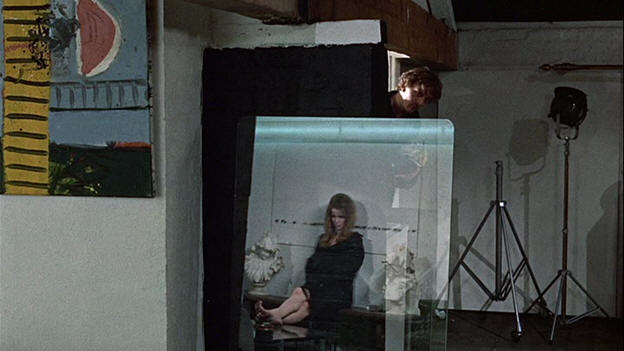
    Figure 1: Thomas entering his studio while Verushka, reflected in a pane of glass, waits.

    One of the most famous scenes from early in the film is the photo shoot with the real-world model Verushka, which is portrayed as an act of sexual seduction. Photographers commonly manipulate the mood of their subjects, and this is exactly what Thomas is doing here in an over-the-top sixties fashion. Thomas evidently enjoys working with Verushka (in contrast to his other models in the following scene), but he doesn’t get personally involved. He makes her wait for over an hour with no apology; he’s indifferent to her concerns about missing her flight; and when he has the shots he wants, he turns away from her with indifference. The scene with Verushka demonstrates that Thomas is a master of desire, or at least is regarded as such by himself and his associates; he can manipulate the desire of the model and his audience without any personal investment. Verushka, in contrast, is evidently really caught up in the excitement.

    There’s no evidence that Thomas feels any real passion for his job as fashion photographer, much less the abstract fashion photographs he produces; on the contrary, he despises the fact that he’s forced to prostitute himself to a purely commercial craft. The photo shoot scenes are almost like an assembly line, and the models are dressed and made-up like impersonal masks or objects.

    His models represent his audience. It is precisely such young women who would purchase the fashion magazines and the clothing they sell. The two fashion “groupies” who invade his studio are not only intrigued by the photographer himself and world of high-fashion photography, they also simply want to wear and see themselves in the clothes he has in his studio. Thomas is openly contemptuous of his audience, and they fearfully worship him all the more for it.

    The rock concert scene extends the film’s investigation of desire. The crowd is strangely still and passive during the concert, more like a film audience than a rock concert audience. When the guitar player “angrily” smashes his guitar (as so many rock stars did deliberately at the end of the show) and throws the neck to the audience, a sudden frenzy ensues in which people are trampled as everyone seeks the object sacralized by contact with the music idol. The photographer is caught in the frenzy like everyone else, demonstrating his susceptibility to mimetic contagion.

    He wins the guitar and escapes, but once he is outside, he examines the neck with a critical eye and tosses it away. The neck’s appeal was purely mimetic, and thus the film demystifies desire. Between this scene and the murder, Girard could have derived his entire theory of mimetic desire and scapegoating. Just before the rock concert, Thomas walks in on Bill and Patricia having sex in their apartment, but only Patricia sees him. She is evidently bored having sex with her husband (a wedding ring on her left hand is visible in this scene), but when she notices Thomas quietly watching them, she becomes excited and motions for him to stay and watch. Her desire becomes stimulated only when there is a witness to validate her husband’s desire for her.(9)

    It’s unclear exactly what Antonioni’s attitude is towards the swinging scene of the film, but Thomas himself is dissatisfied with his life. He complains to Ron, his editor, that he wishes he had “tons of money; then I’d be free,” and that’s he’s sick of the “bloody bitches” that he works with. Thomas’s dissatisfaction is to some extent a pose compatible with the image he cultivates, as Ron’s comment suggests: “Free to do what? Free like him?” At which point the film cuts to a close-up of one of Thomas’s photographs portraying a bleak-looking homeless man. But Thomas is also genuinely disillusioned, having an insight into the seeming emptiness of liberated, “fulfilled” desire.

    Patricia offers a mirror image of his disaffection. After making love to her husband, she goes to Thomas’s studio and he immediately asks her whether she ever thinks of leaving Bill (in light of her obvious dissatisfaction with him). She replies firmly, “No, I don’t think so,” leaving the exact nature of her unhappiness with Bill undefined. A minute later, however, she makes an almost inarticulate plea for help: “Will you help me? . . . I don’t know what to do.” The question is left strangely hanging in their distracted conversation.

    Thomas evidently has ambitions to do serious art, but presumably he can’t make enough money to survive on projects such as the photo-art book on London he’s planning. Thomas is searching for a deeper level of meaning that seems unavailable even (or especially) in a world of liberated desire. The murder in the park that he photographs promises him, and us as audience, a new possibility of meaning. He’s finally getting at something that’s “real” and meaningful: human violence. But unlike a conventional murder mystery, it’s not clear whether a murder has taken place at all.

    He encounters a romantic couple in the park purely by chance and decides to take some pictures. During the taking of the photographs, the viewer has no clues that a murder might be taking place. The woman’s (Jane) reaction to his photographing them seems exaggerated and desperate, but is explainable if she were trying to cover up adultery, as she claims later.
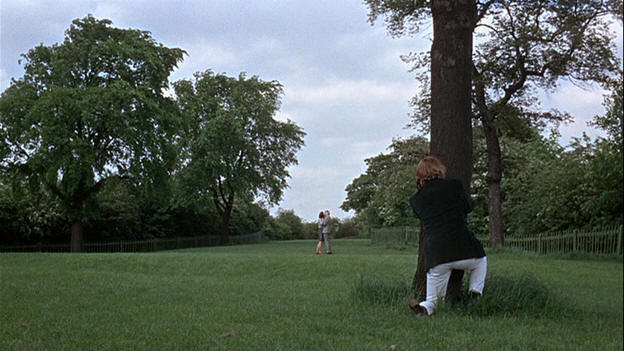
    Figure 2: Thomas at the Park

    After he leaves the park and meets his friend in a restaurant, he catches a man spying on him and then trying to open the trunk of his car. The film clearly implies here that the woman has an accomplice, and he is not the man she was kissing in the park. This is hard to explain unless there has been a murder. This same man apparently follows him to his studio and directs the Redgrave character there. In his studio, she again seems strangely desperate and tries to steal his camera with the photos. Then she offers to have sex with him in exchange for the film, another sign of her desperation, although the film suggests that later she is really attracted to him.

    He finally gives her a decoy roll of film while secretly keeping the real roll. During his encounter with her, he receives a phone call from an unknown person, which introduces an outrageous and comic series of contradictory statements about the person who is calling and his relationship with her. His behavior here could be seen as a response to the woman’s lack of disclosure, but it is also typical of his character, as when he disguises himself as a bum at the flophouse. His sense of identity is not just ironic and performative but cynical and manipulative. There is a certain existential emptiness at his core. He doesn’t know who he is or what he really wants, for all his mastery of others’ desires.

    The scene in which he blows up the photographs galvanizes him in a way that we haven’t seen before. He’s consumed here by a real desire to know what actually happened in the park. At least one of the blown-up shots seems to demonstrate unambiguously that there was a man with a gun hidden in the bushes at the park, presumably the same man who follows him to his studio and later steals the photos. We recall as we see this shadowy figure the woman’s insistent leading of the man around the park, pulling on his arm, which could be putting him into position for the murder.
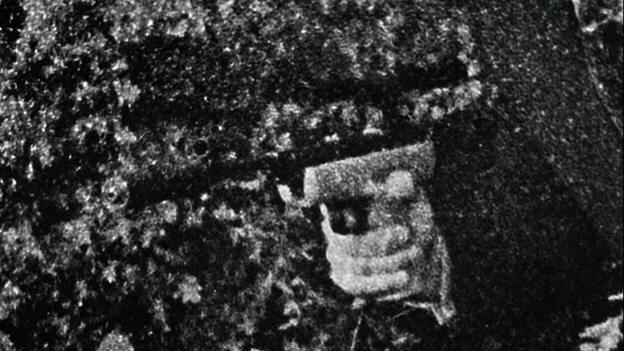
    Figure 3: Blow up of hand with gun.

    The route to knowledge here is through the photographs. The movie realizes that questions of knowledge are all in the last analysis questions of representation. The supremely realistic photograph is not a transparent representation but rather an actual discovery mode. Blowing up the photographs could be viewed as analogous to using a microscope, simply extending the reach of the senses. But in theoretical terms, the film recognizes the profound truth that representation reveals things that simple perception cannot. The question is not so much what happened, as in a conventional murder mystery, but the relationship between a world of signs and a constructed world of meaning. The photograph is a sign to be interpreted.

    Through the blowups he constructs a narrative: first, that he has prevented a murder from taking place, and then, that he was an unknowing witness to a murder. The film thus enacts the historical passage from photography to narrative film. But the narrative, unlike the indexical photographs, has to be constructed, illustrating the specific aesthetic possibilities of film. The photograph, a physical impression of sensual appearances, takes him beyond appearances to an underlying, hidden reality. By itself, the photo-fact is inadequate to its presumed meaning; it must be “blown up” and interpreted to reveal its truth (more on this point below). The fact that murder is given as a token of basic human meaning is significant; the film recognizes on some level the violence that representation originated to ameliorate.

    The murder in Blowup would be amenable to a Girardian interpretation: behind the seemingly idyllic scene of the park is a violent reality, which is discovered through the serendipitous photographs. Girard might well gloss the seeming ambiguity of the murder as simply a modernist myth that our critical analysis would serve to unmask. As we’ll see, however, the ambiguity surrounding the murder cannot be dismissed that easily.
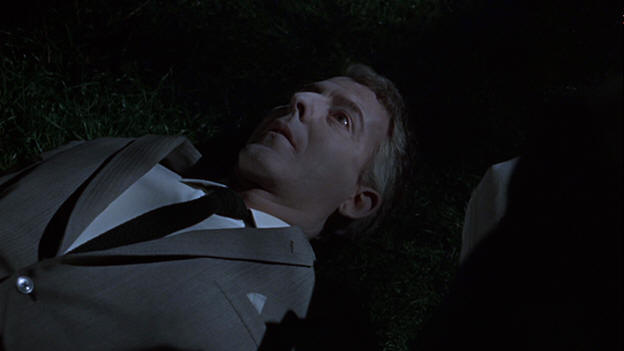
    Figure 4: The dead body

    After his blowups reveal what resembles a prone body, he returns to the park at night and discovers what seems to be an actual body, the man with Jane earlier, and he even reaches out and touches it. Some critics take this scene as irrefutable evidence that a murder has taken place. But the body he finds is very strange looking. The lighting from an electric sign casts a weird blue pallor over everything.(10) There are no overt signs of violence on the rigid body. The eyes are open and stare vacantly up. It looks like a wax doll or rather an actor pretending to be dead, as of course it is on one level, and which is precisely the point, in my view. The deliberately fake looking body suggests that the film is reflecting here upon its own representational mode.

    In a sense, this is the ultimate realism, a fiction that more or less openly admits its own fictional status. As in Hitchcock’s Stage Fright or David Lynch’s Mulholland Drive, we learn that we cannot trust what we see. It’s common to say that Blowup problematizes photographic realism; what’s interesting to me is how it illustrates the transition from realism to abstract art, especially painting, but also radical works like Finnegans Wake.

    As he blows up the photos, they become more and more grainy and fragmented; rather than revealing new detail, they seem to decompose into random splotches of black and white. The blowup sequence proves to be the iconoclastic destruction of the image, which is exactly the logic of abstract and expressionist art. The breakdown of the figural in 20th century plastic art reflects an attempt to suggest an underlying, more authentic reality inaccessible to formal representation, or simply to deny that there is any definitive reality to be represented at all.

    Figure 5: The only remaining blow up from the park.

    After all the prints are stolen, Thomas finds one remaining extreme blowup of the body that the thief left behind inadvertently. He shows it to Patricia, who remarks, “It looks like one of Bill’s paintings.” Earlier in the film, Bill describes his painting process, pointing to a painting he did in the cubist style:

    They don’t mean anything when I do them—just a mess. Afterwards I find something to hang onto—like that—like—like . . . that leg . . . . And then it sorts itself out. It adds up. It’s like finding a clue in a detective story.
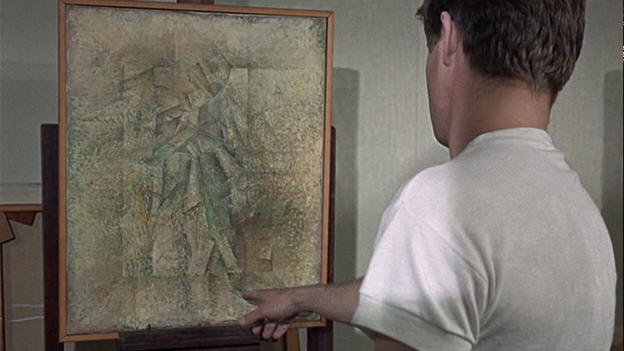
    Figure 6: Deciphering a modern painting.

    This almost exactly parallels the process of interpreting the blowups, providing an important comment upon that sequence. In Bill’s description, finding the form or meaning is completely arbitrary. There’s no intention to put that form into the painting; it emerges by chance as much as from the viewing process as from the painting process. This suggests that any kind of set meaning we find is purely contingent. The sign bears no necessary relationship to its meaning. All we have are fragments like the random splotches of paint in Bill’s paintings, which we can hardly hope to assemble into any coherent whole.(11) The hope of realism, to establish that link through fidelity to empirical truth, is doomed. Anti-figural art thus illustrates the problem that realism is unable to solve. Blowupdemonstrates how the logic of realism leads inevitably to its own demise.

    In an essay from 1964, Antonioni writes,

    We know that under the revealed image there is another one which is more faithful to reality, and under this one there is yet another, and again another under this last one, down to the true image of that absolute, mysterious reality that no one will ever see. Or perhaps, not until the decomposition of every image, of every reality.

    Therefore abstract cinema would have its reason for existing. (63)

    This quote nicely illustrates the logic of realism. By going “under the revealed image” one is able to find “another one which is more faithful to reality.” Destroying the image to reveal the truth, which is figured as image, a seemingly natural sign, free of human mediation. But the iconoclastic process has no logical stopping point; it continues until it destroys all images, ending in “the decomposition of every image, of every reality,” and justifying the turn to abstraction. The meaning of iconoclasm is the process itself, the cathartic and sometimes genuinely progressive destruction of conventional forms. But, at the theoretical level, it begs the central question of meaning as such.

    As anthropology, the film denies any definitive originary scene. There are only interpretations of an event which is finally ambiguous, not “real.” Representation can’t do without interpretation (which is essentially arbitrary because conditioned by desire), and so there is no transparent window onto reality, even with a photograph. The film thus confirms the thesis of deconstruction before deconstruction was widely known in America, even by academics.

    Blowup illustrates what is ethically at stake in the postmodern turn. To find the murderer, to settle on one version of events, would necessitate another killing, in terms of the plot imperatives of the detective film. Deferring the revelation of the identity of the murderer allows us to defer that second murder. The claim that meaning is always deferred is on one level a denial of meaning, but on another level it exemplifies the anthropological truth that deferral is meaning, and in this movie, the deferral of closure is the deferral of the sacrificial violence that typically ends such a movie.

    Postmodernism begins with the revelation of the Holocaust, creating a hyper-awareness of victimization that makes the conventional movie ending seem sacrificial. This is a progressive move in ethical terms for Western society, allowing for important developments like the civil rights movement of the fifties and sixties. But as the film points up, it could also mean letting a murderer go free: thus the necessity for post-millennialism, a recognition of the limits of victimary thought.

    One other factor complicates the plot question about the murder. As many critics have noted, the film makes a parallel between the shooter in the park and Thomas, who also shoots in the park. Both of them hide themselves in the bushes at the murder scene, and the shooter is young and blond, physically resembling Thomas. The shooter, therefore, is set up as Thomas’s mimetic double or rival, and this holds an important clue to the meaning of the film. Photography, we recall, is the mode of representation that ostensibly eliminates the mediator. But the film suggests that representation always involves human mediation. As his double, the shooter haunts Thomas, spying on him as he eats, following him to his workplace, ransacking his studio, stealing the photographic evidence, and finally disposing of the body, the one seemingly incontrovertible piece of evidence.(12) Before the murder, Thomas has been in charge of virtually every situation in which he finds himself; he demonstrates the mastery of desire. But now he isn’t in control, not even of his own photographs, which are stolen by the shooter. In terms of the film’s allegory, the artist is not in charge of his own meanings. The desires of the Other intervene. In more literal terms, we could mention the impact of a film director’s various collaborators, the cameramen, producers, actors, as well as his professional competitors and audience. The shooter, as mimetic double, illustrates all the ways that Thomas is not in control of his own desires and, therefore, the meaning of his representations or signs, not simply in reception but origin. As Stephen Crane points out in “The Blue Hotel,” every murder is the result of a collaboration. Antonioni gives a semiotic spin to this rather Girardian point. It’s not so much that Thomas collaborates in the murder or has unconscious murderous (or sexual) desires, although some critics have argued that his lack of public action allows the murderer to go free.(13) It is rather that all representations are mediated by desire, and since no desire is wholly original or self-identical, therefore the meaning of our representations is similarly decentered.

    At the ending of the film, Thomas goes back to the park in search of the body again but finds it missing, and thus any evidence that a murder occurred at all. As he wanders on his way home, he encounters the students dressed as mimes that opened the film. Miming, like film, is a visual art. They unload from their car and two of them mime playing a game of tennis at a court surrounded by a high wire fence, while the rest watch the path of the imaginary ball intently. John Freccero notes insightfully that the mimes are associated with magic and sorcery, liminal figures “who mediate between the world of spirit and the world of matter” (127), between material signifier and spiritual meaning.
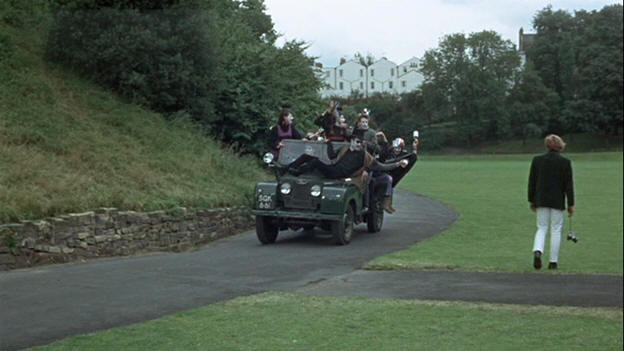
    Figure 7: The mime group and Thomas.

    Thomas watches the imaginary game with detached amusement until they pretend to hit the ball over the fence in his direction, gesturing for him to throw the ball back. This is an ambivalent moment for Thomas. Will he play their game, which seems so empty, especially in the aftermath of the murder? He reluctantly accepts the necessity of fictionality, miming picking up the ball and throwing it back, so that they can continue the game. In effect, Thomas is forced by the events of the film to acknowledge that the meaning he is searching for is, like the ball, a fiction. Even the objectivity of a photograph proves to be a mediated representation whose meaning he cannot control.

    The tennis court fence parallels the white picket fence at the park.(14) In the earlier scene, when photographing the couple, he hops over the fence, thus placing himself outside of the “frame” or “scene” of the murder. He positions himself as an impartial and objective recorder of the incident, like a camera itself. Similarly, he finds himself on the outside of the fence at the tennis court, watching a game in which he declines, at first, to participate, holding himself “above the game” as it were. Yet, just as he became sucked into the events at the park, losing control of his perspective and finding himself a participant in events; so, at the tennis court, by the same logic, he enters into the game in contradiction with his general attitude of mimetic detachment. Anthropologically speaking, the significance of the scenic center is never independent of the spectatorship of the periphery. The impact of the desiring imagination of every spectator makes perfectly objective, unmediated representation impossible. Disinterested spectatorship is itself an illusion (and the target of the film’s iconoclasm); there are only more or less conscious degrees of participation.

    After Thomas returns the ball, the camera stays with him in a medium close-up, and we now hear the actual sound of a tennis ball being hit back and forth. The film cuts to a long shot, the theme music rises, and Thomas mysteriously fades out, leaving only an empty field and the end credits. In these final moments of the film, Antonioni directs our attention to the fictional nature of the film we are watching, confirming what he had hinted at earlier with the fake-looking dead body. In doing so, he acknowledges his own inevitable, active presence in the film, and thus the impossibility of the goal of realism, the askesis of the artist’s desiring imagination. Antonioni called Thomas’s vanishing his “autograph” (qtd. in Chatman 145), signaling his presence through Thomas’s disappearance.

    Antonioni reframes what we have been watching; as the camera pulls back, we ourselves are literally pulled out of the frame of the narrative to the level of the filmmaker, who can add sound effects or fade out characters with ease. Antonioni in effect tips his hand to the audience, asking us to acknowledge our participation, like Thomas, like Antonioni, in what has transpired. Not only does Thomas recognize the fictional nature of the representations he inhabits, and his active role therein, so we too are reminded that Thomas himself and the whole story are a fiction in whose creation we have collaborated.

    The ending makes the film into a kind of Möbius strip: the “inside” and the “outside” of the story are joined paradoxically by a twisting of the linear narrative. After the blowup sequence and the nighttime scene in the park, the ending completes the circle of self-reference. The “reality” of the murder is “undecidable,” because the clear distinction, the narrative frame that separates fiction and reality, is deliberately twisted upon itself in a mise en abyme.

    There’s a leveling in postmodernism, an elision of the difference between reality and fiction, which is on the one hand a palpable error, but on the other represents a genuine anthropological recognition of the mediated nature of the sign and its referent, the integral relationship of desire and representation. Blowup deconstructs its own claim to realism, not in opposition to realism but as the only logical conclusion to the flawed premises of film realism, that meaning can be found in empirical reality, and that photography offers us an objective record of that reality.

    Works Cited

    Antonioni, Michelangelo. The Architecture of Vision: Writings & Interviews on Cinema. Ed. Marga Cottino-Jones. New York: Marsilio, 1996.

    ———. Blow-Up: A Film by Michelangelo Antonioni. Modern Film Scripts. New York: Simon and Schuster, 1971.

    Barthes, Roland. Camera Lucida: Reflections on Photography. Trans. Richard Howard. New York: Hill and Wang/Farrar, Straus, and Giroux, 1981.

    Bazin, André. What is Cinema? Trans. Hugh Gray. Berkeley: University of California Press, 1967.

    Blowup. Dir. Michelangelo Antonioni. Perf. David Hemmings, Vanessa Redgrave, Sarah Miles. MGM, 1966.

    Chatman, Seymour. Antonioni: Or, The Surface of the World. Berkeley: University of California Press, 1985.

    Deacon, Terrence W. The Symbolic Species: The Co-evolution of Language and the Brain. New York: W.W. Norton, 1997.

    Eberwein, Robert T. “The Master Text of Blow-up.” Close Viewings: An Anthology of New Film Criticism. Ed. Peter Lehman. Tallahassee: Florida State University Press, 1990. 262-281.

    Freccero, John. “Blow-Up: From the Word to the Image.” Focus on Blow-Up. Ed. Roy Huss. Englewood Cliffs, NJ: Prentice-Hall, 1971. 116-128.

    Gans, Eric. Chronicles of Love and Resentment. <#132. “The Sign, the Thing, and Titanic.” 11 April 1998. <https://anthropoetics.org/views/vw132.htm>

    Wittgenstein, Ludwig. Philosophical Investigations. Trans. G.E.M. Anscombe. Englewood Cliffs, NJ: Prentice Hall, 1958.

    Notes

    1. See Chronicle #83. (back)
    2. On Gans’s hypothesis of an originary scene, see Originary Thinking: Elements of Generative Anthropology (Stanford, Calif.: Stanford University Press, 1993), 1-9. (back)
    3. See on this point Richard van Oort, “Cognitive Science and the Problem of Representation,” Poetics Today 24:2 (Summer 2003): 237-295. (back)
    4. See Peter Goldman, “Iconoclasm in the Old and New Testaments,” Contagion: Journal of Violence, Mimesis, and Culture 10 (Spring 2003): 83-94; and Herbert N. Schneidau, Sacred Discontent: The Bible and Western Tradition (Baton Rouge: Louisiana State University Press, 1976). (back)
    5. All biblical references are to the King James Version. (back)
    6. My account of realism in this paragraph is indebted to Erich Auerbach, Mimesis: The Representation of Reality in Western Literature, trans. Willard R. Trask (Princeton, NJ: Princeton University Press, 1953). (back)
    7. Gans suggests usefully “that we may characterize film as realistic spectacle” (Chronicles #228). (back)
    8. Jurij Lotman, in his analysis of the film, begins from the same semiotic starting point. My interpretation, however, was developed independently of Lotman and, except for a few minor points, along divergent lines. Lotman sees Antonioni returning to the Eisensteinian film tradition in Blowup. See Semiotics of Cinema, trans. Mark E. Suino (Ann Arbor: Dept. of Slavic Languages and Literature/University of Michigan, 1976), 97-105. (back)
    9. This scene is an interesting variation of the typical triangular configuration described by Girard, in which a man requires a mediator in order to validate his choice of love object. In the movie, the woman requires a mediator to validate her husband’s love for her. Blowup suggests the Lacanian point that our desire is for the desire of the other. Patricia’s desire is mediated through her husband’s desire for her, but her husband’s desire requires mimetic confirmation by Thomas, who, as one more or less aloof to her sexual charms, is able to fulfill that function effectively. The point is not simply that she wishes she were making love to Thomas, but that desire requires a triangular configuration in which one member remains more or less unattainable. Significantly, she rejects without hesitation Thomas’s suggestion that she leave her husband, since that would dissolve the triangle. (back)
    10. The sign itself is noteworthy: a couple of letters can be discerned, but they combine into a purely abstract pattern like a logo. The sign is a pure “sign” (Antonioni’s pun, perhaps), but what it signifies, as with the body, we have no idea. Cf. Hubert Meeker, “Blow-Up,Focus on Blow-Up, Ed. Roy Huss (Englewood Cliffs, NJ: Prentice-Hall, 1971), 51. (back)
    11. I owe to my colleague Bob Hudson of Brigham Young University the insight that the film is haunted by fragments such as the propeller and the broken guitar. (back)
    12. We can’t be certain the man who spies on Thomas as he eats does all these things, but he is certainly the best candidate presented by the film. It is hard to imagine the frantic and distracted Redgrave character having the sang-froid to dispose of all the evidence so efficiently. (back)
    13. Psychoanalytic critics such as Melvin Goldstein (qtd. in Eberwein 265-66) argue for an Oedipal triangle between Thomas, Jane, and the older man in the park. In this scenario, the shooter in the bushes acts out Thomas’s unconscious desire to kill the father-rival. Thomas is thus unable to find and punish the shooter for the same reasons that Hamlet delays in killing Claudius, in Ernest Jones’s interpretation of the play. In my view, the film does not support such an interpretation, which would require a more developed relationship between Thomas, Jane, and the older man to become convincing. Antonioni foregrounds issues surrounding art and representation rather than sexual rivalry or aggression. Desire is certainly central, but it’s addressed at a more general level. Attempts to locate the entire meaning of the murder plot in the psyche of Thomas as an individual are mistaken. Antonioni’s preoccupations are quite explicitly epistemological. Contrasting Blowup to Peeping Tom or Rear Window illustrates how Antonioni has chosen to background the psychosexual, as does his choice to end the film with a scene that addresses fictionality rather than sex or murder. (back)
    14. I’m indebted to my colleague Richard van Oort of University of Victoria, British Columbia, for the insight that the two fences parallel each other as the frames of the scenes they enclose. (back)
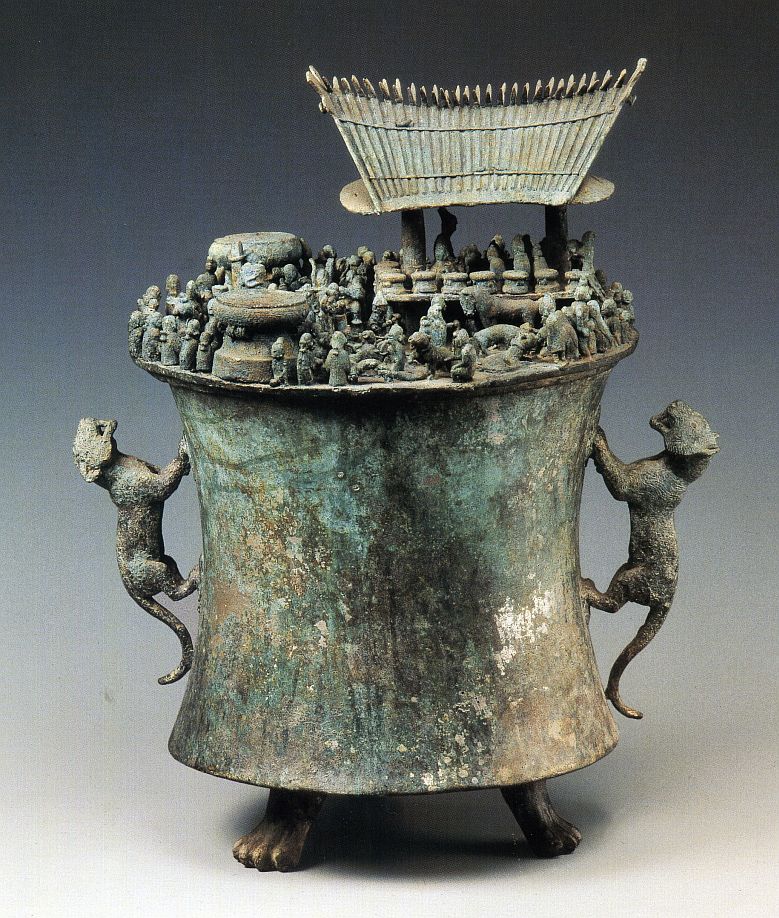
  • Gregory Bateson: Epistemology, Language, Play and the Double Bind

    Let us begin epistemology where Bateson does, with the metaphor of binocular vision. He points out the fact that, because the two eyes have different perspectives on the world, the brain is enabled to construct a stereoscopic guide to the three-dimensional world before us (Bateson, 1978: 79-81). To judge distance and shape with the aid of one eye alone leaves us only with parallax effects, perspectival convergences and textural shrinkings with distance, the fading of colours in a landscape through the dust and vapour in the air, none of which produce the sensory depth that characterizes the stereoscopic experience. You cannot play tennis successfully if you have one eye covered. Two views of “the same” region outside us give us a better grasp on the real. There is nothing to be gained by overlaying a view of the world with the very same view. If “two descriptions are better than one,” there must be some kind of mismatch between them (Bateson, 1980: 150). Indeed, it is misleading to believe that the communication of knowledge performs nothing more than a tautologous demonstration of what is already known, a kind of McChoakumchild delivery of fact from the knowledgeable to the ignorant.

    Bateson gave a special meaning to the logical notion of tautology. The mathematical definition, as Bateson himself gives it: “[Tautology] springs from a set cluster of arbitrary axioms or definitions and no “new” information may be added to that cluster after the assertion of axioms” (Bateson, 1980: 236; his emphasis). What his investigations into evolutionary theory led to was the conviction that “information” in the proper sense of the term produced an updating of existing behaviours, and that the changes this implies arise from the interaction of two separate processes, that of the chance mutation of the genetic inheritance and that of the draconian filter of the challenging and possibly lethal contingencies of creaturely existence. There could not be a “tautology” of creaturely reaction across a species and beyond, for both creature and species would be condemned to extinction if they were unable to change responses when the environment changes. The “steady state” of survival over generations is only possible if such adjustments are allowed for (1980: 234), and they involve random changes within both processes, two stochastic modes. “Stochastic” as a word derives from a Greek word the metaphor of which is an “aiming at a mark,” and, as all archers know, however skilled, there is always a random element in what they do. What results is “a zigzag ladder of dialectic between form and process” (ibid.: 210). To rigidify responses into one unchanging tautologous system, whatever rigorousness and “certainty” it may claim, is a recipe for a self-defeating disaster. “Every action of the living creature involves some trial and error, and for any trial to be new, it must be random” (1980: 202). On the contrary, as he put it, the tautologous ecological system has to be “torn”; to underscore this, Bateson quotes the lines from Tennyson’s “Morte D”Arthur” (Bateson,1980; 223):

    The old order changeth, yielding place to new,
    And God fulfils himself in many ways,
    Lest one good custom should corrupt the world.

    And elsewhere we find him saying, “I once heard a Zen master state categorically: “To become accustomed to anything is a terrible thing” (1978: 215). One is reminded of the key line of the insistent little poem by Laurence Binyon, that repeatedly asks the question “Why do I not grow used?” (the “used” pronounced with an “s” sound, not a “z”).

    Bateson turned to Gustav Jung for a useful distinction, that between the “pleroma” and the “creatura.” Jung defines the pleroma as “the world in which events are caused by forces and impacts and in which there are no ‘distinctions’”: in the creatura, “effects are brought about precisely by difference” (Jung, 1961; Bateson, 1978: 430). One can say that it corresponds to the more familiar distinction between inanimate and animate, but his use of the criterion of difference as against absence of it requires some clarification. After all, one can point to many “differences” within the inanimate, for example, in mass differences between two planets that produce their gravitational effects upon each other—are not the tides a continuous proof of such difference?

    What Jung and, hence, Bateson are drawing attention to, however, is the fact that creatures have the power of differentiating elements in their environment in the service of the maintenance of life and the reproduction of their species, and, furthermore, in that same service are, in varying degrees, capable of consequently changing the character of that differentiation by trial and error. Obviously the inanimate Real goes its own way without any such organization of the flow of events, without any such distinctions acted upon to satisfy desires and to escape from fears.

    It is here that an epistemological claim now being made within the philosophy of perception becomes relevant. However tempted we may be into thinking that what comes to our sensory organs is already neatly parcelled into those “recognizable” units we call “things,” “persons,” and even “selves,” the input from the real is in no way named, in no way conveniently sorted for us. Things do not come to us already labelled. It is not the case that, to take visual experience alone, that we are already provided with a rigorous counting of entities from the field of colour and form. Certainly the colours and forms can provide us with evidence which we can interpret in various ways, and it is undeniable that such interpretations differ from creature to creature. No animal’s eyes are sensitive to precisely the same range of light-waves as another, and there are marked differences from species to species; the pigeon, for example, has four types of cone where we have three, and so may respond with a colour that is outside the ability of our visual cortex to produce. Consider, too, the perspectival and often fragmentary nature of our percepts: I can say now that I see “a tree” before me, but its lower trunk is concealed from me, and am I clearly distinguishing its branches and leaves from those of the tree behind it?—all this while the autumn wind is blowing leaves away? Tomasello asks us to contrast the perceptions of a painter and a climber both looking at a mountain: it does not occur to him that the sensory and perceptual selections from the real made by the two would be markedly different (Tomasello 2003, 69)—so where is the “same mountain” outside their convenient mutual assumption?

    As regards the supposed certainty of mutual counting of “singularities,” consider this exchange between two bird-watchers engaged in recording numbers of birds:

    A: That bird you just counted.

    B: Well, what about it?

    A: It was two-and-a-bit leaves.

    The “binocular,” “dialectical” advantage of two heads being better than one is well demonstrated by this little scene. Notice that it could not have taken place had the sensory input arrived already marked with “objective fact.” Sensory experience is like the evidence a detective works with: in fact, one could say that it itself is an example of the sensory experience with which we all have to work. What is merely a depression in the ground to Dr. Watson, if he notices it at all, is a sign to Sherlock Holmes that a woman with a limp who has recently purchased her shoes at Harrod’s has passed that way.

    The philosopher, therefore, calls sensory experience “non-epistemic,” that is, containing no knowledge in itself (see Wright, (ed.), “Introduction,” 2008). Other names for it have been “raw-feel,” “anoetic” (Greek: no mind), and “non-doxastic” (Greek: no notion). Only a process of trial and error guided by the motivations of pain and pleasure can enable the brain to project “thinghood” on the chaos of sensation. To revert to Batesonian terms, one can say that the flux of experience, and ultimately the inputs from the Real that excite it for all our senses, are analogue in nature, whereas the imposition of entityhood by human beings is digital. Bateson actually says, “We are looking for a binary division of thought process that will be stochastic in both of its halves, but the halves will differ in that the random component of one half will be digital and the random component of the other will be analogic” (Bateson, 1979: 200). That the brain does have some low-level automatic systems that make edges more obvious and colours more contrasting does not guarantee safe action; indeed, such automatism in some circumstances could lead to fatal evolutionary consequences. As Bateson insists, it is flexibility that protects both creature and species when the environment turns unpredictable as far as past “custom” is concerned. This is why learning can take place. This is not to deny that many animals have instinctive perceptual responses built in; even a human infant responds automatically to the nipple, but the real evolutionary advantage lies in being able to tune one’s percepts to changing situations. That the sensory is no more than interpretable evidence is therefore a significant advantage to the creature, the prime reason being that its perceptions are not merely passive responses to supposedly given entities in the array of light and sound and feel and smell, but always-tentative guides that can be re-directed as a result of the new setback—or new boost—from the environment. What characterizes the evolutionary process is the flexibility that subjects a so far successful rigidification of response to a transformation. As another writer on play, Brian Sutton-Smith, puts it while defining play, “Biologically, its function is to reinforce the organism’s variability in the face of rigidifications of successful adaptation” (Sutton-Smith, 1997, 231).

    This flexibility suddenly widened in scope and subtlety when language evolved. Prior to that moment, animal signals were limited in their effects. One bird’s leap in fear from the ground could be the release of the same act from its fellows in the flock; a stag’s bellow could be a warning or challenge to other males; the howling of a pack of wolves could stand for possession of territory; a cub’s mewling could alert its mother to its protection; and the like. In all of these, the survival of species and/or creature is rendered the surer by a sequence of behaviour that has proved adaptive in the past. There is no possibility of its being altered in its significance by creatures acting in concert; the flexibility has a definite limit. What is plain is that a sign system evolved for one species of animal that allowed a system of symbols to emerge that achieved an unprecedented flexibility, and, further, by Bateson’s own principle, at once effected a liberation of co-operative action that could not but enhance the evolutionary process—although its not guaranteeing any moral progress is a matter to which we shall return (for a full-scale philosophical underpinning of the epistemological argument so far, see Wright, 2005: Chs. 3 and 4).

    Now we have reached a critical moment in this assessment of Bateson’s thought, for we have now reached the topic of language. According to his approach as we have seen so far, something “binocular” should be integral to it. As he says, “It would be bad natural history to expect mental processes and communicative habits of mammals to conform to the logician’s ideal” (Bateson, 1976: 121).

    “The logician’s ideal” is, of course, tautology, the state of universal certainty and coherence in his current logical system, there being a deductive link between all its propositions and the axioms from which it springs. So, although we may hope that the meaning of all the words in the dictionary, and of any others that speakers make up on the spur of the moment, will remain forever securely fixed in their transfer from person to person, such an ideal, if Bateson is right, hardly belongs to an evolutionary strategy worthy of the name. Recall that he said that, with a tautology, “no new information can be added.” It is patent that we each of us do not understand a word in the same way. Speaking is essentially a co-operative venture, a view underscored by his assertion that “’survival’ is not a matter of the skin as boundary” (Bateson, 1980: 435). It is here that we must bring together three strands of his thought, ones that he himself did not thoroughly entwine, those of language, play and the Double Bind.

    Let us go directly to his definition of play. It is characterized, he says, by the addition of a meta-communicative act, one that stands outside the current level of communication and comments upon it, certainly a “binocular” structure: “These actions, in which we now engage, do not denote what would be denoted by these actions which these actions denote. The playful nip denotes the bite, but it does not denote what would be denoted by the bite” (Bateson, 1976: 121).

    Bateson immediately draws attention to the fact that play is paradoxical, indicated in his very definition since the word “denote” is used at two levels of abstraction: with two monkeys at play, the action of a nip indicates aggressive attack, but the grin which preceded it denotes that that lower-level denotation does not apply in this instance. This results in two peculiarities of play: “(a) that the messages or signals exchanged in play are in a certain sense untrue or not meant; and (b) that that which is denoted by these signals is non-existent” (Bateson, 1976: 123). A denotation before accepted within an existing communication scheme is subverted by an act of meta-communication which (temporarily) cancels that original scheme.

    Bateson notes that play can sometimes fail because the clue to the meta-communication (in the above case, the playful grin) is not observed, or, for some other reason, is disregarded or deliberately ignored. He mentions a ritual common in the Andaman Islands in which leaders of warring tribes meeting in a peace parley were ceremonially allowed “to go through the motions,” as we say, of striking each other: there were occasions on which the meta-communicative aspect failed and the blow was responded to on the lower level, so that actual fighting broke out (ibid.: 122). One recalls the white man in America’s South who, during a performance of Shakespeare’s Othello, rushed up out of the audience onto the stage to stop the black actor suffocating the white actress taking the part of Desdemona. There are occasions when student “initiation ceremonies” take a sadistic turn. There are many people who, for unconscious reasons, are quite unable to act a part upon the stage, or even to adopt a change of voice to improve a joke. While watching a 3-D film, we might not be able to resist ducking as a spear is thrown at the camera. The gap between the two levels of communication and meta-communication is fraught with tension, and there is a reason for this, to which we shall return.

    But what has this to do with actual language? A first answer might be to point to the structure of jokes, riddles and conundrums, for there we find a deliberate shifting of meaning as a result of contesting clues from the context. To take the simplest of examples, drawn from a child’s book of jokes:

    PATIENT: Doctor, doctor, I’ve lost my memory?

    DOCTOR: When did it happen?

    PATIENT: When did what happen?

    (Ahlberg and Ahlberg, 1982: 90)

    The second line is the one where it can be said that “communication” and “meta-communication” turn out to be at odds, and that is the result of a rival clue to its meaning which appears in the third line. The “it” in line 2, as uttered by the doctor is clearly referring for him and, he believes, for his patient, to the loss of memory of which the patient has just informed him. There is no problem with that pronoun from his point of view as the context is precisely what the patient has just said, and it is the custom in a conversation to maintain mutual reference to the topic raised; pronouns depend upon the hearer being able to pick up what was referred to earlier—that is how they all work. To quote Bateson, we need “an outer frame to delimit the ground against which the figures are to be perceived” (1976: 127). However, the understanding of the patient has suffered a radical change, so radical that she was unable to keep that topic before her mind. Her very question shows that she is now unable to share with him what has to be shared in order for a statement to be made by the speaker and acknowledged by the hearer. She has lost that “outer frame” that was common between them, without which no sharing can take place. A question, after all, is a plea to be updated about something, and the practical paradox here is that she it was who proposed the topic in the first place, but has now forgotten what it was.

    The core irony arises from the fact that she is questioning him about that pronoun reference; her question is itself the clue to the “meta-communication,” the very feature that renders the doctor’s question ambiguous, for her forgetfulness over so short a time is the proof of her original claim in the first line. We can do here what children would not, derive a further meta-communication from the sad fact that there actually are persons with severe brain injury who are unable to activate their short-term memory after a disturbingly brief time, a thought which, if too salient for the hearer, could drain the joke of its fun. That we should not wish to be so reminded nevertheless makes plain that the meaning of a statement depends markedly on the frame that the hearer brings to it. Bateson was insistent that feeling could not be detached from meaning, that the supposedly “rational” could easily be subverted by the “irrational” (1978: 111-12).

    What is especially relevant here for normal communication outside joke contexts is that precisely the same structure is present. One has to keep in mind both (1) the intent to share understandings of some portion of the Real, and (2) the intent of the speaker to update the hearer, and of the hearer to be so updated. This is where the binocularity of language comes “into play,” as we unthinkingly put it. The linguist Sir Alan Gardiner was one of the first early critics of Saussure’s view of language. Saussure privileged the “synchronic” (Greek same time) aspect of language, that agreed set of rules that specified the match of word to concept for all participants, the “dictionary-view” in which meanings and words existed as a range of fixed pairs across all speakers, which he called la langue. Saussure was well aware that language was subject to change—”diachrony” (Greek through time)—evidenced in daily speech, which he called la parole, but it seemed obvious to him that communication could not take place unless all participants understood the same by the words they used. He even drew a little diagram in which, for two heads facing each other, he tells us that the same concept gets lodged in each head, one concept “corresponding to” the other (Saussure, 1974: 11). He likened this equivalence to the two sides of the same piece of paper (ibid.: 113). Initially, one is tempted to agree, for how could two people communicate if they had different understandings of the same word?—wouldn’t they be talking past each other? However, Gardiner points out that Saussure is forgetting two vital elements in this structure: (a) that it is actually the case that two persons do have somewhat different understandings of the word, so that they overlap and yet remain distinct, with the result that the difference does not necessarily interfere with the communication, but, on the contrary, constitutes the reason for it; and (b) that what is referred to in the Real cannot be exactly the same on every occasion of use (Gardiner, 1932: 81; 1944, 109).

    Let us take first (a), the personal differences in understanding, to which attention was drawn above. There are undeniable facts which cannot be ignored. First, each person has different sensory experiences from everyone else. The point need not be laboured: to consider one sense alone, there are marked differences in range and sensitivity of hearing from person to person. Second, each has a different learning history for each word, so that as regards both denotation and connotation, including associations of feeling, there is no pure match of understanding. As George Steiner has cogently argued, we each speak an “idiolect” of the “standard” language; he adds, “[t]here are no facsimiles of sensibility, no twin psyches” (Steiner, 1975: 170). It is not that we are speaking a “private language” so berated by the Wittgensteinians of the last century: we are speaking a private version of the public language. Steiner likens it to a form of translation (ibid.: 47). The fact has been scientifically proved by the psycholinguist Ragnar Rommetveit, who demonstrated that two subjects can pick out what they regard as “the same entity” when the experiment revealed that they were using different criteria of categorization (Rommetveit,1974, 29-51).

    As regards (b), what is being referred to in the Real, Gardiner has this to say of two French speakers using the word bœuf: “The living ox before the two observers makes its own new, if infinitesimal contribution to the signifié of bœuf ” (Gardiner. 1944: 109), the “signifié” being the concept supposedly “common” to the two observers. So there is “binocularity” on levels (a) and (b), that is, both in the understanding of the two engaged in communication and in what they have “singled” out of the Real for one has to add to Gardiner’s formulation that the “infinitesimal contribution” is undeniably different for the two observers. But one can still ask “How does the ‘tautology’ of the public language, Saussure’s la langue, come into this perspective?”

    This is where Bateson’s notion of play delivers an explanation, for we have reached a genuine “conundrum” in linguistics and philosophy. It is significant to note that Terrence Deacon in his book The Symbolic Species cannot help referring to the problem of the origin of language as a “conundrum” (1997, 23), and later refers to it as “the central riddle of the problem of language origins” (ibid., 44; my emphasis). Look back at the child’s joke that was analysed above. The joker and the hearer of the joke, according to la langue, were both seemingly accepting a “common” meaning for that pronoun “it,” but, when the clue to a new frame, a new context of relevance arrived in the third line, one that forced a “meta-communicative” look at what had just been said, its meaning changed and we were left with an ambiguity. Binocularity had produced an updating of a meaning, one that was not present before.

    Now what happens in an informative statement is exactly the same. The speaker has a new understanding of a region of the Real that she wishes to propose to the hearer. After all, the aim of speech is to help the hearer to a better view of that region. Bird-watcher A wanted Bird-watcher B to alter the very counting of a “thing,” so not even the singularity of some-“thing” can be guaranteed in this world. We are certainly not surrounded by given Dinge-an-Sich, “things-as-such,” to use Immanuel Kant’s phrase (Critique of Pure Reason: A29, B45) because we cannot use the word “such” until we have pointed out a supposed singularity to someone else. The two engaged in language must begin with the assumption that they have picked out exactly the same entity from the Real, same in virtually a timeless sense, in that they are both taking for granted that there is one entity that pre-exists their attempts to single “it” out, and that, whatever criteria they each may be using, “it” is there as an unchanging “referent” awaiting the joint “reference.” After all, if they did not take singularity for granted, they would never be able to get a rough purchase on the real; their differing perspectives could not be drawn into the necessary rough overlap.

    One must make an adjustment here to Michael Tomasello’s analysis of human dialogue as distinct from animal communication. He sees the essential criterion to be an extension of a situation in which the group are sharing attention; there is a “joint attentional scene,” minimally consisting of two agents and something that constitutes the “same entity” for each. Whereas animals are unable to take account of the fact that each has a different perspective, human beings are able to take account of the other’s intentional perspective (Tomasello, 2003, 25-8). This is also insisted upon by Eric Gans: there was at the origin of language an essential scene in which a “mimetic crisis” occurred characterized by the ur-speaker’s realization of her difference of understanding from the other of the common object, which leads to “an internalization of the model’s motivation” as they converge on “the object” (Gans 1995, 7). However, neither Tomasello and Gans perceive the implication of their own words, which is that, if each agent has a different perspective on the so-called centre of attention, there is no guarantee whatsoever of the singularity of what both have been tempted to call “the same entity.”

    But Bateson could draw attention to the fact that we have used the phrase “taking for” in our taken-for-granted joint reference, and what does the phrase “to take for” mean? We use it in such sentences as the following:

    As she was politely backing out of the room, actually trying to conceal her eagerness to go, she reached out behind her for the door-handle and took that of the pantry for that of the backdoor, so that she rapidly disappeared in among the tins and bins to the great amusement of everyone there.

    “To take for” means to accept one thing or person for another, to accept a substitute that will do for the time being. And what is it in our case that is being “accepted as a substitute for the time being”—its being granted. And what does “granted” mean?—it means allowed, permitted, exposed to no expectation of opposition of will and desire from the other. So “to take for granted” means to accept an illusion of real agreement as a perfect agreement, an apparent blending of motivation with another as a perfect fusing. And what is this illusory agreement the illusion of which is to be temporarily ignored?—that a single object is before the agents concerned.

    So in order to begin an informative statement, speaker and hearer have to enter into a little play sequence: they have to pretend together for the moment that what is denoted by some reference that they are making is exactly the same for both; we might call this the “subject” of their discussion. It is as if to take full advantage of their “binocularity,” the differences in their view of the real, they have to pretend that there are no differences, just as the differing perspectives of our two eyes are superimposed into one stereoscopic scene. What Catherine Bates says in her excellent book Play in a Godless World as applying to texts, “A text makes a contract between writer and reader who agree for a period to play the same game” (Bates, 1999: 73) can be applied as readily to all statements. Play agreement or no, it is still made with some common hope as its basis, one that can be extended to a final goal of happiness for both, even though that is a mere ideal, though it be one that, poetically, and therefore, spiritually, as we say, could inspire them both.

    For an example, take the situation where the hearer has asked the speaker “Where is the painting?” Before she receives an answer it can be said that speaker and hearer have entered into the collusion that there is a singular portion of the Real that provides exactly the same reference for both of them. It is the same as with the two bird-watchers who had “that bird you just counted” as their subject (even though there was no such bird!). Having established this play agreement with the hearer, the speaker then provides a new frame—we might call it the “predicate”—which updates the understanding of the hearer so that the “referent” is not now understood by the hearer in the same way as before. The speaker replies, “The painting is in the attic.” The subject word “painting” does not now “denote what it formerly denoted” for the hearer, because part of the history of that painting now includes for her its being in the attic at a certain time. To object that the painting “itself” is “just the same as it was before” is no more than a declaration of the trust that projected a timeless logical singularity beyond the actual experience of either of the persons involved as the imaginary focus of their differing selections from the Real. Add Gardiner’s point, the word-meaning of “painting” has also been subjected to an “infinitesimal” change. When Gans refers to “the object” as a “theme,” he should bear in mind that a theme is open to variations. (Gans 1995, 6).

    Just as in the joke above, something that was “tautologous” for speaker and hearer, that is, apparently requiring “no new information,” is suddenly perceived to have been ambiguous, the additional meaning being that new information. The structure of the Statement, the very core of communication, is therefore precisely that of play as Bateson has defined it. Any statement can thus be said to consist of an imagined tautologous “communication” being changed as a result of a “meta-communication.” If the statement is accepted by the hearer, what has happened is what Gardiner said would happen: the language, la langue, has been changed. Or one might say that, by means of beginning with a mutually assumed “synchronic” co-ordination in la langue, they together, in la parole, achieved a “diachronic” advance in the language.(1)

    It might be said with some justification that the language they began the statement in is not the language they ended it in. This turns speaker and hearer metaphorically into Cretan Liars, for in the Paradox of the Liar,—”’All Cretans are liars,’ said the Cretan”—the statement he makes is rendered false by the new frame that enters with the last three words, and so too, as we have seen, with the Statement, which begins with “tautology” as supposedly true and ends with a new frame that alters meaning, supposedly false by the earlier supposition but now accepted as the “true,” new tautology. This corresponds to Bateson’s remark, quoted earlier, that play always contains something strictly “untrue.” It is not that the dictionary meaning remains the same before and after the utterance: it is that, after the utterance, a new agreement about what a word means has entered the language. We all alter the dictionary meaning as we speak, even though because the change is most often “infinitesimal,” to use Gardiner’s word, we do not notice it, particularly as our aim together is to bring the language into closer contact with the ever-changing Real.

    Gans is thus correct when he detects within the origin of language a paradoxical element, as the analogy with the Cretan Liar Paradox has just shown. Richard van Oort is also pointing out a similar feature when he prefers with Austin to see language as more performative than constative, that is, strictly propositional, only resolvable as True and False. (van Oort, 1997). One might say that when a speaker updates the hearer to a new selection from the real for the taken-for-granted “common” word, what has happened is significantly like saying “I name this ship Hermes.” “This ship,” in this case, is a new selection from the real to which the word had not before been applied; the speaker has effected a transformation of what was taken to be “the same entity.” Hence, the speaker has “performed” a speech act that alters a rule which will now become part of the “taken-for-granted” ritual of la langue. Van Oort points out that Austin’s examples of performatives were all of ritual origin (van Oort 1997, 5).

    The patient in the joke above was unable to maintain the initial taking-for-granted because she forgot it. The trick—and, following Bateson—one does mean “trick”—is to play at a perfect agreement at the start of the statement so that a partial correction of it can go through by the end of it. The trick lies in the fact that we believe that a singular object lies beyond the practical overlap of our purposes with a fuzzy region of the Real, but all that actually exists is the boundaryless, analogic Real on which we have projected an ideal of agreement as upon a logically singular, “objective” digital entity by our mutual collusion (from the Latin for playing together). So again, Bateson’s dictum that in play what is projected, strictly speaking, “does not exist” applies to the initial move in the Statement, because there are no timeless, logically singular entities in the Real that correspond to that supposedly “perfect agreement.” The co-ordination process itself exists; the overlap between our differing selections from the Real exists, even though we cannot gauge the extent and character of that overlap; but the purely objective entity does not exist, being only a kind of fictive catalyst that enables us to focus together on an area of interest to us. La langue is a provisional order that we are constantly updating, and Bateson’s phrase “a zigzag ladder of dialectic between form and process” best describes its series of changes, the “form” being the Real, the “process” being the continual adjustment of word to changing world. We can also invoke Tomasello’s metaphor of “ratcheting” advances in meaning (Tomasello 2003, 69).

    Imagine that there are two of, say, our australopithecine forebears hunting deer together, perhaps grasping stones as possible weapons (chimpanzees use sticks as tools without being able to communicate linguistically, so there is nothing to anticipate a human element in that fact). They are still at the animal stage of having no mode of communication other than the type of noises of warning, aggressive threat, sexual challenge, etc. that advanced animals possess, none of which are symbolic in the linguistic sense, the response to them being merely instinctive or conditioned.

    The following circumstance now comes about: one of them, let us say a female, notices, as we would say, a stag hidden within a bush not far from them, the stag not yet having become aware of them (for her what we call the “stag” may be conceptualized only as prey or food, the “bush” merely as plant). Then she notices that her male companion does not realise that the animal is hidden there. She, having been as a child one who was fond of play of every kind (and we know well that animals have the capacity to play), now raises her hands to the sides of her head in the form of antlers. This is the necessary “transparency,” the Second Clue, which is itself ambiguous, being at once merely open hands by her head and also a stag’s antlers. She foregrounds her performance as clearly as she can, perhaps sniffing like a deer, mock-nibbling with her mouth, and twitching her nose to improve the suggestion. This is the sort of thing perhaps she often did as a child in play. She then looks “meaningfully,” as we would naturally say, in the direction of the deer. She cannot point with her hands for that would be a symbol before symbols had come into existence. If now the male anthropoid tumbles to what is being said, and especially if now they make the attack together and the stag brought down, the first linguistic communication has gone through with great success. As Gans correctly insists, there is no necessity that the first statement be phonic in character (Gans 1999, 7). An updating of one agent’s mode of attention, and thus, his concept and percept, had been brought about by another agent employing a transparency in a situation where the “speaker” was aware that the “hearer” needed updating about a region of the real. We have to say that the female was certainly meaning that a familiar source of food was before them even before her male companion picked up the clue (even though she had no words for source of food, or even stag, only the concepts of them), so it is strictly possible to mean before a fully functioning language has come into existence.

    Now to analyse in detail what has come about. The female realised two things: (1) that a portion of real existence important to their immediate common desires was before them both, which we would describe as a bush containing a stag; and (2) that her companion was not aware of the bush/branches/leaves as hiding it. Her looking across in the direction of the bush and stag drew his attention to that portion of existence. The measure of overlap between their perceptions might only be very rough, for she is very conscious that the bush is hiding the stag, seeing the antlers among the branches, but he at first only looks vaguely in that direction, taking in perhaps the grass in front, or some rocks above, or a bird perching on a branch. Perhaps he actually sees the antlers as branches. However, her performance brings the concept of a stag into his mind; his desire for food is awakened and he now “catches sight,” as we unthinkingly say, of the hoofs of the stag under the bush. It may be in the past that this has been his successful way of finding hidden deer, so he looks there out of habit. He now perceives, not only the stag, but the significance of his partner’s performance: he has reached the state of understanding Gardiner was the first to identify, the recognition of the other’s intention, even though that could only be partial (Gardiner, 1932: 82). Incidentally, Gardiner arrived at this analysis long before the philosopher Paul Grice, who is usually credited with the insight (Grice 1967). Our male anthropoid advances cautiously with his stone at the ready—she follows likewise, and they bring down their prey. As they dance in delight round their capture, he raises his hands to his ears like antlers and she responds with the same in playful happiness, and the “word” becomes firmly established between them , recalled, and more deeply learned, later in joyful ritual dances. Note that one cannot detach ambiguous “word” from the ambiguous grammatical “statement” in this scenario: grammar and semantics emerge simultaneously—in a social act of play.

    The gap between the subject-as-“communication” and the predicate-as-“meta-communication” is still “fraught with tension,” as we mentioned earlier. The reason is easy to find, for the “taking-for-granted” may not produce a satisfactory outcome for the hearer, in spite of her trust in the speaker. We can now understand what “sharing” actually is; it is an act of trust by two people “playing” together that the updating will be such that the “granting” will not be betrayed by it. If one has granted something, one expects that nothing will transpire that produces dissatisfaction, even suffering, but will further one’s hopes and desires. George Steiner. I believe, is the first to draw attention to the central importance of trust in the statement: “All understanding, and the demonstrative statement of understanding which is translation, starts with an act of trust” (Steiner, 1975: 296). He was referring to translation proper, but we have seen how the word “translation” applies metaphorically to normal communication—from idiolect to idiolect. Since trust—better, faith—is at the heart of communication, it is time to turn for a last insight to Bateson’s definition of the Double Bind.

    What takes us there is the unfortunate implication here that no amount of “taking-for-granted” can guard against the possibility of speaker and hearer ending up in a tragic confrontation once all consequences come fully into the open, those intended, those unintended, and those unconsciously intended. The tension will be all the more extreme if both participants made the error of taking what was an experimental mutual co-ordination of two selections from the Real as an unchallengeable, “objective,” singular one. This is insidiously easy to do as it seems that (1) what one has “objectified” exists in an impersonally rigid state apart from all human choice, whereas it is the attraction of one’s own subjective selection, together with our trust in our partner in dialogue, that bestows this aura of certainty; and (2) the need to imagine that objectivity was the necessary first move in the statement, so how easy to take that mutual pretence for independent fact.

    Bateson has provided a detailed analysis of the Double Bind. Two or more persons are involved in a repeated sequence that results in an experience of intense frustration and inner conflict for the victim, an experience that by virtue of its repetition, becomes traumatic. The victim must have been subject to a “primary negative injunction” in which an act has either been forbidden on pain of punishment, or demanded with an equal threat. The authority-figure is one from whom love and protection is expected, typically a parent (or parents), but also possibly a sibling (or siblings). There then occurs a “secondary injunction,” backed up with the same aversive techniques, but this time more subtly presented, through gesture or expression or ambiguous utterances—but, whatever the devious means by which it presents itself, the message is unmistakable, namely, that it is now the converse of the earlier prohibition that is being insisted upon. Perhaps one parent subtly gainsays at a more abstract level what the other demands in a concrete situation. The victim, in addition, by virtue of his or her dependency, is unable to escape from the trap into which the authority has placed them. Once the traumatic pattern has been established over a number of occasions, panic, rage or, at the worst, psychotic episodes may be induced in the victim by any fragment of the sequence (Bateson, 1976b: 6-7).

    In what way could this have a structure similar to that of the Statement itself? One can begin with a dictum that expresses an essential element in my own theory of language: “What is implicit for each cannot all be explicit for both” (Wright, 2005; 169). When speaker and hearer join in the game of having “singled” out an entity, be it person, thing or self, from the Real, all that has happened is that they have brought their own individual selections from the flux that confronts them into, as we saw, some kind of overlap, an overlap only proved by their judgements of success as regards their motivations, their particular desires and fears, those judgements sustained by their faith in each other. It is, however, impossible that all the consequences of the current agreement are salient to both parties, for, as was mentioned above, such consequences can be intended by one without it having become salient to the other. This can easily happen without any deceitfulness on the part of the former. New circumstances, quite unexpected at the time of agreement, may involve commitments that were not openly envisaged. After all, in our illustrative situation there might have been a lion behind the bush holding a stag in its jaws. This is not to mention the possibility of a frankly unintended consequence, the outcome of some contingency that emerges unannounced from the Real. What then are speaker and hearer to do in such circumstances for what is presented is a demand for sacrifice on one side or another or on both sides?

    It becomes ethically obvious that the earlier agreement—however much it is backed up by appeal to fine-sounding virtues like “sincerity,” “loyalty,” “duty,” “integrity,” “truth” and “obedience”—cannot now be simply judged by that appeal. If the two persons are bound by the bond of love, then sacrifice may become the only right course of action, and it cannot, as simply, be a sacrifice that is a pure self-abnegation. There has to be reckoning what is implied both for oneself and for others in possibly similar positions who are loved and valued. In some cases, since the dilemma arises from the ambiguity of the moral trap, a comic resolution is possible, and one person can laugh themselves into abandoning their desires: unfortunately, the ambiguity may go down deeper such that the confrontation has tragic implications. People are not computers: one cannot brainwash them into giving up their inmost fears and desires.

    Can one here draw in what Gans has detected at the origin of language, that the ability to symbolize is bound up with an “aborting of the desire to appropriate” whatever it was that aroused desire (Gans, 1995, 2)? To enter into the “taking-for-granted” demands more than a blind trust, for, as we have just seen, there is no guarantee that the other’s interpretation will turn out to be the same as one’s own. What is required is faith, a faith that is prepared for the confrontation of sharp antagonism with those one loves: love, of course, is bold enough to require sacrifice at such moments. This is not a given, of course: there is no normativity built in to the evolution of language. The individual, created by the faith of those who have spoken throughout history, is still faced with an ethical choice.

    The obverse of the readiness to sacrifice goes along with the conviction that the language is in order as it is, in other words, as fixedly understood as consisting of unchangeable meanings fortunately equivalent to one’s own interpretation, existing in a world ontologically made up of consolingly secure, countable entities. So to hold to a pure “constative” view of language is revealed as sheer superstition, and, in common with all other superstitions, is timidly unable to countenance the radical risk of faith. The illusion of linguistic Being plays over real Becoming, an illusion necessarily maintained by faith openly as an illusion, which is how we play if we play properly. The logically-minded cannot play. With Gans we can say that there is an ineradicable “theatrical” element (Gans, 1995, 5).

    That this is an uncomfortable conclusion is hard to accept, especially, as we saw above, when the initial entry into the agreement was premised on some utopian hope of a final happiness. If one had made the error of thinking that the beloved other could somehow magically have foreseen all possible consequences, so that her understanding could never diverge from one’s own, then her apparently new interpretation of the old agreement may look for all the world like betrayal, deceit, disloyalty, undutifulness, insincerity, duplicity. It is here that Bateson’s analysis of the Double Bind comes into play, for he is describing victims who had committed themselves to the supposedly protective authority only to discover that what was promised becomes what is actively denied. Of the schizophrenic who is suffering under a Double Bind he says, “He might, for example, assume that behind every statement there is a concealed meaning which is detrimental to his welfare” (Bateson, 1976b: 10). However, it must be pointed out that it is just as likely that the “concealed meaning,” that is, what is implicit for one contributor to the dialogue but not to the other, might provide a much greater reward than expected. The unexpected might turn out to enhance one’s happiness beyond one’s expectations and not diminish it. There is nothing, though, in the structure that favours the happy outcome of the mismatch in understanding over the unhappy one. It looks as if the Statement, the evolutionary advance that turned an animal into a human being, did not deliver along with it any direct moral progress.

    It is rather the case that what we are inside is a system in which we have to try to play the Freudian game of “Fort-da.” The child Freud describes had invented a game in which he threw a wooden reel attached to a piece of string over the edge of his curtained cot so that it disappeared, shouting “O-o-o-o!” “which was not a mere interjection but represented [as his mother assured Freud] the German word Fort! (‘Gone!’) . . . He then pulled the reel [into] the cot again by the string and hailed its reappearance with a joyful ‘Da!’ (‘There’)” (Freud, 1984 [1920]: 284). Freud interprets this as the child reliving and establishing its acceptance of the renunciation of the mother as demanded by her frequent departures from him, the game being a form of “compensation” for the abandonment. Similarly, what is required of us is a continual renewal of hope in the face of a complete absence in the Real of any assured promise of fulfilment. Every statement thus plays the game of “Fort-da.”

    No wonder fundamentalists of all religions would rather have a spurious guarantee of an assured personal happiness that really awaits them at the end of their lives and at the end of all time. They have not reached the degree of acceptance of the possibility of sacrifice that being in a society necessitates. They do not want to turn the inescapable trust that is necessary to speak at all into a true faith that accepts the radical possibility of the greatest risk. Fundamentalism is therefore at its heart cowardly; hence its empty bluster about courage. Nor can fundamentalists play: for they turn the imagined supposition of the ideal agreement we need to open a statement for evidence of its actuality. From the evolutionary point of view, they are rigidified, bound into a self-deluding superstition. We owe the emergence of our “individuality” within the game of language to the faith of those who have preceded us, but that faith provides no safe pledge of an unchangeable and eternal personhood, some hallowed, inflexible uniqueness. Those primitive tribes that divinized their ancestors were nearer to understanding the structuring of our existence than ourselves. Our only immortality lies in what we contribute to that faith, both while we remain alive and in the legacy of faith we leave behind us.

    Gregory Bateson has thus provided the key to the explanation of the Statement, and hence, of language itself, in his perception that communication relies on the element of play, in both of its two senses, that of looseness, as in the play of a key in a lock, the “flexibility” he saw as essential to evolution, and in the sense of a game, one in which we have to be ready to perceive unexpected opportunities in what before was rigidified. We must add that, in all games, properly played, the chance of losing is not one by which good players are daunted.

    References

    Ahlberg, Janet and Ahlberg, Allan (1982). The Ha Ha Bonk Book. Harmondsworth: Penguin Books.

    Bates, Catherine (1999) Play in a Godless World. London: Open Gate Press.

    Bateson, Gregory (1976a) “A theory of play and fantasy” in Play: Its Role in Development and Evolution. Jerome. S. Bruner. Alison Jolly and Kathy Sylva, eds. Harmondsworth: Penguin Books, pp. 119-29.

    Bateson, Gregory (1976b) “Toward a theory of schizophrenia,” in Double Bind: The Foundation of the Communicational Approach to the Family. Carlos E. Sluzki and Donald C. Ransom eds. New York: Grune and Stratton, pp. 3-32.

    Bateson, Gregory (1978). Steps to an Ecology of Mind: Collected Essays in Anthropology, Psychiatry, Evolution and Epistemology. London: Paladin.

    Bateson, Gregory (1980). Mind and Nature: A Necessary Unity. London: Fontana.

    Deacon, Terrence (1997) The Symbolic Species: The Co-Evolution of Language and the Humna Brain. London: Allen Lane, The Penguin Press.

    Freud, Sigmund (1984 [1920]) “Beyond the Pleasure Principle,” in On Metapsychology: The Theory of Psychoanalysis, The Pelican Freud Library, Vol. 11, Angela Richards ed. Trans; James Strachey. Harmondsworth: Penguin Books, pp. 269-338.

    Gans, Eric (1995) “Mimetic Paradox and the Event of Human Origin.” Anthropoetics, I/2, 1-12.

    Gans, Eric (1999) “The Little Bang: The Early Origin of Language.” Anthropoetics, 5/1, 1-11.

    Gardiner, Sir Alan (1932) The Theory of Speech and Language. Oxford: Clarendon Press.

    Gardiner, Sir Alan (1944): “De Saussure’s analysis of the ‘signe linguistique.’” Acta Linguistica, 4: 696-719.

    Grice, H. P. (1967) “Meaning,” in P. F. Strawson ed., Philosophical Logic. Oxford: Oxford University Press, pp. 39-48.

    Jung, Gustav (1961). Septem Sermones ad Mortuos (Seven Sermons to the Dead). London: Stuart and Watkins.

    Oort, Richard van (1997) “Performative-Constative Revisited: the Genetics of Austin’s Theory of Speech Acts.” Anthropoetics II/2, 1-14.

    Rommetveit, Ragnar (1974) On Message Structure: A Framework for the Study of Language and Communication. London & New York: John Wiley & Sons.

    Saussure, Ferdinand de (1974 [1915]) Course in General Linguistics. Charles Bally and Albert Sechehaye eds. Trans. Wade Baskin. London: Fontana/Collins.

    Steiner, George (1975) After Babel: Aspects of Language and Translation. Oxford: Oxford University Press.

    Sutton-Smith, Brian (1997) The Ambiguity of Play. Cambridge, Massachusetts: Harvard University Press.

    Tomasello, Michael (2003) Constructing a Language. Cambridge, Massachusetts and London.

    Wright, Edmond (2005) Narrative, Perception, Language, and Faith. Basingstoke: Palgrave Macmillan.

    Wright, Edmond, ed. (2008) The Case for Qualia. Cambridge, Massachusetts: MIT Press.

    Notes

    1. There is not space here to show how the real “subject” and “predicate” of a statement, that is, what was knowingly presupposed by both speaker and hearer to be the same for both, and the portion of the speaker’s statement that updates that fictively-mutual understanding, do not necessarily correspond to the grammatical subject and predicate. For a full explanation, see Wright, 2005: 142-7.(back)

  • Marginalist Politics, Political Grammar

    Introduction

    Eric Gans’ Chronicle of Love & Resentment 348, “The Four Freedoms,” suggests the possibility of thinking about politics in terms of linguistic categories. The value of pursuing this suggestion seems to me to lie in the application of terms drawn rigorously out of the originary hypothesis so as to generate a new theoretical vocabulary—the point being to see something we couldn’t otherwise. In the case of Gans’ Chronicle, we can think of “freedom” in terms of the unfolding of linguistic forms first explored in The Origin of Language and then applied to cultural forms in The End of Culture. So, “ostensive freedom” lies in the transcendence of the appetitive and horizontal in the intention of an object on the originary scene; imperative freedom is the negative freedom “from another’s intention”; declarative freedom is “the freedom to help choose the imperatives by which one will be governed”; and discursive freedom “permits the individual not simply to intend a representation of the world as it is or he thinks it should be, but to offer himself to the world as an esthetic totality, a sacred central object.” Finally, since “the originary ostensive freedom to intend an object in principle generates for each member of society the discursive freedom to become an object of intention,” it seems worthwhile to seize upon the strong sense of continuity suggested here between the “first” and “fourth” freedom (and, presumably, the others along the way) and proceed to think about how any concrete mode of freedom would articulate all of these modes in the free act.

    First, though, I note some ambivalence in the way “imperative freedom” is treated in the Chronicle. The only “positive” imperative freedom imagined here is that of the sadist—the problem posed is the restraint of imperativity. Resentment toward imperatives is well grounded in, perhaps even constitutive of, the liberal and democratic political traditions, and a declarative politics, that is, the subordination of commands to deliberation, is the manner in which that resentment is generalized and made explicit. Still, while one could say that at several removes we help choose the imperatives by which we are governed, viewing imperatives as necessary evils doesn’t serve to integrate imperatives into a declarative order, and this seems to me a serious weak point in liberal political thinking. Insofar as there are areas of social life in which imperative chains of command are indispensable, those areas of life must establish criteria for competence, legitimacy and authority of given orders and commands. We can withhold the designation “freedom” from the unhindered (by external, “declarative” constraints) issuing of orders according to internally and traditionally constituted processes and for well established and publicly audited purposes, but at some cost, I believe. First, the cost is theoretical: we don’t have a way of integrating fully human desires and impulses such as ambition, the desire for fame and the calling to serve the collective in a responsible position in a scenic understanding of the human; nor, for that matter, have we gotten any closer to explaining why those whose vocation is to issue imperatives might be more or less likely to listen to those who deliberate upon their validity from a distance. More precisely: how has it happened, and how does it continue to happen, that some of those who issue imperatives are willing to act against others who do so in the name of “toothless” declaratives? Second, by maintaining the traditional liberal mistrust and distaste for such desires and a disdain for the spontaneous and reciprocal suspicion of “imperators” toward those who deliberate thanks to the peace they provide, we are unable to resist the demonization of manifestations of such desires and resentments, which entails the political and ethical cost of adding fuel to the victimary fire—along with the failure to develop an immunity to the less pressing, but by no means unthinkable, recrudescence of “strong men” demagogues who exploit what often appears to be a self-willed weakness of liberal societies.

    Imperative freedom can only be rethought in terms of its problematic integration into a declarative or deliberative order by further developing the articulation of the linguistic forms into a political vocabulary. For example, ostensive freedom must be brought to bear in conjoining the declarative (deliberative, juridical, principled) with the imperative: that imperatives have been deployed consonant with deliberative practices must be affirmed through means established by those practices in interplay with the sources of the imperatives themselves. Someone must be responsible for that affirmation, and everyone must know (or be able to know) who they are. Through such affirmations we re-enact the transcendence of the horizontal and the founding of the community. Similarly, changes in the laws governing the internal affairs of institutions administered by strict chains of command must be “registered” through modifications in the publicly known procedures by which commands are issued. There must be ways, in other words, of demonstrating, verifying and authenticating the channels by which declaratives are translated into imperatives and vice versa, and all this must involve an ostensive dimension: someone must “point” to a legitimate act in order to “seal” its legitimacy, we must all be able to point to the one who has pointed, and so on. Since without such scenic verification freedom would surely be lost, it seems to me a valid project, then, to see whether we might direct the attention of (originary) political thinking to the seemingly narrow task of distinguishing among various modes and degrees of “translatability”—or, as I prefer, “convertibility” of imperatives and declaratives. The most urgent problem is with the convertibility of imperatives: those imperatives that could be recast as consequent upon a declarative, or a general claim asserting some regular set of relationships and possibilities in social reality, would be those most readily integrated into a deliberative order. Imperative freedom would in turn be recast as the defense of that order. Our sense of declarative freedom, meanwhile would be sharpened by the implicit criterion “demanding” that the assertion of any observation or principle regarding liberal society be itself compatible with the norms of imperative freedom upon which that society depends.

    As for discursive freedom, the political vocabulary and grammar I am proposing suggests the need to speak about more and less politically relevant manifestations of such freedom. Political sacralities emerge when one demonstrates a willingness to confirm or authenticate the conversion of an imperative into a declarative or a declarative into an imperative; and the degree of sacrality is higher the more necessary such confirmation or authentification is in the situation and the less “basis” there is for it in the existing procedures of authentification. (Naturally, taking on this responsibility can include refusing to confirm or authenticate.) This indicates a willingness to be a scapegoat, and whether one will be hero, scapegoat, or just goat can be ascertained only after the fact. But insofar as one engages in such a task as part of the process of self-composition as a sacred totality, one is doing something more than making a political decision: one is engaged in a discovery procedure, in gaining knowledge in the only way one possibly can in the midst of social activity, by acting in “revealing” ways. One thereby assumes that there is a principle to one’s action—a new declarative—but one that can be fully formulated only after the fact, by a spectator. There is a paradox at the heart of such action: offering oneself up as a possible scapegoat (while evincing no—while disciplining ones’ actions and the signs one emits so as to defer any—desire to be scapegoated) requires intricate, if largely tacit knowledge of the “field” one is entering, and it subsequently generates knowledge regarding the current state of society; but, the more free the act, the more one makes oneself available to and dependent upon the unreserved ostensive affirmations of others, the less anyone, including oneself, can know what one is going to do next and what it is going to mean.

    So, the test of this essay is whether it provides a new, unique way of exploring this paradox in terms of the problem of imperative-declarative convertibility. I don’t mean to exclude all other political vocabularies (as if it were in my power to do so) but simply to propose a measure for political discourse: the generation of viable political principles and a way of assessing their viability. I have already said something about our unease, in a liberal democratic society, in discussing imperatives, and I would like to broaden the point a bit. Once we distinguish between more and less convertible imperatives, we might find ourselves free to apply the term in all sorts of new ways, and in particular in discussions of subjectivity and character—to put it simply, if we think about it, we order ourselves around quite a bit, and that has quite a bit to do with what makes us free. Second, though, and perhaps more controversially, we “receive” impersonal imperatives quite frequently: an examination of how often people claim to be taking orders from entities such as “history,” “society,” and “reality” would be extraordinarily revealing, and not merely for the purposes of “demystification”—after all, what imperative are we following when we demystify? More importantly, I don’t see a better way of describing whatever it is that makes us come to the defense of a victim of injustice than that we are following an imperative coming from where we cannot quite tell. We can only get better at hearing and assessing such imperatives if we learn how to listen for them.


    The transcendent imperative of a political order predicated upon consent is the enhancement of consent. We obey that imperative both by increasing the visibility of that order’s reliance upon consent and the creation of means by which the forms and degrees of consent can be audited. Grammatically speaking, the progress of civil society (and civil society must either progress or regress, as more people are incessantly thrown into the swirl of the marketplace and the contestations of the political system; the systems must either marginalize these new entrants or adapt to the pressures and challenges produced by their presence) involves increasing the convertibility of imperatives into declaratives. This doesn’t imply a lesser reliance upon imperatives, which are simply unavoidable across enormous swaths of social life (and, for that matter, psychological, inner, life). Rather, the point is that imperatives must become ever more translatable, by those who are to execute, enforce, and obey them, into declaratives—”Because I said so” (a barely declarative iteration of the force already implicit in the imperative) must give way to “Because I have been duly authorized by those you have duly authorized to superintend this process” (a declarative reference to a consensual reality enabling the imperative). Or, to put it somewhat differently, if it doesn’t give way, civil society is attenuated and, at some point, swept away.

    Civil society progresses or regresses in response to events that we can consider crises in imperative/declarative convertibility: imperatives set in motion a chain of events which undermines the authority at stake in their issuance and, rather than minimizing rivalries over access within a particular arena of goods and tasks by settling the question of who determines said access, such imperatives instead intensify them. Perhaps this happens because other centers of authority, sometimes even those created or elevated by the challenged authority itself, have arisen and started to make competing claims to obedience; perhaps because the sphere of consequences following from the application of a hitherto unproblematic imperative has widened beyond the reach of whoever has issued that imperative’s ability to direct and regulate outcomes; perhaps because the subjects of the imperative are, for reasons arising from different arenas altogether, not the “same” subjects as those who used to obey—habituated to deliberating and choosing from amongst a range of “imperators” elsewhere, they demand no less here (which is to say, they arrogate to themselves a center of imperative issuing authority).

    Whatever the circumstances, what results from such an “imperative crisis” is an event which concludes with the acknowledgement that that “kind” of imperative can no longer be obeyed while another “kind” of imperative (even one as minimal as “don’t obey that other kind”) has been ostensively verified as “valid” (it was seen to resolve the crisis). The difference will lie in the greater convertibility and hence flexibility of the new imperative and the “imperative center” erected upon it. The new imperative order, at the very least, comes with a justification and narrative (a declarative) along the lines of “this is what happened when we obeyed without question the old imperative,” thus establishing at least minimal criteria and scope for argument and assessment of imperatives compatible with the new order and candidates qualified to issue those imperatives. Hence, an increase in the quality and quantity of consent.

    The model of social transformation I have been describing is meant to approximate the actual liberalization and democratization of Western societies in particular over the last couple of centuries. By presenting it as a series of reversible conjoinings of imperatives and declaratives, regimes of command and authority with modes of discoursing and deliberating, I hope to suggest something of the contingency of the entire process. There is a kind of minimal “necessity” in modern social development: civil society will not remain static, so it must advance or recede, flourish or degenerate; maybe we always see some combination of all of these processes, but a sustained equilibrium seems most unlikely. We can get better at freedom; we can also forget it. And the getting better and forgetting takes place everywhere. I would call a politics attuned to this contingency “marginalist.” Marginalism is in fact a politics of the center—it is a deliberate effort to place oneself at the margin along with everyone else, intent upon preserving and repairing the social center: the protection of the inexhaustibility of the value of the individual (and attentiveness presupposes the fragility of the value). What I mean to distinguish marginalism from, for the purposes of this discussion, would be what I will call a “metaphysical liberalism.”

    I use the term “metaphysical liberalism” to cover the history of modern liberalism from its origins in Hobbes and Locke through its later transformation in American Progressivism and its more recent degeneration in the victimary politics of White Guilt and what John Fonte calls “transnational progressivism.” Let’s say that liberalism is the conviction that human freedom is universal and can be spread across all spheres of life—esthetic and political; intellectual and spiritual; personal and moral. And we shouldn’t be distracted by the contrast between freedom and equality: one could stress one over the other in any instance, but the two are unthinkable without their interdependence. Etienne Balibar’s term, “equaliberty,” or the ancient Greek “isonomy,” capture this interdependence. No one could be free by themselves, no more than anyone could trade by themselves, and one must at least be equal with those with whom one shares one’s freedom. By the same token, what kind of equality is imaginable without the freedom to defend it against violation? The history of liberalism would probably best be written as the history of recognitions, and failures to recognize, new dimensions of this interdependence. In its specifically political and civil form, liberalism had to begin by confronting, by directing resentment towards, some particularly odious restrictions on freedom and equality, which is to say, unconvertible imperatives. Liberalism, furthermore, could only advance the same way—by locating new or hitherto unnoted obstacles to freedom. Different forms of liberalism will offer different answers to the question, obstacles to what, exactly? That is, where is the presently unrealized freedom/equality located? What is the unconvertible imperative forbidding?

    For metaphysical liberalism, the answers are to be found in pre-existing reality. This assumption is what connects what seem to be the very different forms of politics I mentioned in the previous paragraph. For the liberals of the Enlightenment, up through the thinking of the American founders, human beings are naturally self-interested and therefore given to violence when different interests collide; they are simultaneously capable of reasoning, calculating possible consequences beyond the sphere of immediate desires, and can hence transcend the conflicts to which their self-interest inevitably leads. This first of all is taken to imply a commitment to minimal institutions, like constitutional government and the free market, which frame and moderate conflicts, and train us to find compromises. However distant such a liberalism seems from the welfare-state quasi-socialism of the Progressives who dominated American politics from 1932-1980, the latter have usually seen themselves as direct descendants of classical liberalism, and not without reason: if historical developments render the minimal institutions which evolved in the 19th century ineffective in addressing new complexities, inequalities, and restrictions on freedom (such as those introduced by the large corporations and imperialism), then wouldn’t the preservation of liberty require the transformation of those institutions? And how else would we go about transforming them other than through the use of that very reason which, according to Hobbes, enabled us to arrive at the social contract in the first place? But “reason,” in the 20th century, means science, technology and organization, and the defense of liberty must involve the availability of such modes of thought and organizing capacities to all citizens. The answer to the question, “obstacles to what” is still, then, our potentialities as rational beings who can defer violence by organizing the satisfaction of needs and the realization of capacities so as to remove the source of conflict, even if those potentialities are by now more collective than individual (and even that simply shifts the emphasis to the undeniably shared dimension of freedom). Transnational progressives extend this logic to the globe, but the continuity is deceptive: White Guilt represents the turn within liberalism toward an overwhelming concern with restricting putative obstacles to freedom (tyranny, but also the false hopes, fears and prejudices that support tyranny), a concern that in previous, more optimistic forms of liberalism seemed temporary, but now seems indelibly inscribed in and, through some fateful historical wrong turn, to be inseparable from the very concepts of freedom and equality themselves.

    The historical dead end of White Guilt, then, is the dead end of metaphysical liberalism. If we see freedom as taking orders from a known reality (whether Human Nature or the evolutionary Historical Process), then our politics is determined by resentment towards those who deviate from whatever model of reality we are working with. Such a politics is ultimately resentment towards the contingencies of history. And this is true of those who resent the “Others” who bitterly “cling” to their religion and guns as well as those who resent the “biased” liberal elites in the media. I don’t weigh these resentments equally in moral or political terms, and I have my own sympathies, but the point is that both resentments hit the same dead end.

    The originary liberalism I am calling marginalism seeks to find another path for the “arts” of equality and freedom by accepting the need to continually invent and create forms and representations of “equaliberty” or “isonomy.” De Tocqueville is, of course, a crucial precursor, but what is new here is my claim that such inventions and creations must engage not primarily those among whom there is already a presumption of equality, but precisely those between whom, in the current dead end of metaphysical liberalism, there have arisen incommensurable differences and unbridgeable asymmetries. And they are in fact incommensurable and unbridgeable within metaphysical liberalism—hence the need for new political thinking. In originary liberalism, or marginalism, we are no longer seeking to know the reality from which we could take our orders; reality is indeed full of imperatives, and metaphysical liberalism has been a rich cataloguing of many of them, but we aim at deferring the implementation of the general imperatives that oppose some obstacle to our freedom in order to allow for the gathering of some irreconcilable imperatives which could only be reconciled in a new and more freely joined reality. Trying, for example, to generate plausible scenes or thought experiments which might reconcile (without softening) the imperative to resist total war and protect civilians with the imperative to make war ruthlessly against precisely those who use our adherence to that prior imperative to blackmail us is far more likely to expand the sphere of freedom and liberty than trying to designate the bearers of either demand as historical delinquents.

    We can think about marginalism, first of all in terms of economic theory, in the following way: the sum total of values (ultimately, my own time, talent, and energy and whatever I can solicit from others) I am able to confer is distributed in a particular manner among a range of objects available on the market. This distribution is constantly shifting in response both to internal changes in my scale of values and the prices of objects, determined, ultimately, by the intersections of everyone else’s ever-shifting scale of values. Each of us is constantly faced with choices: if acquiring one set of desired objects requires an increased quantity of value, I must consider some internal recalibration of my scale of values. If the price of sugar goes up and I want the same amount of sugar, all things being equal, I will have to settle for less of something else. As I seek out information on the distribution of values, my own actions convey information regarding values to others. What interests me here are those objects which are, or become at a certain point, irreducible and indivisible as a result of some small, even infinitesimal shifts, so as to bring about some systemic transformation in my overall “portfolio” of values. For example, I can’t buy half a car, so if my income decreases or the price of cars increases sufficiently, I simply drop from the category of “car owner” and into the category of “mass transit user”; even if I can afford an old, used, car, I might experience a similarly qualitative, albeit less dramatic, drop in status or “level,” affecting my employment prospects and my circle of friends and associates. The price of cars, and, in turn, the amount of value ultimately allotted to the production of cars, will be determined by such drops (or, of course, ascents) from one such category into another—at a certain point, owning cars becomes a universally acknowledged necessity; or, car ownership becomes a luxury and we find ourselves transformed into a society of mass transit users, and in a kind of domino effect, other values are transformed accordingly.

    At a certain point, then, some infinitesimal change tips the scale into some new order of being, with the establishment of a new level of reality or the abolition of an existing one. These are (to leave economics in the narrow sense and move to the broader field of what Ludwig von Mises called “praxeology”) the events that generate new signs: the originary event involved the production of just such an indivisible and irreducible new order of being, a threshold of conflict above which violence can, and can only, be deferred through the use of signs, and the more we were to hypothetically break down the various “elements” of the scene (a scene that might have “almost” taken place innumerable times previously) in an attempt to isolate the particular element that tipped the group over into the human community, the more the generation of new candidates for such an irreplaceable element would outpace any plausible criteria for distinguishing between the “credentials” of the respective “candidates”; without, nevertheless, impairing our conviction that there must be such an element, given the undeniable reality of the scene into which we are inquiring. Naturally, such “tipping points” are of extraordinary (I would almost say, exclusive) intellectual and ethical interest. Marginalism is interested, then, in the disproportion between “units” of change (which are recognizable as units only after the fact) and shifts in “levels” of reality; marginalism in politics is interested in those infinitesimal shifts in consent wherein displacements of obedience away from one imperative center dissolve the order it supports and displacements to some new imperative install another, emergent, center, capable, first of all, of supporting an exchange of declaratives (deliberation aimed at determining a new mode of authenticating imperatives) regarding the viability of the respective orders.

    The identification of such “units” is always a matter of trial and error, but the defining feature of a marginalist politics is that we are always trying (and often erring)—this involves holding in reserve some margin of obedience to imperative centers supported by even the most free civil society, and doing so as a kind of instrument for registering the limits of the prevailing imperative order. The prevailing imperative order: we are dealing here with far more than the military and the police; we are dealing with the entire realm of social life governed by norms of loyalty, protection, honor, hierarchy, dispatch, pedagogy, the automatism of habit, and the indispensability of specific individuals situated temporally and spatially. Such is also the realm where little, and sometimes nothing, short of unanimity will do: in emergencies, in our “spontaneous” adherence to the order of a queue, to the norms of politeness in a social setting, in my not reconsidering after every word whether to continue reading a text but rather to just keep going, at least for now; and much, much, more.

    Such a margin of “civil disobedience” or “dissent” is very often nothing more than a sense of irony shared with others toward the manner in which a particular set of imperatives, which we nevertheless wholeheartedly endorse and enthusiastically fulfill, are deployed by a particular authority. In a free order, there is always something anomalous, and therefore potentially comical, about those who are “overly” concerned with the maintenance of order, at least for those positioned high or low enough to take such order for granted. Even in such cases, though, we are signaling that there is some as yet undetermined point at which we would disobey—perhaps even by simply quietly altering or omitting some portion of the imperative—that imperator or that imperative center. Whatever now is endearingly silly enough about our boss to make us smile might become, through some infinitesimal shift in his practices or in our attention or tolerance, ridiculous enough to make us laugh out loud or overbearing enough that we are willing to make our resentment visible, perhaps first to a narrow, but then a wider “audience.”

    Change always takes place on the margin of the prevailing imperative order: the party one has always voted for, which one’s parents always voted for, the party of the political heroes of one’s youth, the party it is unthinkable to betray, that party, one election cycle, nominates a questionable candidate—one notices certain new slogans, detects a shift in emphasis, a new set of associates becomes more prominent around that candidate, and so on. Well, it’s still your party, and you pull the lever as always. But after another such candidate, and another, and then one that goes beyond questionable to borderline unacceptable—a new imperative, uncomfortably close in origins to the one enjoining party loyalty—induces a kind of internal imperative crisis. In that case, one does the unimaginable, and listens to what the other party’s candidate has to say. Well, he sounds different than I expected, different than I remembered. I’m certainly not going to cross over the line this time, but maybe next time, just to keep my side honest…

    This process, leaving aside the portrait of an uninquisitive but perfectly reasonable, and probably typical, voter, is how change takes place in political thinking and affiliation. Try saying to the person described above that he “should” stop letting the party in question take his vote for granted—why “should” he, exactly? What standing have you to issue imperatives in this case? What we all have standing to do as citizens, though, is to put forth ostensives, to attempt to draw attention to some new object, to propose new patterns of paying attention. We can seek to instigate or accelerate an imperative crisis in our fellow citizens, and then try to construct declaratives that resolve that crisis by obeying ourselves the emergent imperatives of a new imperative center.

    Imperative orders break down all the time. For example, the injunction, virtually sacred in the U.S. from at least World War 2 on, that “politics should stop at the water’s edge,” that is, that partisan disagreements should not be conducted in other countries and, in particular, criticisms of the foreign policy of the incumbent President should not be aired elsewhere. In that case, former President Carter “should not” be condemning Bush’s policies throughout the world, Nancy Pelosi and other congressional Democrats “should not” have gone to Syria in 2007 to present themselves as representatives of an alternative U.S. foreign policy, Al Gore “should not” have gone to Saudi Arabia in 2003 and accused the Bush Administration of mistreating Arabs and Muslims merely because of their ethnicity and religion, etc., etc. But, again, a moment’s thought—which is to say, a moment’s suspension of the imperative to re-iterate the terms of that imperative center, inspired by my own imperative crisis—leads to the question, the “softer” imperative(1): why “shouldn’t” they? Or, to put it in more pragmatic terms, what is the effectiveness of my “should not”? How many divisions does my “should not” have? (How many divisions “should” it have?) I can argue for putting these figures on trial for treason or lesser violations, or, as some have suggested in the wake of Carter’s latest adventure in peace-making with Hamas, taking away their passports. That, at least, would be a proposed imperative directed at those who are authorized to issue imperatives (as opposed to the impotent gesture of asking others to internalize the very imperatives they have obviously rejected); it would, also, though, place us on the threshold of a very different imperative order, thereby acknowledging the demise of the old one.

    As a political thinker, that is where I want to be: that is where I find a full exercise of my freedom, on the threshold of various possible new imperative orders. I can construct a scene organized around the proposal that Carter’s application for a passport be denied in a way that I can’t around the fantasy that Carter internalize my demand that he not do something. And this possible scene places us on the threshold of others: if Carter’s passport, than who else’s? How do we formulate the new principle at stake here, that is, how do we construct a new declarative? What new field of imperatives would that declarative open up as power shifts back and forth from one set of hands to another? All these questions signify the emergence of a new imperative order, with possible “soft” imperatives coming from all directions, seeking to exclude, qualify, and subsume each other. Ultimately, a question like the following imposes itself: what might I want to do which will lead them to want to take away my passport? This is a question for a marginalist politics—it seeks to identify a threshold. What, first of all, would I want to do, once the injunction upon pursuing partisan politics beyond the water’s edge has been rescinded? And which, of all those things I might want to do, would be the thing that leads them (let’s say that “they” are those who don’t mind at all the aforementioned actions of Carter et al) to put in a bid for a new imperative center? What would I have them compelled to protect (what would be the compulsion here—what imperatives, coming from where, could they disobey only at great peril to the force of the imperatives they are accustomed to issue?), and in protecting, confront those they believe they can only confront by facing a decline in their imperative power from some other quarter, a Charybdis equal to the Scylla of the imperative propelling them forward? How much more enlightening and liberating such deliberations and inquiries would be compared to all the “should nots”! And, lest anyone object that such a politics would devolve into a petty partisan “tit for tat,” I would remark that it is precisely the need to identify the elements of a dissolving and emerging imperative center that situates marginalist politics in a very precise relation to the center of civil life. A joint American-Pakistani evangelical enterprise focused on building new Churches aimed at converting Muslims, if attacked, or insufficiently defended by, the Pakistani government, with the consequent death, injury, captivity, and so on, of Americans, would draw upon an imperative center (and lead to the recoil of others, situated in relation to other centers) in such a way as to make visible the current status of the social center itself.

    The political virtue of a marginalist politics is that it keeps reminding us of where imperative orders come from in the first place. Asking whether one would like to place Jimmy Carter on trial for treason focuses the attention on (demands that we attend to) the meaning of the sanction against taking partisan politics beyond the water’s edge; it reminds, us, that is, of where such sanctions come from, in what they subsist, what we take to be the means of interpreting and enforcing them. On such margins, that is, we iterate the founding political covenants on the terms set by some new event that has nullified at least some portion of the previous iteration. Through a marginalist politics, our consent becomes much more visible, ever present and tangible—we would be generating a reality explicitly predicated upon our consent to it. And there is no need to assert that anyone should become a marginalist; whoever wants to can simply become one by starting off on the margin. Withhold that margin of consent to the imperative order closest to you and see what possibilities thereby reveal themselves.

    A marginalist politics comes up against the prevailing alliance of White Guilt and the victimary blackmail driving the Global Intifada(2). But I would suggest that our vulnerability to such Gnostic, cultic reactionary forces lies in our adherence to traditional metaphysics, in the belief in the primacy of the declarative sentence. In politics, metaphysics means a belief in the transparency of the imperative center to declarative statements, or in the causal relation by which the latter can be formulated so as to transform the former in reliable ways. We can keep working to dismantle metaphysics even while subtracting the polemical rancor from that attempt: metaphysics, the belief that propositions can reflect a permanent reality, was presented as a replacement for the vanished authority of the ritual order, first of all in ancient Greece and Rome, and more recently in our own modernity. We don’t need to treat that effort, in the manner of some Heideggereans, as an insidious coup against the glories of anarchy celebrated by the pre-Socratics. One can simply argue that it presently interferes, and has perhaps interfered for some time (thereby making the transition from metaphysical to originary modernity more painful than it needs to be), with the establishment of new modes of authority predicated upon the conjoining of individual freedom with voluntary cooperation. This is an “omni-centric” order, a greater distribution of powers with more sophisticated modes of accountability than the “progressivist” order that emerged in response to the crises of the transition to advanced modernity and that seeks to generate centers of authoritative expertise. Metaphysical liberalism is “programmed” to identify discrepancies between an abstract model of equality and actuality, and issues imperatives demanding the abolition of institutions and beliefs even tangentially related to such discrepancies and deviations. Originary liberalism, or marginalism, responds to such discrepancies by trying to establish “platforms” upon which equality can be practiced and staged so as to affirm the tacit relation between declaratives and imperatives implicit in the legitimacy of those institutions. Metaphysical liberalism progressively narrows and intensifies the range of acceptable imperatives, which must compel action against some form of “privilege,” however deviously hidden or disguised; marginalism preserves the complementarity of declarative and imperative by increasing their reciprocal convertibility while preserving the separateness of their respective functions.

    Metaphysical liberalism embeds natural equality in a presupposed world modeled on that very equality: to know that world is to reinforce that natural equality, and conversely, a failure to know the world (due to some kind of prejudice) is the central cause of inequality. Metaphysical liberalism is what we are practicing in issuing imperatives that vainly aim at eliminating the threshold separating declarative and imperative as different forms of events consisting of different forms of effectiveness. If I say, for example, that the media should be unbiased or fair, I am asserting the existence of a coherent and complete “reality” (one that could, if we had enough time and resources, be comprehensively described in a huge collection of propositions), which it is the media’s imperative to represent because, presumably, it is our imperative to know. Some organizing declarative statement about the nature of our society is ordering me to look at an undistorted picture of that social order, and I follow that order by ordering others to do likewise. If I say that Jimmy Carter “should not” meet with Hamas, I assume a shared reality with both Carter and whomever I am speaking to, a reality in which meeting with Hamas violates the same imperative, with the same force, for all of us by virtue of this recognition—otherwise, I am just saying that I don’t want him to, which is hardly worth saying. If reality, as a coherent whole, exists outside of and is represented by the declarative sentence, then all of the consequent imperatives are likewise inscribed in that reality and impose themselves effectively as a result of its accurate reflection. Originary liberalism acknowledges a multilayered grammar implicit in reality, and that reality yields differently to different speech acts, meaning that preserving the integrity of the different speech forms is integral to supporting the primary declarative principles of liberal politics.

    Judgments emerge along with a new political principle out of the margin of disobedience. A new imperative is generated by the inability to verify the correspondence between an imperative issuing from the prevailing center and its “licensing” principle. In other words, the new imperative results from the failure of an ostensive sign, from, as Eric Gans argues in The Origin of Language, an “inappropriate” ostensive. The new imperative is, then, first of all seeking a new ostensive to resolve the crisis of which it is itself the result. This new imperative will itself be “impossible” for those situated within the prevailing imperative order, and will become even more so as it takes shape as the imperative to expose all the failed and failing ostensive signs still mortgaged to the old order. This process of exposure in turn generates more failed ostensives, as the application of the old imperatives cannot withstand the scrutiny of the new center. The practices and icons we are used to “pointing” to, the rituals we are used to repeating, the maxims we habitually utter no longer settle disputes or ameliorate conflicts—indeed, they now seem to be ironic reminders of the persistence of those disputes and conflicts.

    In turn, new horizontal associations become possible once the vertical hierarchies embedded in the old imperative order become problematic; these new associations are generated by the new shared ostensives, and the emergent imperative order is first of all concerned with defending those ostensives and the scenes and associations organized around them. These new ostensive-imperative articulations must first of all be figured. As the new margin becomes visible as an alternative site of loyalty, we are not yet at the point where there could be any intelligible principles, except, perhaps, inadequate ones redirected from the existing order. The new imperatives will always be to protect, to rescue, to remember someone and some event that marked the crisis of the existing imperative center. The creation of a new principle, then, is the production of a new political “syntax,” one that links the emergent ostensive-imperative articulations with criteria for identifying new articulations and for “generalizing” from them toward the establishment of institutions that would prevent such “illegitimate” acts. In other words, we are equal to the extent that we all verify ostensively the convertibility of the imperative we will obey or have obeyed. The ritual invocation of one’s individuality and the declaration that “I have my own opinion,” “make up my own mind,” and that “no one tells me what to think” with which college professors are so familiar is such an ostensive verification: there is a good reason why such ritual formulae are put forth when students are being “forced” to think about a text or idea they find uninteresting, distasteful, or difficult. It is easy to ridicule such a declaration, but identifying its marginal impossibility or unintelligibility—in what kind of scene would students no longer have the freedom or self-possession to say that; or, under what conditions could they really “mean” it; or, for that matter, refuse to say it when it seems “prescribed”—would teach us a great deal about the current status of freedom and would generate a new principle. In fact, it would lead to the principle that equality should be defined more and more by the displays of “self” that would make good on the declarative types to which I will propose that the transcendence of our most recent imperative crisis be mortgaged.

    Marginalism is a genuinely universal mode of politics, practicable by high and low alike, on the most micro as well as the most macro level. In fact, as soon as you withhold your margin of consent from the prevailing imperative order, you will find your allies and see its further ramifications, however and wherever you made that preliminary move. It was precisely the marginalism of the “Bush Doctrine” that so outraged leftists and foreign policy “realists.” Both parties defend a particular section of the prevailing imperative order—the leftists, the creeping hegemony of “international law,” the realists, the existing “equilibrium” of interstate powers and the diplomatic games that grease its wheels—and it is from these imperative orders that the notion of regime change as a weapon in asymmetrical warfare removed a cornerstone without which neither can stand. The marginalist tactics of the weak, meanwhile, are well known: the slowdown on the factory floor, the refusal to cooperate with police, and so on. Nor is marginalism exclusive to left or right: we can anticipate more and less subtle forms of civil disobedience from the social and libertarian right if the Left gains power over the U.S. government this November and seeks to implement wide-ranging socialization policies; meanwhile, a healthy left might have eschewed the political theater of simulated indictments of the Bush Administration and generating discontent with a policy in Iraq which cannot be abandoned without horrific consequences from the humanitarian as well as national security standpoint, and instead aimed at keeping the Administration honest by monitoring the emergence of civil society in Iraq—keeping in touch with trade unions, secular political figures, and parties, keeping those persecuted for religious reasons in the public eye, and so on. Instead of complaining that Bush didn’t “really” mean it when he claimed we were in Iraq to liberate its people, why don’t you mean it? Withdraw your consent from those imperatives remaking reality that don’t serve that end by supporting, proposing, and inventing those that do; the point is to remain attached to the ongoing remaking of reality. Indeed, it’s not too late for such a left to emerge. Even more, marginalism is equally well suited for normal, everyday political transactions as for times of crisis and emergencies; whether one is in the middle of a string of victories or has one’s back against the wall; in free or unfree societies—imperatives always contain some margin of ambiguity in their reach and implementation and there is therefore always some margin of consent to be withheld.

    Contemporary liberalism, regardless of its roots in Enlightenment thought and nineteenth-century liberals like Mill, takes as its founding event the Holocaust. The Nazi genocide or, rather, the way the genocide came to be represented through post-war trials and victim testimony, “mapped” very effectively the two major concerns of liberals: first, the systematic discrimination against blacks, in blatant contradiction to all the stated ideals of American society and to the self-representation of America as the defender of the free world which had emerged from the War; and, second, the implication of the “banality” of everyday life, the routine and “thoughtless” obedience to arbitrary norms and mimetic standards (keeping up with the Joneses) in other, more egregious elements of American society, such as its racism, inequality, and “threatening” patriotism, militarism, and imperialism. Liberalism focused more on the issue of invidious discrimination based on arbitrary, natural differences, while the left took the more radical path of indicting the American “way of life” as such, but if the two sets of imperatives are grounded in the same event they would ultimately be inseparable—and, indeed, not only has an unmistakable contempt for the American middle class and consumer culture been detectable in a certain strain of liberalism from the 1950s on, but the intertwining of the two ways into the event of the Holocaust would also explain why liberalism since the 1960s has been so vulnerable to the more intense form of White Guilt propagated by the Left. Liberalism, once it came to be organized more around a series of taboos forbidding any statement that might, even indirectly, be used to justify segregation or “McCarthyism” than around the continual generation of new forms of freedom, became defenseless against political movements whose primary weapon was the intensification and extension of those taboos.

    The implication of this analysis is that the creation of a more originary, or marginalist, liberalism, requires the transcendence of Holocaust theology. This is not a call to forget the Holocaust—in fact, accepting that the flow of anthropological revelations produced by the Holocaust and its aftermath is slowing to a trickle is the best way of both preserving that enormous store of experience and resisting the perversion of Holocaust theology into today’s anti-Western, anti-American, and anti-semitic White Guilt. Even more, accepting that we are no longer “within” the event of the Holocaust will make possible a further flow of revelations as we come to situate the Holocaust in relation to the founding event of marginalism, 9/11. Marginalism is, in the first instance, a refusal of victimary blackmail (such blackmail being the new imperative authorized by the revelations registered in Holocaust theology) and, in the second instance, the desire for an alliance with the victims of our “victims” (thereby revealing the imperative center licensed by Holocaust theology as defunct). Such a political faith has its taboos as well, and will undoubtedly become exhausted and transcended in turn, but for now the richness of possibilities it embodies is more profound than its limitations: everywhere, we see social reality constructed in accord with the imperative order first imagined by Progressivism, which is that the commands of experts, social engineers, or anyone who claims to transcend everyday interests—the daily round of mimetic desire, rivalry and hard-won, always fragile transcendence—in a unitary organization of social life in terms of the “long term” needs and interests of some entity inclusive of all of us (society, the masses, the world, the planet) are the commands we should be obeying. Progressivism arose so as to restrain the mushrooming centers of power (corporate, imperial, and mass consumptionist) which emerged in the early 20th century West and is therefore congenitally suspicious of affirmations of the free market order. Hence, its ambivalence and paralysis before the rise of the victimary blackmail we call terrorism, and the re-energized faith of Islam, itself a toxic mix of victimary resentment and unlimited imperial ambition, introduces a stain of irrationality and violence into the Progressive world-view—a stain that it can’t cleanse, because the White Guilt that so energized the Progressive project in the post-WW II world contains no epistemological terms enabling one to distinguish genuine victimary claims from false ones, and hence legitimate from illegitimate imperatives, leaving the ability to disrupt normal life (blackmail) the de facto criterion (as opposed to earlier, more “innocent” analyses which saw terrorism merely as a method used by movements whose legitimacy was affirmed through other means). In other words, there is too much overlap between the demands of the blackmailers and those of the (now) transnational progressives, especially in the area of demanding that American power and American sovereignty be subordinated to some kind of international imperative order. This “anomaly” is what provides the opening to marginalism.

    Marginalism has no a priori principles, but it is a way of producing principles, with principles understood to be no more than declaratives with the capacity to generate or consolidate a new imperative center. “All men are created equal” doesn’t tell us how to solve any particular problem, and “equality,” as we have learned, is an extremely amorphous term, but the statement enables me to demand that certain practices and institutions be modified or abolished; it also might provide others with new ways of defending those institutions and practices; but, in the process, we find that our vocabulary for discussing them has shifted, and, in the end, only those institutions and practices (and the imperatives they produce) which can include “equality” in their legitimating discourse without provoking contempt or derision will survive. Marginalism, as an originary form of liberalism, remains within this framework, assuming that human equality, iterating, as it does, the reciprocity on the originary scene, is the horizon beyond which we cannot go and should not try. So, the principles generated by marginalism are always on the margin of the emergence of new forms of equality, where that universal declaration itself gets entangled in various imperative crises.

    The limits of the metaphysical claim to equality are consequences of the imperatives that have flowed from that claim. The central imperative of modernity has been to oppose all imperatives that violate the essential symmetry between persons posited by that metaphysical claim; a claim, moreover, modeled on the very specific forms of symmetry found on the economic market. Each participant in exchange enters the market from where it matters not; and returns, following the exchange, to that same indeterminate place. Any imperative either participant might issue to the other would be subordinate to the terms of the exchange, as in “give me another square foot of cloth, as you promised.” The imperative, in other words, refers directly back to the declarative establishing the contract. Contracts need to be enforced; or, to put it linguistically, agreement upon the declarative cannot by itself be completely counted on to guarantee that the participants will equally and freely consent to all imperatives claimed to conform to that declarative—so, the need for an arbiter is likewise freely agreed upon, along with the scope of his powers (the type of imperatives he can issue and the forms of said issuance) and manner of selection and replacement. All kinds of ambiguities and problems arise from this configuration, but let’s proceed for a while longer on the assumption that these difficulties present nothing exceeding the capacity of the shared interest and vigilance of those who initially entered into the contract.

    We would still be faced with the following problem: this exchange configuration must now be deployed as a model for corroding extant imperatives that interfere with its functioning (or repairing those which it has already corroded). Into no other relationship do we enter in a manner irrelevant to where we enter from and where we depart to; in no other relationship, that is, is a particular imperative more closely tied to a public, verifiable declarative than to a chain of previous imperatives. In other words, those advancing the exchange relation must arm themselves with effective imperatives of their own, above all, the founding modern imperative to abolish all imperatives that cannot be reconciled with the exchange model: “you must mobilize to oppose x… to overthrow y…to support z…” Such imperatives tend to constitute events by producing martyrs whose victimization paved the way for the abolition of one or another assault on equality; indeed, what else could testify to the real existence of the imperatives at stake? Exchange relations can only engage those with something to buy and sell right now; the demand that one join a common mobilization to overturn putative or real obstacles to you having something to buy with or to sell can be obeyed by everyone. The desire to enter into exchange relations along with the possibility of finding available or inventing new ways of doing so will always be entangled with the resentment towards the exchange relations which are right now excluding one; to put it linguistically, the conversion of imperatives into declaratives (and the extraction of new, declarative-friendly imperatives from existing declaratives) generates the antagonistic process whereby such declaratives appear as a mere mask for the more directly experienced imperative (on the shop floor, by the landlord evicting you, the policeman telling you to move along, etc.). And such resentments give rise to new, properly modern, imperative centers, above all the aforementioned “Progressivism”: which is to say, bossing others based on your putatively superior knowledge of the commands issued by History.

    One can’t reject metaphysical liberalism on the circular grounds that it is metaphysical—after all, the problems of slavery, overt racial inequality and imperialism, to mention just a few humanitarian accomplishments, were solved, for the most part, on the terms of metaphysical equality, and how could one say for sure that today’s, from certain perspectives, far easier dilemmas, couldn’t as well? My answer is that metaphysical liberalism, where it has not been rendered powerless against Progressivism has become inseparable from it, and therefore from White Guilt, because the imperatives deriving from the unequal positions from which we have entered exchanges and—today, more and more—where we go once we have completed them are simply beyond the capacity of the exchange configuration (as a model for settling disputes and assuaging resentment) to “carry,” or devise the terms for imperative-declarative conversions. Indeed, the source of the imperatives mandating that we fight inequality has shifted from differential starting points (the main source of working class resentment, or that along lines of racial and gender inequality) to that of probable consequences: the devastation of the environment, of course, but also such vague but unfalsifiable fears (also known as “slippery slopes”) as of “endless war,” “structural” racism, sexism and homophobia, and the deployment of the means of destruction we possess for genocidal purposes. This, as I have been arguing, is the legacy of the White Guilt embodied in Holocaust Theology, which goes well beyond the evils of racial discrimination to the moral limits of the very everyday exchange relations upon which modern freedom is founded. These moral limits are real, which is why merely saying that we “should” transcend Holocaust Theology would not only be futile but would partake of those very moral limitations.

    The exchange relation is universal, but its establishment as a norm is the result of a series of events in which attempts to destroy it, primarily through the persecution of those most prominently associated with it, have come to appear as signs portending the self-destruction of the entire community. History can only unfold through such events and signs—the originary scene establishes our vocation as the species that can only learn through events and can only remember through signs. “Principles,” or declaratives generative of a fresh series of convertible imperatives, distill and provoke such events. The problem for a marginalist politics, then, is the formulation of principles that can begin by acknowledging the asymmetries produced by the modern imperative and end by “limning” or “suggesting” ways into events generative of the signs of new modes of symmetry. “All men are created equal” creates a logjam once we have lost our agreement on what counts as a threat to that equality, in which case even the principle itself can appear as a threat (as any principle contains implicit provisos regarding possible exceptions); the victims produced by imperatives simultaneously licensed by and in violation of the principle of equality confront us with the problem of diminishing returns as demands for equality appear to produce more inequality. Marginalist principles, then, would propose minimal moves that all concerned with a given situation or clustered around a common object could make that would have the result of all addressing each other as equals, with norms of accountability refined so as to minimize or, failing that, render transparent the terms of victimization. In a certain sense, such principles would be much more historically grounded and local, but on another level (if properly formulated) they would be both iterable (and the more iterable the more we construct) by signs and “universal” in the sense that we could all talk about them; even more precisely, they would interfere with the way we all talk while providing us with new ways of doing so.

    Declaratives work because, if they are repeated and internalized (“lived”) by all, they rule out all imperatives that would set one agency wielding imperatives against another invested in the same declarative, thereby making it possible for the interlocutors to examine the possible consequences of the imperatives not ruled out of court, secure in the knowledge that whichever is implemented they will not be victimized in some irremediable way. Marginalist declaratives, more specifically targeted to frame incommensurable imperatives circulating within asymmetrical settings, would be characterized by the following. First, they would be genuine declarative sentences, that is, “indicatives,” cleared of all imperative, interrogative, vocative, exclamatory, etc., “admixture”; only declaratives, in other words, that create a linguistic reality which distances itself from any direct application to the reality in which we obey imperatives in ostensively verifiable ways can provide the intellectual space for articulating urgently contending imperatives. Second, such declaratives will take on board incommensurable and inseparable imperatives, both issuing from the paradoxes of the modern dispensation insofar as the task of the marginalist declarative is precisely to find a mode of commensurability. Third, the declarative “disables” both imperatives by splitting the subject issuing each of them along with the subject to which they are issued. Finally, the marginalist principle has a chiasmic structure: whatever capacity or “right” to issue imperatives is subtracted from one side in the process of “disabling” is rerouted to the other side as a form of responsibility to address certain kinds of imperatives.

    I will put these principles for the generation of principles to work in exploring a hypothetical, barely (and oddly so) discussed, and yet inevitable, at least if the republic is to survive (hence the oddness), situation—the explicit disobedience, on the part of some future President, of a Supreme Court ruling. The political interest in such a hypothetical situation coincides with the reasons for both its inevitability and the rarity with which it is ever raised as even a theoretical possibility—such a proposed act would violate a whole structure of taboos upon which the victimary revision of the Constitutional order rests, and it is those very taboos which place our future as a free society at stake. There is really no reason why such an act should be particularly scandalous—nothing in the Constitution itself gives the Supreme Court the final word on what the Constitution means: not only is the Supreme Court restricted to ruling on cases that come before it, which can only be “analogous” to future cases (allowing the other branches of government to determine the “degree” of “analogousness” before that next case comes before the Court) but, insofar as the President takes an oath to defend the Constitution, he must also have some idea of what it would mean to do so and, therefore, of what, exactly, he has sworn to defend. Indeed, as is well known, Lincoln laid down the grounds for such a stance in his response to the Dred Scott ruling, conceding that while we must obey the Court’s ruling as it pertains to this particular case, we are allowed, even obliged, to extend its implications no further. What I am proposing goes a little bit further, reaching back into Andrew Jackson’s famous declaration that “Justice Marshall has made his ruling—now let him enforce it,” but there is a unified line of reasoning connecting the two insofar as the cooperation of the Executive Branch is required for any Court decision to become “real,” and the President would be violating his own oath were he to enforce a ruling he was convinced was itself unconstitutional, not to say a danger to the Constitution.

    Such a hypothetical case is an exemplary one for an elucidation of a marginalist politics since the assumption that the Court’s decision on what the Constitution means is final is a perfect example of the antinomies of metaphysical liberalism: if the rules of the game are to be inscribed in some higher reality outside of the game itself, then allotting such power to the most unaccountable branch of government, one which exercised only moral, and no physical, power, would be the safest choice; meanwhile such delegation of the task of deriving the rules from a transcendent reality has the paradoxical effect of imposing more and more limitations upon the scope of democratic decision making. Needless to say, the Supreme Court is part of the game, as became clearer throughout the course of the 20th century; first, with its resistance to the New Deal (resistance to the hyper-politicization of society inevitably politicized the Court) and then, most decisively, with the Brown vs. Board of Education decision outlawing segregation. If, then, the rules can only be worked out in the course of playing the game itself, not without a referee, but with each player assuming the role of a provisional referee by first of all abstaining from seizing all of the power it might under its interpretation of the rules, then the “game” can only be carried on insofar as each player also adopts the restraints along with the powers of its role, making moves only it can make. So, the question for the Supreme Court and for all of us if the President were to disobey, openly, evenly defiantly, a ruling, would be, then what? What’s your next move? Public opinion (in its various forms) would be split in some proportion between supporters and opponents of the President’s move; such a split could be conducted through the Congress, which itself has various means for disabling or aiding the President; ultimately, those who have pledged to obey imperatives issued by the President have the last resort of civil disobedience, which will in turn be “fed back” into public opinion, and so on. We can hope that such an initial move would chosen so as curb evident abuses of the Court’s power rather than to seize unprecedented uses for the executive’s; even if that turns out not be the case, if we can’t hope that the other elements of society would be roused to obstruct any attempt on the part of the President to nullify the Court’s power to decide any other case, that would surely indicate the atrophy of constitutional responsibility of the other branches, and through them, the people themselves, and hence the need of even more energetic renewal. This might create a Constitutional “crisis,” but what is such a crisis other than an iteration of the founding scene in which the precise definition and interplay of these powers needs to be worked out?

    I say that such a situation is virtually inevitable because it is only a matter of time before the Supreme Court rules that the President must surrender executive (especially war-making and law enforcement) powers without which it could no longer perform, and could therefore no longer be held accountable for, the duties assigned it by the Constitution. We are perilously close to such a condition already—all that would be required to tip us over the edge would be some ruling, drawing upon international human rights law, making American soldiers or officials liable to being charged, in foreign courts, with crimes against humanity or the like. (Even some recent decisions regarding the internment and treatment of prisoners could easily, given a couple of easily foreseeable applications, push us over the edge.) The assumption implicit in Brown vs. Board of Ed (which might very well have been correct for that particular case) was that only the impartiality claimed by the judiciary can defer the violence implicit in a modern, democratic polity which supplements the diminished sacred center with a sparagmos (mass consumption) that itself incites mimetic rivalries beyond the regulatory reach of that weakened center. The legislative branch, on this account (which represents the transformation of metaphysical liberalism into progressivism), can only divide the spoils, necessarily unevenly; while the executive can only serve the interests of a majority which maintains its equilibrium through successive bouts of scapegoating. This is the assumption that has guided the Supreme Court, with remarkable consistency and precision, towards the licensing of all forms of cultural marginality and the forbidding of all attempts to assert a stabilizing and shared center. The next step may be a difficult one in practice, but in theory it is very simple: all attempts to assert international hegemony under the banner of “central” principles such as freedom and equality must fall under the same ban (in accord with all of respectable and even some disreputable sectors of “world opinion”), with “endangered” forms world-wide given protection.

    So, such a situation would confront us with incommensurable demands and, in order to duly consider all the elements of the example we must grant legitimacy to the impossible demand on the part of those in, say, the “international human rights community” to assert an interest in the limits of American executive power. This legitimacy would lie in the fact that, after all, our actions have enormous consequences in the wider world, yet there is no commensurate, and certainly no constitutionally ordained, means for those thus affected to affect Americans in return. Such demands and the resentments underlying them, in other words, are inevitable; even more, finding some way to “process” them effectively can only help the functioning of our own system. We have, then, our incommensurable and inseparable demands. We have decided to exclude any “should”; we have determined to “split” both sides (the defenders of the last word of the judiciary and those of the unitary executive); and we have obligated ourselves to seek out a chiasmic relationship whereby rights of which one side is deprived are transmuted into responsibilities that the other side would take on.

    If the executive is to take away some of the general power the Court has claimed for itself, it might, in return, provide the Court with more carefully delineated powers in more specific cases: so, for example, if the President were to refuse (in one version of our hypothetical) to render a soldier accused of war crimes to the claimed universal jurisdiction of, say, some European country, on the order of the Supreme Court, he might simultaneously issue a slew of Executive Orders forbidding commerce with a wide range of terrorist sponsors and enablers, spreading the net of complicity with Crimes against Humanity wide enough so as to ensure court challenges and, further, defend that move by asking for that very same grant of universal jurisdiction over such crimes as the Court has recognized for others. Such a move would counter one territorialization of the international legal regime with another, and while deterring the activism of the Court by forcing it to take on what would certainly be some unwanted responsibility, would nevertheless risk setting a precedent of conditional legitimation of that regime. Still, shouldn’t we wish to participate in preserving and shaping the international legal regime we were partially responsible for establishing at Nuremberg? Challenging the international human rights “community” to formulate realistic legal and political frameworks for protecting the victims of those transnational progressivism doctrinally considers permanent victims would induce a much needed imperative crisis.

    We still haven’t formulated a more general principle from which such a “move” might be derived, but that is because there is more to be said about the limitations of the exchange model around which we have organized our discussion of liberalism, and which has been a limitation upon the metaphysical liberalism originating in the Enlightenment. Even if we accept that the purpose of government in accord with that model is to protect the freedom of the exchange relationship from “force and fraud,” it would still fall to the government to determine what counts as force or fraud. This is obvious enough, but the likely answer that such decisions are themselves to be made on the basis of freely exchanged declaratives is inadequate because those exchanges necessarily rely upon some common experience of frauds that we have detected and instances of force that have repelled us: in other words, they depend upon some broadly acknowledged breach in the existing imperative order.

    To put it another way, ensuring chains of accountability and the forms of transparency required for the authentification of accountability is a task that can be accomplished; determining that declaratives formed through uncoerced discursive exchanges have indeed been faithfully translated into corresponding imperatives is not. That is why public discussion is geared toward the election of people situated in some established imperative order rather than toward a series of plebiscites on proposed public policies. Asking that the “results” of a debate over our presence in Iraq, or over illegal immigration, or abortion, or any other “issue” be registered accurately in public actions is a recipe for perpetual frustration, accumulated resentment and political disaffection, because those located on imperative chains cannot extract themselves from those chains and situate themselves within a substantially different one as a result of a new declarative, whose intrinsic convertibility into imperatives cannot be guaranteed in advance. Or, at least they can’t do it in an orderly way, which is to say in a manner which those demanding translation of the declarative in question would recognize as satisfying their demand. Public debate is meaningful to the extent that it focuses on the margins of existing imperative chains, where one set of arrangements can be “slanted” towards another (as I hope I have made clear, focusing on the margin tells us nothing about the rapidity of the change or how thoroughgoing it will turn out to be). And it is precisely such debates, and the declaratives issuing from them, which can be taken to frame such marginal shifts, that rely upon “authentification.” The role of government is, then, as much to strengthen convertible imperatives as it is to see to the convertibility of all imperatives, and the role of political thinking is to surround imperatives whose convertibility has been demonstrated (or seems likely to prove demonstrable) with supplementary declaratives which can in turn produce auxiliary imperatives.

    In politics, then, significance lies in the tracks a particular line of thinking lays down bridging the gap between declaratives and imperatives. It is certainly possible to declare, and declare sincerely, that one is opposed to certain activities because they lead to unacceptable forms of victimization. But you can only really believe someone who convinces you that they are themselves obeying an imperative they have issued to themselves to stand between victimizer and victim. I don’t say that every politician or citizen makes such a claim, or presents themselves as such a figure, only that if “enough” don’t, the system will fail. The transformation of this “standing between” into an icon of liberty, insofar as it creates a space wherein one is invulnerable to all demands but the one insisting one stay there and maintain that space, is what in politics transcends the exchange relation and provides the basis for the exchange of declarations leading to the formulation of principles. It is such freedom that hearkens back to the founding event of the political community in the—first—marginal indication and then common protection of those whose victimage we no longer countenance because to do so would be to disarm ourselves of the capacity to attend responsibly to anyone’s freedom, including our own. So, to return to our hypothetical, our derived principle might be that by refusing to allow the possibility of producing victims of the center to interfere with the defense of actual victims against their very present victimizers, the President returns the court to its more originary task of figuring out how to distinguish the victimizer from the victim in specific cases, and simultaneously appropriates for the executive the responsibility for setting international norms. While such an assertion of norm-setting power on the part of the executive might seem unacceptably autocratic, in fact it would set in motion a whole range of moves and counter-moves, internationally and nationally, leading to the passing of new laws, the establishment of new legal precedents (the courts would get some of their international reach back, albeit not quite in the form they had hoped for) and the forming of civil associations surrounding the emergent imperative regime.

    The broader marginalist principle in play is that only by formulating “moves” that require the “moves” of others to complete them and confer upon them significance can the asymmetries of postmodern market society be brought within the orbit of modern equality from which it has spun away. Wherever and however I “stand between” victim and victimizer and in doing so display the self-issued imperative I choose to obey, I maximize the split such an act induces in my community to the extent that it is imitable and ultimately generalizable; even more, though, if I set my self-issued imperative off against the imperative from which I have marginally withheld consent, I make the repairing of that split contingent upon others testing the convertibility of the imperative in question. The best model here is still the civil disobedience practiced by the Civil Rights movement, but its limits as a model lie in its location within the terms of metaphysical liberalism: the Civil Rights movement foundered and then became a victimary institution once the basic terms of constitutionally mandated equality were met, but clearly without having resolved the resentments framed in terms of Holocaust Theology.

    As marginalist examples go, so far all we seem to have are more on the model of Communist bloc dissidents, who present their persecuted selves as a warning of the dangers of totalitarianism and whose powerlessness stands as a demand that we strengthen our resolve to resist. I have in mind individuals from victimary groups—such as “apostate” Muslim women like Ayaan Hirsi Ali or, in a different context, a figure like Clarence Thomas—who defy their own communities in the name of the principles of metaphysical equality and individualism. Such principles have become an annoyance to many, if not most, of those in the societies predicated upon them and, of course, I have subjected them to some criticism here as well. And the dissident stance is quite limited—it never had the same kind of effect in the Communist countries as civil disobedience had in the U.S. or in colonial India. Nevertheless, we could imagine a politics modeled on the attempt to convert our governments and institutions to the imperative, not only to protect and even treasure those dissidents we already have, but to operate under the assumption that there are many more—so many that we would all be overwhelmed—waiting, and waiting to find out that they are waiting, to receive such protection and appreciation. We can assume that dissidence might grow into civil disobedience, which is to say that unreconstructed imperative orders cannot bear much slack, and opening them a little might be enough to impair them irremediably. More and more of our politics, in that case, would be directed toward helping develop the means for reconstructing imperative orders. And such practices of remediation might take us beyond metaphysical liberalism, toward a recuperation of the modes of sacrality and experiences of constitutional founding that have been marginalized in the constitution of metaphysical modernity.

    Notes

    1. My reference here is to Gans’ discussion of the emergence of the declarative sentence in his The Origin of Language. See, in particular the section “Negation and Predication: The Origin of the Declarative, 164-8). (back)

    2. Here, I will refer the reader both to Gans’ series of Chronicles on White Guilt, and the series of essays I have written over the past couple of years, mostly in New English Review, but most recently in Anthropoetics: Gans on White Guilt: https://anthropoetics.org/views/vw310.htm; https://anthropoetics.org/views/vw311.htm; https://anthropoetics.org/views/vw313.htm; https://anthropoetics.org/views/vw316.htm; https://anthropoetics.org/views/vw320.htm; https://anthropoetics.org/views/vw323.htm; my guest Chronicle addressing these issues: https://anthropoetics.org/views/vw342.htm; my essay in the GATE 2007 Special Anthropoetics issue: https://anthropoetics.org/journal/ap-vol-13/ap1302/1302katz/ and my NER essays:
    http://www.newenglishreview.org/custpage.cfm?frm=3882&sec_id=3882. (back)

  • Kenneth Burke’s Shakespearean Anthropology: Scott L. Newstok, editor. Kenneth Burke on Shakespeare. West Lafayette, IN: Parlor Press, 2007. 368 pp.

    I

    Scott Newstok’s handsome new collection of Kenneth Burke’s writings on Shakespeare is a true labor of love. Everything is here, from recognized classics such as the essays on Othello, Coriolanus, and King Lear to previously unpublished lectures and notes. With the exception of the lead chapter (Burke’s 1964 lecture “Shakespeare Was What?”), Newstok has assembled these pieces in chronological order. The annotations are scrupulous. In the case of the lectures, for example, Newstok faithfully reproduces in the footnotes text Burke had crossed out in the original typescript. And there is even a 66-page appendix in which Newstok has painstakingly collected from Burke’s other critical works all remarks, however brief, on Shakespeare. This is no small feat considering Burke wrote and published prodigiously during his long career. Reading these pieces reminds us how seamlessly Shakespeare was woven into Burke’s general theory of culture.

    How are we to respond to such a treasure trove of Burkean Shakespeariana? Should we read it, as it seems intended to be read, as the definitive edition of Burke’s Shakespeare criticism for Shakespeare scholars? How you answer this question depends on your expectations. If you are looking for insights on Shakespeare’s plays, then you will probably agree that this is primarily an example of Shakespeare scholarship. You may disagree with Burke’s particular interpretations, but your allegiance to the discipline will prevent you from denying that the book is indeed “about” Shakespeare. Thus you may note that Burke says some interesting things about Shakespeare, and you may even store one or two of his remarks for future reference (perhaps in a footnote to one of your own writings on Shakespeare). But in the end the point is to see how Burke can advance the discipline itself, which is to say, the work of Shakespeare scholars in literature departments. This is the eclecticism of literary studies. Rival interpretations are ultimately trumped by the untranscendable aesthetic work. This asymmetry between critic and poet guarantees the continuity of the discipline, which reproduces itself by competing for a piece of the immortal poet, the “greatest of all writers ever,” as Harold Bloom enthusiastically puts it in his back-cover blurb endorsing Newstok’s collection.

    But there is another way to read “Burke on Shakespeare.” This is to see his work in the context of an overall anthropology. If you read Burke this way, you will be less inclined to stop at the circumference of Shakespeare studies. Instead, you will want to draw your circle more widely until you have passed beyond Shakespeare to an anthropology of dramatic and cultural form. This is in fact how Burke wanted to be read. Since I don’t think it is possible to make full sense of Burke’s pronouncements on Shakespeare without first having a sense of this background or “terministic screen” (to use one of Burke’s phrases), I will begin by discussing this anthropology. I will then move on to discuss some of his more specific remarks on Shakespeare.

    II

    Burke’s word for anthropology is dramatism. Humans, Burke says, are symbol-using animals. Symbols are distinct from indexical signs in that they are acts which include reference to a “dramatic” scene or background. Acts are distinguished from mere motion in the sense that whereas physical and biological things move, people act intentionally not just toward the physical world (for many other higher animals act intentionally in this sense) but also toward the intentions of others. People adjust their actions self-consciously by “syncing” them with the intentions of those around them. Moreover, this awareness comes with a conscious desire to participate collectively in the sharing of another’s intentions, as when the child strives to follow its mother’s gaze and participate in her admiring attention toward the flowers on the table. In short, human actions come laden with moral and aesthetic significance. Asked why Othello killed his wife, we will not be satisfied with a scientific account of how the neurons firing in Othello’s brain caused him to smother Desdemona with a pillow. And we will not be satisfied because the “terministic screen” or theory we seek assumes the presence of humanly significant actions over and above the “motions” of the physical and biological world. This connection between symbolic action (“dramatism”) and moral judgment leads Burke to make the interesting suggestion that the first word must have been a negative, “No! [Don’t take it!]” The object is present to perception but forbidden to appropriation. The prohibition is implicit in the use of the word, which assumes the formal separation between word and thing, or, as Burke puts it, “the self-evident distinction between symbol and symbolized.”(1) In comprehending the word, the subject implicitly agrees to forgo, for the time being, the thing it refers to. Burke therefore asserts that language is fundamentally “hortatory” (SS 63). Before propositional negation (“The cat is not [here]”), there is moral negation (“Thou shalt not!”).

    But the injunction not to do something implies its opposite. Obedience or adherence to a moral law implies disobedience. And disobedience in turn implies guilt. The response to guilt is victimage, which is the attempt to redeem the sin of disobedience via the scapegoat. This narrative from prohibition to disobedience to redemption defines humanity and leads Burke to assert, in a characteristic oxymoron, that humanity is “rotten with perfection” (SS 70). Burke links the “substitutions” of the symbol system with the “substitutions” of the scapegoat principle. Just as the sign substitutes for the thing, so too the scapegoat is a substitute for the sins of the community: “a dramatistic analysis shows how the negativistic principle of guilt implicit in the nature of order combines with the principles of thoroughness (or ‘perfection’) and substitution that are characteristic of symbol systems in such a way that the sacrificial principle of victimage (the ‘scapegoat’) is intrinsic to human congregation” (SS 280).

    I have summarized very briefly Burke’s notion of victimage. However, I have to say that Burke’s explanation of the origin of victimage is not as clear as one might hope. What Burke appears to be saying is that the human capacity for language, which philosophers tend to idealize as a purely abstract relation between “ideas” or “propositions,” also manifests itself in the human propensity for ritual sacrifice or victimage. The scapegoat is an arbitrary substitution for the sins of the community just as the symbol is an arbitrary substitution for the thing. If this paraphrase is accurate, it puts Burke quite close to generative anthropology.(2) Unlike René Girard, who sees scapegoating as the foundation of all culture, including the transformation of the thing (the first victim) into a sign (the first symbol), Burke sees it the other way around. The symbolic prohibition of the thing (the negative) gives rise to the notion of disobedience (sin) which gives rise to the need for expiation (victimage). Prohibition and victimage are “scenic” phenomena, in the sense that they are “intrinsic to human congregation.”

    In his 1978 Diacritics interview, Girard criticized Burke for committing the poststructuralist sin of linguistic idealism.(3) But rather than lump Burke with the worst excesses of poststructuralist thought (which, in 1978, was admittedly the main focus of the debate between Girard and his original Diacritics‘ audience), it seems more fruitful to see Burke as following Durkheim in his understanding of the symbolic form of culture. The capacity to see the central figure as a victim or scapegoat assumes the prior capacity for symbolic representation. With Burke, we can therefore affirm that what precedes the designation of the victim is the emission of the “negative” symbolic sign. In the terminology of generative anthropology, the sacralization of the central figure is preceded by the “aborted gesture of appropriation,” which severs the indexical relation between gesture and appetitive object. Burke’s originary symbol is “negative” in the same sense that the originary ostensive sign is a “negation” of the preexisting indexical relation to perceptual objects. The fundamental separation between words and things assumed by all language can be traced to this “originary” scene. Within the context of this scene, the separation is not “metaphysical” (i.e., given à la Chomsky by an unexplained language “instinct” or “module”), but seen to be a consequence of the configuration of the scene itself. The originary sign defers the mimetic conflict of multiple converging appetites by transforming the central object from an object of appetitive or indexical perception into a figure of “tragic” symbolic identification.

    In this “dramatistic” theory of human origin, the sign designates the object by situating it at the center of a collective scene of attention. Attention to the object is reinforced not merely by the individual’s own (biologically given) appetitive interest in the object, but by the presence of the other symbol user(s). As Michael Tomasello has shown, the child acquires language by being initiated into these “scenes of joint attention.”(4) The exemplary case is the pointing gesture, in which the child is encouraged to pay attention to the object while also attending to the parent’s utterance that “names” it. As in the deictic “There!” the object is singled out as the central focus of attention against which everything else becomes background. In designating the object as significant, the parent may be said to sacralize—or, more minimally, designate as significant—the object for the child.

    Tomasello’s research corroborates Burke’s “dramatistic” theory of language origin, but it does not explain it. On the contrary, Burke’s “dramatism” constitutes a minimal anthropology that explains all subsequent uses of symbolic representation, including the “representative anecdotes” of traditional literary forms such as tragedy. In order for human ontogeny to recapitulate human phylogeny, the scene of joint attention must already exist as a general anthropological phenomenon. This anthropology is assumed by Burke in his theory of dramatism. In Burke’s originary narrative, the symbol originates in a negative (“No!”), which in turn yields disorder or disobedience, which in turn yields the need for expiation (victimage). Translating Burke’s terms into those of generative anthropology, we can say that appetite is transformed into desire, which is then unleashed in the sparagmos, the collective “desecration” of the sacred object in the sacrificial feast. It is here, in the aftermath of the sparagmos, that we can situate the experience of guilt that Burke associates with this destruction of the “order” given by the negative, “No!”

    III

    How does Burke’s dramatistic anthropology help us read Shakespeare? Burke sees dramatic content as a function of form. Thus tragedy comes with a “formal” expectation of victimage. But whence comes the “form” of victimage? As we have seen, Burke explains victimage as a potential of language which separates words from things. This separation, far from being a metaphysical given of language, is originally an ethical injunction to refrain from doing something. But this injunction (“No! [Don’t possess this object!]”) paradoxically encourages the individual to imagine its transgression. This is the source of the aesthetic response, which capitalizes on the ethical tension between sign and referent inaugurated by the negative. The aesthetic response shapes the audience’s “arrows of expectation” by pointing to the object as an imaginary object of transgression. In tragedy, the protagonist suffers for his crime of transgression. As Burke puts it, “Any ethical ‘thou shalt not’ sets up the conditions for an author to engage an audience by depicting characters that variously violate or threaten to violate the ‘thou shalt not.’”(5)

    Since Aristotle, critics have devoted their energies to explaining the tragic hero’s suffering in terms of the work’s content. Oedipus suffers not merely because he has committed the crimes of incest and parricide but because of his “tragic flaw” or excessive hubris. But as Burke’s analyses make clear, these “crimes” are themselves a function of the audience’s formal expectation, which is the need for expiation through victimage. Hence Burke asserts that literary or dramatic form is but another word for the audience’s psychology: “form would be the psychology of the audience. Or, seen from another angle, form is the creation of an appetite in the mind of the auditor, and the adequate satisfying of that appetite” (KBS 22).

    This relationship between the form of victimage and the form of dramatic tragedy is apparent in many of the essays collected by Newstok. But perhaps the clearest exposition of the idea comes in Burke’s discussion of Antony’s function in Julius Caesar (“Antony in Behalf of the Play”). In this critical tour de force, Burke imagines Antony turning from the Roman mob (in his “Friends, Romans, countrymen” speech) to address the offstage audience in the theater. The point of this exercise is to imagine Antony in the role of theoretician of drama. In a deft replication of the insider/outsider problem of cultural anthropology, Burke straddles the gap between form and content, anthropology and aesthetic work, author and audience, critic and text, present and past. “Thus,” Burke writes, “we have a tale from Shakespeare, retold, not as a plot but from the standpoint of the rhetorician, who is concerned with a work’s process of appeal.” Instead of being “a dramatic character within the play, [Antony] is here made to speak as a critical commentator upon the play, explaining its mechanism and its virtues” (KBS 38).

    The first point Burke makes is that from the viewpoint of the author there is little difference between the offstage audience and the Roman mob. Thus Burke imagines Antony saying to the offstage audience, “your author has kept you in as vacillating a condition as this very Roman mob you have been watching with so little respect. I doubt if he distinguishes between the two of you. All that I as Antony do to this play-mob, as a character-recipe I do to you” (KBS 39). Antony serves a “double purpose” (KBS 40). While Caesar is still alive, Antony’s loyalty and charismatic expansiveness let “Caesar shine a bit warmly” (KBS 40). After Caesar is murdered, Antony takes over Caesar’s function, which is to maintain the paradoxical attentions of the audience upon the central victim. Caesar is dead but the “Caesar-principle” lives on. Antony’s function has been to cultivate our identification with Caesar. But against this identification stands our tragic awareness that Caesar must die. This awareness is not something that is internal to the play. It is given by the general form of symbolic action, an account of which Burke has given in his theory of dramatism. In order for the drama to work, the characters must ultimately serve this “dramatistic” function. Hence Burke talks of a “Caesar-principle” that is opposed to a “Brutus-principle” (KBS 40). That is, Brutus’s function in the play is to cultivate our extra-literary resentment by channeling it on Caesar. There are multiple devices the playwright uses to achieve this. For example, Cassius describes Caesar’s weakness (he has the falling sickness). Moreover, Cassius claims he has easily defeated this would-be emperor in a swimming contest. Flattered by Cassius, Brutus sees himself as a heroic republican fighting against Caesar’s tyranny. And if this is not enough, Shakespeare provides us with a host of special effects or portents. The night before Caesar’s murder there is a terrible storm. Casca sees a lion in the Capitol and a slave whose hand is miraculously on fire. Calpurnia dreams of the graves yielding up their dead and of Caesar’s statue spouting blood. Finally, Caesar invites his own victimization when he appears “on the stage in his nightgown” (KBS 40) while all the world around him whirls in a sea of dangerous portents. This man is doomed to die. And we “have been made conspirators” in the murder (KBS 41).

    But our vicarious involvement in Caesar’s death leaves us with a burden of guilt. “For this transgression,” Burke says, “there must be some expiative beast brought up for sacrifice” (KBS 41). This is the point of Antony’s involvement. He is the agent of a reversal that sees the vicitimizer become the victim: “Brutus must die to absolve you of your stabbing an emperor who was deaf in one ear and whose wife was sterile” (KBS 41). Now the same ambivalence the audience held toward Caesar is turned toward Brutus. On the one hand, Brutus is an “honorable man” because he fights for the Republic, reminding his countrymen of the good old days when Rome freed itself from the tyranny of the last Tarquin king. But on the other, he is a conspirator who hides his “monstrous visage” in “smiles and affability.”(6) As Burke points out, Brutus shrinks from the affections of his wife because “he is sinisterly engaged” (KBS 42). He cannot tolerate the love and fidelity she represents. All this makes Brutus “a fit expiative offering for our offense of murder” (KBS 42). Brutus is both noble and base. In his role as spokesman for Rome he is noble, but in his role as conspirator he is base. This paradox in Brutus’s character mirrors the tragic paradox of the stage, in which the protagonist is both an object of identification and a victim to be vilified. Burke goes on to show how Antony’s great speech is shot through with this same paradox. Antony can say Brutus is “an honorable man” in order to show he is dishonorable. He can say he comes “to bury Caesar, not to praise him” in order to praise him and bring “him to life again” (KBS 44). And he claims he will not stir the mob’s heart “to mutiny and rage” but then proceeds to do exactly that. In other words, he participates in the same paradox that Burke attributes to language. The first symbol is a negation, but this negation implies its own negation, which is the transgression of the injunction.

    IV

    I began this review by saying that in order to understand Burke’s remarks on Shakespeare, one needs to understand his anthropology. I hope I have managed to give a sense of how the larger anthropological picture fits in with Burke’s reading of Shakespeare. There is, however, a historical question concerning the “end of literature” that I have not addressed. Is Burke’s analysis of Shakespeare intended as a historical deconstruction of the sacrificial function of the aesthetic work? For example, in showing us how Antony manipulates the audience, does Burke undermine the very practices the playwright depends on for his dramatic success?

    Sometimes Burke writes as though this is indeed the case. For example, when he declares that Shakespeare probably made little distinction between the Roman mob and the mob in the pit, Burke seems to be implying that Shakespeare was more interested in writing for the modern critic who could appreciate the excellence of his manipulations of a crowd hungry for victims. I have some sympathy for this view, and Burke certainly wouldn’t be the first to suggest it. Critics as diverse as Harold Goddard, John Vyvyan, and René Girard have all presented some version of this hypothesis. Basically it takes the following form. As a writer Shakespeare resented the demands of the theater, which required him to satisfy the audience’s appetite for victims. But Shakespeare was much too intelligent simply to pander to this audience. He therefore wrote for two audiences, the “play-mob” (KBS 39) or crowd and a discerning auditor who was also ideally a reader. Goddard’s The Meaning of Shakespeare is peppered with remarks about how the reader alone can appreciate Shakespeare’s textual subtleties. Furthermore, these subtleties are explicitly designed to go against the grain of the theatrical reception of the play. Vyvyan’s sense of Shakespeare as a Neoplatonist is based on a version of the two-audience theory when he says that Shakespeare solved the problem of tragic conflict by depicting in the later romances the protagonist’s turn to “creative mercy.” Finally, Girard uses the two-audience theory to explain Shakespeare’s refusal to abandon the theater despite his abhorrence of the sacrificial practices it demanded. For Girard, Shakespeare is a follower of the Gospels who used his medium to spread the word to those who could hear him. This is not simply a matter of bad faith. Girard’s “deconstruction” of the sacrificial practice of revenge fits with Shakespeare’s own criticism of the genre of revenge tragedy.(7)

    But Girard’s ambivalence to the literary work can be taken as an index of the larger historical question. That is, how are we to explain the critic’s own historical relationship to the aesthetic work? In Girard’s case, Shakespeare is to be admired because he undermines the sacrificial practices of drama itself, thereby putting the playwright himself out of business. “The logical implication of Girard’s critique of tragedy,” Eric Gans writes, “would be to follow Racine after Phèdre in rejecting not only tragic form but esthetic culture in general as a divertissement from the antisacrificial truth revealed by Christianity.”(8) This conclusion is in fact what Vyvyan recommends in his account of “the Shakespearean ethic.” After the late romances have staged the primacy of forgiveness over revenge, there is little for Shakespeare to do except retire to Stratford. But a theory that explains the aesthetic only by banishing it can hardly be said to be an explanation.

    Burke’s account of the “psychology and form” of the dramatic work, which amplifies the ethical tension wrought by the negative symbol, gives to the aesthetic a function that is not merely supplemental to his anthropology. In this regard, Burke’s dramatism sits much closer to Gans than to Girard. Whereas Girard ultimately has no place for the aesthetic in his anthropology, for Gans the aesthetic is an element of the originary scene itself.(9) What enables Girard ultimately to abandon the literary work is his sense that all art is necessarily a mythologization of the anthropological truth of mimetic violence. Shakespeare’s power as an author thus lies in his unprecedented undermining of the mythology upon which the literary work’s representation of violence is founded. But even Shakespeare must eventually capitulate to the truth of the Gospels.

    Girard’s suspicion of the artwork is a consequence of his suspicion of language, which is made to follow rather than precede the sparagmos of the originary scene. In Gans’s reformulation of this scene, language emerges as an “aborted gesture of appropriation” that precedes and therefore can never ultimately be closed within the scapegoat scenario. Humanity may be compelled to mimetic violence, but this compulsion is preceded by a hesitation that, if only for a moment, gives us the awareness that this compulsion is generated from within the scene itself. Burke shares with generative anthropology the belief that humanity has the historical capacity to understand itself sufficiently to defer the apocalyptic “end of history” that would also be its demise.

    Notes

    1. Kenneth Burke, On Symbols and Society, ed. Joseph R. Gusfield (Chicago: University of Chicago Press, 1989), 53 (hereafter cited in text as SS). (back)

    2. See William Mishler, who has also noticed this similarity between Burke and generative anthropology, in “The Question of the Origin of Language in René Girard, Eric Gans, and Kenneth Burke,” Anthropoetics 5, no. 1 (1999), https://anthropoetics.org/journal/ap-vol-5/ap0501/mishler/ (back)

    3. See René Girard, “Interview,” Diacritics 8, no. 1 (1978): 31-54. (back)

    4. See Michael Tomasello, The Cultural Origins of Human Cognition (Boston, MA: Harvard University Press, 1999). See also Tomasello’s recent refinement of the idea of joint attention in “Why Don’t Apes Point?” in Roots of Human Sociality: Culture, Cognition and Interaction, ed. N. J. Enfield and Stephen C. Levinson (Oxford: Berg, 2006), 506-24. (back)

    5. Kenneth Burke, Kenneth Burke on Shakespeare, ed. Scott L. Newstok (West Lafayette, IN: Parlor Press, 2007), 129-30 (hereafter cited in text as KBS). (back)

    6. William Shakespeare, Julius Caesar, in The Complete Works of Shakespeare, ed. David Bevington (New York: Pearson, 2004), 2.1.81-82. (back)

    7. See Harold Goddard, The Meaning of Shakespeare (Chicago: University of Chicago Press, 1951); John Vyvyan, The Shakespearean Ethic (London: Chatto & Windus, 1959); and René Girard, A Theater of Envy (Oxford: Oxford University Press, 1991). (back)

    8. Eric Gans, “Form Against Content: René Girard’s Theory of Tragedy,” Revista Portuguesa de Filosofia 56, no. 1-2 (2000): 59. (back)

    9. See, in particular, Eric Gans, Originary Thinking: Elements of Generative Anthropology (Stanford, CA: Stanford University Press, 1993). (back)

  • Notes for a History of Transcendence

    I have referred many times to transcendence in recent Chronicles without making explicit exactly what I mean by it. Transcendence is a charged term, with religious connotations or at least metaphysical ones. For medieval thought, transcendence is the relation of God to the world; for Kant, the transcendental is the realm of the possibility of knowledge; for Sartre, transcendence is the free relationship of the subject (pour-soi) to its intended objects. But the human subject’s freedom to “transcend” objects is a function of his possession of language, the implicit model of intentionality that phenomenology ignores. Similarly, it is language that makes knowledge in the Kantian sense possible. The absence of any reflection on the connection between language and knowledge in Kant reveals the unquestionable status in his time of the ahistorical metaphysical equation of language with the production of declarative sentences or propositions attributing predicates to Ideas. As for relevance of the linguistic model to the medieval notion of God’s transcendence, this idea has been at the core of GA from the beginning. As an advocate of Ockham’s razor, I propose as a minimal model of transcendence the relation of the linguistic sign to its worldly referent.

    Following Max Weber, many thinkers, including Hans Blumenberg (The Legitimacy of the Modern Age, 1966) and more recently, Charles Taylor (A Secular Age, 2007), have described the “disenchantment” of the passage from the medieval world to modernity. The “enchanted” universe was peopled with all kinds of “spiritual” beings–ghosts, demons, fairies, angels–with man in the middle and God at the top of the so-called great chain of being. The modern world-view, alas, eliminates all these spirits, leaving only man and, for the believer, God–but God alone in his heaven, deprived of the intermediaries through whom he traditionally maintained contact with his creatures.

    This familiar account has the defect of all metaphysical discourse: it takes for granted the inexplicable or supernatural character of the transcendental realm, so that we are faced with the choice of either believing in it or considering it as a figment of our imagination–the familiar dichotomy of God-creates-man vs. man-creates-God. From the standpoint of the originary hypothesis, the minimal ontology of the human involves things and signs; the spiritual realm is minimally modeled by the sign, whether as its source or simply as its correlate in human experience. The pre-modern plethora of beings at different levels of spiritual perfection reflected, on the positive side, a more compelling intuition of the genesis of “spirit” in an event in which the sacred becomes an object of experience, but on the negative, a lack of clarity in grasping the dichotomous ontology of the “spiritual.” In other words, what we lose in “disenchantment” is the incarnated (or less kindly, fetishized) trace of the ostensive experience of the genesis of the transcendent. The strictly dichotomous separation of the human and the divine in the new era, for which Protestantism returned for inspiration to the Old Testament, allows a clearer understanding of the distinction between the worldly and the transcendent, although it never intersects with the nearly contemporaneous inquiries into the origin of language.


    Kant’s notion of the transcendental as the prior condition of knowledge, while ignoring the ontological priority of language to “knowledge,” establishes the ontology of traditional metaphysics on a new epistemological ground. Kant’s is the first concept of transcendence as a veritable a priori not linked to the folk memory of historical experience preserved in religious narrative. This revolutionary step was taken in response to Humean skepticism concerning the existence of a realm of thought separate from the empirical world. No doubt we can associate Kant’s turn away from the empirical naturalism of the Enlightenment with the coming realization that the social order itself had moral and epistemological preconditions inaccessible to empirical observation–that the evolution of the ritual order of the “old regime” into a bourgeois society based on exchange could not simply be described as the replacement of an irrational order by a rational one. But Kant’s achievement depends precisely on excluding any such historical contingencies from the category of the transcendental. (Whether Hegel’s reintegration of history into metaphysics is more than a supremely brilliant ratiocination, as suggested by Francis Fukuyama’s ever-so-controversial declaration of the “end of history,” is a matter I cannot deal with here.)

    How are the “pure forms” of space and time, along with the “transcendentally deduced” categories of causality, negation, possibility, etc., that Kant poses as the transcendental conditions of knowledge, related to language? As prerequisites of worldly experience, space and time are not dependent on language. But for Kant, space, time, and the quasi-Aristotelian “categories” provide the ground not of worldly experience but of the intuitions that are the basis for the synthetic a priori truths of geometry as well as all other representations. The relationship of Kant’s space and time to the phenomena that appear within them is analogous to the relationship between the world of the signs of language and the world of objects to which these signs are made to refer. No doubt animals may be said to have “experiences,” but they cannot have what Kant calls intuitions, since they cannot formulate their experiences in such a way as to share their meaning with others, or express it to themselves.

    Space and time in the Kantian sense are the preconditions of the néant of intentionality that separates the human subject from its worldly experience. The transcendental conditions of experience are the constitutive elements of a scene. For Kant, this scene exists a priori; if we are driven beyond the limits of a priori certitude to conceive its origin, our conception will be theological, not anthropological. Yet the scene can indeed be understood anthropologically as originating along with the representations that we situate on it. Kant’s conception of the transcendental is in fact an abstract version of the distinction between the world of signs and the world of things that is the central ontological distinction of GA.

    The philosophy of Leibniz and Wolff, in thus treating the difference between the sensible and the intelligible as merely logical, has given a completely wrong direction to all investigations into the nature and origin of our knowledge. This difference is quite evidently transcendental. It does not merely concern their [logical] form, as being either clear or confused. It concerns their origin and content. It is not that by our sensibility we cannot know the nature of things in themselves in any save a confused fashion; we do not apprehend them in any fashion whatsoever [my emphasis]. If our subjective constitution be removed, the represented object, with the qualities which sensible intuition bestows upon it, is nowhere to be found, and cannot possibly be found. For it is this subjective constitution which determines its form as appearance.
    (Critique of Pure Reason, tr. Kemp Smith, I, 1, sec. 8: “General Observations on Transcendental Aesthetic”)

    Kant reproaches Leibniz and Wolff with failing to grasp the transcendental nature of the distinction between the “sensible” and the “intelligible,” as if the faculty of “sensibility” gave us confused ideas of the things-in-themselves that our intellect grasps clearly. This critique involves two distinct elements. First, the “merely logical” distinction between the sensible and the intelligible treats all beings as of the same nature, placing them on a continuum between the empirical and the abstract rather than grasping the transcendental nature of the latter. From this there results a second failure, even more serious from Kant’s standpoint: the failure to recognize that the “intelligible” does not deal with reality-in-itself at all, but intends its own ideal objects. The introduction of the category of the transcendental, by making explicit the implicit language-reality dualism of metaphysics, serves to correct those whose monistic ontology (whether empiricist, like Locke, Condillac, and Hume, or rationalist, like Leibniz and Wolff) led them to see ideas as mere abstractions from sense-data.

    The “indexical” signals used by animals are traces of the impingement of objects on their senses and should therefore be understood as belonging to the same world as these objects, whereas human language, constructed of “symbolic” or “arbitrary” signs, occupies a different ontological space. No doubt Kant speaks not of signs and things but of the “sensible” and the “intelligible,” and he is concerned above all to distinguish between the phenomena of our empirical knowledge and “things in themselves.” But the representations that inhabit the intellect are made of nothing but language. True to the metaphysical tradition that begins with Plato, and whose limitations he is the first major philosopher to acknowledge and the last one to accept, Kant does not concern himself with the anthropological basis of language or with the constructed nature of the declarative propositions in which his ideas, like Plato’s, are formulated. But the ontological distinction he was the first to make rigorous–one whose analogy in Plato is that between the Ideas and their imitations or cave-wall shadows–is modeled on the linguistic one, even when it exceeds it. Kant’s refusal to countenance knowledge of things-in-themselves defines his transcendental “idealism.” This cutting off our sensations and intuitions of worldly objects from their being-in-itself (the ancestor of Saussure’s distinction between the linguistic signified and the worldly referent) is a metaphysical holding action that shifts our interaction with material reality from the thing-side to the sign-side of the ledger in the interest of protecting the intentional space, the Sartrian néant, with which our possession of language surrounds the objects of our perception.

    Kant brought metaphysics to its supreme level of accomplishment by grasping “pure reason’s” dependence on the transcendent realm of ideas counterpoised to the universe of things unknowable in themselves. But an unresolved dualism not overtly based on faith is unstable. Whence comes the transcendental into the immanent world? The various ways of answering this question pose for Kant the “antinomies” of pure reason: Did the world have a beginning? Did it have an external (free) cause? Is there a “necessary being”? The monisms that would attempt to “lift up” and abolish Kant’s dualism, from Hegel to Marx and Nietzsche, have their point of departure in the abstractness of Kant’s ontological divide between “horizontal” reality and its “vertical” semiotic counterpart.


    Today’s world is little preoccupied by the question of transcendence that remained under different guises the central theme of the great existentialists, from Heidegger to Sartre. Ordinary language philosophy thinks it can jettison the transcendental framework and come to an understanding of language through careful observation of its usages, in which Austin discovered the ostensive residue of the sacred. Contemporary with this tendency and of at least equal significance is the death–and possible transfiguration–of the “continental” tradition that had preserved the notion of transcendence. With Jacques Derrida, the critique of metaphysics reaches the point where it no longer denies transcendence or psychologizes it but analytically dissolves it in immanence. Derrida’s différance undermines the ontological ground of the distinction between language and reality by situating it in a worldly time of deferral incompatible with Kant’s transcendental notion of time as a pure ground of intuition. But this return to a Humean agnosticism concerning the transcendental is at the same time an opening to the anthropological generation of the transcendent from the immanent. The différance within which language appears is the opening of human time to the emergence of the sign, the deferral of the violence attendant on “absolute” desire that surrounds the common birthplace of the sacred and the significant.

    It will be no surprise to readers of this Chronicle that this provisional history of transcendence concludes with the originary hypothesis. For GA, the generation of the transcendent from the immanent is at the same time the emergence of the human from the prehuman. In the originary scene of representation, mimetic violence is deferred through the collective sacralization of the central desire-object by the sign. I will not describe this scenario in detail, as I have done it many times elsewhere (for example, in the Introduction to GA on this site). It will suffice here to point out that the minimal demonstration of the transcendental character of the linguistic sign is the fact that its meaning inheres not in the minds of the individual members of the community but in the shared understanding of the community as a whole. There is no physical locus, neuronal or otherwise, in which the meaning of a linguistic or other cultural sign can be found. Whether or not we attribute it to a supernatural source, the transcendental status of human representations is the defining trait of the creature that Aristotle defined by its possession of the logos.


  • Believing in GA

    Because its hypothesis is conceived as a minimal object of belief, GA is in principle an optimal meeting place for believers and unbelievers. The postmodern era has been dominated by assertions of identity and difference, not attempts at conversation, but we have reason to hope that this will not remain the case throughout the post-millennial age that is now upon us.

    An individual’s relationship to the transcendental cannot be reduced to belief in a set of propositions. The constitutive blindness of metaphysics that is at the same time the source of speculative thought lies in taking for granted to the point of effectively ignoring the transcendental nature of language, the genesis of the proposition or declarative sentence not being thought to require an explanation. The counterpart of this lack of attention to the transcendental nature of formal representation is the limitation of the transcendental to the explicitly religious or institutional forms of transcendence that invoke the “supernatural.” What we call secularization is the historicizing of this blindness in a narrative of “disenchantment” with the diminished salience of these institutional forms with the rise of the market in the Renaissance. This apparently experiential term reflects not an individual experience of spiritual disillusion but a romantic, retrospective view of the historical process, of which Charles Taylor exhaustively elaborates the various strands in A Secular Age (Harvard, 2007). When Musset expressed this disenchantment in 1834 by “Je suis venu trop tard dans un monde trop vieux– I have come too late into a world too old” he was projecting onto history the passage from childhood to adolescence, envying an imagined past plenitude as ontogeny recapitulating phylogeny.

    GA is founded on the principle that the uniquely human activity of representation, including above all language, cannot be understood independently of transcendence. Nothing in nature is comparable to the implicit shared agreement as to meaning that grounds the existence of the individual signs (words, morphemes) of language. The analogy between type:token and genotype:phenotype is like that between a circle drawn on a blackboard and the trace of a moving mathematical point. The simple evidence of these truths makes equally evident the ideological nature of the “materialist” refusal of a distinct ontological status to language and other forms of representation. Whether or not a sacred being of some sort is logically necessary to sustain the community of the sign, the historical necessity of the concept of such a being at the origin of this community can hardly be doubted.

    The affirmation of the transcendental nature of language does not render nugatory the analysis of secularization, but it allows us to understand the emergence of modernity without postulating a sea-change in human ontology. To adopt this perspective is to object in principle to attempts such as those of Pascal Boyer or Daniel Dennett to explain the emergence of religious phenomena in terms of the evolution of the already-(speaking) human. In Breaking the Spell (Viking, 2006), Dennett invokes a collection of just-so stories to explain the “memes” of ancestor-worship, animism, ritual recitation/enactment of texts in oral culture, and so on. Dennett freely acknowledges that all these activities are dependent on language: “once language evolved we became not just curious but inquisitive: we actually asked questions aloud, in articulated language. . . . On one point at least, the Darwinian and Biblical accounts of how we got here agree: in the beginning was the Word” (367-68). But he fails to understand the central implication of his Darwin-Gospel alliance: not only are religious phenomena dependent on language, but language is historically dependent on them; what must be explained is not religion, given language, but religion emerging coevally with language. This is the key idea of the late Roy Rappaport, whose Ritual and Religion in the Making of Humanity (Cambridge UP, 1999) Dennett and his fellows occasionally cite, but without attacking the dilemma of this common birth.

    The believer conceives transcendence as a “mystery” and accepts a historically revealed creation story that claims to tell us how we came to exist as God-naming, sign-using beings. The non-believer rejects the mystery of transcendence and with it, the need for any such scene of origin. For the non-believer, signs, including those of language, are just a variety of things that stand in for others, a new use of matter rather than a new mode of being. From this perspective, creation stories and their associated discourses have no truth-value; they persist because they enhance their believers’ chances of survival. Belief in them can then be explained, as in Rodney Stark’s analyses, as the result of a rational (albeit not necessarily conscious) decision. The only update Dawkins’ or Dennett’s view of these discourses as collections of “memes” makes to Stark is to replace his problematic notion of rationality with a spurious analogy to the genetic code. To call a given topos of belief a “meme” is to do no more than identify it as a memorable element of human culture; the generality of the term implies–without the least effort at demonstration–that the survival of all such elements, however diverse their content, can be similarly explained, in a manner analogous to that of the favored genetic combinations of the four components of DNA.


    The personal side of GA

    Although the autobiographical element cannot be wholly eliminated from these Chronicles, it obeys the same law of parsimony as the content of the originary hypothesis itself. The hypothesis, once formulated, may be adopted by anyone, but its original formulation by either a believer or a committed atheist would have been highly unlikely; neither would have an incentive to devise a minimal creation story. It could only plausibly be devised by someone for whom it could serve as a non-religious substitute for religion. I will not attempt to speculate on whether anyone other than a Bronx Romantic meets this criterion.

    By the same token, despite the maximal openness of the originary hypothesis to supplementary beliefs, its formulator, so long as he maintains faith in it as a model of human emergence, would have no incentive to adopt a more elaborate creation story. The same need for an “own” version of human origin that motivated the originary hypothesis would deter him from taking on faith a more elaborate version. In contrast, for one who already adheres to such a version, the originary hypothesis offers the possibility less of conversion than of reduction; in the context of conversation with others of different beliefs, one must agree to reduce the content of one’s assertions to a common minimum.

    This is not to say that the originary hypothesis is not minimally in competition with other creation stories. That its creator has a uniquely personal reason for making it the basis of his belief system does not preclude others from doing the same. Any such fellow adherents would be neither believers nor atheists. In abandoning the narratives of traditional religion they would forego historical connection with the great revelations of the past, which can rightfully claim, despite the difficulty of determining the exact causal chain, to have provided the historical basis upon which the hypothesis was constructed. It is common (although far from universal) parlance among atheists that religion with its “absurd” beliefs is often useful for society, that believers both benefit from its consolations (the “afterlife”) and pass this benefit on to the larger society in the form of a diminished propensity to immoral behavior. If, instead, we consider religious creation stories and their associated doctrines as reflecting specific historical revelations about the human, then these stories’ contingent “irrationality” demonstrates a reverence for the event-nature or historicity of humanity that the originary hypothesis can demonstrate only minimally. Since the Enlightenment, rationalists have been awaiting the universal triumph of atheism that will supersede all wagers on behalf of specific historical revelations. That this has no appearance of happening reflects an anthropological reality that Enlightenment-style atheism cannot accommodate: the human intuition of the scenic origin of transcendence as the deferral of mimetic violence. That not everyone accepts this intuition is understandable, given that the collective nature of meanings is no longer located in a well-defined community to which all are called to adhere; but that most people accept it nonetheless suggests that this intuition is an indispensable element of global civilization–one whose minimal expression would be something like the originary hypothesis.

    A movement toward such minimality would have to dispense with the reinforcement of what Durkheim called communal solidarity provided by ritual–prayer, ceremony, sacrifice–which reproduces the ostensive nature of the originary event. The long-term tendency of the major religions has indeed been toward deritualization, with the sacrificial moment of the sparagmos occupying an ever less central role (compare the wafer of the Mass with the lamb of the Paschal feast). As for the future, barring catastrophe, no particular historical revelation can possibly unify what we may begin to call the global community. Jean-Pierre Dupuy and others argue that the ecological and military catastrophes that threaten us indeed constitute a new revelation, which, as I tried to show in Chronicle 349, has provided the basis for something like a new religion. I remain an unbeliever. Only a hypothetical reconstruction can be shared by all. What this suggests for the foreseeable future is not the abolition of religion and its replacement by a minimal model, but rather the survival of the various religious traditions within the context of the global community, for which something like the originary hypothesis can provide a lingua franca. It is tempting to speak of humanity’s apocalyptic éternel retour, the arc of history linking, over a million years, the small group of original humans with the global billions whose fate seems equally precarious. But the key precondition of this expansion has been the multiplication of degrees of freedom that the transcendence of human representation has made possible. The different historical traditions are interpenetrating and mutually transforming streams in the general flow of our global cultural heritage; however we may long for the end of their often violent turbulence, we could not survive their dissolution in uniformity.

    If the originary hypothesis can serve as the beginning of a post-millennial tradition of anthropological self-understanding, I will be satisfied to remain its only “true believer.”


  • The New Anthropic Principle

    We necessarily think in propositions and for this reason cannot escape the metaphysical, which is merely a synonym for the transcendental; a declarative sentence creates a “fictional” reality “next to” (meta) or independent of the physical world. But we need not follow the metaphysical tradition in taking propositional or declarative language for granted. The corollary assumption that language is essentially independent of its specific origin among the beings who use it allows us to describe the natural world, and the human world, too, to the extent that it likewise takes for granted the existence of propositional language. What metaphysical thinking is incapable of describing is the one moment at which language cannot be taken for granted, the originary moment that inaugurates the transcendental relationship between representation and reality that uniquely characterizes the human. This moment has been from the beginning the province of religion; more recently, it has become that of generative anthropology.

    The interface between the real and transcendent worlds is paradoxical in a more fundamental sense than logical paradox; it is literally outside or “beside” (para) the realm of linguistic representation because it is where representation came into being. What is “absurd” in religious discourse from the standpoint of propositional reason can always be understood as the worldly incarnation of the otherworldly characteristics of language, or more generally of representation; religious narratives describe the miracle of becoming-language. The specific irrationalities of these stories are not only a source of solidarity and exclusiveness to their communities of believers; each story formulates an originary hypothesis of the human, albeit one not characterized by parsimoniousness. The common characteristic of the subjects of religious narratives is that they share the non-mortality that belongs only to the world of the sign. Signs do not die, and the gods who share this quality explain by their presence on earth the presence of these signs.

    For René Girard, the immortality of the gods is a mythical deformation of the role of the emissary victim in bringing peace to the community. The victim is killed, but he remains present through the expurgated memory of the murder, which brings peace to the community by concentrating its aggression on the single “scapegoat.” Thus the myth tells an anthropological truth at the expense of a lie; its dead protagonist is presented as eternally alive, disculpating the murderers of their crime. But what Girard describes as an example of méconnaissance is the basis for all our religious ideas, including his own: whether or not there is a “true” immortality and a “true” God, the only anthropological source of these categories is the transfer to the victim of the categories of the sign by means of which we commemorate him. To call the primitive forms of transcendence misapprehensions is to go beyond the anthropological lesson of Christianity itself, which is that there is no ontological separation between the human and the transcendent. Jesus’ role is not to end this gap but to declare it fictitious.

    In his little book, Saint Paul (PUF, 1997), Alain Badiou makes the point that Paul’s only proposition about Jesus is that he was resurrected, an “absurd” affirmation that cannot be understood as a simple empirical statement.

    Paul . . . reduces Christianity to a single proposition: Jesus is resurrected. Now this is the [my emphasis] fabulous (fabuleux) element, since all the rest–birth, preaching, death–can after all be defended [as plausible]. What is “fable” is the element in a story that we conceive as having no contact with reality, save through the invisible and indirectly accessible residue [of the fabulous] that clings to every overt figure of the imagination (qui colle à tout imaginaire patent). (p. 5; my translation)

    Badiou’s reference to the “residue” of the fabulous that clings to the reality-based imagination expands on my point above concerning the originary “absurdity” of the interface between the worldly and the transcendent. The originary hypothesis explains the pertinence of this particular “absurdity.” The resurrection is, once more, a transcendence mediated by, or modeled on, the act of representation; like Girard’s mythical victims who appear to avoid death, Jesus accedes from the mortal state of the inhabitants of the real world to the immortality of the sign, the difference being that he is explicitly described prior to his miraculous resurrection as both human and innocent. Jesus’ transcendence of death through the sign is revealed to Paul on the road to Damascus as the product of his persecution of Jesus’ original followers, a point I developed in Science and Faith. Paul’s reduction of Christianity to the “fabulous” affirmation of the resurrection is, in religious rather than scientific terms, a minimal statement of the hypothetical communal discovery/invention of transcendence through the reciprocal exchange of the sign as the “aborted gesture of appropriation.”

    The hardest thing to accept in GA’s new way of thinking is that “ordinary” human language is a form, indeed, the fundamental form of transcendence, and that the atheistic critiques that proclaim the superfluity of God and miracles are blind to the fact that language is as much of a miracle as the biblical act of creation. This does not mean that representation cannot be explained without supernatural forces, merely that the ontology of language has more in common with that of God than with that of animal communication or the genetic code. The “absurd” affirmations of religious discourse are mediations between the worldly and the transcendental, not alternatives to the propositions of science, which do not so mediate. Similarly, the originary hypothesis is not an alternative to religious discourse but a minimal model of the first event that is in principle compatible with all such discourses, if not with the absence of any such discourse. For to claim that it is unnecessary to narrate an inaugural event of our mutual communication through signs is less to deny the transcendental status of representation than to leave it unthought.

    The new anthropic principle

    The term anthropic principle is commonly used as a means of dismissing claims of divine creation: if the latest cosmological model makes the conditions for the existence of (human) life highly improbable, it suffices to note that if we didn’t exist, we wouldn’t be observing these conditions; hence if the probability of a universe’s meeting these conditions is 1/n, it suffices to remove this anomaly to assume that ours is the one “anthropic” case out of k universes, where ((n-1)/n)^k <.5.

    The sheer arrogance this kind of “reasoning” is comparable only to its naiveté, as though we were certain enough about the origin of the universe to assess the probability of the conditions of life and then hypothesize the existence of zillions of other universes of which we can never have the slightest evidence. Instead, we should redefine the anthropic principle in anthropological rather than cosmological terms: the universe, but particularly, life on Earth, must be such as to permit the origin of representation. Since the emission of a sign is a voluntary, conscious, and memorable act that commemorates the objects and acts of which it is the representation, this new anthropic principle entails that at a given moment in the evolution of our ancestors, a first act of representation occurred, commemorating the first event. A world without events is a world without representation. The Darwinian model of gradual, genetic changes is not inconsistent with the anthropic principle, but does not entail or imply it.

    Creation stories

    The “absurd” religious narratives that mediate between the world of appetite and the world of transcendence are all more or less explicitly creation stories that tell of the irruption of the sacred into the appetitive world that creates us as humans through the gift of representation. The creation of the natural universe by this same force may then be understood as an affirmation of the new anthropic principle: the creator of a universe within which humans can be created must be as powerful as, if not superior to, the creator of humanity.

    I need not dwell here on the importance of the creation story for the Judeo-Christian and Islamic traditions. Yet some religions place little emphasis on creation stories; either the universe is considered as eternal and/or cyclical, or, in the words of the Buddha, knowledge of the origin of [human] life “is not fundamental to the holy life.” We are invited to turn away from concern with an originary event in a doubling of the originary renunciation of the central object. Not seeking to know the moment of origin sets an example for renouncing knowledge of any event, that is, any memorable violence done by human desire. This constitutive renunciation makes Buddhism both more and less than a religion in the Western sense. A major factor in its appeal to many Westerners is that, in contrast to the Abrahamic religions, it requires no belief in a sacred history. GA was born in the context of the Western tension between man creating God and God creating man; the Buddhist alternative detaches the originary act of renunciation from its locus in an event in such a way as to obviate the need for either mode of creation. But this detachment is an act of askesis that demonstrates the “necessity” of a creation story as much as the stories themselves.


    The “absurd” narratives of the various religions are translations of the same basic insight that the human is defined by the transcendental; each draws different anthropological consequences from this fundamental dependency. Indeed, the same may be said of the fictions of art, which also depend on our faith in the artist’s ability to give human plausibility to the intentions of his subjects. The originary hypothesis provides a minimal principle of interpretation for these narratives. Whether or not the hypothesis is acceptable to the faithful of any given religion, I can at least claim that the hypothesis in its minimality is designed to have a minimally perturbing effect on believers in general.

    Were a proponent of GA to participate in a discussion among partisans of various belief systems, the point would not be to argue about the specifics of the originary hypothesis, but to begin from the agreement that the hypothesis of an originary event is necessary. Religious believers would agree, because they have already implicitly accepted this assertion; the holdouts would be the atheists. But we would hope to persuade someone with no use for the supernatural of the usefulness of a hypothetical natural event on the basis of which he could both begin to understand religious narratives and enter into dialogue with those who believe in them.