Author: staceymeeker

  • Tragic Victims in Japanese Religion, Politics, and the Arts

    The purpose of this article is to draw attention to the presence in Japan of a victimary discourse and a scapegoat mechanism which, beyond religion, helped shape Japanese politics, literature and the arts. This victimary discourse, which yet needs to be defined, has been so influential in pre-modern Japanese culture, that it became a national ideology. A thorough understanding of Japanese culture without realizing the religious, political and cultural importance of this ideology would at best be incomplete and superficial.

    Historical evidence of a victimary discourse in Japan is as old as historiography and written literature. Entire portions of histories such as the Nihongiryaku and the Fuso Ryakki, and the Gukanshowere based on the scapegoating ideology. An entire genre of Japanese literature – the tales of the failing heroes – including such great classics as the Heike Monogatari, and numerous dramatic as well as pictorial works such as the Kitano Tenjin Engi Emaki, a national treasure, draw from it. By sponsoring religious institutions and literary as well as artistic works around scapegoats, political leaders have drawn their legitimacy from this ideology.

    The fear and worship of political victims occupies an important place in Japanese religion. Like ancestral and nature gods (kami in Japanese), political victims were deified and subject to worship from the lowest echelons of society to the very top. Let me discuss some concrete examples and try to define the kind of victim worship, which, in the course of history, has assumed such importance.

    Perhaps we should begin with Japan’s oldest and most revered anthology of poetry entitled the Manyoshu. Containing more than 4500 songs, some of which transmitted orally for generations, the first two books of the Manyoshu already existed by the middle of the eighth century. Given the craze for things Chinese at that time, the Manyoshu may have been a Japanese version of its great Chinese predecessor, the Shih Ching. Whereas the idea to compile such an anthology was certainly Chinese, the nature and content of the songs differs greatly, for Manyoshu songs are mainly ritual songs sung at such ritual occasions as travel, marriage, enthronement, funerals, etc., often it seems by important persons such as emperors, empresses, officials, and, perhaps most importantly, by official ritualistic poets.(1) Umehara Takashi suggested convincingly that the oldest, original books of the Manyoshu contain a disproportionate number of songs sung by political victims: Kakinomoto no Hitomaro, Otomo no Yakamochi, Prince Arima, Prince Otsu’s sister and possibly more.(2) This was in the 1960’s and 70’s, when Japanese scholars became acutely aware of the importance of scapegoats in their culture, Hitomaro died in obscure circumstance in exile. His ranks were posthumously restored, an effort to appease his spirit as we can tell from similar facts in later Japanese history. Yakamochi was executed, as a result of having been implicated in the assassination of Fujiwara no Tanetsugu in 785. This was between the Nara period (710-784) and the Heian period (794-1185) when, because of political instability, the emperor Kanmu decided to relocate his capital from Nara to Nagaoka (784-94) and then to what is now known as Kyoto. Princes Arima and Otsu were executed because of their involvement in imperial succession disputes. Was the original Manyoshu an attempt to publish the works of political victims to appease their spirits?

    Before defining the “theology” of victims, let me briefly present another series of prominent victims, victimized by the political ascendancy of the Fujiwara clan. The Japanese history entitled Shoku Nihongi, records under the date of 20/5/863 (all dates henceforth will be in the order of day, lunar month, and year) a cult offered to a number of political victims at the imperial garden called Shinsen-en just south of Kyoto’s imperial compound. The worshiped victims were as follows: 1. Prince Sawara (posth. Emperor Sudo, d. 785) who was accused of having plotted against the above Fujiwara no Tanetsugu and against the transfer of the capital from Nara to Nagaoka. Prince Sawara was exiled and died in mysterious circumstances without having ever been pardoned, aged 36. 2. Prince Iyo (executed in 807) and his mother Kisshi both victims of an imperial succession dispute in 807. 3. Fujiwara no Nakanari (executed in 810) responsible for the Kusuko Uprising. 4. Tachibana no Hayanari, involved in the Jowa Uprising and executed in 842. He had been in China with Saicho (posthumously Dengyo Daishi), the founder of the Japanese Tendai school of Buddhism. 5. Bunya no Miyatamaro was put to death the following year as a result of the same uprising. 6. Mononobe no Moriya who, with the rest of the Mononobe clan, was killed by the Soga clan in 587.(3)

    2

    Later, two more prominent victims were added to the list. Kibi no Makibi (693-775), who had spent some years in China and is credited with the transfer to Japan of the Korean deity Gozu Tenno. According to the scroll entitled Kibi Daijin Nitto Emaki (Scroll of Minister Kibi’s Journey to China now at the Boston Museum of Fine Arts) Kibi studied Chinese poetry, closed in a tower and engaged the Chinese in chess and, aided by the ghost of Abe no Nakamaro, was able to outdo other Chinese scholars in the interpretation of the Shih Ching.(4) They also added to the list Sugawara no Michizane (more on him below) to become the Eight Goryo, the Eight August Spirits, the most worshiped victims.

    The 863 cult called goryo-e or “meeting with the august spirits” worshiped these victims in ways no different than many Japanese festivals today. They were offered a popular festival including a lecture on the sutras Konkomyo-gyo and Hannayshin-gyo followed by performances by the artists of the Bureau of Music of Chinese and Korean dances, sangaku performances, shooting arrows from horseback, sumo wrestling, and puppet plays. The purpose of the 863 goryo-e was to appease these spirits but not, as is the case in other cultures, to banish them from the human world. Rather than to banish them, the community tried to convert these victims into beneficent, tutelary deities. The nature of Japanese deities, whether nature, ancestral or scapegoat ones, has traditionally been ambivalent. Deities can be both good and evil; when ‘good’ the members try periodically to maintain that quality in their deities, because they believe that their agriculture and wellbeing depended on it. When bad for any reason, they try to convert the deity/deities back to good ones by offering them, often on an ad hoc basis, gay and elaborate festivals as tokens of community effort and sacrifice. One of the methods to appease these victims was to restore their ranks or, as in the case of Emperor Sudo, bestow on them even higher ranks, which they then enjoy forever in the heavenly bureaucracy.

    The 863 goryo-e was not the only rite held to appease these spirits. Such goryo-e were also held in the provinces. More was done to appease the spirit of Prince Sawara. After the premature death in 9/intercalary3/785 of his wife as a result of an epidemic, Emperor Kanmu declared a general amnesty and restored Prince Sawara to the rank of Crown Prince and offered the prince a proper burial. In 11/6/785, when the new crown prince fell ill, an oracle revealed that he was possessed by Prince Sawara’s spirit. In 19/7 therefore, the Emperor gave the dead prince the title of Sudo Tenno (Emperor Sudo) and his grave was transferred to the Yamato region, the proper site for imperial burials. This is the only known case in which the title of emperor was given to a dead person. When this proved insufficient, the Emperor decided to relocate the capital and to move to present Kyoto.

    Similar efforts had already been made concerning other members of the goryo. In 3/850 Emperor Ninmyo died followed two days later by his wife. In the belief that this was the work of Hayanari, in 5/850, the new emperor promoted Hayanari to Fifth Rank and his grave was transferred to his native province, thus ending, posthumously, Hayanari’s demotion and exile. In 5/853, after an epidemic in the Third Month, the court awarded him the even higher Junior Forth Rank.

    From what we have learned so far, we can offer the following definition of Japanese victim/deities. Traditionally, many East Asian (Chinese, Korean and Japanese) religions are based on a parallelism of real and supernatural worlds. The real world is meant to reflect a supernatural one. An exact replica of the Chinese government, with all its offices and officials was believed to exist in the other world as well. Based on this parallelism, the Japanese believed that a victim will take its office, power, or that to which it felt entitled to, or that which was injustly taken away from him, into the world of the dead. The power, which they enjoyed or were supposed to enjoy in life, is the same power from which they can exact their revenge and perpetrate evil upon their communities from the other world. Hence the name ‘vengeful deities’ some scholars have given to them.

    By definition, these victims were people who died prematurely, in unnatural circumstances. These include: execution, exile, death during travel (kykaushi), suicide, death as a result of grudge, jealousy or any other strong emotion, death on the battlefield, death as a result of natural calamities such as epidemics, floods, earthquakes, fires, and starvation.

    It is only logical therefore that the more powerful a victim has been during his or her life, the more it was feared. For if an emperor, an imperial prince or any other high government official is victimized, that spirit can effect a revenge on the living that is commensurate with the power it enjoyed or took as granted, when it were alive. Such victims were for the Japanese the very raison d’être of all natural disasters, social and political upheavals, epidemics, unusual natural phenomena (eclipses, snow in summer, etc) and provided them with an explanation of their volatile world and lives.

    Once these victimary spirits are appeased by the efforts of those who were not directly involved in their deaths or by later leaders, they turn into good deities willing to protect the community. Many Japanese festivals, which actuate such victims, make them into scapegoats. Not only do they have the potential to cause harm to the community but also, as appeased deities, they become scapegoats who, absorbing the sins of the community, help to prevent the very harms they potentially perpetrate. Such is indeed the ambivalence of practically all Japanese deities.

    3

    That such a religious system could become the mainstay of the political system comes as no surprise. For those who have the political, social and economic power to build shrines for them and offer them elaborate worship, are also those who were believed to control these victims as well as the natural and human disasters they allegedly cause. Hence the fact that, as far back we can trace this religious phenomenon in historiography, the worship of political victims has been the prerogative of powerful people and families. Hence also the fact that the 863 goryo-e was sponsored by people who, at the start of the sessho-kanpaku system of government, had considerable political ambition. Sessho are the regents who served during the reign of infant emperors and kanpaku (e.g. prime minister) was the highest position in the imperial government. The combined sessho-kanpaku was equal to civil dictator. These titles have been traditionally given to leading members of the Fujiwara clan who controlled the imperial throne by marrying their daughters to the emperors (traditional imperial in-laws) and often by enthroning their infant grandsons. The fact that the sessho-kanpaku system developed at the same time as the first goryo-e is no coincidence. It was sponsored by Fujiwara no Mototsune (836-91), kanpaku in 887 (related to 3 emperors) and Fujiwara no Tsuneyuki. The sessho regent system has already begun under Fujiwara no Yoshifusa (804-72) Mototsune’s father, in 866.

    Such a cult did not appear suddenly and out-of-nowhere in 863. It had existed already before, sponsored by political outs to embarrass the leaders whenever natural disaster stroke. Natural disasters have traditionally been considered portents of heaven’s displeasure with the current political leadership. Why was it that Fujiwara no Yoshifusa and his son Mototsune brought such ‘out’ cult into the political mainstream? Was it that Yoshifusa used this system to compete religiously against rivals within his own clan? Or was it that he needed to legitimize his newly acquired power by sponsoring this cult? We may never know the answer to all these questions without taking later development into account. It is well known, however, that Yoshifusa competed with many brothers (he had four) and competition among siblings was common in the Japanese clan system. This was true especially when, under Yoshifusa, the Fujiwara developed into a family system (Kajuji, Kan’in, Kujo, Nijo, Ichijo, Iwakura, Saionji, etc.) on the basis of hereditary rights to office.

    In order to reply to these questions, we need to take into account the later developments of the cult of political victims and to discuss the details of Sugawara no Michizane’s career. The above-mentioned Mototsune had four sons and four daughters. Under the Chinese political system the Japanese had adopted by the seventh century, women had no rights to political office, but a matrilineal and matrilocal system was still lingering on before it changed, beginning with the leading Fujiwara in the tenth century, into a patrilineal family system. Under Mototsune, political rivalry among brothers continued unabated. Mototsune’s eldest son Tokihira ((871-909) took over the political authority from his father and his career began early when, in 14/2/899, Emperor Uda (r. 887-97), appointed him Sadaijin (Minister of the Left), the most powerful office under the Kanpaku. Uda whose mother was not a Fujiwara, however, was a strong-willed emperor intent on balancing Fujiwara power with other clans. He therefore appointed Sugawara no Michizane (845-903) Udaijin (Minister of the Right). Under the hereditary system developing at that time, the Sugawara had no rights to such high office and the Fujiwara under Tokihira profited from every chance to intrigue against Michizane. Michizane however was the descendent of a scholarly family. His father was an expert in Chinese studies and his expertise was particularly important when the imperial government needed information about Chinese precedent and a scholar-diplomat in its foreign relations. His grandfather had opened a school of Chinese learning and the precocious Michizane, able to compose Chinese poems at age 10, eventually became an expert in his own rights. In 874, he was promoted to Fifth Rank, which gave him access to the court and opened the door to high government positions. In 880, at the death of his father, he took over his grandfather’s college. As an expert in Chinese studies, he was charged in 883 and 7/5/895 with receiving the ambassadors of the kingdom of Parhae. After the death of Fujiwara no Mototsune, his first son Tokihira succeeded him. Emperor Uda appointed Michizane to head his private office. In 893, he became adjunct to the crown prince’s (later Emperor Daigo) office headed by Tokihira. In 894, Michizane was appointed ambassador to China but, concerned about the decline of the T’ang dynasty and perhaps about his own political future, he advised the emperor to discontinue sending embassies to China for the time being. In 897, Emperor Uda abdicated in favor of Emperor Daigo. After the enthronement ceremonies, both Tokihira and Michizane were promoted to Third Rank and to the positions of Minister of the Left and Minister of the Right respectively. This promotion gave Michizane access to all correspondence. Three daughters of Michizane entered the court, one married Emperor Uda’s second son. In 900, Miyoshi no Kiyoyuki, whom Michizane had once refused the doctorate, warns Michizane that a plot is being prepared against him at court.

    Uda was able to keep the political rivalry between his two ministers under check but, as was customary by the time, he abdicated in favor of the younger Emperor Daigo (885-930). Soon after the Daigo’s enthronement, Tokihira assembled such disgruntled politicians as Fujiwara no Kiyotsura (34), Minamoto no Hikaru (56), the son of Emperor Ninmyo (810-50), Fujiwara no Sadakuni (34) and Fujiwara no Sugane (45). Tokihira promised Hikaru the position of Uchuben (Secretary of the Right) if successful Sugane who served as Uchuben aspired to the position of Udaisho (General of the Right Guard). At first, Michizane promoted Sugane but, during a banquet, slapped him on grounds of insubordination. The marriage of Michizane’s daughter to Prince Tokiyo, the maternal brother of Emperor Daigo, served as food for the plotters. They accused Michizane of promoting Tokiyo at the expense of Daigo, who at age seventeen was already too old for the emperorship. In 3/1/901, the credulous Daigo immediately decreed that Michzane should be stripped from his court rank and sent to the Dazaifu (Military Headquarters of the West) as a low-ranking official.(5)This amounted to nothing else but exile. His entire family was sent away from Kyoto under the harshest conditions. In 25/1/901, Michizane left Kyoto. Before leaving, he sent his Chinese poems to his friend Ki no Haseo. Intent on preventing Michizane’s exile, Ex-emperor Toba tried to force his way into the palace but Minamoto no Sugane prevented him.(6) The Ex-emperor sat in the grass and waited until the end of the day without avail. That day, Minamoto no Hikaru was appointed Minister of the Right and took over Michizane’s post. On 25/2/903, after having proclaimed his innocence, Michizane died unpardoned at the Dazaifu. He was sixty years old.

    4

    It is worth our while to consult the two major histories which cover that time, not only to know what happened in the years immediately after Michizane’s untimely death, but also to realize how the victimary ideology shaped contemporary historiography. Let me begin with the more detailed Nihongiryaku (a history compiled by an unknown person, covering from the age of the gods to Emperor Goichijo (reigned 1016-36) assuming the format of a diary from the reign of Emperor Uda). Then I will proceed to the Fuso Ryakki (Compiled by monk Koen (1119-69?), covering from Emperor Jinmu (first official emperor, dates unknown) till Emperor Horikawa (reigned 1079-1107)

    25/12/902 the death of Michizane reported

    7/7/903 Drought

    8/7/903 Prayers for rain

    7/intercalary3/904 Epidemic

    1/4/904 Solar eclipse

    7/4/904 Thunderstorm

    23/6/904 Floods

    1/10/904 Solar eclipse

    1/4/905 Solar eclipse

    15/4/905 Lunar eclipse

    1/4/906 Solar eclipse

    2/4/906 violent thunderstorm. Hail as big as eggs

    3/7/906 Death of Fujiwara no Sadakuni

    7/6/907 Death of Fujiwara no Atsuko, Emperor Daigo’s wetnurse

    1/9/907 Solar eclipse

    7/11/907 Death of Fujiwara no Sugane, age 54

    1/2/908 Solar eclipse

    4/4/908 Death of Fujiwara no Tokihira, age 39

    1/5/908 Epidemic

    19/5/908 Floods

    9/6/908 Thunderstorm

    12/6/908 Prayer for the cessation of rain

    1/7/908 Insurrection in Shimofusa Province

    7/908 Epidemic

    1/1/909 Abundant rain

    22/4/909 Violent storms

    5

    23/4/909 Violent storms

    14/5/909 Thunderstorm

    1/7/909 Solar eclipse

    1/1/910 Solar eclipse

    1/6/910 Solar eclipse

    6/910 Flood in the capital

    1/12/910 Solar eclipse

    8/4/911 Solar eclipse

    10/4/911 Prayers for rain

    5/5/911 Epidemic

    1/interc.5/911 Solar eclipse

    2/6/911 Prayers for rain

    1/11/911 Solar eclipse

    21/3/912 Minamoto no Hikaru dies age 68 during a hunt. His horse dragged him and his body disappeared in the mud

    1/5/912 Solar eclipse

    14/8/912 A kite dropped a mouse it had caught onto Fujiwara no Kiyotsura

    1/11/912 Solar eclipse

    7/11/912 Violent storms

    1/4/913 Solar eclipse

    2/5/913 Fire in the capital destroys 617 houses

    1/10/913 Solar eclipse

    1/3/914 Solar eclipse

    1/9/914 Solar eclipse

    10/15/914 Epidemic. Continues into the following year

    1/3/916 Solar eclipse

    3/5/916 Hail

    7/5/916 Hail with violent winds

    29/6/916 Earthquake

    1/9/916 Solar eclipse

    Disturbances in eastern Japan

    6

    1/3/917 Solar eclipse

    7/917 Beginning of a famine

    1/1/918 Solar eclipse

    1/8/918 Solar eclipse

    15/8/918 Violent storms

    Such reports continue until 923. Below I select only the events related to the people who played a role in Michizane’s exile and supported Fujiwara no Tokihira.

    21/3/923 Death of Crown Prince Yasuakira. People cried as loud as thunder. He was possessed by Kan’s (Michizane’s) spirit.

    20/4/923 Michizane restored to Minister of the Right, Second Rank

    11/interc.4/923 Epidemic

    26/6/930 The weather was clear. A black cloud moved in from Mt. Atago and quickie covered the sky. It thundered loudly and lightning struck the Seiryoden. The wall caught fire. Dainagon Fujiwara no Kiyotsura’s dress caught fire, his breast split and he died instantly, age 64. Uchuben Taira no Mareyo suffered burns in his face. At the Shishinden: Hyoe-no-Suke Mibu Tadakane’s hair caught fire and he died. Ki no Kagetsura’s stomach split open and he lost consciousness. Azumi Munehito’s knees sustained burns and he could no longer get up. The Emperor fell ill. An epidemic reigned.

    15/9/930 The Emperor began to cough

    29/9/930 The Emperor passed away.(7)


    Fuso Ryakki.

    20/4/903 Report of an oracle in which Michizane revealed that he turned into a god of thunder

    10/2/904 Yasuakira (two years old) appointed crown prince

    7/8/908 Minamoto no Sugane dies at age 54

    14/1/909 Lunar eclipse.

    909/ Spring and Summer Epidemic

    4/4/909 Tokihira dies at age 39. During his illness, ten monks came to offer prayers but they were afraid of the evil spirit that was haunting Tokihira. In broad daylight, Michizane’s spirit came out of Tokihira’s ears as a blue dragon.

    1/1/911 Solar eclipse

    7/6/911 Floods

    12/3/913 Minamoto no Hikaru dies at age 68. He dreamed of Michizane the year before

    2/5/915 Fire destroys 617 houses in the capital

    7

    5/6/915 Floods

    916 Autumn Epidemic

    8/918 Floods

    20/4/923 Michizane’s rank restored after an oracle

    11/intercalary 4/923 Epidemic

    18/6/925 Crown Prince Yasuyori dies at age 5. His mother was Tokihira’s daughter

    925 Summer Drought

    4-5/927 severe epidemic

    1/6/927 Earthquake

    11/7/927 Thunder storm. Lighting strikes pagoda of Saidai-ji Temple

    3/929 Epidemic in Home Provinces. The deads fill the streets

    16/6/929 Lunar eclipse

    26/7/929 Typhoon and floods

    8/929 Typhoon

    930 Spring and Summer Epidemic

    26/6/930 Lightning strikes Imperial Palace twice. Michizane caused the lightning.

    Emperor Daigo dies at age 36.

    The Fuso Ryakki includes an entire supplement on the lightning.

    No only in the enumeration of natural calamities and the death of Michizane’s rivals, in some cases, the histories specifically mention Michizane’s spirit as the perpetrator. In its report of Minamoto no Hikaru’s cruel death, the Nihongiryaku strongly suggests that it was Michizane who was behind it. The same can be said about the kite dropping a dead mouse onto Fujiwara no Kiyotsura’s head. Furthermore, in its report of Crown Prince Yasuakira’s death, it refers to Michizane as the cause. In the case of the lightning striking the private quarters of Emperor Daigo, and his consequent death, both histories make it unequivocally clear that the cause of the lightning was no other than the god of thunder, Michizane. The thirteenth-century scroll entitled Kitano Tenjin Engi Emaki, now a national treasure clearly represents the lightning as engendered by Sugawara no Michizane’s vengeful spirit. Both histories were compiled at least partly according to a victimary discourse.

    According to the Okagami (Great Mirror), a collection of stories about Fujiwara no Michinaga (966-1027) and his times claims that “People say Tokihira’s descendents died out because of the terrible sin he committed. No doubt they are right…” Tokihira’s eldest son Yasutada died in 936, at age 47, a ghost haunting his deathbed. Tokihira’s third son Atsusada died in 943 at the age of thirty-eight. Both daughters died prematurely. Only his second son Akitada was able to live over sixty and rose to the position of Minister of the Right, but as the Okagami points out, only because he lived simply and frugally. Yet his line died out too in the end allegedly because of Michizane’s grudge.(8)

    Under the year 941, the Fuso Ryakki reports that Priest Nichizo (905?-985?) had met Michizane in hell as the god of lightning (Karai Tenjin). Nichizo was undergoing austerities in Yoshino and went to hell and back.(9) Already in 905, Umasake Yasuyuki, an official who followed Michizane into exile, received an oracle instructing him to erect a shrine and to worship Michizane as the deity Tenman Daijisai Tenjin. This deity whose Sanskrit name is Mahesvara, was originally a Brahman deity ruling over the Great One Thousand Worlds and who is surrounded sixty protective deities and one hundred thousand heavenly goddesses.(10) Upon receiving this oracle, he built the Anraku-ji (lit. Peace and Comfort Temple) at the Dazaifu.

    8

    These histories make it absolutely clear that, in the context of Japanese religion at that time, Michizane’s spirit needs to be placated and converted into a benevolent deity. Ironically perhaps, the person who started this task was no other than Tokihira’s younger brother and political rival Fujiwara no Tadahira (880-949) and his descendants. Upon Minamoto no Hikaru’s death, Tadahira managed to promote himself Minister of the Right and, when Michizane was posthumously reappointed Minister of the Right, Tadahira was given the position of Minister of the Left. He also profited from Tokihira’s premature death to revive the regency and served as sessho under Emperor Suzaku (r. 930-46) and kanpaku (941-48) under Suzaku and Emperor Murakami.

    In 919, Tadahira rebuilt the Anraku-ji at the Dazaifu and in 959, Tadahira’s son Morosuke (908-60) sponsored a building in what was later to become the celebrated Kitano Shrine in Kyoto. The shrine goes back to a miko(11) called Ayako who received an oracle from Michizane instructing her to worship him at Ukon no Baba; a site in an area of Kyoto generally referred to as Kitano. Ukon no Baba had been a place of agricultural worship dedicated to the thunder and water gods and numerous prayers for rain or a good harvest were held there, some offered by Emperor Daigo and prominent politicians like Tokihira. Morosuke also offered treasures to the Kitano Shrine, which helped it, become a permanent institution with branches all over Japan.

    The year 959 is significant. Morosuke rivaled Sugane’s son Motokata (888-953). Motokata married his daughter to Emperor Murakami (r. 946-67) who bore him his first son. But Morosuke also managed to marry his daughters to the emperor and gave birth to two sons who became future emperors (Reizei r. 967-69 and Enyu r. 969-84) and succeeded in making his son crown prince. The building of the Kitano Shrine also coincided with Morosuke’s efforts to establish his branch of the Fujiwara as a separate family called the Kujo. After his death in 960, the Tadahira-Morosuke’s line became the most powerful faction at court. His elder brother revived the regency system under Emperor Reizei whereupon it became hereditary within the Kujo line. All subsequent Kujo leaders sponsored the Kitano Shrine: Kaneie (929-90) and Michinaga (966-1027). In 8/5/987, Kaneie had the Kitano shrine included among the Nineteen Great Shrines of the imperial family.(12)In 22/5/993, Michinaga, Kaneie’s fifth son, sessho in 1015 and kanpaku in 1018, sent an emissary to the Dazaifu in Kyushu to promote Michizane to Minister of the Left, Senior First Rank. On the 22/interc.10/993, Michizane was promoted to Dajo Daijin (Chief Minister). In 21/10/1004 he arranged for the first imperial visit to the shrine. The imperial visit coincided with Michinaga’s rise to supreme power.(13)

    By now, the Kitano Shrine dedicated to the spirit of Sugawara no Michizane had become the tutelary shrine of the Kujo Family. The Kujo also made an effort to restore the Sugawara family and eventually both the Anraku-ji and the Kitano shrine were placed under Michizane’s descendents. The leading Fujiwara also sponsored the Sugawara to write Michizane’s in-life and after-life biographies. The Kitano Tenjin Goden, written during the years 931 and 947 was written by a Sugawara and destined for a new history of Japan entitled Shinkokushi. (14) In 1106, a Sugawara Nobutsune compiled his Kanke Godenki (Biography of the Sugawara Family) about the Michizane’s life and deification.(15) Sugawara Tamenaga (1158-1246) may have been the author he Tenjin Ki in which we learn for the first time that Michizane may have been an incarnation of the bodhisattva Kannon.(16)

    In 12/994, Michizane revealed in an oracle that that he no longer holds any grudge and that he will henceforth protect the state.(17) This set the stage for Michizane’s worship as a god of literature. Literature became an important part of the Kitano cult. It began with the readings of Michizane’s poems from his private collection entitled Kanke Koshu within a Shinto/Buddhist ritual called Tenjin Koshiki offered to the Kitano shrine.(18) Beginning perhaps with Yoshishige no Yasutane (934?-97), poets with literary ambitions offered prayers at the shrine. When, in the year 986, Yasutane offered a series of Chinese poems to the shrine, he called Michizane “the father of literature.”(19) The Gonara Tenno Shinki also considers Michizane as a god of poetry.(20) In 25/6/1012, Oe no Masahira called Michizane “a true master of poetry” when he visited the Kitano shrine.(21) Some compare Michizane with Confucius and the Buddha. These statements contributed to Michizane’s deification as a god of literature and promoted the visits to the Kitano shrine of numerous poets throughout subsequent history.

    Kujo Kanezane (1149-1207), sixth descendent of Michinaga, was behind the compilation of the Kitano Tenjin Engi, the history of the Kitano Shrine. Kanezane became regent at age 38 and in 1189, strongly supported by the first shogun Minamoto no Yoritomo, was appointed Chief Minister. The 1219 copy of the manuscript reveals that Priest Jien (1155-1225), Kanezane’s younger brother was one of its authors. It also reveals that the history was probably written in the years 1190-99. This was a time of deep political and social changes in Japan when the old imperial government lost power to a military, shogunal government. It is therefore conceivable that the Kujo intended the work to sustain their new position as liaison between the imperial and shogunal governments.

    The Kitano Tenjin Engi begins with Michizane’s brilliant career. Then it gives an account of Tokihira’s intrigue, Michizane’s exile and tragic death. His soul turned into an evil deity who caused misfortunes at the court and upon his rivals. Then it tells the story of the Kitano shrine and extols the virtues of the Kujo. The history ends with an explanation of the virtues of the Kitano shrine and those of the deity Tenjin (Michizane) as a beneficent deity.(22)

    9

    In 1219, Kujo Michiie (1191-1252), Kanezane’s grandson offered an illustrated version of the history entitled Kitano Tenjin Engi Emaki (Illustrated Scroll of the History of the Kitano Shrine) and an enlarged version of the history to the Kitano shrine in 1223.(23) This was after the assassination in 1219 of third shogun Sanetomo and after Ex-emperor Gotoba’s abortive attempt to topple the shogunate of 1121. He perhaps intended this new version to placate the spirit of Michizane so that peace may prevail in the nation (of course under Kujo leadership). In 1226, Michiie managed to have his son Yoritsune appointed fourth shogun. Like before, Kujo sponsorship of building projects and literary and artistic works coincided with important political developments and cannot be said to be entirely selfless sacrifice.

    Priest Jien contributed considerably to the cult of victims. Understandably so because he lived in a time of deep turmoil. In mid-twelfth century much of the political power of the imperial government shifted to the warriors (samurai). This was not because the warriors usurped imperial power by force, but rather because political factions in the imperial government increasingly used military force to press their demands. By the middle of the twelfth century, two prominent military clans, both originally from the Kanto area of present-day Tokyo emerged: the Taira (also Heike) and the Minamoto (also Genji). At first the Taira dominated but between 1180 and 1185, the Minamoto eliminated the Taira. During the last battle between the rivaling clans at Dannoura on the Western edge of Japan’s main island Honshu, the child emperor Antoku (1178-85) whom the Taira had taken along with his mother and many court nobles perished. After the news of the battle reached the capital Kyoto, the earth shook violently. This was bad news for anyone believing in the power of dead victims.

    Concerned about a victimized emperor and nobles, Jien wrote a private moral history entitled the Gukansho, petitioned the ex-emperor to build the temple Daisenpoin in Kyoto to appease the spirits and organized the Heike Monogatari (Tales of the Heike), one of Japan’s great literary classic. As a member of the Kujo, Jien has a stake in promoting the cult of political victims and his activities were in tune with Kujo religious tradition. The Gukansho dates to the year 1219; the year Shogun Minamoto no Sanetomo was assassinated and two years before Ex-emperor Gotoba marched against the military government in Kamakura and coincides with the compilation of the Kitano Tenjin Engi Emaki. This was also a highly unstable time when the Kujo needed to consolidate their political future and sponsor the religious activities needed for that end. The Gukansho is a history in which the vengeful spirits are the main historical driving force. Here is what Jien had to say about vengeful spirits in his Gukansho:

    Vengeful spirits are those which, when they were alive, felt an implacable hatred toward those who caused it. From the tiniest hermit huts to the end of the empire, they slog at their rivals in the traps they tend and seek to destroy them by slander and false accusations; this is how they cause disorder in the world and harm the people. When they cannot exact their revenge from the visible world, they do so from the world of the dead.(24)

    Furthermore, Jien claims that it was the cult his ancestors offered that placated Michizane’s spirit and allowed the Kujo to prosper. He claims that Michizane was an incarnation of the bodhisattva Kannon who sacrificed himself for the good politics of the Kujo.

    In 12/1204, Jien presented to the emperor the following petition for the construction of the temple Daisenpoin:

    Since the disturbances started in the Hogen [1154-59] and Genryaku [1184-85] eras, the warriors have made the people uneasy with their constant movements… Maleficent ministers and rebellious warriors have disturbed the nation and have caused wars and many have died far away from their families and have turned into demons. They are like the southern barbarians aspiring to high position, and eastern barbarians who have deviated from the way seeking prosperity. We must safeguard the nation by overcoming the ills of our times and convert them into good.(25)

    Jien wrote further that a person of virtue who has undergone Buddhist discipline must placate these spirits by the Buddhist means of eko (Skt. parinamama) and guide them to salvation. He also emphasizes the use of raku (sukah) to restore the spirits to normal condition.(26)

    In this petition, Jien points out the dangers the victimary spirits present to the nation and urges the emperor to fund the building. Jien suggests that the temple be organized according to four categories of priests, the fourth of which are monks specializing in the recitation of the sutras (sekkyo-shi). Furthermore, he proposes that a group of blind monks with a good voice should be placed under the Sekkyo-shi.(27) One of the professions open to the blind in ancient Japan was to eulogize the dead in a lyrical recitation at the rhythm of a musical instrument called the Biwa. According to the Moso Yurai (Origin of the Blind Priests), Empress Genmei (661-712) ordered that blind monks placate the spirits who cause havoc.(28) The blind monks did so by reciting the sutra Chijin-kyo (Sutra of the God of the Earth) with their biwa.(29) It was believed that lyrical eulogy and the sympathy it engenders among the living will placate the dead and prevent them from causing calamities. Jien saw in the most talented among these blinds, potent instruments for the placation of the evil spirits. In presenting this proposal, Jien set the foundation for a recitative art called the Heike-gatari (Recitation of the Tales of the Heike) which survived until the present.(30) The Daisenpoin was built according to Jien’s specifications, but it has not survived.

    10

    It is not until the Tsurezuregusa (Essays in Idleness) written between 1310 and 1331 that we learn more about how Jien organized the Tales.

    During the reign of ex-Emperor Gotoba, Yukinaga, the Former Governor of Shinano [Province] was known for his learning but, summoned to discuss the poetry of Po Chu-I, but having forgotten two of Po Chu-I’s poems about the Dance of the Seven Virtues, was given the nickname “Wearing the hat of the Five Virtues”, which depressed him so much that he abandoned his studies and retired from the mundane world. When Priest Jichin [Jien] had difficulties in organizing monk-specialists of an art into a sub-category, he relied on this Lay-priest of Shinano.

    This lay-priest created the Heike Monogatari and taught the blind monk Jobutsu how to recite it… Because he was from the East, Jobutsu wrote what the warriors told him about the battles. The Biwa priests of today continue to imitate the natural voice of Jobutsu.(31)

    We do not know anything about the activities of these monks during the time the Daisenpoin stood, but, by the thirteenth century, these Biwa monks (Biwa Hoshi) as they were called were placed under the supervision of a family called the Todoza. To place a group of artists under the umbrella of an authoritative family was the norm in the Middle Ages. It was a means for the political sponsors to control the art and to prevent free-for-all creativity. Since these arts were so closely linked to politics, politicians had a major stake in ‘correct’ performance because any deviation from the sponsored norm could potentially undermine political authority. It was also under the Todoza that an authoritative written text was established precisely to standardize the recitation.(32)

    Some of these recitations were subject to a ritual protocol and calendar. On 16/2 every year, the blind monks gathered at a place to the northeast of Kyoto called Shinomiya Kawara to perform a ritual called shakuto-e.(33) They did this in honor of their tutelary deity, the fourth prince (Shinomiya) of the emperor Ninmyo (810-50) who was blind and a skilled Biwa performer. Shinomiya Kawara was a liminal area associated with the ten deities called shiku which were believed to control the so-called Kimon, the Gate of the Devils in the northeast, through which all evil was believed to pass into the city. According to ancient Japanese belief, Shinomiya Kawara was located in a particularly dangerous direction. On a rock called Biwa-ishi (Biwa Rock), the monks built a stone stupa and recited ten thousand times the sutra Hannya Shingyo also called the Heart Sutra. Whether they also recited parts of the Tales is unknown but likely.

    The blind reciters also gathered on the 24/4 every year at the dry riverbed of the Kamo River at the height of Shijo street to worship Emperor Antoku (1178-85) at the anniversary of his tragic death. They did this in an area controlled by the deity of epidemics Gozu Tenno whose shrine, the Gion Shrine, was nearby. The highlight of the ritual was floating a sutra downriver (kyo-nagashi). Floating downriver effigies or other representative objects, was a widely used means to rid oneself of the evil spirits.

    The Ashikaga shoguns sponsored public recitation of the Heike Monogatari. Called Kanjin Heike, they were also fund-raising events to benefit the building or rebuilding of temples. The 16/4/1466 Kanjin Heike attracted thousands of spectators.

    Perhaps most importantly, it was the shoguns of the Kamakura (1185-1333) and Ashikaga (1336-1568) and the Tokugawa (1603-1868) Periods, who came to sponsor the victimary spirits the most. The Kamakura leaders sponsored Dengaku performances as means to appease the noxious spirits. The Ashikaga are on record for having sponsored Dengaku and Sarugaku (both precursors of the modern Noh) events in the dry Kamo riverbed. Under the names Dengaku or Sarugaku, Noh actors performed the evil spirits on a stage constructed in the dry riverbed or other liminal areas around Kyoto. There were numerous Sarugaku events the Ashikaga sponsored in liminal areas of the capital Kyoto: 11-13/7/1412 such an event took place for three days at the Imamiya shrine, on 12/5/1412 one took place in the Kamo dry riverbed at Shijo. The one of 10/7/1413 occurred not far from the shogunal headquarters. Thousands of Kyoto citizens came to see the lavish performances of the Sarugaku actor On’ami (?-1467). Zeami (1363-1443), a Sarugaku Noh actor of the subdued yugen style performed during seven days at Kitano shrine. By 1433, Zeami lost out to the ostentatious style of On’ami. Some of these events ended in fights and quarrels to the extent that the shogunal officials had to shortcut, even prohibit the performances. They had become popular events allowing people to vent their frustrations. But, such prohibitions were only temporary.

    Among the many Noh plays staging evil spirits there is a particularly exemplary play. It is Sanemori written by the playwright and shogun-sponsored actor Zeami. Saito Sanemori (?-1183) was a warrior fighting on the side of the Taira. He proceeded to Shinohara (Kaga Province) in an effort to halt the advancing Minamoto troops. He was close to sixty, an age far too advanced to go into battle at that time and he was killed. His horse dragged him into the ricefields. Since that time, whenever the villagers faced a bad harvest, they attributed it to the vengeful spirit of Saito Sanemori and offered him a cult called Sanemori-okuri (Sending Off Sanemori) or Mushi-okuri (Sending Off [Noxious] Insects). On the 11/5/1414, according to the Manzai Jugo Nikki, a diary kept by the monk Manzai during the years 1411-35, an itinerant priest called Yugyo Shonin, happened to pass through the area, when the spirit of Sanemori appeared to him.(34) The villagers told him that the vision predicted a bad harvest. Yugyo Shonin therefore proceeded immediately to exorcise the spirit. Zeami wrote his Sanemori on the basis of this story. Evil spirits are usually exorcised on stage which is why the Noh theater became a kind of exorcist theater, the performance of which would safeguard the nation from the havoc these spirits can cause. Sanemore, however, also became a kind of scapegoat deity. In the Mushi-okuri festival which takes place each year, the people touch the puppet representing Sanemori as if to hand their impurities over to him and begin a new cycle free of sin. The floats in the Gion Festival of Kyoto (highlight, July 17 and 18), the modern version of the 836 goryo-e, a boy called chigo rides on the first Naginata float. The sword (naginata) on top of the float seems threatens the evil spirits into submission. The chigo is supposed to absorb all impurities that had accumulated over the years in the community. This is why he has to undergo extensive purification at the end of the festival in order to be readmitted into society.

    11

    Conclusion

    One plausible reason why political leaders such as the Kujo and later the shoguns sacrificed so much to appease political victims is that this system could be used to explain the world and to maintain the political status quo at the same time. The way this worked should be clear from the above examples. Natural calamities do occur, but they always subside eventually. To attribute them to political victims, that is, giving them a human cause, ultimately places these calamities under human, political control. Practically all natural calamities in pre-modern Japan were believed to have a had a human cause. Before modern science, this allowed the political and religious leaders to identify the cause of natural calamities and to direct their placatory efforts to an identifiable human entity. Natural disaster does strike from time to time but rather than to leave them unexplained and incomprehensible in the minds of the people, the political leaders used them to legitimize their authority. By offering elaborate cult to the political victims, the leaders claimed that evil spirits caused by their predecessors, but they made it clear that it was thanks to their efforts to pacify these spirits that brought about a return of normal conditions. It allows political leaders to claim that, when the calamities subside, it was thanks to their good offices and benevolent, pious government. These deified victims became the mainstay of society and the center of religion. Victimary deities were believed to maintain their presence and to have a strong stake in the state. This is why state affairs could not be conducted without offering them cult. Because of this ‘presence’, these victimary deities were also revered as oracle-delivering deities, and used to predict the future. Like in Delphi, Japanese political leaders manipulated such oracles to benefit the state.

    These deified victims also functioned as scapegoats. They were highly ambivalent. They are both devils and deities, able to cause, but also to abate and prevent calamities. These were the deities on whom the community would hand their sins and on whom they would rely to overcome their calamities. This system balances the forces of good and evil and creates structure and anti-structure. Sympathy with failing heroes, making heroes out of political rivals, villains and rebels, became a cult in which ironically even the victors had to participate.

    Perhaps because of the dominant Confucian philosophy, the Chinese have not made heroes out of the defeated, at least not at the national level. Defeat was a divine judgment rather than a human feat. Confucianists tended to make it the “victim’s fault.” Also, the Chinese did not need to explain natural calamities in terms of the goryo. Natural calamities were caused by a “heaven” dissatisfied with official conduct “under heaven” and not by victims seeking justice or revenge. in Japan, however, the goryo, like other deities, were placed beyond the morality of good and evil.They were heroes despite the dominant socio-political ideology and regradless of whether or not they were wrong or unjust. In China, a Sugawara no Michizane would probably never have been deified as he was in Japan, on a national level, even though, according to popular opinion, he was wronged.

    In Japan, political victims are the anti-heroes religion and the arts engendered. Seeing a play or hearing a story or reading about these victims was believed not only to prevent calamities and perpetuate the order but , psychologically, to defer resentment, revenge and violence. Literary and theatrical heroes are also proxies. They stand for any victim that may threaten the stability of the state. Rather than sacrificing some living human or animal for the good of the rest, as was practiced in many other cultures, this is a system whereby already dead victims are called to play the role of scapegoats. The tragic heroes in literature and the theater are not living but substitute scapegoats.

    Thus the Japanese have used their victims to explain uncontrollable natural forces and human fate. The fear of evil spirits tended to curb unlimited violence. One can kill an enemy, but then one has to worship him. It is conceivable that, emphasizing the power of political victims, Jien intended just that, namely, to curb violence in an age dominated by the warriors. But, at the same time, he wanted to contribute to the political fate of his family. Such dual purpose is a common feature in pre-modern Japanese religion. It is an attempt to divert violence into the metaphysical realm and convert it into an instrument of peace and stability.

    12

    Notes

    1. See on this Herbert Plutschow, Chaos and Cosmos – Ritual in early and medieval Japanese literature (Leiden, 1990).(back)

    2. “Suitei no uta,” Subaru, vol 12 (1973) pp. 270-324. See also Masuda Katsumi, “Nagasarebito Hitomaro,” Kokubungaku (Kaishaku to Kyozai no Kenkyu) vol. 21, no. 5, pp. 82-84 and Ohama Itsuhiko, “Chinkon no shi,” Bungaku, vol. 39, no. 9, pp. 1005-15.(back)

    3. Kokushi Taikei, vol. 4 (Tokyo, 1934) pp. 112-13.(back)

    4. Abe no Nakamaro (701-70) went to China with Kibi but failed to return and died in China. The scroll was probably painted to appease Kibi’s spirit. (back)

    5. The Dazaifu was established as an office of the ritsuryo government in mid-seventh century to guard the northern coast of Kyushu, the nearest point between Japan and the Asiatic continent.(back)

    6. The Minamoto surname was given to imperial princes not eligible to become crown princes.(back)

    7. Nihongiryaku (Shintei Zoho-)Kokushi Taikei, vol. 11 (Tokyo, 1929) pp. 8-42.(back)

    8. Nihon Koten Bungaku Taikei, vol. 21 (Tokyo, 1970) p. 79.(back)

    9. Kokushi Taikei, vol. 6 (Tokyo, 1907) pp. 708-12.(back)

    10. On Umasake Yasuyuki’s shrine, see Tenmangu Anrakuji Soso Nikki, Shinto Taikei, Jinja-hen, vol. 48 “Dazaifu” (Tokyo, 1991) p. 4. On the oracle, see Tenmangu Takusen Ki, Gunsho Ruiju, vol. 2 Jingi-bu (Tokyo, 1932) p. 130 and Tenjin Koshiki, Zoku Gunsho Ruiju, vol. 3, part 1, Jingi-bu, p. 34.(back)

    11. Miko are shaman-type virgins serving the deities at their shrines. They were believed to becomes possessed by the deities they represent and deliver oracles.(back)

    12. According to the Dainihon Shiryo under 24/6/Shoryaku 2. Later, in 3/1039, more shrines were added to the Nineteen. On this, see Nijunisha Chushiki, Gunsho Ruiju, vol. 2, Jingi-bu (Tokyo, 1932) p. 209ff.(back)

    13. See on this Francine Herail, Notes Journalieres de Fujiwara no Michinaga – Ministre a la Court de Heian 993-1018 – Traduction du Midokanpakuki, vol. 3 (Geneve, 1991) pp. 444-45.(back)

    14. Compiled during the years 936 and 969.(back)

    15. This is included in the Shinto Taikei, vol. 11, Jinja-hen, pp. 83-90. (back)

    16. This is included in Shinto Taikei, vol. 11, Jinja-hen, pp. 103-29. The original Tenjin Ki is lost. The earliest copy dates to the year 1194.(back)

    17. This is recorded in the Kitano Tenjin Goden, Shinto Taikei, vol. 11, Jinja-hen, “Kitano”, pp. 14-15. (back)

    18. For an example, see Zoku Gunsho Ruiju, vol. 3, part 1, Jingi-bu, pp. 42-43. The Kanke Koshu peoms are the ones Michizane sent to his friend Ki no Haseo before going into exile. They are included in the Nihon Koten Bungaku Taikei, vol. 72 (Tokyo, 1966). See also note about poem no. 514 (p. 524).(back)

    19. See on this Josef Kyburz, pp. 349-50 and Sakamoto Taro, Sugawara Michizane, Jinbutsu Sosho, vol. 100 (Tokyo, 1966) pp. 161-62.(back)

    20. See on this Sakamoto Taro, op. Cit., pp. 163-64.(back)

    21. Shin Nihon Koten Bungaku Taikei, vol. 27 (Tokyo, 1992) p. 347.(back)

    22. Gunsho Ruiju, vol 2, Jingi-bu, p. 147.(back)

    23. Shinshui-)Nihon Emakimono Zenshu.(back)

    24. Nihon Koten Bungaku Taikei, vol. 86 (Tokyo, 1965) p. 339.(back)

    13

    25. Reprinted in Fukuda Akira, “Kataribon no seiritsu,” Nihon Bungaku (June, 1990) p. 58. For a discussion of this document, see Akamatsu Toshihide, Kamakura Bukkyo no Kenkyu (Tokyo, 1959) pp. 276-79 and Zoku Kamakura Bukkyo no Kenkyu (Tokyo, 1966) pp. 384-87.(back)

    26. Dainihon Shiryo, vol. 4, 10, pp. 279-80 “Daisenpoin no koto.”(back)

    27. Dainihon Shiryo, vol. 4, 10, p. 266.(back)

    28. Nihon Shomin Seikatsu Shiryo Shusei, vol. 17, p. 247. (back)

    29. The text entitled Chijin Moso Engi explains the history of this practice. See Nihon Shomin Seikatsu Shiryo Shusei, vol. 17, pp. 225-27. Yanagita Kunio reports that blind monks were summoned to pray against floods and droughts because they were supposed to control the dragon. See on this (Teihon-)Yanagita Kunio Shu, vol. 8 (Tokyo, 1962) pp. 309-11.(back)

    30. The Tales of the Heike (Heike Monogatari) the story of the downfall of the Heike (Taira) clan between 1156 and 1185 told according to the Buddhist law of cause and effect. The oldest manuscript dates to the years between 1219-1243. There are various versions. (back)

    31. Nihon Koten Bungaku Taikei, vol. 30 (Tokyo, 1957) pp. 271-72.(back)

    32. See Todoyoshu, Nihon Shomin Seikatsu Shiryo Shusei, vol. 17 (Tokyo, 1972) p. 230.(back)

    33. On this ritual, see Honcho Seiki, (Shintei Zoho-)Kokushi Taikei, vol. 9 (Tokyo, 1933) p. 12.(back)

    34. Zoku Gunsho Ruiju, suppl. Vol. 1 (Tokyo, 1924) p. 46.(back)


  • Speed and Violence: Sacrifice in Virilio, Derrida, and Girard

    I

    Paul Virilio’s theory of the accident suggests that when one creates technology one also engineers the faults and mistakes that plague the machine. Virilio shows how technology and the accident are caught in a dynamic relationship, akin to Descartes’ (O’Neill, 2000) manic quest to exorcise doubt; the more complex the technology one develops the more evasive the faults that cause the machine to malfunction become. Thus, the invention of new technology represents the attempt to order the disorder of the system and drive out the chaotic influence of the accident. Regarding this technology / accident economy, Virilio writes:

    The accident is an inverted miracle, a secular miracle, a revelation. When you invent the ship, you also invent the shipwreck; when you invent the plane you also invent the plane crash; and when you invent electricity, you invent electrocution…Every technology carries its own negativity, which is invented at the same time as technical progress (1999: 89).

    Here, Virilio’s attempt to see technology as totality explains the idea of the accident as negative invention. Later in the same interview, Politics of the Very Worst, he expands his position in order to show how the machine combats error through technological innovation:

    …the development of technologies can only happen through the analysis and surpassing of these accidents. When the European railroads were introduced, the traffic was poorly regulated and accidents multiplied. The railroad engineers convened in Brussels in 1880 and invented the famous block system. It was a way to effectively regulate traffic so as to avoid the devastating effects of progress, train wrecks. The sinking of the Titanic is a similar example. After this tragedy, SOS was developed, a way of calling for help by radio. The explosion of the Challenger space shuttle is a considerable event that reveals the original accident of the engine in the same way as the shipwreck of the first ocean liner (1999: 89).

    2

    Virilio’s reference to the Challenger space shuttle as the “original accident of the engine” allows one to understand the moment of the machine’s error from a theoretical point of view. It shows how the radical over-determination of the mechanical structure is represented by the accidental event and invites us to see how the crash is constitutive of the violent expenditure of an excessive “supplement,” that the crash occurs because the machine has been designed to work at speeds that leave absolutely no room for error. Thus Virilio explains how the excessive pace of progressive technology is limited by the faults the accident exposes. The essential function of the destructive event is to consume the excessive energy of the superabundant machine and prolong the productivity of the technological model. According to this realization it is clear that the destructive accident is also the source of the machine’s renewal; its destructive consumption allows for the endless re-invention of the ordered system.

    At the synchronic level, we can see how Virilio’s theory of technological progress is located within a contextual framework. It is apparent that there is always a technical structure available for the exploration of the accidental event. However, beyond this analysis of the dynamic technology / accident bind, a theory that can be compared to Bataille’s (1991) thesis of excess and consumption, the narrativity of Virilio’s account appears to follow Derrida’s theory of différance into the groundless sphere of textuality. Put another way, because Virilio’s reasoning suggests that each technological form emerges from the noise and chaos of the accident, while every accident issues from the excessive pace of technology, one seems unable to derive any originary, causal understanding from Virilio’s text. For instance, in the Challenger example, Virilio’s theory implies that the invention of the space shuttle was provoked by the failure of some earlier form of space technology, while its crash led to the invention of later, more complex, designs aimed at driving out the errors that led the space shuttle to malfunction. Although this analysis of the Challenger episode grounds the thesis of the accident at the synchronic level, it is difficult to locate any foundational crash or invention at the level of diachronic analysis. In other words, the temptation is to suggest that Virilio fails to excavate the “originary event”: did technology predate the accident or should we see the accident as the disordered chaos that provoked the invention of the ordered machine?


    In response to this apparent relativism, which has led many to regard Virilio as a post-modern thinker, the aim of this article is to show how we may ground his theory of speed (dromology) in the originary morality of a victimary position. I want to suggest that Virilio’s theory of the functional accident as the recuperated negativity that allows for the progress of the non-human machine defines a form of radical subjectivism that can be the locus of a reorganized moral economy in opposition to the anonymity of post-modern machine culture. My article draws on the work of Girard and Derrida as counter-points that may allow one to understand the centrality of this moral dimension to books like The Information Bomb (2000a) and Polar Inertia (2000b).

    In the first instance, the parallels between Virilio and Derrida are clear. Like Derrida’s deconstruction, one may suggest that Virilio’s technology / accident system appears to refer to a representational game, the oscillation between the free-play of difference and metaphysical presence which Derrida describes through the notion of différance. Akin to différance, the word that encapsulates the relationship between metaphysical presence and difference through the undecidability of the silent a, it is apparent that Virilio’s idea of technology incubates the disorder of the accident, the free-play of chaotic energy that threatens to destroy the metaphysical structures of the machine whenever it is unleashed. Moreover, according to Bandera’s (1982) reading of Derrida, the silent a that stands at the core of différance represents the tombstone, the trace of disorder and chaos that metaphysical structures attempt to drive out. Like Virilio’s concept of technology, this analysis illustrates deconstruction’s understanding of metaphysics as a disciplinary form of universality. As Derrida’s (1981) exploration of Plato’s “pharmacy” suggests, the persistence of the absence of meaning, as described by the figure of the tombstone, should serve as a reminder that certainty and presence have never existed apart from such attempts to fix deterministic structure to our thinking about the world. Here, Derrida renounces the vain search for God, the quest for centrality and origin, and reverses the Platonic mission by emphasizing the traces of disorder. Akin to Virilio’s theory of the technology / accident relation, such a position is keen to show how the outside is intrinsically linked to the inside. By opposing the aim of Plato’s pharmacy, the drive to separate the cure from the poison, Derrida wants to explain how good and bad medicine are always mixed. This is perhaps deconstruction’s key discovery: the realization that this mixture, the binding that relates presence and absence, furnishes a place for the maintenance of disorder.

    From this comparison we can see that, as with Virilio’s thesis of the technology / accident machine, Derrida recognizes that one cannot take absence away from presence because both are part of the same representational game. However, my suggestion is that where Virilio and Derrida separate is on their recognition of speed. In contrast to Derrida’s sphere of timeless textuality, Virilio’s synchronic theory of the accident is driven by a temporal dimension. Girard’s thesis on the acceleration of mimetic relations allows us to see how Virilio’s concept of speed leads the technology / accident oscillation towards an apocalyptic crash, the critical moment of un-differentiation. By contrast, as Bandera explains, Derrida neglects the theory of speed in his textual analysis. His deconstructive play of différance represents a sphere of endless deferral:

    3

    The point is that, as the game accelerates there will be more and more differences in less and less time. And since their reciprocal differentiation depends on the duration of their deferring, the shorter this duration becomes the less distinctly different they will be from one another. Which means that, beyond a certain time threshold la différance begins to work in reverse, against itself, actively promoting a state of general undifferentiation, for there will be a diminishing number of differences capable of making any difference whatsoever. Beyond such a point, la différance turns into l’indifférance. In other words, the game that Derrida has uncovered in his deconstruction of metaphysics, cannot be postulated as endless–not because there is anything external to it that would stop it or destroy it, but because it can generate its own destruction in time (1982: 322).

    In much the same way that Bandera uncovers the destructive potential of l’indifférance by subjecting the theory of endless deferral to a critique which shows how distance / time = velocity, Virilio’s notion of the technology / accident cycle’s apocalyptic conclusion sums up the mimetic crisis that threatens to collapse all technological structures:

    …one thing that must be considered here is the preponderant role of the speed of the accident, thus the limitation of speed and the penalties for “exceeding the speed limit” . . . With the current world-wide revolution in communication and telematics, acceleration has reached its physical limit, the speed of electromagnetic waves. So there is the risk not of a local accident in a particular location, but rather of a global accident that would affect if not the entire planet, then at least the majority of people concerned by these technologies (1999: 92-93).

    I want to argue that Virilio’s theory of the speed limit mirrors Bandera’s analysis of the temporality of différance. However, apart from serving as a contextual critique that highlights the limitations of Derrida’s textual project, Virilio’s dromology also allows one to understand how the theory of the technology / accident relation is able to move beyond the synchronic plane towards the depth of diachronic analysis. That is, whereas Bandera’s critique of Derrida shows how deconstruction’s theory of timeless textuality must reach the speed of critical mass at some point in time, at a deeper level such an examination subjects the theory of endless deferral to another theoretical inquiry. It is the excavation of this point which allows one to ground Virilio’s dromology in the diachronic sphere, the level of analysis that leads towards the anthropology of the originary scene.

    Grounding deconstruction in time through reference to the notion of speed, Bandera reads Derrida’s project in the light of Girard’s anthropology (1986). On this basis, he argues that Derrida’s textual system scapegoats metaphysics in order to secure its own textual integrity. In other words, it offsets its own violent demise through the expulsion of the sacrificial object. Here, Bandera explains that, following Derrida’s exposure of metaphysical error, deconstruction’s endless assault on the remains of presence begins to resemble the collective violence of Girard’s scapegoat mechanism. Although the sacrificial object is never consciously consumed, the mechanism that enacts the violence of the destructive event is far from accidental. The scapegoat is the sign of channeled violence, the consumption of the excessive supplement that averts the descent into the originary violence of the war of all against all. Like Derrida’s deconstruction, the project that in Bandera’s view both theorizes and repeats the sacrificial performance, Virilio’s technology / accident spiral renews the stability of the technocratic collective sphere by expending the excessive energy of the superabundant machine; localized accidents act as conduits that channel the excessive energy of progressive technology away from the possibility of a technological apocalypse. In this perspective, one is led to question whether Virilio’s accident is actually constitutive of an accidental event. Although the descriptions of the failures of technology in Politics of the Very Worst (1999) and The Information Bomb (2000a) allow one to see how the accident is not a ritual performance in the Girardian / Gansian sense, it is still unclear whether the structural functionalism of the technological crash allows it to be categorized as accidental.

    Perhaps the answer to the question of the predictability of Virilio’s accident is grounded in issues of perspective. On the synchronic level, the destruction of the technological structure could be seen as accidental, while from a diachronic perspective, where speed becomes apparent, such violence would appear clearly governed by the deterministic nature of the scapegoat mechanism implicit in the technology / accident economy. Herein lies the fundamental irony of Virilio’s bind: the accidental event acts as the critique of the technological mechanism that creates it, the very same system that its expenditure stabilizes in the progressive mechanism of technology. Virilio’s notion of the accident is paradoxical; his use of the term suggests that he regards the errors that destroy technology as strategic contingencies that reaffirm the disciplinary nature of the mechanical model rather than as emancipatory openings which can allow for the birth of experimental political movements, technological explorations of future possibilities for human / machine interaction. This suggests that Virilio’s use of the notion of the accident reflects an awareness of a diachronic perspective even though the everyday sense of the term “accident” may lead one to understand his theory as a synchronic system. My claim is that Virilio is well aware of this ironic bind. He knows that accidents will happen and it is this recognition that allows him to avoid miming the systematic violence of the technology / accident economy at the level of his own texts.

    4

    In essence this is the accusation that Bandera levels at Derrida–that deconstruction repeats the violence its author aims to critique–when he argues that deconstruction’s assault on metaphysics secures the integrity of the textual sphere, which in turn re-orders the turbulence of the creaking collective. For Bandera, Derrida’s victimization of metaphysics defines deconstruction as both scapegoat mechanism and scapegoat mythology. On the one hand, the destruction of metaphysics allows for the survival of endless textuality, while, on the other hand, endless textuality obscures the violence of the sacrificial scapegoat mechanism by advancing a theory of openness and difference. Following such a realization it quickly becomes a question of whether deconstruction should be seen as a response to the violence of metaphysics’ expulsion of writing, or whether deconstruction is itself constitutive of the sacrificial machine, the system that projects the sacrificial object’s originary crime back towards the level of causality. For Gans (1997) this question of cause and effect, the argument over which violence came first, ignores the role of mimesis in generating conflictual relations. According to Gans’s generative anthropology it is precisely this tension, the bind that exists between the two poles, that is constitutive of the originary scene. Like the debate between deconstruction and metaphysics, Virilio’s technology / accident relation can be formulated in terms of Gans’s thesis. This diachronic (historical) analysis does not refer to either “technology” or “the accident” as the originary event but rather considers the scene generated by the tension that exists between the two poles.

    Gans follows Girard’s (1986) thesis of the scapegoat mechanism; both writers share an explicit condemnation of the mimetic violence that over-flows the social at times of excessive speed. However, I want to argue that what separates Girard from Gans is the former’s emphasis on the moral position occupied by the victim. Although generative anthropology views the representation of the non-human sacrificial object as the guiding principle for a new political ethic, Agamben’s study, Homo Sacer (1998), allows one to see how the logic employed by the Gansian notion of signification, which acts as a device for the separation of humanity and animality, takes the form of a ban that repeats the founding gestures of those discursive forms that secure the sphere of political discourse through the exclusion of “bare life” (pre-discursive existence, or, in Lacanian terms, the Real). Agamben refers to the figure of the wolf-man, the human / animal hybrid of Germanic myth, in order to show how the space of modern politics is sustained by what he calls inclusive-exclusion. According to this idea, the liminal state occupied by the wolf-man allows it to constitute both an inclusion, by virtue of being half-human, and an exclusion, because of its animal nature. Like Girard’s foundational victim, who is able to stand as the inclusive-exclusion by retrospectively referring to both heroism and villainy, Agamben’s wolf-man represents the expulsion which grounds the collective order through its embodiment of homo sacer, the person “who may be killed yet not sacrificed” (1998: 8).

    From this point of view, Gans’s commitment to the level of political discourse may reproduce the sado-masochistic machine which excludes / alienates otherness in order to constitute a sphere for textual contestation. His use of the sign as a marker for the division of humanity and animality threatens to confirm the role of the wolf-man / homo sacer as one of inclusive-exclusion by advancing a position which allows it to be at once included in the sphere of humanity, which means that it can serve as a foundational victim for the social order, yet excluded from the level of political signification because of its designated animality. It is this non-human element that prevents homo sacer‘s entry into the city, the domain of law and order, which would allow its victimary position to be understood in terms of divine / judicial sacrifice, and abandons it to the amorality of the state of nature. Conversely, Girard’s theory, which regards Christ as the exemplary scapegoat, is closer to Agamben’s notion of inclusive-exclusion because it moves away from the sphere of symbolic articulation and advocates a thesis based on a consideration of the foundational violence of the collective order. Here, Girard’s reading of biblical scripture makes use of Hegel’s master / slave dialectic in order to show how the victim represents the independent position, the subjective pole that secures the integrity of the objective social sphere (O’Neill, 1996).

    Following Girard’s reading of the crucifixion and Agamben’s notion of inclusive-exclusion, my suggestion is that it is also possible to ground Virilio’s technology / accident spiral in the morality attached to the victimary position. Indeed, McKenna’s comparison of Girard and Derrida, Violence and Difference (1992), shows how the victim’s relation to violence is governed by the effects of speed. As the scapegoat mechanism accelerates, more victims are required to tranquilize the mimetic crisis that threatens to engulf the collective order. Here, Virilio’s dystopic total accident reflects at the level of quantity what Girard’s exemplary scapegoat, Christ, illustrates on that of quality. Both examples recall the morality of the originary scene, an anthropological discovery that Derrida’s timeless textuality prohibits.

    II

    Derrida’s tombstones of presence hide nothing; one is urged to focus on the hole itself rather than anything that metaphysics suggests lay behind it. In contrast, Virilio’s accidents commemorate the demise of the victim. As the threat of the total accident deepens, Virilio grounds the technology / accident bind on what we may call an ethic of radical subjectivity. The crash victim’s experience of “absolute” victimary subjectivity opens Virilio’s relation to originary centrality. Indeed, as if to compare the phenomenological reality of his own position with the mechanical objectivity / textuality advanced by deconstruction, Virilio refers to the endless fractality of quantum physics, the sign system that seems to exemplify the work of Derrida’s différance:

    5

    In trying to reconstitute this cosmological jigsaw in which the doubling of time causes the doubling of infinity, we observe a strange “conception of the world” where the macrocosm is finite and the microcosm has no end, where macroscopic space-time is perceptible not in spite of its size but thanks to its very gigantism, while microscopic space-speed is imperceptible for the opposite reason. On the one hand, we observe an extensive time of the infinitely large of duration (space-time), which is calculated in billions of years. On the other hand, an intensive time of the infinitely small of time (space-speed) is counted in billionths of a second, and here the theological question of Genesis…is in danger of losing its meaning, at least as far as the “beginning of time” is concerned.

    For if there really is an infinitely small of time as there is one of space (as the theory of relativity requires), the first minute of the universe is infinite and a beginning of time has to be sought deep inside the absolute intensity of the instant (2000b: 42).

    In this extract from Polar Inertia, Virilio notes that although contemporary cosmology has relinquished a narrative Genesis in favor of the infinitely dense play of fractality at a non-scenic origin, he finds an infinite concentration of human time concealed in the detemporalized model of quantum theory in much the same way that Bandera observes the scapegoat mechanism at work in deconstruction. Following Girard’s example of the subterranean influence of biblical scripture, Virilio argues that Derrida must rediscover the victim buried beneath the tombstone.

    In contrast to this position, writers such as Richard Beardsworth (2000) and Colin Davies (2000) may be seen to exemplify the contemporary ideology that seeks to privilege mechanical objectivity over radical subjectivity. In a recent issue of Cultural Values, both these authors defended deconstruction’s commitment to textuality by arguing that recourse to theories of victimization, such as those expressed by Girard and Virilio, eliminate difference by excluding the polysemy of symbolic articulation in favor of designated truth claims. Ironically mirroring Bandera’s critique of Derrida, Beardsworth suggests that Girard’s theory of the foundational murder violates the relationship between primitive society and modernity by claiming that the New Testament’s non-violent God stands apart from the violent Gods of primitive society. He argues that by scapegoating non-modern society Girard performs the ritualistic violence his own theories critique:

    Girard’s thesis of nonviolence inverts into violence by becoming itself violent in order to ensure its own nonviolence (Beardsworth, 2000: 150).

    For Beardsworth, Girard’s exclusion of violence in order to secure the truth claims advanced by non-violence is itself an act of violence. Beardsworth argues that, in thus deciding (from the Latin word “decidere,” to cut the throat of the victim), Girard sacrifices otherness and reduces difference in favor of the moral position occupied by the scapegoat; Girard fixes the role of the victim and, by making the indeterminate a negative category of the determinate, denies the free-play of multiplicity. In sympathy with this position, Davies’ article “Fathers, Others: The Sacrificial Victim in Freud, Girard, and Levinas” (2000) suggests that Girard’s empiricism limits his project in relation to those of Freud and Levinas. He argues that whereas both Freud, in Totem and Taboo (1985), and Levinas, in Totality and Infinity (1979), assert the potential fictionality, and thus the indeterminacy, of their theories of violence, Girard’s fetishizes the reality / mythology dichotomy in his claim to have discovered the empirical truth of the scapegoat mechanism, the satanic system that hides the truth of the violent nature of social organization. Throughout his essay, Davies suggests that Girard’s commitment to the single truth of victimization leads him to become entangled in his own scapegoat theory. Davies argues that, in contrast to the “nominalistic” model-construction of both Freud and Levinas, Girard’s assertion of the reality of a transcendental position makes him see himself as the prophet of truth who, when his singular truth-claim is not accepted by all, becomes the victim of his own scapegoat mechanism:

    This goes together with a sense in Girard’s writing, particularly evident in Le Bouc émissaire, that he himself, as voice of truth, is the victim of a malicious, wicked attack and misunderstanding tantamount to persecution by his contemporaries (Davies, 2000: 202).

    6

    Both Beardsworth and Davies explain a process whereby Girard performs his own theory. For Beardsworth, Girard scapegoats alternative truths in order to secure the closure of his own theoretical model, whereas Davies suggests that the rigidity of the Girardian concept of truth leads its author to become caught up in the violent drama of his own scapegoat mechanism. However, both these writers fail to recognize how absolute subjectivity inverts into absolute objectivity and vice-versa. They fail to understand the logic of reversibility according to which the Derridean search for difference leads to a state of undifferentiation, from which emerges deconstruction as a non-human technology that must respect all difference and therefore discern no difference at all. In essence, this ironic reversal follows the Lacanian logic, exemplified by Holbein’s painting The Ambassadors, which suggests that when one searches for a specific meaning, as with Derrida’s quest for difference, the abyssal nature of the Real will cause that meaning to remain absolutely obscure. Against this eternal obscurity, Lacanian psychoanalysis argues that the only way to comprehend the meaning of the Real, as the viewer of Holbein’s skull is well aware, is by focusing beyond the object of desire. This paradoxical strategy of evasion as comprehension, which is summed up by the title of Zizek’s book Looking Awry (1992), allows one to argue that the strength of the Girardian victimary position lies in the very “weak point” that Beardsworth and Davies are so keen to attack. Girard’s empirical truth-claims, the objectivity that Beardsworth and Davies critique, re-establish a moral victimary position, what we may call an ethics of the Real (Zupancic, 1999), by grounding the other’s experience within an objective category. Although this strategy appears to follow the logic of Derrida’s notion of différance, my assertion is that deconstruction’s attempt to contain the void of subjectivity is far too deliberate. As opposed to Girard, whose objectivity opens a space for subjectivity by preserving the integrity of the kernel of the Lacanian Real (Girard saves the privilege of the victim’s phenomenological experience by looking beyond its place in the symbolic order), Derrida’s attempt to “look awry” misses the groundless nature of the subject and, overstating the role of the politics of difference, reinvents a state of mechanical objectivity that recodes individual freedom as an antiseptic category alienated from the subjective kernel of the Real.

    This is precisely what Richard Kearney suggests in his article “Aliens and Others: Between Girard and Derrida” (1999), which illuminates an underdeveloped strand of Bandera’s critique of Derrida’s différance. Starting his inquiry from a slightly different angle than Bandera, Kearney argues that the openness to difference Derrida foregrounds in his Politics of Friendship (1997) feeds back into the Girardian notions of undifferentiation and disorder by advancing a state of radical disorganization. Stating that politics requires the critical judgment offered by Girard’s Hegelian dichotomy in order to offset the violence that accompanies the collapse of social organization, Kearney suggests that deconstruction’s hospitality is dangerously open:

    If all reading is reading in the dark how can we discern between holy and unholy spirits, how can we distinguish between deities of peace and justice and demonic deities of horror and destruction? In sum, deconstructive non-judgmentalism requires to be supplemented with an ethical hermeneutics capable of discerning between good and evil (Kearney, 1999: 261).

    While Kearney’s essay allows one to understand how deconstruction advocates a condition of radical undifferentiation, Bandera’s article makes it clear that deconstruction is well aware of the logic that underpins its structural functionalism. In order to make its own voice heard amongst the many available opinions, deconstruction prioritizes its own message over that of others. As Bandera’s article points out, critiques such as those of Beardsworth and Davies set out to scapegoat metaphysics in order to secure deconstruction’s own centrality. Far from advancing the open system Beardsworth suggests in his article, “Logics of Violence: Religion and the Practice of Philosophy,” deconstruction has become the dominant orthodoxy against which others are judged. As Jameson’s (2000) work on inclusive / exclusive social formations suggests, violent utopianism is the inevitable fate of the anti-utopian political order:

    . . . enough has been said to justify the conclusion that any active or operative political anti-Utopianism . . . must sooner or later reveal itself as a vibrant form of Utopianism in its own right (2000: 392).

    In this sense, the Girardian complaint that scapegoat theory is undervalued may be justifiable. Akin to recent critiques of the dominant ideology thesis, such as Abercrombie, Hill, and Turner (1986), which seek to impose an ideological position by foregrounding a non-position, deconstruction’s program of absolute hospitality to the Other opens the way for otherness at the cost of critical opposition. One is allowed entrance to deconstruction’s space of difference only so long as all subjective particularities (such as Agamben’s notion of “bare life”) are jettisoned in favor of the mechanical objectivity of the politics of the Cartesian subject / alienated human (Zizek, 1992). For both Girard and Virilio this is an apocalyptic condition. As The Information Bomb (2000a) illustrates, the accident stands at the end of the human subjectivity of the self / other binary, the very form of particularity which deconstruction attempts to collapse through the invention of a category of absolute neutrality or total openness.

    7

    Virilio’s example of the Philip Nitschke / Bob Dent case acts as a critique of the dangers of an unquestioning acceptance of the technological / textual colonization of the human body by allowing us to understand how the human / non-human relation reaches critical mass and feeds into the technology / accident machine. For Virilio, the Nitschke / Dent episode (Bob Dent, a terminal cancer patient, consented to computer-aided euthanasia by taking advantage of a remote-suicide machine developed by his doctor Philip Nitschke) shows how technology collapses the man / machine bind and achieves total mastery over humanity through the sacrificial accident. Writing on the conclusion to this zero-sum game, Virilio claims that the Nitschke / Dent episode suggests comparisons with “Kasparov, the world chess champion, playing a game against a computer specially designed to defeat him” (2000a: 5); both events illuminate the onset of techno-domination, the condition that allows the objective machine to progress at the expense of subjective humanity.

    Following Oughourlian’s (1991) theory of mimetic desire, masters and slaves, and the construction of the monadic self, one can see how at this terminal point the machine possesses man. Here the accident, the collision between self and other, renders humanity expendable and seals the fate of the victim. According to Virilio this condition is caused by the over-reliance on technology, a situation which is itself predicated on the ostensibly democratic nature of machine culture. As the Nitschke / Dent case illustrates, the empty form of the technology leads one to assume its neutrality. As we have seen with Derrida and the advocates of deconstruction (such as Beardsworth and Davies), to whom we may add the critics of the dominant ideology thesis (such as Abercrombie, Hill, and Turner), this position ignores the most powerful form of bias: the ideological prejudice hidden deep within the complex structure of the technological / textual form (Zizek, 1994). To extend this equation of technology / textual form and ideology, just as Virilio’s theory of progressive technology illuminates a mechanism that advances the ideological program of late capitalism through the accident and its subsequent consumption of victims, Derrida’s concept of différance mimes in the textual realm the post-industrial system’s program of techno-scientific frontierism / exploration. Foregrounding this relation between Virilio’s theory of technology and Derrida’s deconstruction makes clear that the ideological prejudice that is hidden within technology is also present within the form of progressive textuality.

    The effect of the ideological misrecognition present at the formal level of technological / textual fundamentalism is two-fold. First, the ideology of the monadic self is inflated as humanity attempts to assert its own position in the face of the increasing dominance of technology / text. However, because this self-augmentation is sought through technology / text itself, the ideological process simply compounds the original problem of over-reliance on non-human forms. In other words, because the components of the ideology of the monadic self are embedded in the structures of technology / text, the attempt to raise the value of humanity in relation to machines through non-human forms of articulation is denied by the circular reasoning employed. Second, the dominance of technology / text as a machine for the extension of the monadic self leads to both a loss of historical memory and the end of political morality. With regard to the loss of memory, Virilio refers to the concept of motion sickness or “kinetosis” to show how the mimetic bind between humanity and technology leads to dizzying speeds that cause the self to become disoriented and decentered. The disregard for political morality, which Virilio identifies as another category of the crisis of technological high modernity, is an effect of this radical disorientation of the monadic self. For Virilio this condition, caused by the excessive speed of technology, leads to further investment in non-human augmentation and consequently the increased popularity of the political ideologies of the monadic self and the possessive individual. To illustrate this process at work, Virilio considers how technology is able to both cripple and augment the body:

    Those disabled in war or injured in serious road or work accidents, victims of terrorism and people who have lost arms, legs, their mobility, sight, speech or virility are all afflicted at the same time by a forgetting, a paramnesia. On the one hand, they more or less consciously repress the unbearable images of the accident which violently deprived them of their able-bodied state; on the other hand, new visions force themselves upon their minds, in sleep or in half-sleep, as a compensation for the motor and sensory privations that now afflict them (2000a: 39-40).

    Here we can see how the technological accident leads to the destruction of the body and its subsequent re-formation through non-human augmentation. Virilio shows how, when we are crippled in the world, the technological form re-presents an image of our former mobility. It becomes a symbolic form which at once sustains a deterministic world system and structures humanity’s relationship with progressive technology. This theory of cybernetic tranquilization is similarly relevant at the level of textuality. Bandera’s critique of deconstruction shows how, in much the same way that Girard’s notion of the scapegoat explains how the anesthetization of the social system is secured by the death of the sacrificial victim, Derrida’s space of difference and indeterminacy is achieved at the expense of dissenting voices, which are dismissed as totalitarian others.

    8

    At the level of technology, Virilio provides several examples of this dichotomous condition. In The Information Bomb he relates the story of the Inuit boy who discovered that a skeleton on display in the New York Natural History Museum was that of his father. Noting how the appropriation’s of the father’s skeleton by Columbia University’s anthropology department should be seen as emblematic of the opinion that saw peripheral people as lower forms of humanity, he concludes that one should understand such an episode as an illustration of the “transfer of the West’s expansionist drives from the exhausted geography of the terrestrial to the human body” (2000a: 55). From the perspective of techno-science, it is clear that this example of the technological colonization of the body mirrors the earlier critique of deconstruction as the textual colonization of human subjectivity. In this instance, techno-science advances its own goals at the cost of human concerns and empowers those with access to the cybernetic sphere. Virilio finds an analogy between the inflation of technology / text at the expense of corporeality and slapstick cinema, where the attraction of verticality is bound up with its ability to create the illusion that one can survive accidents and emerge unscathed:

    Just before the carnage of 1914, American cinema of the Mack Sennett type offered it up for our consumption as comedy, with those short slapstick films in which hosts of vehicles of different kinds (trains, cars, planes and ships) collided, crashed, smashed, exploded and were quickly repaired in a collection of catastrophes from which the heroes emerged without pain and strangely unharmed (2000a: 90).

    By extending the comparison of the effects of real accidents with those of textual crashes, Virilio illuminates the ideological misrecognition that occupies a central role in both technological fundamentalism and deconstruction. The failure to understand that techno-textual acceleration, which allows the center to imagine undifferentiation as the onset of a political age without accidents, is predicated on the systematic exclusion of those who are unable to perform at high speed. Both technology and deconstruction hide the savage nature of speed behind the cartoon violence of ideological textuality. At this level of articulation, Virilio’s concepts of the accident, absolute speed, and inertia do not signify violent undifferentiation in the Girardian sense of the crisis of degree, but problematize the textual notions of absence and openness we find in Derrida and deconstruction.

    III

    My thesis is that Virilio’s theories of the total accident, the end of modernity, and inertia explain the importance for him of the victimary position. Virilio is resistant to the effects of speed and committed to the cause of those who fail to keep pace with the technological world system. Conversely, he is highly critical of forms of articulation that embrace speed and collapse content in order to organize faster structures. Virilio suggests that this empty form of organization, what he calls the “tendency,” is emblematic of the onset of total technology and the emergence of an uncritical appreciation of machines that overstates the neutrality of form. One of Virilio’s recent interviews illustrates his association of uncritical technological fundamentalism with political theories of knowledge relativism. He notes, relating an episode which concerned Lyotard:

    My friend asked: “Well, Lyotard, what do you have to say about that grand narrative called justice? Is that too a grand narrative belonging to the past?” A fine point indeed! Needless to say, Lyotard was at a loss for an answer. And indeed, to me, even if I accept the demise of the grand historical narrative and ideological narratives in favor of the small narratives, the narrative of justice is beyond deconstruction. . . Justice cannot be divided up, be fractalized on pain of descent into barbarism. We have reached the limit there. (Virilio in Armitage, 2000: 39)

    In sympathy with Kearney’s critique of Derrida’s “alienology” (absolute hospitality towards aliens), Virilio shows how the openness of Lyotard’s postmodernism introduces difference at the sacrifice of the recognition of structural power relations. Indeed, his reference to the fractalization of justice leading to the descent into savage undifferentiation appears to support the Girardian thesis advanced by Bandera, suggesting that theories of difference such as Derrida’s deconstruction and Lyotard’s postmodernism introduce freedom through the consumption of otherness. Those who fail to keep pace with difference become scapegoats, they are dismissed by a discursive construction which hides its “every man for himself” political agenda behind the mask of democratic meritocracy. In essence it is an appreciation of this ideological misrecognition that causes Bandera to see theories such as deconstruction and postmodernism as sacrificial myths.

    9

    In contrast to the subterranean bias which drives these narratives, Virilio’s theory of technology introduces a consideration of structural power relations through a dromological thesis that shows how technology empowers the dominant center at the expense of otherness. The dichotomous notion of techno-stratification (stratification of the technocratic social order into techno-rich / techno-poor) is made clear by texts such as The Information Bomb (2000a), which enact the continual separation of the virtual and the actual. Within this binary structure, the virtual is the sphere of high velocity which concerns the center, while the actual remains the province of the low-speed periphery. Indeed, for Virilio it is precisely because the continued success of the former is dependent on the exclusion of the latter that politics should argue against the fascism of speed. Opposing Derrida, whose article on the aporia of speed, “No Apocalypse, Not Now” (1984) suggests that criticism must speed-up in order to keep pace with the movements of the world system, Virilio advises against the pursuit of high velocity. Akin to Girard’s Things Hidden Since the Foundation of the World(1987), Virilio views the technological apocalypse as a cataclysmic horizon. As Crogan (2000) points out, although the speed of Virilio’s work allows one to see how he writes from within the confines of the tendency, the attempt to save critical content from the savage effects of speeding structure remains central to his dromological project.

    While Virilio tries to slow the pace of the world system from within the confines of the “tendency,” Derrida embraces speed and violence as signs of unrealized potential. In “No Apocalypse, Not Now” he explains how the value of the aporia of speed may lie in its destructive function, its ability to destabilize existing structures and suggest the emergence of new forms of political organization. According to the theories advanced by both Virilio and Girard, such a commitment illuminates deconstruction’s relation to the structures of technological fundamentalism and the machine-like process that allows form to overwhelm the warnings advanced by critical content. Like the work of Deleuze and Guattari (1988) and Manuel De Landa (1991), this theory documents the progress of the technological war-machine. Both Virilio, in his book Pure War (1997), and Girard, whose Theatre of Envy (2000) compares Hamlet’s desire for revenge to the Cold War nuclear stand-off, show how the military model infects all areas of human experience. Similarly, both thinkers warn against the dangers of embracing high speed by suggesting that we look towards the memorialization of victimary groups for cautionary evidence. While Girard views the New Testament as the “excessive supplement” that has the potential to over-code further episodes of scapegoat violence, Virilio advocates the creation of a Museum of Accidents (1989) to allow future generations to remember the horrors of high-modern speed.

    Against Virilio’s museum of accidents, which commemorates the victims of technological speed, Derrida’s victimary sign is represented by the spectrality of timeless textuality. The notion of difference detemporalizes the condition monumentalized in the Hiroshima War Museum; Derrida’s spectral signs, ghosts that haunt the dream of verticality, fetishize the fleshy remains of the Keloids, the deformed mutations that populate the Hiroshima archive. Thus Derrida buries the bodies Virilio remembers and chooses the antiseptic level of textuality over the anthropology of foundational violence. Following the Nietzschean realization of the death of God, the thesis that marks the end of humanity’s originary position, Derrida looks to the tombstone, the undecidability of the pyramidal a, for security. However, this fetishization of the outside-inside does violence to the victims of the technological war-machine. As Bandera notes, deconstruction erases the victim who generated the pyramidal a of différance in order to secure the integrity of the textual sphere. Against this process, a repetition of Girard’s theory of the scapegoat mechanism, Virilio’s thesis of the destructive violence of the accident memorializes the victims of the progressive technological system and remembers the dead who lie beneath the tombstones of ideological textuality.

    Acknowledgments

    I would like to thank Siobhan Holohan for her constant support and encouragement, and John O’Neill for his invaluable insights and continued direction. His seminars at Staffordshire University continue to inspire my work.

    10

    Bibliography

    Abercrombie, N; Hill, S; and Turner, B (1986) Sovereign Individuals of Capitalism. London: Allen & Unwin.

    Agamben, G (1998) Homo Sacer: Sovereign Power and Bare Life. Stanford: Stanford University Press.

    Armitage, J (Ed.) (2000) Paul Virilio: From Modernism to Hypermodernism and Beyond. London: Sage.

    Armitage, J “From Modernism to Hypermodernism and Beyond: An Interview with Paul Virilio” in Armitage, J (Ed.) (2000) Paul Virilio: From Modernism to Hypermodernism and Beyond. London: Sage.

    Bandera, C (1982) “Notes on Derrida, Tombstones, and the Representational Game” Stanford French Review. Volume 6.

    Bataille, G (1991) The Accursed Share: Volume I: Consumption. New York: Zone Books.

    Baudrillard, J (1983) Simulations. New York: Semiotext(e).

    Baudrillard, J (1995) The Gulf War Did Not Take Place. Sydney: Power Press.

    Beardsworth, R (2000) “Logics of Violence: Religion and the Practice of Philosophy” Cultural Values. Volume 4: Number 2.

    Borch-Jacobsen, M (1991) Lacan: The Absolute Master. Stanford: Stanford University Press.

    Crogan, P “The Tendency, the Accident and the Untimely: Paul Virilio’s Engagement with the Future” in Armitage, J (Ed.) (2000) Paul Virilio: From Modernism to Hypermodernism and Beyond. London: Sage.

    Davies, C (2000) “Fathers, Others: The Sacrificial Victim in Freud, Girard, and Levinas’ Cultural Values. Volume 4: Number 2.

    De Landa, M (1991) War in the Age of Intelligent Machines. New York: Zone Books.

    Deleuze, G and Guattari, F (1988) A Thousand Plateaus: Capitalism and Schizophrenia: Volume II. London: Athlone.

    Derrida, J (1981) Dissemination. London: Athlone.

    Derrida, J (1984) “No Apocalypse, Not Now (full speed ahead, seven missiles, seven missives)” Diacrits. XIV: Summer.

    Derrida, J (1994) Specters of Marx: The State of Debt, the Work of Mourning, and the New International. London: Routledge.

    Derrida, J (1997) Politics of Friendship. London: Verso.

    Freud, S (1985) “Totem and Taboo” in The Origins of Religion. London: Penguin.

    Gans, E (1993) Originary Thinking: Elements of Generative Anthropology. Stanford: Stanford University Press.

    Gans, E (1997) Signs of Paradox: Irony, Resentment, and Other Mimetic Structures. Stanford: Stanford University Press.

    Girard, R (1986) The Scapegoat. Baltimore: Johns Hopkins University Press.

    Girard, R (1987) Things Hidden Since the Foundation of the World with Jean-Michel Oughourlian and Guy Lefort. Stanford: Stanford University Press.

    Girard, R (1991) Job: Victim of his People. London: Athlone.

    Girard, R (1997) Resurrection from the Underground: Feodor Dostoevsky. New York: Crossroad Publishing.

    Girard, R (2000) A Theatre of Envy. Leominster: Gracewing.

    Jameson, F “Utopianism and Anti-Utopianism” in Hardt, M and Weeks, K (eds.) (2000) The Jameson Reader. Oxford: Blackwell.

    11

    Kearney, R (1999) “Aliens and Others: Between Girard and Derrida” Cultural Values. Volume 3: Number 3.

    Lacan, J (1993) The Psychoses: The Seminar of Jacques Lacan: Book III: 1955-1956. London: Routledge.

    Levinas, E (1979) Totality and Infinity. The Hague: Nijhoff.

    McKenna, A (1992) Violence and Difference: Girard, Derrida, and Deconstruction. Urbana: University of Illinois Press.

    O’Neill, J (1996) Hegel’s Dialectic of Desire and Recognition: Texts and Commentary. Albany: State University of New York Press.

    O’Neill, J (1999) “What Gives (with Derrida)?” European Journal of Social Theory. Volume 2.

    O’Neill, J (2000) “Descartes’ Theatre of Dis-belief” forthcoming in Communication and Cognition. Ghent: University of Ghent.

    Oughourlian, J-M (1991) The Puppet of Desire: The Psychology of Hysteria, Possession, and Hypnosis. Stanford: Stanford University Press.

    Scarry, E (1985) The Body in Pain: The Making and Unmaking of the World. Oxford: Oxford University Press.

    Virilio, P (1975) Bunker Archeology. Paris: Les Éditions Du Demi-Cercle.

    Virilio, P (1977) Speed and Politics: An Essay on Dromology. New York: Semiotext(e).

    Virilio, P (1989) The Museum of Accidents. Toronto: Public Access Collective.

    Virilio, P (1997) Pure War. New York: Semiotext(e).

    Virilio, P (1999) Politics of the Very Worst. New York: Semiotext(e).

    Virilio, P (2000a) The Information Bomb. London: Verso.

    Virilio, P (2000b) Polar Inertia. London: Sage.

    Zizek, S (1992) Looking Awry: An Introduction to Jacques Lacan through Popular Culture. Cambridge: MIT Press.

    Zizek, S “The Spectre of Ideology” in Zizek, S (Ed.) (1994) Mapping Ideology. London: Verso.

    Zizek, S (Ed.) (1994) Mapping Ideology. London: Verso.

    Zupancic, A (1999) Ethics of the Real: Kant and Lacan. London: Verso.

  • Performatism, or the End of Postmodernism

    Performatism’s break with postmodernism did not take place cleanly and in one stroke. Performatism–as with every other new epoch–borrows in many instances from the old epoch while breaking with it sharply in other, decisive regards. The main difference vis-à-vis postmodernism asserts itself in this case in the use of a holistic, discrete subject and sign. This is logically and practically incompatible with postmodernism’s notion of subject and sign as unstable side effects of a constantly shifting textual context. At present, however, the use of classical devices of postmodernism to create closed signs and subjects is almost unavoidable: the new epoch is still dependent on the instruments of the old. Critics of performatism will no doubt be quick to claim that works like Buddha’s Little Finger or Run Lola Run are postmodern because they operate with virtual realities. It is important not to forget, though, that the function of virtual reality in such cases is completely different: it serves goals–the absolute reconciliation of the subject with its context in Pelevin, the unconditional preservation of the loving subject in Run Lola Run–which postmodernism dismisses as banal, metaphysical expressions of belief. If one chooses to ignore the annoying pretension of these works to achieving fictional transcendence, then there is no reason not to go on endlessly misreading them as postmodern.

    An essayistic example of the gradual transition between postmodernism and performatism is Boris Groys’s recent Unter Verdacht. Eine Phänomenologie der Medien [Under suspicion. A phenomenology of the media] (Groys 2000).(14) Groys, one could say, “rediscovers” the holistic sign, ontology and performance but, in keeping with the pessimistic metaphysics of the postmodern, still continues to conceive of them as evil and threatening. The main goal of Groys’s essay is to explain the way aesthetic value is created in (post-)modern media culture. Groys assumes that aesthetic value arises when a thing is enshrined in a cultural archive, that is, in an authoritative space guaranteeing (at least for a time) the aesthetic object’s effectiveness. Groys argues that the conditions for admission to the archive can be defined neither in terms of content nor material, otherwise such conditions could be predicted and reproduced at will (getting a urinal placed in a museum does not, for example, depend on the archive’s secret preference for toilet fixtures or porcelain). For Groys, the specific conditions for admission to the archive can also not be purely semiotic, for they cannot be determined–as poststructuralism assumes–by the interplay of freely flowing, subject- and objectless signs. Rather, the key to the archive lies for Groys in the hidden, direct, unpredictable relation between the sign and its material substrate. This relation, in turn, can only come about when a subject causes a sign and its substrate to enter into a unified, binding relation vis-à-vis an observer. Consequently, the aesthetic effectiveness of the artistic artifact is for Groys an ontological and not a semiotic or semantic problem. Groys, however, chooses to address this problem in phenomenological rather than ontological terms. The defining feature of artistic success is hence not any specific, as yet unrevealed essence, but rather our suspicion that “someone or other” behind the scenes is manipulating things to get them into the archive. This “ontological suspicion,” which is necessarily directed against an alien, manipulating subject, is not, in Groys’s view, adequately accounted for in deconstructivism’s critique of metaphysics, which sees culture as an endless sea of signs which the observer can bask in safely and comfortably (see 2000, 37). Much more convincing for Groys is way the subject is represented in popular culture (as, for example, in films like Terminator, Alien or Independence Day): there the alien subject appears as a merciless killer destroying everyone who crosses his path (2000, 75). This suspicion of the alien subject’s intrinsically evil nature can, however, be used to help gain entrance to the archive, namely by employing what Groys calls the “sincerity effect” [Effekt der Aufrichtigkeit]. Basically, this amounts to what psychologists call paradoxical intervention: you achieve best results by advocating the opposite of what is normally expected of you. Hence the liberal politician appears most sincere when he favors conservative positions, the conservative politician sincere when he propounds liberal ones (2000, 72). Also, according to Groys, whoever publicly reveals his or her own badness is usually regarded as sincere. This works not because such behavior is revelatory per se , but because it confirms our suspicion that, beneath the surface, the alien subject is always somehow evil (2000, 78-79). In Groys’s view, the only protection against the alien, malicious subject is to be malicious oneself, that is, to appear “sincere” before others in the paradoxical way described above (2000, 79).

    Groys’s thinking, though ironic and cynical in Purdy’s sense, is undoubtedly already performatist. The subject mysteriously engineering the admission of a work of media art into the archive carries out a holistic performance in which a subject, a thing-based sign, and a communicative partner are successfully united. Groys, however, remains obligated to the negative concept of subject prevailing in postmodernism, which insinuates that the subject striving for whole knowledge is either narcissistic (Lacan), reactionary (Foucault) or generally evil (Baudrillard), and he remains obligated to postmodern epistemology, which sees metaphysical fraud in every attempt to link signs with things (Derrida). In contrast to Groys, I believe that in the new epoch it is not the “evil” principle of continued, random border transgression that is dominant, but rather the benevolent principle of drawing borders to create a quasi-sacral space in which an existing state can under certain circumstances be transcended. Groys grasps this situation correctly when he notes that “the phenomenon of sincerity arises . . . in a combination of contextually defined innovation and reduction” (2000, 73). This reduction and innovation, however, takes place in performatism in a way that is much more radical and positive than Groys imagines. Under optimal conditions, the performative subject is reduced so much through its massive denseness that it no longer poses a threat to others.(15) Similarly, the performatist subject’s utter simplicity tends to defuse any suspicion that it is simulating or insincere (even in the case of simulated idiocy in The Idiots none of the “victims” guesses its fraudulent nature; the guiding criterion is not authenticity, but rather the degree to which the performance is assimilated by the observer to form a working whole). In contrast to Groys I would also suggest that it is not evil which determines the post-postmodern condition (even if evil is still active and present as a residual phenomenon), but rather love, for love, as the optimal condition of innovation, enables any subject to be loved–that is, to enter with another, alien subject into a whole, salvational space or frame. This perspective, which is that of a sacralizing metaphysical optimism, means the end of postmodernism and not its continuation by other means.

    8

    Another example of mixed performatism and postmodernism can be found in Les particules élémentaires (1998), Michel Houellebecq’s acid novel of postmodern manners. There, Houellebecq exposes the increasingly virulent dualism of postmodern culture by creating two characters completely incapable of love: one is guided entirely by the mind, the other by sex. Over the course of nearly 340 pages Houellebecq unfolds scenes of psychological indifference and coarseness, mechanical copulation and incredible brutality that are meant to document the utter emptiness of his heroes. It is only in the last ten or so pages that he begins to develop the utopian notion of a genetically engineered, peaceful, and selfless new gender. Houellebecq’s novel is performatistic inasmuch as it fictionally transcends the postmodern image of humankind. At the same time, he remains for the most part obligated to pessimistic postmodern metaphysics, whose only point of orientation is death and its unsavory proxies (at one point a mouthpiece for Houellebecq states: “in the end, life breaks your heart after all. . . . And then nobody laughs. . . . All that’s left is loneliness, cold and silence. All that’s left is death”(16)). Houellebecq is a postmodern revolted by his own postmodernity so much that he seeks salvation through the genetic transformation of the old, evil, masculine subject; the author himself however evidently has problems developing an autonomous story line out of the new, cloned gender.

    The problem of separating performatism from postmodernism–in this case from Russian conceptualism–is expressly treated by Viktor Pelevin in his short story “Vstroennyi napominatel’” [The built-in warning signal] (1998, 381-384). The story concerns a fictive artistic movement called vibrationalism which assumes that “we live in an oscillating world and ourselves represent a collection of oscillations” (1998, 381). The conceptualist, according to Pelevin’ s “vibrationalist,” makes the mistake of trying to fixate the concept: “the pure fixation of ideas leads us back onto the well-tread path of conceptualism” (1998, 381). Vibrationalism, by contrast, which intensifies the oscillations with artistic means and directs them back at itself, causes “its own boundaries to appear fuzzy and so to speak non-existent. For that reason the task of the vibrationalist artist is to leap between the Scylla of conceptualism and the Charybdis of ex-post-facto theoretizing” (1998, 381). Pelevin’s critique of conceptualism is patently unfair. Conceptualism isn’t static; it oscillates between contexts, or between subject and context, just as “vibrationalism” does. But is “vibrationalism” identical with conceptualism because of that? Crucial to “vibrationalism” as well as to Pelevin’s work in general is that sign and subject overcome the dualism of subject and object, of thing and sign in a reductionistic performance. The successful suspension of this dualism can be achieved in various ways. It can be experienced in a mystical performance; it can be described using paradoxical Buddhist jargon; or it can be performed in a fictional frame that is accessible to everyone and that can always be invested with a certain degree of self-irony (in this case vibrationalism doesn’t work because the artist doesn’t heed his own instructions).(17)   Because precisely this sort of ironic failure plays a major role in Pelevin’s plot lines these are often confused with the ironic devices of postmodernism, whose own dysfunctionality and failure is a foregone conclusion. While a formal identity is undeniable, postmodernism differs from Pelevin by not recognizing that a unified, transcendent perspective can be temporarily instituted or performed within a fictional frame. In performatism the set is always toward transcending irony; in postmodernism it is toward generating irony ad infinitum . The crowning achievement of postmodernism is in any case hardly going to consist in enthroning precisely those things–the subject, belief, transcendence, presence…–which it has up to now relentlessly scattered to the winds.

    I can make out five basic features of performatism:

    1. No more endless citing and no authenticity, but rather the framing of things already existing in order to transcend or radically renew them; use of ritual, dogma or similarly inhibiting frames in order to transform or transcend existing states of being; return of history in the guise of an empirically framed subject (for example, Greenblatt’s history of self-fashioning, Michaels’ neopragmatism). In narrative, return of authoriality, of a binding authorial frame, marked by different ways of stylizing transcendence: vertically (passage to a higher level); horizontally (sidestepping to a different frame); holistically (getting the right fit between subject and frame).
    2. Instead of an order of floating, unstable relations between parts of signs the holistic subject-sign-thing-relation becomes the basis of all communication and all social interaction; the use of a sign is an (involuntary) act of belief instead of a semiotic or semantic blunder. The subject appears to solid or opaque; it can be dumb, naive, dazed, simple-minded, simple, earnest and heroic but not endlessly cynical or ironic.
    3. The switch from a mode of endless temporal deferral (différance, process) to the one-time or finite joining of opposites in the present (paradoxical performance, Gans’s ostensivity).
    4. Transition from metaphysical pessimism to metaphysical optimism; the metaphysical point of orientation is no longer death and its proxies (emptiness, kenosis, absence, dysfunctionality) but rather psychologically experienced or fictionally framed states of transcendence (resurrection, passage to Nirvana, love, catharsis, fulfillment or plerosis, deification etc.).

    9

    1. Return and rehabilitation of the phallus as an active, unifying agent of performativity; simultaneous ironization or retraction of its desire and pretensions to power for the benefit of the feminine; the phallus as positive frame for the vagina and vice versa (male characters act empty or vaginal; female ones act phallic, that is, active and goal-oriented). In general, a tendency towards desexualization; love, or the unifying quality of desire, whether masculine, feminine, hetero- or homosexual, is more important than endlessly playing out one’s otherness.

    Finally, an excerpt from Ingo Schulze’s Simple Storys (1998, Engl. trans. 2000), in which the massive opacity of his “simple” characters asserts itself with exemplary force:

    “Something happened to me once at the movies,” said Edgar. “We came late, the only place to sit was in the front row. The movie started off with a bird’s-eye view, a flight over a jungle. I closed my eyes so I wouldn’t get dizzy. Then off to my right I heard a deep chuckling sound, a wonderful laugh. . . . And somehow it was always in places where nobody else was laughing. She had her legs crossed and was jiggling her right foot up and down, it was like an invitation. I touched her elbow with mine, she didn’t even notice. I thought I’d only have to put my arm around her and she’d lean against me like it was completely natural, like it just had to be. And at the same time I wanted to stroke her calf. I had to really hold myself back, really, we were sitting so close together. . . My God, is she beautiful, I kept thinking all the time. After each chuckle I wanted to kiss her.”

    “And–did you?”

    “I couldn’t tell who was sitting next to her. A man–yeah, but I couldn’t tell whether or not he was with her.”

    “She wasn’t alone?” asked Jenny.

    “No,” said Edgar. “She wasn’t alone. She was there with a whole group.” He paused.

    “What then?”

    Edgar shook his head. “I couldn’t have seen it. She was retarded, the whole group was retarded.”

    “Oh shit,” said Jenny.

    “I’d fallen in love with an idiot.”

    “Unbelievable.”

    “Yeah,” he said. “The worst thing was, I wanted her anyway.”

    “Huh?”

    “I’d fallen in love, it was too late.”

         Schulze 1998, 257-258; my translation

    In a way, we are in the same situation as Edgar: we feel the presence of an epoch whose contours are just barely visible and in which we can perceive only simplicity or simple-mindedness.

    The main thing, though, is to already be in love with it.

    10

    Literature Cited

    Bateson, Gregory. 1972. Steps to an Ecology of Mind. New York.

    Bell, Alan. 1999. American Beauty. The Shooting Script. New York.

    Butler, Judith. 1990. Gender Troubles. Feminism and the Subversion of Identity. New York/London.

    Foster, Norman and Jenkins, David. 2000. Rebuilding the Reichstag. New York.

    Gans, Eric. Chronicles of Love and Resentment https://anthropoetics.org/views

    Gans, Eric. 1997. Signs of Paradox. Irony, Resentment, and Other Mimetic Structures, Stanford.

    Goffman, Erving. 1974. Frame Analysis. An Essay on the Organization of Experience. New York.

    Greenblatt, Stephen. 1988. Shakespearean Negotiations: The Circulation of Social Energy in Renaissance England. Berkeley.

    Groys, Boris. 2000. Unter Verdacht. Eine Phänomenologie der Medien. Munich.

    Houellebecq, Michel. 1998. Les particules élémentaires. Paris.

    Houellebecq, Michel 1999. Elementarteilchen. Köln.

    Karrer, Leo et al. (eds.). 2000. Gewaltige Opfer. Filmgespräche mit René Girard und Lars von Trier. Köln.

    Michaels, Walter Benn. 1995. Our America: Nativism, Modernism and Pluralism. Chapel Hill.

    Mitchell, W.J.T. 1982. Against Theory. Literary Studies and the New Pragmatism. Chicago.

    Pelevin, Viktor. 1998. Zheltaia strela. Moscow.

    Purdy, Jedediah. 2000. For Common Things. Irony, Trust, and Commitment in America Today. New York.

    Schulze, Ingo. 1998. Simple Storys. Berlin.

    Ulitskaia, Liudmila. 1998. Vesëlye pokhorony. Moscow.

    Von Trier, Lars “The Man Who Would Give Up Control”. Internet interview with Peter Ovig Knudsen (http://www.dogme95.dk/the_idiots/interview/interview.htm)

    Filmography

    American Beauty. America/England 1999. Directed by Sam Mendes; screenplay by Alan Ball; director of photography, Conrad L. Hall; edited by Tariq Anwar and Chris Greenbury; music by Thomas Newman. With: Kevin Spacey, Annette Bening, Thora Birch, Wes Bentley, Mena Suvari, Peter Gallagher, Allison Janney, Scott Bakula, Sam Robards, Chris Cooper.

    Idioterne [The Idiots]. Denmark 1998. Written and directed by Lars von Trier; sound by Design Per Streit; edited by Molly Malene Stengaard. With: Bodil Jorgensen, Jens Albinus, Anne Louise Hassing, Troels Lyby, Nikolaj Lie Kaas and others.

    Lola rennt. [Released in America as Run Lola Run] Germany 1999. Written and directed by Tom Tykwer; camera, Frank Friebe; edited by Matthilde Bonnefoy; music by Tom Tykwer, Johnny Klimek and Reinhold Heil. With: Franka Potente, Moritz Bleibtreu, Herbert Knaup, Nina Petri, Armin Rohde and others.

    Návrat idiota [Return of the idiot], Czech Republic 1999. Written and directed by Sasa Gedeon; camera, Stepan Kucera; edited by Petr Turyna; music by Vladimír Godár. With: Pavel Liska, Anna Geislerová, Tatiana Vilhelmová, Jirí Langmeier and others.

    Ghost Dog. America 2000. Written and directed by Jim Jarmusch; director of photography, Robby Muller; edited by Jay Rabinowitz; music by the RZA; produced by Richard Guay; released by Artisan Entertainment. With: Forest Whitaker (Ghost Dog), John Tormey (Louie), Camille Winbush (Pearline), Cliff Gorman (Sonny Valerio), Frank Minucci (Big Angie), Isaach de Bankole (Raymond), Victor Argo (Vinny) and Damon Whitaker (Young Ghost Dog).

    Samotári [Loners], Czech Republic 2000. Directed by David Ondrícek; written by Petr Zelenka; camera, Richard Rericha; music by Jan P. Muchow. With: Jitka Schneiderová, Sasa Raasilov, Labina Mitevská, Ivan Trojan and others.

    11

    Notes

    1. The following article was originally written in German and will probably appear in that language sometime in the year 2001. The translation is my own. (back)
    2. Gans’s concept of language was first set forth in The Origin of Language, Berkeley 1981. After that follow: The End of Culture, Berkeley 1985; Science and Faith, Savage, Md. 1990; Originary Thinking, Stanford 1993; Signs of Paradox.Irony, Resentment, and Other Mimetic Structures, Stanford 1997. My resume follows Signs of Paradox, especially Chapter One, “Mimetic Paradox and the Event of Human Origin,” 13-35.(back)
    3. For more on this see Gans’s humorous lament in Chronicle 188, “Adorers of Literature Scared of Criticism,” 20 November 1999 as well as Knapp and Michaels’ critique of E.D. Hirsch in Mitchell 1985, 19-20.(back)
    4. For the references to Ulitskaia’s stories I am indebted to Anita Becker of Weimar, Germany.(back)
    5. The figure of the simpleton transcending his own lifeworld can incidentally also be found in the mass media. An example of this is Zlatko, a popular participant in the German version of the “Big-Brother” show, which itself can be understood in performatist terms as a closed, holistic frame propagating the growth of subjectivity under conditions of total representation. The show is, of course, cynical and voyeuristic, since it assumes that the artificially induced socialization of the participants will go awry. Zlatko, who was ejected fairly quickly from the communal container dwelling, showed himself to be the real winner of the game. As a true simpleton (among other things, he didn’t know who Shakespeare was!) he remained at least for a time inaccessible to the greedy, voyeuristic gaze of the viewers. (back)
    6. This may be contrasted to Derrida’s well-known distrust of representation and visual evidence and Lacan’s attempt in Four Fundamental Concepts of Psychoanalysis to separate the merely mechanical eye of the subject from the omnipotent gaze of the Other. Lacan’s and Derrida’s attitude toward vision and representation are gnostic: they prefer tracing a multitude of arcane, fleeting signs emanating from a dual origin to Christian witnessing, which is based on the ability of a viewer to reproduce a single, exemplary act of self-sacrifice. Ricky’s theology, which is only latently christological, seems to suggest that all death is a form of self-sacrifice and that anyone or anything can act as a divine mediator. The incarnation of this theology is, of course, Lester: he winds up sacrificing himself for the others and becoming divine without really wanting to do so. In general, one could say that the performatism in American Beauty gives the aleatory world of postmodernism a chance at redemption by introducing into it a sacral, sacrificial, vestigially christological moment.(back)
    7. Michel, a benign figure in nightgown and sleeping cap, is the German version of Uncle Sam.(back)
    8. From an Internet interview “The Man Who Would Give Up Control” with Peter Ovig Knudsen (see bibliography).(back)
    9. For theological, Girardian treatments of von Trier’s Dogma films, Tarkovskij’s Offret and other recent movies see Karrer 2000.(back)
    10. Readers unfamiliar with the building in situ should refer to the documentation in Foster and Jenkins 2000. (back)
    11. These are incidentally what Gans calls ostensive signs, i.e., simple signs referring to an object or situation that is directly present (Fire! Man overboard!). In the case of the Reichstag many of the scribblings are examples of ostensive self-naming, which in this case acts as a kind of self-referential historical performance: “My name is x and I’m here (as a Russian soldier at Hitler’s seat of power)!”(back)
    12. This “framing” must not be confused with Derrida’s frame or parergon. Performatist framing serves to relate a lower state to a higher one, to stylize the possibility of transcendence. By contrast, the parergon is a spatially indeterminate line highlighting the endless problem of conditionality and not resulting in any sort of performative change (except, perhaps, further, temporally and spatially deferred reflexion on the nature of conditionality itself). More relevant than the parergon in this regard seems to me to be Gregory Bateson’s concept of framing (Bateson 1972), which emphasizes not just the paradoxical nature of the frame but also its relation to psychological mechanisms prior to the linguistic sign; pertinent is also the sociological frame theory developed by Erving Goffman (1974), which offers, among other things, a typology of of frames as they appear in social reality. (back)

    12

    1. The feminist, poststructuralist notion of gender as subjectless (preferably non-heterosexual, non-phallic) performance is expressed programmatically in Judith Butler’s Gender Trouble (1990, 25), where she states that “gender is always a doing, though not a doing by a subject who might be said to preexist the deed.” By contrast, performatism implies that what is important is finding a “fit” between fixed biological givens like male and female genitalia and the smorgasbord of psychosocial attributes comprising gender. Although subjectivity in performatism is not preset–there is always an interplay between subject and context–the goal of this interplay is to set an identity frame within the context rather than to flow along with it.(back)
    2. The Russian-born Groys (b. 1947) is an art critic, philosopher and essayist; until his emigration to Germany in 1981 he was a leading member of the Moscow conceptualist circle. His Total Art of Stalinism (Princeton 1992, German orig. Gesamtkunstwerk Stalin, 1988) is a seminal analysis of Russian culture from the conceptualist point of view. (back)
    3. This aspect of performatism–as with all others–can be presented ironically. For example, in The Idiots the commune’s curvaceous blonde entices several men in a public pool to make a pass at her so that they can be driven away by a grunting, waddling cohort pretending to be her husband. The men are driven away not by a physical threat, but rather, as it would appear, by the shock of competing with an idiot for an erotic object of desire. (back)
    4. My translation from the German (Houellebecq 1999, 328). (back)
    5. It would be a serious mistake to claim that performatism is postmodernism simply because it contains irony. In performatism, irony results when transcendent ideals are realized imperfectly; in practical terms it is an unavoidable fact of life (the presumably steadfast anti-ironicist Purdy notes this expressly in the Afterword of For Common Things, 2000, 212-214). The intrinsic irony of all human cultural activity is also confirmed by Gans, who sees paradox and irony as an unavoidable and necessary result of having a sign but not complete control over the thing it designates (cf. 1997, Chapter 3, “The Necessity of Paradox,” 37ff.). (back)
  • Performatism in Architecture. On Framing and the Spatial Realization of Ostensivity

    In my first article on performatism (Eshelman 2001(2)), I suggested that we have entered a new epoch in which subject, sign, and thing come together in ways that create an aesthetic experience of transcendency. Since the success of this endeavor entails a difficult, out-of-the-ordinary act, I called the techniques used in it “performances” and the epoch growing out of it “performatism.” I also suggested that two of the most important devices of performatism are framing and the reduction of subjectivity. Characters find themselves encased in a frame or rigid set of circumstances that they transcend by reverting to reduced states of consciousness and/or by focusing on simple, opaque things. “Transcendency” refers here to two things: the fictional representation of successful performances, on the one hand, and a phenomenology, an act of experiencing on the other. The performatist narrative doesn’t just depict acts of transcendence, it confronts us with an incredible, aesthetically mediated construct which we are challenged to accept as truth. In short, we are made to experience belief as an aesthetic fact. Whether we really believe is not something for a secular theory like performatism to decide or prescribe.

    By far the most compelling way to describe performatism in semiotic terms I have found to be Eric Gans’s concept of the ostensive. This concept states that all semiotic acts must be traced to the setting of a primal, whole, at first meaningless, sign that defers mimetic violence and transcends the animal state to produce the human. Gans usually presents the ostensive as a linguistic or paleoanthropological universal. However, I believe that in its historical context, as a specific reaction to poststructuralism and postmodernism, the ostensive also provides a key to explaining the aesthetic dominant of the epoch now developing around us. In other words, I think we are entering an era in which the stylization of ostensivity qua performance is becoming the unavoidable mode of aesthetic expression. Eric Gans had the prescience (or perhaps also the misfortune) to anticipate this dominant a good fifteen years before it had any direct equivalent in a work of art. I might also add that Gans has advanced a notion of his own, post-millennialism,(3) to describe the era after postmodernism, or what I call performatism. I have no real quarrel with Gans’s concept, which is far more inclusive than my own. The purpose of performatism as a term is simply to focus in on the specifics of aesthetic experience and, ultimately, to help describe what I think is turning out to be a major shift in the epochal landscape.

    In the following remarks, I would like to do two things. In a first step, I would like to link the concept of framing more closely with Gans’s idea of the ostensive; in a second, I would like to apply the insights won thereby to the realm of architecture and spatial relations in general. Most of the examples of performatist architecture are from Berlin, where I have been teaching recently. The radical rebuilding of the city in the wake of German reunification has spawned a whole new set of architectural devices that are no longer reconcilable with the norms and conventions of postmodernism.

    Framing and Ostensivity

    In the originary ostensive scene as postulated by Gans, two subjects without language vie for a thing.(4) Normally, they would be condemned to imitate one another’s actions until a violent struggle breaks out. At some point, however, one of them sets forth a sign to designate the desired object. When this sign is accepted by the second subject, it forms the first, ostensive, sign, which by definition always refers to a thing at hand. The sign defers a violent struggle for the thing and enables the subjects to transcend their animal status and experience a common human bond that can be developed further. The horizontal, unchanging dimension of animal appetite is transcended by the creation of a vertical, semiotic, specifically human order out of which all later culture is then generated. One could also think of the ostensive sign as a kind of primal, paradoxical sign-frame encompassing a signifier and a thing and generating a larger frame delimiting a common field, the human.(5) This could be depicted in the following way (Diagram 1):

    2

    The inner sign-frame contains the abstract signifier and the concrete thing without ever being reducible to the one or the other. The thing cannot be conceived of without the signifier; the signifier has no performative power without reference to the thing. The ostensive sign has no meaning in the usual sense of the word, standing rather solely for the truth of its own reconciliatory achievement. The originary sign is, in truth, a kind of fictional construct, but at the same time a powerful and indispensable one. For once the reconciliatory power of the sign has been interiorized by the group, there is no returning to a precultural, presemiotic, or prehuman state. The originary sign-frame lays the groundwork for a larger, cultural frame that allows language-bearers to generate increasingly complex, predicative modes of communication no longer relying on the immediate presence of a thing. This ubiquitous, abstract mode of signification–what Gans calls the declarative–eventually comes to obscure the ostensive, “thingly” quality of the originary act of signification as well as the feel for its reconciliatory, transcendent achievement.(6)

    Unlike ourselves, the early humans or hominids who have just created the ostensive sign still stand in awe of its power, even as they are unable to relate it directly to the origin of the human. Instead, they fetishize the powerful, mysteriously empty ostensive sign by designating it the “name-of-God” (cf. Gans 1997, 53) and by surrounding it with prohibitions and sacred rituals mediating what they believe is access to the Beyond (a still higher, incontrovertible frame outside the purview of the human). To the name-of-God then accrue semantic additions which allow the original ostensive act to become memorable and iterable. With time, the name-of-God becomes more and more laden with conventional meanings and binding, punitive directives. Eventually, ritual frames develop out of it which regulate social and religious behavior on a much broader scale. The ritual frame is by now largely opaque, consisting of semantic, secondary accretions that have been added onto the original, paradoxical, ostensive sign-frame. The things it frames are in themselves murky, speculative reenactments or representations of the primal scene. Because they are ascribed the power associated with the name-of-God, neither the frame nor its represented contents are open to critical question. Also, in this archaic stage, the ritualized frame has the same sacral status as the things being depicted or performed; indeed, the two are relatively undifferentiated. With the secularization and differentiation of society, however, this relationship shifts. The binding frame becomes increasingly secondary, an optional ornament; the unbound, represented actions or objects it encloses become the primary focus of interest. This is apparent from the way Kant, as a leading representative of the Enlightenment, deals with frames and ornamentation. As Derrida demonstrates in his well-known critique of the “parergon” in The Truth in Painting (1987), Kant tries to use the frame to mark off an intrinsic, primary area from an extrinsic, secondary one, both in the work of art and in religious belief. For Kant, frames have clearly become a form of supplementary ornamentation that he would like to exclude from his ordered pursuit of reason, beauty, and faith. The frame has, in other words, become a burden, a distraction from the “reasonable” things being represented in the work of art or being performed in philosophy and religious practice. As Derrida demonstrates with his usual acuity, this sort of exclusion is impossible, since the frame is both extrinsic and intrinsic to the work of art which it surrounds. The frame is unavoidably that place where we have to begin deciding what is important and what is not important about a work of art. The frame is where we begin performing those very acts of aesthetic judgment that Kant would like to confine to an intrinsic, privileged area (which he needs the frame to mark off so that he can begin talking about that area in the first place). In a typical deconstructive move, Derrida temporarily restores the supplementary frame to a position of equality vis-à-vis the supposedly intrinsic area of representation, but doesn’t consider the ontological implications of what he has done. Derrida isn’t interested in the originary power of the frame; he’s interested in liminal spaces which can be used to critique any sort of discourse trying to resist the uncontrollable pull exerted by outside contexts. Since all discourse is forced to do this at some point, Derrida never suffers from a lack of things to do; he simply moves on to deconstruct the next metaphysical conceit. From a performatist point of view, however, what Derrida does with the frame is a first step in the right direction; by taking the frame seriously again, Derrida inadvertently restores to it some of its originary, sacral valence.(7)

    Gans’s concept of the ostensive then makes this valence explicit. For the ostensive allows us to think of the frame not just as a liminal space, as a convenient starting point for an endless epistemological critique, but rather also as the minimal set of conditions necessary for effecting a very real act of transcendence (the act of becoming human, the act of acquiring a linguistically mediated consciousness). The ostensive makes it possible to think of the frame as more than simply an ornament or a supplement; it allows us to reclaim thematically something of the frame’s originary, performative force without fetishizing the ostensive, as does Girard, or getting lost in the endless ironies of the declarative, as does Derrida.(8) In the sense that Gans’s generative anthropology (GA) mediates between the declarative and the ostensive, it can be also be seen as a kind of discourse of framing. However, this discourse is now focused on an ontologically founded, ostensive center and the human frame surrounding it.

    3

    This mediated recovery of the ostensive is not, however, limited to the conceptually rigorous, explicit approach of GA. In recent works of literature, film, and architecture, artists are, without necessarily being aware of it, beginning to apprehend the originary qualities inherent in language and to produce works that represent and frame near equivalents of the primal ostensive scene. The reason for this unwitting convergence of art and theory is, I think, not difficult to explain. The most effective way of stopping postmodern modes of proliferation and deconstruction is to fall back on signs that are structurally similar to the ostensive sign, which consists of only a signifier and a referent and which has no meaning to deconstruct or contextualize. “Idiotic” grunts (as performed by the commune members in Lars von Trier’s Dogma film The Idiots) or a white plastic bag twirling in the wind (as filmed by Ricky Fitts in American Beauty) are examples of how the intentionally framed regress to “meaningless” signs helps revitalize the lives of these and other characters.(9) The very lack of meaning allows the characters–and ourselves–to once more experience redemption, truth, and beauty at the object or ostensive level. This new way of framing could be depicted schematically as follows (Diagram 2):

    As in the archaic era of the ostensive, the ostensive sign (or any similar configuration with a radically reduced semantic content and a direct reference to a thing) occupies the center of attention. As in the archaic era, the frame is now once more being used as an instrument to enable transcendence. The difference, of course, is that this striving is now mediated through art, proceeds in retrograde fashion, and is acutely aware of its own paradoxality. Using frames, we can once more represent successful acts of transcendence in fictional worlds or experience transcendence vicariously by identifying with “meaningless,” “idiotic,” or otherwise reduced states of subjectivity and the things they focus on. In performatism, as in postmodern culture, the intermediate frame is correctly perceived as being important in pragmatic terms but no longer reliable in epistemological ones. As Derrida has shown, the frame is both extrinsic and intrinsic to what it surrounds (it surrounds and is itself always surrounded). It necessarily has breaks or contradictions, since it derives its authority from still higher frames or levels whose veracity is no less open to question than its own. Both performatism and postmodernism are aware of the ironies involved in recurring to the authority of higher, absent frames. The difference between the two is that performatism situates narrative and spatial equivalents of the ostensive at the core of all higher-level consciousness. Performatist thinking and art reorients itself to the latter-day equivalents of a “meaningless” but nonetheless deeply significant, irreducible inner frame. This frame can hardly be deconstructed because it has little or no semantic content and almost no context; it works simply through the truth of its own existence, as a reminder of the performative foundation of the human. It is also the place where beauty, love, belief, morality and all the other originary, performative situations that postmodernism dismisses as “metaphysical” were established–situations that are now being revitalized in aesthetic settings. Just how this is being done in architecture is the subject of the following remarks.

    4

    Spatializing Ostensivity: The Language of Performatist Architecture

    Performatism in architecture arises when minimal spatial relations are configured in such a way as to suggest the possibility of achieving transcendence. Given the background of modernist architecture, in which there have been no lack of minimalist attempts to stylize or appropriate transcendence, and that of postmodernist architecture, which ironicizes its predecessor’s program, this implies several restrictions. Like modernist architecture, performatist architecture stylizes functionality and tends to use simple forms suggesting a single, monistic end. However, unlike modernism, performatist architecture is aimed at evoking transcendency through devices that are perceived neither as being motivated by modernist notions of ideal functionality (whose most obvious token is the grid or square) nor as displaying an ornamental plurality in the postmodern sense (citing and mixing received, recognizable codes). Instead, performatist devices call attention to spatially mediated, minimal relations which seem to overcome certain intractable material or physical limitations. One might call this transcendent functionalism, as opposed to the rational or technical functionalism of modernism. Instead of expressing a geometrically founded principle in a consistent, foreseeable way, the performative device suggests the possibility of overcoming some spatial limitation with heretofore unrecognized functional means. Since this functional striving for transcendence is necessarily always incomplete, the result is a “useless” architectonic relation, or ornamentation–something that modernism of course rejects. At the same time, this type of ornamentation is not postmodern: it is the willed, paradoxical by-product of an architectonic act aimed at achieving transcendence and not the playful, ironically presented citation of previously existing, immanent styles.

    In general, the incomplete architectonic performance functions in a way analogous to the ostensive sign, which founds the human through a quasi-transcendent, paradoxical act in which a thing is replaced by a sign-thing that partially overcomes the material conditions of its origin. Just as performatist narratives can be thought of as creating rough analogies to the originary scene using simple signs, retrograde characters, and fictional frames promising (and sometimes delivering) transcendence, performatist architecture can be thought of as highlighting certain types of spatial relationships that seem to overcome their own involvement in brute materiality. This turn towards the ostensive and the stylization of transcendence is not some sort of whim. Rather, it is a logical reaction to the legacy of modernism and postmodernism. Modernism sought to realize the aesthetic qualities of simplicity and unity in architecture but made the mistake of equating these with an essentialist relation, functionality. The result was a supposedly non-ornamental, rationally founded “ism” that with time revealed itself to be no less ornamental and no less metaphysical than any of its predecessor styles (modernist architects employed the square frame and the glass box universally, without regard to their actual consequences, such as leaky roofs or overheated office workers, and took the doctrine of functionalism to be an infallible blueprint for creating urban utopia). Postmodernism, by contrast, uncoupled style from any essentialist claims, resulting in a profusion of wittily cited ornaments and an ironic, can’t-nail-me-down-to-anything attitude. The result has been a highly context-sensitive, but also stylistically superficial architectural vernacular. Performatist architecture reacts against both by returning to an aesthetics of simplicity that is founded not in functionality or in stylistic citation but in the human–more specifically, in the semiotically mediated human capacity to believe. To put this in a slightly different way, postmodernism has shown us in an aesthetically and intellectually convincing way that knowing involves entering an endlessly complicated, uncontrollable regress with no origin, no goal, and no binding answers. The most effective way of escaping from that regress is to believe, or to focus in on simple, incredible object relations that seem to transcend the material conditions of their own existence and that challenge us to accept them whether we want to or not. It is this challenge that separates performatism from the postmodern and modern. We already know–just as the postmodernists and modernists do–that these relations are implausible, but that is now beside the point. For what these relations now do is to force us to focus our attention on a nascent act of transcendence and to identify with that act in a coherent, unified way. The sum of this implausible architectonic act and the involuntary identification with that act is a performance, a combined making and self-making that exists, if only for a time, in a state of vibrant, unstable unity. This unity comes about through an aesthetically mediated confluence of otherwise divergent desires or interests. It is only possible because artists have systematically begun to simulate the mechanisms of belief with aesthetic means and because a growing number of people are allowing themselves to be moved by this simulation. Whoever is content to know these incredible acts (to “unmask” their already obvious simulatory character or appeal to belief) will miss the point. Such a viewer, though effortlessly maintaining his or her epistemological superiority vis-à-vis the aesthetically engaged performatist, will remain entrapped forever in the endless loops of postmodernist reflection.

    Based on my observations in Berlin, I think it is safe to speak of nine basic devices of performatist architecture, arranged roughly in order of importance:

    1. Theistic creation (addition/subtraction of mass)
    2. Transparency (dematerialization)
    3. Triangulation
    4. Kinesis
    5. Impendency
    6. Wholeness (closure)
    7. Framing
    8. Centering + ostensivity
    9. Oneness (generativity)

    5

    Here is a brief rundown of each category.

    1. Theistic Creation (addition/subtraction of mass)

    A striking and very common architectonic device of performatism is to slice mass out of buildings on a grand scale or, less frequently, to add mass to them in peculiar places. The effect of this slicing or adding is theistic rather than ornamental or functional in the postmodernist or modernist sense. The user or viewer is meant to feel the powerful, preterhuman hand of the architect rather than to perceive some sort of ornamentally familiar form or compelling technical principle. The addition or subtraction of mass suggests a quasi-divine ability to give and take away; the architect presents himself (or herself) in the manner of a potent, but nonetheless limited manipulator of matter, as an anthropomorphic divinity who intervenes in the world below in a goal-directed, forward, but nonetheless ineffable way.(10) This may be contrasted with the demiurgical architect of modernism, whose striving for rationally guided technical perfection is not open to any sort of self-doubt, or with the gnostic architect of postmodernism, whose seemingly indifferent combining of unrelated, received styles creates an ironic metaposition lacking any fixed point of origin. In general, the performatist act of slicing/adding suggests a decisive, half-human, half-transcendent act of originary architectonic creation. This explains why in performatist structures we often see parts of roofs cut away to reveal the sky. The suggestion is that the architectural object is mediating some higher, celestial frame; the architectonic sign conveying the transcendent message ostentatiously reveals the transcendent through a gaping hole or lack in its own material makeup.(11)

    2. Transparency (dematerialization)

    Transparency, which strongly implies the transcendent act of dematerialization, is another ubiquitous feature of performatist architecture. Performatist structures constantly evoke the possibility of transcending materiality by presenting it in the form of transparent, seemingly dematerialized planes. Postmodernism, by contrast, likes reflective surfaces because they refer back to a context and away from an origin, and bright colors, because they evoke secondary semantic associations not particular to the materials being used. Modernism, which also employs transparency a great deal, usually uses it to highlight internal formal or structural essences, as exemplified in Mies’s notion that a building’s glass skin should reveal its structural bones (cf. the discussion in Neumeyer 1986, 147-174). According to Rowe and Slutzky’s well-known essay (Basel 1997, orig. 1955), in modernism there is in addition to this literal transparency also a phenomenal one that creates overlapping, ambiguous planes, as in Le Corbusier’s villa at Garches (cf. 1997, 33-41). Performatist transparency, by contrast, is demonstrative and tautological. It reifies, albeit imperfectly, the possibility of transcending materiality per se and doesn’t really reveal anything particular about a structure’s inner workings or essence. This has a certain analogy in the ostensive scene as described by Gans (1997, 39). The originary sign at first refers transparently to the thing. Upon seeing the thing in this mediated way, however, we discover that it isn’t the thing itself we desire, but rather the “center of the scene of representation that the sign brought into existence.” The thing vanishes, “to be restored through the renewed mediation of the sign” (1997, 40). Transparent planes or frames that don’t reveal a particular essential content replay this semiotic disappearing act on a grand, sublime scale. In Gans’s thought, I might add, this dematerialization also has crucial sacral implications, since it leads to the “discovery” of God, that is, the principle missing from the center.

    3. Triangulation

    A key spatial figure of performatist architectonics is triangulation. The triangle is a minimal figure embodying the transition from one- to two-dimensionality (from the horizontal to the vertical). Functionally, in the form of the lean-to, it no doubt represents the earliest form of man-made shelter. Visually it can be thought of as a figure valorizing the opposition divergence/convergence (Diagram 3):

    6

    The apex of the triangle acts, on the one hand, as an index sign pointing to something particular, and on the other, as two lines extending out into infinity. Triangles also dissect and dynamicize space by creating slants and inclined planes. Modernism, although striving for geometrical purity and simplicity, traditionally disdains triangular figures, which it associates with folkloristic gables. These it replaces with squares or blocks connoting infinitely rational functionality (the block as the base for still another block, which is the base for still another block, etc.). The A-frame house, which is planted firmly on the ground, is only latently performatistic. From the postmodernist perspective it might be thought of as citing the primal, triangular lean-to; from the modernist perspective it carries a structural feature–the gable–to a logical, unifying conclusion. Performatism, by contrast, takes triangularity and makes it into a figure of belief: it tilts it and positions it in precarious, unexpected ways, suggesting that its normal function of providing shelter and stability has been overcome. A secondary device involved in performative triangulation is the use of acute angles. These “sharpen” the dynamic relationship between the concrete presence (convergence) and ineffable absence (divergence) that is played out in the triangular scene. The acute angle, which constricts space within the building and wastes space without, suggests mathematically mediated precision and rigor without usually having any real functional value (the Flatiron building is the exception confirming the rule). Finally, triangulation suggests a paradoxical, performative way of overcoming the semantic opposition of verticality/horizontality that normally helps define all architectural epochs. Utopian modernist architecture, for example, foregrounds verticality according to the building-block principle noted above. Postmodern architecture, which is interested in the horizontal relations of context and conditionality, relativizes and sometimes even parodies the utopian rationality of modernism (when Philip Johnson, for example, tops the International Style of his famous A.T.&T. skyscraper with a piece of bric-a-brac, he effectively brings the high-flying utopian aspirations it cites back down to historical earth). Performatist architecture, by contrast, revitalizes the upward motion by casting it as a dynamic, oblique line or plane, which can, however, also be perceived just as well as a conduit of downward motion (see also the discussion of kinesis below). Such a line is neither ornamental nor functional, but demonstrative and performative: it draws attention to and revitalizes some symbolic relation located along the axis of the high and the low. As in the original ostensive scene, we are made to perceive architectonic space as a paradoxical unity existing prior to these two semantic opposites. It is also perhaps not entirely coincidental that the triangular constellation is reified in the originary ostensive scene itself, which cannot be reduced to anything less than a triadic relation.(12)

    4. Kinesis

    Kinesis is important to performatist architecture because it is uniquely suited to reifying transcendence by architectonic means, namely by suggesting that a static object, a building, is doing something that it cannot, that is, move. Usually, this takes place in the functional context of triangulation: the oblique side of the triangle suggests that a dynamic, “sliding” relationship between up and down is being mediated by the building. Modernist architecture, inasmuch as it follows the building-block principle, tends to promote stasis; postmodern architecture (such as the early Frank Gehry house) often suggests movement, but always in a non-directed way. An intermediate position seems to be occupied by Gehry’s recent work, as in the Guggenheim Museum in Bilbao, the Nationale-Nederlanden Building in Prague, or the conference room in the DG Bank in Berlin. These structures, which seem to wriggle and squirm in all directions without really going anywhere, might still be thought of as examples of postmodern undecidability. At the same time, however, their undulating folds and bends may also be considered unique, amorphous forms evoking the very origin of form itself.(13) Deconstructivist architecture, such as Daniel Libeskind’s Jewish Museum in Berlin, is also very much kinetic. Libeskind, though, emphasizes dysfunctionality and absence (the fractured, oddly arranged floor plan of the Jewish Museum is, for example, said to be reminiscent of a shattered Star of David, the empty inner spaces suggest the void left by the murder of the European Jews rather than sliced-away matter). In principle, at least, the kinetic architecture of performatism would always have to point out where it wants to move to–hence the importance of triangulation.

    5. Impendency

    A device related to kinesis and theistic creation is what I would call impendency (from impendere, to hang over, threaten). Buildings of this kind are architectonically so dynamic that they seem to be on the verge of collapse; they work, as it were, by putting fear of the Lord and awe of the architect into the viewer at the same time. This device, which I have found in several cases in Berlin, has certain equivalents in modernist architecture, as, for example, in Frank Lloyd Wright’s elegantly cantilevered Fallingwater House(14) or Mies van der Rohe’s National Gallery in Berlin, whose heavy black steel-and-concrete roof seems to float on air. The difference between modernism and performatism can be traced back to the difference between transcendence mediated by technical rationality and transcendence mediated by simple, wondrous configurations. In impendent modernist structures like the ones named, we are supposed to be aware that technical wizardry such as reinforced concrete or high-tension steel is keeping the precipitously hanging structures in place; in performatist ones, we are deliberately made to experience how a building seems to overcome imminent collapse. This sublime drama is human, and not technical: it is an expression of the architect’s will or willfulness, rather than a demonstration of technical prowess. Postmodernist, particularly deconstructivist, buildings also thematize collapse and dysfunctionality. However, they do this without the metaphysical optimism of performatism, which plays out the non-rational, faith-based possibility of overcoming materiality, gravity, or functionality per se.

    7

    6. Wholeness (closure)

    Wholeness and closure are frequently thematized in performatist architecture, which stylizes them using novel, egg-shaped structures rather than the geometric, rational circles of modernism. Closure is of course anathema to postmodernism’s tactics of boundary transgression and delimitation; modernism tends to favor open spaces and the utopian unlimitedness implied by them. The notion of closure is, incidentally, a crucial aspect of the originary scene according to Gans. In his scenario, the protagonists who have just created the first sign must stand back from it to admire its wholeness and closedness: “the creation of a formal object in the sign requires that the criteria for formal closure be imposed by the subject” (Gans 1997, 29). This ability to impose closure through semiotic mediation is, in turn, the condition marking the “minimal structure of human will” (1997, 29). Performatism, one could say, revitalizes this originary moment in an architectonic act.

    7. Framing (disassociation)

    Intermediate frames are an unreliable, but nonetheless essential part of the performatist scene: they provide the structure that enables dynamic acts of transcendence to occur at all, but are themselves necessarily fallible and dependent on an ostensive sign (the “inner frame”) or on other, extrinsic frames. As is the case in impendency, performatist architecture often employs frames as tokens of theistic self-revelation. Frames may bend dynamically at odd angles or have missing chunks suggesting a paradoxical confluence of architectonic might and impotence in the face of the Beyond; very often the frame seems to disassociate itself radically from its content (or vice versa). Postmodernist architecture sometimes thematizes frames, but, like Derrida, isn’t really interested in them as mediators of origin or transcendence. An example of this is the Frank Gehry house, which is an older building framed by a junky-looking new fence that establishes a liminal space between the two–readers interested in this may want to refer to Jameson’s well-known analysis (Jameson 1991, 97-129). The modernist frame, as exemplified by Mies van der Rohe’s Banking Pavilion in the Toronto-Dominion Center or the National Gallery in Berlin, creates an autonomous, transparent space for the individual to regard the world anew through a frame connoting technically mediated rationality.(15) The postmodernist frame is a liminal, schizoid one that creates a relationship of spatial undecidability between the solid frame and its voided content. Examples of this can be seen in many buildings of Oswald Mathias Ungers, who likes to cite and stylize the modernist, structural grid, in effect making what was once an essentialist principle into a superficial ornament.

    8. Centering + Ostensivity

    Performatist structures like to point at things for reasons outlined above in the discussion of triangulation; sometimes they also like to center them and point at them. I have found a few odd examples of this, although it seems a minor, hard-to-implement device. Postmodernism, obviously, eschews all centrification; modernism centers things by way of symmetrical arrangement but doesn’t point at them.

    9. Oneness (generativity)

    In at least one instance, I’ve found a building, Mathias Oswald Ungers’ Family Court in Berlin, that plays with a single form (a square) in a kinetic, three-dimensional performance suggesting that other forms are being generated out of it in a dynamic, open-ended way. This mixture of rational, radical monism and ludic generativity suggests a synthesis of modernism and postmodernism. Modernism is rigidly monist but doesn’t play; postmodern hates monism but likes to play. Representing generativity in architecture directly is in any case a very ambitious, aesthetically difficult move that will probably be limited to a small number of structures.

    Performatist Architecture in Berlin

    Before I start my virtual stroll through Berlin, the reader should be aware that I will be treating these buildings in terms of their place in the performatist code rather than in regard to their urban context, the oeuvre of their planners, and their success or failure as functional and aesthetic objects–that is, the usual subjects of architectural criticism. Those familiar with German and curious about these and other topics might want to consult Falk Jaeger’s well-informed and richly illustrated Architektur für das neue Jahrtausend, which provides the most up-to-date critical overview of the architectural scene in Berlin of the 1990’s. I would also like to take this opportunity to thank my research assistant, Franziska Havemann, who was instrumental in having the pictures taken and digitally “developed.”

    8

    The Estrel Hotel (triangulation, framing, impendency, theist creation)

    The Estrel Hotel (fig. 1, fig. 2) is performatism at its most exuberant. The hotel’s main structure is a gigantic wedge whose apex points down toward a specific spot on earth (you, the observer) while its open angles stretch upwards and outwards toward the infinite bounds of the sky. The upwardly directed push from solid, gleaming mass to nothingness is accentuated by an empty frame above extending the wedge structure below. The sky itself then fills out the emptied earthly construct–a common performatist device suggesting a transcendent goal. The most striking feature of the building is the enormous wopperjawed wedge resting on the inclined plane of the building’s forefront. You could think of it as an impendent threat (the proverbial ton of bricks about to slam down on your head) or as a load on a ramp miraculously defying the laws of gravity. The theist implications are here, I think, self-evident: as Jaeger writes, “you can almost imagine how the architects took a knife and carved the form out of a block of clay” (2001, 179). Viewed from the side (not visible in these pictures), the Estrel also suggests the intent of a theistically inspired creator to overcome materiality. A large chunk has been carved out of the fore and aft parts of the building, which are linked only by a catwalk; the jaggedly running juxtaposition of glass (above) and stone (below) along the building suggests a willful, if uneven, transition from solid earth to immaterial sky.

    The Kant Triangle (kinesis, triangulation, impendency)

    The Kant Triangle (fig. 3), located prominently next to the Bahnhof Zoo train station, is not especially performatist in terms of its basic ornamentation. Indeed, the reflective glass surface on the side, the juxtaposition of quadratic and circular figures as well as the ornamental struts are all typical features of postmodernism. What makes the building extravagantly performatistic is the fact that it really and truly moves: the triangular gizmo on top is a kind of gigantic weather vane or sail that actually shifts when the wind builds up enough (initially unaware of this fact, I made a mental note to stay clear when the first big gust of wind came along). The oversized weather vane does have a function of sorts–it can be used to clean the building–but there are probably easier and less ostentatious ways to go about doing this. With this kind of building, the context is secondary. Your attention involuntarily focuses on the giant triangle, which, depending on the way the wind is blowing, decenters itself again by pointing outward towards something in the scene around it. This is a good working example of transcendent functionalism. The “function” of the vane is to attract attention to itself so that it can refocus that attention elsewhere once again; the agency guiding that function (the wind) is part of a bigger, natural, ineffable frame that transcends us all while at the same time leaving a spatial, terrestrial marker incontrovertibly demonstrating its existence.

    Neues Kranzler Eck Shopping Mall, Kurfürstendamm (triangulation, transparency, framing, kinesis, theistic creation)

    Also centrally located near, and visible from, Bahnhof Zoo. The extreme acute angle of the transparent, triangulated facade “wastes” space in an extravagant, visible way incompatible with any quotidian function (fig. 4). Paradoxically, this grand display of ornamental excess is derived from the Euclidian axiom that two non-parallel planes in space must converge. The true function of this rationally motivated ornamentation would indeed appear to be to direct the observer’s gaze upwards in the most radical possible way (fig. 5). As in many other structures, the half-built transparent roofing and the incomplete frames (fig. 6, fig. 7) suggest that the heavens above are the real, ultimate roof of the work of art (designed either by a theist, personal God interested in building a shopping mall, or a theist, incompletely omnipotent architect, in this case Helmut Jahn). A nice ornamental touch is provided by the two aviaries (fig. 8), which house tropical birds. They repeat the triangular structure of the building as a frame while also displaying living, squawking symbols of transcendency.

    Peek and Cloppenburg Department Store, Kurfürstendamm (framing, kinesis, transparency, triangulation)

    The transparent mass of this department store on the Kudamm (fig. 9) appears to be flowing out from under its massive, upwardly directed frame. This dramatic disassociation of frame and content thematizes the possibility of overcoming an originary relation, which here takes on the semantic attributes of of solid vs. liquid (in functional terms, the transparent shield keeps water off passers-by and prospective customers while at the same time mimicking the attributes of what it is protecting them from). In terms of gender, the transparent, flowing skirt might be thought of as a graceful female counterpoint to the masculine, muscular frame: Peek & Cloppenburg, after all, clothes both men and women.

    The Baden-Würtemberg Office, Tiergartenstraße (theistic creation, triangulation)

    A willful, theist architect has gutted the building, but in a goal-directed, elegant way made clear by triangulation (fig. 10) The horizon lines leading into the building serve to draw us involuntarily into its space, even as we are taken aback by the drastic, non-functional removal of so much matter from a rectilinear volume. Further rectangular incisions in the main triangular slice heighten this effect even more.

    9

    The British Embassy, Wilhelmstraße (theist creation, triangulation)

    Because of its bright, arbitrarily selected colors and playful shapes the British Embassy (fig. 11, fig. 12) near the Pariser Platz might superficially seem postmodern. Once more, however, I believe a theistic gesture of “I take away and I give” informs the building’s character more than anything else. In general, it looks as if the architect first eviscerated the building and then placed an enormous triangular form in it pointing back directly out to YOU. The odd feeling of being drawn into the building and at the same time repulsed by it is strengthened by the absence of window frames allowing you to find your bearings–the horizon lines recede in such an acute way that you have the impression of no connection between the facade and what is behind it (once more a case of a frame disassociated from its content). The total effect is more than a bit unsettling. The building is massive and yet vulnerable, attractive and yet repelling. This paradox is originary and performative rather than cited or semantic. There is no set of previous codes I am aware of that could help us figure out what the building is doing to us.

    Indian Embassy, Tiergartenstraße (theist creation)

    One of a spate of new foreign embassies in Berlin trying to outdo one another in architectural brilliance (fig. 13). It was designed, it would seem, by a theistically inspired architect with a large round cookie cutter.

    The DG Bank, Pariser Platz (framing, transparency, triangulation, theist creation)

    The usual line on the DG Bank (fig. 14) is that the overly restrictive building code for the Pariser Platz caused Frank Gehry to design a run-of-the-mill facade, while the real focal point of the building is the bizarre “Horse’s Head” conference room tucked away inside. In performatist terms, however, I find that the facade, in its own way, is no less remarkable or complex than the Bilbao museum or any of Gehry’s other crumply, amorphous metallic structures. The massive, cut-off columns, which simultaneously frame oversize, movable windows, suggest a powerful upward surge which is paradoxically intensified by being chopped off at the top (that’s the theist architect at work again) and by the triangular incline of the transparent window-become-balcony (which suggests overcoming the need for a horizontal frame: fig. 15). The building as a whole is dramatic juxtaposition of upwardly bound, self-transcending transparency and crude, earthbound materiality: on the one hand, Gehry creates a massive, uncompromising frame; on the other, he tries to get rid of it in a series of incompletely realized, irregular, staggered steps (note how the balconies on the second floor create a slightly protruding step or plane setting up the massive, dramatic removal of volume further above).

    The Paul Löbe Government Office Building, Regierungsviertel (transparency, impendency, theist creation, framing)

    Placed between the Federal Chancellery and the Reichstag, the Paul Löbe Building (fig. 16) has the thankless task of linking the massive, brooding Reichstag and the swirling, effervescent Federal Chancellery. Be that as it may, it is still a textbook example of performatist technique. The large chunks cut out of the roof make a transcendent, ineffable frame–the sky–an intrinsic part of the entire architectural statement (fig. 17). This is a common, but very effective performatist device. The spindly pillars of the roof (fig. 18) look as if they could be knocked over with one swift kick (in the aftermath of September 11th, one wonders if the architect has had any second thoughts about this impendent feature). The large cuts made in the side of the building are huge theist incisions supposed to make it possible for passersby to observe, at least superficially, just what their elected representatives are up to. After decades of postmodern distrust of visual evidence, performatism–as exemplified in Gans’s notion of the ostensive–suggests that truth can be made present and visible in terms of a specifically framed, artificial scene, even as this scene is always open to resentment over what it cannot depict (in this case the abstract or cognitive aspects of lawmaking). You don’t have to be a hard-boiled cynic to “see through” this particular device, but I think it should be understood together with the total theist message, which implies that the Federal Representatives are also beholden to a higher context of undisclosed origin (German cabinet members, for example, have the option of taking the oath of office either with reference to God or without).

    10

    The Sony Center, Potsdamer Platz (kinesis, transparency, centering, theistic creation, triangulation)

    Designed by Helmut Jahn, the megalomaniac German-American architect critics love to hate, and owned by a multinational entertainment moloch, the Sony Center (fig. 19) is neither gemütlich (exuding emotional warmth) nor volkstümlich (of the people). It seems to attract visitors not because of any innate charm, but because several large cinemas were cleverly located in or near it. Nonetheless, the Sony Center and the surrounding buildings (also designed by Jahn) are all impressive examples of performatist spatialization. The roof, for example (fig. 20), suggests a giant whirligig about to take off on its own in defiance of all notions of functionality or common sense; the odd structure in the middle, by contrast, points dramatically downwards to a center point. As a matter of fact, it looks as if a giant dart has just plunged in the Center’s roof, dramatically exemplifying the Sony Playstation motto “It’s not a game.” The typical incompleteness of the roof makes the firmament–and even the megalomaniac architect’s ultimate inadequacy before it–a part of the total aesthetic statement. Another oddity is the enigmatic, trestle-like frame planted on the building’s roof (fig. 21). As in many other performatist structures, it seems to transcend both ornamentation and functionality by combining both in a paradoxical way that resists any earthly explanation. Normally, the trestle is found in that epitome of functional ugliness, the train bridge. Planted on the top of a building like this, the trestle becomes an ornament connoting an out-of-place, as yet unachieved functionality that would presumably require us to transcend everything we have known up to now about buildings and train bridges. Unlike postmodernist ornamentation and citation, which is clever and smoothly ironic, this suggests the work of a powerful, yet not perfectly omnipotent hand (that of a theist God or of the architect mimicking Him).

    The notion of theist creation also applies to the neighboring Deutsche Bahn Building, which looks as if Jahn took a very large hatchet and chopped it in half (fig. 22). Depending on your perspective, it could be either a sign of tremendous power or a bow to something higher, a sublime subtraction of mass demonstrating that less can also be infinitely more.

    Price Waterhouse Coopers Building, Potsdamer Platz (triangulation, transparency)

    This striking Renzo Piano building (fig. 23) realizes triangulation and transparency in the extreme. Note that the transparent facade of this skyscraper doesn’t really reveal any skeletal frame à la Mies (fig. 24); instead, it accentuates the non-functional, but logically realized acuteness of the triangular frame. This is a typical performatist paradox with a transcendence-seeking resolution. The acute, geometrically rigorous frame thrusting itself out of the building’s functional body embodies both ornamentation and functionalism while transcending them both: it is a geometrically defined, rationally conceived, useless ornament whose function is to point upwards and outwards towards an unidentifiable, higher source. If you reverse this function–if you think of yourself being sucked into the space cut out by the building–you are drawn into a newly built, very popular shopping district.

    The Treptow Crematorium, Baumgartenstraße (all nine performatist devices)

    If you ever have the misfortune to die and be cremated in Berlin, your friends and family will have the good fortune to mourn your passing in this building. Many people think that this is one of the most important and beautiful structures erected in Berlin in the last ten years; indeed, the interest in the Crematorium as an aesthetic object is so great that the cemetery’s administrators have had to hire a private company to conduct tours during cemetery off-hours.

    Of all the buildings treated here, the Crematorium is the only one that actually fulfils a sacral function, albeit one on the fringe of Church dogma (cremation is a pagan rather than a Christian rite and seems to have become popular in recent years because it’s cheaper than a regular full burial). This sacral context, which makes the set to transcendency visible to even the most hidebound cynic, is not, however, a necessary condition of performatism. Indeed, the architects, Axel Schultes and Charlotte Frank, used almost identical devices in two completely secular buildings (the Federal Chancellery in Berlin–see fig. 33 below–and the Art Museum in Bonn). This more or less self-contained sacral aesthetic (or aesthetic sacrality) is more important than the context-sensitivity typical of postmodernism. Ideally, the performatist leap to the transcendent can take place anywhere, under any conditions.

    11

    The Crematorium is a veritable encyclopedia of performatist devices. By all appearances, the theist creator seems to have carved it out of a single block (in reality the building is made of plain old poured concrete: fig. 25). Slices in the roof (fig. 26) suggest a rationally planned passage to heaven as well as the ease with which even the most solid-seeming material can be made to evanesce. Dematerialization is also suggested by the transparent walls; you can literally see through the entire building. Very effective is also the kinetic manipulation of the facade (fig. 27); the louvers make matter appear and disappear upon command. The ornamental, absolutely superfluous triangulation defining the three ominous smokestacks (fig. 28, fig. 29) suggests upward, transcendent expansiveness while pointing downward, as it were, at thee. Not quite visible in the picture is the incision made in the earth, into which the theist creator has, as it were, laid the Crematorium (the actual cremating, which is done by a computer-guided mechanism, takes place underground). Inside, the twenty-nine light-tipped columns arouse universal wonder (fig. 30). It is hardly necessary to comment on how they simultaneously transcend functionality, materiality and “mere” ornamentation. An at first curious, but on second thought absolutely characteristic feature is the egg suspended from a barely visible wire hung from the ceiling above a round pool (fig. 31, fig. 32). Here, Schultes and Gill are evidently citing pagan symbols of originary unity (cf. Käplinger 1998). I invite the reader to decide what is more important: the performative, magical representation of that unity, or the derivative fact of its citation. Also striking are the curiously tiered walls of the Crematorium with their regular rows of holes and casket-like incisions with sandpiles at their base. The holes contain lights which, when lit, performatively suggest the dispersion of matter from within; the sandpiles represent the dissolution of matter into dust. These and other devices used in the Crematorium are suggestive of non-Christian sacral structures (the Temple of Karnak, the Great Mosque in Cordoba, Stonehenge, etc.) without, as far as I can tell, really citing them directly. The point is not to quote but to create what Schultes calls “suggestive spatiality” (Schultes 2001, 202) or, as he also once put it, “a new, primeval convention, an architectonic imperative” (Rauterberg 2000).

    The Federal Chancellery, Regierungsviertel (transparency, kinesis)

    Dubbed the “Chancellor’s Washing Machine” by the general public, this swirling, grandiose structure (fig. 33), which is the seat of executive power in Germany as well as the Chancellor’s home, has been accused of being gargantuan and excessively garish.(16) Like the Reichstag, the Presidential Chancellery, and the Paul Löbe Building, it makes an important positive statement about political culture in today’s Germany. In each case, the decision-making bodies involved could have opted for staid, emotionless structures suggesting stability, bureaucratic efficiency, and consensual continuity–the reassuring hallmarks of postwar German politics. Instead, the vacuum that resulted after German reunification was taken as a chance to fit out Germany with an architectonic face beholden to no particular previous historical style and conveying open, uplifting qualities. This is most certainly one case where the fall of communism has had a direct aesthetic expression: the building definitely makes a post-millennial statement in Gans’s sense.(17)

    The Chancellery itself is a great deal larger than my picture suggests. It is flanked by two massive office blocks, and from the distance its boxy exterior does indeed resemble a giant, outlandish household appliance (the popular idea of the building as a kind of gargantuan washing machine fits in well with my notion of transcendent functionalism). The facade, which is the most striking and widely photographed feature, works by radically disassociating frame and content in both vertical and horizontal space. As in the Treptower Crematorium, it is possible to see through the vast building entirely; the structure seeks in this way to disavow its own materiality. Wings have been sliced into the roof suggesting both flight and the overcoming of matter; the flight theme is echoed further below by the pterodactyl-like roof stretched out over the entrance. The profusion of chopped-off pillars suggests theist willfulness mitigated by natural growth (the trees on top). On the horizontal level, the first floor appears to be disassociated entirely from the ground floor; similarly, the louvers in back of the pillars dissect and “move” space on a horizontal axis. On the ground, the oddly configured grass strips repeat the wing patterns above and point us toward the entrance. In general, the building “opens” out towards us and tries to draw us into its space, which is then made to dematerialize as much as possible. This effect of openness, transparency, and upwardly bound movement is entirely conscious and political. Schultes wanted to make this German equivalent of the American White House as open to the public view as possible, and was bitterly disappointed that a Citizen’s Information Center he designed was not built in front of the Chancellery (cf. Schultes 2001).

    The Presidential Chancellery, Tiergarten (wholeness)

    A shiny anthracite egg (fig. 34), which connotes wholeness while at the same time managing to integrate its natural surroundings into itself visually. The building reflects, but in a humane, inclusive way, and not in the cool, metallic-sunglass-style typical of postmodernism: black and white, nature and culture merge amicably on its receding, self-effacing surface.

    12

    The Lemon Office Building (closure + triangulation, impendency, transparency, theist creation)

    Figuratively speaking, this is performatism’s way of squaring the circle (fig. 35, fig. 36). Triangulation, which normally involves stylizing convergence and divergence, is combined here in a paradoxical way with circularity and wholeness. Seen from the road, the Lemon Building seems to float over its base, which is marked by crisp incisions that seemingly undermine its wholeness and stability–all the work of an architect not quite of this world. In this structure, the occupants of the building unwittingly participate in the performatist plan: undrawn, the window shades realize transparency; drawn, materialization. This spontaneous individual activity of the building’s users–something modernist architects disdained as a gross disruption of their rigorous symmetries–is now integrated into the total aesthetic scheme.

    GSW Office Building, Kochstraße (transparency, kinesis, framing)

    The sail-like structure on top of this building (fig. 37) as well as the peculiar transparent facade (fig. 38) work together to create a chimney-like draft that cools the building. This demonstrates that performatist devices need not be non-functional in reality–they just have to look that way. In this case there is also still a certain overlap between postmodern and performatist language. The sail on top can be said to cite 1950’s-style buildings (Jaeger 2001, 68) and the red-pink-orange color of the awnings is no doubt still a frivolous, postmodern touch. No longer postmodern, however, is the way the they interact with the transparent frame to suggest dematerialization. The awnings, whose number and arrangement is constantly changing as their users pull them up and down, put on a striking, spontaneous performance while suggesting that material things are being suspended in thin air. The frame itself appears entirely disassociated from its content, which is yet another frame.

    The Family Court, Kreuzberg (framing, generativity)

    This building by the square-loving German architect Mathias Oswald Ungers still has ties to the postmodern aesthetic. It cites a presumably functional unit, the square or grid, and treats it as a superficial ornament rather than as the external expression of an inner functional principle (fig. 39). Here, though, it seems to me that Ungers transcends postmodernism by using the square as a generative unit that unfolds in a dynamic second dimension (on the building’s facade) and in a third dimension (the empty frame beside it: fig. 40). In both instances, the square is more than a mere ornament or a simple bearer of functionality. On the two-dimensional plane the kinetically ever expanding squares demonstrate generativity (if observed from top right to bottom left) or, in a way more natural to the eye, reduction to originary unity (if observed from bottom left to top right). The disassociation of frame and content that we have observed elsewhere is realized in an especially radical way off to the left. The frame’s contents seem to have taken off for parts unknown, leaving the functional structure behind as a useless ornament reminding us of a just transpired transcendent incident. Ungers, whose manifesto “Towards a New Architecture” (1960) was a harbinger of postmodernism, has more recently expressed himself in ways suggestive of performatism. In remarks about his Landesbibliothek in Karlsruhe (Ungers 1992) he notes that the building he designed is supposed to “look as if it had already always been there” (his “schon immer” being normal German usage and not a Hegel or Derrida quotation). In emphasizing the “uniqueness” (Einmaligkeit) of the building, Ungers rejects the notion of following an “eclecticistic principle.” Rather, he “decomposes” aspects of other structures to form timeless architectonic invariants striving for perfection. His technique consists of “a play of formal elements which remain the same independently of historical development and which are employed in varied form and in the most varied epochs in different works of architecture.” This “iconographic principle,” as Ungers calls it, resembles the sacral practice of icon painting: “Just as the icon is the original image [Urbild] and in the course of time is perfected ever more, so too does the the process of assimilation consist not just in banal imitation, but also in ever new interpretations of what are essentially the same architectonic elements.” His plan for the Library is thus “not just the extension of an already existing architectonic concept, but also its continuation in the sense of a search for perfection.”

    The Jewish Museum, Berlin Mitte (kinesis, theist neglect, incomplete triangulation)

    Daniel Libeskind’s Jewish Museum (fig. 41) is a deconstructivist, late-postmodern structure that, however, shares numerous devices with performatism (just as deconstruction itself shares certain theoretical positions with Gans’s GA and performatism). One of the most striking differences between deconstructive and performatist architecture is the former’s metaphysical pessimism. Although manifestly theist–it stylizes an act of originary creation/destruction rather than citing previous styles–the Jewish Museum suggests the willful neglect of a theist God: the cuts in the building look as though an evil Other has slashed the building with a giant razor (fig. 42). Generally speaking, triangulation is either lacking (forms are simply oblique) or is incomplete, as in the cuts on the facade (fig. 41). The slanting, squat steles topped by greenery are more suggestive of gravestones than of structural devices; together with the rest of the building they suggest a world gone awry but slowly trying to set itself right again.

    13

    Bibliography

    Derrida, Jacques. “Architecture Where the Desire May Live.” In Rethinking Architecture. Ed. Neil Leach. London & New York. 319-323.

    Derrida, Jacques. The Truth in Painting. Chicago 1987.

    Eshelman, Raoul. 2001. “Performatism, or the End of Postmodernism.” Anthropoetics 6, 2 (Fall/Winter 2001). (anthropoetics.ucla.edu/ap0602/perform.htm)

    Gans, Eric. 1981. The Origin of Language. Berkeley.

    Gans, Eric. 1997. Signs of Paradox. Irony, Resentment, and Other Mimetic Structures. Stanford.

    Girard, René. 1987. Things Hidden Since the Foundation of the World. Stanford.

    Heidegger, Martin. 1997. “Building, Dwelling, Thinking.” In Rethinking Architecture. Ed. Neil Leach. London & New York. 100-108.

    Jaeger, Falk. 2001. Architektur für das neue Jahrtausend. Stuttgart.

    Jameson, Fredric. 1991. Postmodernism, or, the Cultural Logic of Late Capitalism. Durham.

    Käplinger, Claus. 1998. “Monumentaler Raum der Stille.” Taggesspiegel, 29 November 1998 (www2.tagesspiegel.de/archiv/1998/11/30/ku-ar-9330.html).

    Neumeyer, Fritz. 1986. Mies van der Rohe. Das kunstlose Wort. Gedanken zur Baukunst. Berlin.

    Neumeyer, Fritz. 1994. “A World in Itself: Architecture and Technology.” In The Presence of Mies. Ed. Detlef Mertins. Princeton. 71-84.

    Rauterberg, Hanno. 2000. “Enthusiast des neuen Raums.” Die Zeit Nr. 42, 12 October 2000. 51 (also accessible at www.zeit.de/2000/42/Kultur/200042_schultes.html).

    Rowe, Colin & Slutzky, Robert. 1997. Transparency. Basel.

    Schultes, Axel. 2001. (Interview) “Die Republik muss sich wichtig nehmen.” Der Spiegel, Nr. 17, April 2001. 200-206 (also accessible at www.spiegel.de/spiegel/0,1518,130871,00.html).

    Ungers, Mathias Oswald. 1992. “Der Entwurf für die Badische Landesbibliothek in Karlsruhe.”Buch Leser Bibliothek. Festschrift der Badischen Landesbibliothek zum Neubau. Ed. Gerhard Römer. Karlsruhe. 63-71 (also accessible at www.blb-karlsruhe.de/blb/blbhtml/allgemeines/gebaeude/gebaeude-ungers/gebaeude-ungers-text.html).

    Wald, Matthew L. 2001. “Rescuing a World-Famous but Fragile House.” New York Times, September 2, 2001.

    14

    Notes
    1. The second half of this paper was presented as a talk at the John-F.-Kennedy-Institut in Berlin on 15 November 2001. (back)

    2. The German original has in the meantime appeared in Wiener Slawistischer Almanach 46 (2000), 149-173. (back)

    3. See Chronicle 209, June 3, 2000. (back)

    4. I am following here the argumentation outlined in Signs of Paradox (Gans 1997). (back)

    5. In his internet “Introduction to GA” (anthropoetics.ucla.edu/gaintro.htm) Gans writes: “The spectator’s separation from the esthetic representation is experienced as a formal barrier or frame that surrounds it, independently of the reality of the inaccessible central figure that is necessary to the sacred.” (back)

    6. For an extensive discussion of how ostensive generates first the imperative and then the declarative see Gans 1981. (back)

    7. As Girard (1987, 64) writes, “if you examine the pivotal terms in the finest analyses of Derrida, you will see that beyond the deconstruction of philosophical concepts, it is always a question of the paradoxes of the sacred […].” (back)

    8. As Gans says in this regard, “Girard’s key limitation is a mirror image of that of Derrida: where the latter can only comprehend declarative truth, the former sees only the ostensive” (Gans 1997, 58). (back)

    9. See my analyses of these works in Eshelman 2001. (back)

    10. Analogous to the theist God, who places humankind into an imperfect framework in which He then intervenes in unpredictable, unknowable ways. Like acts of God in general, theist devices may appear to be pointless or unmotivated. (back)

    11. Readers familiar with deconstructive discourse will recognize this as the exact theological opposite of what is done by deconstruction. For deconstruction, such defects or lacunae mark the fatal nothingness lurking beyond signification. The whole point of occidental metaphysics, from its perspective, is to cover up, defer or deny these markers through the application of ever more discursive twists and turns. The melancholy, metaphysically pessimistic goal of deconstruction is to critique this cover-up or repression through the application of its own discourse, which it turn helps realize precisely that deferral which it itself is unmasking. (back)

    12. One could oppose this to Heidegger’s notion of the Geviert or fourfold as the point of architectonic origin (see Heidegger 1997, 106). For example, one could think of the threefold relation as being quasi-semantic and ostensive, the fourfold relation between “earth and air, men and gods” as being always already semantic or, as Gans and Derrida would say, “metaphysical.” In his own writings on architecture, Derrida (1997) suggests two by now familiar patterns derived from his text analyses. Architecture may either be labyrinthine, a mark of the failure of the Tower of Babel to impose a universal language/architecture on humankind (322), or “an experience of the Supreme which is not higher but in a sense more ancient than space and therefore is a spatialization of time” (323)–an architectural incarnation of différance. In this last instance, Derrida is a hair’s breadth away from generative anthropology’s notions of the human and the sacred. What is missing, as always, is the causal nexus that would explain why this leap from time to space came about in the first place. Derrida’s originary moment remains a brilliant, self-engendering act without any anchoring in the scene of the human. (back)

    15

    13. Gehry himself considers these structures to be no longer postmodern. However, the Nationale-Nederlanden Building in Prague (popularly called “Ginger and Fred” or “The Dancing House”) as well as the so-called “Horse’s Head” conference room in the DG Bank contain anthropomorphic elements reminiscent of the postmodern habit of semanticizing architectonic relations. In addition, the “Horse’s Head” contains what look to me like large buckyballs, thus suggesting–by way of quotation–a double origin of undular organicity and angular crystalicity.(back)

    14. Whose sagging balcony now has to be held up by an elaborate set of trusses, as recently reported by the New York Times (Wald 2001, 1). (back)

    15. For more on this technique see Neumeyer 1994, 78. (back)

    16. The mainstream press’s reaction to the Chancellery has been mixed. A positive view can be found in Rauterberg 2000. Readers interested in some of the standard criticism directed at the building should consult the interview conducted by Der Spiegel with Schultes (Schultes 2001).(back)

    17. In Gans’s reckoning, post-millennialism starts with the reunification of Central Europe and the victory of capitalism, rather than with the year 2000. (back)

  • Benchmarks (Anthropoetics VII, no. 2)

    Although the articles in this issue touch on diverse subjects, all seek to come to terms with the historical specificity of our “post-millennial” era. Raoul Eshelman strikingly confirms the analytic value of his aesthetic concept of performatism in his extensively documented analysis of recent Berlin architecture. In Adam Katz‘s first article for Anthropoetics, the question of Jewish/Israeli “normalization” is the occasion of a rethinking of the originary hypothesis, including a redefinition of the concept of “sacrifice,” that sheds new light on the dilemmas of contemporary politics in the Middle East and elsewhere. Dawn Perlmutter pursues her interest in the sacrificial elements of our culture with a richly documented parallel study of recent American Satanism and contemporary terrorism. The issue concludes with a dialogue between Ammar Abdulhamid and myself, largely focused on the Middle East, that resonates with some of the considerations in Katz’s article.


    About our Contributors

    Raoul Eshelman (Ph.D. University of Constance 1988, Habilitation Hamburg 1995) is a Slavist specializing in modern and postmodern Czech and Russian literature. He is presently a Privatdozent at the Freie Universität Berlin (where he taught a seminar on Generative Anthropology in Fall 2001) and lives in Wasserburg am Inn, Bavaria.

    Adam Katz teaches English at Quinnipiac University and other universities in Connecticut. He is the author of Postmodernism and the Politics of “Culture” (Westview 2000) and writes on Holocaust literature, composition, pedagogy, cultural studies, and postmodern politics. He is currently working on a book about the fiction of Ronald Sukenick.

    Dawn Perlmutter is Director of the Institute for the Research of Organized and Ritual Violence. She is the author of two books and numerous articles on violent aesthetics, image worship and ritual violence in contemporary culture. She regularly consults for and trains law enforcement agencies throughout the United States on identifying and investigating ritual crime. Dawn Perlmutter holds a Doctor of Philosophy from New York University and a Master of Fine Arts from The American University, Washington, DC.

    Ammar Abdulhamid operates Etana Press, a small publishing house in Damascus, Syria. He holds a BS in history from the University of Wisconsin, and is the author of the novel Menstruation, published in London in 2001 (and since translated into several languages), which deals with the social and sexual mores of contemporary Syrian youth.

    Eric Gans‘s CV may be found by clicking on his name below.

  • A Dialogue on the Middle East and Other Subjects

    Editorial Note: This text was composed in September-October 2001 as an interview intended for publication in the Arabic-language webzine Maaber (www.maaber.com). In part because it clarifies my position on matters that have preoccupied us since September 11, I requested Mr. Abdulhamid’s permission to publish it in Anthropoetics. Taking advantage of what the French call l’esprit de l’escalier, I have appended some additional material in [brackets]. – EG

    EG: Before beginning, I would like to commend you for your courage and perseverance in keeping a West-Middle East dialogue going at this difficult time, which is precisely when such dialogue is the most necessary.

    AA: For the benefit of your Arabic readers who are, for the majority, quite new to the concepts of Originary Thinking and Generative Anthropology, please give us brief definitions of these terms.

    EG: The term “Generative Anthropology” (GA) was suggested to me by my publisher; I had wanted to use “genetic anthropology” (translating the French word génétique) but in English this would refer to genetics. Thus the term implies no relationship with Chomsky’s “generative grammar.” The central idea of GA is that language, and human culture in general, insofar as it falls under the general category of “representation” or the use of signs, emerges as a collective, “scenic” means of deferring the violence occasioned by mimetic desire. Perhaps the simplest characterization of humanity is that it is the species that has more to fear from its own members than its natural environment, including predators, starvation, and everything else. (The terrorist attack on New York provoked someone to remark that this was harder to bear than a natural disaster because “you know they wanted to kill you.”)

    GA begins with René Girard’s model of human desire as mimetic or imitative; each person’s desire is incited and reinforced by the desire of others. As a positive force, mimetic desire helps us to acquire new values and learn new behaviors. But it also has a negative side: since we all imitate each other’s desire, we all tend to become rival contenders for the same object. As our ancestors became more human, they became correspondingly more mimetic, with the result that the potential violence of their rivalry became too great to be controlled by animal modes of communication. I hypothesize that the first use of representation arose as a means to prevent, or, as I prefer to say, adopting a term of Jacques Derrida, to defer this mimetic violence. A capsule formulation of the fundamental hypothesis of GA (which I call the “originary hypothesis”) is that the human is uniquely characterized by the deferral of violence through representation. In a scenic configuration, with the participants on the periphery of a circle and an object of desire (say, a source of food) at the center, each wishes to appropriate the object for himself, but, as each fears the others, his gesture of appropriation is cut off from its object and transformed into the first sign. Thus the linguistic sign may be considered an “aborted gesture of appropriation.” The sign as a re-presentation of the object can be shared by all participants, and each communicates through it to all the others that he has renounced his attempt to possess the object. At the same time, this concentration of all signs–of all significance–on the central object is the originary model of the sacred. Thus one may consider the first sign the name-of-God.

    All cultural activities remain scenic, even when the scene is internalized in the individual imagination. GA is a way of thinking about human culture that derives its fundamental categories from the originary scene. For example, the principle of reciprocity is fundamental to most conceptions of morality, in particular, to Kant’s famous “categorical imperative.” But where does this principle come from? GA’s answer: from the reciprocal exchange of signs in the originary scene. Each emits the sign and at the same time is aware of the others’ equivalent action. Since we all possess language, we are all potential interlocutors. The inequalities that generate resentment–an important concept in GA–may all be understood as exclusions from dialogue.

    2

    A few years ago I began to use the term originary thinking as a synonym for GA in order to make clearer that Generative Anthropology is not a branch of the academic discipline practiced in Anthropology departments. GA is a way of thinking about the human. As such, it does not have a specific research program of its own–something that makes more difficult its acceptance in our university system–but it can help clarify the fundamental presuppositions of all disciplines, including Anthropology, that deal with human culture.

    AA: In one of your Chronicles, you described Western Civilization as “the most successful of human enterprises.” A recent point made in the debates of the GAlist raises the issue of applicability of the basic concepts of GA, such as minimality, to other cultures. Before we go any further, then, it might be important to wonder: how Western is GA really, despite its universalist aspirations and claims?

    EG: If I understand your question, you are asking, “Isn’t GA really (just) a Western mode of thought?” Certainly GA was developed in the West, and it owes a great deal to the vision of (Judeo-)Christianity, or the (Judeo-)Christian vision, of René Girard. This in itself says nothing about its universal applicability, any more than it would for a hypothesis in physics or biology. But a theory of culture is of necessity itself an element of culture; and because human beings naturally resent exclusion from dialogue, it is impossible simply to propound a universal anthropology without reflecting on its origins in a particular culture.

    I don’t think it is chauvinistic to point to the success of the Western mode of “liberal democracy” in creating for its members both prosperity and (relative) political freedom. I can’t prove that these are the highest human values, but the number of people who seek to emigrate to Western-style nations seems proof enough, as it was in the days of the Berlin Wall. Who would not prefer better health care, a longer life expectancy, and more options in every domain of human activity from work to food to leisure?

    If one seeks to understand what it is that has permitted this superior effectiveness, one is led to compare the forms of organization in different social groups. The modern market system arose in the Christian world, and even beyond Max Weber’s well-known association of capitalism with the “Protestant ethic,” it owes something to the Christian vision of the Kingdom of God as the mutual recognition of individual souls. I think one can make the case that “consumer society” is motivated by a worldly form of this very vision: each individual’s unique pattern of consumption makes him a recognizable model for all the others.

    But, however important it may be to explain the origin of the market system, this is a backward-looking quest, whereas the point of any research is to improve things in the future. It seems to me that today’s global marketplace is no longer adequately described as “Western civilization.” To the extent that it can be viewed as such by those who feel excluded from it, it has not yet fulfilled the essential task of any social organization, local, regional, or global, which is to defer violence. Nor will this task be accomplished, as some superficial critics suggest, through the elimination of all cultural differences for the benefit of MacDonald’s and Coca Cola. Globalization has given us Chinese jazz, French rap, and California-Thai restaurants. The essential thing is to increase the global exchange system’s degrees of freedom–and this means helping less advanced societies to benefit from participation in it.

    To those who cite the resentment of the enemies of the global market as proof of its fundamental inadequacy, I can only say that, although a great deal of divergence is possible concerning the way in which the world order will evolve, the very nihilism of recent attacks on this order, from the farce of the mindless rioting at WTO meetings to the tragedy of suicidal mass annihilation, demonstrates that there is no real alternative. Forgetting their moral horrors, atavistic regimes like that of the Taliban cannot even feed their people. For the world as a whole to follow their path, it would have to lose nine tenths of its population. [It is nevertheless imprecise to call the al Qaeda terrorists nihilistic. Although their religious motivation makes them indifferent to the annihilation of the world, it provides the ground for a “medieval” Islamic utopia, all the more powerful in that its realization on earth is not indispensable.]

    But your question has a theoretical as well as a practical point: does GA’s principle of “minimality” not in fact exclude the values of non-Western cultures? I do not think so. The claim that all human culture is dominated by the problems posed by mimetic desire could perhaps only have been formulated in the West during the postwar or postmodern era. But the evidence for this claim in every culture is overwhelming. I don’t think it’s a Western prejudice to believe that people are all basically the same, that only their forms of organization differ, and that, over the course of history, some of these forms prove more effective than others and tend to replace them. Certainly I have never seen any evidence to the contrary.

    3

    AA: What are the mechanisms of “exclusion” at work here in your opinion, I mean with regards to the global marketplace? How much of it do you think is intentional due to greed or some form of superiority complex vis-à-vis other cultures? Is the idea of “the virtue of selfishness,” advocated by Ayn Rand among others, manifesting itself here, be it consciously or unconsciously?

    EG: The “virtue of selfishness” as the motor of market society goes back at least to Mandeville’s The Fable of the Bees; or, Private Vices, Publick Benefits (1714). Others, in contrast, have cited the mutual trust that is essential to the operation of the market system. Rather than emphasize either trait, I would simply insist on the notion of minimal constraint; people are both good and bad, selfish and generous, but the optimal exchange system is one that permits individual interests to interact with each other as freely as possible, as opposed to systems where the distribution-system is centrally controlled.

    I don’t think the difficulties of integrating the less-advanced economies into the global market should be seen from the perspective of “exclusion”; this is a victimary term, and, as you know, I think that in the post-millennial era the persecutor-victim model is increasingly less useful. Indeed, rather than seeing international relations as the zero-sum game of “imperialism” in which the resentment of the poor countries is taken as a sign of their exploitation by the wealthy ones–not that this never happens–this resentment is better understood as reflecting their lack of presence in, and profit from, the marketplace. Rather than depending on, say, African nations for their profits, the advanced economies today scarcely know that Africa exists.

    There is no simple formula for successfully integrating all economies into the global market. Neither coercion nor charity are very effective. But the current outpouring of resentment, however horrible its mode of expression, should be understood as a sign that this integration is indeed taking place, and that, barring world catastrophe, those who prefer medieval society to globalization are reacting against the inevitable.

    AA: With the collapse of the Soviet Union and what has been described as the downfall of communism (though one can hardly tell considering the continuing proliferation of communist parties and ideologues out there), the notion of free market economics now dominates the scene. You seem to be quite a “believer” in this system; how much of a “believer” are you? What would you have to say about programs such as Affirmative Action meant to somehow establish a system of checks and balances within the overall system of free market economy for the purpose of controlling resentment?

    EG: I think that it has been shown that socialism as a system–in contrast with “social democracy”–does not really exist, that its alternative status to “capitalism” was a sham. This does not of course preclude the success of the experiments in mixed economy that we see in countries like China or Singapore. But I find it hard to believe that Chinese “communism” can survive as more than a vestigial justification for the political oligarchy, or that this oligarchy itself will not evolve at some point–as I believe it is already doing–into a more democratic system.

    As for being a “believer” in the market, I believe that all social forms are best understood as modes of exchange, and that the best form is the one that generates the greatest number of degrees of freedom. The lesson of the past century is that, like it or not, there is no real alternative to the market system because no other conceivable social order can be “wiser” in allowing for a greater contribution of the members of the society to its decision-making process. The market is an agency whose outputs all can influence but no one can forestall or dominate. Any system that purports to improve life by repressing the market must involve confiscatory economic policies backed by a tyrannical political structure, and such policies cannot succeed even in the economic domain. This does not mean we should leave all decisions to the market. In the liberal-democratic polity, a political exchange-system oversees and regulates the economic system; mature market economies provide, among other things, a “safety net” for people unable to compete in the marketplace.

    As for Affirmative Action and social policy in general, I would state my position on two levels: a general one of political theory, and a more personal one of political preference. On the general level, I would say that the debate on Affirmative Action as it has taken place in the US, despite all the hypocrisy and self-serving claims of victimage–notably on the part of privileged white women who have been by far the most successful beneficiaries of these policies–is nevertheless exemplary of the messy yet, no doubt, maximally fair way such things are decided in a democracy. On this level, I think it is a fine thing that we have both a Left and a Right, Democrats as well as Republicans, supporters and opponents of Affirmative Action.

    4

    On the level of personal political opinion, while I can understand that long years of discrimination call out for some remedy, I believe that any policy favoring one social group over another is best implemented indirectly. Racial quotas enforced by means of differential admission criteria (such that a Black or Hispanic with score X is admitted and a White or Asian rejected) may have positive effects, but they are ultimately demeaning to the groups they are intended to serve. I observed more racial tension on campus during the Affirmative Action era than there had been twenty years earlier. As an example of “good” affirmative action, I would cite a recent initiative of the University of California to sponsor high-school graduates normally not admittable as first-year students for two years at community (two-year) colleges, with the assurance that, if they perform satisfactorily, they will be admitted to the University in their third year. This allows the University to monitor and encourage the education of “minority” students without selecting them at the expense of others. [Unfortunately, implementation of this policy has been postponed for budgetary reasons.]

    * * *

    [Digression: The Persistence of Politics: The conjunction of this article with Adam Katz’s in this issue, which gently takes me to task for neglecting the political, makes this an appropriate moment for me to revisit the relationship of political to economic exchange.

    In the originary scene, substitution of the exchange of (reproducible) signs for that of the (irreplaceable) central referent is, like the multiplication of loaves and fishes, a “miracle” that defers violence. This act of representation permits the inauguration of a human economy through the attribution of “equal” portions of the central object, and, subsequently, the birth of genuine economic production, which takes place in “private” but whose value will be tested on the public scene of representation, the originary market. The long-term outcome of this process of deferral and confirmation is the dissemination of sacred centrality into the myriad desire-objects of the modern consumer economy, such that, as a general rule, no single object holds a sufficient sacred charge to motivate violence.

    A similar diffusion of sacrality may be said to take place in the political sphere. Once the creation of surplus-producing agricultural economies makes it possible to acquire the political power of the sacred center by usurping its (ritual) redistributive functions, the scarcity of such power makes it a perennial object of conflict, but this conflict is nevertheless restrained in principle by the dependency of political power on the exchange of representations between sovereign and citizen. As society has evolved, this exchange has become progressively more democratic and interactive.

    I have sometimes given the impression that I view politics in liberal democracy as merely a safety valve for the resentment generated in the economic sphere. But the very existence of this sphere is predicated on a prior acceptance of political authority. Economic exchange depends on social peace, not just negatively, but as its raison d’être, the source of all the cultural meanings that make it more than pillage or extortion.

    In contrast to Marxism’s insistence on the primacy of the economic, originary thinking implies that history is driven by the evolution of its dominant modes of social organization, which is to say, its political forms. This view is, notably, implicit in my characterization of the postmodern era by the widespread adoption, in reaction to the Holocaust, of an ethical epistemology that understands asymmetrical political structures as victimary and therefore as untenable. Yet this characterization conceals an eschatological temptation: to affirm that now, in the post-postmodern or post-millennial age when, arguably, all significant political asymmetries have been eliminated, the appropriate model for human relations has become economic rather than political, so that complaints of injustice can henceforth be replaced by negotiations from a standpoint of formal equality. I admit to having succumbed at times to this temptation.

    Any affirmation of the end of politics is itself unavoidably political. Just as socialism’s “from each according to his abilities . . .” fails to abolish politics because the “abilities” (and “needs”) of each can be determined only by an all-powerful central authority, so political authority alone can impose a negotiatory (economic) model on parties who complain of (political) injustice. Nor can the transcendence of the political be achieved by “bracketing” or deferring the moral status of such complaints, since this bracketing is itself precisely the substance of the (political) paradigm-shift from the political to the economic.

    The minimalist position that the “wisdom of the market” should decide in the political as well as in the economic sphere logically implies that it is itself subject to the wisdom of the political marketplace. Acting out paradoxes of this sort leads to the infinite regression of “mimetic crisis,” which human culture came into existence to avoid. Our lucid acceptance of this paradox does not, appearances to the contrary, signal the end of (political) history. What it suggests is rather that the political debate will be defined, with increasing sharpness, by the opposition between an all-inclusive global system for the exchange of goods and representations and an unstable margin constantly seeking new tactics for contesting this system “from without.”

    5

    This margin can by (self-)definition be dealt with only politically. In its most dangerous mode, it forces itself on our consciousness, as it has done recently, through a victimary claim so extreme that it goes beyond victimage. If I am ready to blow myself up along with everyone else, I no longer need “white guilt” to make you realize that participation in the “all-inclusive” exchange system is a political act for which, on occasion, one may be held responsible.

    However we may be tempted to explain it in terms of psychology, even of psychopathology, the marginal stance is a defiantly political one that precludes any final, “rational” decision as to the optimum rules of the economic game. We may denounce ad infinitum the mensonge romantique (romantic lie) of the victimary attitude, but this attitude, we discover, endlessly renews itself, because, in our very ontology, we are all “outside” the economic exchange system, whether we happily participate in it or prefer to remain apocalyptically apart as its victim and divinity. Of the consequences of this post-millennial revelation, we can as yet draw only the most crucial: henceforth, the politico-economic game, whatever its rules, cannot be played violently, lest it endanger the entire human experiment of deferring violence through representation. This is an eschatology that “we,” as minimally rational human beings, can all agree on, and confidently impose with all necessary force on its would-be falsifiers.

    Adam Katz also raises a more fundamental question, that of the politics of originary thinking itself. D’où parlez-vous (from where do you speak?) when presenting the originary hypothesis? What is the politics of the hypothesizer’s theoretical / spectatorial position outside the scene? This is not an issue I can deal with here at any length. I think it can be approached from within the scene by reference to the tension between center and periphery. The “moral model” of perfect reciprocity among the participants on the periphery of the scene can never be completely realized because it depends on their non-reciprocal difference from the “sacred” center. Which is why we have consumer society (and terrorism) rather than the Kingdom of God. To minimize the political stance of the originary hypothesizer is to ensure the compatibility of his model with the maximal number of different possibilities for valorizing–or ignoring–the constitutive difference between center and periphery, possibilities that correspond to real and potential forms of political organization. This minimization is homologous in the political sphere with that of the difference between God creating man and man creating God in the religious sphere. Which is not to say that this statement of principle solves, or can ever solve, the problem of its own“politics.”]

    * * *

    AA: To go back to a point you made above, can we understand from your response that language (as the linguistic sign or the act of representation), and with it the whole of human culture, emerged as a result of an act, namely: “the aborted gesture of appropriation,” that sought to counter-balance the tendency to engage in appropriation at any cost and, thus, to help ensure the survival of the group? In other words, wouldn’t language itself here appear as some sort of an affirmative action program meant to contain resentment and thus defer the violence that could result from a “mindless” continuation of mimetic appropriation?

    EG: Yes, language bears with it an implicit moral model of reciprocal exchange that we all share. Animal societies are governed by pecking-order hierarchies; the originary scene of human language begins with a universal renunciation of the central object that becomes sacred to everyone, including the “alpha animal.” Primitive hunter-gatherer human societies are egalitarian; the sacred stands above any individual, and all are equal with respect to the fundamental configuration of the scene of representation. Human inequality only emerges from this originary equality when wealth begins to be accumulated and the sacred center becomes a locus of redistribution that a “big man” can appropriate.

    Thus I think you are right to see “affirmative action” as implicit in human language. Affirmative action is motivated by the “white guilt” that the originary reciprocity that defines the human has been violated, that others are being excluded from the social dialogue. The whole postwar era has been dominated by the confrontation of the resentment of the excluded with the guilt aroused by their exclusion.

    AA: You hinted, in one of your early Chronicles, at the demise of liberalism; does that make you a conservative from the point of view of American politics?

    EG: My critique of socialism is not that it’s inferior to “capitalism” but that the concept itself has no coherent meaning. I am almost tempted to say the same thing about what Americans call “liberalism.” (As I’m sure you know, in France a “liberal” is someone Americans would call a neo-conservative, even a libertarian, someone who “believes” in the market.) The word has almost entirely disappeared from our national political vocabulary. I recall Michael Dukakis’ embarrassment in 1988 at being asked if he considered himself a liberal; I doubt if Al Gore ever used the word in last year’s campaign. To the extent that this term has become associated with a particular moment in post-war American politics, that of Lyndon Johnson’s “Great Society,” when it was believed that we could eradicate poverty and related ills simply by handing out money to the poor through the welfare system, liberalism died with the adoption of welfare reform a few years ago.

    6

    But, as I said in answer to the previous question, on the level of political theory, although there need not be communists in a democratic society, there must be liberals, relatively speaking. There must be a debate about what kind of safety net is necessary, about how to balance productive efficiency with the concerns of the consuming public, including long-term concerns such as the environment. The American electorate has never been inclined to close off the liberal-conservative debate, even if its terms must occasionally change. As a result of one such change, we may consider post-war liberalism to be dead, but now there are “neo-liberals” to carry on.

    In the Chronicle you allude to, I was implicitly referring to academic liberalism, which corresponds roughly to the ideology of a European “Green” party. My point was that today’s liberals condemn all existing social forms in the name of equality, yet deny that their resentment of inequality, which extends vicariously to animals and even to plants and rocks, is the product of a uniquely human experience–one for which the originary hypothesis offers a generative model. This denial leads to unfortunate concepts like “animal rights.” We punish those who abuse animals, just as we punish someone who despoils a monument. Does this mean the monument has “rights”?

    As I believe I also said in that Chronicle, in the current vocabulary of American politics, I am rather a neo-conservative than a conservative. A conservative is less someone who thinks he should put his faith in the dynamic of the exchange-system than someone who puts his faith in God, or, in any case, in “tradition.” I find this “paleo-conservatism” incompatible with, or at least, uncongenial to, GA’s minimalistic presuppositions about the human.

    AA: How would you appraise someone like Noam Chomsky and his “neo-Anarchist” colleagues?

    EG: What little I know about Chomsky’s politics gives me no desire to know more. Chomsky is very nearly a Holocaust denier; he burns with resentment for every victimage in the world but that of his own people. His political writings, from what I have seen of them, are litanies of accusations of immorality and greed directed against those in power, particularly in the United States. At best, such criticism can bring scandals to light; it is incompatible with any kind of political theory. “Anarchism” is just another word for a personal nihilism protected–and in cases like Chomsky’s, richly rewarded–by the very order one affects to despise. Were I an anarchist, I would feel myself obliged to reject the benefits of such an order. Diogenes lived in a barrel; I doubt if Chomsky does.

    AA: From what I read of Chomsky, he seems more a revisionist than a denier. He throws some doubts on the scale of the Holocaust, and criticizes the way it was used as “a propaganda tool.” What do you have to say about this, considering that he is not the only Jewish scholar of late to raise these issues?

    EG: I believe I said “very nearly” a denier. No, Chomsky doesn’t deny the Holocaust, nor (for example) the massacres of Pol Pot, but whenever one talks about the Jews who died, he complains that we have forgotten the Gypsies, and when one talks about the massacres in Cambodia, he reproaches us for forgetting those in East Timor. Here is a quote about September 11: “The terrorist attacks were major atrocities. In scale they may not reach the level of many others, for example, Clinton’s bombing of the Sudan with no credible pretext, destroying half its pharmaceutical supplies and killing unknown numbers of people (no one knows, because the US blocked an inquiry at the UN and no one cares to pursue it).” In other words, by deploring an atrocity against a group Chomsky dislikes (and the US, far more than the Jews, is the central object of his hatred), one is complicit through silence in what is presented as a worse atrocity–even if the ill-advised bombing of the Sudan factory was done on credible if erroneous information in response to a terrorist act (the bombing of two US embassies), and deliberately staged at night in order to avoid killing “unknown numbers of people.” I fully agree with David Horowitz’ assessment in “The Sick Mind of Noam Chomsky” (Salon.com; September 26, 2001) that Chomsky is “a pathological ayatollah of anti-American hate.”

    Here is a less polemical quote, from Pierre Vidal-Naquet, “On Faurisson and Chomsky” in Assassins of Memory (NY: Columbia University Press, 1992): “To be sure, it is not the case that Chomsky’s theses in any way approximate those of the neo-Nazis. But why does he find so much energy and even tenderness in defending those who have become the publishers and defenders of the neo-Nazis, and so much rage against those who allow themselves to fight them? That is the simple question I shall raise. When logic has no other end than self-defence, it goes mad.”

    AA: As for Anarchists, yes, you’re quite right, they are indeed using the very “system” they criticize. But how else are they supposed to operate? Working from outside the system turns them into outlaws, and perhaps even terrorists, while living in barrels will only serve to marginalize them and undermine their ability to communicate their ideas.

    7

    EG: My reference to barrels was facetious. But if “anarchists” like Chomsky are not only tolerated but lionized by the academic world and the intellectual community in the United States and Europe, that strikes me as a demonstration that they are in no way dangerous to the system, but serve as outlets for resentment, somewhat like stand-up comedians. It’s a familiar aspect of the market system since the Romantic era that those who stridently oppose the bourgeoisie are very much a part of it. My real criticism of “anarchists” is not that they don’t live in barrels, but that they propose no alternative to the system that shelters them. Rather than lonely voices of sanity, they are simply part of the background noise of the market system. The recent protests at WTO meetings and the “peace rallies” after the recent events transmit no positive political views. Marxism may be fundamentally flawed, but it is a coherent political philosophy. “Anarchism” is not–unless you are referring (and I don’t think you are) to libertarians à la Ayn Rand, who are at the antipodes of Chomsky, and whose views I find almost as irrelevant.

    AA: GA, in many ways, is based on the works of French anthropologist René Girard, but the latter has proven too Christian for the tastes of many of his colleagues, including perhaps you. Still, one has to ask, how Christian is GA, if it is Christian at all?

    EG: Abstracting from the question of belief, one can consider Christianity, at least as Girard presents it, as an anthropology. This is the substance of Girard’s most recent book, which is, not coincidentally, perhaps the one most impregnated with Christian vocabulary: Je vois Satan tomber comme l’éclair. Girard’s conception of Christianity is that it alone fully reveals the “scapegoat mechanism” that is the principle of all earlier, sacrificial, religions and that remains present in “sacrificial Christianity” that fails to adhere to the implications of its founding revelation.

    I have no difficulty with the notion that, in comparison with other religions, Christianity has a firmer grasp of the ideal of reciprocal morality and is consequently sharper in its critique of sacrificial practices. But the difference between a religion and a minimal anthropology is nowhere made clearer: Christianity can only commemorate the historical locus of its founding revelation by attributing to the source of this revelation a unique sacred status. However ingeniously we “anthropologize” this attribution–by generalizing it to all human beings, by finding parallels to the Trinity in the individual mind, by demonstrating the identity between the victim of sacrifice and the divinity of sacrifice–it remains bound to a particular historical experience and a particular person, and is consequently not fully generalizable. Christianity is a “universal” religion, but no religion can become the global religion. This is a translation into religious terms of my remarks about Western civilization above.

    Hence, despite my admiration for Christianity, I do not consider GA a Christian way of thinking. I would go further; I don’t consider Girard’s anthropology “Christian” either. His steadfast affirmation that all his ideas are already present in the New Testament is something he no doubt believes, and it is certainly more reassuring–and less resentment-generating–than the claim to have discovered it all himself, but it is no truer than if I were to claim that all the ideas of Generative Anthropology were already present in the originary scene. They are all derived from it, and filiations can be traced, but they could not have been made explicit at the time, any more than the authors of the Gospels could have formulated the theory of mimetic desire, let alone the originary hypothesis. I see this making-explicit as a continuing process that began with the first sign and continues throughout history. For Girard–and he is not without self-contradiction on this point–all “sacrificial” religions disguise the truth, and Christianity, partially anticipated by Hebrew religion, reveals it. All is then revealed, but the revelation must be renewed, and that is Girard’s function. I don’t think this is the appropriate way to understand human history. All history is revelation, not just one being’s miraculous appearance.

    AA: You have stated quite clearly in many of your writings that GA is meant to replace religion as a way of thought with regards to human origins. Can you clarify that more? Can you clarify more the relationship (potential, real) between GA and religion?

    EG: It would be utopian, not to say megalomaniacal, to claim that GA or any other way of thinking could replace religion. To use an oxymoron, which is a genuine paradox, GA may be considered a minimal religion–provided we take into account that religion is not a minimalist form of representation. In effect, what we do when we “minimalize” religion into GA is reduce the institutional sacred to its minimal form, which is language. For example, the minimal core of God’s immortality is the immortality of the sign, whose relation to its meaning does not live and die in worldly time. In minimal terms, God is the subsistent center of the scene of representation, that is, the Being that by “eternally” guaranteeing the meaning of the sign as langue permits our communicative use of it in parole. In the same vein, the individual soul’s immortality is that of its possessor’s “story.” In Homer’s day, the poet who told your story was considered to have made you immortal. Proust’s great novel about recovering “lost time” is meant to serve a similar function.

    But I have no illusion that this kind of reduction can replace religion. I would define the “religious experience” as precisely the feeling that one can extrapolate from the mere formal persistence of meaning to a force that impinges on the world. And the essential function of this force is to preserve us from violence. There are “no atheists in the foxholes” because, in times of danger, we rely on God to defer violence in the same way as the representation of the sacred deferred violence in the originary scene.

    8

    I have every sympathy with those who pray to God as the ultimate interlocutor in moments of crisis. If there is a minimal God who guarantees the permanence of language and of the scene on which it appears, then who can know the limits of this guaranteeing Being’s capacity to defer violence? But, by a paradox characteristic of representation in general, once you have defined God in this way, you cannot “believe” in his power beyond that of the representations that he is said to guarantee. God is always conceived as prior to and independent of our representations of him. Minimally, God is coeval with humanity; as an object of knowledge, he is unknown before the emergence of human representation. Yet this representation could not have come into being had it not designated a presence prior to its emergence. The sacred is not something I invent; I can only discover it. Yet it had never manifested itself before that moment. To the extent that one can bound one’s spiritual life by the understanding of this paradox, and only to that extent, one can substitute GA for religion.

    AA: Is Jesus, from the point of view of GA and regardless of sacrality considerations, a figure of love or resentment? Or did he make a transition from one to the other as his “mission” proceeded?

    EG: The “historical Jesus” being pretty much a chimera, we have only the Jesus of the Gospels, who is presented as free from all resentment. When Jesus gets angry, which is pretty often, this is not resentment but a lesson to us not to tolerate evil. (Those who think it is Christian to blame ourselves for the recent terrorism should reread these passages.) Nor is there anything in the Gospels that supports the idea of a spiritual “transition” on Jesus’ part, except perhaps from optimism to pessimism concerning the reception of his mission. We may of course speculate that the “historical Jesus” was a Jewish patriot or “zealot,” as one theory has it. If we compare Jesus with predecessors like the Maccabees, one can see a progression from resentment to love, from violence to the renunciation of violence–but also from political effectiveness to political quietism. It’s a good story, maybe a plausible one; it’s just not the one told in the Gospels.

    This is not to say that formulas like “the last will be the first” do not presuppose resentment. But the resentment is deferred beyond death; we are asked to renounce acting on it. And it is never presented as Jesus’ resentment.

    AA: What about a figure such as Muhammad; do you know enough about his life and career to formulate an opinion from the point of view of GA?

    EG: My picture of Muhammad is fragmentary, to say the least. I think of him as a latecomer to the monotheistic tradition who founds a religion for its outsiders. Whereas the Hebrews of Exodus leave the world of the archaic empires, Islam attracts those who are left out of early Christian (and Jewish) civilization. Its enormous presence today in the so-called third world reflects this vocation.

    Christianity conquered the empire from within; Islam attacks it from without. Unlike Jesus, Muhammad was a warrior as well as a prophet. Where Jesus, in the Hebrew prophetic tradition, denounced worldly power [all the better to obtain it, Nietzsche might say], Muhammad sought such power. This does not make one “better” than the other, but it leads to important differences in the social orders associated with the two religions. However absolute the power of Christian monarchs, there was always a distinction between the private world of reciprocal morality, which evolves into what comes to be called “civil society” and eventually into the market system, and the institutions of central political power. In Islam, where the prophet is both conqueror and law-giver, there is no such distinction. This makes the relationship of Islamic countries with the global market-system, and with democratic politics, particularly problematic. Islam has often, I think unfortunately, been a means of resisting the embourgeoisement without which civil society and democracy cannot flourish.

    AA: What would say about the use of victimary rhetoric in East-West relations?

    EG: I assume that by “East-West” you are referring to the relations between industrialized nations and those less developed, most of which were formerly either colonies or political dependencies of the “West.” I would say grosso modo that rhetoric, any rhetoric, is useful as long as it allows new participants to enter the dialogue, but that it becomes harmful when these new participants continue to use it and thereby shut off dialogue. Like stock market booms, inflationary periods of victimary rhetoric tend to last a little too long. In the post-colonial world, the persistence of the persecutor-victim model has greatly delayed the integration of many economies into the world market system. Compare South Korea with Zimbabwe or Algeria. Victimary rhetoric incites resentment to express itself as violence rather than recycling it into the exchange-system.

    I read an interview the other day with a Pakistani admirer of Bin Laden. When asked why he hates the United States, he cited, among other things, the bombing of Iraq. For this man, Iraq’s invasion of Kuwait, not to speak of the violence its government has wreaked on its own citizens, is discounted as secondary conflict within his world, as opposed to the violence of the external persecutor-victim relation. Thus in the Gulf War, rather than defending Kuwait–and Saudi Arabia–we were persecuting Iraq.

    9

    AA: How about the use of victimary rhetoric in the Arab-Israeli struggle? What sorts of light can GA shed on this whole issue, in your opinion?

    EG: This is, as you know, the touchiest of issues. As a Jewish American whose son was brought up in Israel, I cannot claim neutrality. Jews are no strangers to victimary rhetoric. In my view, the postwar / postmodern era that saw the end of colonialism and racial discrimination in the USA and even South Africa, as well as the enforcement of the rights of women, religious minorities, the handicapped, homosexuals, and so on, begins with the Holocaust and the legitimacy it granted to victimary rhetoric. Here was a case where there was no need to “see both sides”: the Nazis were persecutors and the Jews were victims. This model could then be applied to all other overtly unequal relationships.

    This being said, what strikes me most in the rhetoric of both sides of the Arab-Israeli conflict is that, whereas many Israelis, at least until recently, have openly sympathized with the Palestinians and considered their grievances legitimate or at any rate understandable, I have never heard from any Palestinian spokesman any sign of similar sympathy for the Israelis. When Sadat came to Jerusalem, there was truly a moment of mutual sympathy that led to a durable peace treaty–and, unfortunately, to Sadat’s assassination. I doubt that Arafat is capable of such a gesture, either personally or politically. The Palestinians present themselves as victims of absolute injustice. If they kill Israelis, however brutally or arbitrarily, they are simply responding to persecution. But if Israeli soldiers kill a Palestinian even when they are being shot at, they are persecutors and the Palestinians are victims, martyrs. Here you have a clear case where victimary rhetoric prevents dialogue: if Israel is by its mere existence a persecutor and the Palestinian community its victim, no conversation is possible. Many people had hoped that the Oslo peace process would lead beyond this mindset, but the new Intifada proved them wrong. I think that even now a good deal of the distrust on the Israeli side would be dissipated rather quickly if the Palestinians showed some signs of reciprocity.

    Conversely, from what I understand, the great flaw in Barak’s approach was that, however generous his concessions, he never treated the Palestinian negotiators as equal partners in dialogue, thereby confirming their victimary apprehensions. I hope that, despite the scenes of hateful celebration, the recent events will lead both sides to welcome the resumption of negotiations, as seems, very tentatively, to be occurring.

    AA: Well, I guess due to our particular backgrounds none of us can actually claim neutrality when dealing with the issue of the Arab-Israeli struggle. Nonetheless, our mutual commitment to the use of language to defer violence already creates a bond between us that I am sure would help us forge ahead with this dialogue regardless of the touchiness of the issue involved. Having said this, let me respond to couple of points you made in your answer to this question.

    • Can the Palestinians realistically be expected to sympathize or show any sign of reciprocity with the Israelis where there is nothing yet created on the ground that can give them any sense of closure? Sympathy seems to be the prerogative of the strong.

    EG: I understand your point here. But the whole idea of the Oslo process was that real negotiations, that is, between symmetrical partners, were possible. This has subsequently proved illusory.

    Let me put the discussion on a more general level. As a reader of my Chronicles, you are aware that I have been trying to construct an ethic for our “post-millennial” or post-victimary era. Our problem is that the political mechanisms of liberal-democratic society are effective only between relative equals, yet the victimary approach to asymmetrical relations that worked in the past is no longer viable. In other words, we have to understand resentment and attempt to allay it, but we cannot accept it as a source of truth.

    The application of this formula to the Israeli-Palestinian situation is that, indeed, the Israelis must maintain their sympathy for the Palestinians, but they cannot simply accept the Palestinians’ vision of reality and the demands that flow from it. Palestinians customarily describe Israel in the most violently hostile terms. Here is the beginning of a recent, typical, article in the Palestine Times: “It all began more than 52 years ago when Arab nations sold Palestine to marauding Jews from Europe and America who came to the land of Milk and Honey to pillage, plunder and massacre the native inhabitants.” Even Israeli “revisionists” critical of Zionist policy toward the Palestinians cannot engage in dialogue with this kind of language.

    10

    No doubt it is too much for Israel to expect sympathy from the Palestinians, but we can hope for a gradual diminution of resentment. Unfortunately, having Sharon on one side and the terrorists on the other is not conducive to this process. But I do not think we should see failure as inevitable, or as irrevocable. Had Barak been more diplomatic, had Arafat been more statesmanlike, it seems to me that there was a real chance for peace. Such a chance, we must believe, will come again. Arafat has certainly been sounding pretty statesmanlike lately. [This was written before the recent (December-January) Palestinian promises and attempts to crack down on terrorism. At the very least, the change in tone reflects the delegitimation of political violence since September 11, which, hopefully, can provide some common ground for both Israeli and Palestinian negotiators.]

    AA: Palestinians are in many ways doing everything the Zionists did to create their state. Their violence is neither unusual nor unique. Some would argue that it is even more “justified,” since they are seeking to liberate part of their original homeland, most Palestinians having already accepted the right of Israel to exist. Can we blame the Palestinians for being as prone to violence as any other people in the same circumstances? I mean, personally, I do condemn violence, and I am not one of those people who condone suicide bombings for any reason. But the circumstances of the struggle, and the way the world is responding to it, are such that the Palestinians seem to be encouraged indeed to think of themselves and, hence, act as ultimate victims.

    EG: Tout comprendre, c’est tout pardonner, and one can well understand the Palestinians’ frustration. But terrorism makes negotiation impossible. Whatever its crimes, Jewish terrorism before the creation of the Israeli state was limited and purposeful; it focused on discouraging the British so that they would get out, which they did. What is the focus of Palestinian terrorism? It is a mode of revenge rather than a political act. And its result is to harden Israeli positions. Sharon wouldn’t be in power without the Intifada, and he wouldn’t be occupying Bethlehem as I write if one of his ministers hadn’t been assassinated. The only possible rational context for Palestinian terrorism is a campaign to drive the Jews out of the Middle East altogether–a desire often expressed in Arab countries, as you know.

    AA: You said: “if Israel is by its mere existence a persecutor and the Palestinian community its victim, no conversation is possible.” But then, the Palestinians were indeed victimized by the creation of the State of Israel with hundreds of thousands of them getting thrown out of their homes (Barak himself, it is said, came very close to admitting that, without endorsing the right of return, of course). Thus, they were victimized in the ultimate sense because there is no undoing the injustice that fell upon them.

    For a long time this is what the Palestinians have been unprepared to accept, but with the Oslo Accord, they proved that they have finally come to terms with that. What went wrong after that?

    Let me be more clear. You refer to the assassination of Rabin in a Chronicle that came out at that time; do you think Rabin would have been able to deliver peace? As such, is the problem with the peace process related to the leaders involved? Or are we faced here with a typical Girardian situation where the people on both sides are dictating the course of action to the leaders and demanding the right sparagmos. If so, how can this situation be handled?

    EG: No doubt the Palestinians suffered in 1948, but you can’t forget that the Arab countries invaded Israel at the outset and that history would have been very different had they accepted the original partition agreement. And of course you are aware that Israel only took over the West Bank after another invasion in 1967, and that Jordan subsequently refused to take it back.

    But I don’t think we should be discussing the subject on this level, where each side can cite its arguments. The fundamental problem is that, in the eyes of the Arab world, certainly until recently, and I think still today in most quarters, Israel simply has no right to exist. The Oslo accords (which followed peace treaties with Egypt and Jordan and some lessening of international tension) seemed to reflect a change in this attitude. But here I return to my earlier point: if Israel has a right to exist, and the Palestinians have a right to a state, then, however disparate their power, they must be able to negotiate in symmetry. Which is to say that some signs of mutual sympathy are necessary. I’m not sure if Rabin and Arafat shaking hands was quite enough, but it was a first step.

    11

    I understand the Palestinians’ desire for a “right of return,” if only as an acknowledgement of their symmetry with their interlocutors. Perhaps there is a way of finessing that issue. Clearly Israel can’t just give back its land, most of which has been greatly transformed, to those who occupied it before 1948. Nor is it very clear what a returnee would do with his property in a country utterly unlike the one he left. Perhaps some kind of compensation would be satisfactory; perhaps even the right of Israeli citizenship, although one must understand Israel’s fear of no longer being a–the only–“Jewish state.” Or perhaps, as I heard at the time of the negotiations, all the Palestinians desired was an acknowledgement of their right in abstracto. Yet I can’t help thinking, considering the extent of Barak’s offer, that the real reason it was not accepted was not that Israel had rejected the “right of return,” but that, when push came to shove, the Palestinian leadership–not to speak of the Palestinian “street”–just could not bring themselves to accept the legitimate existence of Israel.

    I don’t know if Rabin would have been able to bring peace, but if, as I believe, there was a real chance of peace, perhaps just a little thing like that handshake on the White House lawn, coupled with Rabin’s great prestige in Israel, might have made the difference. I also believe that Arafat had genuine respect for Rabin and would have been far more willing to take a chance on him than on Barak, who, as I understand, never reached out to him personally.

    Now we’ll just have to wait for the latest cycle to play itself out. Perhaps if the US is successful in destroying the al Qaeda network (which remains to be seen), the glamour and apparent usefulness of terrorism and “martyrdom” will diminish even in “the land of milk and honey.” After all, the IRA has begun disarming; the Berlin wall fell; apartheid was ended. One should never despair.

    * * *

    AA: How legitimate, in your opinion, is the feminist criticism of GA and the works of Girard as being too “masculine?” How would you respond to this criticism?

    EG: There have also been attempts at Girardian feminism. Since Girard is “for the victim,” his thought has sometimes been appropriated by practitioners of victimary thinking. This being said, and putting aside the rhetorical aspects of the feminist critique, I think the point of legitimate debate is whether culture, including language, functions primarily to defer violence or whether it is an artifact of humanity’s unique family structure, a domain in which women may be considered to have taken the lead. The evident facts that women’s bodies, including both primary and secondary sexual characteristics, have been modified by evolution far more than men’s, and that sexual attraction was and continues to be the driving force in this process–whose adaptive function is clearly to secure masculine support for our helpless, large-brained infants–might seem to imply some linkage between our sexual uniqueness and that other distinctive human trait which is representation.

    By one account (written by a man, incidentally), the first intentional signs were ochre markings used by women to simulate menstrual blood in order to attract males. But such speculations have not persuaded me to abandon the fundamental principle that culture exists primarily, because critically, to defer violence. There is really no society, except perhaps our own, in which women have an equal part in social decisions, particularly those concerning the sacred. Either women are deemed unclean and kept away from sacred rites, or they are considered sacred and placed at the center of these rites–two variants of the same general configuration. If women had been the originators of signs and therefore of culture, how could they have “lost control” of it? No doubt there have been throughout history fluctuations in the relative power of men and women, but the notion that men at some point “usurped” a once-maternal power is just a resentful myth.

    It is not simply because men are physically stronger than women that culture has always been dominated by males, but because culture functions primarily to defer violence and violence is a male prerogative–and a male danger. A society that sends its women into battle is not going to survive through very many generations. That doesn’t make women “inferior” to men; on the contrary, their lives are generally held more precious than men’s. I can imagine a feminist of the future who, on reading that in the Titanic disaster most of the women were saved while most of the men drowned, alleges this as proof that in 1912 women held more political power than men.

    12

    AA: In one of your early Chronicles, you rejected the hypothesis that language and representation were indeed invented by mothers seeking to communicate with their infant children. The essence of your objection seems to have been that the intimacy of the mother-child relation would have stood as an obstacle in the face of disseminating any system of communication that developed between the two.

    A potential counter-argument here could be that intimacy at the time did not require privacy. The mother-child relation, no matter how intimate, was not quite private, as such mimesis could have taken over and the system could have easily spread to the community.

    The real point here is this: why insist that representation was strictly invented in order to defer violence? Why can’t we speculate that language had evolved through some other system, but its potential for deferring violence was only “discovered” at a certain mimetic crisis?

    EG: My answer to the previous question can be applied here. As you see quite clearly, the real question is whether language and culture emerged in order to defer violence or whether this deferral is merely a collateral function.

    The point of the originary hypothesis is to account not so much for the superiority of human language over that of our ape cousins as for its different mode of operation, through symbols as opposed to “indexical” signals. Human is to ape language more or less as the Keplerian is to the Ptolemaic planetary system: both can enunciate certain basic facts, but the latter, in contrast to the former, cannot be extended to other data without an exponential increase in complexity. Apes can no doubt communicate all sorts of things in their languages. But a language of conventional signs, even if at the start it doesn’t communicate very much information, has an essentially unbounded capacity for such communication, whereas animal signal systems do not. What must be explained is why we adopted a potentially more effective system at a moment when it did not convey more information.

    The originary hypothesis explains exactly how the linguistic sign differs from the signal: it is not part of an action to appropriate its referent, but a gesture of renunciation of this referent, incarnating a general interdiction that could only have arisen as a means to defer conflict. Girard presents a good deal of evidence in La violence et le sacré in support of the hypothesis that all rites are sacrificial and that sacrifice is a means of channeling and dispelling violence. Why should language, which is a minimal rite, have a different origin?

    As for the mother-child relationship, when mothers teach their children to speak today, they don’t invent a private or semi-private language, they teach them a simplified version of the language they speak with other adults. Language is a reciprocal exchange and the mother initiates her child into language so that he can learn to take part in this exchange. How could such an exchange have originated in the context of a fundamentally unequal relationship? Barring some radical reformulation, the idea of mother-child language origin seems to me a feminist pipe-dream rather than a serious hypothesis.

    * * *

    AA: In one of your recent Chronicles you raise the issue of vulnerability and the possibility of relapse as a counter-argument to Francis Fukuyama’s thesis expounded in The End of History and the Last Man. But Mr. Fukuyama himself has repeatedly asserted that he does not discount the possibility of relapse.

    What he seems to be suggesting is this: in a society that, for one reason or another, failed to achieve liberal democracy, or where there occurred a relapse, aspirations will still lead the people, sooner or later, towards the fulfillment, or at least, the envisioning of liberal democracy as the system that could not be improved upon. This means that the discovery of liberal democracy marks the ideological end of history.

    In Mr. Fukuyama’s own words in his introduction to the ’93 paperback edition of his book: “While some present-day countries might fail to achieve stable liberal democracy, and others might lapse back into other, more primitive forms of rule like theocracy or military dictatorships, the ideal of liberal democracy could not be improved upon.”

    By arguing against Fukuyama, are you, by any chance, suggesting that the liberal democratic system can be improved upon? Or are you simply trying to keep the option open so as to safeguard the idea of liberal democracy from becoming a “dogma”? Or is there some other explanation?

    13

    EG: I think some of the Chronicles I have written recently make my position clearer. I admire Fukuyama’s clarity and forcefulness and have often referred to him in my columns. But there is a contradiction between unilaterally declaring the end of history and describing this “end” as a political mode that is incompatible with any such declaration.

    Fukuyama, following Kojève’s Hegelian fundamentalism, doesn’t seem to see the difficulty of applying Hegel’s “absolute idealism” to an open-ended human temporality that continually generates new knowledge and options. The nation-state is not the final incarnation of the Weltgeist. Marx, at least, thought of the Hegelian “end of history” as the beginning of a new, creative world of freedom. Fukuyama, in contrast, in the only silly passage in his brilliantly prescient 1989 article, evokes the wistful sadness of seeing history come to an end and the boredom of living “after history,” when just the opposite should be the case. Forgetting for the moment about Bin Laden, the integration of all of humanity into the global economy would not result in a stagnant utopia but in ever more creative and unpredictable forms of interaction on every level.

    But we cannot forget about Bin Laden. As I said in my Chronicles in answer to some remarks of your own, even if al Qaeda doesn’t have right now the ability to destroy the global market system, we can’t just assume that next time this will still be the case. We must respect our adversaries enough to acknowledge the coherence of their world view. The “medieval” society they prefer–with or without Islamic law–is exactly what they would bring about if they did succeed in destroying modern civilization. This gives their destructive actions a consistency that was not the case for either right- or left-wing “socialism” (recalling that Nazi is short for “National-Socialist”). These doctrines, however cruel, claimed that, once the eggs were broken, the omelet would be superior to anything eaten before, in both the moral and the material sense: the International Soviet or the Thousand-Year Reich would be not only morally superior but more economically productive than bourgeois society. (In the Depression, such claims had a certain credibility.) The terrorists make no such promises of material prosperity.

    Fukuyama is certainly right that their ideology does not express any really new ideas. But suppose they won; suppose our civilization were destroyed. Would it really be useful to say that we were still really at the end of history, but that the Idea just met with some temporary setbacks on its way to incarnation? I think that, even in the narrow sense in which Fukuyama uses the term, the “end of history” requires, at the very least, a consensus of all states or state-like entities. One can argue that McVeighs will always be possible within liberal democracies (I have made this case in an article called “Originary Democracy and the Critique of Pure Fairness,” in The Democratic Experience and Political Violence, ed. David Rapoport and Leonard Weinberg, London: Frank Cass, 2001, 308-24), but al Qaeda is a problem for the Idea itself. It’s all well and good to talk about liberal democracy and globalization, but if large parts of the less developed world can’t be integrated into the global system fast enough to prevent events like September 11, then some changes must be made, the Idea must be tweaked.

    To speak more concretely: at a minimum, as life in the US demonstrates more clearly each day, “liberal democracy” must install a much more powerful and pervasive security apparatus. And this, in turn, will necessarily restrict the liberties in which the Idea of liberal democracy consists. Liberal democracy is successful because it is maximally adaptable. But one can’t simply dismiss every possible adaptation as epiphenomenal by claiming that it’s already implicit in the Idea of liberal democracy. This is closed, apocalyptic thinking, like Girard’s claim that Christ has already revealed the whole of anthropological truth. For Girard too, life in post-history is boring.

    One more point. The “end of history” is homologous with the end of war. WWII was the last total war that civilization, and perhaps humanity itself, could survive. War between the most advanced states having always been the motor of political history, the impossibility of war brings history to an end. Throughout the Cold War, as its name implies, the possibility of war seemed to be not abolished but indefinitely suspended, so that the “two world systems” were expected to remain face to face indefinitely into the future. The end of the Cold War then appeared to put an end to the very Idea of war. But now we are waging a new, “asymmetrical” kind of war. And all of a sudden we realize that our side is vulnerable–that if we don’t do things right, we could lose. If even this time of uncertainty and tension doesn’t qualify as “history” in the eyes of our faithful Hegelian, then we’ll just have to imitate Marx and stand him back on his feet.

    AA: You have touched in your responses on the September 11 terrorist attacks, but let us here address this issue in a more direct manner. In your Chronicle referred to above you introduce the concept of the “Talibanization” of the world. What exactly do you mean by that? Do you buy into the notion that this attack represents in some way a “clash of civilizations?”

    EG: I’ve tried to answer this question in my most recent Chronicles. No, I agree with you (and Fukuyama) that there is no “clash of civilizations”; the conflict or “dialectic” is taking place within global society. But the conflict is with an “internal other” not satisfactorily conceptualizable in Hegelian terms. Resentment is not a Hegelian category; even in the master-slave dialectic, the slave isn’t resentful, he just learns while the master vegetates, and eventually, as Kojève puts it, he becomes a freed slave, a bourgeois.

    14

    What I meant by “Talibanization” is certainly not that the Taliban would take over the world. But if the terrorists and their friends, this time or the next, can put together enough weaponry to destroy the fabric of global civilization, the keepers of the order that would emerge in the ensuing “state of nature” would be gangs of armed men, the most stable and powerful of which would probably follow a rigid, transcendentally imposed ideology like that of the Taliban. As Durkheim observed, the core function of religion is ensuring social cohesion; secular society requires a much higher level of organization than religious society.

    * * *

    AA: Finally, and by way of ending this second part of the interview, let me revisit the issue of the Holocaust, if only by way of registering a personal sentiment.

    It is rather unfortunate that many Arabs choose to ignore this issue. I can understand the reasons behind this attitude, namely the way the Israelis and their supporters use this issue on occasions to make the world turn a blind eye to developments in the Occupied Territories.

    Still, I think the issue is much too significant in the course of human history to be so ignored or, worse, to be considered as some sort of political fraud, as some conspiratorialists imply at times. On the other hand, I really fail to understand why so many people in Europe and the States seem to be so obsessed with not revising the numbers involved here. Would the tragedy be any less significant had its victims been one million rather than six? It is the nature of the tragedy and not only its scale that is significant here.

    Here is one example where one people were singled out for destruction not because of any real fault of their own, but because of the internal logic of the Nazi movement and Nazi society. The reasons which the Zionist fathers give to explain the persecution of the Jews in Europe, namely their perceived isolationist tendencies and what seemed like archaic particularities, could explain (but never justify) discrimination, an ugly tendency in itself. But they could never explain something like persecution, pogroms, or a holocaust. Never. These things could never be explained by any alleged “fault” of the victims, or their way of life.

    As such, I totally agree with you when you say that, in this case, there is no need to “see both sides.”

    EG: This is a good place for me to express my admiration for your concern for dialogue, on this as on a whole range of issues. First, a couple of details. No doubt it is impossible to determine the number of Jews killed in the Holocaust within ten or a hundred. I have seen low estimates of somewhere around five million. But there is a point at which, as Engels might have said, quantity turns into quality. Killing one million would no doubt be bad enough, but when the consensus of historians, both Jewish and non-Jewish, has settled on the figure of six million, reducing it to one million cannot but cast doubt on the basic thesis. If all these people have been exaggerating by a factor of six, then, perhaps, beyond the usual wartime brutality, nothing really happened at all. Maybe, as the revisionists say, there never were any gas chambers; the prisoners just died of overwork and disease. I won’t go any farther along that path.

    I’m not sure what you mean by the “Zionist fathers”‘ explanation of the persecution of the Jews. No doubt assimilated Jews like Herzl displayed a certain impatience with the “shtetl Jew” and his archaic ways, but the obsession with the “Jewish question” beginning in the mid-nineteenth century requires a more organic explanation. After all, if these backward tendencies were the problem, there would be no need for Zionism; one could just modernize, as most Jews have done in the US. Zionism reflects a deep despair (born in part from Herzl’s experience of French anti-Semitism during the Dreyfus affair) that the Jews would ever be accepted within Christian society.

    The “Jewish question” fascinates me for many reasons. One is that few people, even few Jews, really understand modern anti-Semitism–the one thing that Tim McVeigh and Bin Laden have in common. Anti-Semitism is not garden-variety racism. We should certainly accord Gypsies, homosexuals, the mentally ill, not to speak of millions of Russians, a place in our memorials of the Holocaust. But, numbers aside, in how many speeches, in how many political tracts, did the Nazis refer to these other groups? Anti-Semitism was their constant obsession, the very core of their political doctrine. I have several times had occasion to refer in my Chronicles to the American neo-Nazi novel The Turner Diaries–most recently because, at the climax of the story, the protagonist flies a nuclear-armed airplane into the Pentagon. This novel portrays the triumph of the White race over a United States run entirely by Jews, for whom Blacks and others serve as henchmen: the Jews punish disobedient Whites by handing their wives over to Blacks to rape. The Jews are vermin, but they are also the secret masters of market society, as the infamous Protocols of the Elders of Zion–still reprinted, unfortunately, in the Arab world–makes clear. Given the association of Jews with the market, it should not surprise us that the first modern anti-Semites were men of the left: Alphonse Toussenel, the author of the first major work of French anti-Semitism (Les juifs, rois de l’époque, 1844), was a socialist, a disciple of Fourier.

    15

    The Holocaust–the greatest of human horrors, as even Chomsky affirms–was focused on the Jews. It provided the archetype for the victimary epistemology that was so spectacularly successful in the postwar era. Jew is to Nazi as: colonial to colonizer, Southern or South African Black to White, woman to man, homosexual to straight, handicapped to “normally abled” . . . This process, like affirmative action, has scarcely benefited the Jews, who have gone from sub-human to Honky in a generation. The only compensation the Jews received for the Holocaust, aside from some inadequate and still largely unpaid reparations, was Israel. The British finally gave their blessing, the Soviet Union its recognition, Germany a good deal of financial assistance–and, of course, the United States its backing and continued support. During its first decades, Israel was seen (outside the Arab world) as a courageous little country fighting against huge odds. But since 1967, or at least since the Yom Kippur war in 1973, when Israel’s military superiority became incontestable, anti-Zionism has become the new rallying cry for the enemies of global market society–Chomsky being, once more, a usefully caricatural example.

    Thus, all question of blame or responsibility aside, the Jews once again find themselves at the center of the historical dialectic. It is far from fantastic to speculate that, without Israel, there would be not only no al Qaeda, but no fundamental friction between Islam and the West; perhaps the Arab countries would even have evolved into democracies, or in any case into more vigorous economies . . .

    Some might see this revival of the “Jewish question” as just a historical accident, but it seems inherent in the mimetic ambiguity of the notion of the Jews as the “chosen” people. The Jews are in a very real sense the first nation, the first people who define themselves by something other than a territory. Whence their survival in a stateless condition for so long. Yet, again in contrast to the Gypsies, the religion they created to ensure their survival (or vice-versa) is at the core of all Western or “Abrahamic” religion. However many Jews have converted to either Christianity or Islam, the persistence of Judaism makes it impossible for either of its more successful rivals to declare itself the “end of history” in the religious sphere.

    Over the past century and a half it has become increasingly clear that, however absurd it may appear to Enlightenment rationalism, the stigma of sacrificial election borne by the Jews is the central sore point of Western history. The “end of history” has to do with the Jews in a quite literal sense. Christians identified “the conversion of the Jews” with the end of this world and the coming of God’s kingdom. The Marxists wanted to void the “Jewish question” by abolishing religion altogether and treating the Jews as a “nationality”–Stalin’s increasingly vicious anti-Semitism after WWII reflects his frustration with the failure of this policy. And for the Nazis, of course, the extermination of the Jews was the key event that would move society into “post-history.”

    These eschatological visions are defunct. Fukuyama’s is not, but it requires correction. If we take Marx’s association of the Jews with capitalism not as an anti-Semitic slur but as the Hegelian assimilation of a people to an Idea, then we may interpret Fukuyama’s thesis as saying that history is over, not because the Jews have been eliminated, but because they have univocally triumphed: globalism even more than liberal democracy is “Jewish” in its disregard for national boundaries and its insistence on the circulation of capital. But to put Fukuyama’s thesis in these terms is only another way of displaying its inadequacy. The end of history cannot be defined by either the annihilation or the triumph of any people.

    Today the “Jewish question” is concentrated in Palestine. The Palestinians did not exist as a people before the founding of the state of Israel; they were simply the Arabs living in a particular area in the Middle East, one that had been incorporated into Trans-Jordan (as it used to be called) but that could just as well have become part of Syria. The very idea of a Palestinian nation, as you suggest above, emerged in mimetic opposition to Israeli statehood. I do not mean to say that it is for that reason spurious or inauthentic. In a very real sense, all nationalism takes the Jews as its model. This was quite clear in the case of Germany, as a number of Jewish-German thinkers pointed out before 1933: the Germans, always the odd men out in Western Europe, fancied themselves the “chosen people” of the Aryan race.

    16

    Israel is perceived by most Moslems as a source of rage and humiliation. Jewish exceptionalism is realized there in the most scandalous possible way, by the implantation of a Western-type society in one of the central holy places of the Umma. History’s answer to those such as Toynbee who thought that, with the founding of their own state, the Jews would become an ethnic group like every other, is that Israel merely amplifies the scandal of the “chosen people” to state level, obliging the Jews to affirm for the sake of their very survival the sense of superiority to other groups that they had always been accused of secretly harboring.

    History would be easier without Israel, but it is only with Israel that it can achieve closure. One of Barak’s proposals that I hope will one day be renewed is the agreement to share control of Jerusalem. It is certainly true that Jerusalem, whatever its significance for Moslems, is the only city sacred to the Jews; no one is asking for joint control of Mecca or Medina. But, precisely for that reason, the peaceful sharing of power in Jerusalem would be the sign of a genuine peace, even the beginning of friendship between Israelis and Palestinians, and thus between Jews and Moslems. In biblical (or Koranic) terms, this would be the reconciliation of Isaac and Ishmael, the legitimate heir and the outcast. By sharing Jerusalem, the Jews would symbolically share the “chosenness” that has made them the objects of millennial resentment with an Arab nation that is in a very real sense Israel’s own creation. However unrealistic it may sound at the moment, I think it is only through the benign example of the oldest nation serving as godfather to the newest that the phase of history dominated by war will end.

    As things are going at present, this peace and friendship may be a long time in coming. Meanwhile, by way of making a beginning in the realm of ideas, I am grateful for this opportunity to converse in peace and friendship with you.

    Editors’Note June 2026: Formatting changes were made at the time of migration to clarify the identities of the speakers in the dialogue. Their respective texts remain unchanged.

  • The Originary Scene, Sacrifice, and the Politics of Normalization in A.B. Yehoshua’s Mr. Mani

    In a short essay on his novel, Mr. Mani, the Israeli novelist A.B. Yehoshua declares his intentions for the novel: to free Israeli Jews from the “menacing myth” (64) of the akedah, the binding and aborted sacrifice of Isaac. The way he tried to do this, he says, was to turn “that which in the bible story was merely a threatened sacrifice” into “an awesome reality”: “by actualizing the murderous threat I could perhaps discredit its appeal and perhaps extricate the very soul of this bedrock story. This is what I refer to when I say I am annulling the sacrifice of Isaac by its fulfillment” (64). In this essay I will suggest that the logic of transference implicit in Yehoshua’s project–to exorcise an ambivalent founding narrative by dramatizing or acting out its logical conclusions–takes the novel well beyond Yehoshua’s explicit intentions in a manner that is of great interest to originary thinking.

    Yehoshua’s opposition to the centrality of the akedah story in Judaism rests upon more than the fact that it is clearly objectionable in moral terms. Rather, Yehoshua is most concerned by “its growing negative implications for our national self image” (63). On this level, the akedah story interferes with the normalization of the Jewish people at which Zionism aims, as a result of which national unification would be based upon “territory, language and history” (64) (“as all other peoples are constituted” [64]), rather than upon the “melding of seed and creed” (64). The Jewish insistence on singularity is in this case really a compulsive reiteration of the (self-)sacrificial structure of Jewish identity represented by the akedah. That is, Isaac, in a scene presumably reiterated throughout Jewish history, can only secure his identity in the proximity of martyrdom. This provides an explanation of decisions made by Jews collectively throughout history, which can be accounted for as pathological attempts to court martyrdom. The transcendence of sacrifice, often taken to be the meaning of the akedah story, is in this case taken to be an insidious internalization of sacrificial logic.

    Yehoshua’s attack on the akedah seems to follow the familiar Enlightenment pattern of demystification. This involves, first of all, secularizing the story by rendering it in psychologically plausible terms: “it is precisely from the secular perspective that the story of the Akedah is plausible, and it is from such a viewpoint that I consider it and can accept its moral coherence” (63). Thus, in addition to replacing the threatened sacrifice with an actual one, Yehoshua replaces the divinely sanctioned sacrifice with one conceived in “credible psychological and realistic” (64) terms. According to Yehoshua’s reading of the Akedah, Abraham, in founding his family line on iconoclasm, that is, “a new faith in a new unitary god,” to which end “he broke the idols in the home of his father” (63), was naturally concerned that his son might grow up and do the same to him. To prevent this, “he stages an akedah,” terrifying Isaac and then convincing him that he “owed his life to his father’s God.”

    In addition to thus explaining the akedah, Yehoshua also seeks to marginalize its place in the history of Jewish national existence: “[t]hroughout the remainder of the Bible there are no further references to the akedah story” (63). The “major emphasis on the myth within Jewish theology began much later than the Bible, but since then, of course, it has thrived” (63). Decoding this in terms of the Zionist “creed,” the akedah story was produced to account for a “pre-national” mode of Jewish existence, was marginalized during the “national” period of a broader, territorially based “Israeli” identity (the period recorded in most of the Bible), and then “thrives” in the exilic period. The implication is clear: the akedah is a Diasporic myth, and for Yehoshua a symptom of the “neurotic” condition of exile.(1) Its continuance in present day Israel therefore interferes with the normalization of the Jewish people and the development of a broader “Israeli” (rather than Diasporic “Jewish”) identity.(2)

    Yehoshua concludes his brief essay as follows:

    For all its implausibility and lack of realism, the concept of the modern Canaanites will always serve as a fruitful challenge to Zionist Israel. When I wrote the “Fifth conversation” for Mr. Mani, we were in the first difficult months of the Intifada, before we became inured to atrocity, and every dead Palestinian child still caused us sleepless nights. At the time, I recalled that at the beginning of Zionism, Ben Gurion and President Ben Zvi came up with the peculiar notions that Yosef Mani [the “Isaac” of the book’s culminating “conversation”] propounds–that the Arabs of the country were merely converted descendants of Jews who had remained devoted to the land after the destruction of the Second Temple. And that perhaps due to their attachment to the land they gave up their loyalty to the faith of their fathers. Yet now we torture our brothers of old with the afflictions of the occupation. (64-5)

    2

    This tortured (in more ways than one) paragraph requires quite a bit of explication. The Canaanites were a small group of (mostly) modernist artists and writers who, in the early days of the state of Israel, argued that the Jews were really (or should see themselves as) “Canaanites,” that is, descendants, along with the Arab occupants of the land, of the people who lived there prior to the founding of the ancient “Israeli” commonwealth. Although their political program was utterly ineffectual (a bizarre, eclectic mix of the expansionism of the extreme Right with the anti-Zionism of the extreme Left), the Canaanites have had enormous influence on Israeli art and culture, including Yehoshua himself.(3) This is undoubtedly because they took “normalization” to its logical conclusion, aiming at utterly erasing all traces of an “abnormal” history.

    Here, while marking their ideas as “implausible” and “unrealistic,” Yehoshua also notes with nostalgia the (fleeting) appearance of these “peculiar notions” in the mainstream of Zionist thought, while the character whose tragic end is the akedah enacted in the novel is the representative of those ideas. But this means that, in the sacrifice enacted in Mr. Mani, the victim is the advocate of normalization who is too explicit, extreme, and in advance of his time. On the face of it, this poses no problem for Yehoshua’s thesis–presenting his “Isaac” as a forward-thinking supporter of normalization simply implicates modern Zionist politics, with its inability to abandon its commitment to Jewish singularity, in the logic of the akedah. But “Canaanism” was necessarily ahead of its time (implausible and unrealistic) because it was an iconoclastic creed of normalization. As such, it cannot be assimilated to normalization itself (it cannot enter the promised land). The Canaanites ultimately reproduced the double bind of normalization: what greater proof of abnormality can there be than the elaborate codification of the fantasy of normalcy? And it is this creed of normalization that is paradoxically offered up as a sacrifice in Yehoshua’s novel.

    Let us now consider the implication that normalization is a condition of genuine peace with “our brothers of old,” the Palestinian Arabs. On Yehoshua’s account, the Arabs are a positive model to be emulated: they remained attached to the land rather than the “faith of their fathers” and were rewarded with the “normal,” national existence which the Jews are now seeking. At the same time, of course, they don’t realize who they “really” are, and, without this, a genuine reciprocity between “Jews who have forgotten they are Jews” and “Jews who can’t forget they are Jews” is impossible. The Jewish experience of alienation and exile is therefore crucial for the equation. Yehoshua’s proposed path to normalization is thus founded upon mimetic rivalry between Israelis and Palestinians: each has a competing and commensurable claim to the central object. This becomes especially clear when we realize that, as a result of the Jewish drive for normalization, the Palestinians have “acquired” just such an experience, along with their own claims to singularity, as the “Jews of Israel,” or the “Jews of the Arab world.”

    My reading of the novel will suggest that Yehoshua therefore exceeds his intentions by articulating a mode of Israeli identity dependent upon an agonistic form of reciprocity with the Palestinians. It is a form of reciprocity that can be sustained only insofar as the terms of exchange are inherently paradoxical, implicating “normalization” in “singularity,” “territory” in “creed,” and vice versa. The novel does this, as I will show, not by discrediting the akedah but by transforming it from a founding story into one possible response to the revelation of the paradoxical nature of the originary scene. Of course, this argument for reciprocity can appear apologetic, that is, as justifying the current unequal relations between the two peoples. And Palestinians might not find the claim that they are “Jews who have forgotten that they are Jews” much of an invitation to dialogue. Implicit in the argument of Yehoshua’s novel, however, is a mode of Israeli-Palestinian engagement that would transform resentment and “elevate” mimetic rivalry: the rule of the game would be that Palestinians likewise put forward a narrative of their own that includes Israeli Jews in alienating, but ultimately “answerable” terms.

    Mr. Mani is, as Gershon Shaked says, an “anti-family anti-saga” (277), tracing five generations of fathers and sons from the Mani family in and out of Jerusalem from 1848 to 1982. It is told in the form of five “conversations,” in which we are given one side of the conversation and must infer the contribution of the other partner. The conversations, furthermore, are given in reverse order, with the final conversation in the book therefore the first chronologically. Each conversation is set at a crucial point in modern Jewish history, where some alternative regarding the various possibilities of “normalization” (assimilation, Zionism, peace with the Palestinians) is on the agenda.(4) Finally, with the exception of the final conversation, no Mani is a conversation partner–the conversations are about the Manis, to whom we are therefore exposed in a mediated fashion.

    The relationship between the conversation partners in the first four conversations is strikingly similar (I am setting aside the final conversation, which does not fit this pattern, and needs to be addressed separately). In each case, we have a younger speaker and an older interlocutor who is, for the most part, a listener. The younger partner is more independent, critical and skeptical, the older more conventional and affirmative of social norms. The younger partner, we are told (in the “biographical” information we are given before each conversation), had some desire to pursue interests in the arts or humanities before being forced into a more conventional profession (such as law or medicine). The speaker, then, has both the aesthetic capabilities to “see” something in his/her Mani, while being familiar enough with the more limited outlook of his/her listener, and to know how to make them “see” the same thing, albeit in a more limited way.

    3

    Thus, the first conversation is between Hagar, a young woman from a kibbutz, who has met Gavriel Mani, her boyfriend’s father, on a trip to Jerusalem, and her mother, Yael, a “typical” kibbutznik still (in 1982) fiercely loyal to the socialist ideals of the kibbutz, and lately adding to this ideological perspective an overly literalistic belief in behaviorist psychology. The second conversation is between Egon Bruner, a budding classicist in the nineteenth-century mold, currently (1944) a German soldier in occupied Crete, and his adopted “Grandmother,” Andrea Sauchon, a “typical” representative of the German aristocracy who went along with Hitler in the name of order, anti-Communism, and their own imperialist “ideals.” The third conversation is between Lieutenant Ivor Horowitz, a Jewish Englishman serving as a prosecutor in the British force occupying Palestine in 1918, and Colonel Michael Woodhouse an (again) “typical” member of the British aristocracy, who represents the colonial and military norms and codes of the British ruling class. The fourth conversation, finally, set in 1899, is between Dr. Efrayim Shapiro, a skeptical Polish Jewish pediatrician, and his father, Sholom Shapiro, a businessman and enthusiastic Zionist. Central to each conversation are the questions of what, exactly, the primary speaker (who, in each case, is the one who had actually encountered the Mani) sees in the Mani, and what this speaker succeeds (or fails) to communicate to the other partner.

    The conversation partner who has actually seen the Mani, I would like to refer to as the “fascinated spectator”: in each case, they are inexplicably drawn to the energetic, mysterious, possibly pathological Mr. Mani. There is a strong sense that something “foundational” is at stake, that some kind of singular judgment is called for, and it is this sense that each fascinated spectator tries to communicate. To put it simply, each spectator is witness to a (self-)sacrifice and/or revelation of some kind, whose effects radiate outward to the community, depending upon the ability of the witness to communicate it. Thus, Hagar in the first conversation simply calls upon Gavriel Mani in order to give him a message from his son, but then “slipped into his house uninvited, because I knew I had to find out what was going on in there” (23). She finds a noose in his bedroom, and concludes that Mani (whose mother had just died) was about to take his own life (a reasonable conclusion, of course, but it is just as plausible, as Hagar herself suggests later, that this is some ritual of deferred self-sacrifice). She then stays at his side, despite his attempts to send her back to Tel Aviv, for three days, until the “spell,” that is, Hagar’s intense conviction that she can and must save him, wears off.

    Egon, in the second conversation, becomes so obsessed with Efrayim Mani’s (whom Egon is responsible for arresting and deporting along with the rest of the Jews on the island) “theory” of self-cancellation, with the possibility of “return[ing] to the starting point and becom[ing] simply human again” (128), that he spends two years keeping a daily watch on Mani, checking to see whether, when he thinks he is not being watched, he “cancel[s] the cancellation” (129). Ivor Horowitz, in the third conversation, investigates with complete thoroughness Yosef Mani’s “unbelievably intense” (169) world, first of all because of his scrupulousness as a British officer and a Jew who must prove his loyalty and ability to his superiors, but also because of his extremely alien, seemingly maniacal focus on politics as salvation (and/or self-martyrdom). And Efrayim Shapiro speaks of Moshe Mani’s “power” that “could move you to do anything by his presence,” a power which is an “illusory reflection . . . of the soon-to-surface destructiveness within him” (267). He finally has to “distanc[e] [him]self in such a way [as to] eventually muster the strength to break the chains of his captivity” (271), to resist the demonic attractive force of both Mani and Jerusalem.

    In each of the first four conversations, as well, the question of that Mani’s motivation, or driving passion, is left to oscillate between undecidable alternatives: pitiable pathology (or, in the case of Efrayim Mani, simple deception aimed at survival) or genuine revelatory disclosure. Each Mani is either trapped within a determinist historical structure, his vain struggles to escape merely symptomatic reiterations of that structure, or he is exercising an astonishing freedom, in which case the failure is on the part of the spectator and the larger community who are unwilling or unable to respond in kind. Here, the judgment of the fascinated spectator is crucial. For example, Efrayim Shapiro, in the fourth conversation, resolutely insists upon a pathological interpretation of Moshe Mani’s ultimate self-destruction: despite what we can take to be his father’s objection, he keeps claiming that all of Mani’s actions (his energetic self-promotion at the Zionist Congress, his obsessive love for Linka, Efrayim’s sister) were all “pretexts” set up to bring about his final suicidal act (he throws himself in front of a train just as Efrayim and Linka are about to separate from him once and for all). The reader is given to see, however, that Efrayim’s insistence upon this interpretation is an attempt to evade his own responsibility for the outcome, a responsibility rooted in the skepticism which leads him to dissociate himself from any commitment. Efrayim, 46 years after “successfully” resisting the lure of Jerusalem, “sacrifices” himself at the gates of the Auschwitz death camp. His father, meanwhile, the committed Zionist, later travels to Jerusalem, seeking out the remaining members of the Mani family, in an attempt to “compensate” them, presumably, for the destruction unwittingly wrought in their lives by his children.

    4

    Hagar, meanwhile, in the first conversation, just as resolutely resists all psychologistic and deterministic interpretations of Mani’s or her own behavior, defending the integrity of her experience and the “revelation” she has witnessed. This mode of accounting for her experience, moreover, corresponds to her actions in relation to Gavriel Mani, whom she quite likely rescued, if not from suicide, then from a repetition compulsion that would have converted his mother’s death into a withdrawal from all meaningful contact with the world. Hagar brings Gavriel into her own family circle, where a romantic connection with her mother is suggested, signifying the “integration” of the Mani family history into contemporary Israel. By bearing his grandson, furthermore, and naming him after her own father (killed in the 1967 war), without marrying his son (who disclaims responsibility for the child) Hagar refounds the Mani family in accord with a new logic.

    The originary scene represented by the Mani, in other words, depends upon a spectator. In fact, I want to briefly suggest that this is true of any scene, by definition, including the originary scene postulated by Eric Gans as the origin of language. Mimetic rivalry, I would argue, only makes sense insofar as it takes place in front of a spectator, a court of appeal implicitly able to distinguish original from copy, better from worse and, ultimately, to determine whose actions out of those converging on the sacred object actually “fit” the form of appropriation demanded by that object most “closely.” That this question is crucial to the speculations on justice and injustice developed by Gans in some recent Chronicles can be demonstrated in a way that conveniently advances my own analysis and argument here.

    In discussing the Israel/Palestine conflict as a case where both parties seem to have equally legitimate victimary claims, Gans seems to arrive at several different (although not necessarily mutually exclusive) conclusions. One is that the Israelis, as the stronger party, have the obligation to take upon themselves the deferral of the Palestinians’ resentment (see Chronicle 250). A second is that a certain unilateralism on Israel’s part, in simply claiming Jerusalem as its own, might help move contemporary politics beyond the self-evident legitimacy of victimary claims as such (Chronicle 218). As this suggestion also takes for granted Israel’s greater power, I will now suggest a problem with that assumption: it is undermined the more one introduces (as victimary discourses are especially wont to do) various “long-term” and “worst-case” scenarios, such as the acquisition of nuclear weapons by one of Israel’s enemies (or one of the countries that might become an enemy if it had a nuclear weapon), the overthrow of regimes currently at peace (at least formally) with Israel and their replacement by radical Islamist regimes, and so on.

    In this case, we are led to consider another model of reconciliation suggested by Gans, despite his claim that it doesn’t apply to Israel/Palestine: that in cases where victimary claims are “equal,” or at least where priority cannot be sorted out “internally,” then the conflict can only be settled by outside intervention. If this proposal is not simply to generate further resentment (including the resentment of the third party), then it must be possible to presuppose at least the possibility of that party’s disinterestedness. It seems to me that only by including the spectator in the originary scene is it possible to account for such disinterestedness. In fact, Gans’s first two proposals appear as attempts to include such disinterestedness within the capacity of the stronger party to distance itself from the immediacy of its resentment. It’s easy to see how this can only lead to the intensification of resentment on both sides. We can approach the issue more productively, however, if, following up on the outside intervention proposal, we acknowledge that both sides have “always already” taken the spectator into account. Even more, the resentment on both sides is always already displayed resentment, intended to register with a spectator–which, I would stress, not only does not imply that it is not “real,” but is in fact precisely what makes it real. I don’t think it would be very difficult to prove this in the case of either the Israelis or the Palestinians.

    This would further imply that the disinterestedness of the spectator depends upon his/her recognition of the scenic structure of displayed resentment (and his/her ability to take into account his/her own simultaneously internal and external relation to the scene). The intervention of the (powerful) spectator can, then, indeed be productive insofar as it is used to break with the fantasy of both sides that the “right” spectator would place them at the center, that is, to impose both responsibility and a certain marginality on both parties (it is the assumption of an “ideal” spectator, for Israel the US, for the Palestinians the UN and “world,” especially European, opinion, that, I would suggest, has ultimately made negotiations interminable and impossible). For this reason, I am in fact sympathetic to Gans’s support for a bit of unilateralism on Israel’s part, which, I would add, must include Israel itself deciding once and for all what it wants its borders to be. That is, Israel could no longer evade responsibility in the name of “their” evasion of responsibility. The other side of the equation might be an American declaration that if the Palestinians formally announce the founding of the State of Palestine, explicitly cutting their ties with all of the rights that, ratified through a long series of UN resolutions, are to be “delivered” to them along with entire state “package,” the US will immediately recognize that state. The U.S. would then commence viewing Israeli-Palestinian relations in inter-state terms. I would also suggest that the current campaign against Middle East-centered terrorism might make such an approach productive. The current situation imposes a marginality which is revealed to both parties through their failed attempts to place themselves at the center–for the Israelis, as the “original” victim of terrorism, for the Palestinians, as the party whose victimization is the source of this globally destructive resentment.(5)

    5

    In fact, in both the first and fourth conversations, the metaphor of the theater has a particularly prominent role. Near the conclusion of the fourth conversation–just as Moshe Mani takes his final leave of Linka and Efrayim by asserting “We shall never meet again . . . and you are to blame. Do you not see that you are to blame?”–the latter says:

    I was still shaking my head when it flashed through my mind that I had made a terrible mistake–that the curtain had already risen–that before me no longer stood a doctor from Jerusalem but an actor forced to recite a script that he could not revise–one drummed into him immemorial ages ago–which–although he was the director and the theater owner too–he was not at liberty to leave unperformed and must stage to the bitter end (284).

    For Efrayim, the actor possesses only an illusory freedom because the script comes from elsewhere. Insofar as the spectator is unproblematically outside of the scene (merely a “pretext” for the play), that spectator is able to see that the end was included in the beginning, and that beginning itself only refers back to another beginning, which in turn . . . To put it another way, action always presupposes a script, and the script itself presupposes another action, implicitly relying upon another script. In fact, the more control the actor has over the conditions of production (even, or especially, if he is the “director” and “theater owner” as well), the more he is implicated in fulfilling the obligations entailed in the transmitted script, obligations that also presuppose the uninterrogated assumptions and expectations of a passive audience.

    In the first conversation, meanwhile, Hagar constantly refers to herself as feeling, during her experience with Gavriel Mani, like a character in a book or a movie, that is, on display. In her case, the setting and the script pre-exist her, but she is unfamiliar with them: she is thus actor and spectator of her own actions, but is not in possession of the “script.” Yet she is also scripting her own story as she proceeds, by extrapolating from her own actions (which also means that she relinquishes her claim to be the privileged interpreter): wrongly believing herself to be pregnant with Gavriel Mani’s grandchild when she goes to see him, she does in fact afterward become pregnant with his grandchild. She is, furthermore, stage-managing other “productions”: to her mother’s crude “Oedipal” reading of Hagar’s interest in Mr. Mani, she says, “Did it ever occur to you, say, that what I’m looking for is not a father for me but a husband for you” (24). In other words, it is Hagar’s appropriation and differentiation of the roles rigidly separated and hardened by Efrayim Shapiro–she is actor, spectator, director, scriptwriter and theater owner at the same time, but in different relations and articulations of these roles–that enables her action to be characterized by freedom and responsibility aimed at reconciliation and a fresh start. She is the only one of the “fascinated spectators” of the novel who actively intervenes in the Mani in question’s acting out of his sacrificial role–who, that is, sends the Mani narrative in a new direction.

    I have been suggesting that each Mani operates as a kind of sacred center, from which violence and freedom, sacrifice and revelation, both emanate. Furthermore, the effects, and even the reality, of the sacred center depend upon the reception and response of the fascinated spectator, and, in turn, upon that spectator’s relationship to an individual who is implicitly representative of a larger, “mainstream” audience. The truth of the Mani in question thus depends upon the fascinated spectator’s ability to transform him/herself into a rhetorical performer who somehow finds a way to convey at least some sense of this truth so as to displace the common sense of the audience. Whatever theory of “identity” or “Jewish identity” the book is arguing for is thus articulated through these relationships. But these scenic elements themselves are rooted in resentment and mimetic rivalry, as I will show through a discussion of the climactic (but also anti-climactic) fifth conversation.

    The final conversation is set in an inn in Athens, in 1848. The participants in the conversation are Avraham Mani, Flora Molkho-Haddaya (who leaves midway through the conversation) and Rabbi Shabbetai Hananiaha Haddaya (who, having recently suffered a debilitating stroke, is unable to speak and, possibly, to comprehend). Thus, in this final conversation, a Mani is a participant. Furthermore, the structure of resentment constituting the conversation is for the first time implicated in the fate of the particular Mani in question. Rabbi Haddaya was Avraham’s mentor as a young man, and Flora was the woman whom Avraham had wanted to marry following the death of his wife: in fact, before marrying Flora himself (for reasons that are never clarified), the Rabbi had tried to make a match between Flora and Avraham, but she had refused. Moreover, Avraham’s son, Yosef, supplanted him in the affections of both. As a merchant who was often away, Avraham often left his son in Haddaya’s and Flora’s household; as a more talented student than his father, Yosef is more of a disciple to the Rabbi than Avraham could ever be, and as a kind of surrogate son (and/or possibly lover) to Flora, he gains a closeness to her that was never granted to Avraham. The Rabbi, Flora, and Yosef, finally, all treat Avraham with a rather thinly veiled contempt.

    6

    This, then, is the stage for Yehoshua’s presentation of the akedah story, “in a reasonable psychological context,” that is, one thoroughly saturated with resentment. Avraham has come to the Rabbi in order to seek out a judgment on whether, after having committed the crimes of killing his son and sleeping with (and impregnating) his daughter-in-law, it is now permissible for him to take his own life. His story is an act of revenge against both the Rabbi and Flora: not only has he killed their favorite, the one preferred over him, but in sleeping with Flora’s lookalike niece, he has possessed her after all. Furthermore, his story of sacrifice and self-sacrifice usurps the Rabbi’s central position. These motives, presented rather transparently in Avraham Mani’s discourse, tend to complicate the question of what he has actually done. Regardless of what is apparently Yehoshua’s explicit assertion,(6) it is not at all clear whether Avraham has actually killed his son or to what extent he is complicit in his murder. What is clear is that Yosef, shortly after arriving in Jerusalem, somehow adopted the idée fixe that the Arabs of Jerusalem were in fact “Jews who had forgotten they were Jews,” and took it upon himself to “remind” them. He embarks on a project of indirect proselytizing (such as recruiting them for Jewish prayer sessions), ultimately arousing the opposition of Muslims and Christians alike. There is a final scene in which, pursued by Christian and Muslim mobs (and Avraham) to the traditional site of the Temple Mount (also the traditional site of the akedah), Yosef has his throat slit.

    Elements incompatible with Yehoshua’s identification of the akedah “pathology” with iconoclasm and monotheism are evident here. First, rather than clearly representing (actualizing) the act, his portrayal makes it thoroughly undecidable, or, rather, completely dependent upon the scene reflecting on the original scene. It is quite plausible to see Avraham as taking responsibility for an act he has not in fact committed, precisely because of the way in which it places him in the center of the structure of resentment. Along similar lines, it is possible to see his assertion of responsibility as a result of his guilt over precisely these resentful feelings. Even if we assume that Avraham has killed his son, his resentment provides a radically different and far more plausible explanation than the one Yehoshua has provided for the original akedah: to meld “seed and creed,” that is, to found a nation on absolute obedience to an all-powerful God rather than on “territory, language and history.”

    This leads to yet another problem. In Yehoshua’s account, Avraham is the one who wants his idée fixe transmitted across the generations, realizing that this can only be accomplished through the use or the threat of violence. In Mr. Mani, however, Yosef is the one with the “creed,” and the one ready to use violence to enforce it: he speaks of the “chastisements” he will use against the Arabs if they fail to “remember” that they are Jews, and he dies for his beliefs. Avraham wants nothing more than the continuation of his “seed,” that is, a “normal” family structure. This is the surface reason for his decision to sleep with Tamara, Yosef’s young wife, once he realizes that the couple has never consummated their marriage (again, for reasons never clarified: some critics see Yosef as homosexual [see Band, 239-40, for example], which makes sense but to my mind is never confirmed by the text; another possibility is that Tamara’s physical similarity to Flora makes their marital relationship in effect the incestuous one that Avraham ultimately establishes with Tamara. I prefer this explanation because it implicates the marriage in the deeply tangled and ultimately unresolved structure of resentments, substitutions and displacements which the novel insistently suggests lie behind the “ideas” of the Mani men).

    In other words, at the moment of truth in Yehoshua’s novel, we find precisely the same antinomies that have been building all along: between pathology and revelation, historical fatality rooted in violence and free action. And the resolution of these antinomies is quite impossible here since the “spectator” is not only an actor in the drama he narrates, but is also the “stage manager” of the scene wherein he narrates it. The structural opposition between Avraham Mani, at the very beginning, and Hagar, at the very end, provides us with one key to making sense of this: whereas Avraham’s violence consists in concentrating all of these roles in his unrecognized drive to place himself at the center, Hagar disaggregates these roles and thus liberates them (that is, liberates the scene) from the sacrificial structure. This suggests the following relationship between the originary scene and sacrifice: sacrifice is a particular response to the originary scene, one that aims at identifying the different parts (actor, spectator, scriptwriter, etc.) with a single, controlling, transhistorical will.

    Interestingly, Gavriel Mani has no “ideas,” no “project” (nor is Hagar presented as a character who would be particularly impressed by either): it is as if the “creedal” element of the akedah has simply exhausted itself, so that all that is left is the more easily displaced rote repetition of the self-sacrificial structure. The problem here is that this would render Yehoshua’s novel, with all of its national-therapeutic ambitions, unnecessary. The akedah story, and its grip on the Israeli psyche, is dying a natural death, just as Zionism, in fact, would have predicted. Yehoshua’s novel is describing the process of normalization rather than struggling to provoke and enact it. This, of course, might only be a problem for Yehoshua’s conception of the novel and his self-conception as an Israeli artist. I would suggest, however, that while Yehoshua’s own reading of the novel in ideological terms (the Enlightenment struggle against religion) is in fact undermined, the novel resituates the problem of the akedah in scenic terms: liberation from the akedah involves a liberation of the originary scenic elements from their sacrificial structure.

    7

    The novel’s implicit contention, then, is that the deconstruction of sacrifice is indeed a perpetual necessity.(7) This is the case in Yehoshua’s novel, I would suggest, primarily for political reasons. For example, even if we read the first conversation as the accomplishment of normalization, we must take note of the conclusion of the “Biographical supplements” following the conversation. There, we are told that Gavriel Mani preferred to drive from Jerusalem to visit Hagar and Yael through the West Bank, asserting that “the route through Hebron was perfectly safe and the villagers along it were peaceful” (72). However, “in the early autumn of 1987 [that is, a couple of months before the beginning of the Intifada], a large rock was thrown at the judge’s car as he drove through Dir-el-Mana, a village some twenty kilometers south of Hebron. That evening he confessed to Yael that it would be wiser to stop coming via Hebron, even though he felt drawn to that route” (73). Mani might be drawn to that route for pathological, self-sacrificial reasons; a better reading, however, is that, as a descendant of a Jerusalem family, Mani is comfortable with the pluralistic nature of the country and region in a way that most native Israelis would not be. The loss of this “Levantine” consciousness is the cost of normalization, and is closely connected with the intensification of national antagonisms, themselves an important trigger of sacrificial discourse.

    Beyond this, Yehoshua’s novel is perhaps shifting the debate from normalization vs. singularity to different (singular) positions within the process of normalization. The novel is extremely conscious of the implication of normalization in imitation, which is to say mimetic rivalry, but of a type with an extra double bind built into it: the desire for normalization, if taken literally, assumes that one has already surrendered on the field of mimetic rivalry (one accepts one’s otherness as abnormal) while at the same time implying an attempt to now outdo the other at his/her own game. The novel suggests that one need not take this desire literally–that there is an alternative to epigonism, on the one hand, and the intensification of mimetic rivalry to the point of violence or self-destruction on the other.

    So, for example, Ivor Horowitz of the third conversation saves Yosef Mani, who is on trial for stealing secret documents and selling them to the Germans while working as an interpreter for the British Army in Palestine (his “payment” is that the Germans allow him access to the Arab population still under their control in order to preach his “precocious” “two states for two peoples” solution to the imminent conflict). He does so, while going out of his way to assert his own “Britishness,” by exploiting his interlocutor’s British imperial prejudices and even the suspicions of dual loyalty which he knows attach to himself, as a British Jew, in aristocratic and imperial circles. In one instance, he implicitly explains Captain Dagget’s (the officer who brought Mani into the British army, thereby giving him access to the documents he later steals) deception by Mani in terms of the Captain’s “quintessentially” and eccentrically British “connoisseurship that borders on madness” (181) for horses–thus subtly conferring on his own “outsider” position the authority of objectivity. This courageous political move on Horowitz’s part is validated, in the novel’s terms, by his support, later in life, for Zionism and Israel. Similarly, even Efrayim Mani’s doomed attempt to convince Egon Bruner that he has “cancelled” his Jewishness, that is, to play on the contradictions in Bruner’s desire for a pure, unsullied “human” identity and the discrepancy between “surface” manifestations of identity and its real “content,” manages to save his own family. The more politically responsible characters in the novel, that is, self-consciously perform rather than trying to resolve the antinomy of identity and difference.

    This would imply that “normalization” is only genuine and legitimate when it rests upon the scenic revelation that pathological resolutions to mimetic rivalry either suppress or seek to systematize as ideologies. For this purpose, Yehoshua resorts to a transferential strategy adopted by an earlier immanentist critic of Zionist normalization, Gershom Scholem. Scholem’s studies of Jewish mysticism were aimed at confronting the mainstream scholars of the “Science of Judaism” with the originary scene of modern Jewish identity that made their own project possible. In The Messianic Idea in Judaism, Scholem argued that the Messianism of the Sabbatean and, later, the Frankist sects, which “Enlightened” Jewish scholars considered shameful and “irrational” phenomena to be marginalized at all costs, in fact made the Jewish Enlightenment possible by offering a space of critique of traditional Judaism. Scholem’s aims here were of course political: by stressing the popular, anarchic and potentially revolutionary streams of Judaism neglected by Jewish epigones, he foregrounded Jewishness as a yet to be fulfilled political project with its own integrity.(8)

    In this connection, it is significant that Rabbi Haddaya of the fifth conversation is linked explicitly to the Marranos (the Jews who survived the Spanish Inquisition by hiding their Jewish identity, conducting Jewish rituals in secret while outwardly professing Christianity; they were important forerunners of those Jews who adhered to the Messianic claims of Shabbetai Tsvi): he was, as a young man, “accepted into the talmudical academy of Rabbi Yosef Kardo, a descendant of a family of Marranos that had returned to Judaism in the early 1700s” (299). He is also linked to the Sabbateans: as an orphaned infant, he was adopted “by a childless old couple named Haddaya; according to one version, the infant was named Shabbatai for the false messiah Shabbatai Tsvi, who had lived in the previous century but whose remaining followers the Haddayas were connected with” (299).

    8

    In this case, insofar as we can speculate that Yosef Mani’s “Canaanite” idea of “Jews who have forgotten” and must remember that they are Jews was in some direct or indirect manner gleaned from the esoteric origins and ideas of Haddaya, Yehoshua is drawing a rather direct line from these pre-modern Jewish heresies and the modernist (post) Zionist heresy of “Canaanism.” In both cases, the discrepancy between essence and appearance is the site of the political articulation of identity; and in both cases this “intense,” “foundational” or originary mode of politics operates upon the mainstream that disavows it, opening the mainstream to new possibilities. It is by opening this space performatively that Yehoshua’s novel does, finally, discredit the akedah–the Manis are, in effect, a kind of alienation device dismantling the prevailing Zionist narratives of modern Jewish history. And this effect in fact requires that we not be certain of what Avraham Mani has actually done. As I suggested, each possible interpretation of the “climactic” scene refers to another possible interpretation implicating us more deeply in the resentments constitutive of the scene of telling. The novelist, that is, defers the sacrificial structure by offering the reader the scene itself as sign.

    Yehoshua’s novel, then, has significant implications for originary thinking in the domain of political identity. Eric Gans tends to assimilate political exchange to economic exchange, even if not as radically as many on the right. This also leaves unanswered the question of the status of sacrifice in the contemporary world: Gans’s argument that modern art has essentially exhausted its theoretical potentialities follows from his claim that sacrifice no longer needs to be treated ironically (which would involve “taking it seriously”). Does this mean that sacrifice is no longer a threat, and will “wither away” with the further extension of the market? Or that, as a perpetual threat, the best way to defer it is to refuse to take it seriously? In this latter case, does this refusal to take sacrifice seriously also defer the project of reinstituting the originary sign with each act of signification (since this would raise the threat of sacrifice)? (9) In sum, can sacrifice be transcended, once and for all?

    I am suggesting that only in the arena of the political can this question be addressed seriously. Politics, in Mr. Mani, is where the paradoxical nature of the sign is enacted concretely. It is political action that appears radically free (that is, no causal chain suffices to account for it) from the standpoint of the actor, and radically determined from the standpoint of the spectator. The reason for this is that the political act challenges the spectator to recover the scenic elements revealed in the act. Sacrifice is the failure to take up this challenge by reverting to the categories of stability and continuity that essentially deny the act by constructing a larger, imaginary scene of which the actual scene is a mere repetition. This, in scenic terms (that is, where is the spectator in relation to the scene?), is the basis for the prioritizing of the declarative over the ostensive in metaphysical thought:(10) the spectator refuses responsibility for judging and thereby rearticulating the scene by reducing it to a prior, unchanging, universalizable scene over which the spectator (employing the “long view” available only to the spectator) exercises authority (and authorship). Only in political action is the scene that is referred to (in the political demand or polemic) the same scene as that constituted by the act itself. An expanded space of politics would certainly generate more resentment, and hence make the question of sacrifice more explicit–but might that not be a precondition for confronting it?

    I want to conclude by suggesting that the tendency to forget the institution of the sign (which, after all, makes originary thinking necessary in the first place) is part of the operation of the sign itself–that is, the sign has an irreducibly esoteric structure. Those who imitate the first gesture renouncing appropriation of the sacred object are “set up” by that gesture–they have been disarmed insofar as they find themselves imitating a gesture whose meaning they can grasp only after the fact (after they have seen others in turn imitating them). It is this anxiety at “finding oneself” that is forgotten by constructing a scene putatively prior to and determining any particular scene; a scene which, furthermore, only the magician or metaphysician has access to from yet another, unseen scene. The unfolding of the egalitarian content of signification generates resentment against such esotericism. Only politics, in the sense I have given it here, can bring that esotericism out into the open, insofar as, in politics, to grasp the hidden intentions or even the essence of the other is simultaneously to constitute a space of accountability wherein those intentions can be placed on a scene that also includes their consequences.(11)

    9

    Notes

    1. Yehoshua has long been associated with his passionate attacks on the “neurotic” Jewish Diasporic condition and his arguments in favor of “normalization.” (back)

    2. In a conversation with the Palestinian Israeli novelist Anton Shammas recorded in David Grossman’s Sleeping on a Wire, Yehoshua asserts that “[f]or me, Israeli’ is the authentic, complete and consummate word for the concept ‘Jewish’! Israeliness is the total, perfect and original Judaism, one that provides answers in all areas of life. The term ‘Jewish,’ after all, came into being a thousand years after the concept ‘Israeli’ existed in practice, and it was created to describe a fraction, what remained after everything the Israeli lost in the Diaspora, until he turned into a ‘Jew’” (253-4). (back)

    3. See Yaacov Shavit’s excellent study of the “Canaanites,” The New Hebrew Nation: A Study in Israeli Heresy and Fantasy. (back)

    4. See Mintz and Horn’s essays on the question of historical “alternatives” in Mr. Mani. (back)

    5. I am setting aside Gans’s argument that “we can tell the Palestinians to stop hating the Israelis and start writing software” (Chronicle 218) in the name of what I consider an equally plausible hypothesis–that political reconciliation might be a precondition of such economic processes.(back)

    6. According to Arnold Band, “Yehoshua himself has informed me both in written and oral communication that the father, Avraham, actually killed his own son” (244). Looking at the specific passage cited by Yehoshua, Band, like myself, is unable to see it. (back)

    7. Here I am engaging with the issues Gans raises in Chronicle 184. There, Gans argues that the “end of the ability of the esthetic to discriminate between the sacrificial and anti-sacrificial . . . liberates the esthetic from the ethical end of justifying sacrifice.” But is this because sacrifice has been internalized psychologically, rather than abolished? Gans is, I think, ambiguous on the implications of this. On the one hand, the capacity to “ironize” rather than “deconstruct” sacrifice suggests that “sacrifice is no longer understood as a necessary feature of social organization.” On the other hand, couldn’t it be the case that the refusal to “take it seriously” really implies an inability to do so; and that the need to ironize it suggest that we have not transcended it? Would victimary discourses have the power they do if sacrifice was no longer a pressing issue? (back)

    8. Scholem writes, “I shall endeavor to show that the nihilism of the Sabbatian and Frankist movements, with its doctrine so profoundly shocking to the Jewish conception of things that the violation of the Torah could become its true fulfillment . . . , was a dialectical outgrowth of the belief in the Messiahship of Sabbatai Zevi, and that this nihilism, in turn, helped pave the way for the Haskalah and the reform movement of the nineteenth century, once its original religious impulse was exhausted” (84). (back)

    9. Gans writes: “The unique event in which the verticality of human language emerges from the horizontal world of appetite is a moment of liberation re-enacted in every subsequent act of representation. We must think our uniqueness that until now only religion has articulated” (1997 Acknowledgements, italics in original). If we must think our uniqueness, then we can also refuse or fail to do so; once originary thinking is available, this refusal or failure becomes a conscious decision. I am suggesting that herein lies a politics intrinsic to originary thinking that goes beyond Gans’s reflections on justice and political economy so far. It is a politics that would involve not only an expanded realm of exchange but what we might call a transparent self-reflexivity regarding one’s point of entry into that realm. (back)

    10. See Gans, “Plato and the Birth of Conceptual Thought.” (back)

    11. I am here trying to open a line of communication between originary thinking and contemporary attempts (themselves indebted to earlier thinkers such as Hannah Arendt, Carl Schmitt and Leo Strauss) by thinkers such as Alain Badiou, Jacques Ranciere, Slavoj Zizek and others to think politics in more originary terms, i.e., as scenic and paradoxical and hence constituted through “foundational” acts rather than norms. (back)

    10

    Works Cited

    Band, Arnold J. “Mr. Mani: The Archaeology of Self-Deception.” Prooftexts 12 (1992) 231-244.

    Gans, Eric. Chronicles of Love and Resentment, 184, 218, and 250. anthropoetics.ucla.edu/views.

    ———-. “Plato and the Birth of Conceptual Thought.” Anthropoetics II, 2 (January 1997). anthropoetics.ucla.edu/ap0202/plato.htm.

    ———-. Signs of Paradox: Irony, Resentment and Other Mimetic Structures. Stanford, CA: Stanford University Press, 1997.

    Grossman, David. Sleeping on a Wire: Conversations with Palestinians in Israel. Translated by Haim Watzman. New York: Farrar, Strauss and Giroux, 1993.

    Horn, Bernard. “The Shoah, the Akedah, and the Conversations in A.B. Yehoshua’s Mr. Mani.”Symposium, Fall 1999, 136-150.

    Mintz, Alan. Translating Israel: Contemporary Hebrew Literature and Its Reception in America. Syracuse: Syracuse University Press, 2001.

    Shaked, Gershom. Modern Hebrew Fiction. Translated by Yael Lotan. Bloomington, Indiana: Indiana University Press, 2000.

    Shavit, Yaacov. The New Hebrew Nation: A Study in Israeli Heresy and Fantasy. London, Totowa, NJ: Frank Cass, 1987.

    Scholem, Gershom. The Messianic Idea in Judaism and Other Essays on Jewish Spirituality. New York: Schocken Books, 1971.

    Yehoshua, A.B. “Mr Mani and the Akedah.” Judaism, Winter 2001, 61-65.

    ———-. Mr. Mani. Translated by Hillel Halkin. New York: Doubleday, 1992.

  • Benchmarks (Anthropoetics VI, no.2)

    This issue contains two articles on East Asian culture. Herbert Plutschow‘s article, his third for Anthropoetics, is based on his ongoing historical research into the sacrificial aspect of Japanese culture. His striking confirmation of Girard’s victim->deity model may surprise those of us who function within the Western monotheistic paradigm. Cecily Hurst‘s article is an elaboration of her paper for last Spring’s GA seminar, which discusses, again as a culture shock to Westerners, an intricate vision of language based on an anthropology that lacks a “state of nature.”

    Raoul Eshelman‘s article offers a friendly challenge to the notion of the “post-millennial” that also identifies a kindred spirit in GA and the dynamic of post-postmodern art. Mark Featherstone‘s article, based on a graduate seminar paper, suggests an interesting rapprochement between Paul Virilio’s work and that of René Girard.

    About our Contributors

    Herbert Plutschow was born in Zurich, Switzerland and was educated in Switzerland, England, Spain, France and the U.S.A. He received his PhD in Japanese Literature from Columbia University and teaches in the Department of East Asian Languages & Cultures at UCLA. His major publications are Chaos and Cosmos – Ritual in Early and Medieval Japanese Literature (1990); Japan’s Name Culture (1995); Matsuri – The Festivals of Japan (1996); Portraits of Japanologists (2000, in Japanese). Another book, The Tea Master, is scheduled for 2001.

    Cecily Hurst is doing doctoral work in the UCLA Department of East Asian Languages & Cultures.

    Raoul Eshelman (b. 1956) is an American Slavist living in Germany. He received his Ph.D. at the University of Constance (1988) and his Habilitation at the University of Hamburg (1995). He is the author of Early Soviet Postmodernism (1997) as well as numerous articles on modern and postmodern Russian and Czech literature. As of Winter Semester 2000-2001 he is teaching as a Privatdozent at the University of Regensburg.

    Mark Featherstone has recently completed a PhD in Social Theory at Staffordshire University. His thesis “Knowledge and the Production of Non-Knowledge” is forthcoming at Hampton Press. Apart from his doctoral work, he has also written on contemporary science fiction cinema and published several articles on the logic of conspiracy theory. He currently teaches social theory and anthropology at Keele University, UK.

  • Skandalon 2001: The Religious Practices of Modern Satanists and Terrorists

    Skandalon is an expression found in the Gospels that refers to an obstacle upon which one keeps stumbling, a trap, a snare; it is associated with Satan. In Girardian terms, skandalon designates an inability to walk away from mimetic rivalry that results in all kinds of destructive practices and exemplifies the predicament of the model-obstacle of mimetic theory. This article considers five aspects of skandalon: personifications, rivalries, models, religions, and sacred violence, as manifested in the concepts of both Satanism and terrorism. The similarities are striking, compelling and significant.

    While the theme of terrorism has been consistently and appropriately addressed in media accounts of the American tragedy that occurred on September 11, 2001, there is another relevant concept that intermittently appears in the press but has seldom been specifically considered. The Islamic extremist position that the United States is the “Great Satan,” the thousands of reports of the face of Satan seen in the photographs of the smoke coming out of the World Trade Center (http://detnews.com/2001/nation/0109/19/a05-297999.htm orhttp://www.snopes2.com/rumors/wtcface.htm), and the essentially evil nature of this act suggest that Satanism needs to be examined. The concept of Satanism is just as disturbing, frightening, and elusive as the concept of terrorism. For some, Satan is a personified evil being, for others, he is a metaphor for the existence of evil, and, for many more, Satan is a myth that arose out of biblical literature. Whatever views you may hold concerning the reality of Satan, there is no question that Satanism exists.

    Personifications

    Modern Satanism

    Satanism is present in American culture as a religion, as a genre in film, music, and art, as a political ideal, and as a popular subject in the media. Satanism is a religion, acknowledged by the US Federal Government, that maintains ethical doctrines, specific rituals, and true believers. This religion is widely practiced in Western society, both individually and communally, through Satanic churches, covens, and grottoes. As with other organized religions, beliefs vary among different sects and congregations, ranging from a form of ethical egoism to worshiping a specific deity. In most sects, Satanism is a reversal of Christianity, and similarities are found between the symbolism and ritual practices of each group. In this article, I will present an overview of contemporary American Satanic groups, beliefs, and practices, describing how those beliefs differ from extreme fundamentalist Islamic views of Satanism and how modern American Satanists interpret the tragedy of September 11 from their own theological perspective. Finally, I will apply the Girardian concept of ritual violence and specifically skandalon to these manifestations of Satanism.

    Modern Terrorism

    Terrorism too is present in American culture as a religion, a genre in film, music, and art, a political ideal, and a popular subject in the media. Like Satanism, terrorism is enacted by religious groups that maintain ethical doctrines, specific rituals, and true believers. Often referred to as cults, militias, or cells, these religions are widely practiced throughout the world, both individually and communally, and include Christian Identity, Aum Shinrikyo, Islamic fundamentalism, and many others. As with organized religions, beliefs vary among different groups and followings, ranging from a form of devout purism as a return to original strict interpretations of sacred text to the worship of a leader as a deity. Similarities are found in racist, elitist ideologies that advocate violence, terrorism, and genocide and view every other group as satanic or the evil Babylon. In this article, I will present an overview of the beliefs and practices of modern terrorists, notably including Wahhabism, the religion of Osama bin Laden and nearly every devout Muslim terrorist since the eighteenth century. I will describe how terrorists justify their violent acts theologically by claiming that American culture is completely satanic. Finally, I will apply the Girardian concept of ritual violence and specifically skandalon to these manifestations of terrorism.

    2

    Rivalries

    Defining Satanism

    Definitions of Satanism are problematic because it is a relative concept determined by the theological, moral, political, sociological, and legal perspectives of each group. Basically, one man’s God is another man’s devil. From a fundamentalist Christian theological perspective, any practice other than Christianity is considered satanic, and from a fundamental Islamic perspective, any practice other than Islam is considered satanic. This is based on strict interpretation of identical prohibitions found in both the Bible and the Quran. The Quran 28.70 states, “And He is Allah, there is no god but He,” and the Bible in Exodus 20.2-3 states, “I am the Lord your God. . . . You shall have no other gods before Me.”(1) One result of these prohibitions has been a history of holy wars; another has been that some people denounce God and embrace Satanism. Modern Satanists clearly admit that their religion is anti-God, and it is irrelevant to them whether it be the God of the Christian Bible or Allah of the Quran. However, that does not necessarily mean that all modern Satanists are devil worshipers. Contemporary Satanism entails either worshiping Satan as a personified evil being or glorifying what he represents. Other characteristics of Satanism include beliefs based on a form of hedonism or egoism. Many contemporary Satanists also identify with pagan pre-monotheistic beliefs.

    Historically, Satanism was attributed to groups designated as heretical simply because they deviated from strict Christian or Islamic practices. Today, many non-traditional religions, especially those that entail occult practices, such as Santeria, Voodoo, Wicca, and Druidism, are often still categorized as Satanic. This controversy has provoked a vehement debate among new religious movement scholars. These usually fall into three general categories: Anticult scholars, who emphasize potential harms among new religious groups, cult apologists, who emphasize religious freedom, and countercult organizations, who oppose religious groups on theological grounds. The debate is complex and ongoing. The anticult position on Satanism is that it exists in a variety of individual and group religions, some of which are responsible for serious crimes. The cult apologist position is that it is a benign new religious movement and that allegations of crimes are due to satanic “panics” and urban legends. The countercult position is that, from an orthodox perspective, any group other than the true religion is heretical and/or satanic. Thus, Satanism is a culturally relative construct that varies in place and in time and is intrinsically intertwined with issues of religious freedom, even if that freedom entails the subjugation and harm of others.

    Defining Terrorism

    Like definitions of Satanism, definitions of terrorism are problematic because it, too, is a relative concept, determined by the theological, moral, political, sociological, and legal perspectives of each group. Basically, one man’s terrorist is another man’s freedom fighter. There are many contrary definitions of terrorism, dependent upon the perspective of the author. Similar to the anticult / cult apologist debate among religious scholars attempting to draw the line of religious freedom, political philosophers and legal scholars attempt to distinguish between political freedoms, terrorism, anarchy, and justice.

    The FBI has two general categories of terrorism, domestic and international. Domestic terrorism is defined as “The unlawful use, or threatened use, of violence by a group or individual that is based entirely within the United States or its territories without foreign direction and which is committed against persons or property with the intent of intimidating or coercing a government or its population in furtherance of political or social objectives.”(2) The FBI’s definition of international terrorism involves “violent acts, or acts dangerous to human life, that are a violation of the criminal laws of the United States or any state, or that would be a criminal violation if committed within the jurisdiction of the United States or any state, and which are intended to intimidate or coerce a civilian population, influence the police of a government, or affect the conduct of a government.”(3)

    The concept of violence is intrinsic to the definition of terrorism, but that only further complicates the issue because not all acts of violence are considered negative. One political view will consider an act as terrorism and another will deem it justifiable retribution. Furthermore, the distinction between terrorism and retribution is dependent upon the perception of who was violated first. This is exemplified by the similarities in the post-September 11 speeches by President Bush and Osama bin Laden, in which each accuses the other of being a terrorist. “And there are civilians, innocent children being killed every day in Iraq without any guilt.” “Americans have known surprise attacks but never before on thousands of civilians.” “Muslims, this is the day of question. This is a new (inaudible) against you, all against the Muslims and Medina. So be like the followers of the prophet, peace be upon him, and all countrymen, lovers of God and the prophet within, and a new battle, [a] great battle . . .” “I ask you to uphold the values of America, and remember why so many have come here. We are in a fight for our principles, and our first responsibility is to live by them.” “Let the whole world know that we shall never accept that the tragedy of Andalucia would be repeated in Palestine.” ” I will never forget this wound to our country, or those who inflicted it.”(4) The tones of the speeches are so similar that it can be difficult to identify who is being quoted. (Transcript of President Bush’s speech: http://www.whitehouse.gov/news/releases/2001/09/20010920-8.html; transcript of Osama bin Laden’s video:http://abcnews.go.com/sections/world/DailyNews/strike_binladentrans011007.html .)

    3

    In a recent article in Le Monde, René Girard commented on the current crisis and described terrorism as a form of mimetic competition on a planetary scale. “The error is always to reason within the categories of “difference,” when the root of all conflicts is rather “competition,” the mimetic rivalry between persons, countries, cultures. Competition is the desire to imitate the other in order to obtain the same thing he or she has, by violence if need be”(5)(http://www.lemonde.fr/article/o,5987,3230–239636-,00.html). Imitation and competition are not evident just in President Bush’s and Osama bin Laden’s speeches, they are apparent in their identical desire to protect their beliefs by violently imposing their ideologies. Eric Gans described the current conflict in terms of resentment from his originary model of reciprocity in “Window of Opportunity” Chronicle 248 (https://anthropoetics.org/views/vw248.htm). Essentially Gans claims that since every social order generates resentment, the current conflict is not a clash of religions or cultures but a battle between those who lead civilization and those whose resentment is so strong they will its destruction. Although Gans clearly states that terrorism is unacceptable, he argues that one can never wholly eliminate the source of terrorism because “Any ethical model with a claim to practical application must allow for the existence of individuals and groups within the larger society who consider that society unjust and who ardently desire its destruction, even if they be destroyed along with it.”(6) The problem is that there is no means to acceptably defer this resentment. Terrorism is a culturally relative construct that varies in place and in time and is intrinsically intertwined with issues of political freedom, even if that freedom entails the subjugation and harm of others.

    Models

    Typologies of Satanism

    Typologies of Satanism are just as problematic as definitions, since it is a culturally relative construct that is generally defined by its adversaries. There are additional controversies concerning the very existence of some Satanic groups. As a result of these debates, it is especially difficult to present an agreed-upon typology. It is significant to note that the study of Satanism is in its infancy; basic demographic and ethnological data have yet to be compiled, and it is unclear whether accurate information is available. However, after reviewing proposed typologies from a variety of sources, I have been able to detect four general categories, although they may be referred to by different names or only for purposes of condemnation.(7) These categories are: religious / organized Satanists, traditional / intergenerational Satanists, self-styled Satanists, and youth subculture Satanists. These classifications are broad and not mutually exclusive. In addition to the four major categories of Satanic groups, another classification is sometimes used to differentiate Satanists: Satanic groups can be characterized as either atheistic or theistic. Theistic Satanists glorify what they imagine Satan represents; they worship Satan or other deities as incarnations of an evil being. Finally, there are many other occult organizations that, although not specifically Satanic, have similar practices and rituals, such as many vampire religions, Goth, and the fetish scene. Some of these groups are described in detail in my previous Anthropoetics article, “The Sacrificial Aesthetic: Blood Rituals from Art to Murder” (https://anthropoetics.org/journal/ap-vol-5/ap0502/blood/).

    Religious / Organized Satanists

    Religious Satanism consists of organized groups and churches with diverse varieties of Satanic beliefs. Religious Satanists are also known as “true believers,” individuals who have seriously committed themselves to the beliefs, tenets, rituals, and ideologies of a Satanic religion. Currently, in the United States, some Satanic churches are recognized by the government as religions, and, consequently, are not only protected by the First Amendment but also receive tax-exempt status. There are many American Satanic churches and a variety of other religious organizations that openly practice Satanism, most of which have web pages on the Internet providing information on their beliefs and practices as well as membership applications. Satanism is often also referred to as the Left Hand Path, occultism, black magic, or the Dark Arts; various similar groups use the same designations.

    Due to the provocative nature of this religion, the Internet has become the primary source for the substantial growth of the Satanic community. The World Wide Web provides a significant forum for recruiting new members, disseminating information, and exchanging ideas. There are hundreds of web sites for Satanic organizations, churches, support groups, occult supplies, and all things related to the Left Hand Path. In addition to individual web sites, there are libraries, chat rooms, message boards, and resource sites. Just a few of the more active resource web sites include: The Satanic Network (http://www.satannet.com/), The Australian Satanic Council (http://www.satanic.org.au), Devil Spawn (http://www.geocities.com/satanism_au/index.html), and The 600 Club, whose name is a deliberate parody of the Christian 700 club (http://the600club.net/cgi-bin/community/index.pl). There are so many Satanic web sites that there are several awards given to the best sites, including Lucifer’s Top List and Tomb of Darkness. Some of the hosts of the Satanic awards have their own web sites listing the winners, with convenient hyperlinks. They include The Fire Within Top 100, The Best Satanic Sites on the Internet (http://members.hostedscripts.com/top.cgi?user=TheDevil), and Blacklist Top 100, which is truly disturbing because it links to violent pornography, torture, and images of actual murders (http://www.damnage.com/BlackList/index.shtml).

    Finally, as unimaginable as it may seem, there is Radio Free Satan (http://radiofreesatan.com), available 24 hours a day, advertised as the voice of Satan on the Internet (http://www.live365.com/cgi-bin/directory.cgi?autostart=radiofreesatan). The Church of Satan just recently announced the premiere of Satanism Today, another Internet radio station, whose stated goals are to publicize the philosophy of their church and its membership; they list the following topics: news from the satanic perspective, applications of satanic theory in daily life, and practical applications of greater and lesser magic, featuring a new guest each week and much more.

    4

    The two most established, best-known American Satanic churches are The Church of Satan [CoS] and The Temple of Set [ToS], which are described in detail in the next section. It is worth noting that Satanic religious organizations are often referred to by the first initials of their names but, significantly, these initials are not read as acronyms. Some other Satanic organizations include: First Church of Satan [FCoS] (http://www.churchofsatan.org/main.html), Cult of Mastema [CoM] (http://www.geocities.com/satanism_au/library/genintro.html), Ordo Templi Satanis [OTS] (http://www.satanist.net/satan/satanism/Ots/Ots.htm), Church of Lucifer [COL] (http://www.churchoflucifer.org/), Ordo Sinistra Vivendi [OSV] (http://www.geocities.com/satanism_au/library/svrc.html). There are many orders, grottoes, pylons and covens of the main churches, and a significant number of unrelated, less well-known groups, many of which also have web pages on the Internet. Although it is difficult to establish numbers and geographical locations of members, most are located in the United States, Europe, and Australia; they can be found on every continent except Antarctica. On the African and South American continents, occult dark magic is practiced in the context of indigenous religions, which would account for the smaller membership in Western Satanic churches in those countries. In many countries, organized Satanic groups are not tolerated and must remain underground. Although the ideologies of these groups may be highly offensive to more traditional religions, it is generally thought that religious Satanists are on the whole law-abiding citizens whose known practices rarely constitute illegal activities. However, this has been questioned in statements of the many survivors and victims of occult-related crimes, who claim that these groups are simply covers for criminal acts.

    Traditional / Intergenerational Satanists

    Traditional Satanists are considered a highly organized international secret cult network actively engaged in a variety of criminal activities, including arson, ritual abuse, sexual abuse, incest, kidnapping, child pornography, and ritual murder involving mutilation, dismemberment, and sometimes cannibalism. Similar to religious Satanists, traditional Satanists are also known as “true believers”; they are exceptionally devoted to their beliefs, which comprise an extreme fundamentalist version of Satanic religion. They are also referred to as generational or intergenerational Satanists. Many members contend that they were raised in this belief system, going back as far as several generations. Ideologically, traditional Satanists worship Satan as the evil deity described in the New Testament; their religious practices include blood rituals, animal and human sacrifice, and a variety of sadistic sexual rites for the glorification of Satan. The previously described religious Satanists all vehemently deny engaging in these activities and consider the allegation as a form of defamation. Because of a lack of empirical evidence, many scholars, Satanic church members, mental health professionals, and a large portion of the general public consider these assertions to be urban myths, false memories, and a form of satanic panic. Although studies have not been conducted to determine the frequency with which it occurs, there is factual evidence that the practice of traditional Satanism exists.

    Examples of criminal cases involving alleged traditional Satanists include the infamous McMartin preschool trial that lasted six years and was the first multi-victim multi-offender child abuse case. Beginning in March 1984, 208 counts of child abuse involving 40 children were directed against 7 adults; the two owners of the school, one owner’s son, and four schoolteachers. By January 1986, a new district attorney dropped all charges against five of the adults; remaining were 52 charges against Ray Buckey and 20 counts against Peggy Buckey, with one count of conspiracy. After several years, in August 1990, another jury was hung and the prosecution gave up trying to obtain a conviction. This case spurred many similar prosecutions, which were referred to as witch hunts by people who argue that this type of abuse does not occur. This trial was also a national media event, the subject of many books, studies, and films. Other famous controversial descriptions of victims of Satanic ritual abuse and entire Satanic communities practicing traditional Satanism are found in the classic non-fiction (although some claim, fictional) books Michelle Remembers and Satan’s High Priest. Both books describe in detail heinous ritual practices of traditional Satanists. The web site ReligiousTolerance.org lists 41 multi-victim multi-offender court cases with allegations of ritual abuse (http://www.religioustolerance.org/ra_case#us). Hyperlinks to more details about the cases are provided by the authors; however, the reader should take note that their viewpoint is that satanic ritual abuse does not occur. For an objective and informative description of the debates and issues concerning satanic ritual abuse, see:http://www.gospelcom.net/apologeticsindex/s05.html . As an example of the debates on satanic ritual abuse, an article entitled “Satanism: Skeptics Abound” can be viewed athttp://www.xeper.org/pub/tos/archives/satskep.html .

    Self-Styled Satanists

    Self-styled Satanists are either individually involved with Satanism or belong to small, loosely organized groups. Self-styled Satanists are sub-classified either as “dabblers,” people who are intermittently and experientially involved in occult activities, or as “true criminals” who use the occult as an excuse to justify or rationalize their criminal behavior. The rituals and belief systems of dabblers and true criminals are either entirely self-invented, a combination of a variety of traditions, or are emulated from media/cultural images of Satanic practices. Self-styled Satanists are not viewed as true believers, since their primary interest is usually the acquisition of personal power, material gain, or gratification through criminal activity rather than spiritual Satanic worship. Religious Satanists are offended by the claims and actions of self-styled Satanists who bring bad publicity to their already controversial religion.

    Some self-styled Satanists engage in criminal activities, ranging from child molestation and animal mutilation to homicide, and their crimes conform to their self-invented ideologies. It is in this category of Satanism that most ritualistic crimes are placed; Satanic ritual abuse is often mistaken for a form of sexual sadism or serial murder. A classic example of a self-styled Satanist is Richard Ramirez, dubbed “The Night Stalker,” who in 1985 terrorized Los Angeles by breaking into people’s homes, raping, torturing, mutilating, and murdering his victims, and, most notably, forcing them to declare their love for Satan. In the spring and summer of 1985, Ramirez committed over twenty attacks. In 1989, Ramirez was found guilty on thirteen counts of murder and, in a famous gesture during the trial, raised his hand with a pentagram on it and said, “Hail Satan.” Currently awaiting execution at San Quentin prison, he continues to be completely devoted to Satan. For more details on Richard Ramirez, see:http://www.geocities.com/Area51/Shadowlands/4077/ramirez.html .

    5

    Youth Subculture Satanists

    Youth subculture Satanists are similar to self-styled Satanists; however, their interest in Satanism is usually transitory and may not evolve into criminal activities. Youth subculture Satanists are sub-categorized as dabblers; they are teenagers and young adults who are usually introduced to Satanism via music, film, the Internet, and other media. Most often, these young adults turn to the occult because of a deep sense of alienation from mainstream culture and spiritual traditions. They either eventually return to more traditional beliefs or are recruited into one of the many Satanic religious organizations. Their rituals usually escalate depending upon the length of time they are involved in Satanism, beginning with simple magical incantations and sometimes evolving into animal and human sacrifice. Common crimes of youth subculture Satanists include vandalism, arson, grave desecration, animal mutilation, school violence, and sometimes murder. Depending upon their level of seriousness at the time of their involvement, they can also be considered momentary true believers.

    There are numerous examples of youth subculture Satanists who commit crimes. Examples of the more serious crimes of homicide and mass murder committed include the case of sixteen-year-old Luke Woodham, who, on October 1, 1997, in Pearl, Mississippi, stabbed his mother to death, then went to school and opened fire with a rifle, killing two of his classmates and wounding seven. Luke Woodham was part of a larger group of youths who had embraced Satanism. His new peers, who were part of a group known as the Kroth, which sought to destroy its enemies and practice Satanic worship, instructed Luke that murder was a viable means of accomplishing the purposes and goals of the shared belief system (http://www.cnn.com/US/9806/11/school.shooting.03/index.html#links). Another example occurred in Chiavenna, Italy on June 6, 2000, when three teenage girls brutally murdered a nun, Sister Mary Laura Manetti, after they had formed their own Satanic group, which, they said, was influenced by the lyrics of heavy metal musician Marilyn Manson. (Seehttp://www.petersvoice.com/nunmurder3.htm and http://www.metalhammer.co.uk/article.asp?ID=4607&type=NWS .) Numerous murders and suicides have been attributed to the media and cultural influence of Satanism.

    Anti-Satanism

    A typology of Satanism would be incomplete without mentioning organizations specifically established to combat Satanism and who are chiefly responsible for assigning Satanists to the preceding categories. These are variously referred to as anticult organizations, countercult organizations, and watch groups. For an in-depth look into these categories, Apologetics Index contains a vast archive of articles, newspapers, commentaries, and resources. Apologetics Index states that it “provides research resources on religious cults, sects, new religious movements, alternative religions, apologetics, anticult, and countercult organizations, doctrines, religious practices and world views. These resources reflect a variety of theological and/or sociological perspectives.”(8) Although a self-proclaimed Christian countercult organization, it provides a surprisingly objective perspective on most pages (http://www.gospelcom.net/apologeticsindex/c11.html).

    A few of the better-known anticult groups include the Cult Awareness Network (CAN), formerly a clearinghouse for information about cults whose mission was to educate the public and to provide support to victims of cults and their families. CAN was subjected to a huge scandal when sued by the Church of Scientology, who eventually forced them to close down, obtained all their records, bought all of their logos, trademarks, and so on through bankruptcy and are currently operating their own version of CAN. The American Family Foundation, founded in 1979, is a research center and educational organization whose mission is to study psychological manipulation and cultic groups, to educate the public, and to assist those who have been adversely affected by a cult-related experience. The Watchman Fellowship is considered the foremost Christian countercult ministry; its resources include over 9,000 files and a 35,000 volume library on abusive religious groups, cults, and the occult. These are just a few of the numerous countercult and anticult organizations.

    The primary goals of the previously mentioned anticult organizations are to protect their people from external violence and to preserve their way of life. As we examine the religions of modern Satanists, it will be evident that their own primary goals are identical to their rivals’. Significantly, all of the above-mentioned models of Satanism are classified not by the groups themselves but by organizations external to these groups, often acting in direct opposition to their ideologies, thus exemplifying the predicament of mimetic rivalry and the model-obstacle.

    Typologies of Terrorism

    Typologies of terrorism are just as problematic as definitions, and for similar reasons; terrorism is a culturally relative construct defined by its enemies. The most relevant source for categories of terrorism from the ideological perspective of the US government can be found in a Congressional Statement made to the US Senate Committee on Appropriations, on May 10, 2001, by Louis J. Freeh, Director of the Federal Bureau of Investigation, entitled “On the Threat of Terrorism to the United States” (http://www.fbi.gov/congress/congress01/freeh051001.htm). This pre-September 11 statement accurately foreshadowed current terrorist incidents by describing recent trends, statistics, arrests, and investigations into acts of terrorism.

    6

    International Terrorism

    The FBI’s classification of terrorism into international and domestic is based on geography and not on the goal of the behavior. According to the FBI typology, international terrorism has three subcategories based on the structural organization of the various groups: loosely affiliated extremists, formal terrorist organizations, and state sponsors of terrorism. The first category of international terrorism, loosely affiliated extremists, includes Sunni Islamic extremists, such as Osama bin Laden and those affiliated with his Al-Qaeda organization–individuals from varying nationalities, ethnic groups, tribes, races, and terrorist groups who support extremist Sunni goals. The common element among these diverse individuals is that they are committed to the radical international jihad movement, whose ideology includes promoting violence against the “enemies of Islam” in order to overthrow all governments not ruled by conservative Islamic law. Foreshadowing the American tragedy, in the congressional statement dated May 10, 2001, loosely affiliated extremists were considered the most urgent threat to the US because their goals consisted of carrying out large scale, high profile, high casualty terrorist attacks against US interests and citizens.

    The second category of international terrorism, formal terrorist organizations, includes extremist groups such as the Palestinian Hamas, the Irish Republican Army, the Egyptian Al-Gama Al-Islamiyya, and the Lebanese Hizballah. They are characterized as autonomous, generally transnational organizations that have their own infrastructures, personnel, financial arrangements, and training facilities. They have a presence in the US, with members engaged in fund-raising, recruiting, and intelligence gathering. Additionally, they maintain operations and support networks in the US. Prior to September 11, the Hizballah were responsible for the deaths of more Americans than any other terrorist group.

    The third category of international terrorism is state sponsors of terrorism, consisting of countries that view terrorism as a tool of foreign policy. At the time of the May 10 congressional statement, the Department of State listed seven countries as state sponsors of terrorism: Iran, Iraq, Sudan, Libya, Syria, Cuba, and North Korea. Iran represented the greatest threat to the US because it supports financially and logistically anti-Western acts of terrorism by others.

    Domestic Terrorism

    Domestic terrorism also has three subcategories, but these are based on the ideologies of the various groups, designated as right-wing extremist groups, left-wing extremist groups, and special-interest extremists. The right-wing extremist groups are characterized by adherence to the principles of racial supremacy and their embrace of antigovernment, anti-regulatory beliefs. Formal right-wing hate groups that represent a continuing terrorist threat on a national level include the World Church of the Creator (WCOTC) and the Aryan Nations; racism-based hatred remains an integral component of these groups’ core orientations. Another group in this category is the Southeastern States Alliance, an umbrella organization of militias in Florida, Georgia, South Carolina, Alabama, and other southern states, a group that planned to attack national guard armories in 1999 . The goal of this group was to create social and political chaos, thereby forcing the US government to declare martial law, an act they believed would lead to its violent overthrow by the American people. Two of the seven planned acts of terrorism prevented in 1999 were potentially large-scale, high-casualty attacks.

    The second category of domestic terrorism comprises left-wing and Puerto Rican extremist groups who view themselves as protectors of the people against the dehumanizing effects of capitalism and imperialism. Generally professing a revolutionary socialist doctrine, they believe in bringing about change through revolution rather than the political process. Several of these groups are seeking to secure full Puerto Rican independence from the US. These extremist Puerto Rican separatist groups are the Armed Forces for Puerto Rican National Liberation, FALN, Fuerzas Armadas de Liberacion Nacional Puertorriquena, and Los Machesteros. FALN has carried out bombings in the US mainland, primarily in and around New York, and Los Macheteros is suspected of three bombings in Puerto Rico.

    The third category of domestic terrorism is special interest extremists, who differ from right- and left-wing terrorists in that they seek to resolve specific issues rather than overthrowing the entire political system. They conduct acts of politically motivated violence in order to bring public attention to their specific causes. These groups occupy the extreme fringes of animal rights, pro-life, environmental, anti-nuclear, and other political and social movements. The groups most noted for acts of vandalism and terrorist activity include the Animal Liberation Front (ALF) and the Earth Liberation Front (ELF), which have caused millions of dollars in damages to businesses they consider hostile to the environment or to animal rights.

    Current Trends in Terrorism

    Additionally, the FBI’s terrorist typology includes a category called “current trends in modern terrorism.” These fall into two categories: weapons of mass destruction, including what is currently referred to as bioterrorism, and the use of the Internet to commit acts of terrorism, including what is currently known as cyber-terrorism. Weapons of mass destruction include chemical, biological, and radiological agents. A 1999 Emergency Response to a Terrorism Self-Study Manual, published by the Federal Emergency Management Agency to train fire, medical, and hazardous materials first responders, lists five categories of terrorist incidents. The acronym B-NICE is a simple way to remember the five: biological, nuclear, incendiary, chemical, and explosive. FEMA also lists the four routes of entry: inhalation, absorption, ingestion, and injection, and the four common types of biological agents: bacteria, viruses, rickettsia, and toxins. The FEMA manual describes handling of biological, nuclear, incendiary, and chemical incidents. Chemical agents fall into five classes: nerve agents, blister agents, blood agents, choking agents, and irritating agents, the effects of which are described in horrifying detail.(9)

    7

    Statistics listed in the May 10, 2001 FBI congressional statement claim that, between 1997 and 2000, the FBI investigated 779 weapons of mass destruction reports, generally involving individuals or small groups. The vast majority of these cases were found to be without merit; the two agents most involved in the investigation were the biological toxin ricin and the bacteriological agent anthrax. Surprisingly, although the actual ricin toxin had been involved in some cases, no anthrax agents had been uncovered in any law enforcement investigation in the United States, even though, in 2000, 90 of the 115 biological threats investigated involved the use of anthrax. In a more recent congressional statement specifically on bioterrorism, dated November 6, 2001 (http://www.fbi.gov/congress/congress01/caruso110601.htm), posterior to the events of September 11 and the tragic deaths of five persons from anthrax, the FBI claims to have responded to approximately 7,089 suspicious anthrax letters, 950 incidents involving weapons of mass destruction, and an estimated 29,331 telephone calls from the public about suspicious packages. Their statement on bioterrorism classifies potential threats into two categories: overt and covert releases, based on the way the biological agent is released into the community. An overt scenario involves the announced release of an agent; a covert release is not discovered until individuals report symptoms.

    Terrorists are increasingly using the Internet to recruit members, communicate between cells and members, raise funds, and spread propaganda. Other terrorist uses of the Internet include attacks on government websites and e-mail servers and attempts to inundate systems with e-mail messages. Cyber-terrorism is the use of cyber tools to shut down or degrade national infrastructures, such as energy, transportation, communications, or government services, for the purpose of coercing or intimidating a government or civilian population.

    Anti-Terrorism

    As with Satanism, a typology of terrorism would be incomplete without mentioning organizations specifically established to abolish terrorism and who are chiefly responsible for assigning terrorists to the preceding categories. These are variously referred to as antiterrorist organizations, counterterrorist organizations, and watch groups. The FBI and other US government agencies have counterterrorist divisions; legislation is enacted and armies are mobilized to enforce antiterrorist laws. The most recent notable examples include the USA Patriot Act, an acronym for Uniting and Strengthening America by Providing Appropriate Tools Required to Intercept and Obstruct Terrorism Act of 2001 (Enrolled Bill H.R.3162), whose purpose is to deter and punish terrorists around the world and to enhance law enforcement’s investigative tools (http://thomas.loc.gov/cgi-bin/query/z?c107:H.R.3162.ENR:); the Aviation and Transportation Security Act (Enrolled Bill S.1447) to improve aviation security (http://thomas.loc.gov/cgi-bin/query/z?c107:S.1447.ENR:); and Authorization for Use of Military Force (Enrolled Bill S.J.Res.23) to authorize the United States Armed Forces to take action against those responsible for the recent attacks launched against the United States (http://thomas.loc.gov/cgi-bin/query/z?c107:S.J.RES.23.ENR:). For a complete list of legislation related to the attack of September 11, 2001, see the Library of Congress web site or Thomas legislative information on the Internet (http://thomas.loc.gov/home/terrorleg.htm). In addition to government legislation, there are many private terrorist watch groups, such as the Terrorism Research Center, dedicated to informing the public of the phenomena of terrorism and information warfare (http://www.terrorism.com/index.shtml), and the Emergency Response and Research Institute, which provides 24-hour news, information, analysis, and coverage of disasters and major emergency events. The Institute, located on the web athttp://www.emergency.com , contains a Counterterrorism Operations page that lists a summary of worldwide terrorism events, groups, and terrorist strategies and tactics (http://www.emergency.com/cntrterr.htm). The Southern Poverty Law Center’s intelligence project tracks active hate groups in the US (http://www.splcenter.org/intelligenceproject/ip-index.html). Domestic terrorists have their own watch groups; one example is a white supremacist web site called Jew Watch, a response to Hatewatch, advertised as keeping a close watch on Jewish communities and organizations worldwide (http://www.jewwatch.com/).

    The primary goals of these antiterrorist organizations are to protect their people from external violence and to preserve their way of life. As we examine the religions of modern terrorists, it will be evident that they share these goals.

    Religions

    Modern Religious Satanism

    Just as Christianity is manifested in a number of diverse Christian religions, there are many varieties of Satanism and Satanic sects, sometimes pejoratively designated as cults. Most practitioners of Satanism proudly acknowledge the designation of Satanists, others admit that their religion entails occultism, magic, and worshiping specific deities but do not consider it specifically Satanic; all religions vehemently disavow the category of cult. Commonalities among the major Satanic churches include: hierarchical structures, opposition to Christian tenets, magical ideologies, and advocating ethical egoism and the acquisition of personal and political power. Like other religious denominations, individual Satanic churches profess spiritual superiority over each other and claim that they are practicing the one true faith. Most of these groups do not practice theistic Satanism, worshipping Satan as a personified evil being, but atheistic Satanism, glorifying what they imagine he represents, including indulgence, vengeance, and engaging in sin as a source of self-gratification or self-deification.

    Three active groups best exemplify the religious practices of modern Satanists: the Church of Satan, the Temple of Set, and Ordo Templi Orientis–which earnestly claims that it is not a Satanic organization. All three groups have large international memberships, degrees of initiation, and sophisticated web sites translated into many languages, and are recognized as religions by the US Federal Government.

    8

    Scholars generally agree that modern religious Satanism evolved from two specific traditions and the writings of their influential leaders, Aleister Crowley and Anton LaVey. However, there is a debate as to whether modern Satanism began with Crowley in the early twentieth century or with the founding of the Church of Satan by Anton LaVey in 1966. We should note that self-styled Satanists, satanic dabblers and traditional Satanists may follow unrelated philosophical and mystical traditions.

    Ordo Templi Orientis

    Aleister Crowley never considered himself a Satanist, although he was a member of many secret occult societies, founded the Abbey of Thelema, and proclaimed himself the Antichrist in 1904. Crowley’s writings on magic influenced many contemporary Satanic groups, most notably the Ordo Templi Orientis or O.T.O. (http://www.otohq,org/oto/). “O.T.O. is incorporated in the State of California as a not-for-profit religious organization with tax exemption in California and the United States under section 501 (C) (3) of the Internal Revenue Code. O.T.O. currently operates in 40 countries around the world and has approximately 3,000 active members.”(10) According to its web site, “O.T.O. functions as a fraternal, initiatory, social and educational organization of a religious nature.”(11) Although officially founded at the beginning of the twentieth century, O.T.O. draws from a variety of traditions of esoteric wisdom, such as the Freemasonic, Rosicrucian, and Illuminist movements of the eighteenth and nineteenth centuries, the Knights Templar of the Middle Ages, early Christian Gnosticism, and the pagan mystery schools. The O.T.O was founded in 1895 by Karl Kellner and Theodor Reuss, both of whom were high level Freemasons. Reuss brought Crowley into the O.T.O. in 1910 and admitted him to the level of three degrees. In 1912, Crowley was appointed National Grand Master General X for Great Britain and Ireland. He subsequently revised rituals and moved O.T.O away from Masonry and towards Thelema. In 1922, Crowley was appointed the highest-level Outer Head of the order, which he remained until his death in 1947. His writings became the cornerstone of the contemporary O.T.O. Current members of O.T.O take Crowley for their prophet; they practice his religion, known as Thelema, and call themselves Thelemites.

    The Holy Books of Thelema, all authored by Crowley, form the canon of Thelemic Holy Scripture. The most important text is Liber AL vel Legis, sub figura CCXX, commonly referred to as The Book of the Law (entire text at http://www.otohq.org/oto/l220.html). Another significant text that is part of the Thelemic canon but not the Holy Books is Liber XXX: Aerum vel Saeculi, sub figura CDXVIII, commonly called The Vision and the Voice. “The theology of Thelema postulates all manifested existence arising from the interaction of two cosmic principles: the infinitely extended, all-pervading Space-Time continuum; and the atomic, individually expressed Principle of Life and Wisdom. . . . The Thelemic theological system utilizes the divinities of various cultures and religions as personifications of specific divine, archetypal, and cosmic forces. Thelemic doctrine holds that all the diverse religions of Humanity are grounded in universal truths. . . . History is considered to be divided into a series of Aeons, each with its own dominant concept of divinity and its own formula of redemption and advancement. The current aeon is termed the Aeon of Horus . . . According to Thelemic doctrine, the expression of Divine Law in the Aeon of Horus is “Do what thou wilt.”(12)Thelemites keep a record of their personal practices in a magical diary, practice a particular form of prayer four times a day, and often take mystical names for themselves as a sign of commitment. They customarily greet each other with the phrase, “Do what thou wilt shall be the whole of the Law,” to which the customary response is, “Love is the Law, love under will.”(13)O.T.O. has a liturgical arm called Ecclesia Gnostica Catholica (E.G.C.), the Gnostic Catholic Church, whose principal ritual is called the Gnostic Mass. There is a Thelemic calendar, which begins in 1904 EV (the year Liber AL was received); each Thelemic year starts on March 20 of the civil calendar, at the Vernal Equinox. Holy days are observed as set forth in The Book of the Law; they include the equinoxes and solstices and dates important to Crowley’s life. Three rites of passage are observed in each Thelemite’s life: birth, puberty, and death.

    The religious structure of O.T.O. is similar to Freemasonry and the ancient mystery schools. It is based on a series of ceremonially conferred initiations. This very complex system involves 21 initiate degrees: thirteen numbered degrees and eight unnumbered intermediate degrees or sub-degrees. Membership is divided into two primary categories, associate and initiate. Associate members have access to publications and may attend activities but do not enter into degree ceremonies. Membership in Ecclesia Gnostica Catholica is conferred through ceremonies of baptism and confirmation. The O.T.O. U.S. Grand Lodge hierarchical structure includes a Grand Master General, Grand Secretary General, Grand Treasurer General, Initiation Secretary, Electoral College, Quartermasters, and Internet Secretary. The international headquarters is located in Berlin, Germany. As of this writing, there are 96 separate web sites listing branches throughout the world. They are referred to as Camps, Oases, Encampments, or Lodges, with identifying names preceding them. Membership information and detailed accounts of the religion are readily available through their many web sites. O.T.O. does not consider itself to be a Satanic Religion or a Freemason practice, although the theology and ritual practices have significant elements of both. Ordo Templi Orientis is listed as a Satanic religion in most reference books and web sites.

    There are no recorded incidents of violence; however, litigation is documented in US courts involving claims by different factions of O.T.O. to ownership of the copyrights of Aleister Crowley’s works, intellectual property issues, and administrative control. There are also conspiracy theories surrounding high-ranking members’ activities during the World Wars. Although O.T.O vehemently claims not to be a Satanic religion, Aleister Crowley, their prophet, variously known as The Great Beast 666, the Antichrist, and the wickedest man who ever lived, inspired the basic principles of many contemporary Satanic groups.

    9

    Church of Satan

    The beginning of religious Satanism in America is generally dated from the establishment of the Church of Satan, CoS (http://www.churchofsatan.com/home.html),  founded on April 30, 1966, Walpurgisnacht on the occult calendar, by Anton Szandor LaVey. LaVey declared himself the High Priest of the Church, the Black Pope, and announced that a new era, “I Anno Satanas,” had begun. The church was officially formalized on September 20, 1971 as a California non-profit religious corporation. (There is contrary information concerning its application for tax-exempt status: one claim states that they were denied this status by the IRS and the California Franchise Tax Board, while current leaders claim that they oppose government assistance and that the church never applied for tax-exempt status.) The Church of Satan received nationwide attention as the first publicly self-proclaimed Satanic religion. Because its membership is kept private, there is no available data on the number of current members.

    The founder, Anton LaVey, worked at various unusual jobs before founding the Church of Satan, including lion tamer for a circus, carnival hypnotist, organ player at a burlesque club, and photographer for the San Francisco police. In 1950, in San Francisco, LaVey started a group known as the Magic Circle, an occult club that began to attract attention and led to the founding of the Church of Satan in 1966. In 1967 the Church received tremendous publicity when LaVey presided over a Satanic wedding, a Satanic funeral for a church member, and the Satanic baptism of his three-year-old daughter Zeena. LaVey was also an actor and consultant on several Hollywood films, playing the role of the devil in Rosemary’s Baby. Many celebrities are purported to have had connections with the church, including Sammy Davis Jr., Jayne Mansfield, and Kim Novak. More controversial connections include Marilyn Manson and one of the murderers in the Charles Manson family.

    Although just about every aspect of Anton LaVey’s history has been scrutinized, with several allegations that his personal history was fabricated, there is no doubt that, in 1969, he authoredThe Satanic Bible, which has sold over a million copies and is widely distributed throughout the world. This book contains the core beliefs of the Church of Satan. Additional texts by LaVey include The Compleat Witch in 1970, later entitled The Satanic Witch, and The Satanic Rituals in 1972. Anton LaVey, who inspired thousands to embrace modern Satanism, died on October 29, 1997, leaving a controversial legacy.

    The Church of Satan is a hedonistic religion that does not worship Satan as a supernatural being but as a symbol of defiance against Christianity. The central doctrine of the church is summed up in the “Nine Satanic Statements” written by Anton LaVey in The Satanic Bible:

    (1) Satan represents indulgence, instead of abstinence. (2) Satan represents vital existence, instead of spiritual pipe dreams. (3) Satan represents undefiled wisdom, instead of hypocritical self-deceit. (4) Satan represents kindness to those who deserve it, instead of love wasted on ingrates. (5) Satan represents vengeance, instead of turning the other cheek. (6) Satan represents responsibility to the responsible, instead of concern for psychic vampires. (7) Satan represents man as just another animal, more often worse than those that walk on all fours, who, because of his divine spiritual and intellectual development has become the most vicious animal of all. (8) Satan represents all of the so-called sins, as they all lead to physical, mental or emotional gratification. (9) Satan has been the best friend the church has ever had, as he has kept it in business all these years.(14)

    There are also Nine Satanic Sins: stupidity, pretentiousness, solipsism, self-deceit, herd conformity, lack of perspective, forgetfulness of past orthodoxies, counterproductive pride, and lack of aesthetics. Additionally, there are Eleven Satanic Rules of the Earth, and a 1988 treatise entitled Pentagonal Revisionism, a Five Point Program. The theology of the Church of Satan proposes that emotions such as greed, lust, and hatred are natural instincts and that the denial of these feelings is wrong. Members consider themselves to be in tune with the carnal nature of humanity. Their religion incorporates magical ideologies, occult symbolism, and three main types of rituals: sexual rituals to aid in attaining physical ecstasy, healing or happiness rituals to help loved ones, and destructive rituals to release anger and hatred. Ceremonies are pageants where male members wear full length black robes, female members wear sexually suggestive clothing, amulets are often worn, and the most distinguishing symbol is the Sigl of Baphomet, a goat’s head drawn within an inverted pentagram. Candle magic is employed, the language is “Enochian”; in the church’s early days, a nude woman was used as the altar.

    The hierarchical structure of the Church includes a grotto system, which consists of individuals in geographic proximity who form a grotto for ritual activity, socialization, and the pursuit of various projects. Grottos are run by individuals referred to as Grotto Masters; many grottos remain underground while others have Internet sites. The official representatives of the philosophy of the church are found in the higher levels, which include the Priesthood of Mendes whose initiates are given titles of Priest/Priestess or Magister/Magistra. Members of the priesthood make up the Council of Nine, which is the ruling body of the organization, responsible to the High Priest/Priestess. The Order of the Trapezoid consists of individuals who assist in the administration of the Church. Membership in the priesthood is by invitation only. As of April 31, 2001, Magister Peter Gilmore and High Priestess Blanche Barton, who was the mother of LaVey’s son Xerxes and his partner until his death, are High Priest and Priestess.

    The Church of Satan has no recorded incidents of violence; however, the Satanic Bible has been in the possession of and/or cited as an influence by many self-styled Satanists who committed heinous crimes. The Church of Satan has been involved in many legal disputes and controversies surrounding LaVey’s life: his daughter Zeena’s becoming a Priestess in the rival Temple of Set, divorce proceedings, financial problems, and claims to succession fought between Barton and LaVey’s daughter Karla. Notwithstanding the controversies, the Church of Satan has had an irrefutable impact on the establishment of Satanic churches and on advancing Satanism as a contemporary religion.

    10

    Temple of Set

    The Temple of Set, ToS (http://www.xeper.org/pub/tos/), was founded in 1975 by Michael Aquino, a former High Priest of the Church of Satan. The same year, it was recognized as a non-profit church and subsequently received exemption from federal and state taxes. This is a highly sophisticated, intellectual religion, whose philosophy is focused on the acquisition of self-knowledge and power through magic, responsibility, and will. Michael Aquino, still the head of the Temple of Set, is a former Lieutenant in an Army intelligence unit that specialized in psychological warfare. His secular vitae, which is available on the Temple of Set web site, lists among his accomplishments a Ph.D. in Political Science with a dissertation entitled “The Neutron Bomb,” many distinguished service awards, military decorations including the Bronze Star, Meritorious Service Medal, Air Medal, and Vietnam service medal for three campaigns, and training in special forces and military intelligence. Aquino joined the Church of Satan in 1969 while he was in the army, became a priest in the church in 1970, and was promoted to the level of Magister IV, the highest ranking below High Priest, held by Anton LaVey. In 1975, philosophical differences, as well as the feeling that LaVey was using the Church for his own personal gain, led Aquino to leave the Church of Satan, along with a number of others, to found the Temple of Set.

    Historically, the Temple of Set may be considered a sect of the Church of Satan. However, in contrast with Anton LaVey’s hedonistic philosophy, Setian philosophy aspires to ultimate self-control and power through magic. Members refer to themselves as Setians because they identify the Egyptian God Set as a much more complex role model than the Judeo-Christian Satan. However, they still consider their religion to be Satanic, in that it is a Left Hand Path that opposes traditional Judaeo-Christian beliefs. The Temple of Set rejects the spiritual emptiness, nihilism, and mindless hedonism of modern society, as manifested in phenomena from advertising to superstition; its ideal is “Being is Knowing,” the opposite of the Buddhist Right Hand Path philosophy of “Being is Suffering.” “Setians, even though they believe in a literal deity, do not worship Set in the same way that Christians worship God. Rather they honor Set for representing a deeper consciousness and individual strength–thus worshipping Set is analogous to worshipping the individual. The ultimate goal of Setians is to reach this higher spiritual consciousness and understanding of the self–the process of self actualization is called Xeper, an Egyptian term meaning “to come into being.”(15) Their goal is to recreate a tradition of self-deification. In brief, they do not pray to Set, they emulate him. The Book of Coming Forth by Night, written by Michael Aquino, supposedly with the help of Set himself, may be considered a sacred text of the Temple. The Temple also maintains a series of encyclopedias entitled TheJeweled Tablets of Set and a regular newsletter called The Scroll of Set.

    The Temple of Set’s religious hierarchy entails six degrees of initiation: Setian I, Adept II, Priest/Priestess of Set III Magister/Magistra Templi IV, Magus/Maga V, and Ipsissimus/Ipsissima VI. New members start out as Setian I, then advance to Adept II only after mastering the essential principles of black magic. If new members do not advance to Adept II in two years, their membership is discontinued. Most members stay at the second degree level throughout their membership in the Temple. Executive authority in the Temple is held by the Council of Nine, which appoints both the High Priest of Set and the Executive Director. The Temple of Set is highly organized and has members worldwide, but, because it avoids publicity and keeps its membership private, there is no available data on the number of members. Their web site, The Official Temple of Set World Wide Web Site (http://www.xeper.org/pub/tos/), provides information in seven different languages. The organizational structure consists of Pylons, named after the gates of ancient Egyptian temples, which are geographically localized and are under the trust and responsibility of a designated officer called a Sentinel. There are also divisions in the Temple called Orders that specialize in one or more particular fields of the magical arts and sciences. Each member, once having reached Adept II status, must affiliate within one year with an Order reflective of his or her personal interests and aptitudes. The collective knowledge of all of the Orders is available to the Temple membership. The Temple of Set currently lists eleven pylons and nine orders, each with its own corresponding web page.

    The Temple of Set has no recorded incidents of violence. However, the Temple has been plagued with legal issues over the years, specifically concerning its founder. In 1986, a scandal broke out involving allegations of child molestation at the day care center at Presidio Army Base where Michael Aquino was assigned. “Gary Hambright, a daycare worker, was charged with 12 counts of sodomy, oral copulation, and lewd conduct. Aquino, along with his wife Lilith, were identified by some of the children as possibly being another who had participated in the molestations. However, no formal charges were ever brought against Aquino and the case against Hambright was later dismissed. In 1994, Aquino sued Linda Blood, a former member of the Temple of Set, for libel in her book The New Satanists. The book, Aquino’s attorneys claimed, depicted him and his fellow Setians as pedophiles, child abusers, murderers, and the masterminds behind a nationwide Satanic conspiracy. The suit was settled out of court, with details of the settlement kept confidential. The latest lawsuit, in 1997, was brought against an Internet provider for failing to block defamatory posts from an anonymous user. A person using the name “Curio” had posted over 500 messages that accused Aquino of having participated in heinous crimes, sexual perversions, and acts of moral turpitude, according to Aquino’s lawyers. The case against the Internet company ElectriCiti was thrown out of court.(16) Notwithstanding the controversies and the Temple’s position on keeping details of its development private, there can be no doubt that the Temple of Set is a highly organized, sophisticated, influential, and flourishing Satanic religion.

    Modern Religious Terrorism

    Just as there are many varieties of Christianity manifested in a number of diverse Christian religions, there are many varieties of non-recognized religions and religious sects pejoratively designated as terrorist religions or cults. Practitioners of these non-recognized religions vehemently disavow the terms “terrorist” and “cult.” Commonalties among the major non-recognized religions designated as terrorist groups/cults include: hierarchical structures, opposition to mainstream Christian tenets, and the quest for personal and political power. Similar to other religious denominations, these religious sects profess spiritual superiority and claim that they are practicing the one true faith. I will confine my discussion to three active religions that exemplify the religious practices of modern terrorists: Christian Identity, Aum Supreme Truth, and Wahhabism, all three of which earnestly deny that they are terrorist organizations.

    11

    Christian Identity

    The Christian Identity Movement is comprised of many radical fundamentalist Christian churches, extreme right-wing political groups, and survival groups. It is a complex, highly varied, and loosely organized movement whose fundamental teachings are based on the ideology that Anglo-Saxons are the direct descendents of the Ten Lost Tribes of Israel and are thus the true chosen people of God. Current groups that practice Christian Identity are associated with preaching hate, racism and genocide and condoning violence towards minorities, especially Jews. However, the original movement evolved from the British Israelism movement of the mid-nineteenth century, which did not start as a hate group nor did its leaders preach violence. Christian Identity took shape in early twentieth-century America, when it was influenced by American Nativism, the Ku Klux Klan, and various strands of anti-Semitism. By the 1970s and 1980s, Christian Identity ideology merged with anti-tax and paramilitary movements and rhetoric, and its actions became more violent. In its current form, Christian Identity is the unifying theology for a number of diverse groups; it provides its members with a religious basis for racism and a religious doctrine that allows believers to fuse religion with hate, conspiracy theories, and apocalyptic fear of the future.

    There is no single founder of the movement, which developed over a period of seventy years and is still changing. Three people who were significant to its evolution are Reverend John Wilson, Edward Hine, and Howard Rand. Wilson and Hine began the movement as British Israelism in 1840. It developed into the Identity Movement when Howard Rand founded the Anglo-Saxon Federation of America in 1930 with the help of Wesley Swift, who was a member of the KKK. Later, Swift founded his own church, called the Church of Jesus Christ Christian, which developed into the Aryan Nations.

    The following beliefs are held in common by most Christian Identity groups: (1) A very conservative interpretation of the Christian Bible, which is their main sacred text. This interpretation includes a hatred of homosexuality and homosexuals, and a strict rejection of followers of other religions. (2) A view of the white race, which is sometimes referred to as the Adamic Race or True Israelites, as superior to all others. The view that other races are the satanic spawn of Cain leads to a hatred of African Americans, Native Americans, and any person from “non-Aryan” countries. (3) The belief that other pre-Adamic and non-white people were already in existence when Adam was created and that Adam and Eve were white. This leads directly to the belief that Anglo-Saxon Protestants are the true descendants of God’s chosen people of the Hebrew Scriptures. (4) That the commandment which forbids adultery does not refer to extramarital affairs but to racial adultery and interracial marriages. The tenth commandment in their view already bans adultery. (5) That they are the direct descendents of God’s chosen people, the Jewish people having descended from Cain. This belief is associated with extreme anti-Semitism within their movement. These beliefs can be summed up in what is referred to as the “two-seedline” doctrine: “Christian Identity followers assert that Adam was preceded by other, lesser races, identified as ‘The beasts of the field’ (Gen.1:25). Eve was seduced by the snake (Satan) and gave birth to two seed lines: Cain, the direct descendent of Satan and Eve, and Abel, who was of good Aryan stock through Adam. Cain then became the progenitor of the Jews in his subsequent matings with the non-Adamic races. Christian Identity adherents believe the Jews are predisposed to carry on a conspiracy against the Adamic seed line and today have achieved almost complete control of the earth.”(17)

    Christian identity does not have a national organizational structure; rather, it is a grouping of churches throughout the country that follow its basic ideology. Some of these churches are as small as a dozen people and some have memberships in the thousands. The Southern Poverty Law Center currently lists 602 active hate groups, of which 32 are specifically identified as Christian Identity groups (http://www.splcenter.org/intelligenceproject/ip-index.html). Some of the better known organizations that follow Christian Identity beliefs include: Aryan Nations, American Nazi Party, Church of Jesus Christ Christian, Confederate Hammerskins, National Association for the Advancement of White People, Kingdom Identity Ministries, Posse Comitatus, Christian Research, Scriptures for America, White Aryan Resistance (WAR), and White Separatists Banner. Although many Internet search engines will not link to racist web sites, the Nationalist Observer prides itself on having the world’s largest white racist internet links page: http://www.cwporter.com/RACISTLINKS.html .

    The Aryan Nations is a particularly large group that adheres to Christian Identity and espouses hatred towards Jews, the federal government, African Americans and other minorities. Their ultimate goal is forcibly to take over five northwestern states, Oregon, Idaho, Wyoming, Washington, and Montana from the US government in order to establish an Aryan homeland. Aryan Nations has a headquarters in Hayden Lake, Idaho and a number of state chapters. Its annual World Congress attracts a number of different factions from right-wing groups and has strengthened their base of support.

    The activities of Aryan Nations and similar groups led to a study conducted by the FBI, announced on October 20, 1999 as “Project Megiddo.” This study was intended to alert US law enforcement to what is described as “the potential for extremist criminal activity in the United States by individuals or domestic groups who attach special significance to the year 2000.” An accompanying FBI statement mentioned that, “The threat posed by extremists as a result of perceived events associated with the year 2000 is real. The volatile mix of apocalyptic religious and New World Order conspiracy theories may produce violent acts aimed at precipitating the end of the world as prophesied in the Bible.”(18) The data for the report was collected over nine months by the FBI’s domestic terrorism unit and was not supposed to be made public. However, the Center for the Study of New Religious Movements, CESNUR, a cult apologist organization, obtained a copy and placed it on their web site, at http://www.cesnur.org/test/FBI_004.htm . The Christian Identity movement was discussed at length in the Project Megiddo report because of its apocalyptic beliefs.

    12

    Christian Identity also believes in the inevitability of the end of the world and the Second Coming of Christ. It is believed that a cleansing process is needed before Christ’s kingdom can be established on earth. During this time, Jews and their allies will attempt to destroy the white race by any means available. The result will be a violent and bloody struggle, a war, in effect, between God’s forces, the white race, and the forces of evil, the Jews and nonwhites. The view of Armageddon varies among Christian Identity believers. Some contend there will be a race war in which millions die; others believe that the United Nations, backed by Jewish representatives of the antichrist, will take over the country and promote a new world order. Only after the final battle is ended and God’s kingdom is established on earth will the Aryan people be recognized as the one true Israel. Christian Identity adherents believe that God will use his chosen race as his weapon to battle the forces of evil. They believe that they are among those chosen by God to wage this battle during Armageddon and that they will be the last line of defense for the white race and Christian America. To prepare for these events, they engage in survivalist and paramilitary training, storing foodstuffs and supplies, and caching weapons and ammunition. They often reside on compounds in remote areas.(19)

    The Megiddo Report also identified potential violent threats from groups and individuals whose mission is to bring about a race war. Some of their stated reasons for potential violence were the lack of structure in Christian Identity, which creates a greater potential for violence from lone offenders and/or leaderless cells, the ease with which persons can move from one group to another until they find a more radical one, the increased cooperation between different groups pairing up with militias and receiving paramilitary training, and, finally, the formation of splinter groups or state chapters whose leaders have diminished control over the members. Unfortunately, there are many examples of violence committed by practitioners of Christian Identity. A subgroup of the Aryan Nations called The Order, headed by Bob Matthews, committed a number of violent crimes, including murder. Their mission was to bring about a race war, and they inspired several other groups to pursue the same goal. Dennis McGiffen formed a cell called The New Order whose members were arrested before they could follow through on their plan. Another person who spent time at the Aryan compound, Chevie Kehoe, was convicted of three homicides, conspiracy, and interstate transportation of stolen property. Just a few of the recent incidents perpetrated by Christian Identity members include bombings at a Birmingham, Alabama abortion clinic and at the Atlanta Olympics, the torching of three synagogues in Sacramento in July, 1999, and the murder of a gay couple near Redding, CA. Christian Identity openly advocates racism, hatred, violence, genocide, and terrorism.

    Aum Shinrikyo

    Aum Shinrikyo, translated as Aum Supreme Truth, is a Japanese religious movement founded in 1987 by Shoko Asahara. This religion, which reached a peak of about 40,000 members worldwide, was officially registered with the Japanese Government under the Religious Corporations Law (shukyo hojin ho) in August 1989. Aum Shinrikyo, which combines elements of Buddhism, Christianity, and a variety of Asian traditions, evolved into an apocalyptic movement. It is best known for its violent acts, including detaining, coercing, torturing, and killing people and, most notably, the development and use of weapons of mass destruction. Both CESNUR (http://www.cesnur.org/testi/aum1.htm) and Apologetics Index (http://www.gospelcom.net/apologeticsindex/a06.html) have pages listing the many articles dealing with this religious group and its activities.

    Shoko Asahara, born in 1955 as Chizuo Matsumoto, was partially blind at birth. He attended a school for the blind from the age of five, and after graduating in 1977, he moved to Tokyo, where he failed to get into Tokyo University and turned to studying acupuncture and traditional Chinese medicine. He married in 1978, and, in the early 1980s, opened a folk medicine shop and established a school for yogis with his wife. During that time, he joined Agonshu, a “New New Religion” that stressed liberation from bad karma via mediation. In 1986, while alone in the Himalayan Mountains, he claims to have received enlightenment, and upon his return in 1987 changed his name from Chizo Matsumoto to the holy Asahara Shoko. This inspired him to organize his religion, which he named Aum Shinrikyo. The name of the religion includes the Hindu and Buddhist sacred syllable “Om,” which, Asahara taught, refers to the creation, preservation, and destruction of the universe. Shinrikyo is translated as “teaching of the supreme truth”; Aum Shinrikyo teaches the “supreme truth” about creation and destruction.

    Aum Shinrikyo’s fundamental religious claim is that it offers liberation from suffering and illness. “Full of Hindu motifs and practices, the primary deity in Aum is Shiva, the god of destruction. This deity embodies Aum’s main focus: the creation and destruction of the universe. The Buddhist ideas incorporated include transmigration and rebirth, the world of suffering, and the goal of better rebirths and enlightenment through meditation. . . . He initially taught that members must work to transfer evil energy into positive energy and avoid mass destruction via nuclear war.”(20) “Asahara claimed he was the savior who would establish the perfect Shambhala kingdom on earth. The aim was to make Japan into Shambhala, and then to make the whole world into Shambhala. . . . In Asahara’s 1987 book Initiation, he predicted that a nuclear war would occur between 1999 and 2003, but could be averted if Aum established centers overseas and gained 30,000 renunciants. . . . Even if Armageddon occurred, Aum devotees would be saved because they would have the ability to consciously abandon their physical bodies for existence in the astral world.”(21) With this theology, he began what was called the Lotus Village Plan, the building of small communes in order to be self-sufficient and rebuild civilization after Armageddon. “But Asahara’s thought began to take a more pessimistic turn as he studied the New Testament Book of Revelation on which he produced two commentaries,Doomsday, 1989 and From Destruction to Emptiness: A Sequel to Doomsday, 1989. By 1990 the Lotus Villages needed to be equipped with shelter for protection from nuclear, chemical and bacterial weapons . . . In 1989 to 1990 his focus shifted to a catastrophic millennialism involving a pessimistic evaluation of society and unredeemable humanity, corresponding with Aum’s increasing conflicts with the world outside its communes.”(22)

    13

    In 1990, Asahara and a number of other top-ranking members of the group announced their candidacies as Supreme Truth Party representatives for the House of Representatives. They believed they were serious contenders and were severely disillusioned when they lost. “The loss of the election combined with many negative news articles significantly affected the ideology of Aum Shinrikyo; they now viewed the world as persecuting them and no longer attempted to save the world, only Aum members. In addition, Aum members were being taught that enemies identified as the United States military, Freemasons, the Japanese government, and Jews were conspiring to destroy them. Asahara started preaching Armageddon by utilizing the predictions of Nostradamus, the New Testament book of Revelation, Hitler’s statements about a thousand-year Reich and his own psychic powers.”(23) In 1992, he wrote The Ideal Society Shambhala, and, in 1993, he compiled a collection of his public talks entitled The Frightening Prophecies of Asahara Shoko.

    In the years after founding the religion, Shoko Asahara claimed that he was a Buddha who possessed psychic powers, including the power to levitate and to soul-travel out of the body, and that he had an infallible power of prophecy. “In his book Initiation, 1987, Asahara claimed thatshaktipat given by himself to the devotee was necessary to awaken the kundalini. In 1994, Aum scientists began producing drugs, LSD, sodium thiopental, mescaline, methamphetamine, and PCP, for use in religious initiations. Even those chemically induced mystical experiences were attributed by Aum believers to the Shakti, the spiritual power, energy of the guru.”(24) Members of Aum believed that their own enlightenment would come if they submitted to Asahara as the guru; in fact, they were encouraged to repeat 20 times a day, “I pledge faithfulness to Aum, the Guru and the God Shiva. Please lead me (name) quickly to enlightenment.”(25) Shoko Asahara not only identified himself as the Buddha of the current age and the reincarnation of the god Shiva, but, in 1992, he published a book entitled Declaring Myself the Christ, where he also claimed to be the lamb of God who absorbed the bad karma of his disciples even though it made him ill. “Asahara taught that people who rejected him as the guru were destined for rebirth in the lower realms of the animals, hungry ghosts, and the hells due to their bad karma. Acceptance of Asahara as the incarnation of Shiva, as the guru was necessary to attain good karma and salvation”(26) “Asahara’s role as the messiah was to enable persons to attain a superhuman condition. Aum Shinrikyo was an organization of superhumans, who would survive Armageddon and then establish Shambhala on earth, which would be a 1000 year kingdom.”(27)

    Shinrinkyo rituals included the “initiation of blood,” a secret Tantric rite where the blood of the Guru is taken into one’s body; consequently, vials of Asahara’s blood were sold so that devotees could absorb his special DNA by drinking his blood. Special caps called PSI, short for “perfect salvation initiation,” were rented and worn by members to bring their thoughts into harmony with the Guru. Asahara insisted that his devotees practice an extreme form of asceticism or else they would not achieve salvation in the Shambhala millennial kingdom. His practice of asceticism included fasting or living on a meager diet, being lowered into scalding or near-freezing water, being hung upside down, or being given drugs such as LSD to stimulate altered consciousness. “Every member was encouraged to meditate and practice a variety of yogic disciplines, and the most committed disciples became shukkesha, renunciants. Becoming a renunciant meant cutting off all contact with one’s family, turning over all property and assets to Aum, pledging devotion to Asahara, living communally and practicing rigorous asceticism. By these means, shukkesha believed they would develop superhuman powers of clairvoyance, levitation, and the ability to travel through the spiritual realms. The shukkesha aimed to become superhuman beings, the only ones who would not be destroyed in Armageddon”(28)

    Aum Shinrikyo reportedly was worth over a billion dollars from real estate, stocks, blood and headgear sales, and donations from members. Asahara also had a number of small businesses. Aum attracted highly educated young men and women who felt that Japanese society had become too commercialized. The men who became the Aum leaders were highly educated scientists who researched and developed a variety of weapons of mass destruction. There were also a significant number of female leaders involved in diverse fields such as medicine, nursing, and bookkeeping who oversaw the administration of the communes and the factory work. Asahara had sex with a number of Aum women with the intention of impregnating them and explained this by claiming that the guru knew how to catch the good souls floating in the air and bring them into physical incarnation. There is little information about the children except that they were generally neglected.

    Members were convinced that society outside the Aum compound was under the influence of evil mind control and that Aum counteracted society’s brainwashing with good mind control that taught supreme truth. Aum members would listen for hours to audiotaped affirmations that they should not doubt Aum because doubt is an illusion caused by earthly desire. Members were severed from contact with their families and the outside world, and systematically indoctrinated into worshipping Asahara with the use of standard mind control techniques, such as drugs, sleep and food deprivation, fear, physical beatings, isolation, and constant reinforcement of new beliefs. Once inducted into Aum Shinrikyo under orders of Shoko Asahara, members were prepared to destroy the world in order to recreate it.

    The violence associated with Aum Shinrikyo ranged from the extreme ascetic practices of its members to murdering individuals and attempting to annihilate thousands of people. The following is a chronology of some of Aum Shinrikyo’s acts of violence. In 1988, a member died while being subjected to cold water immersion. In 1989, several parents hired the Yokohama lawyer Tsutsumi Sakamoto, who represented the Aum Shinrikyo Victims Society, families of members in the group. He was interviewed in 1989 by the Tokyo Broadcasting System and revealed details of the group’s illegal activities. The interview was never broadcast, because Tsutsumi, his wife, and their 14-month-old child were kidnapped and murdered in their Yokohama apartment by Aum members, who later confessed to the killings. In June 1993, Aum scientists tested their first weapon of mass destruction by using a fan on a rooftop of a Tokyo building to spray anthrax across the city. Birds, pets, and plants died, people got sick, and cars and clothing were stained. In June 1994, sarin gas was released by Aum devotees from a truck in the central Japanese city of Matsumoto, killing seven people and injuring 600.

    14

    In January 1994, two former members attempted to rescue one of their mothers who was still in the commune. They were captured and brought before Asahara and his wife; one was forced to murder the other and then report to family members outside the commune that everyone was fine. In September 1994, a lethal gas used in WWI was released into the apartment of a journalist who had written two anti-Aum books and critical articles; she was hospitalized but survived. In December, a Tokyo parking attendant who had provided shelter for five defectors was injected with VX nerve agent; he was hospitalized but survived. In December 1994, a man who was believed to be an undercover police agent was killed on the street when an Aum member injected him with VX nerve agent. In January 1995, the head of the Aum Shinrikyo Victims Society was sprayed with VX as he walked across a parking lot; he was in a coma for several weeks but recovered. In February 1995, a businessman who was hiding his sister after she defected was abducted from a Tokyo street and injected with sodium thiopental; he died during interrogation, and an industrial size microwave oven was used to incinerate his body. His sister had donated about $600,000 to Aum. Aum also ran a hospital in Tokyo where they treated dissenting and disruptive members by incarcerating and drugging them; this hospital had an unusually high death rate. Japanese police concluded that Aum members killed approximately 32 people between October 1988 and March 1995; at least eight died from ascetic practices and others were killed for wanting to defect.

    On March 20, 1995, five members of Aum Shinrikyo boarded five subway cars at different stations in Tokyo. At 8:00 AM, they deposited plastic bags containing sarin gas on the floor, punctured the bags, and immediately disembarked. The fumes of the deadly nerve gas injured over 5,000 people and twelve people died. Two days later, a videotaped message from Shoko Asahara was broadcast in Japan that motivated members to further violent actions. On March 30, the head of the National Police was shot outside his residence as he left for work and seriously injured; two hours later, an anonymous call to the media warned that more police officers would be assassinated if the investigation was not stopped. Asahara predicted that on April 15, 1995, a huge catastrophe would occur in Tokyo; this prediction caused the closing of two shopping complexes, quieted the normally bustling Shinjuku station, and caused 20,000 police to be deployed. On May 5, an attempt to release hydrogen cyanide at Tokyo’s busiest station failed when the device burst into flames. An intensive police hunt led to the arrest of over 200 Aum members, but Asahara remained at large until May 16, when he was found hiding at Aum headquarters. He was charged with murder in connection with the Tokyo subway gas attack, the Matsumoto gas release, the murders of the Sakamoto family and Kariya, and the production of illegal drugs. On the same day as his arrest, May 16, 1995, a letter bomb was sent by Aum devotees to the Tokyo governor’s office that exploded in the hands of a secretary. This was attributed to the governor’s announcement of his intention to revoke Aum Shinrikyo’s status as a registered religion.(29)

    Shoko Asahara went to trial on 17 criminal charges in April 1996. In October 1998, an Aum member was sentenced to death for the murder of four people, and in September 1999 and June 2000, two other members were sentenced to death for releasing sarin gas in the subway. Many members were given long prison sentences. Asahara maintains his innocence, although many followers have confessed their involvement in these crimes and have claimed they acted under Asahara’s direct orders. On June 22, 2001, Asahara’s trial reached its 200th hearing with no verdict in sight. In January 2000, the cult, still in existence, changed its name to Aleph, the first letter of the Hebrew alphabet, indicating a new beginning. Although the group has publicly renounced its founding leader Asahara, police have found instructions for making nerve gas in a member’s car. Aum’s every move is now being monitored by authorities under a new law, passed in December 1999, that allows police to conduct raids and demand information without a warrant. In the aftermath of September 11, the US government updated its list of foreign terrorist organizations on October 5, 2001 to include Aum Shinrikyo/Aleph. (http://www.state.gov/s/ct/rls/rpt/fto/2001/index.cfm?docid=5258)

    Wahhabism

    Fundamentalist sects of Islam emerged in the eighteenth century in reaction to what was felt as the weakening of Islam through Western influence. Fundamentalists believe that the law of Allah that was first revealed by the Prophet is just as relevant today as it was then, and they seek to establish the ideal society that Allah proposed. Although Islamic fundamentalists may adhere to the basic principles of Islam, their political interpretation of Islam is significantly different from that of most Muslims. This is most obvious in the fundamentalist application of the concept of Sharia. Sharia is a complete sacred legal system, derived directly from the Quran, that guides Muslims in all times and all places, governing every aspect of individual and social life. Whereas the Quran may be viewed as the constitution of Islam, the Sharia comprises the revealed and canonical laws of the religion. It is the core of Muslim practice regardless of sect and is essentially what unites all the diverse communities of Islam. How the Sharia should be interpreted to adapt it to modern times is a major point of contention among the different sects. Islamic fundamentalists attempt to live by a strict interpretation of the Sharia and view the lifestyle of the West as a threat and the antithesis of what the Sharia represents. An excellent paper by Knut Vikor entitled “The Sharia and the Nation State: Who Can Codify the Divine Law?” presented at the Fourth Nordic Conference on Middle Eastern Studies in August 1998, describes the political significance of this concept. (Seehttp://www.hf.uib.no/smi/pao/vikor.html .)

    Although there are other Islamic fundamentalist religious sects, two of the most important are the Kharijites and the Wahhabis. The Kharijites are the oldest sect of Islam; the name means “seceders.” They were formerly extremely violent and were responsible for the assassination of the fourth caliph, Ali. Today they are strict fundamentalists and Quranic literalists, and they believe that the succession of the Prophet is open to anyone of true faith, not just the Sunni and Shiites.

    15

    The Wahhabi movement is considered the most conservative of all Muslim sects in its refusal to accept any revision of Quranic Law. It is essentially a purification of Sunni Islam that regards the veneration of images, ostentatious worship, and luxurious living as evil. Its goal is to return to the ideal, fundamental form of Islam of the era of the first four caliphs following the Prophet; it teaches that all additions to Islam after the third century of the Muslim era are false and should be rejected. Members describe themselves as Muwahhidun (Unitarians), those who firmly uphold the doctrine that God is one, the only one, Wahid. The Wahhabi view of Islam asserts that all who do not adhere to its beliefs are infidels, including mainstream Sunni and Shiite Muslims. Wahhabis practice an extreme form of Puritanism; they limit themselves to simple short prayers, worship in undecorated mosques where even the name of the Prophet cannot be inscribed, and refuse to celebrate his birthday. Many Islamic scholars and organizations have published denunciations of Wahhabism as a rigid minority sect intolerant of other forms of Islam. For one such article published by the Islamic Supreme Council of America, seehttp://www.islamicsupremecouncil.org/RadicalMovements/radicalism.htm .

    The Wahhabi Movement was founded by Muhammad ibn Abd al-Wahhab in the eighteenth century. In 1744, Abd al-Wahhab was exiled from his native city, Uyayna, because of his controversial preaching from his book Kitab al-tawid or Book of Unity. During his exile, he went into the northeast Nejd and converted the Saud tribe. Once the Saudi sheik was convinced that it was his religious mission to wage holy war, jihad, against all other forms of Islam, he began the conquest of his neighbors in 1763. By 1811, the Wahhabis ruled all Arabia, except Yemen, from their capital at Riyadh. The Ottoman sultan attempted to crush them by sending out expeditions, but to no avail. However, the Sultan met with success when he called on Muhammad Ali of Egypt, and, by 1818, the Wahhabis were driven into the desert. In the Nejd they reassembled their power and from 1821 to 1833 gained control over the Persian Gulf coast of Arabia. Their subsequent domain steadily weakened; nonetheless, a third triumph came for the Wahhabi movement when Ibn Saud advanced from his capture of Riyadh in 1902 to the reconstitution in 1932 of nearly all his ancestral domain under the name Saudi Arabia, where Wahhabism remains dominant to this day. Members of the Wahhab family continue to hold prominent positions in Saudi Arabia because their ancestors helped the Saudi ruling family unify its kingdom in 1932. Wahhabism has also served as an inspiration to other Islamic reform movements, from India and Sumatra to North Africa and Sudan.(30)

    Wahhabi theology and jurisprudence is based respectively on the teachings of Ibn Taymiyah and on the legal school of Ahmad ibn Hanbal; they stress literal belief in the Quran and Hadith and the establishment of a Muslim state based solely on Islamic law. The contemporary Wahhabi movement is flourishing in every Muslim country. In Lebanon alone, the movement is estimated by officials to have about 4,000 members; it is far larger in Egypt, Saudi Arabia, and Pakistan. It goes by many names, including Ikhwan, Salifiyya, Mowahabin, and the best known, Taliban. Anti-Wahhabi Muslims refer to Wahhabism as fitna an Najdiyyah or “the trouble out of Nejd.” Wahhabis receive financial support at the highest levels of the Saudi Arabian government.(31) Wahhabi religious schools, known as madrassas, are part of a worldwide network of Muslim extremists. Beginning at ages 7-15, Wahhabi schools indoctrinate young men into the fundamentals of strict Islam, religious obligations, and radical militancy. Between the ages of 15-25, the young men are prepared for jihad and are trained to fight for the conquest of Wahhabi Islam. Not all of the young men who attend Wahhabi schools turn to violence. Some become religious teachers, and the vast majority of Wahhabi communities do not openly maintain armed militias, although they may engage in paramilitary training. The exception is the Taliban, who do not conceal weapons or other arms.(32) The term Wahhabi has pejorative connotations, and Saudis themselves do not use the term, preferring to call themselves Unitarians, believers in one indivisible deity.(33)

    The Wahhabis’ strict interpretation of the Sharia has sanctioned extreme laws and forms of punishment. According to Stephen Schwartz in the October 6, 2001 London Spectator, virtually all recent acts of terrorism have been enacted by Wahhabis. “Bin Laden is a Wahhabi. So are the suicide bombers in Israel. So are his Egyptian allies, who exulted as they stabbed foreign tourists to death at Luxor not many years ago, bathing in blood up to their elbows and emitting blasphemous cries of ecstasy. So are the Algerian Islamist terrorists, whose contribution to the purification of the world consisted of murdering people for such sins as running a movie projector or reading secular newspapers. So are the Taliban style guerrillas in Kashmir who murder Hindus.”(34)

    According to some sources, the Taliban do not practice Wahhabism but belong to what is known as the Deobandi Movement, named after a small town in the Indian Himalayas where the movement was founded in 1860, during the period of British rule in India. Similar to Wahhabism, it is an unusually strict form of Sunni Islam. The followers of both the Deobandi movement and the Wahhabi movement make a sharp distinction between revealed sacred knowledge and profane human knowledge, which they reject. Deobandi philosophy has helped spawn many fundamentalist groups in the Muslim world, including the Taliban, although Afghans have been part of the Deobandi movement since its beginning. Over time, Deobandi philosophy has evolved toward more orthodoxy and militant fundamentalism.

    The violence inflicted because of Deobandi and Wahhabi religious ideology has been substantial. Among the thousands of discussions of Islamic fundamentalism since September 11, one statement sums up the religious connection: “Not all Muslims are suicide bombers, but all Muslim suicide bombers are Wahhabis.”(35) There is no debating the violence that this belief system has inspired and continues to inspire. Unfortunately, we have all become familiar with the names of terrorist organizations such as al Qaeda, the Islamic Movement of Uzbekistan, the Egyptian Islamic Jihad, the Algerian Armed Islamic Group, Harakat ul-Mujahidin in Pakistan, and the Abu Sayyaf Group in the Philippines, all of whom have been linked to bin Laden. (For a complete list of terrorists and groups identified under Executive Order 13224, signed by President Bush on September 23, 2001, see http://www.state.gov/s/ct/rls/fs/2001/index.cfm?docid=6531 .) The violence perpetrated by these groups includes many incidents of suicide bombing, kidnapping, hijacking, and murder.

    16

    The following is a selected list of documented Islamic Fundamentalist terrorist crimes in the past twenty years against US citizens abroad and at home. April 18, 1983: bombing of the US embassy in Beirut by the Islamic Jihad, killing 63 people, including the CIA’s Middle East Director, and injuring 120; October 23, 1983: simultaneous bombing of marine barracks in Beirut by the Islamic Jihad, killing 242 Americans; March 16, 1984: kidnapping and murder of Embassy Political Officer William Buckley in Beirut by the Islamic Jihad; April 12, 1984: restaurant bombing by the Hizballah, killing 18 US servicemen and injuring 83 people near a US Air Force base in Torrejon, Spain; June 14, 1985: hijacking of a TWA flight by the Lebanese Hizballah, killing a US navy sailor and holding 145 passengers for 17 days; October 7, 1985: hijacking of the Italian cruise liner Achille Lauro by the Palestine Liberation Front, killing one US passenger; April 5 and February 17, 1988: kidnapping and murder of US Marine Corps Lt. Col. William Higgins, serving in Lebanon, by the Hizballah; February 26, 1993: First World Trade Center bombing by Islamic terrorists, leaving 6 dead and injuring 1,000; February 23, 1997: Empire State Building sniper attack by a Palestinian gunman, killing one and wounding 4; November 17, 1997: attack on tourists in Egypt by Al-Gama’at al Islamiyya, killing 58 tourists and wounding 26; August 7, 1998: U.S. Embassy bombings in east Africa, attributed to Osama bin Laden, killing 91 and wounding over 5,000; October 12, 2000: attack on the USS Cole, attributed to bin Laden, killing 17 sailors and injuring 39, and, of course, the September 11, 2001 hijacking of commercial airliners, destruction of the World Trade Towers and attack on the Pentagon, also attributed to bin Laden, leaving approximately 4,000 dead and an undetermined number injured. For a complete list of terrorist incidents from 1961-2001, seehttp://www.state.gov/r/pa/ho/pubs/fs/index.cfm?docid=5902 .

    A final observation is that the treatment of women under the Taliban is a heinous form of physical, psychological, symbolic, and spiritual violence that exceeds even the most extreme interpretations of patriarchal religious tenets. For an excellent article written prior to September 11 on the treatment of women under the Taliban, see “Buried Alive: Afghan Women under the Taliban” by Jan Goodwin (http://www.echonyc.com/~onissues/su98goodwin.html).

    Sacred Violence

    Satanism and Sacred Violence

    Regardless of how heinous, irrational, or inexplicable it may be, sacred violence is always considered justified by the religious groups that practice it. The two most common sacred and secular justifications are sacrifice and retribution. Throughout history and across cultures, sacred violence has been sanctioned, condoned, and deemed necessary on religious principles. In the year 2001, sacred violence is still sanctioned, condoned, and deemed necessary on religious principles, only now we have the technology to, at best, scandalize the world and, at worst, completely destroy it.

    Sacrifice

    Satanic sacred violence is manifested in both overt and covert ways. The most obvious example is sacrifice, derived from the Latin sacrificare, meaning “to make holy.” An ancient concept of sacrifice involves a religious offering or gift to a supreme being, in which the offering is consecrated through its destruction. The Satanic religions mentioned above, Ordo Templi Orientis, Church of Satan and Temple of Set, have published vehement disclaimers affirming that they do not engage in Satanic ritual abuse, blood rituals, or any form of animal or human sacrifice. However, there is one traditional Satanic group that openly promotes sacrifice, a British-based organization called the Order of the Nine Angles or ONA (http://members.easyspace.com/oww/satan/Satanism/Ona/Ona.htm). Their web site provides a guide to human sacrifice that advocates both voluntary and involuntary sacrifice, that is, ritual murder. The ONA have three methods of involuntary sacrifice: (1) by magical means, (2) by the “death ritual,” the direct killing of a person chosen as a sacrifice, and (3) by assassination. The ONA describe ritual death as a powerful form of magic that has two purposes: it releases energy which can be directed or stored and draws down dark forces which can then be used for specific goals. Their sacrificial rituals are described in detail on their web page,http://members.easyspace.com/oww/satan/Satanism/Ona/Odoc10.htm . The ONA refer to human sacrifice as just another way of furthering the work of Satan.

    Voluntary sacrifice occurs every seventeen years as part of the Ceremony of Recalling: the one chosen becomes Immortal . . . An involuntary sacrifice is when an individual or individuals are chosen by a group, Temple or Order. Such sacrifices are usually sacrificed on the Spring Equinox . . . There are no restrictions concerning involuntary sacrifices other than that they are usually in some way opponents of Satanism or the satanic way of living. . . . Candidates are zealous interfering Nazarenes, those (e.g., journalists) attempting to disrupt in some way established Satanist groups or orders, political/businesspersons whose activities are detrimental to the Satanist spirit, and those whose removal will aid the sinister dialectic and/or improve the human stock. . . . The victim or victims are brought or enticed to the area chosen for the Ritual, bound by the Guardian of the Temple, and, at the appropriate point in the Ritual, sacrificed either by the Master or the Mistress using the sacrificial knife. The body or bodies are then buried or otherwise disposed of. . . . Those who participate in the Ritual of Sacrifice must revel in the deaths.(36)

    In addition to groups such as the ONA, there are many examples of teenagers and young adult youth subculture Satanists who regularly kill animals in an attempt to develop their magical skills. In fact, when examining a mutilated animal carcass, the most effective way to identify the perpetrator is by the level of skill evidenced in the attempted ritual sacrifice. Unfortunately, animal sacrifice can easily escalate to human sacrifice, especially when teenage dabblers can get detailed instructions instantaneously on the Internet.

    17

    Violent Scripture

    Violence is not blatantly evident in the rituals of the Church of Satan, Temple of Set, or Ordo Temple Orientis; however, sacred violence is explicitly expressed in many verses of the holy scriptures of the OTO. In Chapter III of Liber AL vel Legis / The Book of the Law, Crowley the Thelemite prophet speaks:

    III,11: Worship me with fire & blood; worship me with swords & with spears. Let the woman be girt with a sword before me: let blood flow to my name. Trample down the Heathen; be upon them, o warrior, I will give you of their flesh to eat! III, 12: sacrifice cattle, little and big, after a child. III,18: mercy let be off: damn them who pity! Kill and torture; spare not; be upon them! III, 24: The best blood is of the moon, monthly: then the fresh blood of a child, or dropping from the host of heaven: then of enemies; then of the priest or of the worshippers: last of some beast, no matter what. III, 34: Another prophet shall arise, and bring fresh fever from the skies; another woman shall awake the lust & worship of the Snake; another soul of God and beast shall mingle in the globed priest; another sacrifice shall stain the tomb; another king shall reign . . . III, 51: With my hawk’s head I peck at the eyes of Jesus as he hangs upon the cross. III, 52: I flap my wings in the face of Mohammed & blind him. III, 53: With my claws I tear out the flesh of the Indian and the Buddhist, Mongol and Din. III, 55: let Mary inviolate be torn upon wheels: for her sake let all chaste women be utterly despised among you!(37)

    It is apparent from just these few verses that The Book of the Law is the antithesis of Christianity. According to Crowley’s final comments at the end of the text, it is mandated that Thelemites interpret the holy scripture of The Book of the Law for themselves. Although it is possible to interpret it as a form of allegory, there can be no doubt that the writings of Thelemite holy scripture advocate violence, and are anti-Christian and anti-Islamic. Although Thelemite rituals do not explicitly contain violence, their principle that “do what thou wilt shall be the whole of the Law” has an obvious potential for violence.

    Vengeance

    The Roman legal concept of lex talionis or “law of retaliation” is a common form of sacred violence and one of the fundamental principles of Satanic religions. The lex talionis is also the basis for retributivist justifications for punishment, such as the death penalty in the US, and is associated with the Old Testament maxim of an eye for an eye, a tooth for a tooth. According to the retributivist view, when a person has been wronged, the state is justified in inflicting the same degree of harm that the perpetrator inflicted on the victim. Retribution is, so to speak, legal revenge administered by designated authorities to prevent vigilantism from leading to a cycle of mutual revenge. Satanic churches not only promote the lex talionis but argue that it requires stricter and swifter enforcement. This concept is so important to Satanism that Satanic churches refer to lex talionis as lex Satanicus.

    The law of retaliation is one of the fundamental principles of the Church of Satan and is found in several of their tenets. The fifth of the nine Satanic Statements found in the Satanic Bible reads, “Satan represents vengeance instead of turning the other cheek.” The Book of Satan portion of the Satanic Bible is quite clear on this issue, “7. Hate your enemies with a whole heart, and if a man smite you on one cheek, smash him on the other!; smite him hip and thigh, for self-preservation is the highest law! . . . 9. Give blow for blow, scorn for scorn, doom for doom–with compound interest liberally added thereunto! Eye for eye, tooth for tooth, aye four-fold, a hundred fold!”(38) Finally, the application of the lex talionis is found in the third point of the Church of Satan’s Pentagonal Revisionism:

    Third, we call for the re-establishment of Lex Talionis throughout human society. The Judeo-Christian tradition which exists secularly under the guise of liberal humanism has exalted the criminal over the victim, taking responsibility away from the wrongdoer with their doctrine of forgiveness. Such thinking is a disgrace towards the ideal of justice . . . Satanists are particularly disgusted by the extraordinary level of criminal activity which abounds today and advocate a return to the Roman “Lex Talionis”; let the punishment fit in kind and degree to the crime. To achieve this, we would be pleased to see the institution of an elite police force, of men and women in peak physical and mental condition, trained in advanced techniques of crime fighting who would be truly equipped to handle the vermin that make so many of our cities into little more than concrete jungles. Man is by nature a social creature and makes his social contract with his fellows, thus rules of conduct are established to allow maximum freedom for individuals to interact. Disobey those rules and punishment should be swift and sure, and most probably public as well.(39)

    The Satanic concept of lex talionis is consistent with Satanism’s political Social Darwinian philosophy and their promotion of eugenics. Eugenics is advocated in the first point of their Pentagonal Revisionism and is referred to as “stratification,” where each member of society reaches a level commensurate with their own development based on the principle of survival of the strongest. For an in-depth article on the Church of Satan’s philosophy, see “Satanism: The Feared Religion” by Magister Peter H. Gilmore (http://www.churchofsatan.com/Pages/Feared.html). For a Satanic interpretation of the lex talionis by Magister R. Strunch of The Fire Within, see http://home.vest.net/re-jo/satanism/lextalionis.htm .

    18

    In the first chapter of his classic text, Violence and the Sacred, René Girard addresses the concept of retribution. Girard demonstrates that the institution of sacrifice and the judicial system share the same function: to subdue violence, stifle the impulse to vengeance, and stop it from escalating in an endless cycle of uncontrolled reciprocal violence. “The procedures that keep men’s violence in bounds have one thing in common: they are no strangers to the ways of violence. There is reason to believe that they are all rooted in religion. . . . Whether it be through sacrificial killing or legal punishment, the problem is to forestall a series of reprisals.”(40)Modern Satanists hold the same fundamental premise concerning violence and human nature as that put forth in Girardian theory. Satanists maintain that humans are violent by nature; they recognize mimetic desire, and consider rituals of sacrifice to be sacred and necessary to defer violence. The significant difference is that Satanists embrace these attributes and manipulate them for their own agendas. They are cognizant of mimetic rivalries and not only welcome them but instigate them, which is what makes them authentically Satanic. Since Satanists advocate indulgence in human desires, it logically follows that they recognize the need for strict punishment. The lex talionis is attractive to Satanists because it provides them with a cultural mechanism for dealing with what they deem to be unacceptable behavior, indulging in the emotion of revenge, and enforcing their Darwinian ideology. The Satanic emphasis on revenge also serves as an excellent recruiting device, since revenge is exactly what alienated teenagers are often seeking. Whether you refer to it as the lex talionis, retribution, retaliation, or vengeance, without some such system of conflict resolution, whether in the form of religious sacrifice or the secular death penalty, there is always the looming threat of a cycle of uncontrolled reciprocal violence.

    Satanic Responses to September 11, 2001

    There were a variety of responses to September 11 from different Satanic groups. Most expressed condolences, informed their members if anyone was killed or injured, and provided hyperlinks to donate blood or money. Of course, their acknowledgment of the tragedy had a particularly Satanic perspective; for example, Grand Magister Blackwood of the Worldwide Order of Satanists posted on his web site, “Sept. 11, 2001, a day on which the stupidity of those who believe in god crap and their stupid holy war shit has taken lives. As Satanists we can not let the screwballs win this war. I plead with every Satanist out there to donate blood and save a life. We know that god does not exist and it is up to real people to step in and save someone who may need it.”(41) Satanic Priests, similarly to many other American clergy, wrote sermons concerning the tragic events and interpreted their theological implications for their followers. Lex Satanicus / Lex Talionis was explicitly expressed in many of the Satanic responses to the events. Peter Gilmore, High Priest of the Church of Satan wrote on their web site, “Moving among my fellow New Yorkers, it was heartening to hear residents of this city calling out for the blood of those who are the cause of these acts of war, as well as for the punishment of those who shield, support, or otherwise sympathize with terrorists. The philosophy of Satanism is clear on such issues: the Fifth Satanic Statement from the Satanic Bible says ‘Satan represents vengeance, instead of turning the other cheek’ . . . many of the people of this nation now share this point of view. Yesterday, Americans saw things they hold as precious being shattered by those who view our society as being the adversary of the theocracy they wish to establish. They call us The Great Satan. It is time for our nation to play that role with grim purpose.”(42) For the complete statement, see http://www.churchofsatan.com/Pages/News.html .

    Lord Egan, the High Priest of The First Church of Satan, discussed his church’s position on the attacks on their web site:

    On September 11, in the Year One, commercial airliners were hijacked by a group of Islamic fundamentalists who perceived the United States as “the Great Satan” . . . On behalf of the First Church of Satan, I wish to express our profound sorrow and grief for the tragic loss of life and suffering . . . [R]ather than shun evil, we should strive to understand it, for without darkness there can be no light. We must strive to close the gap which separates God from Satan because, if we don’t, millions more will die. The split mind theology is part of our national heritage of international psychosis. Good and evil cannot be divided as quintessential absolutes, for certainly there are strengths and weaknesses in everyone. Furthermore, spiritual salvation does not require blind obedience to the will of a messiah. Satanists speak of a process whereby we continue to challenge ourselves and strip away the layers of blindness which separate us from our own humanity. . . . I am understandably opposed to rhetoric used by leaders who refer to these terrorists as “evil.” . . . However, I am not opposed to the use of force against those who initiate force, therefore we support US President George W. Bush, British Prime Minister Tony Blair and others who have called for military action.(43)

    To view the entire statement, see http://www.churchofsatan.org/main.html .

    Patriotism is not lost on Satanists, and some flew American flags in recognition of their support; however, since it is obviously against their beliefs to write God Bless America, Grand Magister Blackwood of the Temples of Satan (http://www.realsatanism.com/real_satanism.htm) wrote “Hail America,” as in “Hail Satan,” under the image of the American flag. A European Satanic organization called The Black Order of the Trapezoid (http://www.schwartzeorden.org/) also had an American flag, but underneath they wrote “God Hates U.S. All!” The Black Order of the Trapezoid, like many other Satanic groups, openly advocates neo-Nazism, which they have merged with Satanism. Their response to September 11 was that the U.S. provoked the attack with their foreign policy, and they took the opportunity to curse the US government.

    Unfortunately, many Satanic groups used the tragic events of September 11 as an opportunity to recruit young Americans by appealing to their fresh emotions of revenge, disillusionment, and insecurity. Modern Satanists fundamentally understand the nature of sacred violence and know how to manipulate the political situation so that ordinarily peaceful people will engage in violence as a necessary religious obligation. Trapped in a cycle of righteous revenge, one feels no remorse, because sacred violence is always justified.

    19

    Violent Priests

    Sacred violence is manifested in the Christian Identity Movement in a concept referred to as the Phineas Priesthood. This relatively new tenet justifies the use of violence if it is perpetrated in order to punish violators of “God’s Law,” as found in an extreme interpretation of the 25th chapter of the Book of Numbers. These Priests are initiated by committing violent acts such as murder, referred to as “Phineas Acts,” against non-whites, Jews, and homosexuals. Unfortunately, this is a very appealing concept to Christian Identity extremists, who believe they are being persecuted by a Jewish-controlled US government and are eagerly preparing for Armageddon. The Phineas Priesthood is viewed as a call to action or a badge of honor.

    The concept of the Phineas Priesthood in Christian Identity originated in an obscure book entitled Vigilantes of Christendom: The Story of the Phineas Priesthood by Richard Kelly Hoskins, published in 1990. According to Hoskins, history is a series of ongoing judgments meted out by God and responded to by believers. This response takes the form of murdering those who transgress the Law. “For Hoskins, the Phineas Priest–the embodiment of Christian Identity belief and obedience to God–is not one who prepares for impending race war, but one who commits racist, anti-Semitic or homophobic murder to stave off God’s ongoing judgment of white people for failing to uphold the “Law.” For Hoskins this includes such “crimes” as interracial marriage and allowing homosexuals to live.”(44)

    The concept of the Phineas Priesthood was further advocated in a gathering in Estes Park, Colorado that included Reverend Pete Peters of the La Porte, Colorado-based Church of Christ, Identity followers, and members of the neo-Nazi Movement and the Ku Klux Klan. They met shortly after the murder of Vicki and Samuel Weaver in 1992, during an armed standoff with federal agents near Naples, Idaho, and the result was a report that many observers claim to be the impetus for the armed wing of the Patriot Movement, the militias, and the Phineas Priesthood. The Estes Report, initially called “Special Report on the Meeting of Christian Men held in Estes Park, Colorado October 23, 24, 25, 1992, Concerning the Killing of Vickie and Samuel Weaver By the United States Government,” clearly advocates vigilante violence:

    As was the case with our Founding Fathers, the establishment of a Christian civil body politic should be a primary goal for Christian men across the nation, for it is the chief means for carrying out the judgments of God. It has the authority to punish the evildoer as mandated in Romans 13. This country’s existing government does not fit the description of the “governing authorities” in Romans 13. The current situation in America is one in which the established government does not punish evildoers, but rather is increasingly using its power to punish the righteous. It is a tyrannical government. Therefore, it is not a Christian civil body politic. . . . The means for Christian men to bring about Divine judgment is not limited in certain cases to the actions of the body politic. In such cases, God’s Word also provides precedent for what is today termed “vigilante action.” Vigilante action is Scriptural, but any such action must be in conformity with Bible precedents and directives. Vigilante action is the exception, not the rule. It should be noted that the action of Phineas (Numbers 25:1-9) is considered by many not to be true vigilante action, but was in fact the carrying out of directives of God through the civil body politic.(45)

    Reverend Peters’ writings have made him one of the foremost leaders of the Christian Identity Movement. The Estes Park Report also included a text by Louis Beam Jr., Ambassador at Large for the Aryan Nations and former Grand Dragon of the Ku Klux Klan, entitled “Leaderless Resistance,” which was used as a model by the paramilitary right for the creation of “phantom cells”–decentralized gangs of terrorists that carry out special operations in militia groupings.

    Christian identity ideology has inspired many individuals to commit heinous crimes. In just the two months of July and August 1999, subsequently known as the “Summer of Hate,” there were three unrelated incidents of hate crimes involving murder. Benjamin Smith, a 21-year-old student at the University of Indiana, went on a weekend shooting rampage in Illinois and Indiana, killing two people and wounding nine before he committed suicide. He specifically targeted minorities; on July 2, 1999 he first murdered the well-known college basketball coach Ricky Birdsong, then wounded six orthodox Jews in Chicago. The next day, Smith opened fire on two African American and six Asian men in the Illinois towns of Springfield and Champagne-Urbana. On July 4, Smith killed a Korean man outside a church in Bloomington, Indiana, and then shot himself when police were closing in. Smith was a member of the World Church of the Creator (http://www.wcotc.com/index.shtml) headed by Reverend Matthew Hale, Pontifex Maximus, that publishes texts such as The White Man’s Bible and overtly preaches white supremacy. Dr. William Pierce, head of The National Alliance (http://www.natvan.com/), author of the Turner Diaries and a leading figure in the White Supremacist movement, commented on Benjamin Smith’s shooting spree in an article entitled “Knowledge and Discipline”:

    I don’t know anything about Smith except what was on the television news and the internet, but I cannot help but feel sympathy for him. Smith, according to those who knew him, was intelligent, quiet, and serious. He was a student of criminal justice at the University of Indiana. Most notably, however, he was racially conscious. He was unhappy about the destruction of our White society in America and the perversion of our European culture by the program of Multiculturalism promoted by the government and the media. He distributed leaflets on the University of Indiana campus in Bloomington, expressing his views, and the university administration harassed him for it. He distributed leaflets off the campus in Bloomington and in the Chicago suburb of Wilmette, Illinois, where he grew up. Leftists, feminists, and Jews organized a public demonstration against him in Bloomington in an effort to stop his leaflet distribution, and the police in Wilmette arrested him. Blacks repeatedly smashed the windows of his apartment in Bloomington to show their disagreement with Smith’s “racist” views. It must have been very stressful for Smith, trying to exercise his freedom of speech in a society which pays lip service to our Bill of Rights but which actually tries its best to make life difficult for anyone who doesn’t toe the party line.(46)

    20

    To view William Pierce’s entire article, see http://www.natvan.com/free-speech/fs997d.html . This is a clear example of how white supremacist ideology justifies violent acts and praises their perpetrator as a hero.

    This incident inspired legislation called the Hate Crimes Prevention Act, a bill that amends the existing federal hate crimes law to expand the government’s role in investigation and also expands the definition of hate crime to include sexual orientation, gender, and disability. Unfortunately, one day before the bill went to congress, another hate crime occurred. On July 21, 1999, two brothers, Benjamin Matthew Williams and James Tyler Williams, broke into a gay couple’s home in Northern California and shot them to death. During Benjamin Williams’ confession, he said his only regret about the murders is that they didn’t inspire others to emulate him, and he insisted that his actions do not constitute a crime. The Williams brothers are practicing members of Christian Identity. Benjamin Williams stated, “You obey a government of man until there is a conflict, then you obey a higher law. . . . It’s part of the faith. So many people claim to be Christians and complain about all these things their religion says are a sin, but they’re not willing to do anything about it. They do not have the guts.”(47) Williams is revered in jail by his fellow white supremacists and received considerable media attention. The two brothers were also suspected of three Sacramento area synagogue arsons and were recently given lengthy prison sentences: Benjamin Williams received 30 years and James Williams, 21 years for the synagogue fires. They both still face murder charges. The police discovered a letter from Benjamin Williams to National Alliance leader William Pierce in which he allegedly asked the white supremacist for assignments and suggested he could bring other recruits aboard.(48)

    The third major incident in the Summer of Hate occurred on August 10, 1999. Buford Oneal Furrow, Jr. walked into the North Valley Jewish Community Center in suburban Granada Hills, California and opened fire, wounding five including one five-year-old and two six-year-old boys. Shortly afterward, he murdered a Filipino-American postman. In the early 1990s, Buford Furrow had joined the Aryan Nations (http://www.aryan-nations.org/) and was influenced by the Christian Identity concept of the Phineas Priesthood. War Cycles Peace Cycles, another book by Richard Kelly Hoskins, was found in his possession. According to the indictment, Furrow expressed no regrets over the killing of Joseph Santos Ileto and the wounding of five people at the Jewish Community Center. In the 61-page indictment, he said he would not have killed the postal worker if he had been white and that he targeted the center because of his hatred for Jews. At the time of his arrest, Buford Furrow admitted the crimes and said it was a wake up call to anti-Semitic and hate groups.

    One of the major influences on these crimes is Reverend Pete Peters’ book The Bible: Handbook for Survivalists, Racists, Tax Protesters, Militants and Right Wing Extremists, where he reinterprets the Biblical story of Phineas for his racist believers: “perhaps there was an organization in Phineas’ day known as the NAACP, National Association for the Advancement of Canaanite People, who took exception with this teaching of segregation. Perhaps there were pulpits proclaiming a more tolerant and socially accepted view and government agencies crusading for affirmative action. We really do not know; but we do know from the Bible story in Numbers chapter 25 that the Israelite people began to disobey God’s law, accept integration, cultural exchange and a type of interracial marriage, and thus were struck collectively by a plague. Phineas was the man who courageously fought against the racial treason even to the point of bloodshed, and he too was honored by God.”(49)

    Another radical and influential voice of the racist right is Alex Curtis, who, through his Internet magazine, the Nationalist Observer, and telephone hotlines promotes a new ideology called “Lone Wolf Activism,” which encourages white supremacists to act alone in violent ways. He advocates a two-tiered revolutionary hate movement. The first tier is above ground and spreads subversive propaganda that guides the underground, the second tier are lone wolves, racist combatants acting alone or in small groups who chip away at the government’s infrastructure by daily anonymous acts.(50) Curtis also copied a chart from Louis Beam’s book Essays of a Klansman that assigns point values to various targets and entitled the chart the “Lone Wolf Point System.” “Policy Formulation and Decision making Leaders of International satanic anti-Christ Conspiracy for control of the world are each worth one full point. Members of Congress are each valued at one-fifth of one point. The Director of the FBI carries a reward of one-sixth of one point and lone wolves earn half of one point for each national leader of the NAACP. A racist who collects one full point earns the designation Aryan Warrior, one-third of one point merits the title Commando and so on.”(51) Curtis was the target of a joint investigation of the FBI and the San Diego Police Department dubbed “Operation Lone Wolf,” which revealed that Curtis led a cell of various white supremacist associates to commit criminal acts and target public figures who spoke out against hate crimes. The investigation led to an indictment charging Curtis with conspiracy to violate civil rights by targeting prominent members of the community. For the entire investigation, see the FBI web site athttp://www.fbi.gov/majcases/lonewolf/lonewolf1.htm . For an article written by a white supremacist on the subject of lone wolves, see http://www.wakeupordie.com/html/lupus.html .

    This ideology has not only influenced Phineas Priests but led to a number of other violent hate crimes. Two particularly disturbing examples are the 1998 sadistic dragging death of James Byrd Jr., in Jasper, Texas, during which the three white supremacists who tortured and murdered James Byrd made reference to William Pierce’s Turner Diaries, and the 1995 Oklahoma City bombing of the Murrah Federal Building by Timothy McVeigh, killing 168 people. McVeigh referred to the dead children as “collateral damage,” and his only regret was that their deaths were a public relations nightmare that detracted from his cause of avenging Waco and Ruby Ridge. The crimes committed in the cause of white supremacy are too numerous to mention but, significantly, not one of the perpetrators has displayed remorse, because violence in the name of the sacred is always justified.

    21

    Holy War

    Islamic fundamentalists justify sacred violence through various interpretations of the religious doctrine of jihad. This term, which does not literally translate as “holy war,” is very controversial, and Islamic scholars have continually been divided on how it should be interpreted. Similar to other concepts in the Quran, the interpretation of jihad is dependent upon the religious and political views of individual Islamic sects. Even contemporary definitions are contradictory. According to the Islamic Glossary of the Muslim Students Association at USC, “Jihad, sometimes spelled Jihaad, is an Arabic word the root of which is Jahada, which means to strive for a better way of life. The nouns are Juhd, Mujahid. Jihad, and Ijtihad. The other meanings are endeavor, strain, exertion, effort, diligence, and fighting to defend one’s life, land and religion. Jihad should not be confused with Holy war; the latter does not exist in Islam nor will Islam allow its followers to be involved in a holy war. The latter refers to the Holy War of the Crusaders”(52). The Encyclopedia of Politics and Religion states, “The Islamic idea of Jihad, which is derived from the Arabic root meaning to strive or to make an effort, connotes a wide range of meanings, from an inward spiritual struggle to attain perfect faith to an outward material struggle to promote justice and the Islamic social system.”(53); T.P. Hughes’ Dictionary of Islam presents a different definition, “Jihad: An effort, or a striving. A religious war with those who are unbelievers in the mission of Muhammad. It is an incumbent religious duty, established in the Quran and in the traditions as a divine institution, and enjoined specially for the purpose of advancing Islam and of repelling evil from Muslims.”(54) (For the entire dictionary entry, see http://www.answering-islam.org/Index/Hughes/jihad.htm .) For some, jihad means to struggle to maintain one’s faith, for others, it represents the duty of Muslims to preserve Islam by ridding the world of Western influences. The concept of jihad for militant Islamic fundamentalists, including Osama bin Laden, is holy war to rid the Muslim Holy Land of infidels; it is their duty to wage war against all enemies in their struggle for an Islamic State. In fact, some consider Jihad the sixth pillar of Islam, the missing or forgotten obligation.

    The origins of bin Laden’s concept of jihad date back to early twentieth-century Pakistan and Egypt. Two leading figures, Hassan al-Banna and Syed Abul Maududi, sought to restore the Islamic ideal of the unity of religion and state, which, they believed, could only occur by returning Islam to a traditional society governed by a strict interpretation of Islamic law. Al-Banna and Maududi emphasized the concept of jihad as holy war in order to end foreign occupation of Muslim lands. Maududi views true Islam as a modern revolutionary party: “Islam is a revolutionary ideology which seeks to alter the social order of the entire world and rebuild it in conformity with its own tenets and ideals. . . . Jihad refers to that revolutionary struggle and utmost exertion which the Islamic Nation/Party brings into play in order to achieve this objective.”(55) In the 1950s, a prominent member of Egypt’s Muslim Brotherhood, Sayed Qutb, took the arguments of Al-Banna and Maududi much further, proclaiming that all non-Muslims were infidels, even the so called people of the Book, the Christians and the Jews, and he predicted a future conflict between Islam and the West. “Islamists emphasize the battle against jahiliyya, traditionally understood as the pagan state of ignorance in pre-Islamic Arabia, but reinterpreted by Qutb to mean any contemporary system not based on the original holy sources of Quran and Hadith and not operating under Sharia. Qutb also reinterpreted jihad to mean permanent conflict between the Islamic system and all contemporary jahili paradigms. The concepts of the two systems are totally incompatible, so there is no possibility of compromise or coexistence between them.”(56) When Egyptian President Abdel Nasser executed Qutb, his writings gained even wider acceptance in the Arab world, especially after the defeat of the Arabs in the 1967 war with Israel. Qutb’s writings shaped the militant view of Islam and contributed to the fundamentalist designation of the US as the Great Satan: “Qutb divides the world into two camps: God’s party versus Satan’s. Man faces a moral choice he cannot evade, and he must voluntarily submit to God’s moral laws in Sharia. There is only one God and one truth. All else is error. There is only one law, Sharia. All other law is mere human caprice.”(57) For further reading on how radical Islamic movements have altered traditional Islamic concepts, seehttp://meria.idc.ac.il/journal/2001/issue4/jv5n4a2.htm .

    The writings of Qutb and Maududi influenced many younger Arabs, including Palestine scholar Abdullah Azzam, who had fought with the PLO in the 1970s. While studying Islamic law in Cairo, Azzam met the family of Sayed Qutb; he eventually taught at the University in Saudi Arabia, where one of his students was Osama bin Laden. The battle to liberate Afghanistan from Soviet occupation in 1979 provided Azzam with an opportunity to put his revolutionary ideals into practice. He was dubbed the “Emir of Jihad” because he was one of the first Arabs to join the Afghan fight along with Osama bin Laden. They worked together to recruit Arabs to fight in the holy war, and Azzam published books and magazines advocating the moral duty of every Muslim to undertake jihad. Azzam’s assassination by car bomb in 1989 contributed to the emergence of a still more radical fundamentalism, led by the Egyptian Ayman al-Zawahri, whose cause was again furthered by the 1991 Gulf War, which brought US troops to Saudi Arabia. Bin Laden and his Muslim soldiers were extremely disturbed to see land they regarded as sacred occupied by infidel soldiers. It was Zawahri’s influence over Osama bin Laden and the al-Qaeda organization that paved the way for the famous 1998 “Declaration of War” against the United States and the beginning of the terrorist attacks on American targets.(58) The February 23, 1998 Declaration of War, entitled “Jihad Against Jews and Crusaders,” has now become evidence that links the bin Laden network to the September 11 attacks. (To view the document, see http://www.library.cornell.edu/colldev/mideast/wif.htm .) Osama bin Laden justifies his declaration of war against the US and his terrorist actions as a defensive struggle against enemies who attack and occupy Muslim lands. “Usama bin-Laden does not theorize about jihad, but simply claims that it is part of the Islamic religion, especially relevant in the case of repelling infidel invaders. The stationing of Western military bases on the soil of Muslim states constitutes an occupation by infidels, a clear cause for jihad. In his notorious ‘ladinese Espistle’ in which he declared jihad against America, he bases himself on Ibn-Taymiyya who stressed the importance of dealing with the greater kurf (danger) before dealing with other, lesser dangers. It is a religious duty to repel the greatest danger even if it means ignoring smaller enemies for a while. He identifies the greater kurf as America, because of its occupation of the Arabian Peninsula and its support of Israel.”(59) The suicide attacks on the World Trade Center and the Pentagon are a form of jihad, as are all the other acts of terrorism attributed to Islamic fundamentalists. Since suicide is religiously prohibited in Islam, suicide attacks have to be viewed as a form of sacred violence. Killing oneself for the glory of Islam is considered by extremist fundamentalists to be a supreme form of jihad and a type of terrorism allowed by the Sharia; it is not suicide, intihar, but martyrdom, istishhad, one that will procure a special place in Paradise. “Active martyrdom is another area of reinterpretation and implementation. Martyrdom is being actively encouraged and glorified by fundamentalists, and its rewards in the afterlife stressed to induce many to court it. Extreme fundamentalists have revived the khariji and assassin traditions of suicide-killings as a legitimate weapon in their contemporary jihad. . . . Most radicals agree that suicide is a major sin forbidden in Islam. However, they use Quranic verses, Hadith, and cases from the early history of Islam to prove that the voluntary sacrifice of oneself in the cause of Islam (including blowing oneself up as a living bomb) with the objective of defending Muslims and hurting their enemies, is not considered suicide but is a legitimate fight to the death.”(60)

    22

    Christian Identity groups and Islamic fundamentalists may be surprised to discover that they have many ideological views in common. Both view history as a fundamental cosmic struggle between good and evil. Both justify sacred violence in remarkably similar interpretations of their view of man’s relationship to God, both consider the US government to be Satanic, both share anti-Semitism, racial supremacist views, and justifications for terrorism and suicidal missions, which naturally results in their hatred for each other. Hence it is not surprising that there were conspiracy theories claiming that it was white supremacist groups that attacked the World Trade Center or that they are still high on the list of suspects for the anthrax attacks. The two groups also have in common their ability to recruit individuals for their religious cause and their willingness to break government laws in the name of a higher sacred law. Modern terrorists, like white supremacists, understand the nature of sacred violence and know how to manipulate the political situation to incite ordinarily peaceful people to engage in violence as a necessary religious obligation.

    Skandalon

    The similarities of the religious practices of modern Satanists and terrorists are striking, compelling, and numerous. All of the previously mentioned religions legitimize violence with the principle that the end justifies the means, whether the end is individual gratification or the establishment of an ideal world. This is evident from a brief review of the five sections of this paper. Personifications demonstrated that Satanism and terrorism are present in American culture in many forms. Rivalries showed that Satanism and terrorism are relative concepts determined by the theological, moral, political, and legal perspectives of each group and intertwined with issues of religious and political freedom. Models demonstrated that typologies of Satanism and terrorism are defined by antithetical ideologies and that the concepts are culturally constructed. Religions provided insights into the variety of religious practices of six different Satanic and terrorist groups and demonstrated that they do not consider themselves cultists or terrorists. Finally, Sacred Violence demonstrated that, regardless of how heinous, irrational, or inexplicable, religious violence is always felt to be justified and never thought of as sacrilege or terrorism by the groups that practice it. Throughout this article it is apparent that both Satanists and terrorists are in continual conflict with opposing ideologies.

    According to their writings, these groups essentially desire what most individuals and cultures desire: respect, acknowledgment, power, control, and so on. However, their goals are not easily achieved, since their absolutist ideologies are in direct opposition to the absolutist ideologies of mainstream Judaism, Christianity, and Islam, with each accusing the other of worshipping false gods. In Girardian terms, these phenomena are referred to respectively as mimetic desire and mimetic rivalry. The manifestation of these rivalries was visibly evident in the previous sections on Rivalries, Models, and Religions. The section on Sacred Violence demonstrates that these rivalries eventually escalate to reprehensible acts of violence, provoking violent reprisals which then evoke violent retaliation, in an endless cycle of mutual revenge, with each group righteously proclaiming that they are justified. According to Girard, it is at this point that a mimetic crisis has been reached, “the war of all against all.” Girard describes how the mimetic crisis is resolved by a scapegoating process that he refers to as the “single victim mechanism.” The single victim mechanism assigns blame to a single individual so that the community can avoid social chaos and unity can be reestablished. “The resulting violence of all against all would finally annihilate the community if it were not transformed, in the end, into a war of all against one.”(61) The inability to walk away from these mimetic rivalries, escalating violence, assignations of blame, and endless cycles of mutual violence is referred to as skandalon.

    To quote Girard, “In order to designate the exasperation of mimetic rivalry, the Gospels have a marvelous word that, at times seems almost synonymous with Satan, skandalon. The idea comes from the Bible and it means the obstacle against which one keeps stumbling . . . The skandalon designates a very common inability to walk away from mimetic rivalry which turns into an addiction . . . The skandalon is all kinds of destructive addiction, drugs, sex, power, and above all morbid competitiveness, professional, sexual, political, intellectual, and spiritual, especially spiritual.”(62) In The Scandal of the Gospels, David McCracken refers to skandalon in terms of offense: “A scandal may titillate or outrage us; either way, the titillation or moral indignation effectively prevents any challenge of the sort that offense brings to the assumptions and truths we hold most dear and the idols we cherish most deeply. Offense violates our assumptions about what our world is or what we think it ought to be. Whatever is unofficial, unestablished, or non-normal, deviant or nonstandard, in our view, carries with it the possibility of offense.”(63)McCracken’s concept of skandalon as offense treats scandal as a personal affront that incites one to action. There can be no doubt that most individuals find the religious practices of modern Satanists and terrorists to be a form of scandal that is highly offensive and seriously provocative.

    An examination of the religious practices of modern Satanists and terrorists allows us to reduce the fundamental basis for all rivalries, scandals, and violence to one concept: the transgression of the prohibitions of idolatry. Girard recognizes idolatry as the quintessential scandal in the Old Testament: “idolatry, which means the scapegoat given sacred status in the form of a solid and material object–the obstacle made divine. Idolatry is the quintessential stumbling block.”(64) Girard describes the paradox of scandal, “The words that designate mimetic rivalry and its consequences are the noun skandalon and the verb skandalizein. Like the Hebrew word that it translates, scandal means, not one of those ordinary obstacles that we avoid easily after we run into it the first time, but a paradoxical obstacle that it is almost impossible to avoid: the more the obstacle, or scandal repels us, the more it attracts us.”(65) Modern Satanists indulge in the worst form of idolatry, worship of other gods, and the ultimate offense, the aspiration to be God. On the contrary, most extremist fundamentalists desire stricter enforcement of Biblical or Quranic prohibitions. Satanists and terrorists represent two extreme responses to the laws of idolatry, complete indulgence versus austere rejection of all objects of desire, both culminating, ironically, in acts of sacred violence. A primary characteristic of idolatry is the simultaneous attribution of attraction and repulsion also found in the concept of skandalon. The fundamental nature of idolatry entails transgression and taboo. Desiring the transgression creates the need for the prohibition; the transgression essentially defines the taboo, which explains how religious groups with diametrically opposing doctrines can fall into the same trap.

    Satanists embrace sin consciously because, in their arrogance, they assume that if they accept scandal they can control it, which is how they are trapped. Modern terrorists embrace prohibitions because, in their self-righteousness, they assume that if they can control scandal they can avoid it, which is how they, too, are trapped. Idolatry is the perfect obstacle; it causes believers to stumble through both sin and righteousness. Skandalon, the personification of Satan, the father of lies, seduces extremist fundamentalists through righteousness and Satanists through sin, trapping them in rivalries that cause accusations leading to scandals and escalating into an endless cycle of reciprocal violence. Although scandal cannot be altogether avoided, we must do our best to recognize the snares it lays for us in these two serious and dangerous contemporary manifestations of idolatry.

    23

    Notes

    1. The Quran (Elmhurst, New York: Tahrike Tarsile Quran, 1988) 259. Surah 28.70, translated by M.H. Shakir, andNew American Standard Bible (Chicago: Moody Press, 1977) 61; Exodus 20.2-3. (back)

    2. Louis J. Freeh, Statement on the Threat of Terrorism to the United States (Congressional Statement Federal Bureau of Investigation before the United States Senate Committees on Appropriations, Armed Services, and Select Committee on Intelligence, May 10, 2001) 3 (http://www.fbi.gov/congress/congress01/freeh051001.htm). (back)

    3. Louis Freeh, Statement on the Threat of Terrorism to the United States, May 10, 2001, 2. (back)

    4. Osama bin Laden, Response to Start of Military Action in Afghanistan (ABCnews.com, video transcript, October 7, 2001) taped prior to the start of military action against the Taliban; originally appeared on Al-Jazeera Arabic Satellite station (http://abcnews.go.com/sections/world/DailyNews/strike_binladentrans011007.html), and President George W. Bush, President Bush’s Speech Before a Joint Session of Congress, September 20, 2001  (http://www.whitehouse.gov/news/releases/2001/09/20010920-8.html). (back)

    5. Rene Girard, “What is played today is a mimetic competition on a planetary scale,” Le Monde, November 5, 2001 (http://www.lemonde.fr/article/0,5987,3230–239636-,00.html. (back)

    6. Eric Gans, Window of Opportunity (Chronicles of Love and Resentment No. 248, October 20, 2001) https://anthropoetics.org/views/vw248.htm . (back)

    7. The Satanic typology was compiled from a variety of sources including: Timothy Miller, America’s Alternative Religions (Albany: SUNY Press 1995) 405, George Mather, Larry Nichols, editors, Dictionary of Cults, Sects, Religions and the Occult, (Grand Rapids: Zondervan Publishing, 1993) 245, State of California Office of Criminal Justice Planning, Occult Crime, A Law Enforcement Primer (Sacramento, CA, 1989) 18-19. (back)

    8. This statement appears at the end of most of their entries. Apologetics Index (2001) http://www.gospelcom.net/apologeticsindex/c09c.html . (back)

    9. FEMA, Emergency Response to Terrorism Self Study Manual (Washington, DC: U.S. Department of Justice Office of Justice Programs, 1999) 7-16. (back)

    10. Ordo Templi Orientis U.S. Grand Lodge web site, History, 15 (http://www.oto-usa.org/oto/history.html). (back)

    11. Ordo Templi Orientis U.S. Grand Lodge web site, Intro to Thelema, 4 (http://www.oto-usa.org/oto/thelema.html).(back)

    12. Ibid., 1-2. (back)

    13. Ibid., 4.  (back)

    14. Anton Szandor LaVey, The Satanic Bible (New York: Avon Books, 1969) 25. (back)

    15. The Official Temple of Set World Wide Web Site (http://www.xeper.org/pub/tos/welcome.html). (back)

    16. Religious Movements Homepage at the University of Virginia, Temple of Set Legal Problems, 4 (http://religiousmovements.lib.virginia.edu/nrms/satanism/tempset.html). (back)

    17. Federal Bureau of Investigation, Project Megiddo (CESNUR, Center for Studies on New Religious Movements web site, October 20, 1999) 1. (back)

    18. Ontario Consultants on Religious Tolerance web site, FBI Project Megiddo, 1 (http://www.religioustolerance.org/megiddo.htm). (back)

    19. Federal Bureau of Investigation, Project Megiddo (CESNUR, Center for Studies on New Religious Movements web site, October 20, 1999) 2. (back)

    20. Religious Movements Homepage at the University of Virginia, Aum Shinrikyo, Beliefs of Group, 6 (http://religiousmovements.lib.virginia.edu/nrms/aums.html). (back)

    21. Catherine Wessinger, How the Millennium Comes Violently (New York: Seven Bridges Press, 2000) 135, 136.(back)

    22. Wessinger 136. (back)

    23. Wessinger 137. (back)

    24. Wessinger 128. (back)

    24

    25. Wessinger 129. (back)

    26. Wessinger 129. (back)

    27. Wessinger 137. (back)

    28. Wessinger 134. (back)

    29. Wessinger 121-126. (back)

    30. Encyclopedia.com, Wahhabi, (Electric Library) (http://www.encyclopedia.com/printablenew/13580.html). (back)

    31. Sue Lackey, The “New Wahhabi” movement  (MSNBC, October 17, 2001) 3 (http://www.msnbc.com/news/643005.asp?cp1=1). (back)

    32. Ibid., 2.(back)

    33. Roger Hardy, Analysis: Inside Wahhabi Islam, (BBC News, September 30, 2001) 2 (http://news.bbc.co.uk/hi/english/world/middle_east/newsid_1571000/1571144.stm). (back)

    34. Stephen Schwartz, Ground Zero and the Saudi Connection (London: The Spectator, October 6, 2001) 4 (http://www.spectator.co.uk/article.php3?table=old&section=current&issue=2002-01-05&id=1104). (back)

    35. Stephen Schwartz 3. (back)

    36. Order of the White Wolf web site, Order of the Nine Angles, A Gift for the Prince, A Guide to Human Sacrifice(http://members.easyspace.com/oww/satan/Satanism/Ona/Odoc10.htm). (back)

    37. Ordo Templi Orientis U.S. Grand Lodge web site, The Book of the Law, 1, 2, 4 (http://www.otohq.org/oto/l220.html). (back)

    38. Anton Szandor LaVey, The Satanic Bible (New York: Avon Books, 1969) 33. (back)

    39. Peter H. Gilmore, Satanism: The Feared Religion (Church of Satan web site) 5-6 (http://www.churchofsatan.com/Pages/Feared.html). (back)

    40. René Girard, Violence and the Sacred (Baltimore and London, The Johns Hopkins University Press, 1977) 23, 25.(back)

    41. High Priest Blackwood, The Temples of Satan, formerly The Worldwide Order of Satanists, web site (http://realsatanism.com/). (back)

    42. Peter H. Gilmore, Satanic News on the March, (Church of Satan web site) 3-4 (http://www.churchofsatan.com/Pages/News.html). (back)

    43. Lord Egan, Confronting the Great Satan, (First Church of Satan web site) 1-3 (http://www.churchofsatan.org/main.html). (back)

    44. Tom Burghardt, Paul Hill: A Phineas Priest, Theology Used to Justify Political Murder (Arm the Spirit, Monday, July 3, 1995) 5 (http://burn.ucsd.edu/archives/ats-l/1995.Jul/0015.html). (back)

    45. Burghardt 6-7. (back)

    46. William Pierce, “Knowledge and Discipline,” Free Speech, V, 7 (July 1999) 1 (http://www.natvan.com/free-speech/fs997d.html). (back)

    47. Gary Delsohn and Sam Stanton, “I’m guilty of obeying the laws of the creator”  (Salon.com, November 8, 1999) 2 (http://www.salon.com/news/feature/1999/11/08/hate/). (back)

    48. Rebecca Rosen Lum, Feds in Sacramento probe national conspiracy  (Jewish Bulletin News, August 6, 1999) 1 (http://www.jewishsf.com/bk990806/1afeds.shtml). (back)

    49. Burghardt 7. (back)

    50. Anti Defamation League, Alex Curtis: “Lone Wolf” of Hate Prowls the Internet, 1 (http://www.adl.org/curtis/default.htm). (back)

    51. Anti Defamation League, Alex Curtis: “By Whatever Means Necessary,” 1(http://www.adl.org/curtis/by_whatever_means.html). (back)

    25

    52. Muslim Students Association at USC, Islamic Glossary, Jihad (http://www.usc.edu/dept/MSA/reference/glossary/term.JIHAD.html). (back)

    53. Robert Wuthnow, editor, Encyclopedia of Politics and Religion (Washington, D.C.: Congressional Quarterly, Inc. 1998) 425. (back)

    54. Thomas Patrick Hughes, Dictionary of Islam (http://www.answering-islam.org/Index/Hughes/jihad.htm) 243.(back)

    55. David Zeidan, The Islamic Fundamentalist View of Life As A Perennial Battle (MERIA Middle East review of International Affairs, Volume 5, No. 4, December 2001) 4 (http://meria.idc.ac.il/journal/2001/issue4/jv5n4a2.htm).(back)

    56. Zeidan 3. (back)

    57. Zeidan 4. (back)

    58. Fiona Symon, Analysis: the roots of jihad (BBC News, Middle East, Tuesday, October 16, 2001) http://news.bbc.co.uk/hi/english/world/middle_east/newsid_1603000/1603178.stm . (back)

    59. Zeidan 19. (back)

    60. Zeidan 19, 20. (back)

    61. Rene Girard, I See Satan Fall like Lightning (New York: Orbis Books, 2001) xii, 24. (back)

    62. Rene Girard, Things Hidden Since the Foundation of the World (Stanford, CA: Stanford University Press, 1978) 198. (back)

    63. David McCracken, The Scandal of the Gospels, Jesus, Story and Offense (New York, Oxford: Oxford University Press, 1994) 7. (back)

    64. Girard, Things Hidden Since the Foundation of the World, 42. (back)

    65. Girard, I See Satan Fall like Lightning, 16. (back)
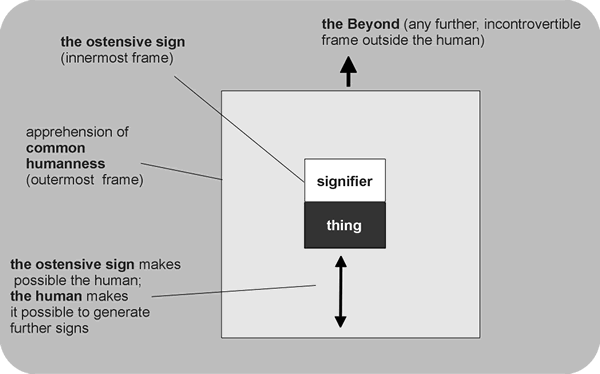
     

  • Happy Birthday: Blues Riffs

    Birthdays are happy moments, but each year more ironically so. Religion liberates us from this growing awareness of finitude. The sacred sign’s deferral of human violence becomes the originary source of our consciousness of death; we apply this pattern of deferral to the violence of death in general. Nor is this an unwarranted extrapolation; our consciousness of death makes us conscious of human life as not mere physical existence but the life of a soul, the locus of representations by nature immortal.

    I am convinced of this originary explanation. But does it provide consolation, let alone liberation, to one who has just celebrated his 59th birthday? Even if Generative Anthropology–as distinguished from previous claimants to the title–truly deserves to be called the theoretical equivalent of religion, its elegance comes at the price of the messy human specificity around which communities are built–not only religious, but also theoretical communities. An idea survives when it reflects, or generates, a collective interest…

    I had begun my birthday Chronicle in this manner when Stacey reminded me that one of my grade-school teachers once asked me in exasperation whether I had been vaccinated with a phonograph needle. I was always spinning ideas and retailing information on a series of subjects–snakes, baseball, philosophy (courtesy of the New York Public Library)–and frequent sessions with Mr. B and Mr. S, our good cop / bad cop vice-principals, did little to curtail the irrepressible chatterbox. A little kid can speak freely because he isn’t expected to be a real authority on anything; in the world of adult professionals, the amateur learns not to speak out of turn.

    In Chronicles 111, 113, and 122, I described my native ideology of Bronx Romanticism: an unquestioning faith in Western high culture at a time when this culture had already begun to define itself in opposition to any such faith. The Bronx Romantic is exposed to romantic clichés at too early an age to be able to exorcise them. Reaching adolescence in a world where distinction is equated with the proliferation of outward signs, he thinks he can save himself by equating distinction with the absence of outward signs. He renounces the gilded French provincial-style dining-room of his respectable Bronx household and conceives a vision of “greatness” in featureless purity. He rebels against Emma Bovary only to become Frédéric Moreau.

    The Bronx Romantic freely imagines himself in the company of the immortals because he is convinced that he is absolutely insignificant. The awareness that nothing he can do could possibly be of the least consequence places him all at once on a transcendental summit inaccessible to those who actually scale the cliffs. Whatever the Bronx Romantic accomplishes in adult life is bound to be both an incredible surprise and a horrible disappointment. Dostoevsky understood the delicious irony of this paradox. “Notes from Underground,” in the bright red covers of the Macmillan edition and Constance Garnett’s understated Victorian prose that the literal-minded call unfaithful to the original Russian, was the Bible of my adolescence. “I am a sick man; I am a spiteful man. I believe my liver is diseased.” Yes!

    The Bronx Romantic is of another race than the baby boomers of the forward-looking post-war era. We sprouted in the arid soil of the late Depression, when those who could blame the latter for their failure refocused their ambitions on their children. (My father was a member of the New York Bar who never practiced law; not an unusual case.) We were bearers of parental desires concrete only in appearance, motivated more by regret than hope of vicarious enjoyment.

    Today’s yuppie parents, the bobos all the more so, make their children showcases for their parenting. No after-school enrichment class, movie-spin-off action figure, or classmate’s catered birthday party can be guiltlessly passed up. Full of their own anxiety for success, they project this onto their children rather than ask their children to succeed for them. These kids are not meant to fulfill their parents’ desires; it is the kids’ desires the parents rush to fulfill before they grow too old to be sure what their desires are. (See Chronicle 211). The emphasis is not on becoming but possessing; ostensibly this is done in preparation for the future, but this future so much prepared and so little defined cannot help but be–like the Bronx Romantic’s but for the opposite reason–an insufficient return on investment. The serious but banal careers with which the children of my generation strove to realize their parents’ dreams (“my son the doctor”) cannot suffice for these children. Nothing can. They should grow up to be the most accomplished generation in history as long as they keep taking their Prozac.

    The incarnation of the Bronx Romantic’s family paradox, GA is both a rethinking of the entirety of human self-knowledge and an empty abstraction, an intellectual revolution and an exercise in bavardage. GA minimally explains the phenomena of human culture. It understands that significance exists only as actualized in concrete, spatiotemporal being; but knowing this, it leaves the details to others. This infuriates the specialists, whose whole lives have been devoted to the acquisition of these details. It also disregards the stuff of human lives, not least of all my own.


    Anyone who’s gone shopping with me will tell you that I am exasperatingly fascinated with detail. Stacey has witnessed me examining and testing a dozen “identical” Opinel knives and accumulating over numerous shopping trips a finely nuanced collection of abrasives (grades 00, 0, 1, 2, 3 nylon steel wool, large and small (red) Crate & Barrel acrylic scrubbers, various files, rasps, and hand-drill sanding attachments, a metal brush-head fitted to a heavy-duty handle…). In Paris, we visited all three marchés aux puces and brought back from France a (red) toilet brush–shaped differently than American models–and a rubber broom.  My favorite shopping places are discount stores, like Independence, MO’s fabulous Recovery Sales Outlet, where shopping fools can find everything from jewels to tools.

    The charm of the “found object,” the incredible bargain you buy first and figure out what to do with afterward, or simply find on the street (my years of running in Santa Monica have produced a large collection of “streeted” coins, a pair of pliers, a silk scarf, and a couple of stuffed animals), lies not only in its unexpected entry into your life but in the mysterious way it finds there an exclusive niche that you never knew existed. Or you can renovate and return to circulation objects that had fallen out of the paradigm, like the lamp in the shape of a lovely lady that we found in an old carton and regilded, and that now stands on my mother’s nest of tables in the living room. As the new find is accommodated into the pre-existing community of objects, new categories and hierarchies emerge. People criticize Imelda Marcos for piling up all those shoes, but I am certain that in her mind each pair serves a uniquely specific function.

    There is what Hegel would have called a dialectic between finding and desiring: finding a new item generates a desire for a whole series–the principle of coin, stamp, sportscard collecting. Each one of our abrasives has its specific use, real or potential, as do each of our knife-sharpening devices (try those new diamonds-in-plastic stones), four varieties of hand lotion (see Consumer Reports) or our many nail-clippers: one for the living room, one for the study, one for the office, one on my key-chain… After I discovered Chinese exercise balls in San Francisco, I made two trips to our local Chinatown to obtain, for home and office, large and small ones (for female guests), enameled and plain ones, and stone ones to avoid the clanging. (I was proud of my ability to turn the balls without touching each other in either hand and in either direction, and always considered the musical ones vulgar, until a Chinese student informed me that the point of these is not to make noise but, on the contrary, to test the practitioner’s ability to turn them silently. I haven’t had occasion to pursue this new level of expertise.) When I took up juggling not long ago, remembering that my father could juggle, I ordered sets of beanbags from each of the two juggling supply companies, one set more firmly packed, the other with a more grippable surface, six of one set and five of the other, although I could never learn to do more than three consistently. (You have to start younger.)

    Doug Collins, the theoretician of the found object, told me the other day after my Durkheim lecture, “You don’t hang around. You make your point and you’re out of there.” He seemed to mean this as a compliment, shades of Napoleon impatient to get to the next battle. But the reality is that center stage is not a comfortable place and I’d rather be searching for a bug in a Javascript program. Great art radiates the comfort and joy of infinite immersion: Bach, Proust, Brueghel, Flaubert working on his “unfinished” Bouvard et Pécuchet, Nick Park’s claymation in Chicken Run. Eventually, you have to wrap the film, print the book, cut the CD, frame the canvas, but the artist’s secret desire is that his work remain a part of his life rather than a product, even at the risk of its becoming, like Frenhofer’s “Belle Noiseuse” in Balzac’s “Unknown Masterpiece,” increasingly incomprehensible to others. “Yes, but it’s beautiful to me,” not: “here’s the lowdown on Durkheim and goodbye.”

    The details I can’t get enough of remain in the private realm where the amateur is never upstaged by the professional. Private life is, as Lévi-Strauss calls “savage” thought, bricolage, tinkering. As I work at doing the dishes, I continually improve efficiency–using plain and abrasive-covered sponges with or without detergent-filled handles, French and American Scotchbrite (available from Costco in an 18-pack), grade 2 steel wool (more effective than grade 3), dishcloths backed with nylon mesh, or French sponge-cloths that leave a surface dryer than anything on the American market, or replacing flimsy paper towels with blue shoptowels-on-a-roll–but this efficiency has no standing in the marketplace.


    A way of thinking is not a Platonic essence; it operates its own narration and the drama is in the details. That of GA cannot be separated from the personal drama that began with the young kid in the Bronx and endures with the old kid at UCLA. Le moi est haïssable [the self/ego is detestable], so I speak of Generative Anthropology or originary thinking rather than my ideas. The slogans supplement the ideas’ abstractness; their familiarity through repetition substitutes for the personal specificity that is the shyly veiled reverse face of originary thinking–provided the familiarity has been achieved. Not long ago a group of UCLA faculty got together to consider applying for a grant to study the relationship between religion and science. As I expounded my grand originary vision of the subject that the others were attacking piecemeal from the perspective of dreams or emotions or pain or what-not, I suddenly saw myself in their eyes as peddling some crackpot scheme–Iterative Ecology, Correlative Doxology, Rebarbative Pomology–that gives you all the answers before you’ve even heard the question. We never did apply for that grant.

    The Bronx Romantic clings to empty transcendence out of fear that the world will not love him enough if he merely participates in it as a historical being, unique only as historical beings are unique. This weakness is also his strength; who else would have an interest in the minimal unity of the human? But birthdays teach even the Bronx Romantic that this unity, lived by a finite being, can be understood only through finitude. Both the generality and the particularity of life are all there is. While I can still make out the scar from my old phonograph-needle vaccination, maybe I’d better crank up the old turntable; vice-principals beware!

        — Eric Gans