Author: staceymeeker

  • GA and Religion: Thoughts on the 2021 GASC Conference

    This year’s GASC conference, organized by Roman Katsman and sponsored by his home institution, Bar-Ilan University in Ramat Gan, Israel, had been postponed from last year, and we had hoped to hold it in the traditional in-person mode. But despite our disappointment at being limited to Zoom, the quality of the papers was high and the atmosphere was cordial and friendly throughout. The GA faithful were well represented: three of the four original contributors to Anthropoetics in 1995 were online as were all three past and present presidents of GASC—which I managed to persuade the group to pronounce a la “UCLA” instead of as “Gask.” (Try imagining USC as “Usk”!)

    I won’t discuss the individual papers, but I was impressed by the innovative character of many of them, both those in the literary domain and those that ventured outside it. This overall impression confirmed my notion that generative anthropology is best understood as an originary phenomenology, a way of thinking grounded in an ontology not simply intuited via introspection a la Descartes, but founded on an originary scenario that can be described and discussed, and consequently not only placed in parallel with other humanistic discourses but used to provide intuitive tests of social-science results.

    This reflects the uniqueness of GA as a mode of originary thinking that remains open to everyday human intuition, while being in no way incompatible with scientific findings. The principle of a shared scenic hypothesis does not limit us to any particular configuration, once we have accepted (1) that human language and culture emerged in/as an event, and (2) that the human cannot be derived from any combination of animal traits in the absence of such an event.


    Since its origin with the publication of The Origin of Language forty years ago, GA has had to deal with the fact that the originary hypothesis is non grata in the academic/intellectual world. I have come to the paradoxical conclusion that the root of this situation lies in an intuition common to both GA and the social scientists who dismiss it: that to speak of an originary event is necessarily to evoke the sacred.

    This intuition entails that, in order to avoid contaminating empirical science with the “sense of the sacred,” it does not suffice to bracket or even deny the existence of God as a transcendent being. For whether or not founded in a transcendental ontology, the sense of the sacred is inseparable from what I have been calling “humanistic” thought.

    I experience the sacred in the first place as an external will imposing itself on me, a will to which my first reaction is one of originary resentment, since it frustrates my desire. Nonetheless, in the originary context, I must submit to this will as providential, insuring my own survival as well as that of the human community.

    The One God of the Hebrews embodies the sacred will in perhaps the clearest terms. Under his rule, resentment of the sacred is not embodied in a symmetrical countervailing force, such as the Zoroastrian Ahriman or Satan in Milton’s Paradise Lost, but in the paradoxically subhuman yet articulate form of the serpent.


    The result of the expulsion of the sacred from social-science anthropology is that the unique aspects of human culture, language included, must be classified within the overall category of genetically determined traits. Thus the transition between our ape ancestors and ourselves is assimilated to that of speciation in general: language, religion, human consciousness, like the opposable thumb, must be understood as “adaptations” whose emergence can ultimately be explained in Darwinian/Mendelian terms. GA’s evenemential hypothesis of origin is not so much rejected in preference to a better one as dismissed as a category error.

    Other considerations aside, this bracketing of the sacred in the digital era no doubt reflects the urgent need to explore the limits of artificial intelligence as a means of fulfilling the Frankensteinian project of constructing a more efficient version of human intelligence, and by extension of “the human” as such, free of the interference of an intuition whose worldly source in the interaction between the individual and the community appears irreducible to an algorithm.

    The historical irony of it all is that just when we come up with an anthropology that explains in rationally comprehensible terms the titillating paradoxes of “deconstruction,” those who had allowed themselves to be titillated have abandoned such matters for “critical race theory” et al, whereas those less susceptible to titillation have sworn off all such para-scientific excursions and returned full-time to their laboratories, where they can avoid woke politics as well as “unfalsifiable” hypotheses.

    How then can we hope to reverse this consequence of the reinforcement of the dominant empirical research paradigm? It is tempting to assume the role of Cassandra, claiming that it is the all-too-evident “decline of the West” that makes it unable to acknowledge the genius of generative anthropology, or in less spectacular terms, the sacred as an essential component of the human. But before resigning ourselves to a tragic fate, we should exert ourselves to seek other options.


    In this context, the one thing that I would have liked to see more of in our conference, and that I hope to see more of in the future, is work with a substantive focus on GA and the sacred. Although most of the papers touched on religious themes, only Bishop Pierre Whalon’s was focused on the sacred’s fundamental relationship to generative anthropology.

    Given the literary orientation of most of GA’s adepts, the sacred is not an easy subject to deal with—nor was it the theory’s original focus. Literature encounters religion on various levels, and a number of papers focused on religious themes or paradigms within literary works and oeuvres. But because literature is by definition a secular, “post-religious” activity, such analyses can touch only peripherally on the more fundamental relationship of the sacred to the originary hypothesis.

    Along these lines, it seems to me of the greatest importance for the continued flourishing of GA to establish a mutually nourishing dialogue with religious thinkers, including theologians who accept not merely the existence of God but the dogmatic basis of a given religion, whether Christianity or another. I strongly concur with Bishop Whalon’s vision of GA as a potential ally of theological reflection, which, as he emphasizes, is always really about the human: religious faith is human faith.

    Given the demise of French Theory and the consequent erosion of the platform in literary studies for examining the tension between the metaphysical and the anthropological, the field of religious studies remains the sole academic domain in which the human distinction of a soul informed by the sacred remains a subject of serious reflection.

    But this does not require us to sign up for new PhDs. There is still a great deal of latitude in language and Comparative Literature programs for interdisciplinary research. The Urtext of GA, Girard’s 1961 Mensonge romantique et vérité romanesque, is as much a reflection on the sacred foundations of desire as on the novel form—and all of Girard’s works, as well as my own, were authored by professors of (French) literature.

    The fact that both of us have frequently been taken for “anthropologists” is not a category error. The excitement that inhabited literary studies after the First World War and throughout the 20th century—the criticism of Valéry, the Russian Formalists, the New Critics and the Nouvelle Critique, and in particular of Girardian “mimetic theory” and GA—was a result of literature’s being perceived as a prime source of anthropological intuition. And by the same token, the return from fictional to sacred texts should not be seen reductively as “the Bible as literature,” but rather as a demonstration that the textual sensitivity we have gained through literary study can be applied to sacred texts as well.

    This perspective should allow us, even in today’s climate, to escape the victimary reductionism of CRT and the like. On the contrary, the framework supplied by GA and its interaction with religious texts provides the basis for an anthropology whose political implications are generous rather than vindictive. Just as we need not espouse the ideology of slavery to recognize its historical superiority to the execution of prisoners, so we need not advocate other obsolete hierarchical distinctions in order to evaluate them in their historical context, always remembering that the first imperative of any society is to maximize its chances of survival—and that until very recently, the fundamental ethical values of any society were guaranteed by a shared conception of the sacred.


    One final point. As I mentioned in my conference talk, the examination of the world’s religious texts and practices in the light of the originary hypothesis provides a template for any number of research projects that can occupy our minds and enrich our anthropological understanding. My brief analysis of Nagarjuna’s Mahayana Buddhism at our 2016 conference (see Chronicles 515516) provides but a foretaste of our originary phenomenology’s potential as a method for comparative religious study. I very much hope that the intrinsic interest of such projects inspires other members of the GA community to explore this domain far more deeply.

  • Theology and anthropology: can each help the other?

    At first blush, my title may sound a bit ridiculous, wishful thinking for some, balderdash for others.[1] What has Jerusalem to do with Athens?[2]

    For one thing, both study humans, which is a bit stranger than we usually realize: humans studying humans.[3] While anthropology clearly does—it’s in the title of the discipline, after all—it may seem strange that theology is about the study of people too. But what are believers? That is what must be understood before thinking about what is believed. So all theologians, not just Christians, start with humans first, and only then try to think God.

    It is clear that the present intellectual context is hard on both disciplines—we are actually in the same boat, so to speak. Only fundamentalists think and act as if the interpretation of their sacred texts or doctrines is unchanging.[4] There is a parallel in scientism, that only that which is established by science narrowly defined can be true, and this flat materialist perspective reduces human being to no real importance—so why study it?

    Therefore, scientism tends to dismiss anthropology. It turns out to be “just” humanities after all, for these ideologues. In other words, easily dismissed… And on the totem pole of the humanities, theology is at the very bottom. For both, there is the issue of (re)claiming legitimacy, and although the two disciplines are very different, the contemporary crisis of truth—whether there is any possibility of knowing what is true—is their common battleground.

    Now let me define my terms. “Science” as say, physics, in a first instance gathers and measures physical data, seeks insight into them, formulates questions and then hypotheses; and in a second instance devises ways to verify a hypothesis and finally communicate the results as probably true or probably false. Call this type of Wissenschaft (“science” in German) Naturwissenschaft or natural science. There are sciences such as sociology that gathers and examines data about human societies, seeks insight into them, formulates questions and then hypotheses; and in a second instance devises ways to verify a hypothesis and finally communicate the results as probably true or probably false. Call it Geisteswissenschaft.[5]

    Science as anthropology is sometimes Natur and sometimes Geist and often both, according to the current definition of the American Anthropological Association:

    To understand the full sweep and complexity of cultures across all of human history, anthropology draws and builds upon knowledge from the social and biological sciences as well as the humanities and physical sciences. A central concern of anthropologists is the application of knowledge to the solution of human problems. Historically, anthropologists in the United States have been trained in one of four areas: sociocultural anthropology, biological/physical anthropology, archaeology, and linguistic anthropology. Anthropologists often integrate the perspectives of several of these areas into their research, teaching, and professional lives.[6]

    “Religion” comes from Latin “binding together”: in terms of a person, religion poses questions of existence, and secondarily it is a cultural formulation created by a community. The German-American theologian Paul Tillich defined faith as a personal response to matters of “ultimate concern.”[7] These are in fact existential: does my life have a meaning, who am I and why, what is death in general and my death in particular, and so on. One’s primary reaction is thus highly intimate, and this questioning goes on throughout life. One may conclude that such questions are meaningless; or that they are irrelevant to me; or that I will think about them someday, perhaps after taking a class. There are as many possible responses as there are people, and as we are never static so long as we are alive, change in our existential stance is inevitable.

    Religion is a secondary, communal response to these ultimate concerns. This “answer”—codified in ritual, practices, liturgies, doctrines—is usually handed down to each member of the community from parents to children. No one escapes this formative indoctrination. It is part of the culture of one’s family, clan, tribe, nation, and it begins at birth. Obviously, one can reject at length the religion that came with mother’s milk, and perhaps some people should. Furthermore, this religious formation can very well be one of the several forms of atheism that not only rejects the accouterments of this or that religion, but that also possesses its own doctrines, social practices, and (informally at least) even rituals.[8]

    Faith is the trusting response, a commitment, that one’s approach to handling ultimate concerns is right. But once expressed—conceptualized —as belief, no one can claim that it is certain for all people at all times in all places. Faith is at best an estimate of probability to which it is worth committing oneself, for neither one person nor all the faithful can prove it. In the final analysis, faith is more of a question than an answer. Belief is an answer that raises questions: where there is faith there must also be doubt.

    This is the root of all theology, whose classic definition is fides quærens intellectum, faith seeking understanding.[9] I take this to mean for humanity in general and not just Christians. Some form of faith is present in each one of us.[10] We all have moments when we question this faith. To do so scientifically is the discipline of theology. It too “gathers and examines data, seeks insight into them, formulates questions and then hypotheses; and in a second instance devises ways to verify a hypothesis and finally communicate the results as probably true or probably false.” Like all sciences, theologies are judged by their internal coherence as well as their interpretation of the evidence they marshal. And like all sciences, theologies begin when people experience awe and wonder.

    However, theology in general and Christian theology in particular is a different Wissenschaft then either natural or human sciences in one basic respect. The former begins from sense information; the latter adds human meanings to such information. Theology begins first not with data but with dogmata[11]. These are the givens, the mysteries of faith. In the face of the uneasiness the word “mystery” might cause, Flannery O’Connor gives a helpful word: “… a dogma is only a gateway to contemplation and is an instrument of freedom and not of restriction. It preserves mystery for the human mind.”[12] Doctrine, on the other hand, is a growing body of understandings, and these are the proper subject of theology as a science. Here hypotheses and probability hold just as much as for the other sciences.[13]

    Furthermore, like anthropology, theology is a study of culture. “A theology mediates between a cultural matrix and the role and significance of a religion in that matrix.”[14] While this definition has been hotly contested, its relevance to the task of theology remains. As such, it is also relevant to the development of the understanding of the “the full sweep and complexity of cultures across all of human history.”

    Let us make a start with “what everyone calls ‘god’.”[15] The German theologian Karl Rahner pointed out that of the thousands of human languages, living or extinct, every single one has a word for “god.”[16] The anthropologist Eric Gans calls this phenomenon “the sense of the sacred,” which in his analysis is one of the four marks distinguishing humans qua Homo sapiens from other primates.[17]

    Gans claims that this “sense of the sacred” is an essential aspect of human being, alone among all animals. His Generative Anthropology (hereafter GA) is a significant development of René Girard’s work on mimetic violence. In books like The Scapegoat and Violence and the Sacred, Girard focused on the communal phenomenon of scapegoating as a key to understanding basic issues concerning violence among human communities.

    Gans posits a “minimal hypothesis,” in fact a heuristic, for the origin of the specifically human, as opposed to other primates. He describes the originary[18] moment of a community of proto-humans who are gathered around a fresh carcass. All members desire to eat of it, because they see others wanting to do the same—mimesis. The growth of mimetic desire among all of them increases the danger of violence. But instead of an alpha imposing a pecking order by violence, as none is strong enough to appropriate the meat alone, one member creates a sign, an “aborted gesture of appropriation.”

    The sign is an object, a product, a whole imitating another whole [viz., appropriation]. The sign points to its referent, but in order to do so, it must be cut off from the possibility of attaining it, must mimic the object’s closure in its own. What is new about the human sign as opposed to the most complex animal signals is that it is the product of a formal consciousness. The sign is a form in that it turns back on itself in order not to appear to be pursued as a gesture of appropriation.[19]

    As the members of the group reproduce the sign, the originary event becomes a scene, a re-enactment of the deferral of violence and survival of the community through the sign, which becomes a symbol. The scene has a center and a periphery, moving outward from the sacred to the profane.

    What humanity has from the beginning designated as god is not the object that occupies the center of the circle but the Being of the center itself, which subsists after the destruction of its original inhabitant and whose will, conceived as the force that held the circle and its center in equilibrium at the moment of the emission of the sign, guarantees the sign’s timeless meaning…[20]

    Comparing the GA heuristic to this discussion allows us to find a potential for “what everyone calls god” in concrete human experience and history. As an anthropological, i.e., scientific, tool, it does not depend upon acceptance of the existence of a deity at all, of course. However, the universal ritual reenactment of “originary scenes” noted by scholars such as Mircea Eliade[21] (as well as Girard) gives further grounding of a specifically non-theological basis for people seeking to understand how religions develop, and what that means in this or that instance.

    This generic fides I have defined is not what Christians mean when we recite “We believe in one God.” At best it is a reaction to the mystery of human being in general and le moi in particular. Here is the first contribution of GA to theology. A clear and sharp distinction between faith and belief is crucial to theology’s work of understanding.[22] At the same time, it is also important for anthropologists studying religions.

    GA provides for theology a scientific tool with this sense of the sacred. Although I am no anthropologist, I am struck by its ability to move from originary scenes to fertile interpretations of contemporary societies. In other words, GA’s heuristic competence in both understanding the data of humanity’s myriad creation myths and proposing a theory whose fruitfulness are its lettres de noblesse: it is a science of the human. As such, GA is not afraid of god-talk: as such, it is invaluable to theologians.

    But it is not a theology, thank God. It should be clear that Gans’s theory is a heuristic and not a reference to any particular event. The work of theologians is to develop human understandings of mysteries believed to be divine.[23] At best, theology can never give us certitude, but only “that obscure, analogical and imperfect understanding that throws some light upon the truth known from elsewhere and enables us to possess it more fully.”[24] We cannot go beyond such understanding, and therefore our theologies will always be in need of revision and development as a result, even as they (hopefully) progress.

    In this work GA is invaluable. At the same time, the creative new strategies that theologians are developing to address the general crisis of legitimate authorities can be helpful for anthropologists as well.[25]

    One area of mutual concern is the origin of humans, Homo sapiens.

    Since the theory of evolution is generally accepted by the vast majority of Christians, except for some inclined to imagining that the Bible is in fact a history written by God[26], and so build fantasies such as “creation parks.”[27] It is certainly true that churches have been obtuse at times, even to the point of seeking to kill,[28] the scientific method developed from (not rejecting) a basic theological truth: one learns nothing at all by saying that God “made it that way.” Whether god is or not, god is not a datum of the universe.[29] This is as much a scientific premise as it is theological.

    The search for human origins is the proper of anthropology, though its tools have greatly expanded through genetic research as well as paleontology. The older linear scheme continues to develop evermore numerous branches. Yet the question remains: when did Homo sapiens become humans like us? Granted, put like that, it might seem like question-begging. Yet we want to know how and when humans began to use language as the historical record shows, how and when “we” began to make art, how and when did marriage develop not just as animal pair-bonding but as cultural symbols as well, and what is the origin and meaning of the “sense of the sacred”?

    These questions are vital to theology as well. The second chapter of Genesis has an odd twist: God invites the adam (“groundling”)[30] to name—the specific power of language—all the animals, as part of a search of a “helper” for its loneliness. Prior to that, naming was only God’s power (Gen. 1:5, 8, 10), and it is hierarchical: adam names animals, God names adam.

    Walker Percy reflected on the story of Helen Keller’s discovery of the name “water.” First, he quotes from Keller’s own The Story of My Life, when she understood the name “water”:

    Suddenly I felt a misty consciousness as of something forgotten—a thrill of returning thought; and somehow the mystery of language was revealed to me. I knew then that “w-a-t-e-r” meant the wonderful cool something that was flowing over my hand. That living word awakened my soul, gave it light, hope, joy, set it free! […] Everything had a name, and each name gave birth to a new thought. As we returned to the house every object which I touched seemed to quiver with life.[31]

    Percy continues:

     … eight-year-old Helen made her breakthrough from the good responding animal which behaviorists study so successfully to the strange name-giving and sentence-uttering creature who begins by naming shoes and ships and sealing wax, and later tells jokes, curses, reads the paper, writes La sua volontade e nostra pace, or becomes a Hegel and composes an entire system of philosophy.[32]

    Theologian Rowan Williams comments on 40,000-year-old Ice Age art, namely, certain “lion/man” statuettes: “lion’s heads and human bodies shaped in leonine form.”

    The makers of such objects are engaged in a profoundly linguistic task: they are so depicting one thing that it “speak of” another, both blurring boundaries and sharpening distinctions … thus indicating the presence of pre-frontal cortex activity in the brain. A characteristic intelligible form of life or action is identified and recognized at work in another living agent, and the representation creates a new hybrid material shape: this is a shape that describes nothing in the “real” world in the ordinary sense of description, but is not simply a casual jeu d’esprit…[33]

     In other words, it is art, just like the magnificent cave paintings at Lascaux and in many other places.

    I have written about marriage as symbolic pair-bonding in my 2016 book, Made in Heaven: How God Acts in Marriage,[34] relying on anthropological insights as well as theology per se. Besides Gans, I quoted Robin Fox’s classic Kinship and Marriage:

    Kinship and marriage are about the basic facts of life. They are about “birth and conception, and death,” the eternal round that seemed to depress the poet but which excites, among others, the anthropologist.

    [. . . ] Man is an animal, but he puts the basic facts of life to work for himself in ways that no other animal does or can.[35] (This last sentence sums up the subject shared by anthropology and theology.)

    Finally, the sense of the sacred for theology is therefore what impels faith to attempt to explain what it cannot describe. Reflecting on this paradox calls forth questioning, as we seek insights into this phenomenon that is both individual and so, unique, and also shared in and by a community of worship through which faith comes.[36] For anthropology it is different, a heuristic that has nevertheless proven to be very fruitful indeed.

    Faith is a trusting response to that which is “revealed” in the originary event. Since language is always communal, I learn a vocabulary developed by my “community of faith” to describe what I am feeling and why I should or should not trust it.[37] Doubt is always a reflection of faith: no one doubts what is certain. Atheists and agnostics are not exempt from this basic aspect of human being. We are all haunted, so to speak, by the originary event.

    Such are some commonalities between anthropology and theology. In the present context of a flight from understanding into the hollow comfort of certainty, where seeking truth is derided as merely an occult power grab, or it is defined from sacred texts that brook no interpretation, both are sciences that have much to offer each other. Not only in the academy, but in practice as well.

    We are all in the same boat, and it is taking on water fast. One can row, the other bail, and then trade places. But both need to get to shore.

    Notes

    [1] In an important new book, Derrick Peterson has deconstructed the “warfare” between science and religion that supposedly exists (and certainly sells popular books), as a story that never happened. He relies on massive efforts by historians of science over the past half-century, as well as his own research, to tell a radically different story: “While deconstructing many of the historical misunderstand[ings] that have gone into the thesis and continue to linger in our consciousness does not solve all our problems, or prove Christianity true, or that God is real, it does help us precisely by clearing the decks. While the rhetoric of ‘everything we know is wrong’ can be quite trying when used as marketing, often in the areas of the history of science and religion one does truly wish we could all start over.” Flat Earths and Fake Footnotes: The Strange Tale of How the Conflict Between Science and Christianity Was Written into History (Eugene, OR: Cascade, 2021), 316.

    [2] Reversing the third-century theologian Tertullian’s famous line, “What then has Athens in common with Jerusalem ? What has the Academy in common with the Church ?” http://www.tertullian.org/articles/bindley_test/bindley_test_07prae.htm

    [3] Neuroscientists studying the brain are nothing else than brains studying brains, for example.

    [4] An analogy would be the “originalist” jurists who believe the US Constitution can only be interpreted in its original meaning and context. Like modern religious fundamentalism, this notion is of fairly recent origin. It is false because it is unhistorical. The Constitution originated from the deliberations of a group of propertied white men, half of whom were slaveowners. Even if we could have direct access to their mindset, it would be of no help in addressing contemporary issues of American jurisprudence.

    [5] This classic distinction comes from Franz Boas, “The Study of Geography” Science 11 Feb 1887: Vol. ns-9, Issue 210S, 137-141.

    [6] See https://www.americananthro.org.

    [7] A helpful compendium of his thought is Paul Tillich, Dynamics of Faith (HarperOne, 2017). He expanded on its themes in his three-volume Systematic Theology.

    [8] See John Grey, Seven Types of Atheism (London: Farrar, Straus and Giroux, 2018). Conversely, there are religions without rituals.

    [9] Anselm of Canterbury, Proslogion, 1.

    [10] .« On est contraint à la foi. Croire de force, tel est le résultat. Mais avoir foi ne suffit pas pour être tranquille. La foi a on ne sait quel bizarre besoin de forme. De là les religions. Rien n’est accablant comme une croyance sans contour. » Victor Hugo, Les travailleurs de la mer, vol. 2, p.111.

    [11] The word “dogma” comes from the Greek δοκεῖν (dokein), meaning to believe, to hold an opinion. It has taken on the pejorative meaning of something to be believed without question, imposed by a religious or ideological authority, e.g., “Marxist dogma.” Thus dogma connotes something irrational. However, its precise meaning in Christian discourse is those truths that can only be known through divine revelation, “the mysteries of the faith”.

    [12] Flannery O’Connor in a letter to “A”, in The Habit of Being (New York: Farrar, Straus and Giroux, 1988), 92. “A” has recently been identified as Hazel “Betty” Hester.

    [13] Bernard Lonergan, The Triune God: Systematics tr. Michael Shields (Collected Works of Bernard Lonergan, Vol. 12, University of Toronto Press, 2007), 31-51.

    [14] Bernard Lonergan, Method in Theology (Collected Works of Bernard Lonergan, Vol. 14, University of Toronto Press, 2017), 3. This definition is controversial because it is generic, and deliberatively, not specifically Christian. In fact, Lonergan proposes a “generalized empirical method” which moves in eight “functions” from first, research, to finally, communications, in a heuristic that relies upon an adaptation of scientific method for any community of thinkers. As such it is applicable to all scholars, scientific or otherwise.

    [15]quod omnes dicunt Deum“—Thomas Aquinas, Summa theologicæ I.q.2.a.3.

    [16] See The Content of Faith: The Best of Karl Rahner’s Theological Writings, eds. Karl Lehmann and Albert Raffelt, trans. by Harvey D. Egan, S.J. (New York: The Crossroad Publishing Co., 1992), 205-211; 205. A classic restatement of the ubiquity of the notion of god is John Calvin: “Yet there is, as the eminent pagan says, no nation so barbarous, no people so savage, that they have not a deep-seated conviction that there is a god.” (Institutes of Religion, I.3.1.) The “pagan” is of course Cicero. See inter alia, Tusculan Disputations, I.13.30.

    [17] The others are highly developed symbolic language, the creation of art, and the practice of marriage as culturally defined symbolic pair-bonding. See A New Way of Thinking: Generative Anthropology in Religion, Philosophy, Art (Aurora, Colorado: The Davies Group, 2011).

    [18] Originary not original. The distinction is crucial.

    [19] Signs of Paradox: Irony, Resentment, and other Mimetic Structures (Stanford, CA: Stanford University Press, 1997), 30.

    [20] The Scenic Imagination: Originary Thinking from Hobbes to the Present Day (Stanford, CA: Stanford University Press, 2008), 3

    [21] Le sacré et le profane (Paris: Gallimard, 1987).

    [22] As it is for analytic epistemologists who mistakenly seek grounds for “justified true belief”, or else reject its possibility, missing the point completely. See inter alia, Laurent Jodoin, “The Wars on Truth“.

    [23] This is not strictly true of Buddhism, of course, but it holds for Buddhist theologians to develop understandings of their religion’s tenets.

    [24] Lonergan, Systematics, 107. Emphasis added.

    [25] See, e.g., Jeremy Wilkins, Before Truth (Washington, DC: Catholic University Press, 2018), 31-51.

    [26] As opposed to “inspired”—literally, “God-breathed”—a radical difference between a book written by “God’s finger” instead of by human authors. See II Timothy 3:16.

    [27] See e.g., the Creation Museum.

    [28] The Inquisition was originally a pastoral process, to help people refine their understanding of the faith. It became murderous only when the monarchs of Spain “weaponized” it for their political purposes: thus the “Spanish” Inquisition. Another argument for separation of church and state…

    [29] Otherwise the god·dess is merely a very powerful alien, i.e., not divine. This is why I welcome satires like “The Church of the Flying Spaghetti Monster“, to remind first of all believers of this basic truth. It is also why I think process theologies are mistaken at their root. For a succinct argument, see David Burrell, “Does process theology rest on a mistake?” Theological Studies 43, no. 1 (March 1982): 125–35.

    [30] From Hebrew adamah, meaning “earth”, that from which in Genesis 2 God formed the adam. It only found its loneliness resolved when God “sexed” it into male and female. And see Gans’ analysis of Eve’s ressentiment

    [31] Quoted in “The Delta Factor”, The Message in the Bottle ( ), 34-35.

    [32] Ibid.

    [33] Rowan Williams, The Edge of Words (London: Bloomsbury, 2014), 25-6; he references Jill Cook, Ice Age Art: Arrival of the Modern Mind (London: British Museum Press, 2013), 28-37. She suggests that such complex symbolization indicates a “modern mind”; Williams opines that it rather indicates “human intellection as such.”

    [34] Fall River, MA: Theology for Everybody Books (reviewed by Eric Gans here).

    [35] Robin Fox, Kinship and Marriage (Cambridge, England, 1967; Cambridge University Press), 27; Made in Heaven, 12.

    [36] See, for instance, “Hindu and Christian Bhakti: A Common Human Response to the Sacred”, David C. Scott, Indian Journal of Theology, 29(1),1980: 12-32

    [37] One great mistake of our time that that first we have a “religious experience” and then we individually search out a community of faith that best expresses that experience, and this applies equally to atheists as to theists. This stunted notion informs the idea that parents should not raise their children in the same faith tradition as themselves so they can find their “own” religion. The upshot is not that the young become sophisticated as they grow into adulthood, but rather that they are completely unprepared for the basic questions of life, and so are more liable to be recruited into sects.

  • History, Desire, and Sadomasochism in Alice Munro’s “The Beggar Maid”

    Alice Munro is the first Canadian and first short-story writer to win the Nobel Prize for Literature (in 2013), a belated recognition of the cultural power of a genre of which she is one of the greatest modern practitioners. One of her most notable works, Who Do You Think You Are?[1] (1978), as its title suggests, is a collection of stories concerning identity-seeking. Of the ten pieces in the collection, four—”Royal Beatings,” “Privilege,” “Half a Grapefruit,” and “The Beggar Maid”—are about the protagonist Rose’s childhood experiences growing up in an economically and socially marginalized Ontario farming town—the fictional (and aptly named) Hanratty—during the nineteen-thirties and -forties. All are more or less overtly concerned with little Rose’s self-conscious discovery of her peripheral status and her resentful envy of those at the center, making them potentially apt subjects for originary analysis. This paper will use Mimetic Theory and the Generative Anthropology heuristic to probe some of the insights into modernity offered by this the last-mentioned story.

    If in the first three stories all her center-seeking efforts are childish and make little ostensible difference to her life, in “The Beggar Maid” the project assumes a more consequential dimension. This story concerns the period (apparently the early nineteen-fifties) in which Rose enters college and is unexpectedly granted access to a more broadly acknowledged center in life. In particular, her desire for centrality seems to be promised material fulfillment in the form of marriage with Patrick Blatchford, a slightly older graduate student from a rich background in the exotic, even “magic” (95) locale of British Columbia.

    “The Beggar Maid” is about love, or its absence, about desire—which in one form or another is never absent—and about a marriage and its toppling. But in a way, all these topics circle around the changing terms of the quest for centrality in mid-twentieth-century North America. The story begins with laconic introductions of the major figures and their relationships. There are three of them, and it should come as no surprise to students of René Girard and Generative Anthropology, that they arrange themselves into the geometry of a triangle. Patrick, Rose, and Rose’s host and mentor Dr. Henshawe are knit together, that is, by complex of interlocking desires.

    It might be easiest to start with Patrick, as his desires are perhaps the most legible and consistent. Why does he want Rose? Of course, sexual attraction has its own imperatives and we are to understand that Rose is more beautiful than the other scholarship students with whom she is grouped. Amusingly enough, we must see these rivals through the adolescent Rose’s judgmental gaze, as:

    four or five girls of the same stooped and matronly type … and several bright-eyed, self-satisfied, babyish-looking boys. It seemed to be the rule that girl scholarship winners looked about forty and boys about twelve. It was not possible, of course, that they all looked like this. It was not possible that in one glance … Rose could detect traces of eczema, stained underarms, dandruff, moldy deposits on the teeth, and crusty flakes in the corners of the eyes. That was only what she thought. But there was a pall over them, she was not mistaken, there was a true terrible pall of eagerness and docility (73-74).

    So, even allowing for rivalrous distortions, Rose is good-looking and, at least in her own opinion, more spirited, even rebellious, and thus naturally attractive. But mimetic influences of course inflect all such choices, producing Goethe’s famous “elective affinities,” and Patrick gives a very clear indication of what else has moved him. “I’m glad,” he tells Rose, who has warned him, accurately, that he would think her home in Hanratty a “dump” (78). “I’m glad you’re poor. You’re so lovely. You’re like the Beggar Maid” (79). He is referring to Edward Burne-Jones’ 1884 Pre-Raphaelite painting, King Cophetua and the Beggar Maid, which Rose of course quickly looks up and interprets.


    King Cophetua and the Beggar Maid (1884)
    Photo © Tate. Image available from Tate Images through a CC-BY-NC-ND-3.0 (Unported) license.
    Original image available at https://www.tate.org.uk/art/artworks/burne-jones-king-cophetua-and-the-beggar-maid-n01771

    The first stirrings of resentment of her admirer can easily be detected in the resulting verdict. “The milky surrender of her, the helplessness and gratitude. Was that,” Rose wonders, “how Patrick saw [her]?” (80). Does he see the same “docility” that she has just sneered at in the other scholarship girls? But we can look up the painting, too and, as Munro is perhaps inviting us to recognize, both Patrick and Rose seem to be misreading it to their own desiring purposes. Burne-Jones’s beautiful Maid is actually elevated above the clearly worshipful King, gazing over his head in some sort of self-possessed trance of feminine sublimity. Far from surrendering or expressing gratitude, that is, she seems to have the power in their relationship, obliviously accepting his obeisance. And there is no question that Patrick has, in his turn, mythologized Rose’s socioeconomic status. She has been centralized for him, we might say, by her victimhood, and he is clearly imagining himself the rescuing or conquering knight, who is both romantically obsessed and heroically self-sacrificial, lowering himself (as the King has literally done) to sit at her feet.

    The question, of course, will be whether or how thoroughly Rose absorbs Patrick’s view of things, follows his modelling of her own status (or for that matter, the modelling of the culture of the previous century of which the Pre-Raphaelites were a prestigious expression). Clearly, she is drawn to it—she will admit she likes at least the idea of being worshipped (85). But someone else is also pulling her in a different direction.

    Dr. Henshawe is the retired professor in whose house Rose stays as a scholarship student when she leaves Hanratty to come to the university. Her view of Rose’s proper identity is repeatedly and insistently expressed: she is a “scholar” (69). Although this, too, Rose both imitates and resents:

    Dr. Henshawe directed conversation. She mentioned Frank Scott and Dorothy Livesay.[2] She said Rose must read them. Rose must read this, she must read that. Rose became sullenly determined not to. She was reading Thomas Mann. She was reading Tolstoy (70).

    Even in superficial (or “sullen”) rebellion, that is, she is moving in the professor’s general direction. Still clearer is Dr. Henshawe’s affixing of a socioeconomic label to her ward. Munro’s characteristic wit registers as Rose tries out this new marker of identity, with all its opening vistas of what Generative Anthropology will call victimary centrality, on her stepmother Flo in Hanratty:

    Before she came to Dr. Henshawe’s, Rose had never heard of the working class. She took the designation home.

    “This would have to be the last part of town where they put the sewers,” Flo said.

    “Of course,” Rose said coolly. “This is the working-class part of town.”

    Working class?” said Flo. “Not if the ones around here can help it.” (70)

    But when Rose seems granted an opportunity through marriage to escape this category, Dr. Henshawe resists. Indeed, she wants to tear Rose away from Patrick.

    As a professor, Dr. Henshawe assumes multiple roles: as a social superior of Rose, as a teacher and academic mentor, and as a surrogate parent of sorts, guiding or trying to guide Rose’s emotional life as well as her career. Part of what is fascinating yet convincing in Munro’s account is how few her interventions really are, how small the suggestions, to have such consequences for Rose’s life—but so it is.

    Although less luxurious than that of Patrick’s family, the house Dr. Henshawe lives in represents the richest lifestyle Rose has seen, at least before visiting British Columbia. Seemingly kind to scholarship students, the professor’s posture is not totally altruistic. At first sight, Dr. Henshawe impresses Rose unpleasantly as a “charming nuisance” (75), who, according to Rose’s resentful perspective, assumes a role of benefactor, expecting humbleness and gratitude from the scholarship girls. Accordingly, the professor seems (to Rose) to deem it her natural right to plan Rose’s life in the way she does those of the other girls. Paradoxically enough, this interference is manifested in her enthusiastic endorsement of Rose’s ambitions. In a typically adolescent exploratory mode, Rose ventures the idea, had she been a man, of a career as a foreign correspondent.

    “Then you must be one!” cried Dr. Henshawe alarmingly. The future will be wide open, for women. You must concentrate on languages. You must take courses in political science. And economics. Perhaps you could get a job on the paper for the summer. I have friends there.” (72)

    Rose of course recoils from being taken so literally. And she doesn’t at all like the prospect of these various exertions that she “must” make. “It was dangerous,” Munro dryly remarks, “to mention things to Dr. Henshawe” (73). And yet, Rose’s eventual career as a television journalist will not be too far removed from this initial idea.

    But on the matter of Patrick, the challenge is considerably greater. When Dr. Henshawe finds that he has an eye for Rose, she tries to check their love affair by probing Rose’s psychology. Indeed, she is almost uncannily perceptive.

    There are three critical conversations between Dr. Henshawe and Rose on the subject of Patrick. Each conversation affects Rose mimetically, subtly altering her perceptions and triggering various kinds of resentful resistance. On the first occasion, the professor spots Patrick waiting for Rose outside the door of her house:

    “Oh, Rose! Come and look!” called Dr. Henshawe, in her soft, amused voice, and they looked down together from the dark window of the study. “The poor young man,” said Dr. Henshawe tenderly….

    She called Patrick poor because he was in love, and perhaps also because he was male, doomed to push and blunder….

    “Guarding the door,” Dr. Henshawe said. “Oh, Rose!”

    Another time she said disturbingly, “Oh, dear, I’m afraid he is after the wrong girl.” (69)

    Rose, of course, recoils. But she also sees freshly, sees what the professor has shown her. She doesn’t like being made to see these things, but she sees them. She is forced to consider her suitor’s flaws, which are of a very particular, even privileged kind. All Munro’s subtle insight into the hardness or strength instilled by the kind of upbringing Rose (or she herself) has had is suggested in the assessment Dr. Henshawe’s intervention provokes. Patrick, Rose fumes,

    …was asking to be laughed at. He was the most vulnerable person Rose had ever known, he made himself so, didn’t know anything about protecting himself. (69)

    But will she take on the task of protecting him? Legitimating his naivety by taking it seriously? It is an open question, because at the same time, Patrick “was also full of cruel judgments, he was full of conceit” (69).

    Another talk with Rose occurs when Dr. Henshawe sees that the relationship between Rose and Patrick is becoming more serious. The professor is a socialist, a founder of the Canadian party (69), and in her class-conscious way she hints that Rose has made a coup. She must have an eye on Patrick’s “mercantile empire,” even though, in her own version of broad-mindedness, she allows as how she herself “doesn’t despise wealth” (80). But on balance, by reminding Rose of her ambition, her study and degrees, the mentor tries to pull her acolyte back from a life with Patrick. “Are you going to forget all that so soon?” (80).

    There are signs, however, that this time Dr. Henshawe may be overplaying her hand—or playing it in too obvious and literal a way. Patronizing laughter at “poor” Patrick was much more effective. Now Rose subjects the professor’s words to a withering critique.

    Mercantile Empire was a rather grand way of putting it. Patrick’s family owned a chain of department stores in British Columbia. All Patrick had said to Rose was that his father owned some stores…. She could not realize what a coup she had made because [in Hanratty] it would have been a coup for her if the butcher’s son had fallen for her, or the jeweler’s; people would say she had done well. (80)

    Dr. Henshawe has also miscalculated the particular mimetic effect in play. As Rose reflects on this conversation, she comes to see that it is her desire for worship that has most moved her, rather than her desire for money and social status as the professor assumed. And other factors: “she believed she felt sorry for him, that she had to help him out” (80), a motivation that Patrick will later, after she witnesses the misery of his family life, explicitly evoke from her: “You see why I need you? I need you so much!” (89).

    Still, this second crucial conversation does also surreptitiously make Rose doubt her love for Patrick and her future role in marriage. The discrepancy between them hinted by the professor makes Rose explode in anger at Patrick. It is a dramatic moment, that Rose can feel coming and that she tries ineffectually to forestall. They are in Dr. Henshawe’s snow-covered yard at night, as a tense, half-playful exchange and rough-housing between them begins to escalate. The ever-anxious Patrick remonstrates.

    “Dr. Henshawe will hear you!”

    “Dr. Henshawe says you are an honorable young man,” Rose said dreamily. “I think she’s in love with you.” … He couldn’t bear the way Rose was talking. She blew at the snow in his hair. “Why don’t you go in and deflower her? I’m sure she’s a virgin. That’s her window. Why don’t you?” She rubbed his hair, then slipped her hand inside his overcoat … “You’re hard!” she said triumphantly. “Oh, Patrick! You’ve got a hard-on for Dr. Henshawe!” (82)

    Nor can she cease tormenting him; they begin a physical struggle, in which she seeks to provoke him to overpower her with a masculine strength she fears he does not possess. This scene does of course point towards a triangular rivalry with Dr. Henshawe, although it is not necessarily or literally a sexual one, and at the very climax of the snowy wrestling match between Rose and Patrick a beam of light from the professor’s window makes the connection complete. But this is almost a kind of sacramental light, offering to purge Rose of her conflictive darkness. Dr. Henshawe calls to her in a “patient, encouraging voice,” almost the way Jesus might call for a sinner to return, “as if Rose was lost in a fog nearby, and needed directing home” (83). It is indeed the moment Rose’s inner conflict is at its fiercest. She is standing at the brink of the precipice.

    The third conversation takes place directly after this scene.

    “Do you love him, Rose?” said Dr. Henshawe. “No, think about it. Do you?” Her voice was full of doubt and seriousness. Rose took a deep breath and answered as if filled with calm emotion, “Yes, I do.”

    “Well, then.” (83)

    Here, Dr. Henshawe’s intervention most clearly works against its intention. The words “as if” tell all. The professor cannot grasp that this question is not about Rose’s relation with Patrick, but about her rivalry with the professor herself. Rose rises to what seems to be a challenge, matching her mentor’s seriousness and adulthood. Munro, again with her consummate grasp of such dynamics, wittily signals how merely theatrical this answer is, how young Rose remains, as the pivotal exchange is followed immediately by an account of her waking that night and binge-eating chocolate bars (83).

    The rivalry between Rose and Dr. Henshawe has made Patrick more valuable, propelling Rose towards marriage despite her reservations, and now the story turns to the struggle between the protagonist and her lover.

    An intelligent and ambitious small-town girl, Rose from childhood has suffered from a deeply felt peripherality and has longed for the allure of a more central life. Her mediators in both respects have been general, vague, but oppressive and importunate. Much of Munro’s fiction deals with the individual’s experience of such forces. In Rose’s case, her sensitivity to them allows for no easy escape. Once in college, the identity of scholarship girl cannot satisfy her desire, and she sets out hungrily seeking what Eric Gans has called “a local monopoly of attention.”[3] But not too local, Rose feels. “She wanted to perform in public” (72). She seeks a series of other identities so that she can be more widely, more spectacularly known and envied. These, as Munro sardonically establishes, are not practical choices.

    She thought she wanted to be an actress but she never tried to act, was afraid to go near the college drama productions. She knew she couldn’t sing or dance. She would really have liked to play the harp, but she had no ear for music. She wanted to be known and envied, slim and clever. (72)

    Enter, then, Patrick, his worship, his social standing, the envy and attention that her relationship with him really does generate, and not just in the disapproving mode of Dr. Henshawe. If Rose had been prone to be content with the life that the tired but not yet fully played-out knight-and-maiden configuration he offers could still provide her in the mid-twentieth-century Canadian middle class, things might have gone more smoothly. For many a couple in the era, this arrangement of desires surely still did work well enough, even if new forces (such as a half-slumbering feminism) were soon to rise. However, for someone like Rose, and even in the relatively provincial Canadian academic environment, change already is afoot, and she is indeed ambitious, animated by a stronger craving. She wants to be known, and Patrick’s outdated idea of her as a Beggar Maid is inadequate. “What about the rest of her? Energy, laziness, vanity, discontent, ambition?” Mind you, such myopia is not entirely his fault. “She concealed all that. He had no idea” (86).

    Ambition we might define as the self-conscious thematization or privileging of a pursuit of the center. Generative Anthropology leads us to expect, of course, that centrality will always attract desire, and that desire and its shadow, resentment, can take many forms or adopt many strategies. But the ambitious adopt a particularly open, we might even say, naïve approach, that lays out with special clarity the preoccupations of their society and culture. The ambitious are those who allow the rest of us to see the desires we ourselves feel but find it safer or more tactically astute to conceal.

    But in certain intensities of ambition, success must be measured in ways that society does not overtly acknowledge at all, or at least as such. Once Dr. Henshawe has fallen out of the triangular relationship and Rose enters into her final binary struggle with Patrick, certain cruelties begin to appear in her behavior: she leaves ordinary resentment behind and enters the realm of sadomasochism. According to René Girard, masochism is

    the mimetic representation of the subject’s mimetic relationship with the most violent of models, that is to say, with the most insurmountable of obstacles…. The subject places all his faith in the impenetrable obstacle; he no longer searches for the traces of the being which is capable of freeing him from his failure, except in the one which invariably causes him to fail. (331, 333)[4]

    So does Rose, although in an interesting way. In dealing with Patrick, a comparatively weak man over whom she clearly has some strong advantages, she repeatedly tries to detect something undefeatable in him.

    If King Cophetua and the Beggar Maid provides Patrick with a flattering model for his own quest, Munro also uses the painting to help us to recognize the source of Rose’s rather clichéd and atavistic standard for male attractiveness, a standard that dovetails only too neatly with the rather brutal realities of her upbringing (noted above)—why does Patrick not know how to protect himself? Why does he say things like, “I suppose I don’t seem very manly” (78)? But her way of processing this remark takes a curious two-step turn:

    She was startled and irritated by such an exposure. He took such chances; had nothing ever taught him not to take such chances? But maybe he didn’t, after all. He knew she would have to say something reassuring. Though she was longing not to, she longed to say judiciously, “Well, no. You don’t.”

    But that would not actually be true. He did seem masculine to her. Because he took these chances. Only a man could be so careless and demanding. (78)

    Rose’s default position—for all the satirical distance she can put between herself and her admirer—is that he must be aggressive and have a fierce desire to conquer her. She reads his reference to the painting as indicating that in Patrick’s eyes, she is the peripheral figure to be pitied and salvaged more than loved. She might seem reflexively to reject such a role, but her behavior in fact embraces it, seeks to provoke him to dominate her. In short, she wants Patrick to take on a role that is familiar to her, that others, in Hanratty for example, have taken on as well. According to Girard,

    The masochistic subject wishes to reproduce the relationship of inferiority, contempt and persecution that he believes he has with his model. It is necessary for the subject to be on the stage at which the model interests him solely as a rival, with the opposition and the violence of that rival already coming out into the foreground (330).

    In her eyes King Cophetua obviously satisfies such a request for violence: “He would make a puddle of her, with his fierce desire.” And Patrick, implicitly, is failing to attain the standard he himself seems to have invoked. Of the imagined King, she thinks “there would be no apologizing with him, none of that flinching, that lack of faith, that seemed to be revealed in all transactions with Patrick” (80).

    So Rose is disillusioned with Patrick for his easy surrender to her. “The subject,” Girard notes,

    knows by experience that disillusionment awaits him on the other side of any obstacle that can easily be overcome. So, he sets out to find the insurmountable obstacles, the unbeatable rival, and the ungraspable object. Desire seeks ever for success. But it will have nothing to do with easy success; like Nietzsche, it is only interested in lost causes (326).

    Rose is repelled by Patrick’s too easily achieved devotion: “if only … he would not start thanking and fondling and worshipping her. She didn’t like worship, really…” (85). When they kiss in the snow his “lips were soft; his tongue was shy; he collapsed over rather than held her, she could not find any force in him” (81). In short, as a subject Rose repeatedly feels disillusioned when she remains unchallenged and a secure possessor of her object.

    In Girard’s analysis, primary masochism can result in sadism. In sadism, the subject plays the role of model and persecutor (332). When Rose feels the lack of force in Patrick, she is again so disappointed that she begins to persecute Patrick both verbally and physically. Ignoring Patrick’s supplication to keep her voice down and her hands away from his fly, she tries to bully him.

    If the value of the object can be measured by the level of resistance that the model puts up, it is perfectly understandable that the desire will tend to set a higher and higher value on violence itself, that it fetishizes violence and makes of it the obligatory seasoning for all the pleasures that it can still have with the object, or even—at a still more advanced level—with the model itself, which becomes the beloved persecutor. (330)

    It is typical of this kind of sadism, that Rose feels more satisfied with Patrick when he begins to resist, show force: “As soon as he started to fight she was relieved—that was what she wanted from him, some sort of action. But she had to keep resisting, until he really proved himself stronger. She was afraid he might not be able to” (82). For the masochistic, if the rival is absent, pleasure is diminished or impossible. When Patrick fights against Rose’s bullying—”He forced her down, down, to her knees, face down in the snow. He pulled her arms back and rubbed her face in the snow” (82)—Rose is so pleased with his resistance that she declares her love for him, crying out: “Kiss me! Kiss the snow! I love you!” (83). But the beauty of Munro’s story is that she historicizes what Girard describes in abstract, universalized terms. The trajectory of this sadomasochism is situated in class and culture. Rose’s background makes her unable to bear the “fondling” that a woman from an entirely different background might well have enjoyed, might not at all have seen as a sign of masculine weakness. But even for her, such an atavistic idea of gender roles cannot be sustained in the world Rose is actually coming to inhabit—she herself will not be able to sustain it.

    But for the moment her ferocious desire to be dominated and her sadistic longing to provoke such domination intensify, leading to a spectacular scene of emotional violence. There is a particular challenge to staging a lover’s quarrel in fiction, and Munro both prepares and executes this one with consummate skill. It’s a tour-de-force of built-up resentment and invective, which the reader enjoys as much as Rose herself. Both have been well prepared.

    It begins quietly. After the first edgy comments, he asks if she is premenstrual. She says she is not but “realized with dismay that she was” (93). She moves ahead.

    “I don’t want to get married,” she said, backing away from the cruelty of I don’t want to marry you.

    “When did you come to this decision?”

    “Long ago. This morning.”

    They were talking in whispers.” (93)

    An intermediate stage involves tears and apologies.

    “It’s just so hard to tell you!”

    “Tell me what?”

              ….

    “I don’t love you!” she said. “I don’t love you. I don’t love you.” She fell on the bed and put her head in the pillow. “I’m so sorry. I’m so sorry. I can’t help it.” (94-95)

    But this is soon enough left behind. The plausible half-truth comes next, the accusation of class snobbery, a weapon that has been at hand from the start, from the reference to the painted Beggar Maid, but that Rose only now brings to bear.

     “You despise me. You despise my family and my background and you think you are doing me a great favor—”

     “I fell in love with you,” Patrick said. “I don’t despise you. Oh, Rose. I worship you.” (95)

    This predictable defense, in all its earnest weakness, brings on the final onslaught. Patrick would doubtless have been better advised to have said or hinted that he did look down on her. The model cannot worship the subject, and survive in that role, at least not where Rose comes from. The discharge of resentment is made with memorable relish, and its terms are all Hanratty.

    “You’re a sissy,” Rose said. “You’re a prude.” She jumped off the bed with great pleasure as she said this. She felt full of energy. More was coming. Terrible things were coming.

    “You don’t even know how to make love right. I always wanted to get out of this from the very first. I felt sorry for you. You won’t look where you’re going, you’re always knocking things over, just because you can’t be bothered, you can’t be bothered noticing anything, you’re wrapped up in yourself, and you’re always bragging, it’s so stupid, you don’t even know how to brag right, if you really want to impress people you’ll never do it, the way you do it all they do is laugh at you!”

    Patrick sat on the bed and looked at up her, his face open to whatever she would say. She wanted to beat and beat him, to say worse and worse, uglier and crueler, things.” (95-96)

    Patrick is frozen in the posture of King Cophetua, gazing up. From primary masochism to secondary masochism, such a pattern of relationship recurs, as Rose tries to make Patrick subject to the ill-usage she believes herself to suffer from the hands of Patrick as a model.

    And yet they do, after all, marry. It is what men and women do, it is the way of the visible world, all the world’s signs point to it. To be called “wife, sweetheart. Those mild lovely words … it was what she had dreamed of; it was not what she wanted” (81). The distinction matters. “Desire,” Girard observes, “can easily see that appearances cannot be trusted. It lives more and more in a world of signs and indices” (328). When the mere signs do finally move from the virtual to the material fact of marriage, it is no wonder that Rose cannot feel its worth. The marriage fails, but not for the sorts of sexual reasons that might have been predicted from Rose’s attack on Patrick’s masculine strength. Their lovemaking, as students before they are even engaged, unexpectedly, is a success. She need not counterfeit, and before long “pleasure presented itself” (84). Patrick needn’t be as violent as the king to grant her this. In Patrick’s bedroom, after, while he is out fetching coffees and she gazes about herself in post-coital languor, she wonders if the signs and the desired experience towards which they beckon really can merge.

    Might it not be possible, to feel as she pretended? If this sexual surprise was possible, wasn’t anything? Patrick was not much help; his chivalry and self-abasement, next door to his scoldings, did discourage her. But wasn’t the real fault hers? Her conviction that anyone who could fall in love with her must be hopelessly lacking, must finally be revealed to be a fool? … she could see him as a likable, intelligent, even humorous person; no hero; no fool. Perhaps they could be ordinary. (85)

    This is sensible, plausible: the imagined life to which ordinary triangular desire can bring ordinary human beings, the life other people live. But it is easier imagined than achieved. She cannot fully abandon the masochistic imperative, clings to the sense of humiliation she is made to suffer and the disdain that she is made to undergo in relation to the absolute superiority of the model, a psychology typical of Girard’s masochistic imitator: “All the time, moving and speaking, she was destroying herself for him, yet he looked right through her, through all the distractions she was creating, and loved some obedient image that she herself could not see” (85). This demanding, controlling, disapproving, seemingly tough aspect of Patrick is the bond that connects her to him, because of which Rose both wants and does not want to fall out of love with him.

    It is not that there aren’t opportunities to accurately measure the possibility of attaining that commonplace human felicity that she glimpses in his bedroom. The trip to Patrick’s family in British Columbia, for example, unmasks Rose’s illusion about the central life under the shining armor: Patrick’s emotionally abusive family choke people off, diminish rather than exalt them. Comparing Patrick’s family and her own, she comes to the sensible conclusion that the central life she longs for is only in form rather in content. A trip back to Hanratty delivers its own set of insights—both visits brilliantly handled with Munro’s characteristic talent for the comic grotesque, and her equally potent feel for the paradoxical allegiances created by the long experience of home. Rose comes to the correct conclusion, the conclusion that readers too can easily see is wise, and asserts her self-respect to the extent that she determines to break up with Patrick. Why then doesn’t she?

    The key reason may be glimpsed near the start of the violent scene discussed above. Just before her escalation into cruelty, Rose notices something disconcerting about Patrick’s changed posture towards her. She finds him not as suppliant as before: “he who used to plead with her do you love me, do you really, did not bring the subject up now” (94). His diminished passion (or neediness) makes Rose more attached to him because for the masochist, the stronger the rival, the more interested the subject will become in him. After the quarrel, during which she ostensibly tries to drive him from her, “viciously” concluding by claiming that she never wants to see him again (96), his measured approach is also striking. He writes a calm note, saying they should talk but proposing they wait two weeks to do so.

    Tantalizingly, Rose seems to pull back from the mimetic maelstrom, acknowledging again the triangular role of Dr. Henshawe, to whom she returns. She tells the professor that she is not seeing Patrick while she studies for her exams. “Rose could see that even that pleased her” (96).

    But, crucially, she does not reveal the breakup to Dr. Henshawe, or to anyone else. “She didn’t like giving up being envied; the experience was so new to her” (96). And, perhaps worse, she illogically feels she cannot choose the professor’s modelling and can only exit the triangle completely: “it seemed clear that if she escaped from Patrick, she must escape from Dr. Henshawe too. And she did not want to stay on at the college, with people knowing about the broken engagement” (96). There are harsh pragmatic implications to this decision, casting her loose from social and economic support and thus into the material temptations Patrick offers. But at bottom it is the result of a failure to recognize the power of the mimetic, a failure to realize that the only escape from one subjection is another and hopefully better desire.

    Rose’s rejection of Patrick then inexorably softens, in terms that clearly suggest it is his new-found aloofness, his reasonableness, his very lack of desperation and love that works on her.

    He had behaved well. He had not tried to rouse her pity, he had not bullied her, he had not molested her with pitiful telephone calls and letters. He had not come and sat on Dr. Henshawe’s doorstep. He was an honorable person…. (97)

    Observing him from behind, “almost in darkness” (97), undetected, as he works at the university library, she returns to the realm of signs, of visions. It is surely crucial that he is oblivious, back turned, cannot betray any feeling towards her and therefore might be uncaring, even rejecting.

    Then she had a compelling picture of herself. She was running softly into Patrick’s carrel, she was throwing her arms around from behind, she was giving everything back to him.… She saw them laughing and crying, explaining, forgiving. I love you. I do love you, it’s all right, I was terrible, I didn’t mean it…. This was a violent temptation for her; it was barely resistible. She had an impulse to hurl herself. Whether it was off a cliff or into a warm bed of welcoming grass and flowers, she really could not tell.

    It was not resistible, after all. She did it. (97)

    She has indeed been reduced to the dark condition of non-existence. Patrick has become more superior as a model, and it is more desirable to make up with him. The more risky the adventure, the more excited the imitator, since “desire aims to achieve shattering triumphs and pleasures that cannot be described” (327). Like Oscar Wilde, she can resist anything but temptation, in her case the temptation to fling herself against the most obdurate model, to allow herself the shattering triumph of being defeated by him. But that of course is not what she finally experiences. She merely experiences a failed marriage, a few hours or days of that ordinary felicity she imagined but many more days and months of mediocrity and unhappiness.

    “If the object has not been designated in the first place, the model would never be transformed into an obstacle and persecutor” (334). From the beginning, Patrick is designated as model because of his rich family background. Due to the halo brought about by their relationship, Rose begins to taste the sweetness of prestige: she is envied by college students; the better people in Hanratty offer to talk with her. Her stepmother, Flo, could be humbled in Patrick’s presence. But prestige has two sides: it makes Rose feel nervous as well as flattered. While it brings blessings to Rose, it also makes her psychologically troubled. There are moments when Patrick is portrayed neutrally without being distorted by the perspective of envy or desire. Certain passages discussed above, in his bedroom after love-making, or in the library before she goes to him, are examples. Others occur in the account of their subsequent marriage, when “sometimes, without reason or warning, happiness, the possibility of happiness, would surprise them. Then it was as if they were in different though identical-seeming skins, as if there existed a radiantly kind and innocent Rose and Patrick, hardly ever visible, in the shadow of their usual selves” (99). But these are not enough. Is this because of the continuing shadow cast by darker, more fundamental urges, the hunger for the stunning triumphs dreamed of by the ambitious masochistic?

    However her journey may have begun, Rose experiences the everyday irony, or the disillusion, of any subject moving from the periphery to the desired, or at least ostensible center. As a small-town girl, she understands and cannot help but also continue to feel the resentment of the peripheral people around her, even as their manners at the Hanratty dinner table to which she invites Patrick now mortify her. But upon arriving at the table of Patrick’s parents in British Columbia, for example, or at her own domestic table in her married life, neither the desire nor the resentment can sustain her.

    When the marriage is over, she reflects on what brought and for a time kept them together, and on what happened to her in the crucial, triangular interval described by the story. After sorting through the more obvious factors and giving them their due, the crucial source she settles on for her personal disaster is somewhat surprising, something “she never said to anybody, never confided: … that it had not been pity or greed or cowardice or vanity but something quite different, like a vision of happiness” (99). And through a largely miserable marital life she still caught glimpses of it, brief visions, that reminded her of the ones she had had when they were students.

    Then it was as if they were in different though identical-seeming skins, as if there existed a radiantly kind and innocent Rose and Patrick, hardly ever visible, in the shadow of their usual selves. Perhaps it was that Patrick she saw when she was free of him, invisible to him, looking into his carrel. Perhaps it was. (99)

    It seems the visions, what Girard calls “signs and indices,” never dissipate entirely, whatever the experiences of disillusion or for that matter the subject’s maturation and practical escape from their grasp. They remain to haunt her. But for all that they may have shown her something true, honourable, or generous about her future husband, Rose, or Munro, is unequivocal. “She should have left him there” (99).

    Munro’s stories cover a period in history (in Canada and in the West generally) where extreme economic depression and poverty are rapidly being replaced by growing wealth. It was a period when economic inequality was also precipitously lessening—economists call it “the great contraction” because the wealth of the rich is not so far removed from the wealth of the middle class and even poor. It is a period now receding from view,[5] but it remains possible to imagine and learn from the accompanying psychological strains. Great writers like Alice Munro explore and articulate these strains, the stresses of desire in an era of rising expectations, the accompanying resentments, and the potentially disastrous lurch out of “object” desire, out of mere triangular rivalry, and into such pathologies as sadomasochism. Girard analyzes these phenomena in a largely abstract, timeless frame, even if his situation of “internally mediated desire” (of which they are a feature) in modernity is always implicit. But Munro very specifically locates them in time, place and person, and gives us some sense, furthermore, of the human price to be paid.

    Rose, to a degree, recovers. She has her career, and the other stories in Who Do You Think You Are? trace her variably successful pursuit of identity, her negotiation of the forces of love and resentment through adulthood. But the central paradox of her life is never fully resolved—perhaps because it is a version of the paradox of desire itself. The hauntings of possibility and their destructive shadows persist. Perhaps the darkest and saddest of the various wonderfully realized scenes in “The Beggar Maid” is its last. In a repetition of the structure of the library scene, Rose encounters Patrick by chance in an airport, almost a decade after their divorce. As in the library, she sees him before he sees her, and her reaction replicates the earlier one.

    She had the same feeling that this was a person she was bound to, that by a certain magical, yet possible trick, they could find and trust each other, and that to begin this all she had to do was go up and touch him on the shoulder, surprise him with his happiness. (99)

    She is “bound to him” only too truly, but bound as in helplessly chained, or as one of Girard’s other titles has it, “to double business bound,”[6] the double business of reciprocal obsession. Still, she remains sufficiently anchored now in the ordinary world not to give in as she had done before, not to approach him. She observes him from a distance, sees how his birthmark has faded, the birthmark that had seemed to be the very locus of his primal character for her before, her ambivalence towards him (68). But then he turns and does see her. And he reacts.

    He made a face at her. It was a truly hateful, savagely warning, face; infantile, self-indulgent, yet calculated; it was a timed explosion of disgust and loathing. It was hard to believe. But she saw it. (100)

    It is a glimpse into the furnace of pathological sadomasochism that is the final truth of this kind of desire. She flees, shaken by this “sudden, hallucinatory appearance of [her] true enemy” (100). Her shock is poignant, even though the more reflective reader might be tempted to recall her own earlier cruelties and the mutually destructive cycles of emotional violence through which the couple has passed.

    She was not really able to understand…. How could anybody hate Rose so much, at the very moment when she was ready to come forward with her good will, her smiling confession of exhaustion, her air of diffident faith in civilized overtures?

    Oh, Patrick could. Patrick could. (100)

    The last sentence of the quotation, and of the story, seems to leave the possibility that one member of this deadly pairing was more to blame. And throughout the story we are certainly offered plenty of good reasons to prefer Rose to Patrick, to condemn his oblivious masculinity, his snobbishness, his shallow intellectualism and pettiness, and to forgive her for her own failings, attributable to the rather awful circumstances of her birth, her various victimhoods. In short, we are encouraged in easily activated resentments of Patrick’s wealth and status, gender and culture. He is not made an attractive character, to us, for all that Rose sometimes protests that he is. Munro does not forgo this resource for pleasing her readers. The closing scene is a final reassurance that we were right to dislike him—that we are free to enjoy doing so.

    But we also register the diagnostic phrasing of “civilized overtures,” reminding us of the kind of forces the story is dramatizing. These are the forces that Girard is concerned with, that civilization cannot control, that always return for all our attempts to tame them. Rose’s more comforting narrative—the attractive, ambitious, spunky poor girl, the beggar maid who rejects the label and transcends her background—is shadowed by a darker one, about the human costs of rivalrous desire in an age of opportunity. Munro tells this story too.[7]

    Notes

    [1] The collection was published in the United States and Britain under the title, The Beggar Maid. Quotations are from this edition: Knopf (1979) and Allen Lane (1980).

    [2] Minor Canadian literary luminaries of the day.

    [3] Eric Gans. Originary Thinking: Elements of Generative Anthropology, Stanford University Press, 1993, p. 128.

    [4] All quotations are from René Girard, with Jean-Michel Oughourlian and Guy Lefort, Things Hidden since the Foundation of the World, Trans. Stephen Bann, Stanford University Press, 1987.

    [5] This development has been widely reported. For example, a little after the period Munro writes about, in 1965, bosses made about 20 times as much money as the average worker. They now make about 200 times as much. Jill Lepore, “We Work”, The New Yorker, January 18, 2021, p. 69.

    [6] To Double Business Bound: Essays on Literature, Mimesis and Anthropology. Johns Hopkins University Press, 1978.

    [7] The author wishes to thank Professor Ian Dennis of the University of Ottawa for editorial advice and assistance.

  • Benchmarks (Anthropoetics XXVI, no. 2)

    Yuhui Bao is an Associate Professor in The College of the Humanities, Beijing University of Chinese Medicine and was a visiting scholar at the Department of English, University of Ottawa, from 2018 to 2019. She has published on Chinese Medicine translation and is currently working on the fiction of Alice Munro using the heuristics of Mimetic Theory and Generative Anthropology. An article on Munro and Eileen Chang is forthcoming in The Journal of the Short Story in English. This is her first contribution to Anthropoetics.

    Ian Dennis is a professor of English at the University of Ottawa and Secretary-Treasurer of the Generative Anthropology Society & Conference. He is the author of four published novels, of the Girardian study Nationalism and Desire in Early Historical Fiction (Macmillan 1997), and of Lord Byron and the History of Desire (Delaware 2009), a work of literary criticism making use of both mimetic theory and generative anthropology. He was the chief organiser of the 2009 GA conference in Ottawa, and co-organiser in 2013 at UCLA and in 2019 in New York City. He is currently working on a book of GA theory tentatively titled Varieties of Aesthetic Experience, from which the present article is excerpted.

    Peter Goldman, Ph.D., is a retired professor of English literature. His main area of scholarship is English Reformation and Renaissance literature including William Shakespeare, John Bunyan, and John Milton. He has also published articles on literary theory, film and film theory, Renaissance painting, Kafka, and other topics. Peter will be performing a one-person show of Pyramus and Thisbe from Shakespeare’s A Midsummer Night’s Dream.

    Pierre Whalon was ordained Deacon and Priest in 1985 in The Episcopal Church. After serving parishes in Pennsylvania and Florida, he was elected Bishop of the Convocation of Episcopal Churches in Europe and consecrated in Rome in 2001. He resigned on July 1, 2019.
    Bilingual in French and English, he has published in both languages a large number of articles and book reviews in both religious and secular publications, as well as Made in Heaven? How God Acts in Marriage (KDP, 2016) which references Generative Anthropology, Laïcité : l’expression publique de la religion (ATF, 2018) with Jean-Michel Cadiot, and three forthcoming books in theology, epistemology, and economics. See pierrewhalon.info .
    Bishop Whalon has done extensive ecumenical work representing The Episcopal Church in Europe and the Middle East, and instigated and participated in interreligious dialogues, especially with Iran.
    He has a longtime interest in refugee issues, and in 2007, he co-founded The Association d’entraide aux minorités d’Orient (AEMO), a French-based non-profit organization that has been resettling people in need in France ever since. Some 5500 people—those at risk of death for reasons of their faith—have found asylum as a result of the work of AEMO.

  • A New Way of Interpreting Literature, Shakespeare, and Milton

    How should we understand the relationship between a work of literature and its audience? To begin, we can observe that Aristotle’s concept of catharsis and the classical dichotomy of “teach and delight” remain foundational for understanding how literature functions. But Aristotle has little to say about how the audience’s response is affected by historical circumstances. For this question we need to turn to the Russian theorist Mikhail Bakhtin and his recognition that discourse, especially literary discourse, is essentially dialogical in nature. Whereas Aristotle views the audience as passive in reception, Bakhtin calls our attention to the two-way, dynamic relationship of audience and artwork. A literary work is necessarily formed in response to the concerns of a specific historical audience: their questions, interests, and resistance, so that a text can be said to be “looking” in several directions at once and working on different levels simultaneously. Writers, of course, know that it’s necessary to address a particular audience; but Bakhtin takes this insight to a deeper level by exploring how discourse is dialogical not just in address but in origin and formation, at every level. Bakhtin is notable for his understanding of language in structural terms: it’s not just individuals who are in dialogue with each other but discourses, which condition what can and cannot be said.[1]

    But it’s not always clear what motivates the process of dialogue or heteroglossia in Bakhtin’s theory, and to this extent he is rather confined by the framework of structuralism. As I’ve argued elsewhere, Bakhtin’s theory needs René Girard’s interpretation of mimetic desire to supplement his concept of the dialogical.[2] Mimesis or imitation is the force that brings different individuals and discourses into creative dialogue with each other, a process that may involve contradictions and struggle. Girard is fundamentally concerned with ethical issues including the foundational question of social order. Mimetic desire, Girard observes, often leads us into conflict. Our condition as social animals is desire, and this leads to the possibility of frustration and resentment in our relations at the personal and political levels.[3]

    The connection between a literary work and its audience can be viewed in the terms I’ve just outlined: dialogical and inhabited by desire or resentment. Our relationship to literature—its figures, form, and implied author—is ethical, subject to similar (although not identical) concerns that inform our relationship to other humans. Writers are well aware of potential resistance because they are the first audience of their work and members of the same community, even if they are leading in a new direction. Authors must consider how to fashion their work so that it can overcome or avoid reader resentment. The basic issue for a new way of interpreting literature is authority, including the potential resistance of readers and how a work responds to this problem. This new method requires a new way of thinking about literary authority. But first we need to consider the larger question of cultural authority.

    1. Language, Culture, and Social Order

    We know from Darwin (and just common sense) that the basic condition for living creatures is competition for limited resources, food and desirable mates. Darwin (and before him, Adam Smith) shows that by a winnowing process competition can be productive of dynamic innovations. For social species, however, intraspecies competition can create dangers for the group. No one has elucidated the nature of this danger (in regard to humans) better than Girard with his theory of mimetic desire. Aristotle observes that humans are the most mimetic of animals. Our mimetic nature explains the delight we take in works of art that represent or imitate things or actions. Aristotle notes that we learn by imitation, and we enjoy learning new things, knowledge or skills (6-7). Aristotle amends Plato’s concept of mimesis, by which mimesis has the tendency to dissolve necessary social distinctions; hence Socrates’ advice to banish the poets from his ideal republic.[4] I certainly don’t think we can accuse Girard of reviving Plato’s fear of mimesis. But Girard recognizes that our propensity for mimesis is not without danger, when individuals imitate each other’s desires. Objects, or persons, that become the focus of convergent desires are often the putative cause for conflict, which can reach epic proportions, as with the case of Helen of Troy. Our predisposition for mimesis expresses the underlying imperative of competition for limited resources. Mimesis facilitates learning and consumption, both of which are necessary for survival.[5] Excluding a rival from appropriation may be just as adaptive as appropriation by itself, and Girard points out that mimesis is expressed more by rivalry than desire by itself (The Girard Reader 41-42). For this reason, mimesis can lead us to desire things that are actually destructive in various ways.

    The instinct for mimesis is favored by natural selection, at least in the human line of primates. Considered as a form of learning and competition, mimesis is adaptive for the species, but it can lead to destructive conflicts that threaten not only individuals but the group as a whole, as the example of the Trojan war illustrates. Many Shakespeare plays illustrate how the rivalry among powerful aristocrats can lead to a crisis that threatens the country as whole. Such is the basic plot of many of Shakespeare’s tragedies and histories.[6]

    Mimesis has two basic meanings: imitation and representation. There is some overlap here. Some forms of representation, such as iconic signifiers, are directly imitative. And even symbolic signifiers that do not physically resemble their signified can be said to imitate their referents in a certain sense.[7] Representation is based on imitation, even as it goes beyond it.[8] Mimetic behavior is found among many animal species, but only humans have representation or language. Mimesis is the decisive common factor among humans and animals, the bridge between our primate ancestors and the human species. The problem then is to explain the transition from animal imitation to human representation. To do so requires a hypothesis of the origin of language. We need such a hypothesis to understand how language answers to the problem of social order. In what follows, I draw upon Eric Gans’s originary hypothesis.[9]

    All social species have some form of social order. For bees and ants, the social order is based on instinct, encoded in the genes. But purely instinctual behavior leaves little room for flexibility in responding to a changing environment. Other social species have the ability for learning (or at least conditioning), and primates in particular have considerable behavioral flexibility. Such species are typically organized in a dominance hierarchy with alpha animals (male and female), betas, and so on. One’s place in the hierarchy is maintained by one-on-one encounters between individuals involving displays of strength (or submission). Coalitions that rely on mutual grooming and similar behaviors are also important. “Authority” in a dominance hierarchy is based on strength and the exchange of favors: direct tokens of help or harm. No language or culture is required. The distribution of food and access to mates is governed by an individual’s place in the hierarchy. Human social order is more complex by several orders of magnitude.

    In formulating an originary hypothesis we need to account for all the available relevant evidence with a minimum of presuppositions. There are dozens of theories of human origin. But most such theories fail to account for relevant evidence and/or they make unwarranted presuppositions. We need to construct our hypothesis with the principles of parsimony and necessity at every step. We begin with a primate species in our far distant past (thousands or even millions of years ago) that, due to evolutionary pressures, is becoming more mimetic. Evolutionary pressures necessarily involve the environment in some way, a scarcity of food or the danger of predation, and they can result in competition within the group. Mimetic behavior is something we share with other animals, especially other primates. And we know that mimetic behavior evolves because it is adaptive.[10] In addition, language or representation is a form of mimesis; we can safely assume that the one (language) originated in the other (imitation). Everything in this scenario so far can be parsimoniously accounted for by the available evidence.

    Because our primate group is becoming more mimetic, there are increased competitive pressures within the group that would result in potential and/or real conflicts. We can observe the dangers of mimetic behavior among existing primates and especially humans, the most mimetic of all animals. But why did only one primate species evolve language and not the others? Again, there must have been some difference in the environment and/or within the group that led to natural selection for an increased mimetic instinct. Evolution is parsimonious; it doesn’t favor the development of anything not adaptive. The ancestors of chimpanzees and gorillas were well adapted to their particular environmental niche such that they didn’t need language. We can assume that our primate ancestors originated language because they needed it to survive.

    How did our ancestral primate group adapt to the competitive pressures I’ve described? Remember that mimesis is not just a propensity for imitation and competition but also a form of intelligence. Our primate ancestors were able to invent a new form of mimesis, language, according to the following scenario.

    What makes the emergence of language necessary is a conflict that cannot be resolved by existing social order mechanisms (much less a genetic mutation).[11] This group has evolved to the point that, as a group, they are able to successfully hunt other animals. We have observed similar behavior among chimpanzees in hunting smaller animals such as monkeys. We hypothesize a small group of primates has surrounded a food object such as an animal carcass after a successful hunt. Normally, the alpha animal would take the most choice parts, followed by the beta and so on down the line. But the power of competitive mimesis is such that the central food object appears irresistible to the appetite. This is not just simple appetite, but appetite multiplied by the power of imitative rivalry. The power of mimesis compels each individual to reach out to appropriate the central food object, overcoming the internal restraints normally imposed by the dominance hierarchy. At this point, destructive conflict threatens the group, what is called a mimetic crisis. The threat of violence combined with the power of mimetic appetite is such that the central object appears surpassingly desirable but also surpassingly dangerous. The imperative to imitate meets the imperative not to imitate: the only satisfactory resolution is to continue to imitate in another register, as representation. It seems the central object cannot be appropriated but only signified. The indexical movement of appropriation is converted into a sign, a gesture designating the object as taboo, as sacred, as significant in the human sense. This gesture is the first linguistic sign, an ostensive signifier representing a present object, indicating its significance for the group. The sign is “exchanged” by the primates surrounding the central object, deferring the violence threatening the group.[12] The first sign would be followed by a sparagmos, a discharge of aggression directed to the tearing apart and consumption of the animal carcass, equally shared. The originary event disrupts the dominance hierarchy; everyone is equal in terms of their relationship to the center, and in their ability to exchange signs. The nascent humans imitate each other in giving the sign, but they signify the central object consciously and intentionally, and they recognize the sign given by the others. Exchange and deferral are the originary and still essential functions of language. We can choose to trade words instead of blows. Of course, any exchange of signs does not resolve the problem once and for all, and violence remains an ever-present danger to the human species. Words can even be used to incite violence. Such instances do not invalidate our unique ability to defer violence by representation.

    Humans are distinguished as the species with an extraordinary facility for mimesis, language, and sophisticated forms of cooperation. Language becomes the basis for a new form of social order. Language depends on repetition and convention, and it can be understood as the minimal form of ritual. On the originary scene and its ritual repetitions, the humans are present to each other as a group, an experience with no equivalent in the animal world. Humans are aware of conspecifics in a novel way, which constitutes the distinction of human consciousness. We are sensitive not just to others’ behavior but also their thoughts, so much so that we sometimes attribute thoughts to animals or even inanimate objects.

    Our social order based on language and culture is unique in its flexibility and capacity for formal innovation, from egalitarian hunter-gatherer tribes, the ancient empires of Egypt and Babylonia, the feudal system, and finally democratic free-market societies.

    For a long time the first sign was used only at times of real or potential crisis, to avoid the imminent threat of conflict. But eventually the sign would be repeated as a prophylactic in ritual, including the sacrifice and distribution of a food animal. The original ostensive gesture would then be supplemented with imperative signs, designed to summon the presence of god; and finally mature, declarative language, with the ability to discuss anything we can dream or reason about. The evolution of the mature language we have today would be a relatively slow process over many generations.

    There are a few important consequences of the originary hypothesis I want to emphasize. Our social order depends on cultural authority—which is communal and symbolic in nature—and not reducible to indexical tokens of support or threat. On the originary scene, social order involves the submission of the group to the central locus understood as powerful and dangerous: sacred. The repetition of the sign (whether in memory or practice) reveals that the central locus has a “being” that is independent of any particular content. In anthropological terms, this enduring “being” is the origin of the idea of god. The exchange of signs gives rise to a form of transcendence: violence is sublimated or aufgehoben through representation. The original form of significance is the sacred, which represents, on one level, the promise of peace, the peaceful presence of the community to itself.

    The scene of representation is structured by a center and periphery, the humans who exchange signs about the center. Originally, the central locus is perceived as sacred and therefore forbidden to the humans on the periphery, but eventually it can be occupied by a human who takes on sacred status, such as the “divine” rulers common in human history. We should note the tension between human periphery and central locus. Our relationship to the sacred center and its authority is inherently ambivalent: feared but also desired. Sacred taboos are the epitome of what appear to be arbitrary prohibitions. What is most desired is irrationally forbidden (and vice-versa). We may be grateful to the being of the central locus for creating peace, but we also resent the central figure for excluding us. We see this ambivalence today in our attitude toward public figures such as politicians and celebrities: idolized and admired but also intensely resented. The public may worship a celebrity today and rejoice in their downfall tomorrow. The position of authority is also a position of vulnerability, as so many tragedies illustrate. Public figures are always subject to the resentment of the periphery, those excluded from the privileges of centrality. For these reasons, our cultural order has a certain fragility, since we rely on authority figures yet also resent them. Put positively, the human community strives for reciprocity in all social relations.

    Each person at the originary scene remembers the event, in a way that goes beyond the simple conditioning we find in animals. Humans remember an event as an event, so that individuals internalize the scene, which becomes the locus of the self, or soul in religious terms. Each of us has a private scene of representation, the imagination or memory. But the scene of representation is originally public. The originary event functions to subordinate the individual to a higher authority that, as Emile Durkheim recognized, incarnates the power of the community.[13] But there is a latent rivalry between the private, internal scene and the public, ritual center.[14] As we’ll see, modernity involves the shift of the locus of cultural authority from the public ritual center to the private scene, a shift that makes necessary new forms of social order, such as the social contract, by which we grant authority to the government only on the condition that it protects individual rights. Thomas Hobbes and John Locke proposed versions of the social contract as the origin of political order, but we can view it more accurately as presenting the logic that governs political systems, the reasons why we obey laws and cooperate with the government.

    Given the human propensity for conflict, social order depends upon some kind of authority, whether divinely sanctioned or by general agreement. In the originary hypothesis, the authority granted to the center is perceived as divine and transcendent. The center, in effect, authorizes itself; it is naturally and/or supernaturally divine. But from our perspective, we can see that this perception is a mystification, since what gives the center power is the attention we give to it, focused by our mimetic desires/resentments. These two different ways of understanding centrality are found in history. For most of human history the authority of the ruling class, priestly and aristocratic, was legitimized as divine and (more or less) accepted on this basis; this was true as recently as Shakespeare’s lifetime. But the seventeenth century gave rise to alternative theories of political legitimacy based on the idea of “natural” rights.

    2. Literature and Social Order

    Now that we’ve outlined the larger problem of social order and authority from an anthropological perspective, we can look at how these issues are refracted in literature. Literature is rooted in myth, of course; and it is only with the ancient Greeks that we find what is properly called literature, written stories primarily about humans rather than the gods alone. The authority of myth is tied up with the authority of religion, which is the historical form of cultural authority. Religion is key to social order in all traditional societies, societies that respect divine laws and hierarchy. How and why did ancient Greece invent literature?

    Literature as a relatively independent cultural practice begins with a problem of authority, which was the weakness of religion in ancient Greece.[15] The best evidence for the decline of religion is first of all the fact that only ancient Greece found it both possible and necessary to invent literature and philosophy. The Socratic dialogues reveal a society in which religious truth was openly questioned. Religion was still enormously important, but it was beginning to lose its unquestioned authority.

    Compared to modernity, of course, the ancient Greeks were immersed in a religious world-view but comparing them to their neighbors in Egypt and elsewhere reveals important differences. For one thing, the Greeks were traders in the Mediterranean Sea, and as a result they were exposed to different cultures and not in a hostile way. The Greeks were able to see that the cultural distinctions that had traditionally been held as universal and natural were in fact mutable. This recognition led certain citizens to invent philosophy, as an attempt to pierce through the flux of appearances to what is truly essential and universal.

    The relative freedom of Athenian society made possible the development of their singular culture, but that same freedom posed problems of social order. The development of art was not simply an expression of the human spirit but an attempt to remedy the weakness of traditional sacred distinctions that were the basis of their community. It was not accidental that tragedy originated in a religious/civic festival, the City Dionysia. Although their art had a degree of cultural independence, it was still grounded in ritual and myth, from which it borrowed its authority. Greek drama was not seeking to displace religion but to support it by providing a secondary path for pacifying resentment. Socratic philosophy was more radical in its relationship to religion.

    Religion legitimates itself by recourse to the power of the gods, who require sacrificial rituals, offerings, and prayers to continue to bless the community. The authority of art is rather different. The problem was how to shift authority from the gods to humans, to humanize the divine. The Homeric epics find the struggles of humans just as compelling as those of the gods.

    The subjects of Homeric epic and Greek tragedy were drawn mainly from myth and mythic-historical events like the Trojan war, and they were often concerned with semi-divine figures like Heracles and Achilles or kings like Oedipus. Because literature was so closely associated with religion, the authority of literature itself was not particularly problematic (Plato notwithstanding); what was primary were real life problems of social and political conflict, which typically formed the subject matter of their literature. As Gans has pointed out, the famous “rage” of Achilles, his “menis,” the first word of The Iliad, is best understood as his “resentment” of Agamemnon for pulling rank and taking away his captive Briseis.[16] The rivalry between warrior aristocrats is a serious problem for military hierarchies. What happens when the greatest warrior, Achilles, must submit himself to the war leader, King Agamemnon; when merit conflicts with status? Achilles learns finally that he must abandon his wrath and reconcile with the community, that even the greatest of warriors is subject to fate. In this sense, Homer’s epic is conservative in its message, although it still grants Achilles and his disruptive wrath great authority. But Achilles is finally a human and not a god, despite his divine mother. This was an important lesson for the ancient Greeks, and it was for this reason (among others) that The Iliad was given the authority of sacred scripture. For ancient epic and tragedy, the question is not primarily the authority of the work and its figures for the audience but rather the locus of authority within the work for its main characters, and the answer, generally, is with the gods and fate, despite the immense dignity of the human protagonists. In contemporaneous Near Eastern societies, such questions were not given the legitimacy of epic literature.

    Aristotle’s analysis of tragedy can further our understanding here. Epic and tragedy work to teach and delight, but what do they teach, and how do they delight? The rhythm and harmony of the poetry are important, but we focus here on content, which Aristotle argued is primary: plot and character. He addressed himself to the question: what are the necessary features of a tragedy’s plot and characters so that spectators will feel pity and fear for the protagonist and experience catharsis at his downfall? Like The Iliad, Sophocles’ Oedipus Rex teaches that even, and especially, the most powerful member of society is subject to fate, which represents the cosmic order that is the foundation of community. In terms of our originary hypothesis, a human occupying the central locus is subject to the structure and integrity of the larger political scene, which includes the resentments of the periphery.

    As René Girard has argued, the plague that afflicts Thebes can be viewed as a metaphor for a mimetic, that is, social crisis; both mimetic contagion and infectious disease threaten the social distinctions that maintain community.[17] In such a crisis, the community typically finds a scapegoat—in this case, one who is both envied and feared as the “tyrant” of Thebes.[18] The representation of Oedipus’s blinding and exile provides a catharsis that would satisfy the resentment that citizens inevitably felt toward their leaders. At the same time, the fate of Oedipus reconciles spectators to their peripheral position, since the price of centrality is exile or death. Aristotle shows that a tragedy is fashioned, ideally, so that the audience accepts the protagonist’s downfall as necessary, as “fated.” This recognition is what enables the feeling of catharsis. We may pity and fear the fate of Oedipus, but ultimately his blinding and exile are the necessary purging of an evil that disturbs the cosmic order. Although Aristotle doesn’t use the word “fate,” his analysis points in precisely this direction. In the best tragedies, he writes, “the change to bad fortune which he undergoes is not due to any moral defect or depravity, but to an error [hamartia] of some kind” (21).[19] In other words, the protagonist’s downfall should be caused by the unintended results of his actions. The unexpected causal relation creates a feeling of necessity and doom that is the essence of fate considered as an aesthetic experience.

    3. The Hebrew Contribution

    There was one notable exception among the ancient Near Eastern countries to the above observations and that was the Hebrews. They took a completely different approach to the problem of authority. In fact they defined themselves by their opposition to their neighbors, the priestly, polytheistic hierarchies of Mesopotamia and Egypt. Placing their faith in an invisible, transcendent God gave the Jews a subversive and persistent independence from the foreign powers to which they often found themselves subject. Their social order tended to be leveling of traditional hierarchical distinctions. The one true God is so awesome and powerful that all humans are relatively equal. We find no divinized rulers such as the pharaohs of Egypt among the Hebrews, and even King David, God’s favorite, is represented as distinctly flawed and emphatically human in the Hebrew Bible.

    The Mosaic revelation of God’s transcendent authority provided the seed that made possible the development of Modernity.[20] The worship of foreign gods is defined as idolatry, and the imperative destruction of their images is known as iconoclasm. Jan Assman suggests that the second commandment prohibition of “graven images” expresses the rejection of a political theology while enabling the liberation of the Hebrews from their foreign overlords:

    Idolatry primarily means the legitimization of the state in terms of divine representation. The state presents itself in its images, symbols, and ceremonies as a representative of the divine. From the viewpoint of the Bible, this is idolatry. From the viewpoint of Egypt, however, it is precisely for this that the state was created. . . . the Egyptians believed the gods to be remote and hidden, having withdrawn from earth and made themselves invisible. In lieu of their corporal presence, they installed the state on earth to represent them in the form of kings, images, and sacred animals. . . . the king acts as representative of the creator, installed on earth “for ever and ever” in order to establish “Ma’at” [true order and justice] and to expel disorder. . . . The prohibition against images means, in the first place, that the “living God” (Elohim hayim) must not be represented. Images contradict the real presence of the divine implied by the idea of the covenant. The latter is a form both political and “living” reflecting God’s turning toward the world. Images are media of a “magical” representation of an absent divine power and therefore imply or presuppose the idea of divine absence. The “living God” hides and reveals himself as he chooses and forbids any attempt at a magical summoning of his presence. (87)

    We can’t say that the Hebrews separated religion from the state (i.e., their self-government), but their religion was separate from and opposed to the empires that surrounded (and sometimes ruled over) them. Rulers and state powers are almost always portrayed as cruel, corrupt, and tyrannical in the Judeo-Christian scriptures. The Christian Bible is the most consistently anti-authoritarian collection of documents in human history.

    Despite the iconoclasm of the Bible, the medieval church was able to adapt scripture to its purposes, which included a form of divine hierarchy. It was the Protestant Reformation that allowed the radical potential of the Bible to reach fruition. The translation of the Bible into vernacular languages (and its distribution in affordable form) was one of the most important factors in the cultural revolution of the Reformation, which in turn made possible the Enlightenment and Modernity. Protestants extended Christ’s critique of Jewish ceremonialism to Catholicism. Radical Protestants considered even many fellow churches as insufficiently reformed and still infected with “popish superstition.” Eventually, with the English, American, and French revolutions, the critique of idolatry was extended to divine hierarchy.

    What is important for our purposes is that the Biblical iconoclastic imperative created a critical attitude toward the figures of the sacred center—not just “graven images” but also including a widespread suspicion of the public scene and its authorities. This skepticism toward public figures was correlative with a new authority given to the private scene of representation, the soul. Each Christian, as a divine soul, is equal before God. The private relationship with God becomes the locus of the sacred, while public rituals, religious or political, are vulnerable to accusations of idolatry.

    The Judeo-Christian tradition bestows upon the West a whole new way of thinking about authority, a way fundamentally opposed to divine hierarchy. Christ is authorized precisely through his persecution and crucifixion. Anti-authoritarianism becomes the new foundation for authority. The Protestant rejection of tradition implies a new value for freedom, reason, and empiricism that makes possible what is called “the rise of the West.”[21] Over time, iconoclasm becomes the defining attitude of the West toward public figures in general, whether people, symbols, trends, or dominant ideas. Today even basic biological categories such as male and female are subject to deconstruction. What is any fixed sexual difference but a false idol, an arbitrary and oppressive imposition by society? And so, the private decision to be a different sex demands public recognition.

    4. Christian Individualism and Renaissance Literature

    The new authorization of individuals in Christianity creates a corresponding problem of authority for art, which was usually public in form during the ancient, medieval, and Renaissance periods. Eric Gans writes,

    As soon as we feel ourselves the potential equals in triumph and in suffering of the participants of the agon, we are no longer in the world of the classical aesthetic. Classical decorum is lost; the rivalry of the audience with the central figure reflects a more deeply symmetrical form of resentment than classical form can tolerate. In order to defer the corrosive effect of this internal resentment, the neoclassical [i.e., Renaissance] aesthetic must abandon the naiveté of the classical and represent the scene itself within the work.[22]

    The question for interpretation now becomes, what makes a work of literature and its figures worthy of our attention? This becomes a question in a new way because “we feel ourselves the potential equals in triumph and in suffering of the participants of the agon,” a sense of self-worth directly resulting from the Christian revelation of the equality of souls before God. Recognizing our essential equality actually stimulates resentment at any perception of disparity. (As Gans has argued, this is the central paradox of the democratic doctrine of equal rights.[23])

    For the classical aesthetic, a “legendary or historical guarantee” was enough to give protagonists authority for the audience.[24] But for art conceived upon the auspices of Christianity (medieval, Renaissance, and following), the rivalry and potential resentment of viewers make the representation of centralized figures a problem for artists. The most basic function of art is to assuage resentment—why else do so many people listen to music with earbuds all day? Music, like literature, provides relief from the petty irritations that fill everyday life.[25] But what happens when literature itself provokes resentment?[26]

    One might object that it would be silly for a reader to resent the figures of a literary work; not only are they fictional but also because the reader can merely put down the book and stop reading (or leave the theater). This point actually supports my thesis. With an established religion, as in Shakespeare’s England, people were required by law to attend the church service. With literature, however, one is free to attend to a work or not. This is one way of describing the problem that serious authors face: how to motivate their audience to buy and read an ambitious work that requires some time and effort to appreciate. One meaning of culture is the discipline required to enjoy and take benefit from great art.

    Gans claims that the Renaissance solution to the problem of the audience is to “represent the scene itself within the work.” How exactly does this work? The answer to this question is essentially the history of art since the Renaissance and just as multifarious. In brief, a literary text makes the problem of its own authority a major topic. Serious art becomes explicitly or implicitly self-referential.[27] In one way or another, modern literature models the audience and the problem of reception. This doesn’t mean that art is exclusively self-referential, although there is a germ of truth in the claim of some modern aesthetic theories that all (modern) literature is about itself or the subject of art.

    Gans writes that the most perspicacious way of viewing literary history is in terms of the place of the scene of representation within the work.[28] This suggests that there are different ways of placing the scene, but in every case, placing the scene of representation within the work means a doubling of the scene. The play-within-a-play found in so many Renaissance dramas exemplifies this development. Renaissance art is self-conscious, impelled to reflect upon its own anthropological basis. Literary works explore the “construction” of authority and discover that it is dependent upon the periphery’s attention. Centrality is a function of the scene upon which it is found. The authority of the central figures is not a given, as in Classical literature, but validated for readers by the form and content of the artwork. Yet exploring the bases of authority is inherently ambivalent.

    In many cases, Renaissance art demystifies centrality and shows its human (not divine) basis. Isabella, in Shakespeare’s Measure for Measure, defies the deputy-Duke Angelo and memorably critiques the vanity of earthly rulers:

    . . . man, proud man,
    Dressed in a little brief authority;
    Most ignorant of what he’s most assured,
    His glassy essence, like an angry ape
    Plays such fantastic tricks before high heaven
    As makes the angels weep; who, with our spleens,
    Would all laugh themselves mortal.[29] (2.2.122-8)

    Man is only “Dressed in a little brief authority,” without any intrinsic or lasting dignity or power. The typical actions of an earthly ruler are compared to the tricks of an “angry ape,” whose arrogance blinds him to “His glassy essence,” his immortal soul, which should but doesn’t reflect his creator. Isabella is a novice nun and her perspective is essentially Christian. By deconstructing political authorities, Shakespeare’s play authorizes itself as art. On one level at least, Shakespeare’s plays usually end by affirming monarchy, but along the way political figures are typically and repeatedly humiliated.

    Shakespeare’s iconoclasm goes so far as to critique his own poetry and drama. In the Renaissance debate between art and nature, Shakespeare usually comes down on the side of nature while critiquing art as superficial and deceitful. See, for example, Perdita’s discussion with Polixenes on “art” vs. “great creating nature” in The Winter’s Tale (4.4.81-103). Hamlet, likewise, in response to his mother’s question, disclaims with scorn any “seeming” in his appearance of mourning:

    Seems, madam? Nay, it is. I know not “seems.”
    ‘Tis not alone my inky cloak, good mother,
    Nor customary suits of solemn black,
    Nor windy suspiration of forced breath,
    No, nor the fruitful river in the eye,
    Nor the dejected havior of the visage,
    Together with all forms, moods, shapes of grief,
    That can denote me truly. These indeed seem,
    For they are actions that a man might play.
    But I have that within which passes show;
    These but the trappings and suits of woe. (Hamlet 1.2.76-86)

    Speeches such as these are best understood as apotropaic gestures, warding off the accusation of false seeming that, significantly, might be said to define theater. The play defends itself from iconoclasm by incorporating it within itself, anticipating and thus containing any potential criticism.

    Hamlet is not only defending his sincerity but critiquing what he perceives as the show or scene of mourning for his father’s death and, by extension, all such public, ritual demonstrations. True authority is within. Hamlet has “that within which passes show”: an inwardness so transcendent as to defy representation. This is a radical revolution in the location of authority and a defining feature of modernity. Since culture itself is merely show, only fiction can reveal the truth. Art becomes the premier anthropological discovery procedure for modernity.

    The problem of authority on a public scene is not just a narrow aesthetic problem but directly parallel to the larger problem of how to authorize political figures in an increasingly deritualized world. There are limits to this parallel of course. Art has a variety of techniques for self-authorization not available to political figures, and vice-versa. And art often addresses larger political issues of authority. But before a text can address larger issues, it must first prove itself worthy of our attention. A complaint I have heard about an inferior literary text is “I could have written this!” It is because of individualism that this statement is an insult to the text and its author. Why else should an individual’s comparison to the author be a standard for judgment? This is not to deny that readers identify with literary characters, or that art, in some sense, “holds the mirror up to nature,” but rather that the potential for resentment must be mitigated in some way.

    5. The Sign of Election

    The Middle Ages represent the most sophisticated and complete attempt to synthesize Christian egalitarianism with divine hierarchy. Medieval art was to a large extent Christian and public, and we will look briefly at how medieval painting and sculpture deal with the problem of authority for an artwork’s central figures. To justify their position, the central figures need some kind of supplement. Just as language arose to supplement nature, and art arose to supplement religion, now art finds ways to supplement itself. For medieval art this took the form of signs of sacrality, the most obvious of which is a halo adorning an artwork’s central figures.[30] There is a whole iconography of such symbolic tokens with particular meanings that distinguish specific saints and angels in various ways. We take such signs as merely conventional without considering why they became necessary. The signs of sacrality serve to defuse the charge of idolatry, validating the figures as worthy of representation. Protestants, unfortunately, found such signs inadequate, which led to the iconoclastic destruction of many religious artworks.

    The tokens of divinity can also be understood as signs of election, a radical model of identity introduced by the ancient Hebrews. God distinguished the Hebrews by making them his chosen people, singled out for accomplishing God’s purposes in history. The legitimation of their chosen status is a complex issue. On the one hand, Abraham is called out of his homeland to found a new nation as an expression of God’s power, freedom, and inscrutable will. Abraham and his family are not distinguished in any worldly sense. God chose them to display his power, not to reward Abraham’s earthly significance. God can choose an anonymous shepherd tribe and make of them a great nation, precisely to humiliate the other nations and their delusions of grandeur. Glory belongs to God alone. But on the other hand, when God commanded Abraham to leave his homeland, promising to make of him a great nation, “he believed the LORD, and he counted it to him as righteousness” (Genesis 15.6, ESV). It is Abraham’s faith, an internal quality invisible to the military empires of the Near East, that distinguishes him. But election is a mixed blessing. God makes great demands of the Hebrews, including the call for exclusive loyalty and faith in the face of trials, while promising them success in the long run. But they must pass through the deprivations of the desert wilderness on their way to the promised land, and the scriptures record that the Jews failed God’s tests quite often, for which they suffered. Their suffering becomes an ironic token of God’s favor, anticipating Christ’s crucifixion.

    In the New Testament, the apostle Paul is the great model of individual election. He was traveling to Damascus to persecute Christians and defend traditional Judaism when he was struck down and blinded, elected to be an apostle to the Gentiles. Paul is chosen against his will, in a way that goes beyond the reluctance of Moses and other prophets to serve as God’s messenger. Paul does not “merit” his new identity, although he goes on to great success as an Apostle. Christ is given signs of election, from the announcement of the angel to the virgin Mary and then to the shepherds at his birth; God’s proclamation of Christ’s Sonship at his baptism, the temptation in the desert, and finally his execution by torture on the cross, culminating in the victory of the Resurrection. His whole life, like the Jews’ history, is in effect a Passion story, a record of trials, tribulations, and triumph that succeeds in bringing the message of faith to the world.

    The Passion narrative is diametrically opposed to the story of the fated downfall of Oedipus and other tragic heroes.[31] Theories of Atonement tend to obscure this point, but a main idea of the Passion is that Christ does not in any way deserve his crucifixion, unlike Oedipus who killed his father and married his mother.[32] It is sinful humans that crucify Christ, who is an innocent scapegoat. The violence of the crucifixion is emphatically human and not “divine” or fated. God does not crucify Christ, although he allows it to happen, and he chooses to make the crucifixion the path to salvation to remind humans of their sin and need for grace.

    From the New Testament we learn that anyone can be elected, and in fact the dregs of society, prostitutes and tax collectors, are especially chosen. Concurrently, in accord with iconoclasm, public figures of power and authority are revealed as corrupt.

    Election becomes a major topic for literature from Dante until the present day. Dante’s status as prophetic seer and his vision of Heaven are earned, in effect, by his journey through Hell and Purgatory. The story of individual development, from Bunyan’s Pilgrim’s Progress to Joyce’s A Portrait of the Artist as a Young Man, is paradigmatic for modern authors. The key point is that centrality (and hence authority for readers) must be earned by an individual’s fortitude and determination in the face of trials and temptations. At the same time, in the West, it becomes more possible for individuals to achieve status without the privileges of birth, a real life development that becomes a common subject for novels. The novel of personal development serves to authorize the protagonist as well as authorize the novel itself in a practical way. Many early novels serve as a guide to success in the modern world. These stories draw upon the Judeo-Christian paradigm of election, suffering, trials and tribulation culminating in triumph.

    The drama of personal development is one of the most important solutions to the problem of literary authority. Consider Shakespeare’s Henry the Fifth, who earns his status as king by his time spent with the underclass, his defeat of Hotspur, and finally his victory over the French at the Battle of Agincourt, at which the English army was greatly outnumbered by the French army. On the night before the battle, King Henry visits his troops in their encampment, in disguise, to assess their morale and support. In his discussion with the men, one of the main topics is the king himself, whom the soldiers discuss not knowing he is present. Henry finds that the troops are pessimistic about the battle the next day, given the strength of the French army. In discussing whether the king should be informed of their danger, Henry says they should not do so, lest the king become discouraged, show his fears, and dismay the rest of the men:

    For, though I speak it to you, I think the king is but a man, as I am. The violet smells to him as it doth to me: the element shows to him as it doth to me; all his senses have but human conditions. His ceremonies laid by, in his nakedness he appears but a man; and though his affections are higher mounted than ours, yet when they stoop, they stoop with the like wing. Therefore when he sees reason of fears, as we do, his fears, out of doubt, be of the same relish as ours are. Yet, in reason, no man should possess him with any appearance of fear, lest he, by showing it, should dishearten his army. (Henry V, 4.1.101-113)

    Shakespeare is working with the problem of authority in a sophisticated way here, at both the dramatic level and the (real world) political level. Henry, as a Prince and now as King, maintains a dialogue with the common people, whom he understands well. Just as today, a political candidate can take great advantage by coming from a working-class family or serving in the military, especially during a war—and for good reason. We recognize that these experiences are valuable for leaders. But this is not just a practical issue but one of perception and publicity. By downplaying the king’s “divinity” in his dialogue with the common soldiers, Henry actually adds to his authority for the theater audience and for his followers in the play. Whereas any hint of commonality would normally be an insult among aristocrats, Henry cultivates his kinship with the common people.

    In the same scene, they debate the king’s responsibility in the afterlife for the deaths of the soldiers, if the cause of battle be not just. Historically it was not uncommon for kings to begin wars for selfish political reasons. In Henry IV, Part 2, King Henry IV advises his son “to busy giddy minds / With foreign quarrels” (4.5.212-3), but Henry V works to establish the justice of his decision to wage war against the French. Henry’s authority is not based on birth alone but the justice of his cause. Due to the influence of Christianity, Renaissance literature foregrounds moral concerns that were much less important in ancient Greek literature. The fact that King Henry plays a role during this scene (and throughout the Henriad tetralogy) exemplifies how Renaissance drama typically stages the scene of representation, an anthropological discovery procedure that works on multiple levels but is motivated, first and last, by the potential resistance of spectators.

    Near the end of the scene discussed above, Henry has a long monologue in which he reflects upon the great burden of responsibility on kings and the fragility of their support from ceremony:

    We must bear all. O hard condition,
    Twin-born with greatness, subject to the breath
    Of every fool, whose sense no more can feel
    But his own wringing! What infinite heartsease
    Must kings neglect that private men enjoy!
    And what have kings that privates have not too,
    Save ceremony, save general ceremony?
    And what art thou, thou idol ceremony?
    What kind of god art thou, that suffer’st more
    Of mortal griefs than do thy worshippers?
    What are thy rents? What are thy comings in?
    O ceremony, show me but thy worth!
    What is thy soul of adoration?
    Art thou aught else but place, degree and form,
    Creating awe and fear in other men?
    Wherein thou art less happy, being feared
    Than they in fearing.
    What drink’st thou oft, instead of homage sweet,
    But poisoned flattery? O, be sick, great greatness,
    And bid thy ceremony give thee cure! (Henry V, 4.1.231-50)

    On one level, this is Shakespeare’s plea for sympathy and support for the King, who recognizes acutely that the source of his political authority is in fact simply ceremony: the public, ritual attention of the community and nothing divine. Echoing Protestant reformers’ critique of Catholicism, he calls ceremony an “idol,” so that any reverence given would be idolatry, a concept invented by the ancient Hebrews (see Assman on this point). Unlike many kings and political figures, Henry is well aware that the “homage sweet” he receives is often actually “poisoned flattery.” A public, centralized position is vulnerable on several levels, and the Henriad tetralogy as a whole presents the idea that a king is responsible to his community. The Renaissance theory of “divine right” held that kings were responsible to no one but God. Although his speech deconstructs ceremony, the play itself is a secular ceremony but one that includes several layers of irony. The artistic representation of the bases of authority is interminably complex, because there are so many levels and perspectives (including the critic’s), both synchronically and diachronically. But we should note that this speech functions to authorize Henry by showing his vulnerability and warding off the charge of unmerited power.

    Russell Fraser in his book The War on Poetry shows that the well-known hostility toward poetry and drama in Renaissance England (culminating in the forced closure of theaters in 1642) was not just narrowly religious and moral. Fraser points out, “the hatred of poetry is not exclusive to the Puritan” (7). He writes, “The polemical literature of the period demonstrates conclusively the existence of an economic motive in the attack on poetry and plays” (53). Writers and politicians were concerned with apprentices wasting time in the theater, for example. One reason drama and literature have to justify themselves is that the time and energy of the spectator become a valuable commodity in a world of new economic possibilities. “In the sixteenth century the proper use of time is the prosecuting of virtuous business, which one will gloss as his bias directs him” (55). There is one commodity that is always in short supply, and that is attention.

    6. The Onstage Audience

    In Shakespeare’s dramas, it is usually the aristocracy who has the leisure to watch a play. We get a clue to popular attitudes in Henry IV, Part 1, when Falstaff and Prince Hal put on an impromptu performance of the Prince and his father, the King, discussing Falstaff. I want to draw our attention to the reaction of the Hostess here, who exclaims in response to their playing, “Oh, Jesu, this is excellent sport, I’faith,” and later, “Oh Jesu, he doth it as like one of these harlotry players as ever I see!” (2.4.387, 392-3). Shakespeare has a fine ear for the language of people of all classes. The Hostess represents a person with little education and little opportunity for or expectation of any economic improvement in her condition, and in this sense, she is typical of serving-class people before, during, and after Shakespeare’s lifetime. For the theater audience this little play-within-a-play is a crucial scene for several reasons. But within the world of the play, we can see that the performance is improvised and unsophisticated, with a dagger for a scepter, a cushion for a crown, and Falstaff professing to speak “in King Cambyses’ vein” (2.4.383). Notice that the Hostess has nothing to say about the content of their performance. The mere fact of a person publicly, confidently impersonating the King is enough to elicit her enthusiastic admiration. The Hostess serves to parody the naiveté of certain elements of a previous generation. Still, her comments suggest that outside of London and before the construction of dedicated theaters there, the standards for amusement were relatively low, with little time or occasion for such spectacles. The Mystery plays were put on by amateurs, as were most holiday performances. An audience with little leisure for literature or drama would be highly entertained by almost any dramatic performance, and authors would not be concerned about potential rivalry from the audience (although of course medieval and Renaissance audiences were known to be quite active and vocal during performances, like the Hostess, but this does not suggest rivalry or resentment in the sense I’ve described). But with the construction of dedicated theaters in London, and thus competition for a limited audience; and with the rise of a middle-class with expanded opportunities for advancement, the situation was quite different. The Hostess’s response during the tavern scene supports my thesis by way of contrast. One of the main principles of a new way of interpreting literature is recognizing the cultural revolution that begins with the Renaissance (and before) and continues now. Of course some in Shakespeare’s audience may have been just like the Hostess, grateful for any relief from the tedious work required for survival. But the existence of a substantial body of literature attacking poetry and theater, and the growing resistance to royal authority during Shakespeare’s lifetime shows that larger forces were at work, and the evidence discussed here suggests that audiences were becoming more sophisticated and discerning at both the theatrical and political levels.

    While the Hostess represents an audience member that Shakespeare would not need to worry about, Hamlet‘s Polonius represents one that competes with the central figure. During the First Player’s recital of Aeneas’s speech to Dido (Hamlet 2.2. 475-560), Polonius rudely interrupts with his pedantic comments. Polonius wants to be recognized as man of discernment and taste, and as such he is a rival with the First Player. Hamlet, likewise, competes with the performers of The Murder of Gonzago for the attention of the courtly audience with his caustic commentary. Hamlet, of course, has his own agenda during this scene, but this supports the point I’m making. While his agenda goes beyond the simple vanity of Polonius, he still asserts himself as a rival to the players in terms of “the purpose of playing.” During Claudius’s coronation speech, Hamlet, ostentatiously dressed in black, is again a rival for the attention of court.

    The function of the onstage rivalry of characters like Polonius and Hamlet is a complex issue. By modeling a resistant audience, Shakespeare in effect incorporates and pre-empts the potential rivalry of the off-stage audience. In the case of Polonius, he also parodies his more nitpicking critics. Hamlet’s resentment of Claudius, however, is well-motivated by events. Shakespeare iconoclastically critiques the hypocrisy of courtly ceremony, at the same time authorizing Hamlet and his tragedy. More broadly, these self-referential scenes serve to explore and finally understand the complex, protean relationship of periphery to center in the Early Modern period. Understanding the scene of representation often means demystifying it, but equally often, staging the scene serves to authorize its central figures.

    7. Early Modern Tragedy

    Shakespeare’s Richard the Second stages the Renaissance debate about the authority of kings very directly. Arriving in England after his Ireland expedition and hearing of rebellion among his subjects, Richard proclaims confidently,

    Not all the water in the rough rude sea
    Can wash the balm off from an anointed king.
    The breath of worldly men cannot depose
    The deputy elected by the Lord.
    For every man that Bolingbroke hath pressed
    To lift shrewd steel against our golden crown,
    God for His Richard hath in heavenly pay
    A glorious angel. Then, if angels fight,
    Weak men must fall, for heaven still guards the right. (Richard II, 3.2.54-62)

    But then, a minute later, finding out that the Welsh troops and many of the English people have deserted him, Richard reflects on the vanity of kings:

    . . . within the hollow crown
    That rounds the mortal temples of a king
    Keeps Death his court and there the antic sits,
    Scoffing his state and grinning at his pomp,
    Allowing him a breath, a little scene,
    To monarchize, be fear’d and kill with looks,
    Infusing him with self and vain conceit,
    As if this flesh which walls about our life,
    Were brass impregnable, and humour’d thus
    Comes at the last and with a little pin
    Bores through his castle wall, and farewell king! (Richard II, 3.2.163-70)

    The sheer beauty of the poetry here (and elsewhere) adds considerably to the pathos of Richard’s speech and character. Elevated language, of course, is always associated with tragedy and divine hierarchy. As with many of Shakespeare’s plays, Richard the Second is almost paradigmatic for the shift from the medieval cosmos, the feudal order, to new models of authority based on more practical considerations such as competence and merit but lacking the dignity of divine hierarchy. The fact that Richard becomes a tragic figure in his downfall exemplifies the ambivalent attachment that Renaissance society still had for monarchy and the public, ritual scene of ceremony and honor. But the play as a whole suggests that Richard lacks honor in the moral sense and must be replaced, although his deposition begins the War of the Roses. The problem of authority here occurs at two levels, the political and the aesthetic. Tragedy in the traditional sense, ancient and Renaissance, depends on a certain respect for the cosmic order among the audience. When this respect is lost, then tragedy ends too, although various mutations survive: melodrama and the domestic tragedies of Ibsen, Arthur Miller, and others.

    Shakespeare lived during a period of decisive change: there was still enough respect for divine hierarchy to make possible great tragedy, but the tide had begun to turn, and the seventeenth century introduced radical changes that led to modernity. Shakespeare’s response was to take precisely this change as the subject matter for his plays. There is a discernable progress in his career: tragedy starts to become more problematic as respect for monarchy and aristocracy declines. King Leontes, in the late Romance The Winter’s Tale, becomes ridiculous (and hardly tragic) in his downfall and therefore subject to the carping of Paulina. Plays like Richard the Second in effect stage the end of the medieval cosmos, making this shift the basis for tragedy. The tragedy of King Lear includes the approaching end of the cosmic order and the associated genre of tragedy. The turn to Romance in the latter part of Shakespeare’s career dramatizes the end of tragedy while offering hope for a better future.[33] The development of Shakespeare’s dramatic oeuvre ultimately reflects the increasing resistance of his audience, which is presented allegorically in The Tempest as the challenges made to Prospero’s authority by Caliban, Ariel, and even Miranda.[34] Prospero chooses to abjure his magic in recognition of the impossibility of certain kinds of art/magic in a “brave new world.”

    This shift has everything to do with the change in the locus of the authority from the public ritual scene to the private scene. King Lear, for example, begins with a public ceremony in which Lear divests his authority to “younger strengths” so that he may “Unburdened crawl toward death” (1.1.40-1). The majesty of Lear’s language here and throughout the play testifies to the authority and dignity of the cosmic order. But the opening scene is corrupt at every level, from Lear’s irresponsible abdication to his daughters’ patently false professions of love—symptoms of the decline of divine right in the Jacobean period. His facile acceptance of his daughters’ flattery is a sign of his inner weakness. But this whole elaborate ceremony is brought to sudden collapse, like Prospero’s wedding masque, like The Murder of Gonzago, with the simple “nothing” spoken aloud by his youngest daughter, although Cordelia cannot be blamed for the ensuing tragedy. In the final act, we find a new locus of authority with the private scene, which is presented in utopian terms. After their capture, Cordelia asks her father, “Shall we not see these daughters and these sisters?” presumably to claim preferential treatment as relatives despite being captured foes (5.3.7). But Lear protests,

    No, no, no, no! Come, let’s away to prison.
    We two alone will sing like birds i’ the cage.
    When thou dost ask me blessing, I’ll kneel down
    And ask of thee forgiveness. So we’ll live,
    And pray, and sing, and tell old tales, and laugh
    At gilded butterflies, and hear poor rogues
    Talk of court news; and we’ll talk with them too—
    Who loses and who wins; who’s in, who’s out—
    And take upon’s the mystery of things,
    As if we were God’s spies; and we’ll wear out,
    In a walled prison, packs and sects of great ones,
    That ebb and flow by th’ moon. (5.3.8-19)

    To “see these daughters and these sisters” would be to return to the public scene, in this case, a tribunal of judgment, where they would plead for mercy as helpless captives. Only the private scene, even in a prison, will allow them true freedom, to “live, / And pray, and sing, and tell old tales, and laugh / At gilded butterflies, and hear poor rogues / Talk of court news.” They will view the public scene from a detached, cosmic perspective, “As if we were God’s spies.” The public scene is recognized as the scene of deceit and murder, which tragically invades their prison soon after this speech. The private scene of representation is not just the soul but also the domestic scene of intimacy and devotion, which provides a desirable alternative to the depravity of the public scene. Instead of public recognition, whether of honor or disgrace, they will recognize each other in mutual love and forgiveness.

    The play ends with the heartbreaking spectacle of Lear’s mourning for Cordelia, which is public but also transcendent and thus, in a sense, beyond representation or spectacle. After Lear’s death, the remaining characters abandon the scene with no relish for resuming political rule. Although Albany has the best claim to kingship now, he tells Kent and Edgar, “Friends of my soul, you twain / Rule in this realm, and the gored state sustain” (5.3.325-6). In response, Kent suggests he would rather follow Lear in death, “I have a journey, sir, shortly to go. / My master calls me; I must not say no” (5.3.327-8). They vacate the public scene, both theatrical and political, in recognition of its destruction as the locus of authority. The novel will eventually succeed epic and tragedy as the privileged literary genre, with a private reading experience of (typically) domestic matters.

    8. Paradise Lost and the Problem of the Audience

    Let’s take a look at John Milton’s biblical epic Paradise Lost, a fine example of the late Renaissance aesthetic and some of the trends we’ve identified.[35] Satan’s rejection of God and his Son illustrates the iconoclasm that is so typical of modern literature and culture. For Satan, the angels’ worship of God is mere idolatry. It’s true, of course, that Satan is demonized, and the narrator is careful to justify God’s punishment of Satan and the rebel angels. This brings up an important point, that the question of literary authority is not concerned with whether we like a character or not, whether he is a hero or villain, but to what extent he compels and rewards our attention (although moral considerations, as I mentioned above, are important on certain levels). Milton uses a psychological realism for the protagonists of Paradise Lost, and no character is more psychologically convincing than Satan. However misguided, his rejection of God’s order to worship the Son in Book Five is persuasively motivated. Satan exemplifies the iconoclastic, individualistic attitudes that emerged decisively in Renaissance literature and culture. With the falls of Satan and humans (Adam and Eve), Milton explores the psychology of evil and sin, their self-deluding vanity and falsehood; this is perhaps the main lesson of Paradise Lost and still relevant today.

    Renaissance literature in general is ambivalent about the individualism that fuels modern iconoclasm: while it may be required to resist corruption in high places, it was perceived as disruptive of social order. Edmund in King Lear, although he is theatrically compelling, represents individualism as a threat to virtue and political stability. But Cordelia, in the same play, shows that individualism is necessary in face of the hypocrisy of the opening scene, equally ceremonial and political. Satan also embodies this ambivalence. He is initially presented as heroic and tragic, and even if Milton wanted to critique such tragic heroism as a delusional vanity, it is still absorbing. A substantial number of critics have found Satan’s rebellion more persuasive than the narrator’s attempt to disparage it on moral and theological grounds. The ambivalence of Satan’s character in reception is well known. But what has not been recognized is the extent to which, in portraying Satan, Milton was both representing and responding to the rivalry and resentment of Renaissance readers. Our new method clarifies the difficulty and shows what is at stake in ethical terms. Satan’s resentment mirrors readers’ resentment of public figures including literary protagonists.

    Milton was a great iconoclast in his non-fiction writing. He attacked forced tithes, prohibitions against divorce; and he argued for radical ecclesiastical and political reforms, to the extent of holding a king accountable for his crimes. Iconoclasm can be grounded on a coherent vision for social order, or it can become unmoored and directed blindly to any public center of attention. Milton saw that iconoclasm can be misused, when it is directed to what he perceived as the necessary ground for all social order, God.

    Paradise Lost demonstrates how Renaissance texts “represent the scene itself within the work,” that is, model, test, and interpret the scene of representation. Satan’s rebellion is framed for readers from a variety of perspectives: his own, his followers, the loyal angels, God, the Son, and the narrator. Satan is always aware of an audience and he crafts his self-presentation accordingly. In his monologues, he is his own audience, and he responds critically to his attempts at self-justification (as do many of Shakespeare’s protagonists). This goes beyond what we find in classical literature: e.g., the different perspectives on Achilles’s rage, or the contrast between Tiresias and Oedipus in his tragedy. In the classical aesthetic, the different perspectives serve to develop the plot and characters. In Paradise Lost, they go beyond plot and character to question and interpret the scene of representation itself. The classical aesthetic expresses a broad agreement about the foundations of the cosmic, social order, notwithstanding the conflicts about Helen, Chryseis, and Briseis. To some extent this is also true for Shakespeare’s lifetime, but the English Civil War destroyed any even nominal consensus on the basics of social order, and Paradise Lost reflects this shift. Milton was impelled to frame Satan’s rebellion in a way that is implicitly metarepresentational. Stanley Fish’s reader-response reading of Paradise Lost shows how the interplay of perspectives functions to bring about a new perspective that includes the reader’s.[36] Milton’s epic has a pervasive irony that is foreign to the Classical aesthetic.

    The debate about how to evaluate Satan and God in Paradise Lost demonstrates how authority can work on different levels. There is a problem of authority within the fictional world of the text, by which the epic tests and finally affirms Milton’s vision for social order. But there is also the problem of the authority of the text’s central figures for readers. The contradictory representations of Satan arise from the different strategies Milton used to address these different problems. To compel reader’s attention (and explore the psychology of evil), Milton gave Satan persuasive motivations and unsurpassed depth and interiority. But for characters within the world of the text, Satan’s promise of freedom and autonomy proves illusory. By the same token, having God justify his actions publicly, in theological terms, runs into problems. Many readers have resisted and rejected Milton’s representation of God, exemplifying well what Gans calls the “the rivalry of the audience with the central figure.”

    God’s self-justification is well received by an audience of good angels, yet found lacking by the rebel angels and many readers. While God’s speeches are founded on scriptural authority, Satan’s rebellion is more attractive, at least initially. Satan’s fascination derives in large part from his tragic suffering, which is comparable (ironically and presumably unintentionally) to Christ’s Passion. For many readers, Milton succeeds better at justifying Satan than justifying God. Paying attention to the problem of authority—both within the text and for readers—helps illuminate the famous difficulties that readers have found in Paradise Lost, difficulties that were inherent to the task that Milton set himself, “to justify the ways of God to men” while writing a great epic that would ensure his immortal fame.[37]

    To criticize Milton’s God means to imagine oneself in God’s place. The critics’ rejection of God implies that, if they were God, they would have done things differently, and at least they would have done a better job of justifying themselves. Critical readers are implicitly rivals with God, just as is Satan. God’s speeches in Book Three are Milton’s answer to what is called the “problem of evil”: why, if God is all-powerful, does he allow evil and the resultant suffering to exist? Critics disparage God’s defense on two main grounds. First, God’s reasoning is found faulty and even disingenuous. Second, readers find the fact that God deigns to defend himself in rational terms and at length violates the proper decorum for representing God. Readers take the Bible as the standard for decorum in this regard.

    As readers, we can legitimately ask why God/Milton did not consider specific counterarguments, or why Milton didn’t take a different approach to justifying God. But at the same time we find an implicit rivalry between readers and Milton’s God and with Milton himself. Shakespeare was sometimes ridiculed by fellow poets like Robert Greene and Ben Jonson, but there’s no evidence that his contemporary audience resented him or viewed him as a rival. During Milton’s lifetime, the author becomes a figure for resentment and rivalry, not just the figures within the text. To some extent, this rivalry reflects the particular form of Paradise Lost, in which the narrator is presumably Milton; and the work makes truth claims based on the Bible, for which many readers have their own interpretation. But we also find such resentment toward the authors of many modern works, and this reflects the pervasive modern idea that we are all equal. If we are all equal, then no one is exempt from rivalry. Milton’s God is an idol for Satan and for some readers, and Milton himself becomes a magnet for resentment.

    By suggesting that some literary criticism is informed by rivalry, I don’t imply anything about the validity of such criticism, its logic and supporting evidence. The point is just that the (actual or potential) rivalry/resistance of readers is a problem that shapes literary history in some very important ways. A literary work that attracts criticism is by the same token attracting attention, which is one measure of success. Rivalry and competition are positive forces for innovation and progress. Rivalry is grounded in our sense of moral equality, a foundational principle of modernity. Resentment (and the associated iconoclasm) can be blinding or enlightening. Sir Francis Bacon’s critique of the four idols—idols of the Tribe, idols of the Cave, idols of the Marketplace, and idols of the Theater—was certainly constructive.[38] Rivalry may motivate a reader to write their own work. Milton was inspired by rivalry with his predecessors in the epic genre.

    The implicit rivalry with authors and literary figures helps us to understand why masterpieces of the kind produced by Shakespeare and Milton became increasingly difficult to create in the twentieth century. Modern artists use a variety of creative techniques to deal with the problem of the audience. Samuel Beckett writes in a non-fiction essay, “to be an artist is to fail, as no other dare fail, that failure is his world and the shrink from it desertion, art and craft, good housekeeping.”[39] The proper subject for a postmodern masterpiece is its own impossibility.[40]

    9. Interiority and Authority

    I want to dwell a little on Satan’s highly developed interiority including his inner conflicts. There is always a disjunction between how he presents himself and how he feels and thinks privately. For example, he argues convincingly in Heaven, before his followers, that God is a tyrant whose rule must be rejected. But later, in his monologue on Earth, he admits to himself that God did not deserve his rebellion. Milton was undoubtedly influenced by Marlowe and especially Shakespeare in the representation of Satan’s psychology. Macbeth, Hamlet, virtually all of Shakespeare’s protagonists have great psychological complexity and depth. Compare Satan to Achilles, who doesn’t deign to hide his inner self. For the ancient Greeks, the public self, one’s reputation and honor, constituted the self. In reference to Hamlet, Gans writes,

    The sign of sacrality that justifies the central position of the figure of medieval religious art has now been unpacked from the center and articulated as a tension between the public scene and the private inwardness—the “soul”—of the protagonist.[41]

    As with so much of Gans’s writing, there is a depth of meaning here for us to unpack. First of all, the great Renaissance protagonists give us the illusion of virtually limitless depth of character. Harold Bloom writes,

    Shakespeare’s uncanny power in the rendering of personality is perhaps beyond explanation. Why do his personages seem so real to us, and how could he contrive that illusion so persuasively?[42]

    Bloom recognizes the metatheatrical dimension of Hamlet’s representation: “Hamlet can seem an actual person who somehow has been caught inside a play, so that he has to perform even though he doesn’t want to.”[43] (Tom Stoppard applies this same insight to great effect in his comic masterpiece Rosencrantz and Guildenstern are Dead.) For Bloom, Hamlet is beyond explanation except as an expression of Shakespeare’s transcendent genius. Shakespeare’s “uncanny power” must perhaps remain a fascinating mystery, but we can say with confidence that he was responding to larger cultural developments including the authority bestowed on “private inwardness” by the Judeo-Christian tradition. Gans notes that this inwardness is full of tension and conflict. Both Hamlet and Satan find opportunities to berate themselves (“What a rogue and peasant slave am I!”) and bemoan their situation. The interior struggle involves a tension between “the public scene” (including their role in the larger plot situation) and “the private inwardness—the ‘soul’—of the protagonist.” This conflict reflects our situation as moderns. Whereas medieval characters were identified (and identified themselves) by their social role, as moderns we reserve our ultimate identity for our private life, in dialogue with ourself and our family and friends. Rousseau, Heidegger, and Sartre believed that one’s social role, because it was imposed by society, was inauthentic and should be rejected as the basis of identity. We withdraw our allegiance from the public scene because it is perceived as corrupt and oppressive.

    When King Claudius announces his coronation and marriage, Hamlet stands off at the margin of the scene dressed in black. When challenged privately by the royal couple, he replies with riddling contempt. The authority given to the inward self here provides an alternative to the public scene, and the protagonist is now separable from the ritual scene of tragedy. Hamlet challenges the authority of the public scene (which is also the scene of sacrifice hence tragedy), but fate eventually compels him to the return to the tragic scene in the final act, where he meets his death. The Renaissance aesthetic is still ambivalently attached to the cosmic order and divine hierarchy. This attachment is what makes a tragedy involving fate possible.

    Gans finds that a character’s internal conflict is the heir of the medieval, visible “sign of sacrality.” In other words, an inward tension serves to distinguish modern protagonists and designate them as worthy of attention in an increasingly desacralized world. How exactly does this work? The protagonists may be centralized or marginal within the fictional world of the play, but they generally reject the public scene, and they get a cathartic charge from their rebellion. The iconoclastic rejection and deconstruction of central figures (e.g., Claudius) serves to distinguish the self as “chosen” in a sense—an insight fully incorporated into Romanticism. Election and iconoclasm are the same imperative on different levels.

    The protagonist’s inwardness models a new form of sacrality; their internal conflicts authorize them as worthy of representation, just as classical heroes like Achilles were authorized by their battlefield conflicts. Renaissance protagonists are able to “internalize the crucifixion” (as scholars say), which authorizes the self inwardly and for others. The self becomes, in theory, independent of public recognition. The suffering imposed by a deceitful world is a source of and validation for identity and authority for modernity. The results of Oedipus’s blinding and exile to some extent anticipate the Christian model. He becomes a prophet himself in Sophocles’ Oedipus at Colonus.

    10. Contemporary Audience Resistance

    One of my central claims is that because of the authority given to individuals by Christianity there is a potential for rivalry and resentment among readers for a literary text’s central figures. The primary evidence, as we have seen, is the texts themselves, the various techniques that authors use that function to authorize the central figures and assuage possible resentment. Much literary criticism also supports my thesis. I’ve mentioned how some Milton scholars are implicitly in rivalry with God and Milton. By the same token, how many critics have proposed rewriting the ending to Mark Twain’s Huckleberry Finn? My readers can supply examples from their own secondary research experience. Harold Bloom calls neo-Marxist literary theory and criticism the “school of resentment,” with some justification.[44] Teachers sometimes find students resentful of the time and effort required to understand great literature, showing little appreciation for how these works enrich our lives and prepare our minds for greater tasks. I’ll give an example of how students resist a great work of art from my own experience. I was teaching Ingmar Bergman’s film classic The Seventh Seal in one of my classes, a film with which most of my readers will be familiar. We watched the film together as a class, and then we reviewed and discussed several key scenes. One that I selected for discussion was the picnic scene with the saintly couple Jof and Mia (with their infant son Mikael) sharing fresh milk and wild strawberries by the side of the road with the knight Block, his squire Jöns, and the mute woman. This is one of several scenes from this film that have imprinted themselves indelibly upon my memory. After the terrors they have all suffered in their travels, it is a rare moment of tender joy. The knight is initially somber and sad, but Mia cheers him up with her grace and the strawberries. The knight raises the bowl of milk and gives this beautiful speech of thanksgiving:

    I shall remember this moment: the silence, the twilight, the bowl of strawberries, the bowl of milk. Your faces in the evening light. Mikael asleep, Jof with his lyre. I shall try to remember our talk. I shall carry this memory carefully in my hands as if it were a bowl brimful of fresh milk. It will be a sign to me, and a great sufficiency.[45]

    For me and many others, this is a magnificent moment of joy and peace, emblematic of the power of art to redeem tragedy and suffering. I was especially interested in the knight’s mention of “memory,” a reference to one of the primary functions of language and art, simply to remember events through “a sign.” The public event gives birth to a private memory to be cherished as “a great sufficiency.”

    Yet a student in the class found this speech annoying. I could have never imagined in a million years that somebody could object to this speech. I asked why. She said it was pretentious. Another student chimed in, “yea, he’s dominating the conversation.” It’s true of course that such a speech is not common or realistic in everyday conversation. For me that just makes it all the more special. I was flabbergasted by the students’ response. I tried, briefly, to defend the speech, but I let it go. To some extent, students are reacting not just to the film but to the somewhat artificial situation of the classroom (including the felt pressure to be “critical”). In any case, it demonstrates with perhaps depressing clarity the resistance of a contemporary audience. Marc Gervais comments on the film scene,

    As Jof plays the lute, softly singing a love song to Jesus Christ and springtime, the Knight raises the scooped out dish in a gesture straight out of the offertory, consecration, and communion ritual of the Christian Mass. (17)

    The connection to religious ritual is important. The students’ reaction is modern day iconoclasm. Even though the students have no idea of idolatry, it is the same underlying imperative: the reaction against a figure monopolizing the public center (ever so briefly) with a ceremonial speech that assumes assent.

    Conclusion

    The issue of authority in literature is well known, especially with the work of New Historicists, but the role of the audience has not been recognized. Christian egalitarianism combined with Jewish iconoclasm gives rise to a secular dynamic without parallel, driving the cultural, political, and aesthetic history of the Christian West. Our relationship with centralized figures, political and literary, is profoundly conditioned by the three “R”s: rivalry, resentment, and resistance. Popular literature, based on the principle of wish fulfillment, does not suffer from this problem. Serious literature, on the other hand, requires a certain discipline, and the rewards are proportional. (I don’t mean to suggest any sharp distinction between popular and serious literature in practice. Rather, all literature exists on a continuum of more or less “popular” in the sense I’ve described. Nevertheless, the distinction is real and important.)

    As moderns with more opportunities for advancement as well as for entertainment, we become more jealous of our time and attention. But at the root of the development I’m describing is the tension between public figures that monopolize the center of the scene of representation and individuals on the periphery, who find themselves subordinate in one way or another, however temporarily. This hostility is to some extent natural to human culture, finding its root in the original scene of language. But it becomes an independent cultural principle with Judaic iconoclasm, and it’s extended to all individuals (as an element of identity) by Christian egalitarianism.

    A new way of interpreting literature does not offer a set method and its application will not produce predictable results. Every work of art is unique in terms of its content, form, and context. Interpretation should proceed both methodically and intuitively. Nevertheless this new way does offer some starting points and insights. We begin with the questions: what constitutes authority for the people within the fictional world of the text? And what is the source of the authority of the text (its content, figures, form, and author) for the audience? In addressing these questions, we should recognize that the authority of the text for its audience is a quintessentially modern problem resulting from the Christian doctrine of equality. For modernity, authority is never assured but rather the fragile achievement of a dialogic process of negotiation between center and periphery, always subject to revision.

    We can analyze a text in terms of the relationship between the center of the scene of representation and the periphery, both within the work and including the audience. As an anthropological discovery procedure, literature models and tests the scene of representation on every level, personal, aesthetic, and political. Modern literature, without the support from traditional social hierarchy, must find ways to assuage the potential resentment of readers, and self-reference in various forms is one of the main ways of addressing this problem.

    Works Cited

    <

    Aristotle. Poetics. Translated by Malcolm Heath. London: Penguin Books, 1996.

    Assman, Jan. Of God and Gods: Egypt, Israel, and the Rise of Monotheism. Madison: University of Wisconsin Press, 2008.

    Bacon, Francis. Novum Organum. Translated by Peter Urbach and John Gibson. Chicago, IL: Open Court, 1994.

    Bakhtin, Mikhail. “Discourse in the Novel.” The Dialogic Imagination: Four Essays. Translated by Caryl Emerson and Michael Holquist. Austin: University of Texas Press, 1981. 259-422.

    Beckett, Samuel and Georges Duthuit. “Three Dialogues.” In Samuel Beckett: A Collection of Critical Essays. Englewood Cliffs, N.J.: Prentice-Hall, 1965. 16-22.

    Bloom, Harold. Shakespeare: The Invention of the Human. New York: Riverhead Books, 1998.

    ———. The Western Canon. New York: Riverhead, 1995.

    Deacon, Terrence W. The Symbolic Species: The Co-evolution of Language and the Brain. New York: Norton, 1997.

    Donald, Merlin. “Imitation and Mimesis.” Perspectives on Imitation: From Neuroscience to Social Science Vol. 2. Eds. Susan Hurley and Nick Chater. Cambridge MA: MIT Press, 2005. 283-300.

    Durkheim, Emile. The Elementary Forms of the Religious Life. Translated by Joseph Ward Swain. New York: Free Press, 1915.

    Fish, Stanley E. Surprised by Sin: The Reader in Paradise Lost. Berkeley: University of California Press, 1967.

    Fraser, Russell. The War Against Poetry. Princeton: Princeton University Press, 1970.

    Gans, Eric. “Beckett and the Problem of Modern Culture.” SubStance vol. 11, no. 2, issue 35 (1982): 3-15.

    ———. The End of Culture: Toward a Generative Anthropology. Berkeley: University of California Press, 1985.

    ———. “The Esthetic in History.” Chronicles of Love and Resentment, no. 578, (March 10th, 2018). https://anthropoetics.org/views/vw578/.

    ———. “No More Masterpieces.” Chronicles of Love and Resentment, no. 27 (January 27th, 1996). https://anthropoetics.org/views/vw27/.

    ———. “Originary Democracy and the Critique of Pure Fairness.” The Democratic Experience and Political Violence. Eds. David C. Rappaport and Leonard Weinberg. London: Frank Cass, 2001. 308-324.

    ———. Originary Thinking: Elements of Generative Anthropology. Stanford: Stanford University Press, 1993.

    ———. Science and Faith: The Anthropology of Revelation. Savage, MD: Rowman & Littlefield, 1990.

    ———. Signs of Paradox: Irony, Resentment, and Other Mimetic Structures. Stanford: Stanford University Press, 1997.

    Gervais, Marc. Ingmar Bergman: Magician and Prophet. Montreal, Quebec, Canada: McGill-Queen’s University Press, 1999.

    Girard, René. The Girard Reader. Edited by James G. Williams. New York, Crossroad Publishing, 1996.

    ———. “The Plague in Literature and Myth.” “To double business bound”: Essays on Literature, Mimesis, and Anthropology. Baltimore, MD: Johns Hopkins University Press, 1978. 136-154.

    ———. A Theater of Envy: William Shakespeare. South Bend, IN: St. Augustine’s Press, 2004.

    ———. Things Hidden since the Foundation of the World. Stanford: Stanford University Press, 1987.

    Goldman, Peter. “‘By merit more than birthright’: Election and the Logic of Modernity in Paradise Lost.” Anthropoetics: The Journal of Generative Anthropology XXIII, no. 2 (Spring 2018). https://anthropoetics.org/journal/ap-vol-23/ap2302/2302goldman/

    ———. “The Emergence of Aesthetic Self-Reference.” Anthropoetics: The Journal of Generative Anthropology 24.2 (Spring 2019). https://anthropoetics.org/journal/ap-vol-24/ap2402/2402goldman/

    ———. “Girard and Bakhtin on the Novel.” Anthropoetics: The Journal of Generative Anthropology XXI, no. 2 (Spring 2016). https://anthropoetics.org/journal/ap-vol-21/ap2102/2102goldman/

    ———. “John Milton on Ecclesiastical Free Markets and Weber’s Protestant Ethic.” Anthropoetics: The Journal of Generative Anthropology 22.2 (Spring 2017). https://anthropoetics.org/journal/ap-vol-22/ap2202/2202goldman/

    ———. “Shakespeare’s Gentle Apocalypse: The Tempest.” Anthropoetics: The Journal of Generative Anthropology XVIII, no. 2 (Spring 2013). https://anthropoetics.org/journal/ap-vol-18/ap1802/1802goldman/

    ———.  “‘The reforming of Reformation itself’: Public versus Private Scenes of Representation in Shakespeare’s Measure for Measure.” The Originary Hypothesis: A Minimal Proposal for Humanistic Inquiry. Ed. Adam Katz. Aurora, CO: Davies Group, 2007. 171-211.

    ———. “Why Generative Anthropology?” Chronicles of Love and Resentment, no. 445 (July 13th, 2013). https://anthropoetics.org/views/vw445/.

    ———. “The Winter’s Tale and Antitheatricalism: Shakespeare’s Rehabilitation of the Public Scene.” Anthropoetics: The Journal of Generative Anthropology XVII, no. 1 (Fall 2011). https://anthropoetics.org/journal/ap-vol-17/ap1701/1701goldman/

    Hurley, Susan and Nick Chater, eds. Perspectives on Imitation: From Neuroscience to Social Science Vols 1 & 2. Cambridge MA: MIT Press, 2005.

    Milton, John. The Complete Poetry and Essential Prose of John Milton. Edited by William Kerrigan, John Rumrich, and Stephen M. Fallon. New York: Modern Library-Random House, 2007.

    Plato. Republic. Trans. G.M.A. Grube and C.D.C. Reeve. Indianapolis, IN: Hackett, 1992.

    The Seventh Seal. DVD. Directed by Ingmar Bergman. 1957; New York, NY: The Criterion Collection, 2009.

    Shakespeare, William. The Complete Works of Shakespeare, 5th ed. Edited by David Bevington. New York: Pearson-Longman, 2004.

    Tomasello, Michael. The Cultural Origins of Human Cognition. Cambridge, MA: Harvard UP, 1999.

    Van Oort, Richard. Shakespeare’s Big Men: Tragedy and the Problem of Resentment. Toronto: University of Toronto Press, 2016.

    Notes

    [1] Bakhtin is interested in how the novel exemplifies the process of heteroglossia; Renaissance literature plays a role in the literary-historical development leading to the novel: Mikhail Bakhtin, “Discourse in the Novel” in The Dialogic Imagination: Four Essays, trans. Caryl Emerson and Michael Holquist (Austin: University of Texas Press, 1981), 259-422.

    [2] Peter Goldman, “Girard and Bakhtin on the Novel,” Anthropoetics XXI, no. 2 (Spring 2016), https://anthropoetics.org/journal/ap-vol-21/ap2102/2102goldman/

    [3] For an introduction to Girard’s ideas, see René Girard, The Girard Reader, ed. James G. Williams (New York, Crossroad Publishing, 1996).

    [4] Plato, Republic, Book X, Trans. G.M.A. Grube and C.D.C. Reeve, (Indianapolis, IN: Hackett, 1992): 264-292.

    [5] For recent research that supports Girard’s theory of mimesis in certain aspects, see the essays in Perspectives on Imitation: From Neuroscience to Social Science Vols. 1 & 2, eds. Susan Hurley and Nick Chater (Cambridge MA: MIT Press, 2005); and Michael Tomasello, The Cultural Origins of Human Cognition (Cambridge, MA: Harvard UP, 1999). Although their research supports the importance of imitation for human development and culture, professional specialists in Anthropology and Social Neuroscience have largely ignored Girard’s evidence for the conflictual potential of imitation.

    [6] See René Girard, A Theater of Envy: William Shakespeare (South Bend, IN: St. Augustine’s Press, 2004); and Richard van Oort, Shakespeare’s Big Men: Tragedy and the Problem of Resentment (Toronto: University of Toronto Press, 2016).

    [7] See Eric Gans on this point, Signs of Paradox: Irony, Resentment, and Other Mimetic Structures (Stanford: Stanford University Press, 1997), 21.

    [8] Terrence W. Deacon shows how symbolic signs depend upon mimetic (iconic and indexical) signs: The Symbolic Species: The Co-evolution of Language and the Brain, Chap. Three, “Symbols Aren’t Simple,” (New York: Norton, 1997): 69-101. See also Merlin Donald on the mimetic basis of language and culture: “Imitation and Mimesis,” Perspectives on Imitation: From Neuroscience to Social Science Vol. 2, eds. Susan Hurley and Nick Chater, (Cambridge MA: MIT Press, 2005), 283-300.

    [9] On the originary hypothesis, see Eric Gans, Originary Thinking: Elements of Generative Anthropology (Stanford: Stanford University Press, 1993), 1-44.

    [10] On the adaptive nature of imitation and its importance for the evolution of the human species, see the essays in Perspectives on Imitation: From Neuroscience to Social Science Vols. 1 & 2, eds. Susan Hurley and Nick Chater, Cambridge MA: MIT Press, 2005; especially Merlin Donald’s essay “Imitation and Mimesis,” 283-300; as well as Eric Gans’s originary hypothesis referenced above in footnote #9.

    [11] This claim is the perhaps the most important (and original) insight of and foundation for Eric Gans’s originary hypothesis.

    [12] For more on the parsimony of this hypothesis, see Peter Goldman, “Why Generative Anthropology?” Chronicles of Love and Resentment No. 445 (July 13th, 2013), https://anthropoetics.org/views/vw445/.

    [13] Emile Durkheim, The Elementary Forms of the Religious Life, trans. Joseph Ward Swain (New York: Free Press, 1915), 236-7.

    [14] On the opposition of public and private scenes of representation, see Peter Goldman, “‘The reforming of Reformation itself’: Public versus Private Scenes of Representation in Shakespeare’s Measure for Measure,” in The Originary Hypothesis: A Minimal Proposal for Humanistic Inquiry, ed. Adam Katz, 171-211. Aurora, CO: Davies Group, 2007.

    [15] Eric Gans, The End of Culture: Toward a Generative Anthropology (Berkeley: University of California Press, 1985), 177.

    [16] Eric Gans, The End of Culture, 242-8.

    [17] René Girard, “The Plague in Literature and Myth,” in “To double business bound”: Essays on Literature, Mimesis, and Anthropology (Baltimore, MD: Johns Hopkins University Press, 1978), 136-154.

    [18] The English word “tyrant” is derived from the Greek tyrannos, which was originally a neutral term for one who came to power without the sanction of a city’s constitutional laws.

    [19]Aristotle also writes, “The imitation is not just of a complete action, but also of events that evoke fear and pity. These effects occur above all when things come about contrary to expectation but because of one another” (17). The protagonist does “the terrible deed [leading to his downfall] in ignorance” (23). Aristotle, Poetics, translated by Malcolm Heath, (London: Penguin Books, 1996).

    [20] See Eric Gans, Science and Faith: The Anthropology of Revelation, (Savage, MD: Rowman & Littlefield, 1990), p. 60.

    [21] On the “rise of the West,” see Peter Goldman, “John Milton on Ecclesiastical Free Markets and Weber’s Protestant Ethic,” Anthropoetics: The Journal of Generative Anthropology 22.2 (Spring 2017), https://anthropoetics.org/journal/ap-vol-22/ap2202/2202goldman/ .

    [22] Eric Gans, Originary Thinking, 148-9.

    [23] Eric Gans, “Originary Democracy and the Critique of Pure Fairness,” in The Democratic Experience and Political Violence, eds. David C. Rappaport and Leonard Weinberg (London: Frank Cass, 2001), 308-324.

    [24] Eric Gans, Originary Thinking, 149.

    [25] One might also mention the contemporary addiction to apps like YouTube, Facebook, Twitter, etc. With social media, we not only distract ourselves with the amateur productions of others, we can also gain an audience for our own productions. Gaining recognition for our own productions is the most satisfactory way of easing resentment. An implicit goal for us as moderns is to craft our very life as a story that compels and rewards the attention of others; after all, we are “the potential equals in triumph and in suffering of the participants of the agon.”

    [26] One could ask why we still accept the literature of ancient Greece, given the modern potential for resentment. The short answer is that a work of literature implies its audience and original context, and usually we accept it on its own terms.

    [27] I address the issue of self-reference in late Renaissance painting in “The Emergence of Aesthetic Self-Reference,” Anthropoetics 24.2 (Spring 2019), https://anthropoetics.org/journal/ap-vol-24/ap2402/2402goldman/

    [28] Eric Gans, “The Esthetic in History,” Chronicles of Love and Resentment, No. 578, (March 10th, 2018), https://anthropoetics.org/views/vw578/.

    [29] William Shakespeare, The Complete Works of Shakespeare, 5th ed. ed. David Bevington, (New York: Pearson-Longman, 2004). All references to Shakespeare will be to this edition.

    [30] Gans, Originary Thinking, 154-5.

    [31] René Girard argues that the Passion demystifies myths of scapegoating including Oedipus: Things Hidden since the Foundation of the World (Stanford: Stanford University Press, 1987), 180-223.

    [32] Theories of the Atonement usually maintain the divine necessity of the crucifixion for salvation, a point that can elide human responsibility for the historical event of the crucifixion.

    [33] On The Winter’s Tale and Shakespeare’s turn to Romance, see Peter Goldman, “The Winter’s Tale and Antitheatricalism: Shakespeare’s Rehabilitation of the Public Scene,” Anthropoetics XVII no. 1 (Fall 2011), https://anthropoetics.org/journal/ap-vol-17/ap1701/1701goldman/

    [34] See Peter Goldman, “Shakespeare’s Gentle Apocalypse: The TempestAnthropoetics XVIII, no. 2 (Spring 2013), https://anthropoetics.org/journal/ap-vol-18/ap1802/1802goldman/

    [35] John Milton, The Complete Poetry and Essential Prose of John Milton, eds. William Kerrigan, John Rumrich, and Stephen M. Fallon (New York: Modern Library—Random House, 2007).

    [36] Stanley E. Fish, Surprised by Sin: The Reader in Paradise Lost (Berkeley: University of California Press, 1967).

    [37] For more on the conflict between epic and Bible in Paradise Lost, see Peter Goldman, “‘By merit more than birthright’: Election and the Logic of Modernity in Paradise Lost,” Anthropoetics XXIII, no. 2 (Spring 2018), https://anthropoetics.org/journal/ap-vol-23/ap2302/2302goldman/

    [38] Francis Bacon, Novum Organum, trans. Peter Urbach and John Gibson (Chicago, IL: Open Court, 1994), 53-77.

    [39] Samuel Beckett, “Three Dialogues,” in Samuel Beckett: A Collection of Critical Essays, ed. Martin Esslin (Englewood Cliffs, N.J.: Prentice-Hall, 1965), 21.

    [40] On the problem of masterpieces in postmodern culture, see Eric Gans, “Beckett and the Problem of Modern Culture,” SubStance Vol. 11, No. 2, Issue 35 (1982), pp. 3-15; and Eric Gans, “No More Masterpieces,” Chronicles of Love and Resentment, no. 27 (January 27th, 1996), https://anthropoetics.org/views/vw27/.

    [41] Gans, Originary Thinking, 157.

    [42] Harold Bloom, Shakespeare: The Invention of the Human (New York: Riverhead Books, 1998), 6.

    [43] Bloom, Shakespeare, p. 401.

    [44] Harold Bloom, The Western Canon (New York: Riverhead, 1995), 4.

    [45] The Seventh Seal, DVD, directed by Ingmar Bergman (1957; New York, NY: The Criterion Collection, 2009). The given speech here is from the English subtitles.
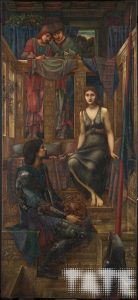

  • Natural Beauty: A GA Perspective

    What seas what shores what grey rocks and what islands
    What water lapping the bow
    And scent of pine and the woodthrush singing through the fog
    What images return
    O my daughter.
    (T. S. Eliot, “Marina,” 1930)

    It’s widely agreed that the idea of “nature” and the aesthetic enjoyment thereof only gradually emerged in human culture. Francis Petrarch famously climbed Mont Ventoux in 1336. (Or didn’t. The feat is of course disputed, as is its firstness and everything else about it. Resentment of claims to precedent-making moments, hinges in history—whoever makes them—is apparently a particularly animating passion amongst historians, the more pivotal the more animating—not to say the doubters are wrong.) Why did he do this (if he did)?

    The only motive for my ascent was the wish to see what so great a height had to offer. I had had the project in mind for many years, for, as you know, I have lived in these parts from childhood on . . . . And so the mountain, which is visible from a great distance, was always before my eyes, and for a long time I planned on doing what I have finally done today. The impulse to make the climb actually took hold of me while I was reading Livy’s History of Rome yesterday . . . where Philip of Macedon . . . climbed Mount Haemus in Thessaly. From its summit, it was reported that he was able to see two seas, the Adriatic and the Euxine. . . . I thought it proper for a young man in private life to attempt what no one would criticize in an aged king.[1]

    There is an element of insouciance, even whimsy here, as well perhaps as what we might call the founding instance of the “because it’s there!” school. All this is underlaid of course with rivalrous desire—to go not so much where no man has gone before, but where Philip of Macedon has gone, or at least somewhere comparable. The restless and challenging spirit of the incipient Renaissance, of which Petrarch himself is a prime mover? A first instance of touristic one-upmanship? Anyway, he seems to have had (or pretended to have had or imagined) some sort of experience looking about from the summit.

    At first, because I was not accustomed to the quality of the air and the effect of the wide expanse of view spread out before me, I stood there like a dazed person. I could see the clouds under our feet, and the tales I had read of Athos and Olympus seemed less incredible as I myself was witnessing the very same things from a less famous mountain.

    As if in anticipation of debunkers in ages to come, he does concede the relative position of his mountain in an implicit hierarchy of them. Mountain climbing, we hardly need say, will henceforth be one of the most intensely mediated, indeed overtly competitive of human pursuits, even or especially where undertaken to achieve self-transcendence and inner peace. Inner peace is the transcendence not of the self but of desire or, as René Girard might have framed the matter, it is undisputed possession of the apex of human as well as geophysical triangularity, the position of the model. But it notoriously doesn’t last.

    I turned my eyes towards Italy, the place to which my heart was most inclined. The great and snow-capped Alps seemed to rise close by, though they were far away . . . . I sighed, I must admit, for Italian skies which I beheld more with my thought than with my eyes, and an inexpressible longing came over me to see once more my friend and my country. . . .

    More with thought, with imagination, with desire, than with his eyes. This of course is merely to concede his humanity. This is human seeing, whatever one is looking at. But there are degrees and emphases, and the fact that the influence of imagination rises to his consciousness suggests a particularly intense weighting of attention towards the sign, as opposed to the referent. If all human seeing after the originary scene is mediated by memories, or remembered signs, an awareness of that mediation is perhaps not just a further instance but a signal moment of experiential transformation, individually and perhaps in this case culturally. Had anyone before this great poetic psychologist ever described the complications of perception in quite these terms?

    Petrarch’s attention certainly oscillates between the natural images spread out before him, whose stupendous expansiveness has left him dazed, and remembered or imagined images of an Italy that he cannot literally see. Are these latter to be thought of as signs, directing and focusing his attention, filling him with desire? As his attention shifts back to the vast landscape, can he be thought of as experiencing a kind of imagined consummation? But, of course, the condition of every aesthetic experience is literal frustration, as he clearly feels here. The imagined gratification, the content, is hazy, impossible, the heart’s helpless desire. Inconceivable, without concept . . . but almost within reach for all that. Were he to start imagining that little nook in Arezzo, being there again, tasting the wine, he would be in another experience, perhaps triggered by the first, but not the specific aesthetic experience of the landscape that we are trying here to describe. He is experiencing the landscape almost as deferral itself—to gaze at it is to be displaced, and this might be true even if the prospect were of another country entirely, to which he had never been. To see—and this is perhaps a paradox of all experiences of vastness and extent—is to see what one cannot see, to see the limits of seeing, or to see those limits more literally than one usually does. But then this is always the experience of desire—a confrontation with the limits of actuality, its boundary with the imagined.

    And one can only bear so much of this kind of thing. Petrarch, like the rest of us, is also “only” human. He starts to moralize, rationalize.

    . . . though at the same time I reproached myself for this double weakness which came from a soul not yet up to manly resistance—and yet there were excuses for both my desires, and several excellent authorities could be cited to support me.[2]

    As a strategy, one must admit that citing scholarly sources in defense of one’s desires has somewhat passed out of favour, although there is certainly something recognizable about Petrarch’s general intent here. Overall, a couple of striking paragraphs of description and reflection are buried in an allegorized and moralized narrative, involving taking the easier and harder paths and so forth, and climbing as spiritual ascension—rather an inescapable metaphor with a long future ahead of it. Instead of gazing further he opens his portable St. Augustine, seeking insight textually rather than experientially. Doubtless one could claim that such responses, the production of such tropes is part or even at the core of his experience. But the poet spends so little time on form, and so much on the doctrinal content to which it seems to point, that we might wonder if his experience has much useful affinity with the kind we are trying to trace—not of course that there aren’t plentiful examples of his procedure available in modern times. Much “nature writing” is still about the self and its quests and temptations, its failed transcendence or apotheosis as one may decide. But Petrarch here never uses, for example, the word “beauty,” or seems to evoke an experience of it beyond those brief phrases we have quoted.

    But he does return to mountains and to nature in his poetry. For example, in Canzoniere 129 (c. 1340):

    From thought to thought, mountain to mountain top
    Love leads me on. . .
    If on a lonely slope a brook or spring
    or a dark vale between two peaks exist
    That is the place my frightened soul takes refuge
    . . .
    In the high mountains and harsh woods I find
    some peace

    Desire for Laura, sexual and romantic desire, indeed love, is involved in, amplified by, gratified to some degree by the natural scenes—by which Petrarch explicitly means the “untrodden” places, the places free of other human beings—that he describes in some detail. Here too, as on the summit of Ventoux, place, perception and “thought” (or desire) combine. This is something a bit more than the mere love-sick mooning about the forest that Shakespeare sends up in As You Like It (1599) or Byron in Don Juan (1819).[3] Petrarch, again, is interested in this seeing—he recognizes, indeed, that love itself is or can be understood as a kind of seeing. Sight and memory of seeing are among his master themes, the two becoming inextricable from his first sight of his beloved, who henceforth steadily invests other places and phenomena.

    I’ve seen her many times—now who’ll believe me?
    in the clear water and above green grass,
    alive, and in the trunk of a beech tree,
    and in a cloud of white so shaped that Leda
    would certainly have said her daughter’s beauty
    fades like a star in sunlight next to it.

    Here beauty is explicitly mentioned, and it is a beauty shared, or undecidable, between Laura and the natural phenomena in which the poet sees her—a relationship explicitly of identity and not metaphor or comparison: the only simile in the passage links Laura’s beauty and that of Helen of Troy. Up to the top of “the highest and freest peak” he feels his “whole desire” being drawn, and the imagined experience there of longing for the distant Laura strikingly recapitulates and builds on that of his desire for Italy.

    Then I begin to measure with my eyes
    my losses, and while weeping I unburden
    the painful cloud that gathers in my heart
    to see and think how much
    air separates me from her lovely face
    always so near and yet so far from me.[4]

    Seeing and thinking again combine to create the experience of the perceptible imperceptible, the nearness of distance, the presence of absence, that seems distinctive to this encounter with natural extensiveness. Here the characteristic and much-to-be-imitated Petrarchan conceits and oxymorons are working to a very particular effect. Long before the natural world seems threatened, either by tourism or by environmental degradation, it is intensely associated in aesthetic experience with loss, inaccessibility, unfulfilled longing.

    Needless to say, future experiences of nature will not all be mediated by heterosexual desire, even if we might note the striking coincidence here of the emergence both of the courtly love tradition and of this new kind of experience of beauty. Nor will the language of “displacement” or “transference” and so forth be at all adequate. But I’ll refrain from too many strong inferences, beyond the obvious one that fully human seeing is always mediated, and that the vehicle of mediation after the originary scene is memory. Nor, Petrarch’s accounts would seem to suggest, is such mediation to be mourned as the loss of an experience more direct, of a kind of primal appropriation. Of course, such experiences of the natural world as he presents us, such unresentful visions of the center, as it were, are made possible firstly by the imagined absence, indeed exclusion of mediators, other people—”the wilder the place is,” Petrarch says, “the more lovely do my thoughts depict her image.”[5] This admittedly resentful or defensive prerequisite will persist. But, that granted, surely one of the great benefits of aesthetic experience, and of this particular kind of aesthetic experience as the poet presents it, is just this fruitful interchange between desire and perception. The sign paradoxically makes us or helps us see that which is not the sign, see in a new way. Deferral makes time for seeing, intensifies that seeing, eventually carries that seeing out into a world far from the initial object of desire, far from communally agreed upon referents.

    Beyond this observation, let’s not try to push the inferences from one example. Rather, we should perhaps concede the central difficulty of any inquiry into aesthetic experience, namely an absence of direct evidence beyond that of the inquirer him or herself. It’s a difficulty that seems even more pronounced in the case of that of natural beauty. It is not that there is a shortage of texts testifying to such experiences—indeed one can be overwhelmed by the plethora. There is a vibrant literature of nature appreciation, a vast scientific literature, and a wide range of visual representation, including rich Chinese and Western traditions of landscape painting. Cinema here, as well, has powerfully contributed. But we are finally reduced to talking about these texts themselves, rather than about the experiences they self-consciously describe, unaided by a common experience of a relatively stable textual subject. We may watch the same movie from the cinema seat beside our commentators, as it were, and strive for some comparative approximation of the experiences they have had. But many more variables are involved in aesthetic experiences of the natural world, which cannot be reproduced the way artworks can. We too can climb Mont Ventoux, but not only are we unable fully to enter into the mind and feelings of a fourteenth-century Christian humanist, but conditions will not be the same, the prospect will have subtly altered, its cultural framing (not to mention commercial appurtenances) will be utterly different. (Note the roadway in our contemporary image—Petrarch’s metaphors would surely have foundered had he summitted by tour bus.) Instead, we read the texts, the narrative and the poem, and strive to find the experience wholly there, or in Rousseau’s Reveries, in Wordsworth or Byron or Keats, in Thoreau or figures of our own “golden age” of nature writing,[6] and a thousand others, even down to demotic sources, naïve enthusings from various sources, including, for example, those of our relatives recently returned from vacations and eager to show us photos, with running commentary.

    Listening to the latter, would we be tempted, for example, to imagine popular and high-art experiences of natural beauty? The question is amusingly posed in a World War Two-era cartoon by the wonderful Bill Mauldin:

    “Beautiful sunset, sir. Is there one for enlisted men?”[7]

    I have in several places emphasized the diversity of aesthetic experiences, their relativity, their imbrication with myriad variables of context and mood.[8] Still, because such experience is on the originary scene, we must concede that GA does have reason to insist on a substrate of commonality. Eric Gans, following Kant, observes that “judgments of works of art . . . carry with them a sense of universal conviction . . .[and] tolerate relativism only provisionally.”[9] In that spirit, this particular discussion will limit its range of textual testimony, with all the potential variables, and add just two more texts to those of Petrarch, using our heuristic to try to theorize the subject in more general terms, looking for ways to talk about the role of memories of texts, and memories of experiences, in the immediate aesthetic experience of natural beauty.

    The intuition of common aesthetic judgment to which Gans points—indeed its absence of “concept” in Kant’s terms—is surely rooted in the mimetic unanimity of the originary scene, where all desired the object, where for all the sign established a center of sacred interdiction and significance, and where contemplation of the sign unanimously increased the desirability of the object in that center. That is, the aesthetic experience precedes ethics and all the disagreements that ethical considerations introduce into the human scene. Aesthetic experience is integral to the establishment of a common humanity, part of being human, part of the very definition of that condition. As Gans notes, people do certainly disagree in their aesthetic judgments, but they retain a common belief in “the esthetic sphere” or “art as a whole,”[10] which formulation we would adjust only to expand it to “aesthetic experience as a whole.” We all have aesthetic experiences, and these experiences all share something, and there seems indeed a deep-rooted impulse—Gans says we are “naturally driven”—to reach agreement, or indeed to share intuitions of beauty, an impulse founded in what is in effect an “anthropological vision.”[11] “‘Tis with our judgments as our watches,” Alexander Pope a bit glibly asserted, “none / Go just alike, yet each believes his own,”[12] but he would hardly have denied that all concerned believed there was such a thing as time. Rare too is the person who honestly disputes the beauty of a sunset—even if he claims to have seen a better one on a beach in Bora Bora in 2005—or denies that, in either that exotic locale or the present one, it marks the end of a day.

    Doubtless, indeed, human beings didn’t always admire sunsets. But on the originary scene the alimentary object suddenly appearing in the new-minted center provokes primeval aesthetic contemplation, an oscillation of attention, however briefly. This object—say an animal carcass—is certainly part of the natural, non-human domain, and although it is not an environment, not a world entire, nothing vast or tinted, it is still invested with desire, it still beckons towards transcendence. The moment of its apprehension is the prototype of a poet gazing at a horizon. The experience of that solitary bard, in short, no matter how high he has hiked or how vehemently he denies his community, is still scenic. Mediation is inescapable—this is how GA understands there being no outside of the text, we might say.

    But the issue that remains is of the significance or meaning of the attempt, the much promoted and yet-to-be-abandoned project of escaping or modifying one’s role in that mediation through experiences of natural beauty, through escape to untrodden paths or pathless wastes. Having discounted it in absolute terms—even having identified it as a species of mensonge romantique—can we nonetheless assess its possible, partial successes or at least effects?

    To that end and for our second textual instance let us jump forward to the Romantic period and William Wordsworth, and in particular his great blank verse poem “Tintern Abbey” (1798).[13] Another possibility, of course, might have been J.J. Rousseau’s Reveries of a Solitary Walker (1778), the subject of an important GA analysis.[14] But Wordsworth, in the wake of both Petrarch and Rousseau, has the advantage for us of explicitly engaging with the theme of memory and perception. For him, the images that return are precisely those of a previous visit to the same beauteous place from which, in the present tense, he attempts to describe his experience, and he confronts directly the oscillation of attention that GA has placed at the center of all aesthetic experience. Indeed, this latest articulation of Petrarch’s combination of sight and thought surely constitutes a major advance in self-consciousness and explicitness:

    And now, with gleams of half-extinguished thought,
    With many recognitions dim and faint,
    And somewhat of a sad perplexity,
    The picture of the mind revives again:
    While here I stand, not only with the sense
    Of present pleasure, but with pleasing thoughts
    That in this moment there is life and food
    For future years. (58-65)

    The perplexity of the experience is sad in the senses both of amplification and of sorrow, encompassing also the phase of imaginary appropriation even in the alimentary terms of “life and food.” Aesthetic attention, we might venture, is always just such a perplexing combination, but what is particular here is the way the poet has mapped its movements onto the longer duration of an individual human life. He does so for a specific purpose, of direct relevance to our current inquiry. How is the mediation not only of one’s own remembered and anticipated seeing, but of the signed desires of our human others to be understood or even accommodated in the aesthetic experience of natural beauty?

    Like Petrarch and Rousseau, Wordsworth has explicitly shunned “the din of towns and cities” in pursuit of unmediated experience—he too has sought the untrodden. But where he differs is in the movement of return that is also implicit in this vision of aesthetic experience. Ultimately, he claims, he (and as is revealed, his sister) flee human community in order to return to it, strengthened, better able to see and hear it. Of the many testimonies to an unresentful vision of the center, to love, these lines are famous surely because so many readers have intuited such a vision as an experiential possibility, one they are moved to desire as well:

    For I have learned
    To look on nature, not as in the hour
    Of thoughtless youth, but hearing oftentimes
    The still sad music of humanity,
    Nor harsh nor grating, though of ample power
    To chasten and subdue. (88-93)

    We have excerpted these lines, it should be said, from the middle section of the poem’s tripartite structure, that recapitulates the remembered benefits in immediate pleasure—”sensations sweet” and “tranquil restoration”—in ethical mobilization—”little, nameless, unremembered acts / Of kindness and of love,” and in more purely spiritual transcendence, when “we are laid asleep in body / And become a living soul” (27, 30, 34-35, 45-46). All three kinds of benefits are to be considered part or products of the aesthetic experience, although for the moment we will concentrate on the second, with its more explicit concern for the issue of human mediation.

    The balance, here and through the whole poem, between a resented other and a beloved if generalized humanity is certainly uneasy, or perhaps we should say, unstable. The denunciations of other people, had they begun to moderate or disappear towards the conclusion of this “process poem,” might have been understood as symptoms of a disorder that the experience of natural beauty had permitted the poet and his sister to heal or transcend, displaced by the more fundamental and eternally sad music they claim now to be able to hear. But this is not the case. It is even as the poem rises to its beautifully muted Wordsworthian climax that the rhetoric is harshest. Nature

    . . . can so inform
    The mind that is within us, so impress
    With quietness and beauty, and so feed
    With lofty thoughts, that neither evil tongues,
    Rash judgments, nor the sneers of selfish men,
    Nor greetings where no kindness is, nor all
    The dreary intercourse of daily life,
    Shall e’er prevail against us . . . (125-132)

    But this is perhaps less hypocrisy than an honest testimony to the difficulties not just of his particular historical moment—and these were considerable—but of the perennial project of modernity. This is explicitly a contest—who will “prevail”?—that the poet here frames as a struggle between the “lofty thoughts” produced by this kind of aesthetic experience and the gravitational power of human passions, in particular the resentments and rivalries of a world without a public sacred center of the kind the poet remembered as still having sway in the communal life of his childhood in Westmoreland. Greetings without kindness he has before identified with the modern city—or no greetings at all—in his great book on London he speaks of the way it “baffled [his] understanding” how men could live as strangers, “knowing not each other’s names.”[15]

    The lofty thoughts are inseparable from this struggle with others, very much as was the case with Rousseau. Or to be more precise, they are only ever to be separated through such a struggle. But they do nonetheless constitute a phase, an extent of oscillation, that needs to be given its full value as part of a genuine aesthetic experience, and in this case an experience that at least aspires to return to the communal peace of the scene. What is lofty is of course what is deferred. Let us return to the shorter interval of immediate aesthetic experience and the ways Wordsworth describes this immediacy, before he begins to situate the experience in the life-narrative that he builds upon the same model. The poem opens on the dominant note of “once again” but it describes what is seen from the bank of the River Wye, both times, with care:

    Again I hear
    These waters, rolling from their mountain-springs
    With a sweet inland murmur. –Once again
    Do I behold these steep and lofty cliffs,
    Which on a wild secluded scene impress
    Thoughts of more deep seclusion; and connect
    The landscape with the quiet of the sky.
    The day is come when I again repose
    Here, under this dark sycamore, and view
    These plots of cottage-ground, these orchard-tufts,
    Which, at this season, with their unripe fruits,
    Among the woods and copses lose themselves,
    Nor, with their green and simple hue, disturb
    The wild green landscape. (2-15)

    These, as another great poet had it, are “green thoughts in a green shade”[16] and Wordsworth’s account of this variety of experience is worth reading carefully. Thoughts, he too says, are imbricated throughout with descriptions of forms—sounds, shapes, colours—a stream of described perceptions, sensations and ideas. Indeed, the slight correction in lines 16-17,—”These hedgerows, hardly hedgerows, little lines / Of sportive wood run wild”—draws explicit attention to the operation of the mind, to the ongoing fact of this mental narrative, in this case as the poet adjusts his assessment of what he sees and the words he chooses for it. By the end of the verse paragraph the story has even left behind the immediately perceived, as the smoke rising from the woods is embellished into the presence of “vagrant dwellers in the houseless woods” or even a possible hermit by a fire. Attention to form, that is, oscillates with a kind of narrative content; attention to the signs, the sounds and sights perceived, shifts to the words consciously chosen for them, to the on-flowing stream of overall experience. As we observed above, the shift of attention to narrative content is an imagining of something desired, something that relates a mere intimation or potentiality of significance to the desirably comprehensible, and this remains true even when the narrative is as minimal and insubstantial as a record of passing mental events or, as in Wordsworth’s phrasing, impressions. Contemplation alternates with a record of contemplation, deferral and sight with thought and event.

    Of course, it should also be noted that, following Wordsworth’s text, we focus here on the aesthetic dimension or phase of an experience that would have other, call them physical and physiological components. Sounds, temperatures, visual phenomena were and are registered by human, pre-human or other-than-human sentient beings, triggering various conditioned or automatic responses. This broadly appetitive dimension is the substrate of fully human consciousness and everything loftier takes place in relationship to it. The eyes move to follow motion, or do not move when there is none. The skin gets goosebumps at the contact of chillier airs, is pleasingly cooled by them in hotter contexts. Loud noises provoke autonomic muscular responses, a quiet susurration of background sounds a relative calming of alertness, dead silence something else again. Human aesthetic experiences of natural beauty have a bodily aspect, more responsive when direct, less so but not fully muted when indirect, when for example, merely viewing a photograph of the Wye Valley, when most of the physical sensations associated with being in situ must be summoned by memory and imagination.

    Where artworks seek specifically to generate aesthetic responses to such scenes, they may indeed adopt strategies to suggest and heighten these bodily connections. As time goes on, the range of workable supporting physiological sensations invoked also expands—a Canadian poetry-and-nature-lover might legitimately wonder how well Wordsworth’s communion with the hedgerows or Keats’s with his nightingale would have developed amidst clouds of biting blackflies so dense the poets could hardly see through them, let alone generate the requisite tranquility whilst trying to preserve their own flesh. But in time these more importunate kinds of bodily experience of the natural scene will also be incorporated into the visions—even become badges of their authenticity.

    Still, Wordsworth and his readers then and since surely spend much more time on the disembodied or deferred aesthetic moment of the overall experience of the natural world than did people of generations past, back to and before Petrarch, and immensely more than did the first humans on the originary scene. We gaze. Attention spans in this respect have lengthened—at least, many clearly have. Moralizing, narrativizing, emotionally or economically exploiting—such operations can be kept in abeyance longer, by many, while we merely look. It is an easy enough thing to observe such an historical change, harder exactly to explain it or describe just how it works. Where one is not in the direct presence of a sign—no fellow hominid pointing, no book on one’s lap, no pan pipes fluting softly in one’s ears—how does one understand the aesthetic experience involved in looking at a real tree, that black sycamore for example? How is it—not a sign itself, not directly designated by signs—beautiful? As we look, do we remember, for example, a Constable painting of such a tree, or even a whole tradition of such representations? Many a lover of natural beauty might claim in fact that the memory or influence went the other way—in the gallery in front of the Constable, we remember the Zion of living trees. When we read the Deerslayer canoeing over his glimmering lake,[17] such images return from our own idylls. But both operations, gazing into memory and memory into gazing, are encompassed by what Gans has called “scenicity” or “our constant, exclusively human conversion of perception into a scene.” It may be that “artworks,” as he argues, “foreground this operation by cutting off the scene from the life-world . . . allowing it to be intended, thought about, on a mental scene of representation.”[18] But just as the aesthetic moment on the originary scene ultimately enabled and sustained the later creation of art, memories of aesthetically heightened perceptions give life to the works that, in turn, facilitate that even fuller measure of deferral. This involves what Wordsworth variously called “an ennobling interchange” or a process whereby we half “perceive” and “half-create”[19] and its further intensification and enhancement in modernity—arguably an enormous expansion and empowerment of that scenicity—implies no fundamental rupture with previous eras and their processes. In short, a generative anthropologist must concede that memory works both ways, steadily enhancing and making more significant experiences that either do or do not pass directly through formal, or as we might call it, “institutional” representation.

    We say “directly” because it must surely be repeated that some at least indirect experience of representation and desire, of mediation, is the absolute minimum requirement for this variety of aesthetic experience as it is for all others. Does a weeks-old infant remember the blissful warmth of sunlight on her face? Yes, surely. But before long, her mother is pointing at something—maybe an animal, or a cloud—and a particular form of attention begins. If it would be fatuous to imagine popular or high versions of the long train of experiences which follow, there are nonetheless some distinctions we might usefully make. Perhaps counterintuitively, we might begin by guessing that as eye and thought, as seeing and desiring or remembering alternate, a long, even ascetic apprenticeship, individual or cultural, is likely needed before the interval of seeing extends itself, at least in aesthetic experience. Like a stalking lion, perhaps a human being can stare long and hard into a landscape, looking for danger, looking for prey. But a long, contemplative deferral of imagined appropriation in the interest of gazing at a woodland scene is what might be characterized, in either case, as a mature achievement. Wordsworth talked about this, too, about the immature phase of such a development, in which passions and desires predominate. He was then “more like a man / Flying from something he dreads than one / Who sought the thing he loved” (71-73). This condition was not without observation of forms, of course—Wordsworth does not claim he was oblivious so much as infatuated, and he uses exactly our own terms for the two poles of the oscillation:

    The sounding cataract
    Haunted me like a passion: the tall rock,
    The mountain, and the deep and gloomy wood,
    Their colours and their forms, were then to me
    An appetite: a feeling and a love,
    That had no need of a remoter charm,
    By thought supplied. . . (77-83)

    Here, though, “thought” or what he has just spoken of as “see[ing] into the life of things” (50) does not quite mean what Petrarch meant by it on the mountaintop, where memory and desiring imagination were more the point. Wordsworth really does intend seeing, and a condition of such profound deferral of every aspect of the appetitive that

    . . . the breath of this corporeal frame
    And even the motion of our human blood
    Almost suspended, we are laid asleep
    In body. . . (44-47)

    Here one sees with “an eye made quiet” (48), surely one of the best short descriptions available to us of the condition of aesthetic sight, whatever length of duration it remains upon the sign. The unquiet eye is the one that is moving back and forth between the desideratum and its designation. For the quieter eye that anxious shuttle has at least slowed.

    This achievement, this “almost” full transcendence of the horizontal relationships of appetitive desire, is once again never a solid state, but occurs, Wordsworth tells us, in certain “blessed mood[s]” (43), and these moods are quite explicitly accessed not through the direct impressions made upon the site of the original experience, but through memory, even if those memories, those images return, as in the poem we discuss, while “once more” upon that site or others like it. Varieties of this broad category of aesthetic experience, then, are perhaps to be distinguished along a chronology of development or intensification of attention to form, albeit one that we quickly must concede lacks a universal teleology, and one upon which many satisfactions or rewards, entirely adequate to their moments, may be known. So, we will be less concerned with narrating that development, especially as some kind of inevitability or normative design, and more with distinguishing and describing the characters of moments along it. And we will also assume that such experiences remain available and potentially recurrent whatever one’s age.

    Direct association with the signs that generate mimetic desire must surely begin the journey. Maternal pointings we have mentioned—that child may some short time hence admire the morning glories her mother is growing in a backyard plot, because and through her mother’s admiration of them. Her mother planting, tending as well as pointing to them are the signs generating the experience. The child really sees these flowers now, will remember them, but the warmth of her mother’s presence predominates, for the moment. Love makes for intenser, more retentive seeing, but that is still mainly reserved for the mother herself.[20]

    Pointing at animals, also. We must next mention anthropomorphism, or as we might call it, identification. While a few may choose inanimate phenomena—Romantic poets in Byron’s train, seeing themselves in volcanic terms—by far the investing in animals predominates here, usually and preferably those not too immediately similar. Apes and monkeys tend to induce uneasiness more commonly; lambs, tigers, even birds, less so, although of course there is no unanimity in such responses. But how can we pleasingly identify with creatures who seem a grotesque parody, even a satire upon our forms and capacities? They possess nothing that we lack. Whereas, a tiger’s strength, ruthlessness, stealth, sleekness. . . . At any rate, identification generally entails narrative, sometimes elaborate but also often fairly simple, and the gratifications of narrative predominate, as imagined participation holds attention with a particular charm. The psalmist longed for the wings of the dove, and the tapestry weaver for those of the swallow, others for the raucous freedoms of crows, the glittering glory of the hummingbird. All such involvements—what in the open air one great poet called “transports of cordiality”[21] but which would surely also encompass humbler enthusiasms indoors, as for singing bears and pontificating lion kings—do surely induce or include, however, at least some degree of enhanced attention to form. Such less directly alimentary relationships extend awareness, that is, lengthen the interval of gazing even while that interval remains considerably shorter than that of identification or narrative or other forms of imagined participation.

    The operation is perhaps too familiar to need much further comment—all that might be debated is the degree to which exposure to good-natured talking cartoon wolves helps heighten attention at some later date to the shadowy grey forms slipping away through the trees or contributes to finding that sight beautiful. But what about bugs? Aesop’s ants and grasshoppers were so thoroughly moralized that it is hard to see how the fable would have much enhanced the form. But have more than two centuries of romanticism and three-quarters of a century or so of nature films brought us into a different aesthetic relationship with the class denominated insecta by Linnaeus in 1758? One of the more eloquent artistic testaments (or inducements) to such a relationship is the film Microcosmos: Le peuple de l’herbe (1996), which also possesses the advantage of having a section, as crickets and mantises themselves do not, on the Rotten Tomatoes review-aggregation and viewer response website.[22] The film was something of a tour-de-force of closeup photography and includes some wittily self-conscious anthropomorphizing, including the sisyphean struggles of a dung beetle, and the soft-focus eroticism of a snail tryst to an operatic soundtrack.

    The respondents at Rotten Tomatoes, both professional critics and ordinary viewers, are almost unanimous in their praise of the film—and this is fairly unusual. A very few find it slightly tedious, but most are enthralled. This might be explained several ways, of course—the film is surely well-made—but we must ask most pointedly about an apparent absence of resentment. Without explicitly human actors, has the narrative in fact been able to bypass the kinds of closer identification that might generate hostility? While the beetle rolling its ball of dung up the hill may look uncannily like familiar images of the hopeless titan, maybe it is unlikely to trigger a hostile reaction against the attention it has attracted, or the centrality the filmmakers have conferred upon it, exactly because it is not in fact human, or very human-like.

    Occasional bug barbarities are featured—spiders and their little doings are always potentially unpleasant—but for the most part there seems to be no narrative context in which the unwilled, natural behaviors on view can mobilize the kind of imaginary participation that might lead to rejection. This may have been a conscious choice, a strategy of the filmmakers, that has worked to effect: the worst sights—one might think of Annie Dillard’s famously horrifying description of a giant water bug eviscerating a frog[23]—are avoided. Another possibly contributing factor is that, by comparison to most nature films of its era and since, the living subjects are not endangered, and there is not the slightest hint that they or their environment are being abused by those watching the film—something of a relief. Insects, at least in this telling, remain abundant, thriving. The usual emotional manoeuvres required either to accept and somehow process blame or shift it to others are not necessary. Still, the near-total absence of resentment might be thought a bit surprising. Only a couple of viewers seem to register any such feelings—Marnie, who “hates bugs,” and was “freaked out” and made to feel itchy; Gregory, “slightly phobic” of them, responded with a mixture of “revulsion and awe.”[24] These perhaps automatic or even “instinctual” responses are arguably not themselves to be considered resentment in our terms, but the promotion of bugs to centrality, to close-up images, to the focus of narrative, may be resented, properly speaking. Gregory’s revulsion and awe might suggest this—he is revolted by what has been made awesome, granted sacrality. One might have expected such responses to be more common—it is not as if humanity’s long relationship with insects hasn’t been fraught. The relatively recent scientific claim that they are essential to our well-being is not yet so widely shared or likely to have entirely obliterated our collective memory of the many outrages visited upon our persons and food supplies. Real fear of larger assailants, those bears, lions, and so on, receded much earlier—Fernand Braudel notes the various accounts of the ancien régime of wolves, penetrating Paris and attacking its inhabitants in the fifteenth century and long after, but finally subsiding by the end of the eighteenth century.[25] But something rather remarkable and more recent must have allowed so many of us to transcend our hostility and feel love for the centralized bug, to see it as beautiful or be receptive to artworks that promote a contemplation of it as such.

    “What we have loved,” Wordsworth told his friend Coleridge at the conclusion of what is probably his greatest poem, “others will love; and we will teach them how.”[26] Others have loved, the mediation has certainly been productive, but they have loved in many ways. Dillard, for example, and for our third text we might do worse than consider her Pilgrim at Tinker Creek (1976), notably extends the range of natural phenomena capable of aesthetic appreciation—or perhaps we should say, models new experiential capacities in this context, testing or stretching as she does the limits of identification. Like Wordsworth’s Prelude this generically diverse and somewhat uneven book considers many subjects, including matters scientific, psychological, and spiritual. But it is particularly eloquent and diagnostic on the matter of aesthetic seeing, the fascinations of form, and the various, expansive and unexpected products of the deferral of narrative or identification when looking at the non-human world. In the train, too, of Petrarch, she explicitly queries the nexus of seeing and thought, seeing and remembering, imagining. Inspired by an account of a young woman surgically given sight after being blind from birth, who responded to the coloured blur of the world by crying, “How beautiful!”, Dillard describes herself mimetically, desiringly, seeing and trying to see what she imagines the woman saw. In a peach orchard, the fruit become “colour patches” that “wrap around” her eyes.

    All day long I walked among shifting colour-patches that parted before me like the Red Sea and closed again in silence, transfigured, wherever I looked back. Some patches swelled and loomed, while others vanished utterly, and dark marks flitted at random over the whole dazzling sweep. But I couldn’t sustain the illusion of flatness. I’ve been around too long. Form is condemned to an eternal danse macabre with meaning: I couldn’t unpeach the peaches. (31-32)

    And “seeing,” worse still, is “very much a matter of verbalization. Unless I call attention to what passes before my eyes, I simply won’t see it” (33). The flight to nature, of course, has always been a flight from mediation, but neither Petrarch nor Rousseau, nor Wordsworth or Byron, have recognized their defeat, the desperation even of the quest, to the degree some of our more recent nature-writers have done.

    But as with many another futile quest, interesting things can sometimes be picked up along the way, or be produced by the doomed effort to, in effect, still the oscillation, defer by very force of will the movement to narrative, to the tyranny of meaning, to identification and imagined gratification. Dillard speaks of “another kind of seeing that involves a letting go” (33) but from our perspective this sounds rather like the obverse of the same coin, the hopeful modern and post-modern Western embrace of the via negativa of an ancient tradition of spiritual discipline, faddish or profound as the individual case may be. Such efforts must be located in the ongoing struggles and resentments of market life. What nonetheless still surely matter are the results of the attempt, through whichever conscious means have been adopted. Pilgrim at Tinker Creek is studded with striking passages of description, the seeing not of now-conventional natural beauties—there is hardly a sunset in the whole book, and though there is a nearby mountain we do not climb it or gaze from its summit—but of what we might call whole new genres of aesthetic experience. The description of the death of the frog is matched with others nearly as vivid and disturbing, prompting the identification of Dillard as one of contemporaneity’s best horror writers.[27] But there are still others on a wide range of subjects, and offering a variety of effects and impacts. For example, to the evocations of the doves and nightingales of the past, we might add this description of an avian descent from the roof of a four-story building.

    The mockingbird took a single step into the air and dropped. His wings were still folded against his sides as though he were singing from a limb and not falling, accelerating thirty-two feet per second per second, through empty air. Just a breath before he would have been dashed to the ground, he unfurled his wings with exact, deliberate care, revealing the broad bars of white, spread his elegant, white-banded tail, and so floated onto the grass. (10)

    Of course, if we say this is an experience of beauty, we must concede that we are responding here to a beautiful text. We can no more penetrate to the original aesthetic experience through the veil of the text that delineates its basic shape while denying direct access to it than Dillard could escape her own mediations while having it. But we can surely distinguish certain features of the experience recorded here: its subject matter, the extent of attention and, as a particular aspect of the latter, its scientificity. An exact rate of acceleration is offered, that must have been studied and known in advance, or at least looked up after the fact. But such knowledge here seems to function to extend rather than truncate the interval of attention. It contributes to the narrative element, of course—such a speed would kill the falling bird, what will happen?—but it surely also extends the moment of attention to the form, the thrilling rapidity that is paradoxically extended where, without such attention, it would surely have been only the slightest shiver of movement in the vast flux of such movements, birds hopping, dropping, leaves blowing, beams of light flickering over the whole sensorium. Even brevity itself lengthens if distinguished, if seen. It intimates, to adapt Wordsworth’s famous phrasing, immortality.

    As modernity advances, we might generally venture, such gazing, while not always empirical per se, is increasingly conditioned by the empiricist frame of mind. We might glance, for example, at the entirely unscientific late nineteenth-century Jesuit poet Gerald Manley Hopkins as he looks at the post-Wordsworthian natural world and praises his God

     . . . for dappled things
    For skies of couple-colour as a brinded cow
    For rose-moles all in stipple upon trout that swim;
    Fresh-firecoal chestnut-falls; finches’ wings
    Landscape plotted and pieced. . . [28]

    Textures, details, qualities are ever more completely stripped of narratives or identifications, and thus seen and attended to with a new singleness of attention, a new intensity. But, of course, the rejoiceful mood will not last—not for Hopkins himself, in fact, but most certainly not for Dillard and others in his train—or should we say, it will be leavened by those other genres of seeing. On the particular subject of the stippled or mottled, the Tinker’s Creek pilgrim is particularly forceful. The mottled is the decaying, the pied is the unwhole, the damaged, the accidental, but seen all the more vividly for that. Marveling at the ravages everywhere visible, at the fact that whole specimens of any species are rare and imperfect ones—spiders lacking legs—the norm, she sees a world

    festering with suppurating sores . . . the copperhead shining new on a rock altar over a fetid pool where a forest should grow . . . the knob-footed killdeer, the tattered butterflies and birds, the snapping turtle festooned with black leaches . . . the flies that make a wound, the flies that find a wound, and a hungry world that won’t wait till I’m decently dead . . . sharks sliced with scars . . . mites in their hides and worms in their hearts. . . . Is our birthright and heritage to be, like Jacob’s cattle on which the life of the nation was founded, “ring-streaked, speckled, and spotted” not with the spangling marks of a grace like beauty rained down from eternity, but with the blotched assaults and quarryings of time? (241-42)

    We have noted a tragic, alienated dimension in the aesthetic experiences of natural beauty in Petrarch, and indeed it is present as well in Wordsworth, but nothing like the violence, perversity, and otherness that Dillard and scientifically informed writers like her have helped their readers see. Heedless alterity might previously have been vested on the remote and terrible heights of uninhabited mountaintops—Percy Shelley summoned up for Romantic hubris the “city of death . . . a flood of ruin . . . that from the boundaries of the sky / Rolls its perpetual stream” of destruction[29]—but offered nothing quite so terrible as the cruel comeuppance of childish identification in this limitless spectacle of indifference, predation and infestation, disease and decay, this vision of the natural world as endless and mechanical process.

    Has such a vision prepared us for, does it complement or even heighten the perceived tragedy of our own destructiveness, vis-a-vis our natural environment? Before trying to answer such a question we should perhaps first ask whether the aesthetic experiences we are attempting to describe here can indeed be called tragic. The curbing of identification with that which has been made central would seem part of such an experience, but is it followed by a recognition of our own resentment of that centrality, our imagined and anticipatory violence towards it, and then the pity evoked by the imagined or enacted violence our resentments have produced? This short sequence of passions repeats, of course, the originary narrative and, as Gans indeed notes, “originary narrative is tragic: the mortal being that had been the occasion for the sign, abandoned by the sacred Being that it incarnated, is delivered up to the violent desires of the community, to be survived by the sign’s transcendent Being.”[30] The violence that rends our identification with the natural world is of course no longer merely alimentary, we do not eat every beautiful thing, the mockingbirds or mountaintops, nor indeed despoil them all in other kinds of consumption—although such direct effects, the prolonged sparagmos of human industriousness, surely does contribute to our feeling. Even where, for example, literal destruction or digestive processes are not involved, we do lament our own collective presence, resent the mandatory sharing of that which we treasured on our own internal scenes, the jostling of the tourist other—really, the other tourist—the presence of the souvenir stands and plastic toilets erected to service him (and us). But our alienation, as we and our three authors have in their different ways been suggesting, has a more profound and inescapable source as well: representation itself, thought. To be human is not just to be capable of transcendence, one might say, but to be condemned to it.

    Yet this tragedy, like the artworks we call by the generic name, has its redemptive effects. “The residue of sadness that follows a tragedy reflects the excess of our love over our resentment,”[31] adds Gans, and this dictum is surely as true in the tragedy of alienation from the natural world as it is in the theatre of Aeschylus or Shakespeare. Precisely that excess, too, has preserved us from each other, and may finally preserve our common habitable world. Tragedy as high art urges no action, makes nothing happen. But melodrama may, and no doubt much or most aesthetic experience of nature, like much or most of the art made about it, is melodramatic in character, its desires and resentments focused more insistently on human rivals and human goals than on the mere spectacle of plummeting mockingbirds. It is not my place here to assess the scientific evidence, the degrees of urgency, the causes or cures, even the ethical considerations, the tradeoffs with morality, raised by human influence on our earthly environment. But we would be blind to suggest that the aesthetic experience of nature in our age is not leavened, for most of us, by a sense of fragility shared neither by Petrarch nor Wordsworth. An unresentful vision of centralized nature, the excess of love thereby generated, is an undeniable feature of our culture now and will surely have its influence on human affairs in the future. Indeed, the addition of this variety of aesthetic experience to the human repertoire may prove one of modernity’s most consequential innovations.

    Still, the same can and should be said about the aesthetic experience of the natural world as Harold Bloom and others have said about that of human artworks.[32] Nature no less than the artwork exists for itself—or must be understood to do so if we are truly to appreciate, see, experience it. This too is deferral. It is for its own sake, and when we grant it to be so, then it is most for ours. There are, of course, differing kinds of experience here as elsewhere. But both tragic and melodramatic aesthetic experiences of nature finally require and nurture deferral—or build the deferral that is nurture—the extended attention that allows for awareness of form. Beyond the pragmatic environmental considerations touched on above, how very much more beauty it makes available to human experience, this formalization of the entirety of non-human creation, this “binding” of so immense a source of transcendence within the scene of representation.[33] Gans describes the situation as the aesthetic “triumphing” in our era “by becoming indistinct from perception—indeed from experience in general.”[34] But human experience, once again, is always oscillatory, so any such triumph can only ever be partial or temporary, and measured by relative durations or intensities. Who amongst us is really able to aestheticize every experience? Would that we could. Even so, and in whatever duration or intensity, if human beings are able to experience beauty, and while they do, they defer violence and appropriation. On the originary scene only one thing, and only briefly, was experienced as beautiful, and that beauty barely distinguishable from hunger, the peace it conferred doubtless brutish and fleeting. Now human attentiveness encompasses, the human itself can “contain,” as the poet and now the songwriter have it,[35] “multitudes,” last lifetimes, see “heaven in a wild flower,” or “eternity in an hour.”[36]

    Notes

    [1] Selections from the Canzoniere and Other Works, trans. Mark Musa (Oxford, 1985): 11.

    [2] Ibid.: 15.

    [3] See Canto 1, 90-94 in particular.

    [4] Trans. Musa: 47-49.

    [5] Trans. Musa : 48.

    [6] https://www.esquire.com/uk/culture/books/g26929946/best-nature-books-writing-trend/

    [7] Up Front (Henry Holt, 1945).

    [8] See, for example, “Reflections on the Popular/High Art Continuum,” Anthropoetics 20.1 (Fall 2014). https://anthropoetics.org/journal/ap-vol-20/ap2001/2001dennis/

    [9] “Art and Faith.” https://anthropoetics.org/views/vw659/

    [10] Ibid.

    [11] Ibid.

    [12] Essay on Criticism (1711), ll. 9-10.

    [13] Actually, “Lines Composed a Few Miles above Tintern Abbey, on Revisiting the Banks of the Wye during a Tour, July 13, 1798.”

    [14] Gans: “The Victim as Subject: The Esthetico-Ethical System of Rousseau’s Rȇveries.” Studies in Romanticism 21 (Spring 1982): 3-31. This text is also discussed in my own Lord Byron and the History of Desire (Delaware, 2009): 16-17 and ff.

    [15] The Prelude (1807) Book VII, ll. 118-20.

    [16] Andrew Marvell, “The Garden” l. 48 (c. 1652).

    [17] James Fenimore Cooper, The Deerslayer: Or the First Warpath (1841).

    [18] “GA and Cinema.” https://anthropoetics.org/views/vw615/

    [19] The Prelude (1850) Book XIII, l. 375, and “Tintern Abbey,” ll. 107-08.

    [20] Wordsworth himself explored this process in The Prelude (1807) Book II, ll.237-80.

    [21] Emily Dickinson, “A Narrow Fellow in the Grass” (1865).

    [22] https://en.wikipedia.org/wiki/Rotten_Tomatoes

    [23] Pilgrim at Tinker Creek (Harper, 1974, 2013): 8.

    [24] https://www.rottentomatoes.com/m/microcosmos/reviews?type=user

    [25]Fernand Braudel, The Structures of Everyday Life. Translated by Siân Reynolds (Fontana, 1981): 66-67.

    [26] The Prelude Book XIV ll. 446-47 (1850). I choose the 1850 reading of “will” over the slightly less forceful “may” of 1807.

    [27] http://www.anniedillard.com/books-annie-dillard.html

    [28] “Pied Beauty” published posthumously in 1918 but written in 1877.

    [29] “Mont Blanc” (Version A; 1816), ll. 105-09.

    [30] “Originary Narrative.” Anthropoetics 3.2 (1997-98). https://anthropoetics.org/journal/ap-vol-3/ap0302/narrative/

    [31] Ibid.

    [32] See, for example, Stanley Fish reflecting on Bloom’s legacy after his death in October, 2019: “It is wrong, said Bloom, and I agree with him, to ask either of art or of academic life, what is it for? It is for itself, and any bending of it to an external purpose will not simply harm it, but destroy it.” https://www.theatlantic.com/ideas/archive/2019/10/question-one-should-never-ask-about-work-art/600337/

    [33] “From Kant to GA: Four Reflections.” https://anthropoetics.org/views/vw660/

    [34] Originary Thinking: Elements of Generative Anthropology (Stanford 1993): 210.

    [35] At about the date of this writing, the Nobel Laureate songwriter Bob Dylan releases an album with the song, “I Contain Multitudes” (2020). Walt Whitman, of course, had it first in “Song of Myself” (1855).

    [36] William Blake, “Auguries of Innocence” (1803).

  • Metaphysics and the Sacred

    A long history could be written about the efforts to escape from the “prison” of metaphysics by Marx, Nietzsche, the Existentialists… and finally, the French Theorists—our ancestors.

    This Chronicle adds little new material to my earlier discussions of “post-metaphysical” thought, but hopefully puts them in a clearer historical and spiritual perspective. In particular, by emphasizing the central role of the sacred in the originary hypothesis, it not merely points to the confluence of generative anthropology and religious thought in “humanistic” anthropology, but helps both explain and demystify the intellectual pathos that has since Heidegger been a both fascinating and disconcerting feature of “Continental” thought, and in particular of its merger with literary criticism in the era of French Theory.


    What is metaphysics?

      1. [T]he branch of philosophy that examines the fundamental nature of reality, including the relationship between mind and matter, between substance and attribute, and between potentiality and actuality. (Wikipedia; from American Heritage Dictionary)
      2. [T]he branch of philosophy that deals with the first principles of things, including abstract concepts such as being, knowing, substance, cause, identity, time, and space.
        Mid-16th century: representing medieval Latin metaphysica (neuter plural), based on Greek ta meta ta phusika ‘the things after the Physics’, referring to the sequence of Aristotle’s works: the title came to denote the branch of study treated in the books, later interpreted as meaning ‘the science of things transcending what is physical or natural’. (Google)

    More significantly, for Heidegger in his 1949 introduction to Was ist Metaphysik? metaphysics is what denkt das Seiende als das Seiende, thinks that-which-is, “be-ings,” as such. As Heidegger goes on to explain, metaphysics sees these things-that-are by “the light of Being,” (das Licht des Seins) but sees not the light itself. (https://www.bard.edu/library/pdfs/Heidegger-Was_ist_Metaphysik.pdf)

    The contrast between the beingness of beings on the one hand and the “light” in which we see them in the first place is a quasi-scenic picture that it is useful to reinterpret in terms of GA’s “new way of thinking” in order to make clear that the poetic-mystical air that fascinates the reader in such texts is not simply a mystification. We should take as a general rule that whenever, as so often in “post-metaphysical” philosophy, we encounter a sense of mystery, we are in the presence of the sacred. Thus perhaps the most fundamental purpose of generative anthropology is as the means of maximally demystifying—not debunking—the sacred, to the point where we decide either to remain within the realm of (humanist) anthropology, or, in an act of faith, to understand the sacred’s otherness as embodied in a divine Other.

    This and other philosophical attempts to define and thereby “exceed” or “escape from” metaphysics express an insight not present in the classical writings of Kant or Hegel: the appeal to a transcendence not accessible “by the light of Being,” but that grounds the light itself, and thereby allows thinking to “think itself” as a product of transcendence.

    In contrast, GA’s definition of metaphysics is straightforwardly historical. It is defined as the way of thinking, derived from Parmenides and formalized in Plato’s doctrine of the Ideas, that considers the existence of propositional language as not requiring to be explained by any transcendence of the material world, either on the part of God or on that of a human sense of the sacred. For Plato, the words we use to express the Ideas are mere shadows of the Ideas themselves.

    GA’s definition explains in anthropological terms the intellectual embarrassment of those who seek to escape metaphysics. Metaphysics’ language of be-ing is in effect that of propositions, of declarative sentences, which make hopefully true statements about things, but fail to establish why it is that we and the things are present in the first place, in answer to Heidegger’s Ur-question, the first sentence of the text of Was ist Metaphysik?: Warum ist überhaupt Seiendes und nicht vielmehr Nichts? Why indeed is there be-ing and not rather Nothing?

    This question seems to be about the presence of “reality,” but it is in the first place about language. What is special about human beings is precisely that they alone have the means to make present and to ask questions about “being,” but the source of this means, language, is taken as a given. Whereas, from an anthropological perspective, this givenness must be explained not as “always-already” existing, but as having come into being at a given moment of natural history, that of the origin of the human and its culture.

    To understand the implications of this definition, think of the number system. Although one wonders if even Plato himself really believed that the Ideas existed from eternity independently of humanity, from the few philosophers I am acquainted with, I would say that most of them believe this of the number system. The idea that “1” only began to exist when some human started counting strikes them as barbaric.

    After all, when we prove a mathematical theorem, we certainly can’t claim that it only became true once we supplied the proof. And from there, the eternity of 2+2=4 would seem to follow. But the properties of a system that exist “eternally” once it is defined do not demonstrate the eternal existence of the system. Before humans existed, we can be sure that 2+2=4 was implicitly true within the number system, but that system itself did not exist in any worldly sense until we came along. We, or the ETIs of Galaxy Z4-832b.

    Metaphysicians, at least those of today, do not believe in the Ideas. Nonetheless, philosophers do not concern themselves with the worldly origin of propositional language, but treat it as though, like the number system, it was not invented but discovered by humans as an eternally available possibility of communication. No doubt one could describe anything in this manner, since if things exist, they must always have been capable of existence. But unlike elephants and volcanoes, language, if a bit less securely than arithmetic, doesn’t appear to require any worldly factors to make it exist, only to discover it.

    This feature of language was implicit in the mindset of early modern science, which could no longer accept the Genesis version of world and human origin, yet had before Darwin no reasonable way to understand the emergence of human culture. Rousseau’s 1755 Discours sur l’origine de l’inégalité is probably the sharpest pre-Darwinian attempt to explain the emergence of “the human” from the “state of nature” in which humans would have found themselves before receiving/evolving the gift of language and culture. In this text, Rousseau explicitly affirms the paradoxical nature, in the pre-Darwinian context, of the origin of language:

    . . . car si les hommes ont eu besoin de la parole pour apprendre à penser, ils ont eu bien plus besoin encore de savoir penser pour trouver l’art de la parole . . .

    . . . for if men needed language in order to learn to think, they needed even more to know how to think in order to discover the art of speech . . .

    But even after the 1859 publication of The Origin of Species, the question remained intractable, and the refusal in 1866 of the newly-founded Société linguistique de Paris to consider papers on the subject is a historical landmark.

    It is therefore easy to understand the reluctance of philosophers, more even than linguists, to deal with this question. Philosophers are not paleontologists; they are interested in the mechanisms of implicitly logical propositional language, not in how humans acquired it. And, perhaps even more than mathematics, logic appears inherent in “reality” however conceived. Even if the entire universe were destroyed, a>b and b>c would still imply a>c at least as surely as 2+2=4.


    Unlike Heidegger, none of the dictionary definitions of metaphysics emphasizes the historical specificity of what might be called the metaphysical world-view, a category that transcends any particular subject matter. When Marx said in his 11th Thesis on Feuerbach that Die Philosophen haben die Welt nur verschieden interpretiert; es kommt aber darauf an, sie zu verändern (The philosophers have only interpreted the world in various ways; but what must be done is to change it), he didn’t use the word “metaphysics,” but the frustration he was expressing was not simply that of a political militant as opposed to a scholar. The philosophers he describes as passive interpreters of the world are implicitly contrasted with activist thinkers like himself who are called upon to use their thinking to change it. And similarly, when Derrida speaks of deconstruction, he is not inciting (directly) to political action, but to the dismantling of the “metaphysical” Western system of thought.

    If in my effort to synthesize the two branches of French Theory, I have sought to redefine metaphysics in concretely anthropological terms, it is because I think it is time that speculative thought faced up to the simple fact that language, of which philosophy is composed, is not a neutral medium but a historical human invention, and that, whether one believe that God taught us to speak or that our ancestors learned to do so by themselves, the origin of language is at the root of human self-understanding, the basis of the logos of the human: anthropology. My original exposition in 1981 of what would eventually become generative anthropology was consequently entitled The Origin of Language (TOOL).

    The fact that it has been so difficult to get a grasp of metaphysics as it were “from without” explains why “escaping” it has been so problematic. As I noted in the previous Chronicle, the melodramatic gestures of Heidegger and Derrida, although ultimately unsatisfactory, are understandable as reactions to the paradoxical worldly effect of the sacred. Thus the Heideggerian idea discussed in that Chronicle of retrieving “the first word of Being” (das frühe Wort des Seins) would be a contradiction in terms except in a concrete scenario such as that of the originary hypothesis—for it is only in such a context that we can understand the birth of language, and of our sense of the sacred as well.


    Metaphysics is not grounded in the ahistorical ideality of language-as-such. Since the very idea of “thinking” implies asserting propositions, its template of language is specifically propositional, composed of declarative sentences.

    But given that language is a worldly phenomenon whose emergence in its full-blown mature state is inconceivable, one cannot avoid the assumption that the earliest human language was what I have described as an ostensive language whose signs designate a present referent, and can be assimilated to a form of voiced gestural pointing. The originary hypothesis proposes that the originary sign emerged in response to the experience of sacred interdiction/deferral whose human motivation would have been the fear of violent conflict, presumably witnessed on previous occasions at a time when the old Alpha-Beta serial hierarchy was breaking down under the pressure of growing mimetic rivalry.

    I do not claim that the hypothesis of an originary ostensive language (in the schema of TOOL, evolving to admit first the imperative and then the declarative, whose predication is at first a substitute for physically presenting the object of an imperative) “explains” metaphysics, let alone that it provides a space external to metaphysics from which we can “contemplate” it, since the very idea of contemplating in language (although not on the scene of collective/individual consciousness) is expressible only in propositions.

    But by tracing language to its presumed worldly origin, we demystify the opposite procedure of seeking “the first word of being” in the context of propositional, that is, metaphysical, language. In the quasi-circular scene whose center is occupied by a common object of desire, separated from its participants by a common sense of sacred interdiction, the originary sign expresses each participant’s renouncement of the attempt to appropriate the object. This sign is directed at the others present at the scene, but in the first place to the sacred center itself. This hypothesis links this first scenic experience with all the scenic phenomena of human culture, from the earliest rites to the omnipresence in today’s world of what I have called the screenic.

    Animals can focus their attention on objects in their sensorial field, but the scene is an exclusively human reality—however suggestive we might find the image of bees observing one of their fellows before flying off to a source of pollen. The implicitly communal nature of the scene is not merely mimetic; it incorporates the specific feature of human mimesis that is its mediation through transcendental/sacred interdiction—the mediation that is the source of desire.

    The “first word” establishes the scenicity of the scene by designating its center as forbidden. This fundamental configuration of human culture defines “Being” in the pre-metaphysical sense of what is sacred, that is, denied to every human qua individual, yet belonging to all as members of the community.

    We should not imagine this foundation of human morality to be arrived at by a sublime reflection along the lines of the Golden Rule. This and other similar “rules” were rather derived from the moral lesson “taught” by the sacred and learned at the scene. For without considering the “existence of God,” the moral intentionality experienced by the group was first experienced as an external interdictive will, and only in response to this will did they conceive their own intentionality.


    We may understand the root of the Existentialists’ hostility to metaphysics as equivalent to GA’s critique of philosophy’s neglect of the worldly origin of language: language was not in the first place a set of propositions, it began with a word. That is, with an assertion of significance, which is the real, existential basis of language. Were the referents of language not significant, of importance to us, we would feel no need to assign predicates to them. Whence, once more, the significant fact that Heidegger’s intuition begins with a word of being rather than a Wittgensteinian proposition.

    Yet, symptomatically, the metaphysician never reflects on the fact that his conception of language cannot accommodate a “word” as an utterance. In this “nostalgic” expression, the self-contradictory nature of the metaphysical world-view is impossible to hide. And the nostalgia for the first word of Being as a “pre-Socratic” appeal from its Platonic-metaphysical dissimulation only makes all the more evident that scenicity, mise-en-scène enforced by sacred interdiction, is precisely what the post-metaphysician is positing as the missing element in the metaphysical world-view. For to refer to its worldly reality would oblige him to recognize the birth of sacrality in the community of protohumans within which the frühe Wort was first pronounced.

  • La différance sacrée

    Four years ago, in Chronicle 535, later incorporated as “A Derridean Parenthesis” in the 2019 edition of The Origin of Language, I translated and discussed the last paragraphs of Derrida’s “La différance,” the text of a lecture published early in his career in the collective work Théorie d’ensemble (Seuil, 1968): 41-66. My point was to show that his non-dialectical “affirmation” of Heidegger’s nostalgia for the “one word” of Being should be interpreted in anthropological terms: that the metaphysical vocabulary that he played with, turned against itself, yet remained wedded to, and finally made the object of this second-degree “affirmation,” was most simply understood as the product of an impossible desire to discover in the atemporal complex of metaphysical abstractions the trace of the first human act—a worldly, practical act: the emission of a sign.

    Having recently reread Derrida’s text, I was struck by the ghostly presence of a key element that I had mentioned only in passing, and that clarifies GA’s ability to liberate itself from the constraints of metaphysics in conjunction with the real world of anthropology: the sacred. Anthropology in itself is not “humanistic”; the adjective must be added, the proof being that professional anthropologists of the current generation are wont to look with suspicion on any suggestion that the sacred is more than a useful fiction for maintaining what Durkheim called “solidarity.” But if we would not reduce the human to its biology, from which the path to the metaphysical sign-world must be divorced from its worldly origins and traced solely by and in the mind of the philosopher, we must insist from the beginning on the transcendental force of the sacred as external to the individual mind, yet not embodied in any worldly object.

    The originary hypothesis offers a worldly context in which the sacred is experienced as an interdictive will that imposes différance as deferral of the biologically reflexive gesture of appropriation. The awareness of this spatio-temporal differentiation between the subject and a deferred and consequently significant reality is shared/represented via the (individual and collective) aborted gesture, which thereupon becomes a sign.

    It would be a potentially fruitful albeit maddening task to seek to read the entirety of Derrida’s text in this spirit. For the moment, I will limit myself to attempting to demonstrate the compatibility of (1) the concreteness of the anthropological, as in the conversion of the aborted gesture of appropriation into a sign in the context of inter-human communication; and (2) the claim that despite its value for communication, the sign was originarily addressed to the sacred force/being/will itself, as an indication of obedience to its interdiction, and to one’s fellow humans only through this mediation—which may therefore be considered implicit in all use of language.

    Here is the relevant section of Derrida’s essay from Chronicle 535:

    Il n’y aura pas de nom unique, fût-il le nom de l’être. Et il faut le penser sans nostalgie, c’est-à-dire hors du mythe de la langue purement maternelle ou purement paternelle, de la patrie perdue de la pensée. Il faut au contraire l’ affirmer, au sens où Nietzsche met l’affirmation en jeu, dans un certain rire et dans un certain pas de la danse.

    Depuis ce rire et cette danse, depuis cette affirmation étrangère à toute dialectique, vient en question cette autre face de la nostalgie que j’appellerai l’espérance heideggerienne. Je ne méconnais pas ce que ce mot peut avoir ici de choquant. Je le risque toutefois, sans en exclure aucune implication, et le mets en rapport avec ce que La parole d’Anaximandre me paraît retenir de la métaphysique : la quête du mot propre et du nom unique. Parlant du “premier mot de l’être“(das frühe Wort des Seins: το χρεών), Heidegger écrit: “Le rapport au présent, déployant son ordre dans l’essence même de la présence, est unique (ist eine einzige). Il reste par excellence incomparable à tout autre rapport. Il appartient à l’unicité de l’être lui-même (Sie gehort zur Einzigkeit des Seins selbst). La langue devrait donc, pour nommer ce qui se déploie dans l’être (das Wesende des Seins), trouver un seul mot, le mot unique (ein einziges, das einzige Wort). C’est là que nous mesurons combien risqué est tout mot de la pensée [tout mot pensant : denkende Wort] qui s’adresse à l’être (das dem Sein zugesprochen wird). Pourtant ce qui est risqué ici n’est pas quelque chose d’impossible; car l’être parle partout et toujours au travers de toute langue.” Telle est la question : l’alliance de la parole et de l’être dans le mot unique, dans le nom enfin propre. Telle est la question qui s’inscrit dans l’affirmation jouée de la différance. Elle porte (sur) chacun des membres de cette phrase : ” L’être / parle / partout et toujours / à travers / toute / langue /. “


    There will be no unique name, be it the name of being. And we must think this without nostalgia, that is, outside the myth of a language purely maternal or purely paternal, of the lost homeland of thought. We must on the contrary affirm it, in the sense that Nietzsche puts affirmation into play, in a certain laugh and a certain dance step.

    From this laugh and this dance, from this affirmation alien to any dialectic, comes into question that other face of nostalgia that I shall call Heideggerian hopefulness (espérance). I am not unaware of how shocking this word may appear in this context. I risk it nevertheless, without excluding any of its implications, and put it in relation to what “The Anaximander Fragment” [Das Spruch des Anaximander] seems to me to retain of metaphysics: the quest for the “proper” noun/word (le mot propre) and the unique name. Speaking of the “first word of being” (das frühe Wort des Seins: το χρεών [necessity]), Heidegger writes: “The relation to the present, deploying its order in the very essence of presence, is unique (ist eine einzige). It remains exemplarily incomparable with any other relation. It belongs to uniqueness itself (Sie gehort zu Einzigkeit des Seins selbst). Language should therefore, to name what presents itself in being (das Wesende des Seins), find a single word, the unique word (ein einziges, das einzige Wort). Here is where we measure how risky is every word of thought [every thinking word: denkende Wort] that is addressed to being (das dem Sein zugesprochen wird). However, what is risked here is not something impossible; for being speaks everywhere and always through every language/tongue.” This is the question : the alliance of speech and being in the unique word, in the at last proper name. This is the question that is inscribed in the played/performed affirmation (affirmation jouée) of la différance. It bears (on) each element of this sentence: “Being / speaks / everywhere and always / through / every / language /.”

    « La différance », in Théorie d’ensemble, Seuil, 1968, p. 66.


    Returning to this text today, I would emphasize Heidegger/Derrida’s attempt to enmesh the sacred in the différance of metaphysics, on the presumption that Nietzsche, who was certainly no theist, had nonetheless, through the medium of the dance, the most ritualistic of arts, been able to introduce into metaphysics an element of worship.

    Once the philosopher is certain that “there will be no unique name . . . of being,” he must (1) think it “without nostalgia,” that is, for a “language purely maternal or paternal”; (2) affirm this absence, with a Nietzschean “play, . . . laugh and dance.” But the quasi-ritual world of the dance allows the reintroduction of the “other face” of nostalgia, Heideggerian espérance, which is that the “relation to the present,” being unique and incomparable to (more fundamental than?) any other relation, must be represented by a unique, primordial(?) word. The “risk” taken by such a word is great (since it must bear the weight of all Being).

    And now, extreme difficulty and incomprehensibility turns into its opposite: what is risked is by no means impossible, for Being—the mediation of all language by the sacred of which we have just spoken—”speaks everywhere and always through every language,” and thus, in every word. Every word is unique, in its presence; there is consequently no word that does not constitute the “unique word” that is the “proper name” of Being.

    Derrida calls it le nom enfin propre, playing on the term nom propre=proper name as if it referred to a quality of appropriateness finally achieved by the philosopher after having renounced the banal sense of “properness” that would simply be inherent in the sign’s material being. What is “proper” is the sign-world itself as the realm of the sacred dance, giving form to the otherwise purely differential Saussurian web of differences.

    Whence the affirmation jouée de la différance : the different words are part of what we might call the “dance music” of la différance, of which all of language is a part.

    This is all very poetic, and convincing in its way, but the reader is obliged to spend more time translating these ideas into a intelligible worldly process than in applying them to any concrete aspect of reality—a clear sign that the spirit of Ockham’s razor, the minimizing of “imaginary entities,” has not been observed.

    This écriture embodies what we might call the “literary” quality of the philosopher’s “nostalgia” for the name of being, which he has “affirmatively” renounced, yet can recuperate by “playing,” “laughing,” “dancing” through language/culture as a whole, in every moment and fragment of which, “being speaks.” That is, one doesn’t find the name, but one experiences release in the esthetic pleasure of the oscillation, the rhythm, the va-et-vient between differential elements, none of which in themselves define “Being,” but all of which together compose a harmonious cosmos of Being which, for the duration of the dance, we are permitted to inhabit. Metaphysics is thereby assimilated to the sacred dance of life.

    I would not mock either the intellectual effort or the anxiety that reveals itself in this text. Derrida isn’t just trying to mystify us. He understands that in order to escape from the endless tracings of différance, he must return to the everyday reality of being: that propositions not only generally refer to worldly objects but, above all, serve worldly functions for the humans who use them, even if a privileged class of metaphysicians are able to speculate on the uncertain foundation of this worldly concreteness. His detour through the world of art—and of playful humor—restores the sense of beauty as “unity in diversity” to the otherwise centerless world of signs.


    If we conceive “the first word” in the context of the hypothetical originary event, the centrality of the dead animal** defines a scene on which the revealed force of sacred interdiction defers the participants’ eventual convergence on the stage. Here the uniqueness of the sign is the necessary mark of its semiotic status. However diverse the gestures and sounds the members of the group may have begun with, these actions will only constitute signing when they are recognizable to all as instances of the same sign. Unlike animal signals, even learned ones, the human sign is the product of a mimetic convergence directed toward the sacred center.

    In contrast, the uniqueness of the “word” pronounced in Derrida/Heidegger’s text is essential insofar as the scene is (implicitly) conceived as a metaphysical version of God’s creation of man—but in God’s absence it lacks any quality other than “earliness.”

    Precisely who pronounces this word? It is significant that no divine or human subject is specified; the word is unique, but it is indifferent whether it be spoken by one or many, by man or God. Yet once we accept the scene as a worldly reality, we can specify that the peripheral spectators emit the sign so to speak as “dictated” to them by the sacred will that “speaks through” the center, interdicting its physical space and what it contains, hence imposing on them the abortion of their acts of appropriation.

    It is the uniqueness of the common central reference, and of the gesture/word that designates it, that justifies the otherwise mystical term propre, which is in this context the metaphysical equivalent of the name of God, the vertical transcendence of the divine having been replaced by the abstraction of Being.

    It is important to recall that the first sign, in the concrete world of the originary hypothesis, falls into no paradigm; it is The Sign and its referent is (The) Being, the sole significant, sign-designated element of the universe. It is this originarity that is shared, in however small a part, by all subsequent signs and their signifieds, the latter term (signifié) replacing the worldly referent by incorporating the contingent reality of experience into an immaterial matrix of meaning.

    For Derrida, outside this privileged moment, the proper exists only to be deconstructed: metaphysics can allow for no “proper,” iconic sign that is privileged above all others to call up “Being.” Yet our originary scenario allows us more than nostalgia for this originary properness; we can, not merely “conceive,” but imagine it, although without the mystical-esthetic aura which the attempt to go beyond metaphysics necessarily fails to avoid.

    The “first word” as conceived by the originary hypothesis cannot be spoken of in the reverential tone suitable to das frühe Wort des Seins. It was no doubt more a gesture than a “word,” but above all, its revelatory force, entirely new to these first humans, is best not associated too readily with the historically attested category of reverential experience evoked by the philosophers’ “nostalgia.”

    We should think of Heidegger-Derrida’s description not as a metaphysical fantasy, but as a real-world description, recognizable beneath the distortions imposed by metaphysics, of the emergence of the first sign. There is no langue until the first parole is pronounced; at that moment, langue and parole are one. Nor is there any separation between the “being” of the central transcendental intentionality addressed by the word and the meaning of the sign itself.


    The key to these admittedly tedious reinterpretations is the simple idea that in la différance, whose temporality deconstructs the simultaneity of the structure of language, differences are at the same time, if we can bear one more neologism, deferrences. This process is more directly and behaviorally understood as the introduction of a hesitation within the normally reflexive appropriative act, a hesitation that is the first act of a specifically human consciousness. That is why I have insisted on the parallel between the scene made possible by la différance and Sartre’s pour-soi inhabited by the néant—a scenic picture of the human psyche that I do not believe has its equivalent in Heidegger.

    La différance, the deferral of reflexive, instinctive, natural relations, separates the center of the scene from the periphery as a locus of interdiction and therefore of contemplation. Once this is done, the multiplicity of the semiotic domain becomes so to speak a natural outgrowth of the scene. As on the stage of microscope on which different microbes can be examined and differentiated, the objects and ideas that appear on the scene are on stage, separated by a sacred-imposed néant from their peripheral observers, whence the reproduction of their differences in the structural symmetry of the signs that designate them. And once the first sign exists, its utterance in itself evokes the scene and its central inhabitant, demonstrating the distinction between the signified of the sign and its originary but mortal referent.

    Thus Derrida’s intuition of a temporal basis for the simultaneity of semiotic structure is not only justified, but provides a porte de sortie from the metaphysical world, within which temporality cannot be accommodated, into the world of mortal beings, to whom the ideality of the sign, and hence of the sacred will that inhabits it, offers us the “intimation of immortality” that finds its nostalgically joyful expression in the music and dance of the Nietzschean éternel retour.


    **It is highly significant that given the ubiquity of feasts centered on edible animals in human cultures, there is no common world in English, nor to my knowledge in other languages, that designates this central element. The French pièce de résistance is a metaphor no doubt inspired by the action of capturing the enemy’s last remaining strong point, hence alluding to the companionship of the victorious army about to enjoy what Homer called an “equal feast” (δαίς ἕϊση).

  • Returning to the Origin

    As I have had occasion to remark, GA is an outgrowth of French Theory, a French Theory that includes René Girard, not as a marginal too-easily-readable figure, but as the Judeo-Christian counterweight to its dominant “Greek” orientation. The entire group, not exactly a school, although more so in retrospect than it seemed at the time, was engaged in the struggle to free Western thought from the metaphysical way of thinking, first conceived by Parmenides and Plato (with a little help from Socrates), that became known as philosophy. Girard was readable because he attacked metaphysics from an external, Christian perspective, whereas the more difficult, philosophical writers, Derrida in particular, sought to deconstruct metaphysics—that is, “philosophical” language—from within, with all the paradoxicality this implies.

    In retrospect, these two factions of French Theory can be seen as representing both sides of the political spectrum. Although Girard had no specific political goals, his quasi-Jansenist critique of mimetic desire—which he significantly calls metaphysical—could be seen as a conservative caution to a society that encourages desire rather than restraining it. As the epigraph of his Mensonge romantique declares (see Chronicle 696), we cannot avoid choosing between mediation by God or by an idol, and it is not by accident that the book concludes with Alyosha’s evangelical words from The Brothers Karamazov. Girard’s reading of these novels, and implicitly of all literary texts, makes the choice between worldly and divine mediation of desire, idolatry and worship, the unique theme of literature and of all culture.

    In contrast, although the first work of postwar Nouvelle Critique, Roland Barthes’ 1953 Le degré zero de l’écriture, was directed specifically against the écriture of Stalinism and in favor of a “zero degree” (exemplified by Camus) that embodied the freedom of Existentialism, the internal critique of metaphysics saw the latter’s neutralization of language as masking a repression embodied in “truthful” language itself, whether (Communists) by the ruling elite against “the people,” or (Nazis) by the mass against the “authentic.” The common feature of the overcoming/deconstruction of metaphysics from within is a critique of culture itself—religion, even language—as a mode of oppression.

    Yet despite Derrida’s expressed sympathy for left-wing causes, as its name suggests, deconstruction, like its caricatural extension in today’s wokeness, had an exclusively negative focus. From his beginnings in La voix et le phénomène, Derrida’s point of attack was la présence, described as a despotically imposed revelatory state very different from its freedom-affirming Existentialist equivalent, the néant-inhabited pour-soi that makes its objects present on what we would call the human scene of representation.

    Derrida’s critique of Rousseau in De la grammatologie as the key modern representative of metaphysical thought can be reduced in sociological terms to the denial of the significance Rousseau gives to the difference between la société commencée, in which man, having begun in the “state of nature”—which pre-Darwinians needed to explain the clearly non-“natural” origin of human culture—is able to form an egalitarian society before experiencing the “fall” described at the start of the second part of the Discours sur l’origine de l’inégalité by the ominous Le premier qui, ayant enclos un terrain, s’avisa de dire, ceci est à moi . . . [The first man who, having fenced off a piece of land, had the idea of saying “this is mine”. . .] Egalitarian hunter-gatherers are not “noble savages,” but they did, and still do, live in societies lacking hierarchical divisions, however unidyllic the results have tended to be. For, unfortunately, resentment does not require inequality, merely the suspicion of inequality.


    Derrida understood that if the scene of culture is to be deconstructed as the rulers’ imposition of an illusory “presence” in order to inveigle their subjects into believing in the scene’s sacred nature, this critique cannot be limited to religion, but must include language as well. This understanding, however perverse, reflected a profound anthropological intuition.

    But such intuitions are not necessary in today’s social sciences, which employ language but have no use for religion. Whence the disdain of a whole generation of social scientists for religion, not just those like Richard Dawkins who attack it, but those like Michael Tomasello who, in a work on the origin of morality, dismisses it in a few amateurish sentences (see Chronicle 519).

    In other words, in the view of today’s respectable and often woke social science, we need no longer “deconstruct metaphysics.” The only deconstruction necessary is to rid anthropology of the notion of the originary. Not only do we know that early societies were not hierarchical; we no longer need presume that they had “religion” in the sense of experiencing the sacred as an interdictive will. No doubt they had rituals, but so apparently did their ape ancestors; such forms of social solidarity thus imply no specific link to language and the other elements of human culture. It is only when we get to ceci est à moi that progressive thinkers denounce religion and the related wiles of the ruling class.


    The ultimate end of liberation from metaphysics cannot be understood in political terms, as though history were fated—as Communists or Nazis would have it—to embody its final truth in The Party. In the enterprise of human self-understanding, the end is rather to grasp the essential, minimal difference between the human and what preceded it. Yet as we know, in the world of today’s social sciences, the contribution of the originary hypothesis to our self-conception is not rejected so much as considered irrelevant, all but superstitious, and even when shown appreciation for its intellectual adventuresomeness, never taken seriously. If we seek to define our current culture’s inauthenticity, it is here that we see it in its naked truth.

    The intellectual snobbery that contributed to the prestige of French Theory is an easy target for ridicule, but it served to liberate the “Anglo-Saxon” mind from its unquestioning fealty to the metaphysical faith, the ultimate expression of which was Wittgenstein’s Tractatus, which ends, Wovon man nicht sprechen kann, darüber muß man schweigen. [Concerning that about which we cannot speak, about that we must be silent.]  Sprechen here means, precisely, emitting declarative sentences, logical propositions. And since the first human utterances could not have been logical propositions, one simply cannot speak of them. No more lucid statement than Wittgenstein’s is conceivable of faith in Parmenides’ way of truth, ὅπως ἔστιν τε καὶ ὡς οὐκ ἔστι μὴ εἶναι, [what is, and cannot not be]; nor is there a clearer expression of the tautological nature of metaphysical truth, founded on self-evident “being” that by definition cannot be questioned.

    If it took deconstruction to liberate the “Anglo-Saxon” mind from the embrace of this tautology, tant mieux. But unless we can find a higher understanding that encompasses both Parmenides and his opponents, we remain stuck in a sterile dilemma of the sort initiated by “This sentence is false.”

    Before human language, such paradoxes did not exist. If paradox is the logical equivalent of God’s punishing the first humans for eating of the forbidden fruit, then why did God give us language in the first place? Or in anthropological terms, what did humans create language for? If it was indeed, as Parmenides suggests, in order to follow the Way of Truth, how then is it possible to conceive false propositions?

    There is no answer to these questions, but they suggest that to understand the origin of language, and of the human, one must return to the stage of language… before propositions. This is a state of humanity inaccessible to metaphysicians, Derrida among others—yet not, at least in theory, to anthropologists, who can perfectly well conceive early humans using what I call “ostensives” but not yet declarative sentences. Yet the world of science remains, or has become, so resolutely metaphysical that although it is obvious that the first stage of language would involve single signs before their combination, given the absence of evidence (prehistoric tape recordings?) it cannot be considered.

    Not that anyone denies that pre-declarative language must have existed. But more final than denial is dismissal. Darüber muß man schweigen.

    Yet if we cannot understand why humans would invent/discover language before truth, before declarative sentences, before metaphysics… then how can we even speak of “anthropology”? Is the Logos of the human somehow not present at its origin?


    We can say, to simplify, that the first sign designates an object of “infinite” significance, in the sense not simply that all desire it, but that its possession is beyond comprehension in the configuration of the originary scene, to the point that it can only be possessed as a representation. But as we have seen, the human scene itself exists only in the context of a sacred will, one that is not a theoretical construct, but a force experienced by all its participants. This allows us a simple definition of the difference between the two objects of worship, God or idol. In an inversion of the fool who looks at the pointing finger rather than the object it points to, the idolater desires the central thing and ignores the interdicting will that makes it central.

    Significance, in a word, exists in a space of deferral created by the sacred. Significance makes truth possible, not the reverse. We become capable of true propositions only once we recognize the significance, the sacred meaningfulness, of their elements. The metaphysical world of propositions reposes on the sacred as the prior guarantee of its significance, the source of the néant of deferral that allows us the time and space in which to contemplate the world and explore its potential utility.

    That the idea of an event of human origin, hence of the sacred scene itself, cannot be discussed is an absurd consequence of this contemplation, whose practice leads occasionally to such pragmatic paradoxes. We evolve rigorous procedures for exploring the potential utility of the natural world, and at a certain point these procedures no longer permit the exploration of our own origin, save in material (say, genetic) terms that this origin itself makes no longer suitable.

    One might call this the Darwinian paradox. The discovery of the mechanism of evolution, which Darwin himself saw principally as the means to discover our own origin (The Descent of Man), makes this discovery “impossible,” or at any rate, unsupported by our cultural institutions, because, precisely, Darwinian evolution, while explaining both our origin’s biological and ethological basis, cannot explain its specificity: that the creatures that “evolve” to the point of becoming human begin at that point to experience their existence in irreducibly non-biological terms.

    There is no gene for humanity. The human cannot exist in a merely biological world; it requires a culture. The human is a reductio ad absurdum of biological evolution. When a creature evolves powers that make it a greater danger to its own existence than the dangers of the external world, this creature can be preserved only by a sacred force that, experienced within but as if from without, defers its appetitive use of these powers.

    Metaphysics—rational thought, science—is the source of humanity’s triumphs over its natural limitations. But having learned to speak in propositions about everything else, we have only now begun to understand in logical terms wovon man nicht sprechen kann. And to our surprise, what we find is that the origin of language is what language was invented to talk about in the first place.

  • The Sacred in Humanist Anthropology

    I have adopted the term humanist to describe GA in contrast with today’s social-science anthropology, whose tendency, in contrast to that of the discipline’s 19th-century founders, is to reduce the sacred to a sociological device, while at the same time bracketing the qualitative aspect of the transition from “beast to man.”

    GA is humanist in the sense that it does not attempt to reduce our intuitive sense of the qualitative difference between humanity and other creatures to a set of quantitative differences. Language, religion, culture, are not simply incremental improvements on their animal analogues. And the category that makes this difference clearest is that of the sacred. Animals have inhibitions, but only humans have interdictions. To deny this is effectively to deny to humanity, within its own thought-system, any way of affirming its uniqueness.

    The sacred is, of course, associated with religious practices which, from the standpoint of GA, derive from the scenic event postulated by the originary hypothesis. But the emergence of secular cultures, or simply of individuals who deny the value of such practices, would then seem to deny to the sacred any claim to universal status as a, let alone the, primary distinction between man and beast.

    There is no word in our vocabulary that unambiguously distinguishes the sacred-as-such from the varieties of sacrality that are celebrated by specific religions. Thus it is only with modern anthropology that the notion of “the sacred” came to be separated from the objects/personae/practices in which it was embodied—a subject worthy of interest in itself. Be that as it may, I will proceed on the assumption that “the sacred” or “sacrality” is a universal anthropological phenomenon that can be detached from any specific practice of worship or conception of divinity. The word “sacred” cannot be reduced to its adjectival role as denoting a quality of certain objects or conceptions. In this conception, the sacred is in the first place experienced as a coercive will that manifests itself in interdiction. In the originary event, the proto-humans experience the sacred as an force that prevents them from attempting to appropriate—and in consequence to fight over—the central object of the scene.


    Identifying the sacred with an interdictive will defines the point at which GA, religion, and natural science converge. This will is a phenomenon first encountered by humans as an external force, not associated with any living creature, and inhabiting rather than manifested by the central object of the scene. The originary sign is the means by which the members of the group communicate their recognition of and submission to this will.

    This description, along with that of the remainder of the hypothetical originary scene, is necessarily speculative, but intuitively accessible to anyone who reconstructs the scene in his imagination. Just as both René Girard and I—along with several generations of “new critics” of various kinds—became interested in these anthropological questions as students of literature, the “scenario” of the originary hypothesis is a minimal narration whose plausibility can only be judged by our intuition, as we judge the actions in a literary work.

    On this subject, I must repeat a point I have made since the beginning: if we would progress in our understanding of the human toward the point of convergence of secular with religious discourse, we cannot await an empirically falsifiable hypothesis of an originary event, because we have no conceivable way to reconstruct such an event.

    The advantage of accepting this hypothetical scenario is that it does not require taking a position with regard to non-empirical reality. To postulate that the sacred is real and effectively a revelation to those who first experience it does not entail the existence of extra-worldly beings or forces. The only transcendental quality entailed by the sacred is its coercive presence to the minds of the participants in the scene.

    The interdictive will of the sacred cannot be understood as emanating from any worldly thing or creature; its existence is detectable only within the minds of those it affects. The analogy with language, which empirically “exists” (in the absence of external writing systems, if not of “inscription” in the Deriddean sense) only in the minds of its speakers, is at this point absolute: the one sign, shared by the scene’s participants, which interdicts and thereby defers appropriation of the central object it designates, is the minimal kernel of what will become the One God of the Hebrews.

    Thus we can understand God as both transcendent and unknowable, and at the same time approachable through the analogy of our own experience of will, and more generally, of our experience of human intentionality on the scene of our consciousness. This analogy is our only phenomenological means of understanding the permanence of the sacred will, whose action has preserved the group and allowed it to survive the collapse of the old serial hierarchy.

    An atheist might say that “God” is just a reference to the collective interdiction that emerges from the group, analogous to our reluctance to take the last piece of cake. But however banal, even this “interdictive” will is not experienced as emanating either from the others standing around the cake plate, nor from the cake-slice itself. It is a reminder, in a civilized context, of the “miraculous” interdiction revealed to the first humans by way of preventing them from losing sight of their communal aim of distributing food in the interest of survival.

    The pre-existence of God to man is an article of faith that by definition cannot be demonstrated. God exists for us in the gap between the natural order of animality, including neuronic intelligence, and human language and awareness of the sacred/God himself, the two being inseparable. The theist’s claim that the originary hypothesis explains, not the origin of the sacred, but its revelation to the first humans, can be understood within GA as a (perhaps necessary?) reinforcement of the heuristic of the originary hypothesis.

    No doubt creationists make a similar argument in claiming that the billions of years of prehistory can just as well be understood as a divine construction made within the standard biblical chronology. Only Ockham’s razor allows us to distinguish these two propositions.

    God embodies providence, care for the humans he has created “in his image.” We first experience this providence in the deferral of our appetitive impulse, not as a voluntary act of our own, but as the reaction to what appears to be an intentional act of interdiction. Whatever the source of this interdiction, it can be seen in retrospect as having permitted humanity to survive and further develop its mimetic intelligence without destroying itself.


    Language is the distinguishing mark of human deferral, of the consequent scenicization of our relationship to our world that Sartre, after Hegel, called the pour-soi. Neither Hegel nor Sartre, however, associate fürsichsein with language, the reason being that they are seeking an “internal” relationship of consciousness to the object that they might agree to call “scenic,” but certainly not linguistic. Hegel speaks of representation/Darstellung in this context as essential to consciousness, but does not examine the specificity of what a representation would consist of:

    Consciousness, even as such, contains in principle the determination of being-for-self in that it represents to itself an object which it senses, or intuits, and so forth; that is, it has within it the content of the object, which in this manner has an ‘ideal’ being . . . . Hegel’s Science of Logic (tr. A. V. Miller, George Allen and Unwin, 1969; https://hegel.net/en/pdf/Hegel-Scilogic.pdf ): 158

    Even more than “socialism in one country,” the idea of “consciousness in one body” seems to me indefensible. Its adoption by metaphysicians is one more result of their disembodiment of words as “ideas,” on the model of the mathematical ideas that, as Socrates reveals, Meno “already has,” a fallacy that even today is generally adopted by mathematicians, if not so readily by philosophers. The idea of God as not merely possessing language but using it to create the real world (“let there be…”) is the unspoken model of this “consciousness.”

    Consciousness is scenic, and for God to have created the human, he must have created the scene on which man receives the revelation of the sacred. The most indispensable of God’s powers is, precisely, being able to create the scene all by himself. God is the embodiment of scenicity, he who “am what/that I am.”

    Thus the creation of man, as canonically depicted by Michelangelo on the ceiling of the Sistine Chapel, involves the transmission of scenicity from one being to another. (We may understand the Trinitarian “Spirit” as the shared logos by means of which the transmission is effected.) But even if we understand the scene in purely human terms, the externality of the sacred will, which is God’s essential attribute, remains indispensable.


    If we limit our stipulations to situating the revelation of the sacred will in the originary event more or less as we have described it, we have provided the basis for what I call an originary phenomenology. The originary scenario as described is both humanly plausible and “minimal,” in the sense of containing only the elements necessary to differentiate humans from other creatures. At the same time, this scenario is intuitable as a narration—and we might say, only as a narration, given the impossibility of obtaining more specific evidence.

    Scientists have rightly abandoned Genesis as a literal account of cosmogony. But the “big bang” and its consequences, even the emergence of life—about which we in fact know so little that scientists feel themselves obliged, on the basis of nothing more than the principle of uniformitarianism, to presume, in the absence of the slightest evidence, its existence wherever so-called “conditions for life” exist, even on our closest neighbor in the solar system—are not matters of urgency. Enabling us to detect and if necessary deflect nearby asteroids in order to avoid the fate of the dinosaurs is as much as humanity can ask from astrophysics.

    In contrast, humans have always felt the need to understand their origin as cultural beings. The optimism of Auguste Comte, who saw us as abandoning “superstitious” religious accounts of human origin in favor of “positive” ones, strikes us today as naïve; these religious accounts, in whatever sense we “believe” in them, remain the only ones that have any meaning for us, in contrast with the gradualistic speculations of natural scientists. Our meager positive knowledge of human origin is far from providing us with a sense of our nature and identity—as today’s “identity politics” well illustrate.


    The originary hypothesis is the first serious attempt at a minimalist scene of human origin. It provides us with the opportunity plausibly to “put ourselves in the place” of the first humans, in contrast with either Freud’s scenario in Totem and Taboo or Girard’s in La violence et le sacré, neither of which provide a credible basis for a phenomenology.

    How can we conceive ourselves in the place of Freud’s frustrated “sons” murdering the “father”?—as though such a configuration could be created solely on the basis of animal inhibitions—or in the place of the murderers of an originary scapegoat? In contrast, the scene of the originary hypothesis is a narration in which we can imagine ourselves as acquiring the fundamental elements of humanity, all of which depend on the scene created by the sacred interdiction.

    The biblical account of human origin, once we bracket the idea of a supernatural source, can itself be understood as a narrative exercise in originary phenomenology, a way of imagining ourselves, individually and/or collectively, as the objects of God’s providential intention in creating a human-centered world. The millennia that separate us from the text’s composition allow us to put its concrete historical details in perspective, and to focus on the universal human traits whose emergence in the Genesis story—which, if properly understood (see Chronicles 675676), is in no way incompatible with the originary hypothesis—retain their value as sources of understanding.

    It is in this anthropological sense that “the Bible as literature” has a real meaning. Religion, culture, language: these uniquely human—and sacred—creations are the very substance of anthropology—the logos of the human.