Author: staceymeeker

  • “Le Cor” and “La Mort du loup”: The Scenic Imagination in Two Poems by Alfred de Vigny

    Introduction

    Lyric addresses a lack. It might be the removal of the poet from the plenitude of life, or his disappointment in a shrunken present as compared to an expansive past (René Girard’s broken promise), or the intolerable emptiness of mere “buying and selling,” as William Wordsworth once put it in a famous sonnet. The advent of the bourgeois market in the early nineteenth century indeed intensified the poet’s sense of living in a late world, which offered no room either for the heroic gesture or for the chevaleresque distinction thereby gained. The last hero, Napoleon, rescuing France from the Revolution, nevertheless proved a disaster for the nation, as François-René Chateaubriand and Lord Byron would both lament. The new, middle-class order based on the market rejected Bonaparte’s Caesarean style of governance with its signature military adventurism. The July 1830 revolution imposed a middle-class monarchy that existed through popular sufferance. Adolphe Thiers, asked by the organizers of the insurrection to name a monarch, notably did not offer the crown to the Duc de Reichstadt, Bonaparte’s son; he offered it to the Duc d’Orléans, also known as Louis-Philippe. The first act of the new government was low-interest loans to small businessmen. Nor did the new society of shopkeepers and consumers, peaceable though it was, appear to place any great value on artistic heroism–rather the market demanded a popular art that assumed the legitimacy of the status-quo and appealed to the largest possible public. Such an art is not individually distinct but functionally anonymous, even when it carries a byline.

    “The Romantic esthetic,” as Eric Gans has written, “appears in the specific historical conditions of the birth of modern bourgeois society” (Originary Thinking [1993] 165) and immediately assumes an “oppositional stance” (165) with respect to that society. Whereas “the neoclassical esthetic” of the seventeenth and eighteenth centuries served to legitimate the social order by reconciling the individual to it, the new “Romantic esthetic” reinforces the individual’s sense of alienation from the leveling system of exchange. It is natural and predictable then that what the Romantic proposes against the banal present is, typically, a bygone era whose fullness would compensate for the vacuity of the existing order. From Rousseau to the Brothers Grimm to James Fenimore Cooper, this is almost uniformly the case. Writes Gans: “Romanticism is in principle a radical esthetic, a return to the origin, even if the radicalism of the Romantic generation itself remained abstract in the face of the concrete tasks of artistic creation”; and “all art since the end of the neoclassical era may be called Romantic; once the self’s own experience becomes the guarantee of the originary event, no modernism, however radical, can exhaust the potential of this opening” (181).

    Romantic artists show marked interest in savages, antiquities, rural people, customs of the countryside, and figures from classical and medieval legend. Present-day survivals of such phenomena likewise appeal to the Romantic’s cultural nostalgia. In this way, Adamic loneliness would be another mode of what Gans calls the “return to the origin.” Almost anything that is not a token of the commercial present, as the Romantic sees it, is preferable to the shop-keeping world, with its annoying predictability and purely banausic concerns. The very precariousness of life in earlier ages or in remote and uncivilized locales recommends them in compensation for the tedium of a bland modernity. The sympathy can extend all the way to the animal world.

    Alfred de Vigny (1797-1863) possesses some of the traits of an oppositional Romantic, and two of his poems, “Le Cor” (1826) and “La Mort du loup” (1843), offer paradigmatic illustrations of Romantic textuality as what Gans calls the return to the origin. In both, the poet expresses his nostalgia for the distant and the archaic, and he articulates his dissatisfaction with the banality of contemporary life. Yet these two poems illustrate another, paradoxical aspect of Romanticism also noted by Gans: “The Romantic lifestyle,” which begins in the assumption of the oppositional stance, “is in fact a preparation for life and career in a market society” (166). In the bourgeois order, “the scenic world of culture is no longer analogous to the scene-less world of the market” (166) so that “the scenic center is no longer public but personal” (167). But precisely by taking up the oppositional stance, the Romantic artist creates a commodity, namely his perspective, of which he is suddenly the unique purveyor, and what “is thus affirmed is precisely what is required by the bourgeois order, where supply and demand replace ritual interaction as the basis for exchange and distribution” (166). Together, “Le Cor” and “La Mort du loup” demonstrate this cycle of alienation through deliberate opposition with final reintegration into the general pattern of market exchange.

    The two poems demonstrate another phenomenon, not mentioned explicitly by Gans but implicit in his idea of Romanticism as an investigation of origins. In both poems, Vigny singles out the violence of the bygone era as the element of interest. In “Le Cor,” Vigny asserts violence to be an essential constituent of the archaic world, which makes that world preferable, in part, to the modern one. In “La Mort du loup,” however, the poet recognizes the same violence as morally tainted, something to be renounced.

    I.

    “Le Cor,” Vigny’s re-telling of the Roland legend, seems to come first in the chronological sequence although the compositional dates of Vigny’s poems are not entirely certain. “Le Cor” shows both a more pronounced oppositional stance on the part of the poet and a greater endorsement of violence or at least a greater willingness to exploit violence on esthetic grounds. Vigny casts the poem in four sections: (i) the poet’s reverie, (ii) Roland’s death scene, (iii) Charlemagne’s return, and (iv) the concluding expostulation. The first section establishes the esthetic receptivity, and even the prophetic clarity, that constitute the bona fides of the poet; this section also invokes images of a vanished age whose fullness would compensate for a presumably deficient present. “The heroic ages are favorable to poetry,” as Chateaubriand wrote, “because they have that antiquity and that uncertainty of tradition which are required by the Muses” (Le génie du Christianisme 262). The people of archaic ages, says Chateaubriand, “were at the same time savages in body,” hence in a manner sublime, while being “civilized in mind” (264), more or less. Something of Chateaubriand’s sense of archaic humanity is at work in “Le Cor,” but for Vigny the historical era differs from the present age particularly in being articulated around moments of brute force; it differs as well in the clear relation of audience to authority, or of periphery to center.

    Vigny’s lyric subject consistently valorizes the numinous center over the banal periphery; Vigny hesitantly endorses the valorization. The center, the place of authority on which attention habitually fixes itself, constitutes the locus that the poet would like to appropriate for himself. The commercial world, by contrast, exhibits no center; it is dispersed, atomistic, and autonomous in its parts. By offering his revelation, the poet hopes to give form to the formlessness of mere exchange and to become salient within the new formation. “Je sens en moi,” Vigny delivered in his diary in 1835, “le besoin de dire à la société les idées que j’ai en moi et qui veulent sortir” [I feel in myself the need to say to society the ideas I have within me and that want to emerge] (Oeuvres poétiques 421).

    “Le Cor” begins with an egocentric affirmation:

    J’aime le son du Cor, le soir, au fond des bois,
    Soit qu’il chante les pleurs de la biche aux abois,
    Ou l’adieu du chasseur que l’écho faible accueille,
    Et que le vent du nord porte de feuille en feuille.

    I love the sounding horn, of an eve, deep within the woods,
    Whether it sings the plaints of the threatened doe
    Or the hunter’s retreat but faintly echoed
    That the north wind carries from leaf to leaf.

    The poet reports to his audience his own esthetic sensitivity to the sound of the hunting-horn, whose distinct acoustic signature represents, in the text, the pre-bourgeois order of feudal society, as exemplified in the combination of privilege and brutality of the hunt. The hunt is first of all an ancient activity, appropriately revisited by someone intent on a conjuration of origin; and the hunt, it should be noted, is an activity that became highly ritualized under feudalism. The hunt’s antique pedigree and its ritual character set it apart from anything in the modern, shopkeeping way of life. We note how the hunt assumes its structure through the intentness of all the participants on the quarry. The hunted animal in effect forms the sacred focus of the hunters considered as an ad hoc community acting in close coordination and in accordance with an existential goal.

    This communal resolve thus has a recognizably ritualistic Gestalt. The market, by contrast, tends to de-ritualize life, dispersing authority from the central, sacred locus to the social periphery. In so doing the market provides the model of modern informality. One notes how the sound of the horn reaches the poet from deep within the woods, reminding him of shadowy and unseen precincts; it functions as the emblem of a wild world, sufficient unto itself, in stark contrast to the middle-class domesticity of towns and cities. A hunting-horn is thus not something that belongs to the usual acoustic experience of city-dwellers. They are more likely to hear the clatter of wagons and the rattle of shutters on the shop-windows, a cacophony of city-sounds that might occur in a novel of bourgeois life designating an all-too-familiar place far from the poet’s refuge.

    It is the poet, therefore, whose attunement to archaic values has permitted him to feel the entrancement of “le son du Cor.” He apparently enjoys the freedom to venture outside the civic world–this, too, distinguishes him from the bourgeoisie–into the precincts of nature and rural life. There he enjoys the rare experience of seeing and hearing great displays of floral and faunal spontaneity without the distraction of the social mass. In his journal, in 1831, Vigny wrote that solitude constituted “une retraite où l’âme se puisse recueillir en elle-même, puisse jouir de ses propres facultés, et rassembler ses forces pour produire quelque chose de grand” [a retreat where the soul can retire into itself, take profit from its own faculties, and concentrate its forces to produce something great] (Oeuvres Poétiques 419). In his solitude, then, and in confronting the forest wilderness, the poet finds his better self, preferable to the modern person because unmediated by the artificialities of modern existence. He comes to know again the feudal world that modernity has swept away, oblivious, it seems, to its archaic values of adventure, loyalty, and heroism in action. Nature here impresses itself on Vigny not only as the background to archaic human activity, but as an instance of the sublime. One should recall Thomas Weiskel’s observation, made apropos of a discussion of Immanuel Kant, to the effect that, “the sublime moment offers to reason an occasion for self-recognition” (The Romantic Sublime 42).

    Reason seeks intellectual clarity and helps to regulate life, but it does these things by drawing down the store of vitality and sapping the communal sense of ultimate meaning; reason is analytical rather than organic, methodical rather than spontaneous. According to Weiskel’s analysis, glimpses of sublimity intimate to the percipient “man’s ontological destiny” (44) and open the way to a revelation of “final things” (42).

    Not only, then, does Vigny’s lyric subject enjoy elite access to precincts of authenticity where he can, in Weiskel’s terms, enjoy the experience of “self-recognition”; he also obtains knowledge of a deeper human condition than the one realized in the humdrum of commercial activity. The city-dweller by contrast possesses little familiarity with the forest world, which the faraway tone of a hunter’s horn betokens; the bourgeois has little familiarity either with the sublimity, or so Romantic thought supposes, that lies beyond the appearances of the merely economic aspect of the world. The poet’s privilege in his access to and possession of this knowledge, along with a certain implied superiority to the uninitiated, is precisely the point.

    Nor, it follows, are the poet’s readers likely fully to empathize with the quarry’s plight as the hounds pursue her implacably. The animal’s presumed terror represents a state of heightened emotion that the regulated orderliness of civic life under a bourgeois regime eliminates. The poet, however, remains aware of this dramatic and above all violent event, with its accompanying affect. The horn-call, emanating from the distance, speaks candidly of “les pleurs de la biche aux abois,” pressed in flight by the hunter’s dogs and destined to die under their assault. Weiskel, in his chapter on Burke, speaks of Romantic sublimity as not so much “the feeling of terror itself,” but rather “a response to terror” (87). In the image of “la biche,” indeed, one encounters the first important scene evoked by the poet, a scene with primitive sacrificial overtones. This is indeed the mode and moment of a “return to the origin,” in Gansian terms, and a complicated “response to terror” in Weiskel’s. If the poet’s presumptive announcement of his fondness for the sound of the horn seems unmotivated, his invocation of the lethal moment when the hounds bring down their quarry nevertheless fixes attention and establishes the logic to underpin the image.

    The echo of the musical signal, carried by the north wind from leaf to leaf, reinforces the notion of distance, while telling that the quarry has been taken, that the predator has triumphed over the prey. Night, distance, predation, the unseen nobleman in the woods–all these symbols stand opposed to the normative order of things and belong to the very medieval epoch that the bourgeoisie has left, definitively, behind.

    The hunter belongs presumably to the upper hierarchy of the barons and counts, a society of privilege, and one, significantly, that may exercise ritualized violence, as in the hunt. Vigny once confided to his journal that the common classes did not understand art. As Vigny writes: “Le peuple, il faut l’avouer, n’aime en France ni la musique, ni la poésie” [the people in France, one must admit, loves neither music nor poetry] (Oeuvres poétiques 419). It is likely that people’s comprehension fails them, Vigny suggests, because the masses take no part in the activities from which art is born; rather, the bourgeoisie satisfies itself almost entirely with “vaudeville.”

    In the second stanza, Vigny raises the stakes: Here the aggression seeks its victim not in an animal but–so Vigny unavoidably implies–in a human being. Many a time the poet has heard, in some distant vibration of a wanderer’s horn, a quality even more portentous than the quaintly musical, which sometimes makes him smile but more often than not makes him cry: He has heard, he says, the “bruits prophétiques” that sounded the death-knell for the knights of legend.

    Que de fois, seul, dans l’ombre à minuit demeuré,
    J’ai souri de l’entendre, et plus souvent pleuré!
    Car je croyais ouïr de ces bruits prophétiques
    Qui précédaient la mort des Paladins antiques.

    How often alone, in midnight shadows concealed,
    I have smiled to hear it, even shedding a tear!
    I thought to hear sounding prophetic plaints,
    Declaring the death-knell for knights of old.

    The poet’s ear thus becomes the acoustic witness of death, the demise, in particular, of bigger-than-life figures from feudal legend. The term paladin stands in opposition to the implied term citoyen.The present world belongs to le citoyen, the old world to le paladin. The poet allies himself with the knight against the citizen. The knight is authentic, a free agent, charged with the defense of civilization against its enemies; his existence is full. The modern citizen, whose ethos the poet would disavow, is inauthentic, and his existence vacuous, for he merely submits to the bourgeois order, keeping his shop, paying his taxes, conforming to the trends. He does not, in the archly Romantic view, engage in largesse or nobility and perhaps fails even to recognize them. So moving is the heroic world of the ballads in its archaic fullness, indeed, that the poet takes inspiration and launches suddenly into a two-stanza apostrophe of the Pyrénées: “O montagnes d’azur! ô pays adoré!” The boulders of “La Frazona” and the “cirque du Marboré” become, under the poet’s inspired assertion, a uniquely enchanted site where one can hear and understand “les airs lointains d’un Cor mélancolique et tendre.” Seen under an archaizing optic, nature itself comes humanly alive.

    Once again the poet has positioned himself in the center of the scene; he directs his audience’s attention (“C’est là qu’il faut s’asseoir, c’est là qu’il faut entendre” [it’s there that one must sit, it’s there that one must listen]), and in effect nominates himself as the one in touch with this more meaningful world, which his readers probably cannot know without his mediation.

    The adjectives chosen by the poet to describe the horn signal, such as “mélancolique et tendre,” recall his equivocal description just a few lines earlier of his feelings whenever he hears the faraway music. Sometimes he smiles, sometimes he cries. Both passages betray the poet’s undecided feelings about what the horn symbolizes in this poem: Violent death. Weiskel provocatively notes that Romantic sublimity can take the form of a “mixture” of opposite emotions, such as “terror and delight” (88) and he quotes Burke’s formulation that sublimity amounts to “a sort of delightful horror, a sort of tranquility tinged with terror” (Weiskel 88 [Burke A Philosophical Inquiry (123)]). Weiskel, in another reference to Burke, notes how the Romantic poet’s experience of sublimity sometimes consists of “an episode in melancholy,” ennui and alienation from the social round having played their part in making the individual ready to receive especially powerful influences from outside the sphere of everyday experience. In the case of Vigny’s poem, the “melancholy” tone carries us, by association, to the violent scene.

    The subsequent stanzas (5 and 6) further exploit the allure of a partially concealed violence. The beauty of nature does not appear in a pristine way; nor does the poet feel that he can be absolutely candid about it. On the contrary, as anguish, danger, and death inhabit even the somewhat idyllic scene of a traveler lingering in the countryside, one must report this circumspectly. Vigny’s representation of nature in “Le Cor” suggests what Weiskel calls “the traumatic sublime” (97). To appreciate forest, mountain, and field, one must possess the fortitude to withstand the tumult and turbulence in the struggle for life that take place within these phenomena. If the poet appeared to love nature in an exemplary way, this appearance would stem from his ability to confront the suffering that nature entails without flinching, or at least to conceal his faint-heartedness from others.

    II.

    In every image that Vigny gives us of nature in “Le Cor,” one finds hints and traces of something inimical:

    Souvent un voyageur, lorsque l’air est sans bruit,
    De cette voix d’airain fait retentir la nuit;
    A ses chants cadencés autour de lui se mêlent
    L’harmonieux grelot du jeune agneau qui bêle.
    Une biche attentive, au lieu de se cacher,
    Se suspend immobile au sommet du rocher,
    Et la cascade unit, dans une chute immense,
    Son éternelle plainte aux chants de la romance.

    Often the traveler, upon the noiseless air,
    Imposes his resounding voice of bronze;
    The bleating stutter of a lost lamb
    With his cadences harmoniously combining.
    An attentive doe stands rock-still, unconcealed,
    Poses herself on the granite height,
    While her cry eternal the great cascade
    Makes one with the sagas of old.

    The “quiet air” offers a static image, but the “voice of bronze” (“d’airain”) breaks the silence. A kind of violence has already entered the scene: the violence of a human intrusion, however legitimate, on pure nature. But under the metallic designation the merely human intrusion becomes something else–the intrusion of the technical order, for “bronze” belongs to metallurgy, and to the social complication that metallurgy implies. For the Romantic imagination, this intrusion of the technical into the natural constitutes the essential sacrilege. That the transgressor might justify his transgression redoubles the offense from the Romantic perspective. The “voice” in Vigny’s stanza belongs to the hunter, among others, and so carries with it the overtones of predation qua profanation. The lamb whose bleating Vigny describes as “harmonious” is a classical candidate for immolation, with both Biblical and pagan associations. At the last minute, Jehovah offers to Abraham the kid that he might substitute for Isaac. Jesus is the familiar “lamb of God.” “The bleating lamb,” says Vigny’s contemporary Chateaubriand, “has something in it tremulous and wild, like the rocks and ruins among which he likes to climb” (Le génie du Christianisme 149).

    The doe in her setting likewise constitutes a sacrificial image, this one created by the poet himself in his opening stanza where he makes this species the object of the hunt; the poet invokes the doe again as a recurring image elsewhere in the poem. We note that the doe apprehensively listens attentively to the horn, which signals the proximity of her pursuers. The anthropomorphism of this intentional act indicates the doe’s apprehension over the hunters’ approach; the intention itself forecasts imminent violence. Even the setting, with its great waterfall and its rocky summit, hints at the possibility of accident, injury, and death. The falls especially have a Tarpeian character; the sound of the waters becomes, in Vigny’s phrase, an “eternal lamentation,” as if for unnamed victims. Once more, we encounter the deep-seated ambiguity of the poet’s response to violence revealed. Lethal events attract him, but they also call forth the sense that is required “lamentation” on behalf of the deceased.

    Vigny in these lines subtly blends the vulnerability of hunted animals, the danger of the cliffs, and the “moaning” of the waters–sacrificial images all–with what he calls “les chants de la romance.” Once again, as throughout the poem so far, the poet’s appreciation of the beauty of a numinous alternate world (“j’aime le son du cor”) serves, not so much to justify, but to explain the violence (as in the customs of the hunt, or the Crusades, or Charlemagne’s wars against the heathen tribes) on which such a world may rely for its cohesion, just as the hunters achieve unity at the expense of the quarry.

    When the poet explains that he now wishes to regale readers with one of the old epics, he indeed returns them to a pre-bourgeois world, that namely of the paladins, those larger-than-life figures, whom he has previously evoked. Like the natural world, the paladin-world is a world of enormity, of struggle, and of stratagem; it entails the deaths of heroes whose souls, as the poet suggests, speak “avec la voix du Cor.” Similarly did the cries of the tortured doe mix with the hunter’s horn at the beginning of the poem. Both are cases of pure sonance functioning in an ostensive mode to draw back a specifically modern consciousness to its own primitive origins. There is thus something restless and disturbing in the memory of the chivalrous age. There is also, however, a certain election in being receptive to that memory because the souvenir represents an intensification of an otherwise devitalized consciousness. “L’ombre du grand Roland,” Vigny tells us, “n’est donc pas consolée” [the shade of great Roland is therefore not consoled].

    For a poet sufficiently sensitive, one not dulled by bourgeois routine and the blandness of popular taste, echoes of ancient deeds still resound, provoking the renewal of vital awareness. The poet, again privileging himself as a central figure, will now articulate for his audience what they cannot hear, or do not remember, but which he senses clairvoyantly before him. As before, in the references to the hunt, the poet’s description of the victim undermines his attempt to valorize the older social order. For, as we have noted, Roland, killed by the Moors, rests uneasily in death. The paladin’s posthumous unease demands moreover that the poet of the present age revisit the circumstances of his death. It is as though there were something unfinished in the narrative of Roland’s exploits.

    The second and third sections of the poem offer the reader Vigny’s version of the hero’s death from La chanson de Roland. As he does with respect to the natural scene, with its hunters and voyagers, Vigny’s lyric subject evaluates the epic scene, with its knights and infidels, as preferable to the modern order, a default-judgment of Romantic thinking. Readers come upon Roland himself in the vale of Ronceveaux, surrounded by the Moors just as, in the first section of the poem, the hounds had surrounded the victim:

    Tous les preux étaient morts, mais aucun n’avait fui.
    Il reste seul debout, Olivier près de lui,
    L’Afrique sur les monts l’entoure et tremble encore.
    “Roland, tu vas mourir, rends-toi,” criait le More[.]

    The bravos lay all dead, but none had flown.
    He remained afoot, Olivier by his side,
    While on the hills the host of Maghreb glowered yet.
    “Death comes for you, give yourself up,” cried the Moor.

    Weiskel says in his study that, “Greatness emerge[s] from the heart of defeat” (44). The death of Roland in “Le Cor” illustrates Weiskel’s thesis. Roland in the ambush in this way resembles the poem’s first image, that namely of the doe, killed by the dogs. The doe cries out as the dogs close in. Roland, sole survivor of the stalwarts, prepares to face his own death by a fierce enemy. In the first image, the sounding horn signals the moment when the dogs leap upon their prey; in the second, as the infidel closes, Roland will sound out his call for help on his own horn of ivory.

    Roland resembles also the second animal placed by Vigny in the nature-tableau, the one who stands attentive and immobile at the top of a rock. Roland himself stands alone, listening to the insults of the Moors calling to him; the hostile shouts, like the signaling horn, augur a fatal result. When boulders tumble down from the cliffs and into the waters below, recalling the huge cascading waterfall of the earlier scene, Roland like the deer leaps to the top of one of the rocks and prepares his defense. One discovers a further parallelism: Roland’s capacity to stare death in the face resembles the poet’s willingness to look into the reality of nature, despite the violence that he finds there, and to identify the rightness of the victim’s struggle. Nothing in the ethos of commerce could prepare a modern person to understand Roland’s heroism, and the moment must appear as what Weiskel calls a “discontinuity . . . between what can be grasped and what can be felt as meaningful” (21). The meaning resists being spelled out; it can be “grasped” only by identification between the poet and the object of his contemplation. To translate the archaic significance into bourgeois language would violate the symbolism.

    This, then, is the ultimate Romantic scene, repeated now three times in the poem: As a group intent on violence surrounds its victim, the decisive moment remains out of view, but we infer it from the subsequent traces. The scene with Roland (minus the moment of his death) thus acquires pivotal importance in the poem. The ambivalence betrayed so far by the poet over the question of dignity and violence finally gives way, for now someone comes to save the victim. Roland’s death might have been inevitable both as history and as poetry, but morally speaking, from the vantage of modern morality, Roland merited rescue. While the poet might well prefer to be elsewhere than in the bourgeois world, his embrace of an older order nevertheless cannot stand. The past age was too cruel. We should empathize with the victim. The sanctity of life outweighs the sublimity of death. When rescuers at last do heed the cries of the lost compatriots, as signaled by Roland’s horn, they are Charlemagne and his nobles.

    Whereas in the images of Parts I and II of “Le Cor,” Vigny gives glimpses of minimal communities of hunters and detached, solitary wanderers, whose tie to society is tenuous, yet in the images of Part III, he shows us a larger society. Charlemagne’s army on campaign obeys the laws of structure and organization. Its existence is variegated, the soldiers being differentiated into special roles. While its purpose is war, it brings with it troubadours and priests, and it can halt in camp for rest and relaxation. Charlemagne and his knights talk among themselves. The soldiers listen to a musician, drink wine, and flirt with shepherd girls. When Roland’s horn finally sounds this same community rides to his rescue at Charlemagne’s command:

    Arrière, chevaliers, repassons la montagne!
    Tremble encor sous nos pieds, sol trompeur de l’Espagne!

    Go back, knights, over the pass again!
    Tremble once more under their feet, treacherous soil of Spain!

    The plural forms (chevaliers, repassons, sous nos pieds) emphasize the group. When the peers arrive, Roland has met the fate that seemed to await the animal in stanzas 5 and 6. Roland has been sent reeling from his rocky perch and lies dead in the waters below, his cries for help ending in death. The image thus assumes the characteristically centripetal form of a ritualistic tableau: the sacred object at the center surrounded by a community for which it supplies a unique focus; the community contemplates that object with the awe that death-by-violence typically calls forth. Readers become part of the galvanized periphery of this scene as they are drawn into it vicariously.

    Has Roland’s soul now found consolation through the poet’s re-telling of the tale? It would seem so. For now, at the end of the poem, in one final line, the poet returns to his opening image but with some significant differences:

    Dieu! que le son du Cor est triste au fond des bois!

    God! But the horn calls sadly from the depth of the wood!

    The similarity with the beginning of the poem is obvious. The sound of the horn still comes from deep within the woods. The hunt belongs to an archaic order; the locus of its emanation lies at the maximum of remoteness from the bourgeois milieu. The horn hides within and sounds forth from the obscurity of dense nature. As does anything deliberately concealed, or by design only half-revealed, the horn signal exercises its predictable fascinating power on the consciousness that becomes–or is made–aware of it. The unseen horn becomes divine and oracular, the active spirit of the nature-realm.

    But certain essential features, not shared, differentiate between the first and last images. The sound of the horn now makes the listener sad: Not bittersweet, or now sad but now happy, or any other ambivalent feeling; but unequivocally melancholy, as much as to say that the subjectivity implied by the poem now perceives in the son du cor an order that draws its cohesion troublingly from victimage. The adjective “triste” marks a preliminary, although not yet a definitive, step toward rejecting that archaic world. The invocation of God (“Dieu”)–not really a religious invocation here, but more of an emotional outburst–shows the poet having recourse to a vocabulary that implies an ethical order, an ability to judge right and wrong. The poet judges at last that what “le son du Cor” signals, however awesome or alluring, is nevertheless brutal and unjust.

    The “Dieu” of this line has replaced the “je” of the opening lines. Not that the poet is not still imaginatively present in the scene, mediating his discoveries for his readers; but he has declined to emphasize his singularity. To step away from subjectivity, in context, is to step towards objectivity. While the poet refrains from aligning himself with any collective, as the poet of “La Mort du loup” does, he does minimize the ego-assertion with which he had begun the poem. Withdrawing the first-person brings the composition a step toward the reintegration into society that Gans’ theory of the Romantic esthetic proposes, and that “La Mort du loup” more fully engages.

    If “Le Cor” gave an instance of what Gans calls the oppositional stance, then “La Mort du loup” will provide the example of coherence within the community. Weiskel would recognize in “La Mort du loup” the “reactive . . . phase” (24) of the Romantic sublime, in which “a fresh relation between the self and its object” (24) leads to a reconciliation with the existing world. Read in the context either of Gans’s claims about Romantic sociology or Weiskel’s about Romantic psychology, “La Mort du loup” is the more emblematic of the two poems. It both describes a “return to the origin,” giving us at the same time a glimpse into ethical enormity, and explicitly acknowledges the need for the poet to participate in the world and in the market–or to be reconciled with an order which, whatever its defects, cannot be wished away and in which therefore the poet must perforce live and adapt. Nevertheless, the later poem still has much in common with the earlier poem. It focuses on the allure of something primeval to which the bourgeoisie can find admittance only by attending to the poet’s mediation.

    III.

    Consider the ominous imagery with which “La Mort du loup” opens:

    Les nuages couraient sur la lune enflammée
    Comme sur l’incendie on voit la fumée,
    Et les bois étaient noirs jusques à l’horizon.

    The clouds swirled around the flamboyant moon,
    Like reeks of smoke across a pyre
    And the woods were deep and black into the distance.

    Here, as in “Le Cor,” atmospheric prodigies augur imminent violence. Vigny has all but placed us again in the midst of the first scene of “Le Cor,” the one evoked by the sound of the hunting horn, for we (“nous”) are immediately involved in the grim task of tracking an animal through the woods. The wandering wolf pack has left claw-tracks that show in the soil. As readers vicariously follow the spoor, they also descend from the bland present guiltily into the sanguine, viscerally exciting past. The chase gains on its quarry. The communal awareness concentrates on the prey. We note, however, how Vigny has transferred the terms. At the beginning of “Le Cor,” the poem remains under the direct control of an ego (a “je”) who marks himself off as alone and therefore as apart from the social context.

    The unseen hunter of “Le Cor,” whose musical signal resounds in the faraway woods, appears to be equally alone; the term for him occurs, as we have remarked, in its singular, not in its plural, form. If he were not alone, then he would be part of a minimal group. But the vocabulary of the stanza fails explicitly to acknowledge the group. In “La Mort du loup,” however, one discovers hunters in the plural with whom the narrator of the poem shares an ad hoc community. He is a participant in, rather than a contemplative observer of, the scene. His use of the first-person plural indeed implicitly extends that community to his readers.

    Thus we (nous) together find ourselves in pursuit of the prey; we belong to the harrying interlopers of the natural realm. Through the fog and the brush the poet catches a glimpse of the wolves:

    J’apperçois tout à coup deux yeux qui flamboyaient,
    Et je vois au delà quelques formes légères
    Qui dansaient sous la lune au milieu des bruyères,
    Comme font, chaque jour, à grand bruit sous nos yeux,
    Quand le maître revient, les lévriers joyeux.

    Suddenly I saw two eyes that flamed,
    And I saw beyond them two slender forms
    That danced under the moon, upon the heather,
    As hounds do for the returning master in salubrious joy
    Making a great palaver with each leap as we watch.

    The incendiary metaphors speak of heightened emotions, the adrenal rush, and indeed the life-or-death character of the hunt. The phrase “tout à coup” reinforces the gathering sublimity of the event and foreshadows the climax of the chase. The hunted animals have indeed acquired a majestic, larger-than-life quality as the party closes in upon them. Their eyes become fiery against the nocturnal backdrop of fog and darkness. This ocular fire recalls the sacrificial “vapeurs de flammes” that presage Roland’s death in “Le Cor.” Vigny now endows the harried creatures with an aura of preternatural virtue. The wolf-pups, whom the poet sees at play, do resemble their domesticated counterparts, but with one striking and unexpected difference: “Les enfants du Loup se jouaient en silence.” By cliché, wolves snarl or growl and their pups yelp. Here, the animals disport themselves soundlessly, with remarkable self-mastery and comportment. Their silence derives, says the poet, from the fact that they live under the constant threat of “l’homme,” who is, without qualification, “leur ennemi.”

    “Leur ennemi” is–consistently with the interpretation so far–indissolubly identical with the first-person plural, the “nous,” of the community formed by the hunt and joined, vicariously, by the reader. The pups’ silence links them with the attentive and immobile biche that appears in the vicinity of the falls in “Le Cor.” The she-wolf reminds the poet of the female animal who suckled Romulus and Remus, in the legendary age before the insuperable breach separated humanity from its bestial cousins in nature’s bourn, before man became the animal’s enemy.

    The male wolf now makes a suicidal stand against his attackers, dogs and men, in order to save his mate and the two wolflings.

    Le Loup vient et s’assied, les deux jambes dressées,
    Par leurs ongles crochus dans le sable enfoncées.
    Il s’est jugé perdu, puisqu’il était surpris,
    Sa retraite coupée et tous ses chemins pris;
    Alors il a saisi, dans sa gueule brûlante,
    Du chien le plus hardi la gorge pantelante,
    Et n’a pas desserré ses mâchoires de fer,
    Malgré nos coups de feu qui traversaient sa chair,
    Et nos couteaux aigus qui, comme des tenailles,
    Se croisaient en plongeant dans ses larges entrailles,
    Jusqu’au dernier moment où le chien étranglé,
    Mort longtemps avant lui, sous ses pieds a roulé.
    The sire-wolf forward stepped, his forelegs tensed,
    Digging with his claws for purchase in the dirt.
    He judged himself lost, overtaken he was,
    Encircled, with every escape cut off;
    Then by the throat seized our bravest hound
    In his fiery maw with one fatal snatch
    And would not forfeit his toothy grip
    No matter our bullets burned his flesh
    And our sharp knives, like talons,
    Plunged and tore among his guts,
    Keeping his strangle hold
    Until at last he dropped the dead assailant at his feet
    Anthropomorphic the attributions might be (the male “judges himself lost” as though he were capable of reason), hence anathema to the skeptical consciousness. Vigny paints a powerful tableau nevertheless. This moment constitutes the real scene-of-origin in the poem, made startling and memorable by the collective knife-blows of the tormenters and the victim’s hopeless struggle. It is the scene of death that opens “Le Cor,” but in which the poet did not show the critical moment, choosing instead to concentrate on ornamental aspects of the ancient sport rather than portray the sanguine reality of its logical conclusion. In Roland’s death-scene, too, Vigny omits to give any direct depiction of the hero’s destruction, only of his preparation for it and of the later discovery of the corpse. In “La Mort du loup,” however, Vigny spares no element of the truth. As the wolf collapses under the collective assault (“nos coups”), he becomes “tout baigné dans son sang.” The recurrent second-person pronouns reinforce the insight that this is how a community constitutes itself, in the collective expenditure of violence against a victim.

    In Homo Necans (1972), Walter Burkert notes the connection between the hunt, whose telos is mainly practical, and ritual: “In the hunt, one might argue, killing is not ceremonial but practical and subject to chance; its meaning and goal, both quite profane, lie in obtaining meat for food; a wild beast must be seen in opposition to a tame animal. And yet the very similarity of hunting and sacrificial customs belies such a distinction. Killing can become ceremonial even among hunters” (15).

    Burkert reminds us that the hunt affords the generative occasion of the Männerbund, the immemorial society of men: “At the core of this new type of male community, which is biologically analogous to a pack of wolves, are the acts of killing and eating” (18). “La Mort du loup” gives us no eating, but it does give us a graphic depiction of killing. Note how “La Mort du loup” also adjusts another aspect of the “Roland” section of “Le Cor.” There, Roland is the one, who dies for us, but he does not die by our action; he dies on the contrary, by enemy action, at the hands of infidels. (Invaders of the land!) The community–Charlemagne and his knights, defenders of the Holy Roman Empire, separated briefly from their compatriots led by Roland–reunites around the fallen hero and then destroys the enemy. In “La Mort du loup,” by contrast, the human community appears on stage already united and intrinsically aggressive; it constitutes a ferocious alliance, which forms a “sinistre croissant” around its noble and innocent quarry. The phrase “sinister croissant,” we note, is applicable to the Roland saga with another connotation.

    As in “Le Cor,” Vigny hardly distinguishes between good-guys and bad-guys. No member of the human community can escape implication in the violent iniquity; and just so does the violent iniquity unify those complicit in its perpetration. The wolf dies without a growl or a whimper, just as the wolf-pups play, that is to say, silently. Wolfish silence signifies wolfish innocence. Speech belongs to the guilty. An episode of preternatural quietude now follows the violent passage.

    In that quietude, the first-person plural of the “nous” reduces itself to the discrete “je,” as though individuality were generated by the act of collective violence. The “je” is indeed quick to separate himself from the pack of hunters whom he had previously joined, and whom he now disdains as they set off in pursuit of further sacrificial offerings in the form of the mother-wolf and her pups. But that “je” almost immediately gives up his own voice in order to let speak vicariously through him the victims themselves, first describing the fleeing mother-wolf’s ethical imperative to save her young, and, finally, channeling the anguish of the fallen male wolf. If the poet had hitherto yearned for the centeredness of archaic ritual, he would now find himself unwilling to countenance the acts requisite to such centeredness, and he does:

    J’ai reposé mon front sur mon fusil sans poudre,
    Me prenant à penser, et n’ai pu me résoudre
    A poursuivre sa Louve et ses fils, qui, tous trois,
    Avaient voulu l’attendre, et, comme je le crois,
    Sans ses deux Louveteaux, la belle et sombre veuve
    Ne l’eût pas laissé seul subir la grande épreuve;
    Mais son devoir était de les sauver[.]
    I leaned my pate against the smoking barrel,
    Taken in thought, while yet resolving not,
    To keep the chase after the she-wolf and her pups
    Who, all three, would willingly have made the stand.
    But for the wolflings the mother, somber widow now,
    Would not have forsaken the sire in his stand,
    Obliging instead to save her little ones.
    The poet attributes to the she-wolf the thought that she must act now to save her pups from hunger and so prevent them from ever making the “pacte des villes / Que l’homme a fait avec les animaux serviles” [the pact of the cities / That man has made with servile animals]. The poet apostrophizes the wolves and by extension the whole of the animal kingdom as “les premiers possesseurs du bois et du rocher” [the first owners of wood and rock]. Yet that “pacte des villes,” forged by humanity, has the same aim as the she-wolf’s bestial and inarticulate resolve. This resolve would entail the protection of the defenseless and the provisioning of life. Recognition, however reluctant, of the necessity of the “pacte” balances, on the other side of the equation, both the oppositional individual’s nostalgia for the pre-human world and his unease at recognizing that human order springs from the violent unanimity of a “sinistre croissant.” As Burkert puts it: “The power to kill and [the] respect for life [are able to] illuminate each other” (21).

    The poet cannot escape his membership in the cruel phalanx. If it were the case, as the poet says, that, “seul le silence est grand; tout le reste est faiblesse,” [only silence is great; all the rest is weakness] he has nevertheless conspicuously not committed himself to suffer his fate, as do the animal-victims, “sans parler.” This is the moral dictum that the poet puts in the mouth of the slain wolf, the victim now held up before the poet’s readers as an ideal of existential sublimity. But la parole is the poet’s very stuff. Language indeed seems to spring, on the occasion described in Vigny’s poem, from the traumatic space opened up by the bloody killing. The scene becomes, to use Burkert’s language, “a central point where weapons, blood, and death establish a sense of human community” and “the irreversible event becomes a formative experience… provoking feelings of fear and guilt and increasing the desire to make reparation” (21). Vigny’s contemporary, Chateaubriand, had a similar intuition, noting that “when a savage pierces a roebuck with his arrows . . . this action is poetic” (Le génie du Christianisme 263), but modern people by contrast cannot with equal legitimacy take innocent, even animal, life for sport.

    Modern people are too much transformed, by their Biblically mediated ability to empathize, to kill dumb beasts with vain and guiltless abandon. (Harming an animal is a criminal offense.) Vigny certainly yields to his own capacity for empathy. In the stillness following the male wolf’s death, the poet suddenly feels compelled “to think” about the enormity that has just occurred. Only by exercising language, the unique property of man, can Vigny commemorate the sublimity of speechless animals. In exploiting this human specificity, however, the poet necessarily contravenes the ideal that he has discovered in the animal’s stoic dumbness. In offering the vision to an audience, furthermore, the poet indeed affirms his membership not in the sublime but in the market order; he has a commodity, his vision, to exchange, and he is more than willing to set up shop for the vending of it. He is thus a member of what the poem calls “le pacte des villes.” As such, he is one of the bourgeois types implicitly demeaned in the early, egocentric and “oppositional” stanzas of “Le Cor.” This fact will not be changed by the calculatedly Rousseauvian pose implicit in the poet’s Adamic claim to be able to decipher the wolf’s silent language on behalf of his otherwise stymied audience.

    Gans speaks of “the constitutive hypocrisy of Romanticism” (Originary Thinking 166). The paradox of the poet’s claim at the end of “La Mort du loup” illustrates the meaning of the term. Yet in “La Mort du loup,” the poet appears to be aware of the hypocrisy in a way that he is not in “Le Cor.” If the poet of “Le Cor” is not quite, in Gans’s words, “ontologically prior to the collectivity” (166), he more than hints at his being spiritually superior to it. His commemoration of the medieval past certainly implies a deficiency in the present that those who are of the present cannot fathom until the poet has explained it to them. The fact that the poet of “La Mort du loup” has no difficulty in uttering the plural nous indicates that he has gone some distance towards relinquishing the “pose,” as Gans says, of someone not implicated in the existing order. Of course, the poet of “La Mort du loup” does distinguish himself in any number of ways, beginning with the fact that he, not his reader, is the poet, and that he, not some other member of the chase, appears to sanction the flight to safety of the she-wolf with her cubs.

    IV.

    The Romantic poet, as Gans writes, opposes himself, by virtue of his special insight, to the rest of society, but “the more subtle Romantic work figures this opposition . . . as the protection or care of a weaker and less eloquent figure (usually female) by the stronger poet-narrator” (169). This is the very pattern of “La Mort du loup.” Thus like Jean-Jacques Rousseau in the Rêveries du promeneur solitaire, the Vigny-poet is superlatively sympathetic to animals and nature. Presumably, the poet’s audience will approve of the poet’s mercy and identify with his regret over the death of the he-wolf and the widowing of his mate. But to admit this is to admit further that the bourgeois audience is, in its way, superior to the archaic world represented by the chase; the bourgeoisie has learned to identify with and admire the selfsame victim, in this case the wolf, against whom the primitive sodality of men acts with fierce unanimity. Neither the hunter celebrated in “Le Cor” nor the rude trackers co-present with the subject-narrator in “La Mort du loup” gives evidence of having any sympathy for the beast at bay.

    Gans writes that the content of Romantic art is “cognitive” (170). We might say with equal validity that a type of Romantic art is theoretical, that it insists on the active contemplation of the primitivism revealed in the imaginative return to origin. How does this work out in the poem? The opposition between poet and bourgeois audience now seems considerably relaxed. The poet of “La Mort du loup” effectively admits his bond with society. As the existing modern civic order typically does not engage in brutality such as the hunt, it seems indeed less guilty of ignobility than the archaic societies customarily extolled by Romantic poets. The bourgeois order is by no means as interesting as those archaic societies, but it offers a more humane milieu. What remains in the space opened up by this detente? After participating in the killing of the wolf, the poet rests pensively while leaning on his rifle. Late in the poem, the poet puts an unlikely call to mental action in the mouth of the vanquished animal:

    Il disait: “Si tu peux, fais que ton âme arrive,
    A force de rester studieuse et pensive,
    Jusqu’à ce haut degré de stoïque fierté
    Où, naissant dans les bois, j’ai tout d’abord monté.[“]
    He said: “See to it that your soul achieves,
    With all your strength resolved and all your mind applied,
    The same high Stoic dignity,
    That I, forest-born, so proudly to you have shown.”
    The wolf has shown the poet that everything human, including the highest degree of thought, exists in a genetic relation with primordial violence, for violence has a uniquely unifying and mentally quickening effect. The term stoic appears through no accident, since the point of the Stoical system, especially in its Roman expression in writers like Seneca and the Emperor Marcus, is to enable the individual to comport himself decently in a world of violence that buffets him constantly. The poet has earlier given us a reminder of Rome in the image of the she-wolf suckling the divine twins. The wolf can even be said to substitute, in the poetic scheme, for a human victim. Man is the enemy, says the poet, but he is just as much the enemy of himself as he is of the wild beast. “Man is beast to man,” is an old and true saying. Thus one of the twin founders of Rome, suckled by a she-wolf, killed the other; and Rome, like France, descended into bloody civil war. Modern France at the time of “La Mort du loup” had only recently emerged from a long period of recurrent insurrectionary disruption.

    The revolution of 1789 quickly became a terror and a slaughter. The very logic of revolutionary terror lies in the identification of scapegoat-victims around whose immolation insurgent solidarity can be molded. Napoleon emerged from the terror but quickly embroiled the nation in his military debacles against foreign rather than domestic enemies. A restoration of the monarchy took place, but Charles X proved reactionary and incompetent. While the July 1830 revolution occurred on a smaller scale than that of 1789, it still saw several thousands killed, mainly in Paris, before Charles abdicated, yielding the throne to Louis-Philippe.

    This shift of power represented a triumph of the bourgeoisie and coincided with a recovery of the depressed economy. If the placid, market-oriented present had sublimated ferocity into the great pattern of exchange, the bourgeoisie should be congratulated; but it should also be goaded into remembering that the peace of regular exchange is a dispensation expensively achieved and that it was not always so. Nor need it be always so, as recurrent social disruption has made all too clear. Will anything prevent the “croissant sinistre” of the “pacte des villes” from turning its ferocity once again on itself?

    Vigny appears to arrive at a decidedly un-Romantic and yet entirely unavoidable conclusion: If we wish to defer violence, we have no alternative but to enter the cycle of exchange by participating in the market; the peace of the market supplies the conditions under which poetic revelations of “originarity” can be appreciated, and the poet is therefore really at home nowhere but in the bourgeois society that he pretends to despise. In Vigny, of course, spite is really too harsh a word. The ambiguity that he feels about the anti-bourgeois scenes that he invokes in “Le Cor” is already tantamount to a justification of the modern, largely non-victimary social order, even though the poet retains the pose of opposition. Once again a few words from Chateaubriand shed light on the movement that occurs in between “Le Cor” and “La Mort du loup.” We have already cited Chateaubriand to the effect that while primitive violence is legitimately poetic, identically violent acts, in a modern milieu, are not.

    Chateaubriand goes on to say that: “In proportion as society multiplied its wants of life, poets learned that they ought not, as in past times, to exhibit every circumstance to the eye, but to throw a veil over certain parts of the picture,” whereupon, “having advanced to this step, they perceived that it was also necessary to select” (Le génie 264). “Le Cor” is a poem, which, in Chateaubriand’s language, conceals and selects, in order to create beauty. “La Mort du loup” rejects the poetics of concealment and reveals violence for what it is: An origin of consciousness and cultural forms, at the expense of a victim, and one which therefore should not be ritually reproduced in the context of a post-ritual or Christian society.

    In this revelatory logic of the victim, certain conclusions become unanswerable. If the wolf were a truly noble creature, then it would follow that those who ignore him treat him better, in fact, than those who hunt him down and kill him with their collective knife-blows. If the price of sublimity were death, then it would be better not to incorporate enormities in the regulation of life. The well-ordered life offers a certain optimum of happiness, which happily relinquishes the Dionysiac intensity of antique passions. In the rise of the bourgeoisie, Gans argues, there appears for the first time: “An institution in which the moral or formal equality of membership in the community of exchangers of signs . . . becomes a model for participation in the society of exchangers of things. This institution is the free market” (Originary Thinking 59). In the free market, “the equality of participants . . . is their equal capacity to offer their goods and services at an impersonally determined market price”; and “it is by means of the formal equality of the market that the ethical principle of equality makes its long-deferred return to the social order” (Originary Thinking 59).

    Gans also writes that, “It is the free individual’s independence from central control that permits [him] to formulate a strategy of return and ultimately to prevail over the guardians of ritually guaranteed equality” (57). Yet bourgeois consciousness, despite being rooted in the fundamentally moral notion of reciprocity, is not without defect. In particular, it tends to the ahistorical, and it therefore insufficiently recognizes its own historical status as an optimally peaceful condition acquired through centuries of trial and error. The market needs its oppositional figures, like the poets, to remind contemporary humanity, whose thought is parochial and ahistorical, of the contrast between the current civic order and the quite different communal orders that antedate it. “La Mort du loup,” for all of the poem’s surface Romanticism, does this, and qualifies itself as a remarkably post– or meta-Romantic poem.

    V.

    Born under the Directorate, Vigny understood himself already in his late twenties as a child of catastrophic violence. He responds to a biographical inquiry from Paul Foucher (20 April 1828) by saying, “Ma vie est simple, monsieur. . . . Resté seul enfant d’une famille de Beauce très nombreuse et anéantie par la Révolution, où périrent mes sept oncles” [My life is simple, sir. . . . The only surviving child of a very large Beauce family wiped out by the Revolution, in which my seven uncles perished] (Plus belles lettres 25). A few years later, to Auguste Brizeux (2 August 1831), concerning his father, Vigny writes, “Il avait sept frères, La Révolution les avait tué” [he had seven brothers, the Revolution had killed them] (41). The phrase in its repetition acquires a formulaic, even a Homeric, quality, like an epithet: Alfred of seven uncles orphaned. The comment is not an aside. Vigny conceives of himself early as a poet and he conceives of the poet in a specific, rather vatic way, as an inevitably unappreciated interpreter of humanity to itself. Thus to Brizeux also (30 March 1831), Vigny had written, concerning the life of letters, “Les parias de société sont les poètes, les hommes d’âme et de coeur, les hommes supérieurs et honorables” [the pariahs of society are the poets, men of soul and heart, superior and honorable]; moreover, “tous les pouvoirs les détestent, parce qu’ils voient en eux leurs juges, ceux qui les condamnent avant la posterité” (40) [all the powers detest them because they see in them their judges, those who condemn them in advance of posterity]. In context the word “pouvoir” also has a special connotation, referring as it does to the Moloch character of the Revolution, which demanded victims and devoured them sacrificially. The year 1830, of course, was the year of yet another revolution, in which Vigny had declared himself ready to take arms for the restored monarchy that the bourgeois uprising would disestablish.

    Bertrand de la Salle, in his study of Vigny (1963), declares that there are two types of poet, the type who strives for a musical effect and the type who conjures images that he then offers for contemplation within the framework of his verse. “Chez Vigny,” de la Salle writes, “c’est l’image qui prédomine” [with Vigny it’s the image that dominates] (64). The seven uncles mentioned in the letters of 1830 furnish one such image, slightly paradoxical because they have been “annihilated,” as does the wolf in his final, mortal moments in “La mort du loup,” as does Roland when the Muslim ambush falls on him in “Le Cor.” Death and violence maintain an obvious connection, but death and nature are no less connected than death and violence. Nature implies death, as part of the natural process or cycle, and it therefore implies the negation of consciousness. The Romantic paradox of Vigny’s poetry emerges from the very inaccessibility of the images that de la Salle puts at the center of the poet’s esthetics.

    Consider another of Vigny’s letters, this one addressed to Edouard de la Grange (September 1832) in which the opening topic is the natural sublime. Vigny writes, in reference to the Swiss Alps, “Il y a une chose qui doit consoler l’homme de sa petitesse en face des grands debris d’une gigantesque nature, c’est que son imagination soit assez puissante pour planer au-dessus de ces Pyramides lumineuses et les réduire en lignes géographiques en les mésurant sous les pieds, comme il mesure et pèse les astres sur sa tête” [there is one thing that should console man for his smallness before the great wreckage of a gigantic nature, which is that his imagination is powerful enough to soar over these luminous Pyramids and reduce them to geographical lines by measuring them under his feet, as he measures and weighs the stars above his head]. Vigny adds that: “Je ne sais pourquoi j’ai toujours éprouvé une sorte d’indignation, pareille à la colère, en face de ces pierres ou ces eaux massives qui ont la prétention de nous effrayer et qui ne sont, après tout, que les choses stupides dominées par nous; j’ai montré le poing à la mer et aux montagnes et je ne les aime pas, parce qu’elles nous résistant” [I don’t know why I have always felt a kind of indignation, similar to anger, before these rocks and massive waters that presume to frighten us and which are after all no more than stupid things that we dominate ; I shook my fist at the sea and the mountains and I don’t love them, because they resist us] (Les plus belles lettres, 45-46).

    The foregoing epistolary passages are obviously related to the nature-description in “Le Cor” and “La Mort du loup,” most especially to the alpine scenes in the former. The first passage puts brute nature and imagination in a kind of active contest in which the prize goes to imagination. On the one hand the mountains mock man’s “smallness” but imagination, the distinguishing human trait, “reduces” the mountains to concepts of geography, quite literally to images. On the other hand, consciousness cannot shake off the irrational appeal that nature exerts over it; nature might be “stupid” but it is also “resistant.” Mind can represent nature, but it cannot appropriate nature and it cannot rejoin itself to nature while remaining itself. Vigny’s nature has the qualities that Generative Anthropology associates both with the esthetic object and with the sign: It fixates attention but refuses appropriation; it becomes an object par excellence of the theorizing gaze. Therefore in the case of Vigny it is plausible to speak of what Gans calls “the scenic imagination,” on which the subject feels expelled from the center and forced into interaction with his co-specifics on the social periphery.

    In Chronicles of Love and Resentment 256, Gans contrasts the Enlightenment’s notion of the human scene with that of the Romantic Era. Concerning the Eighteenth-Century mind, Gans writes: “The scenic imagination of the Enlightenment constructs an anthropological genesis for the ancients’ timeless conceptions of the social order, but remains on the level of politics, the interaction of represented desires. The language by which we represent these desires does not appear to require a collective scene of origin; it is conceived either as emerging from the indexical signs of natural appetite (Condillac) or as the product of a unique faculty of free contemplation (Herder).” As to the human scene proposed by those who repudiated the Enlightenment: “The Romantics abandoned generative hypotheses for representations of the nature we all presumably share beneath the divisive mediations of bourgeois exchange, and which hold out the promise of the universal harmony that Romantic poets seek to incarnate in images.”

    These observations imply something, finally, for the actual development of the French nation, especially for its politics, in which Vigny was involved. According to Gans: “Romantic politics, exemplified in France by the most illustrious of [the Romantic] poets–both Hugo and Lamartine sat in the legislature of the July Monarchy and were active in the abortive Second Republic, the latter as its first provisional president–equated shared ideas and images with shared feelings, or, in political terms, with shared interests. In conceiving these representations as a source of harmony, the Romantic confuses their deferral of mimetic conflict with the final transcendence of mimetic desire.” Earlier we quoted Weiskel on the presence in the Romantic worldview of a “discontinuity . . . between what can be grasped and what can be felt as meaningful,” where “grasped” refers to reductive, rational understanding. We ourselves have argued that, in respect of Romantic esthetics, to appreciate forest, mountain, and field, one must possess the fortitude to withstand the tumult and turbulence in the struggle for life that takes place within these phenomena; and if the poet appeared to love nature in an exemplary way, this appearance would stem from his ability to confront the suffering–say rather, the anguish–that nature entails without flinching, or at least to conceal his faint-heartedness from others.

    It should be added that, in reluctantly affirming bourgeois existence, the poet must also represent that anguish as irrecoverable in the orderly modern context. Lyric indeed addresses a lack, but it addresses a necessary lack. Two figures of speech, one from “Le Cor” and one from “La Mort du loup,” take on renewed significance in this light. In “Le Cor,” the poet has heard “les bruits prophétiques” that herald the end of chivalry; in “La Mort du loup,” the poet makes reference to “Le pacte des villes,” which denotes culture as against nature (man against wolf). To value “le pacte des villes” is to relinquish the atavistic desires conjured by “le son du cor.” In so remarking we make way for the further observation that Vigny’s poetry is something other –something ethically more developed–than generic Romantic poetry; that it is Post-Romantic, in a delicately self-conscious and anthropologically acute way.

    To throw this special quality of Vigny’s poetry into relief, one might put “Le Cor” in comparison with an earlier and a later poem on the thematics of the hunt. A useful specimen of earlier poetry would be Gottfried August Bürger’s Wilde Jagd (1773), which Vigny might have known. A useful specimen of later poetry would be Jens Peter Jacobsen’s Gurresange (1886). Here are the opening lines of Das Wilde Jagd in French:

    Le cor retentit, on entend les cris du départ. Le coursier du comte hennit et s’élance. Derrière lui se précipitent les valets et les piqueurs; détachés de la laisse, les chiens frappent l’air de leurs aboiements, ils se jettent à travers les champs, les ronces et les prairies.C’était le jour consacré au repos et à la prière. Les rayons du soleil doraient le clocher, tandis que le son harmonieux et mesuré des cloches appelait les chrétiens à l’office du matin. Déjà s’elevaient vers le ciel les chants pieux des fidèles assemblés.The horn sounds, one hears the cries of departure. The neighing steed of the count struts forth. Behind him rush the grooms and huntsmen; detached from the leash, the dogs hit the air with their barking, they lope through the fields and bushes and grasslands.It was the day dedicated to rest and prayer. The rays of the sun gilded the steeple, while the harmonious, measured ringing of the bells called Christians to the morning service. Already, sending skyward pious chants, the faithful assembled.A bit later, “Le son du cor s’accorde mal avec la voix pieuse des cloches et les chants du matin, lui dit d’un ton plein de douceur son compagnon de droite; reviens sur tes pas, ta chasse ne peut être heureuse aujourd’hui; écoute ton bon génie et ne te laisse pas guider par l’ennemi des hommes” [The sound of the horn sits uneasily with the pious voice of bells and singing in the morning, said in a gentle tone his right-hand neighbor; retrace your steps, your game can not be happy today, listen to your good spirit and do not let yourself be guided by the enemy of mankind]. Bürger (1748-1794), drawing on a medieval Danish legend, employs incipiently Romantic vocabulary to tell a story, the pointed moral of which is far less Romantic than it is Protestant and conventional. The Count, in flouting the obligations of the Sabbath, brings damnation on himself; he suffers the punishment of conducting the hunt eternally, without respite, in a ghostly, undead condition. In Walter Scott’s English: “Still, still shall last the dreadful chase, / Till time itself shall have an end; / By day, they scour earth’s cavern’d space, / At midnight’s witching hour, ascend.”

    In Gurresange, Jacobsen (1847-1885) turns Bürger’s version on its head by validating the rebellion of the Count, identified by Jacobsen with the semi-historical character Valdemar of Gurre. Valdemar makes a Byronic break with God:

    Herre, ved du vad du gjørde,
    Da du Tove fra mig tog?
    Ved du at det var min sidste
    Fristed, hvorfra du mig jog?
    Herre, rødmer du ej af Skam,
    Det var den fattiges eneste Lam?

    Lord, wittest thou what thou hast done
    When thou from me  my Tove dost take?
    Knewest thou not t’was my last asylum
    When thou hunted’st me forth?
    Lord, reddenest thou not from shame
    That thou took’st from this poor herdsman his only lamb?

    The first line, “God, knowest thou what thou has done,” echoes the Gospel and arrogates to Valdemar Christ’s own victimary primacy. Valdemar even says that God hunted him (“du mig jog”) from his last refuge. Jacobsen despite his late date is emphatically Romantic hence also militantly anti-conventional: Society for Jacobsen is the nemesis of individuality and authenticity. Sanctifying marriage, for example, over love, which is the topic of the just-quoted lines, God should “redden from shame.”

    Das Wilde Jagd belongs to the Pre-Romantic esthetic, of which Originary Thinking asserts that in it “the . . . subject remains focused on the sacred center, but has already become aware that it is human desire that is supplying its language” (162). The symbol of order in Bürger’s poem is the church steeple, picked out by the sunbeam, but the action belongs to the blaspheming Count. Jacobsen’s Gurresange (the title is in the plural) belong to the Romantic esthetic, of which Originary Thinking asserts that it is “in principle hostile to the market” (166). Romanticism constitutes itself as “oppositional culture” in which “individual experience of the originary becomes a demonstration of the ‘unnaturalness’ of the market” (166). “Le Cor” and “La Mort du loup” fit neatly, however, in neither category. Vigny understands what an Arch-Romantic like Jacobsen does not. Originary Thinking formulates the insight this way: “The role of the individual as thus affirmed [by Romanticism] is precisely what is required by the bourgeois order, where supply and demand replace ritual interaction as the basis for exchange and distribution” (166).

    The recentness of the Revolution–in which the “seven uncles” fell–has effectively deglamorized sacrificial violence for Vigny in his creative maturity; yet Vigny understands the relation of esthetic interest to the trophies of sparagmatic action. It is the original sin of the de-ritualized market to owe a debt to something that it, in its adoption and internalization of Gospel morality, has once and for all renounced and that it cannot re-institute without deconstituting itself. The modern self-conscious moral person must satisfy himself with representations. “Le son du Cor,” for example, as entrancing as it might be, must take its place as reportage carried, as the poem puts it, “de feuille en feuille,” by the winds. “Feuille en feuille” is nicely ambiguous, for it can mean “leaf by leaf” or “page by page.” For the modern consciousness, ritual has become “romance,” Vigny’s term, or textuality, as contemporary critics like to say.

    What? “Romance” is the modern substitute for religion? Perhaps. The sacred center, no matter how much the subject yearns to recreate it or to be it, is from now on a matter of representation, another ambiguous word extending from the theory of language and consciousness to the practice of politics and the making of justice.

    Works Cited

    Edmund Burke. A Philosophical Inquiry. Oxford University Press, 1990.

    Walter Burkert (translated by Peter Bing). Homo Necans. University of California Press, 1983.

    François Auguste René de Chateaubriand (translated by Charles White). The Genius of Christianity. John Murphy and Company, 1856.

    James Doolittle. Alfred de Vigny. Twayne, 1967.

    Eric Gans. Originary Thinking. Stanford University Press, 1993.

    Eric Gans. The Scenic Imagination. Stanford University Press, 2008.

    Eric Gans. Signs of Paradox. Stanford University Press, 1997.

    Bertrand de la Salle. Alfred de Vigny. Librairie Arthème Fayard, 1963.

    Alfred de Vigny. Les Plus Belles Lettres. Calman-Lévy, 1963.

    Alfred de Vigny. Oeuvres Poétiques. Garnier-Flammarion, 1978.

    Thomas Weiskel. The Romantic Sublime. Johns Hopkins University Press, 1976.

    The Bürger and Jacobsen texts are quoted from online sources.
  • Violence and Truth in Clint Eastwood’s Gran Torino

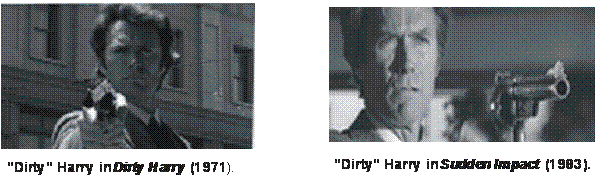
    Clint Eastwood’s Gran Torino was released in cinemas in 2008. A quite well received movie, it represents the culmination of Eastwood’s fifty-year career as actor and director. And culmination is indeed an appropriate term because, in a paradoxical way, it is a logical consequence of many other roles that the former mayor of Carmel has played over the years. It is as if Gran Torino‘s narrative structure summarized the careers of the characters once played by Clint Eastwood, such as The Man with No Name, the detective “Dirty Harry” Callahan or William Munny.

    The film, using the usual Clint Eastwood themes, centers on the problem and dynamics of the transition from the perspective of the hero of violence to the point of view of someone who, by sacrificing himself, aims to definitely break the cycles of violence. This evolution is described with outstanding conceptual rigor. As a matter of fact, we claim that Gran Torino displays in a cinematographic context some of the fundamental insights of René Girard’s anthropology. The structure of the movie reveals the same logic that underpins Girard’s work: the collective dynamics of gangs, the reciprocity of violence, the acceleration of reprisals, the role of initiation rituals, the relationship between gift and violence. Furthermore, Gran Torino shows how the actions that led to the sacrifice of the main character in the movie, Walt Kowalski (played by Clint Eastwood), represent the only true way to definitively break with violence. In that sense, Gran Torino is, in an explicit way, a representation of Jesus Christ’s Path of the Cross. As in Girard’s work, in Gran Torino the figure of Jesus Christ is the one that denounces violence and finally breaks with its vicious circle. If we look at the whole path of Clint Eastwood as a film actor from this point of view, we consider it to be a major cultural event that he, in his final movie as an actor, should play such a figura christi as Walt Kowalski.

    The film begins with the funeral of Walt Kowalski’s wife. She never appears in the film and it might be thought that her death, and her funeral, would have the reconciling effects among the living that death and funerals usually have. Above all, the reconciling power of the dead should exert its effects on his family. None of this happens, however. The dissension between Walt Kowalski and his family is the dominant theme of the funeral: dissension between Walt and his granddaughter, of whose “modern” behavior he clearly disapproves; and, finally, tension between Walt and his son and daughter-in-law. There is no actual violence, only a not quite verbalized dissent (marked by Walt’s disapproving spitting at his granddaughter). The tension between Walt and his family will last throughout the movie, but for the moment we only have a testiness that barely reaches the real violence that is the main subject of the film. In any case, Walt is a lonely man without a family.

    The increasing rivalry, the escalation towards violence, follows immediately. Walt is clearly a “conservative” American, an employee of the once thriving U.S. automotive industry. Successive waves of immigrants led a Hmong community to move into the Detroit suburban area where Walt lives.(1) A family belonging to that community settled just next door to Walt’s house, displaying their specific cultural practices. The relationship of mutual antagonism between Walt and the matriarch of the Hmong family is the theme that follows the episode of the funeral. The antagonism is reciprocal, made visible by words and gestures, but at the same time it is somewhat camouflaged, because the mutual verbal invectives remain largely unintelligible due to the viewer’s inability to understand the Hmong language. The linguistic difficulty does not, however, prevent the antagonism between Walt and the matriarch from occurring through the mutual spitting that ends the scene.

    So far, the latent violence has taken place between pairs of individuals. The movie comes to its real issue with the arrival of a member of the Hmong family, Vang Thao Lor (Bee Vang). He appears as the target of a gang of Mexicans, who cover him with all kinds of insults and threats. Thao is subject to mindless violence, whose sole purpose is to feed the gang as a gang. Thao’s salvation occurs immediately afterwards, with the appearance of another gang, this time a Hmong gang. This group intervenes to save Thao from the other one, no longer triggering violence between individuals, but now between gangs. Following a scene of extreme reciprocal verbal violence, where the weapons only appear discreetly in the two cars sitting side by side, the Hmong gang saves Thao from the Mexican gang.

    At the next moment the movie develops the logic of violent gangs. The Hmong gang, led by Fong “Spider” (Doua Moua), Thao’s cousin, carries out the actions that are typical of the collective logic of gangs. After some initial resistance, the gang tries to bring about Thao’s initiation, aiming at his acculturation, integration, and assimilation into the gang.

    Rituals of initiation are among mankind’s oldest cultural forms.(2) In this case, the action that brings about the initiation operates as a classic rite of passage. And, as with most similar rituals, the present one normally consists in an act of disorder, an offense. The offense is a crime, but in a context from which, strangely enough in twenty-first century America, public authorities (the police) will remain singularly absent. The ritual offense that must be carried out by Thao is the theft of the Gran Torino, a legendary car that Walt himself had helped build in his days as a worker at Ford, and which he maintains with particular dedication. The theft of the Gran Torino is Thao’s initiation ritual.

    The ritual goes wrong. Walt realizes that someone is trying to steal his car, and Thao has to flee. The failure of the ritual prevents the passage and integration of Thao into the gang. In a sense, his initiation into the order of violence has failed. We can imagine that the subsequent story of the film would be totally different if the ritual of initiation had been successful.

    For the moment, Thao remains in a sort of no-man’s land. Despite the failure of the ritual, the Hmong gang tries again to assimilate Thao. It is at that moment that Thao’s true initiation occurs: instead of being assimilated, initiated, by the Hmong gang, he will be so by Walt. This begins to happen when, despite the opposition of the family, the gang tries to take Thao away: Walt shows up and blocks the attempt. If the Hmong gang saved Thao from the gang of Mexicans, now it is Walt who saves the disputed boy from his previous saviours. But he saves him in a crescendo of violence, because he saves Thao with a gun in his hand, the first time that weapons actually make an appearance. However, the approach taken by Clint Eastwood and represented by Walt Kowalski begins to change. Whereas until then violence (and rescue) take place in a setting of ‘all against one’ (both gangs against Thao) or ‘all against all’ (the fight between the gangs); now it is one against all. A singular figure begins to emerge, one that will gradually escape the logic of the reciprocity between gangs, and the unity of each gang against a single individual.

    Nevertheless, at this moment of the movie, the figure of Walt still embodies violence, and all the main characters of the film (with two exceptions) will also embody it. Kowalski is the man who, through violence, restrained the violence exerted by the Hmong gang on Thao. He will later emerge as Thao’s good model, as opposed to the bad model formed by the Hmong gang. Then–just after Thao’s failed ritual–the film enters a different stage. While the previous phase was marked by the negative reciprocity of the violence between gangs and individuals, now a form of positive reciprocity emerges. As always, Eastwood directs as an accomplished anthropologist. So, the figure of the gift appears when, in gratitude to Walt for saving Thao, his neighbors place some offerings at the door of his house.

    Walt does not immediately react to the positive offering by positive reciprocity. At the moment, positive reciprocity is overshadowed by the logic of reciprocal negative violence in a scene in which Walt talks with a Catholic priest, Father Janovich (Christopher Carley). The priest had already made an appearance in the film, and his role will become increasingly important. Now, he warns Walt about the extreme violence that seems to be building, urging him to “call the police.” In fact, the role of the police is precisely to prevent the escalation of violence between private agents. But Walt dismisses the idea, stating the “need to act quickly,” just as he acted quickly in the Korean War in which he had fought.

    It will then become clear that all action takes place within a pre-judiciary order in which there are no rules and no mediating entities that could prevent the rising level of violence. And, indeed, almost to the end of the movie, the police will be oddly absent. Since the action takes place in twenty-first century America, and Clint Eastwood doesn’t film events and narrative structures whose occurrence is nearly impossible, such an omission is extremely significant.

    Mindless violence returns almost immediately. This time it is a pack of black men who block the path of Sue Lor (Ahney Her), Thao’s sister, and her boyfriend. The pack, with the usual obscene verbal violence, expels the “coward” boyfriend and clearly anticipates Sue’s rape. But it turns out that Walt saves Sue. Watching the scene, Walt feigns pulling the trigger of a gun with his fingers, before actually producing a gun.

    Walt Kowalski first saved Thao from the Hmong gang, and now saves Sue from a pack of black ruffians. The result is that Thao and Sue’s family–still an extended family with some of the characteristics of families in traditional societies–will increasingly renew their presents to Walt. He finally seems to accept this apparent logic of gift giving, evolving from the negative reciprocity that he shared at the beginning of the film with his Hmong neighbors to positive reciprocity. Always in accordance with well-known anthropological facts, this reciprocity is celebrated by a festive meal. It would appear that Walt himself was acculturated by the Hmong, and that the old dissensions–which can be dated back to the time when Walt fought in the Korean War–have disappeared. However, as the remainder of the movie will show, what really happens is that the Hmong neighbors began to see Walt as their new god, their god of violence who saved Thao, first, and then Sue. The transition towards the regime of gift-offering and positive changes is always grounded on a previous initial act, a foundational act, of violence.(3)

    Indeed, Walt is now becoming the god of violence to the Hmong family. He will be seen as an agent of positive reciprocity within that Hmong community, and as an agent of their negativity towards the others, outside. He becomes the potentate of this fragile community. At the right moment, the community will remind him of this.

    For the moment and before that happens, before the accumulated tensions reappear with an entirely destructive force, the scene where Walt and the Hmong community share a meal marks a significant shift in the atmosphere of the movie. If until then violence–a certain kind of still contained violence–reigned, now positive acculturation replaces it, at least for some time. It is the time marked by Thao’s repentance, when he confesses to Walt that he was the author of the aborted theft of the Gran Torino. Thao undergoes a new initiation, but a good initiation this time, driven by positive values. As stated above, the bad model of the Hmong gang is replaced by the good model that Walt now turns out to be. He initiates Thao in the value of work, in the prospects of a normal adult life, perhaps even rooted in university studies. The movie then goes through a set of sequences that last a little under a third of its length, following the initial phase of violence and paving the way to the final reign of violence.

    Walt has acculturated Thao, and to that extent he has created a profound dissent in the Hmong community, taken as a whole. He separated Thao from the gang as he also separated the gang from Thao’s family. Basically, Walt has been sowing violence. He had previously somehow anticipated what he was doing, and it is that reality that will be imposed in an increasingly unavoidable form. The third part of the movie will display the relentless acceleration of violence. From now on the pace of the movie will be vertiginous.

    Everything starts with the response–a response that was bound to come–from the Hmong band. The response begins by being centered on Thao, who suffers a new kind of “initiation” at the hands of the gang. Thao, who broke the unanimity once desired by the group, will be put at the center of a circle formed by the members of the gang. The gang members then brutally punish him by burning his face with a cigarette. It is a new ritual, but one now closer to the pure form of violence, in which a pack of men encircle and punish a single man. At that moment the vicious cycle of violence finally accelerates: until then, physical violence had never existed. There had been only verbal violence and simulations of weapons being fired. Now, there is actual physical violence. The cycle will unfold in an accelerating crescendo.

    It is the nature of violence to appeal to more violence, “violence attracts violence,” precisely. And the problem is that each person is always responding, without anybody being able to know exactly who started it. If, earlier on, in the first stage of the movie, Walt resorted to violence (albeit not consummated physically) to contain other forms of violence, he will now resort to an increasing level of violence with the sole purpose of directly responding to previous violence. It is the first time that he really responds. Only later will he fully understand the vicious circle in which he became the main actor.

    Walt replies to Thao’s burning by raising the stakes: he waits until one member of the Hmong gang is alone, punches and kicks him until he is left unconscious, in a scene filmed with such appalling realism that the viewer has to experience the brutality of the act. As is the case with the best moments of Clint Eastwood’s movies, violence now is not the senseless, fanciful, implausible violence of the majority of films that so delight millions of viewers. It is realistic violence, which displays its own naked and mindless brutality.

    Violence is an escalation of difference towards indifference. This dynamic is, until its absolute end, masterfully displayed in Gran Torino. Initially, violence was only verbal. Then, there are simulations of shots being fired. The response comes in the form of burns. The response is always a difference from the previous level and prepares indifference by a new kind of difference: brutal punches and kicks. The counter-response can only be a further escalation of the difference towards indifference.

    The Hmong gang will in fact respond. Always according to well-known anthropological facts, the band will respond obliquely, to the side, as it were. The gang will not respond directly to Walt (who was the aggressor of one of its members). The band unleashes its revenge on Thao’s family.

    This is the logic of reprisals, which go from the “periphery” to the “center.” The reason is that, although it was not directly responsible for the violence someone is responding to, the “periphery” is usually the weakest link. Only later will there be an attack on the central target. That is what the gang does: it attacks the “periphery” instead of the “center” (the central target), which is Walt Kowalski. And the gang does this by shelling the home of Thao’s family (the periphery). If the difference is still operating, in the transfer of reprisals from the central target to the more vulnerable periphery, the truth is that the escalation continues with the shift from punching to shooting. This is the escalation of violence: those who respond raise the stakes in a vertiginous acceleration of time.

    At this point, when the film speeds up dramatically, it is clear that Walt finally begins to understand the cycle in which he has been involved, and to which, at the same time, he has decisively contributed. This reflection by Walt (not yet quite explicit) is interrupted by yet another response from the Hmong gang. After strafing the house, the gang picks up Sue, who is raped and brutally beaten. It is only then that blood appears, this link between life and the menstrual cycle, on the one hand, and death, sex, and rape, on the other. At the same time, in an odd way, all this takes place in Detroit in the twenty-first century, with an absent police force! As mentioned above, this means that Clint Eastwood wants to direct the dynamics of violence that unfolds in the private space of reprisals.

    After Sue’s brutal beating and rape, Walt goes back to his “reflections.” But not before, in an act of rage–the rage of someone who understands the fire that he had ignited and so understands the origin and dynamics of violence–he has mutilated himself and bled. The wounds in the hands of Walt are displayed in an ostensive way. To the viewer, this scene is barely understandable at the time, and in fact it will only be clear in the light of the unusual ending of the film. In the scene that follows, Walt becomes even more explicit about his “reflections” when he talks with the priest Janovich. The dialogue is always accompanied by several shots that highlight Walt’s still wounded hands. He says that “Thao and Sue will never have peace in this world as long as gangs are around,” finally realizing that the cycle of violence has no end, and that only death can follow and replace it. But the priest Janovich does not seem to fully understand what he is hearing, and instead points out that “he (Walt) knows what Thao expects.” And then asks, what will he, Walt, do?

    At that moment, the audience knows perfectly well “what Thao expects.” And what Thao “expects” is also what his family “expects.” Is it not the case that Walt is their god of violence, the avenger of the received offenses? And what Thao and his family “expect” is clearly what the viewers also begin to “expect.” What else could be “expected” from someone with Clint Eastwood’s record? We could even say that everyone was not only expecting, but rather desiring, Walt’s response. And what everyone was expecting was evidently a violent response, at least at the level of the earlier violence. It should be a response of such brutality that it would have to move in the circle of death.

    We must confess, perhaps in a personal way, that at this stage of the film we asked ourselves some questions. In fact, Walt seemed to give clear signs of not being inclined to continue the cycle of reprisals. It was apparent that he had understood that this could only lead to more destruction. But then, as the priest asked, what will Walt do? Only two possibilities seemed to be open. Either Walt would do what everybody “expected,” perhaps thinking that some final deaths could put an end to the cycle of violence; or, the priest’s interventions seemed to suggest, he would try some form of “understanding,” some kind of “dialogue.” But this latter possibility seemed to be completely discarded by the structure of the film. It seemed impossible for some kind of mediation between enemies in the blood to exist. The outcome appeared mysterious. Personally, we confess that we never anticipated the extraordinary ending of the film.

    Walt has taken his decision. He has to solve some minor problems, including locking in his house a Thao mad with rage and thirsty for revenge, and for whom Walt could not do what everyone was “expecting.” But Walt has other ideas. He goes to an open square in front of the Hmong band’s house. They were also “expecting” him.

    The scene that then takes place is a remarkable one, even if taken in the light of criteria of analysis that consider a cinematographic work as pointing only to itself, and therefore with no reference. However, the final scene will refer, and refer to the source of the truth. Walt arrives alone at the front of the house. The members of the gang appear at the doors and windows–in a larger number than usual, so that they almost constitute now a real crowd–displaying some perplexity about the way Walt presents himself. With an increasing dramatic intensity, Walt begins by saying:

    “I’ve got to jump on your way.”
    At this point, one might think that Walt is telling them that he came “to cross their path,” in the sense of being a barrier that exerts a still greater violence than the gang’s violence. In other words, Walt is announcing that he has come to “respond.”

    We are quickly disabused of such an interpretation. Walt demands fire from the members of the band. At that moment, neighbors of the gang’s house show up to witness the events. Walt puts his hand in his pocket (will there be a weapon?), raises his arms and utters the capital phrase:

    “No, me I have got the light.”

    Believing that Walt will pull out a gun, the crowd responds in unison, riddling Walt with bullets. He then falls into a position that forms a cross. We quickly learn that Walt had no weapon. The police arrive. The gang is arrested. We witness Walt’s funeral and the union of the living that usually follows death. In the final scene, Walt’s will is read, which gives Thao the Gran Torino, contrarily to the family’s hopes.

    The ending of the movie, the reading of Walt’s will, etc., is a happy ending that makes the movie abruptly step down from its previous extraordinary level. It is a totally conventional ending that could have been replaced by many others. Clint Eastwood possibly found it necessary, for commercial reasons, for the sake of the viewers’ habits, or for others reasons, to end the movie in a conventional manner. Above all, and we think this is the main reason, this ending was chosen in order to produce an effect of catharsis of the drama that has just been narrated. The drama is somehow erased and the viewer can leave the theater on a more familiar territory. It is as if, after all, Clint Eastwood’s genius is still present when he chooses a conventional happy ending, deliberately targeted at the public’s reactions. However, in truth, the ending of the movie is the scene in front of the gang’s house, Walt’s murder and the arrival of the police. We claim that this final scene, to which we now return, is a Passion.

    We can now evaluate Walt Kowalski’s final decision. He understood that the stupidity and brutality of violence only generate more lethal and indiscriminate violence. And he understood that his actions had also contributed to the unfolding of the cycle. He then made his decision. Not exactly that he “has repented” or that he has thus “atoned his guilt.” Walt clearly shows that his decision is an objective response to the objectivity of the situation: either the continuation of violence that will eventually devour everybody, or–what? The sacrifice of himself, by which he puts an end to the cycle of violence. This is the only and truly radical solution to the problem. It is also the only one that men never follow. The usual solution is what everybody “was expecting,” or what places the solution on someone else’s shoulders.

    Walt sacrifices himself so that the others might live. He offers his sacrifice so that a community could be viable. Is this a solution that has appeared at some juncture in mankind’s history? Clint Eastwood is quite explicit on this point, and it definitely captures the anthropological dimension of Gran Torino. In the truly final scene, Walt embodies the Passion of Jesus Christ.

    This is the movement of the film: from the mechanical cycle of violence to its end and denunciation. It is the movement in which Christ is sacrificed for the sake of humanity, to redeem all its past crimes and prepare for the coming of the Kingdom of God, the realm of positive reciprocity of all men in love. The Passion of Christ, as described in the four Gospels, is the denunciation of all forms of violence and points the way to mankind’s redemption. With his sacrifice, Christ redeemed all past crimes, denounced the nature of violence, its mechanical nature, its injustice; in other words, Jesus Christ wanted all men to live. That is exactly what Walt does: he denounces lays bare, before everyone’s eyes, the truth of violence, breaks away from violence and thus he wants the others to live.

    None of this is “interpretation.” Clint Eastwood’s films, and in particular Gran Torino, require very little “interpretation.” The allusion to the Passion and to Jesus Christ is fully explicit. Remember that Walt begins by saying:

    “I’ve got to jump on your way.”

    Next, Walt apparently asks the members of the gang if they “have light” (to light a cigarette). More precisely:

    “Do you have light?”

    After a few interjections from the members of the gang, and in a crescendo of dramatic intensity, perfectly marked by the direction, Walt raises his arms as if already forming the figure of the cross on which he will fall, and says:

    “No, me I have got the light.”

    “No, [not you], but I bring light.” The light that Walt brings through his death is the light of truth, the truth about the violence of the violent. Walt makes public, brings to light, the truth about violence. He displays–through his unjustified murder–in broad daylight for all to see, violence as something purely destructive and absolutely meaningless. It should be strongly pointed out that just before the exact moment when Walt says that he “brings the light,” Clint Eastwood films the appearance of witnesses. These are the witnesses–in fact, all of us–whom the sacrifice of Walt is addressed to.

    It’s true that the role of the witnesses has some ambiguity. Their role can be interpreted in the light of the scene following Walt’s murder, when the police (finally) arrive. Then, in fact, the witnesses can testify against the gang in a criminal case (as referred to by a policeman). But the permanent absence of the police and the entire organization of the script show that Clint Eastwood’s primary objective is to show an anthropological situation of the near absence of judiciary power, that is, a situation in which the violence that men are capable of is displayed. But, contrarily to what happened to Jesus Christ, where the killers acted with impunity (even backed by the powers of the time), Walt’s killers will be punished. Walt stopped and denounced violence through his death and, additionally, through the legal punishment of the violent. These murdered an innocent, unarmed man in an orgy of collective violence. So, we can say at the same time that Walt’s sacrifice was a foundation for a future condemnation and that it was a light directed to the witnesses. Both ideas converge in the sacrifice and denunciation of violence by Walt.

    Walt Kowalski is a figura christi, a repetition of the Passion where Jesus Christ was killed. In the instant before being riddled with bullets and falling in the shape of the cross, the figure we all know is that of Jesus, he says in an almost imperceptible whisper:

    “Hail Mary, full of grace.”

    All this is literally visible in the film. However, another interpretation should also be briefly mentioned, one that could claim that Walt’s death was a sort of “calculated suicide.” Perhaps such an interpretation is based on two or three scenes of the movie we have so far omitted. This applies to the scene in which Walt received the results of medical exams that apparently (this is not entirely clear) indicate a poor state of health. It is also the case of two scenes in which he spits blood, confirming, again, health problems. But should we say that Walt gives his body to the bullets because he was in bad shape, that he takes advantage of the Hmong story to commit suicide? This is totally implausible. A suicide is a negative, self-destructive act, not the foundation of anything. On the contrary, Walt sacrifices himself so that violence can be stopped and so that the others can live. Therefore, it is a positive act, quite opposed to any suicide.

    But we think that what has been said is not enough to truly understand the singular position of Gran Torino in Clint Eastwood’s career. Something else should be briefly pointed out.

    In an interview,(4) Eastwood said that Gran Torino was probably the last film in which he would participate as an actor. This statement may be construed as an admission that “he is old” (Eastwood is 78), and, as himself admits in the interview, it may not be easy to find roles for actors of that age. In any case, we think that decision is a logical one if one considers the path that leads Eastwood to the portrayal of Walt Kowalski in Gran Torino.

    Let’s remember in very broad lines Clint Eastwood’s career. He was the impenetrable and ruthless gunman in the trilogy that began with A Fistful of Dollars (1964), where he played the Man With No Name. He was then the detective “Dirty” Harry Callahan, this relentless vigilante, always on the razor’s edge between the implementation of private justice and public justice, restoring order by ruthlessly killing rioters. He brought violence and triumphed by violence.

    In 1992 he directed the rightly acclaimed Unforgiven, a story of cycles of violence caused by a huge moral and criminal offense: disfigurement of a prostitute by stabbing. Eastwood is William “Will” Munny, a retired gunman who returns to work and, at the end of the film, carries out a general killing. He is the god of relentless violence that comes in the final night and destroys all his enemies. As always, the order restored by death is brought about at the hand and by the gun of the hero, who embodies violence. As in other movies, in Unforgiven the intentional killing of men is represented as what it is in itself: literally what brings peace by eliminating those who, alive, are an obstacle in the path of others, and who, dead, are no longer such an obstacle.

    As has been pointed out, and as is exemplified by the final actions of “Dirty” Harry or “Will” Munny, violence in Clint Eastwood’s films nearly always has a cathartic effect, both for the other characters and for the audience. This effect is caused by the murders carried out by the gods of revenge represented by Eastwood. It is a founding violence, in the sense that it brings peace through brutal killing, through the murder of an enemy at the hands of the god of violence. This is Eastwood’s typical character, his “brand image”: the ruthless avenger who restores order with shots and produces a catharsis when the troublemaker is eliminated.

    A more recent example is Blood Work (2002). The film tells the story of Jasper “Buddy” Noone (Jeff Daniels), who finds a pseudo-justification of murder by claiming that the bodies of the dead may be used to save other lives. “Buddy” Noone illustrates an archaic sacrificial logic, in which death is justified because it saves the lives of others. But those that are killed are victims that we know were innocent; so, for us, rightly, “Buddy” Noone is just a psychopathic killer, whatever the arguments emphasizing sacrifice with which he disguises himself. In the film, Clint Eastwood is the former detective Terry McCaleb. He is once again the ultimate god of violence who finally kills “Buddy” Noone and thus restores order (catharsis).

    In most of his films, those that made his “brand image,” Eastwood is always the active agent that brings peace through death. However, we can see in some of the latest movies an emphasis of the moral dilemmas and a prelude to the absolutely unique position taken by Eastwood in Gran Torino. The great example is Million Dollar Baby (2004). In a movie filled with almost unbearable violence, Frankie Dunn (Clint Eastwood) faces the dilemma of practicing euthanasia on Maggie Fitzgerald (Hilary Swank). The dilemma is a serious one, and here we no longer find the usual Eastwood who quickly gives death to his enemies. It is after all euthanasia, and it could certainly be argued that Frankie kills Maggie to put an end to her suffering.

    Therefore, in most of his films, Eastwood is the relentless gunman/detective, the judge who is both the god and the angel of death. According to the usual sequence of these films, Eastwood is the judge who punishes the disorderly offenders, often with some physical disabilities. In Million Dollar Baby, the disability is acquired, and Frankie Dunn inflicts death for love, no longer for revenge.

    If, at least until Million Dollar Baby, the usual logic of Eastwood’s films was followed, in Gran Torino Walt Kowalski will also punish the pack of rioters. As stressed above, it was just what everyone was “expecting.” But now we fully understand that Walt Kowalski/Clint Eastwood represents the end of the gunman and of the god of death. In Gran Torino, the perspective is inverted. The ending of the movie inverts the point of view of Clint Eastwood’s previous roles, just as Walt Kowalski’s role is inverted when he becomes the victim rather than the avenger. In its narrative structure, Gran Torino represents Clint Eastwood’s whole path. Kowalski/Eastwood himself is now the victim of the crowd (the gang). The sacrifice is not the sacrifice of others for order to prevail. The sacrifice is now, finally and for the first time in Clint Eastwood’s work, the sacrifice of himself and not, we emphasize, of others. It is the sacrifice of his own life to end violence and for the others to live, not the death of others at the hands of the god of violence for order to be restored. It is a radical solution to the problem of violence that Eastwood has always pondered. It is a unique and singular solution. It is a Passion. When Clint Eastwood embodies such a Passion as an actor, when he takes the logic of violence to the extreme–its absolute denunciation through self-sacrifice–then, in fact, it is the end of the road for Clint Eastwood as a film actor.

    Notes

    1. The Hmong is an ethnic group originated from Southeast Asia. (back)

    2. Cf. René Girard, (1977), Violence and the Sacred, Baltimore: The Johns Hopkins University Press. (back)

    3. René Girard, Idem. (back)

    4. Cf the interview to Rich Cline, available at: http://shadows.wall.net/features/eastwood.htm. Ac. 02-07-2009. (back)

  • “A Democracy of Touch”: Masochism and Tenderness in D. H. Lawrence’s Lady Chatterley’s Lover

    One of the central themes that critics identify in Lady Chatterley’s Lover by D. H. Lawrence is the juxtaposition between the vitalist and rationalist mental outlooks and life attitudes, with the former, epitomized by the gamekeeper, Oliver Mellors, associated with the realm of nature, natural order, fertility, and life force, and the latter, representative of the sterile and efficient era of the industrial class society, exemplified by Clifford Chatterley. Aligned with (and mapped onto) this division is another binary opposition–that between mental life and life proper, or to put it more judgmentally (as the author’s sympathies are unmistakable here), between sere intellectualism and lusty sensualism. I return to this familiar ground, covered multiple times by the critics in the past, in order to shed new light on the notions of sexual mastery and submission in specific connection with vitalism. I will look at the patterns of dominant and submissive behavior that arise in the novel with the goal of demonstrating that these configurations of mastery and subservience represent instances of masochism in its classical formulation as a sexual or psychological perversion of deriving pleasure from pain (both in a direct and figurative sense).

    The hypothesis that I aim to authenticate is that masochism is a “late” phenomenon in the history of representation, which accompanies vitalism’s reaction to modernity (and by modernity I mean a modern late-capitalist technological society characterized by the so-called natural attitude), while at the same time allowing a revealing glimpse into the internal contradictions of vitalism itself. The mental outlook of vitalism, a philosophy championed by D. H. Lawrence, was formed, as I will argue, as a backlash against what it perceived as the technocratic civilization’s insensitivity to human temporality and the consequent disempowerment of man. But in its attempt to bring things back to human scale, vitalists rebel against the notion of transcendence and strive to return to the prelinguistic moment before the origin of language.

    My point of departure will be Julian Moynihan’s observation that Lady Chatterley’s Lover “dramatizes two opposed orientations towards life, two distinct modes of human awareness: the one abstract, cerebral, and unvital; the other concrete, physical, and organic.” He relates this comment to a passage from Lawrence’s essay “Apropos of Lady Chatterley’s Lover,” where the author says that “There are many, many ways of knowing, there are many sorts of knowledge. But the two ways of knowing, for man, are knowing in terms of apartness, which is mental, rational, scientific, and knowing in terms of togetherness, which is religious and poetic. . . . We have abstracted the universe into Matter and Force, we have abstracted men and women into separate personalities–personalities being isolated units, incapable of togetherness–so that all great relationships are bodiless, dead” (67). Lawrence’s elucidation of the meaning of his own novel should be seen as legitimate, for it is agreed that he has explicitly written a programmatic text (roundly criticized as ideological), with the main character serving as his explicit mouthpiece in condemning the reigning cultural values. He insists that the valorization of intellectualism divorced from feeling and sensation fragments human existence and leaves it barren and empty of meaning (Clifford’s stories are meaningless), while tenderness and loving connection (Connie and Mellors’ love) are capable of lifting sexuality from the realm of animal nature and transforming it into something that is genuinely human. In the quoted passage, Lawrence aligns the reductionist approach to knowledge with modern technocratic civilization, and opposes it implicitly to the second way of knowing, that of togetherness. This other way of knowing belongs to vitalist aesthetics and worldview, which Lady Chatterley’s Lover can be seen as promoting. It has been read as an apology for vitalism. Therefore, I will preface my discussion of masochism with some expository remarks on the problematics of vitalism, in order to contextualize my further analysis.

    The valorization of cerebral existence is at home in the world of the chattering classes to which the appropriately named Chatterleys both belong, albeit in somewhat different strata. Connie, whose provenance from an intellectual and cultural elite has supplied her with “an aesthetically unconventional upbringing” (662), has her formative encounter with the life of ideas as a young girl in Germany, where she discovers freedom and the thrill of intellectual debate in a mixed-gender company of students. At this stage, “it was the talk that mattered supremely: the impassioned interchange of talk. Love was only the minor accompaniment” (662). It was men that “insisted on the sex thing like dogs” (662), but to women, it was the passionate and intellectual interchange that held the main attraction, and sex was something to which they consented reluctantly. Later, she continues her association with intellectuals–both aristocrats and commoners–via her husband Clifford’s bohemian set, all of them fashionable literati of London society. Since Clifford, who is paralyzed from the waist down as a result of his war injuries, is impotent, his connection with Connie is solely an intellectual one. She is actively involved in his writing career, reading his stories, encouraging him, and serving as a hostess to his circle of intellectuals. It is suggested that Clifford has a premonition of Connie’s impending desertion, and this is probably why he so ardently about insists that a mental connection, created as a consequence of “an integrated life built on a habit of intimacy” (691), is everything, while casual sex is nothing. He is therefore trying to talk Connie into having a child by another man that would be raised by Clifford as the heir of Wragby. To Connie, on the other hand, it is the mental life that “[begins] to feel like nothingness” (691), and her spiritual awakening is intimately bound up with her sexual awakening, which she experiences with her lover, and her husband’s servant, Oliver Mellors.

    The juxtaposition of vitality versus sterility is set up between the worlds of Lady Chatterley and her lover, on the one hand, and Clifford and his set, on the other. The affair between Connie Chatterley and Oliver Mellors takes place in a rustic hut in the wood that belongs to the Chatterleys estate and begins simultaneously with the renewal of life after the winter, accompanied by a vivid, poetic portrayal of the advent of the spring, punctuated by the minute details of the change of flower blooming seasons. The lovers, Connie and Mellors, their bucolic surroundings, and their affair, narratively framed by the life-affirming progress of the spring, are associated with words such as “vital,” “alive,” and “life,” and allusions to vigor, viability, pliancy, and fertility are frequently invoked in this connection. Thus, trees in the forest, surrounding the love nest, are described as “powerful beings, dim twilit, silent and alive” (739); the oak trees have “powerful trunks . . . , round and vital” (719), and the pine-tree under which Connie sits is an “erect, alive thing” that is “elastic, and powerful, rising up” (714). Early spring daffodils are “so bright and alive” (714), while a newly born a pheasant chick is “the most alive little spark of a creature in seven kingdoms” (732-3). Even these smaller things are powerful in their own way: the daffodils are “so strong in their frailty” (714), and the pheasant chick is “so cheeky” and “so utterly without fear” (733).

    People too are described in a language evocative of plant life–their sturdy bodies giving an impression of being firmly planted in the earth or gravitating toward it. Thus, Connie’s sybaritic father has “stout thighs” that are, like tree trunks, “strong and well-knit, the thighs of a healthy man who had taken pleasure in life” (828). It is suggested that Connie inherits her sensualist nature from her father. Connie’s figure, as she looks at herself in the mirror, is also spoken of in organic terms with her breasts “pear-shaped” but “unripe,” her “down-sloping” curves having retained some youthful “down-slipping richness,” are becoming “sapless” and “going unripe, astringent” after years of celibacy (703-704). In this scene, before she embarks on her affair with Mellors, Connie perceives herself as drained of life (her “vitality is much too low” (709)); only in her buttocks, it appears, “life still lingered hoping” (704). Sex with Mellors, however, has a reinvigorating effect on her. In addition to her newly feminine body contours, she feels rejuvenated inside. During their intercourse, “her womb, that had always been shut, had opened and filled with new life,” and so “in her womb and bowels she was flowing and alive now” (747). In fact, it is her “whole self [that] quivered unconscious and alive, like plasm” (774). Mellors, in turn, is originally depicted as a “pistil of an invisible flower,” “a little frail and quenched,” although still as “curiously full of vitality” (713, 689). After their sexual encounter, he tells Connie: “I thought I’d done with it all. Now I’ve begun again.” And after she asks him “Begun what?” he replies “Life” (735). She echoes his sentiment later to Clifford when she says that “the life of the body is a greater reality than the life of the mind: when the body is really wakened to life” (815).

    Even their body parts become anthropomorphized by the vitalistic description and transformed into independent agents. Thus Connie is stirred by the feel of Mellors “warm, living buttocks” and struck by the “small, bud-like reticence and tenderness of the penis” (773-774). His penis is “proud” and “lordly,” “Like another being!” and Mellors agrees that “he’s got a will of his own” (798). As an expression of their wonderment at the potency and autonomy of their sexual organs, the lovers invent pet names for them, John Thomas and Lady Jane. These synecdochic replacements for their bearers are meant to divorce the love story and the characters from their specific content and elevate them to the level of the universal, where they become simple archetypes of man and woman. In line with this organic, pagan thinking, their genitalia become associated with the source of all life. For Mellors, Connie’s “bottom” acquires the significance of a sacred, Atlas-like being that “could hold the world up” (806). In a symmetrical way, Connie thinks of his penis as the “root of all that is lovely, the primeval root of all full beauty” (774).

    Clifford, on the other hand, is shown as a complete opposite to the world of natural vitality. His change of vocation from being a fashionable writer to undertaking the technological modernization of his mines might strike the reader as an odd transition from mental to materialistic existence. But, interestingly, materiality in the novel is not the same as physicality–it is closer to the physis of the natural attitude than to the embodied experience of élan vital. Via its association with the alienated world of capitalist production, the former is connected with the cerebral realm of ideas, while the latter to the vitalist one of the body and earth. Even though Clifford is animated by his projects of story-writing and acquiring technical expertise on mining, he remains curiously devoid of élan vital. He is said to have a look of “slight vacancy,” that “of a cripple” (661), with “his peculiar and rather vacant apathy” (780) and his insides filled with a “terrible hollow,” a “void” (750). His stories too, although skillful, clever, and increasingly popular in fashionable society, are empty: “there was no touch, no actual contact. It was as if the whole thing took place in a vacuum” (668). These descriptions evoke an image of a rotting fruit or tree decaying from the inside, which fits in well with the overarching metaphor of a human body as a tree that is rooted in the soil from which it derives its life energy by way of its roots, i.e., legs and buttocks. The paraplegic Lord Chatterley, by contrast, is literally disconnected from the earth as the source of all life. His disability epitomizes his existential condition of being “a negation of human contact” (668) and he therefore carries a void inside, as if something is withering in him. The most striking contrast is symbolically encoded in his mode of locomotion: instead of having an innate, organic connection with the earth, of seeming to grow out of it, Clifford rolls over it in a wheelchair, achieving the most fleeting and superficial of contacts. His lack of relatedness or sensitivity to nature is ironically underscored by the episode when he rhapsodizes about the beauty of the “English spring,” while his wheels, in all obliviousness, “jolt over the wood-ruff and the bugle, and squash the little yellow cups of the creeping-jenny . . . [making] a wake through forget-me-nots” (780).

    Clifford’s motor chair is emblematic of the mechanistic world of capitalist production he embodies in the novel. His seat of Wragby is an impersonal assemblage of living spaces that lack an organic center (762) and that repel his wife with their “mechanical cleanliness and the mechanical order” (669). The views from the estate are marred by the permanent cloud of smoke hanging over the Tevershall collieries that belong to it. The sense of sight is offended by “sharp, wicked electric lights” (736), and the sense of smell by “the rattle-rattle of the screens at the pit. The puff of the winding-engine, the clink-clink of shunting trucks, and the hoarse little whistle of the colliery locomotives” (666-7). These images make the coal works look like a vast, impersonal mechanism that has somehow gotten out of control and is now running amok like a rogue force on relentless offensive against the wooded idyll and without any regard to human concerns. As Mellors climbs on top of a denuded knoll, the industrial world reveals itself in all its intimidating ugliness and crushing insentience, impervious to human presence:

    There, in the world of the mechanical greedy, greedy mechanism and mechanized greed, sparkling with lights and gushing hot metal and roaring with traffic, there lay the vast evil thing, ready to destroy whatever did not conform. Soon it would destroy the wood, and the bluebells would spring no more. All vulnerable things must perish under the rolling and running of iron. (736)

    This inanimate mechanized world, poised to steamroll over everything standing in its way, just like Clifford’s chair, is inimical to life in its organic sense. To Clifford, however, life is the energy that feeds the cycle of simple production which, in its turn, puts into efficient use “the chemical possibilities of coal” (728). As he decides to dedicate himself to the technological modernization of his coal pit in order to make it profitable again, he is struck by “a new sense of power flowing through him:” it is as if “Now life came into him” (729).

    These two orientations towards life, the technological and the vitalist, stipulate two types of relationships, according to Lawrence. The working title of the novel was Tenderness, and the relationship of tenderness encapsulates Lawrence’s ideal of human interaction–something that is spontaneous, unconstrained, and completely free from coercion and dominance, made possible by mutual attunement and keen sensitivity. This model of relationship is valorized in the novel as “a democracy of touch” that will be made possible after “we’ve shoved the cerebral stone away” (707). The interrelationships between individuals in modern industrial society, conversely, cannot be free and volitional because of its alienated, mechanistic or automated nature. The constitutive components of the mechanical model operate in the mode of “apartness.” They interact with each other with the help of sent impulses, which initiate movement and force certain parts to produce work. Conceptually, a mechanism’s design is hierarchical, whereby signals are sent along the chain of command, making the principle of subordination endemic to the industrial organization of labor. Not surprisingly, such a built-in necessity of compulsion provokes a reaction by the vitalist with his profoundly anti-authoritarian, voluntarist temperament. One way of subverting established power relationships, explored in Lady Chatterley’s Lover, is, as I will now show, via the outlet of masochist role-playing.

    There are several examples of dominant-submissive games played by pairs of characters. I would like to focus on two most striking ones–those between Lady Chatterley and Oliver Mellors, on the one hand, and Lord Chatterley, and his servant, Mrs Bolton, on the other. Connie Chatterley’s background is not aristocratic, unlike that of her husband’s. Her provenance from the moneyed Bohemian class with its free-thinking tradition gives her some distance to the supposed unbreachability of the class barrier: the principle of absolute separation between the classes does not hold the same sacred status in her eyes as it does for those closer to the noble and plebeian extremes of the social divide. At the same time, it would be an exaggeration to say that she is oblivious to social distinctions. Her ambivalence toward the class system reflects, to some degree, the ambivalent social station of her lover, Oliver Mellors. Even though he comes from a local collier stock and works, at one time, as a humble blacksmith, he has inborn refinement, intelligence, and inquisitiveness that allow him to rise above his station. As a young lad, he courts a school-master’s daughter, and together they become “the most literary-cultured couple in ten counties” (791). And later, after he joins the army, he is favorably noticed by a colonel, through whose patronage he is made a lieutenant. After he retires from the army and goes back to work for his former employer, it is a challenge for him, in Clifford Chatterley’s words, “to get back to his own level” (718)–a situation that is reflected in the way his speech (confusingly, for Lady Chatterley) oscillates between broad Yorkshire dialect and educated English.

    Despite the fact that their respective social positions are not easily pigeonholed, their relationship does entail some degree of indignity (for both). Since in the inherently hierarchical sexual relationship, the male holds the naturally superior position, both Connie and Mellors are denigrated by their sexual involvement. Connie is lowered by her association with a servant, while Mellors is in a humiliating position of having a mistress who is his social superior. It is far from clear which is the more injured party, that is to say, which one of the lovers is degraded more by this connection. Their relationship is initially a power play of mastery and submission until it promises to settle, after Connie gives up her social status, into the culturally stable paradigm of an active-passive/dominant-submissive male-female interaction. (The novel offers, as it were, a happy resolution). In the very beginning, however, the social codes are flouted between Connie and Mellors. The first thing she notices about the gamekeeper is that there is something elusively and insinuatingly defiant in his attitude toward his masters. When Connie first meets him, he looks to her “like a free soldier rather than a servant” (689). The mood of defiance is often conveyed by the look he gives her. Either he “stare[s] into Connie’s eyes, with a perfect, fearless, impersonal look” or his look is “laconic, contemptuous, not hiding his feelings” (697) or his face “[takes] an undefinable look of derision,” while a “smile of mockery [narrows] his eyes” (702). Such signals sent through facial expressions and body language make Connie realize that “the man [does] not respect her” (697). Even his dialect is used as a weapon in his and Connie’s power struggle. When she notices that “his voice on the last words had fallen into the heavy broad drag of the dialect,” she suspects that he did that “in mockery, because there had been no trace of dialect before” (688). Mellors, who has taught himself to speak proper English during his army years and gives an impression of being “almost . . . a gentleman” (688) makes at times a conscious choice to revert to folksy speech in order either to parody and mirror his superiors’ patronizing and supercilious manner or to humiliate his mistress by reminding her of his low birth and thus, in a perverse way, to affirm his mastery over her.

    But even though Connie “was gifted from nature with [an] appearance of demure, submissive maidenliness” (743), she too is capable of engendering a feeling of inferiority in Mellors, on occasion. “He dreaded her will, her female will, and her modern female insistency. And above all, he dreaded her cool, upper-class impudence of having her own way. After all, he was only a hired man” (716). On a whim, she can pull rank on him or remind him who is in control, such as when she stops coming to their assignations for several days, being well aware that it is impossible for him to come and fetch her. All that the gamekeeper can do is stand impotently outside her house and look at her windows. But while she makes him wait in uncertainty, she herself is uncertain too, “divided between two feelings: resentment against him, and a desire to make up with him” (771). However, as their relationship progresses, Connie lets go of her impulse to be the dominant partner. This change of heart is connected with her lover’s gradual awakening within her of her sensuality. At some point, her feelings for him become too strong, too genuine, and so she deliberately erases from her mind an earlier role-image of herself as a Bacchante who is served by her adoring phallus-bearer. She rejects the Bacchanal role model and replaces it with the one of a docile and subservient partner, overcoming her residual fear of “[losing] herself, [becoming] effaced, and she didn’t want to be effaced, a slave, like a savage woman. She must not become a slave. . . . She had a devil of self-will in her breast that could have fought the full soft heaving adoration of her womb and crushed it” (747).

    The self-will is associated in the heroine’s mind with barrenness, and so she willingly gives it up for the sake of love and turns to him with her hitherto hidden side of gentle femininity. Another incentive to abandon self-assertive behavior is provided by the cautionary tale of the gamekeeper’s unhappy marriage to Bertha Coutts. Mellors tells Connie how he hated it when Bertha actively tried to bring herself to orgasm by inducing him to clitoral stimulation: “By God, you think a woman’s soft down there, like a fig. But I tell you the old rampers have beaks between their legs, and they tear at you with it till you’re sick. Self! Self! Self! all self! tearing and shouting!” (792). The horror of the modern female for Mellors lies in her “ghastly female will” (843) of “endless assertion” (722). The epitome of this behavior is Bertha Coutts in her striving toward self-satisfaction. “And it came back on her like a raving necessity, she had to let herself go, and tear, tear, tear, as if she had no sensation in her except in the top of her beak, the very outside top tip that rubbed and tore” (792). The dramatic irony of this confession lies in the fact that this is exactly how Connie brought herself to orgasm with her first lover, Michaelis.

    In contradistinction to other relationships he has known, Mellors wants a relationship built on real tenderness. Some of the connotations of tenderness are softness, sensitivity, pliability, giving way, lack of resistance. That which is tender will not obstruct, hold out against, put itself forward, or put up a fight. It will yield to the force or penetration of the other to the fullest extent. Indeed, this is how Connie is feeling and reacting: “she felt herself melting in the flame,” “she yielded with a quiver,” her body is “softly opened” to “the thrust of a sword,” “she was deeper and deeper and deeper disclosed,” “the quick of all her plasm was touched” (773). Mellors, who thinks “there is no real sex left” and longs to find a woman “who’d really ‘come’ naturally with a man” (793), finds such a woman in Lady Chatterley. Connie allows him to realize the male fantasy of the vaginal and anal orgasms that do not require a separate pleasure organ, like the clitoris–experiences that build on responsiveness rather than self-assertion and willfulness. This is the model of human love that the novel promotes–a tender touch to the core of one’s being, made possible by “primordial tenderness, such as made the world in the beginning” (773). Connie’s first vaginal orgasm is a transformative moment, whereby she “knew herself touched, the consummation was upon her, and she was gone. She was gone, she was not, and she was born: a woman” (773).

    But an even more symbolic act of giving up control and willing self-abasement occurs in the last scene of the protagonists’ love-making when she and Mellors engage in anal sex. For Connie, it felt like “Burning out the shames, the deepest, oldest shames, in the most secret places. It cost her an effort to let him have his way and his will of her. She had to be a passive, consenting thing, like a slave, a physical slave. . . . She would have thought a woman would have died of shame. Instead of which, the shame died” (823). Here it is also appropriate to recall that another connotation of tender is “sore” or “painful,” which correlates with the strong probability that the act of anal intercourse was probably quite painful for Connie. This submission of Connie to Mellors, the archetypal woman to the archetypal man, through the symbolic act of the murder of shame is portrayed in the novel as the ultimate triumph and redemption of love. Yet, at bottom, however, this is a quintessential act of masochism, which involves not only humiliation but physical pain.

    The necessary submission of a woman to a man brings up another point about power relationships. Vitalists do not deny the centrality of power. The words power and powerful are used as frequent descriptors of nature in the novel that have clearly positive connotations. The color of celandines is “the powerful yellow of early summer” (767). Old trees in the forest “seemed a very power of silence, and yet a vital presence” (700). They are “powerful beings, dim twilit, silent and alive” (739); and they have “powerful trunks . . . , round and vital” (719). But the difference between the power of nature and civilization is that the former is a natural, and the latter an unnatural force. By making one of the main protagonists a paraplegic and physically helpless man with great economic (his mines), social (his title), and even intellectual (his stories) influence and power–and thus letting him rule three central areas of human endeavor–Lawrence underscores the unnaturalness of the second type of power and displays his distaste at the way power relations play themselves out in civilized society. This is something that could be witnessed in the battle-of the-wills relationship that exists between Clifford Chatterley and his nurse, Mrs Bolton.

    The relationship between these two is also fraught with shifting power dynamics. Mrs Bolton, who is a local woman with nursing experience, is hired to take care of paraplegic and wheel-chair-bound Clifford in order to help relieve Lady Chatterley. She has “a very good opinion about herself . . . from having bossed the sick colliers for a good many years” and is therefore “in her tiny way, one of the governing classes in the village” (710). As in the case of Mellors, her social position is ambiguous, and she is somewhat of an upstart. “The masters! In a dispute between masters and men, she was always for the men. But when there was no question of contest, she was pining to be superior, to be one of the upper class” (711).

    When she arrives at Wragby, Mrs Bolton is, at first, shy and uncertain. “Clifford made her feel small, and like a servant, she accepted it without a word, adjusting herself to the upper classes” (711). Soon she begins to relax, getting used to her master and regaining a sense that she will eventually “have him in her power. He wasn’t so very different from the colliers, after all, when you lathered his chin, and softly rubbed the bristles” (712). But things turn out to be more complicated, and the two soon embark on an escalating relationship of mutual control and manipulation. Mrs Bolton is said to have “that queer sort of bossiness, endless assertion of her own will,” but Clifford has “a finer, subtler will of self-assertion than herself” (722). While she offers her services to him with a “soft, caressive, subservient, yet managing voice,” he defies her and gains the upper hand by having things done purposefully his way, not hers, by, for example, telling her to take away the hyacinths that she has so carefully arranged or deliberately putting her on indefinite hold with her shaving services. It can be said that she gets back at him by catering to his intimate and hygienic needs, which paralyzed Clifford cannot perform for himself, and which would certainly involve some indignity on his part. Mrs Bolton derives satisfaction and a sense of power from handling his helpless body: “She loved having his body in her charge, absolutely, to the last menial offices. She said to Connie one day: ‘All men are babies, when you come to the bottom of them’” (722). Clifford one-ups her by playing on her class insecurities when he embarks on the project of educating her. First, he teaches her to type and take dictation, then to play board games, which, to Mrs Bolton, are seen as aristocratic pursuits. While Clifford “enjoyed it, it gave him a sense of power,” Mrs Bolton is thrilled, on her part, because “She was coming bit by bit into possession of all that gentry knew, all that made them upper class” (723). But there is yet another level to her excitement–her realization that she is making herself indispensable to him, which is “her genuine thrill,” and a power on top of his power (723).

    Connie notices, at one point, that Clifford is treating a much older Mrs Bolton “as if she were half mistress, half foster-mother to him” (731). “Only when he was alone with Mrs Bolton did he really feel a lord and a master, and his voice ran on with her garrulously as her own can run. And he let her shave him or sponge all his body as if he were a child, really as if he were a child” (729). Gradually, their relationship grows in intensity in order to culminate in a weird sexual game of infantile regression at the moment when Lady Chatterley announces her departure. “Clifford became like a child with Mrs. Bolton. He would hold her hand, and rest his head on her breast, and when she once lightly kissed him, he said! “Yes! Do kiss me! Do kiss me!” And when she sponged his great blond body, he would say the same! “Do kiss me!” and she would lightly kiss his body, anywhere, half in mockery.

    And he lay with a queer, blank face like a child, with a bit of the wonderment of a child. And he would gaze on her with wide, childish eyes, in a relaxation of madonna-worship. It was sheer relaxation on his part, letting go all his manhood, and sinking back to a childish position that was really perverse. And then he would put his hand into her bosom and feel her breasts, and kiss them in exultation, the exultation of perversity, of being a child when he was a man (851).

    Mrs. Bolton was both thrilled and ashamed, she both loved and hated it. Yet she never rebuffed nor rebuked him. And they drew into a closer physical intimacy, an intimacy of perversity, when he was a child stricken with an apparent candour and an apparent wonderment, that looked almost like a religious exaltation: the perverse and literal rendering of: ‘except ye become again as a little child’. –While she was the Magna Mater, full of power and potency, having the great blond child-man under her will and her stroke entirely (851).

    And this relapse into childhood and complete abandoning himself to the power of Mrs Bolton is taking place all the while Clifford is enjoying a very successful career as an industrialist and himself becoming a more powerful man than ever before ( “a new sense of power flowing through him” (729)). The distinction between two kinds of power, natural and unnatural, are illuminated by the two types of relationship, (biologically-)normative between Connie and Mellors, and perverse (between Clifford and Mrs Bolton).

    These instances of willing humiliation and self-abasement can be readily identified as masochistic behavioral templates. Although the original meaning of masochism defines it as pleasure derived from physical pain, the term takes on a less restrictive, psychological connotation almost from the beginning. Theodor Reik writes that the idea of mental masochism came to designate “not a somatic relation but the idea of submission and dependence as the essential element in the pleasure experience” (198). It is, indeed, the latter that is mostly applicable to the games the characters play. In his turn, Sigmund Freud identifies three types of masochism: erotogenic, feminine, and moral. Erotogenic masochism is the basic expression of masochism that underlies the other two. The physiological explanation of the erotogenic masochism is “libidinal sympathetic excitation” which accompanies the physical sensations of pain and unpleasure. The reason for this, as Freud hypothesizes, is that “nothing of considerable importance can occur in the organism without contributing some component to the excitation of the sexual instinct.”

    What the libidinal co-excitation, which gives us the sensation of pleasure, really masks is the death drive. According to Freud, the death drive is one of the regulative principles of the life processes in the organism. Much criticized as a supposition, because it is always fused with the life drive and cannot be detected on its own, the death drive is manifested through the Nirvana principle, which strives to reduce all excitation to zero–a desire to return to the mineral state of being, as it were. But because an organism tends toward self-preservation, the libido acts on behalf of the life drive in order to mitigate or render innocuous the destructive energies of the death drive. It does this in such a way that “it remains inside the organism and, with the help of the accompanying sexual excitation described above, becomes libidinally bound there” (418). This is what primary erotogenic masochism is about. Another way to disarm the death instinct is to turn it outward. Diverted toward external objects, the death drive turns into pure aggression, expressed as the “instinct for mastery or the will to power” (RF 214). When directed towards outside objects and placed in the service of the sexual function, the death drive becomes sadism. But part of this sadism can be diverted back onto the self, creating the phenomenon of secondary masochism.

    The other two kinds of masochism have the erotogenic masochism as their physiological foundation. Feminine masochism is observed in men who have fantasies or playact scenes of being tortured to achieve sexual release. Freud calls this form of masochism feminine, because men are put in “a characteristically female situation” often involving fantasies of being raped or castrated which stem from some childhood sense of guilt and a desire for punishment. Guilt and punishment aspects make feminine masochism a transitional form on the way to moral masochism, which is a more complete reflection of the competing life-governing principles.

    Moral masochism no longer makes physical pain a requirement. The suffering that the subject is addicted to is more often than not psychological. The unconscious sense of guilt is assuaged by punishment imposed by the superego, which serves the function of the guilty conscience. The superego is one of the compartments of the psyche that has internalized the collective parental voice of authority after the Oedipus complex has been transcended. It is locked into opposition with the id, which is the instinctual faculty governed by the pleasure principle. The resulting course of action is negotiated by the reality principle, representing the ego, which enables the postponement of pleasure and temporary toleration of unpleasure in order to maximize future gains and make the organism more fit for survival.

    In the case of moral masochism, the subject is plagued by an especially harsh consciousness. The overweening sense of guilt produces the situation whereby the ego is both plagued by the sadistic superego and plagues itself via its own capacity for masochism. As Freud says ” the sadism of the superego and the masochism of the ego supplement each other and unite to produce the same effects” (425). The symptom of this condition is the resexualization of the Oedipus complex, manifested by a regressive return to the Oedipus situation. This condition is highly applicable to Clifford, who overtly regresses to the role of a baby with Mrs Bolton. It can also be argued that there is a regression to the anal stage. Partly, it consists in his enjoyment of Mrs Bolton’s “menial offices,” and partly, it is expressed through Clifford’s association with money (money being a symbol of feces) and industrial production (“the house was full of the stench of this sulphurous combustion of the earth’s excrement” (667)). But Connie’s and Mellors’ self-conscious humiliation are also recognizable instances of moral masochism.

    Thus even though the underlying explanation of masochism in Freud is monocausal, attributed to the existence of the death drive, its actual workings seem to be two-fold. On the level of the unconscious, masochistic tendencies are explained by the death drive, but on the conscious, psychological level it appears to be the artifact of the human capacity for advanced planning and theory of mind (insofar as we find the superego remonstrating with the id about the desirability or foolhardiness of a certain future course of action), and by extension, of representation. Other theorists of masochism also saw something in the very nature of representation that engenders masochism and renders it perhaps not as counterintuitive as it seems initially. Thus, according to Jacques Lacan, the masochist is not his own agent, but the means and instrument of the Other’s jouissance. He identifies himself with a common object or an exchange object and acts out his desire on an imaginary stage.

    For Theodor Reik, masochism is the disorder of “anticipation,” as it were. Its three main characteristics are: 1) the special importance of fantasy (for the subject, “it represents a preliminary which is indispensable, a conditio sine qua non” (209); 2) the suspense factor (“the tendency to prolong the tension, while we meet with the opposite intention, of resolving the tension, in normal sexual life” (223)); 3) the demonstrative feature, a kind of exhibitionism, through which the masochist wants to demonstrate to the world his humiliation. He sums up the motto of masochism as “victory through defeat” in the way Christ is victorious at the moment of his greatest humiliation. The masochist subject “submits voluntarily to punishment, suffering and humiliations and thus has defiantly purchased the right to enjoy the gratification denied before” (361). In other words, he “loses all battles except the last” (363). Masochistic experience creates the tension of anticipation that vacillates between pleasure and unpleasure, with the anxiety transformed into pleasure by an act of self-mastery. Reik comes close here to understanding that masochistic behavior, by building on overcoming the fear of representation, engages with the very structure of representation that effects a gap between the given and the imagined. At the same time, he does not go far enough into exploring the scenic aspect of representation. The latter is revealed by the third, demonstrative, feature of masochism, which shows an insight into the way a masochistic fantasy is not only “anticipatory,” but also public. It engages with the community of speakers by taking place on the public stage.

    For Jean Laplanche, masochism originates from primal seduction–the original, non-symmetrical, exposure that a child has to the other (an adult), which generates a message that the child has to interpret, presumably “entirely infiltrated with unconscious and sexual significations to which adults themselves do not have the code” (127). The masochist response comes as the second moment–that of self-consciousness–which arrives on the heels of and in response to the first moment, that of the awareness of the other. This first moment has the character of an interruption, and is bound to be experienced as painful, “For the necessarily traumatic intervention of the other must entail–most often in a minor way but sometimes in a major one–the effraction or breaking-in characteristic of pain” (209). Laplanche criticizes Freud for going astray in taking a turn towards a theory of drives. The problem with drives is that they are endogenous, arising within the solipsistic, monadic ego. He, on the other hand, characterizes human sexuality as “exogenous, intersubjective, and intrusive” (198). The other impinges from the outside in the form of an enigmatic message that demands to be translated, and it is the opacity of this message and the uncertainty as to its exact content and context that are experienced as painful. At the same time, because of the intermingling of self-preservationist and sexual physiology, to the extent that they “originate at the same place, in relation to the same source” (128), adult messages acquire unconscious sexual connotations that can induce an auto-erotic response, which is repressed and is later retrieved as a masochist fantasy. What is relevant  to my discussion in Laplanche’s theory is his intuition about the importance of exogeneity, the centrality of the outside and the other to the constitution of subjectivity.

    Gilles Deleuze also deserves to be mentioned as someone who, unlike the other masochism theorists, emphasizes a complete distinctness of masochism from sadism, but also draws strong connections between masochism and the theater of fantasy. He describes masochism as the phenomenon of acute self-consciousness that strives to rid itself of the anticipated punishment. An act of masochism is demonstrative, imaginative, aesthetic, and suspenseful. Its object is to incapacitate the superego by disavowing the mother and abolishing the father. What comes to the forefront in Deleuze’s interpretation of masochism is its temporal and scenic, one can say theatrical, view of the way the masochist operates. “In masochism we find a progression from disavowal as a process of liberation from the pressures of the superego to suspense as incarnation of the ideal” (127). (Deleuze’s example of disavowal is the boy child’s denial: “no, the woman doesn’t lack a penis”). The difference between a disavowal and regular negation is that “Disavowal is a reaction of the imagination, as negation is an operation of the intellect or of thought” (127). The moment of disavowal is followed by a suspenseful awaiting of the birth of the ideal ego as a “narcissistic ideal of omnipotence” (129) that creates a happy resolution to the problem of anticipation. (In Freud, by contrast, it is the superego that has the upper hand, but we can remind ourselves that both the ego and superego are aspects of the self, and thus both interpretations of masochism incorporate an anticipation of a triumphant overcoming of adversity that comes via the dynamic of elevation through humiliation or victory through defeat). Another important aspect to which Deleuze wants to bring the reader’s attention is masochism’s contractual nature. Thus, the narrator of Leopold von Sacher-Masoch’s novel Venus in Furs signs a contract with Wanda, obligating both of them to a temporary mistress-slave relationship. While the sadist would impose his will through an institution, the masochist thinks in contractual terms, the main difference, in Deleuze’s opinion, being “the free consent of the contracting parties [that] determines between them a system of reciprocal rights and duties” (77). To sum up, the common thread of the above theories is a desire to overcome the trauma of representation by closing up the gaps it has injected between the self and the other of consciousness and the now and then of anticipation.

    While the above theories recognize the problematics of “exteriority,” René Girard brings all the various strands together and explains masochism with the schema of a mediated desire. Masochism is an inevitable desire of an impossible ambition. The masochist imitates the desire of his model, the path to which is paved by insuperable obstacles. In fact, the desire is unfulfillable–it is what Girard calls a “metaphysical desire [that] always ends in enslavement, failure, and shame” (176). Why would the masochist choose from the outset such a hostile mediator who creates such difficulties for him? Why would he not choose someone more favorably disposed? Because this is the very definition of the masochist: “We are masochists when we no longer choose our mediator because of the admiration which he inspires in us but because of the disgust we seem to inspire in him” (178). But choosing someone who despises him, the masochist virtually assures that his desire is constitutionally unfulfillable. On the one hand, Girard writes, the imitator is very lucid in observing the connection between his choice of the mediator and the obstacle. On the other hand, this makes him appear even more strikingly blind when he, nevertheless, “tries paradoxically to satisfy his desire by rushing towards the obstacle, thus making his destiny one of misery and failure” (179). Girard cautions, however, that we should not be precipitate in concluding that the subject really desires shame, humiliation, and suffering. On the contrary, he desires something that is a complete opposite–“his mediator’s divinity, and for this divinity he will accept if necessary . . . shame, humiliation, and suffering” (182). By choosing the most difficult mediator that could be conceivably imagined, the imitator aims to master and overcome himself in an extravagant feat of ambition. It is a form of self-deification, as Girard notes, and not of irrationality. What “the masochist desires [is] exactly what we ourselves desire: autonomy and god-like self-control, his own self-esteem and the esteem of others; but by an intuition of metaphysical desire more profound than his doctors possess . . . he no longer hopes to find these inestimable treasures except at the side of a master whose humble slave he will be” (183-84). Thus the half-blind/ half-clear-sighted masochist will continue striving to attain divinity by conquering an impossible obstacle that is constitutionally unconquerable. The built-in futility of this scenario cannot be properly understood until we grasp the triangular structure of desire, which is never naively straightforward but always mediated.

    But there is an even more minimal and theoretical way of grasping the ambivalent desire of masochism. We can by now perhaps see that all of the above explanations present different ways of grasping the pragmatic paradox that arises with the origin of language. The paradox consists in the keeping in simultaneous focus the dual relationship the sign user has with the object and other participants on the scene of representation: the first is the one of prolongation, and the other of joint attention. As Eric Gans says: “Symbolic reference cannot derive from the ‘horizontal’ relation of appetite; it entails a ‘vertical’ relationship of différance that is at the same time one of interdiction. The sign substitutes for the thing only because the thing itself cannot be appropriated. But this interdiction only increases the participants’ desire; the energy invested in this desire maintains the attraction between center and periphery that constitutes the uniquely human phenomenon of the scene” (SI 3). In other words, “the member of the original community cannot possess the desired object, because the desire arises only when the object is not possessed” (EC 28).

    The contradiction that is engaged here is not only formal but psychological. The simultaneous awareness of the desirability of the central object and the absolute impossibility of possessing it cannot be experienced as anything other than painful. Yet the symbolic act of the ethical sharing of the object between language users is, at the same time, empowering and liberating. Surely there is a sense of mastery attendant in the possibility of dividing (or multiplying) a symbolic object into an infinite number of parts and thus assuaging wounded sensibilities and putting all competing desires on an equal footing. Thus the sense of powerlessness inscribed in the act of representation is constitutionally intermingled with the sense of mastery and overcoming in a way that is typical for masochism. It seems then that masochist dynamics are inherent in the mechanics of representation. It is tempting to conclude that masochist tendencies become pronounced late in the history of representation. They grow together with the acute rate of the growth of our cultural self-consciousness, reaching the level of conscious awareness with the crossing over of some qualitative barrier of insight into our linguistic predicament. Masochism is a sophisticated game of role play staged with a great degree of self-awareness on an imaginary scene of representation and thus is ancillary to modernity, insofar as the latter is characterized by the problematic of exaggerated self-consciousness and alienation.

    We have thus far seen how Freud’s masochism of the superego aligns with other theories of masochism that attribute it to representation. Yet Freud’s conception of masochism is richer. There is another factor yet unaccounted for, namely that of the death drive, which is operative on the lowest level but subtends the aggressive impulses of the sadistic superego. On the face of it, it is not immediately apparent how the death instinct, which is originally envisioned as the disintegrative force that pulls the organism down to the inorganic level of the organization of matter via the mechanics of the Nirvana principle that binds pleasure to the reduction of excitation, how this death instinct transforms into something seemingly entirely different–a “separation” anxiety, so to speak, of representation that is transmuted into a force of aggression put into the service of the superego, which unleashes it sadistically against the ego.

    Many later readers of Freud have viewed this identification of the death instinct with the aggressive instinct as highly problematic and have found Freud’s contention that libido rescues the death instinct and co-opts it for the purposes of life and survival unconvincing. Havi Carel in her analysis of the development of the death drive in Freudian theory writes that the death drive is developed by Freud as a general metaphysical principle that formally unifies various self-destructive phenomena but does not provide a generative view of their constitution and interrelation. Some contradictions between its various elements are irreconcilable. For example, masochism, in seeking unpleasure, tends to increase tension. But if it acts as an expression of the death drive then how is it possible for it to work in opposition to the Nirvana principle, which aims to discharge tension? (52). Carel suggests that it might be prudent to discard the Nirvana principle altogether. But should one postulate something like the aggressive drive? Carel thinks that this would also be problematic because “replacing the life/death duality with sexuality/aggression duality has its limitation” (59) “Aggression does not lend itself to the concepts that make up the drive. . . . It does not delineate a specific domain . . . , it has no somatic source . . . [and] it does not provide a model . . . of development” (58).

    Carel has pinpointed correctly, in my opinion, that aggression does not fit the criteria for being a drive. Yet aggression is a phenomenon in its own right with anthropological origins. In its direct or inverted form, it subtends the masochist’s feelings of guilt or anxiety. Whether it is the sadism of the superego in Freud, or the intrusive assault of the Other in Laplanche, or belligerence directed at the superego as the representative of the figure of parental authority in Deleuze, or the defiant push by the anxious consciousness towards the ending of suspense in Reik, or the deliberate choice of the most hostile mediator in Girard, everywhere we find that masochistic behavior does not arise from a purely conceptual conflict but is psychologically motivated by an emotionally charged and combative attitude expressive of an animus toward the other or the “othered” self. Generative Anthropology has identified this impulse as mimetic desire, which originated in the raw aggressiveness of the competitive and imitative instincts of animal social hierarchies but was harnessed and became transformed into the anxiety- and tension-laden paradoxical structure of representation.

    If, however, we place the origin of masochism in unresolved mimetic desire, does this mean that we should discard Freud’s death drive explanation and the Nirvana principle? I suggest that we keep them. The death drive uncovers an important intuition by the vitalists about the temporal aspect of discourse which is, in my view, an indispensable component in the theory of masochism. What Freud’s drive-based view of human behavior has to recommend it is that it provides an important “energist” or energy-oriented perspective that is capable of explaining the trajectory of the stagnation and renewal of meaning, which, in its turn, helps us understand why a periodic repetition (in the form of ritual reproduction) of the originary event is a necessary feature of the scene of representation.

    To rethink the meaning of Freud’s death drive, I would like to recast it in energist terms. The seemingly odd idea of a drive that urges the human organism to return to an inorganic state would make more sense if thought of as entropy. In energist language, the mechanistic and organic paradigms represent two different thermodynamic models–those of a homeostatic system, on the one hand, and a far-from-equilibrium dynamic system, on the other. The former represents the processes in an ideal Newtonian system. It is a system without a death vector and without the dissipation of energy, but one in which one kind of energy is fully converted into another. Such would be a system fully described by the pleasure principle (lacking the economic contradiction introduced by the death drive). According to the homeostatic principle, any loss of energy–due to hunger, exhaustion, loss of heat–would produce an unpleasurable tension that would demand some action to restore the lost energy. The subject would then eat, rest, warm himself up, and thus recover the homeostasis. This is the logic of life preservation, of infinite replenishing, of exchange without loss. In the world of homeostasis, there is neither temporality nor attenuation–a condition that manifests itself as the unchecked expansion of the modernist will-to-power.

    By contrast, the entropic model of psychic processes recognizes the dissipation of energy as a fact of life. The increase in entropy for isolated systems expresses the aging of the system. (OC 258). The so called arrow of time is associated with the evolution of dynamic systems toward states of higher probability, which means entropy increase (OC 253). Ilya Prigogine, who has written extensively about the thermodynamics and physics of irreversible processes, notes that the arrow of time makes its first appearance in the description of thermodynamic processes that are far from equilibrium. This is the domain of organic life and self-organizing systems that do not obey simple laws of Newtonian physics, which are time-reversible. In fact, a certain idea of irreversibility already exists for linguistic systems–it is the idea of the irreversibility of reading. This is a point made already by Paul de Man: once you have read something, your reading cannot be undone. The new meaning that the reading has generated cannot be erased. It has entered the “cosmic” cultural text and will stay there “forever.” But Prigogine’s arrow of time is more complex than a simple irreversibility. In far-from-equilibrium systems, entropy is part and parcel of the production of (new) order. He is describing highly unstable states where even tiny fluctuations can be the cause of principally new system behavior and properties on the macroscopic scale, leading to self-organization and the growth of complexity. Prigogine identifies such states with dissipative structures.

    An interesting feature of dissipative structures is that they constitute so-called high-affinity systems, that is to say, systems in a coherent state, all parts of which are mutually implicated. The nodes of mutual entanglement occur at moments of crisis, called bifurcation points. These are moments of instability / discontinuity in the evolution of a far-from-equilibrium stable state, at which the system could jump off into another state. They can also be seen as moments of possibility–of choice even–for the system of restructuring itself at a higher functioning, more coherent state. But they can start losing coherence and descend into a less organized state of dissipated order. Prigogine’s theory should be of interest to humanists because it presents a satisfying model of novelty and eventfulness, but also of decline and dissipation. The vitalists’ idea of élan vital finds its justification in this or similar models of self-organizing dissipation systems. The entropic view complicates the homeostatic model, suggesting that homeostasis is an idealization. In reality, the pseudo-homeostatic system never reaches the point of full restoration, but squanders energy and order at every cycle until there is no more to lose. From this perspective, something akin to a Freudian death drive (a desire to return to an inanimate, inorganic state, which would indeed be an entropic loss of order) does exist and is distinctly different from aggression, which is directed at survival and reproduction, and thus at an increase of complexity. This too comes into play in the description of masochism insofar as it can be recognized as a phenomenon of vitalist rebellion against the “natural” (Newtonian, homeostatic, anti-entropic) attitude of modernity. What the vitalists are rebelling against is the world of excessive distances and in consequence, dramatically diminished possibilities, all created by the natural attitude.

    The model of reality that underlies the natural attitude is conducive to the creation of excessive distances, that is to say, distances that exceed the “human scale,” as it were, because it is infinite, timeless, and unchecked. The technological world it has helped to create exists in the constant state of acceleration and growing efficiency, giving some justification to Martin Heidegger’s charge of gigantism. Martin Heidegger (himself, arguably, a vitalist) situates the questions of nearness and de-distancing within the context of phenomenological spatiality. According to him, the subject (Dasein) encounters other beings in their nearness, that is to say, in the same region of space that belongs to the horizon of the immediate and spatially contiguous experience. “What is ‘near’ lies in that which is in the circle of an average reach, grasp, and look” (BT 99). As for remote objects (that are “useful things”), Dasein is comported vis-à-vis them in a way that is spatially directed and interested, i.e., phenomenologically intentional, by bringing them into nearness. Bringing into nearness means eliminating distance by whatever means necessary–the process Heidegger calls de-distancing: “Da-sein is essentially de-distancing” (BT 97). With the development of modern technology, the capacity to de-distance rises dramatically. Increasingly remote, heavy, fast, or elusive objects can be reached and manipulated with the help of prosthetic extenders–mechanical arms, transportation and communication devices. The latter attest that the notion of acceleration need not be understood literally. “With the ‘radio,’ for example, Dasein is bringing about today de-distancing of the ‘world’ which is unforeseeable in its meaning for Da-sein, by way of expanding and destroying the everyday surrounding world” (BT 98).

    The more remote objects can be manipulated, the greater the manipulator’s sense of mastery over his environment. But, at the same time, the more remote (in different senses of the word) the objects become, the weaker the kinesthetic link between the experience of physical manipulation or maneuvering the object and the responsive feel of the object’s yielding, obeying, or giving way. There will certainly come a point at which some “naturally” felt barrier is exceeded, and the distance between the expended effort and the awaited feedback will become too great. The resistance that Dasein will need to overcome to bring a desired object into nearness will no longer be commensurate with the required effort.

    In the area of culture, the unchecked growth of physical distances corresponds to the rapid “virtualization” of significance. Individuals with the highest cultural status can lack any and all high status characteristics inherited from animal hierarchies, such as physical size, strength, aggressiveness, physical attractiveness. An almost complete disconnection exists between social status and any instinctual remnant of an emotional response to physical alpha characteristics. It may astonish and humiliate people, like Mellors, that the world of technology is ruled by small, insignificant, debilitated men in nondescript clothes. These men can rule the world by extending their virtual tentacles further than should be humanly possible and wielding hitherto unthinkable symbolic power in more ways than what the vitalist mind can bear.

    Clifford, as already mentioned, is a case in point. Physically decrepit, sexually impotent, emotionally disconnected and intellectually insignificant, he is, nonetheless, a figure of power and influence. From the vitalist’s perspective, his success in business and literature is “unearned.” Connie’s father, for example, pronounces his son-in-law’s stories to be shallow–“there’s nothing in it” (669)–and would probably attribute his fame not to any intrinsic qualities but to being able to ride the crest of fashion. His later financial prosperity owes itself to his willingness to exploit his workers and a kind of cunning that is “devilish” in nature, according to the narrative’s perspective. Throughout the story, he is called void or empty, consistent with the view that there is a kind of absence at the heart of modernity that is created by an ever-widening gap between human intention and its realization, whether through an “unnatural” distance between desire and its fulfillment or an unbearable suspension between the signifying gesture and its meaningful deliverance, wreaked by the increasingly remote and non-responsive technological world-by-proxy. Clifford Chatterley is thus an apt symbol of the world of remotely-controlled virtual reality. He has conquered the two worlds of success that count– artistic success, having become a fashionable and highly paid author, and the world of industrial production, having become a prosperous industrialist who has multiplied his fortune. Being a hereditary aristocrat, he already has the badge of distinction in the last remaining realm of success that would complete the sum of most people’s desires.

    It is Clifford’s purely symbolic power, measured in that virtual commodity, that medium of universal exchange, that Mellors roundly despises. He sees how money has corrupted the young people who work for wages, turning them into consuming machines. “Their spunk is gone dead. Motor-cars and cinemas and aeroplanes suck that last bit out of them” (802). Marxist criticism of capitalism holds a similar view. According to Herbert Marcuse, the capitalist organization of labor has precluded happiness and simple hedonistic pleasures. Because of “antagonistic work relations,” Marcuse writes, “labor is performed not in accordance with the capacities and needs of individuals but according to the requirements of the process of profitable production” (172). Therefore “Labor and happiness are essentially separated” (172). Their coming together can only be possible under the conditions of unalienated labor in a non-antagonistic society.

    For Marxists, this is the society of the future, but for Mellors, it is the past. In traditional societies, as Mellors envisions, men engage in activities that involve movement, strength, physical skill and prowess, competitiveness, touching–both for the sake of bonding as well as measuring themselves up against other males in ways reminiscent of archaic rituals that have preserved the connection with dominance ranking within animal societies. We can surmise that for Mellors, physical, hands-on competitiveness that is more closely tied to the natural order is also more meritocratic. Regrettably, in the era of modernity, this outlet for creative activity has been abandoned because “Their whole life depends on spending money, and . . . they’ve got none to spend” (857).

    Mellors calls for the return of the simplicity and honesty of traditional pursuits (that would presumably reveal the natural hierarchy among men) and for bringing back bright and extravagant clothes instead of insipid and identical business suits, which, because of the disconnection to the real, have lost their markings of prestige. In his letter to Connie he writes: “If the men wore scarlet trousers as I said, they wouldn’t think so much of money: if they could dance and hop and skip, and sing and swagger and be handsome, they could do with very little cash. And amuse the women themselves, and be amused by the women. They ought to learn to be naked and handsome, and to sing in a mass and dance the old group dances, and carve the stools they sit on, and embroider their own emblems. Then they wouldn’t need money” (857). In another place, he says: “An’ I’d get my men to wear different clothes: appen close red trousers, bright red, an’ little short white jackets. Why, if men had red, fine legs, that alone would change them in a month. They’d begin to be men again, to be men! An’ the women could dress as they liked. Because if once the men walked with legs close bright scarlet, and buttocks nice and showing scarlet under a little white jacket: then the women ‘ud begin to be women.” (804).

    In an earlier draft, Lawrence has Mellors refer to “a sort of tribe-room” where men “in scarlet breeches” could “meet to dance and sing and play and wrestle.” The reference to a tribe reinforces the idea of an ancient, bonding-forging rite. Lawrence himself published an article called “Red Trousers” around the time of the publication of Lady Chatterley’s Lover,” where he called upon British men to reject the drabness of the Industrial Revolution’s business suit uniform and instead “stroll down the Strand and Piccadilly . . . wearing tight scarlet trousers fitting the leg, . . . then the revolution against dullness . . . would have begun” (352). David Bradshaw suggests that Lawrence might have been influenced, among others, by the Futurist Manifesto, a movement whose philosophy is compatible with vitalism.

    The image of red trousers, a white jacket, and the accompanying images of swaggering, hopping, and skipping, bring to mind an picture of a bird–a stork or some red-legged sea fowl, which struts around, asserting its position in the animal hierarchy. A strutting red-legged bird is an image of virility (for example, a rooster’s legs turn red during the period of sexual maturation). Again, this is compatible with the idea of a return to the times when human pecking order had some proximity to the simple logic of animal hierarchies expressed in size and strength. For Mellors and fellow vitalists, there is something obscene in the way an insignificant and emasculated man, like Clifford, has corralled such riches of symbolic significance that are overly removed in scope from any symbolic dividends that a central figure of imitation can earn in a real-sized circle, such as in the context of a song, dance, or a jousting tournament.

    The early physical connection between the size of the circle of participants and the distance to the interdicted object of desire has been broken. And here we possibly have another explanation of masochism–a rebellion against gigantism, which places a desired object at too great a distance, too far for it to sustain a dangling illusion that it could possibly be reached, the illusion that is impossible but that might be necessary in order to uphold the pragmatic paradox. Disempowered by distance that exceeds human scale, the masochist wants to be able to feel again in order to recover his mastery over the surrounding world. He can conjure up nearness only by inflicting pain upon himself, even if the price of regressing dangerously close to the moment of human origin is too high. What the masochist’s resistance expresses is a recognition that meaning has an expiration date. When meaning gets stale, it grates. Connie recognizes this when she walks home one day: “’Home!’ . . . it was a warm word to use for that great, weary warren. But then it was a word that had had its day. It was somehow cancelled. All the great words, it seemed to Connie, were cancelled for her generation: love, joy, happiness, home, mother, father, husband, all these great, dynamic words were half dead now, and dying from day to day” (698). In a symptomatically metonymic way, Connie transfers her frustration with contemporary civilization onto men in power: “Even the snaggy craggy oak-trees put out the softest young leaves, spreading thin, brown little wings like young bat-wings in the light. Why had men never any newness in them, any freshness to come forth with! Stale men!” (780).

    This encapsulates an admission there is not only growth in the material universe, but also attenuation and senescence. Phenomena can excite our curiosity and strike us with newness, or they could cause our attention to flag when the newness has begun to wear off. Events could come as timely or inopportune, while ideas could feel up-to-date or obsolete. Narrative action could be precipitate or delayed. One important intuition that vitalism has against the natural attitude is that the bracketing of temporality is too reductive and misses something of fundamental importance in human experience. This intuition is encoded in the temporal dimension of the sign, its deferral. Deferral could be understood both structurally, as infinite postponement (as a messianic promise, an asymptotic progress of history, or, for a modernist writer like Clifford, the undecidability of language), and temporally. The latter means that things are experienced from within our temporal situatedness: they could, for example, come “too early,” or it could be “too late for them.”

    The theory of joint attention, a reciprocal ability of language users to understand that they are attending jointly to a common object or person, has been proposed by cognitive scientists as a necessary evolutionary milestone for the origin of language. In attention, we have another temporal phenomenon. It has a natural span, as well as a dynamic profile: from being intense, in the beginning, it scatters and is used up towards the end. But even more fundamentally, joint attention is evolutionarily linked to the converging appetitive gesture of prelinguistic protohumans. Appetite, which subtends the origin of language, is a temporal experience that has duration and cannot be deferred forever. All this underscores the dual nature of discourse–along the old Saussurean synchronic and diachronic poles, to be sure, but in the new light of Generative Anthropology. On the one hand, language is structural and atemporal. A linguistic sign is permanent and eternal, in some sense. Once it is formed, it can be said to continue to exist (somewhere in the world of Platonic forms) and to signify even after the language itself is forgotten. On the other hand, it can also be said to have a living history, a “built-in obsolescence,” to have run its course, after which it loses its freshness and excitement and becomes “stale.” This is familiar to us from the linguistic phenomenon of dead metaphors and clichés. The ossified language of political ideologies with their ready, hackneyed phrases serves as another reminder of the living and evolving nature of language, which stays always ahead of our attempts to harness it.

    The sign is temporal because mimetic desire which gave rise to it is temporal. And desire is temporal because it retains the memory of appetite. Without the temporal dimension of desire, without appetite and attenuating memory, we would not have ritual. Gans writes that “Ritual was born when the memory of the communal peace brought about by the presence of the sacred object in the originary scene led the community to seek an occasion for the reproduction of the center-periphery structure of that scene” (OT 91-92). And elsewhere he explains that “significant memory retains not merely the deferring function of the sign but also its referent,” (EC 43) the desire for which will come back because “The appetite satiated in that context will recur as desire that cannot be satisfied by the object itself but only by its renewed presence on the public scene of representation” (43). Thus, ritual, the reproduction of the originary event, will be recurrent because the effectiveness of the deferral weakens with time, while desire is constantly reawakened. Put another way, there is a tension between the theoretical and pragmatic dimensions of language. From a theoretical perspective, the separation between the periphery and center is the absolute one of “vertical transcendence,” and the desire for the sacred object in the center is therefore structurally unfulfillable. But in practical terms, the sacred must be periodically reaffirmed or renewed through ritual due to our flagging attention and the unsustainable tension of permanent deferral. The originary event needs to be reinforced from time to time because of the entropic character of language.

    From the thermodynamic point of view, it is interesting that the vitalist love affair is described in the language of heat and energy. Sexual desire is compared to a flame or a candle, and the most desirable aspect of the relationship between the sexes, according to Mellors, is warm-heartedness: “I believe if men could fuck with warm hearts, and is women could take it warm-heartedly, everything would come out all right” (795). Connie and Mellors exchange kisses of warmth (736), and an image that is frequently evoked is that of melting (as in forging or foundry-work–it is fitting that Mellors used to be a blacksmith in his earlier life). These references describe Connie’s sexual experience as “exquisite and melting her all molten inside” (746) or like “curious molten thrilling that spread and spread” (798). Mellors reduces her to “the molten center of womanhood” (746).

    New life is also associated with warmth. Thus, pheasant hens are “proud . . . in all the heat of the pondering female blood” and “are warm with their hot, brooding female bodies” (732) (the etymology of brooding is connected with heat). Connie thinks it is “warm and lovely to hold a child” (744). Sexuality is pure creativity. “As Mellors’ seed sprang in her, his soul sprang towards her too, in the creative act that is far more than procreative.” His orgasm is described as if “the bowels of compassion kindled between them” (843), and when he justifies to Hilda, Connie’s sister, Connie’s unplanned pregnancy, he says: “The Lord blew a bit too soon on the spark” (847)–the allusion to the spark of creation is unmistakable here.

    The vitalist’s response to excessive distance is to remove distance entirely. The initial title of Tenderness evokes, as mentioned, the feeling of complete yielding and sensitivity to each other, especially on the woman’s part. The description of Connie’s vaginal orgasm, her coming to experience “primordial tenderness” where she is “deeper and deeper and deeper disclosed” and “closer and closer plunged the palpable unknown” while “further and further rolled the waves of herself away from herself” until “the quick of all her plasm was touched” (773), paints such an ideal of absolute responsiveness with zero distance. Thus, Connie “knew herself touched, the consummation was upon her, and she was gone. She was gone, she was not, and she was born: a woman” (773).

    By becoming converted to a vitalist worldview, the two protagonists are redeemed, insofar as they transcend the problem of improper masochism. Mellors realizes that he need not be ashamed about his lack of means and lower status. “He realized as he went into her that this was the thing to do, to come into tender touch, without losing his pride or his dignity or his integrity as a man. After all, if she had money and means, and he had none, he should be too proud and honourable to hold back his tenderness from her on that account” (843). On the receiving end, the feminine passivity that is celebrated here brings to the fore the dual meaning of the word “suffer” as something one experiences or undergoes but also as the feeling of pain or distress. Being the sufferer, Connie, at the end of the novel, can embrace feminine masochism proper.

    The zero-distance model of love that the novel promotes, that of a tender touch that reaches the core of the other, overcomes the problem of separateness, alienation, mutual misunderstandings, and competing interests. It transcends the paradigm of Newtonian physics (and the natural attitude), subject to the reductionist, the-whole-is-the-sum-of-its-parts logic, and is instead more in line with the “new physics” of today, such as quantum mechanics and far-from-equilibrium thermodynamics, that theorizes non-local effects (such as constitutive parts of the system acting in concert with each other as if they can “read each other’s minds”–instantly). In thermodynamics, as Prigogine explains, collisions between particles create correlations that lead to the emergence of new orders of complexity. The irreversible arrow of time can be understood “as a flow of correlations” (FG 48). But correlations also create ensembles of particles that act coherently, as one whole. In Prigogine’s formulation, “the second law of thermodynamics . . . implies a departure from locality” (421).

    In other words, the physics of far-from-equilibrium thermodynamics brings together as inseparable and interconnected several strands of thought that do not fit in Newtonian physics (and the natural attitude): the arrow of time, emergence, creativity, mortality, pregnant moments of possibility (points of bifurcation), and non-locality (entanglement or coherent behavior). Perhaps the necessary link between the phenomena above can appear not immediately intuitive, but it is nonetheless the core of vitalists’ intuition about the structure of reality. One could cite Heidegger, as an example of a vitalist thinker, in whose philosophy the questions of temporality, possibility, and belonging are inextricable from each other. It may be justified to say that vitalists were ahead of their time if, by “within-timeness,” we imply a conformity with accepted scientific theories. Socialist theories that postulate the desirability of non-antagonistic societies with non-alienated labor are another domain where vitalist ideas have taken root.

    The vitalist worldview is one of sadness and elation. Elation–because it knows itself as capable of creativity. Only a vital, bodily relationship of touch between a male and female can attain to the ultimate act of creation, that of bringing about a new life, of which the Newtonian model of exchange and interplay is not capable: neither via a scintillating conversation in a fashionable salon, nor an intellectual exchange of ideas or economic commodities, nor trendy, avant-garde art that is all the rage. Modernist art, in its turn, is presented as barren and out of touch with what is essentially human, and, therefore, Clifford’s writings are “meaningless,” there being “no touch, no actual contact” (668).

    The plastic arts side of the modernist movement is represented in the book by Duncan Forbes, who is Clifford’s counterpart in the field of avant-garde painting. “His art was all tubes and valves and spirals and strange colours, ultra-modern” (848). But to Mellors, despite the paintings’ “purity of form and tone,” their overall effect is eviscerating: “It murders all the bowels of compassion in a man” (848). And Connie concurs with him that Duncan’s art is just so many “empty tubes and corrugations” (849). Symbolically, Clifford, who epitomizes “a negation of human contact” (668) and for whom “sex . . . [is] just another form of talk, where you act the words instead of saying them” (680), is himself sterile and therefore needs for his wife to bed another man in order to produce an heir and save the baronetcy.

    The life-affirming message of vitalism, however, is also tinged with sadness because of its facing bravely the entropic question of mortality and obliteration. Here one can bring up Heidegger again with his unflinchingly stoic “being-toward-death.” One could perhaps say that because it is mindful of death, as a phenomenon central to life, the vitalist worldview can be seen as fundamentally tragic. And this is why masochism as self-aggression will always hover somewhere on the periphery of the organistic, energist, celebratory philosophy of life.

    As a movement, vitalism was a response to the cultural forgetting of the temporal dimension of the originary sign and the withering of language. An interesting linguistic feature of the novel is that everything is repeated twice (or even more times). Phrases and memorable descriptor words are repeated either right next to each other or within the span of a paragraph, so that the first mention is still retained in the short-term memory, making the two words of phrases chime with each other. The effect of this literary device is similar to but also different from the stream-of-consciousness narration in a modernist novel. Instead of concatenating ideas impressionistically or creating a chain of allusions, this technique creates an illusion of placing the narrative within real time. It is as if the narrator had said something, then heard himself saying this and had a compulsion to repeat it as if to convince himself of the truth of the statement. It perfectly captures the real-time, “interactive” nature of discourse that unfolds on the scene of representation (even if it is taking place in one’s head) and therefore carries within itself a dramatic, extemporaneous, performative dimension with an imaginary interlocutor who is always present on the scene. Stylistically, the novel with its short sentences, exclamations, and repetitions has the quality of unstudied carelessness or improvisation, as if the narration is unfolding in the “now.” This gives the language of the novel the sense of robustness, rhetorical power, and strong presence.

    Certainly, the attunement to temporality that gives the story its resonance and momentum does suggest that there is some truth in the belief in language’s tendency towards obsolescence (as per Connie’s observation that “All the great words . . . love, joy, happiness, home, mother, father, husband, all these great, dynamic words were half dead now, and dying from day to day” (698)). But vitalist philosophy, according to Eugene Rose, who describes successive stages of nihilism in recent Western history, is an even further descent into the denial of truth than the “realist stage,” which roughly corresponds to the scientific and materialist worldview of late-capitalist society. While the previous stages still speak of “eternal truths,” even though these no longer mean what they used to mean, the vitalist wants to dispense with truth altogether. Rose quotes Nietzsche’s quip from Beyond Good and Evil: “The falseness of an opinion is not for us any objection to it. . . . The question is, how far an opinion is life-furthering, life-preserving, species-preserving, perhaps species-creating.” What this denial of truth indicates is that while the vitalists are astute in diagnosing the problems of modernity, they themselves are blind to the structural, atemporal, and transcendent dimension of language and skeptical of the sign’s ability to signify so as to create eternal meaning. In the terminology of Generative Anthropology, they are dismissive of the absolute distance that must be maintained vis-à-vis the sacred center. Or to put it another way, they misunderstand the sacrificial nature of language, and, according to Eric Voegelin’s GA-compatible view of history, engage in a gnostic rebellion against transcendence.

    In the end, what vitalists want is to regress beyond language. It is not just the past they long to recover, it is a mythical past that never was. It might initially seem, as we observe Connie and Mellors running naked in the woods and braiding flowers into each other’s pubic hair, that they style themselves after neo-pagans in an ambition to retrieve a long-forgotten tradition that predates corrupt and irredeemable civilization. This would appear to be supported by the symbolism of exchanging one sacred for another. While “there’s nothing sacrosanct about a silver tea-pot” (717), according to Connie’s response to Clifford’s complaint that she was not home on time to serve tea, the site of Connie and Mellor’s love-making, the little shed in the pastoral surroundings of the woods, serves as “a sort of little sanctuary” (715). Pseudo-religious characterizations, such as references to Connie “playing Bacchante” (815) and Mellors as “the great god Pan” (857), as well as the description of both of them as “the sons of god with the daughters of man” (774), also point us in this direction. However, theirs is a religion without a sacred–or with a very limited, metaphoric sacred, in the same sense in which the ideas of “the Body” or “Love” are sacralized. In reality, their ideal communion is not mediated by the sacred center, it is purely dyadic. There is no divine presence in their shed that will witness and authenticate their union. They are gods unto themselves.

    But can someone who denies language leave a written history? Those who embrace life, death, change, vigor can certainly create a new life. But would it be akin to a life of a tree or animal in the forest, given that they cannot preserve the record of it for posterity? Ironically, it is Clifford who is originally expected to give his wife’s child his name and inscribe him into the Chatterleys line of succession. If the occurrences within life that vitalists so ardently celebrate cannot be written down and transmitted then can they legitimately be referred to as events of human history? In Mellors’ last letter, he writes that he believes in their private Pentecost, “the little forked flame between me and you” (857). “The Old Pentecost,” he writes, isn’t quite right. Me and God is a bit uppish, somehow” (857). He is rewriting the original Pentecost, which celebrates the event of the appearance of the Holy Spirit that descends in the form of the tongues of fire. It does so in the presence of the disciples, who themselves start speaking in tongues and are thus enabled to preach to and convert the unbelievers. Its structure reproduces the originary event, a kind of initiation, extrapolating it to the global linguistic community, wherein everyone is united in the presence of the sacred. In our case, however, the Pentecost is private, it does not engage any central presence, uniting Connie and Mellors through the tines of the flame’s fork. This a religious ritual involving only two people.

    The urge to escape the scenicity of language is also reflected in the gamekeeper’s “private” language. Mellors is an educated man, an autodidact and a reader; yet he purposefully chooses to slide back from educated English into a countrified dialect, marked as illiterate. Partly, as has already been discussed, he does it in order to humiliate and mock Connie (and her sister Hilda). But it can also be partly attributed to a desire to leave civilization and written language behind and go back to a mythical oral past. He refuses to be categorized as someone who is going to leave a mark behind him. To a “what are you?” question, he replies: “You may well ask. It no doubt is invisible. Yet, I’m something to myself at least. I can see the point of my own existence, though I can quite understand nobody else’s seeing it” (841). He is an artist without a work of art, a silent genius, with his only creation (symptomatically, not to his name) being his and Connie’s baby. And even this conceit is difficult to sustain because the story is, after all, written down as a book, and the author, who speaks through the character, does very likely care about the fate of his literary output.

    Writing a manifesto about the abandonment of language presents a true conundrum, and one could ask whether it is not resolved here by a convoluted act of narrative masochism. That this is so can be ascertained by interrogating the choice of authorial perspective. Even though the author’s social, political, and aesthetic views are ventriloquized by Mellors, it would be a mistake to conclude that he is the author’s alter ego. First, there is the fact that there are only one or two moments when we are given access to his consciousness. Against this hypothesis also speaks the aesthetization and sexualization of the gamekeeper’s image. The descriptions we read of him do not portray him in stereotypically masculine terms. He is depicted as someone fine and delicate, of “exquisite, delicate manliness” (797), compared to a pistil of a flower or associated numerous times with whiteness and slenderness. In these passages, he is seen through Connie’s eyes, both as a refined thing of beauty and a sexual object: he has “slender white arms” and a “lambency [of] the warm, white flame of a single life,” “his velveteen breeches slipping down over his slender loins,” “his white slim back . . . curved”; he is “slender, quiet and quick” or “white as milk, with fine slender muscular flesh” and “slender sensitive loins” (701, 716, 797). There is also a mood of seductiveness attendant to his early appearances in the novel. Again, we are seduced through Connie’s eyes, as he seems to be dismissive of her in such a way, as per Girard, so as to incite her attraction. Thus, he gives her an “impersonal look,” or even a “cold, ugly look of dislike and contempt,” or “his eyes narrowed . . . with impudence,” and the smile on his lips is “mocking or teasing her” (688, 717).

    The descriptions of Connie as a sexual object, on the other hand, are not equally convincing. Her attributes are referred to appreciatively by Mellors himself, such as, for example, when he says that she “got the nicest arse of anybody” (806). Yet his sexual attraction is not transmitted to the reader through the text itself. Connie is described in almost masculine, or, at least, not sexualized terms, as “a ruddy, country-looking girl with . . . [a] sturdy body, and slow movements” (661). She is said to be attractive but never shown in a seductive light from the narrative or some other character’s points of view. Instead she remains throughout the narrative a neutral locus of the authorial perspective and a receptacle of pure experience. Insofar as the dominant narrative frame of reference is that of Connie’s consciousness, it can be said that it is the consciousness in the authorial position that is seduced and sexually dominated by Mellors. This is not to make inferences about the novel’s possibly homoerotic undercurrents. Although the vivid description of anal sex from the perspective of the passive partner lends support to such a reading, this is beside the point. The idea here is rather that a masochistic perception is not only thematically but also structurally embedded in the point of view from which the narrative is told.

    But there is another perspectival layer I would like to address. An interesting thing about this novel is that it makes no pretense of telling the story from the viewpoint of an impartial omniscient narrator. The authorial consciousness is unabashedly prejudiced, opinionated, sweeping us forcefully along the emotional landscape of the unfolding act of narration. However, if we step out, for a moment, from the partiality of the account and treat it as an independent collection of facts, we may be struck by how “unfair” the author is to one of the characters, namely, Clifford. We are talking about a man who became paraplegic fighting a war and who, instead of sinking into despair, reinvented himself not once, but twice, becoming successful both times, a man, finally, who is willing to raise another man’s child as his own. To any impartial observer, he would seem to have some admirable qualities. And yet he is portrayed in the novel with unrelenting antipathy, almost revulsion. If it were accepted that an author had ethical obligations towards his characters in owing them a modicum of objectivity, then a strong case could be made that D. H. Lawrence has violated the writer’s code of honor in the case of Clifford Chatterley.

    His distaste for Clifford knows no bounds, and it grows worse as the story progresses. He is introduced as a pretentious, intellectually shallow, emotionally absent, supercilious, turgid bore, who lacks literary talent yet is lucky to become a celebrated writer because his brand of “Clever, rather spiteful, and yet, in some mysterious way, meaningless” (668) writing happens to fall in with the reigning style. At next glance, there appears something more seriously, organically and spiritually, wrong with him. On the one hand, he is presented as robust, with a “healthy-looking face, . . . broad and strong,” (661), even growing portly. But, at the same time, something that is wrong inside of him begins to show through the exterior. We are told that he is “the slight vacancy of a cripple,” that “something inside him has perished” with his injury, that “there was a blank of insentience” (662). It is as if some inner rot is invading him, which is consistent with the yellow tint with which he becomes afflicted and which is medically connected to his liver, but metaphorically to his recurrent fits of rage. With the hiring of Mrs Bolton and Connie’s losing interest in him, his condition degenerates. By the time he abandons his writing career and throws himself into the study of mining, he is almost completely changed. Outwardly, he appears to be a ruthless capitalist, “an amazingly astute and powerful [man], a master” (730). But “Inwardly, he began to go soft as pulp,” like other self-made industrialists, who are “of a mental age of about thirteen, feeble boys” (728). He is “becoming almost a creature, with a hard, efficient shell of an exterior and a pulpy interior” (730).

    And finally, when he finds out that Connie is leaving him, he regresses to the weird state of an adult infant, playing perverse sexual games with Mrs Bolton. On receiving his wife’s letter, he dissolves into hysteria. “Any attempt to rouse his manhood and his pride would only make him worse: for his manhood was dead, temporarily if not finally. He would only squirm softer and softer, like a worm, and become more dislocated” (851). What can be a more decisive, merciless, and brutal blow to a hated character than depriving him of manhood and turning him into a worm that is growing progressively softer and pulpier until it is certain to be squashed under somebody’s foot? With such an eruption of animosity toward a character, a question that suggests itself is whether this is not an act of disavowal we are witnessing–“no, I am not Clifford Chatterley!”–which in turn suggests that the narrative is covering up an authorial projection onto a figure of absolute abjection. While the author wants to be Mellors, in whose mouth he puts his vitalist credo, he suspects that in reality he is Clifford. Who would be a more fitting figure of identification for the author than another highly literate character and writer? Lady Chatterley’s is a less literate consciousness than Lord Chatterley’s, and the gamekeeper’s than Lady Chatterley’s, disclosing a reverse correspondence between the ladder of affection–from despised Clifford, to neutral Connie, to idealized Mellors–and the distance of identification.

    In the revealed mimetic configuration, Connie is the object of a triangular desire, the apex of the triangular configuration between the three protagonists, Clifford as the imitator, Mellors as the impossible mediator, and Lady Chatterley as the prize. But the choice to align the dominant narrative point of view with Connie’s consciousness obscures and disavows the authorial position of an identification with Clifford and idealization of Mellors. The former’s position of the abject in the novel is an inversion of the sacred position that his own wife holds in his eyes. We are told that Clifford both “worship[s] Connie” and succumbs to “a secret dread of her” (729, 730). He falls into the state of “a queer, craven idolatry, like a savage, a worship based on an enormous fear, and even hate of the power of the idol,” and is living in a “half-subservient dread of her” (729, 730). Although with the opposite sign, this idol worship is structurally analogous to the abasement of Clifford Chatterley in that they both capture an aversion to touch in the fear of being contaminated that is attendant to the position of the sacred.

    Jacques Derrida traces both polarities of the sacred to the idea of the unscathed, which, in English, is etymologically related to Old Norse skaða–to hurt or injure. For Girard, abhorrence and worship would be the two successive stages of mimetic contagion, when the act of the extirpation of the scapegoat from the community’s midst flips into its opposite, a belated recognition of its divine nature. But more fundamentally, this ambivalence towards the sacred captures the underlying ambivalence towards the moment of the origin of language, which establishes peace by instituting the ethics of reciprocity while at the same time giving rise to the existential human condition of an unsatisfiable desire. This underlying ambivalence prompts us to return to the question of whether it would have been better to not have invented language at all. Would we have been better off? While many critics of civilization differ in their diagnosis of when things went wrong–with the onset of Secular Humanism, Enlightenment, or Marxism–radical primitivist philosophers of the John Zerzan type (which could be seen as modern heirs to vitalism) point their finger to the very moment of the origin of language. The originary interdiction of the sign is the source of the masochist’s self-recognition and self-disavowal. The author’s investing Clifford with abject qualities and placing him in subjection to Connie (and, by extension, to Mellors) aims at the symbolic destruction of a literary Clifford within himself as a way of resolving the dilemma of writing a book about non-writing. Perhaps the act of writing a novel about a character who chooses to efface himself into oblivion is itself a circuitous act of masochistic victory through defeat?

    Abbreviations

    BT–Being and Time
    EC–End of Culture
    FG–Is Future Given?
    OC–Order out of Chaos
    OT–Originary Thinking
    SI–The Scenic Imagination

    Works Cited

    Adamowski, T.H. “Being Perfect: Lawrence, Sartre, and Women in Love.” Critical Inquiry. 2.2. (1975). (345-368).

    Bradshaw, David. “Red Trousers: Lady Chatterley’s Lover and John Hargrave.” Essays in Criticism. (55.4). (2005). (352-373).

    Burman, Barbara. “Better and Brighter Clothes: The Men’s Dress Reform Party.” Journal of Design History. 8.4 (1995). (275-290).

    Carel, Havi. Life and Death in Freud and Heidegger. Amsterdam, New York: Rodopi, 2006.

    Deleuze, Gilles. Coldness and Cruelty. New York: Zone Books, 1991.

    de Man, Paul. Allegories of Reading: Figural Language in Rousseau, Nietzsche, Rilke, and Proust. New Haven: Yale University Press, 1979.

    Derrida, Jacques. “Faith and Knowledge.” Acts of Religion. Ed. Gil Anidjar. New York: Routledge, 2002. (40-101).

    Doherty, Gerald. “One vast Hermeneutic Sentence: The Total Lawrentian Text.” PMLA. 106.5 (1991). (1134-1145).

    Freud, Sigmund. “The Economic Problem of Masochism.” On Metapsychology: The Theory of Psychoanalysis. Penguin Books. 413-426.

    Foucault, Michel. The History of Sexuality: An Introduction. Trans. Robert Hurley. Vol. 1. Penguin Books, 1978.

    Gans, Eric. The End of Culture: Toward a Generative Anthropology. Berkeley, Los Angeles, London: University of California Press, 1985.

    —. Originary Thinking: Elements of Generative Anthropology. Stanford, California: Stanford University Press, 1993.

    —. Signs of Paradox: Irony, Resentment, and Other Mimetic Structures. Stanford, California: Stanford University Press, 1997.

    —. The Scenic Imagination: Originary Thinking from Hobbes to the Present Day. Stanford, California: Stanford California Press, 2008.

    Gärdenfors, Peter. How Homo Became Sapiens: On the Evolution of Thinking. Oxford: Oxford University Press, 2003.

    Gilbert, Sandra M. “Soldier’s Heart: Literary Men, Literary Women, and the Great War. ” Signs. 8.3 (1983). (422-450).

    Girard, René. Deceit, Desire, and the Novel. Trans. Yvonne Freccero. Baltimore: John Hopkins University Press, 1965.

    Gordon, David J. “Sex and Language in D.H. Lawrence.” Twentieth Century Literature. 27.4 (1981). (362-375).

    Heidegger, Martin. Being and Time. Trans. Joan Stambaugh. Albany: State University of New York Press, 1996.

    —. Contributions to Philosophy: From Enowning. Trans. Parvis Emad and Kenneth Maly. Bloomington and Indianapolis: Indiana University Press, 2000.

    Humma, John. “The Interpenetrating Metaphor: Nature and Myth in Lady Chatterley’s Lover.” PMLA. (98.1). (1983). (77-86).

    Journet, Debra. “Patrick White and D. H. Lawrence: Sexuality and the Wilderness in a Fringe of Leaves and Lady Chatterley’s Lover.” South Central Review. (5.2). (1988). (62-71).

    King, Dixie. “The Influence of Forster’s Maurice on Lady Chatterley’s Lover.” Contemporary Literature. (23.1). (1982). (65-82).

    Lacan, Jacques. Écrits: A Selection. Trans. Alan Sheridan. New York, London: W.W. Norton & Company, 1977.

    —. The Four Fundamental Concepts of Psycho-analysis. Ed. Jacques-Alain Miller. Trans. Alan Sheridan. Vintage, 1998.

    Laplanche, Jean. “Masochism and the General Theory of Seduction.” Essay on Otherness. London and New York: Routledge, 1999.

    Lawrence, D.H. Lady Chatterley’s Lover. Four Texts. Octopus/Heinemann. (659-858).

    Malraux, André, Friedman, Melvin. “D.H. Lawrence and Eroticism: Concerning Lady Chatterley’s Lover.” Yale French Studies. No. 11 (1953). (55-58).

    Marcuse, Herbert. “On Hedonism.” Negations: Essays in Critical Theory. Trans. Jeremy J. Shapiro. Boston: Beacon Press, 1968. (159-201).

    Misra, B. and Prigogine, I. “Irreversibility and nonlocality.” Letters in Mathematical Physics 7.1. (1983): 421-425.

    Moynahan, Julian. “Lady Chatterley’s Lover: The Deed of Life.” ELH. (26.1). (1959). (66-90).

    Noble, Yvonne and Humma, John. “The Lonely Pistil.” PMLA. (98.5). (1983). (899-900).

    Prigogine, Ilya. The End of Certainty: Time, Chaos, and the New Laws of Nature. New York, London, Toronto, Sydney: The Free Press, 1996.

    —. Is Future Given?. New Jersey, London, Singapore, Hong Kong: World Scientific, 2003.

    —, Stengers, I. Order out of Chaos: Man’s New Dialogue with Nature. New York, Toronto, London, Sydney, Auckland: Bantam Books, 1984.

    Quinodoz, Jean-Michel. Reading Freud: A Chronological Exploration of Freud’s Writings Trans. David Alcorn. New Library of Psychoanalysis Teaching Series. London: Routledge, 2005.

    Rose, Eugene (Fr. Seraphim). ” Nihilism: The Root of the Revolution of the Modern Age.” 12 Mar 2001. http://www.columbia.edu/cu/augustine/arch/nihilism.html 10 Apr. 2011.

    Squires, Michael. “Pastoral Patterns and Pastoral Variants in Lady Chatterley’s Lover.” ELH. (39.1). (1972). (129-146).

    Stoehr, Taylor. “‘Mentalized Sex’ in D.H. Lawrence.” Novel: A Forum on Fiction. (8.8). (1975). (101-122).

    Todd, Stephen. “Lady Chatterley’s Lover and the Attic Orators: The Social Composition of the Athenian Jury.” The Journal of Hellenic Studies. Vol. 110. (1990). (146-173).

    Voegelin, Eric. The New Science of Politics: An Introduction. Chicago & London: The University of Chicago Press, 1952.

    —. Science, Politics, and Gnosticism. Wilmington, Delaware: ISI Books, 1968.

  • Marx and Monotheism

    This Chronicle is the second part of the talk delivered at the 5th annual GA Summer Conference at High Point NC.


    Whether or not you appreciate the Barber analogy discussed in Chronicle 405, you are likely to be thinking of a substantive objection. The Jews may be in some sense defined by the discovery/invention of monotheism figured in the scene with Moses on Mount Horeb, but there is much more to Judaism, well before it was called Judaism, than that. Beyond the “tribal” nature of the revelation to Moses, with its explicit affirmation of election (“my own people”) in the context of preparing the Exodus, there is the Law. Whatever its source, the Torah is a guide to life whose hundreds of commandments throughout almost all of Jewish history defined both what it meant to be a Jew and how the Jews were seen by the peoples in whose domains they lived. The paradox of Jewish firstness that is the originary kernel of the Jewish Question was never forgotten, but it was experienced within a context of particularity that throughout most of Jewish history allowed others to forget the naked abstraction with which Hebrew religion began. “The Jew” was throughout the ages someone whose particularities of dress, dietary restrictions, and Sabbath and other customs differentiated him, often quite sharply, from the non-Jews that came into contact with him. Hence we may speak of two “essences” of Judaism: a punctual, transhistorical, generative essence and a worldly, historical, empirically visible essence—a quintessence and an essence, if you like.

    Traditional Christian antisemitism defines the Jews by a transhistorical essence of its own design, the event of the crucifixion that qualifies the Jews as “Christ-killers.” The heart of this accusation, if we strip away its bloody aspect, is that the election of the Jews is abolished after their rejection and persecution of Christ. From the elect they have become the accursed, and their empirical differences from Christians in customs and dress are signs of this fall from grace. The firstness that marks the Jews’ relationship with the One God, their primacy with respect to monotheism, is invalidated by their blindness to the further revelation of God’s being in Jesus; they are no longer first.


    These preliminaries having been established, I would like to turn to my main point, which is to establish the historical distinction between the “old” and “new” Jewish Question, or the old and new antisemitism. Here, first, is my thesis in anthropological terms: the crucial difference between the “old” Jewish Question of the Middle Ages, directly associated with Jewish difference in the broad areas of daily life which in traditional society are bound up with religious practices, and the “new” Jewish Question of the nineteenth and twentieth centuries, for which the “racial” term antisemitism itself was formulated, is precisely the reduction of Jewish difference from the empirical differences of the Law to its transhistorical, originary quintessence of abstract firstness.

    To situate this thesis in historico-empirical terms, I would claim that we can define a specific moment at which this transformation took place, with such clarity that I very much doubt anything comparable occurred elsewhere. That moment is the thought-interval between Bruno Bauer’s pamphlet on The Jewish Question (Die Judenfrage) in 1843 and Karl Marx’s infinitely more famous critical commentary on Bauer published the following year as Zur Judenfrage, and which I would call the founding manifesto of the modern Jewish Question. This association of the Jewish Question, which would of course be the chief preoccupation of one of the two major “totalitarian” revolutionary movements of the 20th century, with Marx, the ideological founder of the other, still more important such movement—one in which, as Yuri Slezkine points out in The Jewish Century, two generations of Russian Jews were deeply involved—goes far to demonstrate the centrality of firstness and the resentment it arouses to Western and human history.

    Much ink has been spilled over the question of whether Marx, or even Bauer, is “really” antisemitic. Bauer is no medieval Christian attacking the Jews as having rejected Christ; he is a “Left-Hegelian” atheist who criticizes the religious principles of Christianity as well as Judaism, and who ultimately sees religion and modern liberalism as incompatible principles of social organization. Bauer remains nevertheless representative of the “old” antisemitism in that he defines the Jews by their religious particularity: their adherence to the Law, whose archaic, sacrificial nature he emphasizes (he makes similar if more mitigated criticisms of Christian ritual), and their separateness as a community from the Christian world within which the sciences and arts of modernity have emerged. (That this critique sounds ludicrous in the world of Einstein and Freud and Proust only illustrates the considerable difference between the old and the new Jewish Question.) Indeed, Bauer excoriates the Jews for hypocrisy whenever, as with the Sanhedrin convened by Napoleon in 1807, they attempt to downplay the specificity of their Law and its incompatibility with the laws of modern states. For Bauer, the “modern Jew” who is no longer concerned to obey his religious laws and who expresses loyalty to the modern state is not really a Jew at all.

    If Bauer takes an adversarial stance toward the “emancipation of the Jews,” it is because he takes seriously the traditional idea that they constitute a separate community. Thus his discussion of Jewish emancipation in France insists on the fact that even in the absence of an established religion, because the majority of French people are Christian, Sunday is the weekly day of rest; “emancipated” Jews who want to celebrate their own Sabbath on Saturday must suffer the disadvantage of taking a second day off. This is a critique of the hypocrisy of the “secular” state more than of the Jewish minority, but Bauer’s point is that for a Jew to obtain emancipation in such a state, he must renounce the specificity of his Judaism and therefore be no longer truly a Jew.

    Bauer’s critique of the Jew in Christian and post-Christian society emphasizes the incompatibility of traditional Judaism with the modern nation-state. His insistence that Christians and other groups are no more emancipated than Jews in non-democratic states, and that in these states “human rights” are really sets of privileges specific to one or another social group (such as the nobility), is by way of introducing his critique of the Jews as a people that hypocritically demands both to be recognized as participating in society on an equal basis and at the same time to be allowed to retain its traditional parochial customs. We can say in mitigation of the charge of anti-Jewish prejudice that problems of this sort still occupy us in advanced Western countries today, for example in recent legislation in France limiting Muslim dress. The chief point to retain is that what Bauer sees as the Jewish Question is a direct descendant of the problem posed by the Jews in premodern times—they are an alien community with alien laws incompatible with those of the larger society, and their loyalty to their own community outweighs that to the nation as a whole.


    As if to insist on the status of the Bauer-Marx exchange as the watershed between the old and the new antisemitisms, Marx’s own essay is itself divided into two parts. In the first part, he abolishes the old Jewish Question. Reaching the end of it, the reader can have no idea of the reflections that will follow, and in which Marx founds the new Jewish Question—not on a racial basis, the idea of a “Semitic” race being never more than a pretext modeled on colonialist racial ideas that itself offers no explanation—but on the Jews’ alleged “structural” affinity with the market system.

    But let us not get ahead of ourselves. Marx begins by criticizing Bauer for failing to define with sufficient sharpness the difference between bourgeois and citoyen in politically emancipated, democratic society, a difference in terms of which, he insists, the Jew is fundamentally the same as the Christian. Thus whereas Bauer had affirmed that even in a nominally secular, “politically emancipated” state such as France, Jews were still forced to accept an alien Sabbath, Marx dismisses France as an only partially emancipated country and uses instead the United States as his example of a government that gives no political value whatsoever to any specific religion, and where, presumably—although he cites no data, considering the problem in abstracto—Jews are treated in exactly the same way as any of the multitude of Christian sects that make up the majority. (There is no mention of “Sunday laws.”) Marx’s point is that in a true democracy, the individual bourgeois who exercises his right to religious practice is wholly independent of the citizen whose political privileges give him the power to guarantee it, as they guarantee the bourgeois’ other personal activities and the private property which allows him to engage in them. Only in one passage do we see a hint of the radical Marx, who (ironically?) expresses surprise that the French revolutionaries, even when the need to protect the Republic led them to abolish such individual liberties as freedom of the press, inevitably expressed their purpose in safeguarding the Republican state as being to permit the exercise of individual freedom rather than (as in future “Marxist” states) the other way around, the freedoms of individuals, such as they are, existing in Marx’s eyes only for the benefit of the collectivity.

    To sum up, then, Marx takes Bauer to task for remaining focused on the Jews as a “tribal” minority, whose archaic religious particularity, embodied in sacrificial and otherwise irrational laws, is contrasted to the relatively less obtrusive and more enlightened modes of the Christian majority. However secularist Bauer claims to be, his discussion of the Jews remains dominated by the traditional concept of supersessionism: the Christian religion and its socio-political manifestations remain the “fulfillment” of the Jewish religion, a stage that the Jews will have to pass through before, as Bauer hopes, participating in the common enterprise of abolishing religion altogether. To this, Marx opposes the model of a politically emancipated world where all religions are equivalently practices of individual bourgeois, practices to which the political sphere is indifferent. Hence the implicit conclusion of the first part is that modern democracy on the American model abolishes the grounds for the old antisemitism and for any discrimination against Jews, who are as free to practice their religion as Christians.


    The second, crucial part of Marx’s polemic is a response to a briefer essay of Bauer’s, entitled “Die Fähigkeit der heutigen Juden und Christen, frei zu werden” [The Capacity of Today’s Jews and Christians to Become Free], published in a collection of Swiss essays in 1843, the same year as his pamphlet on the Jewish Question. Marx begins in a similar manner, by criticizing Bauer’s old-antisemitic insistence on the religious difference between Jews and Christians. In this pamphlet Bauer had claimed that Christians needed only to free themselves from Christianity to be free, whereas Jews had to “complete” their religion first by a “conversion” to “Christianity in dissolution” [aufgelösten Christentum]. One can say in Bauer’s defense that Christianity as a “religion of the heart” is the ultimate source of the European modernity that led to the Enlightenment, and that “in dissolution” as an institutionalized religion, its morality detaches itself from religious practices. In this context, it is understandable that Bauer would valorize the difference between Christians and Jews, whose communal or “tribal” existence and attachment to their Law was not so easily susceptible to this transformation.

    But a couple of pages later, after stating that he wishes to “get rid of the theological conception of the question,” Marx abruptly introduces a new element, which he calls “the special position [besonderen Stellung] of Judaism in the modern subjugated world” [geknechteten, enslaved, Knecht being the second term in Hegel’s famous “master-slave” (Herr-Knecht) dialectic]. The idea of a special position comes as a surprise after Marx’s insistence in the first part that the religious particularities of the Jews were not decisive. To dramatize a bit, we may say that the expression special position marks the exact point of transition between the old and the new Jewish Question, the old and new antisemitism-generating special position of the Jews. Besonderen Stellung is only a few syllables away from the Nazis’ Sonderbehandlung=extermination.

    It is to substantiate this claim that Marx offers his description of the Jew in the terms that will define the Jewish Question for the era of market society, that will turn the old Jew-hatred into modern antisemitism and lead ultimately to the paroxysm of the Holocaust. Whether or not Marx’s essay is the first systematic manifestation of these ideas (which will a few years later generate the first book-length work of modern antisemitism, Toussenel’s 1847 Les juifs rois de l’époque), it is certainly the most incisive, and given Marx’s later influence and the quality of his thought, the most important.

    Let us consider the real worldly Jews, not the Sabbath Jews, as Bauer does, but the everyday [i.e., weekday] Jews.

    We will not look for the secret of the Jew in his religion, but we will look for the secret of religion in the real Jew.

    What is the worldly basis of Judaism? Practical need, egoism.

    What is the worldly cult of the Jew? Huckstering [der Schacher]. What is his worldly God? Money.

    Very well. Emancipation from huckstering and from money, and therefore from practical, real Judaism would be the self-emancipation of our epoch.

    . . .

    The emancipation of the Jews in its last significance is the emancipation of mankind from Judaism. [emphasis in text]

    The final sentence is repeated almost verbatim as the last sentence of the essay: “The social emancipation of the Jew is the emancipation of society from Judaism.”

    Marx in this period was still a “utopian” socialist, indeed, more a utopian than a socialist. Until recently, and still today in many academic circles, his professed aim of abolishing “practical Judaism” aka “capitalism” has been considered a noble one, even if in recent decades the possibility of carrying it out in the near future seems less clear. So long as “socialism” remains for many a reasonable goal for bourgeois society, the monstrosity of Marx’s aim itself, in contrast with the antisemitic form of its expression, is not remarked. Marx’s critique of the Jews is that their religion embodies in fantastic, other-worldly form the alienation of market society, where all things are reduced to commodities and sold for money—ideas that will be expressed more powerfully a few years later in the Communist Manifesto. The Jewish Question is the occasion rather than the burden of the message. It is only when we take seriously not merely the failure but the impossibility of socialism’s utopian aim of abolishing “alienation” and permitting, as Marx puts it, not limited political emancipation but true human emancipation, that its real perniciousness becomes clear. To abolish money and “huckstering,” which is to say, market exchange, is tantamount to abolishing the universal human mediation of representation, and therefore humanity itself. Put in their most radical terms, which are those Generative Anthropologists should use, Marx’s satiric reflections on the Jews as “worshipers” of money, that is, representation-based exchange among humans, entail that the Jews are the archetype of humanity, and conversely that “emancipation from Judaism” is the extirpation from humanity of its own essence.

    Since Marx makes Judaism a virtual synonym of capitalism and claims that in practical terms, all Christians have become Jews, one might claim that his words imply rather the abolition of the Jewish Question than its reinforcement. But instead they display for all to see the familiar paradox of firstness. All the Christians have become Jews—but the Jews were already Jews, and this, one imagines, confers on them a secret advantage. All other things being equal, as they sometimes are, being a Jew in a world of Christians-become-Jews, or in Slezkine’s language, a “Mercurian” in a world of Apollonians-become-Mercurians, indeed confers a certain advantage, one made all too visible by the success of the Jews in the world of finance, and later, in those of the sciences and arts that had previously been closed to them.

    What Marx never bothers to mention, and indeed, what no one ever mentions, since it’s both too obvious and seemingly unformulable, is that the firstness he ascribes to the German Jews of the early 19th century is fully analogous to that of the Hebrew discoverers of monotheism. They are the inventors, or at any rate the successful adopters of an innovation that will eventually drive its competitors from the field. Of course the Jews didn’t invent money, whereas they did apparently “invent” monotheism. But their success with the abstraction of money, which reduces all value to a single “nameless” measure, parallels their discovery of the now universally accepted advantages of the One God—one might say, is a not insignificant corollary of it. There is One God because the human sacred is essentially the same everywhere, having derived along with our species from a unique originary event, and because as members of different societies meet, they can to a minimal degree come to an agreement about the transcendental nature of God—an agreement GA would like to further extend and minimize. Money too dissolves all secondary differences in the universal interest of exchange. Yet Marx’s Jew who embodies the “spirit of capitalism” is, unlike Weber’s Protestant, the object of a particular hatred for the seeming originarity of this embodiment.


    The first time everyone became a Jew, they called themselves Christians; the second time, Muslims; in both cases “everyone” persecuted the Jews for having become Jews first. In the modern world, everyone uses money and no new systems of belief are required, but the Jew is perceived as having been first with money too. The modern inability to create new religions as systems of exclusion only makes the persecution more ruthless. What Marx calls in his conclusion the emancipation of the world from Judaism is a program that in the following century Stalin and Hitler were to take very seriously, in different but finally convergent ways. The modern face of the Jewish Question, the reduction of its traditional formulation in terms of differences in Law and custom to the simple, paradoxical essence of firstness—where like the Barber one differs historically but not ontologically and therefore differs all the more irrevocably ontologically—has not yet finished playing itself out in the modern world. In Muslim countries today, the Jewish Question is the locus of modernity itself: firstness is the ferociously resented attribute of the whole modern exchange system. One needn’t go along with the increasingly apocalyptic pronouncements of Mark Steyn to be concerned for the fate of modern civilization itself when it becomes, as today, increasingly identified with the accursed firstness of the Jews.


  • The Jewish Barber

    This Chronicle is the first of two parts of the talk I recently delivered at the 5th annual Generative Anthropology Summer Conference in High Point, NC. This conference, flawlessly hosted by my old friend and former student Matt Schneider, who is chair of the English Department at High Point University, was a very positive event which I expect will inspire a further Chronicle or two.


    Everyone knows the paradox of the barber who shaves every man who doesn’t shave himself. As I pointed out a few Chronicles ago (#390), the barber paradox, which set theorists since Bertrand Russell have associated with the paradox inherent in the “set of all sets (that don’t include themselves),” is homologous to the originary paradox of signification that is of particular interest to originary anthropologists. Prior to my encounter with Girard’s originary “mechanism” in La violence et le sacré, I had had the intuition, inspired by the Batesonian idea of “pragmatic paradox,” that paradox is not an anomalous state of logical discourse but the originary state from which it emerges. Language confers significance in the mode of the always-already. It is not enough to say that we create the sacred by designating it as sacred; we designate it in the mode of already being sacred. The originary hypothesis attempts to create a plausible scenario for this process, but the act of signification itself remains paradoxical in the sense that it cannot be reduced to a simple causal sequence. Attempts to do so lead to logical paradoxes, of which the barber paradox may serve as a model.

    As I pointed out in Chronicle 390, the idea of a barber who shaves everyone who doesn’t shave himself is perfectly unexceptional if we understand it as a description of an activity taking place in real time. The barber’s algorithm is simple; he goes through the male population and if the person is unshaven, the barber shaves him. When he comes to himself, if he is unshaven, he shaves himself. At this point, he is shaved, so the barber doesn’t have to shave himself a second time. Thus he shaves everyone, including himself, who hasn’t already shaved himself. The paradox is occasioned by the “logical” compression of the chronology into a permanent state, so that the two states of the barber’s own beard are forcibly equated with each other. Yet this is precisely the circumstance described in the originary hypothesis. The barber’s double status, first unshaven, then shaved, is not captured in the formulation “x does (not) shave himself” since the latter reifies an action into a status; the barber at first doesn’t shave/hasn’t shaved himself, then he has done so.

    When it comes to being sacred, the sign creates the category, but in the mode of representing a prior state, so that the central object never simply becomes sacred. We can easily enough break down the barber’s action to show why “shaving oneself” is an ambiguous status, but there is no way to do this for a sacred object; to designate it is precisely not to be able to appropriate it, as I have expressed by the notion of the aborted gesture of appropriation. The paradox here is pragmatic: in the absence of an effective hierarchy, to express appetitive interest makes the object more inaccessible. The sign, which expresses this inaccessibility, will subsequently facilitate the sparagmos in which the object is divided, but for the moment it does more than “designate the object as inaccessible”; it designates the object as being designated as inaccessible, that is, it draws attention to itself as well as to its object, which is another way of saying that it represents the object. In doing this it creates an ontology in which the object is situated for the moment in another universe, separated from that of the human periphery by a force of interdiction, that is, a moral force, one that, precisely, can only exist as represented. But because of this separation, it is no longer possible to speak of the object’s status before and after its representation by the sacralizing sign; the object is no longer present in the temporal universe of the users of the sign. It is not useful to describe the object as (1) not yet sacred and then (2) rendered sacred by the sign, since these two “states” of the object cannot be observed as following each other within the same universe. The “mystery” of the sacred is precisely this.

    How then is this related specifically to the Jews? This requires that we accept the necessity of “defining” the Jewish people by what might be called a transhistorical essence—something that antisemites have no difficulty with, and philosemites only somewhat more, but that makes nervous those who consider such essences myths rather than realities. Here I needn’t refer to Benedict Anderson’s famous concept of imagined communities, since the “essence” of Judaism is anterior to the collective “imagination” that makes the Jews a people. “History” (Historie) may be a construction, but it is built from a series of events, and however fuzzy our notion of event, the Jews are defined as a people by the event of the Mosaic revelation described in Exodus 3, whose occurrence can be qualified by a term I used in Science and Faith to apply, precisely, to the substance of this event: as autoprobatory. We have no need to “believe” in the voice, the burning bush, or even the existence of Moses himself; we certainly have no need to “believe in God”; but the intuition expressed in God’s giving his name as a declarative sentence (ehyeh asher ehyeh: I am who/that I am) requires no other “proof” than itself. This discovery is what defines the Jewish people. Calling it “monotheism” is convenient, but tends to mask its real originality, a point made by Martin Buber: “The universal sun-god of Amenhotep IV is incomparably closer to the national sun-god of the ancient Egyptian Pantheon than to the God of early Israel, which some have endeavored to derive from him” (Moses, 8). Hebrew monotheism is not simply the reduction of a pantheon of divinities to a single master-god, as in Akhenaton’s henotheism or, for that matter, the kingship of Zeus in the Greek pantheon, where it would be easy enough to treat the secondary gods as mere attributes, as Xenophanes and other Greek thinkers do in effect. It is by eliminating the vocative name of God and “discovering” that his “name” is in fact a declarative sentence that the Hebrew religion was created.

    In this discovery that God cannot be called upon is contained the essential notion of a truly universal god, not the idea of a god “more powerful” than other gods, but an understanding that to the extent we can all speak of (a) god but cannot call him by name, all gods are effectively the same. A god one can call is by necessity the local god of a specific community, and there is no one language, no one communal dialect that all humans speak, that returns them to their originary unity, but it is precisely in this absence of a name that the members of diverse communities can understand the originary sense of the name-of-God better than the originary participants themselves. To know that God’s name is a sentence that only he can pronounce is to know that the sign designates a truly transcendent being, one whom the vocative nature of the name had created the illusion of bringing into the world of the human participants, although for the time of the representation and before the division of the object in the sparagmos, the two worlds are absolutely distinct. The historical essence of Judaism is to have made this discovery.

    I might say in passing that to call this an invention would change nothing in historical reality, since it has been adopted by all Western religions and less radical equivalents are present in the religious practices of other advanced civilizations as well. I have pointed out elsewhere the curious parallel of this “discovery” with the invention of metaphysics in Greece (at what may well have been about the same time, since the origin of the biblical text is not easy to date). Greek philosophy expelled the ostensive-imperative language of religion from systematic thought, which takes place in propositions, declarative sentences, whose anthropological provenance is excluded from consideration. Along the same line, the “forgetting” of the originary ostensive that is consummated by the substitution of a declarative sentence for all “names-of-God” expresses the linguistic intuition that is the foundation of modern linguistics and generative grammar (this is the chief justification for the otherwise somewhat misleading term generative in generative anthropology): that the “destiny” of language is the declarative sentence, and the earlier forms are in effect “destined” to be absorbed into it. For once one has signs for things deemed sacred/significant, worthy in themselves of “non-instinctual” or “disinterested” attention (it being understood that this “disinterest” is not permanent detachment but deferral of appetite), the manipulability of the signs in themselves is a very nearly self-evident possibility that so to speak awaits the syntax to make use of it—even if this wait may have taken hundreds of thousands of years. Putting signs together is a “discovery” that requires “only” what I called the “lowering of the threshold of signification” (and no doubt modification of the vocal tract). In this regard it is noteworthy that the sentence that God gives as his name is essentially empty of content, one that illustrates sentential manipulation itself: I am that I am is more a template for predication than a sentence.

    But just as this new name-of-god realizes the potential of the originary scene, it declares it unrepeatable. The ostensive name-of-god with which we began is no longer possible; there will be no more revelations of namable Gods, or to put it another way, we are already fully human and can’t repeat the circumstances of our origin. A name is a concrete thing, a pointing; a sentence is an abstraction. Monotheism isn’t just the reduction of gods to God; it is a step in the direction of “secularism,” of the substitution of ideas (or Ideas) for sacred beings, a step toward the atheism whose flourishing would await the Christian “supersession” of Judaism and its fruits in the world of commerce and industry.


    Why does this remembered event create for the Jews what I have called a transhistorical essence? Because given the separation of the Hebrews from their original homeland, their community has been defined entirely qua community by its common culture, and therefore by the event of its founding. One can be French without concerning oneself with any given event or even with nos ancêtres les Gaulois, but one can be a Jew only by reference to the founding of the Hebrew religious community, even if one is an atheist otherwise wholly ignorant of Jewish religious beliefs. No matter how peripherally one relates to the history of the Jews, to call oneself a Jew is to evoke this heritage, at the center of which is on the one hand, the monotheist credo announced in this passage, and on the other, the Exodus, the legendary founding event that this passage directly prepares—this of course irrespective of the historical reality of the Exodus itself, let alone its relationship to the “discovery” of monotheism.

    It is an interesting question to what extent the historical homelessness of the Jews that has made it impossible for them to define their community by a place (and we see how anxious the rest of the world is to ensure that the Jews not be able to identify with Israel as their homeland) is a consequence of the specificity of this founding event. Certainly the Christian understanding of the “Wandering Jew” affirms this consequentiality, redefining it of course in its own terms. But rather than speculate abstractly on this question, it can be made sharper and at the same time removed from the contingencies of empirical history if we understand the Hebrew discovery as fundamentally paradoxical, as exemplifying what we might call the Jewish Barber paradox.

    The Hebrew discovery that God has no callable name, that in consequence on the most fundamental ontological level he has the same relationship to everyone in every community, may be understood metaphorically as a “shaving” of everyone’s “beard” of local identification with and name for the divinity. In contrast with beards, which are individual configurations of hair that can be worn as one likes, being clean-shaven is the same for all; however else one differentiates oneself, one cannot do so using an non-existent beard. The Jewish essence may then be defined as removing the specificity of all relationships to God, to a universal unmarking of the specific modes of dialogue that associated the gods with specific communities. But this “shaving” operation is at the same time an indelible marking of the Jew himself, since he is the one exception to the universal sameness of our relationship to the divinity, the unique unmarker, the Barber, and consequently the embodiment of the Jewish Barber paradox.

    Does the Jew unmark himself? If we attempt to retemporalize his action as with the original barber, his original unmarking gesture would apply to himself in his “bearded,” still-pre-Horeb state, where he still gives a name to the divinity. But having done this, he has then given himself a new, absolute distinction as the source of the unmarking, the recipient of the revelation of its necessity.

    Indeed, the Jewish barber reveals an aspect of the barber paradox that the original kept hidden. What is “different” about the Barber shaving himself than the others? The answer is that the others shave only themselves, but the Barber is a “professional” who shaves others. But when he shaves himself, is he using his professional technique or is he forced to shave himself en amateur? It depends on whether we say he shaves himself or he is shaved by the barber. But if we say he shaves himself, he still must be doing it more professionally, since he alone is a barber. But if we say he is shaved by the barber, he must be shaved less professionally than the others, for on himself he can’t make full use of his professional technique. Thus the paradox of the barber can be made independent of the classic description; it is inherent in the undecidable nature or “essence” of his practice. Not in its reality, since however he shaves himself, it’s done; but in our ability to describe his shave using only the categories of barber-shaven and self-shaven.

    Now the Jewish barber in our example is the only one doing any shaving; no one else is shaving himself. But as we see, that is not essential to the paradox, which is really about the undecidable quality of the barber’s self-shave. And in this respect, the Jew’s experience is undecidable with a vengeance—a vengeance the rest of the world has all too often decided to exercise. For if on the one hand the Jewish barber has shaved himself of his God-name in the same manner as everyone else, he is on the other absolutely different from the others because, precisely, he has shaved himself. This is reflected by the fact that the biblical insistence that he abolish God’s old vocative name is accompanied by his receiving God’s non-vocative name as a direct vocal communication—a name that cannot be repeated and consequently cannot be copied by others not privy to this specific historical revelation, irrespective of its real historical circumstances. Whereas in the village the barber’s self-shave (precisely because the others had at least the virtual capacity of shaving themselves) is a mere object of curiosity, in religious matters the one who deprives everyone else of “his” god to the benefit of the One God has acquired a new form of absolute difference. The Jew transforms the “theological” benefit each believer felt to be conferred by belief in “his” god into the religio-historical superiority of being the first to adopt the new understanding and to create/discover the One God appropriate to it. Claiming to be the chosen people of the One God is merely a restatement of this historical firstness; but in contrast to all similar claims by the peoples of named gods, the Jewish claim, that of the Jewish barber, is ineluctable, both for the Jews and for the “nations” that envy them and imitate their model. In Girardian terms, the Jews are the world’s religious mediators, and the external nature of this mediation only makes its universality more galling to the mediated.

    The One God is everyone’s God and no one’s local God, but at the same time he reveals this “locally” to the Hebrews. This is the paradox of Jewish firstness and the ultimate source of antisemitism, which I will generally refer to here with the less pointed term “the Jewish Question.” The very abstractness of this Question explains why antisemitism is so persistent across millennia and social systems. No doubt there are always local reasons why Jews are hated; but the configuration of this hatred perpetuates itself so successfully through these local situations because it has its point of departure in an absolute scandal that generates absolute resentment: that the barber shaves everyone is equivalent to his flaunting before the clean-shaven the thickest beard of all.


  • Resentment, Jealousy, and Mimetic Desire

    I recently signed a contract with the Thiel Foundation, the parent organization of Imitatio, to write a monograph about the evolution of René Girard’s thought from Mensonge romantique et vérité romanesque through the full development of his anthropology in Des choses cachées…, and thence to my own work, beginning with The Origin of Language.

    We must let “history” decide whether GA is, as RG suggests in some remarks on the subject, an example of méconnaissance that replaces the scapegoat of mimetic theory (MT) by a “social contract,” or on the contrary whether Girard’s anthropology should be understood as a preliminary version of GA that lacks a theory of representation. The fundamental debate concerns not so much the relative importance of two thinkers and their thoughts as the articulation of two ways of thinking.


    MT and GA cannot be distinguished merely by confronting their models of desire. The Girardian model, whatever its power, remains within the medias res of the world. As such, it is tributary to the metaphysical mode of thought that takes the existence of representation/language for granted, denying their specific pertinence even as it takes its most telling examples from literature. GA is a new way of thinking because it situates mimetic desire within the context of the originary hypothesis rather than beginning from desire as a “structure” empirically observable in human interaction.

    At the time of Mensonge, Girard had not yet elaborated a general anthropology. But if we “retrodict” the triangular theory of Mensonge from the anthropology first elaborated in La violence et le sacré, the communal source for the triangle of metaphysical desire is the mutually mediating lynch mob that surrounds the emissary victim. I attack the victim because my neighbor does, and vice versa. And following his collective immolation, I worship whatever trace of him is preserved, equally in imitation of my neighbors. Thus irrespective of any differences with GA, in Girard’s own anthropology the sacralization of the central victim is the point of departure for human desire and the source of the deviation of “metaphysical desire” onto objects no longer collectively but personally designated by others as mediators. This is implicit when Girard refers to metaphysical desire in Mensonge as “idolatry,” worship of persons rather than gods, and suggests that the critique of this deviation is specific to the novel. Thus the book concludes with Dostoevsky in the words of Alyosha Karamazov exhorting us to return from the decadence of human mediation to the human-divine mediation of Jesus, whose transcendent example will preserve us from the conflicts of “internal” mediation by each other.

    GA’s model of desire is coeval with language because it is coeval with the human. It avoids the problems associated with Girard’s geometrical metaphor by situating desire from the outset in the configuration of a scene, which remains unchanged whether there are two or twenty persons on the periphery. This configuration conceptualizes both “triangular” rivalry for an object—the peripheral participants whose impossible common desire for the central object makes it sacred and inaccessible—and the “jealous” rivalry familiar to readers of Proust, that described in a lucidly argued as yet unpublished essay by Jean-Pierre Dupuy entitled “La jalousie et les triangles trompeurs.” Here what is important is not the mediator who designates the object of desire—the rival whose wife or mistress one falls in love with—but rather the rival whom one’s beloved prefers, whose “being” or prestige is not the cause but the product of one’s own desire, as in Swann’s jealousy of Odette’s relationship with the vulgar Forcheville. The central object once established as the source of meaning, jealousy is another name for the resentment of those on whom it shines more brightly than oneself. But our originary resentment of the sacred object because it withholds itself from us makes us from the beginning rivals of the center; the human ego is that of a failed god. If prehuman appetitive mimesis may be broadly understood as “triangular,” in the human context the fundamental mimetic-desiring relation is that of resentment, the fearful and hostile feeling, whether or not justified, that someone else is closer to the center than oneself, either enjoying its favors or usurping its role.

    Dupuy argues that in the typical case of desire in modern literature, as well as in life, the triangular model of a mediator who designates to the subject an object of desire is less universal than that of jealousy, where what is desired is not an object designated by a mediator but the subject’s reaction to a perceived totality that excludes him. To use Dupuy’s example, Don Juan’s interest in Zerlina is not due to the “mediation” of the peasant Masetto, but simply to the fact that the girl’s attachment to her peasant companion excludes the Don. Juan is an aristocrat whose liberation from the old social norms allows him to share, so to speak parasitically, the early modern market’s desire for the “infinite,” which he understands as the accumulation of what exists already rather than as an entrepreneurial drive to create something new. His affinity for other men’s wives and fiancées is not the effect of “triangular” imitation so much as a discovery procedure for the desirable; Juan locates his targets through the jealous irritation provoked by couples indifferent to his presence. Similarly, in a study Dupuy refers to, a baby becomes jealous of his mother’s attention to a doll, not because the doll possesses “being,” but because the baby is offended by witnessing a mother-doll unity that excludes him—I would say more precisely that what offends him is that his mother’s love goes to the rival-doll rather than himself. In the normal course of events in market society, we encounter objects of desire more readily than mediators. Before falling in love with my mediator’s wife, I’m more likely to fall for a coquette whose apparent preference for other men makes me suffer. This “Proustian” case is one that Dupuy, following an essay by Nicholas Grimaldi, analyzes in some detail.

    Yet although the jealousy model may well be more productive overall than the triangular model, like the latter it is a structure, a model derived from empirical observation with no claim to an originary relationship to the human. In contrast, the model of resentment familiar to readers of these Chronicles derives directly from the hypothetical originary event. The central focus of desire is the source of all significance in both the broadest, most “symbolic” and the most literal sense, since the significant can only be defined as the quality of what is designated by language. All resentment is generated by exclusion from the center, and resentment of others reflects our sense that someone else is closer to the center and its significance than oneself. More than mere rivalry for a central object of desire, resentment reflects the cultural or human reality of central significance and its extension to objects or persons that come to be associated with it. In the study referred to by Dupuy, the mother’s care, like all acts of love, is a sign of the sacred significance of its object, the source rather than the consequence of the rivalrous significance the baby attributes to the doll that occupies the mother’s attention. Dupuy’s definition of jealousy—un sujet fait face à un monde clos dont la définition et la clôture sont l’effet et la cause de son désir [a subject faces a closed world whose definition and closure are both the effect and the cause of his desire]—is precisely the configuration that defines the resentment of the peripheral participant who reacts violently to any sign of being kept away from the central object. As Dupuy insists, any group that excludes us provokes jealousy or resentment, whether or not its members singly or collectively possess any supplementary Being.


    I had planned this Chronicle before reading Dupuy’s essay, prepared to critique Girard’s mimetic triangle on the basis of methodology alone as an empirical structure with no roots in an originary vision of the human. The triangular model can be made compatible with the originary hypothesis only once it is understood primarily in terms of representation rather than behavioral imitation. But reading Dupuy led me to realize that since resentment, which I had called many years ago “the first word of Western culture”—translating the word menin or “rage” that opens the Iliad—is more fundamental than the varieties of “metaphysical” desire described by Girard in Mensonge, the latter should be understood as variants of resentment that reflect the conditions of social interaction in the nascent and industrial phases of bourgeois market society. The general configuration of mimesis that precedes the human is a biological tendency rather than a cultural configuration; in contrast, the mimetic triangle of Mensonge is cultural, determined not by a mimetic “instinct” but by the effect of socially significant scenes of representation, whether they be those of Emma’s romantic novels or the dinner party from which the Underground Man is excluded.

    In turn, this insight suggests a more generous reading of the “triangle” of Mensonge. To speak of the triangle merely as a structuralist construction is to ignore the Christian anthropology that underlies it and defines it explicitly as a mode of decadence. Girard’s epigraph from Max Scheler, L’homme possède ou un Dieu ou une idole [man possesses either a God or an idol] makes clear that mediation by our fellow humans, even by the “external” heroes of books and history—Napoleon or Amadis of Gaul—is a fallen version of mediation by God, the Christian form of which is the imitation of Christ. Girard’s thesis is that the novel expresses opposition to the “mediated” values of the market system by demonstrating the necessity (whether in or out of “the world”) of returning to the transcendentally distant mediation of Christianity. We must have a mediator, Girard tells us, and it is up to us to choose the transcendence verticale of Jesus over idolatry of another denizen of this world. Seen in this light, the triangle indeed has an originary source, not in the “emissary murder” of La violence but in a center defined by God as the origin of the human and its representations, the origin designated in John’s “In the beginning was the Word.” In this context the question raised by Dupuy concerning the relative superiority of the triangular and jealousy models may be answered in Girard’s favor. However accurate the jealousy model may be in phenomenological terms, its substitution for the triangular model in the analyses of Mensonge would weaken the moral thrust of the author’s implicit Christian anthropology. In Dupuy’s model of desire, the novelistic sufferer from “metaphysical desire” ultimately follows a correct anthropological intuition in which the excluding unity he resents is a figure of human unity as a whole. Thus his sufferings, even when futile, cannot be condemned as immoral, but are a simple consequence of his humanity—a position that Proust in particular would no doubt have endorsed. In contrast, desire presented not as a reaction to an excluding unity but as the idolatrous imitation of another is both humiliating and arguably immoral on its face. We must distinguish this idolatry from the sins of Don Juan, whose patent superiority to his rivals is characteristic of a dramatic rather than a novelistic hero; in his imperious mode of jealousy, Juan does not idolize his rivals, or even his lovers, but himself as the rival of all potential centers of desire.

    The great achievement of Mensonge is less its elaboration of an universal theory of desire than its discovery that nostalgia for transcendent mediation is the deep structure of the modern novel. The novelistic critique of desire that Girard examines is triangular in essence because the interactions of the market system can be reduced to human relations only by personalizing the ad hoc experiential sources of value that distinguish this system from the traditional, ritual-based world. Girard’s triangle and its operations have the advantage over jealousy in explaining the structure of desire in the novel; the triangle expresses—and condemns—the productivity of desire in the bourgeois world in finding new objects for its protagonists.

    The dependency of the “metaphysical” model of Mensonge on Christian anthropology is ultimately a reflection of the fact that it was in Christian societies that the market first evolved. Because of its basis in human mediation, Christianity is not wholly assimilable to a system of ritually grounded rules. It is the foundation of its ethic in the imitation of Christ that is precisely what lends itself to creative extension, or seen in a different light, perversion, into mediation by others—and ultimately to the discovery that Girard and then GA would make that the human itself is explicable as the product of the mutual mediation of desire.

    In the context of Western history, a path leads from resentment to jealousy to the “triangular” desire of market society and the novel, each successive step involving an extension of the previous one that is always ready to fall back into it. What GA does that other modes of thought do not is to clarify the source of these several modes of desire by tracing this path back to the configuration of the originary event.


  • Heuristic Necessity

    The recent Thinking the Human conference at Stanford, my paper for which was published as Chronicle 402, gave me a new idea for positioning the originary hypothesis with respect to the sciences that I would like to discuss here.


    I delivered the paper as part of a rather arbitrarily constituted panel of two, whose other member was a Stanford anthropologist, whom I shall call T, who has done extensive field work among evangelicals and other “low church” Christians. The burden of T’s presentation was to report how prayer, the gift for which is closely correlated with the psychological trait known as absorption, the ability to concentrate wholly on one thing blocking out all else, is associated among these believers with experiences of divine presence. These experiences are generally brief, typically involving a few words heard in the mind with no obvious source and usually recommending some course of action.

    T displayed not the least condescension in discussing beliefs that Dawkins and other professional atheists treat with hostility and contempt. Her approach to the claims of her subjects that they heard God speaking to them was to take their statements at face value within their own belief systems rather than to judge them according to “objective” criteria. As she put it, she took no ontological position with respect to these claims, let alone to the root causes of their possibility.

    Since I spoke after her, I made the point that although our talks had few specifics in common (most notably, the mention of C. S. Lewis’ Mere Christianity), the originary hypothesis, for which the originary sign is best interpreted as the “name-of-God,” understood language in much the same spirit as her “ontology-neutral” presentation of her subjects’ experiences of the divine.

    Nonetheless, after my talk, T, clearly scandalized by my approach, asked me why I was indifferent to empirical data, since of course there could be no originary event of language, no “first word.” To which I replied that GA was a humanistic rather than a scientific theory, a “new way of thinking” that was meant to provide a model of the human rather than a set of hypotheses to be tested by paleontology. While true as far as it goes, I think this defense can be strengthened and made more persuasive.


    I expended much energy at the conference in a not altogether successful effort to remind the scientists present that (1) humans are characterized most simply and fundamentally by language rather than any of the various “cognitive” functions that accompany it, (2) the origin of language and that of the sacred cannot be separated, and (3) sharing food is the most fundamental form of human sociality. Of these fundamental anthropological truths, not even the second is controversial in itself, but in the milieu of empirical science, the idea of combining them as a joint justification for an originary hypothesis is simply unthinkable. My experience convinced me that our “new way of thinking” will not be given a hearing by scientists unless it can be presented in such a way as to make unambiguously clear the difference between its claims and those that are empirically falsifiable. T’s own research suggested a model for this new mode of presentation.

    Although social scientists do not consider the originary hypothesis a true hypothesis in their sense since it is not testable by empirical means, they readily accept that such things as Ignatius Loyola’s imaginative techniques can improve the effectiveness of prayer in evoking concrete images of God, and in the case of T’s subjects, of hearing non-hallucinatory “commands” that they take to be “from God.” (One of T’s more interesting results was that a group of subjects who listened to Loyola-like discourses designed to stimulate the religious imagination gained greatly in sensitivity to divine presence, in contrast with a control group that was given traditional religious texts.) Bracketing ontological claims concerning the reality of the referent of these experiences allowed T to express her results in empirical terms. Yet the possibility of such experience was simply taken for granted. How is it that people have the sensation of speaking with God? Is the mere fact that people claim such experiences a sufficient explanation of their possibility? It would seem all the more crucial to explain this possibility, given that we have no way of determining the status in reality of the personal divinity to whom these experiences are attributed.

    This suggested to me that we might do well to explain the originary hypothesis, as I have at various times described it, as a heuristic for facilitating our understanding of the human, in somewhat the same way as Loyola’s spiritual exercises facilitate our ability to become aware of God’s presence. For when the nonbeliever claims to evaluate the effectiveness of Loyola’s procedures without making any ontological claim as to the existence of God, or even as to the anthropological source of the idea of God, we can argue in defense of our heuristic that as students of the human we cannot not concern ourselves with the origin of language and religion, and that however they originated, all evidence suggests that they were originally linked—a position defended by the late Roy Rappaport, whom I have often mentioned in these Chronicles.

    Putting its explanatory scenario aside, GA’s own neutral attitude toward the ontology of the divine is identical to that of anthropology as T conceives it. For precisely, T insists that the attitude of prayer is not hallucinatory or fictional. Interpreting a word as “from God” is not like claiming to have experienced alien abduction. But if bracketing the “existence” of God does not prevent T from discussing and in every practical sense understanding the believer’s experience, this suggests that the very notion of God is such that its reference and its meaning or signified are indistinguishable. T’s reduction of religious experience to the simple claim of the presence of the sacred independently of any other supernatural element shares with GA the quality of minimalism. GA’s hypothetical scenario may consequently be offered as a heuristic permitting us to understand the possibility of this minimal sacred experience. This does not require us to abandon the ontological claim that the event defined by the emission of the first sign is unique, at least within a given human group. Whatever the exact scenario involved, at some point people must have begun to have the experiences of divine presence that evolved into those T’s subjects report.

    Although GA’s heuristic model is minimal in its own terms, social scientists feel compelled to slash at it with Ockham’s razor because it postulates a cut in time determined by a singular event, which thereupon takes on something of the import of the big bang. Yet there is no more parsimonious way to explain the phenomena of human culture in their scenic unity. Human cultural/representational activity is not understandable without the notion of an event taking place on a scene. An event, any event, is a cut in time, a historical present that divides a past from a future. This analysis of time, associated with Heidegger’s and Sartre’s existentialism, can be traced back to the romantics and to Augustine, and beyond them to the universal human intuition of eventfulness that one finds in every cultural text, religious or secular.

    I think the ontological weight of the firstness of the event can be greatly diminished if in describing the participants’ experience we emphasize less that it is the first event than that it is the first event. To put it a bit differently, the heuristic model of the originary event is not first defined as unique and then understood as the source of the fundamental configuration of human culture. It is the event-heuristic that is primary, its uniqueness, secondary. Once we understand that uniqueness is a characteristic of every event, it becomes clear that it is a fallacy to deny the uniqueness of human origin by alleging the improbability of a singular originary event. The difference between the gradualism of biological evolution, however “punctuated,” and the eventfulness of the human is inherent in the human event as such, which contains its own internal self-consciousness of irreversibility in the fact that it is understood as always already represented. The “heuristic” model of the hypothetical event is simply eventfulness itself, and regardless of the accuracy of the scenario we use to flesh it out, the cut it makes in human history is that of every human event.

    The idea that the human can be defined by a list of traits each one of which might theoretically have emerged at a different time and in a different context is a matter not of ontology but of methodology. It is the anthropological equivalent of performing a laboratory experiment where everything is kept constant except for the single parameter whose ultimate effect on the organism or ecology one is seeking. The fact that in the case at hand no such experiment is possible provides no reason to abandon this mindset, since even in the laboratory of the mind, holding constant all parameters except one makes thinking clearer in principle. Save that—and this is what social scientists refuse to accept—the principle does not apply when the parameter in question is conceivable only as an effect or a corollary of the human phenomenon of shared representation through signs. Language, religion, and such related phenomena as shared intentionality and “theory of mind” are arguably interdependent and associated in their emergence with a communal, scenic context; to separate these traits in their origin and thereby to treat them as qualities of isolated individual minds makes it impossible to explain this interdependence. To then take this impossibility as a refutation of the hypothesis of interdependence would be a case of circular reasoning incompatible with the scientific method.

    Beyond language and other forms of representation, a feature of the originary event that deserves greater emphasis than it normally receives is the sharing of food. Readers of Girard might think that the typical ceremony in human societies is some form of scapegoating, whereas our most frequent “scenic” activity, universal in all human communities from hunter-gatherers to the most advanced industrial economies, is eating in common. Rare indeed is the family that doesn’t get together on holidays such as Thanksgiving or Christmas for a collective feast. The minimal human configuration is the scene, with a collective human periphery surrounding and designating/signifying a sacred center containing an edible object whose “equal” division will supply“equally” shared food— the product of the new mode of distribution initiated by the collective sacred as a solution to the mimetic crisis occasioned by the breakdown of the alpha-beta pecking-order hierarchy. The third criterion should be given equal billing with the other two, because only a new mode of alimentary distribution can guarantee the superior adaptive utility of the scene/sign/sacred configuration over the old alpha-beta hierarchy. To say the new configuration “prevents mimetic violence” would be meaningless in the absence of a new mode of distribution, since peaceful alimentary distribution is the main burden of such hierarchies.

    If this discussion demonstrates anything it is that it matters how we define the human. For it is this definition rather than any “objective” scientific criterion that determines the salience of the event-nature of the human. If we define the human in purely biological terms, whether as homo sapiens alone or as including other species such as the Neanderthals, not only can no singular event determine the passage between the nonhuman and the human but the very category of event by which GA defines the human can have no part whatsoever in this determination. Conversely, if we define the human in cultural terms by the presence or absence of (shared) representation, then we cannot exclude from our definition the notion of the event and its singular status.


    It is by choosing the intuitive evidence of eventfulness over empirical methodology that our new way of thinking parts company with the sciences. It distinguishes itself as well from philosophy-metaphysics, whose various implementations of this intuition always take for granted the existence of a language capable of describing, or to put it more fashionably, inscribing eventfulness in a set of propositions whose logical connections can then be analyzed.

    GA has no pretension of doing without propositional language, even when (as in some recent researches of Adam Katz) it seeks the ostensive basis for declarative utterances. But it is a fallacy to assume that this necessity condemns us to either the social-science or the philosophical version of the “prison house of language.” Our internment there is voluntary and will last only so long as we refuse to accept the ontological novelty of the human and of human language. That the uniquely human trait of shared representation is indeed a new form of being is in conformity with our common-sense intuition that, given that we are wholly dependent on this trait in constructing models of the universe, we cannot refuse to recognize its singular status.

    Perhaps the methodology of empirical science demands this denial; that is a question that can be answered only in practice. But it is certainly not a demand of logic or of common sense. On the contrary, the unexpected persistence of religion even among those who have experienced the disenchantment of the world might serve as a hint to those who study the human that these believers may know something they don’t. Thus I would suggest that the results of Professor T’s study, so respectful of its subjects’ beliefs, hold a lesson that, properly understood, has the potential to burst the methodological bonds within which traditional anthropology would contain it.


  • The Originary Hypothesis (Stanford version)

    This is the text of a lecture delivered at the Thinking the Human conference, sponsored by the new Girardian association Imitatio, held at Stanford on November 15-16, 2010. My aim was to explain the originary hypothesis not so much to “Girardians” as to social scientists at least nominally intrigued by Girard’s mimetic theory.


    Although Generative Anthropology (GA) and its originary hypothesis are described on the Anthropoetics website and in various other publications, many people familiar with Girard’s work are unfamiliar with this material. This conference seems like a good opportunity to situate GA in relation to Girard’s thought and to clear up some misconceptions common among Girardians.

    Generative anthropology is sometimes accused of being a form of “social contract” theory rather than an authentic originary anthropology. Well, it depends what you mean by “social contract.” If we’re talking about Rousseau’s or Hobbes’ constructions, where such things as language and the normal attributes of humanity are taken for granted, then, no, GA is not a social contract theory. But I think the dismissive nature of this critique has a deeper root. Ultimately, GA’s difference from MT (to use a convenient abbreviation) is that the originary scene it conceives involves the deferral of violence rather than its maximal actualization, and the consecration of this deferral in a sign that preserves the knowledge acquired in the originary event. To the extent that language and all elements of culture are, in effect, little contracts between the members of the group to grant certain meanings to certain signs and parts of an overall contract that binds the society together in a common culture, then GA is indeed a “social contract” theory—but I would ask how it is possible to define culture itself as anything else than a “contract” of this sort, not one signed by a group of articulate gentlemen to avoid the “war of all men against all men,” but a set of agreements forged over a long series of events to accept certain social practices, notably including those of language and religious ritual, as meaningful. An originary hypothesis that seeks to provide a plausible beginning for human culture must indeed create a plausible scenario for the origination of such a “contract.”

    The key definition of the human that GA’s hypothesis attempts to actualize is Girardian in inspiration. Because of their greater capacity for mimesis and consequently for mimetic conflict, human beings, in distinction from all other creatures, present a greater danger to themselves than does the outside world. It is to defer this danger that we have invented/discovered the transcendent world of representation and created the representational institutions of language, religion, art, economic exchange, and all the others that make up human culture. My conception of human origin differs from that of Girard in its insistence on the radical transformation effected by the emergence of representation, which must occur as an event. This does not mean that language emerges fully articulated like Athena from the brow of Zeus, but that the first sign of language would not be a sign of language if its emission were not a memorable event, to be followed by countless others. In this perspective, the event of the human is an innovation comparable to the emergence of life. But the difference between the emergence of life and that of the human is that whereas DNA and its precursors “encode” the means of self-reproduction, humans remember and thematize occurrences of emergence, and are consequently the only beings for whom events may be said to exist.

    The originary hypothesis, in its minimal form, is simply this: the human has a punctual origin in an originary event or scene, whose absolute uniqueness—the most parsimonious supposition—is less important than the absolute distinction the event effects. If it happened twice or ten times to different protohuman groups, so be it, but the important point is that the participants in the event were minimally but really, significantly, conscious of it—conscious simply by the fact of having represented it, which is inherent in the origin of representation itself.


    If I conceive the originary event as a scene this is because all human cultural activities, from great rituals to one-on-one conversations to solitary meditations, are fundamentally scenic, and conversely, only humans have scenes, essentially circular configurations with a periphery and a center. The unique human phenomenon of shared attention of which so much has been written lately is scenic; two or more humans communicate to each other the importance of a central object to which they all attend. The originary event is the originary scene, the first example of scenic attention addressed to a common center.

    Since higher animals are already subject to pre-human modes of mimetic rivalry in which, even in the absence of language and other forms of representation, appetites are enhanced by the awareness of similar appetites in others, they employ mechanisms to avoid conflict that are likewise precursors of those of human culture. Chimpanzees, our closest animal relatives, use a “pecking order” control system that we can hypothesize to have been in place at the time of the emergence of the human. But the very fact of this emergence implies that at some point this animal order became inadequate. In a Girardian spirit, the cause for the breakdown should be sought in an “increase of mimesis”: the alpha-beta system, where supremacy is exercised essentially in one-on-one (or small coalition on small coalition) facedowns and occasional battles, becomes inadequate when an increase of mimetic tension leads to a challenge to the authority of the alpha animal not by an individual or coalition but by the entire group. It is at this point that the hypothetical originary event takes place.

    We imagine a group of protohumans, say a hunting party, confronted by a highly desirable object, such as a large edible carcass either found or killed in the hunt. In such circumstances, the alpha’s priority involves the appropriation of the entire object, from which he takes the portion he wishes and then leaves the whole of what remains for the beta, and so on. Although the alpha may not take (much) more than the others, in the pecking order system he appropriates the whole, as does every succeeding participant.

    But we have assumed that these creatures have reached the level of mimetic tension at which the alpha animal is no longer able to exercise his priority. And if the alpha cannot appropriate the whole of the central object, neither can any of the other members of the group. If the alpha reaches for the object, so do all the others, but if he cannot be successful, neither can they. The potential for a generalized mimetic conflict is clear, and the group in question may be assumed to have previously experienced such conflicts. It is at this point that the originary hypothesis postulates a new, human solution to this impasse. Some member(s) of the group realize(s) that their and consequently others’ futile gestures of appropriation toward the object should be understood not as thwarted attempts to appropriate it but as ostensive signs designating the object as something that cannot be appropriated. This is the beginning of “shared attention”: the reciprocal exchange of the sign becomes the means of communicating and reinforcing the newly sacred or interdicted status of the object, whose very desirability is the source of its inaccessibility. This first phase of the originary event ends with the participants symmetrically arrayed on the periphery of the newly sacralized object, whose appropriation they must for the moment defer. Thus the alpha-beta pecking order is superseded by a new social order of reciprocal equality, that found to this day in hunter-gatherer societies. I will deal with the second phase of the event, the sparagmos, in a moment.

    In order to create a sign one requires a moment of hesitation, of deferral, to translate Derrida’s pregnant term différance. Girard recognizes this in his own way by describing the moment after the lynching of the emissary victim as the first moment of non-instinctive attention. Except that there is really nothing to attend to except the victim’s scattered and fragmentary remains, and that the natural outcome of a sparagmos of this kind is dispersal.

    The Girardian scene can nonetheless be easily transformed into that of the originary hypothesis if we take the sparagmos not as the key moment of the process but as its concluding phase, its consequence and reinforcing result, since it provides the group with appetitive satisfaction. Tearing apart the central animal not only discharges the energy of what I call originary resentment against the forbidden center but provides nourishment, and indeed, inaugurates a new mode of distribution. Instead of the alpha, then the beta, then the gamma animal appropriating the whole of the object, taking what they want, and leaving the rest, now the whole group, along the lines of Robertson Smith’s famous camel sacrifice—which I first heard about as a student from René himself—appropriates the object, each participant taking a roughly equal portion, as in all ritual feasts in non-hierarchical conditions, including most meals at family gatherings. Yet the sign remains to commemorate the successful outcome of the new order. And since the sign designates not simply the animal itself but the entire configuration of the scene arrayed around the central object, signaling to one’s fellows that one is renouncing or deferring the appropriation of the object, thus designating it as interdicted, inaccessible, in a word, sacred, I call the first sign or “word” the name-of-God. It is the sign that creates/discovers the presence of God at the center of the protohuman group and at that moment makes them human.

    The most important consequence of the originary hypothesis beyond language itself is the grounding of human morality. C. S. Lewis, in his ever-popular Mere Christianity (McMillan, 1952), takes as his primary demonstration of God’s existence the fact that we all share the same fundamental moral intuition, which he calls the “Law of Right and Wrong” or just “the Law of Nature” (18). The originary hypothesis grounds this intuition in the reciprocal exchange of the sign designating the central object as sacred/forbidden to all. The sign of deferral, which must be understood as a hesitation rather than a permanent renunciation, is what defines us as human, and any violation of this reciprocity, however justified by the needs of the social order, arouses our resentment. Durkheim’s notion that the sacred embodies the values of the community as against those of the individual members of society is ambiguous in that the values consecrated in hierarchical societies, however reinforced by sacred ritual and doctrine, nevertheless contradict the underlying intuition that derives from the originary exchange of the sign, which I call the moral model. The nature of language is fundamentally symmetrical and reciprocal, whatever social asymmetries may be expressed in it; even if you call me tu and I call you vous, we both know both forms; our asymmetry is social rather than intrinsically linguistic.


    I have called Generative Anthropology, the approach to the human based on the originary hypothesis, a new way of thinking because it is neither philosophy nor social science nor religion, but an attempt to think the human from a minimalistic standpoint that avoids the far more consequent aprioris of these other “ways of thinking.”

    I emphasize the term minimal because Ockham’s razor is a feature more central to this way of thinking than to the others, notably that defined by “scientific method.” In natural science, it’s important to postulate the fewest possible parameters, but the difference is relative and not absolutely decisive, the really important thing being to find paradigms that work. We needn’t espouse Kuhn’s “structuralist” notion of the equivalent validity of, say, Ptolemaic and Copernican astronomy to recognize that the two systems are in principle functionally equivalent, and that for some purposes, such as describing what an inhabitant of a given planet would see in the sky at a given moment, all those epicycles might even come in handy.

    In natural science, however few or many parameters are present in the equation, one is dealing with the relation between measurable quantities of some kind. In the case of the human, on the contrary, we are concerned with the simplest set of fundamental qualities that define what is human. This forces us to realize that our very definition of “the human” is not an objective scientific matter. What might be called the problem of the human resides in the decision whether or not to postulate that somewhere between the first life forms and modern humanity a new category of being emerged.

    No doubt biologists and others are free to reject this ontological postulate and to consider only the continuity of human beings with other life forms. In this perspective, the specific attributes of human culture: language, religion, art, and so on, are merely secondary artifacts that do not suffice to define something radically new. Although this position is an a priori rather than a conclusion derived from evidence, its plausibility would be enhanced to the extent that it could be shown that animals possess such apparently specific human attributes as the capacity for language. Thus a generation ago, some limited successes in teaching language to chimpanzees were widely alleged as proof that there was no solution de continuité between human and ape. The modesty of these achievements, in conjunction with such writings as neuroscientist Terrence Deacon’s 1997 book The Symbolic Species, which emphasized the categorical difference between human and animal communication systems, took the edge off this tactic. But the idea that the origin of language can be understood in “biological” terms is still with us.

    Traditional thought, be it that of philosophy or the social sciences, tacitly takes for granted that the human is a separate category of being, one to which the phenomenon of representation is central. But the metaphysical tradition has no way of grounding this intuition outside itself. Hence I define metaphysics as the mode of thought founded on the implicit (and unexamined) presupposition that “natural” or “mature” language, language that allows declarative sentences or propositions, is available for the philosopher’s use in describing the world. This presupposition was so strong not only in the era of classical philosophy but in that of its second flowering in the age of German idealism that nowhere in Kant or Hegel is there an attempt to explain the origin of the language in which the “ideas” or “concepts” of the understanding and reason are expressed. It is simply taken for granted that propositional language exists. The depth of this intuition confirms my definition of metaphysics—one that also applies to almost all the so-called post-metaphysical thinking that has attempted in various ways to “deconstruct” metaphysics.


    Whatever GA’s differences from MT, Girard deserves recognition as the first thinker—a humanistic thinker, not a scientist—with sufficient chutzpah to advance a minimalist theory of the human. Indeed, if there is one thing I learned from René and for which I thank him every day, it’s chutzpah. Girard’s minimalism marks a clear contrast with Freud’s attempt at an originary scene in Totem and Taboo. La violence et le sacré begins somewhat in the manner of Totem and Taboo by setting the stage for the generative scene through the use of ethological (rather than ethnological) parallels. But where Freud uses this scenario as a speculative means to ground his famous Oedipus complex in an “anthropological” configuration whose chief elements are so to speak retrofitted from the ethnographic literature, Girard’s aim is just the opposite: rather than seeking an originary ground for a preestablished pattern of modern human behavior, he would explain human origin on the basis of the minimal quality of mimesis alone.

    What allows Girard’s minimalism to mark a major step beyond Freud’s originary scene on the one hand and Durkheim’s functional explanation of the sacred on the other is the religious basis of his inspiration. Rather than explain religion through anthropology, Girard had the brilliant idea that religion holds the source of the ideas required to found anthropology, and that the great religions are sources of historical revelations whose essential burden is not (only) theological but (also) anthropological; in teaching us about God, they teach us about the human.

    But here I come to the points on which we differ. Taken as an originary anthropology, Girard’s hypothesis suffers from its apparent dependency on the originary model implicit in Christianity. Let me briefly explore three problematic aspects of this dependency. I note from the outset that it is not the Christian source that is the problem, but the disinclination, for whatever reason, to understand it fully as an originary hypothesis.

    (1) The first and least serious problem is the insistence on a human victim. The transition between a pecking-order hierarchy and moral symmetry may indeed result in everyone ganging up on the alpha, but it is more parsimonious to assume that the conflict takes place over an object of appetite, since the latter, once the conflict is concluded, will provide positive reinforcement in the form of food rather than the mere discharge of aggressive energy. No doubt one could eat the alpha himself, but cannibalism requires multiple victims and an Aztec level of organization to become a regular alimentary source. (That this problem is not a major obstacle to the central point of the originary hypothesis, the origin of language, is demonstrated by the fact that in 1981 in The Origin of Language I did not modify this feature of Girard’s hypothesis.) The Christian provenance of this element of Girard’s theory need not be proved, but the scapegoat/victim clearly prefigures Jesus in his persecution and (relative) innocence. The moral implications of the scapegoat scenario are admirable, but from a minimalist perspective the “moral model” of human reciprocity does not require participation in the immolation of a human victim. It suffices that the source of the group’s power be located outside its individual members, in the sacred center.

    (2) The most serious problem in Girard’s hypothesis, one that in a narrow interpretation would allow us to deny its status as an originary hypothesis altogether, is its lack of a theory of the sign. The Christian source of this insouciance is displayed as the epigraph of Des choses cachées..: In arché en ho logos. If Christ is indeed the Word, then one doesn’t need a theory of language. But the passage from the flesh to the word is not something we can take on faith; we need an originary scenario in which language emerges from non-language.

    In order to found an anthropology on a minimal basis, our originary scenario must meet the two interdependent criteria of (1) being a unique event rather than a mechanism whose repetitions cannot allow us to distinguish between their human and prehuman manifestations, and (2) generating a sign that commemorates this event, so that its repetitions will be its historical heirs, different from the originary event because the sign will already exist. Without a mode of representation, the originary event/mechanism has no means to record itself. Without an originary sign, there can be no originary event.

    (3) The third element derives from the second; whatever mystification the originary sacred may be said to involve, it is not in essence founded on méconnaissance. The sign as name-of-God is, to be sure, imperfect knowledge, but it is knowledge nonetheless, not a step backward into blaming a relatively innocent member of the group for both its mimetic crisis and its final reconciliation. Whether or not we attribute this third non-minimal element to the influence of the Christian story, it is above all dependent on the emergence of hierarchical society, the concentration of ritual power in the hands of the big-man, the stage at which we find, for example, the Tikopia myth that Girard analyzes in Des choses cachées… It is at this stage, when humans have usurped the divinity’s central function, that human sacrifice, sacrificial kingships, and the like appear, not in egalitarian hunter-gatherer societies where the sacred is mediated through food-sharing and “totem” feasts rather than the sacrifice of human or human-like figures. As its name tells us, the scapegoat was a goat before it became a man, not the other way around.

    This point is important because it helps explain the extraordinary power of MT. Since we are not hunter-gatherers, and above all since we live after the Christian revelation that identifies the human soul, what I would call the “internal scene of representation,” with the community as a whole and its God, it is possible to accomplish a great deal in cultural analysis in the absence of a theory of the sign. As Bruno Latour has remarked, Girard “has contempt for objects,” which are the things whose differences signs take into account, but this contempt reflects an ethical urgency for which human relations take precedence, where objects of desire are as nothing in comparison with the potential violence of the desire itself. We can argue about the relevance of this vision to contemporary market society, but its very radicalism allows Girard to open new perspectives on modern literature, from Shakespeare to Dostoevsky.


    In conclusion, let us put these disputes aside. The defining trait of an originary anthropology is that it attempts to understand the human from the standpoint of its origin, using a minimal number of presuppositions. Although I do not think an originary hypothesis can do without the origin of representation and the linguistic sign, the idea of such a formulation is more important than its exact content. René Girard is indeed the author of the first originary hypothesis and the chief inspiration for generative anthropology.


  • The Sublime and the Beautiful

    This elusive esthetic concept, which can be traced back to the pseudo-Longinus’ “Peri Hypsous” usually situated in the first century AD, often seems to partake of the prestige of its referents. The word beautiful, particularly as applied to women, can get you in trouble and at best makes you sound like a throwback to the 19th century; but call anything “sublime” and it doesn’t really matter whether it’s excrement on a statue of the Virgin or a supersize multimillion-dollar version of a balloon figure, you become marked by transcendence, or let’s just say cool. Thus my irritation at this talk, coupled with my great affection for beauty, has led me to distance myself from this concept, content to claim that those, beginning with Edmund Burke, who have opposed the sublime to the beautiful more or less as the masculine to the feminine—the one area within which the patriarchy still retains its unchallenged domination—misunderstand the sublimity of beauty itself. But this claim, although not incorrect, is clearly incomplete. Whatever one thinks of the apostles of sublimity, the concepts of the beautiful and the sublime must be articulated; to say that the beautiful is itself sublime does not tell us how to perform this articulation, nor what to do about the categories of the Burkean/Kantian sublime that have no clear relationship to the beautiful. This lacuna in originary esthetics must be repaired.

    The most useful definition of the sublime is as the emotion/sensation that accompanies the experience of transcendence, or most simply, of the sacred, understood as the experience not merely of participating in but of generating transcendence, or in other words, recalling the originary event. The originary emotion that accompanied the invention/discovery of transcendence was one of relief from the possibility of mutual annihilation, coupled with reverence and resentment for the sacred central object that permitted this relief. An object of common appetite is suddenly inhabited by the “sublime” concentration of the community’s desire, and this effects our transition from animal to human.

    Originary analysis allows us to understand both the privilege of the sublime with respect to the beautiful and its greater vulnerability to exploitation, both as a theoretical concept and in its practical manifestations. The originary central object must be in the first place an object of appetite; it is attractive in itself, and the originary configuration only enhances this attraction. But at the moment of the emission of the sign, we are aware of this attraction only as a source of interdiction; the center itself repels those who seek it. It is this first moment of human culture that provides the originary model of the sublime. The mimetic energy of the group, concentrated on the central object, is as if reflected back by this object upon the participants as a repelling force. As the experience of the moment of interdiction, the sublime is associated with the object’s potential for violence rather than its appetitive attractiveness.

    Edmund Burke makes clear the relation between the sublime and the originary interdiction by describing its characteristic affect not as pleasure, which he associates with the beautiful, but what he calls delight, which he defines as the avoidance of pain. Needless to say, Burke does not attribute the source of this potential pain to a Girardian lynch mob, but our generative analysis merely makes more anthropologically parsimonious the fundamental affective relationship that Burke intuits.

    Once the initial moment of interdiction establishes the sacrality of the central object, the participants can once again attend to it in its newly protected state to appreciate its attractive qualities. It is at this moment that we can speak of the origin of the beautiful. The sign in designating/representing the object stimulates an imaginary construction of it as desirable, one that in our familiar oscillatory model continually returns to the sign for reinforcement. This imaginary object need not be subject to interdiction, precisely because of its imaginary nature. This is the proper realm of the esthetic, where the oscillation between representation and imaginary pleasure excludes appetitive satisfaction.

    Artworks of course provide no prospect of such satisfaction. If we take as the limiting case that of female beauty, it is here that we must recall that the original condition of the beautiful was the sublime interdiction of the object. To admire a woman’s beauty is to do so under this interdiction, and to call a woman beautiful is to acknowledge that her beauty is such that it appears to interdict sexual interaction, and consequently to appear as a sign of itself. That is, the interdictive aura a beautiful woman projects in person makes her appearance to us not so different from that of the iconography of the photographs, videos, etc., that reproduce her beauty.

    But we should recall that in the originary case, the attention to the object’s appetitive qualities is at the same time a preparation for its assimilation in the sparagmos, and “natural beauty” is the sign of the appetitively desirable, sexual, alimentary, or other, which the beautiful sign cannot protect from eventual appropriation. And just as the originary sacred object itself becomes the object of the sparagmos, so a beautiful woman may well attract what might be called in a generative context attempts at “appropriation.”


    Thus in the sublime moment the originary object defies appropriation not merely through the mediation of the other members of the group, but in itself; its sacred aura interdicts desire, and this effect will later be instantiated by the kind of “masculine” objects that would fail to attract it in the absence of other humans. The beautiful object, which derives from the moment at which the originary object’s appetitive qualities once more become visible, and which in the originary event prepares the sparagmos, is interdicted only by its formal separation from the life-world, which will later be figured by the proscenium arch or the frame of a painting.

    Whereas in the originary event, the sublime and the beautiful are qualities of the same object at different moments, in the historical experience of humanity, terms such as sublime and beautiful come to be applied to sensations that depend on the reproduction of some aspect or “moment” of the originary event, so that these qualities become attached to “specialized” objects that respectively arouse sublime and beautiful experiences in general and not just at a specific moment in a process. This is the pattern of human culture in general; the “function” of the originary event is not simply to repeat itself indefinitely, but to permit the expansion of human activity to ever-new domains where the moments of the originary event achieve relative autonomy. Which, in the opposite sense, explains the usefulness of originary analysis, which provides a plausible means of retracing historical activities to their originary root.

    Thus the notions of sublime and beautiful are archetypes of the expansion/extension of the sacred into the “cultural” of which Durkheim’s sacred-profane binary is the minimal point of departure. Once something we can call the sacred exists, it is inevitable, anthropologically if not logically, for the “sensation” thus produced to become independent of the specific configuration in which it was originally generated, and to become functional in regulating private as well as public experiences. Yet to recall as does pseudo-Longinus the connection between the “lofty” sentiment of the sacred and that produced by the artwork creates no implicit contrast with the “beautiful,” for the Greek kalon-kagathon [beautiful-and-good] differs from the modern notion of the beautiful as detached from other cultural values. The point of this treatise is not indeed to contrast the sublime with any other quality, but merely to promote sublimity, the experience of transcendence, as the criterion of esthetic judgment.

    The modern notion of the sublime as opposed to the beautiful was inaugurated by Burke, but the fact that he opposes the concepts on the analogy of the sexes shows that it is not the opposition itself, which is already present in Sappho’s (lyric) preference for her feminine beloved over the masculine warriors of epic, but its extension from thematics to a typology of art-inspired experience that is new and significant. The choice of different archetypes as representatives of the sublime on the one hand and beauty on the other reflects the emergence of the scenic imagination as a new locus on which experience can be judged. The doubling of the relation to the scene of representation that I have described as characteristic of the neo- or post-classical era and that is visible in such phenomena as Shakespeare’s “plays-within-plays” allows the contents of the internal scene itself to be examined, in contrast to the objects that these contents represent.

    Kant picks up and deepens Burke’s sublime-beautiful distinction. Kant’s beautiful, which, significantly, he deals with before the sublime, reveals the freedom of its (living) object to transcend its representations, in contrast to the kalon-kagathon for which representation is itself transcendent on the model of the Platonic Idea. To invent a typically Kantian example, in my “judgment of taste,” I feel that this tree, in the asymmetric movement of its branches, the warmth of its greenery, etc., etc., is beautiful “without a concept”: something in it goes beyond the mere word or Verstand-concept tree to touch me as a fellow free living thing. Yet “freedom” and even “life” are characteristics of the uncontrollability of a being and consequently of its potential for violence. No doubt we may not see this tree as actuating such a potential. This living freedom is turned instead toward nurturing, resentment is converted to love—something we quite reasonably associate with the feminine-maternal side of the gender divide. The sublime, in contrast, is openly threatening. But if Kant chooses to give the beautiful pride of place, it is because its exhibition of freedom, which includes the possibilities of both “genders,” is for him a more pertinent sign of transcendence than its potential violence. Indeed, despite the desultory organization of Burke’s treatise, his intuition concerning the relative significance of the sublime and the beautiful reflects a much clearer intuition of the role of the deferral of violence in the constitution of human society than Kant, at the expense of a lesser concern for the distinction between the real and the transcendental, which Kant pushes to its maximal limit within the metaphysical mindset of transparent propositional language.


    Moving on to the romantic era, Victor Hugo’s sublime, as presented in his famous 1827 “Préface de Cromwell,” is never opposed to the beautiful in the manner of Burke; it is rather a modern modification, in contact and contrast with the grotesque, of the beautiful, which in turn is relegated to a category of classical art.

    la muse moderne . . . sentira que tout dans la création n’est pas humainement beau, que le laid y existe à côté du beau, le difforme près du gracieux, le grotesque au revers du sublime, le mal avec le bien, l’ombre avec la lumière.

    [the modern muse . . . will feel that not everything in creation is humanly beautiful, that the ugly exists next to the beautiful, the deformed/misshapen next to the graceful, the grotesque on the other side of the sublime, evil with good, shadow with light.]

    le contact du difforme a donné au sublime moderne quelque chose de plus pur, de plus grand, de plus sublime enfin que le beau antique

    [the contact with the deformed has given the modern sublime something purer, grander, in a word, more sublime than the ancient (ideal of) beauty]

    Indeed, it is difficult to find a single mention of the term sublime in Hugo’s text where it is not accompanied within the space of a sentence at most by the word grotesque or one of its synonyms. Because the sublime is the antithesis of the grotesque, in Hugo’s antithetical esthetic, the grotesque is fated to dissolve in it, as Satan and Jesus merge in God’s light at the end of “Ce que dit la bouche d’ombre,” the longest poem of the Contemplations (book 6). Here the light must become so intense in order to absorb the grotesque that it loses the concrete form that is necessary to generate the sense of beauty. Similarly, the “sublime” moments of Hugo’s theater and novels inject into worldly situations a note of transcendence, generally in the form of a sacrificial gesture in which the character shows his willingness to sacrifice his life for his honor, thereby demonstrating the failure of the plot to contain the infinite subjectivity of its romantic characters.

    In effect, in Hugo’s esthetic, finite form itself is identified with limitation and consequently with the grotesque; everything that was beautiful is absorbed into the sublime. And although unlike Burke, Hugo does not associate the sublime with deferred violence, its reconciliatory role, as in the poem just mentioned, is nonetheless essential. In the romantic esthetic, the nurturing form of the beautiful is insufficient to deal with the threat posed by the grotesque, which is itself best understood simply as a “moment” of the sublime. Even the feminine is absorbed into this dialectic; Hugo’s Lucretia Borgia is the ancestress of Nikita, Lara Croft, the Bride of Kill Bill, and the other violent heroines of our era. For despite Hugo’s lack of philosophical sophistication, we must recognize that it is his vision of the sublime and, by default, the beautiful that has dominated the modern and the postmodern esthetic.


    If I retain a sympathy for the beautiful and a certain antipathy for the sublime, it is no doubt a product of my Bronx Romantic penchant for the lyric scene as the simplest and most personal model of the originary event. As I have already repeated perhaps too often, the lyric beloved is equally beautiful and sublime, since she is infinitely desirable and for that very reason forbidden to the poet. The lyric scene reproduces the originary configuration where a single central object conflates the qualities of sublime and beautiful. Just as the sublime vs beautiful opposition inaugurated by Burke emphasizes the difference between the objects that arouse these two forms of esthetic experience, taking an important step away from their originary unity even as he begins to view them in the light of the scenic imagination, so the lyric beloved combines both, with the specific nuance that although the sublime-interdictive was the primary necessity of the constitution of the lyric scene in the first place, the beautiful is much more clearly and insistently the attribute of the beloved herself.

    For the lyric scene reproduces the originary scene with a different model of desire. Those who have attempted to make sexual rather than alimentary desire the motive of the originary scene run into various insuperable obstacles, the most obvious of which is that sexual activity is not normally collective, and lends itself to scenic concentration only with difficulty (thus an orgy normally involves a chaotic pairing-off rather than a concentration on a central scene, as the French term partouze–a take-off on partout=everywhere, makes clear). The lyric scene has only one participant on the periphery, even if the sublimity of his beloved reflects the implicit presence of the entire world to share his lover-poet’s admiration.

    Clearly the world of lyric is vastly impoverished today. Of the poems I encounter in journals or online, I don’t remember the last one that could be called a love-poem, at least not a heterosexual love-poem. But I can’t imagine that once in a while some young fellow doesn’t write sonnets to his girlfriend, or vice versa. Someday I hope to run across a few.


  • A Paean to Power: Resistance to GA and Orwell’s Nineteen Eighty-Four

    Generative Anthropology strives for a parsimonious understanding of the human, and the simplicity, singularity, and minimality of the originary hypothesis and its derivative heuristic, originary analysis, grant GA an unmatched power to explain the essential dimensions of language and culture. That power is so substantial, in fact, that it often presents—especially to contemporary academics—a scandal, in the original, Girardian sense of that term: the very power of the theory becomes an obstacle not so much to its apprehension as to acceptance of GA’s bases and implications. Those of us who have come to appreciate GA’s elegance, rigor, and interpretive capabilities are all too familiar with the experience of trying to explain the theory to someone we think would appreciate it, only to be met with resistance and reflexive skepticism: “what you say makes sense—but, I don’t know, it explains too much” or “that’s a theory of everything, and I’m suspicious of totalizing narratives.”

    Meeting and overcoming these objections require not a better explanation or breakthrough elaboration of GA. Now in its fourth decade of life, originary thinking has been so intelligently developed and thoroughly, though not exhaustively, explored, that any resistance to generative anthropology must now be seen as arising not from any deficiency in the theory, but from an underlying anxiety about power itself. Those who doubt GA, in other words, do so not because they have discovered a previously undetected flaw in the theory’s intellectual structure, but because GA’s explanatory power and interpretive range makes them nervous. Resistance to GA arises not in spite of its power, but because of its power, and skepticism about GA in the absence of a compelling counter-argument reflects a psychic ambivalence about power in any form—mechanical, economic, intellectual.

    This ambivalence is an extension of what GA recognizes as the victimary tenor of the post-Holocaust era (see Chronicles 40, 224, 230, 341, and 399). GA is well suited to explain this suspicion, because GA is both a powerful theory—that is, an analytic and interpretive method that performs mental work with particular efficiency—and a theory of power: it accounts for the emergence of the specifically human concept of power from the patterns of animal dominance and submission that governed interpersonal relations in the pre-human community. Like the New Historicist cultural critiques inspired by Michel Foucault, GA recognizes the ubiquity of power—and its frequently unequal distribution among individuals—as an elemental aspect of human relations. Unlike New Historicism, however, GA does not simplistically conflate linguistic or intellectual power with physical and economic domination. Instead, GA highlights the ways in which metaphoric and theoretical power differ from and defer interpersonal oppression. GA identifies the crucial distinction between the power of a thought and the power of a blow. The foundational physical concepts of force (an influence that causes a free body to accelerate) and power (the rate at which work is performed or energy is converted) are, like all concepts, echoes of the originary moment when the central object of appetitive attention appears to exert a force that prevents its immediate, individual appropriation. To the participants on the scene, the object appears to emit a force at a distance, and by so doing it initiates the conceptual category of virtual—as opposed to immediate, physical—power. To the extent that language effectively redirects individual action, language delivers force over a distance, without an obvious transmitting medium. GA postulates that the linguistic transmission of force over a distance is less violent and potentially destructive to the community than its alternative, force expressed directly by physical contact. The elaboration of language, therefore, both in the evolution of increasingly complex grammatical structures (the ostensive, imperative, and declarative sentences) and in the accumulation of words, possesses an ethical function, with each new evolutionary stage constituting a new avenue for the deferral of violent mimetic conflict. Another way to think about this capacity of language to operate as a force over distance is to conceptualize representational deferral as conflict that has been restrained: a shove or a blow failed to hit its mark because it was intercepted by a force field seemingly emitted by the object.

    In the originary scene, then, power–which in the protohuman world had been manifested directly, through tooth and claw–was transformed into yet another of those paradoxical essential characteristics of the human, like the sacred and the aesthetic: though it begins in the physical realm, power becomes metaphysical; it is both a means and an end, invisible but manifestly present. GA shows us, though, that language’s virtual power is not illusory; in fact, it could be said that language and the cultural developments it makes possible act with sufficient materiality to obey—like all objects that possess mass—the first law of thermodynamics. Every time language defers what would have otherwise been a violent exchange, it transforms the kinetic energy of a shove or a punch or a kick into the mental energy of a thought or an utterance. Probably this represents a net savings—that is, fewer calories are expended between the two individuals than they would have in an exchange of blows—and the surplus of energy conserved can go into the further expansion of the language, which in turn drives the engine of cultural evolution. If language is the deferral of violence, then culture is a sort of energy reservoir, the conserved energy of human interaction that would otherwise have been expended in more or less violent intraspecific conflict.

    This dynamic illustrates one of the precepts of GA, that culture evolves. Seeing culture as the product of linguistic elaboration, however, also helps to explain why the concept of power is so fraught. More inescapably than any other theory of the human, GA pushes us to acknowledge that symbolic and theoretical power, though far removed from the real of physical action, nevertheless reside on a continuum that stretches from brute animal force on one end to arcane metaphysics on the other. As a result, even metaphoric power is always tainted by what could be called its originary association with its physical and conflictive antecedents. This association, in turn, leads to an even more troubling anxiety, one inescapably linked to representation’s power to defer conflict. If the power of language to defer conflict is increased by the development of richer and more complex forms of representation, then it follows that any reduction in representational complexity could result in an aggregation of physical power. The very fact that power is conceptualized—that is, converted from a physical fact to an idea—suggests that representation’s deferral of conflict is reversible.

    This is why power is so ambivalent, alternately celebrated and feared, and nowhere so much as in contemporary academia. On the one hand, linguistic sophistication is offered as an antidote to the exercise of discursive power by oppressive social institutions—this is the aim of critical discourse analysis, the theoretical basis for most contemporary American college rhetoric and composition programs. Students are, it is said, empowered by subjecting everything from television commercials to college textbooks to analysis of the implicit power relations enacted by those texts. On the other hand, making power the object of this kind of demystification has the inevitable counter-effect of heightening power’s sacred mystique, increasing the suspicion with which intellectual and theoretical power are viewed. This is how GA’s explanatory power interferes with acceptance of the theory. Power is celebrated and admired in the abstract; but even explanatory power always suggests its concrete, threatening forms, because even metaphoric and linguistic power evoke the physical power they originally deferred. Moreover, power is threatening because the serendipitous transformation of actual conflict into the concept of power is always reversible. To simplify—and the power of a minimal theory is indexed by the degree to which it simplifies complex phenomena—is to run the risk of reigniting the war of all-against-all that the emergence of language avoided on the originary scene.

    The best example of this ambivalence about power comes from George Orwell, who has done as much as anyone to define the intellectual parameters of modernity. Orwell’s name, made into an adjective, has become a synonym for politically-motivated distortion of language, and Nineteen Eighty-Four, his dystopic novel of socialist totalitarianism, is one of the best-selling books of all time.Nineteen Eighty-Four is also a prescient anticipation of GA’s insight into the reversibility of language’s ethical order. This is the lesson of the novel’s careful description of the accretion of power through linguistic diminishment. Newspeak, the artificial language created by Ingsoc, the English Socialist party in control of Airstrip One, deconstructs individuality and freedom of thought not by replacing the English language with ideologically orthodox words and phrases, but simply by reducing the number of words in the language. Officially, the aim, as the philologist Syme, hard at work on the eleventh edition of the Newspeak dictionary, tells the novel’s protagonist, Winston Smith, is to “narrow the range of thought,” and thereby make “thoughtcrime literally impossible, because there will be no words in which to express it” (Nineteen Eighty-Four, 46). But Syme unwittingly reveals the deeper purpose of Newspeak when he tells Winston that compiling the dictionary is a matter more of destruction than invention: “You think,” says Syme, “that our chief job is inventing new words. But not a bit of it! We’re destroying words—scores of them, hundreds of them, every day. We’re cutting the language down to the bone. The Eleventh Edition won’t contain a single word that will become obsolete before the year 2050” (45).

    Orwell explains in depth the logic of Newspeak’s destruction of words in a supplementary essay to Nineteen Eighty-Four titled “The Principles of Newspeak.” That Orwell considered this essay indispensable to the novel is demonstrated by an incident from the book’s original publishing history. When the Book-of-the-Month Club announced that it would send the book to its members, but asked to publish it without “The Principles of Newspeak,” Orwell insisted that the edition include the essay, even though doing so threatened to cost Orwell an estimated £40,000 (in the end, Book-of-the-Month Club gave in, and published the book with the essay). As Orwell put it in “The Principles,” “the purpose of Newspeak was not only to provide a medium of expression for the world-view and mental habits proper to the devotees of Ingsoc, but to make all other modes of thought impossible. It was intended that when Newspeak had been adopted once and for all and Oldspeak forgotten, a heretical thought—that is, a thought diverging from the principles of Ingsoc—should be literally unthinkable, at least so far as thought is dependent on words” (246). This was accomplished, Orwell continues, “partly by the invention of new words, but chiefly by eliminating undesirable words and by stripping such words as remained of unorthodox meanings, and so far as possible of all secondary meanings whatever” (246). The effect of this destruction is not just to restrict thought, however. The destruction of words is just one step in the forcible dismantling of the ethical order that a rich, varied, and complex language indirectly created. The heart of Newspeak is what Orwell calls in “The Principles” “the B vocabulary,” which consists of ideologically correct words designed to transmit the limited thoughts allowed to party members. The B vocabulary is comprised of

    short clipped words of unmistakable meaning that could be uttered rapidly and which roused the minimum of echoes in the speaker’s mind. The words of the B vocabulary even gained in force from the fact that nearly all of them were very much alike. Almost invariably these words—GOODTHINK, MINIPAX, PROLEFEED, SEXCRIME, JOYCAMP, INGSOC, BELLYFEEL, THINKPOL, and countless others—were words of two or three syllables, with the stress distributed equally between the first syllable and the last. The use of them encouraged a gabbling style of speech, at once staccato and monotonous. And this was exactly what was aimed at. The intention was to make speech, and especially speech on any subject not ideologically neutral, as nearly as possible independent of consciousness. For the purposes of everyday life it was no doubt necessary, or sometimes necessary, to reflect before speaking, but a Party member called upon to make a political or ethical judgment should be able to spray forth the correct opinions as automatically as a machine gun spraying forth bullets. His training fitted him to do this, the language gave him an almost foolproof instrument, and the texture of the words, with their harsh sound and a certain willful ugliness which was in accord with the spirit of Ingsoc, assisted the process still further. (253)

    The machine-gun metaphor for politically correct speech comes up at least twice in Nineteen Eighty-Four, and is captured in the Newspeak word duckspeak, which, depending on the object to which it is applied, is either the highest praise or the lowest condemnation. Yakking out meaningless utterances is duckspeak; but, writes Orwell, “when ‘The Times’ referred to one of the orators of the Party as a DOUBLEPLUSGOOD DUCKSPEAKER it was paying a warm and valued compliment” (254).

    Duckspeak’s dichotomous nature touches on another of Orwell’s most important insights into language and power, the reliance of Ingsoc on doublethink. Winston calls doublethink “labyrinthine” (10); but in fact, it is quite simple: simply refuse to decide between a pair of mutually exclusive or contradictory propositions, and you have mastered doublethink:

    To know and not to know, to be conscious of complete truthfulness while telling carefully constructed lies, to hold simultaneously two opinions which cancelled out, knowing them to be contradictory and believing in both of them, to use logic against logic, to repudiate morality while laying claim to it, to believe that democracy was impossible and that the Party was the guardian of democracy, to forget whatever it was necessary to forget, then to draw it back into memory again at the moment when it was needed, and then promptly to forget it again: and above all, to apply the same process to the process itself. That was the ultimate subtlety: consciously to induce unconsciousness, and then, once again, to become unconscious of the act of hypnosis you had just performed. Even to understand the word ‘doublethink’ involved the use of doublethink” (32-33).

    As Ingsoc’s arch-enemy Emmanuel Goldstein explains in The Theory and Practice of Oligarchical Collectivism—the forbidden book that lays out English Socialism’s principles, which Winston secretly reads prior to his arrest for thoughtcrime—doublethink transcends mere accidental contradiction and “ordinary hypocrisy” (178). It is, instead, an impudent and deliberate reversal of the factual order, nowhere better exemplified than in the names of the four Ministries that govern every aspect of life in Airstrip One: “The Ministry of Peace concerns itself with war, the Ministry of Truth with lies, the Ministry of Love with torture and the Ministry of Plenty with starvation” (178). Thus the alternative to doublethink is not another Newspeak word, like singlethink. Rather, doublethink’s conceptual opposite is language’s rich and inviting indeterminacy, which GA sees as a product of the central object’s paradoxical status as infinitely desirable and absolutely inaccessible. Doublethink is outrageous to Orwell because it deliberately overlooks this indeterminacy, thereby cutting us off from language’s aesthetic pleasures and marshalling the prodigious energies of the human will to repress violently the linguistically-enabled drift of human thought toward increasing subtlety and complexity. In so doing, doublethink weakens language’s power to defer violence, largely by interrupting the natural tendency of linguistic representation to interpose reflection and deliberation between thought and action. By attacking language at its thoughtful root, doublethink diminishes language’s power to operate at a distance, forcing it to operate more like an instrument of direct force—less like a typewriter, and more like a machine gun.

    In Nineteen Eighty-Four Orwell uses Goldstein’s The Theory and Practice of Oligarchical Collectivism to show that the political structure of Airstrip One is the result not of rehabilitated chaos, but of careful social engineering. Winston is given a copy of this book by his nemesis, the inner party member O’Brien; but just as the “original motive” for the party’s destruction of human equality is about to be revealed, Winston stops reading, is subsequently arrested, and has to learn that motive only in the course of his torturous reintegration into society as an obedient party member who loves Big Brother. O’Brien readily divulges the “central secret” of the totalitarian state: it consists of one word, power. The party seeks power not as a means to some utopian end, but as an end in itself—in GA terms, the complete dismantling of the ethical edifice of culture, and the return, via the annihilation of language’s power to operate at a distance, to power as brute interpersonal force. “We are the priests of power,” O’Brien tells Winston, “God is power,” power not over nature, but “over human beings”:

    ‘The real power, the power we have to fight for night and day, is not power over things, but over men.’ He paused, and for a moment assumed again his air of a schoolmaster questioning a promising pupil: ‘How does one man assert his power over another, Winston?’
    Winston thought. ‘By making him suffer,’ he said.
    ‘Exactly. By making him suffer. Obedience is not enough. Unless he is suffering, how can you be sure that he is obeying your will and not his own? Power is in inflicting pain and humiliation. Power is in tearing human minds to pieces and putting them together again in new shapes of your own choosing. Do you begin to see, then, what kind of world we are creating? It is the exact opposite of the stupid hedonistic Utopias that the old reformers imagined. A world of fear and treachery and torment, a world of trampling and being trampled upon, a world which will grow not less but MORE merciless as it refines itself. Progress in our world will be progress towards more pain. The old civilizations claimed that they were founded on love or justice. Ours is founded upon hatred. In our world there will be no emotions except fear, rage, triumph, and self-abasement. Everything else we shall destroy—everything. . . . There will be no loyalty, except loyalty towards the Party. There will be no love, except the love of Big Brother. There will be no laughter, except the laugh of triumph over a defeated enemy. There will be no art, no literature, no science. When we are omnipotent we shall have no more need of science. There will be no distinction between beauty and ugliness. There will be no curiosity, no enjoyment of the process of life. All competing pleasures will be destroyed. But always—do not forget this, Winston—always there will be the intoxication of power, constantly increasing and constantly growing subtler. Always, at every moment, there will be the thrill of victory, the sensation of trampling on an enemy who is helpless. If you want a picture of the future, imagine a boot stamping on a human face—for ever.’ (219-220)

    What makes this Orwellian world nightmarish is its brutal—as opposed to elegant—simplicity. Nothing is simpler than the violence of a boot stamping on a human face; and this is why, I think, GA’s discursive elegance and interpretive power are threatening to those who express what they no doubt see as a healthy skepticism about generative anthropology. In a misapplication of the transitive property, power, violence, and simplicity are seen as equivalent; and since violence is simple, simplicity is violent. Theoretical parsimony therefore raises the specter of totalitarianism, and no one has shown the modern world better than Orwell how simple totalitarianism is. Totalitarianism is the world returned to its natural state, in which power acts not at a distance and over time, but directly and immediately. That he pointed this out as memorably as he did does not, however, make Orwell a quietist: indeed, the stark contrast Orwell draws in Nineteen Eighty-Four between language as power at a distance and totalitarian language as brute force shows that he understands all too clearly which is to be preferred. It also shows that Orwell, in his own way, intuited one of the core insights of GA: that language, as the defining characteristic of the human, gave us an less violent alternative for the expression of our animal power than the mimetic energy out of which language arose. In addition, Orwell seems to have understood that because language defers violence rather than supplanting or overcoming it altogether—a word is a blow that is not delivered—violence will always be language’s dark shadow. All this cements Orwell’s reputation as a trenchant critic of the postmodern age he inhabited and helped to define, an era (as Eric Gans writes in Chronicle 349) that is “grosso modo, a reaction to Auschwitz,” and in which “the human scene of representation, the source of human Being, is felt to be irremediably impure,” its “existence, however, inescapable” being “morally unacceptable” and therefore “must be unendingly deconstructed.” In Nineteen Eighty-Four Orwell shows where that deconstruction of representation leads, which is why this novel has always struck the post-Auschwitz world as forcefully as it has, and retains its power today. It illustrates—with unmistakable power—what there is to lose by indulging in such deconstructive pessimism, and declaring, with Adorno, “no poetry after Auschwitz.” To give up on language’s organic connection with the world—a connection that GA embraces—is to give up humanity’s most potent source of ethical progress.

    Works Cited

    Orwell, George. Nineteen Eighty-Four. New York: Signet, 1961.