Author: staceymeeker

  • Communities of Meaning

    The fundamental characteristic of all human communities is their ability to communicate through language. Animals too have their “languages,” but human language alone is not bound by genetic evolution but adaptable to real-time conditions and abstract reasoning through our capacity for dialogue, the exchange of linguistic utterances. Hence the origin of human language, and of the human itself, can only be communal. Not even the most biologically oriented student of human origins would suggest any longer that language began with a “language gene” that gradually spread through a group of humans so that at some point two possessors of the gene spontaneously began talking to each other.

    The originary event of language does not predetermine the varieties of human community, from the nuclear family to the transnational “community of nations,” but at every level, community is defined by the exchange of signs. Hence in my recent discussions of the “esthetic community,” I have insisted that the virtual possibility of dialogue is the necessary prerequisite, if not of our esthetic judgment as such, then of the confidence that we are able to feel in its universal significance.

    Which is to say that Kant’s idea that the “subjective” yet “disinterested” esthetic judgment makes the same claim to universality as an analytic judgment must be qualified by the fact that in the latter case, no dialogue is possible beyond correcting an error, or declaring a given problem unsolvable. Whereas esthetic judgments, particularly of works of art—which Kant never considers—are meant to be discussed, and in this provide a model for similar types of behavior—for example, discussions of athletic contests, or even of the quality of wines. To share a novel, a film, or a game of baseball is to be able to talk about it afterward with the confidence that one should in principle be able to defend one’s judgments on the evidence of the work in question, so that any differences of opinion that remain can be attributed to inconsequential personal tastes. This is an important element of human sociality, not simply because it involves arriving at a basic agreement, but because the substance of this agreement is, particularly in the case of narrative artworks, revelatory of fundamental truths about the human condition.


    In contrast, the frustration of our current political situation can most simply be characterized by the impossibility of dialogue, as opposed to the hostile exchange of slogans, between “left” and “right,” categories whose relative capacity for mutual dialogue has been the simplest measure of “open” and “closed” societies since their birth in the French Revolution. Neither the US nor most other Western democracies can count any longer on the existence of a coherent political community. The prognosis of liberal democracy under such conditions is somber.

    Metaphysics

    One of the things that drew me to René Girard was his skeptical attitude toward metaphysics. Girard’s conviction was that the religious understanding of the human and its origin, which he saw as reaching its culmination in Christianity, was far more faithful to anthropological reality than any version of the philosophical or metaphysical one, which he treated more or less as a category error.

    One result of this healthy prejudice against what amounts to a metaphysical sacré qui n’ose pas dire son nom has been that it has taken me forty years and more to integrate the metaphysical within the anthropological realm of the originary hypothesis, and I continue to discover yet more fundamental approaches to this task.

    One might call this is a good thing. Since only the good die young, and I survived the publication of The Origin of Language (TOOL) in 1981, it was best that the rest of my life serve a useful purpose: the linking together of the sacred and the rational in the service of the anthropological. I am less ready than Girard to dismiss the achievements of classical philosophy, but fully agree with him that we should not seek there for the secrets of human origin. As readers of these Chronicles know, metaphysics can be most sharply defined as the way of thinking that treats mature human language as a neutral medium, one whose worldly origin and prehistory, like that of mathematics, is immaterial to its function. For Plato, it goes without saying that the Ideas are prior to the words that humans use to designate their shadows.

    Surely, one might think, this “Idealist” vision is obsolete. But analytic philosophers unanimously share it with regard to mathematics, and whatever their stand toward the Ideas, they tacitly agree that the details and stages of the emergence of speaking humans from their hominin ancestors are not relevant to the operations of mature, propositional language, which, outside of Wittgenstein’s reflections on “language games,” is the only kind that is of relevance to philosophy.

    Since ontological questions of this sort have always been accessible through reflection on the originary hypothesis, why has it taken me so long to get to them? The answer is that my first task was to construct a plausible anthropological “scenario” for the origin of language, conceived not as an gradual process, but as a consciously experienced event. The—at first surprising—lack of response to my hypothesis from the world of human science has meant that I could only discover its many consequences as they emerged within my own reflection.


    Readers of the original TOOL will remark that in it I accepted Girard’s emissary murder/scapegoat scenario as the basis for the originary event, although I have long since come to understand that this model is incompatible with the originary dependence of sign-production on deferral. At the time of TOOL, and of the contemporary “Differences” (MLN 96, French: Spring 1981) that summed up the originary hypothesis by its definition of the human sign as the deferral of violence through representation, I was content to reconcile deferral with the emissary murder, following Girard in situating the origin of language in a moment of peaceful contemplation of the body of the victim after the exhaustion of the group’s aggressive energies. But however many “emissary murders” may have preceded the origin of language, there is no place in the scenario as Girard describes it to insert a sign, with the deferral of action it requires, between such a murder and its aftermath.

    Communal Meaning

    The scenic center of the originary event may be said to define the sacred, but that very sentence is ambiguous. Is it “the center” that is sacred, or the object that occupies it? And is the center not determined in the first place by the appetitive attraction that this object, most simply understood as a source of nourishment, exercises on the members of the group?

    It is impossible not to identify the embodied sacred of the Paleolithic cave artists with the animals they hunted. Any attempt to show that the first sacrificial victims were human would have to explain why, in these paintings, the animals are not only far out of proportion to their human hunters, but the latter are vaguely sketched whereas many of the animals are drawn with a far from “primitive” skill that makes their portraits genuine works of art.

    Yet if the first sign designates “this animal” at the moment it is pronounced, what then is signified by the sign once the worldly scene has dissolved? How indeed do the participants remember the sign? Unlike animal perceptions, which may leave memory-traces but cannot be collectively recalled, the sign allows the originary scene to be evoked as a “collective memory” by and for any and all members of the group. It is this remembered scene with its center that the sign can therefore be said to signify.

    Once the originary event has taken place and has been thus signified by the sign, the shared memory of this event to which the sign gives access transforms the original group into the first human community. The memory itself is not directly transmissible to others, but others may come to be associated with the community through the association of the reproducible sign with the ritual reproduction of the event itself, as language develops more or less through the stages I described in TOOL.

    As the first human action beyond a “behavior,” the sign is a voluntary human act that possesses a communal meaning. Yet a memory itself cannot be shared in any material sense. What then does my memory trace have in common with my neighbor’s that I can be assured that the sign that signifies it has such a meaning?

    What makes this possible is the indelible, revelatory impression of the passage from war to peace, from mutual resentment to mutual love, that the originary event creates and exemplifies, and that can be called the transcendent effect of the sign, constituting it as an instrument of faith in the permanence of the community that it instituted. Instead of absurdly dismissing the sacred, as now seems obligatory in scientific circles, as a myth developed by conniving leaders to keep their followers in line, we should realize that the postulation of a transcendental entity as the source and stable repository of the sign’s meaning is inherent in the very notion of “meaning.”


    As I have discovered over the years, these simple ideas are the hardest to come up with, because there is nothing we take for granted more easily than the existence of language. The first users of language could of course not have thought through the process of creating it, which was in effect the creation of thought itself. But whatever the complexity and sophistication of our thought, it can never, as Hegel might have wished, attain the “end of history” at which it comprehends itself.

    Thus I do not have the pretension to claim that with GA the mystery of our origin has now been revealed. What GA reveals is rather the mystery itself: the fact that there is no materialist-Darwinian explanation for language, although its emergence in no way interferes with the Darwinian process of evolution. For any member of the community, the linguistic sign calls up its meaning on his internal scene of representation. In distinction to other memory traces, this meaning is not only an individual memory, but one shared by all and able to be recalled to any of its members by the use of the sign. The signs of language are not merely communicable, as are animal signals of all kinds, but they are intended as communicable on a ground of a priori confidence that our interlocutor, as a member of our linguistic community, can be expected to interpret them in a way analogous to ourselves. And this means above all that our interlocutor will indeed interpret the sign, assign to it a signified more or less like our own, rather than treat it as a worldly gesture.

    How this is implemented in the individual nervous system is a question of interest to cognitive science, but not directly to GA, which need only insist on the necessity that this communal, self-transcending quality be “coded” in such a way that distinguishes significance-memory, the mode in which we learn language and other sign systems, from the memory traces we share with other animals.

    The category created by the originary sign is most simply described, not as the philosophers’ Being, but as significance, which at the origin cannot be distinguished from sacredness or sacrality. The desire to transmit significance that makes us defer appetitive action and in its place emit a sign is a new, distinctly human phenomenon that has no analogy in prehuman modes of memory and/or communication.

    And over the millennia since that first moment, the enlargement of the set of significant entities, linguistic signifieds, has remained bound by the same criteria, however the human community itself expands and fragments, and whether a sign is meant to be added to the communal store or merely used ad hoc, as in “Let x be …” or “Let us call this a ….” To refer to something by language is ipso facto to situate it on the scene of representation, a locus both individual and collective, accessible and, indeed, conceivable only within the context of a community of meaning, a culture.

    This abstract description of the process of signification says nothing concrete about the nature of such a community, other than its capacity for dialogue among its members: the reciprocal exchange of signs among those who agree sufficiently on their meanings that their interaction can be expected to lead to a lowering rather than an increase of mimetic tension. Whence Kant’s postulation of the universality of esthetic as well as analytic judgments, which, as we have seen, should be understood not as absolute identity, but as a general accord within the community reachable in principle through dialogue.


    But what of a community of meaning so divided as to its own collective essence that dialogue becomes impossible? The events of the past few months, from the pandemic to the riots, make this question particularly pertinent, and not only in the USA. I will attempt to shed some light on this urgent issue in one or more forthcoming Chronicles.

  • Benchmarks (Anthropoetics XXV, no. 2)

    Ian Dennis is a professor of English at the University of Ottawa and Secretary-Treasurer of the Generative Anthropology Society & Conference.  He is the author of four novels, of the Girardian study Nationalism and Desire in Early Historical Fiction (Macmillan 1997), and of Lord Byron and the History of Desire  (Delaware 2009), a work of literary criticism making use of both mimetic theory and generative anthropology.  He was the chief organiser of the 2009 GA conference in Ottawa, and co-organiser in 2013 at UCLA and in 2019 in New York City.  He is currently working on a book of GA theory tentatively titled Varieties of Aesthetic Experience.

    Martin Fashbaugh is an Associate Professor of English and Chair of the School of Arts and Humanities at Black Hills State University in Spearfish, South Dakota, where he teaches Romantic, Victorian, and Modernist literature. Martin has previously published two articles in Anthropoetics, one on George Meredith’s The Ordeal of Richard Feveral and another on Percy Bysshe Shelley’s Epipsychidion, and he has also had an article published on Robert Browning’s “Andrea del Sarto” in Poetica.

    Adam Katz is the author of Anthropomorphics: A Originary Grammar of the Center, just published by Imperium Press, and the editor of The Originary Hypothesis: A Minimal Proposal for Humanistic Inquiry, a collection of essays on Generative Anthropology, and of new editions of Eric Gans’s Science and Faith and The Origin of Language. He publishes regularly in Anthropoetics, and posts often on the GABlog.

    Marina Ludwigs teaches English Literature at Stockholm University. She has a PhD in Comparative Literature from UC Irvine and has published on Victorian, modernist, and contemporary literature, as well as film. Besides Generative Anthropology, her theoretical interests include Girardian theory, narratology, and philosophy of science. She is currently working on a project that studies the interrelationship between literary and scientific models.


  • Language, Culture, Banality, and Resentment: The Turn Toward and the Return from the Linguistic in Robert Louis Stevenson’s The Strange Case of Dr. Jekyll and Mr. Hyde

    I.

    Mr. Utterson, the lawyer and narrator of Robert Louis Stevenson’s The Strange Case of Dr. Jekyll and Mr. Hyde, and his eponymous client suffer from a couple of forms of resentment. On the one hand, both Utterson and Jekyll are resentful of the prospect of being less “gentlemanly” than their peers, and, in response to this possibility, they do their best to maintain a strict code of behavior. On the other hand, they are resentful of being gentlemen, of having to repress instincts and compulsions while those of the working class and more relaxed aristocracy are freer to act capriciously. While Jekyll’s resentment consumes him after he begins drinking the concoction that turns him into Mr. Hyde, Utterson finds a relatively productive way of controlling it, which includes his quest to uncover the truth behind the Jekyll-Hyde relationship, a pursuit that interrupts the tedium of his Victorian upper-middle-class existence. Rather than following an appetitive desire for appropriating a central object, which is what Hyde’s violence at the expense of the trampled girl and murdered member of Parliament (Sir Danvers Carew) represents, Utterson chooses a pathway of deferral by examining a series of clues (signs) which eventually help him to solve the mystery. Discovering the truth through the reading of signs, Utterson’s coping with his suppressed resentment takes a linguistic turn while Jekyll turns away from the humane linguistic and toward the bestial. This essay examines how Stevenson’s novella uses Utterson and Jekyll to critique the rigid decorum of Victorian gentlemanly culture while showing both a productive and self-destructive way of managing it. The productive means of coping involves deferral, what Eric Gans calls the abortive gesture of appropriation, in which the subject avoids mimetic conflict through the representation of the central object rather than through the attempt to capture it. We will see how Utterson’s quest to solve the Hyde mystery is abortive rather than appropriative while Jekyll’s transformation into Hyde is destructive, for it is directed toward the originary center, before the origin of language and culture.

    II.

    In the early chapters of Dr. Jekyll and Mr. Hyde, the narrator devotes much time to the character of Utterson, through whom Stevenson penetrates the mysteries of Hyde and the reclusiveness of Jekyll. In Utterson, the reader discovers the highly regulated lifestyles within the social circle he shares with Jekyll, Mr. Enfield, and Dr. Lanyon. Utterson and his friend Enfield, for instance, take walks every Sunday evening, followed by Utterson’s “dry divinity” reading just before bedtime. Utterson is a slave to a routine, one that prevents him from indulging in extracurricular pleasures such as attending the theatre, for we learn that Utterson likes going to the theatre but “had not crossed the doors of one for twenty years” (7). This fact is crucial to understanding the Victorian professional world to which the lawyer belongs, where men of his class need to regulate their emotions and imagination. Utterson’s highly regulated lifestyle exhibits what Ahmet Süner describes as a “Victorian economy of common sense,” in which affections and fancies “must adhere to the principle of frugality in the economic world” of the novel (223). This frugality principle extends well beyond the economic and into the interpersonal and behavioral sphere. Benjamin O’Dell notes that maintaining one’s status as a gentleman required “persistent control and restraint” (512). Such asceticism and competitiveness may have been required to maintain one’s civil character, but they discouraged generative, creative acts or indulgences because one was continuously trying to either reach or remain at the center of polite society. More importantly, this continuous asceticism could put a strain on the psyche, as is the case with Jekyll and, to a lesser extent, Utterson. As Utterson illustrates, the rigid standard for spending money is indelibly linked to a heavily regulated and ritualistic lifestyle. The reader’s early acquaintance with Utterson and his utilitarian realm of “common sense” makes Jekyll’s stated motivation for producing and drinking his transformative potion seem more plausible and understandable, for it enables him to loosen these oppressive, socially constructed inhibitions.

    In many ways, Jekyll and Utterson are in similar predicaments. For example, Jekyll might equally be explaining Utterson’s disposition when he admits, “And indeed the worst of my faults was a certain impatient gaiety of disposition, such as has made the happiness of many, but such as I found it hard to reconcile with my imperious desire to carry my head high, and wear a more than commonly grave countenance before the public” (47-48). Jekyll is describing an agonistic struggle between his inclination toward spontaneous expression and action and his social circle’s expectations of the “persistent control and restraint” behind this grave public countenance. Similarly, the narrator describes Utterson as one who strives to maintain a stern, austere demeanor:

    Utterson the lawyer was a man of a rugged countenance that was never lighted by a smile; cold, scanty and embarrassed in discourse. However, at gatherings, after a few drinks, something eminently human beaconed from his eye; something indeed which never found its way into his talk, but which spoke not only in these silent symbols of the after-dinner face, but more often and loudly in the acts of his life. (7)

    The narrator is describing a man who is inclined toward animated expression, as suggested by the glint of “something eminently human beacon[ing] from his eye.” But societal expectations have conditioned him to considerably repress it to meet the standards of behavior for a Victorian professional gentleman. This pressure to put on a grave face in society and to suppress his natural gaiety of spirit, of course, gets to the heart of Jekyll’s problem, which is the clampdown of his intuition, instincts, and imagination. Katherine Linehan places the imperative to suppress such “impatient gaiety of disposition” within the context “of the Evangelical cast of Victorian Christianity, with its call for its renunciation of soul-endangering levity in favor of self-disciplined moral earnestness” (qtd. in Stevenson, footnote 2, 48). Stevenson’s novel is objecting to the notion that levity, gaiety, and capriciousness are soul-endangering; in fact, the story implies that the opposite is the case: overly determined moral earnestness corrodes our humanity and can lead to destructive pathologies and crippling resentment. Jekyll, for example, feels he has no creative or cultural means to cope with the burdensome ethos his peers expect him to uphold. He thinks his only recourse is the act of sparagmos resulting from an attempted return to the originary scene, a name for the event that commences the formation of the human.

    III.

    This transformation into Hyde is a move toward a pre-linguistic, originary center and a turn away from Victorian gentlemanly culture, which Stevenson presents as a realm of collective intentionality and self-denial. Jekyll’s means of breaking from this oppressive culture is, of course, quite destructive; consequently, Stevenson’s novel underscores the importance of deferral through the abortive gesture of appropriation. Resentment is natural and unavoidable, but the only rational and humane choice for resentment is the representation of the originary scene rather than a futile rush to its center. This novella critiques a social order where cultural representation and engagement are stagnant and criticizes the utilitarian undervaluing of the arts. The utilitarian philosopher John Stuart Mill, who, like Jekyll, experienced a period in his life in which the tedium of existence was insufferable, discovered the importance of the arts, especially poetry, in cultivating a private emotional life that saved him from self-destructive tendencies. Both Utterson and Jekyll need to cultivate what Mill describes as the “interior culture of individual” (83), and the novel implies that to prevent perverse rushes to the originary center, which is the brutal alternative to the generative cultural act of representation, a rejuvenation of the creative spirit is necessary.

    Such rejuvenation is dependent on the deferral and re-orientation of mimetic desire through the aborted gesture of appropriation, which Eric Gans defines as a “sign that represents or names the central object in its inaccessibility to make it the object of a sign and to sacralize it” (Scenic Imagination 3). Language and art result from relinquishing pursuit of the desired object and expressing this desire by signifying the object. The sign arises from what Gans describes as “a turning away from the other as a model to the object of desire as model” (“Mimetic Paradox and the Event of Human Origin”). The turning away from the other and toward the object is a creative and peaceful act. It is creative because it creates a need to represent the object rather than to pursue it aggressively through competition fueled by mimetic desire. Unfortunately, Utterson, Lanyon, and Jekyll live in a relatively sealed world where there is little room to cultivate a desire for anything new. When describing the company at one of Jekyll’s gatherings, the narrator refers to Jekyll and the guests as “five or six old cronies, all intelligent, reputable men and all judges of good wine” (19). The statement implies that, beyond their shared appreciation of fine wine, they have all cultivated similar tastes and behavior patterns, allowing mimetic desire to shape their behaviors and pursuits. Such mimesis leads to oppressive conformity and a society where creativity is undervalued; a Victorian gentleman like Utterson feels compelled to favor decorum over spontaneity. It is a world that Richard Altick describes as one of “respectability” and “seriousness.” In Victorian People and Ideas, Altick points out that respectability “was a ‘good’ term, signifying social approval elicited by conduct that conformed to the Evangelical mode” (174-75) and seriousness was “puritanically opposed to the vanities and frivolities of life, devoid of humor, and intolerant of others’ frivolity and indulgences” (175). It is easy to see how repression of humor, frivolity, and indulgences disinclines one from finding new and creative ways to signify the originary center, for a gentleman was devoted to maintaining his “gentlemanly status,” which James Eli Adams describes as requiring “a strenuous psychic regimen” (6). Unfortunately, Jekyll cannot cope with the strain of upholding this gentlemanly status as a consequence of his not being able to defer his desire within the scene of upper-middle-class Victorian culture.

    In such a situation, there is always the chance that one might respond in a destructive rather than in a generative, imaginative fashion because artistic creation or, in Utterson’s case, participation in the arts are discouraged rather than encouraged. As Walter E. Houghton notes, Victorian gentlemen often “concealed or suppressed their true convictions and their natural tastes. They said the ‘right’ thing or did the ‘right’ thing; they sacrificed sincerity to propriety” (394). We witness this sacrifice of sincerity to propriety in Utterson’s friendships, as the narrator informs the reader that Utterson’s relationships were with “those of his own blood or those whom he had known the longest” and that “his affections, like ivy, were the growth of time, they implied no aptness in the object” (7-8). In other words, Utterson’s friendships were predicated on convenience and habit, not on genuine feelings of affection or a shared passion for any interest. However, these relationships, such as the one he has with Enfield, provide Utterson with some psychic relief from the dryness of Victorian professional life, as is made clear in the following passage:

    It was reported by those who encountered them in their Sunday walks, that they said nothing, looked singularly dull and would hail with obvious relief the appearance of a friend. For all that, the two men put the greatest store by these excursions, counted them the chief jewel of each week, and not only set aside occasions of pleasure, but even resisted the calls of business, that they might enjoy them uninterrupted. (8)

    We can see that this weekly stroll is not for the purpose of conversation, which would enrich an otherwise dull friendship. It is worth noting that, despite the banality of this ritual, their walk is something to which Utterson and Enfield look forward; in fact, it is the highlight of their week. Of course, this “chief jewel” of an event says more about the oppressive drabness of their professional life than it does about the quality of their friendship. Nonetheless, these weekly strolls are refreshingly unfocused occasions separated from the “calls of business,” allowing for Utterson and Enfield to each awaken their inquisitive spirit.

    IV.

    Indeed, on one of these walks Utterson’s level of excitement changes when he is presented with an opportunity to redirect his energies toward the meaningful activity of learning the mystery behind the Jekyll-Hyde relationship. When Utterson becomes aware of the mystery of Hyde, he develops a clear purpose: to penetrate the center of an unknown, and, in this case, no real rivals are motivating this project. Through his quest to discover why Henry Jekyll has entrusted his will to Hyde, Utterson is reconstructing the originary scene of the crime in the form of a narrative that will be completed by the book’s end, thanks in large part to Lanyon’s and Jekyll’s letters. Utterson’s reconstruction is, in the broad sense, a creative and cognitive act that will lead eventually to a declarative explanation of Jekyll’s mysterious actions. Most importantly, Utterson’s quest to learn the mystery provides him with relief from his ordinary, imitative world, one in which there is no apparent object for his attention, just the tedious pressure of having to retain his position at the center of Victorian gentlemanly culture.

    Jekyll’s solution to cope with this strain is, of course, to live the double life, as he explains in a letter:

    Hence it came about that I concealed my pleasures; and that when I reached years of reflection, and began to look round me and take stock of my progress and position in the world, I stood already committed to a profound duplicity of life. Many a man would have even blazoned such irregularities as I was guilty of; but from the high views that I had set before me, I regarded and hid them with an almost morbid sense of shame. It was thus rather the exacting nature of my aspirations than any particular degradation in my faults that made me what I was, and, with even a deeper trench than in the majority of men, severed in me those provinces of good and ill which divide and compound man’s dual nature. In this case, I was driven to reflect deeply and inveterately on that hard law of life, which lies at the root of religion and is one of the most plentiful springs of distress. (48)

    In high society, Jekyll puts on the mask of the gentleman, but he frequently escapes into a secret life of decadence. Such a habit makes him ashamed, and, consequently, he seeks a way to clear his conscience. Furthermore, and as we can see in the above passage, his remorse over his secret life compels him to think seriously on the topic of religion, which he views as a cultural phenomenon resulting from embarrassment over succumbing to selfishness, greed, lust, and the seven deadly sins. However, the intellectual interest in studying religion as a way of deferring desire is not as influential as Jekyll’s appetitive nature, which pulls him towards the center. Interestingly, the pretext of discovering the truth regarding religion’s origins is one that interests many practitioners of GA, who have investigated how religion emerges from language and studied how language comes from the deferral of appropriation. Jekyll is unable to accomplish this goal of tracing the origin of religion because the concoction he drinks unleashes his appetitive instincts rather than supporting his intellectual curiosity.

    This drink transforms Jekyll into Hyde, who serves as a reminder of our protohuman ancestry, prior to the origin of language. For instance, upon seeing Hyde for the first time, Utterson describes him as “something troglodytic” (17). Later, the narrator describes Hyde’s ape-like fury while inexplicably clubbing Sir Danvers Carew to death. Finally, toward the end of the last chapter (Jekyll’s letter) Jekyll refers to Hyde’s “ape-like spite” (62). These descriptions of Hyde allude to the Darwinian age of the second half of the Nineteenth Century, where the origins of humanity were being traced back to chimpanzees and apes. In On The Origin of Species, Charles Darwin writes that humans “descended from a hairy, tailed quadruped” (551). Darwin’s conclusions changed the way Victorians viewed the human condition, for they learned to see themselves as possessing a bestial, primordial aspect that could overtake their humanity if they were not careful. By changing into Hyde, Jekyll is turning away from what GA characterizes as the linguistic order of social construction, which is what differentiates humans from animals, in favor of this primordial longing to return to humanity’s quadruped, pre-linguistic roots. This was a time in which mimetic desire dominated proto-human communication and violence. As GA scholars have argued, the need to avoid violence eventually led to the creation of language and culture, which was predicated on the deferral of violence and redirection toward the object. Gans asserts, “The only way to avoid destructive violence is to refocus our attention from the human model to the object toward which his gesture points” (“The Little Bang”). Rather than becoming engrossed within the human model in the competitive struggle with rivals for appropriating the object, one can reimagine the object as being too sacred for appropriating. One then makes an originary sign for that object, which forms a simulated world of culture once removed from the originary center. Gans asserts that linguistic signs “subsist not in the real world but in a language-world that lies ‘above’ the real world and in which it can be represented” (“The Little Bang”). It is through the symbolic, generative act of linguistic representation of the center that mimetic conflict is avoided, while an appropriative move toward the center, or the “real,” would eventually lead to violence.

    V.

    The reason Jekyll attempts an actual rather than symbolic flight to the center is undoubtedly complex, and any explanation one can provide (including Jekyll’s own) is incomplete. However, a starting point would be to restate the claim that Jekyll is unable to act with a modicum of spontaneity and freely express himself. Once he transforms into Hyde, his only recourse toward relief is hedonism and violence, a return to bestial, instinctual living from which the originary scene of the human was supposed to have lifted us. By creating or experiencing art or finding other ventures that enable one to contemplate the originary scene without reenacting it in such a literal fashion, one can defer violence through the redirection of violent tendencies. As Gans points out in A New Way of Thinking, creating and experiencing art encourage us to “experience over time an oscillation between the perception of the representation and its meaningful interpretation that models the genesis of the originary sign”; therefore, “Every artwork is designed to provoke in us a model of the originary event” (205). Consequently, the witnessing and producing of art provides the opportunity to contemplate the artistic process that goes back and forth from the originary to its representation. Furthermore, art can free the individual from the entrapment of the ritual community because “art does not presuppose membership in a ritual community but generates its internal significance in the individual spectator” (Gans A New Way of Thinking 205). Art, both for the creator and for the viewer, draws the reader away from the ritual community and toward an “internal,” imagined community. Unfortunately, Jekyll and, to a lesser extent, Utterson are trapped within the world of ritual and lack either resolve or the conscious habit to seek comfort and escape through art. Jekyll’s predicament is, of course, more severe: his repression drives him toward violence, the antithesis of art’s purpose, which rescues one from mimesis and the replicated center of the originary scene. Jekyll’s rush to the center is a flight away from his humanity and toward his animal instinct. Utterson, on the other hand, copes with his repression and banal life through a little “dry divinity reading”; peculiar evening walks with Enfield, which seem to signify a break from the professional pressures; and a natural curiosity in the lives of others, which draw him out of the scene of gentlemanly society. In a broad sense, it is the “art” that Mr. Utterson sees in the lives of others that gives him temporary freedom from his repression.

    Indeed, one’s understanding of art and the viewing of art needs to be broad, so broad as to include any flights of curiosity. When considering Utterson’s actions, one can argue that reading and interpreting a story is a creative, reconstructive act. Utterson’s quest is to reconstruct the narrative that reveals the complete explanation for the Jekyll-Hyde relationship, and his endeavor is artful in that it draws him away from the ordinary realm of mimesis to the extraordinary realm of mystery. Such an escape relieves him temporarily from a resentment he has quietly been trying to suppress for quite some time. The night that he learns of the existence of the shadowy Hyde character is a sleepless one because he is tortured and tantalized at the mystery that lay before him, as Stevenson describes in the following passage:

    He would be aware of the great field of lamps of a nocturnal city; then of the figure of a man walking swiftly; then of a child running from the doctor’s; and then these met, and that human Juggernaut trod the child down and passed on regardless of her screams. Or else he would see a room in a rich house, where his friend lay asleep, dreaming and smiling at his dreams; and then the door of that room would be opened, the curtains of the bed plucked apart, the sleeper recalled, and lo! there would stand by his side a figure to whom power was given, and even at that dead hour, he must rise and do its bidding. The figure in these two phases haunted the lawyer all night; and if at any time he dozed over, it was but to see it glide more stealthily through sleeping houses, or move the more swiftly and still the more swiftly, even to dizziness, through wider labyrinths of lamplighted city, and at every street corner crush a child and leave her screaming. And still the figure had no face by which he might know it; even in his dreams, it had no face, or one that baffled him and melted before his eyes; and thus it was that there sprang up and grew apace in the lawyer’s mind a singularly strong, almost an inordinate, curiosity to behold the features of the real Hyde. (14-15)

    At this point of the story, Utterson is yet to meet Hyde, so he derives his visions of Hyde’s nefarious actions not from experience but, rather, from Enfield’s anecdote of Hyde knocking over the girl and his own speculations on how the brute holds power over Jekyll. Utterson’s imagination fails to come close to visualizing Hyde’s face, even in his dreams, where his imagination would be most liberated to conceive such a thing. This failure to imagine is frustrating, and this frustration pushes him to have a direct encounter with Hyde. Both Enfield’s description of Hyde and Utterson’s clear failure to fully imagine Hyde’s visage increase Utterson’s need to see Hyde for himself, and Utterson’s motivation and frustration stem from his inability to appropriate Hyde within the confines of the imaginary. This pursuit of imaginary appropriation is a lyrical and solipsistic activity, but it is a sort of activity that helps fuel the subject’s desire to return to the scene of triangular conflict and re-engage in the pursuit of appropriating the object. As Gans asserts, “The origin of desire is directly linked to that of the imaginary” (The End of Culture 27), for, on the one hand, the imaginary extends from the aborted gesture of appropriation, which is a productive redirection of attention from the center and toward the periphery, where the subject can represent the central object. On the other hand, the imaginary can reignite desire for a return to the center since art and culture imply that the central object is sacred, not in the sense that it is holy, but in that it has become the source of others’ desire. The viewer and creator can return from the imaginary and toward the object at the scene’s center, both in cases when the imaginary vividly reconstructs the center and especially in cases when the imaginary falls well short of the mark. In Utterson’s case, his imagination fails to adequately construct the figure of Hyde based on his friend Enfield’s account, and it is at this point that Utterson becomes highly motivated to take the action needed to fully understand the Jekyll-Hyde connection. By finding Hyde and learning the facts of the case, he can know what Hyde looks like and gain a clearer understanding of the type of control that Hyde has over Jekyll. Learning the secrets of this mystery are important to Utterson because it gives him a feeling of empowerment that he rarely experiences in ordinary life. Unlike Jekyll, Utterson’s quest for empowerment is constructive because he highly engages his cognitive and imaginary faculties while pursuing knowledge rather than engaging in primitive, appetitive satisfaction.

    VI.

    Utterson’s solution to the tedium of Victorian gentlemanly life is both creative and socially acceptable, for his actions lead to the pursuit of an objective truth, which Lanyon’s and Jekyll’s letters ultimately provide for him. Jekyll’s solution, on the other hand, is primordial and destructive because his acts point toward an inaccessible originary scene just before the formation of language. Rather than an abortive act of representation, he engages in the savagery of appropriation, leading him to a pattern of violence. In the end, Stevenson’s novella subtly teaches readers the importance of curiosity, art, and culture to the human person. As Matthew Arnold declares in Culture and Anarchy, “Culture looks beyond machinery, culture hates hatred; culture has but one great passion, the passion for sweetness and light” (52), which to Arnold mean charm, pleasantness, and aesthetic pleasure. To look beyond this machinery is to abort self-interested appropriation, which leads to violence, and to choose, instead, representation, which leads to a culture of discovery, art, and peace.

    Works Cited

    Altick, Richard D. Victorian People and Ideas. Dent Press, 1974.

    Arnold, Matthew. Culture and Anarchy, edited by Jane Garnett, Oxford World’s Classics, 2009.

    Adams, James Eli. Dandies and Desert Saints: Styles of Victorian Manhood. Cornell University Press, 1995.

    Darwin, Charles. On The Origin of Species, edited by Joseph Carroll. Broadview Texts, 2003.

    Gans, Eric Lawrence. A New Way of Thinking: Generative Anthropology in Religion, Philosophy, Art. Davies Group, 2011.

    —. The End of Culture. University of California Press, 1985.

    —. “The Little Bang: The Early Origin of Language.” Anthropoetics: The Journal of Generative Anthropology, vol. 5, no. 1, http://anthropoetics.ucla.edu/ap0501/gans-2/.

    —“Mimetic Paradox and the Event of Human Origin.”  Anthropoetics: The Journal of Generative Anthropology, vol. 1, no. 2, anthropoetics.ucla.edu/ap0102/mimesis/.

    —. The Scenic Imagination: Originary Thinking from Hobbes to the Present Day. Stanford University Press, 2008.

    Houghton, Walter E. The Victorian Frame of Mind, 1830-1870. Yale University Press, 2014.

    Mill, John Stuart. Autobiography, edited by Mark Philip, Oxford University Press, 2018.

    O’Dell, Benjamin, D. “Character Crisis: Hegemonic Negotiations in Robert Louis Stevenson’s Strange Case of  Dr. Jekyll and Mr. Hyde.” Victorian Literature and Culture, vol. 40, no. 2, 2012, pp. 509-521. 

    Stevenson, Robert Louis. The Strange Case of Dr. Jekyll and Mr. Hyde, edited by Katherine Linehan, W. W. Norton, 2003.

    Süner, Ahmet. “The Late Victorian Economy of Countenance in Strange Case of Dr. Jekyll and Mr. Hyde.”  Papers on Language and Literature, vol. 54, no. 3, 2018, pp. 219-236,309. ProQuest, https://library.bhsu.edu:2071/docview/2096470544?accountid=9609.

  • Celebrity, Cinema, History: Clyde Barrow and Bonnie Parker, Bonnie and Clyde, The Highwaymen

    1. Death Scenes

    Let us begin at the end, the end of the brief lives of Bonnie Parker and Clyde Barrow.

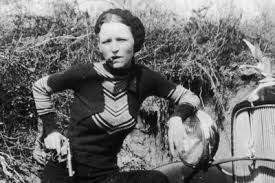
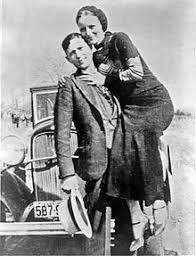
    They are celebrities, in an era of crime celebrity.  Some seize celebrity and some have it thrust upon them, one might say, but in the case of these fairly small-scale Texan robbers it would seem their attainment of the centre follows a stuttering trajectory from aspiration through happenstance to deliberate cultivation.  In flight from one of their several armed confrontations with the law they leave behind some rolls of undeveloped film.  Home photos, gangster poses, are soon spangled across the pages of America’s newspapers.[1]


    Doubtless drawn to their own images in the same mimetic surge, they now actively court attention in various ways, including the submission to those papers of Parker’s doggerel ballads, celebrating their exploits and fatalistically predicting their demise.


    Some day they’ll go down together
    They’ll bury them side by side
    To few it’ll be grief
    To the law a relief
    But it’s death for Bonnie and Clyde[2]

    Then they do die, together, by gunfire on a rural road in Louisiana, May 23, 1934.  Reports and images join the others on the front pages:


    Nothing so becomes the celebrity of their lives like their leaving of them.  The spectacular excess of the violence, the hundreds of bullets and photographs of what those bullets have done are booster rockets, propelling the criminal pair out of the sublunary realm of mere news and notoriety and into the crystal sphere of fame.  The car with their bodies still inside is towed, as if in state, back to town and a frenzied scene of public fascination.
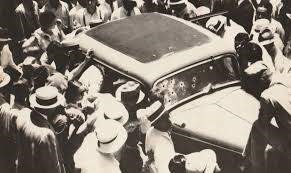
    Thousands attend their funerals.[3]  They are promptly memorialized in various genres, including several Hollywood movies.[4]  Participants, friends and relations all give their accounts in print.  A sign is erected where they died, which is repeatedly pilfered by souvenir-hunters.  The riddled car tours like a carnival attraction.

    Even so, they might have begun to fall back to earth had they not died again in 1967, in slow motion, in a balletic “dance of death” at the end of Arthur Penn’s Bonnie and Clyde.   This most eminent of cinematic deaths propels them on upward into permanent orbit, where they remain.

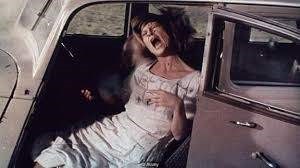
    While the famous film opens with a rapid montage of black and white period photos, some fabricated with the two stars, Warren Beatty and Faye Dunaway, but some apparently authentic and unrelated to Parker and Barrow, when the two bodies finally come to rest at its close there is but one brief, wordless scene. The posse members, hitherto invisible, emerge slowly from hiding places in the greenery and wordlessly surround the now unshown corpses, whose point of view the camera eerily assumes.

    For a few moments, and with an enigmatic range of expressions on their faces, we see them look down at what they have done.  We in turn gaze out at them, out at the periphery of the scene, at those who have forever defined its center with the focus of their violence.  Our position is in that centre, with the famous dead, images of whose final moments of arabesque agony burn still in our memories.  The movie, shockingly, silently, ends.  A sequence of cinematic genius, built on the apparently inexorable geometry of desire and fame, resentment and death.

    But … this is not their true death, some say.  They die again, differently, in 2019, reaching for their guns, in another hail of bullets from a now openly acknowledged source: the lawmen protagonists of The Highwaymen, directed by John Lee Hancock.

    Here, however, after never having been seen close up or in daylight throughout the preceding two hours of the film, death makes Bonnie and Clyde clearly visible.

    And visible they remain, in death, for most of the rest of the film.  In one of many contrasts with Bonnie and Clyde, there is a definite aftermath.  We are shown that towing of the death car into town, mobbed with crazed relic-seekers, who try to cut off locks of their hair, to seize upon anything portable, in an explicit and unseemly frenzy of sacral-celebrity desire.   What was understated to powerfully involving effect in 1967 is made explicit in 2019, and tawdry—something done by others. Something the film does not endorse.

    Now it is the public, the audience, the creators and consumers of celebrity, who emerge and predominate.   Although the dead couple remain on screen, the camera does not pay them much further attention—we get but glimpses now, of a fairly ordinary-looking young man and woman.  Their wounds are visible, but not spectacular, and indeed they make rather decorous corpses, mouths and eyes closed, as if asleep—1934 news photos of them show something quite different, gaping, glazed—The Highwaymen allows nothing so horrifying or pitiable.[5]  But nor is there any slowed time, any aestheticization for them.  No glamourous star power, no Beatty or Dunaway.  However, in another pointed contrast to the 1967 film, their black and white real-life snapshots are the last images to be seen as the credits roll.  They have become their photographs. We know them.

    The lawmen who killed them, though, are forgotten; they watch the spectacle grimly, unnoticed (except by us), from the periphery.

    Indeed, there are two scenes now.  Structurally this might even be said to resemble the “pregnant moment,” as Eric Gans calls it,[6] near the beginning of Hamlet, where a second scene (occupied by the resentful Prince) contests the monopoly of centrality claimed by the erstwhile public scene (occupied by the King and Queen).

    In The Highwaymen it is the public scene of popular celebrity that is resented, and the lawmen are now the marginalized, the victimized even.  They do not quite toss their badges down into the dust, a la High Noon, in eloquent contempt for the unworthy public they have risked their lives to protect …

    … but they are certainly of this lineage.

    The object of scorn is somewhat different, though.  Not the mere cowardice and lack of civic responsibility that Gary Cooper’s gesture rebukes.  But something more, something multi-faceted, and extensive.  Celebrity, yes.  And with it a collapsed moral center, a traditional moral order.  Liberated mimetic desire itself—depicted therefore in its most sheep-like forms. The cheap excitement of violence.  Perhaps indeed the aestheticization of it.  The sentimentality of robin-hood stories, the self-indulgent pleasures of unjustified resentment?  But The Highwaymen is probably not subtle enough a movie to be suggesting all this.  It is hard to miss one clear target, though:  Bonnie and Clyde, directed by Arthur Penn.  1967.  The sixties.

    When will we stop arguing over the sixties?  Perhaps when the last boomer dies.  Or at least then it may become a matter of debate primarily for professional historians.

    At any rate, these three sets of images, these endings, deaths, clearly define and then contest centrality, a specific but apparently still consequential center, even in 2019.  What is at stake?  And what is the special modality of still and then moving images in such cultural operations?

    2. Kiss, Kiss. . .

    There is almost no kissing in The Highwaymen.  A decorous goodbye peck by lawman and wife.  A black and white still of the outlaw couple during the final credits:
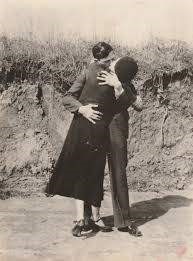
    And there was not really too much in Bonnie and Clyde, either.  Bonnie tries to shower Clyde with kisses as they drive away from their first mutual crime scene, but he rebuffs her.  Later, he turns out to be impotent.  Still later, they apparently do have sex, but no kissing is shown, and Bonnie, who was nude in the opening sequence of the movie, a sequence saturated with sexual longings, is now shown fully dressed, their intimacy  signalled by the mere re-buttoning of Clyde’s only partly-open shirt.

    It takes some imagination, and some bluntly explanatory dialogue, to enable us to see the scene as post-coital at all.  Furthermore, it was widely deplored, including by Pauline Kael,[7] whose otherwise laudatory account of the film helped save it from oblivion and the hostility of its own studio, Warner Brothers.

    This absence of kissing, though, is curious, because free, or if one prefers, illicit love was central to the public legend: young, reasonably good-looking, unmarried (or in Bonnie’s case, to someone else), running free (or wild), and “undoubtedly” (as one historian helpfully notes), “[sleeping] together.”[8]
    Without sex, indeed, they were just small-scale hoodlums, with plenty of competition for the limelight (“Pretty Boy” Floyd, The Dillinger Gang, et al).  Outlaw kissing, indeed, is arguably why there are movies about them at all.

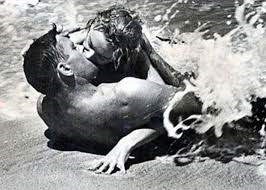
    Besides, as Kael’s title reminds us, kissing is one of the things people do a lot in movies.   What happened to it?

    Eric Gans has recently written on the powers of the cinematic scene and its greater efficiency in turning us from resentment to love.[9] He did not mean, of course, just love in the narrowly sexual or romantic sense.  But surely that is an important aspect of screen power.  We might even wonder whether cinema does love—sex, romance—better than any other art-form.  Lyric poetry might rival it, and doubtless helped produce it.  But only the articulate can love in lyric poetry.  One of the emancipations of cinema, this truly democratizing form, is that it creates a world of great love and great lovers from which the ineloquent are not excluded, can participate, can star.  One need only a body, a face, lips. Really, the less said the better.
    Penn and his screenwriters, however, seem almost hostile to sex, as an ironic, even satirical displacement of sexual desire onto the phallic imagery of guns predominates.

    At least one hopes it is ironic, rather than some sort of earnest demonstration of a psychological truth they thought their audiences needed to have explained.  Either way, sexual love is not here mainly an emotion to be felt, so much as a problem to be deferred.

    Still, their one reluctantly conceded cinematic consummation surely makes possible one of a great film’s greatest and most justly celebrated moments, that masterpiece of editing that gives us Clyde’s and Bonnie’s eyes meeting in recognition and farewell in the instant before the guns begin to fire.

    Perhaps it is a wisdom, even a mercy that The Highwaymen refuses kissing entirely.  That such things, intimacies, kisses, couplings, actually take place amongst the morally vile or their paunchy pursuers is no excuse for showing them on screen!  Perhaps the movie endorses atavistic standards of decency and restraint in this area (as it does in most others) as part of its moral brief.

    But one might suspect there is something else, or more, involved.

    There is a haunting moment in The Highwaymen—and, by comparison with Bonnie and Clyde there are few enough—in which a figure (Clyde Barrow presumably) plays his saxophone at dusk, beside a car parked by the side of a quiet rural road.

    In a seamless transition, next morning, two policemen arrive, offering help to motorists whose car they assume is broken down.  And are summarily murdered. [10]

    The killer is an artistic free spirit.  Or vice-versa. One might call the scene The Highwaymen‘s rebuke of the sentiment the earlier film expressed or inspired, memorably phrased, for example, by film critic Robin Wood, in 1969.  Penn’s Bonnie and Clyde are…

    … representatives of a spontaneous-intuitive aliveness that society even at its best can contain with difficulty or not at all: an aliveness that expresses itself in the overthrowing of restrictions, in asocial, amoral freedom and irresponsibility.  We all respond to it, or if we don’t, we might as well be dead.[11]

    The saxophone is found amongst the arsenal of automatic weapons and ammunition in the back seat of the car in which Parker and Barrow die, one of many details the more recent film insists on, pointing to their absence from the 1967 version.  Penn’s Clyde is no artist—that role is played by the slightly more intelligent and aspiringly poetic Bonnie.  But Bonnie is a terrible poet, touchingly bad.  Part of the appeal of Penn’s protagonists, beyond that spontaneous aliveness, is that they are rubes.  We can see through them, feel superior and thus affectionate to them through our recognition of their naivety, the hopelessness of their project.  Beautiful rubes.  They attract us but are protected by their naivety from our resentment of that attraction.  We pity them.  We love them, and like the generation of any other love, even if we cannot fully endorse Wood’s hyperboles, this is not nothing.  The Highwaymen, however, having none of it, argues fiercely back, insistently contextualizing such aspirations in the mediated world of human desires.  Bonnie and Clyde aren’t about aliveness—they’re about death.  However, if the later film may on the one hand remind us, portentously enough, of the darkness lurking in the selfishness of self-expression, on the other it also points, even if unintentionally but by the same inexorable logic, to its and our own violence, the genuinely tragic twin of that pity, directed towards the centrality that such freedom so provokingly generates around itself.

    3. . . . Bang, Bang

    For generative anthropology, the sign defers violence, and the aesthetic moment in the originary scene defers the literal appropriation that would provoke such violence via an oscillation between the contemplation of that sign and imagined appropriation of its referent.  But this interval of deferral also feeds back into itself, also intensifies the new human experience of desire, proportionate to its length and, presumably, to the plurality and strength of the perceived desires of the others present upon each iteration of the scene.  How else, then, to begin to account for the undeniably potent aesthetics of represented violence, or even the real violence committed with some degree of awareness of its formal character, its species of beauty?

    Each deferral, that is, strengthens the charge of violent desire, sweetens the release when the temporarily proscribed act is imagined, or indeed, performed.  Prohibition rewards transgression, one might say, and one can easily trace the process whereby the ante is steadily upped, barrier after socially sanctified barrier falls, and one of representation’s most striking paradoxes emerges, as the ever more effective deferral of the endemic and individual brings on ever more extreme outbursts of collective, general, and above all represented, indeed, aestheticized violence.[12]

    If cinema, as Gans argues,[13] more efficiently allays resentments, how do we understand the role of one of its most prominent features, the seemingly endless gunfire, the tumbling human bodies, the blood and wounds?

    It’s a large question, beyond the scope of the present article. But the two movies under consideration do at least provide some specifics to ponder.

    Penn’s Bonnie & Clyde is well known to have inaugurated a new era of cinematic violence.  There is a direct line from the slow-motion killing in its final moments to the similarly memorialized but far more extensive bloodshed in Sam Peckinpah’s The Wild Bunch two years later, after which floodgates of gore swing open.

    Penn’s protagonists almost literally stumble into this new territory—the precedent-setting image of the panicked Clyde shooting an unarmed pursuer through the back window of his getaway car—the gun fired and bullet striking to devastating effect in the same frame …

    … occurs at the end of a sequence of comic bumbling—a locus classicus for the trope of the well-meaning criminal protagonist whose  fundamentally innocent plans for wrongdoing collapse into a moral disaster which does punish him, but disproportionately, and which we can never feel is entirely his own fault.  At the same time, it reaches back to a famous image from Sergei Eisenstein’s Battleship Potemkin.

    And Penn, too, is rightly lauded for his capacity to convey pain,[14] at least the pain of the Barrow gang members, and it is with equal fairness noted that there is no cruelty in the violence of this film,[15] no premeditation, with the possible exception of the final ambush.  Violence, very much including violence to others, is something that just happens to the Barrows.

    The combination, of comedy and catastrophe, cinephilic reference, shocking explicitness, a humanized if selective sensitivity to violence, and the absence of intentionality, must of course be understood in its full irony, a crucial element of this subtle as well as potent work of art.  Penn and his writers locate the protagonists’ degradation and destruction in their always already hopeless longings for transcendence.  And irony, as Gans acutely notes, is “always gifted with prestige.”[16]  Still, this is, here at least, what we might designate a high art prestige, the prestige of elegant deferral, of a knowing superiority to common or obviously mediated desire.  Irony of this sort will not, need we say, temper most of the screen violence that comes in the wake of Bonnie and Clyde.  Nor will it placate the hotly ethical resentments of a movie like The Highwaymen, a work as devoid of irony as it is of kissing.

    There is a moment, in the latter film, when the lawman protagonist Frank Hamer has decoded a crime scene in which two motorcycle policemen have died, implausibly establishing from tracks in the dust that Parker must have turned one of the still living victims over so he can see he is about to be shot in the face, by her.  “They aren’t human anymore” is his bitter comment.

    Part, then, of the hard-to-deny satisfactions of the final violence in the more recent movie is a carefully prepared feeling of justified resentment, indeed, that which popular parlance more simply calls “justice.” The Highwaymen locates the criminals’ destruction in their own efficient, intentional, and wanton cruelty, especially that of Bonnie Parker.

    And, of course, in the moral uprightness and indeed courage of their destroyers.  In this final scene it is, again in pointed contrast to 1967, the eyes of the two criminals and those of Hamer that meet, after he has offered them the chance to surrender and in the instant before they themselves precipitate the gunfire that kills them.

    But there are other factors in the generation of this pleasure.

    Among these, I think, are what could perhaps be called its “realism,” but might more accurately be described as the impression of force, the terrific energies that modern cinematic techniques make available: kinetic, vivid, impossibly but only too probably enhanced.  If the screen offers up what Gans calls a “full-fledged duplication of the ontological otherness of the scene of representation,”[17] the cinematic scene of violence allows us to imagine a similarly plausible intensity at the moment of origin, recreating the scale of the stakes of human survival.  It returns us ever and again to the ferocity of originary resentment and the threat hovering over all desire.  Full-fledged indeed.  If anything makes us sit still in movie houses, this does.

    Even so, the violent conclusion of The Highwaymen is a spectacle curiously distanced from immediate or what we might call thematized resentment.  It’s a non-human ballet this time, an almost impersonal experience of shattering glass, jerking not dancing bodies, punctured steel, noise.  Its clarity is the clarity of a powerful moment of memory, of impossibly exact recall.  And yet the shooting, like that in the earlier film, which Kael described as both endless and not a moment too long,[18] is plausibly brief, unextended through the manipulations of cinematic time.  By the post-1967 standards of screen violence, it is remarkably restrained.

    And when the gunfire is over, the restraint continues.  In another matching shot, again from the perspective of the dead, from within the car, we see Hamer’s hand rest briefly on the shoulder of the youngest member of his posse, a former acquaintance of the couple, visibly shocked at what he has done and seen.  But Hamer is not looking at what has been done.  We too experience a turning away rather than a rapt gaze—the center is empty again.  We are offered human feeling, and an understated professionalism—in sharp contrast, of course, to the self-aggrandizing lawmen who make shameless appearances in the earlier film.  Hamer and his men refuse to take money from the breathless reporters who are willing to pay high for an interview, and this, and the admiration we may feel for them, is not nothing.  Overall, there is an absence of triumph, and indeed a quiet melancholy pervades much of the rest of the picture.

    By comparison with the final feeling of Bonnie and Clyde, it is as if nothing particularly significant has happened.  A small, regrettably necessary correction of a civil problem, in the context of broad economic depression, debased popular amusements and a general failure of human flourishing, all of which can surely be expected to continue.

    4. Cinema & The Pop to High Continuum

    High art, Gans argues, “looks back to the renunciation of appetite implicit in the sign” while popular art “looks forward to the appetitive satisfaction in the communal feast.”[19]  In an art of violence the latter, we might add, looks ahead to the pleasurable discharge of resentment in the imagined destruction or defeat of the human obstacles to possession of the center or, to put the same idea slightly differently, to the forcible eviction of those who have usurped that center.

    Aesthetic distinctions of any kind, I have elsewhere argued,[20] are to be located in the experience of those who consume art,[21] and generic identifications should be thought of as forming a kind of continuum.  Aesthetic experiences of any artwork also vary from individual to individual and from time to time, so it is only imprecisely useful to identify an artwork by genre, as almost by statistical likelihood of it being experienced in a given way.

    That said, cinema, as Gans’s recent writings point out, needs to appeal broadly and has often succeeded in doing so—there is very little purely high-art film, no “avant garde.”[22]  And yet the high art experience, I believe, has not disappeared, and not disappeared even from mainstream cinema.  Part of understanding how an aesthetics of violence works in cinema is to recognise the appeal to a range of different experiences in a given movie, although doubtless this range is wider in some than in others.

    There are implications, Gans has persuasively suggested, in the ethical relationship towards human community implicit in the high art and popular art responses—the high art deferral implicitly values the safety of the community, while the gratifications of imagined appropriation enjoy that safety by ignoring it—a point that seems to me particularly salient when represented violence and the gratification of resentment are considered.  The tendency and capacity of high and pop experiences to shift, even in the experience of an individual consumer, let alone in larger groups, led me to formulate the concept of “ethical moods.”  Like the more sharply focussed experiences of sign and object, broader impulses towards appropriation, desire and resentment on the one hand, and deferral and contemplation on the other, can be understood to oscillate.  Ethical moods are such broader oscillations.

    Some works of art undoubtedly facilitate or encourage a narrower range of such moods than others.  But a focus on the genre of artworks has often led us to assess them for their consistency, the coherence of their appeal, even as we gladly welcome what we identify as new or “hybrid” forms.  But this may still be quite an artificial way of judging the effect of such works, which are experienced so multifariously.  Or at least, it might seem so to an anthropologically inflected criticism like that fostered by GA.  A successful film—not to mention a masterpiece like Bonnie and Clyde—is successful to the extent that it hosts or provokes or makes possible a richer range of experiences, experiences which balance themselves not only in a given individual viewer, but in many, over time and across space.  Indeed, it is arguably in their anticipation of the variability of such human experiences that great artworks and great movies achieve their higher successes.  Bonnie and Clyde is masterful in such anticipations, in so frequently being just far enough ahead of expectations as to create a rhythm of unfolding scenes that seem somehow to become inevitable revelations, not for one ideal viewer, but for a very broad range of viewers of different sophistications, different experiences of desire, and in different ethical moods.

    These same qualities, though, in a different form of paradox, also make Bonnie and Clyde a very inconsistent film, formally, aesthetically, and ethically.  Indeed, it has moments weaker on most counts than any in the workmanlike “B” movie that rivals it in 2019.  One such is the sequence beginning with the capture of Frank Hamer, when Clyde shoots the gun from his hand as in a child’s cowboy cartoon book.  Hamer’s subsequent humiliation by Bonnie and Clyde is not only egregiously unhistorical—the filmmakers were successfully sued by the formidable Ranger’s descendants[23]—but the crudest sort of flattery of resentment, unworthy of so much of the rest of the film.

    Tellingly, the scene ends in a flaccid sequence in which Clyde throws Hamer into a river, flails about there with him, then sets him afloat in a skiff to drift away. This offers those open to it one sort of ethical mood, shall we say.  Of a different nature but ultimately appealing to similar passions is the spectacularly chic, sixties’ wardrobe worn by the stars, which provoked a fashion fad but were rightly enough deplored by critics with an allegiance to plausibility.[24]

    Contrast these flaws to the deeply and subtly realized early sequence set at a deserted farm where Bonnie and Clyde have taken refuge.  They are interrupted in their target practice by the expropriated former owner and his black field hand, who watch and then, with an understated mix of uneasiness and eagerness, participate at Clyde’s invitation in shooting out the windows of their own house.

    Here viewers are given an opening into an ethical mood of much greater subtlety, awakened to an ache of deep resentment, but without an obvious scapegoat figure to pummel, only the distant sense, well beyond the bankers whose notices are posted on the deserted buildings, of inexorable but ultimately impersonal forces:  a glimpse into the abyss, an intimation of the inadequacy of human motivations and interventions, an abyss whose most potent affective correlative is, indeed, irony.

    Such scenes, for better and worse, are as we say not much to be found in The Highwaymen, and its achievement is undoubtedly smaller.  Still, in a kind of unacknowledged partnership-cum-rivalry with its predecessor, it too is able to generate both high and popular experiences, deferrals and imagined gratifications, moods of ethical self-congratulation and of more sober reflection on the central problem, and terror, of human desire, resentment and violence.

    5. Cinema and History

    The relationship of various kinds of text to history has not yet been a topic scholars using GA have discussed very extensively, despite the rich historical account that GA itself has offered us.  How does our new way of thinking help us parse the action of love and resentment upon the project of representing not merely the fictional and imaginative, those direct heirs to the virtual creations of the ostensive in the communal present, but the necessarily imperfect but not wholly unsubstantiated or unverifiable record of fact and event in the past?  To what extent is history writing a re-envisioning of the originary scene?

    This seems a particularly interesting issue in the case of cinema, for reasons perhaps related to the special power or, we might say, the special persuasiveness of the form to which Gans testifies.  If “in the cinema there is no imaginary reality that cannot be realized,”[25] in such a medium there is perhaps also nothing desirable—or resented, or feared—that cannot be made realistic, or real.   We might conclude here by sketching a few preliminary lines of inquiry.  Around the lives and deaths of Bonnie Parker and Clyde Barrow there can certainly be an ethical debate—about how to judge what happened, how to frame it, what larger narrative it belongs to—but there is also still and always a more narrowly historical one, about what exactly or indeed did happen.  Facts are selected, of course, in the construction of any narrative.  But as the newspapers and movies aver, and everyone else must agree, something did happen in Bienville Parish, Louisiana in May 1934, and the two people in question did end up dead.  But did Frank Hamer, as he later claimed, step from the bushes and say, “stick em up”?[26]  Or not.[27]  It cannot have been both.  The Highwaymen gives us the former, Bonnie and Clyde, of course, the latter.  Both accounts, as realized on screen, feed resentments, albeit of different kinds.  But the various written sources—testimonies of participants, observers, confidantes of participants and observers, after-the-fact analysts—are not in agreement.

    “Historical accuracy hardly matters anyway,” Kael airily remarks in her influential defence, and speaks of “a new version of a legend.”[28]  But this is surely inadequate, even if it worked well enough at the time.  Witness, these many years later, The Highwaymen, still making the objections that the more famous film left itself open to.  Factual accuracy does clearly matter, at least now, to some, and in certain contexts, and that which can be understood as fact does retain a particular persuasiveness—many movie-goers seem to crave it, even if the fare they mainly consume constantly and demonstrably warps the available record to conform to the shape of their own anticipated resentments and desires, or those the filmmakers aspire to have them feel.  A small but steady trickle of critique can be heard, though, plaintive but persistent, a resistance to being thus accommodated or placated.  And of course, the production of counter-narratives, correctives, revisions, also acknowledges what we might call this meta-desire for the truth, this resistance to legend.  Perhaps only for a fraction of the audience, in a fraction of their ethical moods or viewing hours, but it is discernable all the same.

    Bonnie and Clyde is “a vision of the past, rather than an actual past,” claims another fairly typical defender, and with representations of “an archetypal rather than a documentary past . . . because they are mythically distant from us, we are partially released from the need to make moral judgments on their actions.”[29] “We”?  “Partially”?  Better perhaps to say some are released, or release themselves, at some times.  But clearly for other viewers, and/or at other times, to accept legends which are consciously understood as such and yet which generate at least some of their power from the authenticity of supposed but actually manipulated historical fact, is a species of bad faith.  The authentic is that which is not subject to the gravitational pull of our desires and resentments, or at least that does not detectably seem to be trying to affect them.  Its authenticity is precisely why “we” are interested in history at all.  Where there is no appeal to the authenticity of history—for example, in openly synthetic legends such as those offered by the stream of superhero movies currently flowing from Hollywood—the problem and the resistance do not arise.  Perhaps, though, the power of the legend as revised by Bonnie and Clyde is evidenced not just in the desires it mobilizes but in the uneasiness and even resistance it awakens.[30] A thousand other cinematic adjustments, adaptations, distortions of history raise less than a murmur.  We face here, it seems, a quite complicated question of reception, of aesthetic experience.

    We might note the way both films, and many others, make use of actual historical detail that they could easily, or to better effect, have left out or otherwise fabricated.  The Highwaymen, for all that we might doubt its version of Parker, makes almost a fetish out of its historicity in many other respects, down to filming the ambush at the actual location it occurred, a detail that required pouring tons of earth onto a stretch of road that had been paved over since 1934.[31]  Needless to say such details as the make and colour of the car, the weapons in the posse’s hands (the tommy guns of Bonnie and Clyde are judged inadmissible), and the clothes worn by all concerned are attended to with fierce scrupulosity.  But so also are attempts to provide period psychological and linguistic authenticity: the comment about the outlaws no longer being human, from which sensibilities now rightly enough recoil, is also drawn from the record, although it was not Hamer who made the remark.[32]

    Penn and his screenwriters, however, also cleave quite closely to historical fact in a number of ways, many or even most of them likely undetectable by most of their audience—at least until otherwise tutored.  Why did they bother?   The invented treatment of Hamer was indeed infamous, but Barrow and his gang did actually kidnap several lawmen and humiliate them.  Very little in the film is entirely without some historical analogue or similarity, and this procedure helps create some of that unevenness, even eccentricity, we noted above.  Legends can surely be constructed more easily and more satisfactorily with the more ductile stuff of mere invention—the producers of the superheroes could readily demonstrate how.  But then odd truths, that could not (could they?) be invented, do add a certain texture.

    And then the existence of an ever better-informed viewership might also be proposed as a factor here.  A viewership more educated, more inculcated, for all the doubts and revisions, in the principles of factuality established by the Enlightenment; viewers equipped, one might even point out, with Wikipedia and other engines of verification, however imperfect.  Such an audience might need more than a patina of factuality to be retained, and parts of it, at times, when it mattered, might need considerably more.  And such a viewership might not finally be swayed by the familiar defence that what is in principle true can in fact be false, that the plausible impossibility, even, is superior to the implausible actuality.  It may not always have been thus, but perhaps now it is.  The makers of The Highwaymen certainly seem to have believed so.

    Or might we go further and suggest that there is now a viewership that, being the product of a market culture of some duration at least in parts of the world, is more hip to the tricks of manipulated desire and resentment, more wary of the techniques of seduction, more self-aware as to its own responses?  At least, somewhat more, in each category?  Such a notion runs counter to many a bleak assessment of a general dumbing-down, of blind consumerist gullibility and lust, of irresistibly artful hucksters and vast machines of coercion leading us into a post-truth and fake-news future.  Still, perhaps the possibility that we, some of us, some of the time, have learned something from a couple of centuries’ experience of such appeals to our passions, should not be flatly rejected, and a counterargument might begin with a careful look at the things past ages had been willing to believe, the narratives and legends they bought into.  One thing is quite sure: there was at least some resistance to the legend-facts of 1967 even in that year,[33] it has continued, and fills the 2019 film, even providing it with much of its raison d’être (or the market appeal that would provide the same).  The emergence of mimetic theory and GA, one might add, are perhaps not the only signs of human history arriving at a certain threshold of demystification.

    But let us acknowledge the devil in details and finish by glancing at a couple of the key bones of contention, trying to see where our GA-inflected mode of reading such issues might begin to assist us.

    How many people did Barrow and Parker actually kill, and were all these killings forced upon them by their imperative to escape, to remain free?  The number of dead is reasonably well established,[34] but the motivations and exigencies are still very much matters for debate.  The 1967 film gives us one answer, that of 2019, again and emphatically, another.   But there is no historical consensus, and the killing of the motorcycle patrolmen referred to above appears to be clouded in a particularly classic haze of contradictory evidence.  Bonnie and Clyde avoids the incident entirely, clearly preferring to have its protagonists battle great numbers of attacking police, outnumbered, miraculously escaping—a narrative for which there is in fact some support in other recorded incidents, but which also of course moves desire in a specific and clearly discernible way.  How can the few ambushed by the many not be in the right, not be the heroes?  But The Highwaymen’s staging of the killing of these policemen, the deaths at least which verifiably occurred near Grapevine, Texas, on April 1, 1934, adopts the version provided by a widely discredited eyewitness account,[35] and then struggles implausibly, as we noted, to reconstruct it without explicit recourse to that tainted source—Hamer as a Texan Sherlock Holmes.  Clearly, it was too good not to use, and an attentive viewer will surely at this point begin to lose some faith in the veracity of the whole operation, for all its re-surfaced roads and period fedoras.  If the final ambush, in its extremity, its veritable overkill, must be justified or even made heroic, then Parker and Barrow, and especially the otherwise perhaps pitiable Parker, must indeed be made less than human, or close to it.  The truth …?  … might be that Hamer himself did believe in the story of her merciless killing of one of the policemen—he refers to it in his account[36]—even if the event, at least as such, never occurred.  But neither film seems able to work up this sort of truth to a sufficiently desirable effect, although the later film might have been the better for trying.

    And what, indeed, about Bonnie Parker?  Here the debate is especially sharp, and maybe consequential.  The 2019 film, as noted, features a particularly ferocious, indeed sadistic moll, her inhumanity not only verbally asserted but, as reviewers have been quick to note in an age much less tolerant of such rhetoric, reinforced by an almost complete absence of screen time: she is glimpsed only in shadowy or blurred images, or at the moment of her death, defiantly trying to kill again.[37] The 1967 Bonnie is taught to shoot—it’s part of her release from the stultification of her life, a release for which the film for a time suggests almost any price is worth paying—and she demonstrates an immediate knack for it.  Over the rest of the film she blasts away with the others, although she is never shown, as Clyde, his brother Buck and sidekick C.W. are, actually killing specific persons.  Bonnie and Clyde of course references the famous home photos, the brandished weaponry, cigar between the teeth.

    But these photos were arguably jokes,[38] role-playing, as we note above, self-dramatization, like Bonnie’s poetry.  The written accounts of the time do not provide much support for the image they playfully project.  It is fairly certain that she did not smoke cigars—very unladylike—and pointedly wanted it known, after the pictures were published, that she didn’t.  She might have been lying, but it seems unlikely.  The most detailed biographies suggest otherwise, and furthermore make it more than possible that the actual historical woman never deliberately shot a gun at another human being.[39] Faye Dunaway opened fire in 1967 for female and sexual emancipation (albeit one cannily tinged in irony, doomed by the forces of repression).  The Bonnie of The Highwaymen seems a reflection of—probably not a retort to—the resultant era of Warrior Princesses, the Amazons and female assassins and avengers of the screen, righteously proclaiming at every turn woman’s equal capacity for violence and scorning or destroying any doubters.  But in 1934, many had qualms about her death—Hamer expresses them himself[40]—and the dominant narrative, beyond the lurid tales of the popular press, was of a lovesick woman helplessly pulled into the dark circle of her male partner’s life of crime, but who was not really of his ilk—ultimately a victim.  This view of her actually got her out of jail once, in 1932,[41]and is common in family and other accounts.[42]  What if, every cultural bias acknowledged and duly deplored, this old-fashioned version is still more accurate than the gunslinging proto-feminist heroine we want now?  She was, after all, like those biases, a creation of her own time.  The drive to plough under all such women, such behaviour, such archetypes, to laugh or sneer them first out of existence and then out of the record, for all its successes, still does encounter some friction, it seems, even if in their various ways both films under discussion do their bit to advance the cause.  Will a third, with another version of Parker, yet come?[43]  Might the filmmakers of the future even work under some obligation to try to produce such a one?  Might a history freed as completely as possible from legend be a public good, even in the realm of “fictional recreations” or films “based upon actual events”?

    Because GA focuses on desires and resentments and the finally mediated nature of all culture, it may find itself tempted to ignore the issue of accuracy of representation, to sweep away the kinds of questions we have been raising in this final section.  But looking at this instance perhaps reminds us that we need a way to integrate the mediated character of desire and human culture with the undeniable and perhaps still-growing power of empiricism since the Enlightenment. “The formal quality or coherence of the image is precisely what demonstrates its unpossessability by the spectator,” notes Gans, “its formal otherness.” But he also speaks in this context of “likeness”[44] and perhaps we may add this quality to those which, finally, resist desire and create deferral.  The shapings of desire make the image consumable, and a longing for factual realism is, in resistance, a longing for that formal otherness, even for the autonomy of the other tout court.  Such an impulse is surely a feature of that “critique of desire” Gans notes is central to the realist project.[45]  Is the authenticity of historical fact the needed guarantee of inviolability and thus ultimately of “communal solidarity”?[46]  The emergence of this particular critique, like the emergence of the distinction between high and popular art itself, must of course be historically situated and is a matter of shifting proportions and emphases.  “The passage from myth to fiction of any type is already a decisive victory for resentment,” Gans notes as part of his history of the development of earlier cultural forms.[47]  But so then, too, may be the further passage from fiction to documentary, a resentment of the manipulation of desire practised by a regime of art that has begun to seem outmoded and oppressive.

    There is, of course, elite resentment as well as the broader more popular kind, the resentment of the tyranny of the popular that drives the project of the high artist.  “High art . . . attempt[s] to sever all links between esthetic experience and consumption,” notes Gans in his discussion of the post-romantic period and nineteenth-century realism, “to expel entertainment from art.” [48] No doubt this line of thought might bring us to some rather surprising places if applied to our own context.  It is surely counterintuitive, even paradoxical, to align a modestly popular “B” movie with high art and the banishment of entertainment—the producers at Netflix would certainly recoil with horror at the idea.  Still, the notion that some aspects of such movies, for some viewers in some moods, constitute a principled attempt at deferring the putatively (or perhaps it is merely formerly) “transgressive” desires of popular art perhaps deserves further consideration.  If such an attempt is “reactionary,” as liberal reviewers are quick to claim,[49] must this in the end be accepted as one of the characteristics of high art?  As it must indeed be for any attempt to brake desire or disarm resentment, to resist, among other things, the melodrama of transformative political action.[50] Saying this by no means negates the value of such melodrama, its contribution to social progress and the ongoing task of accommodating the new desires and resentments generated by the previous or latest round of such accommodations.  But high art perennially does put the project into a particular perspective.

    We may have come, then, to a tentative location for the questions raised by these films, along the virtual space of the High to Pop continuum GA has helped us define.  Which is where, for the moment, we must leave them. Does the hunger for verification drive a kind of deferral?  Does it foster, or is it in itself an impulse to delay or even refuse the more immediate gratifications of desire and resentment?  And thus what we might call a kind of high art phase of the aesthetic experience?  One might indeed resist the conclusion on a number of grounds—a kind of dumb literalism seems a low impulse, mindlessly obstructing the grand projects of legend or, in the case of Bonnie and Clyde, a lofty liberal critique of “the system” and the promotion of a (fundamentally elitist) “counterculture” of the Western  middle-class young, that most recent of the many instantiations of the high-minded Romantic rejection of the public center.  Indeed the 1967 film seems almost prophylactically to be insulating itself from such an obtuse assault with the prestigiously ironic manner through which it delivers its own brutally explicit but hazy version of history.  Still, the requirement for factual veracity almost inevitably does place obstacles in the path of desire, these or most other desires.  Dare we suggest this is because historical reality is too complicated, too complex in its causalities and outcomes to conform to the geometries of center and periphery through which human beings understand themselves?  The originary scene is, among its other features, a radical simplification, a reduction, under the imperative pressures of desire and fear, of an immense blur of phenomena into a single meaningful relation.[51]  Culture—making sense of the human—ever after works to such ends.  One way to speak of paradox is as a complication of what desire wants to be simple, and high art embraces paradox more openly than does popular art.  Perhaps the melancholy we observed at the end of The Highwaymen, for all that movie’s crudities and limitations, and its own resentful cooking of the case against Bonnie Parker, pays some tribute to paradox.  The film labours mightily to recreate specifics of place and time, costume and behaviour, and as a result provides a notably diverse look and feeling for the Depression era, bleak certainly, but that seem less calculated than those of Bonnie and Clyde, which tended to produce the picturesque in the service of its more broadly, or shall we say more socio-economically, resentful agenda.[52] One result of the 2019 film’s technique is thus indeed to allow its viewers to see the two criminals and their career more as a symptom of the pathologies of the world they lived in than as a potential or even failed attempt at transcendence thereof.  As we also noted above, the conclusion of The Highwaymen has none of the moral shock in which Bonnie and Clyde left so much of its audience, because nothing about the outcome is really all that shocking. That’s what’s melancholy.

    At any rate, it seems that a desire for the otherness of history is not going away, any more than the high art experience is.  The terms of the struggle to be new, to flee, that is, the contamination of others’ desires—so central an ambition of market life—are continually being reformulated.  One cannot help but suspect, though, that recourse to the domain of factuality will remain “a critique of desire,” a source of high art austerity, and a crucial form of cultural self-discipline deep into the future.

    Notes

    [1] The images reproduced in this essay are from several sources.  Many, such as these black and white snapshots of the two criminal protagonists are widely available in the public domain and were obtained from such sites as Wikipedia.  The colour images from Bonnie and Clyde (Warner Brothers – Seven Arts, 1967) and The Highwaymen (Netflix 2019) are screenshot stills from these two films.

    [2] https://allpoetry.com/The-Trail’s-End

    [3] These details are illustrated with period photography in a documentary aired on PBS in 2016: Bonnie and Clyde, dir. John Maggio, American Experience Films.

    [4] The best of these is probably You Only Live Once (1937), directed by Fritz Lang.  For an appreciative description, see Pauline Kael, Kiss Kiss, Bang, Bang (Little, Brown 1968): 49-51.  Others followed after 1967, including the documentary referred to in the previous note.

    [5] I spare the reader these; they can be found in the illustrations of  Jeff Guinn’s Go Down Together: The True, Untold Story of Bonnie and Clyde (Simon and Schuster, 2009), or I’m Frank Hamer: The Life of a Texas Peace Officer, by H. Gordon Frost and John H. Jenkins (The Pemberton Press, 1968).

    [6] Originary Thinking: Elements of Generative Anthropology (Stanford 1993): 156.

    [7] “Bonnie and Clyde” in Kiss Kiss, Bang, Bang: 54.

    [8] Guinn, 174.

    [9] “GA and Cinema,” https://anthropoetics.org/chronicles/chronicle615/

    [10] The event upon which this scene is based is described in Guinn, 291-94.  One policeman was killed.  The other wounded and taken hostage.

    [11] Arthur Penn: New Edition, with Richard Lippe (Wayne State University Press 1969, 2014): 57.

    [12] I hope not to tire the patience of readers kind enough to have noted before, if they have not always embraced it, my reference to Steven Pinker’s The Better Angels of our Nature: Why Violence has Declined (Viking 2011) for sources of the research demonstrating the decline of endemic violence.  Local and temporal variations conceded, the lowered rate of violence remains, to me at least, a crucial and perhaps crucially underappreciated factor for any broad assessment of human history, and especially recent human history.

    [13] “GA and Cinema,” https://anthropoetics.org/chronicles/chronicle615/

    [14] Robin Wood, Arthur Penn: New Edition: 64.

    [15] Kael puts it, “no sadism,” 52.

    [16] Signs of Paradox: Irony, Resentment and other Mimetic Structures (Stanford 1997):  64.

    [17] “GA and Cinema”  https://anthropoetics.org/chronicles/chronicle615/

    [18] 62.

    [19] Originary Thinking, 171.

    [20]“Reflections on the Popular/High Art Continuum”, Anthropoetics  20.1 (Fall 2014) https://anthropoetics.org/journal/ap-vol-20/ap2001/2001dennis/

    [21] As has frequently been noted, there really is no agreed upon verb—here we uneasily combine experience and consumption, the latter a kind of experience, no doubt.  But consume at least has the virtue of reminding us of the alimentary roots of the originary scene.  We at least “imaginatively” or “virtually consume” ever after.

    [22] “The Screenic Age” in Mimetic Theory and Film, ed. Bubbio and Fleming (Bloomsbury Academic 2019): 111.

    [23] Various critics objected to the conversion of the smooth-shaven Hamer, perhaps the most celebrated of Texas Rangers or even of American lawmen, into a mustachioed stereotypical villain.

    [24] Albert Johnson: “Bonnie’s persistent 1967 look is disturbing and it is a flaw that Penn should not have allowed,” 33.   And even more caustically, Peter Collier, writing in 1968: “Bonnie and Clyde were an advertiser’s dream the minute they were reborn,” 31.  Both are to be found in Focus on Bonnie and Clyde , ed. John G. Cawelti (Prentice-Hall, 1973).

    [25] “The Screenic Age,” 110.

    [26] Hamer’s own account is quoted at length in I’m Frank Hamer, the crucial claim appearing on page 232.  Here, too, it is asserted that the outlaws were reaching for their guns.  One may note the 1968 publication date—the book is an early salvo in the battle the 1967 film provoked.

    [27] Guinn, 338-341. Guinn’s reliance on an amateur re-enactment (424-425) does not inspire complete confidence.

    [28] Her argument extends to noting how many other films are blatantly inaccurate, without facing the criticism levelled at Bonnie and Clyde, 50.  Johnson also claims the film is “about the legend” or about legend-making, 34.

    [29] John G. Cawelti in Focus on Bonnie and Clyde, 55, 58.

    [30] “How do you make a good movie in this country without being jumped on?” asks Kael at the start of her review, 47.

    [31] https://en.wikipedia.org/wiki/The_Highwaymen_(film)

    [32] “County sheriff Smoot Schmid . . . declared that Clyde was no longer a man but an animal.”  Guinn, 287.

    [33] Even or especially in 1967 the film’s “foes found it both immoral in its romanticism of violence and inaccurate in its depiction of history.”  Lester D. Friedman, Bonnie and Clyde (BFI Publishing, 2000): 22.

    [34] Various sources provide a plausible body count, including Guinn.

    [35] See Guinn, 284. The man who seems to have actually done the killing in the manner described, Henry Methvin, later acknowledged that Parker had no part in it.  Among various sources reporting this, see Brian Anderson, “Reality less romantic than outlaw legend,” The Dallas Morning News, April 19, 2003 (Wayback Machine, February 25, 2008).

    [36] “I hated to shoot a woman . . . but I remembered how she kicked the body of the highway patrolman at Grapevine, and fired a bullet into his body as he lay on the ground.”  I’m Frank Hamer, 233.

    [37] See for example the New York Times review by A. O. Scott, https://www.nytimes.com/2019/03/14/movies/the-highwaymen-review.html

    [38] Kael, among others, makes the point, 52.

    [39] Guinn meticulously details each encounter in which weapons are fired, and the closest we come is that Parker may once have let off “a few wild shots” at a moment of confusion, at Barrow’s command, hit no one, and later claimed to have been trying to miss, 184.

    [40] I’m Frank Hamer, 233.

    [41] Guinn, 115.

    [42] See Guinn, 110.  Guinn also plausibly suggests that it may have been Parker’s own view of her situation, or one she at any rate entertained.  In what seems an autobiographically infused poem, “The Story of Suicide Sal,” her innocent heroine is “lured” into a life of crime by her lover, where she languishes until her violent death.  109-110.

    [43] Or perhaps, more likely, we will have a different version and understanding of Clyde Barrow, who was reputedly raped and tortured in prison, a sustained brutalization that led him to ambush and kill his tormentor, his first and life-altering murder.  Neither film comes close to dealing with this event or its effect on his character, despite the significance most biographical accounts give it.  See Guinn, 75-77.  But the incident, like so much else, is of course “disputed.”  David E. Ruth, Review of “Bonnie and Clyde” American Experience Films 2016 (The Journal of American History June 2017): 288.

    [44] The End of Culture: Toward a Generative Anthropology (University of California Press, 1985): 169, 168.

    [45] Originary Thinking, 179.

    [46] The End of Culture, 169.

    [47] The End of Culture, 230.

    [48] Originary Thinking, 182.

    [49] A. O. Scott: “To call The Highwaymen revisionist—or even reactionary—would be an understatement. This retelling of the Bonnie and Clyde story is not content to posit that those two Depression-era outlaws got what they deserved when they died in a hail of bullets on a Louisiana back road.  It has a sackful of bones to pick with the modern world as a whole.”  https://www.nytimes.com/2019/03/14/movies/the-highwaymen-review.html.

    [50] I discuss generic issues of melodrama and tragedy in “Contemporary Tragic Representation and Response: An Originary Exploration” (Anthropoetics 18.1 Fall 2012)  #b17).

    [51] Gans frequently illustrates this point by using the distinction formulated by Jean-Paul Sartre, between the en-soi and the human pour-soi.  See https://anthropoetics.org/chronicles/chronicle615/, for example.

    [52] The indispensable Kael again: “His squatters-jungle scene is too ‘eloquent,’ like a poster making an appeal,” 53.  Others make the point as well.
  • Hierarchical Thinking, Grammatical Structures, and the Originary Scene

    The importance and universality of hierarchical thinking to human cognition cannot be overstated. Hierarchical reasoning is mobilized whenever we approach complex cultural constructs, such as language, music, literature, art, and science. But we make use of it even for the most trivial everyday tasks, such as preparing breakfast, which we automatically understand as a sequence of smaller subtasks on a lower level: as brewing a cup of coffee followed by preparing a toast, for example. We use it both actively and passively, applying hierarchical thinking, for example, to purposive behavior, such as problem-solving, planned action, skill acquisition, and memorization, but also in being aware of hierarchies in surrounding phenomena, such as music or language. In this paper, I will make an argument for the anthropological origin of hierarchical structures. The first, longer, part of my paper will be dedicated to clarifying the relevant characteristics of hierarchical thinking and related concepts. In the second part, I will show how these key features naturally follow from an anthropological understanding of deferral, as it emerges on the scene of representation.

    The strongest evidence in support of the fundamentally hierarchical nature of thinking is our quest for the unification of knowledge, reflected in the unexamined compulsion to discover a unified theory of basic forces in physics or a unified explanatory model, which amount to the same thing. According to the classical model of explanation in the philosophy of science called the covering law model, scientific laws are sets of generalizations that form deductive systems, which in turn consist of propositions arranged on various levels in such a way that lower-level hypotheses are derived from higher-level hypotheses; moreover, “the logical strength of the hypotheses increases the higher their level” (Braithwaite, “Scientific Explanation” 17). Thus “to explain a law . . . is to incorporate it in an established deductive system in which it is deducible from higher-level laws” (347). Searching for a more powerful explanation is climbing higher and higher on the deductive ladder. Some philosophers of explanation do not question this mental habit while others register it but do not take it further than noting that it brings “intellectual satisfaction” (340): “the subsumption of [a] higher-level law under a still-higher-level law raises the intellectual level of . . . generalization” (346).

    The fact that we have an unquestioning expectation of hierarchical structures governing the laws of science and reflected in our intuition of explanatoriness, which grows with the depth of the explanatory tree, is a testament to the fundamental role of hierarchies in human reasoning. But where does the assumption of the hierarchical nature of reality come from? Neuroscientists speculate that it is hardwired in our brains and is located somewhere in the prefrontal cortex, because magnetic resonance imaging shows this to be the area that becomes activated when people are engaged in hierarchical activities. But to view it as merely biological “hardware” or computational “firmware” would be to overlook its relevance to representation and symbolic thinking, if only because the use of language at its most basic functionality of linguistic parsing is explicitly and self-consciously hierarchical. We would be missing an important piece in the larger picture of what it means to be a symbolic thinker on the scene of representation if we did not look at the anthropology of hierarchical structures and, consequently, subject it to originary analysis.

    Since in the rest of my paper I will be discussing hierarchies using the example of language, I will narrow my focus and restrict my discussion to self-similar hierarchical structures, of which language is one. Hierarchical self-similarity simply means that the same structure we find on a lower level is repeated on a higher level, such as a clause within a clause, a phrase within a phrase, or a compound noun within a compound noun. Representing a whole structure with one simple rule is an especially powerful and economical method of encoding and retrieving information, since it sharply reduces memory requirements while at the same time, allowing for infinite generative possibilities and flexibility in manipulating symbols.

    In order to speculate how the ability to think in hierarchies arose on the originary scene, we need to define what a hierarchical relationship entails with greater specificity. What does it mean for a level of conceptualization to be above another level? This is a complex concept that involves two operations: disjunction and ordering. How do these mutually interconnected characteristics arise on the scene of representation? I believe that the term “subsume” as used in the covering-law theory statement that a “generalization is subsumed under a higher-level law” can give us a clue. Subsume is a word that connotes expansion and generativity, present in its meaning of “incorporation as part of a more comprehensive order.” It goes hand-in-hand with the term “covering” from the “covering law theory,” with both evoking an image of an overturned bowl, a lampshade, or overhanging tree branches, which suggest inclusion and sheltering. But in subsuming there is an additional connotation of nesting, stacking, or building up, such as in a stack of bowls or a collection of Russian dolls, which suggests height or extension along a spatial dimension. Objects connected through the structure of subsumption both envelop and rise, contain and stretch.

    In this dual imagery, I detect an echo of what Martin Heidegger stipulates as two types of transcendence that define the human condition, and further down the line, the scenic configuration of Generative Anthropology, as I will show shortly. But first, I will show why these two logically incompatible and heterogeneous types of transcendence both motivate and stymie our impulse to explain and reconcile new information.

    In his Metaphysical Foundations of Logic, Heidegger calls the first type of transcendence the epistemological transcendence and relates it to our desire to know the other person’s mind, to bridge the gap between two monadic consciousnesses. He specifies that this meaning of transcendence is opposed to immanence, with immanence referring to what is present to a consciousness, and transcendence, correspondingly, to what is outside it.  Metaphorically, it is connected to the ideas of inside vs. outside, to crossing a barrier or leaping over a wall. The main image that captures it is that of a consciousness being locked inside its own box of interiority and imagining a passage that would lead it toward the exterior. This concept of transcendence is the foundation of a theory of knowledge; hence the name, given that the epistemological project sees itself as a crossing over an abyss of ignorance or peeking inside a hitherto closed box.

    The other type of transcendence is called the theological transcendence and is paired with contingency as its contrasting term. Contingency, Heidegger explains, is that “what touches us, what pertains to us, that with which we are on the same footing, that which belongs to our kind and sort” (161). Another way of thinking about this is that contingency describes things and phenomena that are available to us or that are within our reach, whether spatially, temporally, or relationally. Consequently, that which is transcendent in this sense would be outside our reach: “what is beyond all this as that which conditions it, as the unconditioned, but at the same time as the really unattainable, what exceeds us” (161). In other words, things that impinge on each other can be imagined to exist in the same space, perhaps in a causal relationship, each conditioned by the one before it, while the transcendent is the first cause that has launched the causal chain into existence but itself exists in a conceptually different domain. It is this relationship between the conditioned (creation) and the unconditioned (creator) that is captured in the name theological.

    These two senses of exceeding human limitations are, for Heidegger, fundamental to “the primordial constitution of the subjectivity of a subject” (165). We can, for example, recognize them in the linguistic division of tropes into two classes of figures, metaphor and metonymy. The metonymic axis of the sliding signifier captures the contingency of the conditioned, which can only be grasped from the transcendent position of the unconditioned. Similarly, the metaphoric axis of the linguistic system expresses the forceful act of bringing together two separate semantic domains, and can thus be thought of as a transcendent gesture of creating an artificial path between two enclosed boxes, as pertains to the epistemological transcendence. The same analogy can be extended from metaphor and metonymy to the Derridian system of différance, combining the operation of difference and deferral. If we think of it in these terms, we can say that the epistemological transcendence contemplates the unbridgeable and arbitrary spatial difference between two signs, while the theological transcendence leads one on an ungroundable chase of meaning through linking dictionary definitions.

    Both of these aspects are reflected in hierarchical thinking. This becomes apparent if we analyze hierarchy through the concept of the covering law, which is its particularly explicit and self-conscious expression, and specifically the figure of subsumption. I see the latter’s dual orientation as a fitting image of the two transcendent polarities in superposition. Thus the stacking aspect, with its spatial extension of height embodying the vertical climbing of the hierarchical ladder, can be understood as a manifestation of the theological dimension of transcendence. The similarity lies not only in its linear extension but in the fact that each higher level of the hierarchical representation becomes more and more powerful in its generality, applicability, and explanatoriness: “the logical strength of the hypotheses increases the higher their level” (Braithwaite, “Scientific Explanation” 17). The imagined apex of the hierarchical pyramid, often hypothetical and unreachable, such as the goal of constructing a unifying theory in physics, exerts its transcendent pull toward the final destination, but “there is no ultimate end to the hierarchy of scientific explanation, and thus no completely final explanation” (347).

    At the same time, the epistemological meaning of transcendence can be detected in the other set of associations evoked by the term subsumption, those of sheltering or containing, implicit in the idea of what it means to incorporate a lawful regularity within a deductive system. Explaining something, that is, making it comprehensible and coherent within the governing paradigm, is an epistemological project. As already said, to explain a law is to figure out a higher level law and a more comprehensive deductive system under which it can be incorporated. It is a movement of breaking through the ceiling of a limiting container in order to go from the inside to the outside. And in a symmetrical fashion, the formal chain of logical deductions moves from the higher-level premises to the lower-level conclusions, from the outside to inside.

    I used the term of superposition loosely, thinking of quantum superposition, which depends on incompatible observables, and using it as a mental hook to help us imagine what happens when the two incompatible concepts of transcendence interact with each other. Their mutual impact cannot be additive as we would expect if these two qualities existed in the same conceptual domain. We should expect a transformative effect that creates something radically new, and this is what we have in the structure of hierarchical thinking, which manifests our innate understanding of levels, predicated, as stated above, on disjunction and ordering.

    As far as I know, Heidegger never theorized hierarchies. But I start with Heidegger’s gloss on transcendence because of his helpful discriminations and elucidation of conflicting exigencies within human thinking that help me establish a clearer focus on the nature of hierarchies. His analysis of transcendence belongs to the period of writing when he was working on creating a theory of subjectivity, which is not the object of my investigation here. Instead of looking at how transcendence constitutes subjectivity, I am interested in the anthropological underpinnings of hierarchical structures because I believe that both hierarchical thinking and transcendence came into existence on the scene of origin concomitatly with symbolic thinking. We can, in fact, recognize how both senses of transcendence are inherent in GA’s pragmatic paradox, which could be visually represented as an impossibility for a participant on the scene to keep both the desired object and the competitor in his sights at the same time, and psychologically, as two incompatible impulses: being able to extend an unopposed acquisitive gesture toward the central object (the theological sense) and knowing what the competitor is intending (the epistemological sense of transcendence).

    We can go further and ask how do these two conflicting desires are converted into a phenomenon as complex as hierarchical thinking. My suggestion is that hierarchy is born on the originary scene when the conversion of the gesture of appropriation into one of designation creates the space of deferral. But before I derive hierarchical reasoning from deferral, I will look more closely at how we process hierarchies, through disjunction and ordering, as groupings that are dependent on other groupings.

    To return to the definition of hierarchical processing, “A central feature of purposive behavior is parcellation of the main goal (e.g., preparing breakfast) into smaller subgoals (preparing coffee and buttering toast)” (Farooqui, “Hierarchical Organization…” 17373). Even though the physical tasks themselves are executed “forward,” temporally speaking, they involve backward reasoning. One example of how this works is given by Gaston Bachelard in his Dialectic of Duration. Bachelard is asking what it means to consolidate a process, to see the whole thing as a grouping, meaning a coherent, intelligible entity, and is subsequently showing that hierarchical ordering is the answer: it is what makes a consolidation of experience possible. To demonstrate this, he gives an example of how we execute a planned action, but also says that the same logic will apply to speech or thought, on other words, to a “passive” act of understanding or information processing. What Bachelard calls the “schema of initiating acts” is held together by some kind of ordering, which groups parcellated action into a cohesive continuity from its “successive summit” (77) (a “successive summit” would be a higher-level generalization in relation to lower-level parts, such as “breakfast” in relation to “making coffee and preparing toast”). Bachelard quotes philosopher Eugene Dupréel, who describes the thinking that goes into constructing a shape, let us say a wooden crate:

     … [W]henever something is made there are two very clear successive states: first of all, the parts of the object to be constructed are assembled and placed in the order in which they should remain. At this point though, this order is only maintained by external and provisional means. Only in a second, definitive state, will the parts themselves, through an internal adjustment, keep the position in relation to each other that is in the finished object. When for instance a crate is to be made, for a few moments it is the maker’s hands which hold the pieces of wood against each other that he is going to nail. Once these have been hammered in, the crate holds together all by itself; it has gone from the first to the second of the two states to whose succession we have just referred. This is clearer still in the moulding process; the duality of time in this process is marked by the duality of the mould and the object that is moulded. Before the cement is poured in, the object’s parts are already placed in the correct order, but the force manifesting this order is external to them. (82-83)

    Bachelard adds: “we thus pass from an ephemeral order to one that lasts, from an entirely external and contingent order to the one that is internal and necessary” (83). And later: the “order has been brought from the outside, going from the whole to the part” (84). What Bachelard describes as the external or ephemeral order, I interpret as the higher hierarchical level, which in my example, is the level that holds the overall conception of a crate in the craftsman’s mind as he performs the successive steps of holding the planks at right angles and nailing them together. In order to create a crate that does not exist yet, the craftsman knows that he has to create a box-like shape without one wall, and then add a wall, and in order to create a box without a wall, he needs to have a box without two walls, and so on… Even though the actual construction proceeds forward, the planning and mental ordering of the action goes back-to-front, informed by the higher level order that is external to the construction process. Keeping in mind an imaginary completed box, we engage in the reverse logic of moving back from the final goal, suggested by the image of the hands holding a still non-existent shape, to each intermediary subgoal until we reach the initial state.

    Ralph Holloway in his classical article, “Culture: A Human Domain,” notes a striking homology between tool-making and linguistic parsing, both of which involve a set of rules or techniques governed by a higher-level “idealized plan.” “Tool-makers’ activities . . . are concatenated upon each other . . . and dependent upon the overall plan or strategy involving the unit conceptualization of the final tool or form” (55). In the same way, speaking involves keeping the overall grammatical structure in mind at the root level. In order to understand an utterance as a well-formed grammatical sentence, we forecast that a noun phrase will be followed by a verb phrase, which will itself consist of a verb followed by a noun phrase. A sentence can only be intelligible from the perspective of its future completion. And so even though we parse a sentence forward, stringing words together one by one, we consolidate it backward, completing the ordering of all constitutive parts from a point in the future, where we “project our consciousness.”  This forward-backward understanding of order also works across levels, as when a noun phrase is embedded in a noun phrase, and so on; and thus to parse it, we need to “descend” to the deepest level of embedding, while simultaneously consolidate our understanding by backtracking to the top hierarchical level.

    Generalizing, we can say that recognizing a pattern or unit of information involves looking ahead in anticipation of its perfect completion, and is thus two-directional, in the sense of relying on a convoluted prospective-retrospective orientation of thought. Here are a couple more examples. One of these is a fractal shape called Koch’s snowflake. To create it, we must follow a set of very simple repeating rules.

    Starting with a triangle, 1) divide each line segment into three segments of equal length. 2) draw an equilateral triangle from the middle segment, 3) repeat. After we repeat this sequence three times, we are beginning to see an emerging shape reminiscent of a snowflake. The more times we do it, the more finely detailed the snowflake becomes. The process is infinite, and at some point, the segments become so small, that the line looks perfectly curved. Thus in constructing Koch’s snowflake, we follow a forward-oriented, iterative set of rules of plotting successively smaller equilateral triangles. However, in order to be able to come up with these rules, to have a vision of the overall design, we should be able to conceptualize the final (albeit infinitely detailed) shape and reverse-engineer it, in order to see what the incremental building steps must be. The same is true for hierarchically-stored information, such as the task of mapping out one’s geographical location. A humorous example of this can be found in A Portrait of the Artist as a Young Man by James Joyce. While in grade school, young Stephen Dedalus is fascinated by the strangeness and variety of geographical place names:

               He opened the geography to study the lesson; but he could not learn the names of places in America. Still they were all different places that had different names. They were all in different countries and the countries were in continents and the continents were in the world and the world was in the universe.

               He turned to the flyleaf of the geography and read what he had written there: himself, his name and where he was.

    Stephen Dedalus
    Class of Elements
    Clongowes Wood College
    Sallins
    County Kildare
    Ireland
    Europe
    The World
    The Universe.                     (15-16)

    The point here is that order to pinpoint the location of the protagonist, we must first go to the end of the chain and map the universe, and only then locate the world within it, find the continents, and so on; otherwise, we have no way of knowing where the class of elements is.

    With these two additional examples, I hope to have demonstrated that communicating in and reproducing patterns engages hierarchical thinking. Even if we do not normally think of a process as hierarchical, such as building a crate, it mobilizes a hierarchical structure because an overall pattern, like a ready crate, is taken as an idea that is held in mind, being lifted to a higher level where it “hovers” above the level of its implementation (building a crate, we must keep the image of the crate in our imagination, on a higher level, as it were). Holding an overall pattern on a higher level entails activating the mental processes of projection and consolidation, described above. This movement retains the sense of the theological transcendence in the way the successive states (of constructing a shape, parsing a string, etc…) can be seen as a countdown toward completion. Traversing the entire path to the point of final destination brings intellectual satisfaction and represents the gesture of closing the transcendent gap to reach the unconditioned. In the case of infinite figures like Koch’s snowflake, the gap is never bridged, but we can intuit its completion in infinity.

    The epistemological transcendence, as mentioned above, is expressed through the discontinuity of hierarchical structures, their stratification into separate levels. I will briefly focus on levels by discussing the logic of recursion. Recursion is not applicable to all hierarchical structures, but it is relevant to self-similar structures, which I am examining, because the latter are easily and naturally generated by a recursive algorithm. Before I show how deferral can unfold into a hierarchical structure, I will briefly discuss the logic of embedding rules. Theoretically, a hierarchy can be processed through successive iterations and additions of levels (and this is how young children approach it, starting with local information first, while older children develop so-called global bias in that they try to detect and identify the overarching hierarchical structure). But a more efficient rule for processing hierarchical information is recursive embedding, in which an item depends on another item of the same category. For example, we are all familiar with recursion within generative grammar, such as compound nouns or embedded noun phrases or clauses, which can be generated on multiple levels with one rule. Recursion in language implies that a linguistic unit may be embedded within the same type of linguistic unit of a (theoretically) infinite depth. Some examples are:  [[[student] film] committee] (compound noun) or [the man [who sold me [the car that wouldn’t start]] no longer works there] (embedded clause and noun phrase).

    Just as hierarchies appear to be inherent to human cognition, so does recursive sequencing, which generates self-similar hierarchies, although cognitive scientists acknowledge that “to what extent humans actually extract recursive principles while parsing self-similar structures, remains mostly untested . . . [and], while there have been some attempts to describe recursion as a cognitive module akin to an encapsulated system in the brain, there is no empirical evidence currently either supporting or challenging this view” (Visual Recursion 24). And while there might or might not exist a “hardware” network in the brain that implements recursive rules, it is not where we should go to understand the function and meaning of recursion.

    One place we can go is to look at the operation of an AI programming language to see how recursion and backward logic work in concert. Some AI languages use the so-called declarative paradigm, fully or partially. Declarative programming is opposed to the more familiar imperative programming, which is procedural and forward-oriented. Imperative languages control the flow of a program’s execution through a sequence of instructions, such as loops and conditional statements, which force the program toward desired states. In real life, people would give directions or instructions on how to do something using imperative logic: “go over there, then do this, then stop.” In the formulation of a Wikipedia article, “In much the same way that the imperative mood in natural languages expresses commands, an imperative program consists of commands for the computer to perform” (“Imperative Languages”, para. 1).

    The declarative programming paradigm, on the other hand, does not force or define the program’s control flow but tells us what it wants done. We can see it with Prolog, an AI language, which is used for “solving problems that can be expressed in the form of objects and their relationships” (PP 1). It is a logic language that is especially well suited to programs that manipulate symbols and abstract concepts, and not necessarily numerical variables or mathematical calculations (although it could be used for these purposes too). Prolog consists mainly of facts, rules, and questions. The declarative part has to do with facts about objects and relationships within the programming universe, which are declared in the beginning of the program. Rules, correspondingly, define and regulate relationships between objects. A program is run by formulating a query and testing whether it can be proven vis-a-vis the known rules and facts. It returns the answer “yes” or “no.” A simple example would be a program consisting of two facts and one rule.

    parents (alice, victoria, albert).

    parents (edward, victoria, albert).

    siblings (Sibling1, Sibling2) :- parents (Sibling1, Mother, Father), parents (Sibling2, Mother, Father).

    Our two facts in an arbitrarily chosen form are about a relationship we call parents. This relationship takes three variables: the name of the child, followed by the name of the mother, then the father. The facts that we have declared use the pre-declared constants of edward and alice for the names of the children and victoria and albert for the parents. The last statement is a rule (indicated by the logical inference of “:-“) that defines the relationship called siblings as something that takes two variables. The relationship will be true if each variable can match a parent statement that has the same values for the variables of Mother and Father. Or to put it in natural sentences: “It’s a specific fact in the program’s world that Victoria and Albert are parents to Edward and Alice. In general, being a sibling means that you have the same parents.”

    We could then formulate the following query:

    ?- siblings (alice, edward).

    This means, intuitively enough: do values alice and edward exist in the relationship of siblings or are Alice and Edward siblings? To which, Prolog will return with the answer: “yes”.

    Suppose, our query was:

    ?- siblings (alice, alfred).

    To the latter, Prolog will return a “no”, which simply means that alfred and alice are not siblings in the world of the program because we have never declared it as a fact.

    Prolog is relevant to my argument because of the way it executes searches for answers using backtracking and recursion. Recursion means that the logical sequence of the execution runs backwards, with the program calling itself until the final point, which is the first fact, is reached. The first fact serves as a stopping condition and the top of the hierarchy. Backtracking, in turn, means that the program starts by trying to solve each goal in a query. But when it comes to a goal that cannot be matched, it backtracks to the most recent spot where a choice of matching a particular fact or rule was made. Here is an example of recursion and backtracking in a Prolog program that calculates factorials. The factorial of an integer is the product of all smaller integers up to and including the number itself. Normally, we do not think of factorials as recursive operations: we “count forward” when we do our calculations, as it were. But the Prolog program below shows how the thinking that underlies the understanding and calculation of factorials involves reversed reasoning and how recursion is implicit in the way we calculate this function.

    factorial (0, 1).

    factorial (N, F) :- N>1, N1 is N-1, factorial (N1, F1), F is F*N1.

    ?- factorial (3, 6).

    yes

    ?- factorial (4, 15).

    no

    In the given formalism, the relationship called factorial takes two variables; the first of these is the number whose factorial we want to know, and the second the value of the factorial. The relationship is defined by one fact and one rule, such that the factorial of 0 is conventionally designated as 1, and the factorial of any integer greater than 1 is the product of this integer and the factorial of the previous integer. The reason this function is recursive is because it refers to itself, embedding a call to itself in the process of calculating intermediate values. The recursion is executed by launching the logic of a countdown, with the factorial of 0 acting as the stopping point. When we ask, for example, what the factorial of 3 is, the program cannot answer immediately; it must defer until it can calculate the factorial of 2, then 1, then 0, at which point it can go no further, 0 being the stopping point. Then it stops and goes back. Going back is called backtracking. As the program backtracks, it performs the calculations for the operations that were previously deferred: calculating the factorial of 1 now that it knows the factorial of 0, then calculating the factorial of 2 now that it knows the factorial of 1, and then finally calculating the factorial of 3 now that it knows the factorial of 2. We can see how the execution is first pushed inward, to the deepest hierarchical level, and then unravels back to the surface level of the query. With each returning step, the sequence of calculations is induced to be performed automatically, as if pulled by a string or activated by a chain reaction of falling dominoes. What is especially pertinent to our previous discussion is the demonstration of how the retrospective movement of consolidation is implemented through the logic of backtracking. By following the order of execution of a Prolog program, we can trace how it simulates our simultaneous prospective-retrospective orientation of thought with a sequential succession of operations that go in both directions. Albeit “unnatural” in its mechanical reversal of direction while alternating between the forward search and backward consolidation processes, Prolog can nonetheless illustrate what is involved in information processing and pattern recognition.

    Our ability to use recursion and backtracking is at the root of deferral and must thus be born with the origin of language and representation. I believe that hierarchy comes into existence on the originary scene when the transformation of the gesture of appropriation into one of designation creates the space of deferral. My understanding of GA’s notion of deferral is that it includes both senses of transcendence (deferral/difference) included in Derrida’s différance. I see it not as a future-oriented postponement but as a convoluted, self-reflexive, teleological structure that has the capacity to form hierarchical orders of unlimited complexity. To defer is not to abandon, forget, or get sidetracked, it is to place oneself in an imaginary future position, from which one can evaluate the past. This possibility is planted in the originary event, which is made possible precisely by the fact that sign users can anticipate what is potentially coming; they have acquired foresight about the danger of converging mimetic desires because they can imagine a future eruption of violence. The event is only a potentiality, at this point: it has not yet happened; yet the participants are able to represent it to themselves as a cautionary scenario from a retrospectively-oriented future moment. Consequently, they re-script the story as one of peaceful resolution through the act of deferral.

    On the originary scene of representation, deferral is a one-step event: after the moment of “awakening” to symbolic thinking, accompanied by the deferral of the acquisitive gesture, the participants return to the appetitive object in the shared act of feasting. But this simple delay must carry within itself the seed of a complex mental operation that we ascribe to deferral, which functions by reserving a place and promising to come back to it. But it can also defer further, reserving a new place and promising to come back to it, and so on… Deferral is in itself a discrete operation, circumscribed by its limited situational context. In the middle of deferring, a new situation might arise, a new circumstance that necessitates a new scene. I have already mentioned embedded grammatical structures in the context of hierarchies and recursion. What makes it possible to parse these structures, in the first place, however, is our capacity for deferral. For example, we can mentally defer parsing a clause within a very long sentence in order to process an embedded clause within this clause, and then defer yet further to go to another, even deeper, level, but eventually reemerge back and consolidate all deferred parts of meaning into one overarching meaning. Our aesthetic enjoyment of Proust’s long sentences is testimony to this ability.

    Deferral, in other words, is infinitely deferrable, and in order to be so, it must have a capacity for deep memory. In computing, the deferrable memory has been implemented though the model of a stack, a type of working memory where intermediate results and pending operations are stored on top of each other and removed last first. You can stack tasks on top of deferred tasks and come back and resume the old job when the current job is finished. In Prolog, we can see this when a program attempts to satisfy a goal. When a variable becomes instantiated, such as Sibling1 to alice in the above example, Prolog puts a place-marker against the stack in order to keep its place while it is trying to instantiate the next variable. When the query is about alice and alfred, as in the second example, the goal of matching alfred to the given facts does not succeed, which forces the execution to go back to the saved place and un-instantiate alice before it can return with the negative answer. Something like a stack then must exist in the brain’s “hardware.” But how would this work conceptually? If storing information and knowing when to come back requires memory, where does memory come in on the originary scene? Does it emerge as a parallel mechanism to deferral to enable the latter to save its place and go back to it? The problem with having a separate memory circuitry, however, is that one needs memory to remind oneself to consult one’s memory. This does present a conundrum; however, we can see, using the example of Prolog, how memory is automatically factored into the process of backtracking on a theoretical level, even though on the level of implementation, something like a stack with place-markers might have a biological analogy in the form of some neural mechanism, which supports our mental capacity for deferral. But conceptually, it is implemented such that the memory of the branching-off locations is automatically restored through backtracking. Finally, if we accept that the premise that parsing a linguistic structure is functionally similar to calculating a factorial, we can see how embedding memory into recursion and backtracking converts the metonymic logic of deferral into the metaphoric logic of hierarchies.

    Another reason for looking into declarative languages has to do with their very name. Is there a kinship between declarative programming and declarative sentences, the latter being of great interest to GA scholars? I think there is, at least for the languages based on queries. The goal of a query is to receive a confirmation. The question is formulated in such a way that it is not a calculation that is an explicit topic of the inquiry, but a fact. Does a given fact conform to the world of the program? If so, a “yes” answer is issued, an assurance that confirms the hypothesized state of affairs. Can we declare it as a fact that edward and alice are siblings embedded into the hierarchical structure of facts and laws? Is it true that the factorial of 3 is 6 based on the definition of the factorial? In receiving a “yes,” we can rest assured that our quest for confirmation has been successful. The kind of anxiety that motivates this quest in the first place is very similar to what is going on in declarative sentences.

    In The Origin of Language, Eric Gans points out that the declarative is not the primary grammatical form, as it is often treated, but a derivative one, having been derived from the intermediate form of the negative ostensive. The latter emerges as a “possible negative ‘reply’ to the imperative” (91) and designates the absence of the desired object. As long as the object is present at hand on the scene of representation, there is no need for grammatical predication. One participant can simply point at it and issue a command, “Hammer!”, to which the other will reply wordlessly by handing him the requested hammer. But if the object is not immediately present, the other can refer to it ostensively, by naming the name (“hammer”) and adding some operator of negation (“no”), to produce a primitive negative ostensive form that might have sounded something like “hammer – no.” The negative ostensive represents the object’s absence on the worldly scene, where the communication between the participants is taking place. But as the negative ostensive evolved into the declarative, the worldly presence of the object is substituted with its linguistic presence through predication. The declarative gives additional information about the whereabouts of the object in the form of topic-comment: “the hammer is over there.” However truly the hammer “is” over there linguistically, it “is” always “over there” by virtue of being a well-formed declarative sentence. Its presence in an abstract linguistic sense comes into existence with the emergence of the declarative, but this does not mean that it is present in the real world at the present moment for the participants who are waiting for it to be produced. As Gans explains, “The information contained in the declarative acts as a bar to the anticipated fulfillment of the imperative request, and in so doing establishes a barrier between the prolonged linguistic presence within which this fulfillment was awaited and the situation at hand” (101). Deferral as a symbolic phenomenon captures the meaning of the originary scene in the pragmatic paradox of holding a frustrated desire for the object that cannot be produced. Instead of materializing the requested object, the declarative signifies the deferral of its presence and thus “the defeat of desire by reality” (92).

    The trauma of the missing object is resolved in a symbolic way through linguistic presence created by predication, but to appreciate it as a cognitive and emotionally fulfilling experience, we need to look at it narratively, because the declarative, while being a derivation of the negative ostensive, is itself the origin of the narrative form, which is its temporal derivation. In his “Originary Narrative” article, Gans writes that the declarative works through the narrative supplementation of the sign, with the sign “telling the story” of its own emergence as a temporal conversion of the gesture of appropriation to the gesture of designation via the hesitation of deferral. What this implies for the evolution of the declarative from the imperative is that “the sign qua declarative “tells the story” of the impossibility of the imperative—of the desired object’s absence from the world of desire.” But the object’s unavailability to physical appropriation is compensated by its symbolic availability, which Gans sees as a minimal narrative performance: “This substitution of an utterance for an object is the originary act of narrative ‘supplementation.’” In narrative terms, we refer to the satisfaction we derive from such supplementation as narrative closure, which is a purely symbolic, intellectual pleasure that can only exist in language and that affords us the gratification of linguistic presence while we cannot have the object itself.

    From its emergence on the originary scene as a new non-instinctual behavior to evade violence, deferral evolves into a complex structure that allows the trauma of the object’s absence from the world of desire to be healed by re-inscribing it into the realm of the symbolic.  And if we look at the anthropological meaning of hierarchical structures, we can observe that they are mobilized for the same purpose, the same project of assuaging anxiety. Thus if we take the area of scientific explanation, we will recognize that all “why?” questions are underlain by a sense of anxiety, which cannot be dismissed as irrelevant or improper to the factual content because it is motivated by the desire to reaffirm a shared scene without which all scientific investigations would be groundless. Implicit in the “why?” question is a request to have one’s belief in the sacrally anchored and mutually-agreed upon truth claims about the nature of reality corroborated. We can always imagine an unstated yes/no query being tacked onto a “why?” question. Such as, “why didn’t the apple fall to the ground? Has the law of gravity been tampered with?” or “why are the shadows so long? Is it later than I thought? Am I not on Earth?”

    What this “why?” yearns for is a reassurance that all is well because a momentarily suspect wayward fact can, after all, be re-inscribed into the relevant hierarchical tree of knowledge. The intellectual satisfaction of being able to subsume a lower-level law under a high hierarchical node, claimed by philosophers of science, has the very same anthropological source, a desire to reaffirm the security and firm grounding of systematized knowledge, behind which lies the desire for the interdicted object on the scene of representation. Deferral takes us on the narrative ride from anxiety to relief, from dissatisfaction to satisfaction, through the peripeteia of confusion and despair, toward the affirmative closure. Yes, we are on Earth. Yes, we are subject to gravity. Yes, Edward and Alice are siblings. Yes, the factorial of 3 is 6. Yes, we’ve got contact. Yes, we are in agreement, we are on the same page, on the same scene, gathered in an ethical stance of joint attention around the same sacred center. The answer is yes; it’s a yes. It is the reassurance of the universal “yes” that Joyce recovers as the longed-for terminus of narrative desire and imposes it as a playfully artificial, formal closure on his Ulysses: “yes I said yes I will Yes” (933). These words conclude an impossibly extended, exuberant monologue of Molly Bloom, who, as the Penelope figure, symbolizes the closure of the classical home-away-home plot. In this type of plot, the gravitational pull toward the moment of homecoming, that is, toward the completion of a task and the final state of rest, serves as an apt expression of deferral’s temporal and emotional trajectory. Heightened by the utterance’s sexual connotations that are encouraged by the monologue it is here resolved by a resounding “yes” to its fulfillment.

    Bibliography

    Bachelard, Gaston. The Dialectic of Duration. Translated by Mary McAllester Jones, London, New York: Rowman & Littlefield, 2000.

    Braithwaite, Richard Bevan. Scientific Explanation: A Study of the Function of Theory, Probability, and Law in Science. Cambridge University Press, 1959.

    Clocksin, W.F. and C.S. Mellish. Programming in Prolog. Berlin, Heidelberg, New York, Tokyo: Springer-Verlag, 1984.

    Dias Martin, Maurício de Jesus, et al. “How children perceive fractals: Hierarchical self-similarity and cognitive development.” Cognition, vol. 133, Issue 1, October, 2014, pp. 10-24, https://www.sciencedirect.com/science/article/pii/S0010027714000997. Accessed 14 September 2019

    —. “Representing visual recursion does not require verbal or motor resources.” Cognitive Psychology, vol. 77, March 15, 2015, pp. 20-41, https://www.sciencedirect.com/science/article/pii/S0010028515000055. Accessed 14 September 2019

    Farooqui, Ausaf A, et al. “Hierarchical Organization of Cognition Reflected in Distributed Frontoparietal Activity.” The Journal of Neuroscience, vol. 32, issue 48, Nov 28, 2012, pp. 17373-81, https://www.ncbi.nlm.nih.gov/pubmed/23197728. Accessed 14 September 2019.

    Gans, Eric. “Originary Narrative.” Anthropoetics. III.2 (Fall 1997 / Winter 1998). Web. https://anthropoetics.org/journal/ap-vol-3/ap0302/narrative/. Accessed 14 September 2019.

    —. Originary Thinking: Elements of Generative Anthropology. Stanford, California: Stanford University Press, 1993. Print.

    —. The Origin of Language. New York City: Spuyten Duyvil, 1989, 2019. Print.

    Haupt, Grietjie. “Hierarchical thinking: a cognitive tool for guiding coherent decision making in design problem solving.” The International Journal for Technology and Design Education, vol. 28, issue 1, March 2018, pp. 207-237, https://link.springer.com/article/10.1007/s10798-016-9381-0. Accessed 14 September 2019.

    Heidegger, Martin. The Metaphysical Foundations of Logic. Trans. Michael Heim. Bloomington: Indiana University Press, 1992.

    Holloway, Ralph L. “Culture: A Human Domain.” Current Anthropology, vol. 10, no. 4, part 2, October, 1969, https://cognitivearchaeologyblog.files.wordpress.com/2015/11/culture-a-human-domain.pdf. Accessed 14 September 2019.

    Joyce, James. A Portrait of the Artist as a Young Man. Wordsworth Classics, 1992.

    —. Ulysses. Penguin Books, 1992.

    Lowenthal, Francis, and Laurent Lefebvre, eds. Language and Recursion. Springer-Verlag New York, 2014.

    Ludwigs, Marina. “The Limit of Explanation: Following the ‘Why’ to its Epistemological Terminus.” Anthropoetics X.1 (Spring/Summer 2004). https://anthropoetics.org/journal/ap-vol-10/ap1001/explanation/. Accessed 14 September 2019.

    —. “Three Gaps of Representation / Three Meanings of Transcendence.” Anthropoetics XV.2 (Spring 2010). https://anthropoetics.org/journal/ap-vol-10/ap1001/explanation/. Accessed 14 September 2019.

    Nickles, Thomas. “Covering Law Explanation.” Philosophy of Science, vol. 38, no. 4, December 1971, pp. 542-561.

    Wikipedia Contributors. “Imperative Programming.” Wikipedia, Wikimedia Foundation, 3 Sept. 2019, en.wikipedia.org/wiki/Imperative_programming. Accessed 8 Sept. 2019.

  • The Linguistic Turn and Generative Literacy

    I’m going to begin with the assumption that the linguistic turn entails the rejection of any attempt to find legitimation for what we say in language in some reality taken to be outside of language, whether this outside be truth, nature, human nature, reality, any form of interiority, the greater good, or anything else. This means that language, rather than being primarily representational, that is, trying to provide an adequate and therefore legitimating picture of what is outside of language, is generative—that is, it is relationships intrinsic to representational structures that create what we call truth, reality, nature, the good and so on.

    To say that language is generative is to say that the meanings of signs are to be found in their effects on other signs, not in reference to reality: the main question, then, becomes, what are the levers or mechanisms within sign systems that make such effects possible? To put it in pragmatic terms, to take the example of argumentation, instead of trying to prove that your discourse represents reality better, the question is how to enter existing discourses in such a way as to modify and eventually become them.

    Anna Wierzbicka’s discussion of modern English in her Experience, Evidence and Sense: The Cultural Legacy of English (2010) provides us with an example of what entering and inhabiting existing discourses means: she shows how the entire language was transformed as a result of one intervention: Locke’s theory of knowledge and politics. She traces a whole series of terms, such as “experience,” evidence,” “empirical,” “sense,” and others back to Locke’s usages,[1] and points out not only the historical contingency and cultural specificity of these terms, but that these are among the very words English speakers take to be most universal and commonsensical. It’s no coincidence that these are the words with which we take ourselves to be describing our access to what lies outside of language.  It lies outside of Wierzbicka’s inquiry to explain how these words operated generatively upon the English language, but I would suggest that raising and answering that kind of question is, in the wake of the linguistic turn, central to any aesthetic, moral, ethical or political inquiry. It may very well be all such an inquiry entails.

    The generativity of language, at least in the post-structuralist forms given it by Derrida’s claim that there is no outside of the text or Rorty’s (1979) injunction to “keep the conversation going” (378), is generally taken to be a pluralist doctrine in which the difference inhabiting the sign is irreducible. But the sign that constitutes the originary scene is absolutely generative, insofar as the sign creates the scene and the human, while at the same time presupposing complete unanimity. And, in fact, I think that the linguistic turn, understood through originary thinking, poses a very different kind of problem, to which we can, in fact, reduce all human problems: that of ensuring that all participants on a scene issue, and know themselves to be issuing, the same sign. This is a problem because it never really is the same sign (the linguistic turners are right about that)—since signs only take on meaning within a scene, a sign on one scene cannot be identical to a sign on another scene, no matter what measures we take or what rules we construct to ensure the sign will be recognized as identical—indeed, we take such measures and construct such rules precisely because there is no internal essence of the sign (or some reality it presumably refers to) that makes it the same.

    There are two ways in which the identity of the sign can be established. One, all participants on a scene can agree that the sign is the same according to some agreed upon criteria for identity—in other words, some metalanguage, which will then have to be grounded in a metaphysical reality outside of language. Or, we can establish the identity of the sign by deliberately and self-referentially constituting a scene upon which the sign directs us to some center. Here, we would embrace what Johanna Drucker (2013) calls “inscription,” suggesting there is no sign without its embodiment and embedment in material and historical enactment. The problem with relying on metalanguage, or what Drucker (2013) calls “notation,” of course, is that any metalanguage is subject to the same self-difference as the language it tries to control.

    Language is going to be generative even if we act as if it is representational—pretensions to a secure metalanguage really serve to guarantee a moral or political certainty that avoids the problem of creating in some space of language the shared attention directed towards some center. We can find the origin of this logocentrism in literacy. David Olson, in his The World on Paper (1994) and The Mind on Paper (2016), has shown that writing was created out of an inquiry into language, including the speech scenes upon which language is used. More recently, Olson has used the notion of classic prose (taken from Mark Turner and Francis Noël-Thomas’s book, Clear and Simple as the Truth) to show that the telos of the metalanguage of literacy is to simulate a scene, modeled on a presumed original speech scene, upon which writer and readers are all present. It is for this purpose that the metalanguage of literacy establishes norms regarding the correctness of sentences and the uses of words—which is to say, it is literacy that enshrines the declarative sentence as the primary form of language—metaphysics is just further elaboration on this.

    Insofar as we rely on notation and metalanguage, then, we imagine ourselves to be present on a simulated, always already constructed scene, with guarantees provided in advance that we all use the same sign. Definitions are established and logic is enforced—indeed, what is logic other than ensuring that, within a proposition, nothing in the definitions of the words predicated on the subject is inconsistent with the definition of the subject? (Determining what counts as “inconsistency” will in turn involve further definitional work.) We can then proceed to eliminate deviants—the ungrammatical, the illogical, the unclear—which further proves that those of us remaining are all in possession of the same sign. This metalinguistic imaginary elides the difference, constitutive of the declarative sentence, between the scene of utterance and the represented scene. Since the scene of writing and reading can be represented on that scene itself, introducing a difference within the scene, this elision generates anomalies within metalanguage.

    These anomalies open the intrinsically imitative and therefore pedagogical dimension of language use that metaphysical presence occludes. This pedagogical dimension can only be enacted “infralinguistically,” to use Bruno Latour’s (2007: 49) term.  In place of the hierarchy between language and metalanguage we have the performance of the difference of the metalinguistically guaranteed sign through its representation until its event nature is elicited. These efforts aim at making visible and inescapable the event-character of the sign, which is to say the sign’s inextricability from histories, traditions, the various ways in which it has been used by different groups in different situations and, above all, from some event, some act of deferral, some origin, the participation in which is the only the way we can reciprocally “authenticate” one another’s use of the sign. What I have in mind here is using language from the scene itself to frame the scene, rather than invoking some metalanguage assumed to come from outside and be unaffected by the scene. Let’s take, for example, a political scientist making an argument regarding the way new media have changed our understanding of “pluralism” in a liberal society: is that political scientist’s address to his fellow political scientists, or whomever he takes his public to be, enacting the kind of pluralism his argument claims to be possible or necessary?

    I have been implicitly suggesting an infralinguistic strategy or vocation for GA, whereby we speak and write in “originary” and “generative” English (or any other language). The basic concepts of GA, such as “desire,” “resentment,” “center” and others don’t really allow us to remain unimplicated in the objects of our analyses—on what basis could I claim to be unresentfully drawing the contours of another’s resentment? GA, then, despite its distinctive (if minimal) conceptual vocabulary, is ill-suited to be a metalanguage. I am asking, what kind of knowledge is GA? If it’s a new way of thinking, it’s a new relation to language. For starters, I’m contending that literacy is itself a second revelation, broadly parallel to the emergence of the Big Man—the revelation here being, as I pointed out before, the autonomy of the declarative sentence.

    We can make further use of Olson to get a sense of what the implications of bringing this revelation to the fore as part of the linguistic turn might be. Olson (2016) points out that the metalanguage of literacy serves the purpose of “supplementing” the presumed scene of recorded speech with verbs referring implicitly to mental acts that would have been performed in a speech situation. If I say someone assumed something to be the case, I am reporting what another said, while also distancing myself from it—the other person was presumably more certain in speaking than I am in reporting his speech. In an oral setting, this would have been reflected in the tone—perhaps mildly mocking—in which the speech was reported; since we don’t have that tone, literacy introduces supplementary terms like “assume.” This allows for another innovation of literacy: the distinction between the meaning of an utterance, and the speaker’s meaning—we can now represent all kinds of ways in which the two can be at odds.

    These verbs then get nominalized and we get new entities, like “assumptions,” and whole new disciplines organized so as to study them. All the human sciences are derived from such nominalizations, and much of everyday discourse (which has been transformed by literacy and the disciplines) as well. Even universally available words like “thoughts” and “ideas” are probably constructs of literacy. What this means is that there are vast domains of linguistic usage that are entirely dependent upon elaborations of the metalanguage of literacy, and also completely oblivious to this fact. We ourselves, within GA, are also thoroughly immersed in the metalanguage of literacy—the difference is, we can know it, and know why, and propose new disciplinary articulations that show such words to be scene- and event-dependent.

    Working “inscriptively,” then, would involve accepting that writing is scenic itself, rather than an attempt to construct a universally shared and permanent speech scene. There is no single scene of writing—writing, rather, involves a dissemination of texts, each of which would serve to constitute a scene that might reference more or less directly any and all of the other scenes organized around the disseminated text. This means that writing generates samples of language, no more directly related to one particular scene upon which they are iterated than any other. Charles Sanders Peirce (Buchler 1955: 152, 326) argued that knowledge is always of the relation between a sample and the population of which it is a sample. Once we abandon attempts to supplement the source, then, we have samples of language, and we generate hypotheses regarding their relation to language as a whole.

    Treating pieces of language as samples involves creating anomalous uses, or, really, acknowledging that all uses are anomalous, and accordingly situating ourselves on the boundary between talking about something and no longer/not yet quite talking about something—”sampling” is a call, or imperative, to generate a new center with an object at it. If we’re obeying the imperative derived from a concept, like, say, “infralanguage,” or “inscription,” then we are looking for samples of language serving as models of these concepts, and looking for ways to make sense of less obvious instances, even seeming counter-instances, in terms of these concepts—for example, noting the infralinguistic dimension inseparable from the most rigorously applied metalanguage.

    Insofar as we have a new center, we want to derive all meaning from that center or, what comes to the same thing, that center calls upon us to affirm or name the world in its name: if we have a center we are using the same sign, and its identity is affirmed in the self-reference that situates one scene generated by the sign in a history of scenes with an origin that is continually marked. Imperatives from the previous scene, like “find new ways to talk about X,” or “use the conceptual resources you have generated to replace some less differentiated way of saying something,” generate the subsequent scenes. Words that bear with them histories distributed across self-referential networks are going to be more generative.

    Metalinguistic terms resist operationalization—what, exactly, are we doing when we “assume” something? Are we always assuming what we assume? If not, what’s the difference between when we’re assuming and when we’re not? The later Wittgenstein was fascinated and perhaps appalled by the evanescence of the “referents” of such meta-linguistic terms.[2]

    It is precisely such terms we can operationalize infralinguistically. If we make a study of “assumptions,” it is not to define and categorize them or to leverage “hidden” assumptions against explicit statements, but, perhaps, to figure out when they come into view, and what kind of thinking is going on when they don’t. Perhaps we can imagine “assumptionless” linguistic performances; or performances that are all assumptions, right there on the surface. The purpose here being to show that such imagining would require new forms of joint attention.

    If language is the deferral of violence, the only thing we are ever talking about is how we are going about deferring violence. Forms of language that can be moved across scenes make it possible to defer not only immediate forms of violence but possible future forms, even ones that we can’t yet imagine. In more critical discussions, where we’re interested in the “viability” of concepts, what we’re really inquiring into is how many possible uses for deferring violence a particular constellation of words might have. If we know this, but others don’t, in talking with others all we are doing is helping them to know this. This knowledge must lie in their own discourses, their own vocabulary—if they are going to speak GA with us they would first have to see that their own discourse is always already GA.

    We’re all always and only talking about how we are deferring violence, but if we don’t all always know this it is because the sign can only refer to a single center, not centeredness in general. So, in entering others’ discourse we identify those signs where reference to a single center interferes with the reference to centeredness as such. This would transform the conversation into one centered on eliciting the distinction between centering and centeredness. This distinction is elicited by treating every utterance as both hypothesizing the way some other sign refers to a center and being, as a sample, a possible center. Our interest in that possible utterance, or sample, then, is in how it can be iterated and disseminated in ways that would make more explicit our talking about the way we are deferring violence.

    It is this practice of sampling, taking pieces of language and pointing them at new centers, that makes language generative, memorable and effective. The linguistic turn entails a hypothesis: that the metaphysical scene of humanism, predicated upon the metalinguistics of literacy, has reached its limits as a means of deferring violence (or, perhaps, was never a source of deferral in the first place). But only the originary hypothesis enables us to complete the linguistic turn, because only originary thinking can be free of the victimary investments of those critiques of metaphysics that emerged alongside the anti-colonial revolts. This, in turn, opens up a difference within originary thinking. I would characterize the difference as follows: on one side, we can see the emergence of the modern marketplace as the source of more advanced forms of deferral that have marginalized if not eliminated the more evident and egregious forms of violence endemic to premodern hierarchies. On the other side, we can see the centralization of state power, its extension into increasingly minute spheres of life, and its destruction or subordination of intermediate forms of power as the means by which violence has been neutralized. In the first case, the means of maintaining and extending existing forms of deferral are clear: continue marketizing the social. In the second case, the question becomes one of facilitating orderly forms of centralization that don’t require the subversion of intermediate layers of authority, since the subversion of authorities from the nation-state to the local police is itself a cause of violence. In this latter case, disputing the market model is of critical importance, because belief in the spread of markets obfuscates the problem of central authority which, within the market model, can at best be seen as an instrument of marketization but is as likely to be seen as an obstacle to be weakened.

    I see the “state centralization” model as more plausible than the “market” model, because the state centralization model can account for market relations (a central authority can establish and regulate markets) while the converse is not the case: if the world is becoming increasingly marketized, why the massive growth of the state? Now, the relevance of this question to the “completion of the linguistic turn” is as follows. A completely marketized order is, as Eric Gans has pointed out, an “omnicentric” one.[3]  In that case, one’s response to the emergence of new resentments or conflicts is to seek or create new centers. But any new center must draw upon the resources and authority of some existing center. At the very least, it must employ the linguistic reserves of existing centers. To acknowledge this explicitly is to repudiate omnicentrism, because reliance on an existing center implies reliance on a history and tradition of centers, among which some must have precedence over others. To refuse to acknowledge this dependence is to assert the spontaneity of the emergence of the new center. To the extent that the emergence of a new center is spontaneous, it is outside of history, tradition and authority. If omnicentrism and therefore spontaneity are to be defended, this outside needs to be “substantized.” This outside is the “target” of the metalinguistics of literacy: liberal political theory has designated this outside as “nature,” or “freedom,” or “natural right.” An omnicentric generative anthropology would call it “desire” and “resentment,” which, it must be assumed, are irreducible to existing forms of authority. But it is hard to deny that any particular form taken by desire and resentment will “mortgage” those emotions to some deployment of power within the existing forms of authority. That desires and resentments are constitutively socially leveraged can never be acknowledged by the market model. And this means that metalinguistic assertions of humanistic essentialism cannot be set aside.

    Within the state centralization or, we could now say, “unicentric,” model, we are committed to fully embedding desires and resentments in their enacted and articulated social form. A particular desire or resentment situates one within a hierarchical order in which desire (to speak roughly) is a projection of some agenda produced by the center and resentment (to continue to speak roughly) is a response to some derogation of authority by the center. There is always some derogation of authority because authority can never be implemented perfectly (the center can never completely offer itself up), but the unicentric model allows us to posit an alternative response to the omnicentric spinning of a new center that must disguise its dependencies: improve the form of authority by making its terms more explicit and its operations more consistent. But in this case we have no need for metalanguage because authority is completely infralinguistic: the exercise of authority produces the frame within which all the references point back to the form of authority.

    Omnicentrism, like metaphysics, must put the declarative form first, because the assertion of a spontaneously generated center must first of all repudiate some command or demand that has curtailed desire and generated resentment. The repudiation of the imperative is best effected by the declarative elevated to primacy over the imperative. For unicentrism, meanwhile, authority is first of all ostensive, then imperative, and only finally declarative (necessary for clarifying imperatives by directing them toward prospective ostensives). Before anything else, we are in a situation in which we are being asked to do something—since the purpose of a metalanguage is to imagine ourselves outside of that or any situation (to pre-negotiate the terms on which we might freely and willingly enter some situation), acknowledging the situation and working out, along with others, its terms, precludes the need for any metalanguage. All we need to do is make the terms of authority more self-referential. This demands that we minimize our assumptions regarding what counts as a scene of knowing, and let the object, the “samples,” organize such scenes. The more generative discourses will be those that can create revelatory scenes of the origin and identity of the sign out of the greatest differentiation in sign use. It is the discourse that knows that all we’re ever doing is talking about how we’re deferring violence without it ever being possible to be completely explicit about that which will be the most generative one. This kind of work would be making the mimetic foundations of our practices more explicit while and by being more overtly mimetic: studying Shakespeare by making the scene of Shakespeare study “Shakespearean”; studying the resentment represented in melodrama with a kind of staged melodramatic resentment; studying the sociology of crowds through a rhetoric that stages one’s differentiation from encroaching crowds of students of crowds; studying bureaucratic attempts to neutralize violence by registering the violent effects of those attempts; teaching writing courses as studies in the discipline of composition—to suggest a few examples as food for thought.

    Works Cited

    Buchler, Julius. Philosophical Writings of Peirce. Dover, 1955.

    Drucker, Johanna. What Is?: Nine Epistemological Essays. Cuneiform Press, 2013.

    Gans, Eric.  Originary Thinking: Elements of Generative Anthropology.  Stanford University Press, 1993.

    Latour, Bruno. Reassembling the Social: An Introduction to Actor-Network Theory. Oxford University Press, 2007.

    Olson, David. The Mind on Paper: Reading, Consciousness and Rationality. Cambridge University Press, 2016.

    ———-. The World On Paper: The Conceptual and Cognitive Implications of Writing and Reading. Cambridge University Press, 1994.

    Thomas, Francis Noël and Mark Turner.  Clear and Simple as the Truth: Writing Classic Prose. Princeton University Press, 2011.

    Wierzbicka, Anna. Experience, Evidence, & Sense: The Hidden Cultural Legacy of English. Oxford University Press, 2010.

    Wittgenstein, Ludwig. Philosophical Investigations. Translated by G.E.M. Anscombe. Basil Blackwell, 1958.

    Notes

    [1] Wierzbicka traces the specifically English notion of “experience” as a word referring to a process involving observation, self-observation and present feeling overwhelmingly to Locke’s usage:

    The double prototype—Locke’s ‘see and feel’—ensures that, while Locke’s conception of experience was not retrospective . . . , it was not exclusively introspective either, but rather introspective and extrospective at the same time. The fact that Locke’s cultural descendants could use experience both in phrases like ‘varieties of religious experience’ and in statements like ‘science aims at understanding the world of experience’ is related to this terminological and conceptual equation between two varieties of knowledge—that based on the thought ‘this is happening to me now’ and that based on the thought ‘this is happening here now.’

    When one compares Locke’s model of experience with that analyzed in section 2.3, one is struck, above all, by the similarities: Clearly the conception reflected in modern phrases like a frightening experience or a weird experience was built on the foundation of Lockean epistemology (53).

    Wierzbicka does add that “there are noticeable differences between the two models,” but those are differences that presuppose that “foundation.”

    To take another example, Wierzbicka attributes to Locke considerable influence in shifting the meaning of “evidence” from those truths which are undeniable (“evident”) to the one calling for epistemic care and modesty: “But although the ‘evidence of facts’ was often seen as ‘strong,’ even ‘unquestionable,’ the certainty derived from factual (and ultimately sense-related) knowledge did not seem as absolute as that previously linked with faith, ‘mathematical certainty,’ or, indeed, an ‘ocular proof’: as Locke put it, ‘certainty and demonstration, are things we must not, in these matters, pretend to.

    Locke’s views on these matters were no doubt symptomatic of a wider mood of the British Enlightenment, and above all, they were themselves hugely influential: it is widely acknowledged that epistemic caution and modesty preached by Locke had an enormous impact on his contemporaries and on many subsequent generations of his readers (146).

    [2] To take just one out of many possible examples in his Philosophical Investigations, we might look at his brief discussion in sections 101-105 of the “ideal” that “there can’t be any vagueness in logic,” an ideal which “absorbs us,” and leads us to believe “it must be in reality.” And, so, “[t]he strict and clear rules of the logical structure of propositions appear to us as something hidden in the background. . . . Where does this idea come from? It is like a pair of glasses on our nose through which we see whatever we look at. It never occurs to us to take them off. . . . When we believe we must find that order, must find the ideal, in our actual language, we become dissatisfied with what are ordinarily called ‘propositions,’ ‘words,’ ‘signs’” (45-6). As literate beings, we have constructed a logic out of “actual language,” projected that logic onto that language, and then find the language less “real” because the grammar doesn’t seem to be “there.”

    [3] See, for example, Originary Thinking, 219.

  • From Kant to GA: Four Reflections

    1. Metaphysics = Thinking sans Anthropology (Was heisst Denken?)

    There was a time when thinker and philosopher were more or less synonymous, and the list of great thinkers of past centuries is no more difficult to establish than those of great artists, generals, inventors…. But today, with the proliferation of academics in various fields, with the redefinition of “philosophy” as an academic discipline rather than covering, as it once did, the whole domain of speculative thought, we are no longer sure about what a “thinker” thinks.

    This is no mere problem of nomenclature. The Greeks inaugurated speculative thinking, first given a formal shape by Parmenides, then defined by Socrates/Plato as specifically metaphysical, leading to a set of reflections on the categories of being, which Aristotle (whom medieval scholars called the Philosopher) formalized in his Organon.

    In contrast to previous modes of thought, GA defines “metaphysical” quite specifically. The philosophical thinking that began with Plato may be minimally defined by its unquestioned premise that mature, declarative/propositional language should not be understood as a (human) invention that emerged from earlier prelinguistic and protolinguistic states, but as a neutral medium independent of its origin, whether conceived as immanent in nature or as the gift of God.

    Plato formalized the notion that the definition of words is the basis of philosophy, but in his way of thinking, the words of language are merely the signifiers of Ideas. However we interpret the Ideas whose shadows we see on the walls of the Cave, it is clear that they are not our inventions—not, in Saussurian terms, the signifieds of human signifiers.

    2. The Esthetic and the “Overcoming of Metaphysics”

    What I call metaphysics is what has been historically known as philosophy. An implicit corollary, which I very much doubt ever crossed the mind of Plato or his successors, is that no hypothesis of the origin of human language is either necessary or relevant to the productions of philosophical “reason.” The dawning awareness that such a corollary is the necessary anthropological condition of metaphysics gave rise, beginning in the mid-18th century, to its “deconstruction” or “overcoming” (Überwindung).

    Prior to my The Origin of Language in 1981, no one either before or after Darwin had seriously hypothesized that the anthropological act of not merely using but inventing language was the foundation of the human symbolic culture of which philosophy is a part. The idea that, before humans began using what Peirce called “symbolic” signs, these signs simply did not existand that goes for numbers as well as words—is on the face of it a truism, yet it is one that thinkers have, from the origin down to today, found hardest to accept. Which is why I believe I am justified in calling generative anthropology a new way of thinking.

    I may be the first “thinker” to have confronted this problem directly, but it has troubled my predecessors for the past quarter of a millennium, since the “pre-Romantic” era of Rousseau and Kant. It is no coincidence that Derrida’s star witness of the paradoxes of “speech” and “writing” was Rousseau, nor that the latter was Kant’s most admired predecessor. Deconstruction is metaphysics’ last credible attempt to save itself by incorporating its own demise, so to speak in a Wagnerian Götterdämmerung that would have been at home in Heidegger’s Schwartzwald.


    As I suggested in the previous Chronicle, Kant, in a purely negative sense, should be understood as the first deconstructor. Instead of Rousseau’s fascinating self-contradictions, Kant’s gesture was simply one of sage renunciation. Whence the fascinating paradox of his final Critique of Judgment: almost the entire book is devoted to varieties of judgment, unlike the ones used in practical or logical circumstances (“the cat is/is not on the mat”), that are non-metaphysical, “without a concept,” embodying “purposefulness without purpose”: judgments of beauty and the sublime, of taste and transcendence.

    Descartes’ Cogito may have founded modern philosophy, but the Cogito is a proposition, and the “thinking” it refers to remains implicit in our use of language. The foundational intuition of GA—that language in its earliest form could not have contained declarative sentences, that before communicating information, its originary function was to communicate deferral—is nowhere implied. But in Kant’s discussion of beauty and sublimity, propositional judgment is secondary to an intuition that, in the light of GA, we may call ostensive.


    After Kant, the overcoming or deconstruction of metaphysics occupies the rest of the history of philosophy, along with the parallel development of an analytic philosophy that makes explicit the retreat of metaphysics from the anthropological realm. It is no coincidence that the same period gave birth to a new science of anthropology, based on the systematic exploration of the remaining tribal societies, whose Ideas, such as Mauss’ “gift,” had to be discovered empirically rather than read off the wall of the Cave. The most fundamental of these, Durkheim’s notion of solidarity, is irreducible to Aristotelian categories: it presupposes not, as in the Politics, a paradigmatic set of orders, but a prior and always renewable disorder, for the sake of whose deferral, culture-mediated solidarity must be constantly reinforced.

    Hegel, the last true metaphysician, sought to provide metaphysics with an internal dynamism (the “dialectic”) that allowed the Ideas to embody themselves in history. That the Hegelian dialectic could be turned to the task of deconstruction was obvious already in the days of the “left Hegelians,” and of course of Marx, although Marx’s claim to have set Hegel “back on his feet” in fact reconceived reality in terms of the “dialectical laws” of metaphysics (cf. Engels’ Dialectics of Nature)—with we know what results.

    On the contrary, the fact that the deconstruction of metaphysics begins with the esthetic should suggest to us that Hegel’s periodization of human history can most usefully be understood as a series of scenic structures describing the enlargement of the human scene of representation, as if in anticipation of the series of “esthetics” I sketched out in Originary Thinking (1993). (Whence the outsized prominence of the most scenic moment of the Phenomenology: the “master-slave dialectic,” which Alexandre Kojève powerfully foregrounded.)

    The advantage of situating the “motor of history” in the esthetic realm is that our ability to verify the scenic authenticity of these works provides this history with a solid transtemporal basis—solid to the extent that the society continues to support, as Kant assumed, a community of mutually shareable esthetic judgment. Given the persistence of this community, the existence of art, whether or not dependent on religious practice, provides us with a criterion for judging the status of the scenic in every society. However “fictive” the details of the esthetic scene, it remains a valid source of reflection on the operations of transcendence.

    3. Beautiful and Sublime, Apollonian and Dionysian

    We are all familiar with Kant’s view of the esthetic, or the “judgment of taste,” but the “sublime” is rarely a subject of interest. I suspect that this is because the sublime is not really a well-defined phenomenon, let alone a “concept.” Where the esthetic judgment is of Zweckmässigkeit ohne Zweck, the sublime is defined as overwhelming our categorical judgment altogether, as too powerful to be understood, in a word, as a revelation of the sacred. Yet Kant associates the sublime with religion only peripherally; his typical examples are not like God speaking from the burning bush, but of great mountains or thunderstorms that refuse to remain bound by the limits of the scene of representation. God is experienced as (“dynamically”) sublime only insofar as he is fearsome, not in his transcendent relationship to his creation. This lacuna reveals the incapacity of Kant’s metaphysical vision to encompass what is in effect God’s community-binding function, within which his “fearsomeness” derives ultimately from the fear of collective violence that he assumes and allays.

    Consequently, from an anthropological perspective, the category of the sublime (hypsos), which in its original formulation by the pseudo-Longinus was in effect a way of incorporating Judeo-Christian transcendence into Greek metaphysical rationalism, is something of a category error, a little like Max Müller’s idea that the sun, because it is so powerful (and why not “sublime”?) must have been the signified of the first word.

    Edmund Burke’s notion of the sublime as our grateful awareness of the transcendence of “pain,” which is quite close to love as the transcendence of resentment, is sharper psychologically than Kant’s. But the simple dichotomy of sublime and beautiful, based on Burke’s intuitive psychology, lacks the dialectical subtlety we will find in Hegel’s exposition of the subject in his Esthetics, where, as resentment is to love, the sublime is the first moment of the dialectic of the beautiful.

    For anything truly beautiful contains an element of sublimity, or transcendence. But it must be more than “transcendent” in the sense of overwhelming; God speaking from the bush is not beautiful. The beautiful is the transcendent bound within the scene of representation. If the sublime does more than gesture beyond this scene, it is no longer a category of the esthetic.


    Nietzsche’s The Birth of Tragedy, his first and most significant work, by opposing the Apollonian to the Dionysian as two contrasting sacred forces, has already taken this dialectic beyond the realm of Ideas into what is in effect a religious anthropology. Although a Phidias statue is more Apollonian and Euripides’ The Bacchae more Dionysian, there is never a moment on the esthetic scene where we either find Apollonian fulfillment only within it or seek Dionysian fulfillment only beyond it. We are driven beyond the work and back to it, and it is this oscillation that maintains our attention on the esthetic scene itself, which embodies the crisis-transcending effect of the sacred in the absence of collective necessity. (Aristotle’s “pity and terror” already expresses this oscillation.) Nietzsche’s genius is to trace these effects back to their anthropological roots: calm contemplation and orgiastic discharge of energy, which he recognizes as formalized moments of sacrificial ritual, and which correspond in the originary event to the withdrawal from the sacred object leading to and followed by its minimally ordered consumption—just orderly enough to permit it to provide nourishment to the community with a minimum of internal violence.

    4. Death of (some? all?) the Arts?

    One final observation, or rather, interrogation. In vast domains of art: contemporary sculpture and “classical” music, recent melody-less popular music, lyric and really all forms of poetry—and one suspects, perhaps even the novel—public evaluation is so far from obeying acceptably objective standards of quality that one no longer feels the need, which is ultimately essential to the esthetic experience, for one’s own judgment of taste to fruitfully dialogue with others.

    Start discussing the effect of some piece of public sculpture and you can’t avoid talking about who the sculptor is, how much it cost, what “effect” it’s supposed to produce, whereas the question of its “beauty” never seems quite relevant. The kind of art-play begun a century ago by Duchamp’s “Fontaine” pointed in striking fashion to the previously hidden truth that art remains an “objective correlative” only to the extent that we can have faith that at the end of the day, we will all come to some kind of consensus—as remains the case for those masterpieces so far preserved from victimary re-evaluation.

    I increasingly see cinema as the only contemporary artistic genre whose esthetic effects remain indisputably authentic. Making a feature film at the very least involves a great expenditure of time, and probably of funds, along with the collaboration of a number of people, and these factors reduce the number of candidates to a reasonable level, while the “language” of cinema, however radically it be extended, must remain “readable” to all. That the surrealist experiments of the 1920s were curiosities and not masterpieces is a lesson that all but the most eccentric later film-makers have understood.


    Concerning the novel, a few decades ago I wrote an article on Alain Robbe-Grillet’s La jalousie and Marguerite Duras’ Le ravissement de Lol V. Stein entitled “The Last French Novels,” (Romanic Review 83, 4; Nov. 1992). None of the recent French or non-French novels I have read, or tried to read, have persuaded me to alter my judgment. This is no doubt an intuition rather than a serious conclusion, but in any case it seems clear that the replacement of the verbal by the “screenic” (see “The Screenic,” Mimetic Theory and Film, Bloomsbury Academic, 2019) has deeper esthetic and cultural consequences than the superficial sociological ones we constantly hear about.

    We can only admire the “smart” cell phone, a portable computer with access to the virtual totality of encyclopedic knowledge—most of which remains expressed in words. But it is hard to deny that the rise of the screenic, which barring catastrophe is here to stay, signals the end of the ultimate prestige of narrative language.

    It is interesting that the advent of self-conscious style in the novel with (my dissertation subject) Gustave Flaubert preceded by only a single generation that of moving pictures. Theatrical developments throughout the 19th century had attempted to “bring the world on stage” in violation of the classical conventions of the French and English traditions. Meanwhile, not to speak of Proust, Joyce, Woolf, or Kafka, writers such as the vastly underrated Australian Miles Franklin, Sigrid Undset, and many only slightly less powerful novelists, extended the vitality of the genre through the first half of the 20th century. But its fate in the postwar era is much less clear.

    The nouveau roman, like the nouvelle critique that it helped inspire, possessed a certain authenticity, but at the same time lent itself to the kind of narcissism that Barthes misguidedly celebrated in Le plaisir du texte as the scriptible. The obvious conclusion is that only novelists committed to a clear anchor in reality, as cinema requires virtually as a matter of course, could be assured that their esthetic intuition is really communicable. Duras’ Ravissement, a genuine masterpiece, is not Duras’ only major work, but I don’t think any of her others comes close to it, and it is certainly not, like the more traditional forms practiced by Undset, Franklin et al., a template for further narratives. Indeed, Lol may well be seen, more even than the works of the avant-garde masters of the form, as “the novel to end all novels.”

    Given the nouveau roman’s ultimate lack of any clear objective other than “defamiliarization,” which made most of its works intolerably boring and nihilistic, the postmodern novel has finally renounced its attempt to renew narrative prose. My “last French novels” were masterpieces because at this early stage of the movement, their linguistic pathology plausibly corresponded, as Beckett’s theater dialogue had succeeded in doing, to the pathologies of a postwar society whose norms, in the first place those of marriage, had lost their legitimacy. As witness Robbe-Grillet’s obsessively “jealous” husband and Lol’s betrayal by her fiancé for the sake of a femme fatale, without in either case the apparently indifferent social order rallying to their support. That Michel Houellebecq is today the only undoubtedly important French novelist is certainly no proof of what Brunetière had optimistically called l’évolution des genres.


    At any rate, narration as such does not seem in danger. The fact that language is no longer its principal support, relegating the novel to a passe-temps for the idle or retired, is perhaps an inevitable effect of the screenic. I am far from the first to warn of the screen’s dangers, common since the introduction of talking pictures in the 1930s, to the purely verbal forms of narration.

    I would love to see lyric poetry, which is in no way in competition with screenic modes, recreate a hierarchy of value to replace the distorted playing-field on which considerations of funding and PC far outweigh the evaluation of linguistic skill or literary refinement. But Gresham’s law has never been more applicable to the arts than in our Social Media era, where only the complexity and expense of film production permit of a reasonable level of esthetic discrimination.

    Nonetheless, art, in whatever form, does not yet seem ready to desert us.

  • Art and Faith

    Given that in the previous Chronicle I suggested that GA return to its roots in literary study, whose anthropological riches are potentially inexhaustible, this seemed an appropriate moment to reflect on the mysterious phenomenon that Kant, the ultimate metaphysician, called the “judgment of taste” (Geschmacksurteil).

    It is worth reminding ourselves that although people disagree about artworks as much as about anything else, esthetic judgments carry with them a sense of universal conviction, not identical to that produced apodictically by the “pure reason” of mathematics, but very different from the superficially similar judgments of politics—and religion. Although it is not always made explicit, both politics and religious faith are implicitly focused on decisions concerning the future. The very notion of “faith” implies reliance in an as yet undefined circumstance; one makes political decisions trusting that they will be effective, just as the believer expresses his faith in God anticipating that God will succor him in a time of need, or if not, that God will have had a good reason for allowing him to suffer. Whereas the only faith an artwork inspires is provisional: that, once we have turned our attention to it, it will prove worthy of our interest. The faith in the esthetic sphere comparable to that in religion is rather that art as a whole, particularly narrative art, will continue through history to produce such works; and it is this faith that I am expressing here.

    My fondness for the liberal-democratic political system is that it accepts the usefulness of political differences, given that the future to which political judgments are directed is always uncertain: we cannot know that the solution we propose is the right one until it has been tried, and then we can still argue about how well it has been tried. Unshakable faith in political systems, such as the “socialism” whose consistent failures are excused by the tautological claim that it “has never really been tried,” misplaces the sacred in the lifeworld.

    Religious faith generally requires affirmative belief in dogmas, which may include historical components, such as the circumstances of Jesus’ birth. But the purpose of such faith is to help the human community to survive, and to help the individual to function within it. Reading religious texts as complete in themselves independently of their bearing on real time is reading the Bible “as literature.”

    Whence the inevitability of disagreements as to how a given religious text or tradition is to be, not simply interpreted, but applied to real-world situations. Judaism, the source-religion of the West, has traditionally encouraged such disagreements, with each Talmudic scholar being always ready to distinguish himself from his neighbor 3/6 3/24/26, 4:34 PM concerning whatever element of religious doctrine is under discussion—given that the Talmud itself is a record of disputations among rabbis over specific passages of the Torah.

    On a larger scale, the professed aim of ecumenical thought is to demonstrate the ultimate agreement of all religions on what we may call fundamental anthropology. But such efforts are only useful on the basis of a clearly articulated anthropological hypothesis that permits the construction of a tentative paradigm within which the diverse religions can be included. I sketched the application of such a method in my comparative analyses of the Western and Eastern uses of paradox as reflecting emphases on different moments of the originary scene (see Chronicles 515516).


    In contrast to both these domains, our judgments of works of art, because they are independent of real-world temporality, tolerate relativism only provisionally. If our interlocutor disagrees with us, rather than accepting his disagreement as a matter of “personal taste,” we are driven to bring our assessments into dialectical synthesis. The reason that people are so ready to share their ideas about artworks in the first place is that we are naturally driven to reach agreement on a common anthropological vision.

    What is of greatest significance in the discussions thus provoked is that the conceptual grounds to which the parties appeal cannot be defined in advance, but can only emerge in the course of the discussion. This contrast with the metaphysical world of “reason” is the substance of Kant’s crucial point that the esthetic judgment is “without a concept” (ohne Begriff).

    Whence my claim in the previous Chronicle that our experience of art is the closest thing we encounter to an “objective correlative” of our anthropology. It was this intuition that led to the renewal of literary criticism in the 20th century: our sense of artistic value is our most effective discovery procedure for human self- understanding. And this because human beings in a multicultural world implicitly share the faith, more universal than that of any religion, that in the esthetic domain, cultural and political differences are ultimately conquerable by “loving” communication, that is, dialogue. Esthetic judgment bears a weight of anthropological truth more certain even than moral judgment, given that, however firm our moral convictions, the object of any such judgment can never be fully severed from the circumstances that surround it. Murder is evil, but this murder is embedded in a matrix of contingencies from which it can only be arbitrarily separated—whence the need for a judicial system. Whereas a work of art, trivial or profound, occupies a scenic world of its own, and demands to be judged independently of any external circumstances.

    Unlike religious faith, faith in one’s esthetic judgment requires no subjection of our own judgment to a higher authority. No doubt this judgment can be influenced; a good part of our education consists in learning to appreciate the more sophisticated forms of art. But except at the margins, where the secular evolution of esthetic taste takes place, new generations assimilate the judgments of the past, and those who have already acquired an esthetic education rarely differ on the quality of canonical works of art, however differently they may interpret them.


    The credo of modern esthetic self-consciousness, in the words of Gustave Flaubert:

    L’auteur, dans son œuvre, doit être, comme Dieu dans l’univers, présent partout et visible nulle part. [The artist in his work must be, like God in the universe, everywhere present and nowhere visible.] Letter to Louise Colet, Dec. 9, 1852

    One of the points emphasized by 20th-century criticism is that the author himself never appears in the work; the narrator who says “I” is no more the author than any of his characters, or than the objects he describes. What makes him its “god” is that the work depends solely on his intention; but we must never perceive this intention as a force independent of the fictional world it constructs, even when the author addresses us directly.

    Thus if I would read Madame Bovary, I must “have faith in,” or better lend faith to, Gustave Flaubert. On our initial encounter with this or any artwork, we accord the creator the presumption that he will prove worthy of our faith. Whence the utility of “criticism” in the simplest sense: advising us in advance whether the work is likely to do so. If I begin to examine a painting, or read a narrative, that strikes me as unworthy of this faith, I am free to withdraw this presumption; or if I continue malgré tout, I can follow the author’s intention without fully accepting it, considering it incoherent, simplistic, unfair, politically biased… That is, in Kant’s terms, we intuit the criteria by which we judge the work only a posteriori, as we experience it.

    Although modern secular culture makes a clear distinction between religious and fictional texts, in more traditional cultures, such as those of the ancient world, the esthetic domain is not strictly detached from its originary sacred origin. When we read Homer, let alone the Mahabharata or the Gilgamesh Epic, however deeply we are immersed in classical culture, we cannot be sure exactly to what extent his original audience “believed” in his stories, which were often used as touchstones of worldly conduct. In the Abrahamic tradition, the Bible and Koran must be read unambiguously as dictated by God himself. But what exactly is the status of the Muse who appears in the first lines of both Homeric epics? Is our faith in the author of these texts meant to extend, as does that of the Bible, over the real world? All we can say for certain is that the intentional “authority” of the (divine or human) author is in the first place over his text, whether or not it extends in addition to the rest of the universe, and the origin of this authority is in the sacred. Were it not for the prior existence of the sacred, art would not exist in “secular” society.


    Neither religious nor esthetic practice is understandable without reference to a shared implicit model, sufficiently stable for the members of different cultures to dialogue with each other, even over millennia. What distinguishes generative from empirical anthropology is that it begins from a minimal hypothesis of this model rather than merely taking its existence for granted.

    Once we accept that culture/representation/deferral originated as a means of avoiding mimetic conflict, the sacred nature of the signified of the sign as the transcendent source of deferral would become ipso facto an object of faith.

    As to what precisely this signified consists of, given that the physical object whose desirability engendered the first scene would by its very nature not be preserved, that is the object of theology in the broadest sense. But the minimal requirement for what we may call (a) god is subjectivity, intentionality, in a word, the humanlike ability to use language. This is the reason why all gods, however they are depicted, are ultimately “anthropomorphic,” even when the separation between divine intention and human language is figured by having the god not speak his own words but “inspire” a human oracle, as at Delphi.

    We use the term “sacred” as a category, but this implies a perspective that even in our own culture remains ambiguous. A religious belief is never in “the sacred,” but in a specific central or center-generating being, as revealed to a specific community in one or more historical variants of the liminal originary event. Recalling such founding event(s) is each religion’s originary function, just as constructing a hypothetical model of the first such event is the task of generative anthropology. But once we have the means to recall an event, its “truth” is no longer an (ostensive) evidence, but a (declarative) reconstruction, a sacred narrative.

    Unlike such a narrative, an artwork requests our exclusive attention for no external purpose. In experiencing it, we defer our worldly pursuits, as if attending to the originary sacred object. Its scenicity demands our desire, whether or not it be capable of maintaining it. This deferral of worldly activity depends, as the originary event did not, on the disponibilité guaranteed us by our sacred-centered social order. Art’s fiction is fictive sacrality; we experience its scenes as though they were the scene, distracting us from our appetitive life. Just as in the 4/6 3/24/26, 4:34 PM beginning, the potential deferral of this life makes us human, but in art we celebrate this deferral without anticipation of an appetitive reward.

    Like all culture, art serves the reinforcement of human solidarity, the triumph of love over resentment. But in art, as opposed to religious ceremony, we experience this reinforcement as an individual pleasure rather than the fulfillment of a communal obligation. This pleasure is a specifically cultural emotion, satisfying desire rather than appetite. And its existence encourages the various arts of design to maximize the esthetic scenicity of every aspect of our worldly experience.


    We should take Kant’s implicit point that beauty, being without a concept, is inaccessible to metaphysics, as above all a positive one. What the great metaphysician is telling us is that beauty can only be understood anthropologically, not a priori but a posteriori: our experience of art is never the fulfillment, but the constant renewal, of our conceptual understanding of the human.

    The twentieth-century revolution in literary criticism that culminated in French Theory made the esthetic a primary source of anthropological thinking rather than a mere field for its application. Which is sadly what it has once again become in today’s aprioristic victimary theorizing, whose parallel with what Barthes denounced as the tautological écriture of Stalinism is all too obvious.

    But this critical void provides all the more opportunity for GA to demonstrate to those frustrated by it why and how our minimalist anthropology, by confronting the cultural phenomena of religion and art with the fewest aprioristic limitations, allows us them to continue to enrich our theoretical self-understanding.

  • Future Perspectives

    It seems increasingly obvious with the years that the postwar phenomenon, rather too diffuse to be called a movement, of la nouvelle critique, and subsequently of (post-structuralist) “French theory”—generally dated from Roland Barthes’ 1953 Degré zero de l’écriture, although writers of L’école de Genève such as Georges Poulet (Etudes sur le temps humain, 1949) had already inaugurated a French version of the “new criticism” more anthropologically oriented than the English—was in fact a new genre of thought, which we may call humanistic anthropology. As opposed to traditional literary scholars, these thinkers saw in literature the best opportunity to explore the human itself at the most fundamental level, which is that of language. What Symbolist poetry had been at an earlier moment in literary history, from Rimbaud through Mallarmé, literary analysis had now become.

    Today, the historical moment in which this tendency was a major force in the academy has come and gone, although a few names (Derrida, Foucault, Deleuze, Lyotard…) remain titillating for those in “soft” social science fields. I will repeat that I consider that generative anthropology, which begins from Girard and includes Derrida, constitutes the ultimate synthesis of this genre.


    A couple of years ago, in Chronicle 568, Adam Katz suggested as a strategy for academics interested in GA that they should not see it as a substitute for thorough grounding in a specific field, but should rather, after reaching professional competence in that field, explore GA’s potential contribution to it—at first, at least, within its accepted parameters. I rather wonder if Adam still considers this a real possibility, given that the academy has become ever more hostile to any theory that suggests that ascriptive identities and the injustices they arouse are not at the center of all human relations.

    What I still like to call liberal democracy is characterized by a shared sense of the limits of political action, and a tacit agreement to stretch these limits only gradually, which is to say, a general accord that however much one disagree, all sides share common norms, which permit what might be called “reasonably reasonable” discussion. There is no sense in seeking to make precise the boundaries of these norms; it is these boundaries that are the subject of debate—but not their fundamental qualities.

    I think it is sufficient to mention Speaker Pelosi’s ceremonious tearing-up of the president’s State of the Union address this January to demonstrate that the victimary side of the aisle, which speaks of “Resistance” to an elected president as though to an enemy occupation, has become something other than a loyal opposition. But what more particularly concerns me is that the domain of the Humanities, which deals with human culture as an intentional enterprise, is almost entirely dominated by this same mentality. GA is not a political doctrine, but its vision of the human is incompatible with the unquestioned reliance on the epistemology of resentment (see Chronicle 621). Fortunately, its dominance is not total, whence the possibility of publishing these Chronicles under a university aegis, but we cannot expect that many opportunities will be available for introducing a GA perspective into academic fields. It is easy to understand why Eastern Europeans such as Ryszard Legutko (The Demon in Democracy; Encounter, 2016), readily compare Western liberalism to the mentality of the defunct Warsaw Pact.

    In response to this illiberal “liberalism,” the social sciences, partly no doubt to sidestep this tendency, have tended to retreat into a methodological empiricism that in particular denies any qualitative specificity to the emergence of the human (see for example Chronicle 611). Yet the whole history of GA shows that humanistic anthropology cannot define itself as a methodology claiming to adopt a neutral perspective toward cultural practices, but must be rooted in a substantive hypothesis of human origin. This was already the case with the various strands of French Theory, except that the tendentiousness of their own (implicit) originary hypotheses, consonant with the growing victimary climate of the intellectual world, was largely taken for granted. Whence the marginalization of Girard (see in particular Chronicles 638 and 643), as well as the reluctance of most of his more recent followers to challenge the status quo. From what I have been given to understand, in his later years, Girard himself, who had enjoyed skewering the critical establishment in the past, was not eager to stand up to this tendency.


    Thus the social sciences reject humanist anthropology as “unscientific” on the grounds of what can simply be called materialism: however complex, human behavior can in principle be reduced, like everything else in the universe, to a set of interactions describable by algorithms. Indeed, if the principle of “conservation of information” is correct, the entire history of the universe should be deducible from its origin (see “Big Questions from… Alan Guth,” Scientific American, April 2020, p. 6) in the “speck” of “an exotic form of matter” that “began to inflate” in the 10-24 second before the “big bang”—whatever this is really supposed to mean other than constituting the solution to an equation. But in any case, the increasing success of AI suggests that, however different human thought is from “machine intelligence,” it would be foolhardy to assume that humans can accomplish anything that cannot eventually be simulated by a machine.

    When back in 1980 John Searle proposed, in his paper “Minds, Brains, and Programs” (Behavioral and Brain Sciences), the “Chinese room” model of artificial intelligence, his point was to distinguish by reductio ad absurdum mechanical from real human intelligence, or “mind.” But the fact that the man in the “Chinese room” who “converses” in Chinese by following the program’s instructions has no understanding of the characters he is producing is an irrelevant distraction, whose intuitive basis lies in the unstated assumption that he would work at a pace many degrees of magnitude slower than the computer whose instructions he would be following. For if indeed he can always respond correctly and in real time in Chinese, then an outside witness would have no way of demonstrating his “inner” ignorance of the “meaning” of his actions. How indeed can I know whether your brain does not operate like a Chinese room? Or for that matter, my own?

    Debate on this question is about as useful as counting angels on pinheads. At least until the algorithms have been written out, we cannot explain the origin of the human more efficiently than in the minimalist terms of an originary hypothesis, concerning which I am unaware of any comparable alternatives to our own. If the human be defined by the deferral of the pre-human menu of “instinctual” reactions, a deferral mutually communicated by a sign, then its innovative elements are defined by categories of thought, which is to say, as forms of cultural communication, whatever their psychophysical specifications.

    Since machines have no “instincts,” their problems are not of deferring anything, but merely of functioning appropriately. I’ll leave it to the cyberneticists to simulate instincts and their deferral—which I can’t imagine a single cyberneticist has ever thought of in these terms—but for the moment I think we can take it for granted that whatever ability machines can demonstrate in solving problems, even in writing poems or painting pictures, it bears no direct relationship to human consciousness. Like all biological phenomena, language and consciousness arose because they were necessary, not, as the various social sciences never cease to assume, because primate brains were getting so big that they just had to express themselves in “conscious” language. The intriguing prospect of an AI simulation of GA’s originary event, in which the sacred emerges simultaneously with the sign as a means of safeguarding the existence of the proto-humanoid community from internecine violence, is a thought experiment that I rather doubt I will live long enough to see put into practice.

    The upshot of all this is that the inheritance of French Theory is dismissed, even by those human scientists who had been intrigued by Derrida and Foucault, except insofar as it can be understood politically, in terms of épistémés that express the world-view of a dominant race/gender/class. We must not forget that the originary hypothesis which remains implicit throughout Derrida’s De la grammatologie is that language is from the first a form of “writing” and therefore of oppression—recalling the origin of the sense of écriture defined by Barthes in 1953.


    I therefore think we would do best to assume that the only area of the academy in which GA can hope for a decent level of acceptance is in the most humanistic corner of the humanities, that is, what remains of departments of “language and literature.” I hasten to note that UCLA, which was in the past the more humanistic of UC’s two main campuses, being notable for its numerous “language departments,” has now, after a concerted effort to attrit most of the European ones, amalgamated them into a department of “European Languages and Transcultural Studies” (ELTS).

    But students are still able to read Homer and Sophocles and Shakespeare, not to speak of Sappho and Austen. Nor has Orwellianism reached the point where all literary analyses must conform to the victimary model. Unlike social scientists, most literary scholars are not wholly devoid of esprit de finesse.

    GA has no political philosophy; it implies at most a meta-philosophy, considering the worst system except… as imposing the least prior constraint on the degrees of freedom of human interaction. But if China’s Brave New World really succeeds in maintaining order and promoting general prosperity while the West continues to apologize to the world for its waning superiority, GA would be obliged to accept this too as anthropological reality. “Freedom” in the Western sense would simply have proven too divisive, in a world where technology can produce both weaponry of previously unheard-of destructiveness and the means of maintaining the high level of control required to insure that it not be used to destroy the social order. The fact that all humans would continue to share the “moral model” of reciprocal exchange is not in contradiction with this, as it has not been in contradiction with the totalitarianisms of the past.


    My judgment that the Humanities is the only academic area in which GA can flourish should not be understood as an expression of resignation. It is easy to argue about politics, but more difficult, and more rewarding, to probe the secret of the satisfaction we find in works of art. No one sensitive to beauty can sincerely attribute artistic value to a work of propaganda, whether it be of political correctness or “socialist realism.”

    It is never too late to learn from works of art. Indeed, it is only in what is too quickly named “esthetic pleasure,” but which is really an experience of revelation that reconnects us with the originary sense of sacred transcendence, that we encounter something like an objective correlative of our anthropological hypotheses.

    Yet I remain of two minds concerning the eternity of art, and—cosmic cataclysms aside—of human culture. As we have seen from its erosive political effects, the epistemology of resentment is not content in principle with any norm of behavior that either presumes or tolerates ascriptive differences. That it has become taboo to deny that a man who wishes, even without modifying his anatomy, to be “gendered” as a woman, is a woman reflects the degree to which the victimary obsession can be carried. In a world wholly dominated by such thinking, as under any Orwellian regime, the production of authentic artworks would risk becoming impossible.

    Nous n’en sommes pas encore là. Even Hollywood can make fun of PC, as witness Ruben Fleischer’s 2019 Zombieland: Double Tap. But we cannot afford to take anything for granted. The West’s clearest sign of cultural suicide, the demographic deficit that now includes the US, leaving Israel as the sole self-reproducing modern Western state, goes far deeper than PC. The strange respect that Islam arouses in those for whom sexual equality and gay marriage are the pillars of democracy is based on a reality far more significant than shared resentment: the fact that its believers believe in it, and that this belief is widely instantiated in reproductive sufficiency.

    Faith lets the mortal community transcend time; art provides it with a reproducible experience of time’s irreversibility. Civilizational failure cannot be redeemed by art, merely memorialized. I devoutly hope that GA’s clarification of these truths can help reverse the tide of resentment eating away at Western civilization.

  • A COVID Silver Lining?

    Like most people who have had the good fortune to live in times of peace, through most of my existence I assumed that the conditions of my own life were normal and required no particular set of historical circumstances to be indefinitely prolonged. But over the last couple of decades I have felt increasingly less at ease with this position, and have come to reflect on the unusually privileged life-conditions of my generation.

    Perhaps the simplest way of understanding the difference between “Mimetic Theory” and GA is that it reflects the contrast between someone who lived through war and occupation, and someone whose first and only experience of a major war was the celebration of V-E Day in Times Square with his parents at the age of 3½. My so-called “silent” generation, thankfully spared a name like “Boomers,” not only escaped the war, but had the added privilege of having seen just enough of it to be thankful for our victory. It is therefore not surprising that I have tended to emphasize the positive elements of human culture, marveling at the success of humanity in having been able, despite its propensity for violence, to defer this violence sufficiently to progress to its current state.

    In more recent generations, a sense of disquietude has progressed so rapidly that I can almost describe my childhood in the Bronx as idyllic compared to the way children are brought up today. When I reached the age of 10 or so, my parents would send me out to buy “Danish” at the local bakery, pick up items at the local supermarket, or have me take the family washing to the Launderette (no washing machines in our apartment building). When was the last time a city dweller saw a 10-year-old, even a 14-year-old, by himself in a store? Or just walking alone in the street?

    In any case, my upbringing provided me with a basis for appreciating the mechanisms by which humans have been able to maintain and gradually increase the benefits of this kind of equilibrium. Yet I am not unaware that such times of peace have not been frequent throughout history, nor that the most recent previous era of relative peace, the “long” 19th century, after having given rise to illusions, similar to those of 1945 or of 1989, of an end to major wars and the indefinite expansion of “global” commerce, was the prelude to the most destructive and inhuman wars ever fought. Can we assume that things are now different?


    Human representational culture had been from the first a means of deferring violence that had always enabled greater violence. With the advent of nuclear weapons, we attained for the first time the ability to destroy all human life, and a good deal of the rest. Yet however revolutionary their potential effects, even the A-Bomb and H-Bomb are just more powerful versions of traditional weapons.

    Recently we have been reading about the danger of a so-called Electro-Magnetic Pulse attack, in which one or more nuclear bombs detonated in the atmosphere would disable all electronic equipment, along with the electric power grid itself. I have seen in several places the estimate that as a consequence of a successful such attack, 90% of our population would die of starvation, illness, etc. This is no doubt more than a trifle exaggerated. But merely entertaining the idea of such a level of destruction is a new development. And yet even the EMP remains bound to a single or small number of physical acts.

    But what about war machines equipped with AI, “drones” and their descendants, cyberattacks on our systems of communication: power grids, GPS satellites, etc.? We already have the ability to deploy such weaponry, and we must assume that the potential scope of such operations will increase exponentially in the next decades. Instead of one or ten nuclear explosions, what of thousands, triggered automatically, lasers exploding our cellphones, radiation wiping out our food supply…

    Not to speak of the obvious fact that the disorder caused by our reaction to a relatively mild virus suggests that, whether or not Covid-19 was a by-product of bioweaponry research, such research should be extremely productive. Imagine if Covid-20 were 10 times as deadly and/or contagious, that virologists could manufacture an indefinite series of such viruses, each one requiring a separate cure (available only to the attackers) …

    Given the digital age’s infancy—a mere thirty-odd years into the Internet—and its rate of progress, such possibilities are hardly futuristic. How then can the human race expect to survive indefinitely? Has not its progress in science and technology continuously demonstrated that destruction is an ever-increasingly more efficient process than construction? The more complex our systems, the greater their vulnerability to perturbation, the more complex the task of defending them and the easier that of disabling them. Entropy is a deferrable but undefeatable enemy.


    We have not yet fully absorbed the fact that WWII was the principal watershed of human history, the last survivable act of unrestricted competition among human societies. The many films that take for their theme the survival of a human remnant after a fictional WWIII are less images of the future than dramatic exaggerations of our own era: we are already the survivors of the great war. And as even a minor crisis like the present one reveals, these cinematic portrayals of a descent into barbarism may be understood as warnings to the “free nations” not to forget the need for self-preservation, which had seemed to become a thing of the past, at first with the defeat of the Axis and even more so with the end of the Cold War.

    If Jean Renoir’s 1937 La grande illusion was the emblematic film about WWI, the last traditional European war between at least minimally respectful enemies, that of WWII is Duras-Resnais’ 1959 Hiroshima mon amour, which goes beyond Renoir’s optimistic emphasis on the humanity of both sides to focus exclusively on the human vulnerability embodied in the former aggressors—now that they had become the losers. The nameless heroine’s two lovers, a young German soldier killed by French partisans and a Japanese veteran who lost his family at Hiroshima, are the Axis armies’ sole representatives. There is no place in this film for Auschwitz and the Sonderabteilungen, Pearl Harbor and the Nanking massacre. We dropped the bomb; they lost; it is they who have become the victims. And as the parallel shots of Hiroshima and the symbolically named French city Nevers make clear, whereas the first has come back to life, the second remains lifeless.

    This choice was by no means an expression of sympathy for the Axis. As far as Auschwitz is concerned, we should remember that before making Hiroshima in 1959, Alain Resnais had pioneered with his 1956 Nuit et brouillard in showing footage of the camps. Nor can we accuse Duras of lack of sympathy for the Résistance, in which she and her husband were directly involved. Electing Hiroshima over Auschwitz as the primary symbol of the war is a victor’s generous gesture, one that at the same time accepts the technological foundation of the “war to end all wars.” Moral horror is what it is; but it is fear of death that deters violence, and this from the first scene of human language. It is fear of The Bomb, not horror of the Holocaust, that has prevented WWIII. If there is no more winning, there will be no more losing.


    Duras-Resnais’ choice was an early example of an attitude that has truly come into its own only since 1989, a mindset that I will call (hyper-)Frostian, going a step beyond the old poet’s definition of a liberal as a man too broadminded to take his own side in a quarrel.

    This self-opposing attitude can be traced back to the Romantic era. No doubt it was prefigured by the autocritiques of Western Civilization that go back at least as far as Montaigne and the cannibales. But mocking our civilization from the standpoint of Sirius or Persia is not quite the same as taking the other side in a quarrel. The first sign of this new tendency, to my knowledge, is found in a text of Chateaubriand, L’essai sur les révolutions (1797), quoted more fully in Chronicle 40. The author, traveling in the region of Niagara Falls, encounters a Native American family; he converses in sign language with all but one young “warrior”:

    The young man alone maintained an obstinate silence; he kept his eyes constantly fixed on me. Despite the black, red, blue stripes, the cut ears, the pearl hanging from his nose that disfigured him, it was easy to distinguish the nobility and the sensitivity that animated his face. How grateful was I to him for not liking me! [Comme je lui savais gré de ne pas m’aimer!] I seemed to read in his heart the history of all the ills with which the Europeans have burdened his fatherland.

    This desire to be disliked by someone whose liking would be assimilated to servility is emblematic of the onset of the victimary era. I would be surprised to discover anything similar anterior to the French Revolution.

    But Chateaubriand’s romantic Frostianism was quite limited in scope. It owed much to the Rousseauian ideal of the “noble savage,” an ideal that very few would have applied to African slaves or to the French lower classes, let alone to defeated enemy powers. It was only after WWII that the Frostian attitude was extended to losers of every description, and that victimary status became an unimpeachable mark of moral superiority.

    Since WWII, the US as the leader of the “free world” has fought—with decreasing ferocity and success—in a series of conflicts where its greater power has been unable to achieve a real victory, first in Korea, then in Vietnam, more recently in Afghanistan and Iraq. The increasingly “asymmetric” conditions of these wars have made it increasingly impossible to impose victory by force. As we see ad nauseam in the emblematic conflict between Israel and the Palestinians, the stronger “Western” side is, in a manner far more blatant than in Resnais’ film, condemned simply for being stronger.

    The causal link is admittedly unclear, but however parochial the American turn to “identity politics” may appear, global post-war Frostianism should be considered the primary causal factor. That American college students, and by now elementary school pupils as well, are trained to be obsessed by fears of subconscious racism or “transphobia” is certainly not the reason why after nearly twenty years the United States has not achieved satisfactory results in the Middle East. However absurd its manifestations, Frostianism must be understood primarily as an attempt by the West to salvage its moral authority in a world where, 75 years after WWII, its persistent socio-economic superiority is less contested than resented.

    Even after decades of hostility and acts of terrorism from Islamists, the rush to condemn “Islamophobia” after 9/11 reflected less compassion for “victims of prejudice” than fear of arousing further resentment—as though recognizing avant la lettre the futility of the forthcoming Iraq campaign. Virtue-signaling in the US may be most visibly a form of status-seeking among white professionals, but its “material basis,” as the Marxists would put it, is the fear of provoking resentment, less that of American minorities than of the non-Western world, the Islamic element of which, until quite recently, seemed to pose the greatest danger. What the “woke” are awake to is less the difficulties of America’s racial and sexual minority populations than the resentment aroused by Western firstness, a resentment that the end of the Cold War only accentuated.


    Which leads me to suggest a possible silver lining in the current crisis. However well or poorly we manage Covid-19, its service as a wake-up call may prove of sufficient value to “Western Civilization” to compensate for the economic difficulties and additional deaths it causes.

    In the first place, it makes us suddenly prefer the messiness and ugliness of Western politics to totalitarianism, above all as a source of truth. Can it really be a coincidence that the virus started in the city with China’s most advanced viral research laboratory? Indeed, one wonders how much we know about anything that goes on in China—which has expelled Western journalists. What trust can we place in the statistics it produces at such a crucial moment? With all our cynicism about fake news and “narratives,” can anyone in the West really claim to prefer a society where “truth” is dictated by a single central authority?

    Since the onset of the pandemic, China’s status as a potential successor to the US as the world’s great power—European newspapers have for a while been describing China as “the world’s largest economy”—has been greatly damaged, less even by its own actions than by the enhanced power of the reality principle in times of crisis. The US had been financing China’s rise to power to a point where it has lost control of many essential markets, nearly including the 5G communications system. And do we still remember the abjectness of last October’s Daryl Morey NBA tweet incident?

    A featured article in the May 4, 2020 National Review by Mark Helprin (“American Foreign and Defense Policy: Between Scylla and Charybdis”) makes in worrisome detail a number of points about our neglect of geostrategic principles over the past thirty years and our need to reestablish our frayed military superiority. Similar points, along with pleas for a Manhattan-level project to reestablish our technological leadership for the 5G era, had been raised by David P. “Spengler” Goldman and others over the past decade or so. What is new today is that public sentiment in the wake of Covid-19 is far more receptive to such thinking. The pandemic will be accounted a felix culpa if indeed it inspires us in time to mobilize our nation, and our allies, to fight for the preservation of the Western model of civilization and its vision of humanity.


    Whether or not the human race indeed originated in a single event of the sort the originary hypothesis describes, it remains undeniable that the principle of “the deferral of violence through representation” is shared by all human beings. This suggests that the ideal of universal brotherhood, the “global village” and the like, is not so much false as premature. The national principle—originated by the Hebrews, as our Protestant forebears well knew—is more than just an abstraction, nor is it a mere artifact of “mimetic rivalry,” any more than our individual soul is defined by such rivalry. Resentment is always present, but love transcends resentment, and the nation is an “imagined community” motivated by this transcendence. It is the denial of this truth, not its affirmation, that is naïve.

    If one day, humanity as a whole can indeed unite in a single polity, it will only be as a super-nation, an overarching “imagined community” deemed worthy of our loyalty, not against other such communities, but simply in itself. It is not to deny either feuds or wars to insist that we do not love our own family primarily in opposition to other families, nor our nation primarily in opposition to other nations. Love, as opposed to resentment, transcends rivalry. If someday we are able to feel such an attachment to a world-wide political-economic organization, well and good. But we are a long way from this possibility, and the lessons of the League of Nations, the United Nations, and even the European Union, should serve to caution us against minimizing the distance we still have to travel.

    Hence we need not imagine that it is to return to the bad old days of bloody national rivalries to reject Emmanuel Macron’s Il n’y a pas de culture française, an unfortunate boutade designed to demonstrate France’s openness to other cultures, as false not only in fact but in principle. If there were no culture française, there would be no France to be open to the world. It is too early to declare the EU a failure, but its difficulties demonstrate that such blithe dismissal of national identity is altogether misguided. The national principle can be expanded but not eliminated. We may all have become far more “multicultural” than in the past, but a few post-national “citizens of the world” do not provide a model for any nation’s citizens to follow.

    Indeed, the strange respect given to Islamism by “progressive” groups whose principles are ostensibly incompatible with its treatment of women, homosexuals, etc., reflects the fact that the Islamic ideal has been since its inception the only enduring rival of the Western national principle: the Umma as a single world community under Allah. The obvious incompatibility of this principle with the conditions of modern life, which inspired the false hope that our military response to 9/11 would lead to its abandonment in favor of Western-style liberal democracy, has made the Middle East a source of world instability.

    The West should take heart from the fact that in the long term, only liberal democracies, polities that can depend on sufficient national unity to allow for political debate whose results are periodically tested by elections, have shown themselves compatible with modernity and its scientific-technological productivity. It remains in our power to demonstrate the persistent truth of this proposition before it is overwhelmed by China’s rapidly evolving cyber-dystopia.

    With the Hong Kong crisis as prologue, the Covid-19 pandemic is the first clear demonstration since China’s rise as an economic—and military—power that the West has been far too hasty in welcoming it unconditionally into “the family of nations.” Let us hope that we will give full credence to this word to the wise; the next one may come too late.