Author: staceymeeker

  • Gods of the Marketplace: The “Work Ethic” from Max Weber to Universal Basic Income

    Christian asceticism, at first fleeing from the world into solitude, had already ruled the world which it had renounced from the monastery and through the Church. But it had, on the whole, left the naturally spontaneous character of daily life in the world untouched. Now it strode into the market-place of life, slammed the door of the monastery behind it, and undertook to penetrate just that daily routine of life with its methodicalness, to fashion it into a life in the world, but neither of nor for this world.[1]

    Max Weber, The Protestant Ethic and the Spirit of Capitalism

    The passage above captures the essence of Max Weber’s famous and controversial essay, as well a deep paradox of capitalism itself. It emerged from Christianity but is, at least in explicit form, antithetical to core Christian values. Now, more than 100 years after the essay first appeared, Weber’s characterization seems more apt than ever. The enigmatic description of daily life in the market system being, like monasticism, “in the world but neither of nor for this world” makes a great deal of sense if we consider enterprises like convenience stores, which know no Sabbath rests or even sleep cycles; convenience store clerks, like monks in a monastery, will reliably be awake at 3 a.m. Weber’s essay seems ever fresh, continually vindicated if not by every intellectual defense, then certainly by the otherworldly ways of the contemporary world.

    Weber’s thesis is very amenable to the perspective of generative anthropology (GA), of the human scene with center and periphery. Weber saw work (and accumulating and investing capital) as deeply entwined with a religious framework. For GA, exchange in general, and the market system specifically, are key concerns, as is of course religion, the sacred.[2] Yet it would be fair to say that GA’s key reference point to the market has been Francis Fukuyama’s End of History” thesis, at least to judge by the number of Chronicles Eric Gans has devoted to it.[3] In this reflection I propose, at a minimum, that engagement with Max Weber and “Weberians” (not excluding Francis Fukuyama himself, who took a Weberian turn in 1995)[4] might cast new light on Weber’s thesis and, reciprocally, extend the outlook of GA in relation to the market.[5]

    Yet there also looms a larger question about the nature of work itself: how it defines, and is defined by, the human—the anthropology of work. That penetration “into just that daily routine” of life that Weber described above is entering a critical stage with increasing automation, the growing ubiquity of artificial intelligence, and now the proposal for a “Universal Basic Income” (UBI). On the one hand (so I will argue), these developments are quite consistent with Weber’s thesis on the “capitalist spirit”—the frenetic productivity ironically unleashed by what was originally the spirit of asceticism. On the other hand, the developments obviously undermine the premise of the famous “work ethic”—that civic virtue derived from Max Weber, though never articulated as such in his thesis. The “work ethic” is no longer self-evident or axiomatic, to say the least; what is the point of working when, it can be argued, there is no need for it?

    This lingering question, the anthropological question about the nature and value of work, hovers over this outline and reflection, whether it is addressed indirectly or directly. In the next section I overview Weber’s thesis as well as its popularization in the “work ethic” meme. In the third section, I review a string of thinkers, most of whom came to different specific conclusions than Weber but all of whom, in one way or another, looked at religion and the market through a “Weberian” framework. In the concluding section, I consider the “work ethic” in light of automation, AI, and UBI, and return to the question of the anthropology of work.

    Max Weber and the “Work Ethic”

    Weber’s famous essay on Protestantism was part of a much larger project. Weber had examined Hinduism, Judaism, and Confucianism, and was planning (though never undertook) a similar study on Islam.[6] Weber was narrowing the focus in his search for the origins of the modern market system: Why the West? Why Christianity? Why especially Protestant Christianity? Why, even more specifically, Calvinism?

    The first part of Weber’s answer involved Martin Luther, who (in Weber’s interpretation) introduced the idea of a “call” or “calling,” wherein one’s occupation in one’s station in life took on the dimension of a religious vocation.[7] However, the more important part of Weber’s thesis was Calvinism, specifically the practical consequences following from the doctrine of predestination.[8]

    Devout Calvinists and puritans were concerned about the state of their souls, but according to doctrine could do nothing to affect their eternal destiny. The sacrament of confession was eliminated, and without cycles of repentance and absolution, believers developed a tortured private conscience (also consequential for the modern sense of individuality). How could they know that they were in a state of grace, that they were among the elect?[9]

    Weber proposed that the solution for Calvinists and puritans was to look for signs of election. This meant, firstly, not engaging in sinful pleasures or selfish indulgences: Protestant asceticism. Secondly, it meant living a productive life, as in Luther’s sense of a “calling,” but now in a very augmented form. Paradoxically, for those who did not believe in works (this irony was not lost on critical Lutherans),[10] Calvinist striving became a signature trait. Enterprise and profit also became a religious virtue, a sign of election. Yet one did not enjoy the fruits of this heightened productivity. Because of the asceticism, much capital was available for productive use, and there followed mutually reinforcing effects: more capital feeding into ever more productive enterprises.[11]

    The “Protestant ethic” is not an explicit doctrine or moral code but rather a habit of thought and behavior that arose in relation to economic activity. In fact, exactly what Weber meant by the “Protestant ethic” and the “spirit of capitalism” has been controversial, since he never explicitly defined them. However, if we consider them as mutually self-defining in the sense above, they seem clear enough. For Weber, the “Protestant ethic” is asceticism combined with extreme productivity; the “spirit of capitalism” is productivity and profit for its own sake, not for personal indulgence. The fact that economic actors were acting for profit but not greed tended over time to loosen strictures against economic practices that would previously have been understood as immoral.[12] The “Protestant ethic” thus morphed into the “spirit of capitalism.”

    As the new spirit of enterprise unfolded historically, profitability, initially a sign of righteousness, became even more detached from morality. (This “value neutral” arena of the market remains a troubling paradox for Christians.) Weber’s illustrative example is John Bunyan’s Pilgrim’s Progress as compared to Daniel Defoe’s Robinson Crusoe. Christian in Pilgrim’s Progress is obsessed with his eternal destiny, while Robinson Crusoe is obsessed with enterprise—though he also does a little missionary work on the side.[13] As this “capitalist spirit” increasingly interpenetrated life and society, it took on a life of its own, disengaging even more from religion, and making its own rules. Weber called the completion of this process the “iron cage”: society became more rationalized, uniform, efficient, methodical, bureaucratic.[14] Exit was not an option.

    It should go without saying that neither Luther nor Calvin had any notion of unleashing the secularized market system on the world, let alone the consumer ethos of the present day. Luther was an economic idealist who decried the “profit motive.”[15] The Reformation was, after all, initially a protest of monetary corruption in the Catholic Church. Calvin, going far beyond Luther, wanted more religion in society, not less.[16] Either would be appalled at the practical consequences Weber outlined. Nevertheless, Weber argued, both men, however unintentionally, let the genie out of the bottle.

    Meanwhile, though Weber’s was a critical theory, the “Protestant ethic” has undergone its own mutation as the “Protestant work ethic,” or simply “work ethic.” This cultural meme denotes a civic virtue, rather than what Weber described: a religious neurosis. The “work ethic” is a staple of the cultural imagination, particularly in North America. It is a sign of character, of one’s capacity for integration into the market system, and this implies traits like hard work, discipline, and of course “delayed gratification.” Delayed gratification is surely a secularized version of the Calvinism’s heavenly rewards—an earthly rather than heavenly payoff promised, or at least suggested, for the future.

    The idea of “delayed gratification” brings this overview around to GA and the originary scene. It is difficult to think of “delayed gratification” in this context without thinking of “deferred appropriation”; a proto-human reaches for an appetitive central object, then the gesture is halted when it becomes apparent that appropriation will unleash the violent resentment of others on the periphery. The “aborted gesture of appropriation” becomes the first sign, designating both the desirability of the object and the dire necessity of not reaching for it. Appropriation, and peaceful rending and distribution, must wait. The sign, in the meantime, becomes the first act of symbolic communication. It launches hominization, and introduces a sign system that transcends the dangerous, corruptible material world.[17]

    The permanent deferral implied by Protestant asceticism—looking forward to transcendent heavenly rewards beyond time—connects, from the standpoint of GA, the private scene of the modern individual conscience to the scene of human origins. Just as important is the devolved bourgeois counterpart, “delayed gratification,” wherein one puts off (but does not abjure) enjoying the earthly fruits of one’s labors; one looks forward to the promise of the good life on earth. These two versions of deferral could be considered part of the continuing unfolding of the originary event as it shapes thought and behavior. Yet a different (and not mutually exclusive) way to look at it is that GA may itself be a product of the “Protestant ethic.” That is, “deferred appropriation” as described by GA projects a sensible bourgeois restraint back upon the scene of origin. This observation parallels the critiques of GA that it is a kind of “social contract” theory. Yet, as with that critique, this is really an opportunity for GA to clarify its self-description and sharpen its self-knowledge.[18]

    Weber among “Weberians”

    Weber’s essay is considered “one of the most influential and provocative ever written,”[19] and, unsurprisingly, has also faced unending objections.[20] In this section I review a string of thinkers that positively engaged Weber’s thesis: R. H. Tawney, Amintore Fanfani, Christopher Dawson, Michael Novak, Francis Fukuyama, Jean-Pierre Dupuy, and Venkatesh Rao. I call them “Weberian” for convenience; they usually disagreed with Weber’s specific conclusions. However, they all adopted a similar framework for looking at religion and the market system, and each contributed, in their way, complementary insights that deepen the overall effect of Weber’s approach. All of them are worth considering from a GA perspective. It goes without saying, considering the vast number of scholars who have taken up Weber’s thesis, that this selection is limited and selective.

    R. H. Tawney

    Religion and the Rise of Capitalism (1926) was written by the socialist historian R. H. Tawney.[21] It is in many ways a superior study to Weber’s and is the book to read for a single account of early capitalism’s complex relation to Christianity. Tawney did not focus, as Weber did, upon a single anthropological thesis and was much more comprehensive, yet also openly indebted to Weber.[22] Tawney’s detailed commentaries on Luther and especially Calvin are particularly valuable supplements to Weber. Tawney thought Luther quite naïve on economics, while Calvin was very much a man of the world, a revolutionary; Calvin was Lenin to Luther’s Marx.[23]

    Tawney gave much more credit to the great commercial centers both before the Reformation (e.g., Florence) and during it (e.g., Antwerp). For Tawney, the relation between Calvinism and capitalism was more like chicken and egg. It was not so much that Calvinism produced capitalists as that Calvinism attracted certain kinds of people, specifically, a rising and dynamic new economic class. Calvin’s thorough, methodical, streamlined theological system appealed to these new players, who were “men of affairs,” like Calvin himself, movers and shakers. Calvinism took root precisely in areas, mostly urban centers, where this new class was gaining influence.[24]

    From a GA perspective, then, the social and economic revolution described in Tawney’s account had less to do with the private scene of individual conscience as described by Weber, and more with the resentments of a rising class on the periphery against the aristocracy at the center, which stood in its way. Yet the religious significance was more than coincidental for Tawney; he saw that Calvinism and the new “capitalist spirit” had mutually reinforcing effects very much along the lines that Weber described, with truly transformative effects on the world.

    Amintore Fanfani

    Amintore Fanfani’s well-known Catholicism, Capitalism and Protestantism (1935) is considered a dissent from Weber, but in fact resonates with agreement, albeit from a reverse perspective.[25] For Fanfani, Weber’s thesis simply elucidated the fundamental flaws of capitalism and Protestantism.[26] Fanfani took more care than Weber to define what he meant by the “capitalist spirit.” For Fanfani, it was essentially cultural acceptance of profit for profit’s sake—a point which helps to clarify Weber’s thesis.[27]

    Fanfani’s critique implied an idealistic call to return to the true faith (Catholicism), integrated within a just, humane, organic social order, and to systems like the Medieval guilds that would regulate economic activity.[28] Reiterated in GA terms, the sacred center of European life was to be restored in this vision, and everyone would have their rightful place on the periphery.

    Fanfani was initially the progressive Catholic traditionalist represented by this book (based on his doctoral thesis). Later, Fanfani became a fascist sympathizer. Eventually, he became Italy’s prime minister and an influential Christian Democrat.[29] John F. Kennedy’s “Great Society” as well as the political tradition represented by politicians such as Angela Merkel could be considered part of Fanfani’s legacy.

    Chistopher Dawson

    The great but now neglected Catholic historian Christopher Dawson responded to Weber’s thesis much differently in his essay “Catholicism and the Bourgeois Mind” (1935).[30] Unlike Fanfani, Dawson had no idea of turning back the clock, but he did want to take stock of where we were, and where we had been.

    For Dawson, this started by recognizing the universal triumph of the bourgeois ethos: “[I]t is no use hunting for the bourgeois. For we are all bourgeois and our civilization is bourgeois from top to bottom.” Instead of Marxist class struggle, “we have seen the bourgeois culture, the bourgeois mind, and even the bourgeois standard of life advancing and expanding until they became diffused throughout the whole social organism and dominated the whole spirit of modern civilization.”[31] Dawson’s characterization recalls the opening epigraph from Weber, and in a similar way remains uncannily accurate. Even North Korea, that rare bastion of communist totalitarianism, must showcase a bourgeois lifestyle among its citizens as a sign of success; even a “Potemkin village” must appear bourgeois.

    But it was not always so. Dawson recalled the time, between the Reformation and the Revolution, when there was also a Counter-Reformation, and hence two views of life fighting for the soul of the West: the bourgeois spirit and the Baroque spirit. The latter “spent its capital lavishly, recklessly, and splendidly, whether to the glory of God or for the adornment of human life.” Baroque culture was

    passionate and ecstatic, and finds its supreme expression in the art of music and in religious mysticism. We have only to compare Bernini with the brothers Adam, or St. Teresa with Hannah More to feel the difference in the spirit and rhythm of the two cultures. The bourgeois culture has the mechanical rhythm of a clock, the Baroque the musical rhythm of a fugue or sonata.[32]

    Dawson elaborated,

    The ideal of bourgeois culture is to maintain a respectable average standard. Its maxims are “honesty is the best policy,” “Do as you would be done by,” “The greatest happiness for the greatest number.” But the Baroque spirit lives in and for the triumphant moment of creative ecstasy. It will have all or nothing.[33]

    Recalling this lost stream in Western civilization fills in important gaps in Weber’s thesis and has several implications. First, from the standpoint of GA and the originary scene, the “bourgeois spirit” emphasizes deferral (e.g. “delayed gratification”) and the equality of the sparagmos (“the greatest good for the greatest number”), while the “Baroque spirit” emphasizes appropriation and aesthetic differentiation (e.g. “all or nothing,” living for “the moment of creative ecstasy”). The two views of economic activity (and of life) thus replay the originary scene in very different ways. However, and to return to an earlier question, the emphasis on appropriation seems frankly inconsistent with the originary scene. GA can thus be seen in this context as a product of bourgeois culture, that is, of the “Protestant ethic.” Because deferral is so central, it is difficult to imagine how GA could have emerged from a Baroque culture.

    Secondly, the lost world of the “Baroque spirit” is not actually lost but exists as a substratum of civilization. It continually pokes up its head in movements like Romanticism, the Pre-Raphaelites, or the Woodstock generation—for what are they if not a recrudescence of the Baroque spirit? There are even Japanese subcultures that idolize the Baroque ethos of Europe as the apex of self-expression, passion, and authenticity.[34] Since so much of GA’s historical and aesthetic analysis has focused on the Romantics—in GA, the adaptation of the scenic center of aesthetic uniqueness to the market system—it may be worthwhile to extend such analyses to the Baroque spirit and to the Counter-Reformation.[35] Or, to put it somewhat more abrasively, Romanticism was a way for the bourgeois spirit to co-opt the Baroque spirit—conversely, a way for the Baroque spirit to “sell out” while maintaining a posture of rebellion and personal uniqueness (e.g. like the rebel musicians of the Woodstock generation “selling out” to the record industry).

    Finally, Dawson’s characterization flips cultural stereotypes about religion and secularism (though no doubt reinforcing others). For Dawson, it is bourgeois culture (secularized Protestantism) that is “uptight” and “repressed,” while Baroque culture (religious and mystical) is self-indulgent and ecstatic. Moreover, from an economic perspective, Dawson’s characterization wrecks another stereotype; Catholicism (in the standard Weberian view) idealizes poverty, hence Catholic regions have been under-developed.[36] In fact (according to Dawson) the Baroque ethos was not impoverished but spendthrift; Baroque culture flagrantly expended resources on cultural adornments like art, music and architecture. One cannot help but notice these profuse vestiges in the “impoverished” regions of the Counter-Reformation, not excluding the host country for the 2018 GA conference—the Baroque splendor of Western civilization. To appropriate Harry Lime’s quip in The Third Man, Baroque culture facilitated this great flourishing of human creativity, while bourgeois culture, however frenetic its economic activity, gave us the cuckoo clock.[37]

    Michael Novak

    Jumping ahead to the “end of history,” the collapse of communism in Europe obviously entailed a re-assessment of capitalism, often in the triumphalist mode typified by Francis Fukuyama’s The End of History and the Last Man (1992).[38] Michael Novak’s provocatively titled book The Catholic Ethic and the Spirit of Capitalism was very much in this spirit, but his title framed it in explicitly in Weberian terms.[39] Novak considered the vindication of democracy and free markets in light both of Weber’s thesis and a century of Catholic social teaching culminating in John Paul II’s Centesimus Annus (1991).[40] Novak’s chief contribution here was to bring Catholic social teaching and John Paul II into this Weberian conversation, which typically proceeds as if neither existed. This is a serious deficit considering that John Paul II in particular was a major intellectual figure, had experienced both fascist and communist totalitarianism, and played no small role in the bloodless collapse of the latter.

    However, interpreting John Paul II on capitalism is not a straightforward matter, and there is a tendency to see, particularly in Centesimus Annus, what one wants to see.[41] John Paul II appeared friendlier toward capitalism than his papal predecessors, and this encouraged Novak to enlist John Paul II’s teaching in support of “neo-conservative” political and economic policies. Novak’s Catholic perspective was, at any rate, quite different from Fanfani’s or Dawson’s.

    Weber, Novak argued, was wrong: the capitalist spirit is both “Catholic” (in line with Catholic social teaching) and “catholic,” universal, e.g., as demonstrated by Japan’s astonishing economic success at the time. Novak’s strategy, and his apologia for the capitalist ethos, are exemplified in the following passage:

    At the inmost heart of the capitalist system . . . is confidence in the creative capacity of the human person. As Catholic theology teaches, and as experience verifies, such confidence is well-placed. Each person is made in the image of God, the Creator. Each is called to be a co-creator and given the vocation to act creatively. Every co-creator is free, that is, expected both to assume responsibility and show initiative.[42]

    Here Novak paraphrases John Paul II’s encyclical Laborem Exercens (1981).[43] On its own, the encyclical does indeed articulate a compelling Catholic “work ethic,” moreover one upon which many other religious traditions might find much common ground. From a GA perspective the formulation above could also be articulated in terms of center, periphery, and the originary scene. Even considering its implicit atheism, GA is friendly to the idea of “co-creation with God”—which is in a sense a direct paraphrase of GA’s originary hypothesis.[44] At any rate, like Dawson’s “Baroque spirit,” Laborem Exercens also puts human creativity in the foreground.

    At the same time, by inserting “At the inmost heart of the capitalist system” at the head of the paragraph above, Novak attempted to stamp the Catholic social tradition as pro-capitalist, and conversely, to stamp capitalism as somehow magisterial. This was a highly problematic maneuver at best, since the Catholic social teaching has consistently condemned not just socialist collectivism, but the profit motive pursued for its own sake.[45] Novak wanted to argue that the core of capitalism is not the profit motive, but human creativity and resourcefulness. Here then was the real difference between Novak and Weber; it was less about sectarian distinctions than the nature of the capitalist enterprise itself. For Weber, the capitalist spirit was the profit motive. For Novak, it was the resourcefulness and creativity that drive it and are recognized and encouraged by it.

    Twenty-five years later, Novak’s characterization seems strangely dated and almost touchingly naïve, while Weber’s thesis remains uncannily on target. As I argue further on, automatization, AI and Universal Basic Income are utterly consistent with the “spirit of capitalism” as Weber describes it, but these developments do not reflect “confidence in the creative capacity of the human person.” In short, Novak over-estimated capitalism’s capacity to reflect human creativity, and wildly under-estimated its capacity to obliterate it; Novak did not grasp the “spirit of capitalism.”

    Francis Fukuyama

    The universality of capitalism (the small “c” part of Novak’s thesis) was explored in another largely forgotten book from the same period, Francis Fukuyama’s own Trust: The Social Virtues and the Creation of Prosperity (1995).[46] In his enormously more influential The End of History, Fukuyama’s fundamental anthropology had been Hegel’s master-slave dialectic; Fukuyama had devoted an entire chapter to it.[47] In Trust, Fukuyama dropped Hegel almost completely and markedly shifted to a Weberian perspective. There were good reasons for this. As Fukuyama observed the center of gravity of capitalism shifting to Asia, he began asking the same sort of questions that Weber had asked about the West: Why Asia? Why East Asia? Why specifically Buddhist and Confucian societies?

    Fukuyama’s observations do not date as badly as Novak’s, precisely because we are still seeing the momentum of capitalism shift to East Asia. However, the perpetual tussle of master and slave seems to fail in modelling the complex relation that labor and economic activity seemed to have with their cultural and religious context. The master-slave dialectic might be considered, like dueling twins in René Girard’s analyses,[48] a mythological construct, at least as far as the market is concerned.

    Fukuyama’s shift to a Weberian framework is significant considering GA and the sustained attention Eric Gans has given to Fukuyama’s “end of history” thesis.[49] Gans has never accepted Fukyama’s “end of history” uncritically or without qualification, but it would also be fair to say that it has served as Gans’ default reference for the free market and liberal democracy after the Cold War.[50] To this extent, GA might be well-served by integrating Weber’s approach into its economic perspective, since Fukuyama himself felt compelled to move in that direction.

    Specifically, we can consider the master-slave dialectic: while it has informed Gans in analyzing “victimary thinking” (identity politics),[51] this Hegelian element plays no part of Gans’ endorsement of Fukuyama’s “end of history”—that is, of the basic premises of liberal democracy and the market system. Yet for Fukuyama, they were inseparable from that dialectic in The End of History. However, within a few years, this Hegelian focus was abandoned in Trust, implying Fukuyama was distancing himself from the “end of history” thesis itself. Simply put, to suggest that GA move toward a Weberian perspective is to suggest that it move from the Fukuyama of the End of History to the Fukuyama of Trust.

    Jean-Pierre Dupuy

    In Economy and the Future: A Crisis of Faith (2014), Jean-Pierre Dupuy does develop a “victimary” model of the market, but one that is mimetic and sacrificial.[52] With like-minded students of René Girard, especially Paul Dumouchel and André Orléan, Dupuy has long focused on the market’s sacred nature.[53] The market is paradoxical and “irrational” (i.e., contra neoclassical economics and “rational choice” theory). The paradox is Girardian: Satan casts out Satan; sacrificial frenzy continually resolves to fix market value. The economy can be seen as a secularized scapegoat mechanism, or conversely as a sacralized secularism—in either case, a new scene of the sacred.

    Dupuy, Orléan and Dumouchel approach the market in ways that should be of obvious interest to GA: they see the market as paradoxical; they see the paradox as “sacred” and generative; they see its resolution as the ongoing transformation of sacrificial dynamics into peaceful, albeit mimetically fraught, transactions. While there are obvious differences with GA, these parallels are quite striking. Dupuy’s book suggests that dialogue between GA and this “school” of mimetic thinkers may be long overdue, and Weber may provide the most favorable context for pursuing it.

    Weber’s thesis is a centerpiece in Dupuy’s book, Dupuy being the most “Weberian” thinker so far considered. (He provides some of the most illuminating commentary on Weber I have encountered.) For Dupuy, Weber’s thesis articulates a generative, pragmatic paradox which many critics, somewhat understandably, fail to understand.[54] Dupuy argues that even Weber did not fully appreciate the potency of his thesis.[55] The archetypal Calvinist should choose fatalism but instead chooses striving;[56] the Calvinist “elects election,” chooses the future, from the present, to determine the past (predestination).[57] The apparent irrationality of this process, especially the religious self-contradiction vis-à-vis predestination, is indeed a stumbling block for critics.

    Yet, Dupuy argues, making much use of psychological studies on “irrational” rewards, Weber’s archetypal Calvinist is making a rational choice, is being “rationally irrational.”[58] Making the future already true in the present, the Calvinist makes predestination “counterfactually” true in the past—making it true by acting as if it were true—despite the fact that “works” should not be able to influence such outcomes either way. Dupuy proposes that this “counterfactual” paradox in relation to past, present, and future underlies the market system itself. Activity in the market rests on faith in a future yet to come into being, which in turn requires that faith to be brought into being.[59] Without this secularized faith, a projection from the past of a present guarantee of future reward, the economy would collapse in an instant.

    Venkatesh Rao

    As the “work ethic”—the cultural meme—crawls into its terminal stages, Venkatesh Rao could be considered its prophet of doom. Rao’s blogged series “The Gervais Principle” (2009-2013) is a brilliant though excruciatingly cynical and self-consciously satirical anatomy of company hierarchies.[60] This extended commentary on Ricki Gervais’ television series The Office has only one direct reference to Weber, and that an ironic one, yet Rao’s religious intuition makes him a consummate Weberian, and his insider analysis is a kind of religious anthropology of the postmodern workplace.

    In a sense, Rao reintroduces the master-slave dialectic and synthesizes it with a Weberian outlook, turning Fukuyama’s “end of history” thesis inside out. Despite the comic and irreverent nature his delivery, I believe that Rao should be taken seriously as a social thinker and self-described tragic realist.[61] The levels of his corporate pyramid have a direct bearing both on Weber’s “Protestant ethic” and the derivative cultural mythos about the “work ethic.”

    Rao’s breakdown of the company hierarchy is adopted directly from a cartoon by Hugh MacLeod [62]
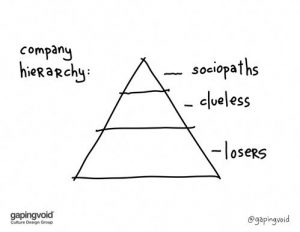
    Reproduced with permission of gapingvoid Culture Design Group, https://www.gapingvoid.com/

    Hugh MacLeod’s cartoon is a pitch-perfect symbol of an unorthodox school of management based on the axiom that organizations don’t suffer pathologies; they are intrinsically pathological constructs. Idealized organizations are not perfect. They are perfectly pathological. So while most management literature is about striving relentlessly towards an ideal by executing organization theories completely, this school . . . would recommend that you do the bare minimum organizing to prevent chaos, and then stop. Let a natural, if declawed, individualist Darwinism operate beyond that point. The result is the MacLeod hierarchy. It may be horrible, but like democracy, it is the best you can do.[63]

    The last, devastating indictment of things as they are, combined with blithe acceptance of the same, is characteristic of Rao. It should be emphasized that Rao is speaking as a corporate insider, not as a denouncer of capitalism, and his series has been applauded by capitalist entrepreneurs.[64]

    There is, of course, no good place to be on MacLeod’s pyramid, though the bottom seems to be the least horrible. In Rao’s analysis, its layers can be seen to correspond to Weber’s thesis and the commentators we have been considering.[65] The “loser” laity at the bottom are the equivalent of Weber’s and Dupuy’s “fatalists”—the rational non-strivers. They know the score but go through the motions. “Losers” in Rao analysis “are not social losers (as in the opposite of ‘cool’), but people who have struck bad bargains economically—giving up capitalist striving for steady paychecks.” They “mortgage their lives away, and hope to die before their money runs out.”[66]

    It bears emphasis that being a “loser”—making enough to get by, not obsessing about work, though not being idle—would have been the normal way of understanding work in traditional Judeo-Christian civilization before Weber’s dynamic took hold. The so-called “losers” would have simply been ordinary, properly oriented, reasonably well-adjusted human beings, not demoralized and/or cynical wage slaves.

    “Losers” have characteristically been the cultural antiheroes at the center of the narrative in movies and television. Gervais’ great innovation, for Rao, is that he moved the “clueless” to the narrative center.[67]

    “Clueless” middle management in Rao’s analysis are the only individuals who still hold to a “work ethic.” More specifically, they are the only true believers in the company, while those on the other levels of the pyramid are functionally atheist. The “clueless” serve as a priestly class overseeing empty rituals. They could be considered the equivalent of pre-Calvinist reformers in Weber’s thesis, viewing the workplace as a “calling”—which for the “clueless” has become a secularized religion of its own. “Clueless” are promoted to middle management not on the merits of their overachievement but because their overachievement, which is pointless, demonstrates a cluelessness which serves specific ends for the sociopaths.[68]

    “Cluelessness,” as embodied for instance in Steve Carell’s character Michael, gives Gervais’ series its signature cringeworthiness, but from the contorted and brittle perspective of middle management. This highlights a mistake that artistic or literary-minded critics make when they comment on the series.[69] For Rao, the cringeworthiness is not really the aesthetic aim but a secondary effect of cluelessness, which is the essential point.[70] While the “clueless” are true believers in the system, they are also the most vulnerable and helpless within it; they are tragicomic Kafkaesque figures. Further, the narrative frame of middle management, connecting, above and below, to the other levels of the company hierarchy, provides a revelatory perspective on the sociopathic nature of the whole organization and its interactions.

    The deeper Rao gets into his analysis, the more explicitly religious he becomes. The “sociopath” gods at the top of the pyramid cap Rao’s analysis. “The Sociopath (capitalized) layer comprises the Darwinian/Protestant Ethic will-to-power types who drive an organization to function despite itself” (emphasis mine).[71] They

    enter and exit organizations at will, at any stage, and do whatever it takes to come out on top. They contribute creativity in early stages of a[n] organization’s life, neurotic leadership in the middle stages, and cold-bloodedness in the later stages, where they drive decisions like mergers, acquisitions and layoffs that others are too scared or too compassionate to drive.[72]

    Note that, in Rao’s sole reference to Weber, the “Protestant Ethic” type—the Calvinist striver—has devolved to the Darwinist, individualistic “will to power” type. Sociopaths, the elect, see past the delusions that operate at the lower levels of the company hierarchy. Yet, because they do see through it all, they sink into their own nihilistic existential dilemmas.

    . . . what Sociopaths ultimately do with their lives . . . [is] generate amoral power from increasing inner emptiness, transforming themselves into forces of nature . . . .

    As a side-effect, they also manufacture transient meanings to fuel the theaters of religiosity (including various secular religions) that lend meaning to lives of Losers and the Clueless . . . .

    When Sociopath stories end, the Loser and Clueless stories that continue become bereft of meaning; sound and fury signifying nothing. When Sociopaths turn their attentions en masse to new frontiers, they leave behind complete cargo cults that continue to function for a while.[73]

    In Rao’s surreally cynical vision, the “capitalist spirit,” having sprung from religion, now generates its own religious ecology, in the service of its (sociopath) gods. Much of Rao’s analysis could be restated—albeit in a warped and inside-out way—in terms of “recognition”–the master-slave dialectic that informed so much of Fukuyama’s End of History.[74]

    Mechanization, AI, UBI, and the Anthropology of Work

    Michael Novak’s critique of Weber fell short because he misunderstood the nature of the “capitalist spirit” in a way Weber did not. The accelerated automatization of human tasks, the increasingly ubiquitous presence of artificial intelligence (AI), and now the proposal for a Universal Basic Income (UBI), in which people would get a salary for doing nothing, press this point home. UBI may be denounced by some opponents as socialist,[75] but in fact it is swiftly gaining acceptance among free market advocates,[76] and could be reasonably be considered the triumph of the “capitalist spirit.” The insane energy generated from the “Protestant ethic”—productivity and profit as ends in themselves, pursued with religious zeal—generate an efficiency and surplus that make such developments rather inevitable. The issue in this context is not whether UBI would be a good or bad thing—it may turn out to be either, or both—but the fact that it is utterly consistent with Weber’s thesis on “the spirit of capitalism.” This is the insight of the animated movie WALL-E, which depicts universal sedentary leisure not as a socialist paradise but as a smoothly operating consumerist utopia/dystopia, populated by congenial, sedentary, perpetually distracted humans and their solicitous robot caretakers.[77]

    Automatization, AI, and UBI are certainly game changers concerning the “work ethic”—not Weber’s thesis, but the cultural meme derived from it. “Delayed gratification” is based on expectation of future reward which, at least in principle and even from a very practical point of view, may soon be available anytime, for free. More plainly, a concerned parent or social commentator cannot realistically appeal to the “work ethic” in the face of these sweeping developments—unless he or she intuitively means something other about work than the “work ethic” ever spelled out, e.g., the intrinsic value of work in character building, creativity, socialization, mental or physical health, or the like.[78]

    Yet this would be not a mythical “work ethic” but an anthropology of work, such as is articulated in the Catholic social encyclicals, particularly John Paul II’s Laborem Exercens. There is a good case to be made for abandoning the idea of a “work ethic” as a civic virtue, not just because it has become meaningless from a pragmatic point of view, but because it was always meaningless from an intellectual point of view: Weber, as pointed out earlier, was describing a religious neurosis, not a civic virtue.

    This is not at all to say that work does not have ethical dimensions, but rather that these dimensions need to be articulated in an anthropologically coherent way. How does work give meaning to, or get meaning from, what GA calls “the human”? Weber’s thesis leads to but did make any pretense of answering this question. The burden of even formulating it as such seems to have fallen largely on Catholic social teaching. Yet the social encyclicals, especially since John Paul II, explicitly appeal to universality and include a call for others to take up such questions in good faith.

    Sadly, with the Catholic Church currently engulfed yet again in abuse scandals and internal disarray, it has lost much credibility as a social voice and will need to, at best, focus inward to clean its own house. By the same token, however, there is so much untapped good in the social encyclicals that it becomes, perhaps, a special responsibility for sympathetic thinkers of other religious traditions, or of a secular perspective, to carry it forward. Weber and our “Weberians” have established that Christians specifically, for better and worse, birthed the “capitalist spirit”; Christian denominations have the onus of grappling with its anthropological consequences.

    It should go without saying in this context that GA is uniquely positioned to articulate an anthropology of work—so essential in defining the human and the human scene. Given GA’s perspective on center and periphery, the communal dimensions of work come into especially sharp focus, going beyond even the great social encyclicals in this respect. In the GA literature, Andrew Bartlett’s Mad Scientist, Impossible Human has laid foundations for such a perspective on work, though his is ironically a literary analysis of non-human creations in canonical science fiction.[79] As I put it in a previous essay,

    In addressing the objectification of the human vis-à-vis science and technology, Bartlett takes pains to articulate an alternate vision of the human as communally situated, both humanized and humanizing through participation in labor, consumption, and exchange, as well as social, romantic, family, and community life: the agony and horror of Mary Shelley’s monster is that he cannot share in any of this.[80]

    René Girard’s mimetic theory, however profound and insightful, has a limited capacity for this anthropological task, because, as I also observed previously, “mimetic theory . . . cannot comprehend social cohesion as anything other than an effluence of sacrificial violence.”[81]

    The anthropology of work is another reason for GA to adopt a more Weberian view. In The End of History, Fukuyama treated increasingly questionable assumptions about work as explicable via the “master-slave dialectic” (e.g., the overworked Japanese salaryman of the 1980s who got a sense of “recognition”).[82] Rao—to the extent that we should take his satiric vision seriously—has underscored the illusory nature of such “recognition.” It is in fact a concept which Fukuyama himself abandoned when he turned to a Weberian perspective in Trust. Fukuyama needed to take religion and culture into account, recognizing, at least intuitively, that work must be tethered to a sacred center, through which it derives most of its human value.

    Acknowledgements

    This study was supported by a research and travel grant from the Institute for the Study of Christianity and Culture of Kinjo Gakuin University. An earlier version of this essay appears in the proceedings volume for the 2018 GA conference.[83] Special thanks are due to Michael Cholewinski, Thomas Turner, and Eric Gans for invaluable comments and encouragement. All errors and viewpoints are of course my own. Thanks are also due to gapingvoid Culture Design Group (https://www.gapingvoid.com/) for permission to reproduce Hugh MacLeod’s cartoon.

    Notes

    [1] Max Weber, The Protestant Ethic and the Spirit of Capitalism, trans. Talcott Parsons (London: Routledge, 2001), 101.

    [2] See part 8 of Eric Gans’ “A Brief Introduction to Generative Anthropology,” https://anthropoetics.org/gaintro/

    [3] Gans takes issue with elements of Fukuyama’s thesis, including the phrase “end of history” itself, but it often serves as a kind of descriptive shorthand for Gans when referring to liberal democracy and the market system in general. For a representative sample, see Eric Gans, “Ending History,” Chronicles of Love and Resentment, no. 174, July 7, 1999, https://anthropoetics.org/views/vw174.htm; “La mondialisation,” Chronicles of Love and Resentment, no. 227, February 3, 2001, https://anthropoetics.org/views/vw227.htm; “Obama and Fukuyama,” Chronicles of Love and Resentment, no. 503, https://anthropoetics.org/views/vw503.htm; “The Realm of Freedom,” Chronicles of Love and Resentment, no. 498, October 10, 2015, https://anthropoetics.org/views/vw498.htm; “Three Post Election Thoughts,” Chronicles of Love and Resentment, no. 527, https://anthropoetics.org/views/vw527.htm

    [4] Fukuyama, Trust: The Social Virtues and the Creation of Prosperity (London: Hamish Hamilton, 1995).

    [5] Peter Goldman has explored the connection between Weber and GA. See especially the last portion of Goldman’s “John Milton on Ecclesiastical Free Markets and Weber’s Protestant Ethic,” Anthropoetics, 22, no. 2 (Spring 2017), https://anthropoetics.org/journal/ap-vol-22/ap2202/2202goldman/

    [6] See Anthony Gidden’s introduction to Max Weber’s Ethic, xiii-xvi.

    [7] Weber, 39-50.

    [8] Ibid., 51-101.

    [9] Ibid., 60-65.

    [10] Ibid, 70.

    [11] Ibid, 115-116.

    [12] As will also be noted further on, this point in Weber’s thesis, the “spirit of capitalism” defined as cultural acceptance of capitalism, was probably best worked out by Amintore Fanfani in Catholicism, Capitalism and Protestantism (London: Sheed and Ward, 1935), 122-153.

    [13] Weber, 119.

    [14] Ibid., 123.

    [15] Weber, 42-43.

    [16] R. H. Tawney, Religion and the Rise of Capitalism: A Historical Study (New York: Harcourt Brace, 1948), 118.

    [17] See Eric Gans, “The Originary Hypothesis (Stanford Version),” paragraphs 6-11, Chronicles of Love and Resentment, no. 402, November 20, 2010, https://anthropoetics.org/views/vw402/

    [18] Ibid., paragraphs 2-4. Gans faced that critique squarely and as a result extended the interpretive reach of GA, mainly by refuting the critique while at the same time refusing to dismiss the “social contract”—a great originary intuition of the Enlightenment. One fruit of Gans’ response was his sweeping study The Scenic Imagination (Stanford, California: Stanford University Press, 2008).

    [19] David S. Landes, The Wealth and Poverty of Nations: Why Some Are So Rich and Some So Poor (New York: W.W. Norton, 1998), 174.

    [20] Giddens, xviii-xxiii.

    [21] Tawney (note 16).

    [22] Tawney, xii-xv.

    [23] Ibid., 102.

    [24] Ibid., 104-105.

    [25] Fanfani (note 12).

    [26] Ibid, note 12.

    [27] Ibid., 28-29.

    [28] See for instance, ibid., 158-159.

    [29] “Amintore Fanfani,” Obituary, The Guardian, November 22, 1999, https://www.theguardian.com/news/1999/nov/22/guardianobituaries1

    [30] Republished in Dawson, The Dynamics of World History, ed. John J. Mulloy (Wilmington, Delaware: ISI Books, 2002), 211-223.

    [31] Ibid., 211.

    [32] Ibid., 218.

    [33] Ibid., 218.

    [34] See my “Subculture, Conformity, and Sacrifice: Kamikaze Girls through a Mimetic Lens,” Apocalypse Deferred: Girard and Japan, ed. Jeremiah L. Alberg (Notre Dame, Indiana: University of Notre Dame Press, 2017), 149-168.

    [35] See Eric Gans, Originary Thinking: Elements of Generative Anthropology (Stanford: Stanford University Press, 1993), 216-217. See also chapters 10 and 11, “The Romantic Esthetic” and “The Modernist Esthetic” (164-206), which usefully parallel and complement Dawson’s observations.

    [36] Data on comparative economic development strikingly corroborates Weber’s thesis over more than four centuries. Reformation countries, particularly Calvinist ones, consistently out-performed Counter-Reformation countries economically, producing 80% of the wealth from the time of the reformation even up to 1980. The data is summarized by historian Pierre Chaunu and quoted by Jean-Pierre Dupuy in Economy and the Future: A Crisis of Faith, trans. M. B. DeBevoise (East Lansing: Michigan State University Press, 2014), 91-92.

    [37] Orson Welles, chapter 14, The Third Man, directed by Carol Reed, screenplay by Graham Greene (London: London Film Productions, 1949). It can be noted that Harry’s “entrepreneurial spirit” belies this psychopathic grandiosity—associating his criminal atrocities with Renaissance genius. Harry is no Machiavelli, but a bourgeois aberration.

    [38] The End of History and the Last Man (New York: The Free Press, 1992).

    [39] The Catholic Ethic and the Spirit of Capitalism (New York: The Free Press, 1993).

    [40] Centesimus Annus (Vatican: The Holy See, 1991), http://w2.vatican.va/content/john-paul-ii/en/encyclicals/documents/hf_jp-ii_enc_01051991_centesimus-annus.html

    [41] See for instance the commentary on Centesimus Annus by Thomas Storck, Appendix II, “What Does Centesimus Annus Really Teach?”, An Economics of Justice and Charity: Catholic Social Teaching, Its Development and Contemporary Relevance (Kettering, Ohio: Angelico Press, 2017), 130-142.

    [42] Novak, preface, xv.

    [43] Laborem Exercens (Vatican: The Holy See, 1981), http://w2.vatican.va/content/john-paul-ii/en/encyclicals/documents/hf_jp-ii_enc_14091981_laborem-exercens.html

    [44] This is typically stated in the paradoxical form, “God creates man, man creates God.” For a fuller explication see part 2 of Eric Gans’ plenary address for the 2018 GA conference in Warsaw, “In the beginning was the word: GA as a religious anthropology—Part 2,” Chronicles of Love and Resentment, no. 591 (July 21, 2018), https://anthropoetics.org/views/vw591/. Parts 1 and 2 were republished together in the conference volume, Generative Anthropology and Transdisciplinary Inquiry: Religion, Science, Language, Culture, ed. Magdalena Złocka-Dąbrowska (Warsaw: Wydawnictwo Naukowe Uniwersytet Kardynała Stefana Wyszyńskiego w Warszawie, 2018), 21-34.

    [45] See Storck, 145-146.

    [46] Trust (London: Hamish Hamilton, 1995).

    [47] End of History, 143-152.

    [48] A notable example is Girard’s discussion of Romulus and Remus and founding myth in The Scapegoat, trans. Yvonne Freccero (Baltimore: Johns Hopkins University Press, 1986), 88-94.

    [49] See note 3.

    [50] See for instance Gans’ “Liberal Democracy Today,” Chronicles of Love and Resentment, no. 609, February 16, 2019, https://anthropoetics.org/views/vw609/ For my own summary and commentary on Fukuyama’s “End of History” thesis, including a review of Gans’ frequent yet qualified and nuanced endorsement of it, see “Scenes of Distress: Reflections on Francis Fukuyama’s ‘End of History,’” Anthropoetics, 22, no. 2 (Spring, 2017), https://anthropoetics.org/journal/ap-vol-22/ap2202/2202taylor/

    [51] For but one example see Eric Gans, “The Crisis of Christianity,” Chronicles of Love and Resentment, no. 491, July 18, 2015, https://anthropoetics.org/views/vw491/

    [52] Dupuy, note 36.

    [53] See for instance Dupuy’s “Panic and the Paradoxes of the Social Order,” Passions in Economy, Politics, and the Media: In Discussion with Christian Theology, ed. Wolfgang Palaver and Petra Steinmair-Posel (Vienna: LIT Verlag, 2005), 215-234; Paul Dumouchel’s, The Ambivalence of Scarcity and Other Essays (East Lansing: Michigan State University Press, 2014), 3-138; André Orléan’s “Money and Mimetic Speculation,” Violence and Truth: On the Work of René Girard, ed. Paul Dumouchel (Stanford, CA: Stanford University Press, 1988), 101-112; Orléan’s The Empire of Value: A New Foundation for Economics (Cambridge, Massachusetts: The MIT Press, 2014).

    [54] Economy and the Future, 91.

    [55] Ibid., 99.

    [56] Ibid., 92-93.

    [57] Ibid., 108-111.

    [58] Ibid., 106-109.

    [59] Ibid, 110-125.

    [60] The Gervais Principle, Part I-VI, ribbonfarm (October 7, 2009-May 16, 2013), https://www.ribbonfarm.com/the-gervais-principle/

    [61] See Rao’s short lecture sponsored by the Economist, “The Gervais Principle,” online video segment, YouTube (May 5, 2017), https://www.youtube.com/watch?v=jJYa68AnECY

    [62] Hugh MacLeod, “company hierarchy,” gapingvoid Culture Design Group (June 27, 2004), https://www.gapingvoid.com/blog/2004/06/27/company-hierarchy/

    [63] Rao, Part I, par. 4.

    [64] Note 61.

    [65] Rao’s psychosocial analyses within and between the groups cannot be treated here but constitute perhaps the most brilliant element of his series. This would be a worthy subject of GA explication in itself; center, periphery, and generative paradox suffuse Rao’s analyses.

    [66] Rao, Part I, par. 8.

    [67] Ibid., par. 30.

    [68] Ibid., par. 31.

    [69] Ibid., par. 3. “Keep in mind that this is an interpretation of The Office as management science; the truth in the art. Literary/artistic critics don’t really seem to get it.”

    [70] Rao, Part IV, par. 95-103 (“Empathy, or Why You Losers Cringe at Michael’s Actions”). The aesthetics of “cringeworthiness,” including in The Office, have been subjects of GA analysis. See Kyle Karthauser, “Popular Culture After Postmodernism: Borat, Family Guy, The Office, and the Awkwardness of Being Earnest,” Anthropoetics, 15, no. 2 (Spring 2010) https://anthropoetics.org/journal/ap-vol-15/ap1502/1502karthauser/. See also the paper by Marina Ludwigs for the 2018 GA conference, “Cringing and Other Desacralizing Affects in Post-Millennial Aesthetics,” appearing in Anthropoetics, 24, no. 1 (Fall 2018) https://anthropoetics.org/journal/ap-vol-24/ap2401/2401ludwigs/ Ludwigs’ essay was also published in print in the conference volume, ed. Złocka-Dąbrowska: “Faithless: Desacralization as an Aesthetic Strategy in Some Recent films,” 45-61. But again, from Rao’s perspective (and if he is right, from Gervais’), cringeworthiness in The Office is a secondary effect of “cluelessness” and its primary function is not the aesthetic affront to the audience.

    [71] Rao, Part I, par. 5.

    [72] Ibid., par. 9.

    [73] Rao, Part VI, par. 12-14.

    [74] Note 47. In this sense, Rao appropriates aspects of Fukuyama’s thesis that Gans has rejected.

    [75] See for instance Sheldon Richman, “Universal Basic Income Proposal Still Fails to Pass Libertarian Scrutiny,” Reason (May 13, 2018), https://reason.com/archives/2018/05/13/universal-basic-income-still-fails

    [76] UBI is central to the platform of presidential candidate Andrew Yang. See the interview segment with Joe Rogan, “Presidential Candidate Andrew Yang’s Case for UBI,” Youtube (February 12, 2019) https://www.youtube.com/watch?v=NAtyv8NpbFQ UBI has also been positively considered by Eric Weinstein as a response to automatization and economic dislocation. See his short lecture “Capitalism 2.0 Will Include a Heavy Dose of Socialism,” sponsored by Big Think, YouTube (June 4, 2017) https://www.youtube.com/watch?v=xzTmBnaiMdE

    [77] WALL-E, directed by Andrew Stanton (Los Angeles: Disney Pixar, 2008).

    [78] A review article for a recent book, Men Without Work: America’s Invisible Crisis, by Nicholas Eberstadt (West Conshohocken, Pennsylvania: Templeton Press, 2016), describes the human toll of worklessness in recent years, especially among millions of men. See Michael Cook, “America’s Ghost Legions of Idle Men,” Intellectual Takeout (October 18, 2018), https://www.intellectualtakeout.org/blog/americas-ghost-legions-idle-men?fbclid=IwAR2F8VlM43oVXdT7csGgQJcaOqUjUE6e_9QI6w9ExcNZ_gip5bvnsfGuxdE

    [79] Mad Scientist, Impossible Human: An Essay in Generative Anthropology (Aurora, Colorado: The Davies Group: 2014).

    [80] See again “Scenes of Distress: Reflections on Francis Fukuyama’s ‘End of History,’” par. 44.

    [81] Ibid., par. 43.

    [82] Note 47.

    [83] “Gods of the Marketplace: The Work Ethic from Max Weber to Venkatesh Rao.” Złocka-Dąbrowska, 77-100.

  • Generative Anthropology as the One Big Discipline

    If the originary hypothesis entails that all human possibilities must be implicit in, and therefore traceable back to, the originary scene, then it follows that Generative Anthropology must be the human science. And if Generative Anthropology is the human science, it must be both incommensurable with and inclusive of all existing human sciences. This places thinkers within GA in a somewhat anomalous position: a tiny, at best barely noticed minority within the human sciences considering itself the practitioners of the only genuine science. This raises the question of what our relationship to the other human sciences should be. But before that question comes another one: what, exactly, counts as a human science, and what should a human science be doing? The notion that the human sciences should be modeled on the physical sciences, presupposing an objective, neutral observer, universally transparent categories and even mathematical methods, and the equivalent of the experimental method, has been discredited. The fact that human inquirers are part of the phenomena they are inquiring into makes the human sciences a qualitatively different enterprise. (I will leave aside the question of how unquestioned these assumptions are for the physical sciences themselves.)

    We cannot establish any pre- or trans-historical starting point for the human sciences—we always begin within traditions of inquiry. All of these traditions have their origin in some break with one ritual or mythological order or another. Some kind of institution or practice that is unintelligible, and yet a source of sanctioned behavior and modes of activity within the existing order, must be what initiates the break and prompts attempts to understand it. Institutions such as money, markets, writing, and republican and democratic governments might all qualify, and, indeed, we see all of these in what, in the West at least, is the first human science, Greek philosophy. The question addressed by Plato in The Republic is still the question all human sciences, more or less directly, must be trying to ask: what is a good way for people to live together? Within a ritual order, such questions could not be asked: the way to live is the way we have always lived, as prescribed by the ritual order and explained by the mythological order. So, a recognition of some disordering element, and a consideration of how to return to a “good” order, is central to the human sciences.

    Richard Seaford makes a very strong case for money being the disordering element at the origin of ancient Greek metaphysics. The universality, eternity, and convertibility of money all find their equivalents in metaphysics, and Seaford even provides a compelling reading of Greek tragedy, showing that money is recognized as the disordering element in the Greek polis. Furthermore, the various antinomies of metaphysics, such as between the material and the ideal, the individual and society, all find their equivalent in money as well. At the same time, metaphysics had to be written down, the effect of writing and the subsequent confusion over the meaning of words was systematically reflected upon in Plato’s texts, and a parallel tradition represented by scholars like Eric Havelock, Walter Ong, and, more recently, David Olson, has, equally compellingly, identified the structure of writing with the form of post-mythical thought. These are overlapping and complementary analyses—I am just giving a reason why I am going to proceed to make sense of the development of the human sciences in terms of writing, while making the point that I would be more than happy to see the same set of questions pursued from the standpoint of the emergence of the full monetization Seaford locates in ancient Greece.

    If the human sciences emerge out of the identification of an element that disorders the ritual/mythical order while creating at least the elements or possibility of a new order, we can further assume that some mythical form or content must remain within the new human science, and furthermore, that anything that we could take to be a genuine advance in the human sciences would be the elimination of some mythical element in the discourse or discipline in question, and its replacement with a concept generated within that discourse or discipline. That concept will be, further, a contribution to the distinction between the (dis)ordering element and the ritual/mythical order from which it breaks. It is under such conditions that we could speak of the emergence of a “discipline”: to be within the discipline is to take as the center of your attention the de-mythicizing (dis)ordering institution or practice; to remain outside of the discipline is to indiscriminately mix mythical with post-mythical elements. So, we now have a preliminary way of talking about what would count as a genuine tradition of inquiry within the human sciences.

    We also have a way of distinguishing between stronger and weaker contributions to any such tradition. Certainly one criterion would be, as I have just pointed out, identifying the break between the mythical and post-mythical, and tracing all the consequences of the break. But a more comprehensive criterion would be—since, after all, whatever enabled the break must have already been possible within the mythical—which discourse can conceptualize the break while simultaneously identifying the continuity from the one social order to the other. But if the new order has an origin in such a break, while nevertheless sharing with that earlier social order some previous origin, the human sciences must either address (“scientifically”) or suppress (“mythically”) the problem of origins. That means that the question regarding a “good” social order becomes the question: why is there a social/human order in the first place? The problem of origins is in its intrinsically paradoxical character, as was already noted by Plato at the origin of metaphysics: whatever we see in the new form must have already been present, at least potentially, in the old form. How could a human science, then, hypothesize regarding the origin without simply projecting back into the previous form those features of the human that most define our current order, which, after all, is the most fully developed form of the human as such? This projection of current social relations back to earlier ones is the mythical form taken by the human sciences: it is equivalent to the explanation of ritual by myth. It is easy to see why speculation on origins, whether of humanity or even of a relatively trivial cultural form, is almost unanimously denounced. But such denunciations cannot prevent historical and cross-cultural inquiries from mythicizing in this way: only a genuinely post-mythical science of the originary can do so.

    The originary hypothesis provides such a science. An account of the origins of the originary hypothesis will help us to understand how this can be the case. Eric Gans’s account of his articulation of Rene Girard and Jacques Derrida points us in two extremely interesting directions. First, through Derrida, to the “linguistic turn” in 20th century thought, that not quite conclusive blow to traditional metaphysics, which imposed the recognition that every concept is constituted by the subordinate term to which it nevertheless claims priority; second, through Girard, back through a history of inquiries (including Freud and early 20th century anthropology) into constitutive violence, into what we might call that in the archaic world which our modernity leaves us least prepared to see. This yoking together of, not opposites but certainly “disparates,” is a disciplinary origin we can always return to as ground. For Derrida, of course, his deconstruction of the speech/writing distinction is a decentering move, but the fact that this decentering can never be definitively accomplished seems to suggest a permanence to the “center” beyond whatever form of political oppression Derrida and his successors might like to attribute to it. In that case, the sign creates the center through deferral, and it is a center that could always be decentered—by another center. The fact that the sign can be repeated, or iterated, is the foundation of writing, but is “always already” to be found in speech or, for that matter, in the aborted gesture of appropriation the originary hypothesis takes to be at the origin of the human. And it is that iterated sign that makes it possible to account for why even the scapegoat scene Girard constructs could be memorable, and accrete new layers of ritual and myth; and if Girard’s scapegoat scene requires the sign, then the generation of the sign no longer requires the scapegoating.

    So, it is this relation between the iterability of the sign, the center that makes that iterability possible, and the participants on the margin who construct themselves through this relation to the center that provides for the continuity from the ritual/mythic to an order in which norms and mimetic models must refer explicitly to social, or desacralized relations. Derridean deconstruction pointed to mythical residues in the human sciences, and even to a ritual violence implicit in perpetual recentering, while in finding this violence to reside in language, he developed the victimary tendency in postmodern culture to its furthest extent. The problem of human origin becomes the problem of controlling violence as it becomes the problem of the origin of language. Only the most stubborn mythical element of the human sciences, the belief that structures are enduring while events are mere effects of those structures, which is to say, that the declarative sentence represents reality comprehensively while the more restricted speech forms merely “implement” declarative statements, needs to be overcome.  The originary hypothesis accomplishes this through the claim that only in a singular event could a sign both marginally and qualitatively different from a gesture of appropriation be the vehicle of the discovery that signs defer violence.

    If myths explain rituals, the human sciences study practices that refer to some social center. The conceptual equipment of Greek philosophy may have been provided by the emergence of money and writing, but its explicit object of inquiry was the social order in the age of the “tyrant,” that is, the post-sacral king who made visible, by exploiting it, the class differences of the post-ritual order. A good society was, in its initial formulation, a society without tyranny, and for the human sciences this has not changed. The terms of all human practices are set by a social center that may, or may not be, tyrannical—depending on what the human sciences tell us. Every event is therefore a judgment of the social center. But every event is also an event of language. The emergence of the post-sacral order in which “tyranny” becomes possible coincides with the emergence of alphabetic writing, itself a product, according to the scholar of literacy, David Olson, of the transformation of language itself into an object of inquiry, starting with the invention of the alphabet to represent speech, but ultimately focused on the problem of reproducing a speech situation in the new medium of writing. This leads to the need to distinguish, metalinguistically, between (using the terminology of analytical philosophy) “using” and “mentioning” words, with the latter referring to an inquiry into how language is used.

    With writing, then, comes linguistic metalanguage: implicit, tacit norms of speech are made explicit, and therefore systematized. This means that language use can be assessed: words can be spelled correctly or incorrectly; words can be used properly (according to their agreed upon definition) or improperly; sentences can be grammatical or ungrammatical. With these distinctions come others, concerning clarity and logicality:

    The metalinguistic concept of a sentence brings these underlying structures into consciousness as objects with particular properties such as clear or ambiguous, grammatical or ungrammatical, and, importantly, as implied or entailed. Such inferences are justified by appeal to wording rather than belief. (116).

    The question of implications and entailments are particularly important here because these concepts implicate the expectations we have of one another in a literate culture. The distinction between the “words on the page” and intended meaning is constitutive of a literate culture, and when someone is considered a “bad reader,” what is usually meant is that he or she fails to make this distinction consistently. The metalanguage for representing speech acts in written discourse includes all of the concepts one is expected to use as a “critical thinker”:

    The concept sentence is special in that it allows one to treat an expression as mentioned rather than used and to comment on it as grammatical, as a premise, as entailed by an earlier sentence and so on. This lexicon is greatly elaborated in literate discourse to include such concepts as statement, claim, assertion, suggestion, inference, or conclusion, concepts important for critical thought. (125)

    Writing, then introduces a disciplinary structure into language, bringing into focus features of language that can then be used for purposes of inquiry and instruction. This also means, that while distinctions between written spoken language and persist, the capacities for thinking generated by literate metalanguage enter into and restructure spoken language as well: we certainly don’t need to write in order to be able to “infer” or “doubt.”

    The implications of literate metalanguage go much further. Olson, in his earlier The World on Paper, had pointed out that the written sentence represents an entire speech act, but it must do so without the thick context that embeds speech carried out by members of a community, in a specific situation. For example, in an oral culture, if one person, in reporting another’s speech, wanted to communicate the uncertainty of that other person, she could simply repeat what that person said in a hesitant tone of voice. “Tone” is one of the many elements of the speech situation that is unavailable in writing, so, the uncertainty must be conveyed with words: it is possible, of course, to simply write, “he wasn’t sure,” but various other ways are developed to convey a wide range of tones: he “suggested,” “conjectured,” “believed,” and so on. Good writing, in this case, would be writing that sufficiently supplements what is lost in “translation” from spoken to written language.

    Olson comes back to this question, in his recent The Mind on Paper, by addressing the norms of “prose,” by way of Mark Turner and Francis-Noel Thomas’s Clear and Simple as the Truth: Writing Classic Prose:

    The classical style takes for granted two of the features that modern, enlightened readers now find objectionable, the assumption that language is transparent to the reality it describes and, second, that it can reveal object [sic?] truths. Further, the Classical style even denies it is a style; it takes itself to be a naked, natural way of speaking… I shall regard the Classical style as the set of norms and standards for evaluating prose in a way similar to those norms that regulate the meaning of words and the logical properties of sentences. Thus prose is a critical, metalinguistic concept that articulates the norms and standards for much of written language and, subsequently, for careful speech. (142)

    It is easy to see that the goal of classic prose is to recuperate the distinction between written and spoken language, or to simulate the assimilation of the former to the latter. The writer of classical prose effaces himself, simply pointing out something in reality that he, along with his readers, look at. In other words, he constructs a scene that remains tacit, and invites a suspension of disbelief allowing the reader to inhabit that same scene, viewing the same object or event, as if converging lines united the two points of view on a single center. Classical prose is an almost perfect example of what Derrida called “presence,” and the entire post-structuralist critique of “metaphysics” could perhaps be made much “clearer” if resituated as an argument over the extent to which we should accept what Olson calls the “conceits” of classical prose.

    Where the critiques of metaphysics have been right in an extremely important way is in noting that what are in fact features of the metalanguage of literacy used to assess written discourse get retrojected as features of the human “mind” or “nature” that the categories of written metalanguage merely construct representationally. To define the human being as a “rational animal,” for example, is to read a feature of written discourse back into the form of human being that produced that kind of discourse. To take “logic” as a natural way of representing how the mind works and building entire cognitive science empires out of it is to do the same. The metalanguage of literacy supplements the speech scene represented by writing: Olson focuses on mental and speech act verbs like “assume,” “suppose,” “contend,” “assert,” which supplement what Anna Wierzbicka shows to be universally shared primes like “think,” “say,” and “know,” and are in turn nominalized into “suppositions,” “assertions,” and so on. Once we have these reifications, a disciplinary space focused on the relation, say, between “assumptions” and “statements” can be created.

    To return to my opening discussion, I have been taking writing, as it has taken shape, through the metalanguage of literacy, studying the possibilities of iterating speech scenes as written (and read) texts in “classic prose” as the (dis)ordering social element that brings forth the kind of shared reflection and discourse ultimately institutionalized in the disciplines of the human sciences. All of the founding concepts of the human sciences, ancient and modern, like “society,” “mind,” “religion,” “language,” “intention” and so on are all supplemental “grounds” for the objects constructed within the disciplines. The point is not that the “entities” named by those words/concepts don’t exist; rather, it’s that they exist as products of inquiry within disciplines, within traditions of inquiry, which is to say that they have a provenance and can and often should be revised or replaced. By now it is a commonplace to point out that to use a word like “religion” to refer to all the various forms of Christianity, Judaism, Buddhism, Islam, Voodoo, tribal rituals, and so on is modeled on Protestantism, with its distinction between “individual faith,” on the one hand, and either Church or State, on the other. To take the example of “intention,” meanwhile, the problem of identifying another’s “intention” is a post-literate one because it presupposes the possibility that the speaker’s meaning might be different than the meaning of the words or sentences uttered by the speaker. To speak about “intention” is to direct attention to the former.

    Since the distinction between the speaker’s meaning and the meaning of words is central to the problem posed to writing of representing speech in abstraction from presence on the scene of speech, we can see the word/concept of “meaning” at the center of the metalanguage of literacy and, therefore, of the disciplines. What we could see as the founding of the disciplines in Plato’s Republic does place “meaning” at the center: for example, the meaning of the word “good.” This is in fact an excellent example of the founding of the human sciences around some (dis)ordering, emergent social element. The word “good,” which is unproblematic as an adjective modifying various ways of being and activities (a good baker, a good warrior, a good father, etc.), which all have their definition and evaluation implicit in the practices they are embedded in, becomes problematic when it becomes necessary to name, describe, and assess activities that don’t fall into traditional categories. It is only then that it becomes possible to ask whether someone is a “good person,” or a “good citizen,” or, indeed, to inquire into nouns like “goodness” or “the Good.” The human sciences have never moved beyond this inquiry into the meaning of words, and cannot do so, no matter how data-driven they become.

    Here, Peirce’s pragmatism, which is the first attempt to think disciplinarity I am familiar with, is especially helpful, because for Peirce, pragmatism is “merely a method of ascertaining the meaning of hard words and abstract concepts.” And the method of doing this “is no other than that experimental method by which all the successful sciences . . . have reached the degrees of certainty that are severally proper to them today” (“Pragmatism in Retrospect: A Last Formulation,” Buchler, 271). Pragmatism would then be a kind of metalanguage of disciplinarity, or perhaps an infralanguage, insofar as it need do no more than test the meaning of words on their own terms:

    The meaning of a proposition is itself a proposition. Indeed, it is no other than the very proposition of which it is the meaning: it is a translation of it. But of the myriads of forms into which a proposition may be translated, what is the one that is to be called its very meaning? It is, according to the pragmaticist, that form in which the proposition becomes applicable to human conduct, not in these or those special circumstances, not when one entertains this or that special design, but that form which is most directly applicable to self-control under every situation, and to every purpose. That is why he locates the meaning in future time, for future conduct is the only conduct that is subject to self-control. But in order that that form of the proposition which is to be taken as its meaning should be applicable to every situation and to every purpose upon which the proposition has any bearing, it must be the simply the general description of all the experimental phenomena which the assertion of the proposition virtually predicts.  (261)

    So, if we advance a scientific proposition, or, let’s say, a claim about reality, the meaning of that proposition is to be found in the future conduct it predicts. That conduct will be shaped by “special circumstances” and “special designs,” from which we must abstract the general form of conduct we have in mind. The forms of conduct which are then to be taken as tests of the proposition will themselves be embedded in yet other special circumstances and special designs. One “situation,” in which the conduct is set, must be distinguished from other situations. Peirce is laying the groundwork for conceptual distinctions that will have to be made by future inquirers, and those future inquirers will be among those whose conduct is being predicted. Those future inquirers, since they are above all interested in inquiry, and therefore truth, and therefore in separating the objects of their inquiry from those presuppositions and concerns which threaten to put an end to that inquiry, will also be especially interested in acquiring the self-control regarding their own habits that is the effect and secondary aim of inquiry. In the process of inquiry, the participants will generate as many translations of the proposition into other propositions, experiments, and forms of conduct as possible—otherwise, how could the discipline determine which is to be called its very meaning? Thus, “[e]very connected series of experiments constitutes a single collective experiment” (260).  Pierce would restrict this all embracing mode of inquiry in which, as a later philosopher of science, Gaston Bachelard, would predict, “social interests will then be reversed once and for all: society will be made for school, not school for society” (The Formation of the Scientific Mind, 249) to “hard words” and “abstract concepts,” but wouldn’t the distinctions between “hard” and “easy” words, and “abstract” and “concrete” concepts, also have to made by some discipline—a discipline that might very well redraw these boundaries? With Pierce, then, we have a conception of disciplinarity as open-ended and aiming at discovering truths that will be universally acknowledged and taken into the formation of habit and conduct, while being at the same time dependent upon the collective conduct of those who will have to follow a proposition through its myriad translations, knowing that the final one will never be arrived at.

    So, we have the discipline of writing, which generates the metalanguage of literacy, which in turn launches a whole fleet of what Marshall McLuhan might have called “sleepwalking” disciplines that essentially reiterate the terms of that metalanguage. This would include every single discipline in the human sciences. Trying to define or analyze an entity like “mind” is, then, an essentially mystified endeavor. This is where Eric Gans’s definition of metaphysics as the assumption that the declarative sentence is the primary linguistic form takes on highly consequential implications. Metaphysics itself is just an inflation and concealment of the metalanguage of literacy which reduces language to its elements, which are in turn both real entities and parts of larger systems. To define a word is to treat it as convertible into declarative sentences, and to make it inextricable from its grammatical relations. Again, I am not quite saying that phenomena like “mind,” “religion,” “language” and so on don’t exist—rather, I am saying that they exist as effects of disciplinary events that obscure the origins and therefore meanings of these words themselves. In working to turn originary thinking into one big discipline we uncover those origins or originary structures and thereby transform the objects.

    Since writing is only possible because all signs are iterable, writing doesn’t come from the outside and invade an innocent oral culture—writing and the metalanguage of literacy it generates simply elicits, in a particular way, what is already internal to language. What I propose targeting in the metalanguage of literacy is that it conceals its own originary structure by treating signs as direct representations of “things,” “ideas,” “thoughts,” and so on. The metalanguage of literacy creates a system of cross-referential nominalizations that purports to represent “reality.” This is what renders it immune to originary hypothesizing, and the best way to address this immunity is to treat all human activity as originary hypothesizing. All questions of discourse and intellectual activity are therefore questions of what we might call the re-discovery of language rather than relations between language and something external, whether in the world or the mind (everything external is already in language). Originary thinking as the one big discipline is, therefore, to use a term taken from Bruno Latour, infralinguistic rather than metalinguistic:

    We have to resist pretending that actors have only a language while the analyst possesses the meta-language in which the first is ’embedded’. As I said earlier, analysts are allowed to possess only some infra-language whose role is simply to help them become attentive to the actors’ own fully developed meta-language, a reflexive account of what they are saying. In most cases, social explanations are simply a superfluous addition that, instead of revealing the forces behind what is said, dissimulates what has been said, as Garfinkel has never tired of showing. (49)

    Latour associates metalinguistic “explanations” that posit some hidden “real” “behind” the intentions of actors with the implication of the modern social sciences in social engineering.  The implication is that the human sciences should help others, including other human scientists, to find the meaning of what they are saying, and in the process to develop new linguistic capacities to discover what we are saying. We might say than rather than generate the terms on which we identify, denounce, apologize for, constrain, or convert actual or budding “tyrants,” the disciplines of the human sciences might help make explicit the ongoing negotiations between a given practice and the social center.

    The founding gesture of a discipline is to turn a nominalization produced elsewhere within the literate order into one that can guide inquiry: for example, from “hooliganism” as a pattern named by the press to “anti-social behavior,” with “causes.” This conversion further entails identifying some scene and event, however abstract, upon which a collective or typical agent does something (“History” is the biggest scene of all). The agent in question might be an author or artist, a nation, state, ethnicity or class, a worshipper, a mind, a gendered subject, a citizen. The concepts and arguments within the discipline consist of differing ways of distinguishing between what the agent meant in doing whatever it does, and what it means that the agent meant that. Now, what it means to do that is to construct a relation between some margin and some center, a relation we can always locate in whatever distinction, implicit or explicit, the disciplinary language itself makes between unmarked and marked “doings” and “happenings.”  For the disciplines, the center is not a ritual center to which donations are given and from which benefits are expected to flow; it is a source of authorized action that, if iterated, will convert resentments into sharing among those iterating it. We don’t agree on which model of action fits this description, hence the discipline, but we can now identify what the agents acting within the discipline are attempting, and have always been attempting.

    The infra and transdisciplinary inquiry into the discipline deploys the nominalizations generated by the discipline—”genre,” “norm,” “belief,” “behavior,” “mind,” “subject,” “text,” and so on—to mark differences in the activity within the discipline itself. Everyone within the discipline becomes a bearer of its originary structure. The question introduced into the discipline, then, is what model of inquiry identifies and enacts the model of action that converts resentments into love. In this case, the model of action itself becomes a model of inquiry: the agents we study are also seeking the authorization of the center. Any nominalization can be used to initiate this inquiry, by turning the nominalization into a verb referring to the disciplinary activity trying to name the objects of its activity. In generating disciplinary events, the way of thinking predicated upon the event-al nature of the human can effect a continuous interference within the discipline. The meaning of this kind of interference is to make the question of meaning as centrality permanent across the disciplines—to make it so that those within the discipline cannot think about what they’re doing outside of this question.

    A transdisciplinary practice of GA, then, involves working within the disciplines, probing the meaning of their constitutive concepts whose origin has been occluded or forgotten. This involves a combination of attentiveness and respect, on the one hand, with complete irreverence, on the other. We should feel free to start from the assumption that any and all concepts might be arbitrary impositions, situated within historical, social and political settings that have provided them with values other than those of unfettered inquiry. Disciplines inquire into their own histories all the time, of course, and into the histories of their concepts, but what they can’t do is simultaneously address the word and the referent—why is there this entity we call “society” or “mind,” and why do we call it “society” or “mind”? It’s possible, within the disciplines, to redefine one or the other—to say, “mind” should really mean y instead of x, or the concept of “society” is strictly limited to post-ritual orders. But the co-constitution of word and entity cannot be grasped, because that lies in the emergence of the human science disciplines from their (dis)ordering post-ritual/mythical elements, an emergence that I have identified with the creation of a literate order.

    The meaning of a word, a sentence, a discourse is in its origin, but its origin is not simply a reference to something that happened, after which other things happened because of it. An origin is the creation of shared attention directed at something, and of those sharing that attention becoming who and what they are because of it. History is less a straight line and more a series of concentric circles, or perhaps vortices: each instant of shared attention includes the attention directed to the practice that created the previous such instant—it retrieves from that practice whatever will provide the increment of deferral needed to ensure that shared attention is sustained. Origins are inscribed within any practice, and we can always locate at least a hypothetical version of them in our practices. A practice, in Alisdair MacIntyre’s words, is

    Any coherent and complex form of socially established cooperative human activity through which goods internal to that form of activity are realized in the course of trying to achieve those standards of excellence which are appropriate to, and partially definitive of that form of activity, with the result that human powers to achieve excellence, and human conceptions to the ends and goods involved, are systematically extended. (187)

    The power of MacIntyre’s definition is that it avoids utilitarian reductionism, which would see a practice as something one does for some extrinsically defined purpose, while at the same time opening up internally constituted and coherent forms of activity and life to the transcendence they are always already constituted by. For MacIntyre’s concepts like “goods” and “excellences,” I would use terms indicating an enhanced relation to a center. A “good” or a form of “excellence” represents an increment of deferral, and an increment of deferral is the eliciting of more “information” from the center. On the originary scene, the central object “tells” the members on the margin to stay their hands, to commit no violence against it, and, in committing no violence against it, commit none against each other. Needless to say, the words for articulating this imperative were unavailable to those participants on the originary scene; they are available to us now because in subsequent scenes a mythological scene was constructed upon which the central object did perform certain acts, utter certain words, and interact with other figures; and, later, with the (dis)ordering impact of money, writing, and the decline of kingship, it became necessary to attribute more complex and also more abstract modes of ordering and distributing to the central entity.

    The center, then, persists, and we can say nothing that is not a speaking of the center. The center persists materially, in the form of some kind of central authority, without which we have no record of any community sustaining itself. But at the same time it persists in the entirety of the ordering of our practices in such a way as will best ensure that this central authority, however placed there, does its duty. Out of the entirety of the ordering of our practices, we can, in further increments of deferral carried out in disciplinary spaces, abstract more minimal models of practice from which we can hypothesize the other elements within the “entirety” might spring. These minimal models of practice are what we take ourselves to be doing when we think about what we are doing, which is, most fundamentally, engaging in inquiry into the center. Disciplinary inquiry itself, then, models the practices into which it inquires, by treating those practices as modes of inquiry. Which means that originary inquirers are positioned so as to question participants in a given discipline regarding the meaning of their practices.

    There are two possible paths toward one big disciplinarity. The most familiar one, attempted by virtually every “revolutionary” theory in the human sciences (historical materialism, psychoanalysis, even deconstruction in its way) is the establishment of a controlling meta-language. GA certainly has the materials for taking this path, in a set of “foundational” concepts (desire, resentment, deferral, center, scene, sign, etc.) defined precisely and contextually through a series of cultural, literary, and social analyses. A contest of meta-languages is the almost universal, indeed practically the only conceivable mode of contestation among competing theories. You put forward your concepts, and I put forward mine; we then look at various objects of analysis and each of us provides an “explanation,” with the “better” or “stronger” one winning.

    Of course, this is a big problem, since there is no theory-free criterion for distinguishing between “stronger” and “weaker” analyses. We also know that there is no level playing field on which these meta-theory contests might take place—rather, the process is historical, with the new theory taking aim at the dominant one. Post-structuralism hit North America in the 1980s with sophisticated analyses of the Romantic poets and canonical novelists like Melville, Hawthorne and Poe because it was through its readings of such figures that the established New Criticism controlled the field. Which theory prevails in the academy might depend far more upon which provides more opportunity for novel PhD theses, grant proposals, and tenure track positions, and what determines that?

    I’m not reducing everything to power relations, and both New Criticism and Poststructuralism provided powerful and, in their time, innovative ways of reading texts; but it would be very hard to show that one theory displaced the other simply because it was “better.” The Kuhnian theory of the replacement of one theory by another through the emergence of anomalies in the existing system that multiply and generate increasingly strained attempts at resolution within the existing system, ultimately to be resolved within a new paradigm including the previous one as a limit case, might describe what happens in the natural sciences (I have my doubts). But when it comes to the human sciences, there is no doubt that a far more complicated process, closer to the kinds of transformations described by Paul Feyerabend, in which economics, politics, and institutional imperatives weigh heavily, determines the outcome. We will never be able to market our wares in a free and open marketplace before informed “consumers,” and it’s hard to see even a younger, leaner and meaner generation of originary thinkers (were such to emerge) engaging in the kind of marketing and politicking and just sheer ganging up that would be required for a theory to prevail in the universities.

    There’s another reason to be skeptical about the grand field of meta-theoretical contest. Such struggles encourage polemics, and polemics encourage the hardening of lines, the fetishization of intellectual materials and the introduction of coercion into matters where it has no rightful place. It was not only Marxists who turned conceptual differences into life and death organizational struggles (and vice versa); psychoanalysis almost immediately split into competing versions, with each singling out a particular element of Freud’s analysis and anathematizing the others.  It was not very different with Derridean, Lacanian, Deleuzean, etc., versions of poststructuralism. If there were to be an institutional stake in GA, enough to draw in “fresh blood,” we would quickly see lines drawn over “orthodox” and “heretical” understandings of “resentment,” the “moral model,” and every other concept. Of course there need to be discussions and there will always be disagreements over any theory, GA certainly included, and disagreements, properly conducted, are generative for any discipline. But the struggle for institutional mastery doesn’t provide the field in which those kinds of disagreements could take place. I would also add that the days of grand theoretical battles in the university, at least the American university, are probably over: between victimary inquisitions, budgetary shortfalls, and the business model imposed on universities, forcing English Departments as much as anyone else to explain how they will be providing students with the kind of “critical thinking skills” they need to get jobs leaves little zest for genuine theoretical battles.

    The other path toward “owning” the transdisciplinary field has never, as far as I know, been tried. That path is learning to speak the theoretical languages we wish to supplant. This is more like body snatching than planet smashing. Let’s take an example that has come up often lately, due to the importance of cognitive psychology to the recent GASC conference in Stockholm: the computer model of the mind. Obviously the computer model is an antagonist to the originary hypothesis, insofar as it takes a product of human thinking aimed at supplementing human thinking in certain areas and retrojects that product back as the model for human thinking itself. Saying that the mind is a computer is not really all that different from saying that our bodies are automobiles. It defines down the human essence to one of our tools, rather than engaging in inquiry into the human essence that enables us to create, use, and criticize computers and cars and to do many other things as well. But once we make our arguments, then what? The computer model of mind enables the inquirer to describe in interesting and complex ways all kinds of things. If I say that as a result of “experience” (refining an already existing “feedback mechanism”) humans construct and continually revise “algorithms” for determining, automatically, specified responses to probable phenomena, can it really be asserted that nothing illuminating can emerge from such an approach? When I am faced with a “choice,” I can, we might say, run some probability calculations, based on controlled scans of the field and subject to time constraints, so as to continually enhance the “effectiveness” of my choices. At the very least, the computer model is a source of provocative metaphors and ways of subverting various sentimentalisms.

    We can certainly speak and think in these ways because the “computer model of mind” is a language, with its rules, idioms and tacit assumptions (to use a famous metaphor from Wittgenstein, it’s one of those newer suburbs built, in a planned and grid-like manner, around the more eccentric, improvised old city—perhaps an industrial park!), and we are language-using beings. I find it irritating and exhausting to repeat the same arguments over and over, which is what one has to do if one is determined to “refute” and “defeat” the “computer model of mind.” But we can speak to the computer model of mind by speaking within it. Asking an adherent to the computer model of mind to lay bare the algorithms he has followed in constructing an experiment so as to test the working of the computer model of mind in some experimental subjects might be more instructive than hectoring him with its contradictions and dehumanizing consequences. The computer model of mind, like any discourse, has its origin and its originary structure (the iteration of its origin in its ongoing operations), and the way to discover this is not just by going back to the records of that conference in 1944 or whenever (unsurprisingly, Ngram has the “computer model of mind” shooting upward in the mid-80s), but by noticing what kinds of things must be said within the discipline and what kinds of things must not be said: by entering it as if it was just emerging and its terms need to be learned by applying them to its emergence. By thus infiltrating the disciplines we might get them to speak their own truth, which (we must have faith in the power of our own discourse here) must both iterate and evade its originary structure.

    How do we remember our own origins while thus undercover in the disciplines; how does One Big Discipline emerge from what appears to be dispersal? The real “proof” of GA as the “strongest” theoretical discourse will be that it can keep showing whatever disciplinary space it inhabits that it needs the way of thinking only originary thinking can provide to address the anomalies in its own discourse, anomalies which the originary disciplinary inquirer will have trained himself to detect. The proof, that is, is in the way we will have clarified in a collaborative manner whatever those in that discipline have devoted themselves to studying—not in how we distract them by pointing out mistakes that might not seem such, or seem relevant, to them. If we find ways to “represent” so as to defer resentments in the course of any inquiry, we exemplify an originary intellectual “ethic,” which can in turn become a compelling topic of conversation. “Our” language, in other words, can take its place within the disciplinary language, and that is where something like genuine intellectual competition takes place, through the framings and counter-framings of intellectual collaborators. We would have to have faith that one day all might wake up and find themselves speaking generative anthropology; of course, along the way something like a crisis would have to take place in each of the various disciplines, and a substantial part of what we are studying now are the elements of that possible crisis.

    One pertinent example of a transdisciplinary project both allied with and serving as a useful model for GA is Anna Wierzbicka’s Natural Semantic Metalanguage. That Wierzbicka harbors such ambitions for her NSM is evident not just from her own references to Leibniz’s aspiration to create a “universal characteristic” as an inspiration, but from her use of the NSM to critique the limitations of other disciplines. So, for example, she points out that many evolutionary psychologists “attribute the human evolutionary success in large part to early humans’ superior capacity for ‘mindreading’” (Imprisoned in English, 156). Wierzbicka goes on to point out that

    “Mindreading” is a nice metaphor, but not a self-explanatory one, and like many other such metaphors popular among scientists, it is bound to English, because “mind” is an English word with no exact counterparts in most other languages of the world. In its present day meaning, mind focuses on thinking and knowing, to the exclusion of emotions and values, and is quite different in this respect from the main counterparts of BODY encoded in other languages….” (157)

     In an instance particularly relevant to GA, in Chapter 13 of her Imprisoned in English, she addresses the work of evolutionary cognitive psychologists like Michael Tomasello, Derek Bickerton, Merlin Donald and others. She not only points out the limitations of their accounts of the emergence of the human due to their assumption of the universality of English words like “believe,” “understand,” “perception,” and “goal,” but rewrites in primes the successive cognitive revolutions hypothesized by these thinkers as having effected the transition from ape to human. She is able to conclude:

    From an NSM perspective, evidence reviewed in studies such as those mentioned above suggests that the “representational resources” of chimpanzees include conceptual primes KNOW, SEE, WANT, and DO, but do not include THINK, which we find in the human language of thought… Whether or not one accepts this conclusion, the methodological point still holds: here as elsewhere issues can be clarified if the debate is freed from the conceptual dependence on English and articulated in simple, stable, and cross-translatable words like see, want, know and think (and, as noted before, say). (171)

    So, Wierzbicka sees her NSM as providing the basis for a transdisciplinary accounting for everything human. But her approach is so radical that it subverts the way I think we would be most likely to think about a grand transdisciplinary breakthrough—ordinarily, such a breakthrough would involve a new way of “explaining” everything, which is to say a reduction to a more abstract metalanguage. That wouldn’t satisfy Wierzbicka, though, because any such unified field theory would be offering its explanations in a particular language, assuming the transparency of culturally specific terms, and therefore no explanations at all. For Wierzbicka, the transdiscipline must translate all of human thought and action into a single, minimal language shared by all languages. This would really involve a rejection of explanation as the purpose of the social sciences, because, once everything can be translated in those words that can themselves be translated no further because they are immediately intelligible, what is there to explain? Explanations just translate into a more abstract language what people would ordinarily discuss in more concrete ways, using everyday words—if the point is to translate into the most everyday of the everyday words, the purpose of inquiry is to contract rather than expand our vocabularies. (Since it seems to me that a condition of transdisciplinarity on the terms of the NSM would be to render one’s own basic concepts and propositions into the primes, I’ll take the initial step and translate “representation is the deferral of violence” as follows: “people say words because if people want to do bad things to others people feel like saying: ‘we don’t want to do these bad things now’.”)

    Indeed, what, exactly, gets “explained” or “proven” in the human sciences? “Prediction” is meaningless, because history does not take place in a controlled space where we can manipulate the variables. Anything we were to take as a confirmed prediction would depend upon an arbitrary delineation of the event in question. Did your theory predict that Donald Trump would win the 2016 presidential election? First of all, millions of other people, even if they were in the minority, also predicted this—do their theories also get confirmed? More important, “Donald Trump elected” represents a culmination of a whole series of events—did you predict the precise margin of victory in Michigan? If not, does someone who came closer than you therefore have a “better” theory? Why isolate this particular prediction, which is the kind made by pollsters and bookies, as the “test” of a particular theory? All such questions are unanswerable, no matter whether the event we choose is the “financial crisis of 2008,” or the Bolshevik Revolution or Napoleon’s defeat in Russia. These events are obviously not “isolated” in the way we would isolate “events” in a laboratory to test the results of a specific “input,” nor could they be (in a sense, the goal of “totalitarian” political movements is to make something like that possible, by making humans fit laboratory subjects—which means we should want events to be less predictable). You could certainly be better or worse at predicting things, but that would say more about your immediate knowledge of conditions on the ground (an officer in Napoleon’s army, a stockbroker on Wall Street, who sets aside his own desires and attempts to game the system, might do a good job of predicting such things), your wits and your experience than about the “strength” of your social theory. The same goes for attempting to test one social form against another: liberal democracy vs. monarchy vs. autocracy vs. religious rule, etc.

    Can anyone really show that this feature of this kind of society, which we see manifested in this particular society of this type in this way, has produced these specific effects, and will continue to do so in all societies of this type (or this particular one, for that matter) regardless of the infinite possible changes in surrounding conditions in the meantime (some of those changes produced by the “cause” we are trying to “isolate”)? And, anyway, a social theory can only, in a circular manner, tell us something about those elements of the social order it has framed as worthy of note, and of necessity must ignore whatever does not enter its frame. It’s possible that one’s predictions might get better as one focused on smaller and more marginal events. And this is just as true for what is presumably the “hardest” of the human sciences, economics. We could say that a better test of the strength of one’s theory is whether it provides its adherents the power to refrain from making predictions in the hope of winning the theory sweepstakes, because it focuses on something more important. In short, prediction is simply another mythic element of the human sciences, the modernized version of divination.

    What a human science is for is to help us see the meaning of events. GA should, I believe share this purpose with Wierzbicka’s NSM. We take (dis)ordering events, as they are registered by the most alert, thoughtful and/or symptomatic testimonies we can find, and we show the difference between what the speakers mean and what their words mean. This difference represents the speaker’s (mis)recognition of what the center has to say. In this way, we can ask pointed questions of those foundational disciplinary concepts that are reiterations of the metalanguage of literacy, and show how those concepts rely upon retrojected nominalizations. The disciplines presuppose their break from the ritual/mythic world while finding it impossible to articulate or even name that break; and for the same reason they must obscure their continuity with that world. They are compelled to saturate the speech situation they are intent on reproducing, which means they cannot examine the difference between writing and speech—that difference being writing’s constitutive “vocation” of studying the difference between speaker’s meaning and word’s meaning.

    A word like “cognition,” for example, is meant to establish a circumscribed mental “space” wherein certain measurable and replicable mental events can take place. It’s easy enough to see that the concept wants to eliminate from thinking what is singular and unreplicable, whether for personal or historical reasons, and to exclude from consideration what is external to the “mind,” such as the “body” or “language.” So an originary thinker within psychology might be bound to introduce all of that into “cognition,” with unpredictable effects upon the concept and the discipline organized around it. It is this forgetting of language, in particular, that we will find everywhere in the disciplines, the forgetting of the fact that concepts are words, with infralinguistic articulations and histories within traditions of inquiry; and this forgetting is required because of another forgetting, that it is precisely the disciplines that blind us to our (dis)continuity with the archaic scene, a (dis)continuity that lies at the origin of all the disciplines. To become one big discipline, it would be sufficient for GA to keep recalling that.

    The best way to elicit meaning from a sign, meanwhile, is to iterate it. Any repetition is a difference, but experimentation with a range of iterations, situating the sign in question in different contexts, with different tones, different “issuers,” and so on serves to reveal the difference between speaker’s meaning and sentence’s meaning. All the other possible meanings of the word can be brought to bear on hypothesizing possible differences between speaker’s meanings and sentence meanings. This form of repetition displaces the kind of repetition that supplements and saturates a scene of speech. The problem with the metaphysical non-scene of classical prose is that in supplementing the scene of recorded speech the writer relies upon the very nominalizations that a disciplinary scene of writing would inquire into: not only do specific “suppositions,” “ideas” and “implications” have histories and derive from traditions, but so do these very concepts themselves. Their historiality lies in their creation of a separate mental scene, unrelated to any center other than some anti-mythical self-creation. The speech scene is taken to be more originary than the writing that represents it, and so metaphysical-classical prose tries to efface the sign in its referent, while ultimately finding that referent to be nowhere but in its own self-creating mind. In the end, that’s the only way of erasing the inexplicable difference between speaker’s meaning and sentence’s meaning. In practicing the scene of writing and reading as just as originary as that of speech, meanwhile, one retrieves the originary gesture of signification.

    Even more, this mode of theorizing brings the constitutive problem of the good society, or how we are to live together, to the forefront of all social thinking, within any discipline. If the purpose or telos of sign use is to repeat the sign in such a way as to defer the new threat of violence, in the post-ritual/mythical order this means ensuring commensurability between speaker’s meaning and word’s meaning. In other words, the ethical dimension of social thinking aims at enabling all of us as speakers or sign-users to bring the meanings we intend into accord with the historical accretions implicit in the signs we use. Our words, in other words, should not be at cross-purposes with our intentions, because when that is the case violence becomes a more likely way of settling mimetic rivalries.

    In becoming one big discipline, GA first of all brings these two layers of meaning into accord within the disciplines themselves. The test, finally, of determining the commensurability of speaker meaning and sentence meaning in relation to the center is whether the disciplinary space can generate imperatives around whose fulfillment new spaces can emerge. David Olson advanced his inquiries into the cognitive effects of literacy by devising little experiments that enable us to see whether, say, a child of a particular age can distinguish between what someone says and what they mean. A GA transdiscipline, both immodest in its ambitions and humble in its respect for the accumulated wisdom of human practices, would do well to propose and devise such experiments, real and merely hypothetical, as frames for determining what mode of centrality a particular practice on the margin must be imagining as it works out the declarative language necessary for directing and reconciling the ostensive and imperative field in which it operates.

    Olson tests children’s ability to distinguish between speaker’s meaning and word (or sentence) meaning by setting up scenarios in which children observe a scene in which one person provides another with information. The experimenter then contrives it so the child comes to know something that either the speaker, the listener, or both, do not know. The question then becomes whether the child can distinguish what she knows from what the participants on the scene know: if the child, for example, has seen the speaker move some object to the green box after telling the listener it was in the red box, where will the child think the listener thinks it is? Distinguishing between the two levels, or perhaps poles, of meaning, is a question of realizing that different people can interpret a sentence in different ways, based upon the prior assumptions they bring to the situation: this is an ability, Olson hypothesizes, that is part of the acquisition of literacy. So, what would be the equivalent in social life of the child who thinks the listener thinks the object is in the green box because the child knows it is there? What would be the experiment that would enable us to test this? And what would be the equivalent of the acquisition of literacy, which enables the child to distinguish his own knowledge from another’s?

    We have recourse here to our founding concept of “deferral.” It is deferral that creates the center of the originary scene, and that therefore enables us to jointly attend to any object on any scene; and it is the ability to jointly attend to an object that generates a broader field of actual and possible objects organized around the central one. So, our question can be, how differentiated is what one person says from another person? Still, we’d need to have a clear criterion for “differentiation”; also, we’d have to take into account the ways in which, say, a schizophrenic’s or paranoid’s speech might be highly differentiated in ways that would indicate something other than an “increment” of deferral. One has to be able to “point to” the object as others do, and further direct their attention to something in or about the object others don’t notice. This “pointing to” would be, in the discourse employed by our “subject,” an internal, potentially self-referential marking of the distinction between this discourse and others. The inquirers themselves would have to be implicated in what they would take as a possible inquiry initiated by the subject: the distinctive “marking” would be distinctive insofar as it points to the resolution of some “anomaly” in an at least preliminary new “paradigm.” We inquirers could only notice the marking insofar as we could contribute to the further construction of the paradigm.

    But in social life, the anomalies of a particular paradigm must be exhausted far more thoroughly than in the laboratory setting; one might say that even the most apparently discredited paradigms are never conclusively discarded, once and for all; indeed, one might even say they never should be. It may be that pointing out the anomalies, persistently and ruthlessly, and embodying the position of the one who bears the exposure of the anomalies, is a way, or the way, of sustaining the deferral that allows possible paradigms, or frames, of various uses, to come into view. In fact, insisting on the anomalous nature of all discourse is a way of enacting the paradoxicality of all linguistic usage. Putting forth a speaker’s meaning that is the intent to inhabit both the “normal” and “revolutionary” positions within the “sentence’s meaning” would be the necessarily qualitative test of a further increment of deferral.

    So, provide someone with a discourse or, in doing “fieldwork,” examine the discourse with which one has provided oneself. Ask, first, what they think “everyone else” would make of this. They will provide you with an answer that you could map somewhere from the extreme, on one side, of saying that what I make of it is what everyone will make of it (it just means X); to, on the other extreme, of taking you through the way different readers or listeners would make sense of this or that portion of the discourse and therefore the discourse as a whole, differently. In other words, the “subject” either assumes, according to the “conceit” of classical prose, that we are all, always, on the same scene; or the subject is to some extent capable of participating in the scenic character of knowing. At each point along the way, we could identify how the ability to hypothesize new possible readings indicates the ability to defer the individual’s own imposition of his speaker’s meaning on the text. The farther along toward this latter pole the discourse moves, the more it becomes possible to ask, what would be the reading that would include them all, as an act of deferral that provides a model for a historically transformative mode of deferral: what we might call the originary-originating meaning. Of course, we inquirers would have to learn how to identify such a reading ourselves. In this way, the transdiscipline would itself be a mode of language learning by situating all language users, which is to say all language learners, within the field of contemporary language, which is to say, across the array of incremental deferrals and backslidings that constitute any cultural moment.

    Works Cited

    Latour, Bruno. Reassembling the Social: An Introduction to Actor-Network Theory. Oxford University Press, 2005.

    MacIntyre, Alisdair. After Virtue: A Study in Moral Theory, Second Edition. London: Duckworth, 1985.

    Olson, David R. The Mind on Paper: Reading, Consciousness and Rationality. Cambridge University Press, 2016.

    Olson, David R. The World on Paper: The Conceptual and Cognitive Implications of Writing and Reading. Cambridge University Press, 1994.

    Peirce, Charles Sanders. Philosophical Writings of Peirce. Edited by Justus Buchler. Dover, 1955.

    Seaford, Richard. Money and the Early Greek Mind: Homer, Philosophy, Tragedy. Cambridge University Press, 2004.

    Wierzbicka, Anna. Imprisoned in English: The Hazards of English as a Default Language. Oxford University Press, 2013.

  • Originarism and Anti-Originarism

    Years ago, I found Eric Voegelin’s characterization of the Enlightenment as “Gnosticism” curmudgeonly, to say the least. After all, the Enlightenment’s arrogant hostility to religion does not cancel its positive historical role in ushering in the modern age of science and technology, with its vast upsurge in human creativity. Whatever our complaints, it’s hard to discount living decades longer with a far higher level of general health. What could I have done about cataracts back in 1800, or even in 1960? How could I have kept my blood pressure down? Not to speak of all our “modern conveniences,” and even more, of the far more fulfilling careers and life-experiences modernity has made available to so many more of us. If this be the wages of Gnosticism, it is hard to reject the bargain.

    Nonetheless, having witnessed the ever-increasing domination of the university and much of the rest of our culture by victimary orthodoxy, I can’t help being reminded of Voegelin’s condemnation. Their pontifications of our “woke” intelligentsia stem from the same epistemological source as the excesses of the Terror that marred the French Revolution: the promotion of the resentment of “victims” into an uncontested principle of justice. And as became ever more clear in the revolutions that followed, from Lenin to Mao to Pol Pot—not forgetting those other revolutionaries Hitler and Mussolini—the tyranny and injustice of the new systems dwarfed those of the regimes they replaced.

    I sense that our civilization, although troubled, is far from being on its last legs. We are spoiled historically, having lived without major wars for two generations, which makes it unfortunately impossible to predict whether our culture-wide indulgence of victimary resentment is leading us on a path to destruction, or is just a harmless acting-out of adolescent rebellion to distract us from the digital revolution and its consequences. Take a look at the pictures of Berlin in 1945, let alone Hiroshima or Auschwitz, or for that matter, of Aleppo today, and try to imagine similar images from the centers of Western civilization. 9/11 in comparison was but a blip. So it is hardly too late to fight the victimary trend on intellectual grounds.

    I cannot help but ask myself what is the connection between Western culture’s increasingly dogmatic victimary autocritique and its equally dogmatic refusal, GA of course excepted, to conceive the passage from the proto-human “state of nature” to that of the originary moment of language as other than a gradual, evolutionary transition. As a point of departure, I can only cite as evidence the similar feeling of intense frustration provoked in me by both.


    What then are the available attitudes toward language origin?

    There are the traditional faithful who, at least in the West, believe that the Logos is the gift of God. I am less sure that language is given such prestige in other religions; my very limited study of Buddhism revealed rather that, at least in the Mahayana tradition, the “truths” asserted by the propositions of language are all deemed self-contradictory. This is traceable to what I have called the fundamental paradox of signification that begins with the originary sign: significance is presupposed by the very sign that creates it, just as the truth of a given proposition is presupposed before it is asserted. This is the source of paradoxes of the “This sentence is false” variety, but it can be applied as well, as Nagarjuna tries to show, to all propositions. This suggests that language can be seen less as a divine gift than as a worldly temptation that the sage must expel from the scene of representation, which, as we know from our “mindfulness” classes, Buddhists take great pains to empty. But for our present purposes, I will limit myself to the religions of the West.

    The philosophers who underwent the “linguistic turn,” today essentially the only ones still standing, remain firm adherents of the metaphysical faith that language is a tool, like mathematics, not an element of human history. These philosophers have stripped the Platonic credo of its ethical-political dimension and simply consider language the neutral ground on which thinking takes place, and that it is up to us to use correctly, whether it be as “ordinary language” or a more rigorous refinement of it. I am sure none of these philosophers would deny that human language had an origin in time, whether gradual or abrupt, but they would consider any such matters as lying outside the bounds of philosophy. We can admire their discretion.

    In contrast, if we take Jacques Derrida as the major post-structuralist Continental-existential-phenomenological thinker, we are struck by the fact that his masterwork De la grammatologie shows the origin of language to have been his central preoccupation, even as he uses Rousseau to show that this origin has always already taken place. Derrida knew as well as I do that language has not “always already” existed, but his point is not about paleontology, but about human culture.

    In his view, we cannot think the origin of language without falling into paradox, as Rousseau, living before Darwin, was simply obliged to do. Derrida’s “scenario” of the origin of language is anti-scenic, like the world of the barber who must yet cannot shave himself. He cites Rousseau’s depiction of “the first” languages only to show that his descriptions always-already contain in germ the “supplement” of writing that destroys their “natural” spontaneity. Derrida would surely never have admitted that Rousseau’s paradoxes are precisely what demonstrate the need for the originary hypothesis.

    Now Derrida is gone, and his many disciples have blended in with the “progressives.” The remaining interest in the origin of language is pursued by biologists, linguists, cognitive scientists, developmental psychologists, and primatologists who, obeying what amounts to a sacred interdiction, exhaustively examine the transitional interfaces between the various parameters of human and animal communications. These scientists are unanimous in seeking an evolutionary sequence from ape to man that effects the transition gradually, without an originary event. Even the absurd Chomskian notion that language originated all at once as the result of a genetic mutation does not posit a human event, but a biological occurrence. In any case, today’s scientists reject even this punctual notion for a reassuring gradualism. The emergence of language from the world of primate communication is put in the category of Eubulides’ paradox of the heap: if we pile up grains of sand one at a time, at what point do we have a heap? The superiority of human over animal “language” becomes a merely quantitative matter.

    As for our victimary friends in the humanities and “soft” social sciences, I cannot vouch for what they think about the origin of language, but I think we can stipulate without hesitation that they would accept the scientists’ verdict: we humans are but one among many animal species, and a good many of both the friends and the species view our presence on this planet as something less than an unalloyed benefit.


    Thus we arrive at this question: what is the connection between the denial not only of the Genesis version of language origin, but of any event of the origin of language—a condition that we might call linguistic atheism or non-originarism—and the spread of victimary thinking in our culture?

    Using this new category, we can transform the traditional dichotomy of atheists and believers into that between those who affirm and those who deny the relevance of an originary event. I say “relevance” because it is not a matter of denying or affirming that “the” event took place, but of the explanatory validity of our model of the human based on the generative notion of an originary event, more or less as described in the originary hypothesis.

    We can then claim that non-originarism justifies Voegelin’s condemnation of the Enlightenment as Gnosticism, as well as the power of victimary thinking among the non-originarists, given that they acknowledge no transcendental check—even an anthropological transcendental check—on their resentments. Finally, and crucially, we can define the task of originary thinking as affirming the necessity of originarism. This admonition remains within the limitation defined by Richard van Oort’s cautionary reminder that GA is not a religion, yet allows it to either supplement or substitute for historical religions, whose existence the originary hypothesis explains as individual manifestations of its maximally general model. Belief in the sacred in terms of a given credo would then be secondary to the acceptance of what seems to me the necessity of deriving our understanding of human culture, its ethics and esthetics, from the event of the collective inauguration of the scene of representation.

    So the question comes down to this: how can our anthropological originarism provide the necessary implicit or explicit basis for a public ethic that can persuasively transcend the epistemology of resentment to reestablish in our academic and deliberative institutions a functional level of political and intellectual civility?

    What is necessary is to go beyond the traditional wisdom of Dostoevsky’s “if God does not exist, anything is possible” to provide an anthropological basis for the ethical wisdom implicit in our definition of the originary human event as the first instance of the deferral of violence through representation. I hope to further develop these ethical implications in a future Chronicle.

  • Reflections on “The Linguistic Turn”–3. Philosophy and Humanistic Anthropology

    I cannot claim expertise in any of these fields save the last, and there only in my own domain of generative anthropology. But if we would advance beyond the dialogue de sourds of warring discourses, each accusing the others of absurdity or inadequacy, we must raise the question of the originary essence of the human. This has been since the outset the preoccupation of GA, whose claim is to open anthropological reflection to a new way of thinking.

    Instead of beginning, like philosophy, by asking what the fact that we can formulate propositions tells us about ourselves and the world, or in its reduced, linguistically-turned form, seeking the rules for speaking correctly; or like religion, beginning from a revealed source that denies worldly origin, GA is on the side of natural, and human, science. The originary hypothesis is offered as a plausible construction of how the language and culture that define us most likely originated in the real world.

    The hypothesis is not merely a “useful fiction,” bringing together disparate elements in a single scene to simplify matters. The originary scene as I have described it is a model of an event that gave rise to human language. We of course have no assurance that things happened quite that way. Nevertheless, what emerges on this hypothetical scene are the essential features of what will henceforth distinguish the human from what preceded it. These features are interdependent and must be conceived as arising together in a single event, which inaugurates the scenicity and historicity of human culture on which the signs of language and ritual will be exchanged and remembered.

    This is the source of the categories of the archi-trace and the supplément of “writing” that Derrida has defined so ingeniously, all the while denying their historical nature. We should understand that their consignment to the always-already is not designed to de-realize them; on the contrary, in our uncompromisingly secular world, it offers them their sole path to immortality. But anthropologists have no place for such metaphysical-transcendental niceties.

    History is all we need, and all the human has ever sought. The fact that we have lived for two generations with weapons capable of extinguishing our species should not lead us to seek refuge in hyperbole. The sole motivation of the first human beings, who accomplished through conscious action in the originary event what other species had had to carry out over many generations through natural selection, was survival. Or to put it in more Darwinian-Spencerian terms, those proto-humans who advanced to a near-human level of mimetic intelligence and did not discover or otherwise acquire representational culture did not survive, as, on the contrary, did those who learned the secret of deferral, inscription, and sacrality.

    As I insisted in last year’s GASC presentation (see Chronicles 590591), at the origin, the significant and the sacred are indistinguishable. The first referent of language is not simply a favored object of perception, something we see as highly desirable; its difference/différance is absolute, for the simple reason that its attraction for the group is alone capable of destroying it. As the object of common desire, it was rendered inaccessible, and this inaccessibility/desirability made it the originary kernel of the scene, the locus of all cultural phenomena. Its inaccessibility, significance, sacrality, obliged us to invent/discover the sign as our only means of addressing it, which meant at the same time addressing each other “about” it.

    This scenic configuration contains in a nutshell all our cultural categories. If generative anthropology had simply ended here and left the rest to future PhD candidates, it would already have performed an invaluable service. But, alas, although ideas can appear only when the world is ready for them, sometimes the world, or the part of the world that is subsidized to take an interest in ideas, becomes obsessed by other, less worthy matters.


    The philosophers of the linguistic turn believed that their all-important task was to purify philosophical language (ideal language philosophers) and/or to understand the workings of everyday language (ordinary language philosophers). In either case, the relationships of language to both its external and internal referents were examined with great rigor. It was considered particularly urgent to purge both ideal and ordinary language of the “metaphysical” vocabulary of classical philosophy: to be meaningful, propositions had to be capable of either empirical or logical verification.

    Hence ideas like God, the soul, salvation, sin, and grace were consigned to history’s dustbin in a way yet more brutal, if with fewer rough edges, than by Marx’s class analysis or Auguste Comte’s passage from the theological through the metaphysical to the “positive.” For what Marx and Comte thought of as “positive” truths were still far from what Wittgenstein or Carnap would have accepted as well-formed propositions.

    We have no a priori quarrel with such decisions. A philosophy is a language-system, and the philosopher is free to establish the rules he finds most helpful in clarifying his thinking. Yet if one recalls that philosophy means love of wisdom, one should be a bit disturbed by the fact that engaging in endless discussions about whether empirical propositions possess “certainty,” or whether we perceive “material objects” rather than, as Russell put it with deliberate inelegance, “parts of one’s brain,” is quite far from what the expression “love of wisdom” brings to mind in ordinary language.

    GA makes no clear demands on analytic philosophy. But it does open the door for examining as something other than “meaningless” the kind of reflections that we find in Heidegger and more particularly, in Sartre and Derrida, which concern the ontological structures that the possession of language presupposes. Once one considers language as a historical phenomenon, as the inauguration of the very category of the historical, then one has at least a chance of being led to examine the kind of categories of being that are necessary to it.

    GA insists on the centrality of the historically originated scene to the very essence of humanity and its representational modes of communication. This is precisely the kind of consideration that has been since the beginning absent from philosophy, which, ever since Socrates’ conversations in the agora, has taken the scene of language with its Ideas as an eternal given. If Continental philosophy has branched off from the classical serenity on this point that is still preserved, in a deliberately restricted domain, by the analytic philosophers of language, it is in its “phenomenological” focus on the scene within individual consciousness, with its still implicit appeal to the public scene without which the private would be inconceivable. Thus every construction of “existential” philosophy, from Heidegger’s Dasein to Sartre’s pour-soi and even Derrida’s archi-trace, makes an unavowed reference to “man’s” confrontation with “nature,” not as a solitary individual, but as a community defined by its scenic intercommunication.


    Unlike the philosopher, the anthropologist cannot simply dismiss cultural realities as absurd. If for millennia, and still today, many if not most people consider God as not just a concept or an illusion but a “real” being, then to dismiss these people’s way of thinking as nonsensical simply demonstrates one’s failure as an anthropologist. The infantility of the works produced in the atheism vogue of a decade ago, with titles like God is Not Good and The God Delusion, would have provoked the scorn of Voltaire himself. I have already cited too many times the preposterous sentence about the origin of religion from the highly respected cognitive psychologist Michael Tomasello (see Chronicle 519). Whether or not Durkheim, or even Lévi-Strauss, “believed in God,” they would never have dreamed of dismissing the idea of religion as a benighted fantasy.

    Once more, GA supplies the remedy. For if we would seek an excuse for today’s social sciences, including anthropology, treating religious notions as infantile fantasies or worse, we can understand this behavior as a simple consequence of having no coherent concept of human origin. My report on a recent issue of Scientific American (see Chronicle 611) stands as evidence that today’s social sciences simply lack the conceptual tools with which to comprehend the qualitative difference of the human from other animals, let alone to understand that the existence of religious phenomena is in any way linked to this difference.


    Let me indulge myself in a bit of patriotism. The narrow focus of British philosophers is a lovable reflection of the cheerily self-confident Oxbridge culture and its extension into the popular domain, where it has generated a whole realm of childlike satire that no other culture even approximates. I have never wanted to read Harry Potter, but its success reflects a uniquely British brand of cosmic silliness that one can already find traces of in Dickens, and that emerges as a genre in its own right with Edward Lear and Lewis Carroll and Kenneth Grahame and A. A. Milne and Beatrix Potter and tutti quanti, not to mention Monty Python.

    In contrast, the “Continent” is famous for what Gilbert called the mystical Germans who preach from 10 till 4. Marx loved to distinguish the practical English from the political French and the “theoretical” Germans. The German philosophical tradition from Leibniz through Nietzsche is unparalleled in Western thought. And speaking as a professor of French, I think its most significant continuation after WWII—which put an end to the heroic age of French politics—is found in “French Theory,” from Sartre and Merleau-Ponty to Derrida, with Girard’s non-Parisian “mimetic theory” providing the opening to anthropology that made GA possible.

    But America, in the rough-hewn New World, far from both the Oxbridge faculty lounge and Heidegger striding in Lederhosen through the Black Forest, is the land of practical thinking. We have had a few “pragmatic” philosophers of language, notably Charles S. Pierce, whose academic career was particularly unsuccessful. Today, were the American university not hogtied by victimary nonsense, generative anthropology could find in it a wonderful platform for American know-how to show its stuff, as it did in very different ways in winning both World Wars.

    Nothing in religious or philosophical thought need be discarded, let alone the empirically driven results of the various human or near-human sciences: paleontology, archeology, ethnology, primatology, cognitive science, linguistics, even most of what is taught in Anthropology departments. GA offers a framework within which these empirical and transcendental modes of thought can all find their place.

    A century and a half after Darwin, those who would engage in fundamental thinking have no excuse for not accepting the obligation to establish the historical existence of language before we begin lecturing, either about purifying or analyzing our own technical or ordinary languages, or about Being or différance or archi-writing or whatever. GA offers a “safe space” in which representatives of all these ways of thinking could in principle come together, hopefully to engage in more fruitful discussions than the sterile polemics we know so well. It both explains and offers a remedy for the disciplinary specialization of the vocabularies and attitudes of these fields that makes it so difficult for them to communicate with one another. In particular, in the philosophical domain that is the main focus of the forthcoming conference, to grant the least relevance to GA is to conclude that the absence of a common ground between language philosophy and phenomenological philosophy, an absence that has brought both to different kinds of hyperspecialized obscurity, is directly attributable to the a priori dismissal by both sides of the question of human language’s origin and historicity.


    I hope the reader does not think that I write this in the light of a utopian vision of the lion lying down with the lamb and the “Anglo-Saxon” linguistic philosopher embracing the “Continental” post-structuralist. But not many of the latter are still left, and are their counterparts doing so well, generations after Russell and Wittgenstein, Carnap and Austin?

    No, I have no illusions that any of the established specialists in these fields will show the least interest in GA, as they have not for 40 years, let alone that they will find in it a source of reconciliation with the anthropological content of religion. But I hope that by reminding you that our new way of thinking has the potential for opening up these fields, in which I think it is fair to say that, concerning the fundamental questions that GA raises, little of note has been accomplished in recent decades, these words might make a sufficient impression on a few of you younger scholars for you to carry them back to your disciplinary fortresses and begin work at unlocking, or tearing down, their gates. And when the specialized journals prove unwilling to publish your resulting thought-experiments, Anthropoetics will be there to welcome them.

  • Reflections on “The Linguistic Turn”– 2. On reading De la grammatologie

    The simplest way to understand the coupure épistémologique that separates GA from philosophy/metaphysics is that it is defined by the very material of The Origin of Language: the hypothetical derivation of the declarative form of mature language from the elementary utterance forms that must have preceded it. For metaphysics, language is independent of human history; it consists of a set of rules for constructing propositions and determining their truth-value. The time involved in the historical evolution of these forms, or in the construction of individual manifestations of them, is no more relevant to their functioning than it would be to the operation of a computational algorithm. Of course “the cat is on the mat” refers to a particular moment and a particular place, but the referential reality that determines the proposition’s truth or falsity is in no way characteristic of the proposition itself.

    This dogma is challenged from within the philosophical edifice by Derrida’s master non-concept of la différance, temporal deferral as the source of semiotic difference, the “deconstructive” correlative of the differences by which Saussure defined language and by extension all sign systems. That la différance was originally grounded in predication is made explicit in a 1968 lecture, “La différance” (in Théorie d’ensemble, Seuil 1968), that I have rarely seen quoted. Here Derrida defines la différance by the deferral/delay implicit in choosing an element from a paradigm. Given an object, to describe its color, one doesn’t spontaneously think “red,” but must choose it from a paradigm of colors. Clearly this model of behavior is not based on the experience of “seeing red.” Derrida’s model is explicitly that of constructing a proposition, where the object X being given, one must then determine its color: X is (not pink nor yellow nor… but) red.

    Yet what the notion of différance shows is precisely the opposite of Derrida’s assertion of the always-already existence of language as the archi-trace. Difference as deferral is temporal, exists in time, and if this be taken seriously, then temporality cannot be limited to the gap between subject and predicate, to the interior of the proposition where it is always-already annulled and must constantly be resuscitated, but must be admitted as well between non-language and language, that is, at the origin of the human. History, the self-conscious human temporality that began with the originary event of language, does not obey the laws of the proposition.

    Language is not a reflex; in contrast with all animal responses to the world of perception, its signs are consciously composed. The primary différance, the originary supplément, is what puts the sign in the place of whatever animal reaction would have been there previously, whether appropriation or avoidance. It is in the time of deferral, the temporal version of Sartre’s “spatial” néant that opens up to human consciousness the airless world of the en-soi, that the différance of the sign is inserted. The originary sign is itself so to speak the first “predicate” in its application to its worldly referent.

    The temporalization of the proposition is indeed “always already” annulled in the proposition itself; it does not “express” the différance that went into its construction. This is not, however, true of the originary deferral that made language possible. No doubt Derrida’s insistence on the always-already existence of language and culture within the “state of nature” into which they emerge, although never understood as such by Rousseau and his contemporaries, is nonetheless a reasonable analysis of their theories of origin, from an era when it was no longer satisfactory merely to allude to God’s creation, yet before the human species could be understood to have evolved. The quasi-pre-social stages of man (sauvagerie, société commencée) that Rousseau gamely postulates in his several efforts to overcome this obstacle can only “supplement” this same always-already problem. But we of the post-Darwinian age are aware of Homo Sapiens as an animal species that emerged from more archaic species that did not, like ours, use signs.


    Language is spoken and even written in time, but in the metaphysical conception of language as consecrated by Plato and Aristotle, it is an atemporal, uncreated medium of propositional thought, whose rules of logical manipulation were first spelled out in the works that make up the latter’s “Organon.” It is not necessary to consider the origin of language in order to study logic, let alone mathematics. But the foundational knowledge that philosophy purports to seek of the human, or of “Being” as we conceive it, is one into which human language must emerge at some specific moment as the origin of the historicity constitutive of the human, of our consciousness and memory of events experienced in temporal sequence.

    The deconstructive temporal considerations that problematize the time-less structuralist paradigm are a feature of the “Continental” play with/in the boundaries of metaphysics, in contrast with “Anglo-Saxon” analytic philosophy, whether of the ideal language or the ordinary language variety. Both trends are expressions of the growing dissatisfaction with classical metaphysics that began in the Early Modern era in the wake of the growing permeability of the hitherto unbreachable barrier between the world of language/culture and that of “nature.”

    That era was a period of increasing exploration of the pre-civilized world, and as a consequence, the beginning of what can truly be called anthropological reflection: the search for an overall conception of the human across not merely civilizational differences but differences of cultural level that would suggest a process of historical evolution. This resulted in putting into question the vision of humanity that had been taken for granted in Western thought as described either literally or figuratively in the Biblical account of the Creation. Once the human comes to be understood as having evolved, along with its sign-systems, from non-human nature, the ontological independence of language from its worldly referents, which philosophy/metaphysics had always taken and continues to take for granted, no longer appeared as a fact of nature, but as a human-imposed convention.


    The greater part of Derrida’s masterwork, De la grammatologie, is dedicated to the analysis of Rousseau’s Essai sur l’origine des langues. This is a posthumous publication not precisely situated in Rousseau’s oeuvre, although I tend to agree with Derrida that, whatever its early sources of inspiration in his musical theories and his polemic with Rameau, it is essentially posterior to the second Discourse (on Inequality). This conclusion follows from the fact that, where the Discourse treats the question of language origin as a paradox (“if men needed language to learn to think, they needed even more to know how to think in order to discover the art of speech”) and discusses it in abstract terms (maternal vs public speech, “natural” cries vs expressions of “ideas”) with no reference whatever to specific languages, the Essai sets up numerous language-specific oppositions, mostly oriented on a South-North axis, reflecting the polemic with Rameau, whose French operas Rousseau rejected in favor of what he saw as more truly musical Italian ones. Thus “Southern” languages and their music (meaning essentially Italian) are melodious, Northern (meaning mostly French, but also German, Russian, etc.) are harmonic, Southern languages emphasize vowels, Northern, consonants, Southern speech and song are passionate, Northern, practical…

    Derrida sees Rousseau as the archetype of logocentric Western thought in the dawning age of anthropology. Standing at the end of the Early Modern era, a philosophe rather than a rigorous metaphysician in the German mold, and one who achieved notoriety in the “civilized” age of Voltaire by his denunciation of the corrupting influence of les sciences et les arts, Rousseau prefigured the Romantics’ problematization of culture’s “supplementary” improvement on nature.

    Rousseau’s writings were the acknowledged inspiration of Claude Lévi-Strauss, who extended the spirit and methodology of linguistic structuralism to ethnology. Derrida’s analysis in the first part of De la grammatologie of Lévi-Strauss’s “writing lesson” from Tristes tropiques effectively shows that, whatever its objective value, the modern ethnologist’s denunciation of writing’s corrupting influence on the tribal Nambikwara reflects his unchanged Rousseauean logocentrism.

    No one has done a better job than Derrida in teasing out over 400 pages of relentless deconstruction the paradoxical core of Rousseau’s intellectual (and psychological) persona. Derrida has every reason to understand the Essai as an obsessive problematization of language as always-already writing, a supplément  to and corruption of nature—one which, by the logique du supplément, is at the same time a restoration of nature from this corruption. In this “logic,” the illusions we debunk can never be discorded, because their denunciation is our only path to originary purity. Rousseau was someone who lived the critique of writing as the mortal supplément in Plato’s Phaedrus (as analyzed in one of Derrida’s best-known essays, “La pharmacie de Platon,” in La dissémination, Seuil 1972), recognizing its necessity even as he denounces its superfluity.

    Plato could denounce writing as (in principle) corrupting even as he writes his dialogues, but he shows no sign of being troubled by, or even aware of, this irony. Socrates is speaking to Phaedrus, and although Phaedrus reads Lysias’ speech, Socrates’ response is “oral,” period. Whereas Rousseau both denounces writing and “confesses” to us its personal necessity. In a word, Plato has a sense of good and bad, but not of (original) sin; Rousseau imports the Judeo-Christian Fall into the Enlightenment. Derrida’s analysis reveals Rousseau’s thought process (as well as aspects of his personal behavior) to be analogous to that of the believer whose only source of salvation comes from continuing to sin in order to be able to purify himself with repentance.

    Derrida never tires of showing that in all Rousseau’s quasi-temporal derivations, say, of language as at first Southern-passionate and only subsequently Northern-analytic, where Rousseau seems to be constructing a proto-Hegelian historical dialectic, the terms can be reversed, and the supplements supplemented, leading back to untainted nature just when we think we have found an excess of supplementarity. It as though by building supplements on supplements, Rousseau, and Derrida as well, sought to escape from the clôture de la métaphysique to reveal the “true” place of man in nature.

    Given the impossibility in the pre-Darwinian era of actually situating human origin in time, the supplement that adds to “nature” is always already part of nature, hence although a source of corruption, also an element of progress, und so weiter. That in our own day it is no longer impossible to formulate plausible hypotheses concerning this origin is, to say the least, irrelevant to Derrida’s concerns.


    Derrida’s analysis of Rousseau’s Essai carries out its demonstrations in such detail that it becomes itself an archetype less of our liberation from metaphysics than of our imprisonment within it. It is fascinating to follow Rousseau’s constant backing and filling. But are we as thinkers, let alone as anthropologists, interested primarily in Rousseau, or even in logocentrism, as though along with the first we were trapped in the second? Isn’t it the ultimate aim of all such reflection on the human condition to understand, not why it is impossible to situate an origin of language that has always already taken place, but on the contrary, how language and the other aspects of human culture most likely originated? They did originate, after all. The Daniel Everetts who tell us how easy it was (see Chronicle 567) have this element of common sense on their side: it must have happened, because here we are.

    It seems to me that it is time to cut the Gordian knot. Language is a communal phenomenon whose emergence is only conceivable on a public scene, and the declarative sentence that combines a subject/topic and predicate is equally inconceivable other than as derived from more elementary forms. The longer the world of human science denies this, or seeks to put it out of its mind, the longer it demonstrates its failure to face the problems that Derrida, for all his perversity, was not willing to dismiss. If we would avoid the endless toujours déjà of deconstruction, then we must agree to take la différance seriously as an anthropological phenomenon and provide for it a plausible scenario of birth.

  • Reflections on “The Linguistic Turn”– 1. Metaphysical Closure

    I have for various reasons never been attracted to analytic philosophy. Not only is my intellectual background “continental” rather than “Anglo-Saxon,” I have always been skeptical of philosophy—metaphysics—in general, a tendency encouraged by study with René Girard, who rightly believed the Hebraic contribution to Western civilization more fundamental than the Greek. Hence when I came up with the originary hypothesis, I considered it an example neither of philosophy nor of “positive” science, but of a new kind of humanist anthropology, simply, a new way of thinking.

    The present age is characterized by a tremendous excess of language production in various forms. Although in the hard sciences and mathematics, there is an objective evaluation system that should ensure that if some obscure figure makes a discovery or proves a theorem, people will find out about it—yet aren’t ancient conjectures proved today by supercomputers, and physical science breakthroughs made in multimillion dollar facilities? I have learned the hard way that this is not the case in the area of fundamental thinking, or what I call originary anthropology.

    By definition, a “new way of thinking” has no established base. But more than this, the current structure of “advanced learning,” even leaving aside the ever-increasing influence of those who would remove “white” books from university libraries*, makes it virtually impossible for ideas like GA to get a hearing in a professional context. The response to GA from social scientists, including linguists, consists essentially of a single sentence: there’s no proof.

    *See https://sleung.wordpress.com/2019/04/15/whiteness-as-collections/, the blog of a university librarian, which contains this delightful sentence: “One of the mind-blowing things [a “librarian of color”] shared was this idea of how our library collections, because they are written mostly by straight white men, are a physical manifestation of white men ideas [sic] taking up all the space in our library stacks.”

    The emperor’s-new-clothes element in GA nonetheless possesses a feeble but real power of attraction, which has sufficed to maintain our little group, with some changes in personnel, for over 30 years. The first GA seminar took place in 1987, and my students and I put together a GA conference at UCLA in 1990, with the late Marvin Harris (Cows, Pigs, Wars, and Witches) as our guest speaker, as an early prelude to Andrew Bartlett’s “GA Thinking Event” initiative in 2007.


    Rereading De la grammatologie in preparation for this year’s conference, I am often reminded of that 60’s cartoon that showed a large cardboard box sitting on the grass in the middle of a field—the point being that we should get “outside the box” and smell the daisies. La clôture de la métaphysique was really all in our mind. Well, today, the metaphysical box is pretty much empty, but in its place, the only non-political things we believe in are positive facts. In the place of thoughts, we have algorithms. No one any longer seeks the toujours-déjà inscriptions of the archi-trace, whose arch(i)-paradoxality could be avoided only by translating its (post)-metaphysical jargon into something calculable. Perhaps soon we will have the equivalent of a quantum theory of thought, so that concepts “entangled” with each other in two places at once would no longer provoke a reductio ad absurdum but constitute a simple scientific fact.

    GA is a “common-sense American” solution to the problems of what might be called late metaphysics. Thinking about thinking does not free one from the contradictions of thinking, it just makes them more complicated. But once one understands that the originary form of language was not engaged in thinking, yet already language (but not always already, unless one wishes to claim that particles orbiting around each other are “signaling” their attraction), one can situate the birth of the declarative proposition that creates the possibility of metaphysics separately from the origin of language. This origin can then be seen as opening a path toward the future possibility of propositional thinking: truth, logic, the accumulation of “inscriptions” of knowledge… while not requiring it all to be somehow present from the first. The originary deferral that creates language must be distinguished from the secondary deferral—the inspiration for Derrida’s différance—involved in predication.


    Given something like our hypothetical originary event, other developments were certainly possible, but the ubiquity of the proposition in all existing languages makes it inevitable that we understand it as a telos already implicit in the first ostensive utterance, which was no longer a simple signal, but a conscious, scenic communication. This remains true even if we accept the possibility of early human communities that acquired or discovered language yet without reaching the propositional level.

    But given that the implicit is not the real, and that not even a French post-structuralist can really believe that the first signs of language realized the Chomskian S+P, it is striking that officially recognized discussions of language origin all simply ignore what makes up the main content of TOOL: a hypothetical path of development from the ostensive to language’s mature state. The explanation for this absence is presumably the same as that for the disinterest in GA as a whole: there’s no proof. Without a data set, one is not “doing science.”

    My definition of metaphysics, which applies first of all to Plato (I think Heidegger would have agreed with it, albeit in somewhat different terms), is as the mode of thinking that takes the existence of the declarative sentence as an ahistorical given. (I think the anti-Platonic Heidegger would have agreed, albeit in somewhat different terms). The Ideas Socrates interrogated the Athenians about were concepts, not words for physical beings (for example, the sun, which was for Max Müller the ur-signified; Müller was one language-theorist to briser la clôture de la métaphysique, even if he never got very far outside). Such Ideas are, precisely, meaningful only as elements of propositions, by means of which truth-verifiable statements may be made about them. It follows from my definition that a metaphysical discourse is one about concepts that are (nonetheless) not considered dependent on the historical emergence of human language.

    My definition makes clear why the discipline of philosophy/metaphysics is incompatible with an anthropological view of language. To make the Ideas of Classical philosophy from Plato to Hegel dependent on the worldly history of language would destroy the moral premise on which philosophy rests: that our possession of “Reason,” which can be exercised only in propositions (cf. Meno’s innate “knowledge” of mathematics), allows us to understand ourselves and our place in the universe well enough to conceive the Good, conceived originally as the basis of the ideal “republic” (politeia). GA’s originary scene, with its assimilation of the significant to the sacred, was not what philosophers have had in mind as the birthplace of Reason.


    The sole historical discourse that can be said to break through the closure of metaphysics independently of an originary hypothesis is one that expresses an analogous (but hardly minimal) hypothesis in religious, that is, openly transcendental terms. The Ursatz of the Western transcendence of metaphysics is the passage I have so often quoted from Exodus 3, where God gives his name to Moses as Ehyeh asher ehyeh, I am w/that I am.

    For you and me, this is a declarative, thus a “metaphysical” sentence, bearing a truth-value that it “defers” into a predication about its Subject rather than revealing it in an instantaneous epiphany. But to be God means not being bound by the rules. (Is there any argument sillier that the claim that God cannot be both omniscient and omnipotent at the same time? Fortunately, he reserves his thunderbolts for serious cases.) Thus he can in effect transform a declarative sentence into a vocative/ostensive, and by so doing he defines himself, both in the sentence itself, and by his power to “name” himself with the sentence. Rather than archi-écriture, this is archi (or archē)-logos, the proof that the Hebrews, fearing the dangers of the clôture de la métaphysique, called on their God to get them out of it.

    It is hard indeed to believe that I am the first person ever to point out the parallel between this revelation, at the very heart of Hebrew theology, of God’s “name” as a tautological proposition, and the Greek creation of philosophy/metaphysics. This parallel foreshadows the Christian blending of these two great alphabetic cultures that has made the West what it is, or was. Yet this parallel is anything but a common possession of our intellectual heritage. At a talk a few years ago by a specialist on the Old Testament, when I mentioned the Exodus passage as exemplifying the specifically Hebrew monotheism of the biblical text, in contrast to the linguistic “polytheism” of Elohim, the answer was that, yes, this is one of many important passages. It clearly has no special prestige among those who devote their careers to studying these texts.

    Are there then other holy books where God gives his name as a declarative sentence, and whose people subsequently consider his (traditional) name (YHVH) as unpronounceable? I am not expert enough to know, but I doubt it. Furthermore, I don’t think it is Occidentocentric (or should I say, white-supremacist) to point out that this is the religion that, through its Christian heresy/derivative, provided the foundation of the modern world. (Not to deny that there are other ways to build great, if somewhat less dynamic, civilizations. As I suggested in my talk in Nagoya—see Chronicles 515 and 516—Asian cultures deal with the scene of language quite differently.)


    Derrida was right to point out the problematization of language in the Early Modern period, which led to such things as Leibniz’s Characteristik and Condillac/Herder/Vico’s speculations on language origin. But these speculations were never central to philosophy, as, for example, the “social contract” was to political science. The scene of the origin of language remained relegated to what Derrida called les marges de la philosophie. We cannot help noticing the immense disparity between the ontological claim of what is in effect the origin of the human itself—the world of “scenic” representation, the sign—and its peripheral treatment within the history of philosophy, even in the works that took the rare trouble to discuss it. If the first linguistic utterance was, as Condillac suggests, a cry for help, how did its vocabulary spread from one person to another? Why indeed was a “vocabulary” needed at all, when the first things any kind of animal noise-making capacity is used for are to warn of danger and to summon help for it? Similar questions can be asked about Herder’s “lamb” scenario. Neither of these worthy efforts light on the crucial point of la différance as the separation between the human and the “instinctive” animal world.

    To define metaphysics as the “closure” that excludes reflection on the origin of language, on the passage from “nature” to “culture”—Derrida’s toujours déjà carries out this same exclusion by refusing to situate the passage in history—turns our attention to a coupure épistémologique that, given Derrida’s philosophical preoccupations, is understandably yet regrettably absent from De la grammatologie: the appearance of the theory of evolution. We have trouble recalling that in the pre-Darwinian era there was simply no reasonable way to conceive humans as both “natural” and “cultural” creatures. The idea of “man” living first in a “state of nature,” and subsequently forming “society” via a “social contract,” is simply absurd, but in the absence of a biological theory of evolution, there is no way of situating in a historical continuum the emergence of our (evidently non-biological) culture. Even had the philosophers anticipated my criticism and decided to avoid metaphysical closure by constructing a hypothetical scenario of the origin of language, they would still have had no way of characterizing the “proto-humans” who discovered/invented language. The only reasonable way to talk about these “men in the state of nature” is as our last primate ancestors. Rousseau’s société commencée in the second Discourse is a worthy but necessarily inadequate attempt to remedy this deficiency.

    In any case, if the originary hypothesis can be accepted as at least a preliminary solution, that problem has been solved. At which point, the question of the elementary forms of language, which is already implicit in Condillac’s or Herder’s scenarios, becomes essential for understanding the era of metaphysical thought that followed. Once one accepts that language did not begin with the declarative sentence, we should be able to do away with self-deconstructing abstractions that go from writing to archi-writing and trace to archi-trace—or speaking/writing of écriture as though we were really (but we are really not) supposed to think of (real live) writing as having in some sense preceded speech.

    Yet we must resist the temptation to oversimplify Derrida’s master-(non)-concept of différance, deferral, by reducing it to its originary core as the deferral of violence. This originarity is an essential anthropological point that Girard as a reader of the Bible and of literature was far better equipped to grasp than a philosopher exclusively concerned with la violence de la lettre—the politics behind which is, we cannot help but note, the tedious victimary leftism of the later postwar era. But the philosophical element of Derrida’s concept should not for all that be neglected. It is indispensable in allowing us to link the existential problematic of avoiding violence to the essential and unique human trait of representation, which is inexplicable without the internal néant that (always) already contains the substance of the notion of la différance.


    What precisely is meta-physical, existing in an “unreal” world of signs, about the declarative sentence that is not true of the elementary forms of the ostensive and imperative?

    The elementary forms must be understood as features of human language, in no way derived from animal signals. Yet they can be doubled by animal signals, and to the extent that we can teach language to animals, learned in their place. A word of warning or of the presence of food can function in the same way as those famous vervet monkey calls, and chimps, in any case, can be trained to use them. Dogs and horses can learn to obey verbal commands, as they learn to use “innate” signals.

    At this stage, the sole but very real difference between animal and human is… la différance, l’écriture if we must, in opposition to the “instantaneous” reality of the en-soi. Derrida accuses metaphysics of falsely claiming this instantaneity to exist in declaratives as well, so that the “truth” of S+P is given not merely synthetically but immediately, like God’s self-identity in Exodus. The elementary forms include no internal deferral; the utterance calls attention to a single object or thing, whether to its presence or its absence. For the deferral that matters, that defines language and the human, is scenic, and it intervenes, as is not the case with animal signals, between the perception of the scene and the decision to defer action in order to communicate—to the community, but also to oneself—the sacrality/significance of the scenic center by means of the sign.

    Once the elementary forms are included in our conception of (human) language, we realize that the difference between animal and human communication systems at the pre-declarative level cannot be grasped by empirical observation, but must be understood within a model of the nascent human community. It is the scenic configuration, with its focus on the center as not inhibited but interdicted through the mediation of the sign, that is uniquely human—and that will give rise over the millennia to first the imperative and then the declarative. The question of whether early humans existed whose language never reached the stage of the declarative sentence must be left to the paleontologists. But in any case, it would seem that animals on their own never advance beyond the ostensive, although they can be trained to respond to our (imperative) commands.

    The animal signal is not, like the human sign, the product of a radical reconfiguration of the animal “community.” It is a straightforward product of evolution, the simplification of what was originally a reflex reaction—to a predator, to a source of food—into a signal as more conducive to the fitness of the group and hence of the genome of the signaler. In contrast, the human word is not the genetically determined modification of an innate reflex. According to the originary hypothesis, it is the result of a real-time reaction to dangerous circumstance, and its transmission is not “instinctual” but conscious. How can we prove this? We have no knowledge of the originary scene other than through its historical consequences. But these consequences are indubitable, and our only means of understanding what they involve is the reconstruction of the minimal difference that presided over their origin.


    The power of Derrida’s insight is manifest in the fact that, in the sense that language is from the outset inhabited by the néant that defines “presence,” it is indeed “always-already” writing, inhabited by la différance. But language, spoken or written, does not depend on a political myth of presence designed to, as Tomasello puts it, anoint the masters of society. No doubt its very existence makes possible the usurpation of the scenic center and the consequent creation of marks of ontological superiority, up to the point of “deification.” But these remain derivatives of the fundamentally egalitarian human scene of representation, which, as Derrida might have agreed, is our uniquely human medium of communication.

  • Speaking of the Soul (for Herbert Morris)

    The other day I made a trip to Royce Hall, the building that houses what is left of the UCLA French Department, to participate in a discussion of a paper on “The Soul” by my former Dean, Herbert Morris, one of very few people for whose sake I would travel to campus.

    Whatever criticisms I might have of Herb’s paper or of the discussion it aroused are of a lower level of importance than two things I admire about Herb. The first is that if I were going to list people I know whose “soulfulness” or “magnanimity” I would vouch for, Herb would be right at the top of the list. I served under him as Chair for three years (1983-86), and knew him as a wise and caring administrator, a real mensch. And the second is the fact that at over 90 years of age, Herb continues to write on a variety of philosophical and esthetic subjects—he is Emeritus Professor of Law and Philosophy, but he has published widely on art and literature as well as on more predictable topics—and he is willing to let his intuition guide him to ever new areas of interest.

    Herb told us that his curiosity about the soul was first aroused by The Devil and Daniel Webster, which came out in 1941, the year of my birth. In this film, Webster (Edward Arnold) has to use his legal skill to release a farmer who has sold his soul from his contract with the Devil. No one really believes in the Devil, yet as Herb did nearly 80 years ago, we all understand only too well what is involved—what it means to have, and to lose, one’s soul.

    This Chronicle is an attempt to profit from Herb’s curiosity about a word that I don’t think I have used in years, yet that remains important to our self-understanding—our anthropology—today all the more by its absence.


    GA is naturally suspicious of talking about words, since its principle is that, in order to avoid the trap of metaphysics that thinkers have been trying to extract themselves from for the past century or two, we must start from a hypothetical real-world situation that provides the precondition for words. It is no accident that philosophy as a discipline begins, precisely, by talking about words. The early dialogues of Plato, such as the Laches or the Lysis, are discussions of words (courage, friendship); more significantly, the Gorgias already shows that Plato’s work, indeed, philosophy as a whole can be understood as an attempt to define the Good as the objective striven for by the ideal polity or “Republic.”

    As I pointed out in my “Plato and the Birth of Conceptual Thought” (https://anthropoetics.org/journal/ap-vol-2/ap0202/plato/ the underlying assumption of this procedure is a kind of ontological proof: if the word exists, then the Idea it stands for must be instantiated, not simply in a universe of pure abstractions like that of mathematics, but in the world itself. Thus Plato wants the existence in our vocabulary of the word good, which indicates that we all share the “Idea” of the Good, to show that what is “good” for each individual is what benefits the community as a whole, as opposed to a selfish “good for me,” since the Idea does not possess such indexicality. Today we tend to find this reasoning fallacious, as Kant found Anselm’s “ontological proof” fallacious; indeed, we banish any “Idea” lacking a concrete physical correlate from the realm of science, in an effort to free ourselves from the millennia of metaphysics that the philosophers bestowed on us, and whose benefits we would like to enjoy without its limitations..

    GA is certainly in sympathy with the need to free ourselves from metaphysics, but we are not ready to remove from our vocabulary words like soul that have no clear physical correlate. The point of the originary hypothesis is rather to provide a pre-propositional point of departure for representation, language, culture as such, so that all words and cultural phenomena can in principle be traced to this hypothetical real-world correlate, which remains through however many layers of mediation their ultimate guarantee—not “logical,” but simply, historical. And conversely, the fact that it remains—that we remain—is the guarantee that the peace brought about in the originary event by the sacred/significant, despite our millennia of wars, has, at least thus far, been maintained. This always-relative peace is the condition of the continued existence of the deferral of violence through representation that is GA’s one-sentence definition of the human.


    Herb, like Plato’s Socrates, wants to understand what it is we are talking about when we use the word “soul,” and like Socrates, he optimistically assumes that we all implicitly agree as to the meaning of the word, and in consequence, implicitly share the Idea of the Good to which “soulfulness” contributes. And the value of a discussion like this one is that this sharing is usually implicit; we take it on faith and don’t usually reflect on it, but when we do, we can reach an explicit agreement that reinforces our faith that the human community’s use of language guarantees its moral harmony. By agreeing on the sense of a word with moral weight like soul, the description of a “virtue” like courage, or a quality like beauty that enhances communal cohesion, we reinforce our faith in “the good society,” just as the non-indexical, socially harmonious Idea of the Good carries with it the implication that there are no essential obstacles to social harmony.

    The possibility of discussing the soul as we did that afternoon implies that, even as we express differently our intuition of the term, all our separate intuitions can be integrated into a single whole. We may bring different ideas to the table, yet we do not expect to debate the concept, but to refine it and presumably improve its usefulness for all of us. For despite our dispersion, we all belong to a single linguistic community and ultimately, to a single human community, and coming together to demonstrate this is, as religious rites were for Durkheim, an occasion to reinforce our communal solidarity.

    To talk about the soul is implicitly to define its moral code. For the soul is the bearer of our moral qualities. As Herb rightly points out, the soul is not identical with the conscience, which is rather a meta-agency that judges our actions and sentiments and therefore our soul in its totality. But when our conscience is troubled, we can say that it fears for the purity of our soul. And we all have pretty much the same sense of what this purity consists in, and what it means to abandon it for worldly benefits, to “sell our soul to the Devil.”


    All this suggests that a discussion about the soul under the auspices of Herb Morris could not help but be a soul-enhancing occasion. Yet in listening to the discussion, I was a bit troubled by the fact that, although the soul’s moral valence was a major preoccupation, it was constantly spoken of as an individual possession, a personal essence that, for example, delights in esthetic pleasures as well as in moral actions, but rather as a mode of self-cultivation than of service to humankind. On a couple of occasions, Herb said that he often encountered young people who lacked passions, goals in life, pointing to this as a sign, not that they had no souls, but that their souls were “unoccupied.” Yet if someone is passionately interested, say, in playing tennis, or even in listening to Mozart, I would not, pace Herb, consider this a sufficient sign that his soul is appropriately “occupied.” We all know about the SS men who listened to Mozart in the concentration camps.

    I would speculate that he idea of selling one’s soul to the devil aroused Herb’s youthful curiosity because the parable in question offers a simple dichotomous test of the soul’s value: do you cherish your soul as an instrument of love for your fellow man, or will you sell it for selfish gain, profiting from the ensuing lack of moral responsibility to acquire riches and bodily pleasures, but renouncing the joys of doing good to others, of reinforcing communal solidarity. Why indeed would the Devil be interested in our souls if not in order to destroy this solidarity, the work-in-progress of his enemy, God?

    To remain within the realm of words, perhaps the term magnanimous gives a clearer idea than soul itself of the soul and its values. The sense of magnanimous, or great-souled, is not such that if a normal-souled person likes Mozart, a magnanimous one would like him more intensely, or enjoy Beethoven and Bach as well. Magnanimous means generous, giving to others, with the implication that the measure of one’s soul is not how many or refined the interests we have, but the degree to which we give of ourselves to others, to which we love our fellow men. Nor is such “giving” a one-way transfer; it is love-as-interaction that benefits the giver as well as the receiver.

    Were I writing in another century, I would make reference here to Abou Ben Adhem, whose “name led all the rest”—but I’ll let you find him on the Internet.

    When Herb quotes Jesus’ line in Mark 8: “For what shall it profit a man, if he shall gain the whole world, and lose his own soul?” he is referring, precisely, to the loss of his soul as the loss of love. Whether or not we wish to imagine such a person burning in the fires of Hell, his soullessness is his estrangement from the human community and the love that binds its members.


    GA began as a theory about the origin of language, but I have always made clear that formal and institutional representation are linked from the start; that language itself is not in the first place about transmitting information, but about demonstrating, from the sharing of the first linguistic sign, our human solidarity. Hence we can say that the ultimate purpose of the originary hypothesis is to provide a minimal anthropological model for the attitudes and behaviors that the term soul encompasses. That a group of university scholars can discuss this term for over an hour with so little focus on its agapic function strikes me as a sign that, in the absence of a publicly-shared religious discourse—for the individual religious commitments of any of the participants must remain mute in a context where there is no presumption that they are shared—GA is our last best chance to provide conditions analogous to the religious context in which the concept of the soul originated.

    The alternative is to descend into the depths of evolutionary psychology and seek to solve the mystery of what thing (gene?) evolved (mutated?) to permit these mimetic Sapiens to live in relative harmony. Yet, as I have been saying for 40 years, biological evolution is not equipped to explain the emergence of the human, with its language and culture and… soul.

    “Soul” is not a “scientific” term; it does not designate an organ or neural complex that can be given a material definition. The strength of the term’s relationship to transcendence is its weakness from the standpoint of positive science. Science seeks to define the essence of the human in the individual, which alone has material existence, whereas the notion of the soul embodies a religion-infused consciousness of the dependence of all individuals on the transcendental unity of the human community. As possessors of souls, we are beneficiaries of the unifying force supplied by the sharing of representations in formal and institutional contexts, “by word and deed,” in prayer and sacrifice.

    But the very fact that there is no way to make this point without retaining the emotional warmth of the term soul, which is after all the reason behind Herb’s continued curiosity about the term and his desire to explore it, is one more proof that the human cannot be reduced to its lowest (material) terms. A minimal hypothesis that seeks the lowest human terms must respect notions like God, the soul, the spirit, salvation, sin and grace. And it must respect as well those like Herb, whose very attraction to the soul not only reminds us of the need for a humanist anthropology, but reflects his own magnanimity, for which this Chronicle expresses my appreciation and admiration.

  • On GA and Cinema

    Although my academic training did not include film studies, which back in the 50s and 60s was not a normal component of humanities programs, I spent a good part of my last two decades at UCLA teaching French cinema, and over the final ten years, I taught more film courses than anything else. My nominal specialty, the nineteenth century, despite its importance in French and world literary history, had gone out of style, if only because students perceived that there was more life, or in cruder terms, that jobs were more plentiful, in post-colonial studies (I taught French-African films too), the once secondary field that essentially took over UCLA’s Department of French and Francophone Studies—now about to be swallowed up in a European Language Department.

    I will resist the temptation to tell how this came about, save to thank Janet Bergstrom, the professor of film studies who initiated me into the field of French film and helped make the last decades of my career so enjoyable.

    Film is particularly agreeable to teach. Unlike books, movies are shown on a screen that the class shares with the instructor. (In my last years of teaching, I used this model wherever possible even in teaching literature, projecting poems and short stories, and even pages of longer works, on a screen rather than referring students to books they often didn’t bring, or didn’t open to the right page.) As I attempted to explain in my essay on “The Screenic” (in Mimetic Theory and Film, Bloomsbury Academic, 2019), this is a sign of the genre’s unique universality.


    The now-ubiquitous screen was the invention of the cinema. For the first time, humans had devised a way to model an entire universe of sharable experience, given that odors and tastes are not normally considered shareable. A film was a “total” artwork in a way that no other could be.

    No doubt the Wagnerian Gesamtkunstwerk was a meaningful concept for the 19th century, and theater as well as opera sought throughout the century to bring more and more of the world onto the stage, in contrast to classical theater of either the Shakespearean or the Racinian variety. But even with horses and boats and casts of hundreds, the stage itself made theater incapable of creating an ontologically other world. The stage was still an altar, a center of attention “beyond” and yet within the real world, a locus of transcendence whose status depended, in the beginning, on circumstance—fear of the violent potential of the object of desire—and subsequently, on convention. Whereas the cinema screen, as its documentary beginnings with the Lumière brothers attest, was a transcendental “window” that could display images of the real world in a separate universe of human representation, to which the spectator could react with no need to accommodate the trappings of convention. Even before sound, seeing “reality” on screen was a radically new experience, one that we have continued to enrich ever since the first showings in 1895. Much early cinema of course imitated theatrical conventions, but it had already learned by the 1910s, and then again with sound by the mid-30s, to try to make us forget these conventions rather than comfort us with them.

    The screenic universe was the first full-fledged duplication of the ontological otherness of the scene of representation, the scenic world of human culture, the “vertical” dimension added to the “horizontality” of the appetitive-inhibitive animal universe, now freed by its technological independence from the artifacts of worldly framing. Dare we speculate that without cinema’s revelation of this radical otherness, the originary hypothesis would not have been conceived?


    To the extent that the human has a minimal distinctive feature, it is scenicity, the fundamental constituent of both language and religion, the basis of our constant, exclusively human conversion of perception into a scene. Artworks foreground this operation by cutting off the scene from the life-world, as in the hypothetical originary event. Scenicity constantly defers our field of experience/perception of the world, allowing it to be intended, thought about, on a mental scene of representation. Our untutored affinity for the screenic confirms this fundamental human attribute.

    Scenicity is more fundamental than either the signs of language or the worship of the sacred/transcendental, because it is the causal element in both, imposing on human experience the deferral of animal instinct that perceives the world “horizontally.” Show me a bunch of chimpanzees, or even bonobos, walking around watching portable screens, and I will feel obliged to revise the originary hypothesis.  In L’être et le néant, Sartre defines the human pour-soi by nothing more than the néant that separates the self from its object, in contrast with the en-soi that, in its absence, is so to speak all stuck together, making deferral, and consequently signs and intentions, impossible.

    Young people today do a lot more with their screens than was conceivable in the era when they remained passive appliances populated only by a limited selection of contents. The cinema was a public place, but even the home television set was still the passive recipient of externally chosen programming, and the multiplication of channels only made the desire to choose “one’s own” content all the more frustrating.

    Today there is a screenic culture that corresponds to a desire to be both spectator and creator of one’s own spectacle. Zuckerberg has made billions from realizing that most people don’t want a web page to publish their “ideas,” for which a tweet is usually enough, but are very much attracted to a screen-page on which to inscribe the details of their lives, pictures of meals and trips, of daily trivia, a “permanent” record of what is precious to them, as opposed to “culturally significant” material before which they can only stand in awe. For the young, even Facebook is not enough, and they constantly immortalize, scenicize themselves on YouTube and Instagram and Snapchat….


    As a technological novelty, the cinema originally tempted the filmmaker simply to point the camera at whatever caught his attention. The Lumière films are 50-second works of art, but aside from a few comic sequences such as the famous arroseur arrosé, the “stories” they tell are framed only perfunctorily as narratives. Even Méliès’ fairy tales, however much we admire their ingenuity and comic verve, are not truly predictive of modern cinema. But just before the first World War, less than twenty years after film’s 1895 debut, “full-length” films emerged, with length and dramatic plots analogous to those of today. Pastrone’s 1914 Cabiria, over two hours long and complete with Etna eruption, can be considered the archetypal Movie, which all the screenic developments since then have only enriched.

    One demonstration of the persistent health of cinema and of the culture it exemplifies is that in the large majority of cases, the genre successfully fulfills the social vocation of art to lead its audience, in the terms of these Chronicles, from resentment to love. Films like Jane Wants a Boyfriend, discussed at length in Chronicle 612, choose their subject matter in such a way as to avoid the political dimension of the victimary. I believe this is done less in a calculated attempt to sell tickets to conservative viewers than from an intuition of the esthetic failure of politically motivated art. When Hollywood politics undercuts this intuition, the results are all too predictable—the resentfully anti-white Get Out is one recent example, not to speak of the political satires of Michael Moore. But such films are thankfully far less numerous than the political views of the Hollywood community would lead us to predict.

    It is something of a consolation for aging to realize that Jane, How to Talk to Girls at Parties, and all the other movies I admire were not made with an audience of 77-year-olds in mind. However estranged the new digital generation may seem from those who experienced life before the Internet and the cell phone, indeed, before the very idea of personal computing and of digital computing itself, we can appreciate quite a few of the same films. The human cannot be explained by biology alone, but our desires are rooted in biology and the cultural artifacts that satisfy them are as well.

    Stories are made of signs, and signs are demonstrations of transcendental communal unity. The simplest way of describing our participation in stories is that they allow us relief from the need to maintain our attention on the flickering panorama of everyday life, with its unfocused sources of attention-demanding phenomena, by focusing it on a scene designed in advance to be worthy of our attention. And the screenic, by creating a clear ontological separation between the scenic and the real, allows us for the first time to reproduce the experiential texture of the actions we attend to and scenicize for ourselves in the real world, in an alternate universe whose every detail is the responsibility of a human author. Given the complexity of cinema production, this person cannot be unambiguously identified as a single individual, but at least since the New Wave, we generally identify him with the director, whose title suggests—as in the days of the “studio system” was not always the case—that it is he who has the last word.

    The Movie, as opposed to the lesser categories of short films, videos, and vlogs, has remained for over a century our dominant screenic source of esthetic satisfaction. Is this destined to change? I am skeptical about the esthetic possibilities of the nascent technology of Virtual Reality, given that the participant, free to observe in 360 degrees what is no longer a scene but a world, is no longer merely a spectator, but has become responsible for making “his own film.”


    A human gesture or sound would not constitute a sign of language, as opposed to an animal signal, unless it were emitted within the néant that separates the scene from its spectators, the locus of presence which is necessarily bounded by absence. This is the demonstration, implicit in all the arts, but made explicit by the screen’s extraworldly doubling of the scene, that the scene of representation, as the basis of culture and humanity, is anterior to the signs of language, which it so to speak calls forth as the characteristically human response to the scenic world. The human begins in the space of deferred action between the spectators and the sacred object, a néant across which individual perception would lose itself without a shared communal sign to assure the perceivers that they all share the same perception of it.

    At the origin, the scene was created out of worldly materials, whether or not, as in the scenario of the originary hypothesis, in the space between a group of hunters and their prey that they no longer knew instinctively how to divide up, but in any case, in a moment of common perception that turns back upon itself as not providing appropriate guidance for instinctive action. A paradoxical state, as Pavlov put it, but one in which the creatures are able to progress beyond the pathological frustration of the experimenter’s dogs by using it as a space of non-instinctual communication.

    What the screenic shows us more clearly than all the altars and stages that preceded it is the transcendental dimension of this space, its ontological separation from the world of its participants—and as a consequence, its neutrality. Nothing is more terribly neutral than a blank screen, the white screen of the cinema still less so than the dormant electronic screen of a computer or cell phone, whose sacred content we await as if in an allegory of the birth of humanity.

    What this suggests is that the tension our first human ancestors must have experienced in the first instant of deferral, between grasping for the object of the hunt and signing their renunciation, when the space separating them from the sacred central object was impenetrable, the object full of meaning, and the threat of violence omnipresent, the life-anxiety we have ever since mitigated by means of solemn rites and in daily life with artworks, has been for over a century allayed most successfully by the experience of watching a movie. Perhaps this is as close as we can come to an intuitive grasp of the originary scene of human culture.

  • Left and Right

    The left-right dichotomy originated in the French Revolutionary Assemblée Constituante in 1789, with the defenders of the monarchy on the right, and those opposed to (resentful of?) the royal veto on the left. The Left being the “sinister” or gauche side, in contrast with the “right” or droit, the later designation of the Jacobin government as the “reign of virtue” is not without irony.

    This dichotomy holds within it the paradox of liberal democracy, which took some time to emerge in France, although its model was already in place in America, and to a large extent in England. The balance between the two sides is not, could not possibly be, “symmetrical”; its very existence is in principle a victory for the Right. For the Right is the party of the political status quo, which it wishes to change as little and as painlessly as possible, claiming this is the way most productive of social and economic progress. Edmund Burke, as we recall, was not a Tory but a Whig, but a cautious one. The principle of the Burkean Right is to avoid unnecessary disorder, to take as one’s rule of thumb that if it ain’t broke, don’t fix it. What shocked Burke about the French Revolution—and it is easy to forget that his Reflections on the Revolution in France was published in 1790, well before the excesses of the Terror, which he so presciently anticipated—was its desire to rebuild society from the bottom up, as though all the accumulated experience of the past should simply be swept away.

    The Right, in this perspective, is happy to sit in a legislative body working out the changes needed to maintain and improve the social order. The Left, on the other hand, as was so well demonstrated by the Revolution’s later history, has no inherent desire to engage in debate. In its heart of hearts, even in the USA, the Left is the party of revolution, the party to end all parties, as has indeed occurred wherever a revolutionary government has taken power, creating the cynical anomaly of the one-party state where “debate” takes place only in the context of democratic centralism.

    Thus the simplest measure of effective liberal democracy is its ability to hold the Left within its limits. Although the American Democratic Party, founded by Madison and Jefferson, has functioned throughout its history within a parliamentary context, its current generation wants to make very clear that this is not something to be taken for granted.


    In contrast to the Burkean Right is the “extreme Right” of Fascism, which shares the Left’s hostility to the give and take of debate. Fascism is, so to speak, a Counter-Reformation to the Left’s communist challenge. This counterrevolutionary revolution seeks a return to a premodern order, but not the feudal society abolished by the French Revolution. Fascism’s core is the Nietzschean claim that the moral decadence of modern bourgeois-parliamentary culture must be reversed through the revival of a mythical, pre-Christian, militaristic past, untouched by the ressentiment of modernity, the embodiment of an unapologetic affirmation of firstness.

    Where fascism attributes to its national group a “racial” superiority that justifies its colonization/enslavement/expulsion/extermination of other groups, socialism denies any such ascriptive distinctions and maintains in theory an ideal of universal equality. Thus in the extermination of the kulaks, or of one quarter of the population of Cambodia, the applicable categories were not ascriptive but social; speaking French or possessing a pair of glasses, for example, are not biologically determined “racial” attributes. But this distinction between affirmation and denial of universal moral equality should make us all the more suspicious of the two totalitarianisms’ similarity in practice. Need we argue over whether it is more evil to exterminate Jews or those who wear glasses? Amateurs of twinning imagery should appreciate the partition of Poland in 1939 under the terms of the Hitler-Stalin pact.

    To the extent that it can be defined as a system of government, fascism is a “national socialism” in which the state directs the economy in the interest of national aggrandizement, but does not run it directly. This is less a dictate of “fascist philosophy” than an artifact of fascism’s status as a reaction to communism. Hitler’s triumph would have been impossible had a key element of the Germany bourgeoisie not thrown its support behind Nazism as insurance against expropriation on the Soviet example.

    The fascists were at least honest enough to celebrate the necessity of the Führerprizip that they shared in re with communism. Indeed, fascism as an economic system demonstrated considerable economic efficiency, while, with equivalent tyranny, socialism proved unsustainable. In World War II, Hitler gave the bourgeois democracies no choice but to ally themselves with communism as the lesser evil. The Soviets won WWII on the ground, at the cost of millions of lives, but the economic engine of the Allies was in the “bourgeois” West—and pound for pound, the Allies were no match for Germany and Japan. If only Heisenberg had come up with The Bomb…


    If fascism was a reaction to communism, the postwar victimary Left is in turn best understood as a reaction to fascism. This was not clear immediately after the war, when communism retained its intention to “bury” capitalism and its liberal-democratic political system, but as the USSR increasingly became an source of disillusion, postwar socialism increasingly mutated into a neo-Marxism that abandoned Marx’s vision of Hegelian transcendence in favor of an endless critique of capitalism, conceived no longer as the final stage of class society, but as a less violent and more hypocritical form of fascism.

    Marx and Engels’ notion of “primitive communism” as the originary state of human society is fully compatible with GA. Hierarchical society could emerge only when human foresight had evolved to the point of cultivating the land (as opposed to merely gathering its fruits), domesticating livestock, etc., and thereby creating a “surplus” beyond hunter-gatherer consumption. At this point, differential abilities, as exemplified by Marshall Sahlins’ description in Stone-Age Economics (Aldine-Atherton, 1972) of the big-man as working harder than his beneficiaries, reveal their value no longer as mere contingencies but as elements of social structure.

    For Marx and the communist movement in general, the inequalities of class society were neither man’s original state nor his permanent destiny. It was the fascists who insisted on the ontological inequality of the races, to the point that “other” human groups could be considered as degenerate forms unworthy of existence. In response, the postwar neo-Marxists, while maintaining Marx’s belief in intrinsic human equality, conceive it as a moral ideal not manifested at any stage of human history. The division of society into economic classes gives way to its segmentation by the ascriptive qualities of race and gender. And although the denunciation of racial discrimination plays the most conspicuous role in what I have been calling victimary thinking, the clearest model of ascriptive inequality is supplied by the difference between the sexes. For in all societies up to the present, women—defined by their capacity to bear children—have been in one way or another subject to the power of men.

    The postwar Left sees the entire edifice of human culture, beginning with language itself, as always already corrupted by the ascriptive écriture that the “ruling classes” had imposed on the population. In this perspective, the Stalinist langue de bois that Roland Barthes critiqued in his 1953 Le degré zero de l’écriture, and which he traced back to the French Revolution, was but a blip in the long history of Right-wing écriture, which, unlike Stalinist prose, we fail to resist because we have always already been taken in by it. At the high point of postwar victimary thought, Jacques Derrida proposed as our task, in the place of Marx’s revolutionary Aufhebung of class society, deconstruction, the undermining of ascriptive inequality, an undertaking that, in contrast to the overturning of class privilege, has no final payoff and is effectively interminable.

    GA’s minimalist conception of human origin avoids this post-Revolutionary parti pris, as it similarly refuses to interpret religious doctrines and rites as instruments of the “ruling class.” We should understand the origin of the human as a liberation from the “natural” rule of the strongest in proto-human society. But this understanding is possible only for those who are willing to accept that human culture—language and religion, the sacred and the significant—adds a new realm of being to the previous natural ontology.

    It is simply a category error to believe that representational culture can be treated as just one more collection of biological traits. Whatever new light future discoveries about early humans may shed on our understanding of our origins, it is absurd to allow the absence of material confirmation to prevent us from constructing a hypothetical scene of origin. In this state of anthropological limbo, the “missing link” between the pre-human and the human must remain either a mystery or a triviality; it is no surprise that some, in exasperation at the blank wall of secular theory, turn back to the prescientific anthropological wisdom of the Bible.


    It is no doubt too early to evaluate the American Left’s current trend, which has had no opportunity to realize itself in action, toward an unapologetic invocation of “socialism,” in which victimary criticism takes second place to grandiose, not to say quixotic, social programs, as exemplified by the “Green New Deal.” What appears of greatest interest in this new direction—whose concurrence with the return of traditional antisemitism is not exactly fortuitous—is its affirmative rather than deconstructive thrust.

    Yet this raises a question. The new “socialist” program asks the society to work, to interact with nature rather than expending its energy on victimary surveiller et punir. Yet the victimocracy that emerged in the Obama era was in its way a creative means of maintaining the social order in the face of the perturbations consequential to digitalization. The premium given to symbol-manipulation over physical labor (see in particular Chronicles 487, 541, and 549), has led to working-class depression and drug abuse, and noticeably increased the penalty for what Shelby Steele calls the “underdevelopment” of men in minority communities.

    In a world where symbols provide the major source of wealth, monopoly power and vast riches are available to the person who writes the most profitable code. On the path to billions, not just physical activity but even the interpersonal deal-making energies of a Rockefeller or a Carnegie have given way to hours at the keyboard cum high-level financing operations, as the film Social Media so neatly illustrates. Under such circumstances, one can wonder whether the seemingly healthy move to action as opposed to denunciation is not, in its real implications, less responsive to current conditions. Not only is the “socialism” it would implement remarkably reminiscent of Chavez’ policy for Venezuela, but even could it somehow be reconciled with the real economy, it is far from clear that all this expense of energy and finance would discharge as effectively as victimocracy the resentments of those left behind by the symbolic economy.

    For the moment, these questions cannot be answered; they suggest points to observe in evaluating the future of the right-left balance that has been the key to the stability of liberal democracy. But one thing I feel confident in saying is that the victimocracy’s unedifying spectacle of moral preening does not justify striving for the Left’s elimination any more than the rise of populist nationalism in the West and the election of Trump signals the Right’s turn to fascism.

    The American system has functioned generally well over the decades largely because it has been able to move political alternatives off the streets into electoral and legislative debate. The “Green New Deal,” with all its excesses, hints at a return to the more constructive leftism of the past. Even the recent spate of antisemitism, focusing the resentment of firstness on the “scapegoat” Jews, can be interpreted as a sign of fatigue with the vastly more extensive virtue-signaling denunciation of “white privilege.”

    Let us hope that these signs are harbingers, however indirect, of a gradual return to more effective and responsive government. It is urgent that liberal democracy get its house in order if it is would successfully meet the challenge posed by China’s model of state capitalism.

    Coda – A Violence-based Theory of Human Origins

    We do well to be cautioned by Keynes’ famous remark that men who think of themselves as practical are in fact in bondage to some long-dead philosopher. It applies mutatis mutandis to scientists who think they can avoid theoretical controversy by limiting themselves to “positive,” that is, physically demonstrable results.

    The recent efforts of the human sciences, in reaction to the previous generation’s deconstructive invasion by French Theory, to do away with any form of theorizing other than strict biological Darwinism, have led to a state in which the theorist has no alternative mode of explanation other than a premodern fideism, but without the divinities and scriptures to justify it.

    A useful example of this is provided by primatologist Richard Wrangham’s The Goodness Paradox (Pantheon, 2019), a recent analysis of the origins of human morality. Wrangham is a serious scientist. He cites if anything an excess of ethological and genetic data in defense of his thesis, which has the virtue of taking seriously the problematic of human violence that Hobbes, Freud, Girard, and GA have all faced in their models of an originary scene, but that paleontologists, let alone linguists and cognitive scientists, who unlike primatologists never see violence in the raw, inevitably neglect as a crucial factor.

    Wrangham’s basic idea is that humans are “self-domesticated,” in the sense that, like domesticated animals, but also a few wild ones, notably the chimpanzee-like bonobos, they exhibit a low level of reactive violence, rarely striking back in fury when provoked. Reactive violence is apparently regulated by different genes than the complementary variety, proactive or premeditated violence, the presence of which Wrangham considers the key distinction between Sapiens and the rest of the animal kingdom, including other versions of Homo. In particular, in what could almost be called a scenario of the origin of humanity, although no specific event or crisis is postulated, this type of violence, as a conspiracy of subalterns, would have functioned at some point to terminate the dominance of the Alpha male over the rest of the social group. Thus, questions of originary language and transcendence aside, we can read Wrangham’s thesis, formulated wholly in biological terms, as a confirmation of our originary hypothesis, in a version that would be particularly attractive to Girardians because, although resembling more Freud’s father-murder than Girard’s arbitrary lynching, it nonetheless operates not through scenic deferral but through murder.

    But in fact, language is not set aside at all. In several places, rather than describing the origin of proactive violence wholly in the biological categories he uses throughout, Wrangham specifically mentions that the difference between Sapiens and apes, and perhaps other species of Homo (although in the absence of evidence he avoids pronouncing on this question), is that men can come together to plan to end the tyranny of the Alpha because they have language. Yet this causal hypothesis is never linked to a hypothesis of the origin of language itself. On the contrary, the concluding chapter contains this striking passage:

    Regardless of when coalitionary proactive aggression began against strangers, the impact of such killing within groups was limited until humans’ development of language . . . With the arrival of planned and communally approved executions [i.e., such as language alone permits], the bullying of an alpha male was exchanged for the subtler tyranny of the previous underdogs. . . . It took the mysterious dawning of a language facility, sometime between 500,000 and 300,000 years ago, to shake us into a new world. (277)

    This passage simply, modestly, declines to offer an explanation for the emergence of language, which (coincidentally?) resolved the problem of the “bullying alpha,” while creating a “subtler tyranny”—for the outcome is after all a form of patriarchy, and Wrangham has absorbed enough of the contemporary ethos to know that male domination is a Bad Thing.

    And yet, to read this paragraph without parti pris, it relies as much on naturally inexplicable forces to resolve a problem of causality as the baldest claim of Creationism. Is there any substantive difference between claiming that God gave us language and attributing it to the “mysterious dawning of a language facility”? Where the term “mysterious” simply means without explanation, a reference to God would at least indicate a link, however ill explained, to a human cultural foundation. But if Wrangham refers to language only in the context of planned aggression, he never discusses religion at all; the word is used in passing once or twice and does not even appear in the index. We are far indeed from The Golden Bough and Les formes élémentaires de la vie religieuse.

    The originary hypothesis does not postulate a preexisting God as the source of human language; it remains neutral in the debate between man creates God and God creates man. GA finds it necessary only to remark that the origin of human language, the first moment of what we have the right to call history, necessarily coincides with the emergence of the shared notion of the sacred.

    Wrangham’s honest refusal to explain away language, to tell us how “easy” it is that it evolved, is a mark of true scientific modesty—and one that confirms, by way of the via negativa, the indispensability of the originary hypothesis.

  • Poets, Intellectuals, and Generative Anthropologists

    In the previous Chronicle, I cited, as a counter-example to the continued vigor of film, the sorry state of lyric poetry. The explanation I suggested is that there is a self-aware community of skilled film-makers who, however predictably victimary their political views, belong to an elite of world-wide influence, entry to which is highly competitive, given the combination of financing and organization required to produce a film for the market, whereas there is nothing comparable among poets.

    As one of many examples of how this operates, Lars von Trier’s “documentary” The Five Obstructions (2003), made with his mentor, Jørgen Leth, is a piece of self-indulgent although often ingenious narcissism, whose real interest lies to my mind simply in showing the audience that they can get away with it—get funding for world travel and production, complacently indulge in intimate conversation presumably not intended for spectators, put together little incoherent films in response to obscure personal challenges—because they are not only “celebrities,” but above all creators capable of making real films that deserve our attention.

    Such antics were common among poets when they played a similar role in the esthetic marketplace; they are virtually unknown since the days of the Beats. On the contrary, the artificial outlets for poetry created by creative writing programs are just one more reflection of the lack of true market tests. Certainly there is an “elite” of poets, some of whom even earn money from their profession, but precisely because the production of poems requires neither skills nor financing, nor is their quality tested in anything like an genuine market, membership in this elite is less a measure of poetic talent than of harmony with the Zeitgeist—today, largely a matter of “identity”: and the poets’ public personas embody this role.

    A similar elitism once existed, on a less exalted scale, in the academic world (see Chronicle 610). When I entered the profession, professors at major universities too belonged to an elite, not generally world-renowned, but self-respecting, which is the important thing. Faculty members in a given field all knew (of) each other, although they traveled far less than in recent decades to conferences, let alone corresponded by email or exchanged tweets and Facebook posts. Once you had joined the club, you were not obliged to toe any lines, let alone that of PC; simply being a member sufficed. In those days there were in fact many respected scholars who published very little, if at all.

    This is the way things have been done in clubs ever since bourgeois society was invented; Winston Churchill’s lifelong “Other Club,” composed of members of the British elite, was a prime example. The point was feeling, not superior to everyone else, as WC and his friends might have felt entitled to do, but simply a sense of shared worthiness, an experience of centered community of a sort that the modern Gesellschaft is too abstract to engender. As sociologists such as Robert Putnam have pointed out, this sense of shared worthy belonging in fact extended quite far down the economic scale, and its decline under the conditions of postmodern sociality is the source of much grief.


    This Chronicle was prompted not by the woes either of my poetic avocation or my academic career (see Chronicle 140), but by those of my principal activity, that of generative anthropologist, or let’s just say, intellectual. From the mid-60s through the 80s, the world of literary and what might be called para-literary study in the US was dominated by a contingent of largely French theorists, whence the slightly pretentious term “French theory.” I knew or met a good number of these people, although I was rather too young to be accepted as their equal, and in any case no American was ever really an equal, merely a translator/adapter/cultural transmitter. Thus as chairman of the UCLA French Department in the 1970s and 80s, I considered it part of my job to invite a number of these theorists to Los Angeles, California being in any case one of their favorite destinations.

    Where I think I misread the possibilities open to an American writing in the mode of “French Theory” was in believing that its apparent freedom of thought was not confined to form, but included content. The deconstructionists and Lacanians loved to mystify their readers by abstruse reasonings, or by intuitive rapprochements with little or no reasoning at all. But, as we should have realized, the bottom line for this family of thinkers (Lacan rather less than the others, if indeed one could attribute to him a clear-cut anthropology of any kind) was postwar victimary thought—the post-Marxist critique of firstness.

    The edifice of Western reason had to be pulled down piece by piece to expose its exploitative foundations. That it all began with Barthes’ critique of Stalinist rhetoric in Le degré zéro de l’écriture is in retrospect a minor irony; in 1953, deconstruction was just warming up to take on the real enemy. But because Girard, whose concern for victims had Christian roots independent of, if not entirely divorced from, the victimary concerns of the Left, supplied what was to me a much more attractive model of “French theory,” I plunged into these intellectual waters unmindful that the fearless freedom of thought they appeared to permit derived the greatest part of its energy from political resentment—specifically, from the search for a foundational critique of the social order that would obviate Marxism’s embarrassing ambition of constructing an alternative to “capitalism,” now that the Soviet Union’s attempt at this was proving terminally unsuccessful. And it was above all this political agenda that was the source of its popularity among French Theory’s fast-radicalizing followers in American academia.


    Generative Anthropology was not always a creature of the Internet, which it long antedated. Back in 1981, when I proposed a minimalist hypothesis that explained humanity’s specific difference in simple terms, one might have expected the scientific world to pay attention. And surely that was what Jack Miles thought—a scholar of religion, working at the time as a University of California Press editor, who would later achieve fame with God: A Biography—when he not only got The Origin of Language approved for publication, but got the Press to advertise it in the New York Review of Books. But by this time, the academic world was stiffening its positions as a mass rather than an elite institution, meaning that the elites that it did promote could no longer bask in the sentiment of belonging, but had to constantly reaffirm their status, like entertainers whose market value depends on remaining in the public eye—or in this case, the eyes of the other participants in the increasingly frequent conferences and journal issues that provided occasions for mutual backscratching.

    In curious contrast to what we saw as the likelihood that a powerful, minimalistic thesis would sweep the field, what emerged was rather a consensus that any theory that did not derive from empirical research was ipso facto external to the “scientific community.” This was the world’s rather harsh way of teaching us that GA was indeed a new way of thinking, one that appeared just at a time when tolerance for individual eccentricities was disappearing.

    This did not mean that the originary hypothesis lacked the potential of suggesting new avenues of neuroscientific research. Such research would indeed be of great value in refining and perhaps modifying the stages of the evolution that lead from the ostensive origin of language to the “mature” languages of the present, all centered on the declarative sentence. But neither the prestige of the University of California Press nor my professorial status could overcome the simple fact that, with a few personal exceptions, no one had any interest in promoting or even examining this radical new theory. The Origin of Language affirmed the necessity of conceiving the origin of the human faculty of representation in a hypothetical scenario incompatible with either the modest extrapolations of empirical anthropology or the abstract constructions of philosophy. Thus it is no surprise that The Origin of Language no longer appears in bibliographies of “serious” works on the subject, a number of which I have examined and found wanting in these Chronicles.

    The reaction of incomprehension and indifference met with by the originary hypothesis in scientific circles—which today include philosophy as well, which has taken the linguistic turn along the analytic “Anglo-Saxon” path—is effectively that between mutually incompatible belief systems. The inability of scientists to define man’s difference from his animal relatives in qualitative terms is taken as not a failure, but a badge of honor, a proof of empirical objectivity, in contrast to illusions of humanity’s ontological difference, dismissed as just disguised forms of Creationism.


    There are lots of blogs, and now vlogs, on the Internet, and I have no a priori grounds for claiming that my Chronicles belong to a superior genre. But given their provenance, I think I can justifiably say that they reflect a greater ambition. In the days when people were just beginning to create personal webpages, I began the Chronicles in the spirit of the intellectuals of an earlier generation, thrilled by the access provided by the Internet to the free movement of thought (see Chronicle 10). In those days there were no “platforms” like WordPress to handle web interfaces; you had to learn HTML, and knowing a few other languages as well was a good idea. Thus I thought—as it turned out, quite naively—that by taking advantage of my amateur facility with micro-computing, I could “scoop” the intellectual community and achieve visibility for the ideas of Generative Anthropology, ideas that by 1995, the year of the simultaneous founding of Anthropoetics and the Chronicles, were already some 15 years old.

    Our website won a couple of awards in the beginning, when there were few comparable sites in competition. And for the first few years, the number of hits on our articles and chronicles increased geometrically. But as the Internet rapidly turned into a mass enterprise with billions and trillions of daily hits, the increase stopped. Blog sites and other platforms emerged to grant access to online publication to those with no computer qualifications beyond word-processing. We not merely failed to keep up, we became less popular than before. The explanation is basically the same as that of the decline of lyric poetry, currently being produced in vast quantities by both “self-expressers” and students in classes and workshops, but very little read. Except that poetry, however significant it might be as art, is not essential to humanity’s anthropological self-understanding.

    The academic world’s lack of attention to online journals like Anthropoetics—which in its nearly 25 years of continuous publication has never received a single word of publicity from UCLA—can be seen as an understandable reaction to a fear of lowered standards. For although our journal’s editors, and most of our contributors, have been qualified university instructors and holders of PhDs, such qualifications are clearly not required for online publications as a whole. Thus it is not surprising that Anthropoetics did not start a trend. As far as I know, I am still the only humanities professor at UCLA to have created an online journal, and the only editor of a journal that is not sponsored by a pre-existing professional organization.

    Just as there is a Gresham’s law of poetry that explains why by now no one has any idea who the worthwhile poets are, so there is a Gresham’s law of Internet prose. I still fancy I am writing essays, serious works of thought that are not mere topical columns, let alone blogs, but how many out there have a stake in respecting this distinction?


    Under these circumstances, there being no possibility of arguing my case in the halls of science, assuming I would be allowed admission, I have continued simply to present it in our usual venues, at times polemically, but never as a direct challenge to the “scientific community.” The latter, meanwhile, continues to produce much valuable paleontological and neuropsychological research, but is never troubled by the fact that all the knowledge it garners, whether from the study of the human brain, child language acquisition, early hominin anatomy, or Sapiens-Neanderthal-Denisovan genetics, never allows it to define human language as anything more than “something profoundly distinct.”

    No wonder, when the emergence of human language is consistently described by contemporary scientists as, to quote Daniel Everett, “really not that difficult.” Yes, human language is clearly more powerful than animal signal systems, but elephants are more powerful than humans—does that make them “ontologically superior”? Is their strength “something profoundly distinct” from ours? It seems a foregone conclusion that, in an era when empirical measurements force us to accept the seemingly absurd propositions of quantum theory as the only set of equations that accord with the data, the idea of asserting as something absolute and not quantifiable the difference between humans and, say, bats—that we can ask how it is to be a bat, but bats cannot do the same for us—is simply taboo.

    Indeed, there is no presently conceivable way to demonstrate the superiority of GA by anything other than intellectual constructions, plausible qualitative explanations of the phenomena of language and culture. Even if neuroscientists discovered tomorrow a structure in the brain they could call a “scene of representation,” they would no doubt be able to show that other animals too possess this structure, albeit in a less developed form.

    Our ontological difference cannot be defined by physical structures alone, even neurological ones. For a neurological structure that exists primarily as a mode of communication, so that its presence in the individual brain is relevant only insofar as it can interact with fellow humans’ similar structures through the use of shared representations—primarily language, but also common ritual and esthetic activities—is not a wholly biological entity. Instead of seeing animal communication as itself primitively post-biological, albeit lacking the means to liberate itself from the world of instinct and to acquire the freedom, the néant, of the human pour-soi, natural science prefers to reduce human communication as well as animal to the merely mechanical.


    Whether lyric poetry remains a viable genre is no doubt a worthy question, but presumably society can survive without it. As I have been saying, I have no doubt that genuine artistic creation is ongoing, and the fact that the cinema, our most powerful art-form, is also the most universally accessible, is anything but a coincidence. Once we had oral epic, now we have video; the media evolve, but art itself does not “progress.” Its fundamental cultural function remains the same—demonstrating the capacity of human representation to give meaning, in the two inextricable senses of the term, linguistic and spiritual, to the elements of human life, by situating them on our common scene of representation.

    But if art does not progress, such is presumably not the case for knowledge, whether knowledge of the natural world, based on the analysis of empirical data, that enhances its future predictability, or knowledge of ourselves as not merely biological beings but participants in culture, that is, in the very enterprise of reflection in which our self-knowledge is enmeshed. Which is to say that at the root of such knowledge there must be an understanding of the specificity of human representation, language and other systems of cultural signs, that cannot simply be translated into quantitative measurements.

    Religion and philosophy are not just holdovers from a pre-scientific past: they reveal truths about our human specificity that quantitative measurements of any kind cannot capture; the phenomenon of the human introduces parameters that are not part of the quantitative, natural universe. The sacred or the beautiful cannot be reduced to the secretions of hormones or the twitches of nerve fibers, because they depend on the scene of representation that we share virtually with our internalized yet indefinitely extensible sense of the human community.

    But neither philosophy nor religion can reach a minimal comprehension of this scene. For the one, presence on it is defined by significance, for the other, by sacrality. Generative Anthropology offers for the first time an anthropological synthesis of these categories. And although, as a result of their deliberate epistemological narrowness, neither philosophy nor theology is altogether compatible with physical science, this handicap does not apply to the practice of GA.


    I think that, despite the limitations of our humanistic backgrounds and the scientists’ indifference, we of the GA community should nonetheless consider ourselves delinquent for not proposing to scientists, not means of “testing” our hypothesis, which is necessarily a fiction, but ways of using it as a source of research projects. Were I a neuroscientist, I would certainly be doing my best to find what in the brain corresponds to the scene of representation that is the central element of our hypothesis. This scene belongs in the broadest sense to the community, but there is no ether in which “communal” realities subsist—their only material presence is in our brains. How these brains communicate with each other to preserve a cultural corpus that, before means of inscription evolved, had to be carried in them alone, is a subject of great interest, one that GA should make more of an effort to ask neuroscientists to explore with us. And similar projects can no doubt be conceived throughout the whole range of what are called in France les sciences humaines.

    Very recently there has indeed been progress on a small scale among independent intellectuals, if not academic scientists. For the first time, largely as an effect of Adam Katz’s efforts on the GABlog, we are seeing interest in GA from not merely isolated individuals but whole groups of people, at more than one or two degrees of separation from our original group. I would note in particular Truediltom’s series of videos on YouTube discussing the new Origin of Language.

    I’m not holding my breath. But I would rather conclude in this vein of prospective hope than by rehashing old and new disappointments. At some point, the current passion for “socialist” victimocracy will lose its charms, the anarchic sense of liberation unleashed by the proliferation of the social media will be calmed, and the need for our new way of conceiving the human will be recognized. If we seek signs of hope, a culture sufficiently authentic to teach us how to talk to girls at parties, to show Jane how to find a boyfriend, cannot continue indefinitely to ignore the significance of the originary hypothesis.