Author: staceymeeker

  • Suffering as the Embodiment of the Sacred in Hugo von Hofmannsthal’s “A Letter” and “Tale of the 672nd Night”

    “Such Stuff as Dreams”
    Such stuff as dreaming is we mortals be,
    And every dream doth open wide its eyes
    Like a small child beneath a cherry tree,

    Above whose top across the deepening skies
    The pale full-moon emerges for its flight.—
    Not otherwise than so our dreams arise.

    They live as a child that laughs, and to the sight
    Appear no smaller on their curving way
    Than the full-moon awakening on the night.

    Our inmost self is open to their sway,
    As spirit hands in sealèd chambers gleam
    They dwell in us and have their life alway.

    And three are one: the man, the thing, the dream.

    (Hugo von Hofmannsthal, The Lyrical Poems 36)

    Christianity contains an almost primordial connection between suffering and the sacred. Perhaps most clearly as imitatio Christi in the form of kenosis, or even more markedly in the form of totally unjustified suffering. As for instance in Peter 1:19: “For this is a gracious thing, when, mindful of God, one endures sorrows while suffering unjustly” (ESV). In addition, the bond between suffering and sacrality may be extended into many other religions and cultures. As indicated by C. Jason Throop, anthropology has historically taken a broad interest in the phenomenon:

    In anthropology, the sacred has long been viewed as a unique register of human existence that is at times intimately associated with human suffering in its various forms and manifestations. Often enfolded within such orientations to the potential sacredness of human suffering are associated moral experiences and ethical concerns. Whether understood in the context of painful rituals of initiation, in the light of pain-induced transformations in consciousness, in the context of particular salvational orientations to loss, illness, human finitude, and death, or in the tendency to view suffering as a means of sacrificing one’s own desires for the benefit of one’s ancestors, spirits, or deities, the link between suffering and the sacred has been well documented in anthropology and elsewhere […]. (68)

    Thus, since suffering is part of everyday existence, the sacred must also have the capacity to make itself known “outside” of more strictly manifested rituals or ceremonies. To Throop’s enumeration one might add the category of existential suffering. Indeed, the seemingly absolutely causeless suffering might be that which most strongly evokes sacred experiences. This ambiguity or affective ambivalence of the experience itself has the immanent capacity to attract both scientific and artistic approaches. In what follows, such possible intersections of artistic expression and anthropology will be further explored.

    In Eric Gans’s originary hypothesis the sacred is introduced as the object in focus in the repetition of the originary event as ritual. In The End of Culture, Gans makes clear that as “the system of exchange turns all worldly objects into profanely manipulable entities, the sacred acquires another world, invisible and yet more real than this one” (45). In presenting his argument Gans makes a reference to Durkheim and his school and their strong focus on primitive societies’ clear separation of the profane and the sacred. Throop, following Geertz, also problematizes Durkheim’s emphasis on the distinction and argues that “there are various intensities of sacred experience that may manifest within the bounds of various perspectives, religious, aesthetic, scientific, commonsense, or otherwise” (72). Gans’s minimal hypothesis too seems to be open to the possible perspective shifts in representations of the quotidian and experiences of the everyday itself. This is so because the profane and the sacred are seen as periphery and centre, thus allowing oscillations between the two positions. Gans draws attention to our full-blown commodity culture in which we may experience ritual as empty or meaningless, “the pejorative sense of the term reflecting our modern impatience with cultural institutions other than systems of representation strictu sensu” (The End of Culture 44). It is the intention below to follow Gans and Throop and focus on the shifts themselves from a commonsensical perspective to intensified experiences through which something of the more formal sacred object retains its power, even if the moment is temporary and the perspective shift may immediately be reversed.

    The attention of the analysis consists of two short stories by fin de siècle author Hugo von Hofmannsthal. In line with Throop, the investigation will probe into suffering as a site for perspective shift or phenomenological transformation. It is of importance to make note of these conversions’ relatedness to the uncanny. Highlighting the work of Taussig, Throop states that

    Taussig views the sacred and the uncanny to be closely related. He sees a similar movement between everyday life and the everyday mysteries that potentially evoke sacred experiences. Shifts between mundane life and sacred experience are, Taussig argues, often subtle, supple, fleeting, and ephemeral. Such experiences arise within the bounds of the everyday, at the same time that they suggest palpable possibilities of an elsewhere breaking through its pale. (73)

    In various ways Throop’s reading of Taussig relates to Hofmannsthal. In his famous short story “A letter,” published in 1902, Hofmannsthal anticipates the twentieth century’s philosophical concern with language as an insufficient tool when it comes to grasping certain aspects of reality. That unease foreshadows the post-structuralist branch (Barthes, Derrida, Deleuze, Foucault) as well as the more logico-scientifically oriented tradition of analytic philosophy (Frege, Russell, Wittgenstein, Moore). Implicit is already the dilemma that language is one of the few instruments we have. Paradoxically, Hofmannsthal expresses the lamentations of malfunctioning language in language. The whole short story is steeped in the fictional form of a letter from Lord Chandos, the younger son of the Earl of Bath, to Francis Bacon as an explanation of why the former has completely renounced all literary writing. Mundane everyday reality at times overwhelms the speaker with a forceful sense of presence that verges on the sacred.

    It will not be easy for me to convey the substance of these good moments to you; words fail me once again. For what makes its presence felt to me at such times, filling any mundane object around me with a swelling tide of higher life as if it were a vessel, in fact has no name and is no doubt hardly nameable. I cannot expect you to understand me without an illustration, and I must ask you to forgive the silliness of my examples. A watering can, a harrow left in a field, a dog in the sun, a shabby churchyard, a cripple, a small farmhouse—any of these can become the vessel of my revelation. Any of these things and the thousand similar ones past which the eye ordinarily glides with natural indifference can at any moment—which I am completely unable to elicit—suddenly take on for me a sublime and moving aura which words seem too weak to describe. Even an absent object, clearly imagined, can inexplicably be chosen to be filled to the brim with this smoothly but steeply rising tide of heavenly feeling. (123)

    Even if the signifying system seems to fail the speaker, the worldly objects are described as having the power to fill him with “a swelling tide of higher life” and “heavenly feeling.” It is precisely when language fails that objects transform into what could be described as sacred. This is so for two main reasons. Firstly, they resist the freely repetitive character of the representational realm. Secondly, they are still “real” while at the same time displaying something of their “otherworldly” ontology. The centre momentarily illuminates the periphery.

    Furthermore, what is intimated is the phenomenological transformation itself. In Gans’s theory, language and representation are primary while ritual and the sacred are secondary. Nevertheless, taken together with the failure of language, the hypothesis would allow for the shift from the merely significant to the sacred in terms of the intangible sign. Throop draws attention to the energetics of this phenomenon.

    The dynamic of shifting between experiences of the sacred and experiences of the profane, between the taken anew and taken for granted, of the now wondrous and previously unremarkable, is therefore a shift in our orientations to the world in which we are enmeshed. It is a transformation that we ourselves catch in the midst of its very unfolding. Experiences of the sacred are not only experiences of transformation that ensue in our confrontation with a limit or the unfamiliar. They arise within the experience of transformation itself. (79)

    The central question is what may release such moments. Gans remarks that it is through modernity that we have begun to be able to get along without the sacred, that our “exchange-system has become at least conceivably capable of taking over the function, formerly carried out by religious institutions, of protecting the social order against the dangers of desire” (The End of Culture 43). In terms of Hofmannsthal the sudden shifts seem to be causeless. Possibly they come out of the protagonist’s suffering. He seems to suffer through an unbearable emptiness: “Apart from these strange chance events (which I hardly know whether to call mental or physical), I live a life of scarcely credible emptiness” (Hofmannsthal 125). The liminality between the mental and the physical is important. Albeit lacking a sense of the ritual, the events appear in the “real” world, strongly anchored in the realm of objectity. This type of phenomenality requires an understanding of Maurice Merleau-Ponty’s conceptualisation of embodiment. The experience would occur neither in the subject nor in the world. “There is reciprocal insertion and intertwining of one in the other” (Merleau-Ponty 138). Merleau-Ponty emphasises that there can be rapid shifts between the sensing and the sensed, but that ultimately they belong to the same phenomenon:

    If one wants metaphors it would be better to say that the body sensed and the body sentient are as the obverse and the reverse […] as two segments of one sole circular course which goes above from left to right and below from right to left, but which is but one sole movement in its two phases. (138)

    Thus, suffering would be neither in the body nor in the world but in both, making the mental–physical dichotomy the protagonist mentions redundant. As in “A Letter,” it is rather an amalgamation of suffering and perception that heightens the mundane to a “mysterious, wordless, infinite rapture” (Hofmannsthal 126). Similarly, in Gans’s hypothesis, the sacred object is simultaneously material and referentially connected to its “otherworldly” realm. What disappears in Hofmannsthal’s rendering of the phenomenon is the signification practice that would regulate desire. This is of prominence in our attempts at a holistic interpretation of Chandos’s predicaments. Firstly, the other world occurs in this one. Secondly, the bracketing of language and control of desire constitute the subject as an embodiment of the lack of control and agency. The everyday objects impinge on the protagonist, without him being able to stop the transformation’s occurrence. Suffering seems to open the subject to the world in a specific way, obliterating commonsensical dichotomies and boundaries.

    What demands attention presses on and disturbs the facility of free signification. In a sense, the secondary level of the originary scene encroaches on the primary level. Since language and desire are aborted, only the mute sacrality itself remains. Hofmannsthal’s letter writer complains:

    Where could you find pity or any comprehensible association of human ideas if on some other evening I find under a nut tree a half-full watering can that a gardener’s boy has forgotten there, and this watering can and the water in it, dark from the shadow of the tree, and a water beetle sculling on the surface of the water from one dark shore to the other, this confluence of trivialities shoots through me from the roots of my hair to the marrow of my toes with such a presence of the infinite that I want to bring out words, knowing that any words I found would vanquish those cherubim in which I do not believe? (124)

    The nameless something, the intangible sign, that has the power to shoot through the protagonist does not depend on language or even the protagonist’s religious belief. He does not believe in an otherworld in terms of personifications. The sacred appears as this world itself in embodied experience. The suffering that provides the scene for these appearances seems to be on a very fundamental level, but if we contrast Hofmannsthal’s “A Letter” to another of his short stories, “Tale of the 672nd Night,” it becomes clear that suffering and the aesthetics of everyday objects do not necessarily produce the effects displayed in “A Letter.” In “Tale” there is a protagonist referred to as “the merchant’s son” who suffers through some form of existential crisis that through a series of chance events eventually leads to his death (Hofmannsthal 15). He has a sudden experience of the physical objects in his residence:

    His eyes were gradually opened to the way all the world’s shapes and colors lived in his objects. He saw in the intricacy of their ornaments an enchanted image of the intricate wonders of the world. He discovered the forms of animals and the forms of flowers, and the gradual transition from one to the other—dolphins, lions and tulips, pearls and acanthus; he discovered the tension between the burden carried by columns and the resistance of the solid ground, and the upward and then downward striving of water; he discovered the bliss of movement and the exaltation of stillness—dancing and death; he discovered the colors of flowers and leaves, the colors of the coats of wild animals and the faces of people, the colors of precious stones, the color of the sea when it is stormy and then when it is calm and shining; and he discovered the moon and the stars, the crystal ball, the mystical circles sprouting wings of seraphim. For a long time he was drunk on this great, profound beauty that was his, and all his days were more beautiful and less empty among these objects, which were no longer dead and insignificant, but a great legacy, the divine work of all the generations.

    Yet he felt the triviality of all these things along with their beauty. (Hofmannsthal 15–16)

    We are presented with a plethora of form and color and yet we do not witness the same phenomenon as in “A Letter.” First of all, the objects are possessions. They are commodities that the protagonist discovers as if anew. Secondly, the focus is solely on the aesthetic qualities of the appearances. “[E]nchanted image” is not identical to the sacred. In “A Letter” the objects press on with a different kind of urgency and the emphasis is not on their beauty per se. Aesthetics are potentially not absent from the sacred but they are not primary. Some form of phenomenological transformation must be involved but since the objects remain “trivial” we do not witness an identical type of possible conversion as we do in “A Letter.” However, the “Tale” contains something similar but which is more clearly suffused in suffering and the uncanny. This can also be linked to Merleau-Ponty, but it has got more to do with visual narcissism. As explained by the French phenomenologist:

    [S]ince the seer is caught up in what he sees, it is still himself he sees: there is a fundamental narcissism of all vision. And thus, for the same reason, the vision he exercises, he also undergoes from the things, such that, as many painters have said, I feel myself looked at by the things, my activity is equally passivity—which is the second and more profound sense of the narcissism: not to see in the outside, as the others see it, the contour of a body one inhabits, but especially to be seen by the outside, to exist within it, to emigrate into it, to be seduced, captivated, alienated by the phantom, so that the seer and the visible reciprocate one another and we no longer know which sees and which is seen. (139)

    What the merchant’s son sees then is himself in the objects, since “[f]or a long time he was drunk on this great, profound beauty that was his” (Hofmannsthal 16; emphasis added). Lord Chandos, on the other hand, suffers the stark thereness of the objects. “A Letter” highlights the opposite phenomenon, since the everyday objects manifest themselves as the contrary to the speaker’s belongings. He cannot even possess them by means of language. In their autonomy they draw attention to the something/nothing of the scene’s centre. At one point in “Tale” the protagonist is struck by the beauty of a young relative of his housekeeper: “The incomparable beauty of her eyelids and lips moved him, and the torpid, joyless movements of her lovely body were to him the enigmatic language of an inaccessible and wonderful world” (Hofmannsthal 18). The language drawn attention to is still some form of aesthetic harmony of physical phenomena. This would be captured by Merleau-Ponty’s concept of embodiment, but we cannot discern the sacred. The “Tale” is saturated with anxiety and uncanny experiences in a life that gradually spins out of control. On one occasion, the protagonist feels a “terrible apprehensiveness […] a mortal fear of the inescapability of life” (Hofmannsthal 20). This existential cul-de-sac ends up in the death of the merchant’s son after he has accidentally been kicked by a horse. The uncanny is revealed as not being identical to the sacred.

    We have seen that Hofmannsthal intuitively explores the phenomenology of the sacred. In “A Letter” the embodied experiences draw attention to phenomenological transformation as well as conforming to Gans’s idea of the sacred as centre and the profane as periphery. The oscillations between these extremes occur on the hither side of representational language. A fundamental suffering appears as a site for such occurrences. However, we do not witness a full-blown religious conversion in which the protagonist stares into the face of God and then is released. The affectivity rather points to the human as suffering the lack of an all-encompassing language and a totalising cognition. In addition, we have seen that such phenomena are very close to the embodied experiences of aesthetic connoisseurship, but that they are not the same. In Gans’s theory, “The Letter” exhibits encounters with the intangible sign. In terms of Throop’s focus on phenomenological transformations, in the shifts from periphery to centre, we witness the sacred as potentiality. The philosophical ground for these subtle and supple transformations may perhaps best be illustrated by Joseph Jastrow’s duck-rabbit (also used by Wittgenstein and displayed in Throop 78), in which we see exactly the same configuration of black pen strokes on white paper, but we can shift between the perception of two different objects.
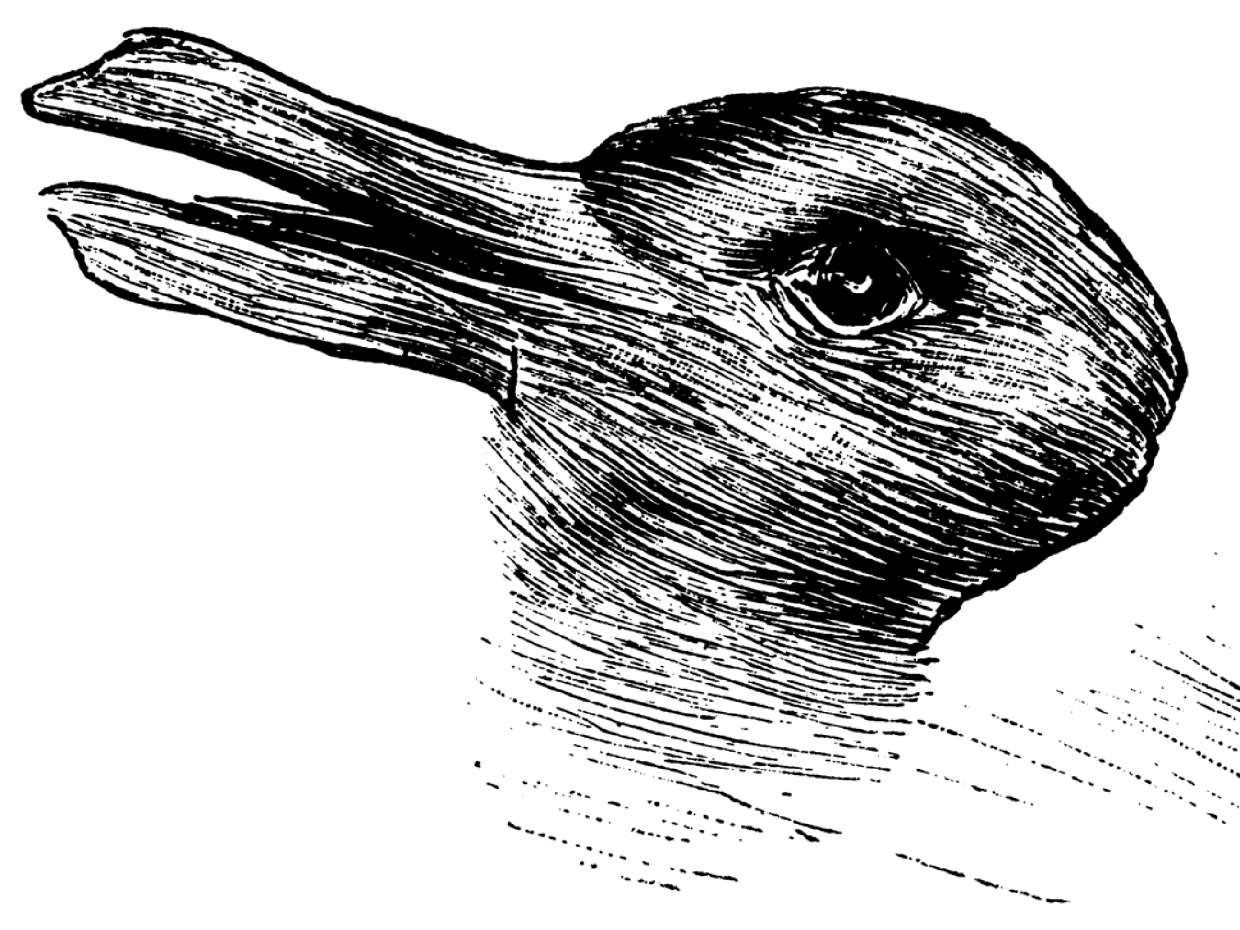
    The shortcomings of language draw attention to fundamental levels of experience in which the sacred persists. Paradoxically, the muteness of sacrality is by Hofmannsthal still described as a language. As put by Kieran Stewart: “The paradox, then, at the very least, is that the only way we can know an ʻobject’ is to infer, modify, and observe it through the mediation of language” (12). The congenial similarities between Hofmannsthal’s fiction and Gans’s theory become clear within the concept of the paradox:

    Paradox is a structure of language; it cannot be conceived without the sign. But neither can the sign be conceived without paradox […] The sign that is in the world represents the world it is in; the sign that stands above the world remains within the world of the sign. (Signs of Paradox 35)

    It is that the language in which I might have been granted the opportunity not only to write but also to think is not Latin or English, or Italian, or Spanish, but a language of which I know not one word, a language in which mute things speak to me and in which I will perhaps have something to say for myself someday when I am dead and standing before an unknown judge. (Hofmannsthal 127–28)

    The paradoxicality of a mute language in Hofmannsthal mirrors the centrality of the paradox in Gans’s theory. The sign’s linguistic and epistemological shortcomings contain exhilarating phenomenological transformations that consolidate the centrality of the sacred in the Austrian author’s work and potentially in all human culture. To suffer through the most trivial everyday experiences opens up the space that may or may not be empty, but which nevertheless emits an energy that transcends sign systems, and again paradoxically, it was precisely the opening up of this space that gave birth to the sign itself.

    Works Cited

    Gans, Eric. Signs of Paradox: Irony, Resentment, and Other Mimetic Structures. Stanford University Press, 1997.

    –––––. The End of Culture: Toward a Generative Anthropology. Berkeley and Los Angeles, California: University of California Press, 1985.

    Hofmannsthal, Hugo von. The Lord Chandos Letter and Other Writings. New York: New York Review of Books, 2005.

    –––––. The Lyrical Poems of Hugo von Hofmannsthal. London: Forgotten Books, 2017.

    Merleau-Ponty, Maurice. “The Intertwining—The Chiasm.” In The Visible and the Invisible. Evanston: Northwestern University Press, 1968: 130–56.

    Stewart, Kieran. “Origins of the Sacred: A Conversation between Eric Gans and Mircea Eliade.” Anthropoetics: The Journal of Generative Anthropology. vol. 20, no. 2, Spring 2015: 77.

    The Holy Bible. 2001. English Standard Version. Harper Collins Publishers. Crossway Bibles. Print.

    Throop, C. Jason. “Sacred Suffering: A Phenomenological Anthropological Perspective.” In Kalpana Ram and Christopher Houston (eds), Phenomenology in Anthropology: A sense of Perspective [E-book], 2015: 68–89.


  • National Identity

    GA is not meant to replace the social sciences. But it can be of help in the empirical study of humanity by posing a minimal core of cultural behavior that supplies the framework of a human ontology. Humans are constantly creating new political configurations as they create new words and artforms, not to speak of new theories about the natural world. But it is important to have a hypothesis about what in the human is originary and what is derived. This distinction is always relative; the “absolute” beginning of the human is with the deferral of instinctual behavior, that is, the Sartrian néant. But the originary hypothesis allows us to rectify our conception of aspects of the human that have frequently been misunderstood.

    In particular, since the beginning of the last century, the Western world has become habituated to understanding cultural basics from the perspective of child development or ontogeny. For example, Michael Tomasello’s exhaustive study of his own child’s linguistic apprenticeship as a path to understanding human language.

    This tendency has been reinforced by Freudian metapsychology, which provides a template for tracing the child’s acquisition of its cultural heritage. But whatever the value of Freudian and related analyses for the understanding of the individual psyche, their contribution to the broader questions of human ontology reflects and reinforces the bias of Western metaphysics toward considering ontogeny as the fundamental source of anthropological knowledge. Just as GA is critical of the metaphysical perspective that takes language for granted, so its minimalism reveals the error of the ontogenetic approach to the categories of culture.

    Whatever the possible inaccuracies in our model of the originary event, it is evident that language and culture originated in a public, collective setting among men. Although the presence of women at the originary event would hardly invalidate the hypothesis, the event surely did not take place in a family setting. (Masculine) rivalry’s potential violence is its motivational point of departure.

    What this means is not that families, perhaps even monogamous ones, did not already exist, but that the new cultural element that defines the human was created on a public scene. Once human culture, even in its earliest stages, was established, it had to be taught to children “from without,” as a cultural imposition on their “animal” natures. And this imposition cannot be reduced to the enforcement of the power of the father and/or mother over the infant. The “superego” is not simply the introjection of the parental/paternal will; it is a communal discipline that is in principle imposed from without on the parents as well, often via a complex family hierarchy.

    This point is crucial to the “question of identity.” An individual’s identity is best defined by his identification with the community that he experiences as primary in the fundamental cultural role of the deferral of violence. It is principally in the context of this community that the subject is empowered to acquire his unique selfhood, his firstness as intrinsic to the welfare of the group as a whole. Hence in today’s world, divided into nation-states, our primary identification is normally with our nationality, which occupies the highest level of the hierarchy of public order that, as we say, holds a monopoly on violence.

    The modern conception of nationhood can be traced to the Hebrews (see Chronicle 468), although nearly two thousand years went by before “the Hebrew nation” was updated to the Western model. In the meantime, the Hebrew tradition, as expressed in the “Abrahamic” religions that derived from it, offered two principal modes of communal identity.

    In the Christian West, religion is put on a separate plane from citizenship (“Render unto Caesar…”), and this essential feature of “Westphalian” nationhood has been the secret of success of these nations—as well as the source of their disastrous conflicts. Israel today is itself essentially a “Westphalian” nation, a fact that helps explain the difficulty of the Arabo-Islamic world in accepting its existence.

    For the troubled nature of Islamic state governance reflects the univocal nature of Islamic universalism, which considers the entire human world to belong “naturally” to the Umma, not as what we call a “religion” but as a total way of life—Sharia in place of “the law of the land.” Those who inhabit the “nation of Islam” identify less with individual countries than with local, tribal entities, the source of familial rather than cultural values.


    The trauma of the two world wars has made European, and to some extent, even American nationalism problematic. The uniquely terrible violence unleashed in WWII made not only Germany but the Western countries, users of the atomic bomb, wary of asserting national power and as a consequence, of the national principle in general.

    The contemporary US still retains its sense of itself as a nation. Yet the rise of “identity politics” shows, not that these sub-national identities (race, gender, etc.) threaten to form distinct communities and (pace California) secede from the USA, but that in an increasing number of cases, individuals invest their firstness in identification with them in opposition to the nation, an attitude recently symbolized by a number of black football players’ highly publicized refusal to stand for the national anthem.

    In these victimary identities, the individual presents himself as obliged to make unusual efforts to compensate for his oppressed status. But as opposed to the traditional Horatio Alger narrative of overcoming handicaps to achieve success, that is, to rejoin the citizenry of the nation, the point is to demonstrate one’s permanent alienation, the affirmation of one’s victimary identity—which only then becomes the basis for an appeal to the nation as a whole. Barack Obama’s election to the presidency is the archetype of this transformation.

    And we need not accuse Obama of hypocrisy or dishonesty to note that, rather than embodying the transcendence of identity politics, as he had proclaimed and as most of his voters had hoped, his administration was the most racially divisive since the days of the 1964 Civil Rights Act. No doubt many middle-class blacks, affirmed in their self-image by Obama’s victories, experienced a welcome reduction of tension between their minority identity and their primary national one; but those who preferred a stance of victimary resentment were encouraged in their decision by many of the President’s policy decisions and individual actions.

    Yet whatever the depredations caused by these victimary attitudes, which have parallels among feminist, gay, and now transgender groups, these groups remain at least nominally within the American framework of “double nationality”: we are all Irish-Americans, Italian-Americans, African-Americans, Jewish-Americans, gay Americans, even “Native” Americans. And the current nastiness toward “whites,” however ugly, is not all that different from the resentment against “WASPs” in earlier generations. The fact that, even with its increasing leftward movement, the Democratic Party remains within the mainstream of American politics suggests that its political evolution will be drastically affected by any sign that the American public no longer finds such attitudes acceptable. Thus the next couple of elections will be crucial in determining the party’s, and the nation’s, future direction.


    The European situation is quite different. The American notion of “identity politics” would seem to have no real equivalent there. In this recent example, the term “identity politics” is used by a British defender of Brexit to criticize the formation of separate national communities, minorities not within but outside what can be called the British nation. Whereas in France, the term politique identitaire, in a sense diametrically opposed to the normal American one—which corresponds rather to the French communautarisme—refers specifically to the assertion of a “French identity” defined by souchiens, French of “Gallic” or at the very least, West European stock.

    Europe’s current demographic crisis is easily misunderstood. Seen simply as a statistical trend, it would indeed appear to be leading to the “replacement” that Houellebecq’s Soumission satirizes, and that my favorite quote from Jens Orback, Swedish “minister of democracy”: “We must be open and tolerant toward Islam and the Muslims because [sic] when we become a minority, they will be so toward us” (see Chronicle 337), takes for granted.

    But such replacements of one people by another do not take place imperceptibly. The electoral upheaval in Italy and that currently threatening in Germany and elsewhere on the continent, not to speak of England, where Labour’s scandalous pandering to Muslim antisemitism would doubtless lead to some very unpleasant interactions were Corbyn to become prime minister—although my money is on Boris Johnson, who looks eerily like a Latin-quoting Trump—are bound to lead to the increasing emergence into public view of the resentments currently being suppressed by government leaders fearful of any suspicion of “Islamophobia.” (I still find it difficult to grasp the mindset of the police and other officials who hushed up the Rotherham and related sex scandals. Fear of besmirching the town’s reputation or even of losing Labour votes hardly suffices to explain the shameful callousness of their collective inaction over many years, for which they have suffered virtually no punishment.)

    But this is just the tip of the iceberg. Muslims were a little over 8% of the Rotherham population in 2011. What will happen if they become 25, or 50% of the population? One doesn’t need a crystal ball to appreciate that in another generation, the immigration policies of Poland and Hungary will appear providential in comparison with the results of Merkel’s Wir schaffen das! or even with France’s far less artificial absorption of large numbers of immigrants from Africa and the Middle East.


    Yet I do not believe that even Germany, still weighted down by guilt for a war that ended over 70 years ago, will simply resign itself to disappear. This can still be prevented if the new “nationalist” parties, assuming they attain a share of political power, make a concerted effort not only to limit new immigration and enforce functional borders, but to integrate (legal) immigrant groups into their national communities. It is too early to dismiss the possibility that the kind of integration that has succeeded in the US, and continues to function among the Spanish-speaking population—now our largest “minority,” but in no way comparable in disaffection to European Muslims—will be able to succeed in Europe.

    I do not believe that Pierre Manent’s idea (see http://www.rene-girard.fr/57_p_44718/chronique-d-eric-gans) of creating a “French Islam” is an unrealizable goal, despite its incompatibility with the Islamist aim of world conquest. It seems clear that the widespread “radicalization” of young Muslims in Europe reflects less the advance of Islam than the démission of European patriotism—the kind of “post-nationalism” that Ryszard Legutko bewails in The Demon in Democracy (Encounter, 2016 [2012]; see Chronicle 532), and that Poland and Eastern Europe in general have taken great steps to avoid. Islamic fundamentalism, like the victimary fundamentalism of the American left, reflects the failing of our modern societies to affirm their own national cultures, not the dynamism of their opposition, obliged to resuscitate often barbaric traditions of the pre-modern era. Chinese neo-socialism offers a more serious modern alternative, but short of armed conflict, the West as a whole can only benefit from some genuinely symmetrical competition.

    Let us hope that the current wave of “populist” nationalism in Europe signals a reaffirmation of Western Civilization—the least successful civilization with the exception of all the others. Only a self-confident and inclusive politique identitaire can fulfill Europe’s ambition to make its multi-national community the model for the next stage of the world’s political evolution.

  • Questions of Identity

    There would have been no difficulty in realizing the “moral model” of human reciprocity on the originary human scene. The beginning of representation that is the basis of human culture can only have occurred in an event characterized by the mutual presence of a small, face to face group, presumably of hunter-scavengers coming upon a source of food. At this stage, there can be only one “language,” one “religion,” and a symmetrical reciprocity that in principle links all the members of the originary group, in contrast to the previously existing linear animal hierarchy. At this stage, the cultural identity of the members is equivalent to their humanity.

    But once there is more than one human community, the “question of identity” becomes intrinsically problematic. As we know, in tribal cultures, the typical reaction to members of other groups who don’t speak one’s language is to consider them as either less or more than human. Yet that this can occur only once representation has created the human culture of the “first” group explains why the moral model always retains the promise of a virtual universal equality, even if in the real world, affirming the humanity of members of other groups is not a necessary consequence of the universality of the model.

    I doubt if many humans today would simply deny the humanity of members of other “tribes” or speakers of other languages. Yet even in our “global” civilization, where all airports look alike and there are McDonalds and Starbucks (and Hermès and Armani) everywhere, no one is truly a “citizen of the world.” Everyone belongs to a number of human categories, but the central tension is between two versions of human universality: the principal identification with one’s own society—in the modern world, normally one’s nationality—and humanity as a whole.

    Today in much of Western Europe, and even in some sectors of American society, although national identity may not be denied, it is no longer taken for granted as a positive value. The most visible sign of this is the extreme reluctance on the part of the European professional class to enforce national or even civilizational norms in the face of a new kind of mass immigration that no longer in principle involves the desire or even the intention to assimilate to the norms of the host culture.

    In the US, virtually whose entire population has been built from immigration, this problem is less critical, yet the “progressive” segment of the professional class shares, albeit to a lesser degree, a similar resistance to “populist” nationalism. To the extent that the flavors of PC, White Guilt, or what I call the victimary differ, the American version is focused not on former colonies but on “racial” differences, to the point where a new “brown” race has been invented that, in contrast to the old categories of Caucasians, Africans, Asians, and Amerindians, includes in its stigma the non-European Caucasians along with most non-Caucasians.


    If at the moment of origin, there can have been but one human community, today, the ideal of a “global” society implies another kind of cultural universality. One seldom hears any longer the term “consumer society”; we have seemingly absorbed the notion that our cultural persona is the product of our personal shopping strategy in the vast cultural megastore or grande surface. This is not the slavery of “conspicuous consumption” but the freedom of self-creation available to all but the most deprived in advanced societies, although only to elites in the poorer countries. Even religion in our age need not involve a lifelong commitment; “new age” religions and related “lifestyle choices” are indeed closer to consumer goods than to the inherited religions of the past.

    But no doubt the reason that we speak less of the consumer society is that we sense that in Western democracies, this aspect of modernity is problematic only for those who engage in PC denunciations of “cultural appropriation.” The problematization of personal identity is centered today outside the framework of one’s self-image, in the primary domain of nationality. It is far less urgent in the US than in Europe, yet in a critical aspect, the problems are comparable, and their difference gives us an insight into the real core of the identity issue.

    In Europe, the identity problem is posed starkly by the radical demographic shift that in many countries appears to be fulfilling the prophecy of “Eurabia”—to which we should add a more recent but ultimately more threatening one of “Eurafrica.” The youth of these countries, whose women average well below the self-perpetuating 2.1 children, is increasingly non-native, and above all Islamic; in a recent statistic, fully 45% of German children under 5 were born to immigrant parents. The long-term questions of identity thus posed can hardly be faced in the framework of a cultural supermarket.

    In the US, neither national identity nor demography are in crisis. But as if to demonstrate that the identity question has a deeper basis, American “elite”-progressive society is increasingly obsessed with “identity politics,” for which a whole new stigmatizing vocabulary, from Islamophobia to transphobia to cisgenderism, has been invented to stigmatize those who fail to express the proper obeisance to the imperative of victimary or “White” guilt.

    Seen in the light of the European situation, one is tempted to say that the specifics of White Guilt are less important than the fact of it: the advanced societies of the West—although not those of East Asia, where the Japanese experienced Hiroshima and Nagasaki as wiping the slate clean of their sins in WWII in a way that Germany, for all the destruction of cities and life, did not—are uncomfortable with firstness. Whether the guilt is post-colonial or “racial” is less important than the discomfort of being a collectivity proud of its unique distinction from others. As opposed to either Christian humility and indifference to worldly advantages, or to Buddhist renunciation of worldly desire, this guilt is a specifically post-modern, post-war, attitude that mirrors the resentment, real or imagined, of those groups that this firstness marks by its exclusion.

    Seen in this perspective, the current problematization of European identity is less a matter of governance than of fundamental social identity. Hence, in contrast to those who see the “new nationalism” of Eastern European countries like Poland and Hungary or of parties such as the AfD in Germany, the FPO in Austria, or the Lega Nord in Italy as posing dangers of neo-fascism, I find this awakened patriotism encouraging.

    For the “globalist” ideology that denies national identity has no real alternative to offer. There is no “global” nation, merely humanity itself, to which we all belong, but not as members of a community. One can lose touch with one’s cultural origins, but no “global” culture, nor even a “European” culture, can replace them.


    In my recent discussions of victimary thinking, I have described the strictures of “PC” as seeking to assimilate the human world to a universal “polite conversation,” one that I would be tempted to call a “tea party” had this term not been preempted by a very different political phenomenon. This one, in any case, would recall not the very unrefined “Boston Tea Party,” but rather the one that Mao said that revolution was not.

    But with reference to Chronicle 460, I would add a nuance to this designation. The bottom line here, as in all reflections on human inequality, remains that firstness contradicts the originary moral model and thus always arouses resentment. But victimary thinking, rather than defining human culture as an egalitarian liberation from animal hierarchy that only subsequently “falls” into hierarchy and inequality, prefers to see the origin of language as always already a mode of oppression.

    This becomes clear from Derrida’s discussion of the origin of the “myth of presence,” where by assimilating language to writing (écriture) he extends Rousseau’s Platonic-“grammatological” critique of writing in contrast to speech to language in general. For Derrida, the Rousseauian parallel between the Fall and the origin of private property and inequality (Le premier qui dit, ‘Ceci est à moi!’), is denounced as a myth; there never was an Eden nor was there ever a non-oppressive language.

    As I have shown, this is a contresens. Language is a liberation, and what Derrida calls the myth of presence is a parasitic accretion on originary linguistic presence which is, precisely, inhabited by différance. All the “errors” of contemporary victimary thought are contained in this politically motivated act of méconnaissance— as if this demonstration could have any more effect on the victimary fundamentalists than debunking race theory would have had on the German electorate in 1933.

    I insist on this point because it is not just a nuance. Instead of the reflection of a “naïve” desire for equality and a return to Edenic love over “fallen” resentment, victimary thought is resentment all the way down, as past and present socialisms have always been. Grounded as it is on an anthropology that begins with oppression, for which so to speak the Nazis and their victims have been there from the beginning, it is no wonder that socialism has produced so many monstrous tyrannies.


    The question of defining a nation is not one that can be resolved by theorizing about “liberalism” or “populism,” but it can be clarified by reference to the origin of the national concept, which in the West—the specificity of Asian cultures must be left aside for the moment—is tied to the recognition of the One God of the Hebrews.

    As I pointed out in Chronicle 468 and elsewhere, the very idea of the nation is linked to the new relationship of “chosen-ness” or firstness established between the Hebrews and the One God, in contrast to both the early “compact” kingdoms and the “ecumenical” empires that followed them. It is notable that Christianity, whose kingdom “is not of this world,” never generated a model polity of its own. On the contrary, by maintaining a gap between religious and secular state functions—the very notion of religion as a distinct institution within the state is a Christian one—Christianity spawned the world’s most highly successful civilization. Each Christian nation is, as God told the Hebrews to be, “a light unto the nations,” first in its own way.

    If Western civilization is today in crisis, this reflects the recoil from “nationalism” as well as from Christianity occasioned by the Holocaust, primarily in Germany, but also among the European Allies, and whose most profound expression is their suicidal demographic deficit.

    I think that we can measure the diminished ability of the participant nations of this civilization to preserve it, politically and above all, demographically, by their refusal to accept Israel, the reestablished state of the original, Hebrew nation, as a model or even as a partner. The persistence of European anti-Zionism, which is, as one hardly needs to demonstrate, the contemporary mode of Jew-hatred, reflects more than the growing “Eurabian” population. It suggests a willingness to abandon the “Westphalian” system of nations, with its roots in the Old Testament, in favor of a de-nationalized Europe, in which by default the only strong cultural identity will be that of Islam—the ironic utopia sketched out in Houllebecq’s Soumission.


    But there are signs of renewal, and not just in the Eastern bloc. It is a serious mistake to assimilate European nationalists to Nazis, when the Nazi bogey-man, having long outlived its contribution to postwar democracy and tolerance, continues to serve only as a stimulus for Western White Guilt and oikophobia. Need I elaborate on the obvious point that, to the extent that normal patriotism is shunned as a return to fascism, only fascists will dare present themselves as patriots?

    It seems to me that, following the Israeli example, the world’s civilized states can survive only if they return to the Westphalian model, for which the two fundamental identities of each member of society are, on the one hand, as a member of his or her nation, and on the other, as a member of what had formerly been Christendom, but must now become, as it always was implicitly, humanity as a whole.

    As for “Europe,” if it can somehow unite its component nations into a single federal one, well and good. But seventy-odd years after WWII, the “United States of Europe” seems increasingly unable to demonstrate its viability.

  • On Rereading the Chronicles — A Birthday Message

    I have spent the past few weeks proofreading, and rereading, past Chronicles, looking for formatting and other errors, and have now gone through three quarters of them. Corrections are thankfully few; I imagine there will be more problems when I start going over the Anthropoetics articles, with footnotes and hyperlinks. There’s really no substitute for doing this myself.

    Next Tuesday I will be 77, so please indulge me in some subjective remarks.

    I must admit I can’t help being impressed with the variety and overall quality of these little essays. They deal intelligently with a large number of issues and refer to quite a few other thinkers; there are also a good number of discussions of films and other esthetic issues.

    But rereading them only makes more evident that, “popular,” that is, non-professional, culture being driven by the need to discharge resentment, one’s ideas do not attain any degree of “virality” on the Internet or anywhere else unless they enlist the resentment of a well-defined clientele. The fact that in the past few months, stimulated largely by Adam Katz’s GABlogs, there have been signs of an interest in GA from the more intellectual domains of the alt-right essentially reflects the fact that this group, unlike either the majority of “progressives” among our intelligentsia or even the conventionally conservative remainder, finds food for its resentments in GA.

    GA has had on university and mainstream publicity departments the effect that DDT once had on mosquitoes. It is a fact that I cite here with no intent of vainglory that there are precious few, if any, living humanists whose work has been the basis for an electronic journal that has appeared regularly for over twenty years, as well as a dozen consecutive yearly meetings of an association (the Generative Anthropology Society and Conference). Yet neither UCLA nor any other institution has ever devoted a single line of publicity to these activities, let alone to me personally.

    Not that I take this personally. It is simply that there is nothing in the university world, in the media world, and certainly not in the more diffuse world of victimary resentments, that could find its nourishment in these ideas, however clearly I believe my polemics with other thinkers demonstrate the qualitative superiority of GA to other ways of thinking (see, for example, Chronicles 567, 525, 519, 490, and 444. You can search the names of other thinkers at https://anthropoetics.org/apsearch/).

    The old academic world that I knew as a student, and that endured through most of the 1970s, was incomparably less politicized than ours, which is to say, far less directly resentment-driven. In those relatively halcyon times, when there was not yet an oversupply of PhDs, the “academy” saw itself as an unproblematically elite operation, an “old boy” system—which also included a few women, like my medieval professor and later Indiana University colleague Anna Hatcher—but which had above all a sense of its own cohesion without a need for the unseemly struggle for visibility that has since become the norm. Just to give a counterexample, in 2010 or so, the last “8-year review” of my department at UCLA before I retired, prepared by a local committee that included one or two outside reviewers, did not even mention my name, although I had published about as many scholarly works as all my colleagues together. But since I no longer attended MLA meetings and wrote about other things than French literature, I was no longer considered part of the “profession.”

    I would love to be able to say that my nonetheless relatively successful academic career should serve as an example to those concerned more with developing their ideas, in particular those of GA, than with the kind of glory available to members of the MLA. But the economics of the profession are far from what they were when I came to UCLA in 1969. Today someone with my qualifications, and my negative “diversity” value, would have little hope of landing a job in a major university. Nor can I honestly present GA as a key to academic success.

    Whereas in the sciences, beneath all the politics and grantsmanship, there is a solid objective core that permits scholars of demonstrated ability to explore byways that may just turn out to be productive, the social sciences, and particularly the humanities, have no such grounding in external reality. In the period that was ending just when I began my graduate studies, literary scholarship claimed to address a well-defined, limited set of tasks: compiling critical editions, writing “literary history,” providing straightforward commentaries on literary works grounded on scholarly knowledge of their historical context. Those were the days when senior professors, as I believe they still do in France, would tell their degree candidates that il y a une thèse à faire on a certain topic: an obscure manuscript, a posthumous publication, or to be particularly daring, a new interpretation of a well-known work, based not on personal insight or “critical theory,” but on some newly discovered historical data.

    I’m sure I would not have been happy under this old system, but it had the advantage of a serene objectivity; reputations were made by fulfilling a relatively transparent set of criteria, not by making oneself visible at conferences. In a sense, I had the best of both worlds; I began my career near the start of the era of la nouvelle critique, but it was not yet the time of “French theory”; there was still room to be original without being fashionable.

    In the past few decades, and increasingly in the last few years, the humanities and social sciences have been overwhelmed by victimary politics, both in their choice of subject matter and in the increasingly narrow focus of their analytic perspectives. The one new area that strikes me as promising is what they call at UCLA and elsewhere the “digital humanities,” the use of computing power to do such things as reconstruct models of ruined buildings on the basis of fragmentary evidence, detect word-patterns of different kinds in masses of text, or mine Twitter to study reactions to films or books. No doubt such “big data”-driven analysis is indeed a way of the future, one also that blessedly allows the researcher to avoid the need to foreground political judgments about the works he studies. But GA’s “originary thinking” has other ambitions.

    I tend to agree with those who say that these Chronicles— which I hate to hear called “blogs”—are really my most important work. They add up to well over a million words, and cover most of the terrain of GA, often more subtly and in greater detail than any of my books. Indeed, my last few books, with a few exceptions—my biography of Carole Landis, my online sketch of “the Girardian roots of GA”—have been compiled from revised versions of the Chronicles, and the new edition of The Origin of Language, which should be published shortly, was composed in Chronicle– sized chapters and published in this series. Like Derrida, if not Girard, I am more comfortable as an essayist than as a book writer. These essays, read by a few dozen people, yet available to countless millions, embody the paradox of a set of ideas too “minimal” to be accepted or even noticed by the contemporary intelligentsia.

    How many of my readers, when confronted by the originary hypothesis, have reacted by conjuring up a rival hypothesis of their own; after all, the scenario is wholly speculative. And once one has done this, instead of realizing that the details of the event are relatively unimportant in contrast with the principle that there must be an event, the typical reaction is: if I can think up an alternative scenario in ten minutes, then there’s nothing special about this one, and that just demonstrates that the whole business is not really serious. Paleoanthropologists work for years digging up bone fragments, neuroscientists spend years exploring brain synapses, and this guy just comes along and invents a theory out of whole cloth and expects everyone to go along with it… And yet my theory plausibly explains the origin of human language and culture and religion, and the others do not.

    Readers of my Girardian Origins of GA will recall that in 1978, when Girard invited me to Hopkins as Visiting Professor in hopes that I would join the faculty there, for my graduate seminar, instead of giving a normal course on literature and/or literary theory—such as the one on Derrida and Girard that I had given the previous year at UCLA—I decided to spend the semester expounding my theory of esthetic paradox as developed in my Essais d’esthétique paradoxale, which had just appeared, without otherwise supplying a reading list. In retrospect, this was a crazy thing to do. Yet I had been Chairman of my department at UCLA for three years; I was not fundamentally irresponsible.

    In retrospect, my behavior seems less a simple conduite d’échec than the manifestation of a kind of unconscious wisdom: my career was surely far more productive at UCLA, where I was not in competition with anyone, than it would have been in the hothouse atmosphere of the East Coast, even before it heated up still more a few years later with the spread of deconstruction and “French theory.”

    And however irrational my gesture may have been, it was also an act of faith: if I was to fulfill my destiny, I must follow my star and not play it safe. As it turned out, my theory of esthetic paradox was, although fundamentally sound, of limited scope. But as a result of that visit and the reflections that it inspired, I produced The Origin of Language and “discovered” GA.

    That my writings have not been widely read or discussed is not a source of joy, but from the perspective that resentment is our default attitude toward others “in our field,” it has been a blessing in disguise. I imagine that if the authors of the books I criticized had ever thought to read my criticisms, they would have responded in kind, and I would have been forced to waste time on polemics that, as they say, would have generated more heat than light.

    As it is, I have felt free to present my ideas without fear of offending anyone, yet knowing that they are available to all. Given that I was fortunate enough to enter the profession at a time when good positions were available and, whatever my follies, now have a perfectly adequate income for my old age, this relatively serene existence has been far better suited to me than the mantle of “celebrity,” even in the limited sense in which it falls on the shoulders of intellectuals.

    Blaise Pascal, best known in the United States for his “triangle” of binary coefficients, was, among other things, a pioneer of the theory of probability. The central religio-philosophical concept of his Pensées was that of le pari, the wager, which as a good Jansenist, he attempts to persuade the libertin or skeptic to make on the existence of a benevolent God, even if, as such a person might think, the chances of God’s existence are vanishingly small. For, as Pascal puts it, if we lose, we lose only our finite life, which will end in any case, but if we win, the payoff is infinite. (I assume that at the time he wrote this, no one had yet thought up the St. Petersburg paradox, which gives the gambler a spuriously “infinite” expectation.)

    The paradoxical esthetic on which I wagered my appointment at Johns Hopkins was not a good bet; but it led by a mysterious path to the formulation of the originary hypothesis on which I have wagered the remainder of my career, materially secure in my tenured position at UCLA.

    I am happy to say that rereading these Chronicles written over 23 years gives me the feeling that I’m winning my bet. If the intellectual world is not able to accept these ideas today, even if it never accepts them, I have no doubt that if humanistic thought is to have a future, it will be forced to retrace the path I have taken.

    Above all, I am grateful to the handful of brave spirits who have accompanied me on this journey. These scholars are making their own contributions to generative anthropology, which I have every hope that they will carry forward into the next generation and beyond.

  • Originary Ontology

    The nice thing about religious discourse is that it puts everything in human terms. Once God has finished his creation, the world has become a human-friendly place, and fixing up the equations—the six days becoming so many billion years—is of secondary importance. But when, in the absence of religious humility or petitio principi, philosophy attempts to “understand” the world, that is, to describe it in words, it cannot escape the epistemological conundrum of connecting these words to a non-divine, that is, a human source of meaning. (Entre parenthèses, it is significant that there is no neutral term for religious discourse. Either one believes it, in which case it is God’s word, or one calls it myth. Girard’s use of the term “biblical” to distinguish Judeo-Christian discourse from that of “pagan” myth is as far as one can go before accepting the necessity of an anthropological hypothesis of our human/cultural/religious/linguistic origin.) Philosophy as a self-conscious activity begins with Plato’s Socrates asking not about “the world” but about the meanings of words, as we may assume the real Socrates did in the Athenian agora. And although his definitions of Courage, Beauty, the Good and the rest provide a model that the entire history of philosophy will only refine, the ontology on which it is purportedly based, the doctrine of Ideas, is founded on a quasi-sacred myth. The idea that what are in fact the words of human languages should be understood as Ideas, independent of our existence, casting shadows on the wall of our “cave,” is not a fanciful sidebar but the very core of our philosophical/metaphysical tradition. Well, you may ask, how can we do better than this? How can we have the chutzpah to challenge the entire philosophical tradition, not on the basis of a scientific discovery, but simply by a priori reasoning? And yet, the answer is simple enough. Platonic metaphysics, the Western philosophical tradition (addressing “Eastern” traditions is another matter, although I think that my reflections on Buddhism (see in particular Chronicles 515 and 516) provide at least a point of departure) is founded on the need to deal with its subject matter in medias res. Whatever our image of the “armchair” philosopher, Socrates was, not coincidentally, anything but. He saw as his task not to elaborate an abstract ontology, but to find a basis for resolving the problems of the polis. It is by no means coincidental that the Republic is Plato’s longest and most frequently cited dialogue: philosophy in the service of creating the “good society.” As, in another sense, is GA. But the past two millennia have taught us that we have to begin further back than the declarative sentence. Kant spoke of his “critical” mode of philosophical thinking as a “Copernican revolution,” an introspective examination of our internal scene of representation that would lead in two generations to phenomenology, and thence to Existenzphilosophie, which would reintroduce the “metaphysical” concept of Being, no longer founded on biblical and/or Platonic authority, but as the product of our, or Heidegger’s, ontological intuition.
    Aware of the quasi-mythical basis for what would come to be called “Continental” philosophy, analytic philosophy seeks to avoid any such appeal to “Ideas” and simply to explore as rigorously as possible the truth-value of propositions. But this attempt to liberate thought from metaphysics misunderstands the real foundation of metaphysics—which is, precisely, the proposition. When analytic philosophy spares us from trying to understand what Heidegger means in calling man “the shepherd of Being” by dismissing such sentences as “meaningless,” it demonstrates only that its concept of “meaning” is too narrowly constrained by propositional logic to encompass the anthropological truth Heidegger’s statement attempts, however “poetically,” to express. Analytic philosophy misses the point, as pointed out by Hamlet to Horatio in I, 5, that it is this anthropological truth that philosophy and ultimately, all human thought aims to address, be it even by attempting to describe the activities of the “natural” world. Whatever the value of the results of analytic philosophy, one thing it does not and cannot do is explain the foundation of the human difference/différance from the rest of nature, a difference that is both historically and logically prior to the existence of the proposition or declarative sentence.

    Now that we have come to the fortieth anniversary of my original formulation of the originary hypothesis during my visit to Johns Hopkins and René Girard in 1978, it is time to make the point that this simple principle is and remains the unchallenged if not unchallengeable basis for an originary anthropology. It provides an explanation of the human that requires no Ideas to descend from heaven, let alone the whole of the language in which we express ourselves.

    For the entire history of philosophy presupposes, and cannot even put seriously into question, that not merely arithmetic and all the rest of mathematics, but language itself are systems that have existed in a virtual state from all eternity, awaiting “intelligent” creatures like ourselves (and  the scientific community appears certain, on zero evidence, that other, possibly more intelligent creatures exist elsewhere) to be downloaded into our brains like so many Apps.

    Nor can the human or “social” sciences explain, or even formulate in their own terms, the différance by which we pass from the en-soi to the pour-soi, a phenomenon that the philosophers at least can describe, even if their science cannot encompass its origin.

    What I have called the “moral model,” the scenic configuration that provides a plausible origin for morality along with language and religion, in contrast to John Rawls’s “original position” that provides the ingenious basis for his model of justice in a necessarily unequal society, is not a thought-experiment, but a genuine hypothesis. The originary hypothesis describes an event arguably similar in its basic pattern to one that must have taken place. Its connection with our profound sense of moral equality, “that all men are created equal,” is not an a posteriori construction, but flows plausibly from the configuration of the hypothetical originary event. Similarly, whereas Sartre’s brilliant description of the pour-soi in L’être et le néant is grounded only in the author’s “phenomenological” intuition, the originary hypothesis offers an evenemential explanation for its emergence.

    Whatever the advance of Kant’s categorical imperative over religiously guaranteed morality, it remains an external imposition, one that can be “proved” only as one proves Euclid’s theorems, on the basis of prior postulates. The moral model, as I have proposed it, does not derive from a series of reasonings; it is realized in actu in the originary event as I have described it.

    Our conviction of moral equality and the symmetrical configuration of the originary scene reinforce each other—just as our behavior in social exchange confirms Mauss’s model of the “gift,” just as our food-sharing festive behavior confirms the hypothesized originary sparagmos. The essential features of the human condition do not change. This is the principle behind what I have called originary analysis: to seek the source of a category of cultural behavior, conceive how it would have emerged in the course of the originary event.


    We should have more confidence in our history. If we do not, it is because we remain the children of the Enlightenment, unable to discover an immanent basis for human uniqueness, but intolerant of the transcendent element of the sacred that, like the baby in the bathwater, had to be discarded in order to do away with our dependency on religious tradition. But at the origin, the sacred and the significant are the same. The referent that we designate to one another through the sign of language is the embodiment of a signified that exists in another dimension than the objects of our appetite. Call it sacred, call it significant—its existence can be attested only by human speakers of language. Language and the recognition of the sacred that we call “religion,” as Vico, de Maistre, Max Müller, and Roy Rappaport understood, are coeval. And the originary hypothesis offers the first plausible model of their moment of birth within the proto-human world.

    I am confident that if the human species survives, this way of thinking, whether or not associated with my name or with the term “generative anthropology,” will eventually triumph, and will lead to unpredictable advances in every domain of human science.

  • In the beginning was the word: GA as a religious anthropology — Part 2

    John 1:1 — In the beginning was the Word: Ἐν ἀρχῇ ἦν ὁ Λόγος

    Few biblical passages or theological statements are more familiar than this one. Readers of René Girard will recall that he uses this proposition as the epigraph to his Des choses cachées depuis la fondation du monde, where, aided by the midwifery of a pair of disciples, he revealed for the first time his ideas about the Bible and Judeo-Christian religion. This book appeared in 1978, when I was coincidentally at Johns Hopkins as a visiting professor. It was during this visit that I conceived the originary hypothesis that would become the basis of GA, and that conjunction was anything but coincidental.

    Those who did not know Girard back then might not realize that for him, it was not a simple matter to reveal his devotion to the Bible and his conviction that it was not simply an object of faith but expressed an anthropological understanding superior to that of the “social science” of anthropology. In the post-religious climate of the 1970s, Girard hesitated to propose a theory that might lead readers to dismiss him as “merely” a religious thinker. Thus in La violence et le sacré, which had appeared in 1972, he had been careful not to touch on Judeo-Christian texts, or to reveal his conception of the categorical difference between biblical and “pagan” religious understanding.

    But Girard’s anthropology, to which mine owes so much, is nonetheless incomplete; it lacks a theory of language, and more generally, of representation. Its epigraph is not on this account ironic, but fideistic. I have always felt that Girard understood the significance of the logos as the foundation of the human, this being indeed John’s point, but that he did not feel obliged to go into the subject in any detail because, as the rest of John’s sentence makes clear, the logos is not only with God but is itself divine, godly—the real meaning of Θεὸς in John 1:1.

    In any case, I have no need to take a stand on the religious issue, because, as I hope to persuade you, the strength of generative anthropology is that, unlike other anthropologies, it corroborates in anthropological terms the genius of John’s sentence. What makes GA accessible to believers and non-believers alike is that it explains this anthropological truth without pronouncing on the ultimately unpronounceable question of God’s existence. Indeed, and this is a point on which I think believers and non-believers should agree, God’s unquestionable mode of being, whether as an idea or as a person, is that God is. Whether God simply is as an idea, or exists as a “real” being, is a matter of faith, which is to say that it cannot be demonstrated, for if it could, then we would not need faith. But one way, if not of defining God, then of uniquely describing him, is as a being inconceivable without language.

    Thus it is quite significant that John begins not with God speaking, as does the Old Testament, but with the logos, which in Greek designates not just a word but an utterance, a discourse, and language in general. Would that presumably atheistic or agnostic scientists were not too proud to reflect on the wisdom of this priority, rather than reducing religion to an outdated superstition or a Nietzschean conspiracy to provide a spurious sanction to those in power.


    Surely John does not mean to suggest that language precedes the reality of God. But he would appear to agree with me that our first revelation of God, or of the sacred, appears with language. As the late Roy Rappaport understood, although his anthropologist successors would rather ignore the issue, religion and language, the necessary components of the human in the full sense of the term, are coeval. You can’t have one without the other. To experience the sacred is to experience it as a sign.

    Rappaport’s articulation of this question is highly instructive. It is tantalizingly close to that of GA, but as we might have feared, a metaphysical presupposition confuses the issue. I quote from his posthumous masterwork, Ritual and Religion in the Making of Humanity (Cambridge, 1999):

    [A]spects of religion, particularly as generated in ritual, ameliorate problems of falsehood intrinsic to language to a degree sufficient to allow human sociability to have developed and to be maintained. . . .

    . . . I do not claim that religion arose more or less simply as an adaptive response to enhanced possibilities of falsehood, but that certain defining elements of religion, especially the concept of the sacred and the process of sanctification, are no less possibilities of language, particularly of linguistic  expressions in ritual, than are lies, and that religion emerged with language. As such, religion is as old as language, which is to say precisely as old as humanity. (15-16; emphasis the author’s)

    Lying is certainly, as Rappaport insists, unique to human users of language. And it is not altogether false to say that the sacred acts as a guarantee of truth-telling. But in the absence of an originary hypothesis, Rappaport is obliged to think about the propositional quality of truth as linguistically primordial, whereas, as we have seen, it is not. The originary guarantee of the sacred is (pace Derrida) its presence, ostensively designated, and the peace it brings “guarantees itself” and is the source of our faith: our faith in God, and in language, the Logos, which for John takes us back to the originary experience of language.


    What I am suggesting is that the reading provided to John’s text by the originary hypothesis discovers in it a truth that even its believing, reverential readers, let alone its dismissive ones, have not grasped, not even Girard himself who taught us so much about religion’s anthropological superiority to secular thought.

    Thus John begins with the logos, and only once we have the logos do we learn that it not merely was with God but that it was God, or more correctly, it was godly, divine. It is curious that although the Greek text is unambiguous, all of the translations have “God” for Θεὸς, and since the Vulgate, most European translations (although neither Luther’s nor the Polish) invert the two elements.

    John is not using logos as a metaphor. No doubt the various uses of this term by Greek philosophers and Jewish thinkers are not irrelevant; no doubt it can be associated with Wisdom, or the Torah, or the Demiurge who in some belief-systems acts as God’s intermediary in creating the world. But the simplest way of understanding logos here strikes me as the truest to the sense of the word itself; logos means language, not just as an object—Saussure’s langue—but as what we have seen is both a collective and an individual phenomenon, la parole—which in French also means word, although logos in John’s text is translated as le Verbe.

    The fact that logos is more general than any corresponding English word, or no doubt any equivalent in a modern language, even in Latin, means only that it is closer to the essential point that I have been seeking to communicate: that at the origin, what is linguistic and what is sacred, significance and sacrality, are the same. We know God only because we have language, which is why, written from a human standpoint, Genesis tells us that God created the world by speaking. But John insists on the priority of language itself in order that we realize that speech is the fundamental human phenomenon, that whether God exists without humans or not, he shows himself only to humans, and does so fundamentally through speech, by which I mean not just that God speaks to us, but that he shares language with us.

    Hence in my reading of this passage, John is making an anthropological observation: our first experience of God is through language. And our first experience of language is that it is with God, that is, inseparable from God. And then—I would say for a Christian, only with the coming of Jesus—that the logos was or became divine, in the sense not that we must worship the sign, which is idolatry, but that God as a person embodied himself in the logos, and thereby demonstrated that the logos, even in the voice of man, shares God’s immortality. The perishable sign that is uttered and then is no more is nonetheless immortal, for its meaning never dies, and to demonstrate this, Jesus had to embody the immortal word of God in a mortal body that would die but be reborn as eternal.

    Jacques Derrida makes much of the idea that writing, historically late, is nevertheless the fundamental form of language, in the sense that the word is never simply an act of speech, which emanates from a person and vanishes, but the re-presentation of a sign that exists outside of time, its inscription. Derrida thinks that in doing this he is undermining the “metaphysical” presence of the word to the speaker. But what he is really doing is clarifying the very point of metaphysics, which is to separate language from its original, ostensive manifestation, and to enthrone the declarative sentence, or proposition, with its “context-free” truth, as its fundamental form. What Derrida fails to understand is that la différance that he rightly sees as the essence of language is already present, that is, present-as-absence, as what Sartre called the néant, in the originary ostensive sign, the aborted or deferred gesture of appropriation, which does not exist in contact with its object, but must be separated from it by a mental space of non-violent contemplation.

    John diverges from anthropology to privilege a moment of history—the coming of Jesus—beyond its merely historical significance, as a truth taken out of time, although revealed at a specific moment. The Son could not use language as the Father did, to modify the world; he could not empower “let there be light” or even “let this cup pass from me.” But God can take on mortal form because the mere use of language is already the transcendence of mortality. It is through language, where we use words without using them up, that we participate in the sacred, deferring its possession and consumption, and in this condition, which is that of Sartre’s pour-soi, we share in the immortality of the sacred by mastering the force of worldly action, not by exercising it.

    What I am suggesting is that, although for the believer the important thing is to find God, and for the Christian, to find him through Jesus, who used words as we do and yet transcended human mortality, for the anthropologist, John’s sentence is a significant contribution to our understanding of the human-in-general. The priority of the Word is an anthropological truth. We could have no idea of God, whether or not he “exists” outside of our consciousness, without the language in which we formulate the idea, just as we could have no idea of our own being if we could not formulate the cogito—which is inevitably misunderstood as a “logical proof,” rather than an affirmation of the indissolubility of being and language.


    The effort to treat language strictly as an object of natural science, confining its study to its operations, to how it works, reflects the failure of “human science” to concern itself with what is fundamentally and specifically human. Max Müller was certainly correct in his intuition that natural selection does not furnish an explanation for the origin of human language.

    Noam Chomsky’s generative grammar, which ironically lent its adjective to GA, is an impressive intellectual accomplishment, one that dominated the field of linguistics in the US and much of the world for two generations. But Chomsky would never have dreamt of attempting to supplement his grammar of the transformations of the declarative sentence S+P with a speculative theory of the origin of this model from simpler forms. This is just not what linguistics does; linguistics is an empirical science, not an exercise in speculation.

    Yes, but unfortunately, to focus exclusively on the structural analysis of the declarative sentence and its transformations, while a perfectly valid subject of empirical research and theorization, perpetuates the sacralization, the taking-for-granted, of the declarative sentence, the gesture by which I have defined the phenomenon of metaphysics. It is not, to be sure, the responsibility of linguistics to liberate us from metaphysics, but one might think that some of the immense intellectual energy that has gone into exploring the vagaries of S+P might have been spent in reflecting on how S and P might have come together in the first place, given that we can hardly imagine the first humans speaking in “complete sentences.” And the fact that it has not provides us with an important insight into where taboo—where the sacred—lies in this domain.

    John was not a greater linguist than Chomsky, but the logos of which he speaks is, at the very least, not just a declarative sentence. The originary logos is not information. Metaphysics, the realm of propositions and truth-value, is indeed the language of rationality; we cannot reason or do science otherwise. But we need not for this purpose affirm that the declarative sentence is a “natural” structure that humans had only so to speak to download from on high when their brains became complex enough to create “symbols” or engage in “double-scope blending.”

    J. L. Austin made a great step forward by understanding language as a means of “doing things with words.” Like Wittgenstein’s “language games,” Austin’s performatives and perlocutionary effects made us realize that there are elements of human communication more fundamental than the transfer of “constative” information. But neither he nor Wittgenstein drew the final conclusion from their observations, which is the importance of attempting to conceive the minimal, originary use of language. For only thus can we gain insight into the origin of the human, which we by inverse hubris deny was the most important, or at any rate, the most significant event in the history of the universe—its creation in the big bang being something we can theorize about but will probably never be able to “explain” in our own terms. For the first time, a being within this universe became able not just to perceive but to represent and inscribe in a communicable form the event of this origin, and everything else. (Like the taboo about confronting language origin, the passion for SETI, the Search for Extra-Terrestrial Intelligence, reflects the same desacralizing need to learn that “we are not unique”—although it is hard to believe that life, and certainly not “intelligent life,” has existed for billions of years on other planets without our having had any news of it.)


    The originary hypothesis is a model, abstract as are all models. There is no need to assume that things happened exactly that way. What is essential is that something like the things that happened in our model must have happened, and that without them, language as we know it would be inconceivable.

    On this point, with all due respect, it seems to me a mistake to conceive of the originary act of the human as an “emissary murder.” In fact, Girard never actually speaks of an “originary” act, and for good reason. He understands, as did Freud, the scenic nature of the human, and conceives a much more minimalistic model of the scene, but just as he lets the equation of Christ with the logos let him avoid the necessity of conceiving how the logos must have appeared as language before it could be revealed as Christ, he lets the revelation of the murder of God in the Crucifixion—given that for our species alone, the need to discharge the potential internal violence of the human group is more urgent than the external needs for food and shelter—preempt these external needs altogether. If in Christianity the communion wafer replaces the sacrificial lamb, we should not forget what a societal triumph it was for a religious service to renounce animal sacrifice.

    The Christian revelation about sacrifice is that, effectively, its violence reflects our resentment of God and of the human itself. As we might explain the miracle of the loaves and fishes: the peace I bring you is the greatest benefit of all, and in the context of this peace, producing the necessary nourishment for the community is a secondary problem. But not only is there no evidence of human sacrifice in the simplest societies, either today or in those that created the cave paintings, but the continued evidence from our own lives of sharing food as the essential form of human sociability, with cannibalism a rare exception, makes it clear that the function of the originary sign was not to designate a human object of aggression but, on the contrary, to defer the violent appropriation of an object of common desire, such as could only be constituted by an animal that the group wished and needed to divide up and consume in a peaceful manner.


    The fundamental characteristic of human consciousness is the scene of representation, before which the human subject defers appropriative action while contemplating its object across an empty “space” or néant that can be traversed only by the sign. By means of the sign, the experience of the object is shared with other humans, really and/or virtually. This scene is “in me,” but its very essence is communal, just as the language we possess in our own brains would not be there were it not in the first place a means of communication with others. No doubt this specific feature of human consciousness is implemented within individual minds, and there alone; there is no “ether” within which resides a “collective consciousness” that brings us together. But such an ether is not necessary; we have language. Language can exist only as both individual and shared, and can only have come into being via the deferral of “instinctive” action that constitutes human consciousness.

    A plausible hypothesis of human origin must explain not simply the deferral of appropriative action on the part of the participants, but the meaning or significance that this novel relation to an object of appetite confers on it. The desired object is “too desirable” to appropriate. This is our originary experience of the significant, which at the origin is synonymous with the sacred. Because the first sign points to the first significant object in the universe, we can say that the first referent of the first word is God, that the first word is the name-of-God. The word was with God. But a Christian would say that only with the coming of Christ, with the inauguration of Christianity, did it become possible to say, and God(ly) was the word. That is, that God had affirmed not simply his identity with but his dependence on Jesus as the human speaker of the word, without whom “God” would, I won’t say not exist, but not be manifest in the world. As Jesus tells us in John 1:18:

    No one has ever seen God. The only begotten God, the One being in the bosom of the Father, He has made Him known.

    And those of us who are not Christians must recognize the anthropological insight in John’s formulation, that of the indissoluble link between God, immortality, or perhaps better put, trans-mortality, and language.


    The originary hypothesis is not a dogma. But I think I can say without exaggeration that it uniquely accounts for the fundamental phenomena of the human, and of the divine insofar as we have an anthropological access to it.

    That there are no other non-trivial rivals to the originary hypothesis explains why it remains so little known. But its obscurity also, I think, puts a burden on those who learn of it, both to seek to improve on it, which is surely possible, and to make it known to others. It seems to me that it is about time that human science caught up with the first sentence of the Gospel of John.

  • In the beginning was the word: GA as a religious anthropology — Part I

    (Keynote lecture, Warsaw GASC, 2018)

    For the past couple of years I have done a good deal of research for these presentations, learning about Buddhism for our Nagoya conference and Anna Wierzbicka for Stockholm. But for this visit to a nation where religious traditions are taken seriously, I thought it would be more useful to go to the heart of the matter: to attempt to justify the hours of work that the members of this group, of whom Magdalena has been one of the most energetic, have devoted to organizing these conferences—this is the twelfth—and contributing to our e-journal Anthropoetics, which has just completed its 23rd year of publication. What indeed is the point of Generative Anthropology?

    A few years ago I published a book called The Scenic Imagination (Stanford, 2007), where I examined philosophical “scenes” as models of human origin, beginning with Hobbes’ invention of the model that would come to be known as the “social contract.” But Hobbes and Rousseau, writing before Darwin, could not really imagine what becoming human meant. They sought to model the origin of “society” or of the “social order” as a cultural phenomenon supplementary to man “in the state of nature,” and so were obliged to imagine creatures that could simply have never existed: humans having come from the hands of their Creator “before” human society. We no longer realize how devastating the idea of human evolution was, not merely to religious belief, but to common sense. Once we accept that man evolved, we have to imagine, not how “society” could have been inaugurated by men “in the state of nature,” but how ape-like creatures could have evolved into men. For atheists as well as believers, this opened up an abyss in their understanding of human prehistory.

    It also led to an unfortunate war between those who defended the new theory of evolution and those who insisted on the Biblical creation story, whose anthropological virtues became difficult to appreciate when they were deformed into cosmological truths. As a result, our understanding of human origins was greatly advanced in the material domain to which paleontology could contribute, but proceeded far less successfully in the domain of the spirit, the immaterial realm of signs, where the specific quality of human consciousness, with its unique possession of language, has remained elusive.

    Not being a “professional” philosopher but, like my teacher René Girard, a professor of literature and a strictly amateur anthropologist, I have long been disappointed by the fact that the “scientific” study of the human has made so little use of the analyses of human consciousness that have been the province of phenomenology since Husserl, and which attain with Sartre’s L’être et le néant an admirable subtlety. These analyses help us to explore, not simply how we “use” language, but how language, and human representational culture in general, including religion, might have gotten started. As for Jacques Derrida’s project of deconstruction, I think we can sympathize with its often excessive coquettishness once we understand that this is not just a sign of cool, but a defense mechanism against the specter of the actual, as opposed to the illusory, overcoming of the “metaphysical.” Thinkers have been talking about this overcoming for two hundred years, yet because its essence remains misunderstood, metaphysics still reigns supreme in the domain of philosophy, and a fortiori in that of empirical science, despite partial breakthroughs such as pragmatism or speech-act theory.

    After nearly forty years, I must express both pride and frustration that what I hope to make you see as the simple lessons of the originary hypothesis, which have come to be called Generative Anthropology, have been totally ignored by the “world of the intellect.” An idea thus enduring yet ignored can only be either trivial, or epoch-making. And so I feel obliged to seek to persuade those who would listen that it is the latter, not the former.

    All the talk about language since the days of Frege and Saussure has concentrated on its present or historically accessible “mature” forms, and discussions of language origin have been limited to retrodictions of its earlier states, on the model of the reconstruction of Indo-European from its component languages. Lists of proto-sememes and theories of “original” language families, such as the “Nostratic” hypothesis, have been formulated. But what has not been done has been to propose, in all its magnitude, a hypothesis of how language might have begun as both a collective and an individual phenomenon.

    We have been treated to some incredible absurdities from researchers who would never dream of releasing “serious” ideas without copious data sets. I will give a couple of examples that will be familiar to readers of my Chronicles.

    Daniel Everett tells us about the first use of language, in his unproblematically titled How Language Began (2017), that “it is not that difficult”:

    Language . . . is not that difficult, in spite of a long [that is, Chomskian] tradition going back to the 1950s telling us that it is extremely complicated, a veritable mystery. What we have seen, to the contrary, is that language is symbols and ordering at its core, and that those are not tough ingredients to develop for brains like ours. (112)

    Signs such as “no shirt, no service,” or film titles such as “Eat, Drink, Man, Woman,” serve Everett as models of just how simple language can be—although in the latter case, the whole point of the ungrammatical title seems to me to suggest the limitations of human culture and reason in dominating our biological drives.

    Or as Gilles Fauconnier and Mark Turner put it in The Way We Think (2002), once the brain reaches a certain cognitive level, language “emerged naturally”:

    Language arose as a singularity. It was a new behavior that emerged naturally once the capacity of blending had developed to the critical level of double-scope blending . . . (181)

    —”double-scope blending” being their term for the capacity of the individual mind to combine ideas from different registers—as though “ideas” existed at all without language in which to express them and a community with which to share them.

    The immense gap between what Peirce called the symbolic sign and its indexical forms as exemplified in animal “languages” is simply ignored. From a dogmatically evolutionary standpoint, language and culture merely reflect the increasing complexity of our brains, as in Engels’ “passage from quantity to quality.” Once you have a certain number of brain cells and a certain number of synapses—and it is easy to imagine why natural selection would favor their increase—you will be sending vehicles into outer space before you know it.

    Once one takes a few moments to reflect on the utter inadequacy of these assumptions, one realizes that the question of language origin, which seems to provide rich food for thought—and which inspired real thinking in the days of Condillac, Herder, and Rousseau—has become a domain of taboo, where a curse falls on anyone who proposes to treat it with the seriousness it deserves. Why is this subject so dangerous? Because treating our difference from other species as something qualitative rather than simply quantitative—bigger brain, opposable thumb…—risks sounding like a pre-scientific—a religious— discourse that sets the human on a higher ontological plane than other animals. Now that we know that man did not “emerge from the state of nature,” we have to show that in fact he never really left it; it’s “not that difficult.”

    It thus appears that Darwin’s discovery, rather than facilitating serious thinking about the origin of language, made such thinking more problematic. Indeed, the newly founded Paris Linguistic Society’s famous 1866 declaration that it would not entertain theories of language origin may be understood as a backhanded response to Darwin: now that we can actually formulate a rational understanding of the “state of nature” from which humanity emerged, we should abjure speculation and confine ourselves to the empirical study of bones and stone tools. Natura non facit salta; the notion of human specificity, of our discontinuity with other species, had become in effect too dangerously religious.

    The theory of evolution did, however, inspire further speculation on the origin of the scenic configuration of the human social order that would eventually lead to GA’s originary hypothesis. Curiously enough, neither Sigmund Freud nor René Girard, the two most significant creators of originary scenarios, were at all concerned with the origin of language. In this, one might say, they were following in the footsteps of the pioneering anthropologists of the 19th century, who after the days of Max Müller (a younger contemporary of Darwin who never accepted the application of evolutionary theory to the emergence of language) had for all practical purposes abandoned the question of language origin, but who remained focused on cultural origin, as if the ritual aspect of culture, with its apparent parallels in the animal world, offered a less radical break with pre-human nature.

    Freud’s father-murder scene in Totem and Taboo is a post-Darwinian artifact of the “scenic imagination.” Freud conceived the Oedipus complex as the fundamental psychic component of the human, and constructed his scenario for this purpose. No doubt Girard’s more abstract conception of desire is an advance over the familiar love-mother hate-father configuration. But if we read Freud’s scenario in the light of the originary hypothesis, we can appreciate that the guilt he attributes to the son-murderers, which inhibits their desire for the “mothers,” reflects the experience of deferral that is complementary to Girard’s notion of the sacred. Thus Freud emphasizes the internal scene of self-reflection that is the essence of human consciousness, and Girard the collective experience of fascination with and withdrawal from the sacred that is the essence of human sociality. But neither could exist without the other. Human consciousness is analogous to a scene from which the individual stands back mentally, and in the collective originary event, physically, contemplating, yet fearing to appropriate, the object on center stage. Once the individual and the collective scenes are understood as having a common origin, we need no other element to define the human than the sign—representation, language—which is implicit in and necessary to both.

    The originary hypothesis proposes a scenario of the simultaneous origin of the sign that designates or represents the sacred object of the individual human consciousness, and of the human community who share the sign and its sacred object. At the origin, significance and sacrality are one.

    I would insist that aside from the originary hypothesis, there is today no competing theory of this origin. That our little group has survived all these years with so little outside encouragement is the result of this simple fact. Either we are deluded, or there is something very precious here, an idea whose obscurity is the sign not of its marginality but of its revolutionary importance. It is for history to determine its ultimate significance, but I think that in any event GA deserves the appellation I have given it of “a new way of thinking.” If my judgment is correct, neither philosophy nor human science, nor even theology, will ever again be the same.

    To be continued…

  • The Little Bang

    Around twenty years ago I found, to describe the originary hypothesis, the notion of the “little bang,” as so to speak a dialectical synthesis of gradualism and catastrophism. At the time, I was considering how to describe the originary event as, on the one hand, a small improvement that led to the simplest form of the sign, but on the other, a huge sea-change because it opened the door to language, religion, and culture. This was in contrast to Girard’s mimetic crisis cum emissary murder, which despite the sound and fury did not really explain the transformation of animal into human, as revealed by the fact that Girard never speaks of an originary event, only of a “mechanism” that somehow led by dint of repetition to the notion of the sacred.

    The idea of the little bang can be made more precise. If we have a plane, and then elevate one point of the plane by a micrometer, it creates a new dimension, even though the extension along that dimension is extremely small. This is neither the gradual expansion of the plane nor the catastrophic eruption of a whole new kingdom. It has characteristics of both, but the important one is that, however small, it is a bang, something qualitatively new.

    I imagine that the “little bang” formula might help clear up some of the ambiguities in Thomas Kuhn’s famous notion of the paradigm shift. In order to remain at the highest level of generality, Kuhn treats paradigms simply as different ways of analyzing the same data. Thus his system lends itself to the “postmodern” idea that there is no “truth,” that we just see things in different ways. Copernicus and Ptolemy could handle the same data, but the first is more efficient than the other—unless of course the progress of computer science led to Ptolemy’s epicycles becoming the more practical way of predicting planetary position. The main point is that the “forces” that motivate the system are simply constructs.

    But if the little bang idea can be applied to physics or astronomy, in these fields, the notion of a new dimension is unproblematic, since in science, dimensions have no ontological significance. Space can be described as three-dimensional, four-dimensional, or many-dimensional, as in string theory. What alone matters is what works as a predictive system. I suspect that, du point de vue de Sirius, the same is true of the human, and that the success of computers, which are after all “mechanical” devices with no pour-soi, in simulating human accomplishments cannot be limited a priori by any of the usual caveats. When computers learned to play chess, we said yes, but they’ll never beat us at Go. Now that they beat us at Go, can we continue to say yes, but they’ll never write good poetry, or, more terrifying prospect, never outdo us in anthropological theory? I find it futile to try to predict the limits of so powerful a mode of simulating human thought. This is not because computers will “become human” as in the sci-fi tales, but simply because they have no need of “becoming human” so long as they can simulate the human.

    But the very existence of computer simulation would be inconceivable without the prior constitution of the human scene of representation, the result of the passage from en-soi to pour-soi through la différance of appetitive relation. From the ultimate “selfish gene” perspective, considering symbolic languages as the ultimate mode of the conservation of signs, since they continue to “exist” even in the absence of instantiation, one might say that the goal of the universe, and of the human in particular, is to create the notion of the symbolic sign, realized in a crude, physical way in genetic codes, but having only truly come into its own with humanity’s complex of intercommunicating minds. These implement a mature sign-system that allows for a clear and conscious distinction between type and token, langue and parole, so that the instance of a sign can be theorized as of a wholly different nature from the subsistence of the sign itself. This is one more way in which the notion of a transcendent Being that embodies this subsistence is the inevitable product of the emergence of such systems.

    Deferral as such does not suffice to explain this result, which justifies Derrida’s ingenious neologism of la différance. Mere delay does not create “difference.” It is a shame that Derrida never thought it worth his while to consider GA’s more fundamental interpretation of this phenomenon, and in retrospect, strange that he did not see that the hesitation between members of a paradigm is derivative of the fundamental “hesitation” that constitutes the sign in the first place, separating off its referent by deferring its connection to the appetitive world.

    I have always accepted Chomsky’s famous refutation of Skinner, which pretty much ended the conditioned-reflex interpretation of language in 1959, as the final word on that subject. But Chomsky describes the originality of human language as its capacity for recursion. Recursion is the capacity of a function to perform an operation on the output of the previous iteration of the same operation, but this notion does not explain the human or linguistic pour-soi. In particular, the sign cannot be explained as a recursion of the animal operation of perception. However complex this operation may be in higher animals, there is no way in which the sign is a “perception of a perception.” Only when once created as a representation is the sign susceptible of recursion as a representation of a representation.

    As a general principle, we should understand the constitution of the human by events as proceeding by crises, but crises resolved by minimal means. If the Alpha-Beta system had continued to function, we would not have needed to invent language; necessity has always been the mother of invention. But the originary time of crisis, which may well have led to numerous deaths, need not and indeed could not have been resolved by the “maximal” ritual of human sacrifice. Within a small group, such actions would be counter-productive, and are contradicted by all those drawings on cave walls where humans remain always on the periphery of the animal victim. Above all, human sacrifice, by its very maximality, would have been incapable of providing a useful substitute for the pecking-order system, whose primary purpose was, particularly in hunting large animals, the distribution of protein-bearing meat among the group.

    And as I insist on pointing out, we still practice the equal feast centered on the sharing of meat, only in exceptional circumstances resorting to cannibalism. What works tends to be preserved because it solves our maximal problems in a minimal way. Talking about lynch mobs is exciting and gives the reader an aha! moment, precisely because lynch mobs are rare, and scapegoating is a powerful metaphor, whereas sharing food with a group of friends and relatives at a Christmas dinner or a seder, or simply with one’s family at home, is no big deal. But that is exactly why it provides the model solution. Each such meal, as is each sentence and each greeting and each gesture of politeness, is one more little bang that repeats the first little bang at the origin of the human.

    A thought experiment

    We think of the type-token relation within language as of a different nature than the “codings” of DNA and other biological signals by the fact that linguistic types, unlike those found in biology, are “really” ideal entities, whereas in biology such entities exist only in the minds of scientists. Thus we make much of the fact that whereas the word “dog” exists independently of any real dogs, there is no biological “dog” in nature apart from the specific dogs that exemplify the species. Even if we redefine “dog” as a certain DNA sequence, its “type” never exists independently of its “tokens,” whereas “ideas” are independent of their realizations and may indeed never be realized, whence the unicorn, Hamlet, etc.

    But consider this. When we talk about unicorns, this is possible only by instantiating somewhere in someone’s brain a unicorn-idea, that is, as some physical, neurological configuration—something neuroscientists have yet to pin down in any very specific way. Whether we speak of an individual dog Spot, or a generic dog, there must be somewhere in our brain a correlative neurological reality, just as we transmit this idea in writing or speech via correlative patters of sound or image. To say that the “type” exists only abstractly is a thought, but that thought, too, exists only in specific neural or sonorous/typographical configurations. We cannot by definition point to a “purely abstract” existence. If we want to speak of an abstract “type” of dog or book or whatever, this is just something we assert while contradicting it in practice by the fact that the “idea” manifests itself only in these concrete instantiations. Even if we only “think” the idea, either it is realized in our brain cells or we are not “thinking” it.

    What then do human signs add to the “codes” of nature? In what sense does merely thinking that they are pure abstractions constitute an improvement over biological codes that do not “think” about themselves? Or is the mere ability to formulate the thought, even if ultimately false, nevertheless a victory over time?

    Like the tree that falls in the forest, does the meaning of language subsist in the absence of anyone to understand it? But who can answer this question other than we, who “posit” the eternal significance of ideas? And given these reflections, is the “existence” of a sacred Being who guarantees the permanence of signs any more dubious than that of the signs themselves?

    What holds this system together is the fact that the signs whose permanence we posit, or rather, unthinkingly assume, are maintained not simply within our individual brains, but within the “ether” of our language- and culture-communities—something we realize poignantly on occasion when the “last speaker” of a language, who is presumably also the last practitioner of a culture, dies, and his/her language/culture would disappear as well, save that other languages and cultures take as their business to preserve the skeletal remains of dead cultures. But we know that this “ether” exists nowhere but within the individual minds of speakers and participants.

    Culture can thus be depicted as a fragile triumph over “materialism,” the kind of “information” that physicists speak of when they say that information is never lost, positing unknowingly a Deist watchmaker who “remembers” every coordinate of every particle. At least so long as there is “intelligent life,” it will give itself the right to conceive of Ideas, of types existing prior to tokens, as the “supernatural” components of the world of our understanding.

  • Victimary Fundamentalism

    In Chronicle 586 I attempted to describe in terms as neutral as possible the victimary religion, begun in the Enlightenment, but radicalized after WWII. Instead of fading away with the waning of 20th-century totalitarianism, this faith has only grown more radical since the demise of the Comintern that had hoped to replace “capitalism” with an earthly paradise where we hunt in the morning and fish in the afternoon (activities presumably to be simulated on one’s cell phone).

    But radicalization is not unambiguous progress; like the enlarged incisors of the late Smilodon, it tends to amount to painting oneself into a corner. Trump’s presidency, rather than being a hysterical counter-reaction to the progressive reign of virtue, bringing with it (a) dictatorship (b) economic depression (c) famine (d) Armageddon, seems to be doing rather well, and I suspect that most of those who were planning self-exile on the example of the wise Jews who fled Germany before the Holocaust are still at their old addresses. So this is perhaps a good time to start thinking about the victimary faith as being, like Islam, less a religion on the march than an endangered religion, and interpreting its frequently thuggish cum infantile tactics, not too different from those of bratty teenagers that terrorize their parents, as signs of insecurity rather than, as they could still appear in the Obama era, of the arrogance of power.

    Despite the Schadenfreude I have not been altogether able to help indulging, my purpose is a serious one: to understand as a religion what Frontpage Magazine (https://www.frontpagemag.com/fpm) reductively but helpfully calls simply “the left,” and, I think very much in the same spirit as Daniel Pipes speaks of Islam (and the Palestinians), not wishing to annihilate it, but merely to defeat its overweening ambitions. I would insist that the process of sifting the wheat from the chaff should be left wholly in the hands of the believers themselves, but only once they have renounced their ambitions of world conquest.

    I would stress that there is very little in Frontpage and in the David Horowitz school from which it emerges that I actively disagree with. But this said, there is no need for another polemic voice in this field. Whereas Daniel Greenfield in particular is refreshing in the clarity of his moral vision and his witty contempt for spurious accusations of “racism” and “Islamophobia,” I think that as generative anthropologists, we can afford to be a little less hard on “the left,” which is not wholly reducible to Antifa, let alone Pol Pot, just as Islam is more than Daesh and Osama bin Laden.

    I am not about to write a history, not even a capsule history, of the Left. I am too old for such a task, and with very few exceptions, the most notable being Carole Landis, I have never been inclined to in-depth research, my tenacity being of both a shorter- and longer-term variety. I will content myself with the old “paternalistic” professorial cliché, Il y a une thèse à faire…, and surely more than one, that would integrate into the notion of a “victimary religion,” perhaps using a different nomenclature, the idea(l)s of the Enlightenment. Today, given the growing distance from the era now known as the “seventeen hundreds,” we tend to treat Rousseau, one of the great inspirers of the revolutionaries, as an opponent of the Enlightenment, forgetting Blake’s “Mock on, mock on, Voltaire, Rousseau.”

    But not merely was the author of Du contrat social a revolutionary political thinker, he was very much the inaugurator of explicit, self-conscious victimary, i.e., leftist, thought. Many years ago I wrote a little article (“The Victim as Subject: The Esthetico-Ethical System of Rousseau’s Rêveries.” Studies in Romanticism 21, 1; Spring 1982) about the opening of his posthumous quasi-autobiographical work Rêveries du promeneur solitaire:

    Me voici donc seul sur la terre, n’ayant plus de frère, de prochain, d’ami, de société que moi-même. Le plus sociable & le plus aimant des humains en a été proscrit par un accord unanime.

    I recall that in my days at Hopkins I showed this passage to Girard, who I thought would like the accord unanime, but he preferred to study the later forms of this sentiment in Dostoevsky’s “Underground Man.”

    Yet tout le victimaire est là. This is not just the “romantic lie” of “mimetic desire,” except in the general sense that all desire refers ultimately to our common scene. No doubt Rousseau takes Christ as his model, but this is not Alyosha’s transcendance verticale but an egoistic identification that turns imitatio Christi into, not mere vanity, but a necessary affirmation of the self—of which the “lie” is only a degraded version.

    In short, Rousseau can be understood in Christian terms as guilty of the sin of pride and of seeking to rival with his divine mediator. But he is no longer acting within the Christian orbit: he has effectively founded a new religion. Neither Girard nor I are believers in this religion, nor particularly sympathetic to it (the Bronx Romantic nonetheless far more than he), but I do think it more useful to attempt to understand it in its own terms, as we understand Islam, as an independent interpretation of the originary event—which is how a generative anthropologist must attempt to view all religions and all cultural phenomena worthy of our consideration. The success and then failure of Marxism, not to speak of deviations like fascism, Nazism, Maoism, etc., has blinded their followers, as well as their skeptical critics, to the broader unity that makes the victimary religion a flawed but not altogether worthless offshoot of the Judeo-Christian religious tradition.

    The wisdom of the old pecking-order animal hierarchies was that they never opposed the individual to the whole of the society, or what amounts to the same thing, to a sacred central Being. Gorilla #3 just wants to defeat #2; Gorilla #12 doesn’t even dream of defeating #1; but even the most abject human being, as Pascal and Dostoevsky knew so well, is a rival of God. Grandeur et misère de l’homme.

    The greatness of Rousseau, which certainly had its monstrous side, was that although he was a super-celebrity, successful as an opera composer as well as a novelist, not even to speak of his philosophical work, this did not prevent him from considering himself the victim of an accord unanime. Unlike the pathetic virtue signalers and Twittermaniacs of our day, Rousseau needed no mediators to express his resentment of God; like Jesus, or Satan, he took on the victimary role directly.

    I have already remarked on the tendency of victimary fundamentalism to take the proportional equivalency of ascriptive groups as the only acceptable sign of a “just” distribution of resources, that is, of a validation of the moral model, whereas any deviation from it, unless it favors a victimary group, is a moral flaw to be corrected. This led (see Chronicle 563) to one writer considering mathematical ability unworthy of “privilege,” and just recently we discovered that the Obama FAA was enforcing what is effectively a racial quota system for some of the world’s most critical jobs (see, e.g., https://www.vdare.com/posts/faa-lowers-standards-for-air-traffic- controllers-because-diversity).

    What this suggests is that, as in all fundamentalisms, dealings with external reality, which respond to the “metaphysical” rationality embodied in mature language, are forcibly subordinated to the originary, pre-metaphysical considerations preserved in ritual. In every institution, moral equality must be translated into “diversity” lest the institution itself, however materially useful to humanity, be rendered unworthy. Thus every day we learn of some new attack on seemingly valuable institutions; Miss America will no longer celebrate female beauty, the Boy Scouts will no longer focus on young males… all in the service of victimary fundamentalism. This gets close to claiming that the universe was created in 4004 BC. Indeed, claiming that mathematics is “white” is not too far from this, and similar associations of apparently uncontroversial virtues with the sin of “whiteness” have become a daily occurrence.

    Every corporation not affiliated with a “conservative” religious organization seems to be jumping on the diversity bandwagon, and universities are spending fortunes without as far as I can tell realizing any of the improvements that affirmative action was designed to create, save increasing the number of “minorities” in various professions. And anyone, such as Professor Wax at Penn, risks the ire of the Twittermob if he or she points out that the beneficiaries of affirmative action don’t really do as well as those from “privileged” groups.

    Young people are increasingly indoctrinated with these fundamentalist values, and in contrast to youth’s supposed rebelliousness, so far, at least, they have largely accepted the spuriously “anti-establishment” rhetoric, much as did the first generation of Soviet youth, described with fearsome intimacy in Yuri Slezkine’s The House of Government. We all know how that adventure ended up.

    Fundamentalism is designed to be invulnerable to argument. And this is a fundamentalism not grounded on sacred texts, but on moral intuition alone. This appeal is, in terms of Western religion, a maximal Protestantism, where sola scriptura is reduced to the inscription on our soul of the most fundamental moral precept.

    Why is “diversity” of ascriptive traits taken as a demonstration of moral equality? Why is a professional group with “the right number” of blacks, women, etc., considered worthy of praise, although by its very nature it excludes others considered unqualified?

    The originary sense of moral equality is the closest thing humans have to a “cultural instinct.” Even the most humble know in their heart that they are “just as good” as the most exalted. Our reciprocal use of language guarantees this sentiment; to learn to hear a language is to learn to speak it, at least in childhood when our acculturation is acquired.

    And it is no accident that the simplest cultures insist on the equal distribution of the products of the hunt. Most ritual meals even today at least pay lip service to the ideal of equal distribution, in what Homer called an “equal feast.” I need not insist on this; the resentment we all feel when we are slighted tells us that no one, however resigned, accepts in his heart being treated as an inferior. And the French Revolution in particular demonstrated that this pent-up resentment could be a major force for social change.

    The ideal of “socialism” affirmed that social evolution could and indeed was bound to realize a society where individual abilities to contribute to it were entirely divorced from their “reward”: from each according to his abilities, to each according to his needs. The socialists were not anthropologists, but it is striking how their ideal corresponded to the moral model that, as I have suggested, describes both the overall outcome of the originary event and the central ethic of hunter-gatherer societies even in the modern era.

    But modern society is based on a highly complex division of labor and, as various social experiments have shown, although we are all moral equals, people who know themselves to have rarer qualifications and/or simply work harder than others resent the absence of greater reward for this as much as the others resent inferior compensation. As a result, a “labor market” exists in parallel with the market for goods where those with higher qualifications can bargain for higher wages. This is virtually a universal phenomenon in all but the most rudimentary societies.

    The fact that the very conception of the “meritocracy” is, along with mathematical ability, punctuality, and the like, currently among the features of modern society whose “whiteness” is under attack by the victimary religion, reflects the frustration of the fundamentalist who would return to the originary source of the human and its moral sense. But given that socialism even at its best has not succeeded anywhere, whether in Israel or China, without morphing into a market economy, merely condemning the labor market itself as immoral is no longer possible.

    I would not go so far as to say that this is a cynical strategy, merely that, given the importance of overcoming ascriptive discrimination in the days following WWII, when the Nazi horror appeared to be the reductio ad absurdum of all such discrimination, the central impulse of postwar victimary religion was to assimilate to ascriptive discrimination all the injustice that socialism saw in the unequal distribution of society’s benefits. De jure discrimination had for the most part been outlawed, but traces still existed, as well as other forms of discrimination (e.g., against homosexuals) that could be considered ascriptive, given that “sexual orientation,” and now, even “sexual identity,” are taken as fundamentally involuntary.

    In this way, the necessary violation of the moral model could be assimilated to the perpetuation of “prejudice,” indefinitely postponing the final reckoning, given that all forms of distinction between sexes, races, etc., even the most benign, such as that between Girl and Boy Scouts, or between the appreciation of beauty in women and men, could be alleged as evidence of social imperfection. This would not prevent women from showing off their bodies in ways unavailable to men, merely its public thematization, like that of all modes of sexual and generally of ascriptive difference.

    Once more, all examples of victimary logic or PC can simply be understood as reflecting the attempt to envision the entire human universe (and through its ecological extension, the entire animal and material universe as well) in the context of a polite conversation, where one would not point out, for example, that one woman is more attractive than another, or that certain things would be better discussed among men, that is, non-victimary beings.

    As I pointed out some twenty years ago (see, e.g., most recently, Chronicle 571), “fairness” is not a transparent concept. Claims that “meritocracy” is “white” demonstrate that the only “objectivity” acceptable to the victimary religion is one that insures that no one is more “privileged” than I am.

    The genius of this religion is that it provides a simple formula for moral superiority. But whereas the assimilation of society to a polite conversation is at least remotely conceivable in the US, where immigrants have been generally welcomed and where minority populations are for the most part well attuned to American life, its application in Europe has led to deliberate blindness to such things as the Rotherham rape-“grooming” scandal, and more generally, to a refusal to require “migrants” from the Muslim world to adopt the local way of life.

    Here we see the real danger of victimary religion, the fundamental falseness of which is revealed in its inability to successfully organize a society, as true religions—including Islam—can. Instead, it reduces the sacred to a kind of children’s game, where the wildest irrationalities are tolerated, as we see every day in our universities, because they are really of little consequence in a society that still retains a generally unified culture—until, of course, it all spirals out of control, and you can be fired for looking at a coworker for six seconds.

    Complacency is hardly to be recommended. The Trump administration could not have come too soon, and the failure of most of the “intellectual” class, including most Jews, who continue to consider Trump the second coming of Hitler, to respond to its overwhelmingly positive effect in stemming the victimary tide is disheartening. But political habits die hard, particularly when they take on religious trappings.

    Yet the fact that our young are indoctrinated in the victimary cult as a new orthodoxy gives no proof that they will not decide one day to revolt against its smug moralism. When we bewail the effects of victimary fundamentalism on so many people who should know better, we may take heart from the sad end of the saber-tooth tiger.

  • Three Modes of Faith

    In The Origin of Language (TOOL) I described institutional and formal representation as the two primary heirs of the originary scenic event. In the institutional case, the community or some part of it attempts to reproduce the event’s peace-bringing effect by repeating the salient elements of the originary configuration, notably, the designation/worship of the sacred central figure in a collective rite, generally ending in a sacrificial feast. The collective religious or civic ceremonies that we hold today are the direct heirs of this originary experience. The peaceful sharing of food, and generally, of meat, is the ever-renewed configuration of our successful hominization, the experience, banalized in everyday environments but less so in times of crisis, of the deferral of violence brought about by the originary sacred.

    As described in detail in TOOL, formal representation reproduces the moment of signification independently of its originary sacred context. The central object was first designated by the aborted gesture of appropriation become a sign, in a conscious, intentional act. As a result of the sign’s “portability” in memory, individuals separated from the communal scene subsequently communicate to one another, or simply to themselves, the “idea” or signified of a specific object.

    At the origin, an ostensive gesture, no doubt accompanied by vocalization, sufficed to inaugurate what cognitive scientists call joint shared attention to a central referent. The elaborate sign-systems of mature human languages are the product of the generalization of this mode of communication to designate, at first “profane,” and then absent objects, which can be identified only through the signs used to refer to them.

    Formal representation or language desacralizes the sign by separating it from its sacred context and making it freely reproducible. But the collective scene as a whole can be desacralized as well, and instead of reproducing the originary experience of sacred deferral, become the source of a new activity: that of judicial-political deliberation.

    The is a third cultural heir of the originary event, one that cannot be called a representation, since it reproduces not the central element of the event but merely its peripheral human configuration, relying on the example of the originary deferral of conflict to permit the resolution of some other potential conflict, either verbally or, if through physical violence as in a duel or ordeal, in an orderly manner that does not threaten the cohesion of the group. In tandem with the judicial function of settling disputes, the scenic configuration also serves the group in coming to collective political decisions about critical courses of action.

    These three heirs of the originary event depend on three varieties of faith. Faith as an anthropological concept cannot be understood without reference to an originary hypothesis. Metaphysics, the foundation of philosophy, avoids this question by tacitly assuming that mature language, centered on the S+P structure of the philosophical proposition or declarative sentence, is a “natural” feature of reality, the circumstances of whose acquisition by humans are at most of secondary importance.

    But to take for granted the existence of the declarative sentence is equivalent to taking for granted that of the human, which is uniquely defined by its possession of language. Thus to accept the founding premise of metaphysics is to reduce the notion of human origin to its merely biological sense. The blindness of the world of science to this equivalence has had the side-effect of making faith in general, and religion in particular, appear superfluous, generating such pseudo-Nietzschean barbarities as the following:

    One way that leaders throughout human history have sought to legitimate themselves and their laws from a moral point of view is to claim that they have somehow been anointed by a deity or in some other supernatural way. . . . [A] key foundation of a religious attitude is the veneration and worship of deceased ancestors and traditions whose spirit somehow lives on . . . . Leaders then took advantage of this attitude and claimed supernatural sources for their leadership.
    Michael Tomasello, A Natural History of Human Morality (Harvard, 2016; italics mine)

    Faith is not simply confidence in the outcome of a given mode of representation. It can be directed only to a being capable of intentionality, whose relationship to its objects is not mechanical or “instinctive” but mediated by the néant of deferral that permits thought. Which is to say that faith is always meta-faith; it is not faith in this or that result, but faith in the subject that presides over it. Faith that a given utterance will “make sense” and communicate to me something useful, faith that an assembly of judges or legislators will arrive at an appropriate decision, faith that the sacred revealed/discovered/invented in the originary scene will continue to defer our resentments so as to permit the perpetuation of our society and our species.

    Faith can be understood in human terms as the expectation of fulfillment of a promise, that is, as a contractual relationship. But however specific the anticipated outcome, faith in a promise exceeds its merely material fulfillment; its object is always an intentional subject. Even the strictest contracts have tacit or explicit provisions for “acts of God” that might prevent this material fulfillment without contradicting one’s faith in the subject’s “good intentions.”

    1.

    Institutional representation, or ritual, has an ambiguous relationship to faith. We explain our engagement in ritual acts as “doing God’s will,” but in its early stages, the reproduction of the originary event may well have arisen spontaneously rather than being planned in advance as a gesture of reverence. It is better to understand faith as emerging from ritual, in the same way as the notion of a sacred being, presiding over the scene of representation independently of any specific central object, would emerge over the course of a number of reiterations of the event. It is only when a rite comes to be planned in advance with confidence in its outcome that the sense would arise that it is dictated by a divine will, and that its efficacy would be attributed to faith in that will.

    The originary hypothesis extends Durkheim’s basic idea, that religion embodies those values of the community that transcend the interests of the individual, to the notion of a “supreme being” who imposes the scene of representation on the universe. We naturally see this being as a person rather than simply a force, since we know it through language. But we can have no direct evidence within our world of this person’s existence; thus, whether or not we seek worldly “proofs” of it, which can never be wholly convincing, it is faith that posits this existence.

    To believe in God is to have faith that his will is just, that whatever our sufferings, we live in “the best of all possible worlds,” in which the fall of every sparrow is part of the divine plan. By definition, God is conceived to be benign, at least sufficiently to permit the human world to perpetuate itself. This is, so to speak, our “contract” with the sacred.

    Understanding worldly events in terms of this benevolent subjectivity challenges faith with the “problem of evil”: how could a benevolent God permit this? Operating at the limit of Christian theology, just before religion would become wholly anthropological and the sacred no more than the humanly significant, René Girard insisted that the point of the Crucifixion is to make humans understand that not God but they alone are responsible for their violence.

    Because we must take God on faith, the simplest explanation for our enduring preoccupation with the fictional universes of art-works is that we know them to be created, as we say, by intelligent design. Given this seemingly obvious parallel, we might find surprising that it is only in the Romantic era, as far as I know, that we encounter the idea expressed by Flaubert: L’artiste dans une œuvre doit être comme Dieu dans la création : qu’on le sente partout, mais qu’on ne le voie pas. [the artist in a work must be like God in creation: we should feel him everywhere but not see him.]

    2.

    The key to language is the portability of the sign and of its scene of representation outside the communal context, to allow the construction of meaningful utterances that can be communicated to others or simply retained in memory (as locutions, not simply as “memory-traces”). The separation of language and thought from the communal, sacred scene has inspired philosophy to describe the mind’s internal scene of representation as a pour-soi with an internal différance that frees consciousness from “instinct” to intend its objects, including its own “voluntary” acts. This is valid as far as it goes, but as cases like that of the “wild child” demonstrate, this autonomous human consciousness can only exist as an inheritor of the communal scene inaugurated in the originary event and perpetuated by the transmission of language.

    As a consequence of the expansion of internal and external communication, the signs of language have been driven by the need for efficiency to evolve through contrast with each other rather than in relation to the objects they represent. Saussure’s dictum that language is on every level a system of differences is a practical necessity of communication. What matters isn’t whether “dog” sounds like a dog, but that it doesn’t sound like “cat.” Only literature and its “street” versions in idioms and slogans have an investment in the mimetic relationship between words and their meanings; given the norm of  l’arbitraire du signifiant, such a mimetic relationship is usually perceived as ironic.

    The first non-ritual uses of the ostensive to point to significant worldly dangers or benefits would have arisen in contexts separate from the originary collective configuration. But it is hard to resist the supposition that early language, perhaps for many generations, was treated as sacred. I imagine we should think of its signs as taught in a ceremony of initiation rather than “learned at mother’s knee.”

    In what sense is language dependent on faith? I have often recalled this late text of Derrida:

    Relating to another, addressing another, presupposes faith. One can never demonstrate, one can never prove that somebody is or is not lying—this is impossible to prove. One is always able to say: I told a falsehood but I said it sincerely, I was mistaken, but I did not lie. Consequently, when somebody speaks to us, he asks us to believe him. This faith is the condition of the social bond itself. There is no social bond without such a faith. (my translation)
    Jacques Derrida, “Moi, l’Algérien,” Nouvel Observateur, November 9, 2006

    Faith that one’s words will be understood requires only our confidence that our interlocutor share the language of our community. But when we accept to receive a linguistic communication, we enter into a linguistic contract with the speaker/author, such that it will, to paraphrase J. L. Austin, do something [useful] with words, whether it produce a “performative” effect (“I hereby sentence you…”), demand a reaction or response (“Fire!”, “Come here!”, “What time is it?”), or take on a “truth-value” of some significance to us. We listen to a declarative such as “the cat is on the mat” in the faith that the completed sentence will make sense, and that we can expect it to be true (or at least that the speaker believe it to be true) and however loosely, pertinent to the speech situation.

    The Johannine idea of God as the Logos, not just the source of language but its message, makes sense if we understand that the originary function of language is to ostensively designate a sacred/significant object. Only once this object is agreed upon can predication become possible. The process of linguistic evolution begins, I have hypothesized, with taking the object into our world with the imperative, whose implicit predicate is “absent-to-be-made-present,” that is, that its object must leave its place in the “heaven” of the sacred/significant and descend into this world. At this point the declarative will arise to provide new information about the object, in compensation for its momentary or permanent inaccessibility.

    3.

    A judicial or political collective distinguishes itself from a ritual or ceremonial group by engaging in a deliberative process whose result is not given in advance. Which is to say that the group is linked by a social contract, implicit or explicit, which in more complex societies includes others represented by the group membership, a contract that presumes the faith of all in the process and their confidence in its outcome. In this it corresponds to our faith that God’s will is “just,” just as in the formal domain, we have faith in the speaker’s or writer’s truthfulness.

    The ultimate object of political faith is the same as that of the simple faith expressed in the repetition of a ritual act: what Durkheim called the reinforcement of solidarity, the community-making effect of the originary event, which can be understood as the ultimate goal of every cultural or sign-mediated activity. But as with the non-ritual use of language, this collective result makes a new contribution to the community beyond the mere ritual reiteration of the originary scene.

    Faith/meta-faith in judicial/political process must have at least one more layer. Because a set of “rules of order” in the form of a written or unwritten constitution must govern the process of deliberation, there must be meta-rules to govern instituting and modifying these rules themselves, which in modern state structures may run to several layers and a high degree of complexity. All but the simplest societies have some such deliberative mechanisms, at least as a “rubber stamp.”

    The distinction between faith in a political process and ideological preference concerning its results is not difficult to understand, yet confusion between the two is the norm rather than the exception. In the recent rash of books expressing disillusionment with “liberalism,” none of them makes a clear distinction between liberal or libertarian ideas and the “liberal” meta-idea of faith in the democratic process. This confusion allows a certain glissement between expressing dismay at, e.g., excesses of sexual liberation, and disillusion with the democratic process itself. Even if the US Supreme Court had not nationally imposed abortion on demand and gay marriage, but had left these decisions, as might have been expected, to the several states, it seems clear that in the medium term, the outcomes would have been the same. In any case, however, one should be able to criticize them as exemplifying an ideology of “liberalism” without thereby condemning the “liberal” democratic process itself.

    These meditations, unlike those of philosophy and the “cognitive sciences” that rely on it, transcend metaphysics in going to the originary root of language. But they are surely far from the last word on these questions.

    As a new way of thinking, GA must find a way to attract the minds and the energy needed to rethink the entirety of the human. Although it is not itself a branch of natural science, originary anthropology provides a fresh basis for research into the biological and neurological workings of the human mind and its scene of representation, whose existence as a theoretical entity is unquestionable, but whose physical manifestation is far from understood.

    Sartre’s pour-soi is understandable in philosophical terms, but these terms are limited by their metaphysical distancing from biological reality. Conversely, individual human consciousness is not understandable as a self-contained neurological mechanism independent of the collective phenomena of representation that are designated by the term culture. Those who would seek, as so many are now doing, the implementation of language and culture in the human brain, must first have a clear grasp, untainted by metaphysical presuppositions, of what it is they are looking for.