Author: staceymeeker

  • Art and Incarnation: Oscillating Views

    How does this oscillation play out in modern history, in the history of modern art that we date from the Impressionists, and in art today, which we call postmodern?

    With Enlightenment’s appropriation of Christianity’s universal morality, and the post-Revolutionary’s bourgeoisie’s appropriation of Enlightenment values, transcendence is invested in the ideology of historical progress, whose orientation only, not its absolute value, was disputed by left and right wing dogmaticians. In Originary Thinking, Gans focuses on the Parnassian poets as illustrative of the artist’s internal exile from history and society, but the genuine transformation in esthetics operates in painting.
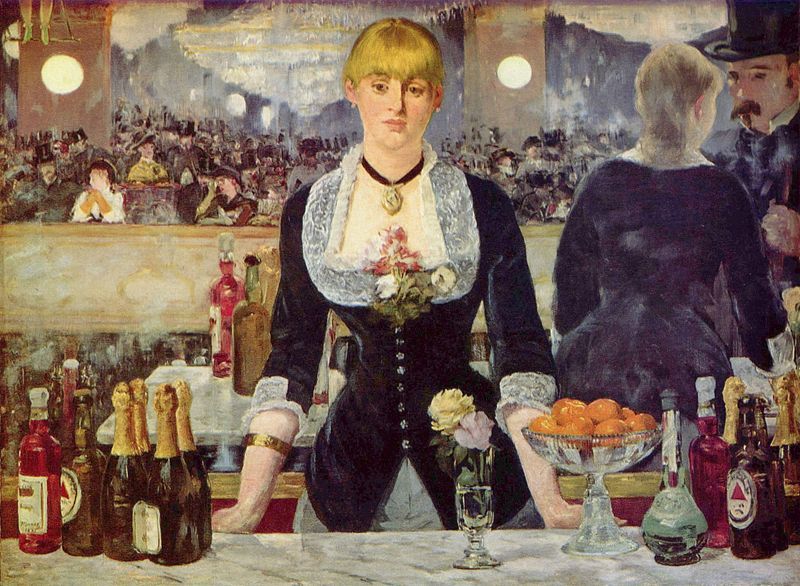
    Manet, The Bar at the Folies Bergeres
    7. Manet, The Bar at the Folies Bergères

    The impressionists turned their backs on the narrative, heroic, and religious content that had occupied the scene of neoclassic art since the Renaissance in order to concentrate increasingly on formal aspects of representation: light, color, volumetric form, and evanescent shapes dispersed by light, and on compositional arrangement as a whole. The impressionists’ subject matter was emphatically contemporary life, what was going on around them: a railroad station or trestle, a boat, balcony, or bar scene. In Manet’s The Bar at the Folies Bergères (1882) the oscillation effected by the mirror–between center and margin, between neoclassic pyramidal structure and drift to the right, that is, between humans as subjects and objects of a gaze–is both theme and structuring principle of a purely immanent reality. Where customer’s gaze meets bar girl’s, the spectator’s gaze is thematized, made the object of reflection, literally, and the object of contemplation thereby, in the person of the customer to the right, so that we know that behind the girl is a mirror, symbol of iconic re-presentation, or painting. Viewing subject and viewed object are rival and complementary themes of the painting of which bottles and balcony are the pretext, the worldly occasion. Like Manet’s Olympia (1863) and his Railway (1872), this is a painting about looking, about seeing and being seen; it is about the human scene in all its immanence. No heroic or mythic or religious material is necessary to dignify its interest: it is good to see, the way fruit is good to eat. The client viewer’s gaze cuts across the painting diagonally, playing with the horizontal and vertical lines of the balcony in the background, that is peopled in a way that is less imposing, impressive than the bottles of wine in the foreground. The content of the artistic image is less important than the arrangement, announcing Cezanne’s still lifes.

    The impressionists’ works notoriously diminish the hieratic significance of content in a way that laid the groundwork for moderns artists, “the first,” as Gans states, “to recognize that esthetic form was prior to any content, and could therefore be given whatever content one liked” (Originary Thinking 195)–or, as was soon the be the case with the likes of Kandinsky, Mondrian, Rothko, and Pollock, no content whatsoever. As Peter Schjeldahl has noted, we experience such works as “engulfing rather than addressing the eye” (80). The artists increasingly focus on relations internal to the scene of the canvas rather than the representation of anything in the world outside it. As more than suggested by the expression “action painting” for the canvases of Jackson Pollack, the work is itself an event.
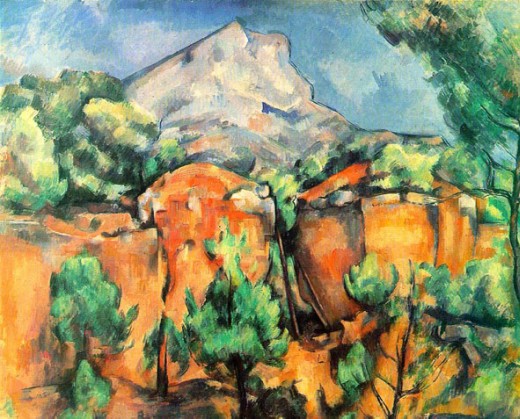
    Cézanne, Le Mont Sainte-Victoire vu de la carriere Bibemus
    8. Cézanne, Le Mont Sainte-Victoire vu de la carrière Bibemus
    Mark Rothko, Yellow and Gold
    9. Mark Rothko, Yellow and Gold

    The famous twenty minutes that Cézanne devoted to each brushstroke in his landscapes of Mont Sainte-Victoire towards the end of his life testify to an oscillation between the “motif,” the object of his lingering gaze, and its representation on canvas. “Le Mont Sainte-Victoire vu de la carrière Bibemus” (1887) is mostly about masses of shape, color, effects of light, working towards “purely” formal composition. With Cézanne we experience Creation as a Work in Progress, in which the tension between icon or image and structure is at a maximum, though the painter’s fascination with la Mont Sainte-Victoire, which can be seen from myriad vantage points around Aix, made of it a symbol of verticality, height, dominance, transcendence. I don’t think it is stretching art-historical imagination to see variations on Cézanne’s efforts in the so-called abstractions of Rothko and Kelly, where color fields are jubilantly explored in the absence of any iconic representation. Color is not represented but presentified in a way that connects the fiat lux vocation of the painter with that of a divine creator.

    Ellsworth Kelly, Orange Field
    10. Ellsworth Kelly, Orange Field
    Georges Braque, Woman with a Guitar
    11. Georges Braque, Woman with a Guitar

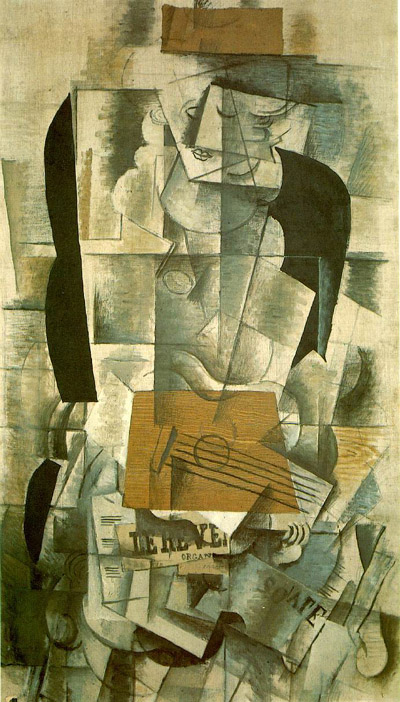
    After Cézanne the movement towards abstraction, purely formal composition, is inevitable, as we customarily see in the pseudo-geometric experimentations of cubism. In Braque’s Woman with a Guitar (1913), the viewers gaze is meant to alternate between an experience of two and three dimensions on the painted surface as well as between recognizable fragments of visible reality and abstract, geometric configurations. For a short period, Picasso and Braque, working together in the same studio, suppress color altogether, along with their signature on the painting, as in this Fruit Dish (ca. 1912), as if to erase the intention of the artist as well from the scene of representation. As if emulating Christianity’s forward progress of institutional self-critique and disenchantment with its own hieratic authority, painting is on a path that will work itself out of a job, conspiring by mid-century in what Harold Rosenberg described as The Dedefinition of Art. Before surveying the impasses implied by those developments, we need to recall that the strange fact that Western art has a history that evolves over time to a point where it flirts with its own devolution is owed to its origin in the doctrine of the Incarnation, where divine revelation inserts itself in human time and in mortal flesh.
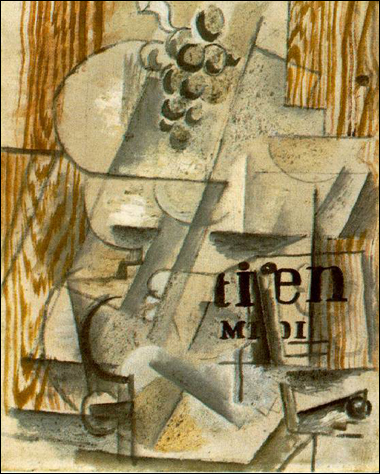
    Georges Braque and Pablo Picasso, Fruit Dish
    12. Georges Braque and Pablo Picasso, Fruit Dish
    Bruce Nauman, <em>The True Artist Helps the World...</em>
    13. Bruce Nauman, The True Artist Helps the World…

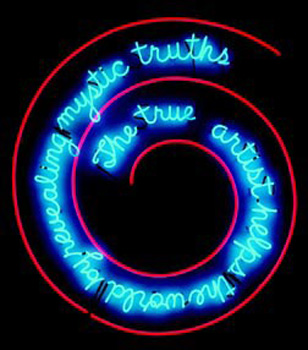
    From cubism through abstract expressionism and its postmodern aftermath in minimalism, conceptualism, pop art and op art, this story is succinctly and tellingly summarized by Gans in the “Esthetic History” portion of Originary Thinking, where he remarks that “the inherent radicalism of the modern age made it imperative for each generation to announce a new departure, a new movement. . . . Each work must carry out the renewal of esthetic form ab ovo” (181). This fact is explicit in Bruce Nauman’s self-described efforts of “trying to understand what art is and what artists do” (in Tomkins 71): “I knew then,” he wrote in 1981, “that I’d have to start out every day and figure out what art was going to be” (Plagens 58). In “The True Artist Helps the World by Revealing Mystic Truths” (Window or Wall Sign 1967) he is less reticent in his claims—if he’s not just joking. A stark polarization of views greeted his 1994 traveling retrospective in our nation’s capital, in Madrid, at MOMA, with the New Yorker‘s Peter Schjeldahl declaring Nauman “the best–the essential–American artist of the last quarter century” and Time‘s Robert Hughes describing his work as “so dumb that you can’t guess whether its dumbness is genuine or feigned” (in Tomkins 74-75).
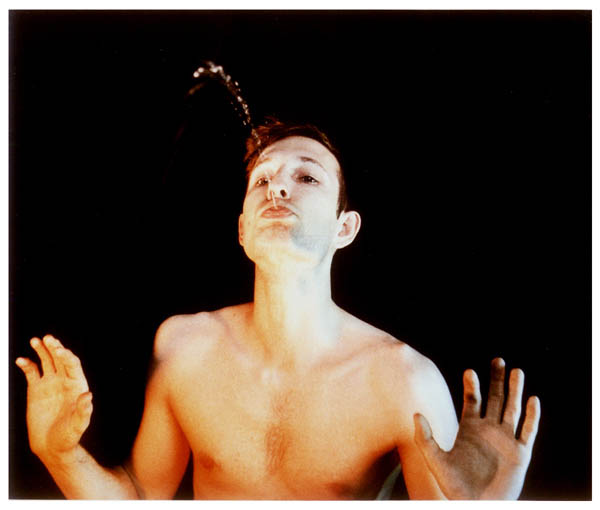
    Bruce Nauman, Self-Portrait as a Fountain
    14. Bruce Nauman, Self-Portrait as a Fountain

    These opposing views clearly reflect a fundamental oscillation within critical opinion itself about what, if anything, there is to admire or talk about; and this very ambiguity has become the hallmark of virtually every “new” artist on the scene. The essays by eminent critics collected in a recent volume entitled Critical Mess: Art Critics on the State of their Practice (Rubenstein, ed.) testify to the current exacerbation of this problem. In the third quarter of the last century, art production came to be seen in avant-garde circles like Artforum as discourse only. The art object is emphatically disdained as a source of esthetic experience in favor of the occasion to think about art, as well as about sundry social and political issues, an activity punctuated now and then by “infantile gestures of excremental desecration,” as noted in the Chronicle named “Sacrificing Culture” (No. 184, Oct. 9, 1999). Every avant-garde breakthrough proclaims itself a new origin—nonsensically—and not without doing intended violence to the viewers’ expectations.

    As noted by Gans, twentieth-century art is hostage to an imperative of innovation and the public, concomitantly, to “the terroristic intention of the artist,” namely to the charge of philistinism if it does not submit to the “obligation to enjoy an avant-garde work” (Originary Thinking 194). Consequently, as Gans observes, “The esthetic must race to keep its paradoxical desire-objects out of the reach of the dynamic rationalization of the market, which is ever converting them into commodities of mass production” (191). Postmodernism can be described as the end of this race, with the artist’s jubilant declaration, in the person of Andy Warhol, that the market has won. As Gans writes: “The recognition of this inalterable dependency of art on the market is a defining trait of postmodernism” (182), an observation that echoes Jeff Koons’s comment at a 1980’s colloquium–his works have gone for the tens of millions at a time–that the “the market is the critic now” (in Critical Mess 102). As a Sotheby’s art expert notes more recently of artist-entrepreneurs, “a lot of artists today are succeeding on sound business principles” (in Thornton 38).
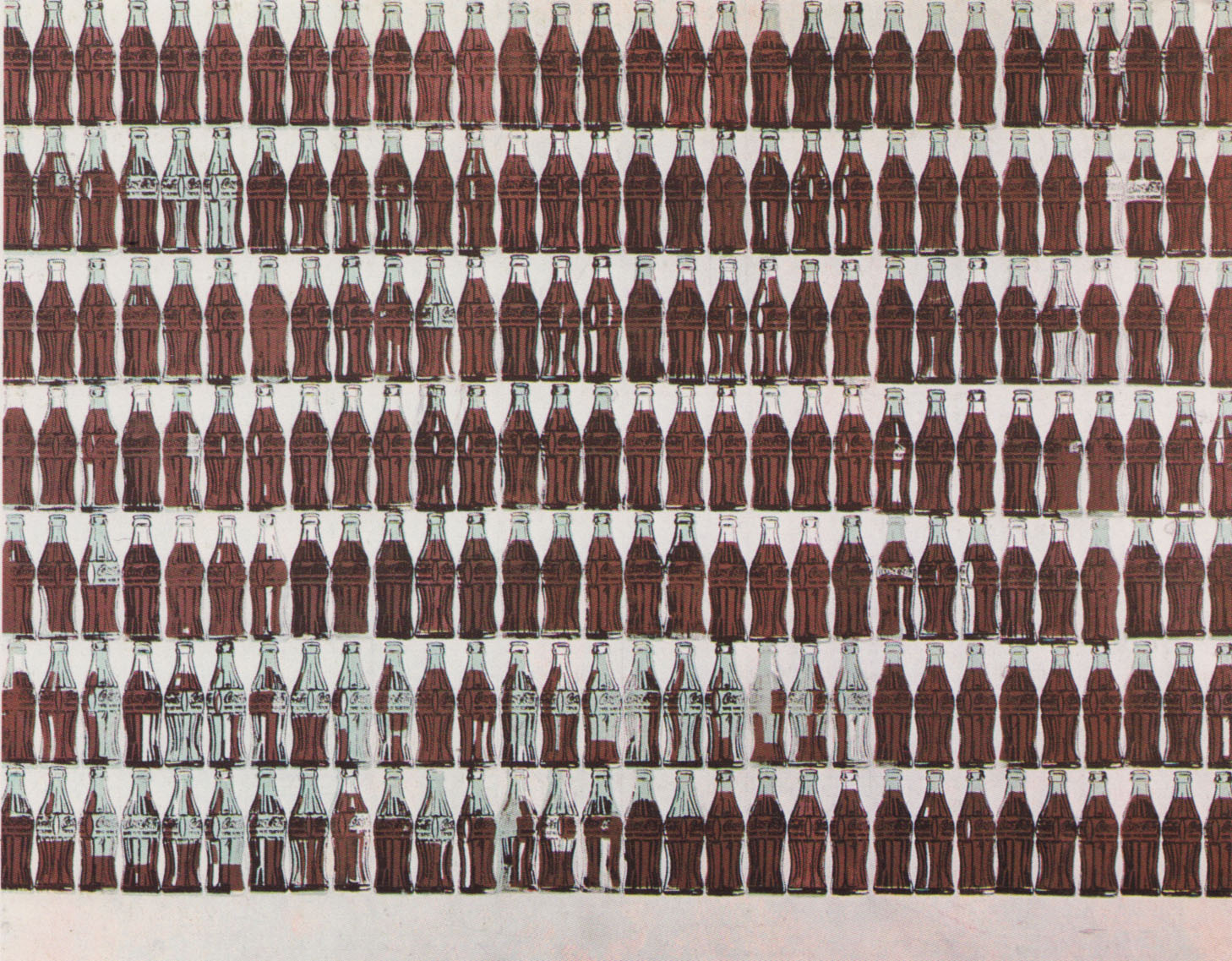
    Andy Warhol, Coke Bottles
    15. Andy Warhol, Coke Bottles

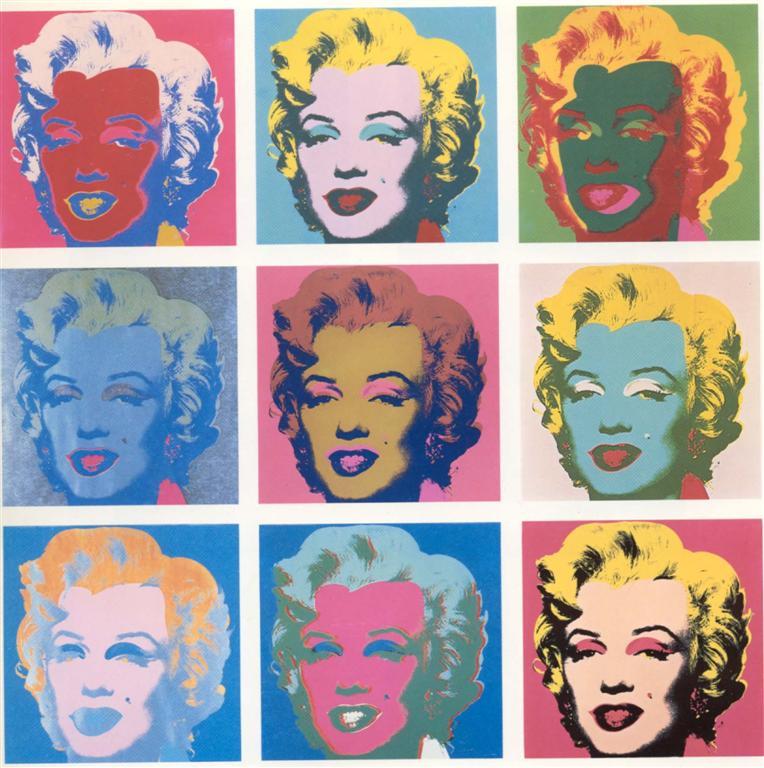
    As Warhol’s viewer contemplates the scrupulous representation of commodities available to every consumer, his or her attention hesitates ambivalently between the artwork as an object of veneration and as an item of consumption, “between the expressive gesture and the mechanical mark” [Buchloh in Michelson 22), his studio shrewdly taking an industrial cognomen as The Factory. In sum, the work itself oscillates thematically between deferral owed to the sacred center and gratification of appetite by those on the periphery, a difference by which the Chronicles frequently distinguish between high and pop art, while acknowledging their scandal-seeking postmodern conflation:
    But the effectiveness of the modern provocation is ultimately dependent, not on the artist’s freedom to give an arbitrary content to the artwork, but on the mimetic charge constitutive of the imaginary scene. Regardless of what is in the center, esthetic form forces us to take it seriously. (Originary Thinking 195) 

    Andy Warhol, Marilyn
    16. Andy Warhol, Marilyn
    Andy Warhol, Mao
    17. Andy Warhol, Mao

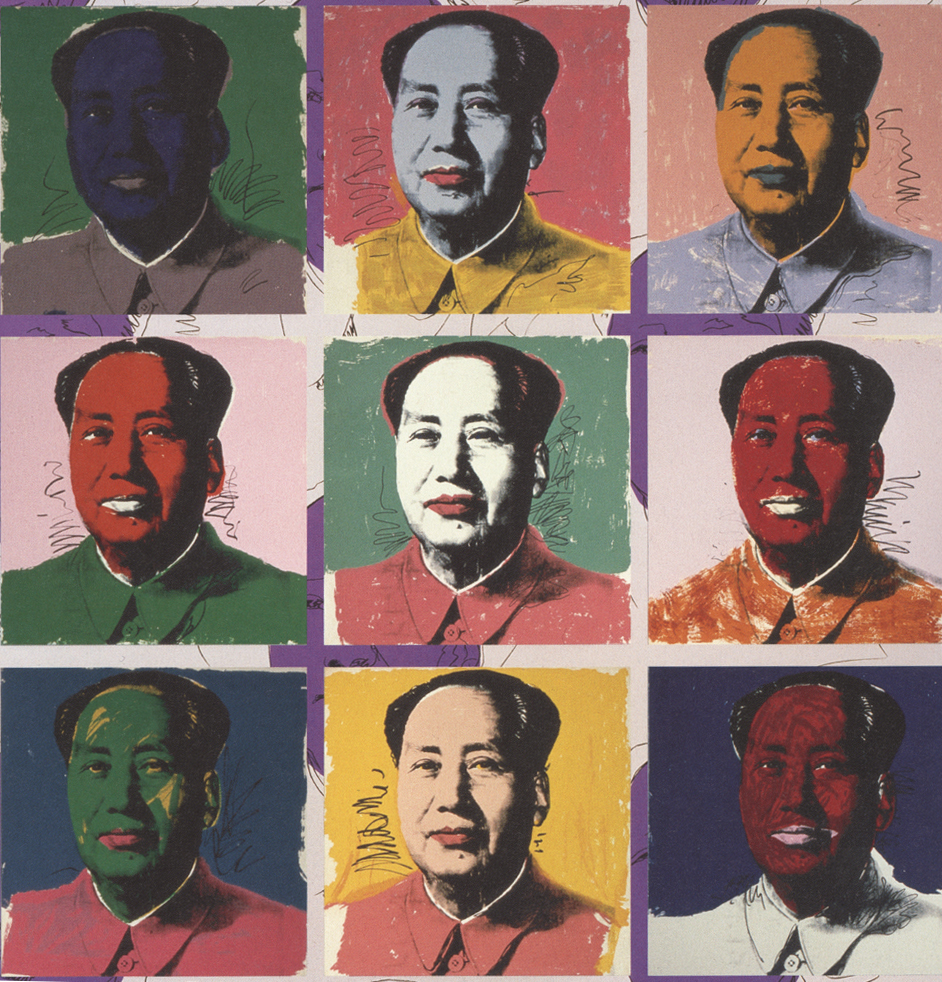
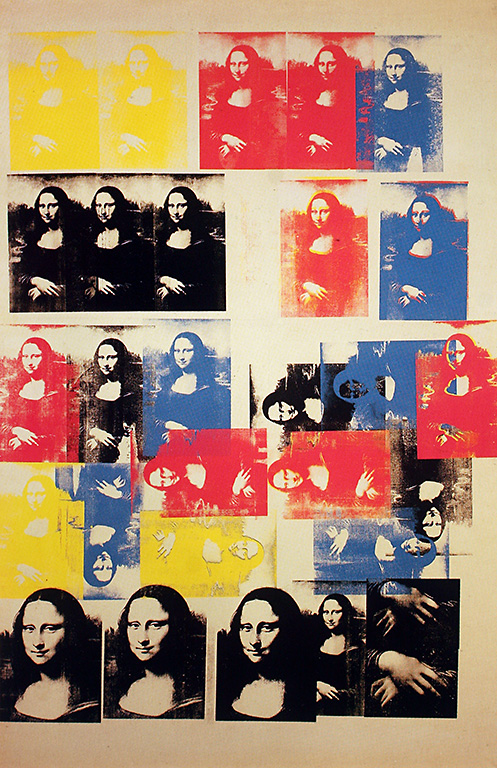
    Warhol’s transparent ploy is not merely to mock high art seriousness and the spectator’s anxious confusion about it; Duchamp, in his carefully disguised resentment of Picasso had already done that with his readymades, as did Rauschenberg and Johns explicitly in Duchamp’s wake. Warhol’s gambit is at once to explore and explode the structure of center and periphery in which art is born of the sacred. In his ubiquitous representations of violence–electric chairs, revolvers, icons of dead or deadly celebrities–we are reminded that he is not a Catholic for nothing.

    The found object is replaced by the found image (Buchloh 95) whose puerile reinscription or serialization thematizes just that gesture, the ubiquity and non-entity of the art object, and where metallic surfacings insist on machine-like reproduction while gold background parodies the aura of the infinite we see in medieval art that is now claimed by the celebrity. This is itself a self-marketing ploy, of course, one of Warhol’s manyblagues. His actual position, as Hal Foster has noted (in Michelson 81), is in between icon and witness of the icono-idolatry of our image-consuming culture, oscillating between the paired roles of exhibitionist and voyeur, spectacle and spectator, which is to say, with Eric Gans, between the object and the sign that refers to it.
    Andy Warhol, Mona Lisa
    18. Andy Warhol, Mona Lisa

    With postmodern art, as exemplified by Warhol, oscillation now inhabits art’s content itself, as the undecidable difference between art and non-art, an ersatz version of sacred/profane divide that constitutes the originary scene of representation, which any number of art installations parody as an outlandish event:

    When the traditional properties inherited from the ritual scene are discarded, we are forced to realize that the esthetic scene can operate without them, since it antedates the controlled world of ritual. The scandal of arbitrary esthetic content pays homage to the sacred, communal origin of the scene on which it is displayed. In discovering the general form of cultural scandal, modernism unearths, beneath the Aristotelian mimesis it rejects, the conflictual mimesis that is the driving force of the originary event. (Originary Thinking 195)

    But the merely provocative intention of such postures simulating art’s violent origin is so transparent as not to bear much repetition. The art scene lately has been typified by the conversely glossy works of Jeff Koons, which proffer metallicized, and monumentally oversized, cartoonish castings of seaside flotation devices, action figures, or comic-book characters. Inflation is the new minimalism by virtue of a pendulum’s swing away from exhausted scandal seeking. The highly touted work of Murakami, whose name is everywhere printed with the circled “c” symbol of copyright, is an explicit homage to his revered Warhol. His latest installation includes within it, as part and parcel of it, a Louis Vuitton emporium; not a gift shop, but a proper store, where the very well-heeled spectator can purchase handbags and other tokens of ostentatiously trademarked prestige that the highly industrialized artist designed for the absurdly pricey maison de couture.

    Jeff Koons, Balloon Dog
    19. Jeff Koons, Balloon Dog
    Jeff Koons, Tulips
    20. Jeff Koons, Tulips
    Jeff Koons, Michael Jackson and Bubbles
    21. Jeff Koons, Michael Jackson and Bubbles

    So my story ends with the unveiling of the long-awaited Takashi Murakami’s long-awaited Janus-faced Oval Buddha (2007), whose happy face grin mocks the Buddha’s enigmatic smile in a Disneyesque, glitzy mock-up of what in the Buddha’s own cultural context expressed blissful and sovereign indifference, transcendence in the form of withdrawal from the violence of the world. On its other side its mouth opens as a maw of teeth in a parody of the horror-movie monster which typically delights in snarfing down its spectators. In response to the unveiling, Sarah Thornton reports that an art world aficionado, spontaneously reaching down into the popular vernacular, otherwise known as the vulgar tongue, exclaims, in dead earnest, “unbefuckinglievable!” (214). The expletive is not merely an accident or incident of notoriously crude New Yorkese, nor merely the symptom of a degraded critical vocabulary; it is not a hapax legomenon, a one-off interjection, which we could dismiss as insignificant. Another observer exclaims in admiration “entertaining as Fuck!” (215). The impropriety of the taboo words is an implicit homage to prerogatives of the sacred as host to what is ultimately untouchable or unsayable or unrepresentable, except as the name-of-God pronounced at and as the originary scene of representation, and restated here as a more edgy or streetwise variant of “God damn!” or “I’ll be damned!” The exclamations are not declarative nor imperative, but expletive, an ostensive of sacralizing wonderment. It is not constative, but performative, despite the absence of ritual; it is therefore hyperbolic, outrageous, obscene because of that very absence; it is an interjection whose role, in the form of miscreant expression, is to reinject the sacred back into the art object, to infuse it desperately with hieratic significance, and thereby guarantee the “wow factor,” in the words that Thornton overhears in her attendance at the art scene, lacking which there is nothing worth seeing or saying anything about.

    Takashi Murakami, <em>Oval Buddha</em>
    22. Takashi Murakami, Oval Buddha
    Takashi Murakami, Oval Buddha
    23. Takashi Murakami, Oval Buddha
    Takashi Murakami, Oval Buddha
    24. Takashi Murakami, Oval Buddha

    At this point, we begin to suspect that the F word is the mantra of postmodern or postpostmodern art appreciation. We hear it in the claims that Damien Hirst makes for his achievements: “I’m a fantastic phenomenal fucking colorist. It’s like, I’m a Bonnard, a Turner, a Matisse.” (in Mess 36). It is not likely that many people believe this, even if he does, and we cannot know that for sure, and it doesn’t matter. The anti-Warholian claim is meant to provoke public interest in his productions. Maybe he does believe it; anyone whose works command a 200 million dollar price tag, as his have in recent auctions, could believe in anything.

    So the story ends where it begins. For belief itself, now strangely devoid of any specific content, formerly named as God, or genius, or beauty, or the sublime, all placeholders for the name-of-God, is what is at issue. Jean-François Lyotard has famously described the postmodern condition as having outlived confidence in a master narrative, in an overarching story that ensured significance to historical and cultural experience. Now every one gets to tell his or her own story. Everyone is the author of his or her own biography, conceived as the self-fashioning, minor masterpiece that we call a career (Gans, The Origin of Language 278), which is guaranteed by the open and egalitarian dynamics of the marketplace. Gans has argued nonetheless that all these stories follow basically the same narrative line, etched out by desire and the resentment that its frustration inspires, and by the rare but signal occasions when love surpasses or counters resentment.

    Much of this is born out by our present financial crisis. Right now the entire market scene is in trouble worldwide, facing the possible collapse of the financial credit system, which we need to recall is essentially a credo, a belief system. And the art market has imploded as a consequence, because it has obeyed the same speculative dynamics, a revolving hall of mirrors in which each investment is modeled on that of another’s investment, and reciprocally onwards and upwards to what we call a speculative bubble. This is a telling metaphor, designating a structure bonded by the molecules at its circumference, its circumstanding, component members on the periphery, rather than by any substantial or material content. The centrality in the art world of auction houses like Christies and Sotheby’s as loci where art history is made by dollar signs discloses the mimetic rivalry driving up prices and sacralizing their targets by the only measurable standard that a market-driven culture has at its disposal. As Thornton remarks in another telling metaphor, “Even if the people here tonight were initially lured into the auction room by a love of art, they find themselves participating in a spectacle where the dollar value of the work has virtually slaughtered its other meanings” (39). Not “trumped,” as we might have expected, but “slaughtered”: yet another gesture, which I find inept, over the top, cheaply sensational, toward the sacred by evoking the violence it withholds.

    New York Times, Sunday Business Section, June 15, 2009
    25. New York Times, Sunday Business Section, June 15, 2009

    Today financial markets are flooded with toxic assets of no knowable, measurable value. Concomitantly art auctions, where collectors are used to bid competitively, mimetically, on presumably “priceless” art works, cannot garner an opening bid for the works of known masters. Speculators in CDOs, CDS’s, and other financial instruments of recent, unregulated concoction, and art spectators are wrapped in the same downward spiral of mimetic disbelief. The Mosaic ban on idolatry obtains, and we are witnessing the punishment that issues from its violation: according to many observers, we have theologized the market, with, among other fantasies, the idea that it is always smarter than its participants, that it, like Adam Smith’s invisible hand, is beneficently self-regulating and self-correcting for humanity’s benefit. What the Mosaic ban reveals about this particular idolatry is that it was always predicated on belief in another’s desire rather than on anything that could bind a community more substantially together, such as a desire for another’s welfare, as prescribed by Deuteronomy (6.5) and Leviticus (19.18). Now we know better, and an inchoate theory of behavioral economics, reminding us that the market’s creators and participants are humans, not statistical “figures,” is on the rise, though as long as it succeeds in ignoring the dynamics of desire and representation disclosed by GA, it probably won’t get very far in illuminating our present crisis. Not, at least, as far as La Fontaine, whose fables “La Montagne qui accouche” (“C’est promettre beaucoup? mais qu’en sort-il souvent? / Du vent.” ) and “La Grenouille qui se veut faire aussi grosse que le boeuf” (whose punch line is a lesson, a “morale” for bull markets: “La chétive pécore s’enfla / Si bien qu’elle creva” [See the puny yokel wax / So large he cracks]) tell us more about mimetically driven self-delusion than all Wall Street analysts put together. An astute New Yorker journalist has recently summarized this colossal mismanagement “in a few familiar words: debt, greed, hubris” (Paumgarten 44), while bringing up Margaret Atwood’s observation that “in Aramaic the words for ‘debt’ and ‘sin’ are the same” (49) and that the ubiquitous search for causes has all the earmarks of scapegoating (49-50). Elsewhere he describes the disaster in terms which resonate with–or shall we say in current art-criticalese: “reappropriate”–the emergent vocabulary of art appreciation, namely: “the call-and-response recapitulation of a giant variegated clusterfuck” (45). Go figure.

    Works Cited

    Arasse, Daniel. Histoires de Peintures. Paris : Gallimard, « Folios Essais », 2007.

    Baschet, Jérôme. L’iconographie médiévale. Paris: Gallimard, « Folio Histoire », 2008.

    Damisch, Hubert. L’Origine de la perspective. Paris : Flammarion « Champs », 1993.

    Francastel, Pierre. La Figure et le lieu : l’ordre visuel du Quattrocento. Paris : Denoël-Gallimard, 1980.

    Goodhart, Sandor. “Reading the Ten Commandments: Torah, Interpretation, and the Name of God.” In Sacrificing Commentary : Reading the End of Literature. Baltimore: Johns Hopkins UP, 1996.

    Gans, Eric. The Origin of Language: A Formal Theory of Representation. University of California Press, 1981.

    —–. Science and Faith: The Anthropology of Revelation. Savage, Md.: Rowman & Littlefield, 1990.

    —–. Originary Thinking: Elements of Generative Anthropology. Stanford University Press, 1993.

    —–. Chronicles of Love and Resentment. Nos. 184 223, 369, 370. Anthropoetics: https://anthropoetics.org/

    Hart, David Bentley. Atheist Delusions : The Christian Revolution and its Fashionable Enemies. New Haven : Yale UP, 2009.

    Michelson, Annette, ed. Andy Warhol. Cambridge, MA: MIT Press, 2001.

    Paumgarten, Nick. “The Death of Kings: Notes from the Meltdown.” New Yorker. May 18, 2009: 40-57.

    Plagens, Peter. “Nauman’s Own.” Newsweek. June 1, 2009: 58-59.

    Rubenstein, Raphael, ed. Critical Mess: Art Critics on the State of their Practice. Lenox, MA: Hard Press, 2006.

    Schefer, Olivier. “Religions de l’art et modernité. » In Traces du sacré. Paris : Centre Pompidou, 2008.

    Schjeldahl, Peter. “Rough Stuff: A Francis Bacon retrospective at the Met.” New Yorker. June 1, 2009: 80-82.

    Thornton, Sarah. Seven Days in the Art World. New York: Norton, 2008.

    Tomkins. Calvin. “Western Disturbances: Bruce Nauman’s Singular Influence.” New Yorker. June 1, 2009: 67-75.

  • God’s Cogito and Ours

    I have written a great deal, no doubt a bit repetitively, about the scene in Exodus 3 where God gives his “name” to Moses as a declarative sentence, ehyeh asher ehyeh. This is a passage that Martin Buber (Moses: The Revelation and the Covenant, Harper, 1946) considered essential, although this does not appear to be the judgment of contemporary specialists, one of whom, when I suggested that this sentence was the key to Hebrew monotheism, replied that, yes, it is an interesting passage.

    Similarly, the origin of philosophy/metaphysics in Plato’s ontologization of predicates like “the Good” was also a grant of ontological fundamentality to the “proposition” or declarative sentence. Heidegger’s critique of metaphysics as a flight from “being” is best understood in our terms as a denunciation of Plato’s disconnection of language from its originary source in the ostensive. (Given the kind of political system Heidegger thought most faithful to the ostensive roots of human culture, one is tempted to side with Plato.)

    Thus the Hebrews and the Greeks discovered at much the same time that the form of “mature” language that people had been using for many millennia was the instrument of an “objective” knowledge independent of the immediate world of the ritual altar (and not simply of “immediacy” or “presence” in general, since it is only in advanced “secular” cultures that we can conceive of this kind of immediacy independently of the surrounding ritual world in which all humans once lived). Just as the Hebrew God has no name that can be pointed to indexically, so the Platonic Good is not indexical either, that is, it cannot be designated with respect to one or another individual, but exists as an object of predication independently of the who or the where of the utterance that contains it. The Hebrew version of this revelation does not deny its religious, centered nature, but it reveals that this centrality is a function, not a locus, so that, as Pascal would later put it, le centre est partout, la circonférence nulle part. Plato’s Ideas are not, like God, assigned the responsibility for their own existence, but they are accessible to us through human language even if their linguistic provenance is not explicitly recognized. Philosophy is born when language becomes able to provide, via the Ideas, the guarantee of the Way of Truth.

    One connection I had never thought to make in this reflection on our civilization’s linguistic origins was with the far more recent Cartesian cogito, arguably the definitive gesture of modern, post-classical philosophy. Yet, when you think about it, God’s declaration to Moses, unlike Plato’s arguments, or rather myths, concerning the substantive nature of the Ideas, is already a cogito. Thus Descartes’ achievement, accomplished when the Hebrew and Greek currents were already fully mixed, should be understood as the application to the individual soul of what had already been accomplished in, or better put, attributed to, the mind of God. In GA terms, Descartes awarded to the human individual’s internal scene of representation the dignity of the public scene centered on God as a secure locus of Being.


    The Hebrew cogito, whenever this “autoprobatory” revelation occurred, is the point of departure for the Exodus, which we may understand as the Hebrews’ exit from the “compact” society of the Egyptian empire, and in linguistic terms, from the ostensive-imperative world of archaic religion. God is first revealed at the center of an ostensive scene, but the Hebrews were first to realize that the ostensive may be understood post factum as the first step toward the linguistic objectivity of the declarative, which comes in the biblical text with the renouncement of the name-of-God that was the original signifier. The Cartesian cogito demonstrates that the human individual’s internal scene of representation is equivalent to the originary, public scene on which significance, or simply being, manifests itself. For even if the truth-value of all one’s thoughts be false, one cannot deny that he in his language-using soul is the thinker of these thoughts. Cogito, ergo sum; I think, therefore I am expresses this argument.

    The similarity to God’s Exodus pronouncement is striking. In both cases, the copula is used without making a normal predication. Je suis, or sum, is not normally spoken alone; we don’t go around saying “I am,” and even less, “I am that/what I am.” God, of course, does not doubt his own existence; he is giving his “name” as Being itself. Similarly, for Descartes, the point is not reasoning but being, more exactly, being a locus of being, a being that thinks and is therefore in possession of such a locus. This is made clearer in the second Meditation variant of the cogito, composed four years after the first (1641 as opposed to 1637) where the author leaves out the reasoning and simply affirms his being on the basis of his act of thinking as “an attribute . . . that alone cannot be detached from me. Je suis, j’existe.” (Descartes, Oeuvres philosophiques, Garnier, 1963: II, 418; italics in the original.)

    The cogito once derived, Descartes develops its consequences:

    Then, examining with attention what I was, and seeing that I could feign that I had no body, and that there was no world, nor any place in which I was; but that I could not feign, for all that, that I was not; and that on the contrary, from the very fact that I thought to doubt the truth of these other things, it followed very evidently and very certainly that I was; whereas, if I had only ceased to think, even if all the rest of what I had ever imagined had been true, I would have had no reason to believe that I had been. I knew from this that I was a substance whose whole essence or nature was solely to think, and which, in order to be, does not require any locus [place] nor depend on any material thing. From which I conclude [De sorte que] that this self, that is, the soul by which I am what I am [italics mine], is entirely distinct from the body, and even that it is easier to know than this body, and that even if the body were not, the soul would not cease to be all that it is. (Discours de la méthode, part 4. ibid: I, 603-04)

    This passage has long been read within the philosophical tradition as an assertion of Descartes’ “dualistic” separation of the soul from the body. But in the light of the originary hypothesis, what is of interest here is that the primary characteristic of human being is the possession of language. Descartes’ soul is “immaterial” in just the sense in which signs are immaterial, not because they are made of some “spiritual” substance but because their ontology is simply different from that of worldly objects (a point I trust GA allows us to understand in an altogether unmystical way). The soul is the seat of language, and without language, representation through signs, Descartes would subsist in a pre-human world without being—not of course because he or anything else would not (yet?) exist, but because there would be no one to confer being on them, although we may prefer to conceive God as having already done this. We cannot help noticing that in his full statement of being, Descartes repeats God’s words from Exodus: je suis ce que je suis. His identity with himself, by which his personal “identity” is constituted, is inseparable from his being able to say it—although unlike God, he does not imply that this is all that may be said about him.

    In contrast with philosophical exegeses, GA explains Descartes’ text in terms of language as an anthropological reality. The philosophers ponder whether Descartes has “proved” his existence, whether his philosophy’s first principle is je suis or perhaps the donc/ergo of reasoning. For the thinking derived from the originary hypothesis, “I think, therefore I am” confers being on him who possesses an internal scene of representation. That is, instead of understanding the cogito in an existential sense: I think, therefore I exist, that is: I feel myself existing when I think, it should be understood rather as: I think, therefore I possess the wherewithal of thinking, which is the internal scene of representation, on which I can imagine all kinds of falsehoods inspired by Satan or just by fatigue, dreams, etc., but where I cannot conceive my not-being, since it is the scene itself rather than any specific thought that is the locus of being.

    This plausibly explains why in the Meditations, Descartes avoided repeating the reasoning of the cogito. His phrase “je suis, j’existe” indeed sounds existential, as though expressing his excitement at “feeling himself exist.” Yet Descartes is not a man of the 20th century. His enthusiasm in discovering his being is better understood as reflecting the fact that the real point of the cogito is not its “logical” deduction (ergo, donc, therefore) but the understanding that thinking demonstrates being because possessing a scene of thinking is participating in being, not in some Heideggerian-mystified sense, but simply because being is what entities “have” by virtue of appearing on the scene of human representation, and the verb “to think” that describes the activity of the scene has a subject who both “has” the scene and appears on it. In a word, “thinking” is nothing but the internal use of language. Before we can speak to others, we must be able to “speak” to ourselves. The “aborted gesture of appropriation” is not merely a communication to our fellows; it is in the first place, insofar as it is a sign and intended as a sign, the externalization of a thought.


    As Descartes’ opposite number Pascal would point out a generation later, humans in knowing themselves to exist also know their mortality. L’homme est un roseau pensant, a “thinking reed,” a mortal user of immortal words, in using which he expresses his impermanence in relation to them. Indeed, Descartes’ cogito is not meant as a demonstration of human autonomy but, on the contrary, of his dependence on God, who, once his own existence is “proven,” must be understood to guarantee the generally truthful content of our sensations, even if we are occasionally tempted by false appearances. Descartes attempts to demonstrate the existence of God by a variant of St. Anselm’s famous “ontological proof” (of which he was apparently unaware): if he can conceive a being possessing all the “perfections” that he lacks, this thought must itself have come from this more perfect being, whom he can then understand to be God.

    We do not find convincing this argument from “perfection,” even when he tightens it with the assertion that existence is itself a perfection, so that the most perfect being that we can conceive must exist. As a piece of logical reasoning, the argument is simply absurd, of a piece with the counter-arguments of atheists who generate analogous “proofs” that “God does not exist.” Yet if we understand it, once more, in the context of the originary hypothesis, the relationship between perfection and thinking becomes less arbitrary. The first thought, the object of the first utterance, is the one significant being, the sacred, interdicted central object. Its “perfection,” in the first place from the participants’ perspective, is precisely its arousal of, yet inaccessibility to, desire, which maintains it in a new, extra-worldly, cultural space separate from the natural world of appetite, and this “vertical” transcendence confers on it a quality that trumps all worldly qualities, and that we conceive as “perfection.” This is a perfection that at the origin definitely includes existence, for the sacred center is not an abstraction but a central object, one that had to be consumable in order to become sacred in the first place. (Later “post-sacrificial” religion will teach us that this quality is ultimately detachable from appetitive satisfaction; one cannot live on a diet of communion wafers.)

    That the quality of God’s holiness is described by the philosopher in spatio-temporal terms as “infinite, eternal, immutable…” (607) should not be understood literally; when Descartes calls God “infinite,” does he really mean to attribute to him spatial dimensions? But if God is the original unique signified of language, his “perfection” is more simply understood in terms of Durkheim’s dichotomy of sacred and profane, meaningful and meaningless, horizontal and vertical. God is “perfectly” meaningful in contrast to the meaningless of all the rest, absolute in contrast to all beings within the world of space and time.

    Thus God ultimately guarantees the world within which the individual demonstrates his existence independently of faith. But the fact remains that the demonstration that is the cogito requires only the thinking soul of the individual, whose ontological dependency is deduced from the cogito itself. Whence Pascal thought of his precursor as a functional atheist, whose conception of God was essentially that of Spinoza, a purely abstract being whose “perfections” are qualities of the scene of representation rather than of the “living God” of a true Christian. But if we understand the scene of language as coeval with our concept of God, then we must conceive the cogito as itself a product of this scene. Once we realize that reasoning of any kind involves language, and that language is not an abstract potentiality but the essential mode of human interaction, we have no difficulty in describing Descartes’ reasoning in anthropological terms. We may then situate Pascal’s objection within the scope of humanity’s dependence on the history of the revelations through which we discover new truths about the originary scene. Descartes’ abstract notion of God is derived from the substantive God-concept of the Hebrews, subsequently personalized or better, “impersoned” by Christ. Pascal, as a faithful Christian, foregrounds this religious truth, whereas Descartes is concerned to seek a minimal core of religious belief that he can demonstrate on the basis of experience. GA does not “resolve” this difference, but it is the sole mode of thought that allows us to understand both sides of the issue as different ways of recalling human dependence on the (same) originary scene.


    God’s “cogito” tells us that he has no name, and more generally, that he has no discrete “qualia” that can be pointed to. His only quality is being itself, but not just being-as-such, or “existence” in whatever form, as though he had just said “I am,” but being-himself. Nothing particular can be predicated of God because he is being-as-selfhood, and thus his own predicate. If we recall the derivation of the declarative from the imperative in The Origin of Language, God furnishes the predicate as a way of situating himself on the “other scene” of language when he cannot be accessed by the interlocutor of the imperative. God’s tautological sentence defines this “other scene” as independent of the real world and its qualities, understandable only as, or by analogy to, the self-substantiality of “mature” declarative language that is or reflects his self-substantiality. That is, the ostensive presence of God is superseded in our understanding by this universalpresence that the linguistic entity of the declarative permits us to grasp.

    The Cartesian cogito is different because it does not seek to (un)define the “name” of God but to establish the “being” of the self. Of course we “know” we exist via Sartre’s “pre-reflexive” cogito; in terms of the “sentiment of existence” we don’t need a logical conclusion. What Descartes is doing in dismissing doubt is to access through his own experience the Parmenidian “way of truth” that is the basis of all (metaphysical) philosophy. “Thinking” is making use of one’s internal scene of representation. Humans, philosophers above all, had always done this, but before Descartes, in thinking even about the processes of thought (“logic”) they had notthought about the scene of representation on which thought takes place.

    Descartes, the quintessential modern philosopher, instead of frequenting the agora like Socrates, prepared his Discours de la méthode by locking himself in his room. He was in fact more a mathematician than a philosopher, more interested in logical reasoning for its own sake than, as the Greek philosophers all were, in the survival of the polis. Descartes’ age was that of Faust, Montaigne, Don Juan, Don Quixote—the first “modern” egos touched by what would come to be called the “Protestant ethic” of the market system, the system of exchange that obliges its participants to possess a model of the system and its “infinite” possibilities within themselves, since its configuration cannot be grasped and handed down as a general law. This was a world where doubt, fear of being deceived by one’s senses and one’s reasonings, reflected the loss of ritual meaning from socio-economic transactions. Without claiming that the cogito depends on a spiritual context such as Calvinist predestination or the Jansenist concept of grace as a rare gift of which we cannot become aware before death, we can say that the modern self has to be sure of its resources. And of these, the most fundamental, the basis of its famous ability to master nature, is its “being” as a user of human language, a participant on the scene of representation, a scenic context already in Descartes’ day no longer sustained primarily through ritual-liturgical acts, but by acts of individual judgment. The idea that the isolated self remains nonetheless connected to the human scene of representation is the source of Descartes’ assurance that the universe he faces is one made for him by God, the guarantor of being-for-humanity.


    Descartes was never concerned to construct an anthropological scene of origin. Yet the intuition of an individual scene of representation was a liberating concept that allowed such thinkers as Descartes’ contemporary Hobbes to conceive of the anthropological model of the “social contract,” the scene on which a number of independent human individuals join in a communal decision to liberate themselves from the “state of nature.” The nascent scenic imagination of the Early Modern era had as its prerequisite a concept of the human individual whose ability to think, that is, to participate in human culture, was guaranteed not by the community but by his own internal scene, consciousness of which preceded awareness of the unifying being of God. The cogito is a key stage in the evolution of human self-consciousness toward awareness of its scenic nature.


  • More on the Victimary

    Readers of these Chronicles will recognize the term “victimary,” which I have been using at least since 1996 (in Chronicle 38), and which has been the subject of the last two Chronicles. But they will also realize that the use of this term, as verified by Google, is entirely restricted to GA publications. One would not expect the partisans of victimary policies to label them thus; they are fighting for justice, against retrograde prejudice, racism, sexism… But on the conservative side, hostility to victimary politics is expressed as a defense of “freedom,” of what the founders called “the pursuit of happiness,” but never as an attack on the victimary itself. That is not to say that astute thinkers of the Burkean stripe, such as Charles Krauthammer or Victor Davis Hanson, do not denounce the moral pretension of victimary attitudes and their apotropaic use to defend “progressives”‘ own wealth and privilege. But the idea that the whole politics of the Left is centered on one simple idea, and that the more doctrinal the politician—and Barack Obama is doctrinal indeed—the more exclusively this idea is used to justify his or her policies, is not one that can be acquired from reading Commentary, or the Weekly Standard, or the National Review, or the Wall Street Journal.

    To use another politically unviable term, denouncing the victimary politics of the Left would be tantamount to asserting the rights of firstness. No doubt one can talk about firstness in other terms (“freedom”, “success”) so long as one doesn’t emphasize the invidious nature of the comparison it implies. In contrast, the victimary, not just the word but the concept itself, is pretty close to taboo. “Blaming the victim” is the greatest of postmodern sins—and once the ethnic or gender affiliation of one of the parties in a dispute defines him/her a priori as the “victim,” no such blame can possibly be deserved. As Ms Sotomayor’s impassioned response to the recent decision to permit Michigan to do away with race-based affirmative action programs suggests, along with similar vehement reactions to attempts to require ID for voting, etc., there is in the United States and no doubt in other industrial countries an important constituency for victimocracy that denounces the denial of special privileges to victimary groups as a form of racism. The very essence of victimary thinking is that there is no “objective” measure of competence that does not implicitly favor the hegemonic group, no scene on which all participants stand on an equal footing—a denial, rooted (in the US) in African slavery, and “ontologized” by the Holocaust.


    The advantage of the term “victimary” lies precisely in what makes it unacceptable to the political class: it emphasizes an unpleasant truth and obliges the hearer to reckon with it—that “progressives” view individuals primarily as members of ascriptive groups. It moves the debate away from “trying not to offend anyone” by pointing out that, if the central value is not offending “anyone,” then only “victims” and their spokesmen will have the floor and will offend the “majority” at their leisure. Edward Said’s “Orientalism” offered the classical paradigm: the “hegemon” learns that there is no way to speak about the “other” without assigning him to a “subaltern” role, and thereby committing at the very least a “micro-aggression”—a phenomenon, if not a term, that is at the center of Said’s argument, whose principal targets are not crude racial myths but serious attempts by conscientious Western scholars to understand some aspect of “the Orient.” But in order to affirm the rights of firstness, which are not those of oppression and condescension, but which merely make it unnecessary for everyone to pretend that no one (except members of victimary groups) is better at anything than anyone else, we have to be willing, not deliberately to offend others, but to take the chance that in telling the truth, someone might be offended.

    A nicer way to put this is, “lighten up.” Perhaps it is easy for Jews to say such things in a country that has never had pogroms and where the old university quotas and most similar restrictions are long gone. But all members of minorities have heard slurs they have learned to ignore—or had done so before micro-aggression became a crime. The other day I watched Old San Francisco (1927), a fine old pre-talkie, made just before The Jazz Singer began speaking on film, but using the same Vitaphone sound system, better suited to sound effects than speech because it required synchronizing a record with the film. In it, Warner Oland, the Swedish “Oriental” actor better known as the sinister Dr. Fu Manchu (and the lovable but somewhat “racist” Charlie Chan), plays a nasty half-breed who exploits the Chinese inhabitants of SF. The program notes (here at UCLA, the use of whose initials to express bemused admiration for its high percentage of East Asian students would be an unpardonable micro-aggression today) castigated the prejudice shown toward the Chinese, particularly Oland’s character who was able to “pass,” much as Jews don’t always have those useful hooked noses. The only redeeming feature was that the Hispanic immigrants whom Oland sought to despoil were treated with respect. Well, yes, but these were aristocratic Spanish colonials, not “brown” native Mexicans, “Hispanics” having not yet come to be seen as a “race.” (The Hispanic heroine was played by beautiful Dolores Costello, “the queen of the silent screen,” whom the IMDB sadly remembers only as Drew Barrymore’s grandmother.)

    Must we work so hard to demonstrate that we don’t share the ethnic prejudices of the past? Our task should be neither to condone nor to condemn but to situate these prejudices. In fact, aside from Oland, the “real” Chinese, all in “ethnic” garb, were treated nonetheless with dignity, and after the historic 1906 earthquake that climaxes the film, a Chinese dwarf (Oland’s brother, whom he kept in a cage!) has the moxie to lead the Irish hero through the wreckage to rescue Miss Costello-Vasquez. We should learn to distinguish between truly dehumanizing portrayals (e.g., The Birth of a Nation) and the generally benign stereotyping of most other films—which contrasts with the really nasty stereotypes Hollywood uses to portray its bugbears on the Right.


    I don’t expect that using the word “victimary” in a web series read by a small number of persons will have any effect on the national vocabulary, but I can at least vote with my keyboard against demonizing micro-aggression and in favor of desensitizing us to expressions of victimary difference. Members of different ethnic groups, as well as the two+ genders, generally get along pretty well, absorbing their quota of micro-aggressions without losing their sense of humor. Creating victims is bad, but telling potential victims to report every ruffle of their feelings to the authorities terrorizes the “majority” while encouraging in the “victims” a level of righteous indignation that would be inappropriate even in concentration camp inmates. The greatest evil of the victimary is not the impassioned insults by which the White Guilty attack their fellows who fail sufficiently to share their guilt, but the free pass given to members of victimary groups to use their resentment as a weapon without being taxed with the least sinfulness.

    The ritual-based society of the Old Regime, as I was saying a few Chronicles ago, treated resentment as a sin in defending the firstness inherent in social norms. Revolutionary thought validated the resentment of those kept in inferior status by these norms, but at least nominally sought to abolish itself along with the privilege it attacked. But because the postmodern victimary thinker knows that privilege of some kind will not disappear, his valorization of “subaltern” resentment is permanent, releasing “victims” in perpetuity from all moral responsibility. If, as Ta-Nehisi Coates insists in “Black Pathology and the Closing of the Progressive Mind” (http://www.theatlantic.com/politics/archive/2014/03/black-pathology- and-the-closing-of-the-progressive-mind/284523/), white supremacy is still “one of the central organizing forces in American life” and “there is overwhelming evidence that America is irresponsible, immoral, and unconscionable in its dealings with black people and with itself,” what “pathology” is not thereby excused? In contrast, members of victimary groups who affirm the norms of the broader society are vilified, as were recently Ayaan Hirsi Ali and Condoleeza Rice, among the this year’s contingent unchosen by “activists” as commencement speakers.


    An optimistic coda: Learning from history

    Is there no possible endpoint for the victimary other than the dystopia of full-fledged victimocracy, where the victims, taking the bit between their teeth, are alone empowered, and the White Guilty are forced to walk the walk as well as talk the talk, as is already happening to many less privileged members of the “majority”? Is the use of the generic “she” in the place of “he” a harbinger of a future where the naïve discriminations of the past will be redoubled knowingly and vengefully in inverse form? Or will “affirmative action” with all its flaws end by fulfilling its promise to truly create a more “diverse” demography in which members of victimary minorities will be seen simply as colleagues and not as “representatives of their race”?

    The market system, in whatever version, requires a certain quota of “injustice,” in the sense of more firstness than can be justified a priori by whatever rules have been put in place. As opposed to ritual-based systems that sacralize in advance the existence of castes, the “free” market allows everyone his or her shot at “the pursuit of happiness” but cannot guarantee either an equal distribution of abilities or of the opportunity to exploit these abilities in the marketplace. This is not a justification for complacency, but for clear judgment.

    We all know that in “learning from history,” we never learn what we expected to learn, and yet we do learn something. It took the first half of the past century to exhaust the large-scale political resentments generated by the early stages of the “capitalist” system, and when we complain about postwar victimary thinking—remembering that the war in question ended nearly 70 years ago—we should thank our lucky stars that the murderous totalitarian solutions to the “contradictions of capitalism” that appealed to the mobs of the past century have largely gone out of business. No one, aside from a few ironic Euro-Marxists who will do anything to keep their revolutionary buzz, can claim that we have not learned that open hostility to the “free market” has produced nothing but horrible failures. And it is a blessing for the West that the final demonstration of this lesson, learned elsewhere at the cost of immense suffering to billions, could be delivered painlessly under the sunny optimism of Ronald Reagan.


    If we would take a long-term optimistic perspective on the politics of our era, we have to see history’s pendulum swings as ways of exhausting the viability of such solutions to the extent necessary to dissuade potential disturbers of the equilibrium. The ultimate basis for this optimism, as I have tried to bring out in the preceding Chronicle, is the greater anthropological veracity of GA’s egalitarian paradigm of the human, in comparison with the victimary paradigm, which sees the human and its culture as originarily marked by hierarchy.

    Victimocracy is the natural outcome of the victimary. The White Guilt of the majority inevitably leads to the empowerment of its victimary minorities. This begins in “symbolic” domains such as advertising and appointments to “token” offices, but has no natural stopping point, even independently of the unequal distribution of aptitudes among the various ethnic/gender groups. That women now make up around 60% of college students and do better financially than men in many subcategories does nothing to prevent politicians’ ginning up feminine resentment via such slogans as the Republican “war on women.”

    The nastiness that is the inevitable result of making victimary resentment the touchstone of all moral conflicts is damaging to white males on a material level, but the pain suffered by the “majority” has a certain lucid nobility in contrast with the plight of the “victims,” unable ever to learn whether the honor received or the promotion granted is truly the result of the “content of their character” rather than the “color of their skin,” constantly encouraged to resentfully attribute their failures to racism, sexism, etc., and treated as “traitors to their race/gender” for expressing solidarity with the “majority.”

    Electing an African-American president in the most literal sense and the concomitant “unleashing” of the radical Left mentioned in a recent WSJ column might be seen as premonitory signs of a definitive triumph of victimocracy. But we should reflect that, however unsavory the satisfaction of some that the “majority” is “finally being given a taste of its own medicine,” this is no doubt the only way of running the course of the historical experiment that can lead to the eventual waning of “affirmative action” and the achievement of something like a relatively color- and gender-blind society. In this regard, the Michigan decision railed against by Ms. Sotomayor is, if not prophetic, at least hopeful.

    Let me suggest, in my septuagenarian wisdom, a rule of thumb for learning from history: controversial policies tend to work out if their implementation removes or diminishes previous reasons for opposition, and conversely. Let us take the example of “gay marriage,” which had never been heard of before about 10-15 years ago and has by now become “common sense” for the majority of the population. I was unhappy with this transformation of the traditional idea of marriage when it began to be proposed, and objected to it in a couple of Chronicles. And in an abstract sense, the traditional idea still strikes me as best. But a few weeks ago, when an old friend and her partner took advantage of the opportunity to marry, it was impossible for me to view this opportunity as a sign of moral breakdown. The consecration of the warmth of this long-term partnership could not possibly be understood as anything but a reinforcement of the sanctity of marriage, an encouragement rather than a discouragement to young heterosexual couples to follow their example—and move some of today’s 40% out-of-wedlock births into the “legitimate” column.

    The victimocratic trend is different, not merely because Mr. Obama has chosen naked partisanship over his original promise of political healing, but simply because phenomena like racial preferences, in contrast to the extension of marriage to same-sex couples, are zero-sum and necessarily produce victims of their own rather than slightly diluting the pool of “traditional” couples. Most real problems can’t be resolved simply by extending some widely-distributed benefit to a small new group of formerly excluded parties, and I did not choose these examples to make that particular contrast.

    The experiment of communism (and the preceding one of fascism) produced millions of deaths because these formulas, however many eggs they broke, did appear for a while to promise a future of omelets in an era of war and depression. And victimocracy, breaking far fewer eggs, has produced some real omelets, not just in jobs and recognition for minority members, but in the not altogether unjustified moral satisfaction procured for the members of the White Guilty. But victimocracy is bound to face the law of diminishing returns. However much its partisans abuse the term “progressive,” we need not fear its unlimited progression, and should work rather to create occasions for dialogue in which the victimary is no longer the only “correct” attitude.

    I will not see the day, but perhaps in a generation or two, MLK Jr’s line about the “content of their character” will become as close to reality in the political and institutional domain as I believe it already is in the personal. For as I wrote when Barack Obama was first elected (in the over-optimistic pre-inauguration December 2008 Chronicle 365) —and I have never varied from this sentiment—whatever institutional messes the victimary gets us into, I have no doubt that a white person and a black person—and in the US the black-white difference is still emblematic of all the others—converse today more as equals and less as members of “hegemonic” and “subaltern” groups than ever in the past. It is no doubt this progress that is most important in the long run, and that excuses in the large, even if it does not justify in the small, the glorification of resentment and the moral preening of the victimary era. History is a messy affair, and we should be above all thankful when facing the horrors of the victimocracy that they are not those of Auschwitz and the Gulag.


  • The Victimary Hypothesis

    In the preceding Chronicle, I proposed that the best way to understand victimary thought in its radical antinomianism is as a new fundamental anthropology, albeit one that denies its “originary” status as well as the violence-deferring virtues of the human scene. The difficulty of grasping the essence of the victimary reflects its radical difference from previous anthropologies, those above all that ontologize the sacred and that we call religions, and even those, derived from the Enlightenment, that posit for the sacred a secular but substantive equivalent. In victimary anthropology, there can be no “event of the origin of language,” since the very notion of “event” is deemed a myth of false immediacy through which those in authority make asymmetric relations appear symmetrical, disguising oppression as free exchange. Here the human emerges, not through reciprocally sharing a sign of equality before the sacred, but through the denial of always-already existing inequality.

    Victimary thought is an inverted metaphysics. Where GA offers the birth scene of the sign as the source of the “moral model” of reciprocal exchange, victimary anthropology implicitly grounds its justification of the victim’s resentment on an unattainable model of perfect reciprocity, a Platonic Good unconnected to human language and practice. What metaphysics posited by fetishizing language, the victimary denies by “deconstructing” the world of human representation. Whereas metaphysics denies the historical origin of language in the service of guaranteeing the substantiveness of the Ideas that it claims human language accesses rather than creating, for the victimary, the idea of “the Good,” rather than subsisting prior to human difference, both embodies and denies this difference as the always-already-existing proof of its own impossibility.

    In Derrida’s maximally rigorous exposition of the victimary model, this impossible moral truth functions exclusively to demonstrate by contrast the victimary nature of all human relations. Deferral, différance, both in GA and in classical philosophy, where Plato’s cave illustrates the necessity of maintaining the separation of the Ideas from the world even at the cost of slavery and illusion, is primarily a means to avoid human violence. For the victimary, in contrast, the gap of deferral is the repressed flaw that gives the lie to the compact presence in which humanity has the illusion of communing with itself. Where the sacred leader pretends to speak without mediation to and for the adoring crowd, victimary thought uncovers between his speech and our hearing the same void that we experience in reading the écriture of a long-dead author.

    Why does the victimary find deferral incompatible with reciprocity, when in the originary hypothesis, the sign’s deferral of immediate contact with the object via the gesture of appropriation is precisely what makes possible the equidistance from the sacred center that constitutes the human? The difference is that Derrida conceives this center, which in our scene is occupied by an object become sacred because too desirable to appropriate, as always already usurped by a central authority whose voice creates the illusory “compactness” by which Voegelin characterizes the ritualistic hierarchy of the old empires. The “natural” pre-human hierarchy of the family is, in Derrida’s reading of Rousseau’s Essai sur l’origine des langues (see De la grammatologie, p. 374), transmuted into a “supplementary” originary political authority, a transition that Derrida associates with the imposition of the law of incest. The significant point, although it is not emphasized in Derrida’s text, is that the human begins, or has always-already begun, not as a group of equals, but as an extension of the family under patriarchal authority. Where Girard’s mimesis fills the proto-human world with rivalrous, potentially aggressive desire and, in our GA variant, requires a space of freedom in the center to function as a social whole, the void at the center of the Derridean world draws in a hierarchical figure by default. The significance for victimary thought of the sexual difference implicit in the incest prohibition will be discussed below.

    Derrida’s deconstruction of the immediacy of “presence” as an ideological myth functions to generate a counter-myth, his own disappointed utopia. Failing to see the humanizing property of the néant, he defines the kernel of culture as a myth of immediacy, whose conscious or unconscious purpose is to disguise the hollow and oppressive relationships between human beings, starting from the center’s tyranny over the periphery. For this exemplary victimary thinker, once animal immediacy has been broken by the deferral instituted by the sign, it can be replaced only by the tyranny of écriture, by which an absent master declares himself present to his deluded slave. (The later, “Levinasian” works of Derrida that partially abandon this perspective also abandon the implicit ambition of his early works to create a coherent, if paradoxical, victimary anthropology; they are consequently not directly germane to the present discussion.)


    The most useful way to understand the focus of victimary critique on Western civilization (in contrast, for example, to its lack of concern for the barbarous practices of sharia, or those of the remaining communist tyrannies) is as an attack on firstness, meaning both the hierarchy necessary to the functioning of the society and above all, its source in the firstness that Christianity inherited from the Jews, transferring it from the religious and moral domain to those of the market economy and to national and eventually global social organization. The most significant modern form taken by this cultural firstness from the early modern era was that of colonization, which, formal and informal, by the turn of the twentieth century had reached most of the rest of the globe. At the interface between more and less technologically and socially advanced cultures, domination is arguably inevitable in some form; today’s medical programs in Africa, however benign, are certainly examples of international firstness. But whatever positive features colonialism may have possessed along with the undoubted negative ones, WWII put an end to its legitimacy, and beyond this, greatly encouraged the post-colonial resentment that is taken for granted today in relationships between former colonies and the Western powers.

    If one stands back from the moral indignation that victimary thought encourages, what one sees is resentment of the West—chiefly by Westerners, as I shall discuss below—for its success. One shudders to think what kind of world we would be living in if, for example, the Ottoman empire had been able to pursue its conquest of Europe, let alone if today’s jihadists were able to establish their caliphate. But such alternatives have been until now made improbable by Christian Europe’s more dynamic and modern institutions that, by encouraging firstness in individuals as inventors and entrepreneurs, imparted firstness to the entire civilization. The atmosphere of contemporary courses on world history is the opposite of the Eurocentric triumphalism of the past, but this perverse humility, however it may help cure us of the sin of pride, throws out the baby of historical achievement with the bathwater of the arrogance that this achievement generates. Discussions of Western slavery simply dismiss as irrelevant the presence of slavery throughout Africa and the Middle East before the arrival of the Europeans. The victimary vision of history, the self-castigation of the “oppressor” civilization, is most simply understood as a critique of firstness as such. There is no way of being superior that cannot be accused of victimage; the only possible comparisons are between bad and worse. Since the human, grounded in reciprocity, continually produces firstness, victimary history is a history of evil.

    Nor is the victimary vision of history, unlike that of the revolutionary era that finds its apogee in Marx, compatible with a theory of social evolution that could eventually yield a “good” (casteless, classless, functionally egalitarian) society. In the absence of a final goal, the politics of group resentment attacks firstness as such as oppression. That victimary activism precludes any possible declaration of victory is clear both from the persistent resentment maintained by eminent spokespersons for victim groups (e.g., Eric Holder) and by an increasing sensitivity to “micro-aggressions” that insures that relations between “majority” and “minorities” will never be judged fully reciprocal.


    Historically, the victimary emerges as a reaction to the Holocaust, experienced along with Hiroshima as the apocalyptic revelations of WWII. The Holocaust was taken as a sign of the moral unworthiness of Western Civilization, whose lesser crimes of oppression: colonialism, racial segregation, patriarchy, “homophobia,” were made finally inexcusable by association with it. Yet the victimary nature of the postmodern, still not understood as such today by most of its adherents or even its enemies, was unforeseeable at the outset. The atmosphere after WWII was essentially hopeful, and the extension of the defeat of Hitler’s racial policy to less radical systems of de jure discrimination such as colonialism and segregation was undertaken primarily in the unresentful spirit of Gandhi and Martin Luther King. As always, the state of “the Jewish question” reflected the fundamental thrust of the movement: the creation of Israel after the war had the world’s sympathy. To the extent that the Jews were the war’s principal victims, the establishment of a Jewish state was seen as helping reestablish our civilization’s moral equilibrium, as were the ongoing battles against segregation and colonialism.

    But the euphoria that greeted Israel’s declaration of independence gave way, especially after its victory in the Six Day War in 1967, to a dubious preference for its Palestinian “victims.” This reigniting of the “Jewish question,” which the more recent phenomenon of jihadism has only intensified, gave proof that the resentment of firstness, embodied by Israel as a representative of the “West,” would survive the failed totalitarian attempts either to level firstness à la Stalin or to convert it into ontological permanence à la Hitler. In the same period of the second half of the 1960s, the victory of the Civil Rights movement over “Jim Crow,” rather than laying American racial resentment to rest, began to provoke demands for the reverse discrimination of “affirmative action” to supplement the formal equality originally sought but now deemed insufficient to provide equal chances to blacks held back by generations of segregation. And so we still have affirmative action nearly fifty years later, to which we have added “diversity” and “disparate impact.” The turn from equality-centered to victim-centered politics in the late 1960s marked the key moment in the transformation of the postmodern from an affirmation of universal human solidarity into the resentful permanent revolution against firstness that has evolved into today’s victimocracy.

    The purely negative or “deconstructive” nature of the victimary reflects the postmodern absence of hope for a credible “more advanced” form of civilization—a conviction that grew throughout the postwar era and received its final demonstration with the fall of world communism in 1989. Motivated exclusively by reducing “oppression,” the victimary mindset is impervious to even the most obvious demonstrations of social improvement through advances in medicine, agriculture, cybertechnology, fuel extraction, …; its chief reaction to such advances is, where possible, to condemn their possible adverse effects on the planet. (A recent column by Kevin Williamson makes the almost-never-heard point that despite wage stagnation, the American poor, not even to speak of the middle class, are far better off materially than they were three decades ago, measured by the improved quality of the goods and services to which they have access.)


    As alluded to in the above discussion of Derrida, anthropological reality provides a guarantee of victimary resentment more fundamental than social stratification (which does not exist as such in the simplest human societies): that of sexual difference. No doubt resentment of this difference was not the point of departure for the empowerment of resentment inaugurated by the French Revolution (although Olympe de Gouges promulgated in 1791 a Déclaration des droits de la femme that pointedly translated the earlier universal—but implicitly male—demand for equality into sexual terms, an affront she was to expiate on the guillotine). Nor was sexual difference the historical stimulus for the victimary era. Yet the thoroughgoing feminism that emerged after WWII, stimulated by the appearance of Simone de Beauvoir’s Le deuxième sexe in 1949, had an altogether different demographic scope than the battles against colonialism and segregation. Relationships among races and ethnic groups are mostly economic, and for many are rare or non-existent; relations between the sexes affect everyone. A “white male” can avoid confrontation with the resentment of “nonwhites,” but not with that of the “second sex.”

    Conversely, sexual difference is the ultimate guarantee that there will always be “oppressors” and “victims.” We need not claim it to be the “unconscious” of postmodern victimary thinking to note that it gives biological proof of human asymmetry, and more significantly, that the far greater male propensity for violence, which of course reflects the sexes’ different functions in reproduction and child care, had made women less central to the sacred and its (religious) culture, whose primary function, as we know, is to defer violence. As we enter the victimocratic phase of the postmodern era—at a time when women near 60% of college students and where young women’s earnings are within striking distance of those of males—the increased potency of female resentment is perversely but understandably reflected in a renewed emphasis on feminist sexual politics.


    Is victimary thinking a “religion”? As heir to the revolutionary destruction of traditional ritual society, it is comparable to the earlier era’s secular substitutes for religion, of which a much-weakened Marxism is the only significant survivor. No doubt, because the victimary has no notion of a kingdom of God, or in secular terms, a fundamentally virtuous social order, it is not “religious” in the sense of commemorating a divine or potentially utopian Creation. Yet in terms of its praxis, one might call victimary activism the very essence of religion; it binds its adherents together not merely in a solidarity-reinforcing system of ritual interactions but in a common mission that, like every evangelism, will always have farther to go and more work to do.

    This praxis is the one key element the victimary retains from the utopian revolutionary movements that preceded it. Victimary thinkers unfailingly sympathize with the remaining revolutionaries, communist and even jihadist, since without really believing in “socialism” (let alone Islamism), they presume that open-ended, uncompromising criticism of “capitalist” societies is unfailingly beneficial. If all symmetries are mythical and can be deconstructed into oppressive differences, then each new awareness of inequity will necessarily lead to the discovery of as yet unsuspected inequities—a state of consciousness illustrated by the Kinsley quotation in last week’s (and Christmas 2004‘s) Chronicles. But this open-endedness remains uniquely focused on sexual and “racial” differences. Charles Murray’s Coming Apart (which deliberately limited itself to whites to avoid confusing class and racial issues) has not generated any particular sympathy for the white working class (although they as well as others have benefited from the recent vast expansion of entitlements such as “food stamps”). Nor have I ever seen the term micro-aggression applied to relations between rich and poor members of the same race, although such phenomena were much remarked on in the pre-victimary and racially insensitive thirties (e.g., the 1936 film My Man Godfrey), when class distinction was the main “prejudice” to be overcome and where the optimistic idea that “we are all the same” was easier to negotiate.


    The central moral dimension of the victimary is easier to sense intuitively than to define precisely. Our first impression is one of obsessive resentful self-righteousness. But if we focus on the “majority,” who remain after all the dominant force in the society, we soon realize that the dominant attitude of the victimary era is rather that of White Guilt, and that in encouraging resentment on the part of victims, the Guilty do not simply identify with them. The increasing vehemence with which respectable progressive publications such as The New Republic denounce the selfishness and insensitivity of their conservative opponents, using an often scurrilous rhetoric found on the right only among hate groups or talk show callers, reflects the mimetic scandal that these are “people like me” yet who, unlike myself, are in denial of their victimizing nature.

    With the partial exception of the ill-fated 1871 Paris Commune, modern revolutions were always exercises in White Guilt, with members of privileged classes demolishing the privileges of their class for the benefit of the oppressed, while persuading themselves (and imposing on everyone else) that to carry out this selfless activity their political privileges should “temporarily” be vastly augmented. In the victimary era, the essential quarrel is still not between oppressor and oppressed, but remains within the privileged group, between those who accept and those who have the arrogance to deny White Guilt. That the term “victimocracy” nonetheless reflects a real shift in power to the victimary groups themselves is a point for future Chronicles to explore.


    The victimary dynamic is most clearly observed by turning from human relations, complicated by feedback loops, to our relationship with Nature. Gaia feels no resentment, but virtuous sufferers from White Guilt experience it on Her behalf, often expressing passionate hostility toward those who persist in considering humanity as the only locus of moral value and hence by right the master of the natural universe. Yet those who express resentment on behalf of Nature do so in full cognizance that they too are among the guilty, and in some cases at least one might even dare to think that they care more about assuaging their own guilt than condemning the brazen guiltlessness of their opponents. Humanity’s “sins” toward Nature can never be redeemed, only diminished by prophylactic measures. If our ecological impact is always negative, it is bound to be ultimately disastrous, and we can at best slow down the final catastrophe, no positive model of virtue being available beyond self-annihilation.

    The example of environmentalism thus suggests to us a quasi-religious view of the victimary as a “Puritanical” world-view obsessed by sin. Environmentalists easily fall into a rhetoric of misanthropy that affirms the universe would be better off without us. Such negative thoughts might have been inspired in the past by our sense of sinfulness with respect to God, which is ultimately to say, against each other. Today, they reflect our guilt for the economic activity with which human existence, particularly in industrial society, disturbs the balance of nature. This suggests by analogy that what ultimately empowers the resentment of victimary groups and confers on it not merely an absence of sinfulness but a badge of virtue is likewise the sin-laden White Guilt of the repentant oppressors—none of which proves that the erstwhile victims, unfettered by guilt, cannot take the initiative from their enablers.


    The balance between firstness and equality, or in more euphemistic terms, “freedom” and “democracy,” is the eternal point of contention between the two sides of what has become in the US, and to some extent elsewhere in the West, an increasingly uncivil political debate. On the Left, by relentlessly attacking firstness in principle, victimary thought offers its adherents a simple answer, grounded in a simple anthropology, analogous to the hammer for which everything looks like a nail. In contrast, defending firstness from these attacks in an affirmative manner that respects but goes beyond Burke’s passive caution about destroying “normal” arrangements is not so easy. But this difficulty makes all the more valuable the positive anthropology of the originary hypothesis, which recognizes, along with religion but not victimary thought, the value and necessity of firstness.

    I hope to discuss in future Chronicle(s) how, or perhaps whether, a politically viable defense of firstness in the long term is possible—a discussion to which Adam Katz’s frequent posts on the GA blog have already much contributed.


  • Virtues Old and New: Toward an Analysis of Victimocracy

    If all sins in the first place derive from originary resentment of the sacred center, reflecting the disappointment that one cannot possess the central object in its entirety but must content oneself with an “equal part,” so are all virtues yet more obviously affirmations of this center.

    Faith is first of the cardinal virtues because it expresses this affirmation most fundamentally; before it can inspire love or even hope, one must “believe in” its reality. Faith is quasi-cognitive, it tends to be expressed in propositions, or credos. But like all language, the language of faith is ostensive before it is declarative; it points to and affirms the center before it can assert anything concerning its existence, and the words of a credo are less important than the “profession of faith” they underwrite.

    Hope, which expresses the expectation that the originary peace be prolonged in time, is consequently the most visceral of the virtues. It is so to speak the human transformation of the “life-force” that makes us get up in the morning with the feeling that we have what Sartre called a “project” into which our “animal” energy is channeled. Hope is not in essence a passive awaiting, but a sense that we have at least a chance to accomplish our goals, and this sense depends on the deferral of conflict that the human provides us. Thus the virtue of hope is an awareness that our specifically human sense of purpose depends on its mediation through the sacred center, so that all our projects are not just our own but come to us through the communal harmony that is the gift of God.

    Finally, love, as I have said many times, is the transcendence of resentment. This must be first true of divine love before it can become true of human love. We love God—in originary terms, we renounce our resentment of the central object—although he withholds himself, revealing himself to us only partially, as our portion of the sacrifice that is our “equal” part of the whole.

    More broadly, we can say that “God is love,” that is, that no other “virtues” are really necessary to participate fully in the human community. For if love is the transcendence of resentment, and originary resentment, resentment of the center, or of God, is the fundamental sin, then love of the center, of God, is the One Virtue. We can love without being conscious of faith or even hope, since when one loves, the other virtues are implicit in love itself.

    As opposed to the sins, directed explicitly to worldly things, either objects or other people, the virtues are all, even love, much more obviously directed to God, or more precisely, to a God-centered universe—so that, inversely, if we truly love our fellow humans, as all great moral thinkers such as Hillel concur, one need not think of God as the theme of our actions, since in this love, God, or simply “the sacred,” is always present.

    In romantic love the universe becomes centered on the loved one in a kind of idolatry, one that in the Christian, essentially chaste form of “courtly love,” explicitly leads to a desire for divine communion, as in Dante’s Paradiso. In contrast, the “pagan” form of such love is, in cultural terms at least, experienced as an alienation, even a curse. Yet one could make the argument that Sappho’s radical affirmation of the cultural significance of “private” passion already contains the essence of what the Judeo-Christian tradition will locate in a more anthropologically comprehensive theological context.


    The interest of presenting this material in GA terms is that the additional concreteness supplied by the hypothetical originary scene provides an imaginary “laboratory” for its exploration. This illustrates the distinction between GA as a humanistic anthropology and “social science,” which directly models empirical worldly realities. The “imaginary laboratory” is not a mere fantasy, yet neither is it an objective reality independent of our theory. Above all, its minimality makes it possible to vary aspects of its paradigm in ways that might appear at first glance counter-intuitive.

    In this and following Chronicle(s), I shall attempt (finally) to understand the victimary in its own terms as an alternative anthropology, distinct from that which GA has adapted from the Judeo-Christian tradition. Please bear with me if this Chronicle bears the marks of a transition. We are already aware that the cardinal virtues and sins of the Western tradition are not those of the new victimary dispensation, but we must try to explain the parallel universe of victimary thinking without either indulging in polemics or accepting the victimary as the new human truth.

    Questions

    Why has Western society experienced the need to extend the helplessness of concentration-camp prisoners to entire human groupings, while assuring them both of their necessary innocence and their obligation to denounce the crimes of their oppressors? Is this just a temporary spike or is it but a new stage in an inexorable progression that opposition can only delay? How interpret the increasingly “totalitarian” (a term I noted in Charles Krauthammer’s column recently) excesses of victimocracy that have been a major catalyst for this series of Chronicles?

    Where are the cardinal virtues today? How have we evolved into a society in which virtue is increasingly redefined as the victimary vengefulness exemplified by the Dartmouth incident referred to in my last Chronicle, where accusing those in authority of racism, sexism, ableism, transphobia… proves one’s purity of heart? Given that this attitude, which seems fully convinced of its own virtue, appears to pay tribute to a notion of the victim very different from that espoused by Christianity, how can GA help us to understand this new moral epistemology? Does this phenomenon give proof that Western society, or some important segment of it, has reached the limits of Christianity, even of religion as such? Is victimocracy then a sign of the godlessness of modernity, of its indifference to our traditional humility before our potential sinfulness, of a boundless and increasingly aggressive self-righteousness?

    We know that Christianity, as a radicalization of the prophets’ concern for the “widow and orphan,” is the historical source of today’s refocusing of the social order on the victim. We may even consider Christianity as “the first victimocracy,” provided, and this is of supreme importance, that we remain fully conscious of the paradoxical nature of this affirmation of the “scandal to the Jews and folly to the pagans” that Paul describes. The reign of Jesus is that of the powerless qua powerless, not the powerless who call on the power of the state to enforce its latest punitive rule against “discrimination.”

    The ultimate question is whether or not we all, “oppressors” and “victims” alike, are and/or have always been nevertheless members of one society, subject to the same universal “moral model” of symmetrical reciprocity. The alternative can be put in very simple terms. When we encounter the affirmation of this model in the Declaration of Independence as “all men are created equal,” should we read it as affirming universal human equality, or does it imply the exclusion and oppression of women (and slaves)?

    On this point, we can understand the Gospels’ “antisemitic” insistence on the Jews’ responsibility for Jesus’ death in a universalistic, non-discriminatory sense, one that I find consonant with Girard’s insistence that the world of the Pharisees represents the highest form of religion as an order in itself, in contrast with the Christian transcendence of the sacrificial. The point is that Jesus was himself a part of the Jewish community, so that the victim and his sacrificers are in this perspective one people; insisting on the agency of the Romans would on the contrary resemble the victimary as currently conceived, with Jesus as a member of an oppressed, “subaltern” group victimized by a colonial power. That in the Gospel story the Jewish mob “compels” the Romans to crucify Jesus is indeed the source of the infamous Christian anti-Judaic paradigm (Jesus as the truly “first” who arouses Jewish anger because he demystifies the Jewish claim to firstness). Nevertheless, if read as an anthropology rather than as a polemic of one religion against another, Gospel “antisemitism” suggests that the Romans, influenced by the collective force exercised by the Jews, are forced to recognize that they too are part of sinful humanity—and therefore equally open to salvation and conversion. (This too seems to me entirely compatible with the views of Girard, who has always insisted that we are all of us, Romans, Jews, and disciples alike, responsible for the death of Jesus.)

    Strikingly, in the victimary era, the paradigm of the Holocaust has been inverted into a growing antisemitism that has the opposite focus from that of the New Testament. Today, just as its soldiers are compared to the S.S., Israel is seen as corresponding to Rome, the colonial power. The Jews, who in the time of Christ represented humanity-in-general, have become an aggressive remnant of “white” European colonialism imposing their tribal will (dixerunt Walt and Mearsheimer) on otherwise enlightened, pacific Americans. Antisemitism, along with hostility to Christianity, is the one prejudice that does not confer a mark of victimhood. On the contrary, as in the days of anti-anti-Communism, to denounce antisemitism is to receive the reply that “Jews always call embarrassing truths antisemitic.” Somehow one rarely hears this response to accusations of “Islamophobia.” (Cf. Ayaan Hirsi Ali at Brandeis, April 2014.)

    The victimary originary hypothesis

    Whence comes the power of victimary thinking? Historically it appears to originate in a radicalization of the Judeo-Christian concern for the victim triggered by the horrors of the Holocaust, although this simple causality should be enriched by situating Nazism itself as an apocalyptic movement in the context of the apparent breakdown of the market system after WWI and the beginnings of the dissolution of the racial caste system in the European colonies. But its promotion of the epistemology of resentment makes it part of the revolutionary tradition begun in 1789.

    Years of pondering this question have led me to conclude that the ultimate explanation for the victimary cannot be found directly in the originary hypothesis. The moral model derived from the hypothesis, which I believe fundamental to the human as such, and which has led me to defend Judeo-Christian morality in opposition to the victimary, is nevertheless not shared by the latter, even implicitly, as the foundation of its own anthropological vision. Hence we can best understand this vision as derived from an alternative originary hypothesis, one never understood in precisely these terms, but which can nonetheless be constructed from its moral stances.

    What I am tentatively proposing here is that the victimary originary hypothesis differs not only from that of GA, but from the originary intuition that has been since the beginning the foundation of all religions. This new approach in no way contradicts my earlier moral stance, but, precisely, it allows me to express my opposition to victimary thought in the most fundamental terms, as a conflict between two anthropological paradigms, rather than a quarrel within a shared paradigm between (in my view) a correct and an erroneous interpretation of it. To show proper respect for my victimary opponents is a prerequisite to meaningful dialogue with them, and in any case to a full understanding of their position and the reason for its apparently ever-growing influence.


    In the context of the present, preliminary essay, let us begin by examining the victimary redefinition of virtue. To simplify matters, we may limit ourselves to the virtue of love, the “greatest” of the virtues, which, as we have observed, may be said to imply the others. Imitatio christi really only asks us to imitate Christ’s love for others, and (we would probably add today) for life and the universe in general.

    Victimary thinkers reject the Christian love that encompasses “thine enemy” as contributing to oppression. In today’s world, they would tell Jesus that however lovingly he regards all human beings, he must recognize that a different level of scrutiny is required for the conduct of those in hegemonic groups than for those whom the latter at least potentially oppress.

    The key point is that these two conceptions of love, the Christian and the victimary, are not separated merely by degree, but imply two different originary anthropologies. Where GA’s originary hypothesis founds the human on the reciprocal exchange of signs that originates the “moral model” of egalitarian morality, the founding intuition of victimocracy is that the oppressor-victim dichotomy, modeled, as I shall elaborate further in a future Chronicle, on the indubitable reality of sexual difference, makes humanity fundamentally unequal, indeed, originarily immoral. Under these circumstances, universal love is not a virtue, but an ideological mask for oppression. Nor is the latter, in the absence of a Fall, the equivalent of original sin as understood in the Bible, although as I showed in Chronicle 417 (“Originary Feminism”), choosing Eve as the initiator of resentment and consequently the instigator of sinful self-consciousness clearly reflects an intuition able to comprehend, if not to accept, the victimary position.

    The victimary hypothesis is already implicit in Derrida’s understanding of deferral or différance, which insists, with apparent unconcern for the anthropological anteriority of egalitarian societies, on the hierarchical nature of the “presence” instituted by representation as écriture,—”writing” in Derrida’s expanded sense in which it marks the “deferred” nature of language. Deconstruction involves precisely—and in its heyday was often dumbed down to—the “demystification” of apparently neutral oppositions such as male-female, black-white, Western-“Oriental”… in order to reveal their disguised victimary essence; each opposition contains, so to speak, a Nazi and a Jew.

    And the most fundamental of these binaries is the one that has brought fame to such as Eve Sedgwick and Judith Butler, that of sexual difference. Hunter-gatherer societies may tend to put less distance between the sexes than hierarchical societies (no harems or brothels here), but even the most egalitarian societies mark sexual difference, and may therefore, from the victimary perspective, be considered originarily unequal, unjust, and oppressive. For the victimary hypothesis shares the same fundamental moral ideal as that of GA, that of reciprocal equality; but it denies that human society has heretofore exemplified this model even in principle, or that even the greatest religious intuitions (at least those of the “hegemonic” West) have ever truly grasped it; Jesus was, after all, a white male. Indeed, one could make the case that this ideal model can never be grasped in its full essence, since we cannot know at a given time what apparently innocuous differences are in fact invidious and deserving of correction. (For an early expression of this idea, see the quote from Michael Kinsley in Chronicle 310, December 25, 2004).


    In the victimary hypothesis, originary resentment of the center is not resolved by the advent of the sign, but denied in a myth or ideology by the hegemonic fraction of the society in order to maintain its domination. The victimary God is not, as Durkheim would have it, the Subject of the values of the society as a whole, but in a perspective closer to that of Marx, the incarnation of the values of the “ruling class.” Nonetheless, Marx agreed with Durkheim that the fundamental moral state of humanity is that of equality; for Marx, “class society” was the means to attain the requisite level of social development that would permit the communist utopia, and was not present at the birth of humanity. Victimary thought, in contrast, sees the human as hegemonic from the outset. This new anthropology is founded on an originary resentment of a new kind: not the symmetrical resentment of God by all humans, but the female resentment of men as projected onto the central divinity. The postmodern suspicion of sexual difference as being in itself the “original sin” of humanity is the model for debunking all previous cultures as ideologies disguising the oppression of victims, beginning, but certainly not ending, with women.

    Although sexual difference is far from the victimocracy’s unique concern, it is significant that it has been revived in recent years as a central theme, long after the principle of sexual equality seemed to have been established. I think this is because sexual difference, anatomically based and unambiguous with only marginal exceptions, is the objective guarantee of the invidious nature of human difference in general. Even if racial differences could be eliminated or simply ignored in a future global society, sexual difference will presumably remain, and with it, an eternal reminder that humanity is still composed of oppressors and victims.


    If this is indeed the best way to understand victimocracy—the very fact of being able to deduce this model being a product of the minimalism of GA—it should prove of considerable interest to develop its implications within GA’s minimalistic theoretical framework. I will pursue this project in subsequent Chronicles.

    While awaiting this, however, I would propose that, whatever our victimary propensities, we continue to practice faith, hope, and love until further notice.


  • Sin II

    My previous Chronicle dealt with sin and resentment but was focused on the contemporary problem of victimocracy, the empowerment of the resentment of presumably subaltern ascriptive social groups. The “brief history of resentment” it contains was focused on this matter of empowerment (although the word was not used in the Chronicle). In the context of this legitimization of resentment, I was more concerned to emphasize human sinfulness than to provide an originary analysis of the phenomenon of sin itself. I hasten to insist that I am not a theologian, Jewish, Christian, or otherwise, and so have only a superficial acquaintance with religious doctrines. But I think GA, in this as in other areas, can provide its own useful conceptualization of categories of such broad human significance as “sin” and “resentment.”


    We may divide the classic list of seven deadly sins into two groups: sins of excess, where the sinner lets himself be dominated by an appetitive or “natural” penchant (lechery, gluttony, avarice, and sloth), and sins of interaction, where the object of the sin is another human being (envy, pride, and anger). Although this latter group has a prima facie relationship with resentment, this is not obvious for the others, which involve taking to excess tropisms we appear to share with the animals.

    The answer is that resentment, as I explained perhaps too briefly in the previous Chronicle, is always mediated by the sacred center, always a sin against God before it is directed to any particular object. An excessive love of food or sex or sleep is a failure to obey the fundamental necessity to defer our appetites or “animal instincts” to the mediation of the center that is the basis of the social order. Ultimately it is God who guarantees these values, or in a more formal, Durkheimian sense, God is our name for the Subject that proclaims them, not merely as specific ethical injunctions, but as the very principles by which a given society, as the local representative of humanity in general, affirms the responsibility of each of its members for its survival.

    Let us recall that according to the originary hypothesis, the human began as a way of regulating the most potentially violence-provoking of our appetites, that for food, particularly high-protein meat. Although the human is best defined by its need to regulate internal conflict before dealing with enemies and adverse conditions in the outside world, in the general case, the two sets of problems are not (as a reader of Girard might sometimes think) unconnected. Humans fight over objects of desire. Although some would make conflict over sexuality the origin of our species, sex is one item that the species itself can, indeed must (sheep and sex dolls aside) supply. Sexual desire under the conditions of human as opposed to animal life may well be, as Genesis suggests, the origin of “shame,” the consciousness of participating in an “animal” activity that dominates the cultural in its own domain and is consequently fundamentally “erotic” and transgressive, but on the simplest level, the need to control the violence aroused by sexual rivalry is not a likely trigger for the originary event. Males frustrated by the dominance of the Alpha need not follow Freud’sTotem and Taboo and unite against him; they can sneak sexual favors at odd hours. Sex is a private, not a public activity, and therefore an unlikely occasion for the birth of the sign.

    For hungry hunter-scavengers, the need to distribute the remains of a large edible animal, dead or dying, provides the obvious center to our hypothetical originary scene, as meat distribution still generally does in our family and collective feasts. Whence the originary equation of sin with unbridled appetite. All will be fed, provided they defer appropriation. Deferral, sharing the sign and not the object, is the beginning of humanity; sin is a failure of deferral, a failure to regulate one’s passions through the mediation of the sacred center. The sins of excess may then be understood as ways of running afoul of this precept.


    The sins that concern the self’s relationship to others are more obviously forms of resentment. Envy is resentment of one’s human model before it is desire for what he possesses; one wishes to acquire his real or fancied proximity to the center. Pride and anger are inverse but equally resentful variants of the same phenomenon. The first asserts one’s own greater centrality in an effort to persuade those who might not be aware of it, including oneself; the second is the expression of an excess of zeal in defending one’s standing. More specifically, in a hierarchical world, the proud does not accept the ultimate destiny of firstness to serve the reciprocity of the group, but affirms his non-reciprocity as an end in itself; in contrast, the angry would assert the priority of reciprocity against the hierarchy that, in principle, serves it.

    One might make the argument that anger is simply an excess of aggressiveness, and therefore belongs in the first group. But a mere excess of aggressive energy could be discharged by strenuous exercise or chopping wood; it would be unnatural to call this sinful. Recalling Achilles’ “rage,” I think it more natural to consider anger a fundamentally interactive phenomenon.

    In all seven cases, to sin is to “succumb to one’s animal instincts,” to neglect the deferral, the néant, that makes us human. Sartre defined what we call here deferral as “freedom,” or “free will,” which he understood as a duty to take responsibility for our acts rather than attribute them in “bad faith” to our impulses. The quasi-religious term bad faith translates the concept of sinfulness into the cognitive terms of philosophy, as an intellectual rather than a moral lapse, but its point is for our purposes the same: to emphasize that our human consciousness, our ability to thematize, to think, to use representations, gives all our acts a moral valence. We are always tempted by sin, yet not mechanically impelled toward it, but in the normal human state endowed with the possibility of resisting the temptation. Or to put it the other way around, the failure to resist temptation is not normally the result of an irresistible impulse, but a conscious sin.


    All students of French letters are or at least were in the past minimally familiar with the 17th-century quarrels of the Jansenists and the Jesuits, the subject of Pascal’s Lettres provinciales. The bone of contention was the distinction between sufficient and efficacious grace, la grâce suffisante and la grâce efficace. The latter is an originally Augustinian concept taken up by the Jansenists: God as the sole source of salvation must accord us his “efficacious” grace to liberate us from sin; the mere fact of our humanity, and even of our baptism into the Christian church, does not suffice to grant us this power. In contrast, “sufficient” grace, the mainstream Catholic concept espoused by the Jesuits, is presumably given to all, even to non-Christians, allowing us to avoid sin by our own efforts of will.

    The notion that sin can be avoided only as the result of a prior election, which reached its height in Calvinism’s notion of predestination, is completely foreign to Judaism. It reflects the emphasis on eschatology in the Christian vision of human history, for which all of humanity “fell” with Adam and the possibility of salvation only reappeared with the sacrifice of Jesus, the whole story ending with the Last Judgment and resurrection in the flesh for the saved.

    Although theology, here as elsewhere, is poor cosmology but good anthropology, it must be understood in its specific historical context. The Christian theologian is operating after the Crucifixion and Resurrection have already taken place, so that all those he addresses have at least a chance of salvation. The very notion of otherworldly salvation, as opposed to the Jewish ideal of virtuous life in the observance of God’s laws, reflects the Christian eschatological perspective. Salvation is not sinlessness, but (in its this-worldly manifestation) the confidence that one has the power to avoid sin, which is to say, in the terms of our analysis, that one is “fully human,” always in principle capable of deferring sinful impulses.

    In contrast with Pascal’s very un-American understanding of salvation as always a goal, never a reality, in certain American evangelical sects, it is common to claim simply that one is “saved.” I rather think those who claim to be “saved” are not really so far from Pascal’s understanding, but they address the problem of avoiding sin in the opposite way from the Calvinists and Jansenists. The latter would make us virtuous by keeping us in constant fear of sin, for the least sin would be a sign that we are not among the predestined or the recipients of “efficacious grace.” By taking the opposite tack, the person who claims to be “saved” is in principle forced to be virtuous to demonstrate the truth of his claim. Different strokes for different folks.

    However much I may share Pascal’s admiration for celui qui cherche en gémissant [he who seeks while groaning, that is, in a constant state of moral malaise], the notion of sufficient grace has the advantage of corresponding to our moral “common sense,” that we are responsible for our sins. This stance corresponds to a “Catholic” notion of Christianity in which the Church exercises a benign oversight over our existence, imposing a common-sense moral anthropology. This is a condition that the Reform, and such related Catholic movements as Jansenism, found insufficient in the face of the supplementary pressures for deferral incident to the rise of market society or “capitalism,” with which since Weber the “Protestant Ethic” has been associated. To put it in simple terms, the Catholic can be content to enjoy his pleasures, provided he not be a slave to them; the Protestant/capitalist, who can only accomplish the “primitive accumulation” of capital by keeping his pleasures to a minimum, must be driven by a supplementary personal quest to be among the elect.


    The key point of the foregoing is that human “free will,” conceived as our capacity for deferral, Sartre’s liberté, is unavoidably a state of potential sinfulness, of which various ritual procedures seek to purge us, but never permanently. A “state of grace” in life is either a moment of ecstasy or a dangerous illusion. This vision of the human condition has been, outside of extreme conditions, a constant of Western society, and more broadly, of all society.

    It is no coincidence that the French Revolution, in which popular resentment was first valorized, began at its most extreme point to proclaim its own religion, the “Cult of the Supreme Being.” Similar phenomena have occurred in the more or less monstrous repetitions of the French Revolution in Russia, China, North Korea, Cambodia, Cuba… not to neglect the “fascist” variants in Italy, Germany, Argentina… What one accomplishes in substituting for the notion of sinfulness the secular one of disloyalty to the revolutionary state as the embodiment of the collective welfare is to transform religion more or less overtly into the terms of Durkheim’s analysis as the expression of the values of the collectivity.

    This may appear to be an act of enlightenment, but in reality it impoverishes the social imagination and its enactment of solidarity, as demonstrated by the nearly inevitable tendency of revolutionary movements to put in the place of sacred worship the stultifying idolatry of a Great Leader. Among the many institutions to which Churchill’s Burkean quip about being the worst with the exception of all the others applies, Judeo-Christian religion may well be the most deserving. As my readers well know, Darwin doesn’t explain the origin of the human; any religion, however badly, does, and those of the Western tradition, far better than most. The same conclusion applies in the domain of ethics, where such constructions as Kant’s “categorical imperative” cannot explain the source of human morality.


    Resentment is as necessary to human survival as pain; it is a signal of a potential danger. But like pain, it is a necessary evil, and in no case a sign of virtue. I spoke in my previous Chronicle of the Old Regime’s encouragement of resentment as a defensive reaction to dishonor, necessary for the preservation of a man’s and his family’s integrity; honor is masculine just as originary violence was masculine. But although such resentment is not Nietzsche’s degraded ressentiment, neither is it a state of angelic sinlessness in which the offended party enjoys a sense of moral outrage at his “oppressor.” To be insulted is not to be oppressed, and both victim and offender remain private parties, not members of hegemonic and subaltern groups—between which, precisely, for better or worse, resentment in this “Cornelian” sense has no legitimate function.

    Today the resentment of officially approved victimary groups is not only legitimized but encouraged and solicited.* The victimocracy continues to proliferate, like a newly introduced species with no natural predators. It promotes no new vision of humanity, as did the old totalitarianisms from the Montagne to Lenin and Hitler and Pol Pot. But this ideological poverty is in fact a sign of the greatest arrogance. In the place of a new world order, victimocracy offers humankind a unique, fully self-righteous moral principle founded on a foolproof epistemology. The principle: act always in such a way as to promote the interests of subaltern groups over their oppressors. And the epistemology: hearken always to the resentment of the victim, a sentiment by nature virtuous and above suspicion.

    Given the hierarchical state of the world—in other terms, the pervasive existence of what I have been calling “firstness”—virtually every human interaction can be understood in victimary terms. In a faculty committee the other day, I was struck by the fact that some participants automatically interpreted the mutual hostility of professors in a troubled department as “bullying,” as though it went without saying that every conflict is between an oppressor and a victim—the perfect solution to every Girardian crisis of mimetic indifferentiation. Victimocracy is a form of angelism, comparable in attitude, if not in action, to a fanatical religious movement (have I mentioned jihad? but these are comfortable people, not potential suicide bombers). Our human exploitation of the natural environment, whether the weasel-named “climate change” follows a doomsday scenario or not, provokes similar reactions.


    For various reasons, victimocracy has gained momentum under Barack Obama’s watch. Nevertheless, and however we judge his policies, the source of the gravitas the president retains is that he displays a moral conscience. One feels that he knows that neither he nor any of the rest of us are either angels or devils—that, good or bad, we are all potential sinners, each responsible for our own actions. I think he would do well to make this point every once in a while, not just to his victimary supporters, but to all of us.


    *By way of illustration, I include here an excerpt from an April 4, 2014 editorial in the Wall Street Journal:

    On Tuesday [April 1] Dartmouth’s finest seized the main administration building and disrupted college business. The squatters were allowed to remain until Thursday night, when the dean of the college negotiated and signed an exit settlement assuring them the non-dialogue would continue.

    The demonstrators had a 72-point manifesto instructing the college to establish pre-set racial admission quotas and a mandatory ethnic studies curriculum for all students. Their other inspirations are for more “womyn or people of color” [on the] faculty; covering sex change operations on the college health plan (“we demand body and gender self-determination”); censoring the library catalog for offensive terms; and installing “gender-neutral bathrooms” in every campus facility, specifically including sports locker rooms.

    […] The occupiers filmed their confrontation and uploaded the hostage video to the Web, where [Dartmouth President Phil] Hanlon can be seen agog as his charges berate him for his “micro-aggressions.” Those are bias infractions that can’t be identified without the right political training.

    Mr. Hanlon left after an hour and told the little tyrants that he welcomed a “conversation” about their ultimatums. They responded in a statement that conversations—to be clear, talking—will lead to “further physical and emotional violence enacted against us by the racist, classist, sexist, heterosexist, transphobic, xenophobic, and ableist structures at Dartmouth.” They added: “Our bodies are already on the line, in danger, and under attack.”


  • Sin and Resentment

    Thinking about the story of Adam and Eve in reference to last week’s Chronicle has led me to the question of sin. I choose this old-fashioned term not only because it is the central element in the Genesis story (although “original sin” is a Christian, not a Hebrew concept), but also because the questions this story raises about sexual/gender difference and the resentments it arouses confirm the validity of this term in the context of both generative anthropology and contemporary human morality—contexts that I have been laboring for over thirty years to show are fundamentally the same.


    Sin, that is, resentment, is indeed original, or better, originary. What I call originary resentment is the resentment directed at the central object of the originary event—hence away from one’s fellows on the periphery—when the object’s very designation/sacralization by the sign makes it inaccessible to its designators. What makes this the origin of the specifically human phenomenon of resentment is that it is focused in the first place on the sacred center itself, accessible during the originary event only through the mediation of the sign, rather than on the others as rivals. In the originary scenario, the designation/consecration of the central object would be followed by the sparagmos in which the object, but never the sacred center itself, is divided and consumed. Thus in distinction to animals in conflict, who remain fixed in pecking-order rivalries, humans experience resentment through the mediation of the sacred.

    That is what makes resentment sinful; it is not mere one-on-one rivalry, but rivalry for possession of the divine. René Girard specifically described the triangular scheme of Mensonge romantique as a form of idolatry in which a human “mediator” takes the place of the divinity. Although at this stage Girard was not constructing an originary anthropology, it is clear from his description of mediation as a deviated form of worship that its originary model was indeed worship of the sacred center, which, as GA proposes, was at the origin the effective source of the deferral of conflict. In a word, resentment is sinful because it is ultimately resentment against God.


    I have always found morally dubious the victimary response to the Holocaust that defines the postmodern era (in contrast with such self-serving definitions as the “end of master [actually ‘meta’] narratives”). The victimary extends the Nazi-Jew model of absolute oppression to asymmetric relationships of all kinds by attributing to them the absolute binary structure of oppressor and victim. This permits the victimary thinker to affirm as wholly justified the resentment of the “victim” and his/her defenders, ignoring the common sinfulness, or propensity to resentment, of both “victim” and “oppressor.” This suggests that a reaffirmation of the anthropological insights contained in the biblical tradition might begin to serve as an antidote to victimary thinking and the victimocracy it has spawned.

    No doubt in the case of a guard and a prisoner in a concentration camp, the sinfulness of the latter’s hatred is not of primary concern; above all, we do not accept the legitimacy of the victim’s powerless status, however “legal” in the Nazi or Communist context. But the concentration camp is not an example of an enduring social order, and certainly not a legitimate model of modern Western society. Inequalities of status and reward, however justified by the overall organization of a given society, will always violate our internal sense of the “moral model” of reciprocity and generate resentment, but granting free rein to selected categories of resenters is a violation of our common humanity. The constant pressure of the victimary critique against the fund of good will that sustains the institutions of Western society risks eroding the latter beyond repair.


    A Brief History of Resentment in the Modern Era

    I will divide this capsule history into three periods: The Old Regime, the Revolutionary-Bourgeois Era (1789-1945), and the Postmodern-Victimary Era.

    The Old Regime

    The old regime may be understood for our purposes as a traditional honor-based society. Membership in social orders was largely fixed, and the resentments generated by the interactions between the orders were in normal circumstances unspoken. In contrast, resentment was an explicit element in relations between individuals. In distinction from the Nietzsche-Scheler notion of resentment in the bourgeois era as a shameful sense of frustrated rage, aristocratic society used the word freely to designate the reaction to a perceived violation of one’s honor, which would normally not be left unavenged. Corneille’s Rome, unique objet de mon ressentiment! (Horace IV, 5) was typical of the frank avowal of resentment in pre-revolutionary France. Resentment in this sense was considered rather a virtue than a vice, even though its “pagan” nature could never be fully reconciled with the Christian ideal of “turning the other cheek.” For honor was not simply an individual but a family and indirectly a social value, one on which a man’s dependents relied for security in the present and continuity in future generations.


    Resentment and the French Revolution

    In contrast with resentment in defense of individual honor, the ideological justification of resentment against the overall social order, considered as unjust, is a product of the French Revolution. In previous ideological battles, for example the religious wars that pervaded Europe for a century after the Reformation, each side’s position was grounded in an existing religio-social order. The English civil wars of the 17th century, which opposed Puritan/Protestants and Anglican/Catholics, leading to the execution of one king and the exiling of another, still followed this model. The Whigs and Tories (both terms that, interestingly enough, originally designated rebellious factions, the Protestant Whigamores, and the Irish word toraidhe meaning “outlaw”) both represented existing social fractions that came into conflict within the overall world of British society. (It was Walter Scott’s depiction of both sides of the residual battles over the results of the Glorious Revolution in 1715 and 1745 that inaugurated the modern “polyphonic” novel.) Only in the French Revolution was there a radical attempt to remake the entire society on ideological grounds, replacing fundamental social relationships, notably those between the “estates,” with an abstract model of equality that had never been tested in practice—and that the American revolutionaries of a few years previously would never have dreamt of implementing. The imperatives to use tu instead of vous and citoyen in place of the usual titles were the most obvious signs of this radical imperative.

    It was this ideological radicalism, apparent even in the early days of the Revolution, that shocked Edmund Burke (Reflections on the Revolution in France, 1790), who had championed the American revolutionaries and had at first been sympathetic to the French. Burkean conservatism is respect for tradition under siege, for established although necessarily resentment-producing social difference, judged as prima facie preferable to what we would call today a return to the Rawlsian “original position.” The left-right opposition that began with the seating in the Parisian National Assembly is a reflection of the symmetrical resentments of these two positions. The left embodies the resentment of the old order, and the right, resentment of this opposition and the disorder it risks creating more than the simple affirmation of the order itself, which, having already been modified, has forever lost its sacred status. (Burke’s chief concern was that England, as opposed to France, not thus depart from its traditions.)


    Bourgeois society: from the revolutionary to the victimary

    The whole of the bourgeois/revolutionary era was marked by the salience of resentment, not (until Nietzsche) as a concept, but as a political force. What the French still commemorate each July 14 is the “people” promenading the heads of the Bastille soldiers on pikes. This was no longer a “peasant revolt,” a mere outpouring of rage, but the unleashing of an anger that would wholly transform the French polity.

    And which, local violence aside, appeared at first to have created a new era of civilization, one that would have its own “rational” system of weights and measures (which has been adopted everywhere but in the US) and its own calendar (which has not). In a scenario that would be repeated throughout the revolutionary era, resentment against the defeated old regime was redirected against insufficiently radical revolutionaries (Girondins, Kerenskyites, Mensheviks). The end result, after much violence and many agonizing reappraisals in France and elsewhere, and a series of minor crises in Great Britain, was that the political tensions of market society could be kept in check only by some kind of parliamentary system.

    The revolutionary/bourgeois era was marked by a retreat of the notion of sinfulness. Revolutionary resentment was hailed as a welcome sign of non-servile reciprocity in the “estate” that had previously accepted its inferior position in the old regime’s social hierarchy. The resentment of the right was equally self-righteous. Bourgeois politics, “democratic” or not, required the equilibration of the opposing resentments of elite and mass, city and country, bourgeois and “proletarians”; the market economy whose emergence had undermined the old order embodied no simple “rational” solution to the allocation of power and resources. In the more or less democratic politics of market society, resentments were negotiated among factions, ministerial and parliamentary. The old regime’s duality of a stable social hierarchy within which individuals contested the limits of each other’s honor gave way to a world where individual and collective battles both concerned “interests,” and resentment was the signal to a given party that its interests were in jeopardy.

    In contrast, the attempt to resolve social tensions through utopian schemes led to disaster. The disappointment generated in June 1848 by the closing of the failed ateliers nationaux that were supposed to provide jobs for the unemployed sparked the bloody conflict that marked the effective end of the 1789-era revolutions in France—and planted the seed that would lead to the abortive 1871 Commune de Paris, a foretaste of the socialist/fascist revolutions that would eventually culminate in WWII and the Holocaust.

    La belle époque at the turn of the 20th century took its positive aura from what appeared to be the long-term stability of bourgeois society. We will never know if WWI was “inevitable” or the result of a chaotic series of errors and miscalculations, notably concerning the deadly indecisiveness of the military technology of the era. At any rate, the trauma of the war exacerbated the social tensions of the market system, and in several countries humiliated or perturbed by the war, Italy, Russia, and Germany, or encouraged by it, as was Japan, generated resentments that overflowed the capacity of the parliamentary system and spilled into totalitarian and militarist movements.

    The totalitarian revolutions against the bourgeois order exalted resentment as a motive for social action to the point where it became wasteful to continue to experience it as an emotion. Some of us are old enough to recall the Marxist eschatology in which “capitalism” was condemned less for its inequities than its historical backwardness; our energies should be employed, not in resenting capitalism, but in hastening the arrival of socialism, where all resentments would be abolished. This process was thought of as simply rational; “the end justifies the means.” If the kulaks had to be exterminated, so be it; the verdict of history was independent of individual emotions. The Nazis, as we know, took a similar approach to the extermination of the Jews, who alone made impossible the harmony of Aryan rule. Kristallnacht was not the model to follow in the Final Solution, which was to be soberly systematic. How indeed resent the Jews while leading them to the gas chamber? Who cannot recall Himmler’s horrible yet almost moving praise of the courage of SS men who were able to see—and create—piles of thousands of bodies without flinching?

    Thus the revolutionary era, which began by opening up the old hierarchies to resentment in order to give birth to a new, privilege-free society, ended with the creation of tyrannies that purported to liberate humanity by means of unspeakable violence from the resentments generated by the market society that had succeeded to the old order. Erecting resentment into a political principle spawned what have been no doubt the greatest human horrors to date.


    Postmodern victimary politics

    The victimary era that followed WWII saw the rapid dissolution of hierarchies built on group identity, notably, racial segregation in the US and eventually in South Africa, and the entire system of Western colonialism. The Holocaust Nazi-Jew model was the major force in stimulating this development because its dehumanized violence made it appear as the reductio ad absurdum of all de jure distinctions based on group identity. The anti-colonial struggle had begun before the war, for example in India, but the defeat of the Axis that openly promoted “racial” superiority destroyed for good the legitimacy of the principle of group difference.

    The Nazi-Jew model gave new legitimacy to “revolutionary” resentment, now attached to “subaltern” ascriptive identities of race, gender, and class, to which were added later such characteristics as sexual orientation, handicap, and age. Social class has tended to merge into race as the racial/ethnic stratification of American and other Western societies has come to substitute for class difference. Although victimary resentment is not personal resentment within a functional hierarchy, the worker resenting the foreman or the servant the master, “subalterns” of all kinds are primed to suspect functional superiority of reflecting not merit but group advantage.


    Victimocracy

    Since this Chronicle is focused on the present, I will not insist here on the internal evolution of the postmodern victimary era (see, for example, Chronicles 426 and 427), but concentrate my remarks on the phase of this period following the end of the Cold War, that coda of the age of revolution that kept alive the hope of doing away with “capitalism” for another generation. Today’s Islamic militantism, however invigorated by the post-colonial “white guilt” of the West, is in no way capable of replacing communism as an apparently viable alternative to the market system. Yet the lack of any such alternative has led only to an intensification of victimary politics to which, following Adam Katz, I call victimocracy. Despite its persistent indulgence of left as opposed to right totalitarianism (e.g., Cuba), victimocracy, unlike the revolutionary movements of the previous era, lacks any vision of a future beyond market society.

    In contrast with traditional, ritual-based society, bourgeois market society cannot rely on static norms of behavior, and so generates resentments on a far larger scale. One can understand the broadly felt impatience, beginning in the Romantic era, with a social order that cannot provide a “model of virtue” for its participants. Churchill’s line about democracy being the worst system with the exception of all the others applies equally to the market economy.

    One might have expected, however, that the discrediting of the presumptive alternatives to the market system, and perhaps even more strikingly, the absence of any new ones— for surely China’s authoritarian market model, hardly stable even in its own terms, is not a viable alternative for advanced industrial societies—would have led to a certain humility on the part of those inclined to complain of the unfairness of the liberal-democratic system. One might have thought, that is, that the old idea of our sinful nature would make a comeback. Instead, the history of resentment took a new turn, and the postwar Holocaust model, rather than dissolving along with the hopes of “socialism,” only became radicalized.


    It is in its uncritical endorsement of the resentments of those who can claim, sometimes spuriously (cf the Cherokee Elizabeth Warren), to belong to a certified victim group, that our age makes us regret the social value of the lost notion of sin. As opposed to crime, guilt for which must be determined case by case via standard legal procedures, sinfulness is a universal human trait. Resentment is no doubt the typical way we detect injustice, but it is not proof of injustice. Encouraging “victims” in their resentment allows them to project all their own sinfulness onto their “oppressors,” whom they are further encouraged to denounce to the authorities on the principle of “zero tolerance” of oppression, however defined.

    The victimocracy’s uncritical reliance on the epistemology of resentment seems to be in a state of constant expansion. In Chronicle 449 I mentioned the report of a UCLA campus survey that, after having sought out and found a few incidents that gave evidence of racism, declared campus racism to be a serious problem, notwithstanding what would appear to be the extreme paucity of such incidents in a community of some 40,000 people. This result was recently reinforced by another “campus climate” survey in which students and others were asked to indicate whether they had experienced incidents of offensive conduct: “24% of respondents believed that they had personally experienced exclusionary, intimidating, offensive, and/or hostile conduct at a UC campus/location…”  “Believing one has experienced” is thus presented as evidence of the experience itself, with no hint that skepticism concerning one’s own resentment is even theoretically possible.

    It goes without saying that all persons, from whatever ascriptive groups, should be treated with fairness and human decency. But I believe that this can only be done once we go back to our religious tradition’s categorization of humans as bearers, not just of the “selfish gene,” but of sinfulness, a tendency to resent others above and beyond reaction to genuine injustice. The farther we go in giving free rein to the resentment of victimary groups, the more intergroup tension and the less tolerance we will create, and the less lovingly people will behave toward one another. The newly popular notion of “micro-aggression” is founded on the conviction that whatever efforts are made to eradicate it, the “hegemonic” stain of racism, sexism, and so on, like that on Lady Macbeth’s hand, can never be cleansed entirely, and that the apparently most innocent interactions, if analyzed with sufficient perspicacity, will reveal it. Like fanatical environmentalists for whom no concentration of a pollutant is low enough, the masters of micro-aggression will never accord an “oppressor” a clean bill of health.

    All social orders are, in the first place, means for controlling resentment. It is not for nothing that the first word of Western culture, the menin of the Iliad, refers to Achilles’ “rage” that is in reality his resentment, his inability to “rage” in an active sense. As our means of detecting injustice, resentment must be checked by what we call our conscience, which is, in effect, our sense of our own potential sinfulness. The victimocracy is fated to discover that allowing any group, be it women, blacks, gays, the handicapped… to locate all sin outside itself is a recipe for social dissolution.

    What can save us from this dystopia is to recall the sense of sin we learn from the understanding of our origin. GA is in this respect a path to the humanistic understanding of what has already been part of our great religious traditions. Call it resentment, call it mimetic desire, our inherent potential for sinfulness requires from all of us constant humility and vigilance. As Pascal reminded the beautiful souls of his era, qui veut faire l’ange, fait la bête—who would act as an angel, acts as a beast.


  • How not to write about religion

    A Tennessee College is Forcing its Faculty to Swear They Believe Adam and Eve Existed

    BY JERRY A. COYNE

    Things are in ferment at Bryan College in Dayton, Tennessee. Named after William Jennings Bryan, one of the prosecution attorneys of the 1925 Scopes Trial (which also took place in Dayton), Bryan is an extremely conservative Christian school that adheres to Biblical literalism.

    Until now. The press of science is beginning to discomfit even literalists, and is making incursions into Bryan.

    The most recent scientific finding that’s causing Christian ferment is the calculation by evolutionary geneticists that the smallest size the population of humans could have experienced when it spread from Africa throughout the world was about 2250 individuals. That comes from back-calculating the minimum size of a human group that could have given rise to the extensive genetic diversity present today in non-African humans. Further, that figure is based on conservative assumptions and is very likely to be an underestimate.

    2250 is, of course, not 2. That means that humanity could never have had just two ancestors within the time frame accepted by Biblical literalists. In other words, Adam and Eve did not exist—at least not in the way the Bible says. And that has huge repercussions for Christianity, for if Adam and Eve weren’t the literal parents of humanity, how did their Original Sin spread to us all? Original Sin is, of course, a pivotal part of most Christian doctrine, for without it there is no reason for Jesus to return and exculpate humanity from sin through his death and Resurrection. If Adam and Eve didn’t exist, but were simply a fiction, then Jesus died for a fiction.

    More liberal Evangelicals have responded by engaging in various species of special pleading, including assuming that Adam and Eve were merely the “federal heads” of humanity: two individuals among many who were designated by God to represent everyone else. That, of course, fails to explain how Original Sin started and spread.

    More liberal theologians simply claim that the Adam and Eve story is a metaphor for our inborn “selfish” nature: our genetic endowment that leads us act for ourselves rather than others. But that then makes animals of many species the bearers of Original Sin as well, and doesn’t explain how Jesus’s return helps us fight the tyranny of our “selfish genes”.

    One of a zillion examples of the adolescent silliness with which “rationalists” write about religion, the above piece appeared in the March 4, 2014 New Republic. No, 2250 does not equal 2, nor even 200. Then again, if after all these centuries of modern science one can still read the Bible as if its language applied in the laboratory, then I imagine that this particular fact wouldn’t make all that much difference. After all, the cosmologists’ estimates for the age of the universe differ from Bishop Ussher’s by even more degrees of magnitude.

    As for the “liberal theologians” (I am willing to take Coyne’s word for this) who blithely assimilate human sinfulness to our possession, along with amoebas and fungi, of “selfish genes,” this is “religious thought” in name only. If religion should do one thing, it should maintain the insight that, at our origin, an event occurred that cannot be undone and that forever distinguishes humans, as users of signs and representations (and in consequence, sufferers from “original sin”), from our animal friends who know neither sin nor language. When a religious tradition has forgotten this, it is time for it to close up shop.


    Although it is easy enough to respond in kind to the sub-Voltairean irony of Dr. Coyne’s text, this will not allow us to make any progress, even in the protected context of these Chronicles, beyond the familiar dialogue de sourds about religion. This dialogue has been going on for several centuries, but seems to have been renewed in its most platitudinous form in recent years—not coincidentally the years that have seen the metastasis of victimary thinking into a victimocracy whose intolerance of what used to be accepted as “normal” has reached a degree of fanaticism found in the past chiefly in the speeches of fire and brimstone preachers, and exceeded today only by the rhetoric and actions of the jihadists.

    In my previous Chronicle, I attempted to deal with the fact that language, including declarative language, that of propositions, is not bound a priori by the straightforward criterion of truth and falsity that has brought us the miracles of science. I do not say this because I “believe in Adam and Eve” or in alien abductions. But Hamlet’s famous quip, “There are more things in heaven and earth, Horatio, than are dreamt of in your philosophy,” which refers to both the kingdom of God and our own earthly habitat, has real anthropological substance. Even as we use language in a logical manner, and certainly there is no other way to develop rational arguments, we should realize nonetheless that that is not how language got started, and even today, not the way language is most often used as a tool of human interaction.

    And emphatically not the way to read the Bible. Not that I want to claim for GA a “new way of reading” that will reconcile all sides around an irreproachable or even probable “truth.” GA is no magic bullet. But as le grand Jacques taught us, language is about deferral, and the thing to do when someone suggests, even ironically, that if the geneticists had found 2 instead of 2250, the “Adam and Eve hypothesis” would have been corroborated (to use Popper’s admirably skeptical term), is to defer any such conclusion. The very fact that people can seem to argue about such things without ever agreeing on a criterion of truth that will permit the argument to end is a sign that such discussions can only be understood on the basis of the originary, anthropological source of deferral: the prevention, for a time, of human conflict, the originary threat of which was presumably somewhat more dangerous than an exchange of barbs in academic publications.

    How can we find a better way to talk about such things? In the first place, we must not be obsessed with the paradox of speaking in the language of truth about forms of language whose claim is rather on faith. Once one accepts that there is a gradient of language from the “naked” deferral of the originary scene to the extreme discipline of the modern laboratory, one can see language as throughout history pulling itself up as it were by its bootstraps to higher degrees of rigor. But this process is not simply a function of time, and there are periods of backsliding and confusion. I think of GA as a response to the current such period, where religious discourse is read with a crude literalism, and in its stead, an equally crude victimary morality is imposed on human relations. We can only hope that the current phase of postmodernism will burn itself out, and that GA’s capacity for progress and reconciliation will one day be made use of in a constructive effort at dialogue.

    It is not condescending to either science or faith to point out that the great religious texts, and even the lesser ones, contain valuable anthropological insights, and above all, provide an explanation of human origin that is a degree of magnitude more specific than the variants of the (Darwinian) theory of evolution. For the latter has no way of dealing with the phenomena of culture and representation, which whatever their biological impact do not exist in the world of biology and cannot be explained by the transmission of genes. That the “myths” of the Garden of Eden and its variants outside the Genesis narrative offer a better explanation of human origin than the theory of evolution should not be taken as an ironic quip. The biblical text has long been interrogated for the light it sheds on the human condition and the place of religion within it, and there is nothing in “modern science” that can take the place of this interrogation.

    What religious discourse has going for it that the usual anthropogenic narratives lack is the sense, paradoxical but indispensable, of the presence of a Subject presiding over the event of the birth of humanity. (Whether this Subject is creator or created is a question in itself undecidable.) The paradox of a narrative of origin lies in the impossibility of introducing the element of the sign into a world in which it does not yet exist, although clearly such an outcome is demanded by common sense in relation to human history. We use signs, and far enough in the past, our ancestors did not, so we must assume that at some later point they first used signs. But the methodologies of empirical science do not permit the construction of a speculative hypothetical scene of the origin of the sign, which is also the origin of the human. Speciation is presumably a genetic matter, and must be explained in Darwinian terms. The change realized by humanity in transmitting organized data by signs rather than genes, that is, in making it into consciously-processed information as opposed to accumulated unconscious mechanisms, has until now been recognized by religious discourse alone. Which suggests that the status of one’s “belief” in the (explanatory power of the) story of Adam and Eve is not as simple as debunkers like Coyle claim.

    Faith in such material is grounded on allegiance to the Judeo-Christian religious tradition, which has been by far the most successful of its kind in fostering political freedom and economic, scientific, and technological progress, the down side of which, however egregious, should not be allowed to dominate the terrain. That the Enlightenment was at its root a Christian phenomenon is not a new idea. The scientific use of empirically testable language, which such as Coyne take for granted, stands on a foundation of deferral that is rooted in the West’s religiously based moral tradition.


    Let us then reflect on the significance of the particular element of the Genesis story that Coyne’s article, and Bryan College, are focused on. There’s a lot in Genesis that we are asked to put our faith in: creation, flood, Cain and Abel, Abraham and Lot, Sodom and Gomorrah, the Tower of Babel, Joseph and his brethren… Why then is the Adam-Eve story singled out? It seems to me that there are two essential reasons. On the one hand, it is the story of our first ancestors that makes clear the anthropological significance of the Bible as the story of human origin. It’s clear that the Bible is not much help in understanding cosmology or geology, and Creationist literalism on these points is simply a category error. But with respect to the origin of the human, the idea of a punctual origin is, precisely, the point where the Bible story shows itself to be wiser than the tracts of the biologists.

    The second point is even more crucial to our understanding of just why faith must be affirmed now and in this text. We cannot read the minds of the directors of Bryan College, but one obvious explanation for demanding an acte de foi in Adam and Eve is the resurgence, sharply accelerated under the current national administration, of a radical feminism that rejects the Bible story as “sexist,” along with the entire biblical tradition. This development, to which we might add the broad acceptance of non-heterosexual marriage, is likely perceived as a threat by the guardians of this tradition, and the request for the religious equivalent of a loyalty oath would then follow.

    Significantly, the “argument” I have most often heard against the hypothetical scenario proposed by GA for the origin of human language is that only men were presumably present at the originary event. In our victimary world, that women are still excluded from many priesthoods, or that, for example, they only got the vote in France in 1945, are not considered as historical facts that must be explained—and for which the best explanation is indeed that which GA offers by tracing the origin of language back to men. On the contrary, in the victimary universe, such things do not deserve explanation; they can only be condemned as unmitigated evils, as one more example of the injustice done to victims by Nazi-like oppressors. Such moralistic irrationalities give evidence that Hitler’s destruction of the social logic of subordination in the inhumanity of the extermination camps and death-marches has unfortunately had an intellectual effect comparable in its way to the human effect of the Holocaust.

    Perhaps as a “professor of ecology and evolution” Coyne is relatively indifferent to victimary attitudes, simply concerned to point out that the Adam-Eve scenario is irrelevant to the constitution of our genetic heritage—as though this were really ever in doubt. But when it comes to what the story is relevant to, the origin of the human, the question of “sexism” is inevitably raised in any but the most literalist circles.

    Let me then put this more starkly. So long as we dismiss the Bible as “sexist,” we deny its validity as a source of insight into the origin of the human and its culture. In Chronicle 419 (February 2012), entitled “Originary Feminism,” I attempted to show how the story of Eve’s acquaintance with the snake and her eventual temptation of Adam to eat the “apple” reinforce GA’s originary hypothesis, according to which language would have first been a means of communication limited to men. Calling this “sexist” is simply refusing to consider a hypothesis that does not correspond with the pieties of our era. We should not have to choose between being the equivalent of Nazis and suggesting that men’s cultural priority over women throughout history be understood as something other than unjustifiable oppression. Whether or not we wish to claim that it was a “good thing” that men dominated public life virtually everywhere until the last five minutes is not terribly relevant in attempting to understand how the human arose.

    For the anthropologically significant truth, which no amount of posturing can change, is that men are stronger and above all, more violent than women, whose indispensable biological function is to be the vessels of the next generation. To sign an oath to validate the Adam-Eve story may be old-fashioned and constraining, but rejecting an originary hypothesis based on male violence out of feminist prejudice is even more constraining. I think we can all agree on a minimal, respectful definition of what it means to “believe in” the biblical text. Whereas some may take Genesis on faith as a discourse of empirically verifiable fact (resolving the obvious contradictions as best they can), I think we can all agree that this text offers a set of models of human behavior that we should consider with the highest seriousness, if not out of faith, then because the society grounded on its principles has been humanity’s most successful. This is no small thing. To “believe” in Adam and Eve in the way I am suggesting is to reflect in all humility on the various moments of their story, including the contradictions between Genesis’ two versions of Eve’s origin.

    When I wrote my piece on originary feminism, I hoped that feminists would appreciate the fact that in my interpretation, by attributing to Eve the first conscious and motivating feelings of resentment, the Bible in its wisdom was in effect making woman, not man, the source of human self-consciousness—the “knowledge of good and evil” that is, after all, what our anthropological activities are meant to promote. Adam may have invented language, but Eve was the first practitioner of GA. Let the feminists put that in their pipe and smoke it—provided that it not be on the tobacco-free UCLA campus.


  • Anthrophilosophy

    Some time ago I described myself in Chronicle 433 as a kind of exiled French intellectual, “bracketing,” as they say, the new-world unsophistication that justifies, or at any rate corresponds to, the American intellectual world’s reliance on the norms of common sense and “scholarship” on the one hand, and “French theory” and the like on the other. Someone like Sartre (old generation) or Derrida (new generation) or, say, Zizek (post-new generation) have a European education that allows them at least to pretend to “know everything,” whereas for an American to know anything he must use footnotes and limit himself to a relatively narrow range of intellectual reference. Thus Europeans write “essays” where Americans write “books,” and the latter are either academic, selling a few dozen copies, or “popular,” in which case their ideas are few and banal and all too clearly expressed and backed up by a great deal of “data.”

    Even as we make fun of the American intellectual’s mimetic tendency to rely on the European for his ontology, we should realize that it is a symptom of a genuine desire for originarity, however it may be perverted, or short-circuited, into a faith in the cultural anteriority of “older cultures” than ours and in the intelligentsia that embodies them. That the works of recent European thinkers have become ever more fragmentary, each book claiming to generate a radically new ontology, as they find less and less value in traditional order and more and more in thought-experiments of the extreme, inspired at a distance by the Holocaust (a factor most explicit in Agamben’s “bare life”), reflects their historical situation in societies that have to all appearances abandoned their demographic burden and are just living out their time on earth by consuming their capital.

    Well, I don’t write like an American, but I don’t really write like a European either. Inspired by the most positive and consistent of European thinkers, I have stuck to the same basic hypothesis for over thirty years. I have recycled the need for an essayistic “theory of everything” into a minimalistic theory of the human that reveals that the simplicity we have been seeking is accessible as a stable originary ontology, one that can be indefinitely extended but that maintains a constant set of values derived from its originary model. GA makes no appeal to the privileged intuition of its creator, but only to an explicit model, carved by Ockham’s razor, that if it is challenged and improved upon will only further demonstrate its heretofore unappreciated necessity. GA, our new way of thinking, is indeed a product of the New World.

    When I published The Origin of Language in 1981, I thought it would lead to all kinds of interesting dialogues about language in the various fields such as philosophy and linguistics that deal with it. Instead, I discovered that the members of those fields had no interest in any such dialogue, not even to mock or reject my theses, which, since they were not presented within the context (in our terms, the “scene”) of their field were therefore functionally non-existent.

    Well, so be it. I have kept on collecting my essays into books, more for “posterity” than for the current generation, who would only read them if they were recommended by an authority in their field. A less institutionally bound notion than “field” of a group of persons connected by a common task and a set of agreed means to perform it is what Adam Katz calls a discipline. GA is, indeed, a discipline, and the fact that we are now preparing the eighth consecutive GA Summer Conference, not to speak of 19 years of Anthropoetics and over 450 Chronicles, demonstrates that it is more than a manifestation of my personal fantasy. But as the Bronx Romantic grows older, if not wiser, the world obliges him to understand with increasing clarity the paradox inherent in his enterprise, and this meditation on “anthrophilosophy” corresponds to the present stage of my reflection on the mode of discourse in which I am (and GA is?) engaged.


    GA in general and these Chronicles in particular correspond to what I at least perceive as a need for a core definition of the human characterized by non-specialized minimalism. The very notion of a “definition” of the human is at odds with the way we think about natural phenomena, which follow certain patterns to which we give names, but which are not naïve reflections of a “Platonic” essence, such Ideas/essences being, on the contrary, hypostases of language. But unlike other natural and even living things, the human (and as a consequence, its culture, the totality of products of its unique faculty of representation) needs to be “defined” in order to mark its extraction from the natural world. We have long left to religious discourse the sole custody of such definitions, and as a result the very idea of defining the human is rejected as religious—at a time when many “religious” apologists, their originary confidence lost, attempt to express the “mysteries” of religion in a language of naive scientism.

    There is nothing else like the originary hypothesis, no competing formulas, because no one else has had the chutzpah to claim that the human can be understood (one might say, best understood, but in fact no one else thinks the “human” can be understood at all) as originating in an event. That is, mind you, not simply as originating in an event, but as originating-in-an-event, i.e., understanding humanity as the sole “natural” entity that so originates, since all other phenomena that originate in events, including precisely the illocutory phenomena that result from “doing things with words,” are already explicitly human phenomena, derivative of the human itself. We know that eventness, événementialité, is human, but we shrink from the necessary conclusion that the human itself must begin as, must be, an event.

    The minimalism of GA goes beyond the “essayistic” and does not precisely dictate an expository form. But the requirement for every reference to the originary hypothesis that it already be in the mind of the reader has limited GA’s public presence. The publication is done either in a restricted context, such as these Chronicles, where the reader can be expected to know (or to look up) the basic facts of the hypothesis, or in a more general context, where these facts have to be spelled out each time, which lends any GA publication independent of the Anthropoetics website a particular opacity. Consequently, these short and unerudite essays are a genre dictated by the theory they expound, and if one give some credit to that theory, as readers of these Chronicles may be presumed to do, then one must credit this format with being “ontologically” adequate to the exposition of the essential qualities of the human.

    Is this “French”? René Girard, whose thought is the principal precursor of GA, writes in a clear and straightforward expository style, no doubt too much so in the eyes of the French (read: Parisian) intellectual establishment, but his writing is nonetheless not linked to a specific literary form. In contrast, I think it can be said that these Chronicles embody not merely a somewhat arbitrary set of “applications” of GA, but a model, for better or worse, of its exposition. GA is about events, but more specifically, it is about scenes, and short essays, like short stories, tend to be focused on a single or no more than a very few scene(s). Which helps to explain why I have found this format so useful in its application to the cultural world that my last several books have been essentially collections of Chronicles—as will largely be the book on antisemitism that Adam Katz and I are currently preparing for publication.


    This kind of writing can never “command authority.” It can only be “speculative,” yet not in the traditional terms of philosophy/metaphysics. Philosophy, it might be said, begins with Parmenides, or perhaps even with Thales, but metaphysics, only with Plato’s Ideas, which made words into Beings and thereby created an ontology to rival the “naive” ontology of religious discourse, which figures the originary scene and its center in terms of already human-like volition. And there philosophy has remained, since it has never truly questioned the existence of language, contenting itself with prowling about its edges. The idea that Western philosophy had to wait until the 1950s for one of its adepts to notice that words “do things,” that language use is an act and not simply a “reflection” of/on reality, is a result of philosophy’s fear of infinite regression, of the paradox that would result if it somehow had to account for the existence of language, which could only be done by using language.

    Generative anthropology, as we know, does not accept this gesture of defeat, which is needless to say never understood as such. On the contrary, it affirms that using language without proposing how language came about and in what context makes it impossible to understand not just language itself but the representational culture of which it is the heart and which is in turn the essential quality of the human.


    I coined for this Chronicle the term “anthrophilosophy,” not because I think or even hope that it will become a new buzzword, but to express, rather awkwardly, the difference between GA and both science and philosophy, a difference that I have earlier designated by the term “humanistic anthropology.” GA is a “humanistic” rather than a natural science because it begins from a hypothesis that founds, and fully founds, the human-as-such. This aspect of the originary hypothesis is what corresponds to the “first principles” of philosophy about Being or whatever, which are founded on the (already-constituted) human, but forbear to present themselves thus.

    The question then arises as to “how much” empirical science is present in the originary hypothesis. Although its principle is that some such hypothesis is required irrespective of our empirical knowledge—this is the intuitive basis that GA shares with religion—clearly some degree of knowledge is necessary beyond the abstract opposition of the cultural and the natural, or more specifically, of signs and representations to “real” objects, if only in order to form a plausible scenario of how the world of signs and representations might have arisen. The necessity of a scene is in a sense empirical; we witness human scenes every day, and never witness genuine animal scenes. For there are no genuine animal scenes, merely the illusion of one produced by, e.g., bees gathered around a dancer “showing them” where to find a new source of nectar.

    The empirical detail that allows the hypothetical originary scene to be convincing, the minimal amount of “anthropology” in the social-science sense, is the contrast between the ape-style pecking order and the potential for mimetic chaos suggested by Girard’s powerful idea that with increasing intelligence=capacity for imitation, there would be an escalating potential for violence. That is, the study of human behavior in the latter’s Mensonge romantique, which showed that a certain model of the novel was founded on the revelation that desire, rather than “spontaneous,” is “contagious,” mediated by others, can be generalized to an aspect of the human condition that would, at a certain point, make the proto-human incapable of a merely one-on-one means of keeping order. The capacity of “desire” to become contagious within a group would require some form of order that would involve the whole group all at once.

    At this point, one must have a scene, centralized around an object of common desire, and the only solution to the impending crisis must be what is the specific trait of the human in contrast to everything else: the sign. The amount of “anthropology” here is small but crucial; we must have knowledge of (1) a factor that leads to the breakdown of earlier order and (2) a factor that allows for a new, human solution to the problem. If (1) can be found in growing mimetic capacity, then (2) is in a sense already given, as the mediating reality of the sign, the first building block of language, and itself a (particularly facile) object of imitation. The idea that the first sign is an aborted gesture of appropriation makes use of the apparent fact that animals, unlike humans, do not point, that is, do not abort their gestures of appropriation and make them into signs. It is not essential to the hypothesis, but it allows it to become a scenario, to generate a mental image.

    This is not philosophy, because it is not content with “principles” that require language to preexist them, nor is it “anthropology” based on empirical observation. Nor do we need to call it “anthropophilosophy.” It is, simply, generative anthropology. And once it exists, I can see no justification for the continued existence of these earlier forms of thought that ignore GA as if it had never been invented/discovered. The world will need time to figure this out, but I am confident it will catch on at some point.


    Our model is only of value insofar as it simplifies and clarifies our understanding of the activities that are germane to the human itself. It is important to point out that the “humanistic” genre of the essay is not simply a short-form preparation for “more serious” analysis, as I might have believed in the early years of GA when I wrote a book with the somewhat pretentious title of The End of Culture. GA’s “first principles” are an originary model of the human, and in encountering in medias res some work or event, this model is always the one applied. But this is not a mechanical or repetitive act, given that human history is itself a continual re-explication of the originary model.

    In a word, all previous critical work, philosophical or historical, is a form of “unconscious” generative anthropology. But having an explicit anthropology of the human scene provides a simple set of criteria by which we can grasp the unity of these human activities, most particularly including religious practice and discourse, which in the context of the originary scene are restored to their real anthropological importance.


  • What is language for, anyway? Three musings

    1. Reflections on paradox

    The originary operation of language is paradoxical, or “paradoxical,” in its very essence, since the originary sign designates as referred-to-by-the-sign and thereby as significant what had previously not been the referent of a sign, and was therefore not significant. Or in other terms, it refers to as sacred what had previously not been referred to as sacred, although this reference is not (and could not be in advance) thematized as the conferral of sacrality. In Austin’s terms, the originary ostensive sign does not offer itself as an illocutionary or performative act. On the contrary, whatever the results of later analysis, the sacred must be experienced as discovered before it can be thought of as created.

    With this fundamental paradoxicality in mind, we can understand the secondary nature of the category of “logical paradox,” and show that in each case what goes wrong is the prior assumption that the meaning of words can be made by fiat to correspond to an objective worldly reality of the sort that “the cat is on the mat” is supposed to typify.

    I found the Barber a precious help in understanding paradox because it is the only common one that refers to the real world in such a way that we are able to distinguish the element of arbitrary postulation from what appears to be description. The paradoxical idea is that of the barber who shaves only everyone who doesn’t shave himself. Then we can’t tell where to put the barber himself, since if he doesn’t shave himself then he must shave himself, etc. Recalling my critique in Chronicle 390, the paradox depends on the idea, which in the real world is absurd, that “X shaves himself” is a permanent state, whereas the very action indicated by the verb implies that on the contrary, shaving oneself involves a transition between two states, from that of unshaven to that of shaven. Thus when the barber shaves himself, he passes from one to the other, shaving his unshaven self before becoming someone who “shaves,” meaning has shaved, himself. There is no paradox in the idea of a barber who shaves everyone who has not yet shaved himself.

    The same method can in principle be applied to all paradoxes, save that they rarely provide an “objective correlative” like shaving. Thus the familiar “this sentence is false,” which takes advantage of the fact that we normally consider sentences to be true or false, that is, to exist atemporally, when in fact, like shaving, they are composed in time. The nullity of paradoxes of this sort is more obvious in “This sentence is true… no, false” where it is even harder to figure out what truth or falsity is being referred to. But there is still a further step to be taken; what does “this sentence” really mean? How about the following:

    This poem doesn’t rhyme

    This novel is very short.

    This symphony is not written in musical notation.

    This automobile …

    Now surely no one would claim that the last expression is an automobile, or even that the preceding one is a symphony, but can’t one write a one-sentence novel? And surely one- and even no-sentence poems are written all the time. My point about paradoxes is not at all to mock the logicians’ quest for formal closure, which just because it can’t be perfected is not a worthless goal (cf Gödel for systems with infinite membership). It is rather to dwell on the significance of what we discover about the impossibility of a paradox-proof system. The scientistic mind (there is unfortunately no way of naming the persons associated with such minds: we can’t call a partisan of scientism a scientist; maybe we should try sciencist?) always handles these questions by seeking some kind of neuronal feedback loop or other biological counterpart to the cultural sign system. But animal brains have the same components as human ones; what makes our thinking different is that it involves signs, which are not properties of brains, even if their operations require new kinds of brain activity.

    What the above examples suggest is that “this sentence,” even when it clearly refers to a sentence, is making an appeal to the conceptual authority of the emitter. To read the sentence, we have to “suspend disbelief” and begin by assuming that it is a sentence, a poem, or even a novel, and perhaps in some fanciful imaginary universe, a symphony. These three acceptances, however different in detail, have the same ontology, which is not that of finding a correspondence between a proposition and a state of affairs in the real world. This is what links all language to its originary configuration as the “arbitrary” designation of the central being as “significant,” and therefore (for the moment) interdicted to the participants’ appetitive activities.

    In a word, the “this” is more fundamental than the word that follows it. If I can tell you that this is a sentence, I might as well be able to tell you it’s an airplane, because with the “this” you have bought into my fictional world where “the cat is on the mat” has meaning independently of any real cat or mat. The “self-referential” nature of paradoxes corresponds to their unveiling of this essentially creative, and therefore “violent” or more precisely, deferred-violent nature of all uses of signs. To make you attend to the sign, you are forced out of the real world into a sign-universe that, whether or not it obeys a set of formal rules (“logic”) is nonetheless extra-worldly, and therefore cultural, human, non-objective. If I can say “the grass is green” or “today is Monday,” I can say “this sentence is false,” because there are no real-world constraints in the world of signs beyond those of life in general. (Such constraints may themselves become the matter of paradox, as in the “St Petersburg paradox” of the gambler or the “unexpected examination paradox,” which depend on the fact of our lives as mortals in time.)

    1. BS in Advertising

    Language is about creating utopias. Harry Frankfurt’s BS concept (see Chronicles 429 and 453) touches on the essence of language because it at least suggests that language is a mode of interaction between potentially violent, constantly resentful beings whose greatest problem, unlike that of all other living creatures, is, as the late Rodney King put it, getting along with each other.

    To take an example alluded to in the previous Chronicle: that of advertising. My mother, who had worked in an advertising department in the 1930s, owned a book that described the three basic advertising categories. According to the Internet, these are still standard eighty years later. The first two are simple enough. The Pioneering stage is that of the introduction of a new product, where you focus on its advantages over what preceded—washing machines over washboards, for example. The Competitive stage is when you tout the superior qualities of your brand over others—no need for an example here. But the third or Retentive stage is a bit different: here the point is “simply” to remind people of your product, which is presumably already well-known. Back in the old days, the first and second stages generated lengthy descriptions and stories of the kind found today in low-budget ads for TV gadgets or diet fads. Today, almost all advertising, even “pioneering,” tends toward the retentive, the reminder-of-presence. The representation of the product, while conveying little or no concrete information, reveals it to us in such a way as to make it memorable, desirable beyond desire, sacred. If you want to compare it with others, there are plenty of websites that let you do this, or you can read Consumer Reports, but the advertising itself is centrally concerned with situating the product in what we might call a quasi-sacred space, the “quasi” being, more or less, the qualifier corresponding to BS.

    After all, we all know that what the housewife or glamor girl or rugged workman or doctor says or implies in the ad “isn’t really true.” But we are at least tempted to enjoy the fantasy, not only because we might be happy to be like these people or attract people like them, but simply as a fantasy, the way we read romance novels. I apologize to readers who find this all too obvious. What is less obvious is that such language-as-sacralization is not simply a frivolous indulgence but the very essence of the human use of signs.

    Advertising “works” despite our full awareness of its lack of objectivity, not because we are hopeless dupes, but because we are grateful despite ourselves to the advertiser for the pacifying utopia that he produces. The great religions perform this function collectively, and great art individually, without a commercial interest and with far greater insight into fundamental anthropological truths, but what is essential and insufficiently appreciated is that this, not the arguments of a scientific treatise, is the fundamental mode of language. Fact-checking is a discipline imposed upon language, first by the bricoleur and then by the laboratory; it is not the “natural” operation of language.

    Although a really good commercial cannot do without a modicum of insight into the problems of the human—say, in those famous Volkswagen ads that showed that inexpensive cars could confer a bonus of hip, less-is-more “cuteness” on poor but future-rich college students—its necessarily limited and commercially interested focus makes it fundamentally BS, no doubt the best example of avowed BS in everyday life. As I have said, the trouble with the category of BS is that it affirms its sacrality by denying it, as do all “dirty words.” But this should only encourage us to understand it in originary terms that transcend its vulgar appellation.


    In contrast, the insults hurled at religion in recent years would reverse the direction of insight from the sublime to the ridiculous. Instead of seeing BS as an homage paid by everyday life to the foundational necessity of the sacred, the critics of religion denounce the sacred itself as BS. Which sometimes leads its defenders to. . .

    1. “Natural” theology in the National Review (2/10/14)

    In response to a reader who claimed that the theistic response to “Why is there not nothing?” must affirm the existence of a creator-God, Nicholas Frankovich replies:

    . . . you can’t refute theism unless you understand it first, and to understand it, you have to start at the logical beginning, with the so-called God of the philosophers. . . . [T]he most fundamental theological precept is not that “there exists God, creator of the universe.” It’s that the mystery of being is irreducible, absolutely immune to attempts at demystification. . . . The closest thing that the question “Why is there not nothing?” has to an answer is the wonder that it elicits in you when you ponder it. . . . This is what theists mean by theism. (p. 2)

    I have omitted the author’s patronizing inserts, such as “Now stop right there,” “Think slowly,” etc., which are meant to demonstrate the thoughtful theist’s superiority to the hasty atheist who foolishly believes, given the number of churches in his neighborhood, that “theism” can generally be associated with the Judeo-Christian tradition, or the Islamic one for that matter. Instead, our theist knows we must begin with the “God of the philosophers,” a phrase that shows scant respect for our religious tradition, now relegated to a secondary flourish on a fundamental sense of “wonder.” The point of this switch, we understand, is that although we may quibble about “creator-Gods,” among whom that of the Old Testament (let’s call him “Yahweh”) has nothing particular to recommend him (or her) over the competition, these historical particularities only distract us from the “philosophical,” and therefore presumably “universal,” and consequently “natural,” sense of wonder that we feel at the existence, as Heidegger put it, of “essents rather than nothing”: Warum ist überhaupt Seiendes und nicht vielmehr Nichts? Das ist die Frage.

    No theology is more anemic and naive than “natural theology.” There is very little distance between Frankovich’s language and the old Max Müller account of “primitive man” in the primeval forest prostrating himself before the divine power of the sun, or of thunder and lightning, or of an earthquake, etc. The fact that our closest animal relatives do not engage in sun- or earthquake-worship never disturbs such thinkers, since “man” is defined as the creature who “wonders,” or who “knows he is going to die,” or some such seminal human trait. The need for language in which to formulate these thoughts is not worthy of mention, since language, presumably, comes along with the package. Müller associated the beginnings of language with the awareness of objects of worship, albeit without proposing a clear path from ape to “man.” But now our Sapiens exemplar is more sophisticated; rather than bowing down in servile worship, he has the philosophical acumen to “wonder.” In Girardian terms, the violence of solar heat or lightning strikes would be understood as a substitute or “metaphor” for (proto-)human violence; such is not needed in the Rousseauian proto-faculty-lounge of our modern Adam.

    I hope I don’t need to rehearse the originary hypothesis for the n+1th time to persuade the reader of these Chronicles that religion is not in the first place a “natural,” let alone a “philosophical” phenomenon. The abstraction of Mr. Frankovich’s definition of “theism” has a long prehistory in the Western religious tradition, and to deny or forget this prehistory is to make it impossible for us to understand whence comes our sense of “wonder,” or let us simply say, our consciousness, but a consciousness mediated by signs, which is what makes us human. The more appropriate question to ask, from a perspective that respects both anthropology and human history, is not “Why is there something rather than nothing?” but “Why are there creatures who (can) ask the question ‘why is there something rather than nothing?’”—a question to which the originary hypothesis provides a minimal answer.


    In future Chronicles, I hope to offer further observations and speculations concerning what language is really for.