Author: staceymeeker

  • Gay Marriage II – The End of Kinship

    I have a pretty good gay friend who hasn’t answered my last couple of emails. He may be out of town, or his computer may be down, but the most likely explanation is that he was offended, perhaps permanently, by my previous “Gay Marriage” (Chronicle 289). One thing that has surprised even me, inured as I am to victimary thinking, is how quickly support of gay marriage has gone from tentative to Pharisaical. Statements of various public officials and letters to newspapers proclaim as a self-evident moral truth, which only an unregenerate Yahoo could think of opposing, a “right” that no one dreamed of until a few years ago and that no one dreamed of enforcing until a few weeks ago. Instant self-righteousness is a powerful thing.

    A couple of examples from the 3/6/04 LA Times:

    I am angered by President Bush’s push for a constitutional amendment to ban gay marriages. … This is a time when we must look to ourselves and ask whether we’re going to let our leaders perpetrate hate and second-class citizenship upon people or if we will join the fight for equal rights. Rise up from the back of the bus, demand your place at the counter…

    So Bush wants to ban gay marriage. I thought the purpose of law and government was to protect people’s rights and freedoms, not to diminish them.

    And from the 3/7 issue:

    I am a homosexual. I am created by God and nature. . . Those people who feel their beliefs entitle them to take away my equal rights have crossed the line from smugness to tyranny.

    Thus gay marriage has become in the space of a few days a “right” that government is supposed to “protect,” denial of which is “perpetrat[ing] hate and second-class citizenship.” To deny a homosexual the option of gay marriage is to “take away” his “equal rights” and thereby to practice “tyranny.” The reference to Rosa Parks shows the power of the victimary paradigm to define any de jure difference as a shameful denial of human equality.


    Victimary rhetoric may be on the wane; it has not lost a major confrontation yet. Gay marriage is beginning to look inevitable. President Bush’s proposal of a constitutional amendment to prevent it seems dubious; as a rule, an amendment designed to preserve a distinction that some court or other has determined to be invidious is destined to fail. Do I even support such an amendment? It seems to me that if amending the Constitution is the only way to enforce a once tacitly held social norm, then that norm is no longer generally accepted, in which case we certainly shouldn’t write it into the Constitution.

    This may indeed be a special case, and I will say why I think so, but no one seems to be making much of a fuss about it. The general public has treated this as one more social-values issue somewhere down the scale from abortion, fetal stem-cell research, and Internet pornography; far from everyone supports it, but it arouses little passion among those who oppose it. After all, abortion, stem-cell research, and pornography may be said to have “victims”: who is the “victim” in a same-sex marriage?

    The victim is our system of kinship, as it has been known since the dawn of human society. But perhaps we don’t really need a kinship system.

    The only mentions of kinship in relation to the gay marriage issue that I have been able to find on the Internet are favorable to gay marriage. Here are two, the first from a relatively neutral source (atheism.about.com), the other from a gay newsletter.

    In summary, what’s the point of gay marriage? The point of gay marriage is the point of all marriage. Marriage is different from other contractual relationships because it creates bonds of kinship. These bonds are in turn different and more important than other bonds: they create significant moral, social, and legal obligations both for those who are married and between those who are married and everyone else. Some individuals may not choose to acknowledge those obligations, but they exist and they constitute the basis of human society – a society which includes both heterosexual and homosexual human beings.

    Obviously marriage only begins to address the much bigger and more interesting question of equality of kinship. Kindness is what makes us kindred–a single act of kindness can be, therefore, a more powerful bond than any court decision or act of Congress. — Scott Tucker, Editor Of Open Letter Online

    Neither of these statements reflect a real understanding of kinship. Kinship is a means for creating family alliances, yes, but the central focus of kinship, which Lévi-Strauss described in the pre-feminist era as “the exchange of women,” is to confine the perpetuation of the species within the extant social order. Marriage has until now been between men and women because childbearing is both a human necessity and a potential disturbance to lines of ancestry that must be maintained within the kinship structure. It is interesting that the first paragraph above speaks about “bonds” and “obligations” without mentioning the children who are normally considered, particularly in modern, nuclear families, as the primary focus of these bonds and obligations.

    We are now proposing to do away with kinship as we know it. Of course this can be presented in positive terms, as the extension of our kinship system to include a few same-sex couples among the many heterosexual ones. Those nice gay couples kissing on the steps of the San Francisco City Hall can hardly be said to pose a danger to the social order. But this reasoning assumes that with gay marriage, all outstanding invidious distinctions relating to marriage have been abolished. On the contrary, the institution of gay marriage makes marriage itself an invidious distinction.


    A recent Weekly Standard article points out that polygamists have been waiting in the wings for gay marriage to be approved; if two men can marry, then the argument against marriage between six men, or two men and a woman, or any other combination, loses its main premise. And why should any two people, whether sexually interested in each other or not, be denied the benefits of marriage? Suppose I live with my sister–or my mother; why shouldn’t we be able to “marry” in order to save on our taxes?

    Marriage is between two people because it takes two people to produce children; this is a biological reality that goes back to well before we came on the scene. Once marriage is redefined as the creation of a “kinship” bond between two people, then the reason for forbidding the extension of this bond to arbitrary groups disappears. Gay marriage is an extension of traditional marriage that paradoxically relies on the traditional notion of marriage remaining intact. Those nice gay couples are acting just as nice heterosexual couples do. But once one need no longer be a heterosexual couple to marry, the very notion of a married couple loses its raison d’être. The presumptive legality of polygamy and group marriage is not the main difficulty posed by gay marriage; the main difficulty is the legality of marriage itself.

    If we see marriage as a privileged state heretofore unfairly denied to a fraction of the general population, then gay couples, let alone polygamists, constitute only a tiny subset of this fraction. Most of the people who suffer from the lack of the marriage privilege are, very simply, the unmarried. So long as marriage had a clear place in social tradition, its privileged status was more or less uncontested. But now that marriage is no longer conceived as a ritually derived adjunct to originary reciprocity but as deriving, like any contractual relation, from this reciprocity itself, its privileged status is no longer justifiable. The gay couple’s argument that it is unfair that a heterosexual couple, but not they, should be eligible for the legal benefits of marriage can be turned against both sets of couples: why should a man or woman be forced to join with someone else in order to receive social benefits? Why should those who like to live in couples have an advantage over those who like to live singly? Polygamists may well ask how what is given to groups of two can be denied to groups of ten. But the more fundamental question is: why deny it to groups of one? How can our society justify denying the equal rights of the uncoupled? Is this denial at a moment when same-sex marriage is becoming legal not crossing the line from smugness to tyranny? It can’t be long before lawyers begin making such arguments; for all I know the briefs are being written at this moment.

    A counter-argument might be made that, precisely in order to maintain the structure of our kinship system, the benefits of marriage should be extended to homosexual couples but not to larger groups or incestuous pairs or single individuals. But the core of this argument is self-contradictory. If tradition is no argument for maintaining marriage in the face of the standard victimary argument for equal rights, then how can it be an acceptable argument for maintaining our kinship system in the face of the same argument?

    Can we do without a government-supported kinship system? This would seem to be the logical conclusion of subjecting marriage to the moral model of reciprocal relationships. Europeans, especially Scandinavians, seem to do pretty well without marriage. This may or may not correlate with the fact that the original non-marrying ethnic stock of these countries is being replaced rather quickly with immigrants from other continents who do marry and whose families, unlike those they are replacing, average well above the replacement level of 2.1 children per woman.


    Since WWII we have lived through a victimary revolution in which the Nazi-Jew model has been applied to every form of unequal human relation. This revolution has now progressed to the point where marriage, the building-block of our kinship system, is seen as discriminating against homosexuals.

    I had always thought that gay marriage would mark the point at which the victimary revolution would be forced to retreat. This may indeed come to pass, but my present impression is that I was wrong–that the moral imperative of inclusion in the reciprocal human dialogue outweighs all else.

    When we were discussing this issue, my wife gave me the example of a couple of elderly ladies of our acquaintance who have lived together for many years. If, she asked, they decided to get married and invited us to their wedding reception, how could we dream of hurting their feelings by refusing to attend? But if that is so, then how can we oppose gay marriage?

    The only reasonable answer to this question is the reasoning I have followed above. If homosexuals want to call their relation “marriage,” so be it. But at that point marriage becomes strictly a matter of personal preference, an institution of civil society with no a priori claims on legal advantage. This would not necessarily prevent couples or larger groups from receiving tax benefits, but such benefits would have to be justified by something other than the fact of living as a married couple–perhaps by that of sharing a single residence. These ramifications will no doubt take some time to work out, but it’s hard to imagine that our legal system will evolve in any other direction. Unless, of course, enough people feel strongly attached to our kinship system to force the advocates of same-sex marriage to accept a less radical form of government-approved consecration. This doesn’t look like a good bet at the moment.


  • It Was Forty Years Ago Today: The Beatles and the Triumph of Cowboy Culture (Guest columnist: Matthew Schneider)

    On the evening of February 9, 1964, 73 million Americans—about a third of the U.S. population at the time—tuned in to the Ed Sullivan Show to see the Beatles’ North American television debut, and forty years later Beatlemania is still going strong. In 2000, the Beatles were third on the Forbes’ annual list of celebrity earners. Three years ago, Beatles 1, a compilation of the group’s 27 number one hits, sold 12 million copies worldwide in the first 12 weeks of its release. Paul McCartney’s “Driving USA” tour—in which the Beatles’ former bassist played 22 of that band’s songs—was the world’s most successful concert series of 2002, earning $103 million in gate receipts. The Beatles Anthology, released in April 2003, holds the record as the fastest-selling music DVD in the history of that medium. Let it Be Naked, a remix of their second-to last album, sold a million copies within four weeks of its release in November 2003. Beatle-related tourism now generates more than $100 million a year for Liverpool, where the boyhood homes of John Lennon and Paul McCartney have been restored to their 1950s configurations and opened as museums under the care of Britain’s National Trust.

    The astonishing public hysteria that greeted the Beatles when they arrived in America four decades ago presents a textbook illustration of how Generative Anthropology views popular culture. The teenaged girls who screamed, fainted, and (in Beatles historian Philip Norman’s incomparable phrase) “left their knickers [w]ringing wet” at the sight of John, Paul, George, and Ringo were indulging in “paradisiacal fantasies concerning [the] locus” (Originary Thinking 173) of their desires, four young men performing at the center of the biggest maelstrom of enthusiastic worship the world had ever seen. This makes a great deal of sense. But how might GA explain the Beatles’ ability to continue commanding pop culture’s locus of resentful desire through nearly a half century? Clearly, in comparison with other entertainment fads that came before and after them, the Beatles’ commercial success is of an altogether different order of magnitude. Can GA help us discover the secret of the Beatles’ ongoing appeal, which now stretches across three generations?

    Of course it can; but GA’s answer to this question bears little resemblance to the raft of historic clichés—heard and seen in the ubiquitous printed and televised tributes like last night’s Grammy Awards—about the Beatles having eased American grief over JFK’s assassination or their having memorably captured and expressed the rebellious spirit of the 1960s. It’s beyond dispute that the precise historic circumstances surrounding their emergence played an indispensable role in creating the Beatles’ initial success; but such explanations can’t account for the group’s seemingly magic capacity to keep being rediscovered by each new generation. (Capitol Records reports that 42.5% of the purchasers of Beatles 1 were 30 and younger—that is, people born well after the group broke up.) But to explain this—the most remarkable aspect of the Beatles phenomenon—we need to broaden our view both of the Beatles’ aesthetic and cultural roots and of the crucial role they played in identifying the key aspects of what Winston Churchill called the “special relationship” between Britain and the United States. In both their music and the highly public identities they quickly assumed in the American imagination, the Beatles embodied the British origins of a cultural mode that in 1964 was just about to take up the central role in American life: the “cowboy culture” of the southern and western rural regions of the U.S.


    Everyone knows that as teenagers in the 1950s the boys who would become the Beatles were swept up in a folk music revival that was simultaneously occurring on both sides of the Atlantic; in America that revival would produce the other signal musical icon of the 1960s, Bob Dylan. GA helps us to see the recuperation and imitation of traditional folk cultural forms as the quintessentially romantic gestures they are. “Throughout the neoclassical period,” writes Prof. Gans, “the popular esthetic never ceased to be operative at the margin of the high culture, where transitional forms such as imitation folk ballads had flourished. But only in the romantic era does the popular begin to enter into rivalry with the high” (Originary Thinking, 175). Clearly, the intensity of such rivalries varies; and we might define a revival as an interval in the ongoing struggle between high and popular culture in which the choice between them carries especially far-reaching lifestyle implications. In choosing to model themselves musically on the raw energy and folk simplicity of Elvis Presley and Chuck Berry instead of the ring-a-ding-ding urbanity and smoothness of Frank Sinatra and Perry Como, the Beatles took popular music in the direction it has followed to our day, in which rappers are regularly acknowledged in both the popular press and academia as “street poets.” But in doing so the Beatles also inaugurated a new cultural era, first in the United States, and then, arguably, in the rest of the world—an era in which the values of the northern British folk culture that produced Elvis and Chuck Berry has increasingly emerged as the dominant mode of contemporary selfhood.

    The American rock and rhythm and blues artists that the Beatles heard and resonated to in the late 1950s stand at the end of nearly two and a half centuries of British-American cultural exchange. The simple ballads and hymns today enjoying a revival as “roots music”—largely as a result of their being prominently featured in the Coen brothers’ film Oh, Brother Where Art Thou?— derive from the rural folk hymns and tunes that came with the largest and latest of four major waves of British immigrants to North America. Between 1717 and 1775, some quarter of a million refugees—displaced by Britain’s changeover from an agrarian to a manufacturing economy—landed on our shores and settled in what was then the American back country: Appalachia and the land spreading west from the Georgia Piedmont to the banks of the Mississippi. Called borderers because they largely came from the counties that bordered the ancient and frequently warring kingdoms of England and Scotland, these hardy immigrants brought to the new land the characteristics that had for generations sustained them in eking out a meager living from the harsh northern British countryside: stubborn individualism, clannish loyalty, hard drinking (and fighting), and enthusiastic religious worship. In the new world the borderers’ old songs—played on stringed folk instruments like the guitar, banjo, and fiddle—encountered other folk traditions, eventually incorporating Afro-Caribbean rhythms and the melancholy tone of slaves’ work songs and field chants to evolve into blues, country, and rhythm and blues. Many distinct influences contributed to the creation of these forms; but the simple three-chord progressions and melodic modes that recur in blues, jazz, and country point toward their common ancestry in the British folk tradition. Thus when John, Paul, George, and Ringo found themselves captivated by Elvis Presley’s 1956 rendition of “Hound Dog”—a speeded-up version of an old Mississippi Delta blues tune—what they were hearing was at once exotic and familiar. Elvis was what northern British folk culture looked like after 225 years of transplantation in the backwoods, where its geographic isolation from the more rapidly evolving northeastern cultures allowed the borderers’ folkways to remain relatively pristine well into the twentieth century.

    When the Beatles brought their distinctive brand of American rock and rhythm and blues to the United States in 1964, they presented to the nation a picture of the vitality of its hybridized British culture, and in so doing brought an end to nearly two centuries of cultural and intellectual dominance by the descendants of Massachusetts Puritans and Virginia Tidewater cavaliers. Ninety-nine years after its defeat at the hands of the Federals, the South rose again, through the unlikely agency of four “youngsters from Liverpool” (as Ed Sullivan introduced them) barely out of their teens. The slick-backed suavity of Bobby Darin and Dean Martin gave way to the shouts and shaggy hair—reminiscent of the country revival or camp-meeting—of John, Paul, George, and Ringo, whose lilting northern English drawls reminded Americans of the origin of their southern accent. Fifties conformity was replaced by a spirit of individualism and rebellion against governmental interference that in the old world had made the borderers nearly impossible for kings and parliaments to rule and in Appalachia had spawned ongoing “whiskey wars” between federal revenue agents and distillers of moonshine, who stubbornly insisted on their right to produce and distribute a cherished folk beverage. America’s Puritan and Quaker cultural inheritances—with their emphasis on politeness, emotional restraint, and public decorum—were finally overcome by the British borderers’ raw energy, plain speaking, and penchant for unbridled emotional display (as may be glimpsed today on the Jerry Springer show). After the Beatles, this became the dominant mode of contemporary selfhood. But like the Beatles’ music, this new paradigm was the product of the unique cultural relationship between Britain and the United States, in which a marginalized folk tradition, transplanted to the new continent, not only survived but flourished. It was this folk tradition—along with its associated values—that the Beatles discovered in American country, blues, and rhythm and blues music and eventually spread to the entire globe.


    No musical act, before or since, has come close to matching the Beatles’ influence on all aspects of the entertainment business. Their Ed Sullivan audience still holds the record as the largest number of Americans to watch a single broadcast; the Beatles were the first rock group to play concerts in stadiums; they were the first pop musicians to take the poetic step of printing the words of their songs on their album covers. Since the Beatles, their pared-down instrumental line-up of guitars and drums has become the industry standard for pop music success. What’s less widely appreciated, though, is the role the Beatles played in bringing into being the present age, in which the borderers’ traditions of individualism and democratic populism have emerged as the dominant American mode of selfhood, and therefore the object of either the world’s aspirations or its abhorrence. Whether other nations largely love or hate America depends on the degree to which the borderers’ values of flinty individualism and skepticism of constituted authority can be said to have infiltrated and spread through that country’s culture. Misidentified by most left-leaning cultural commentators as merely “conservative,” these values are really the same unexpected combination of fiscal tight-fistedness and social libertarianism that have made the politics of figures like Jesse Ventura and Arnold Schwarzenegger so difficult to classify on the old left-right spectrum. As its name serendipitously suggests, borderer culture—the culture of the American south, an area the size of Western Europe and inhabited by some 80 million people—happily crosses the lines that would confine it to a singular, consistent identity. It resents obligations of affiliated interest and responsibility imposed by governments—particularly those that carry the whiff of socialism—but respects, even exalts, ties of kinship and shared regional identity. Borderer culture encompasses the segment of the American populace that is at once the most fiercely private and openly religious. It is sweet and sentimental about what it loves, and merciless to what it hates. And it embraces the very adjective that Donald Rumsfeld’s “old Europe” employs to heap scorn upon it: it’s cowboy culture.

    Is cowboy culture really in the ascendant? One need look no farther than at the history of the American presidency: five of the eight who have held the office since 1964 were either native-born or transplanted southerners (and three, Johnson, Reagan, and Bush, have owned ranches). Political consultants identify the crucial block of voters in the next presidential election as “NASCAR dads”— southern men who loyally follow America’s biggest spectator sport: stock car racing, which traces its origins to impromptu speed contests between moonshiners and revenuers on the windy mountain roads of Appalachia. Cowboy culture is even making inroads in Britain. Tony Blair plays the electric guitar and speaks with the Thames Estuary lower-middle-class accent that is quickly replacing the plummy public school accent that had been considered indispensable for English politicians since the days of Edmund Burke. (Blair also favors Scottish political autonomy, over which the borderers fought the English since the dawn of recorded history.)

    “The originary hypothesis,” writes Prof. Gans, “is in the first place a heuristic.” As such, GA is capable of producing—as readers of this column scarcely need to be reminded—remarkably supple and elegant interpretations of mass mimetic phenomena like Beatlemania. But in tying a fundamental category of the human to its “moment” of emergence in a hypothetical originary scene, originary analysis also fosters the habit of thinking punctually. It reminds us that things have origins, and that fleshing out a plausible model of those origins can go a long way toward helping us make sense of what we’re able to observe around us. Where did American cowboy culture come from, and how did it achieve the ascendancy it enjoys today? It came from northern Britain, and lay fallow under the very noses of the American establishment until it was spectacularly re-imported to our shores by four mop-topped lads from Liverpool, England’s major point of western embarkation. On a cold February night forty years ago today, these humble, under-educated, self-taught songsters started a revolution. They really were, as a campy memorial to them in their hometown asserts, four lads who shook the world.


  • What is a Biography?

    What symbiosis between narrative and life permits us to conceive of a “life-narrative”? Why is the information content of a book, some 100,000 or 200,000 words (I won’t hazard a guess as to how many bits), appropriate for telling the story of someone’s life? The multi-volume lives of the super-important are scarcely a degree of magnitude longer than the biography of a minor figure. Yet even the longest biography has no inherent proportionality to the information content of even the shortest lifetime.

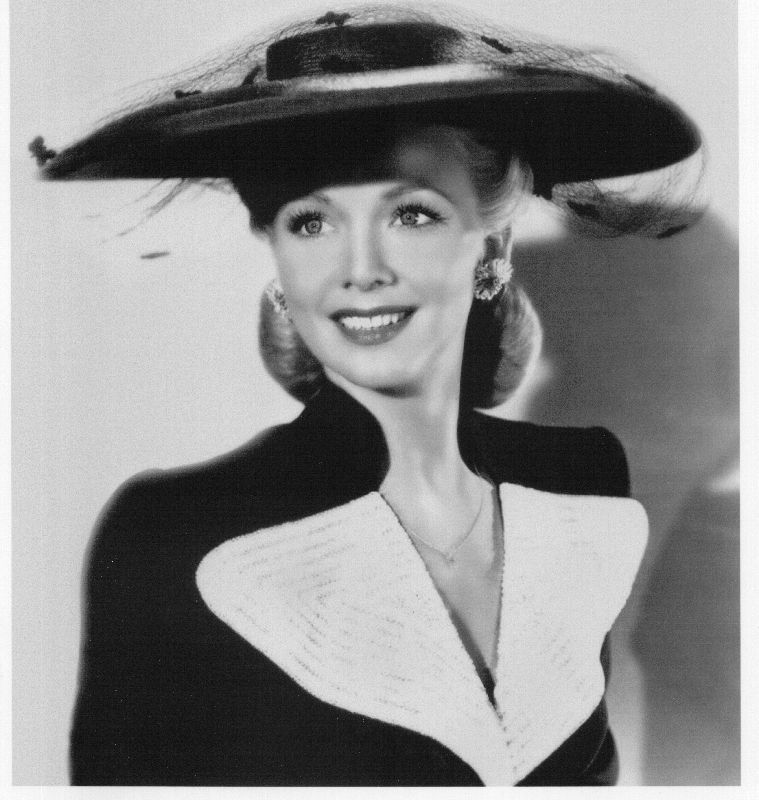
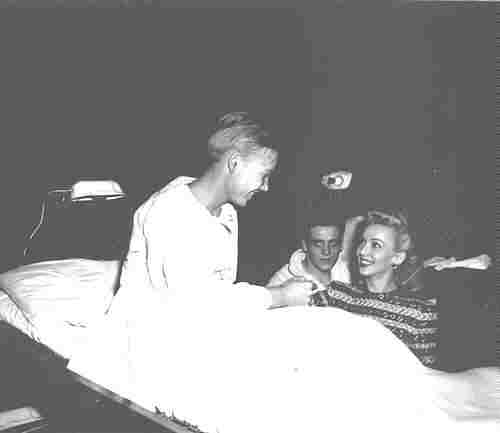
    We can tell someone’s life story because we organize our lives in the form of stories, and only a story that occupies a book is acceptable for purchase and consumption as an independent unit. Book-length biography is a genre reserved for the extraordinary, which the ordinary can adopt only through pastiche or naiveté. The great life occupies the equivalent of a novel; the less-than-great life is tellable only as a short story. The thinness and triteness of Maupassant’s characters is appropriate to this literary form–lives too thin for a full biography briefly recounted as failed, or trivially successful, experiments. Short-story characters live only to illustrate the futility of living–unless it be to show us that there is more in life than can be told in a story. But these latter are fictions whose lives can be sacrificed without qualm to the lesson they convey; a real person in such circumstances would easily find a biographer. Conversely, to be the subject of a book is a tangible sign of greatness. Carole Landis’ career frustrations and suicide would seem less irredeemable were her life commemorated otherwise than in brief and ill-informed essays.

    Commemoration in language is as old as language itself; it is the atemporality of the abstract sign that guarantees the time-bound permanence of the physical monument. Biography replaces legend as the social order becomes both more complex and more aware of its complexity. There can be only “one” legend–if multiple, legends compete–whereas biographies can line the shelves. Even if ordinary people are unworthy of biography, uncountably many can be classified as extraordinary. Indeed, the phenomenon of celebrity having weakened the link between this status and demonstrated achievement, we are all justified in thinking ourselves at least virtually extraordinary.


    Most of what we consider our major cultural forms–movies, operas, plays, short stories, symphonies, concertos, suites, narrative poems–occupy in our lives the mediate duration of a typical rite (a mass, a synagogue service, a wedding ceremony); lyric poems, along with songs and short instrumental pieces, belong to the briefer category typified in ritual by a single prayer or gesture, whereas novels, epic poems, and Wagner’s Ring cycle share the temporality of festivals, such as the Panathenaia where the Homeric epics were recited. The mediate form has the time-frame of a human event, composed in turn of individual moments, throughout all of which the periphery-center structure of the human scene is maintained. Conversely, it is virtually impossible to maintain one’s concentration for the length of a long form; one cannot normally read a novel at a single sitting, and certainly not remain continuously active throughout a week-long festival. The long form is distinguished from the mediate one by an episodic structure incorporating our experienced variation in meaningfulness between explicit and implicit–sacred and profane–scenic moments, with biological roots in cycles of concentration and relaxation, sleep and wakefulness. The long form is not inherently more significant than the mediate: novels are not greater than dramas. But they involve a greater investment of time by both creator and audience because they transmit a degree of magnitude more information. The mediate form depends upon a shared context that in the modern world is cultural rather than empirical, so that it cannot help us to judge whether a real life is or is not of extraordinary significance. Thus a film biography tends to rely on a book’s prior guarantee, normally even when fictional, inevitably when factual.

    In the naturalistic short story that became a mass-produced genre in the late nineteenth century, scenic concentration subordinates living reality to form: a life that can be made into a short story is a life insignificant for all but a single moment. Conversely, the long narrative that extends over the unexceptional time separating one scene from another (the function of description in the novel being to fill the gaps between narrative scenes with something other than narration) models the temporality of human life as a whole rather than that of the sacred scene alone. The sacred is not indeed an end in itself; it defers the danger the human community poses to itself, which for our species alone is the greatest danger, in order that we may concentrate our energies on the lesser but crucial dangers of our environment, including the human environment outside the boundaries of our own society. Long cultural forms not merely reproduce the scene of sacred deferral but illustrate, and reflect upon, the function of this scene in everyday life. The greater significance of long as compared with mediate narration paradoxically corresponds to the presence in the former, in contrast with the latter, of the profane together with the sacred, the duration of dispersion together with the moment of concentration. The story of a life worth living is less rather than more intensely revelatory, farther from rather than closer to sacredness, than that of a life worthy only of sacrificing.


    What then brings unity to the extended temporality of novelistic or biographical existence? In the Homeric epics that are the ancestors of all Western fictional narratives, what ties the beginning to the end is resentment. The “tragic” Iliad is the story of Achilles’ (unjustified) resentment against Agamemnon, which he renounces by returning to battle and then magnanimously returning Hector’s body to Priam; the “comic” Odyssey is that of Odysseus’ (justified) resentment against Penelope’s suitors, whom he massacres at the climax of the story. The French saying La vengeance est un plat qui se mange froid (recently quoted in Tarantino’s Kill Bill as a “Klingon proverb”) succinctly describes the basic structure of long narratives: “hot” resentment, preserved in memory, generates a strategy of “cold” revenge whose implementation can sustain an indefinite series of episodes. Integrated human time contrasts with the entropy of natural life whose continuity is genetic rather than individual; epic fiction is about resentment because resentment lies at the foundation of human temporality. Resentment is our mode of relationship to the mimetic configuration that controls our desires; it acknowledges both our dependency and our disaffection, as figured in the Homeric epics by Achilles’ abortive withdrawal from battle and Odysseus’ disguise as a beggar at the door of his own house.

    This model makes sense for fiction, which commemorates the dependency of the very notion of “life history” on the narrative logic of the originary scene, but a model that gives meaning to an individual life cannot present this life as itself productive of meaning. We should not be too hasty to assimilate reality to representation, fearing to affirm “naively” that meaning is generated in our experience of a reality behind representation and only subsequently captured within it. What would indeed be naïve would be to assume that our models of human action are independent of cultural representations. Fiction provides new models for understanding facts; facts provide new data for the testing and modification of these models. Biography is one means for adjusting narrative form to new content.

    At the public pole of biography, the historical significance of the subject is uncontested. In such cases, human temporality may be taken for granted rather than constituted; our overriding concern is not what makes possible the biographee’s participation in the world but what he has accomplished during his time in it. At the limit, such biography simply borrows its formal coherence from that of the events it recounts and becomes what wed may call biographical history. If the subject has accomplished great things, it suffices to give an account of these accomplishments; his biography is a collection of stories that only incidentally form a narrative totality. But because it finds its coherence in events rather than in their subject, biographical history can tell us nothing about the relationship between individual life and the scene of origin from which it derives its categories of significance.

    To the extent that biography exists as a distinct narrative genre, it is as the attempt to find in a real life the material of a coherent narration. The purest form of biography is that in which the biographer is obliged to make a case for the significance of his subject to a public that has not yet accorded it. In this case alone is biography an independent cultural form.. The significance of the biographee remains latent until the biography reveals it; historically it is the creation of the biography itself. The life of someone who cannot be shown to have played a crucial role in significant events signifies not by contiguity but by example, like that of an actor in a drama rather than of an actor on the world stage. This mode of exemplarity is tragic by the very fact of its  historical marginality. One thinks of Hegel’s reading of Sophocles’ Antigone as incarnating a set of values incompatible with the world as it is, but pregnant with the world of the future.


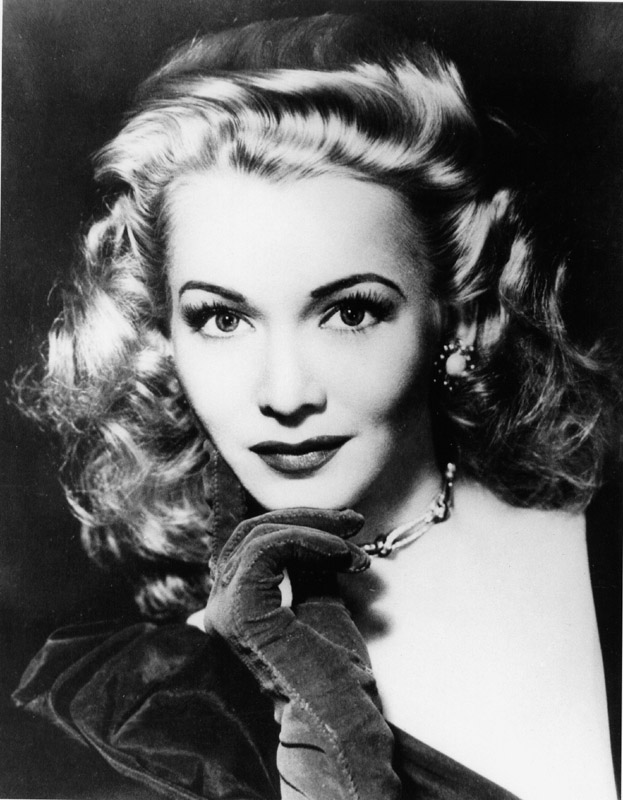
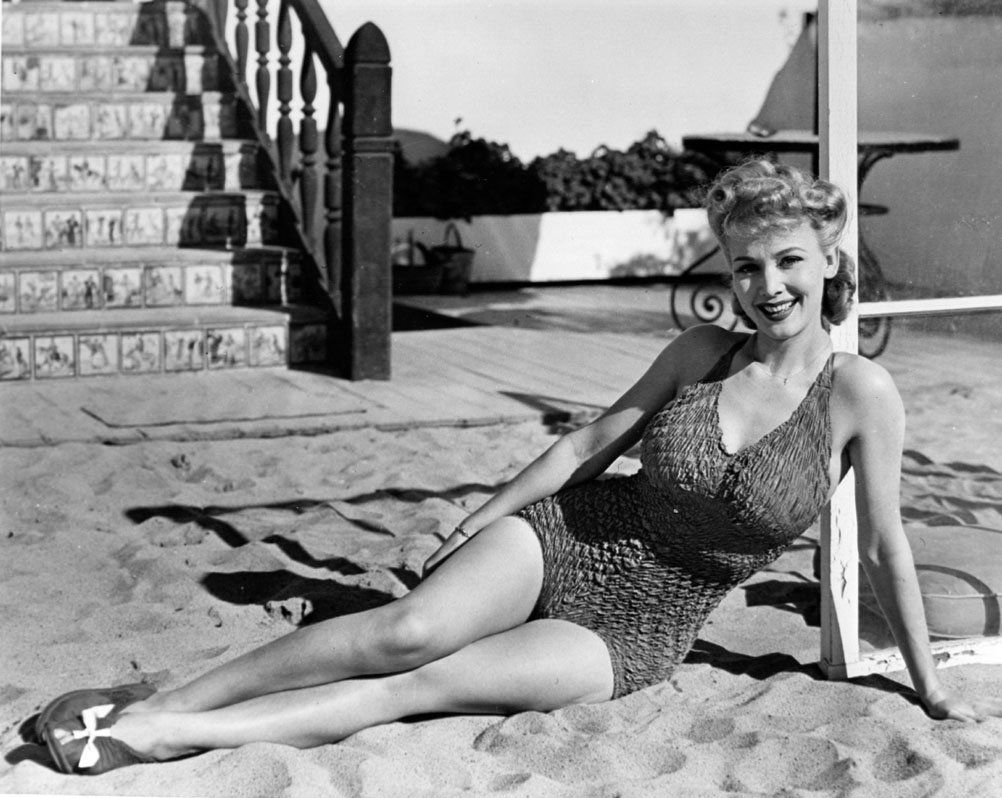
    In the second part of this analysis I will attempt to make a case for Carole Landis as such a person; someone not behind but ahead of her time, who revealed in her lifetime, a revelation never really lost, a new potentiality of human beauty. It is surely a distortion to speak of Carole, as do some of her defenders, as a feminist avant la lettre. Carole did not disdain to exploit her unique beauty in ways incompatible with today’s sexual egalitarianism; but her lesson for all of us is that the cultivation of our personal esthetic is a means to exchange both pleasure and moral reinforcement. Carole’s beauty, so powerfully sexual, nonetheless suggests to us a path toward transcending the asymmetry of gender in mutual respect.

    Since beginning my project on Carole I am better able to understand why no one has written a book about her. There are few sources of information other than movie magazines and gossip columns. Although she was friendly and easy to work with, although her beauty was spectacular and her personality scintillating, not a single one of her associates, not even actors who co-starred with her in several films, has written more than a sentence or two about her–in many cases, not even that. Perhaps they were deterred by the scandal of her suicide; perhaps they felt guilty to have done nothing to prevent her death; perhaps they sensed that she was not wholly of the world in which she lived and worked, even in the milieux where the gossip columnists assure us she was found. The “four Jills” is the only collective with which she is reliably identified–yet the memoirs of her colleague Martha Raye give her no more than a few sentences either.

    Thus I must find a novel in a life seemingly earmarked for a short story. The talented girl typecast because of her figure; the wild girl whose body was her sole claim to fame; the sweet girl too vulnerable for Hollywood; the proto-feminist crushed by the patriarchy; the hopeless romantic who never found true love: one-line definitions of a one-page life, each less false than unworthy of its subject. The difference in the tribute we pay to objects of love and objects of resentment corresponds to that between story and novel; to care for someone, even dead and never known alive, is to want to make her the subject of a book. And whereas the biography of someone whose historical significance is assured takes its departure from the world’s affection rather than one’s own, no devotion is more personal than that which constructs a full-length story for one previously confined to the anecdotal. Like a declaration of love, the promise of a book is a commitment of the fullness of time made in a revelatory moment of unsustainable plenitude.


  • Affirmation of Life III – Originary Analysis of Terrorism

    Our most difficult yet most necessary exercise is to put ourselves in the place of those who want to kill us, not to espouse their resentments, but to affirm through this encounter the unity of the human and the primacy of moral reciprocity. If there is a psychological guide that allows us to distinguish between the satisfactions of resentment and those of love, it is the awareness that love denies the immediate emotional satisfaction provided by the resentful imagination. What we seek is not to understand the phenomenology of vicarious killing but to locate the element of our common humanity that can be made to justify the terrorist’s ideology and actions. We can call this justification fallacious, but we cannot dismiss it as alien to us without denying the humanity of those whom we condemn for denying the humanity of others.

    If the affirmation of life is a good, how is the negation of life possible? The human is founded on the deferral of satisfaction, that is, the suspension of life. Were we wholly immersed in the life-world, we would not be human. The various forms of sacrifice, including the jihadi’s self-sacrifice, pay homage to this originary configuration.

    War, the conflict between two societies, is not a component of the originary scene–happily, because this means that war is not an essential feature of human existence. The originary function of sacrifice is to maintain order within the social unit. Indeed, in its most general meaning of conflict between communities, war is not specifically human; the “struggle for life” among different subgroups within a species is inevitable, and adaptations to intraspecific physical combat are found among insects. War as combat between communities does not depend on any specific constitution of these individual communities; what is different about humanity is not that it forms societies that tend to compete with each other, but that the mechanisms by which these societies are constituted and the events in which these mechanisms manifest themselves are derived from an originary scene. When two scenically constituted communities fight each other, they differ from animal communities more in their internal dynamic than in their mode of combat. Representational factors are relevant only at higher levels of organization; a man fighting a bear can profit from his humanity to improve his weaponry, but not to impose on the bear the human spirit of deferral–nor is this possible even among humans once they become engaged in violent combat.

    In war, animals as well as humans sacrifice their lives for the cause; their “altruism” is predictable by the need to maximize inclusive fitness, the annihilation of one’s community being clearly the most damaging of all contingencies to one’s gene pool. In war, laying down one’s life for one’s comrades or one’s country is hardly abnormal behavior. But today’s suicide bomber is hardly performing the same function as the Kamikazes of WWII; the Japanese pilot who flew his plane into the side of an aircraft carrier has very little in common with the men who flew airliners into the sides of buildings on September 11. As compared to those motivated by the defense of the fatherland, the hijackers acted in the name of no established or emergent political unit. The power and significance of their act lies in the acknowledged asymmetry between the concrete reality–and lives–destroyed and the vague Islamic utopianism this act claimed to promote.

    A terrorist International is in the process of forming, one that extends well beyond the Islamic limits of al Qaeda, drawn together by common resentment of the West and its market-driven prosperity. (In a recent book entitled L’Islam révolutionnaire [Monaco: Eds du Rocher, 2003], the infamous international terrorist Ilich Ramirez Sanchez, better known as “Carlos,” a recent convert to Islam, urges “all revolutionaries, including those of the left, even atheists,” to accept the “luminous” leadership of Osama bin Laden in the fight against the “incarnation of Satan” that is the United States.) The attitude of resentment is, as the evolutionists say, an adaptive behavior for reestablishing moral reciprocity within a given society. Sacrificial ritual and “scapegoating” in general focus the energy of this resentment on targets whose destruction does not endanger the social order as a whole. Between societies, war often serves the function of directing resentment away from the social order; if the ideal “scapegoat” is one whose destruction does not damage this order, then a fortiori the members of another political unit can serve the same function. Indeed, war makes more efficient use than sacrifice of the energy of resentment, since defeating an external enemy can bring economic benefits unavailable within the zero-sum terrain of one’s own society. Arguably the battlefield, the originary locus of valor/value (French valeur), is where resentment first gets productively recycled into the exchange system.


    On the one hand, terrorism is the extreme degree of victimary politics–white guilt is expected to excuse even one’s own potential killers; on the other, it is a reminder of the sacrificial origins of the global exchange system. If scapegoating is an internal and war an external phenomenon, terror becomes a category in itself at the point where the distinction between internal and external breaks down–in a frontierless global economy that includes local cultures whose integration into this economy is, as might be expected, not always, or even usually, successful. Terrorism has been a technique of war, but contemporary terrorism is a war in itself–a new development that we should give George Bush and his government credit for recognizing, whatever one thinks of the specific policies by which they have been waging our side of the war.

    The terrorist returns from exchange to sacrifice; from the marketplace, in which he is implicated insofar as he can act only from within the system he is attempting to destroy, to the originary deferral of desire that founds human culture. Death alone can guarantee the terrorist’s denial of exchange, and, as a result of this denial, makes his action more effective, severing the final ties of shared self-interest between the killer and his potential victims. (As the Israelis will tell you, there’s no foolproof way to stop a suicide bomber.) Suicidal martyrdom, a deterrent to those who love life, is a paradoxically effective recruitment device because it demonstrates to the terminally resentful the viability of the originary human alternative to the master-slave dialectic–as the market system is viewed by those unable or unwilling to conceive economic exchange as a rational process. It is not surprising that this position, characteristic of the Islamic “third world,” has absorbed the radical antisemitism of the internal Western “critique” of the market system as a centralized conspiracy (see Chronicle 292).

    The originary scene is successful because it preserves human life from the dangers of mimetic conflict. The event of deferral is not a visceral reaction of fear; the deferral of appetitive satisfaction is a mode of communication, a communion that prefigures the feast that will follow. One renounces life as an animal in order to live it as a human being. This renunciation is the source of human life as such, and every subsequent human life is dependent on it. Suicide bombing is the ultimate means of calling in the chips of this debt. It reminds us that the opposition between culture and economy as modes of exchange may be reduced in its starkest terms to that between death and life–the former as death to animal instincts and the latter as providing for their continued satisfaction.


    The participants in the originary scene acted to control resentment by redirecting it toward the all-powerful center. The global economy dominated by the United States is for the Islamic militant a Satanic inversion of this originary configuration that can be combated only by an inversion of the originary deferral of violence. Instead of disorder transformed into order by the deferring focus on the center, violence to the center produces a disorder so chaotic that it can be restrained only by the sacrificial order in which desires are renounced rather than merely deferred. The terrorist’s resentful fidelity to the originary constitution of the human emphasizes the renunciation without compensation of our most fundamental appetite–the “instinct of self-preservation”–in the service of transcendence: in a word, theism, in contrast with the deferral of appetite in the service of peaceful exchange: in a word, humanism.

    There is no Archimedian equilibrium point from which to articulate and synthesize man’s creation of god with God’s creation of man, although Christianity articulates this paradox more sharply than any other religion, and generative anthropology offers a minimal model of it. But whereas religion is traditionally the domain where “the end justifies the means”–cf. Pascal’s wager or pari–our era is the historical moment in which the means must be judged in themselves because the means have become the theology. The destruction of the human world order in order that God may impose his own order is Satanic rather than authentically theistic; by claiming to carry out the will of a divinity situated beyond human order the terrorist makes himself the origin of the transcendence he supposedly obeys.

    Theological niceties aside, we must rely on our intuition of the difference between love and resentment. In this regard, the age of communism and its dialectical opposite, Nazism, is a historical watershed. Nazi propaganda stressed love of fatherland over its hate-filled racial doctrines, although the latter were by no means hidden, and communism played this game still more successfully–to such an extent that whereas de-Nazification is still a reality in Europe, de-communization is not even a word. We realize now that a solidary post-market community cannot be created by focusing the resentment generated by the market on the real or symbolic agents of market circulation, but this realization was not automatic: it required the elaboration and ultimate failure of monstrous historical experiments. Contemporary terrorism too is engaged in a historical experiment, but it cannot be realized in a economically viable society; it is a contest between the human order with all its faults and the social equivalent of nothingness.

    Anyone who expresses sympathy for the terrorists by denouncing the global order as “capitalist” or “imperialist” is, deliberately or not, missing the point. Islamic terrorism does not seek to liberate “indigenous forces” kept at bay by imperialist control in order to create a new society; its goal is to produce a chaos so violent that it can be tamed only by the imposition of the Sharia at the hands of Taliban-like gangs, not as a stricter way of regulating economic relations but as a substitute for them. The apparently abstract opposition between love and resentment, order and chaos, becomes an opposition between the world as it is today and one that would be a nightmare for all but a few of its few survivors. One shudders to think how many hundreds of millions of deaths would be required to bring about such an outcome; it is this number, not the day-to-day tallies of terrorist victims, that is the body count we should use to assess the morality of Islamic terrorism. No anthropology that values its subject-matter can conceive this to be required by humanity’s originary constitution; yet it is an option that has always been available to it in principle and that our global society has allowed to emerge as a real, and ominous, possibility.


  • Affirmation of Life II – Life or Death

    However necessary the turn from nihilism to the affirmation of life may be in the intellectual world, in the domain of practical politics it is truly a question of life or death. The great conflict of the 21st century is shaping up between those who believe in “life, liberty, and the pursuit of happiness” and those who are willing to blow themselves up in order to prove this belief unfounded. The survival of humanity requires that we recognize and counter this threat.

    The now waning postmodern political configuration emerged from the conflict of WWII. Although, tragically as it turned out, Nazi Germany’s persecution of the Jews was not seen as a central focus of the war, both major Axis belligerents’ doctrines of racial superiority were nonetheless perceived as challenging the fundamental reciprocity of the moral order; the consciousness of racial and ethnic equality thus raised would provide the basis of the victimary politics of the succeeding era.

    In this context, the war had to be won at all costs. The enemy having chosen to massacre whole groups of people, the Allies felt justified in considering all enemy lives as more or less equally acceptable targets. As a result, the Allies, albeit for less condemnable reasons, shared with the Axis powers the dubious distinction of inflicting history’s greatest violence on civilian populations. Voices continue to be raised against such conceivably unnecessary occurrences as the Dresden firestorm and, of course, the atomic bombing of the two Japanese cities. But although these critiques carry moral weight, they have purchase only within the context of Allied debates; in no way does the civilian death toll put in doubt the justness of the Allied cause.

    The use of the atomic bomb nevertheless marked a turning point in the history of warfare; for the first time we had created a weapon that–and a fortiori the vastly more destructive fusion or “hydrogen” bomb that evolved from it–could no longer either justifiably or realistically be used in warfare. Awareness of this made a third World War unthinkable; the incipient West-East conflict froze into a Cold War standoff of Mutually Assured Destruction (MAD) accompanied by secondary, limited hot wars, in none of which were atomic weapons used or even seriously considered. As Adam Katz pointed out to me recently, this was the context of the birth of modern terrorism, whose threatened and real killing of civilians could be “justified” by the fact that the credible threat to kill unacceptably many enemy civilians was the basis of the foreign policies of the great powers.

    In the postmodern configuration, the Hiroshima factor is subordinate to the Auschwitz factor; it is the identification with victims against their persecutors that supplies the context in which possession of the ultimate weapon is the ultimate sign of inhumanity. Terrorism is the ultimate weapon of victimary politics, which sees the terrorist not as a denier of life, but as one who defends the rights of the oppressed by wreaking violence on their–by definition less worthy–oppressors. The terrorist is a “freedom fighter” whose victims, civilian or military, are tainted by their own participation in victimization. By the same token, terrorism against the Soviet Union was unthinkable; their bomb protected the global proletariat. Yet ideology eventually yielded to reality; the “anticolonialist” USSR fought a guerilla war in Chechnya and lost one in Afghanistan.

    Nietzsche’s notion of life-affirmation, its Nazi perversion aside, could not serve as the foundation of postwar political morality. Eliminating ethnic, class, and later gender distinctions was felt to be more urgent than affirming life across the board–what affirms the life of the dominator denies the life of the dominated. As the term “affirmative action” suggests, affirmation tended to be limited to groups classified as oppressed. To translate “Black is beautiful” into White, or woman’s liberation into men’s liberation, is either caricatural or sinister; “White people’s” organizations are crudely racist, just as the “Christian Identity” movement is a neo-Nazi organization.


    The postmodern period entered its penumbra with the end of the Cold War and went black on 9/11. The end of the spurious symmetry between “capitalism” and “socialism” marked the triumph of the market system as the only system conceivable, of which first fascism and then communism were revealed to be merely nocive variants. Not that the disintegration of the Soviet Union put an end to victimary politics; on the contrary, this politics received a new impulsion from casting off the obvious vices of Sovietism. But the new race-gender-ethnicity triumvirate that replaced the class struggle lacked an alternative social model. Its political options were limited to the choice between incremental gradualism and utopian anarchism–”working within the system” or refusing to accept the lack of viable alternatives.

    After 9/11, this mode of denial did not disappear, but it could no longer disguise its nihilism. The Chomskys and Sontags who continue to explain world affairs as the American victimization of everyone else are exposed not merely as having nothing to put in the place of the system they condemn, but as accomplices of those who would destroy this system even at the price of exterminating the human race.

    Nietzschean thought, as we have seen, came to grief over the lack of specificity with which the “artistic” affirmation of life was defined. The Nietzschean artist is not a victimizer, but, in the absence of originary morality, it is inevitable that the strong will define or at any rate confirm their strength by their ability to crush the weak. Hitler is only the most extreme in a series of obnoxious twentieth-century “Nietzscheans,” from Gide’s Immoralist and Lafcadio to Leopold and Loeb. Our contemporary predicament is, in its practical essence, far easier to define than Nietzsche’s: the battle against the “decadence” of early consumer society was both less urgent and less winnable than the war against those who make our annihilation their principal goal.

    The opposition between the market-oriented liberal-democratic West and the ritual-centered, dictatorial (Middle-) East is often put in terms of “way of life”: isn’t the imposition of liberal democracy on other peoples colonialist, hegemonic, “Orientalist”? Although it is of the essence of liberal democracy that the members of the society choose their own rulers and, as far as possible, their own careers and consumption patterns, this choice is not made in a vacuum; it requires a context whose specificity–and relative rarity–we increasingly respect, and which may not be either available or attractive to the members of traditional societies.

    The present context permits a simple answer to this objection. There is only one aspect of our “way of life” that we must, to ensure our own survival, impose on other peoples: the rejection of the nihilistic activity of terrorism. In the era of decolonization, stateless terrorism was tolerated as an evil means to a good end; the terrorist’s statelessness was really the provisional form of a new national state that would one day replace the old colonial one. In the postmillennial era, tolerance of terrorism is globally suicidal. Terrorists no longer act in the service of a proto-state that awaits only decolonization to emerge. Increasingly, even in such places as Palestine, Chechnya, Kurdistan where the proto-state is the ideological basis for the terrorism–as it is not for al Qaeda, the most prominent terrorist organization of our time–there is no clear path from the terrorist act to the desired new state. Terrorism fails the Auschwitz criterion: it no longer constructively defends victims against persecutors, and it fails the Hiroshima criterion yet more clearly now that there is real danger of a terrorist group acquiring atomic or biological weaponry.

    Instead of a limited action designed to drive out occupiers with no ultimate stake in the land they occupy–a model that de Gaulle shocked the Algerian colonists by applying to their “overseas department”–contemporary terrorists define as “occupiers” members of ethnic groups as committed to the land as their own: the Protestants in Northern Ireland, the Spanish in Basque country, the Sinhalese in the Tamil regions of Sri Lanka, and, of course, the Israelis in their part of Palestine. As the terrorist’s political aims become more nebulous, he focuses more on killing now than on building later; the farther he gets from creating a state, the greater his interest in acquiring weapons “of mass destruction” previously reserved for states–and the more crucial it becomes to take preemptive action to keep these weapons out of his hands.

    The terrorist’s lack of a realistic political aim does not mean the lack of a political worldview. Moslem fundamentalism has its model of the good society: the extension to the entire world, at any rate to those parts of the world Moslems care about, of something like the former Taliban government in Afghanistan. The Umma replaces the state because the modern state is necessarily corrupted by the instrumental rationality of the exchange system. But this disdain for the state and the rationalized economy that supports it is the functional equivalent of genocide. Who doubts whether bin Laden and his friends would have blown up the entire United States had they been capable of it? Stripped of the market and its culture–and of most of its population–the whole world would become a propitious terrain for the new Taliban.


    The principal conclusion to be drawn from these well-known facts is banal: terrorism must be suppressed. But the banality belies a moral paradigm shift that signals the passage from the postmodern, victimary era to the post-millennial one. Terrorism in the preceding era was judged in the context of the victimary model, as a necessarily, or, at worst, unnecessarily evil instrument to a greater end. Now it is terrorism itself, the means, not the end, that is the problem. The originary configuration opposing persecutor to victim has been replaced by one that opposes order to violence.

    This change in configuration reverses the relationship between center and periphery characteristic of the previous era. We have lived for two generations with the cliché that authority, power, indeed, success in any form, are essentially evil–that in the normal state of affairs, losers are good and winners are bad. In this context, any form of rebellion is justifiable, and its violence, excusable. Where a utopian horizon is posited beyond the present configuration, rebellion is the first stage of the revolution that will eliminate domination for good; where it is not, the cry for freedom generates “white guilt” that undermines, even if it cannot altogether destroy, the oppressor’s authority. The latter case, as we began to discover well before the fall of the Berlin Wall, is far more stable; it makes no historical predictions that can be embarrassingly falsified and permits collective resentments to be focused on incremental rather than apocalyptic goals.

    But now that rebellion, in the form of terrorism, poses a threat to civilization and even to the human race, we are obliged to affirm our respect for order and seek to preserve it. Resentment is no longer a guarantee of truth; it has become a symptom to be treated. Victims deserve our sympathy, but just as their plight is not a proof of virtue, neither is it unconditionally appropriate to relieve them of it at the expense of society as a whole. In a word, the Rawlsian-existentialist “original position” of faceless undifferentiation must give way to an originary scene in which the moral order emerges from an act of collective deferral.

    Questions of this sort arise in domains other than politics, for example, in medical treatment: at what point does keeping someone alive become an inappropriate use of collective resources? What best “affirms life” in a world of finite wealth and conflicting interests is never self-evident. But whatever policies are decided on, the social order must be preserved, and those who threaten its existence, rendered harmless by whatever means necessary.

    We would do well to recall the spirit of a simpler time:

    Hitler wasn’t guessing when he incorporated into his psychological warfare the strategy of “divide and conquer.” It worked in Norway and it worked in France, and because there is no immunity to Fascism, it’s trying hard right here in the United States. There is one antidote.

    We’ve got to remember that we’re all in this together. British, Russians, Chinese. And French-Polish-Yugoslav-Jewish-Irish-Mexican-English or what-have-you-Americans. Indians, whites, and Negroes. Soldiers, Sailors, Marines, Coast Guardsmen, boys in the AAF or Merchant Marine. And civilians. Yes, civilians.

    All the names from Pearl Harbor onwards are written on our memories and on our hearts and in your steel and your blood and your courage. The exploits at home aren’t of this kind. But believe me, boys, they do exist.

    In two and a half short years, the country has rolled up its sleeves, and our production record can be heard in the planes that roar over Germany; our War Bond record is built into every tank and destroyer, and the blood banks of the Red Cross are only one of the “musts” on the daily lists of the men and women on the home front.

    None of us here can give as much as you. We all know it. That’s why there is such a determination to give all we can, in time, spirit, money, work. We believe in you. We know you’re good. But you’ve got to believe in us, too, because the home front is also a fighting front. And because this belief, this unity, brings the day of Victory right up there in plain sight. Unity is the one thing Hitler and his cohorts cannot cope with.

    Carole Landis, “United We Stand” (MAST [Merchant Marine Magazine], November 1944)

    (to be continued)


  • Affirmation of Life: I – The Gift of Beauty

    As one gets older, one grows more appreciative of life. I doubt if I would have conceived the same admiration for the beauty of Carole Landis had I encountered her twenty or thirty years ago. Knowledge and experience aside, appreciation of life is the basic component of what we can still call the “wisdom” of age. Life is finite for all, not merely the old; the latter’s sharper realization of it reflects the growing coincidence of their personal horizon with the reality of the human condition.

    The affirmation of life, whether by old or young, is something sorely lacking in our intellectual world, dominated more than ever by resentment. Resentment is the implicit agenda of virtually everything written over the last forty years or so under the name, now becoming quaint, of “theory.” The resentful attitude is the only habitus immune to deconstruction, which casts humanity’s fundamental life-preserving process of deferral as itself a mode of violence–an “error” that guarantees the good conscience of endless expressions of hatred for all that is, condemned as violence done to the entropic paradise that isn’t.

    Today’s nihilism dressed up as egalitarian distrust of authority reflects real problems–inequality is always a problem–but in the derealized mode suitable to tenured lifetimes of conference attendance–one of the more modest forms of life-affirming activity. This winter I am scheduled to teach our department’s “theory” course, which examines a series of discourses whose story-line is always the same: the uncovering of a new strand of the fiendish plot of being against nothingness, of the center against the periphery that the center defines–a paradox that the young Derrida had the intelligence to articulate, albeit in a mode that anticipates its forgetting.

    The affirmation of life can begin but cannot end with the rejection of its deniers. This line of thought brings to mind Nietzsche, easily the most misconstrued of philosophers, whose message, for reasons not entirely extraneous to its content, has been distorted, first into an apology for Nazi brutality (in the name of the “blond beast”), and, more recently, as a lesser but more preposterous evil, into an apology for postmodern nihilism–nihilism, the very phenomenon against which Nietzsche fought so passionately, so desperately. Nietzsche’s simple point, the point of a sick man as mine is of an old one, is that the fundamental criterion of all our activities must be the affirmation of life–the promotion of love rather than resentment. This simple idea, in practice, is not simple at all, the human being precisely defined by the moment in which he defers that which, absent the specter of intraspecific conflict, would contribute to the maintenance of life. Although Nietzsche’s indifference to these anthropological niceties led his name to be invoked by personages whose idea of life-affirmation was putting Jews in gas chambers, the “artistic” self-affirmation he preached was meant to liberate others, not exterminate them.

    Now that we have, not without success, devoted two generations to improving the lot of the world’s victims, it is time we turned our attention to encouraging not the resenting but the rejection of victimhood. If this must come through the study of the coping strategies of the “post-colonial” world, so be it. Even if the only cultures our own intellectual culture allows us to affirm are those most different from–and most economically irrelevant to–our own, it is better to affirm something than nothing. But I will leave this task to my able colleagues. For the past several months, I have been at work at my own project of life-affirmation.


    Last Spring a young man whose opinion I greatly respect took me to task for descending from the general to the particular, from the origin of language to the life, marginally world-historical at best, of a largely forgotten Hollywood actress. How can the life of Carole Landis be relevant to generative anthropology, the science of the originary?

    My answer, really only the beginning of an answer, is that human culture emerged as the result not of incremental evolutionary modification, but of a historically unique event, a singularity. This is not simply a “historical” observation. The human emerged in a singular event and is distinguished from other species by its preservation, through representation, of singular events, organized around singular objects. The founding intuition of Christianity is that human truth, even and particularly the truth of moral reciprocity before which all humans are equal, can be learned only in an experience that absolutely distinguishes from all others a single individual. It is only singular individuals–such as we all are–who can engage in the symmetrical actions of moral reciprocity. It is this singularity that we affirm when we speak of something as life-affirming. Our singular lives are made up, to be sure, of mimetically acquired components, but they are no less singular for that–there being no other model of singularity available to us.

    My unplanned encounter with Carole Landis has given me a wholly unexpected insight into the affirmation of life. I learned, after sixty years of disbelief, that it is possible for real sexual beauty to exist in not merely the private but the public sphere–that in the world of publicity that induces us to desire signs in the place of substance, a woman of real beauty was able for a time, albeit at great cost, to maintain herself.

    A photograph of Carole’s face alone suffices, but only because the beauty of her face is guaranteed by a perfect body, slim and full-bosomed, rounded rather than two-sided (compare the nonetheless beautiful Rita Hayworth), that inspires in whoever sees it not the least desire to add or subtract. That Carole was “strong as a lady wrestler” and able to “run like a deer” only confirms the perfect harmony her appearance makes manifest.

    Why should we care about Carole’s beauty, even if we cannot help appreciate it? I can turn the question around. If we don’t care about the most beautiful human being we have ever seen, what indeed can we care about? If we are so devoured by invidious relations that we cannot stop to admire what our genetic endowment makes it impossible for us not to admire, then we are nihilists indeed. But we aren’t, really. I am encouraged by the fact that not only men but, especially, women to whom I have shown pictures of Carole always express amazement at her beauty, which inspires respect rather than rivalry. One need not desire her to find her incomparably desirable.

    To the extent that Christianity captures the essence of humanity, it is in its doctrine that we are at once all equal before God and godlike before our equals. Precisely because Carole is more beautiful than the rest of us, her altogether exceptional beauty can serve as an example, so that each of us may conceive our own beauty as altogether exceptional as well. Because direct imitation of Carole’s example is impossible, she teaches us to find our own way, not necessarily visual, to merit the attentive and admiring desire of our peers.

    A human physical presence is in the first place a moral presence; I admire Carole’s beauty because these images posed before still or moving film that are all we will ever have of her presence are radiant with the warmth of a human solidarity not subject to the limitations of mortality. The many historically attested demonstrations of Carole’s selfless generosity only confirm what I think anyone can intuit from the contemplation of her recorded image. Our common humanity gives us a common sense of each other; a look of human kindness can mislead us, but not a lifetime of such looks. The dictum that appearances are deceiving is a Cartesian myth; appearances may deceive, but not too often, for they would cease to be appearances of what they pretend to be. In Clouzot’s Le corbeau, one of the best films to come out of the Vichy era, a young woman suspected by the protagonist of sending the poison-pen letters that have terrorized their town asks him to look into her eyes, for the truth is there. If we can no longer do this, we might as well not look at each other at all.


    A few months ago, in Chronicle 281 I called myself a “dialectical hedgehog.” I would venture to say that this figure–rather, for example, than that of Rorty’s “liberal ironist–is the appropriate stance for the age of what my colleague Raoul Eshelman aptly calls “performatism.” It is false to presume that one demonstrates a due respect for one’s interlocutor in dialogue by treating one’s convictions ironically. Relativism is not a mode of thought but a rhetorical ploy, a tactic of thought rather than a strategy: there are no relative truths. Yet in the ethical domain of “practical reason” the assertion of a universal truth shows it to be something other than universal, since my assertion of it is asymmetrically situated with respect to you to whom it is addressed (compare, for example, a mathematical proof); however rigorously a law of conduct may be “deduced” from its premises, its enunciation is at least implicitly an imperative rather than a simple declarative. The post-millennial solution to this paradox is to affirm universal ethical truths in “performative” mode, one that seeks to persuade the spectator esthetically rather than by either logical demonstration or bald assertion.

    Such persuasion does not narrowly take a proposition as its object. In the present case, my aim is not to persuade you of the propositions that Carole was the most beautiful actress in Hollywood, or the most beautiful woman ever photographed, but to show you her beauty in order to encourage you, as she herself did in her lifetime, to profit from your own experience of it as an affirmation of life.

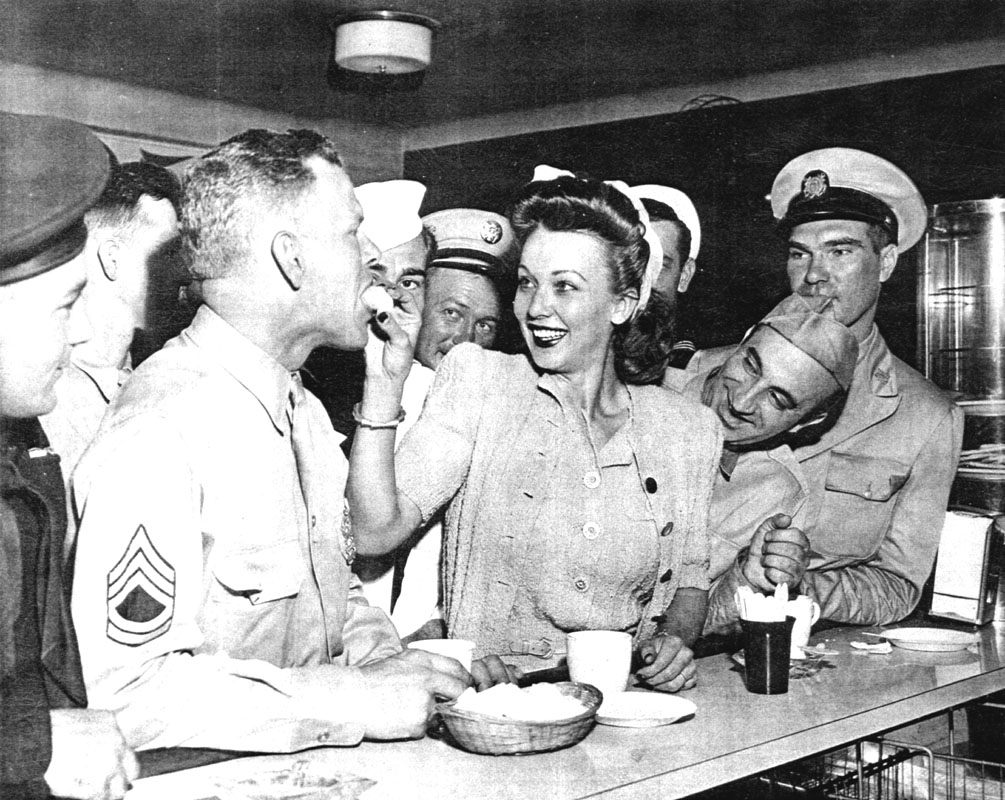
    For Carole the gift of beauty was the most general form of a generosity that she also practiced very specifically; many anecdotes testify to her readiness to give not only her money but her time, whether in speaking individually to the patients in a hospital ward or in inviting groups of soldiers home to dinner and the movies. But with all the good will in the world Carole could not communicate personally with a million soldiers, and, more generally, no number of particular gifts could provide the reassurance not merely of one woman’s personal generosity but of the ultimate harmony between human desire and reality.

    Hence the relationship between what we might call Carole’s visual generosity and the more substantive forms of generosity is not merely fortuitous. To give the gift of beauty is not a substitute for but the first stage of genuine reciprocity. When Carole visited the troops, she saw it as her duty to look her best; her physical appearance was an expression of her desire that each soldier go into combat knowing “what he was fighting for.” The power of her image owes nothing, and everything, to mimesis. It owes nothing because it is self-evident; no side-glance at one’s fellows is necessary to appreciate true beauty. But the transcendental guarantee of desirability that Carole’s image bears with it is itself the product of mimetic tension and deferral. Beauty generates a scene of its own, but this scene itself is derived, like all scenes, from the originary scene. A woman’s beauty that concentrates and focuses on itself the mimetic desire of the community is a sacred trust, and the greatest beauty is possible only for one who inspires in us the confidence that she is worthy of that trust.

    (to be continued)


  • The New Antisemitism and the Bankruptcy of Victimary Thought

    As readers of these Chronicles know, I consider the Holocaust to be the inaugural moment of the victimary era from which we are now emerging. But what we are emerging into is not so clear. The decline of the victimary model by no means implies that the resentments of the postmodern era have been laid to rest. On the contrary, the virulence of these resentments obliges us to rethink the indulgence with which the postmodern era has viewed them.

    One feature of the transition to a new era is the emergence not merely of “Islamism” but of a global Islamic antisemitism as the chief conduit for resentment against the global market system. Just as the victimary model arose in reaction to radical antisemitism, so the model’s decline is accompanied by radical antisemitism’s reappearance. One encounters today in the public press statements of Jew-hatred that not long ago were exclusive to the swastika-strutting lunatic fringe. A single issue of my daily newspaper, the Los Angeles Times of Saturday, October 18, 2003, suffices to illustrate this point.

    1. The following article is reproduced in full.

    Malaysian Premier Stands by Remarks

    From Associated Press

    PUTRAJAYA, Malaysia — Malaysia’s outspoken prime minister refused Friday to apologize for a speech in which he said Jews ruled the world, and he accused Western countries of using a double standard for criticizing Jews and Muslims.

    “Lots of people make nasty statements about us, about Muslims,” Prime Minister Mahathir Mohamad said. “People call Muslims terrorists, they even say Muhammad the prophet was a terrorist.

    “People make such statements, and they seem to get away with it. But if you say anything at all against the Jews, you are accused of being anti-Semitic,” Mahathir said at a news conference after the close of a summit of the Organization of the Islamic Conference, the world’s largest Muslim body.

    Mahathir was reacting to a wave of condemnation over his speech to the summit Thursday, in which he said: “The Europeans killed 6 million Jews out of 12 million. But today Jews rule this world by proxy. They get others to fight and die for them.”

    In his speech, Mahathir used allegations of Jewish dominance to underscore his chief point: that Muslims need to embrace modern knowledge and technology and overcome divisions over religious dogma that have left them weakened globally.

    Mahathir said Muslims had achieved nothing in more than 50 years of fighting Israel. He also said the world’s more than 1 billion Muslims “cannot be defeated by a few million Jews.”

    Mahathir, 77, a senior statesman in the developing world who will retire Oct. 31 after 22 years in power, has long taken pride in calling things the way he sees them. He is a staunch advocate of the Palestinians and strongly opposed the war in Iraq. He has also jailed terrorism suspects from the Al Qaeda-linked Jemaah Islamiah group.

    The U.S., Canada, the European Union, Israel, Germany, Britain and Australia all condemned Mahathir’s remarks about Jews. State Department spokesman Adam Ereli called the speech offensive and inflammatory.

    But Mahathir was unapologetic and said at the news conference that he opposed terrorism, suicide bombings and Israel’s policy of massive retaliation in response to Palestinian violence. “What I said in my speech is that we should stop all this violence,” he said, noting that historically, Jews had sought refuge in Muslim lands to escape persecution in Europe.

    But since Israel was established half a century ago, he said, “there seems to be no more peace in the Middle East.”

    Mahathir was simply telling it like it is, Arab leaders said.

    “I don’t think [the comments] are anti-Semitic at all. I think he was stating the facts,” Yemeni Foreign Minister Abubakr al Qerbi said.

    Egyptian Foreign Minister Ahmed Maher added: “There are people wanting to create trouble, invent problems that do not exist. I would advise them to read the whole speech.”

    The logic with which Mahathir and his allies accuse their accusers is typical of the sacrificial discourse of antisemitism: every criticism of the antisemite is but another proof of the extent of Jewish power. How scandalous that Moslems are accused of terrorism with impunity (one wonders if Mahathir thinks the Mossad was responsible for 9/11), whereas stating the simple truth that “today Jews rule this world by proxy. They get others to fight and die for them” subjects one to opprobrium.

    (As an illustration of how easily Americans get away with insulting Islam, three pages further on we find, “General Apologizes for Remarks on Islam,” where it is reported that Lt. General William Boykin, in reaction to adverse comments, stated that “for those who have been offended, I offer a sincere apology.” Nonetheless, a senior Saudi official is quoted as calling “outrageous” Boykin’s remarks, in which he assimilated the enemies of the US–but not Moslems as such–to Satan and referred to “his [a Somali warlord’s] God” as an “idol.”)

    Mahathir is not an Al Qaeda militant or a Wahhabi cleric. If anything deserves to be called Moslem public opinion it is a position articulated at “a summit of the Organization of the Islamic Conference, the world’s largest Muslim body” and supported by the entirety of its membership–there is no sign of a single dissenting voice. Whatever we think of Islam as a religion, we must face the fact that as a political community, mainstream Islam today is the vector of a renewed global antisemitism with which resenters of the market system increasingly identify. The humiliation inflicted by Israel on the Moslem nations that have been trying for two generations to “drive the Jews into the sea” has given rise to an “Islamic” world-view that is in fact pieced together from the tawdriest scraps of Western thought. Mahathir presents as empirical truth, and his fellow Moslems hasten to confirm by their own experience (“telling it like it is”), the hoary mythology of the Protocols of the Elders of Zion. Along the same lines, a few months ago the New Republic published excerpts from a “scholarly” article by a professor at a major Egyptian university explaining how Jews use the blood of non-Jewish children in the fabrication of their Passover matzoth. Vicious Western idiocy is presented as Islamic fact–as the Associated Press informs us, its “outspoken” promulgator “has long taken pride in calling things the way he sees them.”

    1. My second example is closer to home. The front page of the same newspaper that conveyed the Indonesian indictment of Jewry carried a story about Joseph Lieberman’s visit, one hopes more foolhardy than cynical, to the Arab American Institute conference at Dearborn, Michigan. Unlike Howard Dean, whose pandering denunciations of the “religious right” elicited a standing ovation from the group on the following day, Lieberman was booed for denying that bulldozing the homes of terrorists and building a protective wall to keep them out–policies he hastened to condemn–was itself a form of terrorism. Israel is the only country in the world whose policies, good, bad, and debatable, are scrutinized in this manner; but let that pass. What is of interest is the language, reported without comment by the Times, in which the membership of the Arab American Institute expressed their opposition: “Go home to Tel Aviv!” And from a “Palestinian activist from Danville, Calif.”: “He should be running for the prime minister of Israel… He is such a Jew.” It is appropriate for Arabs to be Arabs, but for Jews to be Jews is contemptible indeed. Not that anti-Zionism has anything to do with antisemitism.
    2. On a lighter note, Saturday’s “Letters to the Times” section contains this little gem:

    The 1st Amendment provides: “Congress shall make no law respecting an establishment of religion.” Only lawyers can read this language as condemning the use of the words “under God” [in the Pledge of Allegiance] while concurrently allowing the expenditure of billions of dollars maintaining the religious state of Israel.

    This offhand crack from a presumed Christian is as frightening as the predictable hostility of Moslem activists. What separates us most radically from the era of my childhood is the legitimacy then accorded to expressions of racial superiority. Today the mainstream press considers racist statements unacceptable, but publishes without comment gratuitous references to “the religious state of Israel.”

    1. A final example, this time from a senior editor of the New Republic, America’s leading weekly journal of ideas–one whose publisher is Jewish and a strong defender of Israel. In his “blog” (I hate that term) of October 13, Greg Easterbrook writes the following about the new Tarantino film, Kill Bill:

    Set aside what it says about Hollywood that today even Disney thinks what the public needs is ever-more-graphic depictions of killing the innocent as cool amusement. Disney’s CEO, Michael Eisner, is Jewish; the chief of Miramax, Harvey Weinstein, is Jewish. Yes, there are plenty of Christian and other Hollywood executives who worship money above all else, promoting for profit the adulation of violence. Does that make it right for Jewish executives to worship money above all else, by promoting for profit the adulation of violence? Recent European history alone ought to cause Jewish executives to experience second thoughts about glorifying the killing of the helpless as a fun lifestyle choice.

    Three days later, Easterbrook made the following apology:

    Easterbrook said he is prepared to defend the thoughts of his essay, but he regrets the way he expressed himself.

    In accusing a Jewish person of worshiping money, Easterbrook said, “you invoke a thousand years of stereotypes about that which Jews have specific historical reasons to fear.”

    “What I wrote here was simply wrong, and for being wrong, I apologize,” he said.

    Whether or not we accept Easterbrook’s apology–which was closely followed by that of the New Republic itself–it would be difficult to find a clearer confirmation of the growing acceptability of antisemitism than the presence of this kind of language, which even in the prewar era would have been used only by professed antisemites, in the discourse of a senior editor of the New Republic. In the guise of reproaching Jews with forgetting the genocide of which they were victims (“recent European history”), Easterbrook reproduces its premise: that Jews who “worship money above all else” are undermining social values by “promoting for profit the adulation of violence”: entartete Kunst, Goebbels called it. No doubt Christians are involved too; as Marx put it in his essay On the Jewish Question, today the Christians have become Jews.

    What is wrong with the victimary paradigm is not its defense of victims, but its means of identifying them. We should not forget that unlike garden-variety racism, which bases a claim of privilege on the superior abilities of the favored race, antisemitism has always presented the Jews as the victimizers; what is new today is that the Jews are credited with explicit as well as implicit power. For the traditional anti-Semite à la Edouard Drumont, The Jew is all-powerful only because the Aryan is too naively good-natured to suspect his adversary’s malevolence. The antisemite works to bring The Jew’s true nature to light, knowing that once revealed for what he is, he can be crushed with little effort. Nietzsche was no antisemite, but he supplied the model of this interaction in his description of the Christian, and originally Jewish, manipulation of the strong by the resentful weak so that the former are shamed out of enforcing their superiority over the latter.

    Postwar victimary thinking rejects the Nietzschean paradigm. The implicit “strength of the weak,” whose success Nietzsche himself could explain only by the resentful cleverness of the Judeo-Christian priesthood, no longer suffices as a pretext for persecution; in its place, the victimary thinker denounces the explicit strength of the strong. The Palestinians supply postmodern antisemitism with its alibi: they are the Jews and the Israelis are the Nazis. (Were this true, of course, there would be no Palestinians.) The diabolically clever Jew is no longer objectively weak; he has become the military Jew of Israel. The nature of Jewish “control” has also changed; in the past the Jews were accused of dominating the world by setting the great powers against each other (e.g., in WWI); now, they are the great power, the principal agents of Western domination of the “Orient.” (The 10/30 Times tells us that many Iraquis blame the recent rash of suicide bombings on… the Israelis.)

    To accredit the fanatical hatred that reveals itself in suicide bombings as a legitimate form of political expression is to abandon the distinction between rational discourse and sacrificial myth that is the foundation of “Western” ethics, or, more precisely, to profit from its protection in order better to deny it to others.  I will never forget the horrible incident in Ramallah in 2000: two Israeli soldiers who took a wrong turn were lynched by a Palestinian mob and their bodies displayed to an enthusiastic crowd who dipped hands in their blood. “Taking the side of the victim” means combating such behavior and the attitude behind it, not expressing “understanding” for it.

    It is a red herring to accuse those who denounce Moslem antisemitism of denigrating Islam as a religion. Islamic theology is one thing; the state of official and unofficial Moslem opinion is another. The atmosphere that encourages remarks like “He’s such a Jew” or “The Jews rule this world by proxy” must not be tolerated. Nor does the refusal to condemn them exemplify the Christian charity that underlies Western democracy. (French President Jacques Chirac, backed by the prime minister of Greece, stopped the EU from ending a summit meeting with a statement deploring Mahathir’s speech; while Chirac–encore heureux!– disagreed with the latter’s views, he considered that an EU summit declaration “would not have been appropriate.” Mahathir thanked him for his “understanding.”)

    There is no simple way to absorb into the exchange system the resentments that have resuscitated The Jew as the hidden center of the now global centerless marketplace. But this task can be carried out effectively only if resentment is deprived of the a priori moral value accorded it in the postmodern era, when it was the only attitude that was never “deconstructed.” Whatever the difficulties attendant on such real or potential phenomena as cloning and genetic engineering, the greatest challenge of twenty-first century ethics will be to remain attentive to the needfulness of which resentment is a symptom while denying the legitimacy of resentment itself.


  • The Girl by the Water: Images of Aphrodite as Mediated Desire

    The image of a pretty girl by the edge of a body of water, typically the ocean, reoccurs frequently in mythology, art, and literature. Since what Daniel Boorstin calls “the Graphic Revolution,” pictures of her have been a staple of many kinds of entertainment, journalism, and advertising. The omnipresence of the girl by the water invites attention not just to her beauty and the interests in whose service pictures of her are being offered up. She sells, or attracts, or deflects because the scene in which she is found is a fundamental one. The girl by the water is sexuality at the boundary between water, as the source of generation in nature, and land, the location of human culture. How she is portrayed in art is an index of a culture’s mediations of sexuality. These mediations are visible representations as diverse as travel advertisements and Celtic and Hindu folklore. Hesiod, Homer, and Shakespeare offer images of the girl that contrast in instructive ways with two of her striking modern appearances: in Kate Chopin’s The Awakening and Margaret Mead’s Coming of Age in Samoa.

    I. The Girl and the Edge of the Water as Images

    René Girard’s analysis of mimetic desire presupposes the existence of what he at times calls appetites (e.g. Origins 122) and at other times calls animal instinct (e.g. Satan 90, 93-94). Appetites are biologically grounded needs, the satisfaction of which is necessary for physical survival. The fact that people occasionally starve in circumstances where the only food available to them is food which violates culturally bound tastes is evidence for Girard’s analysis. By definition, we have no experience of unmediated appetite; we experience our appetites as desires. Desire is “what happens to appetites and needs when they become contaminated with imitation or even entirely displaced by it” (Origins 122). Imitation affects everything from what we think is food to what we think is dangerous to why we think we are sad. We experience our appetites as what our culture’s mediations have done to our appetites.

    Girard’s account of the ways in which mimetic interaction is intertwined with rivalry and hence with capacities for violence that culture must deflect confirms the importance of literature. Both mythology and later texts offer data about mimetic interactions and their consequences and invite related studies of the passions that move through contemporary culture.

    Lust is an appetite that at its root is a biochemical phenomenon. Its centrality to survival is such that it generates activities that are highly pleasurable and highly selective in genetic terms. In social terms, they are highly competitive, potentially violent, and hence intensely mediated. Girard’s explication of the incest taboo describes a feature of this mediation that is virtually universal. The varied and extensive taboos and rituals associated with sexual expression are other mediations. A wide range of literary and artistic representations of a girl by the water illustrate the interfaces between sexual appetite and sexual desire.

    2

    The edge of the water is, in a simple way, the edge of the human world. We cannot live in water. Standing in shallow water is standing at the edge of human experience. Water is connected to generation, both because our bodies, all cellular life, require it to function, and because it is the source of our life in evolutionary terms. The sea in which we cannot now live is the source of the life we now have. The edge of the sea is the edge of life and of generation. The body separates its water from the sea. The fluid in the body is chemically related to the fluid in the sea but must maintain its differentiation to be a body. Such water on land differentiated by and within the body is a person. At the edge of the sea, a person is at the edge of the human and at the edge of the power of generation that is the basis of life. With her feet in the water, the girl is in contact with the water of life in its undifferentiated form, but she is human and lives on land. When she leaves the water and walks back up to the land, she returns to community.

    In this parsing, the sea is unmediated life, the world of appetite that we can imagine as a possibility but cannot experience. The land, as the location of the human, is the world of culture, of mediated desire. Life on land is dependent on water, but the water is constricted by the body. Appetite is constricted by culture. The sexuality of which the girl is the image is universal, powerful, and important. Undifferentiated, like water in the sea, it would generate so much mimetic conflict that it would threaten culture. Like water on land, sexuality is constrained. The constraints within culture include taboos based on many kinds of kinship relations; rituals, including circumcision and other mutilations; conventions of courtship, which focus on such matters as decoration and codes of communication; and marriage, whose many versions limit competition and manage matters associated with child-rearing and property. The girl by the water is a culture’s image of what is ideal in the female. That unmediated desire would be explosively dangerous for a culture is clear. Hence this ideal of sexuality is standing at the edge of the water, an ideal melding of nature and culture, standing at their intersection. That the ideal is not an actual possibility in human experience is something we all know The location is a representation of the complex status of our sexual imaginations, which are tied powerfully to biology but also haunted in diffuse ways by images from culture. The edge of the water is the edge of human experience, the location of an ideal that is conceivable– rarely, almost perceptible–but not part of culture’s business of limiting violence and getting the children raised.

    The many appearances of the girl by the water begin, in western culture, in Hesiod. In the Theogony, she is Aphrodite, and she first comes ashore on the island of Cyprus. In Homer, she is Kalypso, the goddess on the island of Ogygia; the Sirens; or Nausikaa, the Phaiakian Princess whom Odysseus finds playing ball on the sand. Nausikaa, is the literary ancestor of the volleyball players of Venice, California. She is Edna Pontilier, the Creole wife of Kate Chopin’s novel whose awakening is represented as learning to swim in the ocean and whose escape from the inhibitions of Creole culture is to commit suicide by swimming out to sea. The Samoan girls whom Margaret Mead thought she found on a tropical island are instances of the same representation. In the travel advertisements, there is sun, sand, water, and a pretty girl. Usually, she is walking at the edge of the water with very few clothes on. At this point, we are back to Hesiod and Aphrodite.

    II. The Girl in Shakespeare and Homer

    When Shakespeare’s Ferdinand washes up on the beach of Prospero’s magic isle in The Tempest, he finds Miranda, one of the compelling versions of the girl. Miranda is a young but not a child. She has not had corrupting experience, but her questioning of Prospero about their history indicates intelligence and competence (1.2. 52-185). She is a beautiful virgin who has never seen an attractive young man before Ferdinand appears, yet she is fully sexual and immediately responsive to him when they meet. She is has an ideally mediated sexuality, has no lust when there is no appropriate object of lust and lots of it when such an object appears. Her virginity is emphasized in the play. This might seem quaint. Within the play, it is the product of the same isolation that has produced her innocence. It reflects social a social convention. To the extent that the convention alludes to anything fundamental, it invokes a fact that differentiates the sexuality of women from men. Sexually active women have babies. Hence virginity, as a value restraining sexuality for women outside of the marriage that provides for the children that result, has a meaning that is important and still not completely anachronistic. Babies still turn up, and even the technologies that have made undesired pregnancy less likely have brought with them a whole new set of problems. The biology which no longer is as likely to bring a baby now brings a disease. If not virginity per se, sexual restraint still matters, and it matters in different ways for women than for men.

    3

    Ferdinand knows he is on to a good thing. But they share a worry which is visible in her first words about him to her father. She asks Prospero, “What is’t? A spirit? Lord, how it looks about! Believe me, sir, it carries a brave form. But ’tis a spirit” (1.2. 410-2). Ferdinand, who has seen the world, has an identical response to her. He likes her, but he is not sure she is real. He has been following Ariel’s music, and when he sees her, his first guess is that she is “the goddess on whom these airs attend.” But he asks her, just to make sure. “My prime request, which I do last pronounce, is (O you wonder!)/ If you be maid or no?” (1.2.426-8) Prospero is content. “At the first sight, they have changed eyes”(1.2.442). The boy and girl fall in love, and neither, within the universe of the play, are spirits. Their raising of the question in the first place is a measure of the fragility, the rarity if not the impossibility, of what they have encountered. They are, while experiencing a desire that is close to appetite, fully within the sphere of mediated desire. They are both eligible, are intensely mutually attracted, are-the evidence is the Italian they both speak–of appropriate social station. This is, they are afraid, too good to be true. The encounter happens in a play whose topic is the relation, in Girard’s reading a self-mocking of the relation, between reality and the images of reality in art (Envy 343-353).

    Girard explicates Shakespeare’s portrayal, in comedy and tragedy, of characters who do not know what they want, who have troubles of one kind or another because they imitate the desires of others. This is the human situation. In his penultimate play, Shakespeare offers a heroine who is at the far end of a continuum the other end of which would be occupied by characters such as Rosaline, Maria, and Katherine in Love‘s Labor’s Lost, who can’t accept what they want even when they have learned what they want.

    Miranda has not had others around whose desires she could imitate and offers no narcissistic resistance to Ferdinand when they are attracted to each other. But the setting of the play is a desert island where events are controlled by a magician. Prospero is a figure for Shakespeare and the magical setting is his reminder the that the ideal of sexuality in Miranda, like the other ideals of the play, is not real. Miranda is in a play. Her encounter with Ferdinand takes place at the edge of the sea. The perfect desire of Miranda is within the range of human imagination, but Shakespeare’s play and setting establish his sense that the imagined ideal will never be realized. Shakespeare understands his own desire, and ours, so well that he can create Miranda. He mocks himself and us when he identifies himself with Prospero and makes the images in his play the stuff of magic. The lovers on Prospero’s magic isle are no more real than Aphrodite, the creature of Hesiod’s myth.. At the same time, the play points precisely at the problems his earlier characters have with sexual desire and what a better response would look like if they had it.

    The imaginings of men about women will in some ways differ from those of women about themselves and each other, but a wide range of females go to considerable trouble to wear bikinis at beaches. That the image of Aphrodite is powerful is a given. How it is mediated, how it drives individuals in healthy or unhealthy directions is the topic of the stories about her. She is sometimes a blessing, sometimes a curse. The desire to attract men may lead women to wear bikinis at the beach as a strategy, irrespective of their own images of themselves, Clearly, some females do imagine themselves as the girl by the water. Clearly, some women are damaged by their efforts to project this image, whether successful or not, and others are damaged by their refusal to accept the sorts of demands entailed in fashionable versions of the image. The image can damage men as well, turning them from real women and situations to the imitations that they imagine. Homer offers a different response to her in The Odyssey.

    Odysseus’s careful approach to Nausikaa, predicated on avoiding any appearance of the threat of rape, acknowledges her situation as a girl on a beach and models a competent response to it (Odyssey 8.129 ff.). Odysseus is mature, long finished with the construction of his sexual life; thus, the girl’s presence in Homer’s poem serves a different purpose than the presence of Miranda in The Tempest. Nausikaa is beautiful; but her presence and possibility do not alter the course of the hero. That is why he is the hero. His desires are mediated by the normal duties which his history and circumstance have given him. He has a wife; he is a king; he has a son; he has a home. When offered marriage to the princess, he declines (8.335-40). The Homeric scholarship of the twentieth century has established the way in which Homer is preserving an ethical code for Archaic Greece which is culture bound (Knox). There are a lot of ways to respond to beautiful young girls. Odysseus’s response offers a norm which universalizes one ethical response to desire, one mediation of culture and biology. He maintains the oikos.

    4

    III. The Girl as Aphrodite

    Aphrodite is the central Greek version of the girl by the water, and, because Archaic Greece was a coastal culture, consciousness of the sea accounts for details of Aphrodite’s mythic history. But the details of her Greek origin second my parsing of her significance. She is the moist principle as a source of fertility (Rose 7). She is connected to water as the moisture of sexuality. Homer says she is the daughter of Dione, a goddess whose name is the feminine form of Dios, which as “god” becomes a reference to Zeus (Iliad 5.312; see Rose 53). This suggests an early history in which she is a consort to Zeus. In Hesiod she has a new parentage (Theogony 185ff.). When Kronos castrates his father Ouranos, he throws the severed genitals into the sea “and they drifted a great while on the open sea, and there spread a circle of white foam from the immortal flesh, and in it grew a girl. . . .” She went first to Kythera, then to Cyprus, where she comes ashore. The account in Hesiod is detailed enough to have complex sexual associations. Aphros is “foam” and her name means “foam born” in Greek. The Greek root of her name ties her to semen and to the secretions of the vagina. She is sexual moisture, but in the patriarchal version of Archaic Greece, she is connected to masculinity. As the prototype of the girl by the water, she is not an independent sexuality, a matriarchal principle of fertility like Eurynome in the Pelasgian creation story. Neither is she Eros, the primal being in Hesiod who is the principal of generation (Theogony 120ff.). She is an image of sexuality arising from the genitals of the male. I find this a precisely accurate representation of the masculine experience of the female: the masculine experience of women is regularly a projection of masculine constructs that have no essential connection to what makes a woman a woman biologically or an independently self-actualized person in ethical terms.

    Aphrodite’s epithets are Kytheria, of Kythera; Kyprogenia, born of Cyprus; and Philommedea, lover of members, because she appeared from medea, members (Hesiod 196ff.). Her name, as the verb aphrodisiadzo, means to have sexual intercourse; the active being intercourse by the male, the passive intercourse by the female. The power which she represents is visible in The Homeric Hymn to Aphrodite which describes her seduction of Anchises, the father of Aeneas. This account treats her as having near absolute dominion, even over the other gods. Only Athene, Artemis, and Hestia are immune to her. She has power over Zeus, but he retaliates by causing her to fall in love with the mortal Anchises. In an analogue of the story of Paris, she comes to Anchises while he tends cattle on Mt. Ida. He is not by the water, but he is an isolated male. When “awesome longing seized her heart,” she had gone to her temple at Paphos on Cyprus where the three Graces anointed and clothed her. From there she travels to Troy, bewitching lions, wolves, and bears in route. They fawn over her, and she leaves them filled with lust and copulating. She has the same effect on Anchises. Disguised, she “stood before him, in size and form like an unwed maiden, so that he might not see who she was and be afraid” (81-3). She is so beautiful that Anchises, like Odysseus and Ferdinand, asks whether she is real. The goddess lies, behaves modestly, explains that she is there because she has been carried off by Hermes, and asks to meet Anchises’s family. Anchises’s response is identical to Ferdinand’s. His sexual ideal is in front of him, and he speaks quickly:

    “If you are mortal and born of a mortal woman
    and Otreus is your father, famous by name, as you say,
    and if you are here by the will of Hermes,
    the immortal guide, you shall be called my wife forever.
    And so neither god nor mortal will restrain me
    Till I have mingled with you in love
    right now; not even if far-shooting Apollon himself
    should shoot grievous arrows from his silver bow.
    O godlike woman, willingly would I go to the house of Hades
    once I have climbed into your bed” (145-54).

    5

    Anchises falls in love at first sight and intends marriage. But he too suspects that what he is looking at is too good to be true, not being mortal at this point being the equivalent of not being real. His suspicion that the girl is a goddess is confirmed when Aphrodite unmasks herself after their lovemaking. Anchises is terrified. She has power, and he prays that she will not make him impotent. She requires of him only that he not boast of the encounter. His fear and Aphrodite’s reassurance establish the fact that sexuality as appetite is dangerous. It is a biological force that overwhelms individuality in its chemical form. Mediated as a girl who is beautiful but also eligible, one who is concerned about proper families and such, it is the most intense manifestation of individual desire. This is again, in the Archaic text, a confirmation of a point that has a long history. Culture confines the power of sexuality within limits, chastity and marriage being the typical ones.

    Aphrodite in The Homeric Hymn is a natural force, and something closely connected to but prior to the girl by the water. I would gloss her in the Hymn as biology, the real but impersonal force of sexual desire. She is terrifying when not mediated. She must mask herself in order to be attractive to a man. This is a kind of paradigm. When she takes on the guise of the chaste Phrygian maiden, when she is like Miranda or Nausikaa, Aphrodite moves within the sphere of the masculine imagination and becomes attractive, rather than wondrous and threatening. Then she looks like the source of personal fulfillment, and Anchises acts like the man who sees what he wants.

    Aphrodite is, in the Theogony, less a force of nature than a behavior. Hesiod says she was given privilege over “the whispering together of girls, the smiles and deceptions, the delight, and the sweetnesses of love, and the flattery” (205ff.). She is the goddess, at this point, of Nausikaa on the beach playing ball with her friends, and worried about what people will think if she rides into town with a strange man in her cart. Looking for the cultural variables in Hesiod’s description of her, I would note a detail of her description. She is a “modest lovely Goddess, and about her bright and slender feet the grass grew” (195-6). I take the emphasis on feet to be a detail of the conventional Archaic concept of beauty, a part of the archetype that is culturally relative, like suntans, pale skin, and degrees of corpulence. Aphrodite in Hesiod is more like Aphrodite in disguise in The Homeric Hymn. The girl and the goddess exist in a relation that is changeable and ambiguous and which represents the complex mix of biology and culture that is bound up in all of the images of the girl. Aphrodite in Hesiod lacks the terrible seriousness that she will have for Troy.

    In Homer’s only reference to the judgment of Paris, Aphrodite is the source of the delusion which causes Paris to dishonor Athene and Hera when they come to his courtyard and to favor her who supplied “the lust that led to disaster” (24. 28-30). She is here like the ate that deludes Agamemnon. She is not a patron of gossiping girls; she is again a force of nature that does things to men. She causes wars and shatters kingdoms.

    Homer calls her a goddess. It is another 300 years before Euripides identifies her in precisely the terms we would now use. “Aphrodite is nothing but the human lust, named rightly . . .” (Trojan Women lines 989-990). The speaker is Hecuba, and she is denouncing Helen’s claim that Aphrodite made her run off to Troy, in effect, that humans have no individuality in relation to sexual appetite that makes them responsible for what they desire. The Trojan Women dates from 415 B.C. Euripides makes the point more explicit when he turns to the Helen in 412. He uses a version of her history in which the Helen at Troy is a fake, an image substituted by Hera to punish Paris for slighting her in the beauty contest. Euripides could not be more explicit, in reacting to the mythic canon that he had inherited. The thing that the men pursue, this image of beauty, this face that launches ships, is a figment of someone’s imagination. Aphrodite and Helen and the girl by the water merge; they are explicitly identified as representations of sexual appetite mediated by circumstance.

    6

    IV. Chopin’s Use of the Image of Aphrodite

    The mediation at issue in Homer and Shakespeare is marriage. Kirke, the Sirens, and Kalypso are dangerous because they threaten to keep Odyssey from his wife. Nausikaa and Miranda are ideals because, for all of their power, they intend to use their sexuality within marriage. That marriage is a threat to desire is another, particularly fashionable, perspective on mediation. Edna Pontilier, the wife and mother of Kate Chopin’s novel The Awakening, is a prototype of this response.

    The novel’s publication in 1899 was an avatar of the American feminists who refuse to accept the mediations of marriage. The Awakening makes careful use of allusions to Aphrodite as vehicles for a critique of the roles available to women of Chopin’s class. Chopin had married a New Orleans businessman and had six children by the time he died when she was 31. She returned to her family home in St. Louis and supported her family with stories about the Creole culture of Louisiana in which she had lived.

    Her most important character, Edna Pontilier, is married to a successful, complacent, and utterly conventional businessman. She accepts her life and all that comes with it until, vacationing on a coastal island, she agrees to join her circle in a moonlight swim. Previously, her entrances into the water had brought with them “a certain ungovernable dread” (29), but on this night “a feeling of exultation overtook her, as if some power of significant import had been given her to control the working of her body and her soul” (29). She swims boldly out to sea, relying on the new power she feels, but “the stretch of water behind her assumed the aspect of a barrier which her unaided strength would never be able to overcome” (30). She returns to shore, defies her husband’s domination for the first time, and throws an orange (40), a fruit that is one of the traditional emblems of Aphrodite, to Robert Labrun, the young man who has been keeping her company during the summer.

    This signifies a change in her response to him, from casual attention to sexual attraction and a desire for a life with him. But he is bound by a code of gentlemanly restraint, escapes to Mexico to avoid temptation, and while he is absent, Edna accepts the seduction of Arobin, a local rake. When he kissed her, “it was the first kiss of her life to which her nature had really responded. It was a flaming torch that kindled desire” (90). She does not regret husband or children or social status. She regrets that “it was not the kiss of love which had inflamed her. . .” (90).

    Chopin uses Edna’s relation to water in explicit allusion to the lore of Aphrodite. Nothing on the shore makes her aware of her own sexuality, not the company of a handsome young man or the bearing of children by an orthodox husband. The sea from which Hesiod’s Aphrodite was born is the source of her awakening, and the things on shore are a barrier to her appetite once she is conscious of it. Appetite, with which she is comfortable, leads her to move out of her home, offer herself to Robert Labrun, and to accept the sex available to her in Arobin. When she does this, she accepts a scoundrel whose promiscuity is an emblem of appetite. Edna’s copulation with him satisfies an appetite that is at root an impersonal biological force that any male could satisfy. But she wants not just appetite but “the kiss of love.” She is willing to abandon conventional marriage to have it. Labrun is not. She enters her small house expecting to see Labrun waiting for her, imagining “no greater bliss on earth” than possession of her loved one. But he has left again. His note reads, ” ‘I love you. Good-by—because I love you’ ” (121). Labrun is unable to cross the barrier to his appetite created by Edna’s marital status. A servant named Mariequita, hearing Edna’s behavior at a party described, imagines that “Venus rising from the foam could have presented no more entrancing a spectacle than Mrs. Pontilier . . .(121). This imagining is presented as Edna is walking by Mariequita on the way to the beach where she will commit suicide. She strips off her clothes, enters the water, and swims out to sea to her death. With no fulfilling mediation available to her in Louisiana, Aphrodite returns to nature.

    7

    The presence in the masculine genetic inheritance of the sexuality from which Aphrodite arises means that beauty contests do not go away, that Ursula Andress’s presence on the shore of Dr. No’s island will be followed by TV’s Baywatch and that pictures of beautiful women will sell things. The images of Aphrodite still work to their various consequences, sophisticated or otherwise, and in mixtures that are sometimes startling. That Kate Chopin’s girl by the water commits suicide adds a new element to her history. Edna finds her sexual appetite at the beach, and she has impersonal sex available through a conventional means, adultery. What she still does not have is what Ferdinand and Miranda have, a fully individualized and desirous monogamous love. The things behind her, her existing marriage and children, are the barriers that cut her off from the particular use to which she wishes to put her appetite. The girl by the water inThe Awakening is not a mythic projection. She is the vehicle carrying an early version of the feminist critique of the lack of flexibility of the institutions which house desire in western culture.

    V. Aphrodite Comes of Age in Samoa

    Chopin’s novel is a careful use of fiction for anthropological analysis. It is very interesting when the girl by the water shows up at the core of modern cultural anthropology, presented not as myth or a literary device but masked as scientific fact, as in the work of Margaret Mead. In discussing her re-creation of the girl by the water, I will be using the work of Derek Freeman, who has done a careful analysis of Mead’s mistaken claims and who also does a careful history of the intellectual climate which produced those errors.

    Freeman starts with Levi-Strauss’s argument (Heretic 30n.3) that Rousseau’s Discourse on the Origins of Inequality founds modern anthropology by raising the “question of the relationship between nature and culture” (30-33). Social Darwinism was one answer offered in the nineteenth century. The claim that personality is plastic material shaped by culture was the claim of the cultural determinism offered by Franz Boas and others in response to the eugenicists of the turn of the century who sought to account for cultural difference in racial, that is, in genetic terms. This intense debate, to which we owe both Stalin’s promotion of Lamarck’s genetic theories and the American civil rights movement, was the background for Margaret Mead’s work under Boas. Margaret Sanger had begun writing a newspaper column in 1910. Mead is part of the same historical impulse. Sex could be handled better, could be a source of more happiness than typical American mores generated. Mead had an audience waiting for her among those taught they were unhappy because they had been pulled away from happiness by the forces of urban industrial life and especially among those who maintained as a political theory the belief that biology uncorrupted by culture fulfills desire. There then would be, somewhere in nature, a place where scarcity either does not exist or is, at least, equalized, where property does not exist, and where sexual appetite is not mediated by culture, a place where Prospero’s island is real.

    The south seas were one available location for this hope. They attracted a series of explorers, observers, missionaries, and artists (Freeman Heretic 327 n.5). Many of these were matter of fact and competent in their reporting on life in Samoa, both before and after the wholesale conversion of the islanders to Christianity in the 1840’s. Margaret Mead was not matter of fact in her perception and understanding of the Samoans, and her mistakes illustrate how hard it is to be clear-sighted about Aphrodite.

    Mead went to Samoa at 23, immediately after finishing her doctoral work at Columbia under Boas. When Mead encountered Boas at Barnard as an undergraduate, she found her life’s work. She enrolled in his doctoral program at Columbia and did a dissertation on aspects of Polynesian culture using the literature and collections available to her in New York. Boas and his teaching assistant Ruth Benedict were struck by the brilliance and energy of their graduate student She was also under their spell, and Boas had a plan for her. He wanted to challenge the hereditarian approach to behavior by “a study of adolescence in a culture markedly different from those of Western Europe and the United States” (Heretic 59-60). If the study demonstrated that the turmoil associated with adolescence in the West was not universal, Boas would have evidence that behavior was culturally determined. He wanted Mead to work with an American Indian tribe. Mead, set on Polynesia, resisted, agreeing only to focus her work on adolescent girls and settling on Samoa because liners stopped at Pago Pago on the island of Tutuila every three weeks. Boas helped her secure a fellowship from the National Research Council, and she left for American Samoa in August 1925.

    8

    Once in Samoa, Mead spent six weeks in Pago Pago studying the language, then began looking for a place to do her research. She settled on the island of Tau, one of the three islands of Manua, where she lived from November 1925 until April 1926 with the family of the American who ran the local medical dispensary (Heretic 69ff.).

    She studied the Tau phenomenon of adolescent sexuality with the aim of determining “the relative strength of biological puberty and cultural patterns” in the Sturm und Drang associated with adolescence in the industrialized west (Heretic 60). Her work was based on interviews with a cohort of approximately twenty-five girls, ranging in age from fourteen to twenty. A typhoon which hit the islands on January 1, 1926, did so much damage that her informants were unavailable for weeks. In February 1926, she joined an expedition from the Bishop Museum to another village on Tau and to two other islands in Manua. This travel, along with the delays caused by the typhoon, meant that her research on the sexuality of Samoan girls involved only about five weeks of work. In her conversations, she spoke to adolescents in the back room of an American household on Tau in a language that she hardly knew. She had virtually no experience of Samoan political and religious life and had discussed techniques of field work with Boas for half an hour before she left the United States (Heretic 284). She returned to the United States and published Coming of Age in Samoa in 1928.

    Mead went to Samoa to locate the “negative instance” that would confirm Boas’s view that adolescent sexual stress was not universal. She thought she found it. She reported that the girls on this tropical island enjoyed sexuality in a manner free from the conflicts of American culture. “Familiarity with sex, and the recognition of a need of a technique to deal with sex as an art, have produced a scheme of personal relations in which there are no neurotic pictures, no frigidity, no impotence, except as the temporary result of severe illness, and the capacity for intercourse only once in a night is counted as senility” (Mead 151). The system of relations which produce this spectacular society is the topic of Meads’s eight chapters. Her account describes extended families and social relations which free children from conflict by freeing them from intense bonds with their parents and competitive relations with other young people. Sexual initiation was early, and promiscuity was the norm so that “romantic love as it occurs in our civilization, inextricably bound up with ideas of monogamy, exclusiveness, and jealousy, and undeviating fidelity does not occur in Samoa” (105). Mead’s claim was that she had found a society free of rivalrous mimesis, especially the sorts generated within families and by the primacy of competition.

    What Mead found when she went to Samoa was essentially her own culture’s projection of the Greek Aphrodite, but she presents Hesiod’s archetype as ethnography. The first paragraph of her first substantive chapter describes the morning of “A Day in Samoa.” “As the dawn begins to fall among the soft brown roofs and the slender palm trees stand out against a colorless, gleaming sea, lovers slip home from trysts beneath the palm trees or in the shadow of beached canoes, that the light may find each sleeper in his appointed place” (Mead 14). Young girls who have been at the water’s edge for the night treat copulation as a natural phenomenon, a part of nature which needs no mediation. “The Samoan girl who shrugs her shoulder over the excellent technique of some Lothario is nearer to the recognition of sex as an impersonal force with no intrinsic validity, than is the sheltered American girl who falls in love with the first man who kisses her” (222). This would, of course, be true if it were true.

    A Samoan girl who believed that sex had no connection to her identity as a human being or to her relations to other human beings would indeed be closer to believing that it had no “intrinsic validity” than would be an American girl who had read The Tempest and thought it did. Mead’s tautology is a window into her thought processes. Validity is meaning conferred by culture on the forces of nature. Aphrodite in Coming of Age in Samoa walks back and forth between the beach and household without taking on the cultural freight that Mead finds problematic. Part of this freight is the differentiated sexual focus that is behind western romantic love and all of its images. To the extent that any Samoan girls did have sexual encounters that involved only an impersonal force, they would be incarnations of Hesiod’s myth.

    9

    But none of them did. Mead’s Samoan girls are not Miranda, but they are equally unreal. Mead’s account is incorrect on virtually all of the issues about which she makes claims. Mead described only four girls who were in some way deviant and attributed this to their degree of contact with Christian missionaries (Mead 15). She simply ignored the pervasive role of Christianity in the culture she was observing. Information from previous studies which Mead could have consulted, information which she herself collected, and subsequent studies by Freeman and others demonstrate that Samoan culture has the same sorts of competition, despair, violence, and hierarchy that others do. It also has complex mediations of sexual behavior. Chastity was highly valued among women, and the bonds within families were, in fact, close and intense. Freeman eventually located one of the women who had been an informant for Mead. This woman, Faapuaa Faamu, filed an affidavit in which she says that she and other girls lied to Mead, teasing her with wild stories made up to deflect Mead’s probing questions (Mead Hoaxing 7-15). The unenvying girl by the water of Tau was another dream of appetite melded to desire, presented this time not as heroine in play or painting or goddess but as scientific discovery.

    Mead was young and not well trained for the work she was trying to do. She would have needed much more time, better language skills, and residence among several Samoan villages in order to produce accurate information. When she says in her introduction that “a trained student can master the fundamental structure of a primitive society in a few months” (8), she suggests that she is anticipating these limitations and trying to rebut them. Her mistake also reflects her desire to please her mentor Boas and her friend Benedict. She wanted to illustrate the tremendous role played in an individual’s life by the social environment in which each is born and reared (4).

    Freeman closes his study of Mead by citing Daniel Koshland’s view that the debate over nature and nurture is virtually concluded. “It is never nature or nurture but always nature and nurture’ ” (Qtd. in Hoaxing 217 [italics his]). This is a judgment from a writer in Science that supports the data that Girard accumulates from literature and my assumption that the omnipresence of images of girls by the edge between water and land stems from the impossibility of separating appetite and desire.

    Rather than freeing the West from a bias, Mead took a particularly pressing set of biases with her to Samoa. I assume that, at some level, her own sexuality was an issue behind her misunderstanding of Samoa, as was professional ambition, anthropology’s efforts to escape from social Darwinism, and the anti-Western program of some intellectuals inheriting the tone of Marx or Rousseau. When she got to Tau, Mead did not see what was there. Bright, literate, adventurous scholar that she was, she had traveled to “a region that since the days of Bougainville has figured in the fantasies of Europeans and Americans as a place of preternatural contentment and sensual delight” (Heretic 283). Her desire to side with culture in the nature/nurture debate trips her.

    To show that one middle class American behavioral code is a cultural construct, she goes to a culture without that construct, but she does not argue that Samoa is another set of arrangements for mediating the power of sexuality to generate violence. She argues that in Samoa there is no mediation. The significance of her error is magnified by the enormous influence that Mead’s claims have had in the twentieth century. It is paradoxical that her Aphrodite is offered to science as evidence that the different visions of her are connected to culture, when what is portrayed is a dream of sexuality stripped of culture. A putative scientist has inverted her vision and, while believing that she is looking at the world, is looking at the inside of her own brain. Euripides, Shakespeare, and Chopin are better scientists.

    10

    VI. The Beach Is an Important Place

    The versions of the girl by the water in ancient myth, folklore from non-literate cultures, and the highly conscious fictions of sophisticated moderns are in one way less problematic than Mead’s error. We understand in looking at Hesiod that the facticity in his narrative is not in its literal truth but in the dynamic it represents. It is still possible not to take him seriously, a massive error, but we are not likely to miss the fact that his evidence is garbed in myth. Coming to terms with Mead poses a different issue. She marches behind the banner of science, and anthropology’s effort to offer factually accurate data about reality. To take her claim at face value is a different sort of error than ignoring Hesiod’s evidence. He is supposed to be doing mythic projection. Mead is not. It is very important, as an exercise in intellectual defense of self and culture, to understand why such a psychological projection should have the status of fact to some educated opinion in the west for half of the twentieth century.

    Eric Gans provides an explanation of Mead that supports my own analysis. Responding to Freeman’s work, he remarks, “What has made Coming of Age in Samoa the most widely-read ethnographic study ever written is that Mead offers the lay reader the guarantee of academic science that there exists a land where adolescent sexuality, more specifically adolescent female sexuality, is without conflict” (2). Every culture depends on this population of young women because they are the locus of its reproductive capacity and hence of its survival. They are “privileged objects of desire, defended as such against unauthorized males by both external and internal restraints.” The restraints are the controls, taboos, and inhibitions which complicate sexuality once Aphrodite has come ashore. They are universal: they are the mediations of desire. They are universal because they limit violence, provide for children, and stabilize the use of resources. Samoa had many of them:

    Mead’s extraordinary success reflects the fact that she makes Samoa the objective correlative of an erotic dream: young female sexuality endlessly offering itself to male desire without ever becoming caught up in the infernal dialect of desire, not even to speak of the dangers of conception. This is the “innocence” that four generations of readers have found in Mead’s account of Samoan adolescence (2).

    That the girl by the water takes the shape of a scientific fact, which has authority in modern culture, rather than is the person of a goddess, whom we no longer believe in, is testimony of the strength of the appetites which lie behind our desires and of the power of the media that shape those desires.

    Myth, fantasy, and dirty books or movies we know about. Gans observes that Mead’s girls are popular for the same reason pornography is: both offer a world of “conflict free desire” (2). Girard’s work has demonstrated that there is no such thing, and efforts to ground pacifism in his revelation of the mechanism of the scapegoat falsify his demonstration that violence does not go away. It changes its masks. The same is true for the conflicts associated with culture’s efforts to inhibit the destructive possibilities of sexual expression. They do not go away, and efforts to treat sexuality as appetite apart from the needs of persons and societies quickly encounter everything from AIDS to loneliness.

    Aphrodite is ashore. The images in the masculine brain of which she is a personification are not objective realities, but the values which are embedded in the various versions of the girl are real ideas, and any specific ideas a community tries to live by have objective consequences. Both Chopin and Mead are examples of typical problems. Edna Pontilier was married to a man she did not love and who did not love her. Her problem is a common source of misery in human history. Ann Landers for decades served our society well by offering competent and notably unideological advice to unhappy people about the problems in their marriages. She was a mediatior who never thought that happy marriage was impossible but who recognized the myriad of complications generated within the institution. She often recommended divorce, more often recommended other changes, and, in my judgment, did much for human happiness and liberal human relations. Chopin’s analysis of marriage is acute and is the ancestor of contemporaries who have turned away from marriage, some from heterosexual intercourse, on the grounds that the masculine imagination, because it is masculine, cannot satisfy their desire. Abstention from relations with men because they are mediated by masculine concepts of desire is not suicide by drowning but is moving in that direction. In biological terms, it is the end of the species.

    11

    Mead does not propose suicide as a response to the fact that we live with desire rather than appetite, but I find her error equally destructive. Her claim that normal sexuality in western culture was an aberration, given the prominence that she achieved, was taken seriously, is still taken seriously, by many people. At best the error creates crises of expectations of the sort which Ann Landers was so skilled at discussing. At worst, it produces sixteen-year-old girls being raped by strangers on the beaches of Cancun during parentally financed spring breaks from the protective mediations of middle class American culture.

    Their images of Aphrodite are indices to the health of cultures and individuals. Huge enterprises invite us to imitate their uses of her. MTV broadcasts from South Padre Island did not invent desire and did not invent the image of Aphrodite, but they mediate desire just as surely as does Archaic Greek myth. Aphrodite in that myth is a force of nature that enters human experience as a girl emerging form the sea. Her power is the source of the persuasion (peitho) which allows women and men to bond, and which will later be presented by Aeschylus in The Eumenides as the source of cooperation in Athenian democracy. She also is the cause of the wars between men. There is a caution in these images that serves the human community well. Some travel advertisements show a man and woman walking in the water at the edge of the sea with children. To suggest that encounters with Aphrodite may also be the location of family life strike me as salutary. Both males and females, in personal and public ways, need to resist the physical, ethical, and political errors, the emotional travesties, that seek to power themselves with the energy of our responses to Aphrodite. We, as well, need to locate, describe, and defend those models of her and responses to her that further human happiness, whether these models are new or old.

    Kenneth Burke, speaking of the drama, says that form “is an arousing and fulfillment of desires” (124). He is speaking of the same feature that Aristotle has in mind when he refers to magnitude (Poetics 1450b). An effectively formal plot has sufficient length to create expectations in its early parts and then fulfill then in the later parts. It follows from this that longer works of literature, because they have more time to develop expectations, to delay and intensify satisfaction, can produce far more powerful experiences than the shorter genre. War and Peace is not wiser than Gimpel the Fool,but it is more powerful. This formal principle generalizes.

    Life is satisfying when we have appropriate desires and they are met in appropriate ways. The more intensely a sequence of events can generate expectations, the more possibility there is in conclusion for intense fulfillment. This becomes a formal argument that chastity, by which I mean all of the competent inhibitions of sexuality, by delaying sexual experience and intensifying desire, intensifies the pleasures of fulfillment. Margaret Mead’s imagined teenagers, for whom intercourse has about the status as eating a good meal, do not have the possibility of such intensity in their universe. Miranda’s universe, where desire has been ripening without fulfillment but produces an uninhibited capacity for love, offers at least a possibility for the world where Shakespeare and we actually live. Courtship is worth some time and effort. It produces all sorts of things, from knowledge to intimacy to sexual energy, which intensify the satisfactions available to people. The sorts of restraint involved in longer courtships have a serious role in furthering human happiness. This ancient truism does not have to become an immediate argument for a stupid rigidity in conduct. Burke’s point touches on a way in which literature offers important models of how to actually be happy. Ferdinand’s encounter with Miranda is not real but it offers a direction to desire that is more useful than anything that either Kate Chopin or Margaret Mead have imagined.

    12

    Works Cited

    Athanassakis, Apostlos, trans. The Homeric Hymns. Baltimore: Johns Hopkins UP, 1976.

    Burke, Kenneth. Counter-Statement. Berkeley: U Cal P, 1968.

    Chopin, Kate. The Awakening and Selected Stories. Ed. Barbara H. Solomon. New York: Signet, 1976.

    Dr. No. Dir. Terence Young. United Artists, 1962.

    Euripides. “The Trojan Women.” Trans. Richmond Lattimore. The Complete Greek Tragedies. 4 vols. Ed. David Grene and Richmond Lattimore. Chicago” U Chicago P, 1947. 3. 606-661.

    – – -. “Helen.” Trans. Richmond Lattimore. Grene and Lattimore. 3. 411-482.

    Freeman, Derek. Margaret Mead and the Heretic: the Making and Unmaking of an Anthropological Myth. New York: Viking-Penguin, 1996. Rpt. of Margaret Mead and Samoa. Cambridge: Harvard UP, 1983.

    – – -. The Fateful Hoaxing of Margaret Mead: A Historical Analysis of Her Samoan Research. Boulder: Westview, 1999.

    Gans, Eric. “Is Anthropology Empirical?” Chronicles of Love and Resentment 164 (accessed April 3, 1999). Online Posting. Generative Anthropology List. <galist@humnet.ucla.edu>

    Graves, Robert. The Greek Myths. 2 vols. Baltimore: Penguin, 1960.

    Homer. Iliad. Trans. Richmond Lattimore. Chicago: U Chicago P, 1961.

    – – -. The Odyssey. Trans Robert Fitzgerald. New York: Vintage, 1990.

    Knox, Bernard. Intro. and notes. Homer. The Odyssey. Trans Robert Fagles. New York: Viking, 1996.

    Koshland, D. E. “Nature, Nurture, and Behavior.” Science 235 (1987), 1445. Quoted in Derek Freeman. The Fateful Hoaxing of Margaret Mead. Boulder: Westview, 1999. 217

    Lattimore, Richmond, trans. Hesiod. Ann Arbor: U Michigan P, 1959.

    Mead, Margaret. Coming of Age in Samoa. New York: Morrow, 1961.

    Rose, H. J. A Handbook of Greek Mythology. New York: Dutton, 1959.

    Shakespeare, William. The Tempest. Ed. Robert Langbaum. The Signet Classic Shakespeare. New York: Signet, 1964.

    Six Days and Seven Nights. Dir. Ivan Reitman. Touchstone Pictures, 1998.

  • The Forensics of Sacrifice: A Symbolic Analysis of Ritualistic Crime

    Ritual murder includes a wide variety of both sacred and secular acts committed by groups and individuals and is most often attributed to practitioners of occult ideologies such as Satanism, Palo Mayombe, Santeria, and other magical traditions, or to serial killers and sexual sadists who ritually murder their victims. Due to many legal, practical, and ethical controversies the study of contemporary religious violence is in its infancy. There have been no serious empirical studies of ritualistic crimes or classifications that adequately distinguish between ritual homicides committed for sacred versus secular motivations. In the law enforcement community, the investigation and analysis of ritual murder is viewed from a behavioral science perspective derived from methodologies in the fields of psychology, criminology, and forensic science. Problems arising from investigating ritualistic crimes are generally beyond most investigators’ typical experience. Due to the lack of standardized categories, law enforcement professionals cannot agree on the extent of ritualistic crime, the types of crimes committed by individuals and religious groups, or the motives of the perpetrators. Hence, ritual violence is not often recognized, reported, or investigated accurately. Furthermore, academic research on the subject of occult religions typically situates them within the discipline of new religious movements, which is fraught with controversy. Scholars hold vehement debates concerning the credibility of accusations of violence, the validity of research, and the degree of authority that government and law enforcement agencies should assert with respect to new religious movements.

    This article is the result of my ongoing research into the phenomenology of image worship, contemporary blood rituals, and sacred violence. It reflects my continual endeavor to protect the religious freedoms of members of alternative religions while assisting law enforcement professionals in the investigation of ritualistic crimes.

    To introduce the problem I will summarize occult religions and their magical theologies, and describe the types of ritual practices that are illegal and designated as occult crimes. This will be illustrated by examples from a variety of recent cases. The problem will be clarified by describing current methods of criminal profiling and showing how they are intrinsically flawed when applied to ritualistic crimes. I will argue that to understand the nature of contemporary acts of sacrifice it is necessary to suspend Western values, paradigms, and rational thought processes and examine sacrifice from the standpoint of the phenomenology of religious experience and the magical ideology of the practitioner.

    Proposing a solution to the problem, I will introduce an alternative methodology that I have designated “Symbolic Analysis.” The expression “Symbolic Analysis” was chosen because profiling is a highly charged word with negative connotations, but, more importantly, because this methodology concerns symbolism in every sense of the term, including those of semiotics, aesthetics, religion, anthropology, phenomenology, psychology, symbolic interaction, history, philosophy, and linguistics. I will contend that the broad interdisciplinary study of symbolism can provide unique insights into the subtle but significant differences in the characteristics of religious violence.

    Finally, occult ideologies and ritualistic crime will be examined in the context of diverse theories of ritual murder to demonstrate that symbolic analysis is best understood as a “forensics of sacrifice,” defined as pertaining to the legal proceedings or argumentation concerning ritual slaughter as a religious act.

    2

    Part 1: Occult Ideologies

    The word occult is derived from the Latin word occultus which means hidden; it refers to secret, hidden, or esoteric knowledge and, more generally, to any matter concerned with the supernatural. Although there are many interpretations of the term, occult is most often applied to methods of developing hidden powers through extensive specialized training and discipline of the will. The most common practices associated with the occult include divination, magic, and spiritualism (also known as spiritism). There are numerous and diverse religions that have occult theologies. Occult religions are typically founded on nature-based polytheistic ideologies; their members believe they can magically intervene in the universe through specific spells, ceremonies, or rituals. The most widespread occult religions currently practiced in the United States include Afro-Caribbean Syncretic Religions (Santeria, Voodoo, Palo Mayombe and others), Neo-Pagan religions (Wicca, Druidism, Asatru and others), Satanism and, more recently, Vampire religions. There are also numerous new eclectic occult traditions practiced by individuals and members of small, loosely organized groups.

    Although occult is intrinsically defined as hidden or secret knowledge, the World Wide Web has become a repository of such knowledge. Like a cyber-Oracle of Delphi the Internet guides spiritual seekers to unforeseen destinies. Groups that previously kept their theologies and ritual practices secret for fear of persecution are now proudly hosting web sites, spreading their beliefs and recruiting new disciples from all over the world. Occult philosophies, rituals, and spells are accessible in a manner that never could have been conceived of when they were instituted. Moreover, there are occult search engines to help navigate through the vast information. For example Occult 100 (http://www.occult100.com/), Avatarsearch search engine of the occult internet(http://www.avatarsearch.com/), Triple Six Occult Searchism (http://www.my-find.net/cgi-bin/engine.pl?eID=8121) and a variety of occult chat rooms such as occult forums (http://www.occultforums.com/)

    However, not all occult theologies are easily accessible; for obvious reasons, groups and individuals that engage in violent illegal rituals choose to remain anonymous and keep their rites secret. Some groups will post only the positive side of their theologies on the Internet and introduce practitioners to more violent rituals only after they have reached a certain level of initiation. A few are bold enough to proudly flaunt their violent rituals on-line, for example a Satanic religion called the Order of the Nine Angles has a guide to human sacrifice on their web site (http://members.easyspace.com/oww/satan/Satanism/Ona/Odoc10.htm)or (http://galileo.spaceports.com/~ona/) Conversely, many groups are painfully aware of allegations of illegal activities associated with occult traditions and post lengthy disclaimers that they do not engage in animal abuse, ritual abuse or any type of criminal activity in order to disassociate their organization from accusations of violence. For example, The Legion of Loki, an official grotto of the Church of Satan located in St. Louis, Missouri, has a lengthy disclaimer on their web site (http://home.ix.netcom.com/~ambrosi/about.html). Regardless of disclaimers and attempts to educate the public, occult activities are considered unconventional, controversial, and more often than not dangerous. Various perspectives on the controversies surrounding the occult can be found at Religious tolerance.org (http://www.religioustolerance.org/occult.htm) and Apologetics Index (http://www.apologeticsindex.org/o09.htm)To assist in understanding the diversity of beliefs, demonstrate the types of social stigma associated with occult practices, and introduce the problem of ritualistic crime the following are descriptions of the most popular and widespread occult religious traditions in America.

    3

    Syncretic Beliefs

    Syncretic belief systems are religions that have combined two or more different cultural and spiritual beliefs into a new faith. Santeria, Voodoo, Hoodoo, Palo Mayombe, Candomble, and Shango are some of the syncretic Afro-Caribbean religions. Brujeria, a form of witchcraft, has distinctly Mexican cultural and religious roots. Afro-Caribbean faiths originated in the 18th and 19th centuries during African slave trading when owners imposed Catholicism on their slaves and forbade traditional religious practices. In an attempt to maintain their cultural and religious beliefs, Africans disguised their religion by assigning each of their gods the image of a Catholic saint. The name of the religion corresponds to the geographical location it evolved in and the African region it derived from. For example, Santeria (the way of the saints), emerged in Cuba and derived from the Southwestern Nigerian Yoruba tribe. This new faith was eventually introduced to other Latin American countries; in Brazil it became known as Candomble and in Trinidad, Shango. Voodoo, often referred to as Hoodoo in America, evolved in Haiti and originated in Dahomey, today referred to as the Republic of Benin, and was practiced among the Fon, Yoruba, and Ewe. Magic and the belief in supernatural intervention occupy a significant place in the worship of all occult syncretic religions.

    Santeria

    Santeria combines the cultural and spiritual beliefs of the Southwestern Nigerian Yoruba tribe with the religious practices of the Catholic faith; it consists of using magical rituals to worship or satisfy a pantheon of gods and goddesses known as orishas. The following web site provides a complete description of the Santeria pantheon of gods (http://www.seanet.com/~efunmoyiwa/orishas.html). In Cuba, where Santeria developed extensively, the Yoruba became known as Lucumi, a term derived from the Yoruba word akumi, which refers to a native of the Aku, a region of Nigeria where many Yoruba come from. OrishaNet provides excellent articles on the history, theology, and rituals of Santeria (http://www.seanet.com/~efunmoyiwa/).

    Santeria is an earth religion, a magical religious system that has its roots in nature and natural forces. Santeria still retains the fundamental precepts of the ancient Yoruba tradition which includes the concepts of ashe and ebbo. Ashe is a Yoruba word that literally means “so be it,” but it is the symbol of divine power and energy, a term used to describe the energy that permeates the universe. This is a cultural variation of the Melanesian concept of mana or the American Indian concepts of wakan and manitu.Ashe is the power of the Supreme God who created the universe; everything is made of ashe and through ashe everything is possible. Ashe is manifested in persons, religious paraphernalia, invocations in the Yoruba language, the sacred stones, the herbs, the ngangas (sacred cauldrons), and almost anything connected with Santeria magic.(1) The gods of Santeria are the repositories of ashe, the divine power/energy and Santeria spells, rituals; invocations are all conducted in order to acquire ashe from the Gods. This ashe is the power to change things, to solve all problems, subdue enemies, and acquire love and money. Ebbo is the concept of sacrifice and is the way that the orishas are worshiped so that they will give their ashe. Every rite and spell of Santeria is part of the ebbo concept. Fortunately sacrifice does not always require a sacrificial victim. Ebbocan be an offering of fruits, flowers, candles, any of the favorite foods of the orishas or a blood offering. The orisha determines what type of ebbo is required to solve a specific problem and the priest ascertains what the orisha wants by questioning him through the Diloggun, the divination system known also as the seashells.(2)

    Santeria is essentially based on natural magic, and all of the basic elements of worship can be found in nature. The foundation of Santeria worship can be found in four natural elements: water, herbs, seashells, and stones. The bases of many of the major spells of Santeria are herbs, plants, roots, and flowers, each of which is believed to have a spiritual entity that guards it. Each root, flower, tree, or plant is believed to be full of ashe and belongs to one of the orishas who must be asked permission whenever the plant is used. Santeria rituals also require the use of sacrificial birds and animals. Each of the orishas is “fed” his/her favorite food or sacrifice in the ebbo rituals. The blood of roosters and goats is the most common sacrificial offering. Birds (pigeons, canaries, hens, etc.) are used in rubbing rituals where the client is cleansed, the function of which is that any negative feelings caused by evil are passed into the birds.(3) The magical practices of Santeria are a method for believers to gain control over their lives by invoking the proper gods who will effect changes. To truly comprehend this religion it is necessary to understand that for Santeria believers every aspect of human life is controlled by the pantheon of gods. For a complete description of Santeria magic, the following book entitled Santeria, A Practical Guide to Afro-Caribbean Magic by Luis M. Nuñez is online in its entirety. (http://w3.iac.net/~moonweb/Santeria/TOC.html)

    4

    Priests in the Santeria religion are known as Santeros (male) and Santera (female); they are also known by the Yoruba name of omo-orisha, which means child of an orisha. There is a sophisticated hierarchy of Santeria priests and high priests are known as Babalawos. One of the strongest precepts in Santeria is that the dead come before the orishas, hence ancestor worship is central to the practice of Santeria. The dead in one’s family, known collectively as eggun, must be fed periodically, just as the orishas are given offerings. “Therefore we have in Santeria a religious system that honors the ancestors and recognizes a direct contact between mankind and the forces of nature, which are seen as direct manifestations of God himself. This contact between God and mankind through nature is enforced through ebbo, sacrifice, for the purpose of receiving ashe, power.”(4) The fundamental basis of Santeria is a personal relationship with the orishas that will bring the believers happiness, success and wisdom. This devotion or ritual worship occurs in four principal forms: divination, sacrifice, spiritualism, and initiation.

    Until very recently, Santeria rituals were shrouded in a tradition of secrecy that was not part of the original Yoruba religion. Although the Yoruba were successful in hiding their orishas under the guise of Catholic saints, it did not take long for the Spanish settlers to realize what the slaves were doing, which resulted in severe persecution that forced them to cloak their religion in secrecy. This secrecy, which never existed in Nigeria, is still observed by many practitioners of Santeria today and is one of the reasons the religion is often misunderstood and viewed as dangerous.(5) Recently there have been organized attempts by Santeria practitioners to refute the stereotypes, superstitions, and fears associated with the religion. Many Santeria web sites are appearing that involve individual houses, religious supplies, and even bulletin boards and chat rooms. The O.L.U., “Organization for Lukumi Unity,” is a nonprofit cultural organization formed by Olorishas, Babalawos, and Aleyos who want to see all practitioners of the Lukumi Culture and Religion come together in brotherhood. (http://www.lukumiunity.org/mission.html), Excellent websites containing descriptions of various ceremonies, links and photographs are Eleda.org (http://ilarioba.tripod.com/index.html) and Ochareo.com (http://www.ochareo.com/portal.htm) The following web sites belong to botanicas (religious supply stores) (http://www.eden.rutgers.edu/~binkyboy/englishindex.html) and Folkcuba.com (http://www.folkcuba.com/).

    Currently there are several million people living in America who practice some sort of Afro-Caribbean faith, most of whom are not involved in criminal activity. Because of the growing population of Santeria practitioners, many officers routinely discover the remains of sacrificed goats, chickens, roosters, and other animals covered in sacrificial matter in areas such as cemeteries, beaches, near railroad tracks, and other places that have magical significance to the believers. Although it is illegal to discard animal corpses in public places, most of these cases are not indicative of violent criminal behavior but are remnants of ritual ceremonies. Controversies associated with the practice of Santeria most often involve misunderstanding of the use of magical spells, amulets, and food offerings, or the debates surrounding the practice of animal sacrifice.

    Voodoo

    Voodoo is also known as Vodun, Voudou, Vodoun, and Hoodoo and is derived from the Fon word Vodu, which means spirit or deity. The term Voodoo and its derivative Hoodoo originated as derogatory expressions to refer to systems of sorcery and magic, or to specific spells or charms stemming from these systems. Voodoo is an established religion with as many as 60 million followers worldwide, with large populations in New York, Miami, and Montreal, cities with the greatest concentrations of Haitian immigrants. Similar to Santeria, Voodoo is a syncretic religion that developed as a response to the African slave trade; Voodoo evolved among the slaves who were taken to Haiti. Although some of the rituals and ceremonies of Voodoo are comparable to Santeria, there are marked differences. The African tribes where the religious movements originated from were different and the rites varied with each tribe. Voodoo derived from the African tribes of the Nagos, Ibos, Aradas, Dahomeans, and others. Although they share Yoruba and Kongo influences, the cultures they assimilated into were different; Haiti was under French influence during the slave trade while Cuba, Puerto Rico and the Dominican Republic were under Spanish rule.

    5

    Voodoo has a loosely organized priesthood open to both men and women. Male priests are called Houngan and female priests are called Mambo; these limit their practices to white magic, whereas Bokors, also known as Caplatas, practice what is referred to as left hand magic, black magic, or evil sorcery. It is the image of the Bokor that usually provides the stereotypical portrayal of Voodoo spells that are supposed to cause death, illness, or injury, to obtain riches, to bring bad luck to enemies or good fortune to a client, and also to invoke the zombie, a corpse that has been raised from the grave to live again as a mindless slave. Haitian Voodoo is comprised of both good and evil uses of magic, as utilized by the Houngon and the Bocor. There are many different types of Voodoo rituals including individual acts of piety such as lighting candles for particular spirits and large feasts sometimes lasting several days. Similar to Santeria, initiation, divination, sacrifice, and spirit possession are fundamental Voodoo rituals. For a complete description of Voodoo history, rituals, and ceremonies, link to The Vodou Page by Bon Mambo Racine Sans Bout Sa Te La Daginen (http://members.aol.com/racine125/vleson1.html#part1).

    The Haitian form of Voodoo has many deities, known collectively as Loa, who participate in ritualistic ceremonies in several different ways. Rituals are most commonly held to invoke a particular god who best fits the need of the moment and gods are known either as Rada or Petro. Rada and Petro spirits sharply contrast; the Rada spirits are known for their wisdom and benevolence while the Petro spirits are known for their power and Congo influence. Each Loa has its own attributes and form of worship. The following website describes the Voodoo pantheon of gods: (http://fullmoon_deities.tripod.com/voodoo.html). In addition to the attributes associated with Voodoo gods, each god also has their own symbolic drawings called veves; these are line drawings most often drawn during ceremonies to worship a particular spirit. Examples of Voodoo veves can be viewed at (http://www.angelfire.com/mi3/ghostwatchers/veve1.html).

    Voodoo first came to the United States in 1803, when the prohibition against importing slaves from the West Indies was lifted to allow planters access to more labor. What began in Louisiana as the Haitian transplant of Voodoo eventually evolved into an American syncretism known as Hoodoo. This newer form of the ancient traditions developed differently in the United States, supplanting many of its religious aspects with more cultural and medicinal aspects.

    Law enforcement issues concerning Voodoo are similar to Santeria and most frequently involve the use of sacrificed animals; however, the stigma associated with Voodoo takes an entirely different form than that of Santeria although their sacrificial rituals are similar. Stereotypes associated with Voodoo originated with the many inaccurate and racist depictions of the religion in Hollywood films and the media in general. Voodoo is still seriously ridiculed in recent advertisements on television and there are Internet web sites that make fun of voodoo magic, such as Instant Voodoo.com (http://instantvoodoo.com/default.asp?flash=true&), Virtual Voodoo (http://www.runningpress.com/voodoodoll/index.asp) and Pinstruck Digital Voodoo (http://www.pinstruck.com/whatispinstruck.htm). However, similarly to Santeria, Voodoo practitioners are now hosting web sites and bulletin boards such as Vodoun Culture (http://www.geocities.com/Athens/Delphi/5319/ayibobo.htm), the Vodou Page, (http://members.aol.com/racine125/index1.html), West African Dahomean Vodoun (http://www.mamiwata.com/), Vodou, Vodou, Vodou (http://www.salc.wsu.edu/fair_s02/FS14/vodou.htm), and the largest discussion board on Vodou Vodou Arts (http://groups.yahoo.com/group/Vodou_Arts/).

    6

    Palo Mayombe

    Palo Mayombe is another syncretic Afro-Caribbean belief system that combines the cultural and spiritual belief systems of the ancient African Congo tribes with the religious practices of Yoruba slaves and Catholicism. It uses magical rituals that manipulate, captivate, and/or control another person, most often for the practitioner’s malevolent purposes. Like the people from Nigeria, the Congo slaves were forcibly brought to the Caribbean and subsequently forced to adapt their cultural and religious beliefs to the culture and Catholic religious tradition of the new land. Through their assimilation process, the Congo slaves also incorporated some of the beliefs, symbols, and rituals of Santeria. The result of this particular syncretism was Palo Mayombe, derived from the Spanish Palo meaning “wooden stick” or “branch” and referring to the pieces of wood practitioners use for their magic spells.(6) Priests of Palo Mayombe are known as Paleros or Mayomberos. Although the origins of the Mayombero and Santero share similar roots, there are two features that distinguish the rituals and beliefs of these different and individualistic belief systems. First, although many Mayomberos are originally initiated into Santeria, very few Santerians also practice Palo Mayombe. In fact, most Santeria practitioners fear the Mayombero, claiming he practices a sinister form of Santeria which they call brujería–black magic or witchcraft. Second, the rituals of Santeria most often focus magic on positive actions designed to improve one’s personal position or please an orisha. Palo Mayombe, in contrast, centers its rituals on the spirit of the dead, often using magic to inflict misfortune or death upon an enemy. In fact, the Mayombero does not use the orishas but rather invokes the evil spirit of one specific patron who resides in his nganga, the cauldron used during most rituals.(7)For a description of the Palo Mayombe Religion(http://www.inquiceweb.com/dondeKongo.html).

    Some practitioners of Palo Mayombe claim that although they are evoking the spirits of the dead, their intentions are not to harm, that they use Palo in particularly difficult cases because it works much faster and is more effective than Santeria rituals. Regardless, Palo Mayombe essentially is the practice of malevolent magic in the context of myths and rituals of Congo origin, and its magic is accomplished with the use of human bones. Practitioners of Palo Mayombe specialize in accomplishing sorcery through the spirit of the dead. The source of the Paleros’ power is the cauldron where the spirits of the dead reside; the African name for the sacred cauldron, nganga, is a Congo word that means dead, spirit, or supernatural force. The following items are typically found in the nganga; a human skull, bones, graveyard dust, crossroads dust, branches, herbs, insects, animal and bird carcasses, coins, spices, and blood. The initiate in Palo is known as Mpangui, Nganga Nkisi, or Tata Nkisi. The nganga does what its owners order it to do, and working with it is referred to as “playing” with it. When the spirit of the nganga carries out its owner’s wishes, he or she gives it blood as an expression of gratitude.(8) The Paleros also serve their ancestors, all the dead, and the spirits of nature. Chango is the orisha most often worshiped by the Paleros who call him “Nsasi” and claim he originates from the Congo. Palo Mayombe has a pantheon of Gods with both Catholic and Santeria counterparts. For a complete description of the Nkisi, the gods and goddesses of Palo, see (http://www.mayombe-cortalima.com/nkisi/index.htm). For a personal gain or a fee, the Paleros will perform rituals to inflict mental or physical harm, even death, on an individual. A Brujeria or Bilongo is a black magic spell that is achieved in many ways, as when a person is given a magical preparation in food or drink, or when a spirit of the dead is “sent” with the intention of causing torment and misfortune to the victim. Other kinds of black magic include leaving animal carcasses (decapitated roosters, dead goats, human skulls, etc.) at the entrance of a business or home, or preparing special dolls stuffed with ritual items (pendants, herbs, names of people, etc.,) and kept at home.(9)

    Surprisingly there are some Palo Mayombe web sites beginning to appear on the Internet, some that even have photos of actual ngangas. Hebrea Palo Mayombe–La Munanso Primitivo Siete Rayos Punto Firme (http://mayombe.net/), Munanso Siete Rayos Palo Mayombe-Corta Lima (http://www.mayombe-cortalima.com/index.html), and Ochareo.com (http://www.ochareo.com/gallery/cgi-bin/liveframe.cgi/sample3). There are even Palo message boards on the Internet (http://pub188.ezboard.com/fnewlcocommunityboardsfrm9) and (http://groups.yahoo.com/group/PaloMayombe-Kongo/).

    7

    Similarly to Voodoo and Santeria practitioners, Paleros claim that they are being persecuted for their religious beliefs and stigmatized for their ritual practices. However, there is a significant difference; regardless of whether the Palero’s intent is to heal or harm, Palo Mayombe ritually requires the use of human bones, hence this practice always entails the theft of human remains. Additionally, the types of animals sacrificed for Palo include domesticated pets such as dogs and other larger animals. The nganga is routinely fed with blood, so sacrifice occurs much more frequently then in Santeria rituals. Finally the religion of Palo Mayombe appeals to drug traffickers who believe that it has the power to protect them, and Paleros are hired to conduct special protection rituals. There are more crimes attributed to Palo Mayombe than any of the other syncretic traditions; they frequently include grave robbing, extortion, and animal and human sacrifice. Specific Palo Mayombe cases will be described in detail in the section on ritualistic crimes.

    Satanism

    Satanism is a religion acknowledged by the U.S. Federal Government that maintains a set of ethical tenets, specific rituals, and true believers. This religion is widely practiced in Western society both individually and communally through Satanic churches, covens, and grottoes. Similarly to other organized religions, beliefs vary among different sects and according to church leaders, ranging from a form of ethical egoism through worshiping a particular deity. In most sects Satanism is a reversal of Christianity, and similarities are found in the symbolism and ritual practices of each group. For a detailed description of Satanism, the reader is referred to my article in Anthropoetics 7, no. 2 (Fall 2001 / Winter 2002) entitled “Skandalon 2001: The Religious Practices of Modern Satanists and Terrorists” (https://anthropoetics.org/journal/ap-vol-7/ap0702/skandalon/).

    Vampirism

    Vampirism, like other religions, consists of people who have committed themselves to an ideology, maintain ethical tenets within a hierarchical system, and participate in rituals specific to their clans. Practitioners of Vampirism, referred to as Vampires, are part of an extensive subculture. Currently, there is a prevailing phenomenon of Modern Vampires whose serious commitment to their beliefs, community, and culture meet the criteria to be designated a contemporary new religious movement. Since there is no agreed-upon definition of what constitutes a Vampire, the Modern Vampire is an amalgamation of characteristics derived from a variety of historical and cross-cultural archetypes. The subculture, like the Vampire, evolved from a combination of folktales, cultural myths, legends, and eventually the romanticized images found in Hollywood films and popular novels. There are many facets to Vampire culture, and members range from dabblers such as participants in role-playing games to the extremely devoted, who are referred to as “Real Vampires” within the Vampire community. Websites that link to all facets of Vampire culture include: Vampire Junction(http://www.afn.org/~vampires/), Vampires Among Us(http://www.vampiresamongus.com/) and Sanguinarius.org for Real Vampires, Blood Drinkers and Vampiric People (http://www.sanguinarius.org/).

    Vampire belief systems are dependent upon the person’s or group’s interpretation of a Vampire and may be manifested simply as an aesthetic choice or as an entire lifestyle based on a sophisticated Vampire philosophy. Vampirism is specific to Real Vampires, and is practiced in Western society both individually and communally through many different organized Vampire groups, variously referred to as Clans, Churches, Covens, Orders, Houses, and Circles. There are many subgroups of the main clans and a significant number of individual unrelated less well-known groups. As with other new religious movements, it is difficult to establish an accurate number of followers; estimates range from 1000 to 100,000 self-identified Vampires throughout the world. For an idea of how widespread Vampire culture is, the Sanguinarius web site hosts a list of State & Regional e-Groups for Real Vampires (http://www.sanguinarius.org/e-groups-USA.shtml). Commonalties among the major Vampire groups include: hierarchical structures, opposition to Christian tenets, occult magical ideologies, dark symbolism and aesthetics, blood rituals, strict codes of conduct, and advocating the acquisition of personal and political power. Similar to other organized religions, beliefs vary among different sects according to church leaders. Rivalry among the various groups is common, with each professing spiritual superiority over the others and claiming that they are practicing the one true faith. Similar to other new religious movements, many Vampire organizations and churches have asserted that they continually experience various forms of persecution by the media, film perceptions of Vampires, and actual physical threats. The problem is exemplified by The Real Vampire Coalition’s web site entitled “Stop Vampire Hate” (http://www.geocities.com/Area51/Hollow/6416/stop.htm).

    8

    An essential attribute specific to practitioners of Vampirism is the inherent ability to acquire strength and energy from either empathic capability, imbibing blood, or drawing from the psychic energy of others. The latter is referred to as Psychic Vampirism, commonly referred to as “Psi” in the Vampire community. Psychic Vampirism has its origins in ancient folktales that identified Vampires as evil gods or demons and in medieval legends as incubus/succubus entities. In the nineteenth century when science started studying the paranormal through psychical research, the Psychic Vampire was viewed as a ghost-like figure, as opposed to the contemporary conception of a Vampire acquiring immortality as a resuscitated body. There are two primary forms of Psychic Vampirism. One maintains the existence of the astral body, a second invisible body that can separate from the physical body, usually at the moment of death. Astral Vampirism is the ability to send your astral body to attack others. The second, more common form of Psychic Vampirism is sometimes termed Magnetic Vampirism and refers to the ability to drain the life force of another person simply by being in their presence. Most contemporary Vampire religious philosophies involve either one or both forms of Psychic Vampirism. The ability to acquire energy from others, called “feeding” in the Vampire community, is considered intrinsic to Vampire predatory nature. There is a dispute among Vampire Churches whether it is ethical to feed off of the blood or psyche of unwilling donors. Since the acquisition of human life force is the fundamental core of all Vampiric teachings, distinctive methods of assimilating life energy are what distinguish the individual rituals, fundamental principles, and philosophy of each Vampire church. For a complete description of Psychic Vampirism from the perspective of a Vampire, the following article provides interesting insights: (http://www.vampiresamongus.com/psyvamps.html).

    The practice that is most readily identified with Vampirism is blood drinking and bloodletting. A group of members who imbibe blood are referred to as a “feeding circle” and, as opposed to media depictions, rarely bite each other on the neck but usually use razor blades to make cuts into each other’s bodies and suck the blood from those cuts. It is important to clarify that not all Vampires engage in this practice. Each church has an official position concerning blood drinking/letting, ranging from a neutral view of simply recognizing that it exists without encouraging it to considering it the highest sacred act of Vampire worship. All churches post disclaimers concerning the high risk of contracting blood-borne diseases and emphasize that these practices should only occur between consenting adults who have had blood testing and are aware of each other’s status. Even with official disclaimers, blood drinking/letting is sanctioned, extremely prevalent in the Vampire community, and often engaged in publicly at nightclubs, private havens, and churches.

    For Modern Vampires, the use of blood is what separates the dabblers from the Real vampires. In Vampire culture the use of blood is commonly referred to as blood sports, blood play, blood lust, and blood fetishism; it is an expression of sexual, spiritual, recreational, or artistic activities that involve cutting and drinking blood. Blood rituals in the form of sacred acts of worship are fundamental to real Vampire religious beliefs. Blood sports in the form of recreational and/or sexual activities are one of the most dangerous aspects of Vampire culture and are noticeably increasing in popularity. This activity is so popular that there are several websites specifically dedicated to what are called “donors,” defined by Vampires as those who give a little of themselves to calm another person’s cravings. Donors can be psi (feed on psychic energy) or blood donors and feed on actual blood. Some of the web sites where people can meet and exchange blood are Blood Letters Donor Community Board (http://disc.server.com/Indices/107353.html), Drink deeply and dream.com (http://www.drinkdeeplyanddream.com/realvampire/donor.html), and Society of the Black Swan (http://www.angelfire.com/goth/blackswan/). Blood play involves cutting the body, then having another person lick or suck the blood from the cut. Cutting is most often done with a surgical scalpel or fine razor blade making shallow cuts in the top layer of the skin. At many of the Vampire nightclubs it is not unusual to see a group of people cutting and sucking each other’s blood in what is referred to as a feeding circle. Blood play frequently is intertwined with sexual activities and becomes an integral part of the intimacy shared. Occasionally blood sports entail using a syringe to draw blood and then imbibing it or sharing the blood with your partner. Essentially blood sports involve any sadomasochistic practice that involves blood and encompass all forms of body mutilation such as self scarring and play piercing in addition to cutting. Some Vampire web sites provide suggestions for safe feeding, such as the Sanguinarius Vampire Guide: Vampires & Blood Matters: Safe Bloodletting & Feeding (http://www.sanguinarius.org/guide/blood/safe-feeding.shtml) and Vampires Among Us tips and information on bloodletting (http://www.vampiresamongus.com/bloodlettingtips.html), while others provide chat rooms and forums, such as Bloodfestish.com (http://www.bloodfetish.com/). For a detailed description of how blood rituals evolved from movements in the art world and popular culture to blood sports, self mutilation, and sadomasochism found in the Goth, Vampire, and Fetish movements, please see my previous article in Anthropoetics 5, no. 2 (Fall 1999 / Winter 2000) entitled “The Sacrificial Aesthetic: Blood Rituals from Art to Murder” (https://anthropoetics.org/journal/ap-vol-5/ap0502/blood/).

    9

    Another characteristic immediately associated with the Vampire and related to blood drinking is immortality or more specifically life after death. More than any other attribute the conception of immortality held by Real Vampires differs from mythological and fictional accounts that portray a person rising from the grave and maintaining life by drinking the blood of living people. For Real Vampires, immortality is achieved in similar ways to other religious traditions. In some instances the Vampire God(s) will rise again to restore faithful Vampires to their original state. For others it is a form of reincarnation. Additionally some Vampires already consider themselves immortal by virtue of their ability to consciously connect to their incarnations and walk in both the spiritual and physical realm. None of the Vampire religious groups claim to achieve immortality exclusively or instantaneously through the imbibing of blood.

    A custom frequently affiliated with the Vampire scene includes bondage & discipline sexual activity, fetishism, and sadomasochism. This is related to the characteristic of the “Vampyre” as predator/hunter and is a mandatory ritual in some religious groups to achieve higher levels of spirituality. In Vampyre religion sadomasochism is theologically one form of feeding, because, according to The Vampyre Codex (http://www.sacred-texts.com/goth/vc/index.htm), energy coupled with strong emotion is more fulfilling than simple energy alone. According to the Codex, the most intense emotion to feed off of is fear and the next is ecstasy, either sexual or religious. Sadomasochism in the form of Vampire religious ritual provides a combination of all three emotions, hence an intense form of assimilating energy from another.

    One particularly large and influential Vampyre group has an intricate network of members and is referred to as “The Sanguinarium.” This term is derived from the Latin word for blood, sanguis, and signifies how Vampyres regard each other, as in “of the blood.” The Sanguinarium’s website is now referred to as Vampirealmanac.com so there will no longer be confusion between the Sanguinarius web site (http://www.sanguinarium.net/).

    The Sanguinarium promotes a common Vampyre lifestyle comprised of specific customs, etiquette, aesthetics, and ethical tenets. Organization consists of a board of directors called the Sanguinarium Council or Council of Vampyre International Community Affairs (COVICA); board members are designated as Ministers who each have a specific function. The Legacy is the inner circle of the Sanguinarium. Important texts include a combination of fundamental writings from member groups including “The Black Veil,” a code of conduct, “The Vampyre Codex” a spiritual understanding of Vampyrism, and the Sanguinarium Lexicon of Terminology. The Vampyre Almanac is the official publication of the organization. The code of conduct is enforced by the Elders in the tradition of the “Black Veil” (http://www.sanguinarius.org/articles/black_veil_2.shtml) and is comprised of thirteen ethical tenets which all members are expected to abide by.

    Currently there is only one international church authorized as a Vampire Religion by the United States Federal Government. The Temple of the Vampire (http://www.vampiretemple.com/) has been legally registered as a religion since December 1989 and has paved the way for other Vampire religious groups to be acknowledged as practicing an authentic religion. Sacred rites of the Temple of the Vampire include magical rituals to achieve the traditional powers of the Vampire, contact with Undead Gods, and, eventually, the holy act of Vampiric Communion. The Temple of the Vampire is a millennial religion whose origin and resurrection is explained in their Vampire Bible. According to Temple theology, Vampirism is an ancient religion that distinguishes between Living Vampires and Vampires who have experienced physical death who then become known as the Undead Gods. Genuine Vampirism is the exchange of energy between the Living Vampires and the Undead Gods in a ritual that the Temple refers to as Communion. Through this Communion the person gets closer to the Gods, develops higher levels of Vampiric skills, and ultimately achieves immortality by becoming an Undead God. Energy that is offered to the Undead Gods is collected astrally from sleeping human beings.

    10

    Another well-known religious group is The Vampire Church (http://www.vampire-church.com/pageweb48.html), which has an ecumenical philosophy. The stated purpose of The Vampire Church is foremost to offer a haven for Vampires, to share with others of their kind, and to learn from one another. Unlike the elitism of many of the other Vampire sects, they do not tolerate racism (among Vampires), welcome diversity, and their goal is to unite all vampires in a common bond. The Vampire Church considers psychic attacks and forceful feeding as unethical and barbaric, and they are not tolerated. The organization consists of a church council that is responsible for all activities, projects, web site, and general well being of the church. The council is chaired by the Church Elder, who is head of the council and founder of the church.

    Other Vampire groups include the Kheprian Order (http://www.kheperu.org/), whose members are primarily scholar-monks, and their sister house the Sekhrian Order (http://www.geocities.com/sekhemu/), whose members are comprised of mystics and scholars. Both orders follow the Sanguinarium Black Veil or what is also called the “Rules of 13”; the Kheprian Order is where the Vampyre Codex originated.

    There are several Vampire religious groups who openly state that they practice the black arts or what is referred to as the Left Hand Path. Some of the better known groups are Lucifer’s Den (http://www.angelfire.com/mi/LUCIFERSDEN/), House Lilitu (http://www.houselilitu.org/Main.html/), and Order of the Vampyre (http://www.xeper.org/ovampyre/). Some of these groups also identify themselves as Satanic orders and their philosophies focus on individuality, self-preservation, and personal empowerment. One particular Vampyre religious organization known as Thee Empyre ov Nozgoth attempted to unite all Satanic, Left Hand Path, and other occultist groups who follow the dark paths into a new alliance. Their stated goals were political as well as religious and included overthrowing “Zionist majorities” and creating a pure-blooded race and a promised land for the Vampyre race. Although all Vampyre religions are theologically supremacist, the Empyre ov Nozgoth was suggestive of white supremacist hate group ideologies. Fortunately their web site has shut down and hopefully the organization has also.

    Other individual and Vampire religious groups include: House Quinotaur (http://www.quinotaur.org/), The Loyal Order of St. Germaine (http://saintgermaine.com/), House Verthaine (http://www.geocities.com/Area51/Labyrinth/2497/index.html), and many more unpublished, underground, and developing groups.

    Many people are introduced to the Vampire scene through the role-playing game “Vampire: The Masquerade” (http://www.white-wolf.com/Games/Pages/VampireHome.html), others through the erotic nature of the lifestyle, and many more through popular literature such as Anne Rice’s The Vampire Chronicles. However, similarly to Satanic groups, the most renowned source for reaching new members, disseminating information, and gathering is the Internet, which contains thousands of web sites for Vampire organizations, churches, support groups, supplies, and so on. Vampires pride themselves on their use of graphics and technology to create the most distinguished and intricate web sites. The Vampire Society web site has links to almost the entire vampire community (http://www.100megspop3.com/vamplegacy/legacy9.htm).

    Vampirism, the most recent manifestation of the occult, has led to many crimes, ranging from vandalism to murder. Vampire culture is relevant to law enforcement because many juveniles and young adults dabbling in the Goth movement are seduced into the more serious level of the subculture, the Vampire and Fetish Scenes, where blood rituals, sexual sadomasochism, and bondage discipline are regular occurrences. The dangers implicit in drinking and exchanging blood and violent sexual activities are more insidious when they are viewed as sacred rituals that are required for initiation, membership, and status in the group. Example of murders committed by juveniles and young adults who embraced a variety of vampire theologies are found in the ritualistic crimes section.

    11

    Neo-Paganism

    There are hundreds of different Neo-Pagan groups whose commonalities include a reverence for nature (animism and pantheism), belief in the existence of many gods (polytheism) and the practice of what they refer to as white magic. Many neo-Pagan religious groups attempt to recreate ancient European pre-Christian religions, such as Druids, Goddess Worshipers, Nordic Paganism, and others, but one of the largest neo-pagan religions practice Wicca, a form of witchcraft. Neo-Pagan principles do not entail illegal activities and, significantly, “Witches” as they refer to themselves, do not engage in animal sacrifice or other blood rituals. Since there are so many different neo-pagan groups and their philosophies do not entail violent rituals it would go beyond the scope of this article to even briefly describe all of their philosophies. The following are just a few of the hundreds of neo-Pagan web sites that provide information on various groups, theologies, magical ideologies, ethics, and much more: Neo-Pagan Religious Traditions (http://www.religioustolerance.org/neo_paga.htm ), The Celtic Connection (http://www.wicca.com/), Witches Voice (http://www.witchvox.com/), WiccaNet The Home Of Wicca and Wiccans on the Web (http://wiccanet.tv/), Witch Craft, The Practice, The Tradition (http://www.angelfire.com/games3/ladyashmon/wicca.html ), A Guide to the Druids and Celtic Spirituality (http://www.wildideas.net/cathbad/druid.html), Druids and Druidism (http://www.esotericart.com/fringe/druidism.htm), Pagan Link: Pagan networking in the United Kingdom (http://www.paganlink.org/).

    Part 2: Ritualistic Crimes

    In the law enforcement community, illegal ritual activities are typically referred to as “occult crimes.” However, “occult crime” is an inaccurate and pejorative designation; the term “occult” is applicable to many religions and practices that are fundamentally nonviolent. Furthermore, not all violent ritual acts are committed in the worship of a religion. A more objective and accurate expression is “ritualistic crime,” because it encompasses crimes that may entail ritualistic behavior completely unrelated to the occult or any religious tradition. Similar to the term occult, there is no agreed upon definition of ritualistic crimes. Building upon a 1989 California Law Enforcement study of occult crime, ritualistic crime is most precisely defined as any act of violence characterized by a series of repeated physical, sexual, and/or psychological actions/assaults combined with a systematic use of symbols, ceremonies, and/or machinations. The need to repeat such acts can be cultural, sexual, economic, psychological, and/or spiritual.(10)

    Crimes typically associated with ritual violence include: trespassing, vandalism, church desecration, theft, graffiti, arson, extortion, suicide, kidnapping, ritual abuse, animal sacrifice, and ritual murder. Trespassing related to ritualistic crime usually involves persons entering private areas such as woods, barns, and abandoned buildings for the purpose of having an isolated place to worship. Since most occult theologies are nature based, rituals are frequently held outdoors and altars are often constructed of natural elements. Vandalism most often associated with occult crime includes cemetery and church desecration. The most common types of cemetery desecration attributed to occult groups are digging up graves, grave robbing, and tampering with human corpses or skeletons. This is frequently motivated by religious beliefs that require human bones to fulfill specific rituals. Church desecration frequently includes destroying Bibles, urinating and defecating on holy objects and furniture, tearing crucifixes off walls, and destroying rosaries and crucifixes. It is important to note that the motivations behind such vandalism can also be attributed to hate crimes. Thefts from Christian churches, Jewish synagogues, hospitals, morgues, medical schools, and funeral homes are often linked with ritual violence. Items that are most often taken include cadavers, skeletal remains, blood, and religious artifacts that are considered sacred: crucifixes, communion wafers, wine, chalices, and so on. Frequent motivations for these thefts are that particular groups require actual holy artifacts or human organs, bones, and the like for their rituals.

    12

    Graffiti is frequently related to occult crime. While a small amount of graffiti is related to other occult groups, the vast majority is directly related to involvement in Satanism. Nearly all instances of Satanic-related graffiti are committed by juveniles and young adults, most of whom are dabbling in the occult. Occult related arson is also almost always attributed to Satanists, especially juveniles and young adults. Among the most common places for juveniles to commit arson are churches and synagogues in which particularly holy sections or artifacts are burned, and houses or buildings where damaging evidence could be uncovered by investigators. It is important to note that the motivations behind the arson of churches and synagogues can also be attributed to hate crimes.

    Although group practice of extortion is not a known activity of any occult group, individual practitioners of some occult belief systems have used their religious involvement as a method to extort money and information from followers. Investigators have noted that such crimes are especially difficult to prosecute because the victims will not come forward. More often than not, the victims do not perceive themselves as victims because they trust the High Priest and believe their economic sacrifices are being used to protect them. Occult related suicide appears to be the primary domain of juveniles and young adults involved in Satanism and is a major concern among many criminal justice practitioners and therapists. One of the more controversial crimes is kidnapping; kidnapping people of all ages, but especially children, is thought to be a prevalent crime among some occult practitioners. Especially accused are Traditional/Cult Satanists who are said to kidnap victims needed for ritual sacrifice, self-styled juvenile Satanists whose dabbling has taken them “to the point of no return,” and Mayomberos, whose rituals require a human skull. A particularly heinous and controversial crime is known as ritual abuse, ritual child abuse, or, more specifically, Satanic ritual abuse. The alleged perpetrators of such abuse are most often Satanists. In the broadest sense, ritual abuse of children, adolescents, and adults involves repeated physical, sexual psychological and/or spiritual abuse, which utilizes rituals. Currently, there is probably no more divisive issue within the criminal justice community that that of Satanic ritual abuse. While no one disputes the existence or increase of ritualistic abuse, few agree about several other aspects: the extent of ritualistic crimes committed specifically by Satanists, the motivations of perpetrators, and the veracity of the victims who claim to have survived ritual abuse at the hands of Satanists.(11) For a more detailed description of occult crime, a report entitled Occult Crime, a Law Enforcement Primer can be found on the Internet in its entirety at (http://coyotewicca.org/report/27.htm).

    There are many scholars who argue that occult crime does not exist and that allegations can be attributed to witch hunts, satanic panics, and false memories. Occult crime debates are essentially theoretical disputes based on the perspective of the person interpreting the violence. When viewed from the standard behavioral science approach, crimes are the result of deviant behavior and are frequently attributed to teenage pranks, sadists, or gangs. When viewed from the perspective of the belief system of the perpetrator, they are ritualistic crimes and attributed to occult beliefs. Because of conflicting theoretical perspectives, the degree and prevalence of such crimes are unknown. The examples below will illustrate the diversity and frequency of the problem. Although I have assisted with some of the cases cited, the information provided is derived solely from previously published articles and news reports. Since the main concern of this article is sacrifice, the following examples are limited to animal mutilations and ritual homicide.

    Animal Sacrifice

    Animal sacrifice is practiced by believers in Satanism, Santeria, Voodoo, Palo Mayombe, and Vampirism, as well as by young serial killers. The symbolic objects at the crime scene, types of mutilation, and other forensic evidence generally indicate which belief system is practiced.

    13

    In Santeria, Voodoo, and Palo Mayombe, animal sacrifice is a fundamental aspect of the belief system and ritually required as offerings to the gods. For most Satanic and Vampire religions, animal sacrifice is viewed more as an assimilation of power through the torture, pain, and blood of the victim and frequently escalates to larger animals and occasionally humans. In Satanism the torturing and killing of animals is also a common indoctrination method. For serial murderers, the killing of animals is not connected to any theology. Although the crime scene may initially appear similar, serial killers’ motivation for torture and slaughter is primarily secular; they may use animal sacrifice as an opportunity to hone their skills before applying them to human victims. An excellent online database on animal abuse is Pet-Abuse.Com, dedicated to breaking the cycle of violence through action, education and information (http://www.pet-abuse.com/).

    Relatively speaking, animal sacrifice for Santeria and Voodoo rituals is the least disturbing and least heinous. There are three basic types of Sacrifice in Santeria: ritual cleansings, offerings to the eggun or the orishas, and initiation offerings. Ritual cleansings, known as despojos, are carried out when the animals are believed to take on the negative vibrations surrounding an individual and therefore cannot be eaten. During a ritual cleansing the blood of the animal is offered to the saints and the remains of the animal are disposed of in accordance with the wishes of the saint. Cleansing rituals are best explained as cathartic techniques in which the bad feelings caused by the evil in the person are passed into the birds, and the herbs’ curative properties pass into the consultant. Many of the sacrificed animals that are routinely found along the beach, rivers, or railroad tracks are the product of ritual cleansings.

    The other two types of offerings are made to eggun and the orishas are known asebbos and initiation offerings. During initiation offerings the blood is always given to the saints and the meat is always eaten because it is believed to be full of the energy of the gods, whereas in ebbo offerings the meat is not always eaten. Many of the animals used in ritual sacrifice are fowl and include male and female chickens, roosters, ducks, guinea hens, and pigeons. They are known collectively as plumas, “feathers.” Other animals sacrificed in Santeria include goats, sheep, pigs, and occasionally cows.

    Sacrifice to particular orishas is also used in a variety of magical spells for very specific results. There are numerous spell books that individual practitioners can consult if they do not consult a priest. These books, very similar to recipe books, provide the ingredients, amounts, and detailed directions to conduct the ritual. The spells are most often arranged by the desired goal; for example, recipes may be organized under headings such as: love spells, overcoming enemies, acquiring money, protection against evil, and help during court cases. In communities with large populations of Santeria and Voodoo practitioners it is not unusual to find headless chickens on the doorways and steps of courthouses and government buildings where practitioners discard the sacrificed bird as part of a spell that will protect them from being found guilty.

    Although animal sacrifices conducted for Santeria may be theologically benign, they officially constitute crimes under most state statutes and local ordinances and represent a continual problem for Health Departments, Humane Societies, and animal rights groups. The New York courts, in a case entitled First Church of Chango v. American Society for the Prevention of Cruelty to Animals, 134 A.D.2d 971, 521 N.Y.S.2d 356 (Ist Dep’t 1987), affirmed in 70 N.Y.2d 616, 521 N.E.2d 443 (1988) that animal sacrifices were not protected, and could be prohibited under the New York State anti-cruelty law, that is, a neutral, generally applicable statute. A later case concerning the practice of animal sacrifice went all the way to the Supreme Court: Church of the Lukumi Babalu Aye v. City of Hialeah, 508 U.S. 520 1993, in which a Florida Santeria church was being prevented from conducting animal sacrifices(http://online.sfsu.edu/~biella/santeria/dec1.html). In 1993 the justices unanimously ruled in favor of the church, arguing that animal sacrifice is protected by the First Amendment. However, this historical decision providing rights for Santeria practitioners cannot accommodate all of the rituals that are in opposition to city health codes. For example, the ruling does not allow for disposing of animals in public places, which may be necessary according to a particular ritual. Essentially Santeria sacrifice can never be completely reconciled with U.S. laws because it conflicts with health codes and interpretations of what constitutes cruelty to animals. Arrests are still made and they frequently make the news.

    14

    In August 2002 in Middletown, Connecticut, police investigated whether an animal’s tongue nailed to a tree outside the Middlesex Superior Court was a threat or an element of religious animal sacrifice. In March 2003 in Houston, Texas, authorities seized 12 goats, 11 chickens, and two pigeons that were about to be sacrificed in a Santeria ceremony. Evidence at the home showed ritualistic sacrifices had taken place there. In June 2003 in Aberdeen, New Jersey, police investigated a case of four beheaded ducklings that were painted blue and black and found scattered among discarded fruit off the New Jersey coastline. The man arrested in the case claimed he was performing a Santeria ceremony. In August 2002 in Tampa, Florida, four men and one teenager were arrested for animal cruelty while conducting a Santeria sacrifice. Their naked bodies were covered in the blood of a dead goat–and the yard around them was strewn with dismembered heads of chickens, pigeons, and doves. Each was charged with three counts of animal cruelty, a third-degree felony, and $3,000 bail was set for each (http://www.religionnewsblog.com/archives/00000495.html).

    In October 2003 in Passaic, New Jersey, in an attempt to bring attention to the issue of animal sacrifice in the Santeria religion, a Santeria priest sacrificed two red roosters at an altar behind his religious supply store on the city’s main street. “Felix Mota, 43, a santero, or priest of the Afro-Cuban religion, vowed last Wednesday to perform the sacrifice and advised city officials of his plans. Mota’s lawyer, Jesus Pena, said the ritual was protected by a 1993 Supreme Court decision, Lukumi Babaluaye v. the City of Hialeah, Fla., in which the court ruled the sacrifice was a form of religious expression shielded by the First Amendment. Last week, Mayor Sammy Rivera said that his administration has never interfered with an animal sacrifice if it involved a religious ritual. Police were posted outside the botanica Monday night for crowd control”(12) (http://www.philly.com/mld/philly/news/local/7062153.htm). This highly publicized event evoked a variety of responses including those of the nation’s two largest animal protection organizations. The American Society for the Prevention of Cruelty to Animals (ASPCA) and The Humane Society of the United States (HSUS), called on Passaic municipal authorities to enforce New Jersey animal cruelty statutes and prosecute Felix Mota. In a bizarre turn of events a month after the sacrifice, in Newark, New Jersey, a 67-year-old woman was arrested and charged with making terroristic threats against the Santeria priest after she vowed to make a “human sacrifice” of the priest himself. In addition to threatening the Santeria priest, the letter also threatened Passaic Mayor Sammy Rivera and Mota’s lawyer, Jesus Pena. “It’s time to make human sacrifices to make your ancestors even more happy,” read the letter. “The letter also said: “Santeria is an evil, pagan, ancient bloodthirsty cult which enjoys killing animals. . . . The mayor said he did not believe [the woman] meant to carry out her threat to kill him and others, and he even sympathized with her opposition to animal sacrifice.”(13) (http://www.religionnewsblog.com/5073-Santeria_priest,_Passaic_mayor_threatened_after_sacrifice.html).

    Animal sacrifice in the worship of Palo Mayombe surpasses basic problems for health departments and humane societies and has been associated with more serious crimes such as grave robbing, drug trafficking, and murder. Not only is the intention of the worshiper characteristically to cause harm but the items required for particular spells can only be obtained illegally. Additionally Palo Mayombe animal sacrifice is much more disturbing because it entails the use of domesticated pets such as dogs. Since Palo Mayombe focuses its rituals on the spirits of the dead instead of the Palo gods, rituals require human remains, specifically the human skull and other body parts. The central theology of Palo is that the spirit of the person whose bones are placed in the nganga, the sacred cauldron, carries out the owner’s wishes. Animal sacrifice occurs because the nganga must be initiated and continually “fed” blood.

    15

    Although penalties for animal abuse and grave desecration vary from state to state, the more serious ritualistic crime is generally the theft of human remains. There have been several recent cases of cemetery desecration connected to Palo Mayombe. In Delaware there were two recent incidents of grave robberies in which mausoleums were broken into and human skulls were taken. The first incident occurred in November 2002 at the Riverview cemetery in Wilmington, and the second in the Brandywine cemetery in New Castle. Although many occult groups conduct rituals in mausoleums and teenagers commonly execute pranks in cemeteries, symbolic evidence at the crime scene is unique to each religious tradition. The theft of a human skull is commonly associated with Palo Mayombe. No arrests have been made at this time in the Delaware cases. For further information on the Delaware grave desecrations and their alleged connection to Palo Mayombe, see the following article in the Delaware News Journal(http://www.delawareonline.com/newsjournal/local/2003/08/25skulltheftmaybe.html).

    In Newark, New Jersey, several arrests were made in connection to Palo Mayombe rituals. In October 2002 a father and son were arrested after a search of their home uncovered both animal and human remains. Dean Maglione, Essex County Assistant Prosecutor, stated, “They take the head and they put in a cauldron. And after they put it in a cauldron, they put some other ingredients in there and they sell services, they sell ceremonies. People pay to sit in a room with a cauldron”(14) (http://abclocal.go.com/wabc/news/WABC_100802_stolenremains.html). In one news article the reporter specifically recognized the crime scene as a temple: “A raid on the basement temple of a religious sect uncovered human body parts allegedly stolen from cemeteries and the remains of several animals that may have been sacrificed by worshipers. The human remains, including three skulls, were found Monday in cauldrons set up on altars in a building owned by Eddie Figueroa, 56, who authorities believe is a high priest in the Palo Mayombe sect. It was the second time in two months that Newark authorities have recovered stolen body parts from worshipers of the sect, whose priests use human remains in their rituals. The raid grew out of an investigation that began in July, when some remains were stolen from a crypt at Mount Pleasant Cemetery in Newark”(15) (http://www.freerepublic.com/focus/f-news/766389/posts). In March 2003 another arrest was made; 60-year-old Miriam Mirabel was charged with leading the Palo cult and ordering her followers to steal bodies from local cemeteries. This highly publicized case is scheduled for trial early in 2004 in Newark (http://www.religionnewsblog.com/archives/00002590.html).

    Although animal sacrifice for Santeria and Voodoo is disturbing to persons unfamiliar with these practices, it pales in comparison to animal sacrifice that occurs for particular Satanic and Vampire religions. In syncretic religions animals are sacrificed by either quickly slitting their throats or by snapping their necks; at worst, the heads of pigeons or other birds may be bitten off by the Priest. However, in Satanism animals are slowly tortured and heinously mutilated. In most occult traditions blood is believed to consist of life force energy. For Satanic and Vampire religions bloodletting or imbibing blood from a victim represents the assimilation of raw power. The longer an animal is tortured and the pain is prolonged, the more life energy/power is emitted. Ritual torture is viewed as a powerful form of magic that releases energy that can be directed by the perpetrator and used for specific goals. A basic magical principle is that intense emotion releases energy; in nonviolent groups such as neo-paganism this emotional energy is achieved through sexual magic and in traditional Satanism it is achieved through pain. In many cases traditional Satanic and Vampire practitioners will commit sexually sadistic acts to increase their power by harnessing the energy of their victim. Paul Elvidge describes this magical principle in his book, Satanism: An Examination of Black Magic:

    Satanists seek to find liberation by utilizing ritual procedures which also, if effective enough, release large amounts of psychical energy which can then be directed towards specific goals be they external or internal of the practitioner. Magic in this context is defined in two ways, largely dependent upon the way the word is spelled. Traditionally magic has been spelled “magic,” the definition of which is generally understood to mean causing changes in the world or the individual’s consciousness in accordance with the individual’s will using psychical or occult forces. The second spelling of magic adds a “k” to the end of the word, thus “magick.” This spelling dates back to Aleister Crowley’s system of magick–itself based upon older kabalistic and eastern magical traditions. Crowley added the letter “k” in order to differentiate between his own brand of sex magick and other non-sexual forms of magic(16) (http://www.globusz.com/ebooks/Satanism/00000011.htm).

    16

    In his chapter on ritual sacrifice, Elvidge states,

    The concept of ritual sacrifice has been the subject of much debate within the sphere of the Satanic underground. On the whole there can be seen to be two main camps emerging. On one side lie groups such as the Order of Nine Angles and the now-defunct Friends of Hekate. These groups, although differing in their approach to ritualistic magic, can be said to promote the use of human and/or animal sacrifice under certain conditions and for specific reasons. That is, they promote the conscious and willed use of sacrifice rather than the weak indulgence epitomized by the modern day serial killer who has no or very little control over his actions. On the opposite bench can be found the Society of Dark Lily, the Church of Satan and the Temple of Set. Lying in-between both camps can be found the diabolist who may sacrifice animals during his or her rituals of invocation. Yet whilst the diabolist–who often is a solo practitioner, working alone and in secret–may kill animals in his rites, it is doubtful if he would perform human sacrifice on the scale of the Order of Nine Angles or the Friends of Hekate and it is to these two groups one should turn in order to gain a deeper and more constructive insight into the concept of human sacrifice.(17)

    For a complete description of Satanic black magic and the subsequent theological justification for animal and human sacrifice this book is available on line in its entirety (http://www.globusz.com/ebooks/Satanism/00000016.htm).

    Cats are frequently the victims of Satanic ritualistic crimes, so much so that during the month of October many humane societies around the country will not allow cats to be adopted because they are frequently tortured and mutilated. In a recent article in the University of Idaho’s newspaper the Argonaut, the director of the Humane Society, Lori Freeman, confirmed reports that it does not allow black cats to be adopted around Halloween. One of the reasons she gave included the nationwide humane society’s policy not to adopt animals during Halloween because of perceived threats of ritualistic occult animal mutilation and murder (http://www.argonaut.uidaho.edu:16080/archives/103103/). In 1999 in Saratoga, California, three cat mutilations prompted the sheriff’s department to warn residents to contain their pets on Halloween. Cats were taken from the area, killed and mutilated, and then returned to the same area the next morning. An investigation was under way to see if those incidents were related to a string of 20 other cat mutilations in the Almaden area (http://www.svcn.com/archives/saratoganews/10.27.99/cats-9943.html). Dismembered and skinned animals are frequently part of satanic rituals that are held in cemeteries. A recent case occurred in Ephraim, Utah on September 4, 2003, where residents found eight heads of decapitated cats placed in a line surrounded by severed cat paws and legs in a circle on top of a grave in the local cemetery. The manager of the Ephraim animal shelter said their little arms and legs were arranged in a pentagram on top of the grave. She also said that cat and dog killings have been going on throughout the summer. In addition, one of the residents found three grocery bags filled with dried blood hanging from an arch above her husband’s grave (http://www.sltrib.com/2003/Sep/09232003/utah/94978.asp) and (http://www.religionnewsblog.com/4679-Reward_offered_in_mutilation_case.html). In the summer of 2003 in Denver, Colorado and Salt Lake City, Utah, there were reports of over 50 different cases of cat mutilations. The Salt Lake City Police Department, in conjunction with the Humane Society of Utah and anonymous donors, offered a reward of $8,500.00 for information leading to the arrest and conviction of the person or persons responsible for the cat mutilations that occurred over the past two years. In most of the cases a hole was cut in the side of the cat, organs were missing, or the animal was decapitated or severed in half. These attacks were the subject of national and international news reports (http://www.ci.slc.ut.us/police/press/cat_mutlate.htm), (http://www.cbsnews.com/stories/2003/06/20/national/main559603.shtml),and (http://www.aliendave.com/UUFOH_CatMutilations.html). A task force, which consisted of members of Salt Lake County Animal Services, Salt Lake City Police, and the Humane Society of Utah, was established to investigate the incidents. After months of investigations the task force attributed the mutilations to animal predators, not humans. Based on evidence they had collected, they concluded that a den of foxes were responsible. Hair fibers found in the claws of one of the mutilated cats came back positive for fox hair. In addition, a fox den was found near the top of H Street, where many of the cat mutilations occurred. Cat hairs were found in and around the den. Furthermore, the task force looked at the drought situation of the region; the migratory patterns of animals and determined predators were living closer to residential areas than ever before, partly because, according to an animal services report, cats are an abundant source of food. Personally it was a welcome relief to work on a case where the mutilations were the result of natural as opposed to human predators (http://deseretnews.com/dn/view/0,1249,510043484,00.html?).

    17

    There have also been numerous incidents of cows and horses that have been ritually mutilated; it is much more difficult to attribute their deaths to animal predators. The mutilation of cows was so prevalent in the 1970s that the FBI was called in to conduct a special investigation (http://foia.fbi.gov/ufoanim.htm). This has become an infamous case in support of a variety of conspiracies. The conspiracy theories began when an Appaloosa gelding called Snippy from Alamosa, Colorado, was inexplicably killed in 1967. Its carcass was found with all the flesh neatly removed from its head and neck. The gelding’s death set the pattern for a series of bizarre animal mutilations that have occurred across the U.S.A., Canada, and South America. In all cases, parts of the bodies were removed, such as the eyes, ears, genitals, or anus. Many people argued that the deaths were the result of experimentation conducted by UFO aliens. Others suspected that Satanic cults used the animals in their rituals. Another theory that emerged is that cattle were being used in secret U.S. government experiments involving chemical and germ warfare. Although some ranchers and skeptics seem to favor the theory that these animals were mutilated by natural predators, such as wolves and coyotes, the specific types of mutilation are inconsistent with those claims, particularly the manner in which the flesh was removed from the bodies and the surgical skill in which the organs were removed.

    Reports of cattle and horse mutilations are still prevalent. In September 2003 in Lexington, North Carolina, a severed cow’s head was found in an apartment complex; the rest of the body, which had been stabbed, cut, and had organs removed, was found in a pasture several miles away. The acting Davidson County Sheriff stated that the mutilation style killing and the timing (the autumnal equinox) suggested a satanic ritual (http://www.religionnewsblog.com/4671-Sheriff_Animal_Mutilation_Appears_Related_To_Cult.html). The same month, the mutilations of three calves in Faulkner County, Arkansas were being investigated for possible satanic group involvement. The calves died separately beginning in August and ending in September. One of the calves was gutted and the organs and brain were removed, another had the eyes removed and the third was found with no blood(http://www.religionnewsblog.com/4978-Occult_expert_looking_into_suspected_cattle_mutilations.html).

    Horse mutilations are also a frequent occurrence. In 1995 in the district of Maple Ridge outside of Vancouver, Canada, horses were being cut and stabbed with a sharp instrument and questions were being raised as to whether it was the work of a satanic cult, a knife wielding vagrant, or a wild animal (http://www.ufobc.ca/Supernatural/AnimalMutilations/horse.htm). There were so many incidents of horse mutilations in Great Britain that The Metropolitan Police Service initiated an Equine Crime Prevention Unit which, for 15 years, acted as a centralized clearing-house for national reports until it was shut down in 1996 due to downsizing. Just two weeks later, more horses were mutilated. “The volume of attacks in Hampshire between 1989 and 1993 followed a pattern which might provide an insight into motive. For instance, Botley’s four previous victims were geldings, whereas the attacks commonly attributed to the Ripper mostly involved mares. Sexual assault featured heavily. There was an ostensive modus operandi–vaginal or anal penetration with a knife and/or blunt instrument, such as a broomstick or a fence-post, used with sufficient force to cause serious internal damage. The genitals of either sex were sometimes mutilated with a sharp instrument, and many horses were stabbed or slashed elsewhere”(18) (http://www.forteantimes.com/articles/094_ripping.shtml). For a detailed description of horse mutilations in Great Britain between 1993-1997 go to (http://www.forteantimes.com/articles/094_ripfull.shtml).

    As recently as October and December 2002, horses were still being attacked in the United Kingdom. The following incidents occurred in Scotland. When a group of horses had their tails chopped off in their stables, the Grampian Police believed the incident was linked to occult rituals and Halloween (http://www.news.scotsman.com/latest.cfm?id=2103797). When incidents continued into December, details about the attacks were reported in the press:

    18

    At the very least, tails and manes are hacked or carefully cut. In some cases plaits covered with a sticky substance have been woven into the horse’s mane. In others blood appears to have been taken from powerful males and fertile brood mares. Less often, the horses are sexually abused and assaulted. Increasingly, owners have found disturbing ritualistic symbols hidden in corners of fields, ranging from tiny stone altars where hair has been burned to pre-Christian power signs such as double-headed axes.(19)

    A retired police officer was convinced that the attacks on horses were a twisted form of Wicca which consequently provoked the Wiccan community and the Pagan Federation to get involved and offer their assistance to solve the mystery. They immediately asserted that there is nothing involving horses in any of the old or new Pagan spell books. Interestingly, in the practice of Santeria a common ritual item is called an iruke, a scepter made from a horses tail, but it would be highly unlikely that Santeria practitioners would be attacking animals in this fashion and iruke are not used in the manner described. The description of the types of mutilations, stone altars, burning of hair, and symbols of the double headed axe are indicative of satanic rituals. Since 1993 two separate task forces were set up by the police but subsequently disbanded. Currently, concerned groups such as the Scottish Society for the Prevention of Cruelty to Animals and the National Equine Welfare Council, in conjunction with police forces, are setting up a database to monitor all incidents (http://www.religionnewsblog.com/1564-.html).

    Ritual Homicide

    The most controversial crime committed for religious purposes is human sacrifice. Currently, Palo Mayombe practitioners, Satanists, Vampires, and serial killers have been linked to ritual murders. Although sacrificial magical ideologies of various occult traditions have fundamental principles in common, the rites and theologies differ between religions and individual religious sects. Common goals include the acquisition of power to manipulate events that result in harm, healing, protection, initiation, transformation, achieving knowledge, and the ultimate goal of self-deification. The least common motivation for human sacrifice and the one most people associate with Satanism is to draw down dark forces or entities. The following cases of ritual murders are described in the context of the perpetrator’s belief system. Arguments that these crimes were actually the result of disturbed, dysfunctional, or disenfranchised individuals are the result of Western behavioral scientific theories which marginalize the offenders as deviants or “others.” This perspective hinders the investigation, prosecution, and prevention of ritualistic crimes and frankly only serves to help its proponents sleep better at night. Understanding the religious beliefs of the perpetrators is essential to analyzing ritualistic crime.

    There have been numerous ritual murders committed by juvenile and young adult Satanists who are dabbling in magical ideologies. In many of the cases the perpetrators previously engaged in some form of blood ritual, either by cutting/mutilating themselves, drinking and/or exchanging blood during initiation ceremonies, sacrificing animals, or all of the above. On October 1, 1997 in Pearl, Mississippi, sixteen year old Luke Woodham stabbed his mother to death, then went to school and opened fire with a rifle, killing two of his classmates and wounding seven. Luke Woodham was part of a larger group of kids who had embraced Satanism. His new peers, who were part of a group known as the Kroth, which sought to destroy its enemies and practice satanic worship, instructed Luke that murder was a viable means of accomplishing the purposes and goals of their shared belief system. Prior to the murders Woodham brutally beat, tortured, set fire to, and killed his dog, Sparkle. In his personal journal, Woodham described the dog’s death as a thing of “true beauty.” Rejecting an insanity defense, a Mississippi jury found 17-year-old Luke Woodham guilty of two counts of murder and seven counts of aggravated assault. He was sentenced to two consecutive life terms for the murder convictions and seven 20-year sentences for the aggravated assault convictions. Another life sentence was added for the murder of his mother (http://www.cnn.com/US/9806/11/school.shooting.03/). Grant Boyette, the leader and alleged instigator, and four other members of the satanic group the Kroth were charged with conspiracy to murder. Boyette, who prosecutors claimed had put Woodham up to the slayings, pleaded guilty to conspiring to prevent a principal from doing his job. He originally had been scheduled for trial on murder-accessory charges but instead was sentenced to six months at a boot camp-style program called Regimented Inmate Discipline, or RID and five years’ supervised probation (http://more.abcnews.go.com/sections/us/pearl1014/).

    19

    On June 6, 2000 in Chiavenna, Italy, three teenage girls, Milena, Ambra, and Veronica, brutally murdered Sister Mary Laura Manetti after they had formed their own satanic group, which, they said, was influenced by the lyrics of heavy metal musician Marilyn Manson. Prior to the murder the girls had made a satanic pact and conducted a blood ritual as part of the initiation. Milena admitted that they had met outside the church one night and cut their hands, drinking the blood while they pledged an oath of eternal loyalty to each other. “We decided to go for a nun,” Veronica told her interrogators, “because she was the opposite of us. We believe in Satan.”(20) They beat the nun into unconsciousness with a tile and by beating her head against a stone wall. When that failed, they took out knives and stabbed her to death. Throughout her ordeal, Sister Mary Laura prayed for her attackers and promised them that God would forgive them even as she did herself. When the carabinieri searched the girls’ homes they found diaries testifying to their obsession with Satanism and the lyrics of Marilyn Manson. It also became evident that all the girls had dabbled in self-mutilation. The girls received rather light sentences for their crime. Ambra had the case against her dismissed on the grounds of diminished responsibility, and was sentenced to three years’ rehabilitation. Milena and Veronica were found guilty of first degree murder and were each sentenced to eight years and six months. There is a move in Chiavenna to have Sister Mary Laura, who had taught in the town for more than thirty years, beatified(http://www.ewtn.com/library/ISSUES/ZVIROCK.HTM).

    In June 1988, in Sedalia, Missouri, three teens, Theron Roland II, Ronald Clements, and James Hardy, were sentenced to life in prison for the gruesome death of 19-year-old Steven Newberry. The three struck Newberry over the head with a baseball bat more than 50 times during a satanic ritual while chanting, “sacrifice to Satan, sacrifice to Satan.” Then they dumped the body in a cistern, which already held the remains of mutilated cats and squirrels that they had previously sacrificed. “In a 1991 court of appeals document, Roland claimed he murdered his friend after becoming involved in Satanism, began using drugs, and listening to groups like “Megadeth” that “advocated sexual and physical violence.” He began hallucinating, practiced self-mutilation, tortured and killed animals and “chanted” to Satan for power. He developed a mentor relationship with another teen Satanist and they both decided to sacrifice Steve Newberry by clubbing him to death. Roland believed this human sacrifice would “cause Satan to appear and give them power.”(21)

    In June 1984 in Northport, New York, Ricky Kasso and James Troiano were accused of killing 17-year-old Gary Lauwers by gouging his eyes out and stabbing him 17 times during a three-hour torture session. At the end of the ordeal, Kasso and Troiano forced Lauwers to say, “I love you Satan” Although Police claimed Kasso and Troiano killed Lauwers in a dispute over stolen drugs, Kasso had previously become obsessed with black magic and Satanism (after reading LaVey’s Satanic Bible) and after the murder was openly boasting of his human sacrifice. Kasso confessed to the murder and later hanged himself. Troiano was acquitted of second-degree murder(http://www.geocities.com/Area51/Shadowlands/4077/kasso.html). It is not unusual for ritual murderers to be glorified and even have fan clubs. Ricky Kasso has been celebrated as a cult hero and there is even a Yahoo group dedicated to him (http://groups.yahoo.com/group/rickykasso/).

    20

    There have also been a number of ritual homicides committed in the Vampire religious tradition. Typically the magical goal is connected to achieving power and immortality. Drinking blood and cannibalism frequently occur in Vampire murders for the reason that blood is a fundamental aspect of the religious tradition. In November 1996 in Eustis, Florida, Rod Ferrell bludgeoned Richard and Naoma Wendorf to death with a crowbar in their home. Sixteen year old Rodrick Justin Ferrell was the leader of a vampire clan that included four other teenagers and whose rituals included cutting each other’s arms with razors and sucking the blood. On the day of the murders Heather Wendorf, the daughter of the victims, participated in the “embracement ritual” with Ferrell and “crossed over” into the clan by drinking each other’s blood in a cemetery. Ferrell than became her “sire.” That evening he killed her parents. The letter “V” was burned into the victims’ bodies, symbolizing Rod whose Vampire name was “Vassago.” Smaller burns on each side of the “V” represented the other members of the clan. A close friend of Ferrell’s stated that his motivation for the murders was that he was “possessed with the idea of opening the gates to Hell, which meant that he would have to kill a large, large number of people in order to consume their souls. By doing this, Ferrell believed he would obtain super powers.”(22) His ultimate goal was self-deification, which is consistent with practicing particular forms of Vampire magic. Ferrell was sentenced to death in Florida’s electric chair on February 27, 1998, but in view of his age the sentence was later reduced to life in prison. Another teenage clan member, Howard Scott Anderson, is serving life in prison after pleading guilty to participating as Rod’s principal accessory in the double murder. Prior to the murders Rod Ferrell and Scott Anderson had been arrested as juveniles for breaking into an animal shelter and torturing and ritually killing two puppies. The legs of one had been ripped off and were never found. The murders were sensationalized in books, television interviews, and an HBO special entitled Vampire Murders. There are several websites that glorify Rod Ferrell and his Vampire clan, including one that has links to the “serial killer central store” where you can buy a copy of a poster of Ferrell or a journal with his picture on the cover (http://roswell.fortunecity.com/seance/500/killers/family.html) and (http://vampireclan.skcentral.com/home.html). In Loudon County, Virginia in December 2001, Michael Paul Pfohl, Katherine Erne Inglis, Kyle Hulbert, and Clara Schwartz used a two foot sword to murder respected scientist Robert M. Schwartz. Again the victim was the parent of one of the group’s members, Clara’s father. They were involved in a self-described coven, fascinated with vampire culture and the occult and engaged in self-mutilation and blood drinking. Schwartz was stabbed and slashed repeatedly with the sword in what law enforcement officials described as a ritualistic slaying. His body was found facedown and an “X” was carved into the back of his neck. Hulbert wrote that he drank Robert Schwartz’s blood and went into a frenzy. Scores of knives and an altar were found during a search of the home Pfohl and Inglis shared and investigators seized a computer, a rabbit skin and a book of runes from Clara Schwartz’s dorm room at James Madison University. During the investigation authorities worked to decipher a code the suspects used in e-mail, studied the book titled The Vampire’s Bible, and researched an Internet role-playing game called “Vampire: The Masquerade.” Hulbert pleaded guilty to murder and was sentenced to life in prison. Clara Schwartz was convicted of murder and solicitation to commit murder and is serving a 48-year sentence. Pfohl pleaded guilty to second-degree murder and is serving an 18-year sentence. Inglis initially was charged with murder, but prosecutors dropped that charge after she agreed to cooperate with authorities and she was released after spending several months in jail (http://www.washingtonpost.com/ac2/wp-dyn?pagename=article&node=&contentId=A48180-2002Feb8&notFound=true) and (http://www.washingtonpost.com/ac2/wp-dyn?pagename=article&node=&contentId=A54037-2003Feb10&notFound=true).

    On November 24, 2001, in Llanfair, Anglesey, United Kingdom, 17-year-old Mathew Hardman broke into 90-year-old Mabel Leyshon’s home and stabbed her 20 times. He then arranged her dead body on an armchair with her legs propped up on a stool, placed two brass pokers on the floor below her feet in the form of an inverted cross, placed two candlesticks by her body and a candle on the mantelpiece. Hardman then proceeded to slice her chest open, ripped out her heart, wrapped it in newspaper and placed it in a saucepan on top of a silver platter. He then made three deep gashes in the back of Mrs. Leyshon’s leg and drained the blood into the pan before drinking it in a Vampire ritual. Hardman believed that he would become immortal by butchering the 90 year old pensioner and drinking her blood. When police searched his bedroom they found a substantial amount of vampire related books, magazines, and Internet related material. On August 2, 2002, Mathew Hardman, now known as the “Vampire Boy Killer,” was sentenced to serve a minimum of 12 years for the brutal murder. Hardman who had lived nearby had been Mrs. Leyshon’s paper boy (http://news.bbc.co.uk/1/hi/wales/2166683.stm).

    21

    In all of the previously mentioned cases the perpetrators’ method of operation is indicative of “dabbling.” Dabblîng involves people who are intermittently and experientially involved in occult activities. While dabbling in supernatural belief systems also involves non-criminal activity that stems from a vague, curious interest, the aforementioned cases inspired an intense preoccupation that culminated in criminal behavior. Such perpetrators most often act alone or in small, loosely-organized groups. Dabblers usually make up their own belief system based upon some occult ideology and perpetrate criminal activity that conforms to that ideology.(23) Dabbling may be distinguished from another method of operation referred to as “ritualism.” Ritualism involves people who commit criminal activities characterized by a series of repeated physical, sexual, and/or psychological assaults combined with a systematic use of symbols, ceremonies and/or machinations. The need to repeat such acts can be cultural, sexual, economic, psychological, and/or spiritual.(24)

    Another important distinction when investigating ritualistic crimes is the difference between motives of true believers and “true criminals.” True believers are religious practitioners who commit crimes because such acts fit into and/or are required by their particular belief system. These persons are involved in crime primarily because the ideology, rituals, and tenets of their beliefs require them to do so. True criminals are persons who use the occult as an excuse to justify or rationalize their criminal behavior. They are committed not to the belief system but to the criminal action.(25) Richard Ramirez, more commonly known as the Night Stalker, is a classic example of a true criminal and self-styled Satanist. In 1985 he terrorized Los Angeles by breaking into people’s homes, raping, torturing, mutilating, and murdering his victims, and most notably forcing them to declare their love for Satan. In the spring and summer of 1985 Ramirez committed over twenty attacks. In 1989 Ramirez was found guilty on thirteen counts of murder and in an infamous gesture during the trial raised his hand with a pentagram on it and said, “Hail Satan!” Self-styled Satanists such as Ramirez are not viewed as true believers since their primary interest is usually the acquisition of personal power, material gain, or gratification through criminal activity rather than spiritual Satanic worship. This does not mean that Richard Ramirez was not conducting ritualistic crimes; his crimes involved obvious ritual activities and contained Satanic symbolism, and he clearly identifies himself as a Satanist. Although dabblers, true criminals, and true believers can all be identified as Satanists, the differences in motivation significantly affect the types of rituals they conduct–hence the investigation and the evidence sought at the crime scene. For example, true criminals are not as concerned about the accurate symbolism, place, date, or victim of the rituals and are not connected to any organized group or specific Satanic tradition; consequently the symbolic evidence will be unique to that person. Dabblers most often are true believers who are emulating a particular tradition or theology but are not yet experienced enough to accurately conduct the ritual. Occasionally dabblers are true criminals who use the occult as a method to gain followers; in either case, the crime scene reflects a lack of knowledge or skill in sacred rites.

    Ritual homicides committed by true believers reflect a serious knowledge of the particular theology, a high level of skill, and meticulous attention to detail. Essentially, ritual murders committed by true believers are contemporary acts of human sacrifice. The perpetrator considers the murder to be a sacred act and the crime scene will reflect this. The victim is selected according to the purpose of the ritual and can be a stranger or a member of the group. The death will occur in a designated sacred space determined by the group’s doctrine, often an isolated outdoor area. The date is often significant and may correspond to an occult holiday or a group holiday. Since human sacrifice is a blood ritual the most common weapon is a ritual knife. Depending on the group’s doctrine, death may be slow and tortuous or a quick slitting of the throat. A common forensic indicator of ritual sacrifice is for blood to be drained from the victim. Other indicators are mutilation, carving symbols into flesh, cannibalism, sexual abuse, and dismemberment. The purpose of sacrifice is to increase personal power and/or fulfill the requirements of the belief system. True believers are the most dangerous perpetrators of any kind of religious violence because of the degree of their commitment to their beliefs, their disregard for civil authority, and their nontraditional worldview that permits them to murder without remorse.

    22

    Contemporary human sacrifice has occurred in a variety of religious traditions. A recent well documented case of multiple human sacrifice occurred in the worship of Palo Mayombe and was discovered in April 1989 in Matmoros, Mexico. In this case, a young American University of Texas student, Mark Kilroy, and several Mexican citizens were kidnapped and later ritualistically killed by orders of drug dealer and Mayombero Adolfo de Jesus Costanzo. Adolfo de Jesus Constanzo was a Miami-born career criminal and leader of the most violent Palo cult in modern times. He practiced Palo Mayombe, which was an integral part of his serious drug trafficking operation and was responsible for many incidents of human sacrifice where his victims were slaughtered in meticulous and elaborate ceremonies. He was known to his followers as either El Cubano (The Cuban) or El Padrino (The Godfather). Constanzo’s ritual activities stretched from Mexico City to the impoverished areas around Matamoros, near the U.S. border. Constanzo and his many followers committed numerous sadistic murders; although no final number of victims was ever agreed upon, 23 ritual murders were well documented. When the bodies of victims were dug up, which included at least fourteen separate remains, it became evident that some of the bodies were beheaded and trussed with chicken wire, others were totally dismembered. Hearts, brains, and other vital organs had been removed as they were being tortured; at least a few of them were more than likely alive during the process. Still others had obviously been skinned alive. In a nearby shed, other decomposing human organs were found in blood-caked vats and cauldrons. Unfortunately, in the brief decade since this group was discovered, many scholars have published articles refusing to acknowledge the ritual murders as human sacrifice and relegate the deaths to a form of sadism. “Matamoros, many scholars of Afro-Caribbean belief systems assert, was an aberration involving an especially deviant personality who used his involvement with and knowledge of Palo Mayombe for his own economic, criminal, and psychological needs. To these scholars, Constanzo was yet another true criminal involved in spiritual ritualism. Others believe that Mark Kilroy was a human sacrifice murdered because Constanzos’ true belief in Palo Mayombe required his death; for these adherents, what happened in Matamoros could and does happen across the nation.”(26) It is difficult, even for well educated, good intentioned persons, to recognize religious violence for what it is. Although it may be easier to comprehend brutal crimes as a form of psychopathology or as a method of achieving one’s goals, to conduct a comprehensive investigation, these murders must be viewed in the context of the belief system they were perpetrated in. The crime scene had all the symbolism associated with Palo Mayombe a nganga complete with human skull, sticks and blood, a ritual machete, and an assortment of ritual artifacts specific to this practice. Most significantly Adolfo was a true believer who conducted ritual sacrifices for their magical benefits. Hell Ranch was the subject of many books and articles (http://www.crimelibrary.com/serial_killers/weird/constanzo/1.html) and (http://www.skcentral.com/adolfo.html).

    Another recent example of sacrifice committed by true believers occurred on September 21, 2001 in London, England, when the body of a young boy was found floating in London’s River Thames. The body was clothed in orange shorts and had been in the water for up to 10 days. Police also discovered seven half-burned candles wrapped in a white sheet that had washed up on the southern shore of the Thames. The name Adekoye Jo Fola Adeoye was written on the sheet and the name Fola Adeoye was inscribed on the candles. Dr. Hendrik Scholtz, a South African expert in ritualistic murders who took part in a second autopsy of the boy, told a news conference on January 29 that the body bore all the hallmarks of a ritualistic death and was dismembered in a way that was consistent with human sacrifice. Dr. Scholtz said, “It is my opinion that the nature of the discovery of the body, features of the external examination including the nature of the wounds, clothing and mechanism of death are consistent with those of a ritual homicide as practiced in Africa, . . . The person is sacrificed to awaken or summon the supernatural force required to attain that goal.”(27) Detective Inspector Will O’Reilly told the news conference that the name on the white sheet was common in Nigeria’s Yoruba area, but so far they had not been able to trace anyone of that name in Britain. Detectives are now looking at whether the murder was part of a Yoruba or muti ritualistic murder. South Africa has seen several mutimurders of people killed for body parts, which some traditional healers believe are essential ingredients for certain kinds of medicine. British police said they have been in close touch with detectives in Germany and Belgium, where there have been three similar cases involving the murder of children whose bodies were disposed of in running water. See (http://edition.cnn.com/2002/WORLD/europe/01/29/uk.ritual/) and (http://news.bbc.co.uk/1/hi/uk/1899609.stm).
    In addition to the previous examples of ritual murder, the following websites list numerous other incidents: Human sacrifice in the U.S. (http://www.rense.com/ufo6/HUMSAC.htm) and Satanism and Ritual Abuse archive (http://www.newsmakingnews.com/karencuriojonesarchive.htm).

    23

    The interpretation of the aforementioned ritualistic crimes obviously depends on one’s theoretical and theological perspectives. From a psychological viewpoint, violent rituals are all forms of psychopathology regardless of their religious intent because the discipline of psychology is based on Western secular scientific traditions. From an extreme fundamentalist perspective, a dualistic worldview that separates the world into good versus evil, all occult practices inclusive of nonviolent beliefs are indicative of Satanism regardless of individual traditions. From a sociological perspective, ritualistic crimes are a form of social deviance shaped by environmental factors. Ironically, the only people who seem to recognize ritualistic crime as a religious rite in the belief of specific traditions are the practitioners themselves, and their opinions are invalidated because they have been designated as psychopaths. The fundamental problem when researching, investigating, or analyzing ritualistic crime is that the crimes evoke such strong emotions that tap into our deepest beliefs about human nature and spirituality. Hence there are numerous definitional, theoretical, and practical problems. To objectively address these problems I have identified the need for an investigative methodology that is based on symbolism, theories of sacrifice, and knowledge of alternative religious traditions.

    Part 3: Symbolic Analysis

    Profiling is an investigative technique that is considered a type of applied criminology. It is a relatively new forensic discipline and, unlike latent fingerprints, ballistics, DNA, and other forensic methods, it is not a science but an investigative tool. Profiling has a variety of synonyms, including offender profiling, criminal profiling, psychological criminal profiling, psychological profiling, criminal personality profiling, socio-psychological profiling, and most recently, behavioral investigative analysis or criminal investigative analysis. Although its origins can be traced back as early as the 19th century in the work of criminal anthropologists, profiling became a formalized endeavor when the FBI founded its Behavioral Sciences Unit in 1974 (http://www.fbi.gov/hq/td/academy/bsu/bsu.htm). Howard Teten and Pat Mullany, who were applied criminology and hostage negotiation instructors at Quantico, initiated profiling in the Behavioral Sciences Unit.

    From 1975-1977, Robert Ressler, Dick Ault and John Douglas joined the unit, took on various responsibilities, and eventually became instructors in all the various training programs in applied criminal psychology. Other instructors were Tom O’Malley and Dick Harper who both taught sociology and Jim Reese an expert on stress. The FBI’s VICAP team (computer reporting system) was founded in 1983 by Pierce Brooks and the National Center for Analysis of Violent Crime (NCAVC) whose primary mission is identifying and tracking serial criminals was founded in 1984.(28) (http://www.fbi.gov/hq/isd/cirg/ncavc.htm)

    Additionally, in the late 1980s and early 1990s academic criminologists started researching serial killers and began to conduct studies in profiling, offer college courses on the subject, and consult with law enforcement agencies.

    Given the various methodologies and different approaches to profiling, there is no agreed upon definition. However, Howard Teten, now considered the grandfather of profiling, put forth the following definition:

    Offender profiling is a method of identifying the perpetrator of a crime based on an analysis of the nature of the offense and the manner in which it was committed. Various aspects of the criminals personality makeup are determined from his or her choice of actions before, during, and after the crime. This information is combined with other pertinent details and physical evidence, and then compared with the characteristics of known personality types and mental abnormalities to develop a practical working description of the offender.(29)

    24

    The current FBI definition of criminal investigative analysis, a new term for profiling, is

    an investigative process that identifies the major personality and behavioral characteristics of the offender based on the crimes he or she has committed. This process involves a behavioral approach to the offense from the law enforcement perspective as opposed to a mental health viewpoint. The law enforcement perspective focuses on the identification and apprehension of the offender while the mental health viewpoint centers on diagnosis and treatment.(30)

    Current psychological profiling methodologies based on preconceived categories of personality and behavioral characteristics of the offender are intrinsically flawed when applied to ritualistic crimes. Psychological typologies are fundamentally based on Western scientific values, paradigms, and methodologies, which are often contrary to non-Western, non-scientific, religious explanations for events. Hence a profiling system that focuses on significant aspects of religious experience and phenomenology is needed to assist the investigator in shifting his frame of reference from a Western rational perspective to a magical religious perspective by providing suggestions for interpreting evidence based on knowledge of alternative religious ideologies, rituals, and values. Additionally, it is needed so that alternative religions that practice legal albeit unfamiliar rituals are not stigmatized as criminal.

    Building upon Howard Teten’s definition of profiling, I propose the following working definition of symbolic analysis: Symbolic analysis is a method of identifying the perpetrator(s) of a crime based on an analysis of the symbolic nature of the offense and the ritual manner in which it was committed. Various aspects of the criminal’s beliefs are determined from his or her choice of actions before, during, and after the crime. This information is combined with other pertinent details and physical evidence and then compared with the characteristics of known symbols, rituals, and practices of subcultures and/or alternative religions to develop a practical working description of the offender.

    Symbolic analysis is based on the premise that the single most relevant factor in determining motive, method of operation, victimology, and forensics of the crime is the sacred (holy) meaning held by the offender. Although the crime scene characteristics may resemble actions typical of sexual, personal-cause, or group-cause homicide, as described in the FBI’s crime classification system, in symbolic analysis the primary motive is found in the offender’s need to ritually express his perception of the sacred.

    The FBI’s crime classification typology refers to ritualistic motives and methods of operation as the signature aspect or calling card of the crime. Another term the FBI uses for the signature aspect is “personation,” defined as

    Unusual behavior by an offender, beyond that necessary to commit the crime. The offender invests intimate meaning into the crime scene (e.g., by body positioning, mutilation, items removed or left, or other symbolic gestures involving the crime scene). Only the offender knows the meaning of these acts. When a serial offender demonstrates repetitive ritualistic behavior from crime to crime, it is called the signature. The signature aspect of a crime is simply repetitive personation.(31)

    25

    Ritualistic crimes by their very nature involve personation. The premise that only the offender knows the meaning of his ritualistic acts is based on a behavioral approach that does not recognize unfamiliar religious rituals. If an investigator is aware of alternative religious practices it is very possible that he will comprehend the meaning of the offender’s ritual acts. Interpreting the signature aspect of a crime is precisely where symbolic analysis departs from behavioral analysis. Although the FBI’s category of the signature aspect of a crime is useful in distinguishing ritualistic crimes from nonritualistic crimes, it is not specific enough to distinguish between types of ritualistic crimes. A symbolic analysis approach would distinguish between types of ritualistic crimes through the identification of the religion, rites, and intent of the offender(s) based on symbolic evidence, the sacred context of objects, ritualized behavior, and forensic findings at crime scenes. In the final chapter of my recent book Investigating Religious Terrorism & Ritualistic Crimes (http://www.crcpress.com/shopping_cart/products/product_detail.asp?sku=1034&parent_id=&pc=), I introduced a ritual homicide typology to distinguish among types of ritual murders. It is based on five religious concepts: sacrifice, ritual murder, millennialism, holy war, and iconoclasm. The principal purpose of the ritual homicide typology is to assist law enforcement investigators in distinguishing the subtle but significant differences in characteristics of offenses. For this reason the typology maintains the standardized categories, terminology, and crime analysis forms of the Federal Bureau of Investigation’s Violent Criminal Apprehension Program (VICAP), while expanding upon the FBI’s National Center for the Analysis of Violent Crime crime classification system. It is designed to correlate to the symbolic analysis methodology.

    Since religions are living traditions that are continually evolving, symbols and magical ideologies will keep emerging. For this reason symbolic analysis is an inductive methodology that begins with actual items found at crime scenes that are then analyzed in relation to current and evolving ritual activities. Statistical data and empirical research into the prevalence of ritualistic crime cannot begin until there is an accepted methodology based on unanimously accepted definitions, typologies, and legalities of religious violence. The only logical place to begin to fully appreciate sacred violence is to consider theories of ritual murder and fundamental questions of sacrifice.

    The Forensics of Sacrifice

    Literally hundreds of theories of violence have been posited in the study of crime. Some of the major criminological theories are: subcultural theories, blocked opportunity theories, control theories, labeling theories, learning theories, and social learning theories (http://www.umsl.edu/~rkeel/200/subcult.html)(http://www.umsl.edu/~rkeel/200/learnin.html and(http://www.umsl.edu/~rkeel/200/labeling.html). Unfortunately, these theories have not been applied in criminal investigative analysis. Profiling evolved from the FBI’s understanding of serial murder, and from the somewhat broad mandate of the behavioral science unit within the FBI in the early 1970s to formally introduce psychological and behavioral science principles into law enforcement. Although alternative profiling methods are being developed around the world based on a variety of theoretical perspectives such as geographic profiling, methods that focus on offender profiles are still predominantly based on psychological theories of criminal behavior that revolve heavily around personality and psychological anomalies. That is the core of the problem. Since ritualistic crimes are the result of ethnic and religious diversity, they need to be examined from interdisciplinary and cross-cultural perspectives. The most advantageous method of interpreting religious violence is to apply knowledge of world religions and theories of sacred violence, ritual, and sacrifice to the crimes. This does not imply that the work of scholars in academic disciplines that traditionally study crime and criminal behavior is not pertinent. In fact, two scholars in the fields of sociology and psychiatry have recently posed unique theories of violence that involve concepts of symbolism and sacrifice.

    26

    In an extraordinary book entitled Seductions of Crime, Jack Katz, a UCLA professor of sociology, takes an atypical position that questions standard sociological methods of analyzing crime. He argues that the study of crime has been preoccupied with a search for background forces, usually defects in the offenders’ psychological background or social environment, to the neglect of the positive attractions within the lived experience of criminality. He proposes that empirical research turn the direction of inquiry around to focus initially on the foreground rather than the background of crime and to make it our first priority to understand the qualities of experience that distinguish different forms of criminality.(32) Although it may be problematic to apply empirical research to what is essentially a philosophical endeavor, I certainly agree with Katz when he states:

    As unattractive morally as crime may be, we must appreciate that there is genuine experiential creativity in it as well. We should then be able to see what are, for the subject, the authentic attractions of crime and we should then be able to explain variations in criminality beyond what can be accounted for by background factors . . . I suggest that a seemingly simple question be asked persistently in detailed application to the facts of criminal experience: what are people trying to do when they commit a crime?(33)

    When applying that question to ritualistic crimes, the first point that needs to be emphasized is that perpetrators do not consider their actions criminal although they understand them to be illegal. For perpetrators of ritualistic crimes, the violent act is a necessary religious ritual, hence the phenomenology of religious experience is the key to understanding the motivation. Violence has been at the core of religious experience throughout history; the only difference is that in other times and places religious violence has been morally integrated into society.

    Katz addresses the subject of homicide in his first chapter entitled “Righteous Slaughter” and poses the following questions; “What is the killer trying to do in a typical homicide? How does he understand himself, his victim, and the scene at the fatal moment? With what sense and what sensuality is he compelled to act?”(34) Ruling out murders committed for robberies or other predatory crimes, Katz describes homicide as a form of sacrificial violence and argues that “the modal criminal homicide is an impassioned attempt to perform a sacrifice to embody one or another version of the “Good.”(35) Katz considers homicide as a form of sacrifice that derives from humiliation and disrespect and whose goal is to restore offended respectability and honor. He argues that the practical project that the impassioned attacker is trying to accomplish by lashing out against insistent humiliation is analogous to the practices of criminal punishment under the ancient regime, which were continuous with ancient traditions of sacrifice that demonstrated respect for the sacred.

    The nature and gravity of punishment defined the offense of which the condemned was guilty. To sustain the symbolism of he king’s regal sensibilities, each affront to the king’s rule must be given idiosyncratic punishment. The extent of the offense was defined for all to see by the pains the offender was forced to experience. The callous desecration of the criminal’s body was a method of celebrating the precious sensibility that the crime had offended. Such punishments exacted in the name of divine right were continuous with ancient traditions of sacrifice that demonstrated respect for the sacred. When a lamb’s throat is slashed in a religious ceremony, the production of a dead animal is not the objective. A ritual slaughter might follow, the choice parts to be burned in a deferential offering. On other occasions, the drawing of blood, the scarring of a body, or a nonfatal dismemberment might demonstrate sufficient respect. Overall, the practical project–the concern that organized the bloody, righteous behavior–is the manifestation of respect for the sacred. It is not enough to feel devotional spirit. Respect has to be objectified in blood . . . What is at stake in everyday contemporary violence is not a king’s divine right but the sacred core of respectability that the assailant is defending and defining through his violence.(36)

    27

    Katz also argues that in the details of the assault, the project of sacrificial violence recreates the truth of the offense received. He exemplifies this by analyzing cursing that occurs during impassioned attacks. Katz initially distinguishes how expressions that are common when venting anger against the victim differ from expressions used in sacrificial violence.

    Attackers curse, not in the superficial sense of throwing “dirty” words in the vicinity of their victims, but in the more profound, ancient sense of casting a spell or invoking magical forces to effect degrading transformations in a polluting offender. Such cursing is at best an indirect way of venting anger and is often useless or even counterproductive in removing the irritant. But it is a direct and effective way of doing just what it appears to do: symbolically transforming the offending party into an ontologically lower status . . . Cursing is an eminently sensible way of making a subsequent attack into a service honoring the sacred. Now the attack will be against some morally lower, polluted, corrupted, profanized form of life, and hence in honor of a morally higher, more sacred and an eternally respectable realm of being . . . Cursing sets up violence to be a sacrifice to honor the attacker as a priest representing the collective moral being. If the priest is stained by the blood of the sacrifice, by contact with the polluting profane material, that is a measure of the priest’s devotion to society.(37)

    Although the perpetrator may not be aware of this dynamic, Katz is essentially arguing that contemporary murders conducted in righteous rage fulfill the same purpose as ancient sacrifices: to restore respect for the sacred, in this case the sacred core of the individual. Although religious scholars may argue with Katz’s interpretation of the function of sacrifice, it is extraordinary that a sociologist contemplates criminal behavior in terms of sacrificial experience.

    In another unique interpretation of criminal behavior, psychiatrist James Gilligan suggests in Violence, Our Deadly Epidemic and Its Causes that in order to understand murder and other forms of violent behavior we must learn to interpret action as symbolic language with a symbolic logic of its own. Although Gilligan essentially views the underlying causes of violence as humiliation and shame, he acknowledges that murder is carried out in violent rituals that are profoundly symbolic and meaningful. In Chapter Three, entitled “Violent Action as Symbolic Language: Myth, Ritual, and Tragedy,” he describes a twenty-year-old man named Ross L. who on a cold winter night had run into a former high-school classmate who offered him a ride home; during the ride he took out a knife and stabbed her to death. He then mutilated her eyes, cut out her tongue, and threw her out of the car. He was neither stealing her car nor had he raped her. He was sentenced to prison for the rest of his life. Gilligan questions why Ross felt the need to stab out her eyes and cut out her tongue. Ross L. had utter absence of remorse or guilt and feelings not only of total innocence but of wounded innocence despite the fact that he admitted he had committed the acts. He felt that the only justification he needed for his crime was that he didn’t like the way she was looking at him and he didn’t want her talking about him.(38) Gilligan interpreted the underlying symbolic logic of Ross’s mutilation as a desperate attempt to ward off intolerable emotions of shame and humiliation. Gilligan states,

    To understand or make sense of this man’s mutilation of his victim, which is senseless from any rational standpoint, we need to see it as the concrete, nonverbal expression of the following thought (which has the structure of all unconscious thought, of magical thinking): “If I destroy eyes, I will destroy shame” (for one can only be shamed in the [evil] eyes of others); in other words, “If I destroy eyes, I cannot be shamed”; and “if I destroy tongues, then I cannot be talked about, ridiculed or laughed at; my shamefulness cannot be revealed to others. The emotional logic that underlies this particular crime, then, which I called the logic of shame, takes the form of magical thinking that says, “If I kill this person in this way, I will kill shame–I will be able to protect myself from being exposed and vulnerable to and potentially overwhelmed by the feeling of shame.(39)

    28

    Gilligan further describes mutilations in terms of rituals that provide insight into the motivations for the murders,

    The rituals surrounding violence, then, like all rituals, are profoundly symbolic and hence profoundly meaningful (that is, they express many highly specific and closely related meanings, which cannot be translated into a consistent set of propositions). In fact they are more symbolic, and hence more meaningful, the more “senseless” they appear to the rational mind, because they follow laws of magical thinking rather than rational thinking.(40)

    Gilligan’s description of ritual essentially sums up my basic premise concerning the analysis of ritualistic crimes; there is, however, a significant difference in our interpretations of magical thinking. For Gilligan and most psychiatrists, magical thinking is an unconscious endeavor, whereas, in an occult religious worldview, magical thinking is a literal conscious endeavor. The different theoretical interpretations have significant consequences. For example, Gilligan states:

    the mutilation served as a magical means of accomplishing something that even killing one’s victim cannot do, namely, that of destroying the feeling of shame itself . . . So an intensification of the whole project through the introduction of magic, by means of ritual, is necessary, if it is to be powerful enough to enable the murderer to stave off the tidal wave of shame that threatens to engulf him and bring about the death of the self.(41)

    In a symbolic analysis mutilations such as cutting out eyes, tongue, or heart can represent religious rituals in the context of specific theologies that magically empower the murderer without having anything to do with feelings of shame.

    Although both Katz and Gilligan have proposed extraordinary theories of violent behavior, the problem is that they are describing sacrifice and magical thinking as a subconscious activity of the perpetrator. Both scholars have a fundamental understanding of symbolism, magical thinking, and sacrifice, but cannot completely depart from the Western psychological assumptions of their respective disciplines. They both claim that the underlying motivation for violence is humiliation and shame and the reclaiming of self-respect. What they fail to recognize is that for some perpetrators of ritualistic crimes, magic and sacrifice are conscious endeavors whose underlying motivation is to develop hidden powers to magically manipulate events through violent rituals. This may or may not produce the result of reclaiming self-respect. However, it is important to mention that, as in the case of Ross L., not all ritualistic crimes are enacted in the context of a belief system, but the symbolic analysis methodology provides for this scenario, relegating the crime to a secular ritual killing. It is also necessary to emphasize that the various theoretical perspectives are not always mutually exclusive. In the previously mentioned cases of dabblers who committed ritual murders, shame and humiliation were the underlying emotions that initiated their interest in the occult. The significant difference when applying theories to the analysis of ritualistic crime is that sacrificial theories and magical ideologies are more useful for profiling. Although symbolic analysis recognizes ritual murders conducted for secular reasons, psychological theories are not always applicable to true believers who are not conducting their violent rituals because they were shamed or humiliated. For true believers ritual murder is nothing less than sacrifice in its original form. For this reason, magical thinking, the key to ritualistic crimes, has to be examined in terms of conscious choices, not subconscious feelings.

    Magical thinking has been studied in the fields of psychology, psychiatry, anthropology, and religion. Scholars generally attribute magical thinking to primitive peoples who did not have explanations for the world or to a developmental stage in children whose cognitive abilities have not developed an understanding of the principles of cause and effect. The only explanation that is provided for adults who engage in magical thinking is that it is a form of psychopathology or subconscious wish fulfillment. This is the essence of the problem: ritualistic crimes are not interpreted from a worldview that allows for the possibility of magic to exist.

    29

    Religious magic is founded on the ideas of participation, contagion, contiguity, and similarity. For the purposes of understanding ritualistic crimes it is useful to focus on the concept of sympathetic magic which is essentially based on the law of similarity and expressed in the magical principle that “like produces like.” When events can not easily be explained by scientific principles of cause and effect but are merely correlated, they are perceived as related to each other through the similarity between the two events and/or things involved in them, or by the fact that the two events are occurring at the same time or same place (spatial and temporal contiguity). “Magical thinking is the belief that (a) transfer of energy or information between physical systems may take place solely because of their similarity or contiguity in time and space, or (b) that one’s thoughts, words, or actions can achieve specific physical effects in a manner not governed by the principles of ordinary transmission of energy or information.”(42) In brief; magical thinking occurs when there is no clear explanation concerning causal relationships. The practice of magic is the ability to manipulate energy to bring about particular effects in accordance with the will of the magician (priest) through his manipulation of particular objects, rituals, and ceremonies. Sympathetic magic, which is completely unscientific and a reverse reasoning from causal relationships, assumes that things act on each other at a distance through unidentified and inexplicable attraction. For example, in sympathetic magic it is possible to exert influence on someone through what is known as contagion: if you have items that have been in contact with a person such as clothing, hair, and nail parings, they can be used to cause things to happen to that person. Another example is the classic wax doll that is molded in the image of the person so that through the likeness of the person whatever happens to the doll will also happen to the intended victim. In our Kodak moment world, sympathetic magic is also worked frequently through photos or images of a person, which is exactly why some religions prohibit having one’s photo taken–they are concerned not only that their soul is being diminished but that it can be manipulated by others.

    Another significant expression of magical thinking is known as “word magic,” the prime example of which is prayer. Followers of traditional religions pray with the hope that their words will intercede and effect changes. Followers of occult religions use words in a more deliberate and methodical manner to produce very specific results. In many religious traditions, names of deities are considered so sacred that the believer is not supposed to either know or utter them and a variety of euphemisms are used instead. In Satanism and the practice of other forms of black magic, it is essential to know the name of the spirit or demon whose power is being invoked. Recognizing specific ritual incantations can be an excellent opportunity to identify individuals who have previously committed similar crimes or establish their membership in a particular group.

    To investigate ritualistic crimes you have to enter the mind of the perpetrator, and this entails suspending your typical rational thought processes and engaging in magical thinking. You are investigating religions that embrace man’s deepest, darkest urges: incest, blood rituals, and sacrifice, the very impulses that mainstream religions have spent centuries suppressing. The most effective method of eradicating those urges has been to relegate magic to mere superstition by not recognizing any form of thinking that cannot be explained from a rational scientific perspective. To fully comprehend ritualistic crimes, magical ideologies, sacrifice, and blood rituals have to be used to model contemporary religious violence with the same veracity that psychology has been applied to current profiling methods.

    Across cultures and throughout history, the one practice common to all religions is sacrifice, and the most potent form of sacrifice is achieved through blood rituals. Whether animal or human, blood historically is the mandatory substance for religious ritual and sacrifice is the ultimate religious experience. Symbolically, blood represents both purity and impurity, the sacred and the profane, life and death. Blood is extremely significant in religious ideology; there are specific rituals, attitudes, and prohibitions on blood in almost every society. Rituals that involve blood sacrifice date back at least twenty thousand years, until Biblical prohibitions on idol worship abolished communal blood rites and made human and animal sacrifice morally repugnant. The use of blood in ritualistic crimes is more revealing than any other form of evidence. This is not to be confused with blood stain pattern analysis; in occult crime the physical pattern is not as important as the symbolic meaning of blood. Additionally, the level of experience of the perpetrator is immediately evident in the cleanliness of the crime scene or victim. For example, it takes a high level of experience to remove blood from a person or animal without soiling the scene; a juvenile dabbler will not be able to remove blood in the same manner as an experienced high priest, who could have the skills of a surgeon. Additionally, dabblers do not always treat the scene with the proper regard for sacred space, as do true believers. Both historically and today, the role of the sacrificer is an honored and privileged position and will most likely be given to the leader of the group.

    30

    The term sacrifice derives from the Latin sacrificium (sacer, holy and facere, to make) “to make holy,” and carries the connotation of a religious act in the highest or fullest sense; it can also be understood as an act of sanctifying or consecrating an object.(43) Historically, theologians have proposed four purposes of sacrifice, (1) homage / praise, a form of pure adoration, (2) thanksgiving, thanking for a favor that was granted, (3) supplication, asking for anything from material goods to divine intervention, and (4) expiation, placating or requesting forgiveness or the removal or prevention of evil and misfortune. Traditionally the recipients of sacrifice are divine beings who are either worshipped or feared, such as gods, spirits, demonic beings, and sometimes humans, although sacrifice in the proper sense is offered to humans only when they have died and are considered to possess superhuman power.(44) Religious scholars have proposed nine basic purposes of human sacrifice. In addition to the four previously mentioned reasons, they include: transformation, communion, regeneration, divine assimilation, and the achievement of immortality.

    Human sacrifice involving the killing of humans and/or the use of the flesh, blood, or bones of the human body for ritual purposes has been a widespread and complex phenomenon throughout history. The examples above of juveniles who conducted blood rituals, cannibalism, and ritual murder demonstrate that even dabblers have a fundamental understanding of sacrificial practices. The significant ideology behind sacrificial ritual is that blood consists of life force energy and constitutes the highest offering to the gods or ancestors. In specific occult worship, bloodletting or imbibing blood from a victim represents the assimilation of raw power. Additionally, the longer a victim is tortured and the pain is prolonged, the more life energy/power is emitted. In this manner, ritual torture, cannibalism, and homicide make up a contemporary act of human sacrifice that is for the perpetrator a sacred communion meal in which the power of life is assimilated and regenerated; it is a way of achieving immortality and/or becoming a god by unifying the divine and the mortal. The theology of many contemporary occult groups describes their most sacred rituals in sacrificial terms. For example, The Temple of the Vampire claims that Genuine Vampirism is the exchange of energy between the Living Vampires and the Undead Gods in a holy ritual that the Temple refers to as Vampiric Communion. Through this Communion the person gets closer to the Gods, develops higher levels of Vampiric skills, and ultimately achieves immortality by becoming an Undead God. This philosophy was evident in the aforementioned Vampire murders, in which most of the perpetrators wanted to achieve superhuman power and immortality. Many occult groups have specific rituals and degrees of initiation that culminate in achieving a superhuman or godlike level of being.

    Research into historical acts of sacrifice is remarkably pertinent to contemporary ritual killings. Applying academic theories of ritual murder and blood rites to contemporary ritualistic crimes reveals similar motivations, goals, and justifications. The classical works on sacrifice posit specific questions such as: Who offers the sacrifice? What is offered? What external forms belong to the act of offering? In what places and in what times are sacrifices offered? Who is the recipient of the sacrifice? For what reasons are sacrifices offered?(45) Answers to these questions are not only relevant to a classification system of historical acts of sacrifice but to a contemporary typology that can contribute to solving and preventing ritualistic crimes. Ritualistic crimes are best viewed as a form of “ritual anachronisms”: sacred violence that is out of place or time, emerging out of a innate primal sense of the sacred. Examining the history of blood rituals, applying cross cultural theories of sacrifice, and understanding the magical ideologies of contemporary religions will establish a “forensics of sacrifice” whose legal conclusions emerge from understanding ritual slaughter as a religious act in the highest or fullest sense.

    31

    Notes

    1. Rafael Martinez and Charles Wetli, “Santeria: A Magico-Religious System of Afro-Cuban Origin,” The American Journal of Social Psychiatry, Volume II, Number 3, (New York: Brunner/Mazel Inc., 1982) p. 2. (back)

    2. Migene Gonzalez-Wippler, Santeria, The Religion. St. Paul, Minnesota: Llewellyn Publications, 1996, pp. 4-6. (back)

    3. Martinez and Wetli, p. 3. (back)

    4. Gonzalez-Wippler, p. 6. (back)

    5. Gonzalez-Wippler, p. 3. (back)

    6. State of California Office of Criminal Justice, Occult Crime: A Law Enforcement Primer. Sacramento, California, special edition Winter 1989-1990, Volume 1, number 6, p. 12. (back)

    7. Ibid. (back)

    8. Gonzalez-Wippler, pp. 239-240. (back)

    9. Martinez and Wetli, p. 4. (back)

    10. Occult Crime, p. 25. (back)

    11. Ibid, pp. 27-32. (back)

    12. The Associated Press Wire, “Santeria priest sacrifices two roosters in religious ceremony.” Monday Oct. 20, 2003 on line at Philly.comhttp://www.philly.com/mld/philly/news/local/7062153.htm (back)

    13. Steve Strunsky, Newsday, The Associated Press Wire, “Santeria priest, Passaic mayor threatened after sacrifice.” November 17, 2003 on line at Religionnewsblog.comhttp://www.religionnewsblog.com/5073-Santeria_priest,_Passaic_mayor_threatened_after_sacrifice.html (back)

    14. Jeff Rossen, “Two Arrested After Raid On NJ Home Uncovers Stolen Remains,” Temple Newark-WABC, Eyewitness news ABC 7, October 7, 2002 on line athttp://abclocal.go.com/wabc/news/WABC_100802_stolenremains.html (back)

    15. The Associated Press Wire “Father and son charged with desecration of human remains after raid of Newark temple.” October 9, 2002 on line at Freerepublic.com a conservative news forum http://story.news.yahoo.com/news?tmpl=story&u=/ap/20021009/ap_wo_en_po/us_remains_found_1 (back)

    16. Paul Elvidge, Satanism, An Examination of Satanic Black Magic. Globusz Publishing, New York-Berlin, 2003 on line athttp://www.globusz.com/ebooks/Satanism/00000011.htm (back)

    17. Elvidge, http://www.globusz.com/ebooks/Satanism/00000016.htm (back)

    18. “They Rip Horses Don’t They?” Fortean Times, London FT 94 January 1977 on line at forteantimes.com http://www.forteantimes.com/articles/094_ripping.shtml (back)

    32

    19. Andrew Black, Scottish Press Association “Occult Link as Horses Have Tails Chopped Off” October 27, 2003 on line at News.scotsman.comhttp://www.news.scotsman.com/latest.cfm?id=2103797 (back)

    20. Katherine English, producer, The Devil Made Me Do It Wark Clements Production, Glasgow, Scotland, London Channel 4TV, August 21, 2001, documentary on Marilyn Manson’s influence on a satanic homicide in Chiavenna, Italy. (back)

    21. March 1991, STATE MISSOURI v. THERON REED ROLAND COURT OF APPEALS OF MISSOURI, WESTERN DISTRICT, No. WD 40883, 808 S.W.2d 855, STATE OF MISSOURI, RESPONDENT, First degree murder conviction affirmed. (back)

    22. Clifford L. Linedecker, The Vampire Killers St. Martins Press, New York, 1998. p. 159. (back)

    23. Occult Crime, definition of dabbling p. 25. (back)

    24. Ibid., definition of ritualism, p. 25. (back)

    25. Ibid., definitions of true believers and true criminals. pp. 25-26. (back)

    26. Ibid., definition of ritualism. p. 32. (back)

    27. CNN.com/World “London murder ‘human sacrifice.’” January 29, 2002. On line athttp://edition.cnn.com/2002/WORLD/europe/01/29/uk.ritual/ (back)

    28. Tom O’Connor, History of Profiling. North Carolina Wesleyan College, Criminal Justice web site http://faculty.ncwc.edu/toconnor/428/428lect01.htm (back)

    29. Ibid. (back)

    30. John Douglas, Ann Burgess, Allen Burgess and Robert Ressler, Crime Classification Manual, a standard system for investigating and classifying violent crimes, (San Francisco, CA : Jossey-Bass Publishers, 1992) p. 310. (back)

    31. Ibid., p. 251. (back)

    32. Jack Katz, Seductions of Crime, Moral and Sensual Attractions in Doing Evil (New York: Basic Books, a division of Harper Collins Publishers, 1988) pp. 3, 4. (back)

    33. Ibid., pp. 8, 9. (back)

    34. Ibid., p.12. (back)

    35. Ibid. (back)

    36. Ibid., p. 35. (back)

    37. Ibid., pp. 36, 37. (back)

    33

    38. James Gilligan, MD, Violence, Our Deadly Epidemic and Its Causes (New York: G.P.Putnam’s Sons Publishers, 1996) pp. 59, 60. (back)

    39. Ibid., pp. 65-66. (back)

    40. Ibid., p. 85. (back)

    41. Ibid., p. 85. (back)

    42. Leonard Zusne and Warren H. Jones, Anomalistic Psychology, A Study of Magical Thinking, second edition (Hillsdale, New Jersey: Lawrence Erlbaum Associates Publishers, 1989) p. 13. (back)

    43. Mircea Eliade, Editor in Chief, The Encyclopedia of Religion (New York: Macmillan Publishing Co., 1987) Sacrifice, p. 544. (back)

    44. Ibid., p. 549. (back)

    45. Ibid., p. 545. (back)
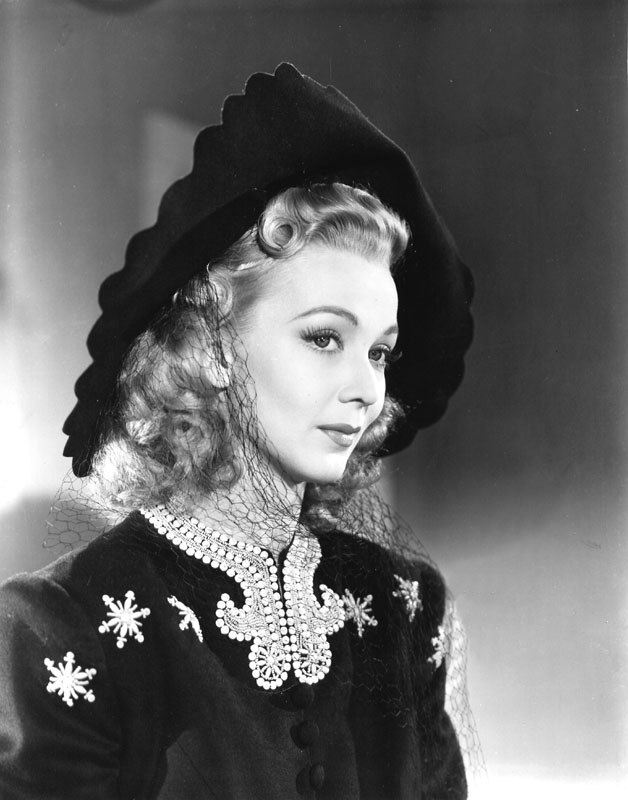
  • Pushkin and Romantic Self-Criticism

    I – “What is Man Made of That He May Reproach Himself?”

    In a crucial episode of Goethe’s The Sorrows of Young Werther, Werther meets someone not unlike himself. He is, of course, horrified, and he loses all self-control.(1) But not in the manner that we might expect a “suicide” to lose control. He reads in the face of Herr Schmidt, the love-lorn suitor of one of Lotte’s friends, an expression of stubbornness and ill humor, not any limitation of the mind, and launches into a diatribe against selfish and self-destructive urges. As Werther puts it, “I simply had to take over the conversation and hold forth against the moodiness of the man” (45). His lecture extols the goodness of life and attacks indolence as a sickness to be cured through pleasure in activity. “Get up and hum a few dance tunes,” Lotte happily adds (46). Herr Schmidt objects that “one is not always in control of oneself, least of all one’s feelings” (46); but Werther retorts that everyone should be thankful to be rid of disagreeable feelings, and calls ill humor a vice: “Anything that does harm to oneself or one’s neighbor deserves to be called a vice” (47). As the debate heats up, Werther grows more and more impassioned. He opposes the doctrine of self-control to the cult of feeling with such intensity and fervor that he breaks down and must leave the company.

    The episode is complex and controversial for any idea of self-criticism, since Werther is blind to his own lucidity. He does not see the relevance of his remarks about Herr Schmidt to his own personality. Nevertheless, the critique does occur in a Romantic novel, giving us a glimpse of the Romantic tendency to critique Romanticism. Romanticism is the greatest skeptic of Romanticism. Rarely, however, have critics of Romanticism described this skepticism with any kind of clarity. The problem of Romanticism’s critique of itself is most often expressed in the form of personal self-criticism and self-injury–nothing like a critique of the movement from within itself. In the case of Rousseau, for example, critics note that his attempts to achieve self-sufficiency and power illuminate his failures and weaknesses. Indeed, Rousseau’s self-sufficiency seems to derive, paradoxically, from his insufficiency. He sacrifices mastery to master. This effect, however, is usually attributed more to Rousseau’s personality than to the structure of his writings.(2)

    Similarly, Werther takes an autobiographical form that occults the critical nature of writing in the Romantic novel. Werther writes The Sorrows of Young Werther, it seems, with the help of an editor. But our glimpse of the editor is limited. It is only in the second part and at the conclusion that he surfaces. His dry and critical prose contrasts sharply with Werther’s letter to Lotte and implies a critique of suicide. But what is the effect of this conclusion? Does it strive to salvage an optimistic world view and to condemn suicide as a desperate and insane act? Or is it the mirror image of Werther’s own self-destructiveness? If the latter is true, the novel takes on the double aspect given to Werther’s personality, and Werther, the novel and the man, are both killed by themselves. “What is man made of,” we may ask ourselves with Werther, “that he may reproach himself?” (23).

    2

    Incidentally, if it sounds as if I am proposing a postmodern reading of the novel’s self-deconstructive nature, let me be clear that I am tracing, rather, the origins of this kind of reading. Postmodern theorists have not developed the anthropology necessary to understand either their own idea of “self-reflexivity” or the human and ethical elements of Romanticism. Instead, they have entrenched their thinking in linguistic theories, in which language often acts as a rather unreliable instrument of illumination. According to the theories of Paul de Man, for example, language serves insight, but as soon as the self tries to reflect on itself in language, the insights dry up. The gap between word and object is just too wide to surmount. Consequently, the novel is doomed to irony, for language represents only its own limitations and never its object.

    Romanticism is a self-critical movement, but theories of language in isolation cannot account for this phenomenon because it involves social and ethical structures that develop in history. Novels reflect upon other novels and upon the novel form in general as well as upon the weaknesses and strengths of their characters, but they do not do so through the ironic properties of language but through the ironic structure that has come to define the self in its contradictory embrace of center and periphery, of the roles of artist and critic, and of victim and victimizer.(3) First, the intense desire for originality and uniqueness characteristic of the Romantic attitude creates an atmosphere of rivalry, in which individual writers criticize others for inventions that they themselves would have prized had they been so fortunate as to discover them, and in which the failure to achieve uniqueness in art often drives artists to seek it by occupying extreme and self-destructive positions in society. Second and more important, the ironic structure of the Romantic novel derives from an ethical and political impulse. The Romantic novel is the creation of the heirs of Rousseau, and it strives to attack the beliefs and understanding of readers, thereby inviting them to participate in a view critical of their own society.(4) Thus, on two counts, such novels manifest ironic human attitudes that have nothing to do with recent theories of language. Indeed, it is only when the self-critical nature of the Romantic character wins out completely over the human and drives it underground that textuality acquires, in anthropomorphic guise, the property of self-destructiveness or self-deconstructiveness–another metaphor for suicide, here textual suicide.

    The Romantic character discovers itself in the representation of victims and marginals, and these positions, due to their critical relation to social organization, force the novel of the period to reflect upon both its status as a literary genre and as an ethical position. Herein lies the value of the Romantic contribution to historical and ethical consciousness as well as its gift to literature. Rousseau and his followers examine the relation between the individual and society, and grant more worth to the one by recording his or her suffering at the hands of the many. Romantic novelists criticize the tendency in society to undervalue, limit, and persecute individual desire, but they try to record their own stake in the same tendencies. This is why we can say that Romanticism is a critical and self-critical movement.

    Yet the term “self-critical” may raise some problems, unless we understand that it embraces a wide spectrum of activities. The Romantics conceive of criticism as a form of philosophical thought, thanks to Kant, but they also lend to criticism the plainer sense of an attack. The emphasis on the suffering of the individual, peculiar to Romanticism, translates the idea of criticism into a much more aggressive attitude, and for the individual schooled in the paranoia of Rousseau, the most abstract of criticisms may offer a personal affront. Similarly, the idea of self-criticism takes on an ominous meaning akin to Werther’s self-reproach. Romanticism begins as a critical and self-critical movement but often turns to self-cutting observations. The blood spilled from its self-inflicted wounds becomes the substance of a sacred baptism, a “blessing,” for “to bless” means “to bloody” and “to make holy.” The Romantic character actively exposes its own weaknesses, a process that gives it an air of ethical superiority; but this process may also begin to resemble the egoism of an old war horse who exhibits an ulcerated limb as a medal of heroism.

    3

    II – “The Poet’s Only Theme is ‘I’”

    By 1821, Pushkin had overtly associated himself with Romanticism, calling his Prisoner of the Caucasus “Romantic.” The later and celebrated novel in verse, Eugene Onegin, shows Pushkin to be a more mature student of Romanticism, and consequently to possess the understanding necessary to put the idea of self-criticism into relief.(5) The overt narrative structure of Onegin encourages criticism of its hero by the narrator, and the plot includes a sufficient number of Romantic types to formulate some idea of how Romantics relate to Romanticism. The narrator, for example, loves to mock Onegin’s belated Romanticism and to sing how he has become blasé and unoriginal, asserting, paradoxically, the Romantic doctrine of originality. The most radical reading of the novel therefore relies on the most unlikely of tendencies, given the current climate in literary theory. To understand Pushkin’s use of self-criticism, we have to decide to read not for plot, philosophical issues, or formal devices but for characters. Indeed, it is only by describing their society that we will realize how the influence of criticism and competition works to diversify the meanings of Romanticism.(6)

    The society of the novel is a highly charged world of desire, snobbery, insult, and self-criticism. For a “love story,” Onegin dwells with surprising consistency on betrayal, back-stabbing, and rivalry. The principal characters–Onegin, Lensky, Tatyana, and the narrator–are in some way all versions of one another, and yet their criticism of each other strikes one as sufficiently valid to establish some difference among them. In the case of the male characters, this difference appears to fit into an evolutionary scheme, in which each character represents a stage in Romantic psychology. But Tatyana, I will argue below in section three, moves through every stage and eventually reaches the emotional and ethical limits of Romanticism.

    The male characters are caught in a web of criticism and self-criticism, in which many actions are calculated to win prestige at another’s expense. The narrator admits to being Onegin’s “good friend” (1.2), although he tells us that his friends and enemies are all the same and that “Friendship, as I must own to you,/ blooms when there’s nothing else to do” (2.13). Lensky is Onegin’s good friend as well, but he dies at Onegin’s hands in a duel. If we assume for a moment that the narrator represents a “stylized Pushkin” (which some critics argue but which I find to be untenable), then it is uncanny to think that Pushkin dies in a duel much in Lensky’s fashion.(7) In short, just as a character seems to gain superiority over one character, a reversal occurs that places him in an inferior position with regard to another character. No one remains on top for more than an instant.

    Who, then, are the characters involved? Onegin is, first of all, a dandy in the Romantic fashion: “when the hour of youthful passion/ struck for Evgeny, with its play/ of hope and gloom, romantic-fashion. . . ./ Eugene was free, and as a dresser/ made London’s dandy his professor” (1.4). That the narrator can describe Onegin as a London dandy implies his belatedness and unoriginality. Indeed, Onegin is the accomplished storyteller and dissembler because he has learned his roles well: “How early he’d learnt to dissemble/ to hide a hope, to make a show/ of jealousy, to seem to tremble/ or pine, persuade of yes or no,/ and act the humble or imperious,/ the indifferent, or deadly serious” (1.10). Onegin dons “new shapes and sizes,” amusing and flattering with the best, stalking the “momentary weakness,” and then afterwards, alone, “at ease,” he imparts “such lessons as you please” (1.11). He is, of course, a grand success in society, receiving trays full of invitations; but each new social occasion is the same, and he can hardly choose among them: “Which one comes first? It’s just the same–/ to do them all is easy game” (1.15).

    Society believes that Onegin is an original, a model to imitate, and consequently it does not see his relationship to Romantic society. The place of Onegin in this society is nowhere more effectively revealed than in the narrator’s description of our hero’s dressing chamber. Onegin is a creature of fashion who astounds everyone with his taste, but the dandy, too, has his models:

    4

    A man who’s active and incisive
    can yet keep nail-care much in mind:
    why fight what’s known to be decisive?
    custom is despot of mankind.
    Dressed like [—], duly dreading
    the barbs that envy’s always spreading,
    Eugene’s a pedant in his dress,
    in fact a thorough fop, no less.
    Three whole hours, at the least accounting,
    he’ll spend before the looking-glass,
    then from his cabinet he’ll pass
    giddy as Venus when she’s mounting
    a masculine disguise to aid
    her progress at the masquerade.

    Your curiosity is burning
    to hear what latest modes require,
    and so, before the world of learning,
    I could describe here his attire;
    and though to do so would be daring,
    it’s my profession; he was wearing–
    but pantaloons, waistcoat, and frock,
    these words are not of Russian stock. . . . (1.25-6)

    The description overflows with the narrator’s irony and mockery. Onegin owes his daring taste to his model dandy, but Pushkin leaves out this all important source, inflaming the reader’s desire and concealing the unoriginality of his hero.(8) The image of Onegin before the mirror is “critical” because it exposes his foppery, but the narrator in no way expects that his critique will quench the reader’s desire to imitate Onegin. Indeed, the narrator teases the reader, implying that Onegin and the reader are in parallel. Onegin looks into the glass to see his model, while the reader looks at Onegin to find his. That Onegin owes his originality to a model dandy is an accusation, but its violence lies dormant, merely inciting further the desire to be the object of accusation. The narrator understands that the Romantic reader would gladly trade places with Onegin and accept the barbs of accusation and envy as symbols of success: “Your curiosity is burning/ to hear what latest modes require” (1.26).

    Unlike Werther or Rousseau, however, Onegin finds dandyism alone sufficient to make him an artist. This is, in fact, the meaning of dandyism, which transforms the artist into the work of art and dispenses with any other aesthetic medium. It may well be that Onegin’s ultimate failure in the novel to establish himself as anything other than a creature of fashion and high society relies on the fact that he is unable to give his boredom and feelings of alienation artistic representation. He remains a Romantic artist who cannot abide art, for his attempts to enter the aesthetic world always end in lethargy and nausea. When he takes up his pen to write, the hard session of work makes him sick, and still “no word came flowing from his quill” (1.43). Nor can he support reading for very long: “with shelves of books deployed for action,/ he read, and read–no satisfaction” (1.44). Onegin appears at first simply too tired and too bored to avail himself of the various models open to him. He has no inclination, à la Werther, “to blow his brains out, but in stead/ to life grew colder than the dead” (1.38). He plays at Childe Harold but finds the highest circles a bore. He gives up the capricious belles of grand society and takes up the role of an underground man, spewing virulence and “epigrams topped up with bile” (1.46). In short, Onegin detests Romantic society but cannot abandon it, and so he becomes a veritable fixture of the salons, as a kind of catatonia overtakes him. But it would be a mistake to think that he lacks either the enthusiasm to play the Romantic game or the strength to rise above it. Onegin’s strategy is to represent his uniqueness by maintaining himself in this paradoxical relationship to Romanticism. He is the Romantic who knows well the failings of Romanticism but he remains a Romantic all the same.

    5

    Onegin, then, is everything that Vladimir Lensky is not, or, rather, Lensky is the innocence that Onegin has lost. The relation between Onegin and Lensky is meant as a Romantic critique of a Romantic, and it serves in an almost facile way to reveal further Onegin’s character. This relation, we will see, gives another dimension to interactions between Onegin and the narrator as well. In contrast to Onegin, Lensky is the “sweet beginner” (2.7). He has read too much Kant and fancies himself a Romantic poet. The narrator, who finds him an easy target for his irony, describes Lensky’s efforts as both sentimental and Romantic on a number of occasions. According to the narrator, Lensky:

    . . . sang of grief and parting-time,
    of something vague, some misty clime;
    roses romantically blowing:
    of many distant lands he sang
    where in the heart of silence rang
    his sobs, where his live tears flowing;
    he sang of lifetime’s yellowed page–
    when not quite eighteen years of age. (2.10)

    Although the narrator uses the word “romantic” to attack Lensky’s verse, we should not understand it as entirely distancing him from Romanticism. The narrator often uses the term “romantic” in two senses, signifying its good form, which he reserves for himself, and its bad forms, which he reserves for others.(9) At one point, he gives us a sample of Lensky’s poetry but betrays his own allegiance to Romanticism:

    “The morning star will soon be shining,
    and soon will day’s bright tune be played;
    but I perhaps will be declining
    into the tomb’s mysterious shade;
    the trail the youthful poet followed
    by sluggish Lethe may be swallowed,
    and I be by the world forgot;
    but, lovely maiden, wilt thou not
    on my untimely urn be weeping,
    thinking: he loved me, and in strife
    the sad beginnings of his life
    he consecrated to my keeping?…
    Friend of my heart, be at my side,
    beloved friend, thou art my bride!”

    So Lensky wrote, obscurely, limply
    (in the romantic style, we say,
    though what’s romantic here I simply
    fail to perceive–that’s by the way). (6.22-3; emphases mine)

    6

    The narrator’s assessment of Lensky’s poetry may be correct, but it does not resolve the issue of Romantic self-criticism. For there is no Romantic ideal that is not mocked in some way within the Romantic novel. The “Romantic” always carries two senses; it is the most pejorative term that one can apply, and at the same time, it is upheld as a lofty ideal. Indeed, the relation between Onegin and Lensky returns to this dilemma repeatedly. Lensky is attracted to Onegin, just as Tatyana will be, because he is so “Romantic.” Lensky pours out his heart to Onegin, hoping to find a soul mate, but, in fact, Onegin scarcely understands him and finds his talk absurd. On the one hand, Onegin smiles “as Lensky talked: the heady/ perfervid language of the bard” and thinks “it’s sheer/ folly for me to interfere/ with such a blissful, brief infection–/ even without me it will sink” (2.15). On the other hand, Onegin catches the fever of Romanticism from Lensky and feels its belated urgings. Onegin mocks Lensky at every turn but falls into competition with him for the very objects that he thinks are beneath him. The superior “Romantic” criticizes the debilitated “Romanticism” of his rival only to adopt this debilitation as his model. At the end of the novel, of course, it is as Lensky with a difference that Onegin reapproaches Tatyana and throws himself, romantically, at her feet.

    The perverse mirroring between Onegin and Lensky is most dramatically exposed in two splendid episodes: the ballroom scene and the duel. The first concerns Onegin’s seduction of Lensky’s beloved Olga. Even though Olga is an obvious Romantic choice, the kind of woman whom one finds in any number of Romantic novels (2.23), Onegin decides maliciously to steal her from his friend. He “whispers some ballad of the hour,/ squeezes her hand–and brings to flower/ on her smug face a flush of pleasure” and takes her for a turn around the ballroom (5.44). Onegin becomes Lensky to win Olga, and she is charmed to find a “new” Romantic hero, and equally charmed to distress her former suitor. This girl from a novel is excited to find herself at last in a novelistic mise en scène, in which men of desire struggle over the woman of their dreams. But after Lensky challenges Onegin to a duel and leaves the ball, she grows bored with Onegin, just as he is wracked afresh by ennui. Romantic love in the novel continually feeds on these kinds of scenes, demanding dramatic episodes to enflame passion, while at the same instant denouncing these very episodes as passionless deceits of fiction.

    The duel presents a similar picture. Dueling is naturally disposed to the problem at hand. It proposes the identity of two rivals and designs a way of differentiating one. The face-off presents the two competitors as mirror-images of each other, until one stands at the end. Pushkin establishes the symmetry of the combatants, as might be expected, by recounting how they fire on each other simultaneously and with the same movements. But once Lensky has fallen, he develops the symmetry between the winner and loser in an unexpected way by drawing on the image of the mirror itself:

    With a sharp epigram it’s pleasant
    to infuriate a clumsy foe;
    and, as observer, to be present
    and watch him stubbornly bring low
    his thrusting horns, and as he passes
    blush to descry in looking-glasses
    his foolish face; more pleasant yet
    to hear him howl: “that’s me!” You’ll get
    more joy still when with mute insistence
    you help him to an honoured fate
    by calming aiming at his pate
    from any gentlemanly distance. . . . (6.33)

    7

    The object of the contest is to force one’s rival to recognize his hideousness in the mirror; but if one is present for this recognition and has brought it about by being a rival to the rival, is not the face in the mirror a double image? Does not one’s own face find its likeness in the rival’s hideousness? This is the ultimate effect of any duel, in which two individuals stand against each other, until one sees in the awful face of death both what he is and could have been. Indeed, as we shall later see, Onegin will from this point on identify himself as a victim of his victimization of Lensky: he pleads the case that his murder of his friend leads to such isolation and anguish that he, not Lensky, must be considered the real victim of the duel.

    The narrator, however, does not place much store in Lensky’s martyrdom. For him, it presents two options: Romanticism and the truth. The Romantic scenario of Lensky’s death demands that it hold a secret desperation and meaning for the world. “Perhaps to improve the world’s condition,” the narrator muses, “perhaps for fame, he was endowed;/ his lyre, now stilled, in its high mission/ might have resounded long and loud/ for aeons. . . ./ His shade,/ after the martyr’s price it paid,/ maybe bore off with it for ever/ a secret truth, and at our cost/ a life-creating voice was lost” (6.37). Lensky’s death and his martyrdom are one; the poetry of his death replaces his poetry, now lost to the world. But the narrator also presents another scenario, and it is “normal”: “at forty he’d have got the gout,/ drunk, eaten, yawned, grown weak and stout,/ at length, midst children swarming round him,/ midst crones with endless tears to shed,/ and doctors, he’d have died in bed” (6.39). Ironically, the banality of Lensky’s other fate makes his Romantic death all the more attractive, at least to a reader, although we might shy to claim that Lensky finds it so himself, now dust in the grave. But, perhaps, Lensky has found what he wanted: at least, his surroundings are Romantic, for the narrator spends three cantos describing the picturesque setting of his grave site, replete with two lonely pines, girl reapers, quivering shadows, singing shepherds, and a young city-bred woman who reads the inscription on his stone and begins to cry over his grave, wondering “Olga . . . what fate befell her” after “Lensky’s doom?” (6.41).(10)

    The narrator’s remarks would seem to indicate that he has himself risen above the choices made by Onegin and Lensky. But his criticisms do not amount necessarily to self-consciousness. Rather, they exist to differentiate him from the others, as if he were in some kind of contest with them. He attacks Onegin as a creature of fashion, but he is likewise a social butterfly. He celebrates the “atmosphere of youth and madness,/ the crush, the glitter and the gladness,/ the ladies’ calculated dress” (1.30). Indeed, the narrator is a Romantic poet in the style of Lensky, although he fancies himself the true Romantic. His great verse work, dedicated to ladies’ feet, deserves every reproach that he flings at Lensky:

    Oh, when, and to what desert banished,
    madman, can you forget their print?
    my little feet, where have you vanished,
    what flowers of spring display your dint?. . .
    The happiness of youth is dead,
    just like, on turf, your fleeting tread.

    On the seashore, with storm impending,
    how envious was I of the waves
    each in tumultuous turn descending
    to lie down at her feet like slaves!
    I longed, like every breaker hissing,
    to smother her dear feet with kissing. . . .

    But, now I’ve praised the queens of fashion,
    enough of my loquacious lyre:
    they don’t deserve what they inspire
    in terms of poetry or passion–
    their looks and language in deceit
    are just as nimble as their feet. (1.31, 33-4)

    8

    I present a excerpt of the narrator’s deliciously silly rhyme: it is more witty than Lensky’s fugue celebration of Olga in the key of doom and gloom, but its motivations are as Romantic. It reveals his desire to be the slave of passion, to be the underdog, to find himself at someone’s feet. Lensky dies of this fate, we know, and Onegin precipitates himself toward it as the novel closes. And yet the narrator does break off his verse to comment on it, and his self-critique, if we may call it that, recognizes that the grandes dames of society do not deserve what they inspire. Apparently, the narrator has the advantage of age; his celebration of ladies’ feet is an early effort upon which he can now look back with more mature eyes. The narrator was once “Lensky” but has now matured to capture the blasé attitude of an “Onegin,” realizing that society is undeserving of him. Onegin, on the contrary, passes through Lensky’s stage rapidly and assumes a critical eye, only to fall back in the end into Lensky’s persona.

    One is tempted to say that these characters meet in crossing, although this is a simplification of Pushkin’s organization. Their criticisms of each other as well as the critical force of the novel would not have such a puzzling and cutting quality, if Pushkin had obeyed a linear scheme. Pushkin’s goal is not to describe the psychological evolution of the Romantic type but to immerse these types in a society in which they must interact, and out of this interaction springs their characterizations and all that we may know of their capacities for criticism and self-criticism.

    Indeed, there is no evolution properly speaking but only a set of position that characters may occupy in order to compete with others. The narrator strives to separate his desires from Onegin’s, but his desires do not involve a chronological or qualitative advance of any kind. For example, at one point, Eugene turns “countryman” for a change of pace: “It all seemed new–for two days only–/ the coolness of the sombre glade . . . the third day, wood and hill and grazing/ gripped him no more; soon they were raising/ an urge to sleep” (1.54). Onegin plays Rousseau but ends up being Baudelaire. The narrator, however, is quick to insist that he really does love nature: “No, I was born for peace abounding/ and country stillness: there the lyre/ has voices that are more resounding,/ poetic dreams, a brighter fire./ To harmless idleness devoted,/ on waves of far niente floated, I roamed by the secluded lake” (1.55). Pushkin had many models of Romanticism to choose from, and he must have realized that the cult of Nature was being challenged by the cult of artifice and art, and that the alienation of city-life was proving as appetizing a subject as the solitude of nature.(11) That he chooses to have the more critical and mature narrator express his love of nature to prove his superior Romanticism is therefore not a conservative gesture but a statement exposing that these Romantic themes are relative to each other and to the Romantic artist’s need to find distinction. Indeed, it is only because Onegin does not like nature that the narrator adores it, for we know from many other passages how helpless he really feels when he is not pursuing fame in high society.

    Nor can the narrator help exposing his need to separate himself from Onegin. His position changes too often not to raise suspicion, and so he must present arguments for his originality. The narrator’s adoration of natural solitude leads directly to a self-defense; the canto is in many ways the central passage of the novel in verse:

    O flowers, and love, and rustic leisure,
    o fields–to you I’m vowed at heart.
    I regularly take much pleasure
    in showing how to tell apart
    myself and Eugene, lest a reader
    of mocking turn, or else a breeder
    of calculated slander should,
    spying my features, as he could,
    put back the libel on the table
    that, like proud Bryon, I can draw
    self-portraits only–furthermore
    the charge that poets are unable
    to sing of others must imply
    the poet’s only theme is “I”. (1.56)

    9

    The “poet’s only theme is ‘I’” is a beautiful line because it exposes that the first-person of Romanticism is necessarily in contradiction with itself.(12) The poet creates a character in the first person, but this first person is always plural, a “we,” in which the representative character is run through exercises by the writer. Any attack, any blow, and any humiliation that the character experiences affects the writer as well, but because the writer places the character in this situation, he or she necessarily plays a game of self-reproach or self-devotion. One could say that it is from the possibility of this self-centeredness that Romanticism develops as an ethical and aesthetic force. Self-criticism is privileged with respect to moral consciousness because it asks how the accuser shares a stake in what he or she condemns, but the Romantic novelist also discovers that the self-reproach entailed by such moralizing has an aesthetic dimension because its suffering is affective–it attracts and pleases an audience–and this social fact permits the writer to transform a moral position into an aesthetic success. Of course, this transformation means that the ethical insight must be sacrificed to aesthetics, but the artist’s consciousness of this fact merely lends greater anguish and suffering to the choice, and thus invigorates the poetics of suffering with added rebound.

    It is neither mockery nor calumny to suggest that Romantic authors take themselves as subjects, despite what the narrator says; it is the only way to expose the character or ethos of Romanticism. This ethos cannot be explained by the nature of language or intertextuality. It remains a psychological and ethical problem, and it simply cannot be formulated unless we posit a continuity of a human kind between writers and their characters. Nor can we reach an understanding of Romantic aesthetics, if we fail to trace its relation to a fundamentally ethical and human origin.

    A final example may place the problem of self-criticism in historical perspective. The narrator, literary man that he is, is prone to launch into all varieties of criticism, and at one point, he offers us his version of literary history. His history is warped by his own desire, of course, but it is not so far from the truth that it does not capture for us the extent to which the history of literature relies on violence. It carries the requisite nostalgia for the past but expresses through the lens of the past an accurate view of the present, so that the achievements of the past merge with the utopic desires of the future:

    Lending his tone a grave inflection,
    the ardent author of the past
    showed one a pattern of perfection
    in which his hero’s mould was cast.
    He gave this figure–loved with passion,
    wronged always in disgraceful fashion–
    a soul of sympathy and grace,
    and brains, and an attractive face.
    Always our fervid hero tended
    pure passion’s flame, and in a trice
    would launch into self-sacrifice;
    always before the volume ended
    due punishment was handed down
    to vice, while virtue got its crown.

    Today a mental fog enwraps us,
    each moral puts us in a doze,
    even in novels, vice entraps us,
    yes, even there its triumph grows.
    Now that the British Muse is able
    to wreck a maiden’s sleep with fable,
    the idol that she’ll most admire
    is either the distrait Vampire,
    Melmoth, whose roaming never ceases,
    Sbogar, mysterious through and through,
    the Corsair, or the Wandering Jew.
    Lord Byron, with his shrewd caprices,
    dressed up a desperate egoism
    to look like sad romanticism. (3.11-12)

    10

    The fear of decadence and its accompanying moralizing casts the present in the guise of evil, whereas the past represents the golden age of virtue, self-sacrifice, and honorable suffering. This golden age presented characters as a picture of perfection, a picture apparently strictly opposed to the evil incarnate of the vampire or Melmoth. And yet do not these virtuous characters and the Gothic ones suffer ultimately the same fate? The former are wronged in a “disgraceful fashion” but possess the virtue to sacrifice themselves at the drop of a hat. The characters of the Gothic, however, are equally prone to sacrifice themselves, as their progeny, Werther, proves so well. Nor does it take too much effort to discover their disgrace, which frequently bears upon them as a result of some social transgression or personal flaw. The heroes of the Gothic are cast as misfits, but the image of their faults almost always relies on some honorable trait that society in its perversity has refused, making continued existence among others a disgrace and humiliation for the hero.(13)

    There is no escaping the problematic of the victim in the Romantic novel. The best an author can do is take the victim’s side, while refusing both to become one and to celebrate those who feign the pose. The narrator dreams for an instant of a better solution: that he might be possessed by a “different devil” and write a novel in another genre: “No secret crimes, and no perditions,/ shall make my story grim as hell;/ no, quite naively I’ll retell/ a Russian family’s old traditions; love’s melting dreams shall fill my rhyme,/ and manners of an earlier time” (3.13). This different devil is, then, a pastoral novel, or some future form of literature that dispenses with vice and invents the angelic. It is a catalogue of “each simple saying in father’s or old uncle’s book” and tells “of children’s plighted playing/ by ancient limes, or by a brook;/ and after jealousy’s grim weather/ I’ll part them, bring them back together . . ./ then to the altar, to be crowned” (3.14).

    This dream is, unfortunately, doomed to fail. We recognize in it a reverie of ethical perfection, love’s reconciliation, and universal harmony, where the aesthetic and the ethical merge in a vision completely free of vice and persecution. In other words, it would be a work of literature in which no victim appeared. But the narrator does not write this novel. He returns to the Romantic tale of Onegin’s fall from grace and leaves the angel for another Jacob to wrestle. Nor did any number of other Romantic hopefuls successfully capture this vision of harmony and nonviolence for the novel. Here is the perfection that Tolstoy sought when he turned to the children’s fable or to the Bible. In short, the Tolstoy whom we do not read today and whom we consider to be flawed. Here is the use to which Lukács puts Tolstoy and Dostoevsky in The Theory of the Novel, whose fugue-like conclusion announces the coming of another and entirely different literary form that will leave behind “the age of absolute sinfulness” and weave a “great unity.”(14) In short, the Lukács whom Lukács himself denounced. Or have we not found Gogol’s vision of his greatest work of art? For the second part of Dead Souls,Gogol designed to write a comedy that would be celestial and free of the slightest malice–a task so vexing that he burned his manuscript in despair and abandoned himself to madness.

    III – I Myself Am Tatyana

    I neglected in the last section to provide an important detail about the narrator’s literary history. He tells it for the specific purpose of accounting for Tatyana’s love of Onegin. Tatyana, it seems, falls in love with Onegin precisely because he appears to resemble the mysterious men whom she has met in novels. According to the narrator, then, Tatyana has succumbed to the vice of modern readers who model their every desire and self-image on the novel. Indeed, Tatyana becomes a Romantic heroine in order to attract her Romantic hero. She mopes in her bed all day and night, detests any friendly voice, and sinks into dejection. She composes herself as a Romantic: “Seeing herself as a creation–/ Clarissa, Julie, or Delphine–/ by writers of her admiration,/ Tatyana, lonely heroine, roamed the still forest like a ranger,/ sought in her book, that text of danger” (3.10). Similarly, her model suitors complement her Romantic self-image and blend into Eugene alone:

    11

    Now, she devours, with what attention,
    delicious novels, laps them up;
    and all their ravishing invention
    with sheer enchantment fills her cup!
    These figures from the world of seeming,
    embodied by the power of dreaming,
    the lover of Julie Wolmar,
    and Malek Adel, de Linar,
    and Werther, martyred and doom-laden,
    and Grandison beyond compare,
    who sets me snoring then and there–
    all for our tender dreamy maiden
    are coloured in a single tone,
    all blend into Eugene alone. (3.9)

    As a heroine of a Romantic novel, Tatyana can look for models in no better places than Rousseau’s La Nouvelle Héloïse, Goethe’s Werther, Richardson’s Clarissa, or Madame de Staël’s Wertherian imitation, Delphine. But, of course, although Tatyana is a character who wants to be the heroine of a Romantic novel, she is not actively pursuing this role for the sake of Eugene Onegin. This purpose more properly belongs to Pushkin. And yet Tatyana shares in common with Pushkin a fundamental feature: she is above all a reader of the novels that Pushkin has read, and her reading assumes a critical dimension just as her author’s reading does. I will venture to raise Tatyana’s role as reader to an even higher plane. My conclusion will be that Tatyana acts as if she has read Eugene Onegin.

    One idea essential to explaining how Romantic novels work is to recognize that the Romantic “I” is equal to the state of mind expressed by the novel itself. We can see this in the case of Werther, in which the novel and the character turn upon themselves to produce a self-criticism. This movement is equally powerful in the creation of any character in whom an author has invested his or her self-image and upon whom a title is bestowed, and it accounts for the difficulties of autobiography within the Romantic context. The state of mind expressed by the novel, for lack of a better phrase, encompasses the many and contradictory attitudes invested by the novelist in different characters and languages. It represents what the novelist has learned about various situations, languages, attitudes, emotions, and characters, but this knowledge does not always direct his or her own life in a consistent fashion, even though it may be greatly prized by the writer and certainly represents a sum of what he or she thinks about a variety of thorny issues.(15) But this state of mind offers itself as well to the reader of a Romantic novel, and this situation is crucial to an understanding of Tatyana. The only way to account for her evolution as a character is to posit that she reads the novel in which she is found. She is educated by the readings through which Pushkin composes his novel; and she learns by experiencing the novel’s sentimentality in her love for Onegin and by absorbing its irony and coldness through her success in society. She embodies the two meanings of “Romantic” and manages, as much as any personality can, to exist within their contradiction.

    To make this claim is to argue that Tatyana is a true Romantic character and not a prop for Pushkin’s development of the plot or of Onegin’s characterization. She is not merely a silly reader of novels, like many characters in Romantic novels, who is duped into a sentimental seduction by “some ballad of the hour.” She is not Flaubert’s Madame Bovary or Pushkin’s own Lizaveta Ivanovna from The Queen of Spades. Nor is she the primitive and beastly femme fatale, the Belle Dame Sans Merci, of Romantic poetry, who, like the sphinx, eats men alive. She is, rather, an exemplary figure, expressing the weaknesses and strengths of the Romantic self in many of its configurations, and equal in her development to any male character. She begins as a reader of novels who is wounded and writes her first poem (the letter to Onegin); later, she learns from novels, after a descent into hell, to dissemble and to play the coquette. She makes herself into a work of art. Finally, she attains through her reading of Onegin’s library and character an understanding of herself and of her relation to the society around her that ruptures the Romantic model of character. And yet she retains sufficient nostalgia for her time of suffering, without returning to it and without succumbing to the ennui of lost innocence, to become a sympathetic personality, one whose specific refusal of Onegin has nothing to do with either revenge or coquetry but with an ethical understanding of what she must do for her own good and for the good of others. Indeed, given her development in the novel, one wonders how Pushkin managed to keep the title that he did. Perhaps to rename his work would have manifested too severely Tatyana’s rejection of Onegin as well as the astonishment with which she struck her own creator. “Do you know my Tatyana has rejected Onegin?,” Pushkin himself remarks, expressing the surprise that one generally owes to real people and not to literary characters: “I never expected it of her” (18).

    12

    The initial description of Tatyana, however, promises nothing of this surprise. Like Olga, she is the type of woman found in any number of Romantic novels. Vladimir Nabokov, in fact, argues that Pushkin’s ideal and enigmatic heroine was merely divided in two to produce Tatyana and Olga, an interesting idea because it demonstrates once more the similarity between Onegin and Lensky.(16) Tatyana plays the dark beauty to Olga’s fragile, demure, and poetic lightness. Whereas Olga is clearly beautiful, Tatyana’s attractiveness relies on a certain savage and wounded disposition: “she lacked her sister’s beauty, lacked/ the rosy bloom that glowed so newly/ to catch the eye and to attract./ Shy as a savage, silent, tearful,/ wild as a forest deer, and fearful,/ Tatyana had a changeling look/ in her own home. . . ./ and in all the play/ of children, though as young as they,/ she never joined, or skipped, but rather/ in silence all day she’d remain/ ensconced beside the window-pane” (2.25). When we first encounter Tatyana, then, she is already cut off from others, behind the window pane, under glass, so to speak. Her wounded nature plays perfectly into the Romantic sympathy for the victim and adds to her mystery and loveliness. Here is a woman, one might say, who is unhappy and with whom one might attain unhappiness.

    Tatyana prefers looking out the window to looking at the people around her. She plays the coquette without realizing her coquetry. Or, rather, her reading of Romantic novels has instructed her that sadness is attractive. When Lensky brings Onegin around to meet Olga, he yawns and asks about her sister. “She was the one who looked as still/ and melancholy as Svetlana,/ and sat down by the window-sill,” Lensky reminds him (3.5). Onegin cannot understand Lensky’s preference for Olga because, for him, Tatyana is by far the more poetic: “I’d choose the other quarter/ if I, like you, had been a bard./ Olga’s no life in her regard” (3.5). Tatyana evidently feels the same way, only more powerfully, and she falls in love with Onegin. Indeed, the narrator suggests that she had long been rehearsing the part of the pining heroine: “Her feelings in their weary session/ had long been wasting and enslaved/ by pain and languishment; she craved/ the fateful diet; by depression/ her heart had long been overrun:/ her soul was waiting … for someone” (3.7).

    Tatyana is in love with the idea of love, and when the opportunity of love presents itself, she grasps it eagerly, immersing herself in emotion, anguish, and longing. Suffering has been the very image of herself for a long time, and now at last provided with an interlocutor in Onegin, she may declare herself as the suffering heroine whom she longs to be. She decides to write a letter confessing her love to Onegin. It is her “masterpiece” of Romantic art, and she hopes that it will be sufficiently attractive to tempt Onegin to play a part in it.

    Strangely, however, it is the narrator who responds most “romantically” to Tatyana’s “masterpiece.” He at once attacks it as twaddle and venerates it as a religious object. The narrator’s introduction of the letter delights in exposing Tatyana’s desires as Romantic clichés, and yet his desires are ultimately just as false. Reading the letter fills him with pain, and yet he treasures it and can never read it too often. Whereas the letter presents the confusion of Tatyana’s pain and self-delight, the narrator’s introduction blends fascination and repulsion. Both are caught in the contradiction of Romantic self-criticism. Here is an abbreviated version of the introduction and the letter:

    13

    Tatyana’s letter, treasured ever
    as sacred, lies before me still.
    I read with secret pain, and never
    can read enough to get my fill.
    Who taught her an address so tender,
    such careless language of surrender?
    Who taught her all this mad, slapdash,
    heartfelt, imploring, touching trash
    fraught with enticement and disaster? . . .

    TATYANA’S LETTER TO ONEGIN
    “I write to you–no more confession
    is needed, nothing’s left to tell.
    I know it’s now in your discretion
    with scorn to make my world a hell.
    But if you’ve kept some faint impression
    of pity for my wretched state,
    you’ll never leave me to my fate. . . .
    Why did you visit us, but why?
    Lost in our backwoods habitation
    I’d not have known you, therefore I
    would have been spared this laceration.
    In time, who knows, the agitation
    of inexperience would have passed,
    I would have found a friend, another,
    and in the role of virtuous mother
    and faithful wife I’d have been cast.
    Another! …No, another never
    in all the world could take my heart!
    Decreed in highest court for ever …
    heaven’s will–for you I’m set apart;
    and my whole life has been directed
    and pledged to you, and firmly planned;
    I know, Godsent one, I’m protected
    until the grave by your strong hand. . . .
    At this midnight of my condition,
    was it not you, dear apparition,
    who in the dark came flashing through
    and, on my bed-head gently leaning,
    with love and comfort in your meaning,
    spoke words of hope? But who are you:
    the guardian angel of tradition,
    or some vile agent of perdition
    sent to seduce? . . .
    I weep, and pray for your protection …
    Imagine it: quite on my own
    I’ve no one here who comprehends me,
    and now a swooning mind attends me,
    dumb I must perish, and alone.
    My heart awaits you: you can turn it
    to life and hope with just a glance–
    or else disturb my mournful trance
    with censure–I’ve done all to earn it! . . . (3.31ff)

    14

    The letter is a declaration of self more than one of love. Its very existence serves to announce that Tatyana exists as a subject, and it insists on the significance of her person, opening with the by then classic “I” of the Romantic text. Like Rousseau’s Confessions, the letter creates the self by declaring its insufficiencies and exhibiting its wounds. Tatyana is alone and beyond the comprehension of others, and every agent or object that invades her solitude must be the sign of a greater power, of fate, of God, of Onegin–angel, demon, Godsent. Her confession announces guilt of the most ambiguous variety, but she readily accepts the burden of punishment and fate nevertheless. Indeed, given the attitudes of the day, it is not excessive to argue that the letter seeks greater misfortune for the already unfortunate Tatyana, since such exposure admitted of a higher probability of shame than of success. Her feelings consequently oscillate between hopefulness and hopelessness, but both emotions betray the attitude of a victim, leaving Onegin to play the role of either savior or torturer.

    Onegin, of course, does not chose to accept her love. Ironically, however, he manages to reject her not by condemning her unworthiness or lack of appeal but by usurping her position as victim. To her confession, he adds his own confession: he pleads that he would choose no one else to share his “sad existence” (4.13), if the decision were really left to him. But, in fact, he “is simply not intended/ for happiness–that alien role” (4.14). Happiness must be alien to Onegin because of his alien nature. Everything opposes their future happiness together: custom, society, and the institution of marriage. Onegin does not fail to invoke all the unnatural forces of society that stand in the way of his natural love for Tatyana. Onegin is so much the victim of his world, so alien to it, that his existence with Tatyana could only turn into a brutalization, and he does not want her to suffer such a cruel fate.

    But Tatyana, at this particular moment, desires just this fate. It is the fate of all Romantics in love, and she does not want to be the exception to a race of exceptions. She is stung to the quick by Onegin’s rejection of her pure love, and she lapses further into despondency. If she cannot play the role of unhappy heroine in real life, she will find another domain in which to achieve her desires. She will live in the world of dreams. “Tatyana’s Dream” represents precisely this desire; it enacts her wish to be the heroine of a Gothic romance with Onegin as her Jean Sbogar or Melmoth. Her dream is therefore a case of the Romantic inserted within the Romantic. Within Pushkin’s Romantic novel in verse, we find a Gothic romance of the most familiar kind. It plays a role similar to that of Ossian in Werther and allows Pushkin to create a mood of somber Romanticism, without, however, embracing its less critical and refined aspect.

    I am not arguing that the dream is a hack creation. In point of fact, it is delightfully composed and fully integrated into the novel. It is, rather, the Romantic nightmare at the heart of Pushkin’s critique of Romanticism. It is, in short, the nightmare that self-criticism can sometimes be. It exposes Pushkin’s dependence on a Gothic Romanticism, despite his attempts to go beyond it, and it reveals the self-defeating nature of Tatyana’s desires.

    Since it is her dream, Tatyana plays the victim, whereas Onegin, now truly demonic, reveals his villainy. As the dream begins, an enormous bear pursues Tatyana through a snowy forest. The dream images enact a rape fantasy, in which the bear, a symbol of raw sexuality, and the physical world contrive to undress and to possess her:

    There’s powdery snow up to her knees;
    now a protruding branch assails her
    and clasps her neck; and who she sees
    her golden earrings off and whipping;
    and now the crunchy snow is stripping
    her darling foot of its wet shoe,
    her handkerchief has fallen too;
    no time to pick it up–she’s dying
    with fright, she hears the approaching bear;
    her fingers shake, she doesn’t dare
    to lift her skirt up. . . . (5.14)

    15

    Tatyana is the “object” of desire in every sense. Everyone and everything tries to possess her. She exists to be exposed. When the bear catches her, it carries her off to a solitary hut in the forest, and she finds herself at the center of a witches’ coven. Various monsters of the most Gothic kind, led by Onegin, menace her, and he deliberately exposes her to the eyes of the monstrous mob, who bellow out in unison, “she’s mine, she’s mine” (5.19). But Onegin cries out the loudest, and drives the others off to have her for his own. Later, when she awakes in horror, she turns to dream interpretation to discover the meaning of this nightmare; but Martin Zadéka’s Oraculum, unfortunately, does not include the necessary symbols in its index, so her experience remains untranslated into prophecy. The dream is the closest that Tatyana gets to becoming a Gothic heroine of the typical kind, except in the mind of the newly smitten Onegin in the final cantos of the novel.

    Tatyana’s dream is Romantic in its conclusions, but it also calls to mind another episode that presents a critique of Romanticism. Tatyana’s dream demands to be compared with the later episode in which she stalks Onegin in his library. In the dream sequence, Pushkin makes Tatyana the hunted, and he expresses her fantasy in the most Romantic clichés. In the library episode, however, Tatyana hunts Onegin, and Pushkin’s use of Gothic and Romantic tropes has an almost parodic effect. Whereas the bear carries Tatyana to the witches’ hovel, her thirst for knowledge brings her to Onegin’s “haunted” house, haunted, that is, by Onegin’s ghosts: “Through country gleaming/ silver with moonlight, in her dreaming/ profoundly sunk, Tatyana stalked/ for hours alone; she walked and walked …/ Suddenly, from a crest, she sighted/ a house. . . ./ She entered the deserted yard./ Dogs howling, rushed in her direction …/ Her frightened cry brought running out/ the household boys in noisy rout. . . ./ she went into the empty shell/ in which our hero used to dwell” (7.15-17).

    The opening sequence parallels that of Tatyana’s dream, but instead of finding herself the heroine of a book, she finds herself in Onegin’s library, face to face with the books in which she wants to live. While Onegin is long departed, Tatyana nevertheless finds his self-erected memorial: all remains exactly as it was when Onegin used to sit there alone, the rooms cluttered with fashionable objects and likenesses of Byron and Napoleon. But being the quintessential reader, Tatyana is most attracted to Onegin’s books, marginalia, and album (the scrapbook in which he has collected passages from his favorite readings), and from them she watches “a different world unroll” (7.21): “Her eyes along the margin flitting/ pursue his pencil. Everywhere/ Onegin’s soul encountered there/ declares itself in ways unwitting–/ terse words or crosses in the book,/ or else a query’s wondering hook” (7.23). Books provide the portrait of the real Onegin, exposing his models and tastes at their origins. As Tatyana follows Onegin’s thought, she comes to understand that he is an imitation, and that his feelings of alienation are the design of a Romantic eccentric:

    And so, at last, feature by feature,
    Tanya begins to understand
    more thoroughly, thank God, the creature
    for whom her passion has been planned
    by fate’s decree: this freakish stranger,
    who walks with sorrow, and with danger,
    whether from heaven or from hell,
    this angel, this proud devil, tell,
    what is he? Just an apparition,
    a shadow, null and meaningless,
    a Muscovite in Harold’s dress,
    a modish second-hand edition,
    a glossary of smart argot…
    a parodistic raree-show? (7.24)

    16

    As the narrator once watched Onegin before the mirror, Tatyana now sees the images by which her ideal man composes himself. It is as if Tatyana finds a book entitled Eugene Onegin next to the many familiar Romantic volumes in the library. Pushkin does not, of course, include such a volume: he is not sufficiently schooled in German Romanticism to delight in this vertiginous paradox.(17) But the point remains that Tatyana’s reading of Eugene Onegin represents a moment of epiphany in which she sees the nature of her own desires. She comes to understand in a conscious way what her desires inferred earlier: that Onegin wants to be the hero of a novel. But now Tatyana can no longer consider this role to be Romantic; it is too “Romantic,” that is, too overtly modeled on the world of books, to be wholly attractive. Eugene Onegin (the man and the book) is a Romantic story, but not the first or the most inventive one. Onegin may be a work of genius, but it is a sad genius composed of a strange mixture of nostalgia and irony, of Romantic idolatry and satire, of desire and desire for desire.

    And yet we cannot fail to observe that Tatyana’s epiphany about Onegin is rendered in indirect speech.(18) Who precisely is the source of this knowledge? Is it not expressed more in the narrator’s style than in Tatyana’s? On the one hand, Tatyana experiences a conversion to the narrator’s critical point of view, and her comments about Onegin are caustic and derisive. On the other hand, as we shall see, she continues to love Onegin and takes no opportunity for revenge. What is the status of her understanding?

    Tatyana and Onegin are not involved in the kind of competition that characterizes the relationship between the narrator and Onegin. She may compete in Pushkin’s and the reader’s minds for the center of the novel, but within the novel itself, she does not have the power to compete with either Onegin or the narrator. But competition is a strange phenomenon. One may compete to win, or to lose, and in the Romantic novel, most contestants aim to fail. Both the narrator and Onegin struggle by design to prove their alienation from the world; they take up the cloak of failure to prove their uniqueness. But a woman in a novel of this period has already lost in some respects, which explains why Romantic male characters in search of marginality repeatedly represent themselves as “feminine.” Tatyana cannot choose her own destiny in the way that a male character can. She may confess her love and suffer shame; she may refuse marriage and present herself as an outcast, but none of these choices is really recognized as “Romantic.” Indeed, the only choice open to a woman in the novel who wishes to be a Romantic is to play the wronged or adulterous woman. But this role, too, demands that she be the object of a man’s desire, not his rival or equal.

    It is in this context that Tatyana’s understanding of Romanticism must be measured and not by her criticisms of Onegin. Women characters are already less Romantic, by and large, than male characters because they are not permitted to express their desires as freely, and fewer opportunities for being Romantic are recognized for them. Tatyana’s rejection of Onegin for her fat husband does not have to be an original gesture to rupture the limits of the Romantic character because female characterization as such already begins to stretch its limits. Thus, Julie’s rejection of Saint-Preux or Lotte’s of Werther clearly resonate in Tatyana’s final decision, but they are as incomprehensible for Romantic male desire in general as Tatyana’s choice is for Onegin. It is sufficient merely that Tatyana step outside the established models of the Romantic heroine and that she express her consciousness of this choice for her very existence in the novel to be construed as a critique of Romanticism. In sum, Romanticism’s marginalization of feminine identity, in contradiction to its almost universal privileging of the marginal, assumes the form of an implicit critique, and whenever a woman character exposes this marginalization, the critique is made explicit.

    There is, then, a fundamental difference between Tatyana’s disgust with Romantic society and that of Onegin and the narrator, and although the narrator often inhabits his heroine’s thoughts, we should try to see how her actions critique the words that he gives her. After reading Onegin’s library, for example, Tatyana enters the Romantic society of Moscow, and the move stings her with feelings of regret at leaving the countryside of her childhood. She also finds herself dreaming of it while surrounded by the dancing and din of the ballroom. This is, of course, the very countryside that she detested earlier for its lack of Romantic society. But her desire for her home does not represent the nostalgia for Nature that the narrator suffers. It represents her feelings of alienation within Romantic society. Once overlooked as the less desirable of two sisters, she has become Moscow’s ideal–“One melancholy fob, declaring/ that she’s ‘ideal’, begins preparing/ an elegy to her address” (7.49)–but she now understands the logic responsible for her ascent, and it relies too much on “dull trash that can’t cohere” (7.48).

    17

    Tatyana has longed her entire life to be the belle of the ball. That she rejects this desire just as she attains it makes sense only if we see her actions in the context of her reading. We have seen the model of Romantic ballroom behavior in Onegin’s malicious ennui, and it does not fit Tatyana. Romantic society bores him, and he takes to victimizing his friends for sport. But Tatyana’s impatience with ballroom society breeds no such behavior. Her boredom with its boredom is neither a self-defeating posture, designed to represent her as a victim, nor a spur to aggrandize herself by attacking her admirers in society, although she certainly finds them tedious. Instead, she clings to fidelity, and in a sense, it is fidelity to both her husband and Onegin.

    Thus, the narrator’s sampling of the ballroom conversation describes Onegin as a freak, but Tatyana in no way treats him as one. This is our first view of Onegin upon his return to society after a long and restless journey: “For what charade is he apparelled?/ Is he a Melmoth, a Childe Harold,/ a patriot, a cosmopolite,/ bigot or prude? or has he quite/ a different mask? is he becoming/ someone like you and me, just nice?/ At least I’ll give him some advice:/ to drop all that old-fashioned mumming;/ too long he’s hoaxed us high and low …” (8.8). It is not clear whether this view is supposed to describe Onegin accurately or merely in terms of ballroom conversation. One thing is certain: its form and content carry the imprint of the narrator’s disposition. The attention to fashion in the description places it firmly within the narrator’s contest with Onegin, reproducing criticisms only too easily associated with earlier remarks.

    My point is that we have a great deal of difficulty seeing Tatyana through the fog of desire surrounding her. The ballroom fops describe her as an “ideal,” and the narrator uses her to continue his attack on Onegin. Onegin as well, now overwhelmed by youth’s distemper, love, sees only the Romantic heroine whom he desires. He adopts the vision of those fops whom Tatyana finds ridiculous. Newly returned to society, Onegin now plays the Romantic outcast à la Rousseau. He has become the butt for the malicious, suffers from dépaysement, and has lost his former confidence to Romantic paranoia. When he sees Tatyana, therefore, he envisions only what he wants to see: the icy and serene face of his executioner: “His head is lost in obstinate reflection;/ and obstinate his look. But she/ sits imperturbable and free” (8.22). Indeed, Onegin sees in Tatyana only the femme fatale whom his self-hatred requires.

    Onegin’s love letter to Tatyana presents the awful symmetry of his paranoia. He is now the victim to her victimizer. He adopts a series of roles–Lensky, Saint-Preux, Werther, Byron–but now he plays them with passion. He hopes, in the same way that Tatyana earlier hoped for a hero, that his letter will tempt her to play Medusa, and it consequently provides a vivid description of what is expected of her: “stern regard” or “proud glance,” the wrath of reproach, and “scorn.” He, for his part, pretends to expect nothing. Rather, he plays the outcast, alien to everybody. He goes so far as to compose himself as the real victim of the duel: Lensky’s death forces him to separate himself from Tatyana and from everything important to his heart: “And then, to part us in full measure,/ Lensky, that tragic victim, died …/ From all sweet things that gave me pleasure, since then my heart was wrenched aside . . . ./ What folly! and what retribution!” (8.32). Nothing is left him now, and as Tatyana’s willing slave, he surrenders all power: “But so it is: I’m in no state/ to battle further with my passion;/ I’m yours, in a predestined fashion,/ and I surrender to my fate” (8.32).

    The letter, in fact, differs little from Tatyana’s note, and the fact of the repetition is significant. First, it reveals the singular importance of the victim for the Romantic character. Second, it is designed for failure because it mimics the very letter that he himself rejected–a fact that cannot escape a reader such as Tatyana. It is, in effect, a statement designed to place her in a double-bind. If Tatyana accepts to play the role of Lotte, Onegin will play Werther. If she takes her revenge for the earlier rejection, she fulfills the whims of his persecution complex. If she admits that she does love her husband, she will be accused of not being Romantic enough.

    18

    Tatyana’s reaction bears the weight of this double-bind. But her burden should not blind us to the intuitions revealed by her choice. Tatyana is a Romantic character. She loves Onegin, despite her understanding of who he is. She loves him with the love of an adolescent, although she is now fully grown. Moreover, she does not love her husband. Now she is asked by Onegin’s letter to give expression to her Romanticism and to play one of the limited roles designed for her. She has every reason to do so, as long as she remains within the Romantic universe. But she does not accept Onegin’s offer. She rejects him not for himself but as a Romanticism:

    “Bliss was so near, so altogether
    attainable! … But now my lot
    is firmly cast. I don’t know whether
    I acted thoughtlessly or not:
    you see, with tears and incantation
    mother implored me; my sad station
    made all fates look the same … and so
    I married. I beseech you, go;
    I know your heart: it has a feeling
    for honour, a straightforward pride.
    I love you (what’s the use to hide
    behind deceit or double-dealing?)
    but I’ve become another’s wife–
    and I’ll be true to him, for life.” (8.47)

    Tatyana does not neglect to express her choice in the Romantic language of destiny; she is, after all, Romantic. But her fate has a social limitation not found in the fate announced by Onegin, when he surrenders himself to his destiny. That she accepts her marriage as a limitation but not as a scene of victimization places her one small step outside the Romantic universe. She confesses her love and remains dutiful without suffering the contradiction. Indeed, it defines her virtue: “what’s the use to hid/ behind deceit or double-dealing?” (8.47). Everything remains cliché, comprehensible only in terms of the Romanticism of the novel, but this is only because the Romantic character composes its choices within this circle of clichés, its inability to escape cliché being another great source of anguish. The fact that Tatyana does not seem to “suffer” this cliché reveals the force of her convictions and an unromantic disposition.

    The traditional reading of Tatyana’s choice, Dostoevsky’s for example, concludes that she proves herself to be the ideal of the virtuous and altruistic Russian woman. This reading is offensive, especially to a modern sensibility, because it seems to say that Tatyana is important because she is a good wife, and a good wife only. But the reading is inescapable, and all the more imposing for the reason that its contradiction always lapses once more into Romanticism. First, it could be argued, as Nabokov does, that Dostoevsky is wrong because Tatyana is merely following Romantic models: Julie and Lotte, before her, rejected their lovers for their husbands and in the same language and gestures. But Nabokov’s own Romanticism makes the unromantic nature of this genealogy unintelligible to him; he exhumes Tatyana’s ancestors only to argue that her rejection of Onegin contains so many expressions of desire that we cannot consider her decision to be final. Indeed, he posits that her words must have made Eugene’s “experienced heart leap with joy” at the expectation of an adulterous fling.(19) Second, it could be argued that Tatyana’s choice is a grander gesture than it is, successfully demonstrating her freedom from her ancestors in the novel. But this reading succumbs to the very desire for uniqueness that Tatyana rejects when she decides not to use her “fate” to represent herself as a victim. It is more surprising, given Romantic prejudices, to believe in wifely duty over passion, and from this conviction springs, no doubt, the astonishment with which Pushkin views his heroine.

    19

    Pushkin’s surprise at Tatyana’s rejection of Onegin betrays his inability to see the marginality of women at the heart of Romantic marginality. Ironically, Tatyana provides Pushkin with his denouement, and when the episode concludes, the narrator bids the reader an abrupt good-bye, as surprised by the conclusion as Pushkin later confessed to be.(20) Indeed, where in a Romantic novel written by a man do we find anything other than surprise (or chauvinistic admiration) when faced with such a choice? For all the apparent interest in femininity in the male Romantic novel, rare is the man who can identify with his women characters.

    Flaubert, of course, makes his celebrated confession of identity, “Madame Bovary, c’est moi.” But Emma is the adulterous woman, and Flaubert’s statement merely carries Romantic self-criticism to the heights of self-hatred and stupidity. “Madame Bovary, c’est moi” belongs to the history of such self-alienating expressions as Rousseau’s “L’Autre, c’est moi,” Nerval’s “Je suis l’autre,” or Rimbaud’s “Je est un autre.” For when Flaubert identifies himself with Emma Bovary, he accuses himself of being the most lamentable cliché. To pronounce “I myself am Madame Bovary” is to represent oneself as the Romantic outcast once more.

    Madame Bovary remains a stupid and bovine creature, but Pushkin gave Tatyana a unique character, and she demonstrates that she knows how to read the Romantic novel. She understands her own genealogy, and she steps into the only viable position left to a woman in the novels of the time. That her choice should have surprised Pushkin reveals the limitation of his reading of Romantic self-criticism as well as the fatal limitation of his own self-consciousness. Pushkin, of course, died in a duel fought with an admirer of his wife, his sister-in-law’s husband, the young and handsome Baron d’Anthes (or Dantès). As the story goes, Pushkin was upset by rumors that d’Anthes was having relations with his wife, although he trusted her and she was certainly innocent, and he forced the Baron to challenge him to a duel to save face in society. The duel took place the next morning. D’Anthes fired first and hit Pushkin. Lying prostrate on the ground, the poet managed to fire his pistol and wounded the Baron slightly; but Pushkin’s injury was severe, and he died two days later in torment.

    Is it too cruel, too hard, to ask whether Pushkin would have died at d’Anthes’s hands, had he not been so very surprised by Tatyana, had he not failed to read Eugene Onegin in the way that she did, had he not played Lensky to d’Anthes’s Onegin? Perhaps Pushkin’s own life’s novel would have ended differently had he been able to say à la Flaubert, “I myself am Tatyana.” Vertiginous thought to consider that the surprise of d’Anthes’s shot and of Tatyana’s character might be one and the same.

    20

    Notes

    1. Parenthetical references are to Johann Wolfgang von Goethe, The Sorrows of Young Werther and Selected Writings, trans. Catherine Hutter (New York: Signet, 1962).(back)

    2. Paul de Man’s now classic reading of Rousseau, in “The Rhetoric of Blindness: Jacques Derrida’s Reading of Rousseau,” Blindness and Insight (1971; revised, Minneapolis: University of Minnesota Press, 1983), 102-141, argues that critics have mistaken Rousseau’s self-reflexive textuality for a variety of mental problems. (back)

    3. I have explored this idea in great depth elsewhere: see my The Romantic Fantastic (Ithaca: Cornell University Press, 1984; The Ethics of Criticism (Ithaca: Cornell University Press, 1988), chaps. 4, 5, and 6; “Rousseau and Autonomy,” Stanford French Review 17.1(1993): 7-24; and “The Werther-Effect: The Esthetics of Suicide,” Mosaic 26.1(1993): 15-34. (back)

    4. Speaking of Tolstoy in particular, Mikhail Bakhtin calls this tendency to attack the reader’s presuppositions an “internal politics of style.” Bakhtin’s definition of the dialogic is useful to describe how novels contribute to critiques of their time, but his idea of language, while correctly tuned to social forces, still relies too much on the idea of style. Thus, he frequently tries to describe the “life of language” rather than that of society, in effect, producing a social theory of language, devoid of society. See Mikhail Bakhtin, The Dialogic Imagination, ed. Michael Holquist, trans. Caryl Emerson and Michael Holquist (Austin: University of Texas Press, 1981), 283-84. (back)

    5. References to Alexander Pushkin, Eugene Onegin, trans. Charles Johnston (New York: Penguin, 1979) will be given parenthetically in chapter and canto numbers. (back)

    6. The world of the Romantic novel is the world of Romantic society, and it is misleading to try to divide this world and the form of the novel. The narrator of Onegin assumes that Romantic novels pervert their readers’ sensibility, and while his remarks represent a critique of Romanticism similar to those found in Stendhal or Flaubert, he is never able to disengage himself sufficiently from Romanticism to remove himself from its problematic of self-criticism. Indeed, criticism of the novel is a predominant theme of the Romantic novel. René Girard fixes on this theme and reverses it, claiming that the “novelistic” (romanesque) implies a striking and superior critique of the “romantic” (romantique). See his Mensonge romantique et vérité romanesque (Paris: Grasset, 1961), translated by Y. Freccero as Deceit, Desire, and the Novel (Baltimore: Johns Hopkins University Press, 1965). (back)

    7. See, for example, Vladimir Nabokov’s characterization of the narrator as a “stylized Pushkin” in the “Translator’s Introduction” to Eugene Onegin, trans. Vladimir Nabokov, 4 vols. (New York: Bolligen Series, Pantheon Books, 1964), 1:6. On the problem of the narrator in general, see J. Thomas Shaw, “The Problem of Unity of the Author-Narrator’s Stance in Pushkin’s Evgenij Onegin,” Russian Language Journal 35.120 (1981): 25-42. (back)

    8. Nabokov notes, in his commentary on Eugene Onegin 2:104-5, that the dandy in question is Colonel Pyotr Chadaaev, and a more interesting model for Onegin could not be imagined. Chadaaev was a brilliant character, fop, and philosopher, who wrote Lettres philosophiques in French in the early 1820’s. When one was published in Russian in the Telescope in 1836, Chadaaev was declared officially insane. (back)

    9. Pushkin’s own use of “Romantic” tends to represent two positions as well. On the one hand, Pushkin writes to his brother Lev in early 1824 that Nikolai Raevski berates Eugene Onegin because he “expected Romanticism from me, found Satire and Cynicism.” But in May of the same year, he tells the poet Küchelbecker that he is writing a “romantic poem.” One year later, he writes to Bestuzhev, defending his novel in verse as nonsatirical: “Where do I have a satire? There is not the ghost of it in Eugene Onegin. With me the embankment would crack if I touched satire.” See Nabokov’s “Pushkin on ‘Eugene Onegin’” in his Eugene Onegin 1:68-74. (back)

    21

    10. The addition of the city-bred woman works as an allusion to the scene of victimization. Despite Lensky’s failed Romanticism, the very fact of his martyrdom qualifies him to become the subject of emotions that cause others to romanticize him.(back)

    11. Pushkin, of course, presents his own version of citified alienation in both The Queen of Spades and “The Bronze Horseman.” The point to realize is that the cult of nature serves the Romantic in stating the desire to flee from the life of the salon and the duties of society, whereas the cult of the city serves equally well at a later date to transgress the existing cult of nature by demonstrating a preference for the isolation and infectious atmosphere of the city’s swarming masses. Each cult in its context celebrates the difference of the Romantic artist. (back)

    12. Most unfortunately, this line is the beautiful fiction of the translator, Charles Johnston, for Pushkin does not use the Russian first person in the same way. The point remains, however, that the canto takes as its subject the problem both of the narrator’s relation to Onegin and of any author’s relation to a character, and it formulates the problem in terms of identity.

    The canto achieves a critical dimension in another important respect. The narrator’s critique of the “reader of mocking turn” relies on sympathy for the persecuted. We are forced to separate the narrator and Onegin, lest we be accused of slander and maliciousness. If we are coerced by this logic, the narrator wins. If we victimize the narrator with our slander, he still wins because he gains the general sympathy accorded to the victim. (back)

    13. See my exposition of the relation between persecution and fantastic literature in The Romantic Fantastic. (back)

    14. Georg Lukács, The Theory of the Novel, trans. Anna Bostock (Cambridge, Mass.: MIT Press, 1971), 152-53. (back)

    15. I use the phrase, “state of mind,” purposefully to indicate my belief that a human being composes the novel and reads it. While this is itself obvious, many current theories of literature do not stress it, preferring to attribute the over-all effect of literary works to language systems, intertextuality, or historical forces. The effects of language and social forces are great, but they are given the individual stamp of the author. Cf., Mikhail Bakhtin, The Dialogic Imagination: “When heteroglossia enters the novel it becomes subject to an artistic reworking. The social and historical voices populating language, all its words and all its forms, which provide language with its particular concrete conceptualizations, are organized in the novel into a structured stylistic system that expresses the differentiated socio-ideological position of the author amid the heteroglossia of his epoch” (300). Despite all the power that he gives to language, Bakhtin returns insistently to the idea that novels are “artistic systems,” that is, systems created by authors. In short, the novel is not only heteroglossia–merely language–but the language of someone, and as such, we may analyze it for its ability to transmit knowledge. (back)

    16. Nabokov, ed., Eugene Onegin 1:15. (back)

    17. Indeed, Tatyana’s reading sharply contrasts with those episodes in German literature in which a character finds the book in which he or she is a character. In Novalis’s Heinrich von Ofterdingen, for example, the hero finds a book in which he is described reading the book in which he finds himself. The effect is an infinite regress that leads to stupefaction and paralysis. Tatyana’s discovery of Onegin’s models and thoughts, in contrast, sheds light on her desires, resulting in a new ability to understand how Romantic society works. (back)

    22

    18. See Mikhail Bakhtin’s analysis, in The Dialogic Imagination 43-50, 321-23, 329-30, of Pushkin’s use of “double-voicedness.” For Bakhtin, it is Pushkin’s heteroglossia that produces the self-critical aspect of Eugene Onegin: “Pushkin’s novel is a self-critique of the literary language of the era, a product of this language’s various strata (generic, everyday, ‘currently fashionable’) mutually illuminating one another. But this interillumination is not of course accomplished at the level of linguistic abstraction: images of language are inseparable from images of various world views and from the living beings who are their agents–people who think, talk, and act in a setting that is social and historically concrete” (49). (back)

    19. Nabokov, ed., Eugene Onegin 3:240-43. On Tatyana’s decision, see also J. Douglas Clayton, Ice and Flame: Aleksandr Pushkin’s Eugene Onegin (Toronto: University of Toronto Press, 1985), 128-37, who traces the reception of Tatyana’s action and argues that she is a Diana figure, both “ideal and faithful”; and William Mills Todd III, Fiction and Society in the Age of Pushkin: Ideology, Institutions, and Narrative (Cambridge: Harvard University Press, 1986), 128-35, who stresses Tatyana’s creativity in playing with sexual roles and conventions. Todd also notes that Onegin’s development reverses Tatyana’s and that her reading is responsible for her understanding of Onegin’s behavior. (back)

    20. Interestingly, Donald Fanger, in “On the Russianness of the Russian Nineteenth-Century Novel,” Art and Culture in Nineteenth-Century Russia, ed. Theofanis George Stavrou (Bloomington, In: Indiana University Press, 1983), 40-56, argues that the abrupt conclusion of Onegin resonates with many other novels of the period, and he gives several explanations for the effect. First, Fanger notes that the authors in question, Pushkin, Lermontov, Gogol, and Tolstoy, consider themselves writers and not novelists, and that they do not consequently adhere to the closed formal pattern of the novel. Second, he argues that this particular form addresses the rise of the masses characteristic of the period in Russian history. (back)