Author: staceymeeker

  • Oedipus the Cliché: Aristotle on Tragic Form and Content

    1. Introduction: Oedipus the Best?

    One of the most widespread assumptions about a good Greek tragedy is that it must have an unhappy ending. Aristotle himself, in Poetics 13, seems to sanction this persistent misunderstanding with his remarks on Sophocles’ most famous work, the Oedipus Tyrannus. For this reason, commentators have long puzzled over Aristotle’s subsequent ranking of Oedipus Tyrannus as a kind of second-rate tragedy in Poetics 14. The puzzle over the apparent contradiction between Poetics 13 and 14 has not been resolved by philologists, but recent scholarship has nonetheless argued persuasively that Aristotle must be read as making a coherent argument across both chapters (see Belfiore 160-176 and Halliwell 202-237).

    In this spirit, then, that is, in defense of the coherence of Aristotle’s argument about the best esthetic experience that tragedy can offer, I would argue that the Poetics needs to be read more carefully (and more anthropologically) in order to recognize that, in Poetics 13, Aristotle is discussing the content of tragedy, and, in Poetics 14, the form of tragedy. For such a reading, Eric Gans’s understanding of esthetic experience as an oscillation between form and content can help to clarify Aristotle’s argument, because Gans’s theory of esthetic history also helps to clarify, with the benefit of hindsight, the discussion of high culture and popular culture also embedded in the Poetics‘ treatment of tragic form and content.

    As Matthew Schneider has observed, “Aristotle anticipates Gans” in many ways, because the key insights of the Poetics into the esthetic experience of tragedy in fact address key anthropological questions:

    The durability of Aristotle’s theory therefore results neither from historic accident nor scholarly conspiracy: discovering that an anthropologically-grounded theory of the sign could sidestep Plato’s fears about art initiating the contagion of conflictive mimesis enables the classical aesthetic eventually to achieve its logical end point: the exploration [of] the scene of representation qua scene.

    Subsequent literary criticism may have abandoned Aristotle’s rigorous anthropological questioning, as Schneider notes, in exchange for a much more sloppy “sacred ambivalence” about esthetic experience. But in addition to shrinking from the anthropological desacralization of tragedy, literary criticism has also made Sophocles’ Oedipus into a sacred cow, by propagating (on the authority of a hasty reading of Aristotle) the idea that the Oedipus Tyrannus is Aristotle’s favorite tragedy.

    While the play’s peculiar construction of tragic irony is a unique case (and hence a special case that tests the esthetic rule about the best tragedy),(1) apart from its irony the play is a textbook example of clichéd form and content in tragedy: a hero learns the truth too late, and comes to an unhappy end. It is this clichéd form and content that makes it exemplary for Aristotle’s purposes in the Poetics. For Aristotle thinks, and says (1453a27-30), that Euripides, not Sophocles, is the gold standard in tragedy. To understand Aristotle on this point, we need to see that he is not contradicting himself between Poetics 13 and 14 on the matter of Oedipus. Generative anthropology can help us here to make a closer reading of Aristotle’s discussion of form and content, and of high and popular culture, with regard to the esthetic of tragedy. In particular, such a closer anthropological reading solves philology’s special difficulties with the received text of Poetics 13 and 14. But it also serves a more general and salutary purpose. It argues against the popular prejudice of many readers of Aristotle and Greek tragedy, a prejudice to which even writings on generative anthropology have hitherto not been immune: the notion that Aristotle gives preeminent esthetic rank to the Oedipus Tyrannus. On the contrary, Aristotle’s Poetics gives no warrant for us to see this play as the “perfect” tragedy (Schneider) or as the “greatest tragedy” of Sophocles (Gans 1993, 139). It is, rather, in Aristotle’s eyes, a compendium of exemplary tragic clichés.(2)

    2. Unhappy Form, Unhappy Content: The Problem of Oedipus in Poetics 13 and 14

    2

    The plot of the Oedipus Tyrannus is well summarized as, formally, the unhappy belated discovery of a violent pathos (suffering), and, with regard to content, as the unhappy end of a morally serious man, King Oedipus:

    The Thebans, in the grip of a terrible plague, are instructed by Delphi to kill or expel the murderer(s) of their former king, Laius. The present king, Oedipus, determined to uncover the truth, eventually discovers that he himself is the murderer and, moreover, that Laius was his father and the widowed queen, Iocaste, whom Oedipus had married, is his mother. Iocaste commits suicide; Oedipus blinds himself and begs, in vain, to be cast out of Thebes. (Sommerstein 43)

    The play, which is dated to between 436 and 426 BCE, stands on its own, and not as part of a trilogy with either Oedipus at Colonus (401 BCE) or Antigone (c.442 BCE). Even if forced together as an artificial “trilogy” (as in contemporary anthologies commonly used by the public, usually in schools and universities), the three plays scarcely portray an ultimately optimistic reversal of fortune for Oedipus. While he seems at the end of his life, after years of wandering in misery, to be taken by the gods to themselves and to become a blessing for Athens, this outcome in the Oedipus at Colonus would have to give way chronologically to the continuance of the curse of Oedipus in the multiple suicides enacted in the Antigone: those of Antigone, Haemon, and Eurydice. The mythological chronology of the events comprising the artificial “trilogy” would have to be: Oedipus Tyrannus, Oedipus at Colonus, and Antigone. That is, the “happy ending” of the Oedipus at Colonus would be succeeded by the “unhappy ending” of the Antigone.

    In the historical chronology, of course, the play with the “happy ending” is dated two decades after the other two plays, the Oedipus at Colonus being written instead in Sophocles’ old age. But it is interesting to note, in this regard, that the Oedipus Tyrannus did not win first prize in competition. The posthumous production of the latest work Oedipus at Colonus, however, did win first prize. Yet in spite of its lesser acclaim Aristotle nevertheless still has much to say about the Oedipus Tyrannus in the Poetics.

    In the Poetics, Aristotle refers to the Oedipus Tyrannus ten times (Kassel 68; cf. Halliwell 40 n.59): twice with Thyestes, in chapter 13, as possessing the best sort of subject matter for tragedy (1453a11, 20); twice in chapter 11, as an example of peripeteia (reversal of the action) and an anagnorisis (recognition of persons) coincident with the peripeteia (1452a24-33); again in chapter 16 as possessing (along with Euripides’ Iphigenia among the Taurians) the best kind of anagnorisis that arises from the dramatic action itself (1455a18); twice in chapter 14, as a tragedy whose plot summary alone causes one to shudder (phrittein 1453b7), containing an anagnorisis of philia (i.e., of kinship: 1453b31); in chapter 15, as a plot that leaves the inexplicable (the alogon) outside the action of the plot (1454b8); meaning, as he says in chapter 24, that Oedipus’s lack of previous inquiry into how Laius died does not concern the action of the plot (1460a30); and in chapter 26 as being of the right (non-epic) length for effectively portraying the action (1462b2).

    This frequency of mention (a veritable top ten list of Aristotelian literary criticism) has led readers to assume that the Oedipus Tyrannus is Aristotle’s gold standard for tragedy. Yet a major puzzle has long confronted interpreters of the Poetics: if the Oedipus Tyrannus is so unproblematically the gold standard, how are we to reconcile the account in chapter 13 (where the Oedipus myth is the stuff of the best tragedies), and the account elsewhere (that it has the best kind of thrill, a coincident anagnorisis and peripeteia, as part of a taut plot structure that excludes inexplicable external action from the course of its own internal development), with the account in chapter 14? For chapter 14 argues that the Oedipus Tyrannus is an example of the second-best plot structure. The best formal plot structure is exemplified for Aristotle in the Iphigenia among the Taurians, with its coincident anagnorisis and peripeteia preventatively before, and not tragically after, the fact of violent pathos (the violent pathos here which, while certainly being the play’s implicit subject, is never realized as its actual content):

    Iphigenia, spirited away by Artemis when about to be sacrificed by her father Agamemnon at Aulis, is now her priestess in the land of the Tauri (the Crimea), obliged to sacrifice every Greek who lands there. Orestes and Pylades arrive in quest of the image Artemis Tauropolos; they are captured, but Iphigenia spares Pylades on condition that he takes a message back to Greece for her. The message reveals her identity to Orestes, and after a joyful reunion they plan and execute a scheme to escape from the wicked King Thoas, taking the image to be with them (to be set up at Halae in Attica). (Sommerstein 52)

    This is the tragedy with a “happy ending” that Aristotle clearly commends in Poetics 14. In Poetics 17, Aristotle gives his own summary of the Iphigenia play’s plot form, that is, of the general [katholou] form, the form without the “contents” [hupothenta] of the character names [onomata] and episodic details concerning these characters [epeisodia]:

    3

    As for the story, whether the poet takes its general outline ready made or constructs it for himself, he should first sketch the general outline, and then fill in the episodes and amplify in detail. The general outline [to katholou] may be illustrated by the Iphigeneia. A young girl is sacrificed; she disappears mysteriously from the eyes of those who sacrificed her; she is transported to another country, where the custom is to sacrifice any strangers to the goddess. To this ministry she is appointed. Some time later her own brother chances to arrive. The fact that the oracle for some reason ordered him to go there, is outside the general plan of the play. The purpose, again, of his coming is outside of the plot’s proper action. However, he comes, he is seized, and, when on the point of being sacrificed, reveals who he is. The mode of recognition may be either that of Euripides or of Polyidus, in whose play he exclaims very naturally: “So it was not my sister only, but I too, who was doomed to be sacrificed”; and by that remark he is saved. After this, the names being once given [hupothenta ta onomata], it remains to fill in the episodes. The episodes [ta epeisodia] must be fitting to the general action. In the case of Orestes, for example, there is the madness that led to his capture [cf. Eur. IT 281-335], and his deliverance by means of the purificatory rite [cf. Eur. IT 1029 ff.]. In the drama, the episodes are short, but it is these that give extension to epic poetry. (1455a34-b16)(3)

    This passage shows not only that Aristotle is conscious of a distinction between plot form (which can be sketched in outline without names) and plot content (which concerns the people named and portrayed in dramatic episodes). It also shows that he has reflected on the problem of plot form and content with regard to the Iphigeneia among the Taurians, the very play that he has just commended as best in form, inPoetics 14 (1454a4-7). The problem, however, is whether this contradicts Aristotle’s apparent recommendation of the Oedipus character-arc, the “unhappy ending” metabasis (change of fortune), in Poetics 13.

    Stephen Halliwell has rightly observed that the unhappy ending of the metabasis apparently recommended in Poetics 13 is “exceptional within the Poetics‘ discussion of tragedy”; for Aristotle, “the possibility of a change in either direction” clearly describes all the metabasis options available to tragedy (218). A careful reading of the text shows that Aristotle is noncommittal on any formula for the recommended metabasis in tragedy. For Halliwell, then, there is continuity between Aristotle’s discussion in Poetics13 and 14 (223), and “the anomaly between Poetics 13 and 14″ (226) with regard to the variations of plot-form is best interpreted in light of a unifying idea: the consistently serious content of tragedy (227-230, 235-237, esp. 228). While Halliwell thus suggests a reading in the direction of content to achieve a coherent account of Poetics 13 and 14, he does not fully work out, however, the esthetic interplay of form and content in tragedy.

    Elizabeth Belfiore, in her book Tragic Pleasures, attempts to reconcile Poetics 13 with Poetics 14 by reaffirming the Oedipus Tyrannus as Aristotle’s gold standard for tragedy. In absolute terms, she suggests, Aristotle prefers a plot with an unhappy ending, where the coincident anagnorisis and peripeteia occurs after a pathos. The Iphigenia plot, with its happy ending, is ranked superior in Poetics 14 only because it “provides an easily followed formula” (Belfiore 176). The Oedipus plot is thus absolutely best “according to craft” (kata ten tekhnen 13. 1453a 22-23), whereas the Iphigenia plot is only relatively best; that is, relative to what poets have been able to generate in formulaic practice by chance (ouk apo tekhnes all’ apo tukhes 14. 1454a 9-11). Belfiore admits that her suggested interpretation is inconclusive and “a plausible suggestion only” because it rests on “this slight different in phrasing” regarding chance and craft (Belfiore 174).

    Despite Belfiore’s efforts, the distinction between the content apparently recommended in Poetics 13 (an unhappy metabasis) and the plot form recommended in Poetics 14 (a happy anagnorisis coincident with a peripeteia generating an ending without pathos) reflects a tension inherent in tragedy that cannot simply be explained with reference to chance practice and carefully cultivated craft. The question remains why an “unhappy ending” ought to be associated with the best craft, and the “happy ending” associated with allegedly formulaic plots. In a word, if the crowds are relatively happy with the formulaic happy Hollywood endings, why is the art-house “unhappy ending” absolutely superior? Moreover, why did allegedly formulaic happy endings evolve only later, after the earlier, absolutely superior unhappy endings? The case in point: Oedipus Tyrannus is dated to between 436 and 426 BCE and Iphigenia among the Taurians is dated to c.414 BCE (Sommerstein 80-81; cf. Knox and Bates).

    The problem still remains why Aristotle in Poetics 14 would rank later, allegedly formulaic developments in plot composition higher than the earlier, high culture “unhappy ending” type of tragedy. Surely an appeal to chance or formula would define not the superiority, but rather the inferiority, of “happy ending” tragedies, just as people imply today when they sneer at the haphazard and formulaic composition of Hollywood endings. The problem has traditionally been seen as concerning why Aristotle gives highest rank to the Hollywood ending in Poetics 14 but seems to imply everywhere else that Oedipus Tyrannus is, despite its second-best type of ending, the Oscar-caliber gold standard in all other respects. Positing that the craft of tragedy degenerated artistically as it advanced technically introduces unwarranted (Nietzschean) assumptions nowhere justified in Aristotle’s text. A more minimal hypothesis is required to explain the harmony between Aristotle’s remarks on the Oedipus and those on the Iphigenia.

    4

    As I have already suggested, the distinction that explains this apparent contradiction in the Poetics is not, pace Belfiore, the distinction between chance and craft, but rather the distinction between content and form. The evolution of tragedy’s subject matter no doubt followed what, by “chance” in a given year, best resonated with audiences. But the cultivation of such tragic content (a metabasis that proved successful with audiences) surely was a practice that was subsequently refined by the development of craft no less than the cultivation of the tragic plot forms (that used more complicated configurations of anagnorisis, peripeteia, and pathos). The tension between form and content is not reducible, then, to the opposition between chance and craft. The interplay between form and content, rather, opens up more possibilities for the artwork, possibilities greater in number than a simple binary opposition between happy and unhappy endings.

    3. Sophocles, Euripides, and Homer: Aristotle on High Culture’s Form and Content

    The fact that there is an apparent contradiction in the Poetics between the recommendation of happy and unhappy endings points only to the inadequacy of this binary standard for literary criticism, and not to the inadequacy of the Poetics. It is insufficient merely to define the difference between high culture and popular culture as the difference between unhappy endings and happy endings. Someone who classifies every movie with a happy Hollywood ending as crowd-pleasing (philanthropon) popular culture, and every movie with an unhappy art-house ending as serious (spoudaios) high culture, is being superficial. Clearly there can be products of high culture with happy endings and products of popular culture with unhappy endings. A more subtle classification, based on a more careful consideration of both the artwork’s form and content, is required. To Aristotle’s credit, the Poetics does contain such a careful classification and consideration. The tension reflected in the apparent contradiction between chapters 13 and 14 testifies to the depth of Aristotle’s analysis, a nascent critical theory that distinguishes between popular effect and more refined artistry, and that does so, moreover, with reference to form and content.

    Evidence for reading Poetics 13 and 14 this way is indicated elsewhere in the work. The plot summary of the Iphigenia in Poetics 17, which distinguishes between form and content, has already been mentioned. But the distinction is prepared from the beginning, in Poetics 2, where Aristotle outlines the ultimate subjects, that is, the defining content, of tragedy’s mimesis: namely, the type of people it represents. Tragedy represents people as better than they are in real life, whereas the content of comedy is people represented as worse than they are:

    We must represent people either as better than in real life, or as worse, or as they are. . . . The same distinction marks off tragedy from comedy; for comedy aims at representing people as worse, tragedy as better than in actual life. (1448a2-5, 16-18)

    In Poetics 25, Aristotle remarks that Euripides in his drama, unlike the drama of Sophocles, represents people not as they ought to be but as they are (1460b33-36). This remark should not lead us to conclude that Aristotle thinks that Euripides composes in a third genre of drama, one that, by virtue of its realistic content, is neither tragedy nor comedy. For Aristotle says in Poetics 13 that Euripides is “the most tragic of the poets” (1453a27-30). What we have here, rather, is an only apparent contradiction between Poetics 2 and 25 in Aristotle’s comparison of Sophocles and Euripides. Like the tension between Poetics 13 and 14, we also have here a tension that reflects the tension between content and form. We ought not to say that Sophocles is high culture and Euripides is popular culture, any more than we ought to say that unhappy endings are high culture and Hollywood endings are popular culture. We will return, therefore, to this comparison of Euripides and Sophocles at the end of this paper, after having studied how Aristotle balances a consideration of content in Poetics13 with a consideration of form in Poetics 14. Any apparent contradiction between the two considerations merely reflects the inherent tension between form and content. The proof of this interpretation, unlike Belfiore’s weak distinction between chance and craft, is a strong textual basis for reading an underlying unity in the discussions of high and popular cultural effects in the Poetics.

    The treatise’s unity is visible when it becomes clear how the distinction between form and content neatly solves longstanding difficulties with interpreting some notorious passages. In Poetics 18, four “kinds” [eide] of tragedy are identified in a passage that has long baffled interpreters with regard to how it is connected to the discussion in the rest of the Poetics (cf. Lucas 184-186):

    There are four kinds [eide] of tragedy: the complex [peplegmene], depending entirely on reversal and recognition; the pathetic [pathetike]–such as the tragedies on Ajax and Ixion; the ethical [ethike]–such as thePhthiotides and the Peleus. The fourth kind is the simple . . .  (1455b32-56a2)Here the “simple” and “complex” kinds can only refer to the plot forms discussed back in Poetics 14. But the introduction of “pathetic” and “ethical” as kinds of tragedy is novel. I would suggest, however, that these two terms refer to the two possible outcomes for a character’s character-arc (metabasis, or change of fortune): an “unhappy” or a “happy” ending as the tragedy’s content. For example, Ajax and Ixion are two characters who, considered as tragic subject matter, invariably come to an unhappy end. Ajax commits suicide after losing the battle over Achilles’ armor to Odysseus and then descending into dishonorable madness. For trying to rape Hera, Ixion suffers eternal punishment in Tartarus on a flaming wheel. The pathetike outcome of both their stories offers tragedy the straightforwardly poignant and sacrificial content of intense human suffering.

    5

    The Phthiotides (“Women of Phthia”) and Peleus (the father of Achilles), on the other hand, are perhaps less clear for us as examples, for the plays do not survive. Based on what evidence we do have, however, it is sound to conjecture that they had “happy endings.” For example, the famous myth of Peleus, Achilles’ father, tells of how he wrestles the goddess Thetis who, in spite of her best efforts to change shape and escape, nevertheless is compelled to be his bride. A wedding is the classic example of a happy ending, and the wedding of Peleus and Thetis could have been the happy finale of a Peleus (cf. Euripides, Iphigenia at Aulis, 1036-1079). (The judgment of Paris at the ensuing wedding reception, however, and the Trojan War which followed upon it, would not be episodes proper to the unitary dramatic action of the wedding, if the wedding were taken as the content for a Peleus; cf. Aristotle at 1462b2-5 and 1459b1-7.) But if Aristotle is referring in Poetics 18 rather to the non-extant Peleus of Euripides, that play would treat the rescue of Peleus from persecutors by Philoctetes on his return from Troy (Post 15; cf. Euripides, Trojan Women 1126-8).

    Similarly, the ending of the Phthiotides would also have been happy, since the play would concern the rescue of Hermione and Orestes from their persecutors and then their marriage. Aristotle could be referring to the non-extant Phthiotides of Sophocles, in which this is likely what happened. Or else when he says, “Phthiotides and Peleus” (hai Phthiotides kai ho Peleus), he is referring to them, not as names of plays, but simply as characters, as he has just done with Ajax and Ixion. That is, he is perhaps referring to both the character Peleus and the chorus of the Women of Phthia in an extant play of Euripides, namely, the Andromache (as Post 13-15 suggests), in which precisely this persecution and marriage of Hermione and Orestes does happen:

    Hermione, daughter of Menelaus and wife of Neoptolemus, plots in her husband’s absence against his concubine Andromache (widow of Hector), whom she accuses of making her barren by witchcraft. She calls in her father, and Andromache and her son are about to be put to death but are saved by Neoptolemus’ aged grandfather Peleus. Hermione contemplates suicide, but her ex-fiancé Orestes, who hates Neoptolemus for having robbed him of Hermione, opportunely arrives; she runs off with him, and he successfully plots to have Neoptolemus murdered at Delphi. (Sommerstein 51)It would not be unusual for the play to be known by a second name; that is, by the name of its chorus, the Phthiotides, as well as by the name Andromache (Post 14). In any case, by adducing the Phthiotides and Peleus as examples, it seems clear that by ethike Aristotle means a tragedy that has a plot whose content is “persecution and deliverance” (Post 15); in other words, he means a metabasis with a happy ending.

    This reading of Aristotle’s classification of tragedy (in terms of form and content) is strengthened by the parallel passage in Poetics 24, where Homer’s epic poems are also described both in terms of general form (being either simple or complex) and their content (being either “pathetic” or “ethical”). The passage confirms, with reference to the Iliad and the Odyssey, my thesis about the “pathetic” and “ethical” in Poetics 18 as being descriptions of the metabasis content (“unhappy” or “happy”):

    Again, epic poetry must have the same kinds [eide] as tragedy: it must be simple [haplen], or complex [peplegmenen], or ethical [ethiken], or pathetic [pathetiken]. The parts also, with the exception of song and spectacle, are the same; for it requires reversals, recognitions, and sufferings. Moreover, the thoughts and the diction ought to be done well. In all these respects, Homer serves as our earliest and sufficient model. Indeed each of his poems has a twofold composition. The Iliad is at once simple [haploun] and pathetic [pathetikon], and the Odyssey complex [peplegmenon] (for recognition scenes run through it), and at the same time ethical [ethike]. Moreover, in diction and thought they are supreme. (1459b7-16)

    Aristotle’s remarks here make sense when we consider the facts. On the one hand, the Iliad has an unhappy ending, as Achilles accepts his impending death and the women of Troy mourn for the slain Hector; but not only is the Iliad thus pathetike in content, it is simple (haple) in form, for Achilles’ anger has simply destined him for eternal glory (kleos) all along.(4) (Of course, he had not foreseen how his anger, and how he does or does not control it, would be the motive force for his winning glory in the successive conflicts, first with Agamemnon, then with Hector, and finally with Priam. But the simple plot form of the Iliad works out the consequences of Achilles’ wrath in all its glorious manifestations.) On the other hand, the Odyssey has a happy ending, as Odysseus returns home, slays the interloping suitors, and is reunited with his wife Penelope; but not only is the Odyssey thus ethike in content, it is complex (peplegmene) in form, as the suitors undergo a reversal (they intend to insult a beggar for sport, but in doing so they precipitate their destruction) and a recognition (for they incur the wrath of Odysseus, who it is in disguise as the beggar).

    6

    Better translations for “pathetic” and “ethical” in chapters 18 and 24, therefore, would be “poignant” (pathetike) for the unhappy metabasis, and “morally uplifting” or “inspirational” (ethike) for the happy metabasis. Generative anthropology, moreover, would probably be most comfortable with translations that point to generative contexts for the content of these two types of metabasis: “sacrificial” (for pathetike) and “sentimental” (for ethike). If we admit with Schneider that “Aristotle anticipates Gans,” then it is not hard to see that, in terms of ultimate content, tragedies can be either “chronicles of love” (ethike) or “chronicles of resentment” (pathetikon).(5)

    Both Sophocles and Euripides achieve the high culture effect of Greek tragedy, but in Aristotle’s literary criticism their mimetic achievement can be distinguished with regard to how they employ form and content. Further, Aristotle’s remarks on Homer help us discern his views on the kinds of tragedy composed by Sophocles and Euripides. But before clarifying Aristotle’s stance on these more general questions, it is time now to confront the particular problem still before us: the fact that, in Poetics 14, Euripides’ Iphigenia among the Taurians is ranked by Aristotle above Sophocles’ Oedipus Tyrannus. In the latter play, I maintain that Aristotle sees how Sophocles reworks clichéd tragic form and content to good effect, whereas in the former Euripides play we see innovation that is not simply effective tragedy but, in Aristotle’s view, the development of the composite of form and content that is most proper to the high culture of tragedy. To see this, we need to recognize the harmony in Aristotle’s presentation, as already evidenced in the discussions above (from Poetics 17, 2, 25, 18, and 24), where he has shown his sensitivity with regard to distinguishing form and content. We turn now to read this harmony in Poetics 13 as commending a certain exemplary content for tragedy, and in Poetics 14 as commending a certain exemplary formal structure. In the end, this will help us to see, not just how each poet is a master of the “complex” (peplegmene) plot form, but which poet is more “sacrificial” (pathetike) or “sentimental” (ethike) with regard to content.

    4. Serious (Not Unhappy) Content: The Exemplary Metabasis of Poetics 13

    First we turn to Poetics 13 to discern its recommended metabasis. We have a clear distinction between types of content in Poetics 13 with Aristotle’s distinction there between what he calls the “single” plot and the “double” plot. Aristotle describes the content of the “double” plot as what is popular with the audiences (philanthropon):(6)the good are rewarded, and the bad are punished. In contrast, Aristotle affirms the superiority of a “single” plot because it exemplifies what he considers to be the right kind of metabasis:

    A well-constructed plot [muthon] should, therefore, be single [haploun] in its issue, rather than double [diploun] as some maintain. It is required to change the fortune [metaballein] not from bad to good [eis eutukhian ek dustukhias], but, reversely, from good to bad [ex eutukhias eis dustukhian]. It should come about as the result not of depravity [dia mokhtherian], but of some great error [di’ hamartian megalen], in a character either such as we have described, or better rather than worse [beltionos mallon e kheironos]. The practice of the stage bears out our view. At first the poets recounted any plots that came in their way. Now, the best tragedies are founded on the story of a few houses–on the fortunes of Alcmaeon, Oedipus, Orestes, Meleager, Thyestes, Telephus, and those others who have done or suffered terrible things. A tragedy, then, to be perfect according to the rules of art should be of this construction. Hence they are in error who censure Euripides just because he follows this principle in his plays, many of which end unhappily [eis dustukhian]. It is, as we have said, the right procedure. The best proof is that on the stage and in dramatic competition, such plays, if well worked out, are the most tragic in effect; and Euripides, even if in other aspects he may be considered not to manage his content well, is still conspicuous as the most tragic [tragikotatos] of the poets. Thus in the second rank comes the kind of tragedy which some place first. Like the Odyssey, it has a double [diplen] thread of plot, and opposite endings for the good and for the bad. It is usually ranked in first place because of the weakness of the spectators; for the poets are guided in what they write by the wishes of the audience. This popular pleasure, however, is not the pleasure proper to tragedy. It is proper rather to comedy, where those who, in the plot, are the deadliest enemies–like Orestes and Aegisthus–depart the stage as friends at the close, and nobody is slain by anybody. (1453a12-39)

    The sentences in this passage, usually taken as commending an unhappy ending over a happy ending, must be read in the context that clearly frames the entire discussion: Aristotle’s express preference for the “single” metabasis over the popular “double”metabasis. Euripides follows the right procedure because he uses a single metabasis. It is following this principle of using a single metabasis that ensures that a poet’s effect is “the most tragic.” Aristotle remarks that many of Euripides’ plays end unhappily (1453a26-27), but with that remark, read in context, he is still implying nonetheless that Euripides’ plays are all single in metabasis. Further, when Aristotle says that the single metabasis should be from good to bad (1453a9), he is speaking relatively, not absolutely, and intends only to contrast the usual metabasis of good people portrayed in a double plot (viz., from bad to good fortune) with the usual metabasis of good people portrayed in a single plot (viz., from good to bad fortune). The remark is not a general prescription that all tragedies must have unhappy endings in order for them to be “most tragic.” It can only be misread as such if taken out of context.

    7

    In Poetics 13, the type of content that is being commended is the singular focus of plot on one person’s fortune, and not so much the type of end that that person meets. The only prescription for the ending is that it should be a single (haplous) plot metabasis. Tragedy’s high culture is best achieved through a single metabasis, and not through the popular metabasis of a double (diplous) plot ending. On the one hand, as Aristotle remarks, the double ending in comedy would have the bad man (Aegisthus) coming to a good end (avoiding the death penalty at Orestes’ hands), and the good man (Orestes) coming to a bad end (failing to exact the necessary vengeance against his enemy, instead making Aegisthus his friend). On the other hand, the double ending in tragedy would be what we actually have in Aeschylus: Orestes kills Aegisthus in vengeance; hence the bad man comes to a bad end (The Libation Bearers 838-877), and the good man comes to a good end (Eumenides 752-777). Aristotle is silent on whether Aeschylus’s treatment of this plot outline is more haple than diple in its execution in the Oresteia, and thus he is silent on the rank of Aeschylus’s Oresteia as an achievement in tragedy. But in outline, nevertheless, the revenge tragedy, with its content of double metabasis, is a “formulaic sub-genre” (Gans 2000, 62) that risks descending into the crude satisfactions expected by popular culture, however much we must still affirm that the Oresteia and the Odyssey do not descend into such diple cliché (cf. Gans 1985, 227-268). In any case, it seems clear enough that in this passage Euripides is the “most tragic” poet, the one who has mastered the use of the content of single metabasis.(7)

    The classification of the possible kinds of single metabasis that precedes this very passage in Poetics 13 also supports the thesis that, for Aristotle, a single plot metabasis with an unhappy ending is not the preferred content. For in that preceding section he says that an unhappy ending can be miaron, vulgar (1452b36). Instead, the single plot metabasis that is to be preferred is selected, not on the basis of the ending being happy or unhappy, but on the basis of the metabasis being generated by a hamartia (mistake):

    First, it is clear that the changing of fortune [metaballontas] presented must not be the spectacle of noble men [epieikeis andras] brought from prosperity to adversity [ex eutukhias eis dustukhian]: for it moves neither pity nor fear; it is merely vulgar [miaron]. Nor, again, that of depraved men [mokhtherous] passing from adversity to prosperity [ex atukhias eis eutukhian]: for this is the most un-tragic [atragoidotaton] of all things; it possesses nothing of these things: it can neither be popularly satisfactory [philanthropon] nor does it call forth pity or fear. Nor, again, should the downfall [ex eutukhias eis dustukhian] of the utter villain [sphodra poneron] be exhibited. A plot composed in such a manner would, doubtless, be popularly satisfying [philanthropon], but it would inspire neither pity nor fear; for pity is aroused by unmerited misfortune, fear by the misfortune of a man like ourselves. Such an event, therefore, will be neither pitiful nor terrible. There remains, then, the character between [metaxu] these two extremes–that of a man who is not preeminent in excellence or righteousness, yet whose changing into misfortune [metaballon eis ten dustukhian] is brought about not by badness or depravity, but by some error [di’ hamartian tina]. He must be one who is highly renowned and prosperous–a personage like Oedipus, Thyestes, or other illustrious men of such families. (1452b34-53a12)

    The important thing to note here is not that Aristotle talks about Oedipus as an example of this kind of single-plot metabasis content. To do so would risk being misled into thinking that an unhappy metabasis is the criterion of high culture. The important thing to note, rather, is that the desirable single-plot metabasis is one whose content concerns hamartia. Whether or not this content, with its hamartia criterion, is sufficient for high culture is not reducible to an “unhappy ending” formula. Aristotle states only the guideline for the mimesis of the metaxu person (“the character between these two extremes”: i.e., the above-average person), and of the hamartia, that is to be the content of the tragic representation. That is, he says that the representation ought to be of a person beltionos mallon e kheironos (1453a16-17): more of a person as people ought to be, rather than of a person as people are. The content guideline concerns the person, and not the ending. In other words, the high culture criterion with regard to content is that a spoudaios (morally serious) person, and the presence of a hamartia, constitute the content of the representation. By chance, plays with unhappy endings brought this fact about content to light. But we should not mistake an unhappy metabasis for Aristotle’s recommended content.

    The classification of the possible kinds of single metabasis in this preceding section can be summed up as:

    c(1) the very good [epieikeis] meet an unhappy end: miaron
    c(2) the below-average [mokhtherous] meet a happy end: atragoidotaton
    c(3) the very bad [sphodra poneros] meets an unhappy end: philanthropon
    c(4) the above-average [metaxu] meets an unhappy end: pitiable & fearful(8)

    8

    What is needed to read this list in context is to realize that the third item, c(3), listed here on its own as a kind of single metabasis, can also be taken as one half of a double metabasis; the other half would be: “good person meets a happy end.” From this point on, after the classification of possible types of single metabasis, Aristotle proceeds, as we have already seen, to discuss just this sort of popularly satisfying double metabasis. We may note that Aristotle does exclude the logical possibility of “good person meets a happy end” from this list of four here (cf. Else 367). The reason is that he does go on to identify this thread of plot as usually characteristic of one half of the popular double metabasis. As he does so, he limits himself in Poetics 13 to rejecting its incarnation as half of the thread in the popular double metabasis. He remains silent on whether “good person meets a happy end” is acceptable as single metabasis content in Poetics 13. Only in Poetics 14 does he go on to consider this single metabasis content, not spoken of in Poetics 13, and to articulate the sort of form that can shape it into the best sort of composite of tragic form and content.

    In sum, it is only the type of person who is here in Poetics 13 being commended as content, and not so much a happy or unhappy ending. A double metabasis is identified as being (like certain types of single metabasis) often characteristic of inferior, vulgar (miaron), and popularly satisfying (philanthropon) culture, and hence more proper to comedy than to tragedy. Further, an unhappy ending is not sufficient for tragic high culture content; a morally serious person implicated in mistaken action certainly is. Thus the high culture criterion is content consisting of serious (and preferably mistaken) action, which is ultimately related to how the person is portrayed relative to how people are or ought to be. By chance, craft discovered workable serious content in the unhappy metabasis. But Aristotle’s point about Oedipus as exemplary content is not that his metabasis is unhappy, but that it is only unhappy because its serious hamartia content is opposed to the popular effect of the double-plot metabasis (1453a12-17). Moreover, concerning how the practice of the stage has demonstrated that Oedipus is exemplary content, Aristotle merely observes that, when in search of an effective metabasis, poets have discovered that by experience the unhappy single metabasis is an easy way to achieve this, because pathos is already embedded in the unhappy content. The happy single metabasis, however, is formally more challenging, and hence a later development, as Aristotle goes on to explain in Poetics 14, since it has to formally generate pity and fear in the absence of any realized pathos content.

    5. Timely (Not Belated) Deferral in Form: The ExemplaryAnagnorisis of Poetics 14

    So much for content in Poetics 13. Regarding form, we have a clear distinction in Poetics 14 between four possible plot forms and their configurations of pathos, anagnorisis, and peripeteia:

    Let us explain more clearly what is meant by skillful handling. The action may be done consciously and with knowledge of the persons, in the manner of the older poets. It is thus too that Euripides makes Medea slay her children. Or, again, the deed of horror may be done, but done in ignorance, and the tie of kinship or friendship be recognized afterwards. The Oedipus of Sophocles is an example. Here, admittedly, the incident is outside the drama proper; but cases occur where it falls within the action of the play: one may cite the Alcmaeon of Astydamas, or Telegonus in the Wounded Odysseus. Again, there is a third possibility: when someone is about to do an irreparable deed through ignorance, but comes to recognize it before it is done. These are the only possible ways: the deed must either be done or not done–and that wittingly or unwittingly; of all these possibilities, [the remaining and as yet unmentioned fourth possibility (which we ought to number, rather, on account of its extreme rarity and unsuitability for tragedy, as “possibility zero”), namely,] to be about to act knowing the persons, and then not to act, is the worst. It is vulgar [miaron] and is not tragic, for it involves no suffering [apathes]. It is, therefore, never, or very rarely, portrayed in tragedy. One instance, however, is in the Antigone, where Haemon tries to kill Creon [but fails, and then kills himself instead: see Sophocles, Antigone 1226-1243]. The next and better way [namely, “possibility one” as mentioned above] is that the violent deed should be perpetrated. Still better, [“possibility two” as mentioned above:] that it should be perpetrated in ignorance, and the recognition made afterwards. There is then nothing vulgar [miaron] involved, and the recognition is thrilling [ekplektikon]. The last case [namely, “possibility three” as mentioned above] is the best, as when in the Cresphontes Merope is about to slay her son, but, recognizing who he is, spares his life. So in the Iphigeneia, the sister recognizes the brother just in time. Again in the Helle, the son recognizes the mother when on the point of handing her over. (1453b26-54a9)

    Commentators, as usual, have made the passage more complicated by postulating a lacuna (cf. Belfiore 171); my comments inserted in editorial brackets above, however, demonstrate that the passage can be read naturally in a logical progression. Following my numbering, then, the entire passage can be summarized as follows, with the four possibilities corresponding to Aristotle’s classification of plot form, from worst to best:

    9

    f(0) Un-tragic plot, without pathos: about to occur with full knowledge, but averted. Example: Haemon’s attack on Creon in Sophocles’ Antigone.
    f(1) Simple plot, with pathos: occurs, and happens with full knowledge. Example: Euripides’ Medea.
    f(2) Complex plot, with pathos: pathos occurs in ignorance, and anagnorisis happens afterwards [usually without a coincident peripeteia]. Example: Sophocles’ Oedipus Tyrannus [in which, unusually but most effectively, a peripeteia is coincident with the anagnorisis].
    f(3) Complex plot, without pathos: a coincident anagnorisis and peripeteia averts pathos. Example: Euripides’ Iphigenia among the Taurians.(9)

    The fact that a plot structure that takes the complex form having no pathos is ranked highest by Aristotle should not mislead us into thinking that an Iphigenia-style “happy ending” is the gold standard for high culture, in contradiction with the apparent indications elsewhere that Oedipus, unhappy metabasis and all, ought to be. The recommended plot in Poetics 14 is not simply a popularly satisfying “happy ending” but, more rigorously, a unitary plot that avoids an unhappy pathos by means of a coincidentanagnorisis and peripeteia having a thrilling effect.

    In other words, a happy metabasis content is not as important as the formal discovery of hamartia. Formally, preventative discovery of hamartia is superior to tragically belated anagnorisis. Formally, Oedipus Tyrannus is only second-best. But this means only that high culture can treat pathos, peripeteia, and anagnorisis in various configurations as either present or absent in the plot structure. It does not require them to be configured so as to generate formulaically an unhappy metabasis (following a crude “high culture” formula: i.e., “avoid Hollywood endings”). Nor does it require them, pace Belfiore, to be configured so as to generate by chance (learning by chance what pleases the crowd) a formulaically happy metabasis (following an easy “popular culture” formula: i.e., “strive for big box office”). Formally, what is essentially prescribed by Aristotle in Poetics 14 is the superiority of a timely deferral of pathos to a belated recognition of the hamartia that generated a pathos.

    In summary, then, Poetics 14 distinguishes between the various simple and complex plot forms, while Poetics 13 distinguishes between the single and the double metabasisof plot content. And Poetics 13 rejects, not the happy ending metabasis, but only the popular culture incarnation of it in the double metabasis. The failure to read Aristotle’s remarks about the unhappy ending metabasis in their context leads to the mistaken conclusion that Aristotle commends only the unhappy metabasis. On the contrary, Aristotle simply commends the single metabasis. Although longstanding theatrical practice has associated the single metabasis with the unhappy ending, this is only because a single metabasis that has a happy ending is harder to achieve than the single metabasis with an unhappy ending. Hence Aristotle proceeds in Poetics 14 to analyze in detail the evolution of form that has led to highest achievement of tragedy’s high culture. At the summit, he ranks the single metabasis content with a complex plot form that discovers and prevents violent pathos.

    6. Drowning Resentful Form-of-the-Content: Complex Form and Single Content

    Yet the question remains why Aristotle ranks the happy absence of pathos higher in terms of formal plot structure, when he has so emphatically treated the high seriousness of Oedipus Tyrannus as exemplary in terms of content. The answer to this question lies in the esthetic theory of Gans, who has developed his analysis of esthetic history in response to René Girard’s theory of mimetic desire (cf. Gans 1977), to explain more fully the relation of texts to material culture. Gans credits Girard alone among critics as seeing the “priority of cultural form over content” (Gans 2000, 55). By this Gans means that prior to both form and content in the artwork is the cultural form-of-the-content (forme du contenu): “literary works, like all cultural forms, can be traced back to events which form their original content” (Gans 1981, 807). There is an anthropological form-of-the-content that is prior to, and originarily generative of, both the artwork’s literary form and content. The anthropological form-of-the-content visible in literary works is found in individual triangles of desire or, more generally, in the resentment of the periphery toward the center. This is the human reality behind the artwork, the cultural reality that generated it. Resentment is our emotional state with regard to those ways in which we are powerless to change our station in life. In a particular situation, for example, we may be frustrated in a triangle of desire and resent the rival who models our desire for the object; the clichéd example here is the romantic triangle. In general, we inhabit the social periphery, and hold resentment towards those who inhabit the social limelight; some clichéd examples here would be resentment towards politicians or celebrities.

    10

    In this regard, improving upon Girard’s literary analysis of triangular mimetic desire, Gans’s generative anthropology has observed how “resentment is the basis of all esthetic form.” By using resentment, Gans is best able to distinguish between popular culture and high culture in esthetic phenomena. Popular art “satisfies the resentment that generates formal closure.” For Aristotle, such popular formal closure can happen both in the happy endings of the double plot or in the unhappy endings of the single plot. But “high art turns us against [resentment]”: this is the more austere experience generated by successful esthetic complications in high culture (Gans 2000, 62 n.9), as Aristotle intimates with his preference for the deferral of violent pathos.

    Gans explains esthetic experience as an oscillation between the contemplation of form and content. It is this oscillation that “drowns” resentment, whether in the askesis of high culture that lingers on the form of the artwork, or in the appetitive satisfaction of popular culture that lingers much more over the consumption of its content (Gans 1993, 117-131). Resentment is deferred in high culture through sublimation, but deferred in popular culture by being discharged (Gans 1997, 132). In this way, “mimesis is a purgative cure for resentment, a catharsis” (Gans 1993, 135). High culture encourages us to dwell more on form, whereas popular culture encourages us to dwell more on content. Yet we can never have an artwork made up of either exclusively form or exclusively content. And thus, on the one hand, high culture can satisfy the full range of our esthetic appetite, by allowing us to oscillate to the “vice” of popular culture (a resentful enjoyment of pure content) and, on the other hand, popular culture can satisfy our esthetic appetite by allowing us to oscillate to the “virtue” of high culture (a sublime contemplation of form). But esthetic experience, of course, is concerned primarily with neither virtue nor vice; its amoral oscillation is what makes it, not moral, but esthetic. Esthetic experience is a purgative cure for resentment because it is not concerned with either moral discipline or indiscipline in the real world, but rather with an emotional catharsis generated of, by, and for the imaginary world of the artwork.

    The content of an unhappy metabasis is consumptively enjoyed as we resentfully delight in the fearful downfall of a great man who had previously occupied the center inaccessible to us, dwellers on the periphery. But the literary revenge enacted to satisfy our resentment also oscillates from the content to the form. The unhappy discovery of unwitting hamartia arouses our pity as we esthetically contemplate the narrative form of the suffering: the formal structure highlights the belatedness that makes our literary revenge possible. Paradoxically, in the case of Oedipus, the pathos has already occurred, before the discovery, and so we can oscillate back to resentful enjoyment of the content. Esthetically, we have our pitiable tragic form and eat its fearful content too. We pity the sacrificial form our resentment takes while, at the same time, we witness the dramatic enactment of that resentment’s fearful power (cf. Gans 1993, 136-142).

    In Sophocles, the esthetic experience is one of high culture as we can linger on the ironic form that depicts how people ought to be, that is, how they ought to bear themselves in undeserved suffering and thus merit our pity. Noble people (people “as they ought to be”) meeting an unhappy end would merely merit the pop-culture Schadenfreude provoked by the merely miaron (vulgar) metabasis: for example, as in the movies, when the wealthy businessman gets a punch in the face from the downtrodden employee; and if the businessman, moreover, is caricatured as totally evil, the violent pathos that occurs is philanthropon (popularly satisfying). Sophocles, however, innovates in developing tragedy’s form, refining the practice of complex form in the service of high culture. His audience’s resentment towards the “better people” (the very resentment that shapes the form-of-the-content of Sophocles’ people) is sublimated by their contemplation of his artistic refinements of complex form.

    But in Euripides, who lingers more on people “as they are,” our emotional engagement with the human content deepens. Moreover, when hamartia is discovered and pathos is avoided, as in the Iphigenia among the Taurians, the formal structure is a higher order of culture than the Oedipus plot form, because there is no pathos and hence less impetus from the narrative form (which is merely the artifice that relates the story of the violent pathos) for us to oscillate back to resentful enjoyment of the content. The height of Sophocles’ formal achievement was the coincident anagnorisis and peripeteia of the Oedipus Tyrannus, which was purchased, however, by placing the pathos outside of the drama (1453b31-34); but in Euripides, the pathos is deferred, and not just by the poet, but by the play’s action: a signal advance in esthetics, for which Aristotle gives him due credit. The violent pathos in tragedy, as a formal closure with regard to human content that mimics the form-of-the-content of a longed-for, resentful real-world pathos, attains its highest possibility of deferral in Euripides. In a word, our resentment is sublimated more than indulged.(10)

    Oedipus Tyrannus then is not so much the gold standard and exemplary paradigm of tragedy’s high culture as it is a handy compendium of its resentful clichés and stereotypes generative of both pity and fear: unhappy metabasis as content, and unhappy belated discovery as form. While useful for illustrative purposes, the Oedipus play’s composite of form and content is not as tragic as Euripides’ plots. For Aristotle’s distinction between form and content, implicit in the Poetics‘ analysis of the esthetic of tragedy, allows us to see how Euripides’ works of high culture are unlike Sophocles’ works of high culture. While, on the one hand, Euripides more effectively appeals to the sentimentality prized by popular culture, on the other hand, he deepens our emotional engagement with his plays’ human content (by having us identify with characters as being “like us” more than having us resent them as being “better than us”). Thus Euripides, not Sophocles, best sublimates the vengeful power of resentment visible in tragedy’s clichéd sacrificial form: “somebody has to die.”

    11

    Aristotle’s apparent endorsement of this clichéd single-plot “unhappy” tragic ending at Poetics 13 (1453a12-17) ought to be read more carefully for what the text in fact says there: that this kind of single-plot “unhappy ending” is preferable only to the inferior double-plot “happy ending” preferred by popular culture. This in no way means that the single-plot “unhappy ending” is the best possible high culture ending. Aristotle’s preference in Poetics 14 for the single-plot “happy ending” that defers violence confirms his attunement to the anthropological function of high culture. A timely recognition that formally defers violence is better than belated discovery of mistaken violence. For in this way, our catharsis formally sublimates our resentful identification with the drama’s content, a content that, anthropologically, is a mimesis of our resentful relationship with the form-of-the-content. That is, the people of the drama (as “better than” or “just as” people are) are shaped as content by a form-of-the-content: by the social resentments that originarily generated the drama’s subject matter and that continue to generate our fascination with its literary content. Formal deferral best sublimates our resentful relationship with the content: that is, with both imaginary content and the real form-of-the-content.

    How ironic that literary criticism has been so scandalized by Aristotle’s apprehension in Poetics 14 of this anthropological truth. For it is no small irony that, in spite of Aristotle’s rigorous desacralization of the play’s form and content, Oedipus has become, not anthropology’s recognition of tragedy’s cultural form-of-the-content, but rather literature’s foremost tragic cliché. Indeed, the hardest reading to do is a close reading of what you are closest to: neither content nor form, but the form-of-the-content.

    12

    Works Cited

    Bates, William N. “The Dating of the Oedipus Tyrannus,” American Journal of Philology54.2 (1933): 166-168.

    Belfiore, Elizabeth S. Tragic Pleasures: Aristotle on Plot and Emotion. Princeton, New Jersey: Princeton UP, 1992.

    Burnett, Anne Pippin. Catastrophe Survived: Euripides’ Plays of Mixed Reversal. Oxford: Clarendon P, 1971.

    Carey, C. “’Philanthropy’ in Aristotle’s Poetics.” Eranos 86 (1988): 131-139.

    Cropp, M.J. (ed.) Euripides Iphigenia in Tauris. Warminster, England: Aris & Phillips, 2000.

    Else, Gerald F. Aristotle’s Poetics: The Argument. Cambridge, Massachusetts: Harvard UP, 1963.

    Gans, Eric. Essais d’esthétique paradoxale. Gallimard, 1977.

    —. “Differences.” Modern Language Notes 96.4 (1981): 792-808.

    —. The End of Culture. Berkeley: U of California P, 1985.

    —. Originary Thinking: Elements of Generative Anthropology. Stanford, California: Stanford UP, 1993.

    —. Signs of Paradox: Irony, Resentment, and Other Mimetic Structures. Stanford, California: Stanford UP, 1997.

    —. “The End of Seinfeld.” Chronicles of Love and Resentment 121 (January 10, 1998): <https://anthropoetics.org/views/vw121.htm>.

    —. “Form Against Content: René Girard’s Theory of Tragedy.” Revista Portuguesa de Filosofia 56 (2000): 53-65.

    Garvie, A.F. “Aeschylus’ simple plots.” in Dawe, R.D., J. Diggle, and P.E. Easterling (eds.), Dionysiaca: Nine Studies in Greek Poetry. Cambridge: 1978, 63-86.

    Golden, Leon and O.B. Hardison, Jr. (eds.) Aristotle’s Poetics: A Translation and Commentary for Students of Literature. Translation by Leon Golden. Commentary by O.B. Hardison, Jr. Englewoord Cliffs, NJ: Prentice-Hall, 1968.

    Halliwell, Stephen. Aristotle’s Poetics. Second edition. Chicago: U of Chicago P, 1998.

    Hiltunen, Ari. Aristotle in Hollywood: The Anatomy of Successful Storytelling. Bristol: Intellect Books, 2002.

    Kassel, Rudolph (ed.) Aristotelis de arte poetica liber. Oxford: Clarendon Press, 1966.

    Knox, Bernard M. W. “The Date of the Oedipus Tyrannus of Sophocles.” American Journal of Philology 77.2 (1956): 133-147.

    Lucas, D.W. (ed.) Aristotle Poetics. Oxford: Clarendon Press, 2001 [1968].

    Murnaghan, Sheila. “Sucking the Juice without Biting the Rind: Aristotle and Tragic Mimesis.” New Literary History 26.4 (1995): 755-773.

    Post, L.A. “Aristotle and Menander.” Transactions and Proceedings of the American Philological Association 69 (1938): 1-42.

    Rutherford, R.B. “Tragic Form and Feeling in the Iliad.” Journal of Hellenic Studies 102 (1982): 145-160.

    Schneider, Matthew. “Sacred Ambivalence: Mimetology in Aristotle, Horace, and Longinus.” Anthropoetics I.1 (June 1995): https://anthropoetics.org/journal/ap-vol-1/ap0101/schneid/

    Sommerstein, Alan H. Greek Drama and Dramatists. London: Routledge, 2002.

    13

    Notes

    * Portions of this essay were delivered as part of the presentation, “Aristotle on Textual and Material History: Mythical Structures of Reality,” a paper read at the 2003 Classical Association of the Canadian West conference on Texts and Material Culture: Possibilities and Problems at the University of Calgary on March 22, 2003. I would like to thank the conference participants for feedback and discussion of the paper. In particular, the comments of Prof. Laurel Bowman of the Department of Greek and Roman Studies, University of Victoria, inspired me to refine my argument. I would also like to thank the referees for Anthropoetics, whose feedback helped me to revise and expand this article.

    1. I would argue that Aristotle in Poetics 14 (at 1453b31-34) is aware of the special case that the Oedipus Tyrannus presents, because of his distinction between Oedipus, on the one hand, and Alcmaeon and Telegonus, on the other hand. Hence I surmise that Aristotle would have shared my opinion about the Oedipus Tyrannus, namely, that it is such an interesting topic for conversation about tragedy because it is both so sui generis and so clichéd. (back)

    2. The Oedipus Tyrannus, however, is admittedly a tour de force that turns stones to bread. Sophocles’ esthetic miracle is one of clichéd form and content reworked, to turn out unparalleled, and literarily exemplary, tragic irony. But our concern here is not this unique esthetic achievement of Sophocles (on this, see instead Gans 1985, 289-295; cf.Gans 1997, 72 and Gans 2000, 58-59). It is, rather, the persistent misunderstanding of Aristotle’s discussion of the play’s clichéd form and content in Poetics 13 and 14, which both professional scholars and Greekless Hollywood amateurs have preferred to read as an endorsement of Sophocles’ Oedipus Tyrannus, and of its unhappy ending, as the Oscar-caliber “master plot” of Greek tragedy (cf. Hiltunen 5-20). Murnaghan, for example, defends this misunderstanding by tracing Aristotle’s “contradictions” back to those of tragedy itself: “The contradictions of the Poetics are conditioned by the nature of tragedy itself, which has the paradoxical mission of giving acceptable form to unacceptable actions, of presenting the unpresentable” (767). (back)

    3. All translations from the Poetics are my own modified versions of Malcolm Heath’s modified version of S.H. Butcher’s translation. Heath’s adaptation is available on-line at <http://www.leeds.ac.uk/classics/resources/poetics/poettran.htm>. See Lucas, Kassel, or Else for recent editions of the Greek text. All my references to Aristotle, Homer, and the tragedians are keyed to the line numbers of the Greek text (and hence not reliant on any particular bibliography entry for page numbers). On the history of the happy plot of Iphigenia the Taurian priestess, see Burnett 73-75. For an excellent recent edition of the play, see Cropp. (back)

    4. For a different view of the Iliad, arguing that it is complex due to a peripeteia and anagnorisis in response to the death of Patroclus, see Rutherford. I am not persuaded, however, since Achilles forswears neither anger nor glory at Iliad 18.98-126. (back)

    5. Cf. the thematic discussion of love and resentment in the first few Internet Chronicles of Eric Gans at <https://anthropoetics.org/views/vw9596.htm>.(back)

    6. This is my fresh interpretation of philanthropon in Aristotle, for which I credit the generative anthropology of Gans as my inspiration. At any rate, it is a word that has exercised many an interpreter. See Carey for recent discussion. (back)

    7. Aeschylus, in contrast, may be seen to have mastered, not the content of single (haple) metabasis, but the form of simple (haplous) plot. See Garvie for details. (back)

    14

    8. Halliwell 217-220 complicates things rather too much, but relatively useful schemata of the discussion are found in Belfiore 161-162, Else 367, and Golden and Hardison 185. Examples from Belfiore corresponding to my schema are: c(1) Prometheus in Aeschylus’ Prometheus Bound (pity and fear is generated, however, by Io’s analogous suffering); c(2) Medea in Euripides’ Medea (pity and fear is generated, however, by the suffering of Jason’s loved ones); c(3) the suitors in Homer’s Odyssey (pity and fear is generated, however, by longsuffering Penelope and by Odysseus in disguise as a beggar); and c(4) Oedipus in Sophocles’ Oedipus Tyrannus (whose story, even in plot outline, generates pity and fear; cf. Poetics 14. 1453b7). (back)

    9. See the useful schemata at Belfiore 173, Else 418-419, Golden and Hardison 197, and Halliwell 224-225. (back)

    10. An example of how sublimated resentment might be effected in a relatively crude dramatic scenario: The student of the story does not throw a pie in the face of the teacher; the student comes to a knowledge of the teacher’s burden in life and bakes a pie for the school bake sale instead. For a more nuanced discussion of the configuration of high and popular culture in the postmodern era, in which they no longer simply contrast, but rather commingle, see Gans 1998. (back)


  • Carole Landis, Revisited

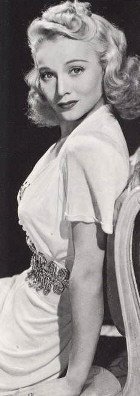
    A sensitive reader of these Chronicles remarked to me that of all of them, Chronicle 280 about Carole Landis is suffused with the most genuine emotion. It is indeed strange and wholly unexpected to experience such depth of feeling for someone known only indirectly. I feel as one who has discovered a buried treasure, something of immense value, lost to the world, to be brought forth by me alone.

    Carole’s beauty is incomparable. The library of the Motion Picture Academy contains a few hundred 8×10 photographs of her, dozens of which are more beautiful than any image I have ever seen of anyone else. Looking at her early photographs (the one that inspired Chronicle 280, still the most beautiful of all, and not in the Academy collection, dates from 1940, when she was 21), one could predict her selfless generosity during the war and after; Carole is so beautiful because her beauty is never coquettishly kept to itself but radiates forth as a gift to the world. It is a beauty that transcends desire as love transcends desire.

    The film idols of the past, Mary Pickford, Lilian Gish, Vilma Banky, Theda Bara, Greta Garbo, Jean Harlow, Rita Hayworth, Marilyn Monroe, Jane Russell, so many others, all belong more or less to their time, and before our eyes become “historical figures,” to be understood rather than simply appreciated. Carole’s timeless beauty touches us now as it would have sixty years ago–more, I think, because the conditions that nourished it no longer exist.


    Since writing Chronicle 280 over two months ago, I have learned a great deal more about Carole. I have seen about half of her 28 films, most forgettable except for her, some forgettable even with her. I have read her book, 4 Jills and a Jeep, which is both a humorous account of Carole’s first USO tour abroad and, in its modest way, her Recherche du temps perdu, the significant time of her life transformed by writing into a model of salvation. I have collected a few dozen photographs of her, and related articles and ads from old magazines. My wife and I have visited her star in Hollywood and left a bouquet on her grave at Forest Lawn.

    Carole’s uniqueness was not entirely of her own making. This was the one time that Hollywood, still in its pre-television, big-studio glory era, would find a place, however grudgingly, for someone so “distractingly desirable” (Life)–whom directors hesitated to use because they not unreasonably feared that her beauty would detract from the plot. Thus was Carole fortuitously allowed to attain the transcendent glamour that she so eagerly offered as a gift to those fighting the last and most crucial of history’s great wars, becoming afflicted in the process with malaria and amoebic dysentery that plagued her the rest of her life.

    Contemplating Carole’s story has taught me a great deal about life narratives. Told as a Hollywood chronicle, it is depressing. Carole was not only beautiful, she could sing in a lovely contralto and act, with a particular gift for comedy; her memoir and other writings (which I believe are essentially her own work) display a knack for witty, vivid narration amazing in someone with a junior high school education. Poised, graceful, modest as befits someone whose attractiveness speaks for itself, neither haughty nor vulgar, intelligent, witty, kind, generous, patriotic, Carole was the true American Beauty. Yet she never starred in a major film and ended her career in low-budget English potboilers. By all accounts she was a delightful person to be with, yet, with the dubious and fatal exception of Rex Harrison, four times married, she seems never to have had a single genuine love relationship. Declining in health and career, looking worn in her last months and no doubt terrified of the nearing age of thirty, she ended her life with a bottle of Seconal. Hardly an uplifting tale.

    There are no books about Carole. No one likes sad stories, unless there is a scandal attached to them, and Harrison is not quite scandal enough. There are, however, a dozen versions of her career in books like Fallen Angels, Hollywood’s Babylon Women, Hollywood’s Unsolved Mysteries, The Hollywood Celebrity Death Book…, for all of which her life’s meaning is defined by her suicide. Here is the beginning of the most sympathetic account of her life, Kirk Crivello’s November 1973 bio-filmography in Film Fan Monthly:

    She came streaking into stardom like a comet ready to burn out–and a few years later, she did. The legend is that Carole Landis was playing herself: a bright and bouncy girl, with an undertone of occasional sadness, searching for something even she wasn’t sure of. She began to stagger under the strain of having to be constantly sexy on screen: “I want a fair chance to prove myself as an actress–not just a curvaceous cutie!” But no one paid her any mind. There have been others, of course–Velez, Monroe, Mansfield, Inger Stevens, Marie McDonald who supposedly acted out their personal lives in their professional careers, their talent and unhappiness as one, propelling them headlong into quick fame and quick destruction. The Hollywood dream cult of the failure of success.There is real sympathy here, but expressed in a formulaic context that refuses to Carole, as well as to the others, the dignity of an individual destiny, a context in which “Hollywood” is the monstrous protagonist and all these women (and a few men, too), sad victims, drawn like moths to its flame. Whatever affection Crivello may have for Carole must be subordinated to the eternal formula of the scandal-sheet, updated weekly at every supermarket checkout counter: the rich and famous are no happier, are even unhappier, than we. But each of these “fallen angels” was different, and I venture to suggest that the antics of the “Mexican spitfire” and the sexual posturing of Mansfield and Monroe were as foreign to Carole as her hundreds of USO concerts here and abroad were to them.

    There is, inevitably, much worse. Carole’s beauty gave occasion for envy, and the more mean-spirited variety of Hollywood resentment literature is filled with what in a different context would be reviled as the lowest form of sexism. For Kenneth Anger in Hollywood Babylon II, she is a “bouncy sexpot” and a promiscuous “studio hooker”; a recent People magazine makes an offhand reference to her as “curvaceous and unfettered by talent,” the two qualifications being presumed synonymous.

    I intend to remedy this situation. Carole’s real story is uplifting rather than depressing. It may be regrettable that Hollywood let us see so little of her, but we should be thankful, yes, thankful even to Hollywood, that it allowed us to see and hear her at all. I would compare Carole, in all seriousness, to Thérèse de Lisieux, France’s most popular saint, who died of tuberculosis in 1897 at the age of 26. The world saw even less of Thérèse than of Carole, but it saw enough to find in her an example of holiness. We don’t need another twenty films to find in Carole’s gift of beauty a consolation for our mortality. Carole’s wartime activities, and the everyday “graciousness and kindness” referred to on her grave, were reciprocated in her time by a popular affection that those of later generations should be given the opportunity to share.


    Beauty is a cultural phenomenon that does more than reinforce biology. A beautiful woman concentrates within her the world’s mimetic power. But the effect is not to provoke violence but to contain and transform it. Although the original desire is libidinous, beauty as magnificent as Carole’s inspires not desire but chaste admiration. The appeal of sexual appetite is whetted by desire only to a certain point. At the moment when I feel that I bear within myself the unanimous desiring community, desire is transformed into a joyful assent to a sharing no longer burdened with sexuality, one in which persons of any gender can participate. The very attributes that inspire desire can be contemplated with disinterested reverence; we experience the body’s beauty as communion with the soul. Carole is a worldly guarantee of incarnation.

    If I have ever had a mission in life, it is to write a book, the only book, about Carole Landis. I cannot blame this mission on God, so I will attribute it to anthropology. Carole has made me realize what this inextricably dialectical mixture of nature and culture called Eric Gans has been put on earth to desire, and to love beyond desire. She has made the thought of death less painful, and those who share my life more precious. This project is a token of my gratitude.


  • What’s New and Old about the Origin of Language (II)

    This week’s Chronicle is the continuation and conclusion of Chronicle 283, which critiques three attempts to explain the origin of language.

    * * *

    My fourth example is Bernard Comrie’s article “From potential to realization: an episode in the origin of language” (New Essays on the Origin of Language, edited by Jürgen Trabant and Sean Ward in the Trends in Linguistics series for Mouton de Gruyter [Berlin and New York, 2001]): 103-17. Less prudent than Bierwisch (see Chronicle 283), Comrie is ready to discuss the very originary moment in which our “language capacity” is actualized for the first time. He describes this moment as the manifestation of what he calls the “Dumbo factor.” At the outset Dumbo, Disney’s flying elephant, was able to fly, but was unaware of this ability. Then, as Comrie puts it, “when placed in a situation where his life depended on being able to fly, he made the attempt and flew” (103). We should note in passing the importance of life-threatening danger to actualizing Dumbo’s latent flying ability, which might be taken to suggest that Disney’s storywriter was closer than Comrie to an understanding of language origin. After discussing a number of cases where limited levels of input lead or do not lead to the emergence of language in children, Comrie makes his concluding argument:

    We may now return to our basic question, namely: what level of input is necessary for language to arise? In the few cases where we can be reasonably certain that a normal child has been exposed to no input, language has not developed. Now, when language first originated this must have been the scenario, that is, the Dumbo Factor must have come into play: a creature that had a certain ability but was unaware that it had this ability must have become aware that it had the ability. We know of no clear modern instances of this happening, but this is not in itself evidence, since most children have the possibility of acquiring language under normal conditions and do so. At best we can say that we have no direct evidence of the Dumbo Factor coming into play, but circumstances make it unlikely that we would encounter such evidence. In one sense, then, our basic question of how humans came to know that they could communicate by means of language remains unanswered. (113-14)Without wishing to single out Comrie for ridicule, I think it is worth pointing out the inanity of this passage. Its fundamental argument is an obvious fallacy: (1) language use requires prior language capacity; (2) since capacity precedes use, there must be a time when one has the capacity without the use, and therefore without awareness of the capacity–the Dumbo Factor; (3) although normally individuals become aware of their capacity by contact with others already using it (i.e., speakers), there is no logical obstacle to actualizing it on one’s own when some external factor acts as a stimulus (“a situation where his life depended on being able to fly”); (4) clearly, in the first use of language, there were no prior users, so therefore (5) the origin of language can be explained by the Dumbo Factor. QED. It should be obvious to you, if not to the author, that this “argument” explains nothing at all, but is a pure artifact of the a priori distinction between capacity and use, potential and realization. Dumbo is a well chosen example, because real elephants can’t fly, and would have a great deal of difficulty in evolving the means to do so unless they were functionally employed in some intermediate state (for gliding, running faster, etc.), as wings are presumed to have evolved in birds. Exactly what it means for the Dumbo-protohuman to “become aware that it had the ability” to use language is left unspecified, since using language, unlike flying, is not something one generally does on one’s own. We would need at least two Dumbos together so that one might inexplicably begin to talk, and the other to understand and reply. Condillac proposed a far more convincing scenario of language origin between two children over 250 years ago.

    The remainder of Comrie’s chapter falls back, in a similar if less self-aware manner than Bierwisch’s, on the idea that, since children will develop language once a vocabulary is supplied, we can get the lexicon of mature language from protolanguage, concluding with the following petitio principi:

    . . . perhaps somewhat surprisingly, the main task in creating language seems to be providing the lexicon. Now, since protolanguage clearly has a lexicon, the early humans who had developed the ability to acquire human language but did not yet have a human language to acquire could in principle have simply taken off from whatever protolanguage they already knew and expanded it. If this scenario is correct, then while the provision of a lexicon is a task that does not in itself require the linguistic ability of humans, it is nonetheless a crucial catalyst for the realization of that ability. (114)In other words, “somewhat surprisingly,” there is no paradox, no problem at all. Protohumans acquire protolanguage, which subsequently evolves into human language, and presto, they have become human, as easily as elephants learn to fly.


    My last pair of examples comes from a third recent collection, The Transition to Language, edited by Alison Wray at Oxford University Press in 2000.

    Wray’s own article in this collection is entitled “Dual Processing in Protolanguage: Performance without Competence” (pp 113-37). She begins from the observation that language, particularly the language of everyday communication, is largely formulaic: “A striking proportion of formulaic expressions are used to manipulate others into physical, emotional, and perceptual reactions” (114). The next step in her reasoning is to remark that

    the manipulative functions of our formulaic language correspond closely with those observed in the communicative behaviour of chimpanzees in the wild . . . On the basis of this parallel . . . I have proposed . . . that the holistic strategy for expressing manipulative messages in phonetic form may be considerably more ancient than the analytic strategy [i.e., the divisibility of the message into meaningful morphemes]. I have suggested that the holistic cries and gestures of our pre-human ancestors were transformed, over a long period of time, into a phonetically expressed set of holistic message strings, each with a manipulative function such as greeting, warning, commanding, threatening, requesting, appeasing, etc. (115)The reference to a “long period of time” should arouse our suspicion; it is used to glide over the passage from a fixed set of genetically determined calls with little learned variability to an unbounded set of unfixed “strings”; Wray’s strings have every appearance of being what Saussure calls arbitrary linguistic “signifiers.” There is not even an attempt at explaining how or why this passage from hard-wired cries and calls to protolinguistic software is accomplished.

    In Wray’s hypothesis, these strings cannot be analyzed into component parts. But since the strings can multiply indefinitely, at a certain time (again determined without reference to any factors external to the individual protohuman brain) these cries/calls/strings stop being purely generic and begin to accommodate specific reference.

    This [accommodation of individual denotation] is what I suggest came to pass at some point during the protolanguage period. The impetus could have been a small but significant increase in memory capacity, a cognitive change that made irresistible the expression of new connections between ideas, and/or environmental pressure to extend the scope of the protolanguage system. In all cases, the consequence would be a minor–but not a major–revolution in expression, opening the way to an analytic system, though not yet to syntax. (123)Thus everything that needs to be explained is attributed, first to a “long period of time,” next to “a small but significant increase,” producing a “minor–but not a major–revolution in expression.” One wonders what is wrong with a large increase and a major revolution; but the real intellectual operation being performed here, of which the author seems blissfully unaware, is to generate a structure of transcendence without anyone taking notice of it, and anything large would be likely to be noticed, if only by the reader.

    Wray then goes on to propose a speculative hypothesis of how words came to be formed, that is, how the holistic strings of protospeech became analyzable into component parts. The following will give you the flavor of her speculations, which an uninitiated observer might call unscientific, or something worse:

    In order to see how the first individual words could emerge, let us imagine that the frequency with which “fetch” messages for individuals are needed is sufficient to support individual designation, and that the system can handle it. The message inventory will include a separate message form for each of [what I say when I want you to] fetch N . . . In other words, there is a distinct phonetic form associated with each individual in the group, for the context of “fetch that person.” . . .Let us next imagine that a speaker wishes to get a hearer to give an apple to Mary, but, though the apple is in plain view, Mary is not present and so cannot be indicated by gesture. The speaker resolves the problem by saying first baku, “[what I say when I want you to] fetch Mary,” and then tebima, “[what I say when I want you to] give specified object (distant) to specified female person.” Since only one of the two variable referents (the apple) has been indicated by gesture, the hearer is seeking local information that will indicate who the recipient of the apple is. Provided baku is viewed as somehow relevant to this quest, the effect (whether on this first occasion or only after repeated usage) will be to interpret “[what I say when I want you to] fetch Mary” as a perceptual rather than physical manipulator (“conjure up an image of Mary”) or indeed, simply to understand baku as “what I say when I mean Mary,” . . . a straightforward referential name. (124)

    I hasten to point out that baku and tebima are fantasy-words with no empirical basis; they are, as Pooh-Bah put it, “corroborative detail intended to give artistic verisimilitude to an otherwise bald and unconvincing narrative.” It would take me too long to point out everything that is wrong with this passage; let it suffice to say that this convoluted just-so story is designed to take the last step in the creation of the linguistic signifier, the arbitrary sign. Instead of beginning with the designation of something specific, a point of departure that was intuitively obvious to eighteenth-century writers such as Maupertuis or Adam Smith, Wray makes this her last and most difficult step, seemingly without realizing that all the rest of her hypothesis is a series of petitiones principii.

    The reason why these perverse protohumans are said to create separate strings for “fetch Mary” and “fetch Rosalie” before creating the names “Mary” and “Rosalie” is that their language, by remaining “holistic,” remains on the other side of the Rubicon that separates the human from the animal. Into this pre- or protohuman “holistic” language, Wray smuggles the essential element of symbolic language, notably arbitrariness, without which the indefinite multiplication of “strings” would be impossible. Then we are told that a specific set of messages–those for “fetching”–become so frequent that a different one is created for each member of the group. It boggles the mind, or mine at any rate, to conceive that a community might have different calls for each member of a group without a concept of reference to that individual, and that the reference to the individual would be derived only from some combination of these calls.

    Wray’s text is an extreme yet sadly typical example of the conceptual gradualism that complicates without in any way resolving the problem of the origin of human language by breaking it down into a series of arbitrary, speculative steps, each one of which presupposes precisely the symbolic relation between sign and referent that it purports to explain. The specialists, who not merely tolerate but actively encourage absurdities of the sort we have just witnessed, reject as unthinkable the notion that the community generates language by designating certain objects as sacred in order to preserve itself from the contagion of mimetic desire. The taboo against the sacred object is so powerful that even individual members of the group can be referenced only through the mediation of a call, “fetch Mary,” which we can somehow conceive before realizing that Mary is the object to be fetched. “Fetch Mary” is what I referred in to The Origin of Language (1981) as a nominal imperative, on the model of the surgeon calling “scalpel!” to his assistant. But before one can have an imperative, one must have an ostensive; before we can “fetch Mary,” we must have an ostensive association between this word/string and Mary herself. The “string” that we are using to fetch Mary must already designate or represent Mary; and for the community to represent Mary independently of the desire to remedy her absence, her presence must already be of particular significance. Reasoning along this line will lead us to the originary hypothesis, which confronts directly the origin of the symbolic sign and the transcendence it brings with it.

    Baku and tebima aside, Wray’s theory is similar to Bierwisch’s; both rely on the growth of the lexicon to explain the evolution of linguistic structure, whether morphological (Bierwisch) or, in the present case, simply lexical in the strong sense, that is, referential. All the smoke and mirrors in Wray’s exposition serve only to hide the key difficulty, which Bierwisch is at least willing to admit he has not solved, of, reference aside, why or how there emerge arbitrary signifiers, not genetically linked to their function and capable of being multiplied indefinitely.


    My final example is drawn from the same anthology: Derek Bickerton’s “Foraging versus Social Intelligence” (pp 207-25). Bickerton first proposed the idea of protolanguage in Roots of Language (1981) on the basis of his study of “pidgins,” simplified versions of languages spoken by non-native speakers that lack complex morphology or syntactic rules, and that evolve into “creoles” when they become the native languages of children brought up in these cultures. Bickerton’s argument (which has been contested by other specialists) is that creoles all share the same simple syntax, which cannot be derived from the more complex languages from which the creole is constructed, and may therefore be attributed ex hypothesi to an underlying “protolinguistic” mental substrate. The notion of protolanguage, the application of which is extended to such cases as apes who are taught versions of human language, appears to offer a bridge between pre-human modes of communication and language proper. It does not, however, as no intermediary concept can, answer the essential question of the origin of symbolic communication, the passage from animal signals to human signs.

    In the article under discussion, Bickerton takes issue with what he refers to as a trend over the past few years of considering language to have arisen “as a direct result of increased and intensified social interaction”; the emergence of language would reflect the increased level of “social intelligence” required to organize an increasingly complex society. This hypothesis understands language as a means rather of social control than of amplifying practical cognition. To quote Bickerton:

    [T]his chapter argues that the initial impetus for a [human] means of “information donation” quite distinct from means employed by other primates–that is, some form of protolanguage–arose directly from the requirements of group foraging, predator avoidance, and instruction of the young, rather than from specifically social interactions between individuals . . . (209)Bickerton’s main argument is this: given that human language is absolutely different from the communication systems of other primates, whereas the higher apes too have complex social relations, the uniqueness of language cannot be explained by the unique complexity of human social relations. Whatever selective pressures might have driven the development of language in humans, these same pressures, in lesser form, would have been present in our ape cousins; yet whereas our language is highly complex, “no other species has developed language at all” (209). I need not elaborate on how generative anthropology deals with this problem; what drives the emergence of language is not a mere increase in “complexity,” but an increase in mimetic capacity that makes animal forms of communication inadequate to prevent the breakdown of the social order in mimetic violence.

    Bickerton goes on to make other points. He rejects Wray’s hypothesis examined above on the grounds that “it seems likelier that the original symbols consisted of single units with single meaning–meanings, moreover, that could somehow be ostensibly demonstrated from the immediate environment” (216). He also alludes to the “cheapness of tokens,” their ease of emission that makes cheating particularly easy. These are points highly congenial to the originary hypothesis: the ostensive use of the sign comes not from a proleptic need to show what it refers to, but from a need to represent-interdict a present object of desire; the cheapness of the originary token is not accompanied by “cheating” because the whole point of the sign is to deny the possibility of cheating by making the centrality and therefore the sacrality of the object of desire the first object of human consciousness.

    Bickerton’s own explanation for the emergence of protolanguage is as follows:

    . . . there is abundant evidence that hominid ecology did differ from that of other primates: our ancestors lived on open savannahs or in marginal woodlands rather than in deep forest, and they were primarily terrestrial rather than primarily arboreal. An even sharper distinction relates to an ecological niche occupied from the time of the Olduwan industry (approx. 2.3 million years ago) onwards. . . Hominids became principally scavengers and were able to compete with other scavengers and predators for the carcasses of large animals across a wide range of habitats. . . .

    How did hominids succeed against fierce competition? Not, surely, by wandering round like a troop of baboons and eating what they happened to stumble on. They must have been able to (1) locate fresh carcasses with extreme certainty and rapidity, and (2) fight off competitors, probably with barrages of flung rocks. . . .

    In such a context, the crudest beginnings of some form of language would have paid off from day one. Any hominid group capable of discriminating food sources (and perhaps also of indicating the relative dangers involved in their exploitation) would have enjoyed an advantage over other hominid groups. Note that the first linguistic communications need not have been monomodal, nor need their units have been arbitrary in the Saussurean sense. Directional gesturing with the hand, accompanied by the imitation of the noise made by a mammoth, could easily have been interpreted as meaning “Come this way, there’s a dead mammoth” . . . (218-19)

    The key giveaway in this just-so story, which explains the origin of language by its cognitive-practical use, is found at the end of the first sentence of the third paragraph quoted above: language “would have paid off from day one.” Why is this expression there in the first place? Because the main difficulty of deriving language from its practical application is that language can have no practical application unless it already exists. “Day one” is a metaphorical way to posit a moment of origin without needing to define it. The originary hypothesis truly has something to say about “day one,” but Bickerton does not; there is no single moment when what he formerly called the “Rubicon” can be crossed, and his “ecology-based” theory is no advance whatever on the many earlier attempts to make the obvious usefulness of language the explanation for its emergence.


    Texts like these, written and compiled by leading scholars in the field and published by respectable houses, are absolutely typical; I could have cited dozens more. In one sense, they make my task terribly easy, since their inadequacy as explanations of language origin is so patent that it can be exposed merely by reading them aloud. In another sense, however, these texts make my task very painful, since they bear witness, over forty years after Girard’s theory of mimetic desire and over twenty years after my hypothesis of the origin of language, to the fact that these ideas have not even brushed against the consciousness of the “serious” investigators of this issue.

    I think I understand why this is the case; the idea that the origin of language, the very birth of the human, is something simple because cultural that some amateur like myself, inspired by another amateur like Girard, can hypothesize about, goes against the grain of the whole university-based structure of knowledge, the only alternative to which is the intellectual sub-stratum of cults and cranks. To put it differently, the origin of language is not the kind of problem that social scientists are used to solving, or able to solve. One might wish to call it an a priori ontological problem, but that would risk situating it in the pre-existent category of metaphysics. No, it is an anthropological problem, yet one of a sort that the science of anthropology has long abandoned. It is a trans-departmental problem that can only be approached by trans-departmental thinking.

    * * *

    We must dare to have faith in our ability to think the world and to experience its truths, so long as we are humble enough, and confident enough, to listen to the arguments of others. Non-specialist though I may be, I will continue to believe that the originary hypothesis is the minimal explanation of the human until someone shows me a reason not to. I hope you will agree that none of the examples discussed above offer much of a threat.

    (Part II of a slightly modified version of a lecture delivered at Westminster College, Salt Lake City, in March 2003)


  • What’s New and Old about the Origin of Language (I)

    In last week’s column, I had occasion to remark that the best designed typology of religious phenomena cannot make up for a deficient theory of origin. Scientific studies of, or better put, around the origin of language suffer from a similar deficiency. I hasten to say that these empirical studies include many useful results, whose demonstration is in most cases at least partially independent of any overall hypothesis of language origin. It is surely useful to learn about the descent of the larynx and the evolution of the primate brain. As long as the authors stick to empirically verifiable subjects, they are on solid ground, and only their fellow specialists are qualified to disagree with them. But at some point in most books and articles about the origin of human language, these authors feel obliged to bite the bullet and construct on the basis of their research a hypothesis of how human language originated. Lacking a sense of the paradoxical nature of language origin, they fall into the paradoxes of “supplementary” thinking with far less awareness than Plato or Rousseau. For the most part, these scholars purport to explain what is by their own admission the radically new phenomenon of human language either by age-old gradualistic Darwinian arguments (language enhances fitness) or, even more naively, by a mechanistic reliance on Mendelian ones (language cannot emerge unless a genetically determined language capacity is already present).

    Of the abundance of examples, I have chosen six, two each from three recent compilations. In the course of these analyses, I hope to convince you of the intellectual and, indeed, scientific superiority of my own anthropological hypothesis–neither falsifiable nor metaphysical–of the origin of language, religion, art, exchange, desire, and everything else that makes us human.


    1. My first example is the article of Tiziano Telleschi, “Origins of language and of society-culture relationships,” in Becoming Loquens (Bochum, 2000), pp. 75-100:

    The true break with the world of other animals occurred when, rather than specializing the soma, the evolving living being . . . refined certain aspects of the “neo-mammalian” brain . . . Language, although presenting only a rudimentary structure, was an initial “choice” which was destined to exercise a profound influence on the development of the brain itself, disrupting the conditions previously imposed by natural selection.

    By giving a “name” to things by means of “single words,” probably a million and a half years ago . . . , the Hominid of the Lower Paleolithic began to achieve increasing independence from objects. In accordance with arguments put forward by Bronowski and Bellugi, who claimed that in epigenesis language carried out the task of restraining and cleansing the content of communication from the emotional pressures of the limbic system, controlling emotive afferences in order to use them to link past and present experiences . . . and to initiate direct connections between different associative cortical areas of non-limbic types, we can presume that “single words” were able to overthrow the dominance of the limbic system . . . (80-81)

    The active agent of the first paragraph is the “evolving living being” that creates language as a result of the evolutionary “choice” of the brain over the body. In the second paragraph, the agent is language itself, which “carried out the task of restraining and cleansing the content of communication from the emotional pressures of the limbic system.” There are no desiring human beings, let alone potentially conflicting ones, in these paragraphs, and for good reason: the emotions that might have led to conflict have been “restrained and cleansed.” A Roy Rappaport (see Chronicle 282), let alone a Durkheim, would recognize that “restraining and cleansing” are precisely the cathartic functions of ritual that since Aristotle’s Poetics have been associated with tragedy. But the “emotional pressures” referred to in this passage are not even remotely conceived as leading to human conflict; their “cleansing” takes place in a wholly cognitive context, as though language removed an emotional filter between the prehuman subject and the object of his cognition. Which is to say that language performs a “cleansing” operation in order to perfect a cognitive system that could not have existed without language. Language is not only an agent, it is a conscious agent, able to plan its cleansing operation with a goal in view; in short, language behaves as though it . . . were making use of language. Which is a lot to expect from an evolutionary abstraction.

    Open a daily newspaper and nearly all the headlines, now more than ever, are about interhuman violence of one kind or another and efforts to prevent or control it. But this truth, theorized long ago by the anthropological wisdom of Machiavelli or Hobbes, is virtually absent from contemporary studies of human origins. At the very most, evolutionary advances are described as advantageous in combat between protohuman or human groups; the idea of conflict within the group itself is simply unthinkable. Yet mimetic violence is never really absent; it is merely metaphorized, converted into “emotional pressures” that need to be cleansed from “communication” between members of the group. If, conversely, we understand these pressures as those of mimetic desire, then the second paragraph’s unexplained personification of language metamorphoses into a simplified statement of the originary hypothesis: the conflict occasioned by mimetic desire over a contested object is deferred by the emission of a linguistic sign that represents and in so doing interdicts that object. Needless to say, this hypothesis, in which protohuman creatures rather than “language” or “the evolving living being” are the agents of historical innovation, is implicit in Telleschi’s text only for someone who has already formulated it; it can hardly be said to emerge from it. On the contrary, the opacity of this text is one more demonstration that lacking a generative hypothesis one cannot “cross the Rubicon” between the biological and the semiotic; the solution will never emerge from the data alone.


    2. My second example, taken from the same collection, is the article by Merlin Donald entitled “Preconditions for the evolution of protolanguages,” Ibid., pp 101-22. Donald has over many years developed a theory of mimesis that unfortunately lacks any connection to René Girard’s seminal theorization of the subject. Once again, the specter of aggression shows its head, only to vanish without a theoretical trace:

    The emergence of mimetic skill would also have amplified the existing range of differences between individuals (and groups) in realms such as social manipulation, fighting and physical dominance in general, toolmaking, tool use, group bonding and loyalty, pedagogical skill, mating behavior and emotional control. This would have complicated social life, placing increased memory demands on individuals; but these communication tools would also have created a much-increased capacity for social coordination, which was probably necessary for a culture capable of moving a seasonal base camp or pursuing a long hunt.

    It is important to consider the question of the durability of a hominid society equipped with mimetic skill: adaptations would not endure if they did not result in a stable survival strategy for a species over the long run. Mimesis would have provided obvious benefits, allowing hominids to expand their territory, extend their potential sources of food, and respond more effectively as a group to dangers and threats. But it may also have introduced some destabilizing elements, especially by amplifying both the opportunities for competition, and the potential social rewards of competitive success. (112-13)

    In the first paragraph, Donald responds to his own objections. If, on the one hand, increased mimetic skill leads to sharper hierarchical differentiation, on the other hand, the “communication tools” associated with this skill permit a higher level of social coordination. What is unclear is the nature of the creatures we are discussing. Whereas ape societies are hierarchical, all tribal-level human societies are egalitarian. The ability of language to enhance the social coordination of steep hierarchies is realized only at the level of state societies; before that, to judge from the evidence, language use is associated rather with the absence of hierarchy. Could it be that Donald is confusing two different levels of human evolution? That increased mimesis, in leading to language, brings about the dissolution of the hierarchical structures we find in primate societies? Although societies with language can and inevitably do see themselves as cultural wholes, the author speaks of “communication,” “fighting,” “dominance,” and so on in the one-on-one context characteristic of animal societies.

    Hence when we arrive at the second paragraph, we are faced with a contradiction that, this time, cannot be dealt with even verbally, but can only be left to us as a problem for the future. It is very Girardian indeed to speak of the dangers occasioned by enhanced “mimetic skill”; enhanced mimetic skill is the independent variable in Girard’s theory of homogenesis. But Donald’s cautionary caveats receive no reply in his own text, and appear therefore as no more than propitiatory gestures.

    These paragraphs conclude the section entitled “The cultural impact of mimetic skill distributed in social groups”; the following section, on “Mimesis as a preadaptation for protolanguage,” makes no mention of the problem posed by these “destabilizing elements,” a problem which, however “important” it may be to consider it, is never again broached in Donald’s text. Here as elsewhere, Donald’s discussion of mimesis is handicapped by the absence of any theorization of the difference between one-on-one imitation and the collective mimetic forms of human culture that serve to control rather than to exacerbate competition. This failure in turn reflects a more profound one, which is the failure to recognize the inherently conflictive structure of mimesis. Rather than being mediated by “the opportunities for competition, and the potential social rewards of competitive success,” the “destabilizing elements” to which mimesis is said to give rise are already present within mimesis itself. One can find better anthropological models in Girard’s work before he became interested in anthropology per se than in those of the one anthropologist who makes mimesis the core of anthropogenesis. If Donald would only take the trouble to type the word “mimesis” into Google, he would encounter conceptions of mimesis far more sophisticated than his own, conceptions that he seems never even to have given himself a chance to reject.


    I now turn to a second collection of articles on language origin: New Essays on the Origin of Language, edited by Jürgen Trabant and Sean Ward in the Trends in Linguistics series for Mouton de Gruyter (Berlin and New York, 2001).

    3. Manfred Bierwisch’s article in this collection, “The apparent paradox of language evolution: can Universal Grammar be explained by adaptive selection?” (pp. 55-79), seeks to avoid a paradox familiar in different forms to students of language origin since Rousseau: since the usefulness of language depends on its being shared with others, it would have to emerge in many minds at the same time–an idea sometimes made to imply that human linguistic capacity originated from a simultaneous genetic mutation.

    It seems obvious to me that this problem vanishes if we can construct a plausible hypothesis for the collective origin of language. But those who study the question seem convinced that, whether or not communication is the force driving protolanguage evolution–and a surprising number of scholars think it is not–the only way to speak of the emergence of language is as that of a capacity for language in the individual “phenotype.”

    Bierwisch’s solution is to separate “linguistic capacity” from “linguistic knowledge,” the latter, but not the former, being “within the range of linguistic theorising” (71). He then proceeds to propose that a “protolexicon” emerges, relying on Herder for the notion of “reflection” as the origin of what he calls the “stimulus-free and situationally independent assignment of structured signals to conceptual representations” (71). This, of course, is precisely what a hypothesis of the origin of language must explain; here it is taken for granted. Bierwisch’s notes that, once a protolexicon comes into being, it has no fixed, genetic limits as to the number of items it can contain. His hypothesis is that it is the increase in this number that drives the development of syntactic and morphological organization:

    I have proposed how to avoid the paradox of language evolution by combining two distinct but interrelated problems, both of which have to be solved anyway: the evolution of the language capacity and the origin of linguistic knowledge. These frequently confounded issues must be clearly distinguished because they depend on fundamentally different conditions affecting the genetic heritage as well as possible knowledge based on it. But it seems that a plausible scenario emerges if they are construed to depend on each other in a non-vicious circle. The capacity to accumulate lexical items could gradually lead to a developmental stage where a random variation indeed leads to an improvement of the linguistic capacity, justifying the urgently desired selectional benefit. (79)It is hard to disagree with the notion that the “language capacity” increases in tandem with the increased use of language rather than appearing all at once through the miraculous acquisition of a “language gene,” or evolving gradually as a purely cognitive capacity that suddenly manifests itself as language–a hypothesis that is either a truism (language can only emerge in a brain that is ready to acquire the mechanism of language) or an absurdity (language is an epiphenomenal communication to others of conceptual connections already present in the individual mind). What Bierwisch does, in fact, is to reduce the problem of language origin to that of the origin of the first “protolinguistic” sign, which is to say, to the problem addressed by the originary hypothesis. In this minimalistic gesture, Bierwisch is in full accord with generative anthropology. Once the sign exists, it will multiply and structure itself syntactically and morphologically, generating Baldwinian (behavior-driven) selection pressure toward an ever-greater language capacity. I think this plausible-sounding argument pays insufficient attention to the non-gradual syntactical gradations of ostensive, imperative, and declarative, but it can be accepted in what the French call its grandes lignes. The missing link, that is, a hypothesis that accounts for the origin of the protolinguistic sign itself, Bierwisch has the modesty not to attempt to supply. However praiseworthy this modesty, the fact remains that one cannot “solve” the paradox of language evolution by proposing a theory that accounts for this evolution only once language, even in its simplest form, has already emerged. The equivalent would be explaining the evolution of life after taking as given the existence of the first living organism.

    (Part I of a slightly abridged version of a lecture delivered at Westminster College, Salt Lake City, in March 2003)


  • Roy Rappaport and The Originary Anthropology of the Sacred

    The fundamental hypothesis of generative anthropology is that the function of representation in general and religious representation in particular is to defer mimetic violence. Although René Girard theorized the triangular structure of mimesis over forty years ago, his model was, and regrettably still is, too simple and elegant to be acceptable to an anthropological empiricism that seeks in the complexities of thick description a remedy against global uniformity. As opposed to physical scientists, for whom the shortest equation that describes a phenomenon within a given error tolerance is unequivocally the best, contemporary anthropologists fear that any general statement about the human risks neglecting, and therefore implicitly denigrating, some part of humanity. The theses presented in most anthropological papers are more scientific in style than in substance. The presentation of empirical data, along with copious citations of and references to other studies’ empirical data, often take the place of the rigorous application of Ockham’s razor. In most cases the “thesis” is not so much a predictive statement about reality as a suggested mode of classification both whose criteria and whose competitors go unmentioned.

    Lest I be accused of calumny, I shall examine the work of the late Roy Rappaport, arguably the leading recent American anthropologist concerned with religion, whose final, posthumous book, Ritual and Religion in the Making of Humanity (1999), develops a general theory of religious phenomena specifically designated as anthropogenetic (“in the making of humanity”).

    Rappaport begins by defining the human through language: “Our forbears became what might loosely be called “fully human” with the emergence of language” (4). He then proceeds to explain this emergence by means of a familiar Darwinian tautology: “It is obvious that the possession of language makes possible ways of life inconceivable to non-verbal creatures, and even proto-language . . . must have conferred important advantages upon the hominids among whom [it] developed” (4). The implication of this statement is that the origin of language is not qualitatively different than the origin of claws, teeth, the elephant’s trunk, or the giraffe’s neck, all of which “confer important advantages” on their possessors. A few pages later, however, Rappaport insists on the qualitative difference between language and any other adaptation:

    But even such far-reaching claims as “Language is the foundation of the human way of life” do not do language’s importance justice, for its significance transcends the species in which it appeared. Leslie White used to say that the appearance of the symbol–by which he meant language–was not simply an evolutionary novelty enhancing the survival chances of a particular species, but the most radical innovation in the evolution of evolution itself since life first appeared. . . . With the symbol an entirely new form of information (in the widest sense of the word) appeared in the world.

    . . . That language permits thought and communication to escape from the solid actualities of here and now to discover other realms, for instance, those of the possible, the plausible, the desirable, and the valuable, has already been emphasized. This was not quite correct. Language does not merely permit such thought but both requires it and makes it inevitable. (7-8; emphasis the author’s)

    Not only is language described as the most radical innovation since life itself, it is specifically distinguished from any mere “evolutionary novelty enhancing the survival chances of a particular species.” This suggests, at the very least, the necessity of a specific hypothesis concerning the circumstances in which this innovation might have emerged. Rappaport observes that, once language exists, humans can, indeed, must, think about such things as possibility and desire. This leads, however, not to an examination of the relationship between language and the mimetic conflict implicit in the possibilities of desire, but to the affirmation that language becomes not merely the motor of human adaptation but an adaptive force in itself:

    adaptive systems can be defined as systems that operate (consciously or unconsciously) to preserve the true value of certain propositions about themselves in the face of perturbations tending to falsify them . . . [T]he propositions favored in human social systems are about such conceptions as God, Honor, Freedom, Fatherland, and The Good. That their preservation has often required great or even ultimate sacrifice on the parts of individuals hardly needs saying. Postulates concerning the unitary or triune nature of god are among those for whom countless individuals have sacrificed their lives or killed others . . . (9-10).

    Here violence–a term that does not merit an entry in the book’s index–is associated with language, not because language is from the outset focused on deferring violence, but because the “preservation” of the “propositions favored” in language-possessing “adaptive systems” is so important that individuals must be sacrificed in large numbers to the necessity of maintaining them. Wars are fought over “propositions” because human evolution has made the preservation of these propositions the central adaptive trait to which everything else must be subordinated, and sacrificed when necessary. But because the link between the sacred propositions and the deferral of violence within the community is never made, no explanation can be given of the source of this violence, or of the frequency of violent conflict between defenders of different propositions. How could sacrificing “countless individuals” be adaptive unless the “propositions” to which the sacrifice is directed preserved the community from a still greater violence? Yet the implication of Rappaport’s text is rather that, although the lives in question are sacrificed to human rather than natural violence, human violence has no particular causal relation to the loss of fitness that would be occasioned by the non-preservation of the “propositions.” Although we kill people from other groups when they threaten our fundamental propositions, the adaptive value of these propositions is not presumed to have anything particular to do with preventing humans from killing other humans. The propositions promote a Durkheimian solidarity the contrary of which–breakdown in mimetic crisis–is never theorized explicitly.


    For Rappaport it is the notion of the proposition that cannot be falsified that provides the connection between language and religion. Language permits one to talk about imaginary realities, hence, inevitably, about false realities. We can lie. Rappaport demurs from making the problem of lying the explicit cause of the emergence of religion, affirming instead that “religion emerged with language. As such, religion is as old as language, which is to say precisely as old as humanity” (16; emphasis the author’s). Yet the sole explanation he offers as to why indeed religion emerged along with language is that contained in the following italicized affirmations:

    I will argue, among other things, that aspects of religion, particularly as generated in ritual, ameliorate problems of falsehood intrinsic to language to a degree sufficient to allow human sociability to have developed and to be maintained. (15; emphasis the author’s)

    The tension between the hedging in this statement (“among other things,” “aspects,” “particularly as”) and its emphatic italicization reflect the contradiction between explaining the emergence of religion by the necessity to “ameliorate problems of falsehood” that can only be posterior to the origin of language and intuiting that religion and language are indissolubly linked moments of an unnamed originary scene. On the one hand, language has adaptive value; on the other, it poses “problems of falsehood” that only religion can resolve by affirming unfalsifiable truths. Rappaport’s favorite example of such an unfalsifiable truth is the Shema (“Hear O Israel, the Lord thy God, the Lord is One”) that he calls the “Ultimate Sacred Postulate” of Judaism, whose maintenance permits all lesser “postulates” to evolve while preserving the Jews as a religious community united around this linguistically unchanging, because unfalsifiable, kernel of faith. In Rappaport’s view, religion, and its core operation, ritual, function to protect humanity against excesses of language that would otherwise undermine sociality by creating confusion between lies and truth. Whereas Durkheim explained religion as a means for maintaining solidarity with respect to a society’s central ethical values, Rappaport sees it as a means to maintaining solidarity with respect to the society’s central propositions. Max Müller called mythology a disease of language; Rappaport, to the contrary, views mythical, that is, unfalsifiable, propositions as a cure for linguistic and social disunity.

    But if language and religion are, as Rappaport affirms, truly coeval, then the “important advantages” conferred by language must at the outset have been identical with those of religion, that is, those obtained by asserting unfalsifiable propositions, rather than the cognitive advantages of language as a means for communicating about reality (“the food is over the hill”). If indeed language and religion emerged at the same time, then one cannot separate language’s adaptive advantages from the possibility of linguistically provoked disunion that religion is required to allay. The first assertions, in a proto-language that could not have articulated them in declarative sentences, must have been themselves religious and consequently, as Durkheim insists, useless as a means of understanding and communicating about empirical reality. Rather than as remedies for lying about empirical facts, the unfalsifiable propositions of religion result from the substitution of shared acts of signification for potentially violent acts of appropriation. What these propositions come into being to oppose is not another (falsifiable) kind of proposition, but a pre-human world lacking in shared symbolic signs of any kind, in which no communal meaning, and consequently no communal interdiction, is possible. Language emerges when the pecking-order control of mimetic conflict cannot withstand the mimetic pressure of a common desire; the first unfalsifiable proposition is not something like “God is one,” but simply “(do not seek to appropriate this because it is) God!”

    We have from Rappaport that lying poses problems of social incoherence–let us say:intrasocial violence–from which religion protects us by making us agree on a core set of unfalsifiable “postulates” that may ultimately be reduced to a single one. We also know that the defense of these postulates has led to a great deal of intersocial violence. The most parsimonious hypothesis that accounts for these two phenomena is that the violence with which a given society defends its postulates against others is the same violence against which these postulates protected it in the first place, that is, that it derives its energy from the same source. Both language and religion emerged in order to prevent the outbreak of mimetic violence, or, as I prefer to say, to “defer” it. Before lying could become a problem, that is, before the danger to the social order could be described in terms of a conflict between propositions, there must have been a potential conflict that could not yet express itself in propositions, even in the elementary forms of proto-language.

    Rappaport concludes the introductory chapter of Ritual and Religion by redefining once again the problem that religion exists to solve, this time as that of “alternatives”:

    The ability to imagine and establish alternative orders is not, on the face of it, problematic. Such an ability makes possible, or even itself constitutes, a quantum leap in adaptive flexibility . . . This enhanced flexibility has, however, an unavoidable but dangerous concomitant: increased grounds for disorder.

    No actual society is utopian. It may, therefore, be difficult for any society’s members not to imagine orders in at least some respects preferable to those under which they do live and labor. If they can conceive of better orders, how are their actions to be kept in sufficient conformity to the prevailing order for that order to persist? The conception of the possible is always in some degree the enemy of the actual. As such it may be a first step toward the disruption of prevailing social and conceptual orders, whether they may be . . . (17-18)

    Once again, disorder is said to emerge from the possibilities inherent in language rather than from the desire that language both defers and generates. In attributing the danger to the social order to the language-user’s inherent ability to “conceive of better orders,” Rappaport once more stands the relationship between language and order on its head. Language did not come into being as an adaptive ability to conceive of alternatives that subsequently comes into conflict with the established order, but as a means for deferring the “alternatives” to the social order that are posed by each individual’s desire to appropriate the (sacred) object of everyone’s desire. Only once this crucial problem is solved can language become a means of representing both empirical reality and its “alternatives.” This fetishization of language and semiotic categories persists throughout Rappaport’s book.


    I submit that there is a better way to talk about the relationship between language, ritual, and the sacred, one that begins not with a set of concepts but with a hypothetical scene from which all cultural phenomena are eventually derived. The scenic hypothesis has among its other advantages that of avoiding purely verbal disputes about whether animals have “ritual” or “language.” Whether or not one uses these terms to refer to animal behavior, what distinguishes the human is its historical derivation from an originary scene. Human ritual may then be characterized not as the assimilation of the extraneous element of independently-evolved language into the more general structure of ritual, but as the attempt to reproduce this scene, that is, as a historical phenomenon, in contrast with biologically driven animal rituals. In the general case, ritual goes beyond the minimal energy required to generate linguistic signs, although poetry shows that language itself can become an object of repetition. It is less important to establish boundaries between the categories of language and ritual than to understand the specific position of cultural phenomena with respect to their ultimate origin. If language, ritual, the sacred, desire, and all other fundamental categories of the human emerged in the same scene, then we can examine each historical case with respect to how it performs the fundamental operation of this scene: the deferral of mimetic violence through representation. Human institutions, as opposed to the behavior patterns of animals, are scenic; they constitute themselves as totalities rather than as sets of piecemeal relations. This is as true of economic exchange as of religion.

    The scene is a model of generative human interaction; its product is representation, the establishment of the sign, or system of signs, as a separate, transcendent mode of being that brings the things of this world into the central focus of human culture. The fundamental task of anthropology is to explain the emergence of this realm, which has no counterpart in the behavior of other creatures. Conversely, once we are in possession of a model of this emergence, that is, of an originary hypothesis, we need have no fear that any phenomenon of human culture will falsify it.


    What is central to generative anthropology and missing from mainstream anthropology is mimetic violence. The negativity that Rappaport presents in cognitive terms as lying or alternatives is in the first place rivalry over an object of desire. What mainstream anthropology refuses to countenance is that the human comes into existence as a means to defer intrasocietal conflict. The simplest definition of the human is as the species that itself poses the greatest danger for its own survival. For the human thus defined by the reflexivity of crisis, language and culture are means for deferring this danger. The originary scenic structure of representation arises when the species, in focusing on itself as its own greatest threat, discovers that the postponement of this threat depends on the interdiction of shared appetite through an entirely new form of relationship that replaces the appetitive by the representational or transcendental.

    In order to ward off the danger of mimetic violence, humanity can survive only by turning its attention to a transcendental center. The refusal of mainstream anthropology to recognize the danger of mimetic violence reflects the Enlightenment denial of transcendence that was originally constitutive of the social sciences. Rappaport, although far more sympathetic than most to ritual and to religion in general, understands the sign in the Piercean rather than the Saussurean mode, as part of the same world as its object; he defines religion not as the subsistent guarantee of the vertical transcendence of the sign, but as a means for bringing order to an already “ritualized” horizontal world, one into which the human, for a reason never explained, injects the phenomenon of representation. What is necessary, however, is to recognize not merely the radical newness of transcendence, but its specific pertinence both to human language and to the other forms of human culture. What is needed, in a word, is not an anthropology of religion or the sacred, but simply an anthropology of the human that offers a model of how the defining phenomenon of representation first emerged. In any such model of the human, language and the sacred will be not merely coeval, but identical in their central core.

    (Abridged version of a lecture delivered at Catholic University, March 2003)


  • Confessions of a Dialectical Hedgehog

    The Landis photograph of Chronicle 280 made real to me as never before Proust’s description of things of beauty–whether a petite phrase of music or an 8×10 photograph–as hostages that guarantee our lives and deaths against meaninglessness. The necessary “littleness” of such things was the subject of Douglas Collins’ recent article in Anthropoetics.

    Yet Proust also observed in our most meaningful experiences an internal mechanism of self-diminution: what he calls les intermittences du coeur, the discontinuities of emotion. The greatest beauty cannot remain with us at every moment, just as the most powerful love cannot sustain us at every moment. Perhaps then I should take a more cautious tone in affirming the meaningfulness of the things that have meaning for me; perhaps I should become what Richard Rorty calls a “liberal ironist” who refuses to make the Kantian affirmation that my experience at this moment is a universal model for all. In the terms of Archilocus’ dichotomy, revived by the late Isaiah Berlin, Rorty would have us all become foxes. The hedgehog conjures up for us the fanatical image of Osama bin Laden–foxy, perhaps, but no fox he.

    Chronicle 279 explained antisemitism as an inevitable reaction to the Jews’ status as the first monotheists–a thesis some rushed involuntarily to confirm by accusing me of arrogantly asserting Jewish superiority. Likewise, I pointed out that the United States was universally envied for its dominant role in the contemporary market system, a statement of fact that only provided new ammunition to the enviers. Thus in my last two Chronicles I have claimed (1) to belong to the religion that “objectively” made the greatest theological advance in (Western) history; (2) to live in the nation that “objectively” dominates the contemporary exchange system; and (3) to be the discoverer of history’s most “objectively” beautiful image. Yet for chutzpah none of these claims holds a candle to the ultimate hedgehog hypothesis that purports to define the parameters of the originary scene of human language. Just as no one can think about monotheism without reference to the Jews, no one should think about language origin without referencing the originary hypothesis; that is the core of Generative Anthropology, which this website exists to promote.

    Since I have now reached senior citizen status, it is surely too late to change into a fox. All I can do to make my peace with the world is to hope that foxdom has some need for my particular strain of the opposing species: hedgehogs who attempt to persuade on rational rather than dogmatic grounds. In honor of the great hedgehog philosopher, der Igel Hegel, I will call myself a dialectical hedgehog.

    At first glance, dialectical hedgehogs don’t seem very useful in the great scheme of things. The bin Ladens command our attention, whether through sheer terror or simply as points of resistance to the market’s circulatory penetration. In the global exchange system, dogmatic hedgehogs are squeaky wheels, and so get lots of grease, whereas the dialectical hedgehog who not only believes he is right but has the supplementary arrogance to think he can demonstrate it to others is dismissed as a troublemaker.

    But can I renounce the need to impose upon the world the unique significance of my own experience? I contemplate my Landis photograph, enthralled with my discovery, but this enthrallment is incomplete without the assent of those who have not yet acknowledged it. It is the dynamic of persuasion that drives the hedgehog dialectic; yet the very violence of my assertion is an obstacle to my reader’s conviction. The foxy tack, so prized in our time, is to deny all satisfaction on the model of the dandy of old: nihil admirari. Emulation of the refusal of desire is the safest rivalry.

    I know as much about irony as anyone, but the irony of desire can be enjoyed only in the brotherhood of ironists, less enchanted with their object than with each other. The Bronx Romantic who conceives his ideas in solitude gains no benefit from mocking the certitudes that inform his quest. On the contrary, when they waver, he must uphold them through an act of faith. There may be moments when my portrait seems less beautiful, when its exquisite equilibrium seems broken; yet in the Proustian spirit of the dying Bergotte before Vermeer’s petit pan de mur jaune [little yellow wall], I affirm this image as my consolation for life and death.

    It is perhaps inevitable that the hedgehog who belongs to both the tribe of the discoverers of God and the nation of the masters of the global economy, and whose anthropology situates itself at the unique point of human origin, should one day declare this specific trace of this specific moment to be the nec plus ultra of beauty. How even begin to prove such an assertion? The proof can only be an act of faith–and of love, in a certain sense.

    Our photograph is an article of commerce produced in a time when high art denied beauty all prestige, when only a Hollywood glamour photographer would create an image with an eye to making it beautiful. Beauty is not a stable state; esthetic desire circulates between the image and the imaginary figure it engenders. The modernist rejection of “mimetic” art is motivated by the refusal to create a representation that one could conceive at any point within this esthetic oscillation as an object of desire in the real world. Such an image might be, Ô horror, marketable. One might find in it a simple likeness, not a sign but a substitute object of desire, a form of pornography. I can defend Landis’ portrait against this accusation, but I cannot deny that someone might find in it a promise of sexual satisfaction. The viewer of Les demoiselles d’Avignon runs a far lesser risk of such contamination.

    The market-terror of modernist high art, no longer willing or able to take its content from the central domains of human experience, leaves popular art, for which the satisfaction of desire was always the aim, free to expand into high art’s traditional terrain. Although our photographer took other, far less remarkable pictures of Carole in the same chair and dress, in this one shot, by chance or design, he found within the conventions of the glamour portrait the means of esthetic transcendence.

    Yet this photograph is not famous; it is no longer even available commercially. Its beauty lacks the external trappings of the popular sacred. As a popular art, glamour photography depends for its marketability above all on its subject. On my last visit to eBay, there were 20-odd Landis items and nearly 6000 Monroe items. Save for a few scattered cultists and aged veterans, there is no Landis-ness to compete with Monroe-ness; a picture of Carole Landis has little cultural iconicity. Perhaps only a Bronx Romantic, the most stubborn variety of dialectical hedgehog, could see in it the purest of all revelations of beauty, one whose esthetic perfection is guaranteed by the very vulgarity of its origin.

    Few of the legendary actresses of Hollywood were really beautiful; none was a match for Landis. Her portrait’s pride and sadness would tell this even to one who knew neither her name nor the time and place of her life. The expression “achingly beautiful” conveys the spectator’s shared experience of this paradox of presence and absence. It is painful to witness great beauty, but we are proud of our pain. We are unworthy to possess the sublimely beautiful, but proud to accept our unworthiness.

    When an individual’s “judgment of taste” affirms its universality, the very affirmation leads to conflict, since the second person to come along, even if he shares the taste of the first, can only passively acknowledge the truth of the other’s judgment. In a democratic world, collectivities can unite around shared ideas of the beautiful only if cultural iconicity ensures that no individual be able to define this beauty for himself. To become Monroe or Madonna requires that each member of the audience be faced with a fait accompli. This cannot be done simply by blanketing the world with publicity, although it cannot be done without it. Just as Landis bears in herself the sign of superlative beauty without need for comparison with others, so the icon must bear in herself the sign of a mass appeal that permits of no individual overbidding. (These remarks apply to male icons as well; but outside the gay community, men, even Leonardo di Caprio, are simply not beautiful.)

    The Marilyns, Madonnas, and Britneys exude a centerless, anonymous attraction; Landis does not. No doubt she posed for plenty of (relatively tasteful) cheesecake pictures; the very existence of our portrait depends on her value as at least a minor icon. Landis in her day was somebody; in Four Jills and a Jeep the flyer she will later marry (and, in real life, divorce) falls in the mud in shock on hearing her say her name. But Landis’ beauty was too real, too variable and vulnerable as well; she could never become like Marilyn a Barthian myth, a sign of herself. Her photographs can be artificial, but the artificiality remains on the surface, unbankable. Terms like “busty” and “curvaceous” were applied to Landis, but they were unworthy of her then as they are now. Perhaps you will say that my sensibilities are not those of the 40s, but I think we all have the same sensibilities; we only value them differently. We can give in to vulgarity or we can resist it; we can aspire to transcendence or reject it as an affectation. Landis’ beauty speaks not to the fox but to the hedgehog.

    What use might there be for a dialectical hedgehog? In a system of emulation, his denial of the possibility of rivalry incites rivalry in transcendental form as the desire to annihilate his very being. If he has discovered the One God, the One Nation, the One Beauty, then there is nothing left for other mortals but the irrationalities of antisemitism, anti-Americanism, even, God forbid, anti-Carolism. But this reasoning falsely implies that all but the Bronx hedgehog are willing to sell their souls either to foxiness or to a categorical dogma. There is a hedgehog in us all. Rather than either suppressing it or turning it to fanaticism, we would do better to teach it the art of dialectic; the fox-chatter of the liberal ironist is not real dialogue.

    How can more than one dialectical hedgehog escape the ineluctable master-slave dialectic of the Hedgehog philosopher? But how do people deal with the Jews? Not everyone is an antisemite. The Jews were there first, but one recognizes their historical priority and moves on; the Jew or non-Jew who does not will contribute nothing positive to the 21st century. Nor is everyone anti-American. The global market, once created, is beyond nationality, as are one’s personal accomplishments. The correct response to the dialectical hedgehog is neither blind resentment nor struggle to the death but acceptance and detachment; we live in an expanding universe with ever more to discover and invent, ever more syntheses to accomplish. We each need the courage to be dialectical hedgehogs in our own sphere; the Bronx Romantic has no pretension of being the first or greatest of the species.

    Nor should anyone begrudge me my portrait. It is mine because it is everyone’s, one at a time rather than collectively–as beauty is supposed to be. Until recently, this photograph sold on the Internet for under $7.00, shipping included–the esthetic bargain of the millennium. No, I am merely reminding my fellow hedgehogs–we are all hedgehogs underneath–that hedgehog beauty is true beauty, the saddest and most exhilarating. For this discovery, dear reader, you should thank Carole Landis, not me.


  • Carole Landis


    Other Photographs

    Few readers will be able to identify the subject of this photograph: Carole Landis, who committed suicide on July 5, 1948 at the age of 29. Hers was a name I had only heard; an actress who played in no major films and who died before I was seven years old. The other night, I watched the quasi-film noir I Wake up Screaming, with Landis as a murder victim whose killer is hunted down by Victor Mature and Betty Grable, who plays her sister. Carole Landis was so unfamiliar to me that on her first appearance in the picture I was surprised to find Betty Grable so beautiful; it took me a moment to realize that Betty was playing the other role.

    In a brief exploration of the Internet, the source of all wisdom, I chanced upon this breathtaking portrait. It is, quite simply, the most perfect representation of a woman’s beauty–of beauty itself–that I have ever seen. Since finding it, I have perused for purpose of comparison hundreds of publicity shots, from the 1930s to the present day. Most are wholly forgettable, some are pretty, many are supposed to be sexy but succeed only in being vulgar, a few are truly sexy, and a very few are portraits that give some insight into their subject. I found none to compare with this one. Seek for yourself, dear reader.

    Especially today, but in fact from the beginning, as the Bible and Georges Bataille tell us, there has been a shamefulness attached to a man’s desire for a woman (women’s desires for men, in contrast, lacking this element of shame, are consequently seen, and feared by men, as shameless). To desire is to threaten the self’s dissolution in the imaginary but always potentially real sparagmos suffered by the peripheral worshiper who dares move toward the center. The “homosocial” sphere until recently so powerful allowed the transcendence of shame by relocating desire in the context of a friendly rivalry for an object considered fundamentally unworthy. The accession of women to more or less equal social and professional roles (a consequence of the postwar victimary critique) has relegated this kind of camaraderie to the lower reaches of the moral order, with the result of removing shame’s protection.

    The role of the bosom in feminine attractiveness is particularly vulnerable to this intensification of shame. Biologically speaking, women’s secondary sexual characteristics have clearly been the object of a very intense selection; just take a look at a female chimpanzee. But desire is shameful; the endless talk about women’s breasts reflects a great uneasiness. The everyday world respects Jesse Ventura’s desire to be reincarnated as a 38DD bra, but the only women in public life with such attributes are figures of fun, the most egregious of whom, Anna-Nicole Smith, shares with Ozzy Osbourne the newly invented role of TVcam scapegoat.

    To admire the photograph above is to accept without shame the bosom’s importance as an element of female beauty. The myriad decolletés that dominate publicity collections rarely succeed even in being sexually attractive, no doubt because, were they to do so, they would risk stepping over the line that separates “innocent” erotic art, quaintly known as cheesecake, from pornography. Cheesecake is a secondary representation of sexual beauty, like the “myths” described by Roland Barthes: it represents the desirable without directly arousing desire, which appears only through its mimetic detour. In contrast, pornography alludes directly to sexual activity; if enough bandwidth is available, it displays such activity in detail. Its effect, which one can turn away from but not avoid, is mimetically to induce the spectator to equivalent activity. Pornography avoids the paradox of esthetic experience, the reliance on the representation’s standing outside the world of the imagination it generates and that depends upon it, by opening a parallel path of fulfillment through the sexual excitation it inspires, relying on the fact, whose adaptiveness needs no explanation, that sexual desire is capable of generating its own satisfaction.

    No doubt affirming that one finds a woman’s bosom beautiful, as opposed to simply desirable, seems hypocritical, more than ever in our day of Hooters restaurants. And that is precisely what explains the remarkable fact that our feminine iconography, obsessed with the bosom, so rarely presents it without disfiguring insistence as a harmonious element of a beautiful whole. Compare our Landis photo with that of Jane Russell (which sells for 500 times its price!), or even that of the iconic Marilyn Monroe.


    Our photograph, neither cheesecake nor pornography, transfigures Carole Landis into a work of art that both arouses desire and transcends it. What sets this photograph apart from all others is, first of all, the dignity of her face in its unostentatious revelation of the tension between pride and sadness. This tension reflects its subject’s historical location on the cusp between the opaque sexuality, innocent or “fatal,” of the prewar, patriarchal era and the self-assertive seductiveness of the feminist generation, which tells the spectator, “look at my body, but know that I know I am more than just a body.” Too late for the former, too early for the latter, Landis was denied both easy solutions, which explains at least in part why she and many other beautiful actresses of her generation met with sad ends. Something of the same expression is visible in another portrait that shows Landis drowning in white fluff, a 1940s Ophelia.

    Pride and sadness, pride in her extraordinary beauty, sadness in knowing that to live on this beauty is to degrade it, not so much by displaying it on screen as by commodifying it on Hollywood’s casting couches. This tension, ultimately destructive of its subject’s life, is held in suspension for the split second’s duration of this portrait, which acknowledges beauty as an objective fact, a source of neither triumph nor abjection. Landis’ expression, devoid of resentment, seeks neither domination nor revenge, only recognition of what is.

    * * *

    The photograph bears the mark of its place and time. Black and white was still the common idiom, of motion pictures as well as still shots. Landis’ clothing and accessories, make-up, and hairdo bespeak the careful grooming and just slightly vulgar elegance of studio-era Hollywood, as do the exaggerated 40s shoulder line and the out-of-focus studio backdrop, and even her name, pieced together from Carole Lombard and baseball commissioner Kenesaw Mountain Landis. The beauty of this or any photograph, which at its best outshines, as this example shows, all other modes of plastic representation, is guaranteed by the reality of its object as it exists at the moment of its formal transfiguration.

    The typical publicity shot showing an actress looking smilingly or suggestively at the camera is hardly pornography, yet it is not art either. It alludes not to sexual activity but to the socially admissible accessory activities of courtship and marriage that make up, generally speaking, the tragic or comic subject matter of the films the actress plays in. Landis herself posed for plenty of such photographs, in a great variety of modes; it is sometimes difficult to see them all as portraits of the same person. Today they have the charm of period pieces, figures of female beauty of an unpretentious dignity rare in the genre. But this charm is incommensurable with the power of our portrait, which finds in Landis herself and in the historical moment she embodies the material of esthetic revelation.


    We may contrast our portrait with the rightmost photograph above, which shows Landis in the same dress, the same chair, almost certainly at the same time. The composition is strongly vertical, emphasizing the line of the arm and, accessorily, the curve of the bust. Here she looks directly at the camera, with a hint of a smile that covers like a mask the tension between inwardness and ingratiation, pride and humility. A certain haughtiness in this smile, contrasting with the more natural expressions of the other shots, reflects the fragility of this equilibrium.

    In our portrait, this problematic self-consciousness is not only displayed in Landis’ facial expression but echoed in the tension of her body, the head turned to the right, the chest thrust just slightly forward and to the left, the curved line down the left side of her face and her neck to her bosom countered by the strong horizontal of the belt that is in turn contained by the upward curve of the chair. The face is turned away, the body toward the spectator; the spirit does not deny the flesh, but discreetly asserts its independence of it, as a separate element in a dynamic harmony. Landis’ face hesitates between a brachycephalic and a dolichocephalic esthetic, which alternate in the other pictures: the lower part of her face is long, the upper part is broad; she is both avid and cerebral. Our portrait displays this tension and its resolution, whereas the elongated picture, with the downward tilt of the head, merely makes it indeterminate.

    * * *

    Let there be no mistake; I am not claiming that Carole Landis was the most beautiful woman in history, or even the most beautiful Hollywood actress of the 1940s. Comparing beauty in this way is a category mistake, degrading an interactive relation to a linear measurement. Yet such a portrait cannot but reveal its subject. Carole Landis, whose short life ended so sadly, was a woman of great talent and generosity, whose tireless USO work during the war made her beloved of GIs and Allied soldiers. We should remember this as we accept from her the lasting gift of this perfect portrait that is, for me at least, the very incarnation of the beautiful.

    Even when he was not thinking of the little phrase, it existed latent in his mind on the same footing as certain other notions without material equivalent, such as our notions of light, of sound, of perspective, of physical pleasure, the rich possessions wherewith our inner temple is diversified and adorned. Perhaps we shall lose them, perhaps they will be obliterated, if we return to nothingness. But so long as we are alive, we can no more bring ourselves to a state in which we shall not have known them than we can with regard to any material object, than we can, for example, doubt the luminosity of a lamp that has just been lit, in view of the changed aspect of everything in the room, from which even the memory of the darkness has vanished. . . . Perhaps it is not-being that is the true state, and all our dream of life is inexistent; but, if so, we feel that these phrases of music, these conceptions which exist in relation to our dream, must be nothing either. We shall perish, but we have as hostages these divine captives who will follow and share our fate. And death in their company is somehow less bitter, less inglorious, perhaps even less probable. (Marcel Proust – Swann in Love)


    Postscript: Carole Landis in Film and History

    Watching Carole Landis on screen is a very different experience from gazing at her photographs. In posed shots, her face is a harmonious whole, whether that of our portrait’s dynamic equilibrium or the simpler harmonies of hundreds of others. On screen, however, as, presumably, in real life, her face exhibits a remarkable complexity. I alluded above to the tension between the long lower face and the broad forehead; in a motion picture, one observes in addition that the planes of her forehead and the lower part of her profile, marked by a pronounced overbite, are unusually independent of each other. Watching her on screen generates a vague anxiety lest her radiant but precarious beauty disintegrate as soon as it is no longer held together by the vitality of her smile–an anxiety that risks distracting our attention from her fictional role. The unique vulnerability of Landis’ face contributes to the resolved tension of our beautiful portrait a supplemental energy of which I had been only vaguely aware.

    This vulnerability, in turn, gives all the more significance to the serene gracefulness of Landis’ body. If her face sometimes seems to be barely held together, her body is always harmonious and at ease. The anxiety provoked by the first is constantly allayed by the sight of the latter. This again is brought out in our portrait; although it stops just below the waist, the leftward turn of the hips suggests the long, elegant legs we see in the photograph below. Landis, who excelled in athletics as a girl, is tall without being “statuesque”; her lovely figure never panders to its admirer.

    If beauty depends on the interdependence of a representation and its imaginary object, then the greatest beauty is the most fragile because the most clearly impossible to conceive without its representational support. In Landis’ case the personal fragility that we sense on screen embodies the moment of transition between two eras defined by the war that defined the limits of human violence. What I described in Landis’ face as the tension between pride and sadness is of the very essence of the esthetic object, whose subject both affirms its presence and hides it behind its representation. Our portrait’s uniqueness reflects the emergence of the postwar sensibility that would no longer allow the mass media to “innocently” offer up to their spectators images of desirable otherness. Our portrait is a lasting memento of the moment when not just glamour photography but representation as such lost its claim to secular innocence.

    * * *

    Carole Landis’ extraordinary efforts for USO during WWII, which permanently damaged her health, were the product of the generosity and graciousness witnessed by all who knew her. This opportunity to make a gift to others of her talent and beauty was without a doubt the high point of Landis’ life. Such innocent generosity could not be maintained after the war. One Hollywood cliché is that Landis was “Marilyn before Marilyn,” but the effect of her suicide was rather to avoid becoming “Marilyn,” the postwar tease whose self-caricaturing sensuality was cheesecake of the mind. Landis’ dignity would have been more consonant with the honestly assertive sexuality of today’s post-feminist age.

    At the end of Four Jills in a Jeep, a nondescript wartime film taken from Landis’ own book about her USO experiences, in a makeshift theater in an unnamed North African city, Carole finally gets to sing in her throaty voice “I’m Crazy.” But just as she starts to sing, the lights go out and her song is interrupted. She restarts the song under the ghostly illumination cast by the flashlights of the attending soldiers, as if in an eerie premonition of her death only four years later.

    Sad as her suicide was, it is a blessing not to have seen Landis as a “TV personality” or a foil to Doris Day. She belongs to another time, one in which she could offer herself to others as a gift that, in turn, guaranteed her beauty’s exquisite and fragile harmony. Carole Landis’ gravestone reads: “To our beloved Carole whose graciousness and kindness touched us all–who will always be with us in the beauties of this earth until we meet again.”


  • Antisemitism and Anti-Americanism

    What has made the Jews a privileged object of collective hatred is their paradoxical place in the history of religion. Their historical role as the first people to worship a unique, universal deity imposes on them the blessing and the curse of defining the one God in terms of their own sacred history. However careful they may be to avoid naming him in any language, the Jews’ humility before God cannot but be experienced by others as a transcendental arrogance. The New Testament and the Koran stand in an unavoidably mimetic relation to the Hebrew Tanach, whether as transformative supplement or wholesale replacement. The Jews’ continued presence is an eternal reminder that all monotheism derives from, and therefore still is, worship of their God.

    Every hegemonic spiritual movement in the Western world from Christianity to Nazism has presented itself as a solution to the “Jewish question,” whether religiously by converting the Jews or nationally by eliminating them. Those in the first group expected the Jews willingly to exchange their paradoxical tribal privilege for membership in a universal community more apparently consonant with the one God’s universal authority. Just as Luther thought his renewed Christianity would succeed in converting the Jews where Roman Catholicism had failed, Marx, in his early On the Jewish Question, by associating capitalism with the universalization of “Jewish” values, links the overcoming of capitalism to the elimination of Judaism. In each case, the conversion attempt was not wholly unsuccessful, but partial success is tantamount to failure, the scandal of the Jews’ resistance being not its reality but its mere possibility. So long as it remains possible for Jews to remain outside the ecumenical community, the one God remains indistinguishable from the tribal god of the Hebrews. The late nineteenth-century ideologues who created and adopted the term “anti-Semitism” thought the good society depended explicitly on the elimination of those whose very existence is an affront to any attempt to begin anew. The Jewish question had become the central political issue, which only the Final Solution could settle for good.

    Conversely, the revelation of a given movement’s roots in Judaism debunks its claim to constitute a new beginning. Nietzsche traces Christian victimary rhetoric to its “genealogical” Jewish source in order to denounce its resentful hypocrisy; Marx denigrates the political liberalism that emancipated the Jews by explaining it as a secondary consequence of the domination of bourgeois society by the “Jewish” value of money. The Jewish nation survives by institutionalizing either its national resentment or its nomadic insubstantiality, as manifested in its devotion to value-free exchange. In either case, the inadequate transcendence of Jewish values must be replaced by a more radical one–communism or the Superman–that will finally overcome the binding force, money or resentment, that sustains the Jews’ mysterious cohesion.

    The Holocaust turned the Western world away from the antisemitic solution to the “Jewish question.” But we should likewise reject the philosemitic solution. Instead of looking forward to the day when antisemitism, along with every other form of identity-based resentment, will have disappeared, we should rather work toward an ethical maturity that allows people to overcome these resentments. The best Christian tradition considers the continued existence of the Jews a test: the true Christian is one who masters his resentment of the Jews.


    The Jews have long been hated as the first nation; today the United States is hated as the ultimate nation. To proclaim the one God is to proclaim the equality under God of all humanity, yet at the same time to foreclose all others from making the unique asymmetrical gesture that establishes this universal symmetry. The position of the USA as the hegemon of the global marketplace engenders a similar paradox; how can I be an equal world-citizen if one country alone exemplifies world-citizenship?

    Modern antisemitism already blends resentment of the originary with resentment of modernity; the Jew’s historical independence of other traditions is blamed for the corrosion of these traditions. Here again, Marx’s critique is exemplary: it is “Jewish” capitalism that makes “all solid things melt into air” (Communist Manifesto). The Jews’ association with money is not a historical contingency of their debarment from owning land but the essence of their rootless national existence; their economic values, like their Torah, exist in the form of portable signs. The triumph of exchange in the modern global economy is the triumph of  portability over rooted stability, and this triumph is doubly incarnate: in the United States, as the capital of the global marketplace, and in Israel, whose existence signifies that the nomads’ conquest is so complete that they now dare to return to the land, even the sacred land of Dar al-Islam.

    It is no coincidence that the United States is the only country in the world where large numbers of Jews have lived for several generations in no real danger of expulsion or persecution. Because the USA is a nation of immigrants, the Jews differ from the rest of its “hyphenated” population only in the peculiarity of their nation of origin, not in the fact of having one. Nor, since WWII, are they under pressure to deny their Jewishness. On the contrary, the oft-discussed danger of assimilation is mitigated by the fact that, in a society that grants prestige to ethnic particularity, Jews who marry Gentiles are as likely to bring up their children as Jews as not. To be a Jew in America is to exult in the universal triumph of “Jewish” fungibility while retaining one’s Jewish identity. This identity is affirmed by American support of Israel, which for antisemites proves the domination of American policy by Jews, but which simply reflects the kinship of the only two countries where being Jewish is normal.


    Since September 11, what both Jews and Americans alike fear most is the hatred of Islam. That Islamic violence toward Jews has not come anywhere near that perpetrated sixty years ago in Christian Europe gives little reassurance in the nuclear and bioweapon age. Islam has become once more what it was in the beginning, the religion of the margins of Western civilization, but it can no longer dream of conquering the center, only of destroying it.

    The fruitless debate about whether the conflict of the extreme forms of Islam with the West constitutes a “clash of civilizations” founders on the asymmetry of the two parties to the conflict. Islam and the West are universalist in two very different senses: in the first case, one joins a potentially universal religious community; in the second, one participates in a virtually global exchange system. No doubt, to the extent that the Islamists themselves are part of that system, they already belong to Western civilization. But they are able to reject this participation even while it is taking place by defining themselves as representatives of a religious counter-civilization whose other-worldly virulence feeds on the impossibility of this-worldly liberation. The more world civilization becomes one, the more its alternatives must be founded outside the world. The fact that the imposition of the Islamists’ version of civilization on the planet at large would be an incalculable disaster is less an obstacle than a stimulus to action.

    In the conflict between Islam and the West, the Jews are a synecdochic focus; although one cannot conceivably kill off the entire Christian population, Hitler showed that one can make a pretty good try at killing off the Jews. The Islamists, however, do not share Hitler’s illusion that it suffices to exterminate the Jews to recreate what Eric Voegelin called a “compact” community. As 9/11 showed, American economic and military power are their principal targets. Nor is it clear that, in imitating the dénouement of the neo-Nazi Turner Diaries by flying a plane into the Pentagon (Turner’s, however, was nuclear-armed), they share the book’s ideological aim of freeing the USA from Jewish domination. Moslems have no vested interest in Aryan liberation.


    Globalization knits nations together through a complex variety of institutions, legal, financial, and political, on the model of the slowly but steadily proceeding integration of Europe. Yet this process of supranational integration does not abolish or even weaken national identity; it merely forces it to redefine itself in cultural rather than politico-economic terms. Under these circumstances, the “first” and “last,” Jewish and American nations become the exemplary targets for the resentment generated by the national idea: the latter, because, as the world becomes more global, world culture becomes increasingly that of the United States; the former, because the originators of monotheism are, better than any other people, adapted to globalization.

    As resentment of Jews becomes conflated with resentment of Americans, it becomes more widespread and seemingly more respectable. Yet there is a perverse comfort for the Jews in this conjunction: nearly three hundred million Americans now share the historical burden of the “chosen people.” Under these circumstances, a second Holocaust is inconceivable, although not, alas, impossible.


  • Marx II: Scenes of Revolution

    C’est la lutte finale
    Groupons-nous, et demain
    L’Internationale
    Sera le genre humain!

    ‘Tis the final conflict
    Let each stand in his place
    The International working class
    Will be the human race!

    Karl Marx wrote very little about the scene of “final conflict” celebrated in the Internationale. Yet the following well-known passage from Capital demonstrates that his historical vision was indeed informed by a scenic imagination that he generally preferred to leave implicit:

    Along with the constantly diminishing number of the magnates of capital, who usurp and monopolize all advantages of this process of transformation, grows the mass of misery, oppression, slavery, degradation, exploitation; but with this too grows the revolt of the working-class, a class always increasing in numbers, and disciplined, united, organized by the very mechanism of the process of capitalist production itself. The monopoly of capital becomes a fetter upon the mode of production, which has sprung up and flourished along with, and under it. Centralization of the means of production and socialization of labor at last reach a point where they become incompatible with their capitalist integument. This integument is burst asunder. The knell of capitalist private property sounds. [Die Stunde des kapitalistischen Privateigentums schlägt.] The expropriators are expropriated. (Capital I, part VIII, ch 32)

    What is most striking about this revolutionary scene is its utter passivity. Even the expropriation of the expropriators takes place in the passive tense. The capitalist “integument” bursts without a human or even an anthropomorphic agent, as the inevitable result of the growing incompatibility between the “centralization of the means of production” and “capitalist private property,” whose hour is struck, not by the revolutionary proletariat, but by the impersonal forces of history.

    Marx’s aim is not to render the proletariat passive, but, on the contrary, by affirming the inevitability of the process, to encourage them to hasten it. To this end, a natural necessity is affirmed in scenic, that is, cultural terms. An impersonal process is made into a spectacle; we are witnesses on the scene of history itself. And although the periphery lacks identifiable agents, the scene, like all scenes, is focused on its mortal center, the expropriators, the sacrificial nature of whose expropriation is underlined by the fatal implications of the striking hour (which the English “knell” renders in a more ecclesiastical register).

    The passage concludes:

    The capitalist mode of appropriation, the result of the capitalist mode of production, produces capitalist private property. This is the first negation of individual private property, as founded on the labor of the proprietor. But capitalist production begets, with the inexorability of a law of Nature, its own negation. It is the negation of negation. This does not re-establish private property for the producer, but gives him individual property based on the acquisition of the capitalist era: i.e., on co-operation and the possession in common of the land and of the means of production.

    The transformation of scattered private property, arising from individual labor, into capitalist private property is, naturally, a process, incomparably more protracted, violent, and difficult, than the transformation of capitalistic private property, already practically resting on socialized production, into socialized property. In the former case, we had the expropriation of the mass of the people by a few usurpers; in the latter, we have the expropriation of a few usurpers by the mass of the people.

    The first paragraph reinforces the process just described as the unfolding of an inexorable” law of Nature,” whereas the second concludes with a reference to a human agent, the “mass of the people” [Volksmasse]. The action here is the same as in the preceding passage, the expropriation of the “usurpers.” But here it is made explicit that the role of the capitalist in history is to construct what turns out to be the final revolutionary scene. Human history is divided into two phases: in the first, “incomparably more protracted,” “scattered” property is concentrated into a form “already practically resting on socialized production,” that is, into an economic totality, a nineteenth-century version of today’s global economy. In contrast, the second phase, that of the “negation of negation,” is swift and automatic, and this because it takes place on the scene laboriously constructed in the course of the first phase. The “mass of the people” is, in effect, the entire society minus the few “usurpers.” On the one hand, a sacrificial scene whose victims, “usurpers” or “expropriators,” play the central role; on the other, a historical process in which this small group of capitalists is cast off as an “integument.” The historical function of the bourgeoisie is to construct the unique and definitive sacrificial scene of human history, in which they play the central role as the last identifiable, and consequently superfluous, individuals, no longer necessary to the henceforth conflict-free historical process.


    As with the scene of revolution, Marx was equally reluctant to lay out the scene of the future communist utopia, and his unique attempt to do so is equally revelatory. It is found in a famous passage from The German Ideology, very nearly contiguous to the passage analyzed in the preceding Chronicle as representative of Marxian anthropology.

    Division of labor and private property are, moreover, identical expressions: in the one the same thing is affirmed with reference to activity as is affirmed in the other with reference to the product of the activity.

    Further, the division of labor implies the contradiction between the interest of the separate individual or the individual family and the communal interest of all individuals who have intercourse with one another. And indeed, this communal interest does not exist merely in the imagination, as the “general interest”, but first of all in reality, as the mutual interdependence of the individuals among whom the labor is divided. And finally, the division of labor offers us the first example of how, as long as man remains in natural society, that is, as long as a cleavage exists between the particular and the common interest, as long, therefore, as activity is not voluntarily, but naturally, divided, man’s own deed becomes an alien power opposed to him, which enslaves him instead of being controlled by him. For as soon as the distribution of labor comes into being, each man has a particular, exclusive sphere of activity, which is forced upon him and from which he cannot escape. He is a hunter, a fisherman, a herdsman, or a critical critic, and must remain so if he does not want to lose his means of livelihood; while in communist society, where nobody has one exclusive sphere of activity but each can become accomplished in any branch he wishes, society regulates the general production and thus makes it possible for me to do one thing today and another tomorrow, to hunt in the morning, fish in the afternoon, rear cattle in the evening, criticize after dinner, just as I have a mind, without ever becoming hunter, fisherman, herdsman or critic. This fixation of social activity, this consolidation of what we ourselves produce into an objective power above us, growing out of our control, thwarting our expectations, bringing to naught our calculations, is one of the chief factors in historical development up till now. (My emphasis)

    There is more than meets the eye in this semi-serious blueprint for the communist utopia. Aside from the pointedly pastoral references to hunting and fishing, the vision of communism as RabelaisAbbaye de Thélème where each can do as he pleases without specializing in anything is reminiscent, in a more individualistic (and far more chaste) mode, of Fourier‘s phalanstères, which were to be meticulously organized so that the members’ desires would all complement each other. But beyond what amounts to blaming “the division of labor” for the mortality that limits the scope of our earthly activities, the heart of this passage is the bland but sinister phrase: “society regulates the general production” (die Gesellschaft die allgemeine Produktion regelt). In any other case, Marx would be the first to tell us that abstractions like “society” disguise specific class interests. This little phrase is a blueprint for totalitarianism; “society,” as incarnated by what Lenin would call “the vanguard of the proletariat,” brooks no political debate over the terms of its regulation of production.

    It is worth reflecting on the flaw in Marx’s anthropology that underlies the flaw in his utopian vision. What we uncover in Marx’s phrase about society is, once again, a scene: for “society” to regulate production, it is necessary that the productive functions of the whole society be accessible to a single decision-making body. Yet this scene remains unvisualized in Marx’s text, where the main clause describes rather the individual’s self-motivated lifestyle. The scene in which “society” decides who should produce what is syntactically subordinated to “my” desire to fish in the morning and hunt in the afternoon, as though “society” were a disinterested computer program that instantaneously transformed the energy of each individual’s desires to produce into a “general production” that would simultaneously satisfy all these individuals’ desires to consume. The cavalier style of the passage does not make it any less valuable as a revelation of the fundamental incoherence of Marx’s anthropology: his vision of the ideal society as a scene without conflict between periphery and center, as a body with a single, absolute will (Rousseau‘s volonté générale), yet wholly lacking in self-presence, existing only to guarantee the individual independence of its members. As those who lived under twentieth-century despotisms learned to their detriment, denial of the scene of reciprocal human exchange is the most deadly denial of all.


    Just as the sacrificial scene of revolution is disguised as an inevitable conflictive movement of impersonal forces, so the sacrificial scene of communism is disguised as the automatic harmonious operation of equally impersonal forces. Although throughout most of the twentieth century, to criticize Marx in this manner would have been denounced as perverse and reactionary, today we are able to realize that these fragments of Marx’s scenic imagination have a good deal to tell us.


  • Karl Marx’s Sceneless Socialism: I – The Originary Moment

    Of the nineteenth century’s two great pourfendeurs of metaphysics, whereas Nietzsche opposes to metaphysics a theory of the scene from which its pretended objectivity derives, Marx ignores the scene as a mere derivative of material relations. Nowhere in Marx’s writing, from his satiric rendering of Eugène Suë’s Mystères de Paris in The Holy Family to his depiction of the 1848 French revolution and the 1871 Paris Commune, does Marx attempt to convey a sense of the scene within which events both occur and are represented. Events are transitions from one historical moment to another; they are never lingered on as significant in themselves.

    One of Marx’s most famous sentences is the “Eleventh Thesis on Feuerbach”: Die Philosophen haben die Welt nur verschieden interpretiert; es kömmt darauf an, sie zu verändern. [Philosophers have hitherto only interpreted the world in various ways; the point is to change it]. Marx’s idea of “changing the world” through thought means revealing the truth about the world’s operations in such a way as to accelerate the processes inherent in these operations; in particular, by making his readers aware of the necessary demise of bourgeois society and of class society in general in order to bring about this demise more quickly. No genuine scene of mutual presence, if one is to take place at all, is possible before the accession to the “realm of freedom” through the liberation of humanity’s productive forces; until then, all figures of scenic presence are ideological shams of the ruling class designed to arrest the dialectical march toward freedom.


    The first definitive statement of Marx’s anthropology is the section entitled “History: Fundamental Conditions” in part I A of The German Ideology (1845). Marx first defines four “moments” that come together synchronically in the human: 1. “the production of material life itself”; 2. “production of new needs” derived from this basic production; 3. “the relation between man and woman, parents and children, the family”; 4. the combination of “a certain mode of production, or industrial stage . . . with a certain mode of co-operation, or social stage.”

    [i.] Only now, after having considered four moments, four aspects of the primary historical relationships do we find that man also possesses “consciousness”, but, even so, not inherent, not “pure” consciousness. From the start the “spirit” is afflicted with the curse of being “burdened” with matter, which here makes its appearance in the form of agitated layers of air, sounds, in short, of language. Language is as old as consciousness, language is practical consciousness that exists also for other men, and for that reason alone it really exists for me personally as well; language, like consciousness, only arises from the need, the necessity, of intercourse with other men. Where there exists a relationship, it exists for me: the animal does not enter into “relations” with anything, it does not enter into any relation at all. For the animal, its relation to others does not exist as a relation. Consciousness is, therefore, from the very beginning a social product, and remains so as long as men exist at all.Language is “practical consciousness” in the sense of material consciousness (“‘burdened’ with matter”) that exists in the world of human interaction. Language alone mediates “relations” between humans, self-conscious relationships that the concerned parties apprehend through the words that define them. There is no generative scene; indeed, Marx does not address the origin of language at all. Although he defines the human by “relations” designated by language rather than simply existing in the world, language does not originate in the spiritual realm of “pure” consciousness, but in the course of the productive process. To quote the preceding section of The German Ideology (I A 4. “The Essence of the Materialist Conception of History: Social Being and Social Consciousness”): “the production of ideas, of conceptions, of consciousness, is at first directly interwoven with the material activity and the material intercourse of men, the language of real life.”

    The “History” passage continues:

    [ii.] Consciousness is at first, of course, merely consciousness concerning the immediate sensuous environment and consciousness of the limited connection with other persons and things outside the individual who is growing self-conscious. At the same time it is consciousness of nature, which first appears to men as a completely alien, all-powerful and unassailable force, with which men’s relations are purely animal and by which they are overawed like beasts; it is thus a purely animal consciousness of nature (natural religion [Naturreligion]) just because nature is as yet hardly modified historically. (We see here immediately: this natural religion or this particular relation of men to nature is determined by the form of society and vice versa. Here, as everywhere, the identity of nature and man appears in such a way that the restricted relation of men to nature determines their restricted relation to one another, and their restricted relation to one another determines men’s restricted relation to nature.) On the other hand, man’s consciousness of the necessity of associating with the individuals around him is the beginning of the consciousness that he is living in society at all. This beginning is as animal as social life itself at this stage. It is mere herd-consciousness, and at this point man is only distinguished from sheep by the fact that with him consciousness takes the place of instinct or that his instinct is a conscious one.Here, in contrast with the previous passage, the human being is “growing self-conscious” and as a consequence humans confront nature as “a completely alien . . . force . . . by which they are overawed like beasts.” This derivation of “natural religion” from the conflation of the inherently cultural relation of awe with the pre-cultural, “animal” reaction to nature is typical of nineteenth-century explanations of the origin of religion; we have already seen its classic exposition in the work of Marx’s contemporary Max Müller (see Chronicle 192). We need not dwell on the absurdity of this derivation, whose association of religious awe with the animal’s presumably inferior abilities to cope with natural forces makes animality itself the source of religious feeling (“overawed like beasts”). What makes this passage important is that Marx’s attempt to describe the genesis of his previously-defined anthropological model obligatorily leads him, in however perfunctory a manner, to account for the sacred. In the parenthesis immediately following the Müller-like derivation, Marx reassociates this worship of nature with human social relations. “We see here immediately: this natural religion or this particular relation of men to nature is determined by the form of society and vice versa.” But what we see “immediately” is rather the contradiction between the parallel drawn here between religion and social form and the earlier derivation of religion from man’s “purely animal” relation to nature. If indeed religion is not simply determined by “the form of society” as we might expect the superstructure to be determined by the infrastructure, but “vice versa” as well, then there is a reciprocal homology between religious ideology and the social order that cannot be explained by our “animal” awe before nature.

    The only coherent explanation of “natural religion” is that our sense of a “completely alien, all-powerful and unassailable force” proceeds not from our experience of nature but from the mimetic violence from which religion preserves the human social order. For the homology to be a functional relationship, this force must become the basis of an order that it constitutes by remaining outside it in the transcendental relation of the sacred that is nowhere to be found in nature. Marx’s materialist disdain for the scene of representation reduces its originary manifestation to an animal act–that is, one that cannot by definition characterize the human. As soon as we are forced to cease our diachronically-oriented productive activities in order to attend to the scene of our experience, we act as beasts. In terms of the historical dialectic, the fearful apprehension of nature as an alien force is the first stage of the process by which we harness this force to our productive enterprise, but the natural religion that results from the appearance of this force on the scene of representation exceeds this dialectic in both directions at once, as at one and the same time a prehuman reaction and an ideological figuration of the productive relations by which the dialectic is presumably constituted.

    It might appear curious that nature provides Marx with the original resistance against which his human dialectic can operate; the theoretician of the class struggle passes up the opportunity to derive human self-consciousness from the scene of human conflict on the example of Hegel’s lord-bondsman dialectic. In this, Marx betrays the Rousseauian roots of socialist thought: a humanity born in Hobbesian internal conflict would lack an originary guarantee of the eschatological communist paradise in which class conflict is abolished; in other terms, it would be beholden to a scene.

    [iii.] This sheep-like or tribal consciousness receives its further development and extension through increased productivity, the increase of needs, and, what is fundamental to both of these, the increase of population. With these there develops the division of labor, which was originally nothing but the division of labor in the sexual act, then that division of labor which develops spontaneously or “naturally” by virtue of natural predisposition (e.g.,physical strength), needs, accidents, etc. etc. Division of labor only becomes truly such from the moment when a division of material and mental labor appears. [Marx’s marginal note:] (The first form of ideologists, priests, is concurrent.) From this moment onward consciousness can really flatter itself that it is something other than consciousness of existing practice, that it really represents something without representing something real; from now on consciousness is in a position to emancipate itself from the world and to proceed to the formation of “pure” theory, theology, philosophy, ethics, etc.Once again, Marx hints at the originary significance of the transcendental dichotomy between signs and things: the moment of the division of labor that gives rise to a self-reflective human consciousness that “can really flatter itself [sich einbilden]” is that between “material” and “mental” labor, the latter, as if in anticipation of Durkheim, being attributed to the sacred functions of priestly “ideology.” Thus the material progress that can be attributed to human labor produces human consciousness only through the mediation of this sacred ideology that exists detached from “existing practice” on the scene of its own “pure” representations.

    This is as far as Marx ever goes in the thematization of the scene of representation. Yet it is far enough to reveal that Marx’s materialist anthropology cannot coherently explain the scene’s dependency on the sacred, which, although described as originating in our animal fear of nature, gives rise not only to a homologous representation of the system of social relations but to human self-consciousness itself as distinct from the unreflective consciousness of the here-and-now.

    [iv.] But even if this theory, theology, philosophy, ethics, etc. comes into contradiction with the existing relations, this can only occur because existing social relations have come into contradiction with existing forces of production; this, moreover, can also occur in a particular national sphere of relations through the appearance of the contradiction, not within the national orbit, but between this national consciousness and the practice of other nations, i.e., between the national and the general consciousness of a nation (as we see it now in Germany).

    Moreover, it is quite immaterial what consciousness starts to do on its own: out of all such muck [Dreck] we get only the one inference that these three moments, the forces of production, the state of society, and consciousness, can and must come into contradiction with one another, because the division of labor implies the possibility, nay the fact that intellectual and material activity–enjoyment and labor, production and consumption–devolve on different individuals, and that the only possibility of their not coming into contradiction lies in the negation in its turn of the division of labor. It is self-evident, moreover, that “specters,” “bonds,” “the higher being,” “concept,” “scruple,” are merely the idealistic, spiritual expression, the conception apparently of the isolated individual, the image of very empirical fetters and limitations, within which the mode of production of life and the form of intercourse coupled with it move.

    In conclusion, Marx reminds us that the above-mentioned “emancipation” of consciousness is in fact an illusion; consciousness reflects “social relations” and its liberation from “existing practice” is merely a reflection of the “contradiction” between these relations and the “forces of production.” Moreover, such a contradiction must occur, presumably because (the text is allusive on this point) the emancipated consciousness is that of a privileged class defined by “intellectual activity” and “consumption” of the material goods produced by those engaged in the “material activity” of “production.”

    Here is the germ of post-metaphysical thought that changes the world not by reflecting the ideology of the privileged consumers but by elaborating that implicit in the productive activity of the proletariat, which not merely opposes them to the bourgeois possessors of the means of production but has the potential to render the bourgeoisie, and all “division of labor” in the sense of class difference, superfluous. Consciousness “on its own” produces only “muck”; its “idealistic, spiritual” contents are merely fanciful representations of the “very empirical fetters and limitations” of the production process, as seen through the distorting lens of class (“social relations”). The justification for the socialist ideology that Marx would subsequently elaborate is that the “fetters” of the current mode of production had become so clearly the effect of current “social relations” that the proletarian ideologist could envisage a world in which, at last, social relations would reflect production relations without conflict–the classless society in which the division of labor would be “negated.” (I will deal with Marx’s concept of the communist revolution in a later Chronicle.)


    In class society, contradiction is inevitable because of the ideological mystification brought about by the division of labor. Yet the origin of this mystification, Marx tells us, is the sacred ideology first promulgated by priests, which itself derives from animal fear before the forces of nature. Which is to say that, however much these priests take advantage of their flock’s credulousness to impose on them an ideology that justifies their own and their allies’ class privileges, this credulousness itself, this willingness to grant authority to those who speak in the name of the sacred, has its origins prior to the division of labor in an “ideological” imperative that is nonetheless independent of humanity’s ideological divisions. The originary role of the sacred in the constitution of the human is one that no confounder of priestly ideology, be he Karl Marx or Friedrich Nietzsche, could account for.