Author: staceymeeker

  • Merchantry, Usury, Villainy: Capitalism and the Threat to Community Integrity in The Merchant of Venice

    In The Merchant of Venice, Shakespeare creates a microcosmic model of early modern society through which he explores not only the readily evident theme of anti-Semitism, but also the changing economic face of Europe. The interactions between Antonio, Shylock, and Portia–that is, between merchant, usurer, and landlord–play out the new set of economic interactions that accompanied the birth of capitalism. The play’s portrayal of these interactions and of the Venetians’ reactions to Shylock and Antonio position the comedy as an exploration of the cultural anxieties surrounding the historical emergence of free markets.

    It is in inquiring into the nature of these anxieties, their causes, and their potential pitfalls that Eric Gans’ originary hypothesis can serve as a productive lens for reading The Merchant of Venice. The shift from feudalism to capitalism brought with it, in broader anthropological terms, a movement from a ritual system of social organization to a market system. As power shifts from the ritualized center of the public scene of representation to market exchanges along the periphery, the Venetians of the play fear that violence will not be successfully deferred as a result and that unstable fluid hierarchies will dominate. Shakespeare explores this tension, both illustrating popular criticisms of the market system and recognizing the oppressive constraints of rigid ritual hierarchies. Expanding on the work of economic historians and New Historicists by framing this play in terms of generative anthropology (GA) demonstrates how The Merchant of Venice can be a prime subject for what Gans calls the essential ongoing study of “the evolution of political, economic, and cultural institutions in terms of the originary dichotomy between central meaning and peripheral exchange” (Chronicle 193).

    At the time that The Merchant of Venice was written, England was the site of a major ideological conflict: the feudalism of the Middle Ages was in the last period of its decline while early capitalism was beginning to develop. The process began as early as 1000 CE, fueled by such changes as improvements in agricultural technology, the development of long-distance trade, and the emergence of predecessors to factory production. The latter innovation–also known as the “putting out system”–importantly began the process of taking artisans out of the guild system and allowing them to work from home with contracts and materials provided by the merchant. (Although the guild system was not directly tied to the feudal hierarchy, it played a similar purpose in inhibiting free markets by placing restrictions on artisans.) For some time, feudalism and capitalism existed in two distinctly separate spheres of society: proto-capitalist “free cities” grew and developed markets within their walls that were unfettered by the dominance of feudal lords. This separation, however, did not prevent the growing merchant trade from chipping away at the once solid foundation of the feudal manor system. Moreover, a substantial working class (i.e., a class of persons free to sell their labor on a market) emerged from the English Enclosure Movement as lords pushed serfs off previously farmed land in order to turn that property into grazing land for an increasingly lucrative textile industry–a shift itself spurred by market pressures on feudal lords.

    Although the free market’s first green shoots were sprouting in England, The Merchant of Venice is set in Venice instead, and for an obvious reason. The Italian city-states, including Venice, featured the most developed of Europe’s mercantile city centers. In fact, Venice had already acquired a notable reputation for guaranteeing a free-market environment for commerce, complete with civil courts to enforce contracts. The English traveler Fynes Moryson describes the Venetian judicial system in his 1617 work An Itinerary. He reports that Venice is greatly revered for “their strict observing of justice” and that its courts have “singular justice in cases of debt and have particular judges over merchants’ bankrupting” (109). Venice’s mercantile activity was already so well developed by this point that a renowned judicial system had developed to support it. If Shakespeare’s play is in fact an examination of the free market, then Venice is the perfect backdrop for that undertaking, as it extrapolates from Venice the future growth of the market system in England.

    But England’s transition did not come about without significant resistance from entrenched feudal social institutions, especially the Catholic Church. Jacques Le Goff writes that “the sudden eruption and spread of the monetary economy threatened old Christian values. Capitalism, a new economic system, was ready to take shape . . . [but] made wholesale use of practices that had always been condemned by the church.” While the feudal hierarchy feared “the growing threat of indebtedness facing both aristocratic landlords and, above all, small independent producers,” the Church feared the destruction of a socioeconomic system which had inherently reinforced religion’s predominant social role by claiming God’s sanction for the wealth of feudal lords and the “paternalistic” care they offered serfs; what threatened to replace the Church was individualistic capitalism (qtd. In Rich). Religious authorities placed numerous restrictions on the activities of merchants, including, for instance, the “law of the just price”: merchants could only earn as much as the poorest of knights. The church’s aim was obvious: to stifle the merchant class’ social mobility and, in consequence, to maintain feudal social relations.

    Restrictions like the law of the just price reflect the fundamental social transformation that paralleled the economic shift from feudalism to capitalism. Economic historian Karl Polanyi argues that as free markets spread, the economy grew to become an autonomous mechanism increasingly separate from the social and political aspects of society. He writes:

    The conceptual tool with which to tackle this transition . . . is the distinction between the embedded and the disembedded condition of the economy in relation to society. . . . In a market economy the production and distribution of goods in principle is carried on through a self-regulating system of price-making markets. It is governed by laws of its own. . . . Not blood-tie, legal compulsion, religious obligation, fealty or magic creates the sociological situations which make individuals partake in economic life . . . (68)

    As Polanyi explains, this transformation from the embedded to the disembedded would not be fully complete until the nineteenth century, but the first steps towards that free-standing economy were evident even in the 16th century. Sir Henry Summer Maine stated the same dichotomy in different terms: whereas ancient society was founded on “status” relations, modern society developed “contractus” relations, in which “rights and duties [were] derived from bilateral arrangements” (Polanyi 69). That is to say that in the feudal system, social status markers determined wealth; with the development of markets, exchange and contracts (and, by consequence, wealth) determined social status. No longer would religion, social structure, or tradition dominate the functioning of the economy.

    What Polanyi frames in terms of an economy’s embeddedness in culture and explores as an economic historian resembles more generally the extent to which humans have a ritualistic relationship towards the center of the scene of representation. In other words, the movement from embedded to disembedded economy parallels what Eric Gans describes as “the never-completable transition from the ritual system of distribution inaugurated in the originary scene to the market system” (Chronicle 34). The ritual system places authority in the sacred center as the source of meaning and thus justifies hierarchies and systems of economic distribution in terms of that center. By contrast, the disembedded or market system minimizes the role of the central authority and instead allows distribution to be determined by the exchange of signs along the periphery of the scene. The law of the just price is a prime example of this difference. The ritualized feudal order required that the church stamp out any signs of social mobility, since such movement would represent a disturbance of the existing hierarchy through peripheral exchanges and empowerment, without the sanction of the ritual center. The ritual constraints that defined pre-market societies may not disappear completely, and indeed may be, as Gans notes, internalized by participants in the market, but the point that GA makes and Polanyi’s findings support is that early modern Europe indeed witnessed a shift towards a market system liberated from social variables. In the play, Antonio, Shylock, and Portia play out the apprehensions of a society witnessing the falling away of ritual constraints and the empowerment of individuals at the periphery to act without regard to community values.

    To understand this bigger picture, we must explore the characters behind the ideological drama, especially the rivals Antonio and Shylock. Critics have come to a variety of conclusions on the significance of this problematic pair of characters: Shylock is routinely seen as representing capitalism, feudalism, or neither of these systems; Antonio is described by one reader as noble, by another as criminal, and by another as synonymous with Shylock himself. Regardless, it is difficult to deny that the play indeed villainizes Shylock and casts him in the role of the stereotypical avaricious usurer. Shylock lives up to popular perceptions of both usurers and Jews in the early modern period: he treasures wealth as much as, if not more than his own daughter and hounds for a Christian’s pound of flesh in an echo of the “blood libel” that fueled early persecution of Jews.

    Underlying this characterization are also compelling, if more subtle similarities between the merchant and usurer. Take, for instance, the play’s recurring interrogation of spirituality among the Venetians. Although Shylock is widely condemned for his greed, Antonio too is motivated by an irreverent materialism that privileges the exchange of earthly goods over transcendental spirituality. He does not express this mindset outright, but rather seems to share it with his friends in Venice—Salerio and Solanio. In the play’s opening scene, Salerio comments that, were he a merchant, he would be distracted by the thought of his ships crashing against the rocks, even while attending church. He considers it normal that a capitalist would be so distressed by the potential loss of capital and revenues that his worries would eclipse other arguably more elevated aspects of life. This materialism contrasts with feudal relations in which the church was central. Feudal lords were no doubt as susceptible to avarice and worldly concerns as the early capitalist, but feudal society erected at least a pretense of piety–a set of ritual and ideological appeals to the authority of God and the church that legitimized the hierarchy: Salerio’s irreverence snubs divine authority while erecting commerce as a new idol.

    Tellingly, Antonio does not question the implications of Salerio and Solanio’s conjectures, casting doubt on whether Antonio can in fact be both Christian and a merchant. He responds to his friends’ concerns by saying:

    Believe me, no. I thank my fortune for it.
    My ventures are not in one bottom trusted,
    Nor to one place; nor is my whole estate
    Upon the fortune of this present year.
    Therefore my merchandise makes me not sad. (1.1.41-5)

    Nowhere does Antonio chide his friends for their arguably un-Christian materialism. For a play so heavily grounded in Christian theology (e.g., in allusions to the transition from Old Testament Law to New Testament mercy), Antonio’s mercantile mindset and that of the entire Venetian community merits additional attention: the New Testament firmly warns against materialism, as when Jesus warns during the Sermon on the Mount, “You cannot serve both God and Money” (NIV, Matt. 6.24). Of course, Shylock’s spiritual integrity is questionable as well. Despite the frequency with which he champions his faith, he repeatedly violates the dictates of the Torah, which include dietary restrictions and calls for mercy similar to those of New Testament Christianity.

    Antonio’s relationship to Shylock also points to doubts about the merchant’s spiritual integrity. Antonio tells us that his relationship with Shylock is strained because he has “oft delivered from [Shylock’s] forfeitures / Many that have at times made moan to me” (22-3). The merchant highlights his role as an anti-usury activist of sorts, disrupting Shylock’s business because he finds it morally objectionable. But Shylock portrays Antonio somewhat differently:

    Signor Antonio, many a time and oft
    In the Rialto you have rated me
    About my moneys and my usances

    You call me misbeliever, cutthroat dog,
    And spit upon my Jewish gabardine,
    And all for use of that which is mine own.
    Well then, it now appears you need my help. (1.3.101-109)

    As with Antonio’s description, Shylock cites Antonio as condemning his usury. However, he subsequently suggests that Antonio has gone beyond business to make this a personal and religious attack. Antonio acknowledges that he has indeed spit upon and sought to humiliate Shylock (“I am as like to call thee so again, / To spit on thee again, to spurn thee too”) (1.3.125-6). Gary Rosenshield takes up this issue and concludes that “Antonio seems to have specifically chosen Shylock; there is no mention of his having humiliated any other usurers, Jewish or Christian . . . to Shylock, Antonio is a symbol of Christian hatred.” Rosenshield adds that Antonio is driven by a degree of “personal hatred [that] seems quite out of keeping for a Christian merchant in a play in which the Christian merchant is being advanced as an ideal” (39).

    Beneath their surface rivalry, then, Antonio and Shylock share a disregard for religious taboos. This similarity implies that merchant and usurer alike are ushering in and are in turn reliant upon a new form of social organization. Ritual constraints–like the dictates that both characters seem to violate–stem from the originary center, from the sacred, and reinforce existing hierarchies. But by moving away from recognizing the authority of the sacred, Antonio and Shylock both support a market system in which the exchange of signs is the principal means of deferring conflict. Indeed, every aspect of life in Shakespeare’s Venice is contractual if not commercial in some respect, from Antonio and Bassanio’s friendship to Jessica and Lorenzo’s love affair. All of these relationships are described in terms of “bonds” between characters. Bassanio is bonded by friendship and debt to Antonio, who in turn owes money (and later flesh) to Shylock; Portia gives a metal band, or ring, to Bassanio to mark their imminent marriage; and even Lancelot seeks to break his bond with Shylock to serve Bassanio instead.

    The various bonds formed in this manner are all, despite their differences, essentially exchanges of signs that create value. Unlike ritual societies, where value is created at the center, Gans reminds us that market societies create value on the periphery in the process of exchange. Shakespeare thus draws attention to the variety of often competing transactions and agreements created among members of the community–i.e., along the periphery of the public scene of representation. In privileging commercial transactions and exchange values over transcendental values that emanate from the center, Antonio, Shylock, and other Venetians illustrate the shift to a market system that so unnerved cultural institutions like the Catholic Church. Unlike feudalism, proto-capitalist merchantry was secular; feudal lords were said to be paternal figures in a divinely sanctioned social hierarchy; merchants have no such role, as these three Venetians illustrate. Therefore, to the extent that Christianity is a community value, capitalist concerns disregard those values and erect a new, fluid hierarchy in which standing is not tied to the sacred. Market-style social organization is the emerging norm in the world depicted by The Merchant of Venice: the single bond of worship directed towards the center disintegrates with the coming of myriad market exchanges.

    With this backdrop, Shakespeare sets the scene for an exploration of the community’s response to these changes. He leaves his own position unclear while probing the cultural anxieties surrounding capitalism. The Venetians turn a blind eye to Antonio’s complicity in the market system and instead demonize Shylock, constructing a scapegoated Other on which to blame the perceived faults of the free market system. They decry Shylock’s greed, Judaism, and usury despite the fact that the characteristics of capitalism that the Venetians so distrust–that is, the market system’s tendency to erode ritual constraints on resentment–result from the individualistic system as a whole. So although anti-Semitism drives the play’s surface conflict, in reality Shylock is merely a scapegoat for the community’s distrust of the free market and the fluid hierarchies that it inaugurates. Rosenshield supports this conclusion, claiming that Antonio “engages Shylock so intensely because he needs to define himself as the antithesis of the Jew, to see himself as a merchant and not a usurer. . . . Shylock is a constant reminder of the fine line dividing the Christian merchant and the Jewish usurer” (39-40). Rosenshield suggests that the merchant’s attempts to differentiate himself from Shylock are forced, almost desperate overreactions to the pair’s similarities. As a result of the Christians’ collective characterization of Shylock, he becomes a particularly villainous character, when in fact he is simply acting in an economic system that he supports alongside Antonio.

    Indeed, Shylock simply doesn’t seem to fit the pattern of Shakespeare’s more clear-cut villains: he takes at best an indirect role in scheming against Antonio, while the typical tragic villain is more actively antagonistic. This comparison reinforces the notion that the usurer is a scapegoat for the play’s larger villain. Iago of Othello and Edward of King Lear follow similar patterns as antagonists: both characters actively plot and act against the play’s protagonist (or one of the secondary protagonists) in order to achieve their given end. By contrast, in a work like The Comedy of Errors, there is no singular antagonist in the form of a character. Instead, all of the characters wrestle with an antagonistic situation. Merchant falls somewhere in between these two categories of plays. Shakespeare crafts a generally villainous character, a protagonist who suffers at his hands, and a resolution that sees the antagonist defeated. Yet, unlike Iago or Edward, Shylock does not plot to get revenge: he enters into the bond telling himself, “If I can catch [Antonio] once upon the hip, / I will feed fat the ancient grudge I bear him” (1.3.40-1), but Shylock is just as surprised as Antonio when the merchant’s ships are supposedly destroyed. Shylock’s revenge is enabled not because of his own scheming–which does not involve an inherently evil act–but because of the strict language of the contract and Antonio’s apparent bad luck. Shylock simply takes advantage of a situation that offers an opportunity to kill Antonio. What the play seems to suggest, without necessarily recognizing it outright, is that the actual culprit behind Antonio’s misfortune is the economic system that justifies the actions of individual actors on the periphery of the public scene of representation and ignores the ritual prohibitions that stem from the sacred center.

    Antonio’s trial in civil court further distinguishes between Shylock’s perceived villainy and the disconcerting changes brought about by the market system. When Shylock demands the payment of his bond, Antonio’s supporters must sacrifice their moral outrage and personal love for Antonio in order to preserve the integrity of the city’s laws. Shylock warns the court, “If you deny [my bond], let the danger light / Upon your charter and your city’s freedom!” (4.1.38-39). The “freedom” which Shylock leverages alludes to Venice’s reputation for rigorous civil courts and unfettered free markets, much as Fynes Moryson described in 1617. Accordingly, while the Duke doesn’t conceal his preference for the Christian defendant, he is reluctant to endanger Venice’s reputation for upholding contracts; he hesitates before yielding to what critic Michael Ferber describes as “the dissolution of the traditional ‘organic’ society into an aggregate of individuals who do as they like” (459). Shylock’s instruction to the court to consider his insistence on Antonio’s pound of flesh as his “humor” underscores this conflict between individual freedom and community well-being (4.1.43). The Duke’s dilemma reflects the transition from an embedded to disembedded economy: a commercial contract can legally override the values, desires, and social strata of the community because the economic sphere has separated from the cultural sphere. The defendant and his supporters fear that Shylock’s likely success in killing a popular and supposedly righteous merchant speaks to the amoral nature of the free market. Mercy has no sway in such a situation because, as an emotional appeal, it is outside the realm of commerce.

    In this context, Antonio and Shylock illustrate what an Elizabethan audience may have seen as the undesirable leveling and destabilizing effects of capitalism. Since contract laws and market mechanisms are disembedded from social relations, the feudal hierarchy’s fears are realized in Venice: merchants can exceed knights in wealth, and Jews can legally threaten Christians. In the rising tension of the courtroom, the play would like to attribute violence between the members of the community to Shylock but implicitly recognizes that the Venetians’ fears stem from the necessity that they acquiesce to the demands of the contract as a means of social organization. Martin Yaffe’s reading of the play supports this notion; he argues that the trial is in fact a judgment on “whether priority should be given to public-spirited friendships as opposed to private profits.” He proposes that the trial asks “whether the community at large is better served by strengthening the bonds that unite citizens as citizens or instead by reinforcing those bonds that unite citizen and stranger alike simply as freely contracting individuals” (51). Yaffe uses this notion to support his broader argument that Shakespeare is in fact challenging the popular attitude towards Jews; although I disagree with his ultimate conclusion, his specific point about capitalism’s effect on community is an apt one.

    In GA terms, the critique of the market system that emerges is that violence can no longer be deferred successfully due to the uncontrolled accumulation of resentment between competitors in the market. The individual freedom of the free market appears to come at the price of the instability of the community that results from release of accumulated resentment. Adam Katz writes that ritual society was capable of deferring violence by containing mimetic desire “within collectivities whose sacred center could explicitly prohibit the transgression of certain limits of envious desire and resentment” (1). The Duke and Venice as a whole have been tasked with fostering the liberation of the free market in the form of contracts, but they are clearly torn between this task and that of upholding the cultural order for the sake of deferring the resentment that has exploded in the conflict between Antonio and Shylock. The play envisions dangerous consequences from relinquishing those prohibitions and unleashing mimetic desire–taken to a symbolic extreme in the form of Shylock’s demand for a pound of Antonio’s flesh.

    Shakespeare’s solution to the threat embodied by the market system is to turn to Portia and the aristocratic world of Belmont. The relationship between Belmont and Venice is embodied in Bassanio. Several critics have observed that Portia and Antonio appear engaged in a contest over Bassanio’s love. Antonio reluctantly parts with Bassanio as the suitor leaves to court Portia, and Portia follows Bassanio when he returns to Venice. However, Bassanio also becomes the subject of a veiled tug-of-war between capitalism and feudalism. At the play’s opening, his motivations for courting Portia are convoluted. Bassanio is not a merchant, but he does have something of the spirit of acquisitiveness and concern with worldly things about him, as illustrated by his mixed attitude towards Portia. The first words we hear from Bassanio about Portia is that courting her is a way to “get clear of all the debts I owe” (1.1.134); she is “a lady richly left; / And she is fair and, fairer than that word, / Of wondrous virtues” (1.1.161-163; emphasis added). Bassanio is not entirely materialistic, but he tellingly describes her wealth before her beauty or virtue. If a culture wary of capitalism defines a healthy community as one that finds meaning in the originary center, then it seems that Bassanio is not only caught between giving priority to wealth or love, but he is subsequently caught between ritual and market systems. While a market system presupposes that monetary exchange value can be established in the process of exchanging signs or goods, a more idealistic perspective elevates the transcendent notion of love above any possibility of being traded. By virtue of his relationship with Antonio in Venice, Bassanio is accustomed to sealing friendships with the exchange of coin rather than through appeals to the sacred. Moreover, much as Antonio’s eyes are looking to his merchandise rather than to heaven, the suitor initially seems to prioritize the baser of Portia’s qualities. In these ways, Bassanio shares traits with the commercial environment of Venice.

    Bassanio’s transition from this commercial mindset to the feudal ethic begins while choosing among Portia’s caskets. He announces, regarding the silver casket, that he will have “none of thee, thou pale and common drudge / ‘Tween man and man” (3.2.103-4). He denounces the very act of commercial exchange. Bassanio suggests that silver (currency) is a lifeless (“pale”) substitute for relationships revolving around emotional or spiritual concerns. It is helpful to contrast the interactions taking place in Belmont with those in Venice. Whereas the bonds connecting Antonio, Bassanio, and Shylock suggest that even friendship and hatred can be converted to economic terms, the casket game is oppressively ritualistic. Gold is notably not the correct casket, because the transcendental values that the lead casket embodies cannot be expressed in economic terms. Of course, the effects of ritual constraints are also illustrated here in the form of Portia’s distress at being under the dead hand of her father. Despite this, the casket game serves as a ritual device that prevents unfettered competition and thus prevents resentment among the suitors by calling upon Portia’s dead father as a central source of authority. Bassanio becomes a convert to this system; he condemns the effects of exchange on the relationship between individuals, and he expresses his romantic love for Portia, having thrown off the cloak of borrowed wealth. Of course, Belmont’s heiress is not bereft of wealth herself. The distinction between capitalist and feudal systems is not wealth itself, but rather where and how that literal and figurative value is created in the realm of exchange. Instead of value stemming from acts of exchange and the effects of market forces, Portia advocates a stable, sacred source of value that legitimizes bonds and preserves the interests of the community. Belmont and Venice thus represent two battling social and economic structures—the latter capitalist, or exchange-oriented and the former aristocratic, or center-oriented.

    The rivalry for Bassanio’s affections (and ethics) begins anew when he returns to Venice, impelled by his both commercial and personal bond with Antonio. Portia conclusively wins the ideological contest only by saving Antonio in the courtroom. She must leave the “Beautiful Mountain” (the name Belmont itself suggesting moral/spiritual elevation) and enter the world of commerce to save the Christians, who are enmeshed in the troubled world of capitalism. Tellingly, Portia’s appeal to Shylock for mercy—her appeal to sacrality—fails. Instead, she is forced to engage in exacting legalese to find a loophole for Antonio to escape from his bond. But the fact that she works within the internal logic of the peripheral contract does not redeem the free market or suggest that ritual and market culture can comfortably coexist. On the contrary, her legal exactitude verges on a reductio ad absurdum. Distinguishing between taking flesh and taking blood underscores the perceived arbitrariness of creating value on the periphery and the potential instability of such bonds. The ease with which Portia undoes a supposedly hard and fast contract is a criticism of the free market as a means of social organization and encourages contrast with the—for better or worse—inflexibly rigid social contracts of ritual societies.

    After Portia dissolves the contract, Bassanio is no longer held under a financial bond with Antonio, but is under the new yoke of a marital bond with Portia. Antonio is similarly freed from his material bond with Shylock to enter a bond on his very soul with Portia (5.1.252). Both of these shifts move the bonds from drawing on peripheral exchanges to generate their importance (i.e., monetary exchange or the exchange of symbols) to drawing on the authority of the sacred. Portia, as the advocate of the center’s primacy, emerges the most powerful from this conflict: Venice is left behind, and the protagonists gather in the aristocratic haven of Belmont. The play ends, then, by settling both the ideological and personal dramas. Shylock loses all around, having been further ostracized and punished, but Antonio does not enjoy a clear cut-victory. He has survived, no doubt, but at Belmont, Antonio is alone among the other couples, having lost Bassanio to Portia. This ending recognizes Antonio’s complicity in the market system for which Shylock received the majority of the stated blame. Antonio is still a virtuous merchant in the eyes of the Venetians, but he is nonetheless an outsider in the ritual environment; he is thoroughly a product of the market system.

    In fact, the nonchalance with which Antonio and Shylock are cast aside, the questionable nature of Portia’s legal intervention, and the underlying causes of Shylock’s grudge against Antonio suggest that there may be a disconnect between what the anti-market Venetians considered an ideal conclusion and what the play as a whole leads us to question about their anxieties. The Venetians warn us that if the usurer had just been sufficiently marginalized and discriminated against, then Antonio would never have been at risk: contracts broke down the rigid hierarchies of the ritual society and unleashed the conflict that appeals to the sacred are supposed to avert. The Venetians’ (and, by extrapolation, England’s) anxieties are understandable, considering the magnitude of the social and economic shifts they were witnessing, yet they are not necessarily sound. Although it is true that the free market naturally breaks up collectivities into aggregates of individual actors, this liberates individuals from the repressive ritual relationship to the center. The alternative is the implementation of the same rules that regulated embedded economies like feudalism: a contractus social structure in which serfs are born as such into a hierarchy continually purged of resentment by appealing to the sacred.

    Moreover, the competition that a transitioning Europe feared for its tendency to create resentment may not have been to blame for the play’s conflict from an anthropological perspective. What was apparently perceived as “unholy capitalism” in the form of Shylock was really only an embryonic free market, not yet entirely free of the fetters of ritual. The Venetians suggest that the source of conflict is the peripheral bond between Antonio and Shylock, but the resentment actually stems from the rigid hierarchy that relegated Jews to the role of money lenders and ostracized them while failing to purge the resulting resentment. The commercial competition between the two characters is merely thinly veiled religious conflict and personal hatred. Notably, Shylock’s desire for “revenge” (3.1.45) is further fanned after Jessica leaves home with the Christian Lorenzo: for Shylock, enforcing the bond is as much a strike at the Christians as a whole as an attack against Antonio himself. In a fully disembedded economy, resentment would be recycled into the system to be deferred by further production and consumption. This helps explain why modern readers of the play often find themselves sympathetic to Shylock’s plight: market relationships are increasingly commonplace and ritual hierarchies increasingly archaic. Though readers do well to keep this caveat in mind while considering cultural critiques of capitalism as a whole, a reading of The Merchant of Venice through the lens of the originary hypothesis provides a promising anthropological perspective on these anxieties as they functioned in Shakespeare’s historical context.

    Works Cited

    Barnet, Sylvan. Introduction. Twentieth Century Interpretations of The Merchant of Venice. Ed. Sylvan Barnet. Englewood Cliffs, NJ: Prentice Hall, 1970. 1-10. Print.

    Cohen, Walter. “The Merchant of Venice and the Possibilities of Historical Criticism.” English Literary History 49.4 (1982): 765-789. JSTOR. Web. 20 Oct. 2010.

    Ferber, Michael. “The Ideology of The Merchant of Venice.” English Literary Renaissance 20.3 (1990): 431-464. Print.

    Gans, Eric. Chronicles of Love and Resentment 34 (16 March 1996), 193 (8 Jan. 2000). Web. 26 Apr. 2011. <https://anthropoetics.org/views/Chronicles_home.cfm>.

    Holy Bible: New International Version. Grand Rapids, MI: Zondervan, 2001. Print.

    Katz, Adam. “Introduction: The Consequences of the Hypothesis.” The Originary Hypothesis: A Minimal Proposal for Humanistic Inquiry. Ed. Adam Katz. Aurora, CO: Davies Group, 2007. 1-40. Print.

    Leggatt, Alexander. Shakespeare’s Comedy of Love. 1974. Abington, Oxfordshire: Routledge 2005. Google Books. Web. 15 Nov. 2010.

    Lim, Walter S.H. “Surety and Spiritual Commercialism in The Merchant of Venice.” Studies in English Literature 1500-1900 50.2 (2010): 355-382. Project Muse. Web. 22 Oct. 2010.

    Moryson, Fynes. “Unpublished Chapters from Itinerary.” The Merchant of Venice. Ed. Lawrence Danson. New York: Pearson Education, 2005. 107-111. Print.

    Newman, Karen. “Portia’s Ring: Unruly Women and Structures of Exchange in The Merchant of Venice.” Shakespeare Quarterly 38.1 (1987): 19-33. Folger Shakespeare Library. Web. 27 July 2010.

    Polanyi, Karl. “Aristotle Discovers the Economy.” Trade and Market in the Early Empires. Ed. Karl Polanyi, Conrad Arensberg, and Harry Pearson. Chicago: Henry Regnery Co, 1971. 64-82. Print

    Rich, Jennifer. “The Merchant Formerly Known as Jew: Redefining the Rhetoric of Merchantry in Shaksepeare’s Merchant of Venice.” Early Modern Literary Studies 13.3 (2008): n. pag. Web. 22 Oct. 2010.

    Rosenshield, Gary. “Deconstructing the Christian Merchant: Antonio and the Merchant of Venice.” SHOFAR 20.2 (2002): 28-51. MLA International Bibliography. Web. 20 Oct. 2010.

    Shakespeare, William. The Merchant of Venice. Ed. Lawrence Danson. New York: Pearson Education, 2005. Print.

    Shapiro, James. Shakespeare and the Jews. New York: Columbia UP, 1996. Print.

    Tovey, Barbara. “The Golden Casket: An Interpretation of The Merchant of Venice.” Shakespeare as Political Thinker. Ed. John E. Alvis and Thomas G. West. Wilmington, Delaware: ISI Books, 2000. 261-287. Print.

    Yaffe, Martin D. Shylock and the Jewish Question. Baltimore: John Hopkins UP, 1997. Print.

  • Benchmarks (Anthropoetics XVII, no. 2)

    This issue contains four articles derived from presentations at last year’s Generative Anthropology Summer Conference at High Point University, as well as one by a new contributor.

    Ian Dennis’ third essay for Anthropoetics deals in his usual elegant and masterful fashion with three key moments in the history of the romantic erotic marketplace. Marina Ludwigs pursues her attempt to differentiate among varieties of transcendence with an analysis of the late Eric Rohmer’s most philosophical film, Ma nuit chez Maud. Edmond Wright is already known to our readers as well as our conference attendees for his witty Batesonian excursions on the paradoxical aspects of human behavior made possible by our creation of signs; here he pursues his reflections on such “triangular” phenomena as jokes and the necessity of faith as a basis for linguistic understanding. And we are very happy to welcome Melanie Long, a sophomore at Westminster College who, under the tutelage of Peter Goldman, has authored an incisive analysis of market relations in The Merchant of Venice. I am also very happy to welcome Roman Katsman to our list of contributors. Roman has long been interested in GA and integrates it provocatively into his analysis of the conflictive nature of rhetoric.

    About Our Contributors

    Ian Dennis is Professor of English at the University of Ottawa, and was the Chief Organiser of the 2009 GA Conference there. He is Secretary-Treasurer of the Generative Anthropology Society and Conference (GASC). He is the author of four novels, of the Girardian study Nationalism and Desire in Early Historical Fiction (Macmillan 1997), and of Lord Byron and the History of Desire (Delaware 2009), a work of literary criticism making substantial use of both Mimetic Theory and Generative Anthropology.

    Roman Katsman is a Senior Lecturer at the Department of Literature of the Jewish People, Bar-Ilan University, Israel. He is the author of the books The Time of Cruel Miracles: Mythopoesis in Dostoevsky and Agnon (2002), Poetics of Becoming: Dynamic Processes of Mythopoesis in Modern and Postmodern Hebrew and Slavic Literature (2005), At the Other End of Gesture: Anthropological Poetics of Gesture in Modern Hebrew Literature (2008). Two other books are in press: ‘A Small Prophecy’: Sincerity and Rhetoric in the Works of S.Y. Agnon, and The Hollow of a Sling: A Principle of Alternative History in Literature. Beginning with his article in Hebrew on GA in Agnon’s works (2001), Katsman has written on the issues of GA in almost every one of his publications in English and Hebrew. Currently, he is working on the problem of laughter and violence in the stories by Isaac Babel, as well as on the concept of minimal origin as applied to the works by Etgar Keret.

    Melanie Long is a sophomore at Westminster College of Salt Lake City, where she is studying economics with minors in applied mathematics and French. After being introduced to Generative Anthropology by Peter Goldman, she presented a work combining GA and economic anthropology at the 2011 GA Summer Conference.

    Marina Ludwigs teaches English Literature at Stockholm University. She has a PhD in Comparative Literature from UC Irvine and has worked with, and presented papers on, both Girardian theory and Generative Anthropology. She is currently writing a book on the anthropological structures of epiphanies.

    Edmond Wright holds degrees in English and philosophy and a doctorate in philosophy. He is a member of the Board of Social Theory of the International Sociological Association, and was sometime a Fellow at the Swedish Collegium for the Advanced Study of the Social Sciences, Uppsala.  He has edited The Ironic Discourse (Poetics Today, 4, 1983), New Representationalisms: Essays in the Philosophy of Perception (Avebury, 1993), Faith and the Real (Paragraph, 24, 2001), and The Case for Qualia (MIT Press, forthcoming, May 2008), and has co-edited with his wife Elizabeth The Zizek Reader, (Blackwell, 1999) and is author of Narrative, Perception, Language, and Faith (Macmillan, 2005).  Over sixty articles of his have appeared in the philosophical journals.  He has also published two volumes of poetry.

  • Cultural Rhetoric, Generative Anthropology, and Narrative Conflict

    This paper has its initial point of departure in Eric Gans’ thoughts on “originary” as opposed to “victimary” rhetoric,(1) in his Signs of Paradox, followed by his discussion of the rhetoric of “white guilt” in the series of seven issues of Chronicles of Love and Resentment;(2) furthermore, in some notes by Adam Katz on rhetoric against the background of his concept of “firstness,” and ultimately resolved in Gans’ recently published A New Way of Thinking. Gans begins (Chapter 2 of Signs of Paradox) by defining the relation between thought and rhetoric as that between earlier and later stages of the originary scene, namely between the dynamic of representation and the dynamic of imitation, thus comparing rhetoric to sparagmos (Gans 1997, 34).(3) This enables Katz to speak about the “secondness” of knowing and rhetoric, in order to describe how the minimal hypothesis can work not as reduction but in an inexhaustible manner: “The test of originary method is, in a sense, rhetorical—whether or not it can constitute scenes that are iterations of the originary scene and that are open to everyone” (Katz 2007, 116). However, despite the supposedly secondary nature of rhetoric, in the Chapter 12 of Signs of Paradox, Gans finds it possible to place rhetoric at the heart of originary event:

    The originary event allows for no neutral vantage point from which the instrumental force of its rhetoric can be perceived. The persuader is as moved by this force as the interlocutor whose difference from himself he seeks to abolish; the former’s priority in the use of the sign leaves him with no residual superiority over the latter in the face of the absolute difference accorded by the sign to its central referent. […] Persuasion can only be reduced to a repeatable technique once the rhetorical power of the community, as manifested in ritual, has become an object of reflection drained of its sacred aura, no longer revelatory but instrumental. […] Although the Greeks taught other agonistic arts, rhetoric is the only one that depends on the deliberate reproduction of the critical tension of the originary scene (Gans 1997, 169-170).

    Then, in the course of his polemic with Derrida in A New Way of Thinking Gans writes:

    This sharing of meaning is a mutual “presence” prerequisite to human communication and to the maintenance of the human community. Language does not place sous rature the “absolute presence” of the first sign; on the contrary, its system of differences extends this presence. Metaphysics’ suspicion of writing’s secondarity with respect to speech indeed reflects an originary intuition, but this intuition, rather than rejecting différance, seeks on the contrary to retrieve through detemporalization the originary différance that founds the human community. The cure for metaphysics is the retemporalization of its founding myth, not as the rediscovery of originary violence, but as the beginning of the never-ending history of its deferral (Gans 2011, 184).

    Of course, these short excerpts hardly do justice to the richness of the rhetorical insights of Gans and his followers,(4) but they do reflect a certain uncertainty regarding what rhetoric is: is it the “firstness” of the “sharing of meaning” or the “secondness” of the “iterations of the originary scene that are open to everyone”? Evidently, the relationship between Generative Anthropology (GA) and rhetoric as practice and discipline requires further investigation. However, I will try to cope with the task not in the way of the rhetoric analysis of GA, but merely by originary analysis of (particularly cultural) rhetoric, while focusing especially on its recent developments. In this article I will argue that a new model of rhetoric, more appropriate to the rhetorical warfare of our days, should be developed, based on GA. I will suggest first, following the rhetoricians of the Liege Group μ (Dubois et al. 1981) in a merely personalistic way, that rhetoric functions in culture as a practice of destroying language and reconstructing it, and thus as a spiritual practice of forming and deconstructing the subject, in other words, as the self-formation and self-recognition of the personality.(5)Second, a discussion of the generative-anthropological motives of rhetoric will lead to an examination of its chaotic and autopoetic nature, and this will raise the need for a renewed discussion of the link between rhetoric and violence. For this purpose, the primary fundament of a renewed model of rhetoric will be constructed, based on Gans’ concepts. Third, in the wake of a critical discussion of Juri Lotman’s approach to rhetoric, I will complete this model based on the concept of narrative conflict. And finally, uniting the lines of thought about originary narrative, narrative conflict, and myth creation (mythopoesis),(6) I will conclude my discussion of the violent originary core of recent cultural rhetoric.

    What is Cultural Rhetoric?

    What is unique about cultural rhetoric? What is it that makes a rhetorical-cultural analysis such as the one made, for example, by Ivo Strecker, Stephen Tyler and their collaborators in their project “Rhetoric and Culture”(7) unique? A rhetorical analysis deals with those figures and tropes intended to engender certain changes in the listener’s consciousness and behavior. A rhetorical-cultural analysis is directed at those figures and tropes which help the culture to cause changes in itself—in its epistemological base and its practical base, in the episteme and in its discursive configurations, in its generative (formative) mechanisms. Thus, such thinkers as Roland Barthes and Michel Foucault engaged in cultural rhetoric, which analysts and technologists of culture and ideology, experts in political rhetoric, etc. also deal with. In such analyses, rhetorical means known from classic rhetoric are transferred to the sphere of cultural rhetoric. If by rhetoric we refer to the means used by the orator to influence his audience, by cultural rhetoric we refer to the rhetorical means used by a cultural agent(8) (party, minister, Parliament, newspaper, playwright, designer, etc.) in order to influence large social groups that are inaccessible to direct interaction, and hence the influence is exerted indirectly, through changes in cultural configurations (a party changes its constitution, a parliament changes a law, a minister launches a reform, a playwright changes his style, a designer sets a fashion, etc.). In sum, the prevailing assumption is that the attempt of one cultural group to influence another cultural group with the aid of rhetorical means is cultural rhetoric. Election propaganda and an advertising campaign are supposedly typical examples of acts of cultural rhetoric.

    The Anthropological Motives of Rhetoric as a Spiritual and Cultural Practice

    Linguists like the members of the Liege Group μ are the boldest representatives of the conception in the theory of rhetoric which perceives the essence of rhetoric in the destruction of language (“deviance from level zero”) and its reconstruction (“reduction to level zero”). But what is the anthropological motive of rhetoric, in this view? We infer that it is love of dangerous, even deadly games,(9) drives of self-destruction (destruction of the language) and of self-establishment (establishment of the language), an attraction to the borderline and the forbidden. We will examine this issue in detail. The key to the issue is an understanding of rhetoric as a special spiritual practice. Its purpose is similar to the purposes of spiritual practices in European or Far Eastern mysticism: to gain a knowledge of the void. Let us take for example a well-known, widespread practice in yoga. The disciple visualizes a certain god, Shiva for example; then he imagines the dance of Shiva or his love (or war) with another god/goddess. Now he imagines the creation of the world by this god. The next stage—visualization of the destruction of this world by the same god. The god dissolves together with the world he created, and then the disciple dissolves and disappears together with the god and the world he created in his imagination. The final goal of this practice is the disappearance of the self together with the disappearance of the universe (through recognition of its unreality).(10)

    The spiritual practice of rhetoric works in a similar fashion. First, rhetoric is invention—the creation of a new name. What is done in the East by mental and physical means is done in rhetoric by discourse: it creates an image of the world, a myth that is a name. Rhetoric creates an imagined, artificial world—an illusion—through language. The new name cannot be created without destroying the old name and the subject. In building the new universe, the subject goes outside of himself or reduces himself to naught and creates a different identity for himself in order to reach the other and convince him, namely to create an imagined reality for him, which he (the other person) will perceive as given. The other also disappears in that imagined world. The self becomes other and the other becomes self in this transcendent act. In rhetoric, the result is called participation or agreement. The referent of the language is not the “real” world, namely the one we knew before the rhetorical act, but the new rhetorical world created by this rhetorical act. At this stage, then, in parallel to visualization in the Eastern practice, the self, the other and the world are destroyed, but a new verbal-mythic world is created.

    The second stage or dimension of the work of rhetoric is the destruction of the illusory world that rhetoric itself has created. This internal conflict is the deep source of endless intense debates about the essence of rhetoric from Gorgias to Barthes: does rhetoric reveal truth or destroy it?(11) The truth about rhetoric is the very fact that rhetoric destroys itself. It undermines its own authority and power to persuade. The illusion created in the rhetorical act exposes its nullity. This is because every trope and every figure from the outside embodies an element of self-destruction. Every trope is a ticking bomb. A metaphor, for example, is an enormous creative vehicle, but its power is based on destruction of the language and the world. It creates a new reality; however, this reality is not stable but quite volatile. It is, as Juri Lotman would say, “the big cultural bang” (Lotman 2009, 19-24) in miniature. Hence owing to the trait of self-dissolution of rhetorical components, the illusory nature of the rhetorical world exposes and nullifies itself. As soon as the persuasion (the participation, agreement, trust) is born, it already fades and sinks into chaos, in which there is no language, world and subject, but it is the source of all these in the next rhetorical act, thus paving the way to what Kenneth Burke calls “the eternal plea.”

    Of course, the pragmatics of rhetoric was always important, but was not its major motive and basis. The claim that rhetoric has a utilitarian motive (its use to develop homiletics, to embellish, educate, to control crowds, etc.) is quite limited. It is similar to the claim, for example, that Christian icons were created in order to attract peasants to churches and to impress them. The argument, merely characteristic of the Middle Ages, that the aim of rhetoric is to organize discourse and in general to codify world orders does not stand up to criticism either. Whenever rhetoric filled that role, it became a dust-filled junkyard.

    Rhetorical speech is similar to dissipative structure in Ilya Prigogine’s chaos theory (Prigogine and Stengers 1997). It is created like order in chaos and it dissipates within the chaos; it is created, coalesces, dissipates, vanishes. This effervescence is the rhetorical act. Those moments in which dissipative structures are created that overshadow the chaos and turn it into background are the moments when rhetoric is invented. If these structures were anticipated and ensured, their appearance would not be called “invention.”

    The question now is: why are the structures of the rhetorical invention necessarily dissipative? The objective of this trait is clear to us: they have to give the audience the confidence that they are fragile enough so that they can be destroyed. Even the most self-confident speakers, armed with the strongest reasons, must create a sense of instability, a sense of the danger of borderline and transition. They need to do this to create a real dynamic of transition as well as to actually move the listener from one state to another, one doxa to another, from one name to another. Even the crudest manipulation embodies a core of instability—the free will of the addressee. Even if from a pragmatic point of view, the addressee cannot disagree, even if everything has already been decided in his place for him, the structure of the communicative event of a rhetorical act will still have the “unstable” character of a potential “threat” of disagreement. Every communicative strategy assumes the possibility that each of its moves can collapse, if it is taken in a rhetorical situation. The potential of dangerous, explosive disagreement of the addressee plays a formative role in rhetoric.

    On the social level, rhetoric works with the boundaries of the private and the public.(12) People create rhetorical worlds, observe the rise of dissipative rhetorical structures, and thus witness the formation of the public space, and of understanding and agreement in the society. At the same time, as they observe dissipative structures, people see them collapse, and thus they witness the renewed establishment of the private, personal, non-social space. Rhetoric is, therefore, a type of strategic game in social and personal reality. The players can make moves in one of the stages of the game or play in the entire game until the end and discover its real objective. This game is only partially built on the spread of probabilities; it is mainly based on the decisions of the actual players, on their choice of personal strategies. If the speaker knew in advance what the addressee wants at every given moment, what he is likely to accept or reject, he would know exactly what to say. But the speaker’s knowledge is limited, and the addressee, along with the aggregate of his desires, changes every minute. Consequently, the speaker makes choices and decisions, also hesitates and changes, invents and performs rhetorical acts again and again. This actually brings rhetoric closer to ethics, turns it into an ambitious competitor of philosophy. In wavering between the private and the public sphere, the speaker moves back and forth between states of expression and non-expression. This spiral movement from non-expression to expression and back is the basis of rhetoric as a spiritual technique of experiencing non-expression and, ultimately, non-being (public).

    A rhetorical act can thus be depicted as a chaotic (dynamic, non-linear) and autopoietic system,(13) namely as possessing an ability of self-organization and self-formation. This quality turns the rhetorical act into a living system. The activity of this system advances through many points of bifurcation (split, choice) in which it becomes unstable, and its progress takes on a random nature. The purpose of rhetoric is, therefore, to organize social-discursive acts as a living system. It does not suffice to say that the purpose of rhetoric is to change the consciousness or behavior of people; we need to add the direction of this change—the survival, replication and development of human (or humanistic-religious, as perceived by Burke) forms of life. For this purpose, rhetoric necessarily also serves as a way of recognizing life. And since rhetorical activity exists through the system vis-à-vis itself, it can be defined as self-organizing, self-recognizing and self-developing. Self recognition characterizes the rhetorical system as autopoietic. In rhetoric, the main motive of cultural action is revealed—self-protection and reproduction by means of organization and self-creation. But if the culture was only organization, it would very quickly cease developing. Hence, culture is in essence a chaotic system, in Lotman’s terms (Lotman 2009), and hence it is not frozen in entropy nor does it become a structure of mathematical or discursive formulae, a dusty storeroom of tropes and topoi. This inexhaustible nature of rhetoric as the living, autopoietic system is based on the inexhaustibility, as Adam Katz wrote (Katz 2007, 101), of the “minimal hypothesis” proclaimed by GA.

    Rhetoric and Generative Anthropology

    We have discussed above the anthropological motive and function of rhetoric. Now we will go on to discuss its anthropological roots with the aid of GA. As mentioned, as far as we are concerned, rhetoric is a spiritual practice of breaking down the language. This assumption enables us to turn to theories of the formation of culture by (deferral) of violence, because it defines the source of the discursive practice in terms of violence. I am taking the liberty of quoting a rather long section from one of Gans’ books, in which he presents the main points of his conception:

    The originary hypothesis affirms that humanity and its institutions are most parsimoniously described as originating in a singular event. When the mimetic conflicts generated by the lability of protohuman appetite can no longer be contained by the pecking-order arrangements of protohuman social structure, a new means is needed for preventing the breakdown of the social order. This means is representation, and the first representation is that of the sacred. To represent is to defer mimetic violence until it can be focused on the shared destruction and consumption of the material center, while preserving the ideal or spiritual center from which meaning and with it, the human, emerge. In this generative scenario, the desire-object at the center becomes the victim of appetitive violence; what we call God is what subsists in the aftermath of this violence as the indestructible because transcendental source of the meaning of the sign that designates the center. The first sign is the name-of-God; re-presenting the material center of desire gives it the meaning of the subsistent center of the scene of representation, thereby undecidably discovering and inventing its significance. Hence there is a non-mystical sense in which, since all words derive from the representation of a central object of desire, every word is a name of God (Gans 2008, 177-179).

    In the rhetorical act, language breaks down. The object of violence in rhetoric is a sign. From the standpoint of generative anthropology, then, the rhetorical act is in the second stage of the origination of the language. The first stage was the originary scene, in which the sign was created indicating the abortive appropriation of the object of desire. Now the mimetic desire and the violence are directed at the sign. The aim of this violence, in the case of rhetoric, is the creation of a state of choice for the subject. A rhetorical act undermines the self-identity of the language in order to create dual identities and conditions of truly free choice. Rhetoric creates a double language, a double myth, and a double world. “Ordinary” and “non-rhetorical” language is merely a movement along one myth. But the listener can be given a choice between two myths, two languages can be created; the language can split into two. All the tropes serve this goal. The aim is to liberate the listener from the language, to take him beyond its boundaries. When he goes out of the language, the listener is supposed to find himself face to face with the identities, which in this case are only personalities prior to the creation of the myth. So that the listener can be face to face with these personalities, between which he is going to choose himself, his position and identity, the language must be put in parentheses, must be rejected. The breakdown we spoke of is in fact deferral or suspension. That is what makes possible a direct, unmediated confrontation with the personalities of choice.

    In this way, the listener again finds himself in a state of conflict: two contradictory forces operate on him, two strategies are available to him, two modes of thought, embodied in the two identities. The listener returns to the originating conflict, the one that precedes the signs and generates them. In the rhetorical act, the listener returns to the originary, pre-linguistic event, in which the encounter with the other is not yet mediated. A truly free choice is the choice prior to the language, even if this “prior” is only an imagined hypothetical scene. The face-to-face event lasts only a very short time (relative to the duration of the entire rhetorical act); it is very unstable. As soon as he makes his choice, the listener sinks into one of the myths. What is happening is mythopoesis. The mythopoesis stops when the listener stops it and designates: This is the myth, this is the sign! This statement signals the return of the language.

    An obvious example of this mechanism is President Obama’s campaign slogan “Yes, we can!”. The audience is provided with a new, highly potent future identity and invited to create a new myth of itself to replace the previous identity and myth. But the main point is that in order to choose a new identity and create a new myth, a listener must return to the originary scene of his love for himself and resentment at his impotence in order to realize this love. This demagogic mirror of narcissism, being placed in front of the listener, ruins the language in which it is engraved, for a short moment eliminates the discourse itself, and turns the personality into the wordless, but energetic and irresistible, image of itself.

    Another, more elegant, example would be a passage on Isaac Babel from Cynthia Ozick’s Fame and Folly: “Whether or not Babel’s travels with the Cossacks—and with Bolshevism altogether—deserve to be termed heroic, he was anything but blind. He saw, he saw, and he saw” (Ozick, 145). Ozick’s sermon moves through a chain of images to the main point of persuasion: “Bolshevism was lethal in its very cradle” (ibid., 146). The persuasiveness of this idea, discursive and ideological by itself, is based, however, on the witnessing power of seeing: He saw, he saw, and he saw. Ozick’s argument is: irrespective of the sincerity or otherwise of Babel’s speech, of which his narrative consists, and which always remains in its “secondness,” his originating seeing of violence, possessing authentic pre-lingual “firstness,” is ultimately truthful. The rhetorical refrain “He saw, he saw, and he saw” breaks down the language in order to create Babel’s personality and myth of witness, and to cause the reader to identify with it in the originary scene of witnessing the violence.

    To sum up, the active stage of the origination of the personality in a rhetorical act is a stage of the conflict that continues until the moment of choice-identification, when the listener claims, in the form of, in Gans’ terms, designative ostensive:(14) “This!,” “This is mine!,” “This is I!,” “This is my (new, proper) name!”(15) The gesture of this designation turns the personality into the object of the designation, namely a myth, and at that moment the language returns. But the language never returns to “itself,” as it was before the rhetorical act. It is a new language, or the language of the new myth, a new sign; it is “re-figuration” of the world, in the terms of Ricoeur’s mimesis (Ricoeur 1984, 70 ff.). The rhetorical act moves from the existing sign back to the originary scene, and forward to the new sign. The personality disappears again behind the new language, until the next rhetorical act.

    A Topos from the Standpoint of Generative Anthropology

    A topos is a common place, which does not belong to anyone and at the same time belongs to everyone. This means that the topos is the most non-personalistic place in the entire sphere of rhetoric. It can be accepted by every one of the participants in the rhetorical act. Nonetheless, a topos constitutes a basis for invention. Every rhetorical invention emerges from a topos, since it defines the boundaries of the agreement. However, to the extent that the speaker aspires to achieve agreement elsewhere, outside of the topos, he is forced to cross the boundary and establish a new place of new agreement (or disagreement, thus provoking resentment). An invention is in fact the invention of the personality, of myth—mythopoesis.

    For example, when the head of Hamas, Khaled Mashal, says that “Hamas rejects any attempt to settle Palestinians in other countries, in particular in Jordan. Jordan should remain Jordan, Palestine—Palestine,”(16) he ostensibly just uses the topos of identification (based on the ostensive) in its extreme form—tautology. However, in fact, he invents, first, the equation between the legal and political status of the two—Jordan and Palestine, and second, the distinction between the population of Jordan and the population of Palestine,(17) thus inventing the distinct personality of the Palestinian people.

    Hence the question: how can the most non-personalistic place in rhetoric (topos) serve as a basis for invention of the personality (perhaps the most personalistic place in rhetoric)? Apparently, a fundamental trait of rhetoric derives from this paradoxical affinity, and we need to analyze and understand it.(18)

    From the standpoint of generative anthropology, rhetoric works with signs, namely with the stage that follows the originary event. Rhetoric, including both the speaker and the listener, receives the topos from without; for rhetoric, it is the given. In a certain sense, a topos is transcendent to rhetoric, just as the language itself can be transcendent, as Eric Gans asserts. The speaker and the listener, then, receive the topos as an existing sign. Invention is a regression from a sign to a personality. From the viewpoint of generative anthropology, the regression takes the form of a second stage of the cycle of the origination of culture, the stage in which the violence is directed at the sign. Putatively, in the case of rhetoric, we should speak about the violence directed at the topos, about a certain type of violence—the appropriation of the topos by the speaker. However, in actual fact, the situation is more complex. The gesture of appropriation directed at the sign is arrested when a new sign is born. The act of invention is, in Gans’ terms, the abortive gesture of the appropriation of the topos. In his failed attempt to appropriate the topos, the speaker creates a new sign, because the topos cannot be appropriated based on its definition and its transcendental nature. A topos cannot be appropriated, but anyone who speaks must try to appropriate it and pay the price for that in the invention/performance of the new identity, of the new name.

    This is apparently the nature of the transition from topos to invention: the topos is not utilized, not appropriated and not given as a gift, but rather nullified, removed. In this act, the speaker supposedly returns, together with the sign, to its “source”—to the pre-linguistic personality, or to be more precise, the sign-as-name becomes a personality in its own myth, it becomes an identity that opens itself to the listener as the possible object that is pointed to. This identity will again become a sign as soon as it is chosen by the listener in his gesture. Thus, in the example mentioned above, the topos of tautology is nullified, because in the newly invented myth, the same is not the same anymore, due to the creation of a new personality—the Palestinian People. Another example: Dostoevsky’s well-known statement, “Beauty will save the world” (The Idiot), based on the eschatological, temporal (of the arrow of time) topos, takes the reader back to the personality of the Savior, tries to appropriate it, and to cause an oscillation between Him and the figure of Beauty. Since the appropriation of the personality (the Name) succeeds, but the appropriation of the topos cannot succeed, the identification of the Savior with the newly created personality of Beauty replaces or cancels the need for Salvation, thus emptying the topos of the time arrow of its meaning.

    To sum up, if a sign is a gesture of pointing to the personality that is chosen, the power of rhetoric lies in its ability to restore the pointer to the last moment of hesitation before he points, to the moment of originating the gesture, to allow him to make a new choice. Rhetoric puts the world created in the gesture in parentheses in order to recreate it. It leads man to pure personalistic existence, to presence without (common) place, to utopia.

    Rhetoric and Violence

    On the one hand, rhetoric is not violent nor does it exist in conditions of violence. On the other hand, rhetoric seems to be emerging from violence and preserving the violence within its genetic core.(19) Eric Gans’ generative model shows the direction for resolving this difficulty: rhetoric is intended to block and process the violence, and hence it must always remain at the heart of the conflict and waver between violence towards a personality and violence towards the sign. In any event, this difficulty has to be clarified.

    There is no such thing as violent rhetoric and non-violent rhetoric. All rhetoric is non-violent, but it is also always “violent.” Every figure or trope takes over the listener’s imagination. A strong image captures the consciousness at least for a limited period of time, and no rational reason, argument, claim, explanation or analysis is capable of overcoming it. Let us take an example. During the military operation against the Hamas in Gaza, known as “Cast Lead,” in January 2009, and during several years of a siege of Gaza that preceded and followed the operation, a slogan was going around that can be summed up as follows: “Israel has turned Gaza into a concentration camp.” An image like that draws its power from sources of emotion, memory, language, a personal and collective subconscious, dominant epistemes, cultural archives, canon, stereotypes, conventions, prejudices. All reason is weak in the face of these enormously strong mechanisms.

    Rhetoric is hypnotic, the image is its gesture of appropriation, and the here-and-now of the present is the victim of its violence. If rhetoric would only appropriate the object of the speech or the topos, they could be rescued, reconquered, restored. But it appropriates and destroys what cannot be restored—the present of speech and of recognition. The image appears as a gesture by a cruel, accusing finger, which fills the entire horizon, concealing every event. What comes after it cannot be anything other than a desperate attempt at justification, a hopeless self-defense; everything will be like the last words of someone doomed to die.

    The image paralyzes and silences the language in order to return the listener to the utopia of the originary scene. There, on the stage of the hypothetical past, man sees himself at the height of the conflict, making his gesture of desire. In its amazing spectacle, its skillful illusion, rhetoric transfers the blame for the violence from itself to the listener and to the object of the violence, from the present to the past. It is impossible to say that rhetoric lies: the event in the past “was,” always “was.” What one can say is that there is no essential rational connection between the originary event in the past and the object of the speech in the present. However, any statement, including the previous sentence, is as naught compared to the image of tragedy.

    If so, we can sum up rhetoric’s mechanism of violence with the following diagram:

    The speaker creates an image >> The image resurrects a violent originary event >> The listener identifies with one of the subjects of the event and takes responsibility for the violence (as a victim or executioner) >> The responsibility cancels out the present and suspends the language >> Any rational reasoning is blocked and fails.

    At the center of this chain of actions the listener identifies with the past, with the other, and puts on the mask of the strange identity. That is the ethical focus of rhetoric, the place of free choice. Hence it is also the weak link in the chain; only through it is it possible to damage the action of the rhetorical image. This damage means denial of the tradition, cultural blindness, forgetting. That is the price the listener may have to pay for resisting the power of the image, for his disagreement with the speaker, his victory in the argument. Another price is emotional imperviousness. Not many are prepared to pay that price, so the image is dominant, and the problem of rhetoric, the kind that not only leads to agreement but also enables disagreement, is at the core of every linguistic and semiotic event. This is why Hamlet’s ghost’s rhetorical act ends with the command to remember (“remember me”—act 1, scene 5), and when Hamlet completely identifies with his father in death, thus ultimately fulfilling the obligation, speech is suspended: “The rest is silence” (act 5, scene 2).

    In this case, can we still talk about persuasion and not about “submission”? Does such an image really leave the listener free choice? All of rhetoric is on the thin line of separation between convincing and succumbing. This separation is not ensured, not granted, but is bought by the listener at the price of cooperation. Although the power of images such as those we gave here as examples is invincible, the speaker who uses them may lose the war, even if he wins the battle. The problem stems from the “topography” of this sort of image, in its legislating its place, or even one can say in its place of legislation. In principle, the rhetorical image ought to legislate, engrave the boundaries of the common place—of the topos. If the topos is not binding (legal)—Hamlet’s “I am bound to hear” (act 1, scene 5)—it is neither valid nor effective. If the topos is not the place of the law—the sacred center of the discourse—it cannot serve as a forum for cooperation and agreement. The problem of the traumatic image is its place on the periphery, or more precisely, in the compulsive oscillation between center and periphery. In order to accept his image, the listener should go out of the center, out of himself, adopt the observation point of the other, to pass to the unlegal/unlegislated place. That is a place of revolution, destruction, violence, war; it is not a place of solidarity and creation. Hence an image like that is in fact a rhetorical failure. Despite their supposedly self-evident availability, in times of war and revolution, the images like that of Gaza as concentration camp cannot nor are they intended to establish agreement. They generally cause the sides to entrench themselves in their positions, duplicating and multiplying the violence and increasing hostility. That is schizophrenic rhetoric that incites a quarrel between a man and himself in order to paralyze and silence him, and thus to remove him from the discourse, not in order to gain his agreement. That is terroristic rhetoric (not only the rhetoric of terrorism), in keeping with the Marxist-Leninist tradition of persuasion through intimidation: if you do not join in the violence, the violence will be turned against you.

    However, rhetoric of this type also has a “positive” goal. If it cannot or does not intend to persuade its adversary that the idea is the right one, then it can capture public opinion—the constant third (vanished or present) side of the rhetorical act, which observes from the sidelines and is silent, not meant to make decisions or accept responsibility. It is the one in whose name or for whose sake the argument supposedly is conducted, the one whose favorable attitude will decide the outcome. Speech intended to satisfy public opinion and gain its favor at the expense of reasoning and persuasion is called demagogy. Even when two adversaries argue with only one another, the speaker is apt to fall into the trap of demagogy in front of the imagined inner audience that exists in him, out of the desire to satisfy himself, to gain a moment of self-sympathy, self-affirmation/gratification. This narcissistic rhetoric can be called auto-demagogy. For example, Dostoevsky’s well-known “Double”—the “double thoughts” (The Idiot), “the ideal of the Madonna and the ideal of Sodom” (The Brothers Karamazov)—which was defined by Mikhail Bakhtin as an ambivalent character, and mistakenly identified by him as carnival and, even more mistakenly, as dialogue, is no more than a typical narcissistic auto-demagogue. In contrast to the true choosing between two really different possibilities in Hamlet’s “To be or not to be,” there is nothing of dialogue in this self-reflexive oscillation between two different (high and low) ideas or personalities (myths) that struggle for the agreement and benevolence of the third—the observing subject.

    What is the source of this narcissistic-demagogic need? There are two: a) infantilism, the inability to pass through the stage of the mirror (in the concept of Jacques Lacan) and establish the real other; b) a lack of confidence, a dearth of authoritativeness, hesitation, a weak self-image, an undefined identity. A demagogue has no identity (myth) of his own to offer his adversary as a choice. He also does not have, for one reason or another, the ability to create a new identity, the ability of rhetorical invention. The sole behavioral pattern available to him is the narcissistic mirror, and hence he can only adopt a strong identity that already exists in the consciousness of the audience and place it as a mirror for himself and the audience. In this move, there is no danger, just as there is no real free choice. In this mimetic triangle, apparent in the “Yes, we can!” example above, the audience points to its own identity, because it sees itself in the mirror pointing to its own identity. Quite economical. The outcome—stagnation and atrophy, which is the absolute opposite of the aims of cultural rhetoric as formulated at the beginning of our discussion. Therefore, a new model of rhetoric must be developed, one that takes into account its power of originating violence, as discussed above.

    The Rhetoric Model of Juri Lotman: A Critical Examination

    Why do we need another model of rhetoric? In any case, it is a long way from the theoretical models, even the best, such as those of Kenneth Burke and Chaim Perelman, and their practical application. What can we do, if we do not want to conduct an endless and aimless dialogue for the sake of dialogue in the Rorty style,(20) and are unable to conduct a rational Habermas-type polemic? The only thing that can justify the development of a rhetorical model is the changing reality. And the world is indeed changing before our eyes, and I want to focus on only one corner of that world—the conduct and solution of violent conflicts, and in particular on one aspect of this sphere—a narrative conflict.

    The science of war in our time is undergoing a radical change. As we all know, besides the battles there are high technologies, psychological warfare, and also public relations and narrative warfare. Rhetoric skips over the fences of diplomacy and enters spheres that until recently were controlled by the gun and the sword. For example, terrorists and various types of resistance groups invent an abundance of provocative stories (which surely would not meet Habermas’ claims of validity)(21) and through them conduct narrative conflicts, which are neither diplomacy nor politics, nor are they physical violence, but they succeed in very effectively advancing their war aims. They succeed in persuading, moving others to cooperate and join in action. These stories are not an ideology; they are not connected to the ruling institutions, but they are also not opposed to them. They create their own battlefield, and their maps cannot be read by rhetoric or by neo-rhetoric. Narrative conflict seems to belong to ideological rather than historical discourse, being a weapon of political rather than academic struggle. For example, among the narratives of Holocaust deniers, the most typical is the narrative of the so-called Nakba (catastrophe, in Arabic)—the mass flight of the Arabs because of the war declared by the Arab states on the newly-proclaimed State of Israel in 1948—presented as the Palestinian Holocaust or Catastrophe.(22) It is known that these events cannot be compared by any measure to the Holocaust of European Jewry; however, a narrative conflict, appealing mostly to emotions, is not about the facts but merely about the names. Appropriation of the name involves the appropriation of the status of victim and thus originates the victimary rhetoric.

    In order to draw closer to the formulation of a rhetoric theory that is more appropriate to the new reality, we will first turn to the model of rhetoric built by Juri Lotman in his book Universe of the Mind: A Semiotic Theory of Culture, in the chapter “Rhetoric as a mechanism for meaning-generation.” He writes there: “A pair of mutually non-juxtaposable signifying elements, between which, thanks to the context they share, a relationship of adequacy is established, forms a semantic trope. Tropes are not, therefore, external ornaments, something applied to a thought from the outside—they constitute the essence of creative thinking, and their function extends beyond art. They are inherent in all creativity” (Lotman 2001, 37). Further on, Lotman explains the nature of these elements and the nature of the adequacy created between them: “A trope, therefore, is not an embellishment merely on the level of expression, a decoration on an invariant content, but is a mechanism for constructing a content which could not be constructed by one language alone. A trope is a figure born at the point of contact between two languages, and its structure is therefore identical to that of the creative consciousness itself” (Lotman 2001, 44). Lotman rapidly moves from the structure of the trope to rhetoric in general, and the mechanism, which Lotman has just discovered, closes on itself: “Rhetorical organization is produced in the field of semantic tension between ‘organic’ and ‘foreign’ structures, and its elements can thus be doubly interpreted. The ‘foreign’ element, even when mechanically introduced into a new structural context, ceases to be equivalent to itself and becomes a sign or an imitation of itself” (Lotman 2001, 50). Lotman uses the concept “mutual untranslatability” to define the relationship between the two languages or the two organizations that construct the trope and rhetoric in general, namely the impossibility of translating, mediating, moving back and forth from one to the other.

    A critical discussion of this model will lead us to a new understanding of the mechanism of rhetoric.

    1) Lotman’s approach is too formal, lacking any functional insight. It refers to the phenomenon of the untranslatability of various languages, but says nothing about the role of this phenomenon. It says nothing about persuasion, and as a result, rhetoric is not differentiated from poetics or any other phenomenon of heterogeneity, of absurd and paradoxical combinations, etc., which do not necessarily reveal a rhetorical character. And in general, the placement of untranslatable elements next to one another does not always and does not necessarily call for translation, and even if it does, that does not necessarily signify the establishment of rhetoric. And now the second point of criticism.

    2) A specific character of the relations between untranslatable elements is derived from the mere fact of mutual untranslatability. This character can be different. On the one extreme—absolute alienation, when one element does not even turn to the other, does not call for translation, is isolated in total autonomy. On the other extreme—a relationship of type and category, part and whole, detail and generality, namely, when one is not perceived without the other, or when one is only a different expression of the other (when the means of expression of the one are not translatable to the means of expression of the other).

    3) Lotman takes rhetoric outside the boundaries of language and moves it to the level of the text. On the one hand, rhetoric is presented as a mechanism that creates meaning, when we have very small semantic elements such as phrases, and in this case we cannot speak about the level of the text, namely, this mechanism of meaning-creation already operates on a very low level (even on the lowest level, such as phonemes, as the members of the Liege Group μ showed). On the other hand, Lotman is forced to move to the textual level, because he has to lead the discussion to a level on which it is possible to speak about untranslatable languages. When speaking of language, he has to speak about grammar and syntax, and hence the transition to the higher level is unavoidable. However, this high level, the textual level, is characterized by certain functionality, different from that of the lower levels.

    4) It turns out, then, that both on the low and high levels untranslatability does not serve any purpose other than creating the effect of untranslatability, and it only attests to itself. As Lotman himself says, signs appear as witnesses that they are signs. The function of signs in rhetoric, then, is no different than the function of signs in poetics or in any other discourse.

    We shall now see how to positively resolve these problems. First of all, we will replace the negative concept of untranslatability with the positive concept of conflict. In doing so, we immediately define the character of untranslatability, the character of the relationship between its various components, and also expose a dynamic-temporary dimension of occurrence in it. In reply to the question, on what level does the conflict occur—the level of the language or the level of the text—we give the following solution: the conflict occurs on both levels since it establishes a generative relation between them. In other words, the source of the conflict, the motive, its genome, is the struggle over the appropriation of the word-name on the linguistic level, while the conflict itself takes place and develops on higher levels, in the form of a struggle between the various realizations of the word-name, i.e., between different myths or narratives. If so, then that untranslatability that Lotman talks about and which, in his view, is the source of rhetoric, must be narrowly defined as a narrative conflict.

    This relationship also explains the mutual attraction of the two untranslatable elements, and the need for translation. A conflict is in itself already a partnership. The requirement for translation appears because different elements begin to seek a solution to the conflict. Translation seems on the horizon to be a solution to the narrative conflict.

    Moreover, the concept of conflict introduces functional orientation into the game. The conflict has a pragmatic meaning: every side tries to appropriate the name in order to create a more persuasive narrative, namely, one that will cause the audience to believe in it and identify with it in opposition to another competing narrative. Each side encourages the audience to choose one of the suggested myths. This pragmatic orientation to a defined choice is the rhetorical persuasion. It is what separates a narrative conflict from other types of untranslatability, and first of all from poetic untranslatability. Poetics lacks this functional-pragmatic orientation for the choice of a narrative. Non-adequacy, poetic untranslatability, and poetic conflicts do not stem from the practical need to appropriate the name (on the linguistic level) and to develop the name(23) (on the textual level). It seems we can mark a clear boundary of the rhetorical manner of language appropriation, as disparate from the poetic manner. For instance, the rhetorical, persuasive efficiency of Francis Bacon’s or Thomas Hobbes’ famous aphorism “Scientia potentia est” (knowledge is power) lies not in the poetic (metaphoric, in particular) juxtaposition of two untranslatable languages— spiritual and physical, but in the invention of the modern narrative of force and movement as opposed to the ancient narrative of substance, in creating or expressing the conflict between the two narratives, and involving the audience in this conflict.

    The model we propose overcomes Lotman’s formalism, also in the way that it endows his static model with a temporal, dynamic dimension. Untranslatability in itself definitely does not assume temporality. Conflict, on the other hand, requires time to develop, to move between various phases of struggle and appropriation. This is not only because of the physical, “organic” duration of the gesture of appropriation, but primarily because of the temporal nature of developing the name—the myth. After all, it is the realization of the personality in history. The historical essence of narrative is that it is not reduced only to the organics of consecutively adding one word to another. All narrative actions, including a narrative conflict, require time and establish temporality. On the ethical-pragmatic plane as well, a rhetorical act requires time because both the persuasion of the speaker and the audience’s decision-making require time. The presentation of the myths for a choice, the oscillation and the choice itself take time. Lotman’s model totally overlooks this requirement. Now, with a precise understanding of the conflictual infrastructure of rhetoric, we can continue constructing the adequate model.

    Towards the Dynamic Model

    In what way does narrative conflict differ from dialectics, discussion, sentence, instruction, argument, reasoning? What is the advantage of its terminology? The concept of narrative conflict defines the originary scene, the “pre” stage of a rhetorical act: the stage of creating the distance, in the terms of Kenneth Burke,(24) in relation to the adversary, on the one hand, and on the other, it is the stage of ingratiating behavior towards the “third audience,” the one that putatively is not a party to the conflict, but whose sympathy and affinity are important to both sides in achieving their goals. In other words, narrative conflict has the structure of demagogy. But lest we err: as such, it constitutes only an initial, albeit formative, stage in the overall act, which is absolutely defined as a true rhetorical act. We need to understand the essence of narrative conflict and its resolution, if we want to understand this rhetorical act. It seems that “narrative identification”(25) is such a problematic and uncertain stage because the narrative as such emerges from conflict and preserves it in its signs, as Eric Gans has already shown (Gans 1997/1998). On the other hand, somewhat mysteriously, the narrative also contains the secret of the resolution of its conflictuality.

    Kenneth Burke discovered the relevance of the concept of myth to rhetorical theory, and described the myth as the “rhetorical reinforcement of ideas” (Burke 1953, 15-20, 203-208), but his approach is limited to a closed, harmonistic, and abstract understanding of the myth. The unifying iconicity of the myth is not its major or essential trait. Myth is concrete and unique, and hence it is forced to struggle against many other myths in the narrative arena of culture. Therefore, we can merge the conceptions of rhetoric discussed above into one model to show that rhetoric is an effort directed at resolving a narrative conflict, which was consciously re-originated by means of a mechanism of mythopoesis (the creation of myths). The process unfolds in four stages. Let us take as our example Einstein’s “God does not play dice with the universe”:

    1) The first stage of the rhetorical act is the creation of the myth (defined, following Alexei Losev, as the story of a personality that realizes its transcendental purpose in empirical history, or in Losev’s succinct definition—as a developed magic name). At this stage, the personality created in speech is absolutely identical to its name, a word identical to meaning. (God is realized in the name of God.)

    2) This leads to the next stage—to the narrative conflict, namely a conflict between two myths: the old myth, in which the audience believes, and the new myth, suggested by the speaker. A name (meaning) becomes an object of violence. (Two narratives or images struggle on our mind: “God plays dice” and “God does not play dice.”)

    3) The following, third stage stems from the mechanism described by Gans: the violence is blocked and the conflict is frozen. This happens owing to the renewed separation between personality and name, between word and meaning. This breaks the language down, creates a deviation from the direct meaning of words, and thus rhetoric is created. (The narratives are being separated from the meaning: it is not about the image of playing God, but about the idea of the universe as cosmos as opposed to the idea of the universe as chaos.)

    4) The blocking of the violence makes it possible to lead the audience to the fourth and last stage of this model: a free choice of one of the two identities created in the two myths. The listener chooses an identity and regards it as his realization, and hence this stage is conducted again by the forces of mythopoesis, only this time the originating and realization of the personality bring about the resolution of the narrative conflict. (I choose the idea of, for instance, chaos, and therefore I reject the proposed new myth, thus deferring the violence between two myths, identifying with the image of God playing dice, finally realizing anew His personality in a non-conflictual way.)

    To clarify this process, let us go back to Losev’s theory of myth, and emphasize again that he defines a miracle as the realization of the transcendental purpose of the personality in empirical history. If so, the creation of the myth is the becoming of the personality in words, or to put it differently, the invention of the name. It is the beginning and foundation of rhetoric. However, as soon as the name takes on existence in public scene, its unity with the mythic personality is undermined, and it becomes the object of the mimetic desire of other players in the public arena. Losev’s theory helps us understand the unique value of the myth; it does not derive from its power to explain or justify natural and linguistic phenomena; that is a secondary purpose. The value of the myth lies in the becoming of the personality, in the miracle of the embodiment of the transcendental in the empirical. In this situation, the personality has “exclusive ownership” of the name. Moreover, a personality is realized in its appropriation of the name, as if it belongs to it and only to it, and as if it realizes and represents only it. At this stage, violence does not exist yet, because the concept of violence does not exist. However, as soon as the process of the becoming of the personality (the creation of the myth) is observed/heard from the side by others, they perceive the appropriation of the name as violence (for example, the myth of playing God turns out to be, or to seem to be, an appropriative, violent image, and thus turns into the object of problematization, i.e. of a violent attempt at re-appropriation). The reason for this, of course, is the awakening of mimetic desire. The others fight for their right to invent/appropriate a name, for their “firstness,” as it is applied by Adam Katz to GA.(26) This right is identified with the right to be realized and to exist, and thus they view it as justified and well-grounded. This right and the myth itself are no longer perceived as negotiable objects. It is here that the conflict begins. When the appropriation of the name is viewed as violence, the entry of other players into the arena is paradoxically perceived as an act that balances, restrains and blocks the appropriation and prevents the violence. If in the first stage the symbol was, in Losev’s terms, an organism, the living unity of the personality and the name, in the second stage the symbol is an object of exchange between the sides. But the exchange is not yet a discussion or a compromise: in the narrative conflict there is no compromise, because every myth, every name, every personality is unique and hence non-communicative in principle. In this way, Soviet ideologists appropriated the Western word “peace” not only because it successfully disguised their revolutionary military plans, but also because they could not allow their opponents to use this powerful word unilaterally; they were uncompromising in their intention to make this word theirs. So, every Soviet man knew that the true desire for “peace in the entire world” belonged only to the Soviet people. This rhetoric (demagogy) was motivated by the logic of warfare: you cannot effectively fight if you do not have at least the same weapon that your enemy has.

    The Levels of Narrative Conflict

    I conclude this study with a proposed primary typology of narrative conflict. It is possible to talk about a narrative conflict on four levels:

    1. A conflict that is represented by narrative means, namely a story about a (narrative) conflict;

    2. A conflict between two or more contradictory or opposing narratives;

    3. A conflict within one narrative, an internal contradiction in the story that turns one narrative into two (or more);

    4. A conflict in relation to the narrative, a struggle over its content, over its affiliation or its appropriation.

    In rhetoric, each of these conflicts is very deliberately and consciously established, motivated and conducted, and in this case one cannot speak about an error or misunderstanding. It is a war. Modern rhetorical warfare is a distinct example of a narrative conflict. All four types of conflict appear in it at one and the same time, out of a desire to overcome the destructive conflictual power to the greatest extent possible. This works in the following way: (1) One of the sides in the warfare (let us call him “the fighter”) creates a narrative on his conflict with the other side; (2) he confronts his adversary with an/other narrative/s, usually those that he himself creates and attributes to the enemy; (3) in each of the confronting, conflicting narratives, the fighter structures an internal contradiction that is meant to prevent a rational, well-reasoned solution of the conflict, and to turn it into a permanently unsolvable problem; (4) in doing so the fighter moves the conflict from the represented plane (“the reality”) to the representative plane, namely to the narrative itself, turning the war into struggles over the appropriation of the names, narratives, and the definition of their contents.(27)

    The aim of this war is not to block violence, nor to reject it but rather to perpetuate it—in two senses: to make it permanent and to document it, engrave it on the cultural memory. Both of these motives support one another. Permanence calls for consecutiveness, and the latter demands collection/production, accumulation and transmission of information, which calls for documentation and the creation of archives. The narrative is the document of the conflict, namely of itself. On the other hand, documentation requires constant attention, interested observation, which is acquired by means of imbuing the conflict with a permanently unsolvable character. I fight, therefore I tell; I tell, therefore I fight. The circle is closed. Narrative conflict is thus a method of establishing and conducting conflicts.

    Conclusion

    One can therefore sum it all up by saying that all rhetoric is cultural rhetoric, since all rhetoric is based on the anthropological element of the emergence of culture from violence, on a complex (chaotic and essentially autopoetic) system of generating, appropriating and destroying the name. From a more specific observation point, cultural rhetoric, in particular that which characterizes the contemporary culture of rhetorical warfare, emerges as the establishment of narrative conflicts and as recurrent attempts to resolve them, to re-establish and perpetuate them.

    Works Cited

    Bartlett, Andrew. 2006-2008. “Frankenstein and the Problem of Modern Science.” Parts 1-3. Anthropoetics 12, no. 2—13, no. 3.

    ———-. 2011. “Originary Human Personhood.” Anthropoetics 16, no. 2.

    Originary Human Personhood

    Burke, Kenneth. 1953. A Rhetoric of Motives. New York: Prentice Hall.

    Cobb, Michael L. 2006. God Hates Fags: The Rhetorics of Religious Violence. New York: New York University Press.

    Crable, Bryan. 2009. “Distance as Ultimate Motive: A Dialectical Interpretation of A Rhetoric of Motives“. Rhetoric Society Quarterly. Vol. 39, no. 3: 213-239.

    Curtius, Ernst Robert. 1953. European Literature and the Latin Middle Ages, trans. Willrd R. Trask. London: Routledge and Kegan Paul.

    Dennis, Ian. 2007. “Byronic Irony in Don Juan.” Anthropoetics 13, no. 2.

    Byronic Irony in Don Juan

    ———-. 2009. “The Pastoral Victim’s Progress.” Anthropoetics 14, no. 2.

    The Pastoral Victim’s Progress: Crabbe to Britten

    Dubois, Jacques et al. 1981. A General Rhetoric, trans. Paul B. Burrell and Edgar M. Slotkin. Baltimore: Johns Hopkins University Press.

    Eliade, Mircea. 1969. Yoga: Immortality and Freedom. Trans. by Willard R. Trask. Princeton NJ: Princeton University Press.

    Foucault, Michel. 2001. Fearless Speech. Los Angeles: Semiotext(e).

    Gans, Eric. 2011. A New Way of Thinking: Generative Anthropology in Religion, Philosophy, Art. Aurora: The Davis Group.

    ———-. 2008. The Scenic Imagination: Originary Thinking from Hobbes to the Present Day. Stanford CA: Stanford University Press.

    ———-. 2007. “On Firstness.” In: Katz, Adam (ed.). The Originary Hypothesis: A Minimal Proposal for Humanistic Inquiry. Aurora: The Davis Group, 41-53.

    ———-. 2005. “White Guilt VI—From Vietnam to Today.” Chronicles of Love and Resentment no. 323 (September 24, 2005).

    https://anthropoetics.org/views/vw323.htm.

    ———-. 2004. “White Guilt I.” Chronicles of Love and Resentment no. 310 (December 25, 2004). https://anthropoetics.org/views/vw310.htm.

    ———-. 1998. “Our Oral Culture.” Chronicles of Love and Resentment no. 130 (March 28, 1998). https://anthropoetics.org/views/vw130.htm.

    ———-. 1997. Signs of Paradox: Irony, Resentment, ad Other Mimetic Structures. Stanford: Stanford University Press.

    ———-. 1997/1998. “Originary Narrative.” Anthropoetics 3, no. 2.

    ———-. 1993. Originary Thinking: Elements of Generative Anthropology. Stanford: Stanford University Press.

    ———-. 1981. The Origin of Language: A Formal Theory of Representation. Los Angeles: University of California Press.

    Habermas, Jürgen. 1984. The Theory of Communicative Action. Volume 1: Reason and the Rationalization of Society, trans. Thomas McCarthy. Boston, MA: Beacon Press.

    ———-. 1991 (1962). The Structural Transformation of the Public Sphere. An Inquiry into a Category of Bourgeois Society, trans. Thomas Burger. MIT Press.

    Huizinga, Johan. 1964. Homo Ludens: A Study of the Play-Element in Culture. Boston: The Beacon Press.

    Katz, Adam. 2007. “The Question of Originary Method: The Generative Thought Experiment.” In: Katz, Adam (ed.). The Originary Hypothesis: A Minimal Proposal for Humanistic Inquiry. Aurora: The Davis Group, 101-138.

    Losev, Alexei. 2003. The Dialectics of Myth. Trans. by Vladimir Marchenkov. New York: Routledge.

    Lotman, Juri. 2001. Universe of the Mind: A Semiotic Theory of Culture. Trans. by Ann Shukman. New York: Tauris.

    ———-. 2009. Culture and Explosion. Trans. by Wilma Clark. Berlin and Boston: Mouton de Gruyter.

    Maturana, Humberto R., and Francisco J. Varela. 1980. Autopoesis and Cognition: The Realization of the Living. Dordrecht, Boston, London: D. Reidel Publishing Company.

    McClure, Kevin. 2009. “Resurrecting the Narrative Paradigm: Identification and the Case of Young Earth Creationism”. Rhetoric Society Quarterly. Vol. 39, no. 2: 189-211.

    Meeker, Stacey. 1998/99. “Utopia Limited: An Anthropological Response to Richard Rorty.” Anthropoetics 4, no. 2.

    Mishler, William. 1999. “The Question of the Origin of Language in Rene Girard, Eric Gans, and Kenneth Burke,” Anthropoetics 5, no. 1.

    The Question of the Origin of Language in René Girard, Eric Gans, and Kenneth Burke

    Oort, Richard van. 2008. “Kenneth Burke’s Shakespearean Anthropology.” Anthropoetics 14, no. 1. https://anthropoetics.org/journal/ap-vol-14/ap1401/1401vanoort/

    Ozick, Cynthia. 1997. Fame & Folly. New York: Vintage Books.

    Peacocke, Emma. 2010. “‘A novel word in my vocabulary’: Laughter and the Evolution of the Byronic Model into Don Juan.Anthropoetics 15, no. 2. https://anthropoetics.org/journal/ap-vol-15/ap1502/1502peacocke/

    Prigogine, Ilya and Isabelle Stengers. 1997. The End of Certainty: Time, Chaos and the New Laws of Nature. New York: The Free Press.

    Ricoeur, Paul. 1984. Time and Narrative, trans. Kathleen McLaughlin and David Pellauer. Vol. 1. Chicago: University of Chicago Press.

    Rowlett, Lori L. 1996. Joshua and the Rhetoric of Violence, A New Historicist Analysis. Sheffield: Sheffield Academic Press.

    Schneider, Matthew. 2009. “‘What’s my name?’ Towards a Generative Anthroponomastics.” Anthropoetics 15, no. 1. https://anthropoetics.org/journal/ap-vol-15/ap1501/1501schneider/

    Sennett, Richard. 1974. The Fall of Public Man. London: Norton.

    Slob, Wouter H. 2002. Dialogical Rhetoric: An Essay on Truth and Normativity after Postmodernism. Dordrecht: Kluwer Academic Publishers.

    Strecker, Ivo. 1988. The Social Practice of Symbolization: An anthropological Analysis. London: Athlone.

    Strecker, Ivo and Stephen Tyler, eds. 2009. Culture and Rhetoric. Oxford and New York: Berghahn Books.

    Tyler, Stephen. 1978. The Said and the Unsaid. New York: New York Academic Press.

    Notes

    1. This distinction paves the way to the juxtaposition of Gans’ Generative Anthropology and Kenneth Burke’s cultural-anthropological theory, which has been probed by the students of GA, but never reached the specifically rhetorical realm. See: Mishler 1999, Oort 2007. Although it is close to GA (more than Rene Girard’s theory is, as Oort notes), Burke’s rhetoric supposedly belongs to the “victimary” type. More detail comparison can be found in Mishler’s paper, which intentionally avoids, however, any reference to Burke’s rhetoric. (back)

    2. “White guilt is the guilt of the unmarked toward the marked” (Gans 2004). See: “White Guilt” I-VI and “Ending White Gult,” Chronicles no. 310, 311, 313, 316, 320, 323, 337 (2004-2006). (back)

    3. In his Chronicles of Love and Resentment no. 130 (March 28, 1998) Gans writes: “Turning the tables on unexamined certitudes like ‘phallogocentrism’ is the very soul of rhetoric, the ‘art of persuasion,’ which functions by arousing our resentment against what it presents as a heretofore unchallenged usurpation of central authority.” Compare this notion with Michel Foucault’s conception of “fearless speech”—parrhesia—as revolt against authority: “In parrhesia, the speaker uses his freedom and chooses frankness instead of persuasion, truth instead of falsehood or silence, the risk of death instead of life and security, criticism instead of flattery, and moral duty instead of self-interest and moral apathy” (Foucault 2001, 19-20). Foucault seeks for problematization of the rhetoric, but in fact just emphasizes its very essence, its conflictual and victimary/originary character. (back)

    4. For application of the concept of victimary, mastery, or heroic rhetoric to esthetic-poetic analysis see, for example, the works by Ian Dennis on Byron (and others) (Dennis 2007 and 2009), followed by the work by Emma Peacocke, on how Byron “subverted the rhetoric of victimhood and suffering” (Peacocke 2010). See also Andrew Bartlett’s study on Frankenstein (Bartlett 2006/2007, Spring/Summer 2007, Fall 2007, 2007/2008). (back)

    5. I will not discuss here the problem of the concept of personality in GA, but I agree with Andrew Bartlett that this problem deserves special investigation (Bartlett 2011). (back)

    6. I define myth, following Alexei Losev, as a miraculous personalistic history transmitted in words, where miracle is a realization of a personality’s transcendental purpose in empirical history (Losev 2003, 185-186). (back)

    7. The project stemmed from the early works of Stephen Tyler (Tyler 1978) and Ivo Strecker (Strecker 1988). Their efforts to establish “a school of the study of culture based on rhetoric and the study of rhetoric based on culture” gave rise to a series of publications, the most exhaustive and programmatic of which is Strecker and Tyler, eds. 2009. (back)

    8. “Agent” and “agency” of a rhetorical act are classical terms of Kenneth Burke (Burke 1953). (back)

    9. On rhetoric as a game see Huizinga 1964, 146-157. (back)

    10. For a detailed description and analysis of this practice, see Eliade 1969, 207-216. (back)

    11. Among the recently published books on the subject of rhetoric and truth, one of the most interesting is Wouter H. Slob’s Dialogical Rhetoric: An Essay on Truth and Normativity after Postmodernism. The author, a Protestant minister, theologian and student of culture at Groningen University in Holland, deals with the problem of the loss of truth in the normative aspect, and examines the possibility of re-establishing it through what he calls “dialogical rhetoric,” as a replacement for dialectic rhetoric. He claims that he does not mean to negate the latter, but only to fully develop its main idea. The truth will not be revealed in any kind of mysterious way “at the end of the day,” but will exist within the polemic itself, and hence there is some point for developing arguments for discussion, refutation and reasoning (Slob 2002, 175). (back)

    12. See, for example: Habermas 1962, Sennett 1974. For Gans, the “public” has the constitutive, not the contextual, meaning (see Gans 1981, 126 ff.). (back)

    13. The theory of autopoesis is a biological-cognitive theory, which studies nature and man for the aim of providing an answer to the question, what is life. According to this theory, which draws upon contemporary theories of life as well as ancient philosophies, a living system is every autopoetic system, namely, a closed system that creates its own components and hence grows stronger, develops and reproduces itself, and adapts itself to changing environmental conditions. The idea of self-reproduction is underpinned by the well-known theory of “the machine that reproduces itself” of the American mathematician John von Neumann. To a large extent, the founders of the theory of autopoesis, the Chilean scholars, Humberto Maturana and Francisco Varela, based it on the synergetic theory of the German physicist Hermann Haken and on the theory of social systems of the German sociologist Niklas Luhmann (Maturana and Varela 1980). (back)

    14. Gans distinguishes between the indicative ostensive (e.g. the cry “Fire!”), which “does not appear to modify the world to which it refers,” and the designative ostensive, analogous to John Austin’s performatives (e.g. the proclamation “I now pronounce you man and wife!”) that “transforms their objects” (Gans 1993, 66). (back)

    15. In this view, I can identify myself as an “anthroponomastic realist,” in the terms proposed by Matthew Schneider: “At the core of the anthroponomastic realist’s view, then, lies a conception of the scene of representation—and, by extension, human interaction—as oriented toward the ritualized, sacred center, with proper names deriving their power to manifest essential identity from their status as repetitions of the originary name-of-God” (Schneider 2009). (back)

    16. Cited from: Kseniia Svetlova, “The East Bundle,” in “The World Order.” Israeli TV Channel 9, broadcasting on the Internet, http://www.zman.com/video/politics/. (back)

    17. Thus, Mashal appropriates, as many others do, the name “Palestine”—the British name for the Land of Israel, the result of the earlier, also well-known, appropriation of the name of the Biblical Philistines. (back)

    18. Ernst Robert Curtius’ proposal in his European Literature and the Latin Middle Ages is intended to solve this paradox (Curtius 1953). His idea of topos as fossilized and revived personal experience, based on Jungian individuation of archetypes of the collective unconsciousness, does not connect the question of why should and can a topos revive, with the question of the origin of the paradox mentioned above. Thus, the origins of both topos and paradox remain in the dark. (back)

    19. This issue of rhetoric and violence apparently was born together with rhetoric. We need to stress that we are not referring here to the trivial cases of “the rhetoric of violence” or “rhetorical violence,” namely rhetoric that serves violent social bodies, and rhetoric that uses violent terms and images and violent technologies of persuasion. These terms can be found in most critical studies—feminist, post-colonial, post-national. They tend to discern “rhetorical violence” in the subjects of their research. On the other hand, the socialistic and revolutionary discourse is very readily identified as “rhetorical violence.” See, for example, Cobb 2006 (on violence against homosexuals); Rowlett 1996 (on the violence of nationalism and of identity shaping). (back)

    20. Cf. Meeker 1998/99; Gans 2011, 155-164. (back)

    21. Jürgen Habermas’ claims of validity are: normativity, truth, and truthfulness (sincerity) (Habermas 1984, 90-100). (back)

    22. See, for example, the speech of Mahmoud Abbas (Abu Mazen) in the UN, September 23, 2011. (back)

    23. Alexei Losev’s shortest definition for the concept of myth is “a developed magic name” (Losev 2003, 185-186). (back)

    24. Bryan Crable shows that the formative element in Kenneth Burke’s famous book A Rhetoric of Motives is the irrevocable distance between speaker and listener. Although this element is not entirely clear, only based on it can Burke speak about the rhetorical act as an “eternal plea” that is never fulfilled (Crable 2009). (back)

    25. Kevin McClure applies Burke’s concept of identification to narratology and establishes the concept of “narrative identification” as stemming from Burke’s own approach and as describing the rhetorical processes at the core of the narrative (McClure 2009). (back)

    26. See also on the struggle for the right of firstness in the monotheistic religions, with regard to the Holocaust, in postmodernism, and concerning 9/11 and jihad in our days, in Gans 2007, 41-53. For this issue in connection with the white guilt problem see: Gans 2005. (back)

    27. See, for example this quotation from the UN speech of Mahmoud Abbas (September 23, 2011): “We entered those negotiations with open hearts and attentive ears and sincere intentions, and we were ready with our documents, papers and proposals. But these negotiations broke down just weeks after their launch. . . . We positively considered the various ideas and proposals and initiatives presented from many countries and parties. But all of these sincere efforts and endeavors undertaken by international parties were repeatedly smashed against a rock by the positions of the Israeli government, which quickly dashed the hopes raised by the launch of negotiations last September.”

    As the whole speech unrolls the well-known Palestinian narrative (1) against the other, presented by the speaker as the Israeli narrative (2), the quoted sentences point to the insincerity of the Israeli government, its infidelity to the “hopes,” while at the background the question remains about the inconsistency of the speaker’s discourse: why all these “various ideas and proposals and initiatives presented from many countries and parties” were initially necessary at all (3); and so the conflict moves from the plane of reality, which cannot be changed by this speech (and the speaker knows it), to the plane of the names and their meaning appropriation: the right to determine the meaning of the words, such as hope, sincerity, peace, law, aggression, race (see also the continuation of the speech) that belong to “us”—the sincere, open-hearted, and “open-headed” people. (back)
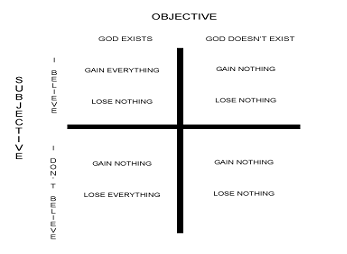
  • Adventures in Sainthood: Pascal’s Wager in Eric Rohmer’s My Night at Maud’s

    The film My Night at Maud’s is the third installment by Éric Rohmer in his 6-part Moral Tales series—one of his most popular films, made in 1969. It takes place in Clermont-Ferrand, the birthplace of Blaise Pascal, between Sunday, the 20th of December, and Sunday, the 27th of December.

    Like many of Rohmer’s films, this film is about a moral choice that its protagonist is facing. The protagonist of the film is an engineer, Jean-Louis, played by Jean-Louis Trintignant, who moves to Clermont-Ferrand to take a job with Michelin after living for a long time in Canada and South America. He is both a devout Catholic and an amateur mathematician, who works with probability problems in his spare time. His dilemma is whether he can remain faithful to Françoise, a beautiful young woman whom he notices on the last Sunday of Advent, at mass.

    Françoise, whose name he does not know yet, is standing next to him in church in an early scene of the film. After the mass, he tries to follow her, but is unsuccessful—she disappears on her scooter. He becomes obsessed with meeting her again and starts searching for her everywhere in Clermont-Ferrand. The next day he sees her passing him, on her scooter again, and has an epiphanic moment. The voice-over comments that “On that Monday, December the 21st, I suddenly knew, without a doubt, that Françoise would be my wife .”

    Later he runs into an old school friend, Vidal (played by Antoine Vitez), whom he hasn’t seen in many years. Vidal is now a philosophy professor at the local university. At Vidal’s instigation, they attend a concert. Jean-Louis agrees to come along because he hopes to meet Françoise (after Vidal tells him that pretty college girls attend these events). Then they go to midnight mass, this time at Jean-Louis’s suggestion. But Jean-Louis does not meet Françoise on either of these occasions. Finally, his friend invites him to visit a female friend of his, Maud, a recently divorced doctor. Jean-Louis is forewarned that she is a very beautiful, smart, and interesting woman, and that Vidal and she have had a brief affair, but things have not worked out. The three have dinner at Maud’s place.

    The atmosphere during the dinner is charged with sexual tension. It is obvious that both Vidal and Jean-Louis are attracted to Maud. The conversation turns to religion. Jean-Louis affirms his commitment to Catholicism, saying that he has not been chaste in the past, but neither has he been promiscuous, insofar that he has only had a few long-term relationships. He says that he is not a saint. But he will no longer succumb to temptation, because he is now converted and wants to meet and marry a Catholic woman. Vidal and Maud, who are both atheists and sexually liberated, start teasing him by saying that he must have already met this woman, because he has a dreamy look, as if he is already in love. Jean-Louis vehemently denies it.

    When it starts snowing, Maud begs Jean-Louis to stay, saying that it is too dangerous to drive to his distant suburb of Seyrat. Vidal leaves, and the protagonist ends up staying the night. The key moment of the film is the moment of temptation. It turns out that Maud does not have the spare bedroom she has promised him. He first tries to sleep in her armchair, then, at her invitation, lies down next to her in bed. At one point, it appears as if something is going to happen between the two, but he resists the temptation, pushing her away.

    The same morning he accidentally runs into Françoise and introduces himself, asking for a date to go to church on Sunday. The rest of the day, is spent with Maud, Vidal, and Vidal’s female friend. In a typical Rohmerian moment of moral ambiguity, Jean-Louis is shown flirting with Maud in a physically affectionate way and even kissing her, which makes his earlier act of renunciation less convincing. On his way home, he runs into Françoise again, and, ironically, ends up spending the night this time in one of the spare bedrooms of Françoise’s student house. She offers the spare room after he has given her a ride home, because his car gets skids and gets stuck on an ice patch. The situation is ironically reversed now. She seems to think that he wants to seduce her, as he walks into her room late at night, looking for matches. But that is not his intention.

    After this night, when Jean-Louis and Françoise start dating, he accidentally finds out that before she became his girlfriend, she had been the mistress of Maud’s husband. This means that she is not a perfect Catholic virgin he thought she was. It is Françoise herself who tells him she had had a lover who had broken up with her. He figures out who the lover was.

    Five years later, the protagonist and Françoise are married and have a young son. They accidentally run into Maud in a seaside resort. Françoise is tense, expecting him to reveal his knowledge of the affair. He withholds it and tells her instead that Maud had been his last fling before he met her, making it sound as if they had been lovers. In this ultimate gesture of generosity toward his wife, he attempts to make her feel better about her own sin by presenting himself to be a bigger sinner than he really is. Perhaps this is the real moral choice that he ends up making, which is more important than the earlier one of resisting temptation.

    This storyline is punctuated by the subtext of the philosophical debate about religion, resolution, temptation, luck, and, ultimately, the nature of faith. Most of the action in the film is constituted by conversations on philosophical topics. The central theme of these discussions is, in one way or another, the problem of choice. Jean-Louis’s imaginary counterpart is Blaise Pascal, known for his ascetic ways and the wager problem that he formulated. The wager refers to Pascal’s argument for believing in God.

    The argument takes the form of what in modern philosophy is called game theory. According to its pragmatic logic, we should wager that God exists because it is the best bet. If God does exist and you have bet on his existence (“betting on his existence” needs to be interpreted further: does it imply the mental state of faith or the choice to lead a Christian life?), you have won the lottery, that of an eternal life in Paradise. Another possibility is that God does not exist, but you have bet on his existence. You still lead a Christian life but do not get any reward in the end. In this case, you have not lost anything other than forgone possibly pleasurable but sinful experiences. Following the same logic, if God does not exist, and you have indeed bet on his non-existence, you would not have lost anything because there is nothing you would have done differently. However, if God does exist, but you have bet on his non-existence, that is to say you have led a sinful and unrepentant life, you have lost your very soul: you have lost everything. You are now sentenced to an eternal life of hell and damnation. From the point of view of game theory, which uses the logic of mathematical expectation or expected utility, it makes the most sense to err on the side of God than otherwise. The win, in the case you wager on God, is positive infinity. The loss, in the case of wagering against God, is negative infinity. The first choice is only rational.

    (http://james-a-watkins.hubpages.com/hub/Brief-Biography-of-Blaise-Pascal)

    The idea of wagering involves both calculation and contract—the former because you need to know the chances and mathematical expectations of various outcomes before you bet, and the latter because you need to ensure your wager’s binding nature. In the end, it must be honored by all participating sides, necessitating some kind of a presiding authority. Significantly, the themes of betting, statistical analysis, and moral accounting are foregrounded in the film. For example, one of Jean-Louis’s hobbies is mathematics, especially statistics. We see him at home, working on mathematical problems (involving the Pascalian binomial distribution and the calculation of mathematical expectation, according to the close-up of the pages). We also find him in a bookstore, leafing through books on statistics and theory of probability.

    Importantly also, the idea of Pascal’s wager has a concrete embodiment in Lean-Louis’s moral dilemma. After he first encounters Françoise, it is suggested (but not spelled out directly) that he makes a kind of wager with God (or forces of fate). He decides to stay faithful to her, even though it is very uncertain, at this point, that he might ever meet her again, let alone marry her. The reward in this bargain, presumably, is having the clear conscience of celibate integrity when he hopefully gives himself to her later. The irony of the situation is, of course, that Françoise, having just emerged from an affair with a married man, is not a pure Catholic virgin he has supposed her to be. But Jean-Louis turns this situation into another kind of transaction, telling Françoise that he is glad that she is not a virgin. Since he is not a virgin either, this makes them even.

    When he meets Vidal in a café for the first time in many years, he tells him that he likes to dabble in mathematics in his spare time. Statistics, of course, is central to the theme of Pascal’s wager, insofar as the latter is mathematically transcribable in a game-theory matrix of payoffs. But not only that. Vidal suggests that Pascal’s wager can and should be generalized as a philosophical problem, applicable to other areas of life—even for a Marxist like himself. As a Marxist, concerned with social justice and the transformation of society, he needs to believe that history has meaning, otherwise his life’s project becomes meaningless. He must choose between two hypotheses—one that society and politics are meaningless, and the other that history has meaning. Personally, he explains, the former makes much more sense to him. He ascribes to it the probability of 80%. Yet he must stake his life on the less probable hypothesis to justify his actions and choices, because the gain, to him, is infinite.

    But does the very idea of “wagering on God” present a conundrum? A belief that we are free to make choices, such as a choice against sinning or a choice to lead a moral life, implies a voluntarist perspective—a worldview that says that we are masters of our actions—which is a position not completely compatible with Pascal’s Jansenism. Jansenism was a religious movement during Pascal’s lifetime, originated by Cornelius Jansen, a Dutch theologian, which was later condemned as a heresy. Pascal subscribed to its tenets and is commonly viewed as a Jansenist. The adherents to this movement advocated a theology quite similar to Calvinism in several important respects. Among other things, they believed in a form of predestination and irresistible grace, which went together with their view of the total depravity of human nature. It is only divine grace that enables human beings to act morally: on their own, they cannot make morally-sanctioned choices. Jansenism was a semi-Protestant movement within Catholicism, insofar as its doctrine did not sanction belief in salvation through works and thus disavowed free will.

    Thus, on the one hand, we have Pascal advocating the doctrine of predestination and irresistible grace, which precludes free choice. On the other, we have him promoting a wager, which is a voluntarist act involving choice and free will. A question suggests itself: can we choose to believe in God? The very precondition of Pascal’s wager as a contract stipulates faith. We wager with God on God’s existence, while holding God as the underwriter of our transaction, which is problematic. It is also problematic to assign probabilities to the existence vs nonexistence of God, which would be assigning probability to hypotheticals. According to Jean-Louis, who thinks that Pascal’s wager is too mercantile (“what I don’t like about Pascal’s wager is its calculated exchange”), it only works if the probability of salvation is more than zero. It can be infinitesimally small, but it cannot be zero, because zero multiplied by any number is zero. But since an atheist cannot allow even the slightest possibility of God’s existence, the wager is not valid for him.

    But what if one believes that the possibility of God’s existence is more than zero? Is it then possible to choose faith as a state of mind? Or is the wager based on nothing more than the rationality of “calculated exchange”? Pascal seems to think faith is sure to follow. And the portal through which it will enter is simple: imitation. He therefore enjoins his reader in the Pensees to abandon reason and start performing rituals unthinkingly. As you start with mechanical actions, according to him, your thoughts will eventually follow, forming mental habits and gradually leading you to faith. Thus, in a bookstore, Jean-Louis opens Pascal’s Pensées and reads:

    You would like to attain faith, and do not know the way; you would like to cure yourself of unbelief, and ask the remedy for it. Learn of those who have been bound like you, and who now stake all their possessions. These are people who know the way which you would follow, and who are cured of an ill of which you would be cured. Follow the way by which they began; by acting as if they believed, taking the holy water, having masses said, etc. (gutenberg.org)

    Another question is whether we are capable of the very act of deliberate choice, that is to say of mastery over ourselves? It is not accidental that predestinarian doctrines also stress the underlying depravity of human nature. Can I choose to leave behind my sinful behavior and bad habits? According to Calvinism and Jansenism, human beings simply do not have the willpower to change and transform themselves unless assisted by irresistible grace. Pascal seems to be aware of this difficulty, as well. The quoted passage continues: “This will naturally make you believe and will stultify you . . . this way leads you to faith, let me tell you that it will lessen the passions which are your stumbling-blocks” (gutenberg.org). In other words, Pascal appears to be saying that passions can lead us astray. People who have no assurance of salvation can seek refuge in ascetic, anti-hedonist practices. They can only read indirect signs of their election, and they hope that one such sign is constituted by their virtuous behavior achieved through rigorous “warfare against the flesh.”

    In the film, this topic is raised at dinner. Ironically, Vidal, who is an atheist, likes Pascal, while religious Jean-Louis is put off by his asceticism. He explains that, having lived in Clermont-Ferrand, Pascal has certainly drunk its excellent Chanturgue wine, but, according to the memoirs of his sister, he never praised it, nor did he ever notice what he ate, unlike Jean-Louis himself, who loves good food and drink and, in general, enjoys both the sensual and intellectual dimensions of life. But even intellectual pursuits can be the devil’s snare, according to the extreme ascetic ethos of Jansenism. At the end of his life, Pascal, the great mathematician, rejected mathematics itself as yet another worldly temptation, a useless intellectual diversion that needlessly excites passions.

    And last but not least there is the question of whether we should, or can, choose at all. How is a wager possible within the constraints of a predestinarian doctrine? Must one choose? Why must one choose? Is the very notion of choice not a contradiction? Yet Pascal’s predestinarianism seems to convolute into a conviction that it is the wager itself that is not optional, not a choice. You cannot not choose, as he states in Pensees: “Yes; but you must wager. It is not optional. You are embarked. You are in the game. Which will you choose then?” Vidal quotes a similar passage: “If there are not infinite chances of losing compared to winning, do not hesitate. Stake it all. You are obliged to play. So renounce reason if you value your life.” The latter passage is reminiscent of God’s injunction to choose life, issued in Deuteronomy 30:19: “I call heaven and earth to record this day against you, that I have set before you life and death, blessing and cursing: therefore choose life, that both thou and thy seed may live.” In not being able or allowed to avoid choice, we cannot escape the givenness of our original spiritual condition. Our situation is such that we are always already launched into “the game” of moral choices and must therefore choose.

    Pascal’s philosophical formulation of choice underscores the very issue of whether Jean-Louis is capable or incapable of moral choice, which is central to the film. Jean-Louis himself would certainly like to avoid or postpone choice. At the very least, he would like to deny its enormity. As Maud needles him about his being a “shame-faced Christian” who refuses to take responsibility for his actions, he grows irritated. “I thought every Christian was to aspire to sainthood,” says Maud. Jean-Louis answers that he cannot be a saint. Not everyone could be a saint, and he is apparently among those who cannot aspire to sainthood. He acknowledges his spiritual mediocrity and his “halfheartedness,” qualifying it by saying, “I am a man of the times, and religion acknowledges the times.”

    Critics such as T. Jefferson Kline and Glen W. Norton have pointed out and debated the meaning of the visual effect of light behind Jean-Louis’s head as he is saying that he must have fallen into a snare of the devil, otherwise he would be a saint—adding that he cannot be a saint. Right before this admission, Jean-Louis is standing next to a painting of a glowing circle, which, in the idiom of religious iconography, reminds us of a halo over a saint’s head. But as the protagonist steps in front of the picture during his disavowal of sainthood, his head, instead of “filling” the empty halo, becomes misaligned with the source of light behind it. The halo does not “fit.” Whether this witty touch serves as an ironic underscoring of Jean-Louis’s failure at sainthood, according to the first critic, or a commentary on the paradoxical status of sainthood’s “impossible possibility” (25), according to the second one—in other words, whether it is ironic or in earnest, the misalignment does illuminate an underlying conflict of a double-bind character that every Christian has to face.

    As lived experience, moral choice is central to the daily struggle of a Christian. Jean-Louis, for example, likes women, and has had several extramarital, albeit long-term and monogamous, affairs. How then will he be judged? Has he forfeited his eternal life? To justify his life and his choices, he has articulated two self-serving theories. One of them is that a Christian is judged not on one deed but cumulatively, on his entire life, with its preponderance, hopefully, of the good over the bad. His other theory is the so called “predestination” of luck. God or fate have been easy on him, as he explains to Vidal and Maud, and later to Françoise. He never had to face a temptation that was strong enough and would lead to a more serious sin than sins of indulgence. Therefore his moral choices have not required too much effort from him so far.

    The various double-bind aspects of the wager encapsulate the paradoxical and transcendent nature of representation. An ultimate kind of wager is a wager with God himself, which is guaranteed by God and which challenges God, at the same time. It is a paradigm for all choice, because every act of decision takes place on the scene of representation vis-à-vis a symbolic central authority invested with transcendent attributes. Entering into this wager requires the mathematics of hope (mathematical expectation is l’espérance mathématique), negotiations of faith, and self-election into sainthood.

    The three aspects of a wager—mathematical expectation, faith, and self-mastery—can be represented by three mimetic triangles, where the position of the sacred apex is occupied, respectively, by God-the-lawgiver, God-the-judge, and God-the-superego. This is based on the triple nature of transcendence—a) the unreachable (evolved from detached cognition), b) the other (the theory of mind), and c) the center (joint attention) (see my article in Anthropoetics, 15, 2, “Three Gaps of Representation / Three Meanings of Transcendence”). While each triangle focuses on one specific type of transcendence, it incorporates all three types of transcendence, since all three are inextricably interrelated. This point is made by Heidegger in The Metaphysical Foundations of Logic, when he compares and contrasts theological vs. epistemological transcendence (which correspond to the unreachable and unknowable transcendences, respectively). Heidegger notes that the two types of transcendence cannot be considered separately. He explains that as soon as we resort to the idea of the Other (epistemological transcendence), it forces us to think of an Absolute Other (with the Absolute evoking the theological meaning of transcendence).

    Now both conceptions of transcendence, the epistemological and the theological, can be conjoined—something that has always happened and always recurs. For once the epistemological conception of transcendence is granted, whether expressly or implicitly, then a being is posited outside the subject, and it stands over against the latter. Among the beings posited opposite, however , is something which towers above everything, the cause of all. It is thus something over against [the subject] and something which transcends all conditioned beings over against [the subject]. (162)

    I will now develop Heidegger’s analysis further, extrapolating it to make a similar argument for the third transcendence, which differentiates the center from the periphery. The reason I am expressing the transcendent relationships as triangles is because the triangle is the minimal configuration representing participants on the scene of representation.

    Thus the first triangle expresses the first type of transcendence, that of detached cognition, which relates to calculation and reasoning based on causal chains. The rational aspect of Pascal’s wager involves the calculation of probabilities and mathematical expectations, which is connected to the first transcendence. Probabilities rely on stochastic laws. We cannot calculate a frequency of an event unless we can be assured of its regularity through some kind of a transcendent law. The central position in the triangle is occupied by God the lawgiver, who guarantees lawful regularities. The first position at the base of the triangle, that of Agent 1, represents myself, who needs to calculate probabilities, and who is also subject to lawful regularities. The second position represents the other, either human or a personified force of nature, who must also obey law in order to make it possible for me to calculate probabilities.

    This cooperative mode of behavior (Agent 1 and Agent 2 cooperating with the law-giving center) can be represented through an orchestra paradigm: the center is occupied by the conductor, while the various members of the orchestra collaborate with the act of musical performance from their peripheral positions. Even though the transcendence I am focusing on is that of detached cognition, the other senses of transcendence, as per Heidegger, are also invoked. For example, the differentiated nature of this configuration, where God-the-Lawgiver occupies the central position, comes from the third sense of transcendence, while the other, who has a mind of his own but who must, nonetheless, cooperate and obey the law, is conjured up by the second transcendence. It is only by invoking all three types of transcendence that the idea of the laws of nature could be articulated.

    The interaction of the three transcendences can be seen even more clearly when calculating probabilities. While deterministic laws of nature have to fire every single time, the stochastic laws are not equally reliable. If a certain action of mine does not guarantee a 100% certainty of success, making a decision in its favor involves the philosophical problem of counterfactuals with its paradoxical logic. If the plane I am on malfunctions and is hurtling toward the ground, would thinking about the statistical safety of air travel soothe me at that moment? What would it matter that my chance of arriving safely is 99.9%, as long as I fall in the remaining 0.1%? In some important respect, the domain of calculation and the domain of actual experience do not intersect.

    And yet I make real-life choices, deliberately selecting situations that are not 100% safe. What am I thinking? According to the above model, I personify the distribution of probabilities as the first triangle. High probability is personalized by me, interpreted as God who has taken my side and has subdued the other (a looming catastrophe?) to prevent him from interfering. I suggest that we tend to personify probabilities in this fashion whether or not we are animists, conventional believers, or atheists, and whether or not we do it consciously, semi-consciously, or unconsciously. Any risk-taking decision arrogates to itself the benevolent God’s protection and the compliance of other actors on the scene of representation. Even the language of probabilities reflects this optimistic belief that God is on our side. When we speak of mathematical expectation or mathematical hope, we no longer mean the indifferent law-giving God but a concerned, providential God.

    But the other side of God’s divine superintendence expresses the double bind, associated with this triangle, the double bind of freedom. Namely, if God governs the behavior of others, he must also be governing my own behavior. It is because God is in charge as the law-giver that it is possible for me to make future plans based on calculations, according to my capacity for detached cognition, and thus exercise my freedom. On the other hand, if I am also governed by divine law, then I am not a free agent, after all. Thus I am both free and not free.

    The second triangle foregrounds the second transcendence, which represents the mystery and the ultimately unknowable nature of another mind, amounting to the problematic of trust. The model of the wager can also be seen a representation of the problem of trust/faith, which is the linchpin of all kinds of exchanges and contracts. By taking up a wager, I enter into a free contract with another participant on the scene of the market. How can I be certain that the other participant will hold up his end of the bargain? Do I place my trust in him implicitly or must I secure a central authoritative figure as the adjudicator? What underwrites my conscience is God-the-adjudicator, who is at the head of the second triangle, which represents the contractual nature of the wager.

    But who is the second participant of this triangle? It is also God, with whom I conduct a wager. This dual role of God as both the judge and the participant testifies to the double-bind of faith, which has to do with an undecidability between faith as a performative act and faith as implicit trust. Placing my trust in the one with whom I conduct a transaction, as a limiting case of the exchange model, underscores the groundlessness of all grounding. Declaring my faith entails thus an oscillation between aligning myself with the center, which represents my conscience and is not in need of bargains, on the one hand, and fulfilling my part of the wager (a promise of good Christian conduct) on the periphery in deference to God-the-judge, on the other.

    As in the first case, the focus on the second transcendence admits the interaction with the other two types of transcendence. Firstly, in order to set up the conditions for a wager, some antecedent calculations need to be performed, which necessitate the thinking-ahead of detached cognition, the first type of transcendence. In addition, the idea of centrality has already been invoked, which is that of the third, mimetic type of transcendence. In itself, the theory of mind, which underlies the second transcendence, does not require a third, mediating, member. But as soon as one posits two subjects opposite each other, the adjudicating center is brought into being.

    The same reasoning holds for the third mimetic triangle, which focuses on the act of self-mastery—the ability to give up sensual pleasures and take control of amorous impulses in order to choose the life of a saint. To represent the dilemma of self-mastery, I choose Freud’s conceptualization of consciousness divided into the three compartments of the ego, id, and superego, because it seems to me a very apt representation of the problematic of self-mastery. The id is the animal part of us, which demands immediate satisfaction. The superego is the moral aspect of the psyche, which personifies societal prohibitions. It is the seat of moral consciousness, which prohibits satisfaction. The ego is the “self” of the subject, which is caught between the desires and constraints created by the id and superego.

    Insofar as the ego employs the so-called “reality principle” in order to calculate the best ways of satisfying the id’s desires without committing grave social transgressions that would affront the superego, it avails itself of the first transcendence, because it is the first transcendence that deals with calculations and advanced planning. And insofar as it divides itself into three “persons” that are involved in negotiations and conflicts, it can be said to resort to the second transcendence, that which is invoked to describe our dealings with individual, unpredictable consciousnesses.

    The paradox that this configuration embodies is that of the double-bind of mastery. What this refers to is the fact that the self cannot represent itself as fully masterful. If the ego takes the upper hand over the id, it is the superego, which emerges victorious, as the faculty which forced the ego to suppress the id’s desires. In the opposite case, when the id succeeds in pushing through its demands, it is the ego again that fails in its exercise of control.

    In the last analysis, the superego is the place-holder for the voice of conscience, which calls us to choose faith. (In Heidegger, the faculty of summoning is also integrated into his analysis of subjectivity. The connotations of passivity and submissiveness in the word subject have arisen out of this interactive aspect of consciousness. Subjecthood, in other words, involves being subject to an occasional call of conscience which enjoins the self to engage in authentic action). Responding to the call to faith voluntarily, in a mood of agreeable inclination, almost anticipating it before it is issued, is a gesture of sovereignty and self-ownership. Such a response constitutes a genuine action—an act of accession to the center in the self-elected role of saint.

    The three mimetic triangles combine, separate, and superimpose over each other, creating the contradictory configurations of action vs. suspension of action, inclusion vs. exclusion, trust vs. mistrust, free will vs. constraint, reluctance vs. compulsion of choice, etc., all of which epitomize the problematic of wagering and are explained by the originary paradox of the sign, expressive of the fundamentally untenable situation of human desire being structurally predicated on its impossibility of realization.

    The oscillation between an imaginary prolongation of the acquisitive gesture toward the central object and the desisting gesture of recoil from the sacred center or “the oscillation between the contemplation of the referent as formally designated by the sign . . . and the imaginary contemplation of the referent alone as content” creates the paradoxical structure of the sign which lies at the heart of representation.

    The back-and-forth movement gives rise to the phenomenon of dual perception that differentiates between two states. I would like to refer to these two states as acquisitive vs. reverential. In the reverential state, all participants on the scene of representation step away from the central object in the spirit of veneration that recognizes its sacred status. This state expresses the collective consciousness of the originary scene. In the acquisitive frame of mind, the participant perceives the distance between himself and the center as theoretically breachable and can imagine himself acceding to it. The other participant on the scene has become his rival, and the original participant envisions himself as excluded from the scene by an imaginary collusion between his rival and the center, similarly to the way Cain felt excluded by a perceived fellowship between Abel and God.

    In My Night at Maud’s, this oscillation is captured by the theme of proper vs. improper centering. The improper centering is created by the mimetic triangle between Maud, Vidal, and Jean-Louis. Even though Jean-Louis resolves that he will find and marry Françoise, who is still a stranger at this point, he almost succumbs to the temptation of becoming intimate with Maud. From the very start, there is a certain suggestiveness to their introduction. By adumbrating Jean-Louis and Maud’s meeting in the way he does, Vidal plants a seed of anticipation in his friend’s head. He stops just short of suggesting that something might happen between these two. But after he notices that she is flirting with Jean-Louis, he appears to have had a change of heart, becoming himself flirtatious with her and acting in an affectionately physical way. Jean-Louis and Vidal’s triangular attention is focused on Maud as an improper center.

    The key detail is that Maud does not have a separate bedroom. She sleeps in her living-room, and her bed is prominently displayed there. At some point late in the evening, Maud says that she is tired but not sleepy, and would like to go to bed, but would also like the men to stay and chat with her, so pretending this to be a “salon from the olden days.”

    She leaves and comes back, dressed in an ostensibly simple but sexily short nightgown, and climbs into her bed. Her bed thus becomes a center stage on which the desiring gazes of the protagonists have converged—an improper center stage, insofar as it performs an illegitimate inversion between private and public spaces. The bed, an intimate piece of furniture, with its occupant wearing an intimate article of clothing, do not belong in the living room.

    This scene is later mirrored by a symmetrical scene in which the protagonist walks into Françoise’s bedroom. Françoise’s posture, facial expression, and even the glimpse of her fussy nightgown leave no doubt that, in this case, he has intruded into a deeply private space.

    It is the impropriety of Maud’s bed as the center that has created the momentum of mimetic contagion. Vidal grows sullen and starts drinking, and finally leaves abruptly. He seemingly jokingly pushes Jean-Louis back into an armchair and orders him to stay, as if usurping the central God-like position of throwing the other two together.

    Maud’s interpretation of his taking leave is that it was “pure bravado.” According to her spin on things, she is the one who has rejected Vidal, who had been in love with her. As she is talking about his rival, Jean-Louis, who has a moment ago been trying to convince her of his conversion to celibacy, gets up from his seat and sits on her bed. As he responds, he is leaning toward her and speaking in a very seductive way. She stops him by switching the conversation to a more impersonal topic.

    In the end, Jean-Louis crosses over the barrier to the mimetic center when he accepts Maud’s invitation to sleep next to her. In the scene that is reproduced on some posters and DVD covers of the film, Jean-Louis is depicted lying next to Maud in bed. Jean-Louis wraps himself pointedly in an individual blanket and tries to face away from Maud. Yet on awakening, he almost succumbs to temptation.

    An almost complete inversion of this scheme occurs in the church scene with Françoise. After the protagonist spends the night in Françoise’s otherwise deserted dormitory, she realizes that she has not mistaken herself in trusting this complete stranger. In the morning, she is almost giddy with happiness. Jean-Louis has passed the test in her eyes. This is the first Sunday after Christmas, and they go to church together. Now we have the third, and the most important, church scene in the film. In each scene, we are shown the same priest, perfectly centered. This is especially apparent in the first scene, when we are shown the priest conducting the ritual of the sacrament while being in the perfect center not just of the film frame but of the whole interior architectural ensemble, where he appears properly in his place, properly centered and thus invested with the proper authority of God’s representative that induces respectful distance from the congregation.

    In the final church scene, we just see a close-up of him (also centered) giving a sermon on being called to sainthood. Both Jean-Louis and Françoise are in a state of rapt attention. They are listening not as two separate people but in an attuned awareness of each other. Their body language reproduces the scene of joint attention, the third-order attention that is one of the most important evolutionary milestones on the way to language. It is this reciprocal attention that lays the foundation for the verticality of language (allowing the participant to switch attention between the other participant and the central object) and the differentiation between the center and the periphery. Jean-Louis and Françoise seem to communicate through subtle body-language cues. In a complete reversal of the bed scene, it is the priest now who is in the middle, with the two protagonists on the periphery, and, instead of being turned away from each other, they are slightly turned toward each other, listening to the priest as one unit.

    What is the significance of the final sermon? The priest says: Christianity is not a moral code. It is a way of life, which is an adventure in sanctity. The sermon functions as an invitation—an invitation to be admitted to the center, by becoming a saint. It is an invitation that cannot be refused. The priest calls this path “a linking, a progression” that carries one along to holiness. But this progression is not the same as the progression of a mimetic contagion. It is the irresistible progression of faith, the irresistible working of grace. And the admittance to the center is not effected through an acquisitive gesture that excludes the other and obliterates the difference between center and periphery. It is brought about via an act of absolute inclusion that René Girard describes as an act of Imitatio Christi—imitating Christ not so much in the sense of imitating his good works but rather in the sense of imitating his non-acquisitive desire to resemble God the Father. This act of inclusion both preserves the worshipful distance to the sacred center and, paradoxically, invites the faithful to accede to it.

    My claim is that the undeclinable and irresistible invitation to become a saint is a way out of the wager’s economy of calculation (as quoted above, what Jean-Louis does not like about Pascal’s wager is its economy of exchange) into sainthood’s logic of singularity. Despite denying Maud’s earlier claim that “every Christian is to aspire to sainthood,” Jean-Louis is not fully honest with himself. It is his fear and reluctance that are speaking. His friends too challenge him on his small prevarications. “You stake nothing, you give up nothing,” as Vidal chides Jean-Louis. Jean-Louis postpones and delays because becoming a saint is an act of sheer audacity. Even the priest says that one has to be insane to choose this path.

    In linguistic terms, it is the audacity of arrogating the subject position, of speaking the “I.” It is only the subject that can tell a truly original narrative, breaking free of the mimetic economy of contagion. Staying on the periphery leaves one forever entangled in imitating already existing narratives. One of the striking images of this film, returning under several guises, is that of pursuing the path of desire and not being able to stop. In one of the striking early scenes, Jean-Louis is shown chasing Françoise in his car through the narrow winding streets of Clermont-Ferrand as she weaves through traffic on her scooter and eventually disappears. A similar idea is evoked by recurring allusions to slippery roads and losing control while driving, such as when Maud asks Jean-Louis to stay. A relevant and fascinating sequence in this respect is the one where Jean-Louis is looking for matches in the spare dormitory room of Françoise’s house where he has been placed. He really must smoke, but the matches are in Françoise’s room. He does not speak, but the viewer can literally read his thoughts, which are almost palpable, in the way he hesitantly approaches her room. “If I knock on her door, she will think that I have some designs on her. She will become scared, thinking that she has made a mistake, inviting a complete stranger to sleep under her roof. And yet I really want to smoke.” This I find to be an especially vivid example of how anticipations are formed mimetically out of a finite repertoire of already familiar narratives.

    In contrast to that, only someone in the position of a saint can tell a truly new narrative. Genuine newness, according to the priest, is the real meaning of Christmas. In the sermon that he gives on Christmas eve, he tells his congregation that the joy he wishes them is the joy of newness. It is not the nostalgic joy of childhood memories or pious adherence to traditions. It is a celebration of new beginnings, a celebration not only of the birth of Christ but of our own rebirth. When in his last sermon, the priest refers to Christian life as an adventure, he means a truly new adventure, not one constructed according to old models but one that has never been told before. Becoming a saint involves the self-confidence of daring to tell a narrative for the very first time, but also a vulnerability of exposing yourself to the position of a scapegoat.

    The final episode of the film proves that Jean-Louis has taken the priest’s sermon to heart. His allowing Françoise to think the worst about himself and Maud in order to make her feel less guilty is an act of true meekness, modeling itself on the lamb who takes away the sins of the world—the ultimate sacrificial position.

    The centering of the subject position is achieved through a self-grounding narrative. In Rohmer’s film, this grounding is effected through the device of epiphany. In one of the early scenes, the protagonist tells us that he has just had a sudden insight about marrying Françoise. Yet at this moment he does not yet know the name of the woman he has fallen in love with. This signals to the viewer that the scene should be viewed from the perspective of the narrative past. The narrator already knows what has taken place. But his alter-ego hasn’t lived through this yet. It is clear that the epiphanic realization is a narrative post-construction. But this is exactly how epiphanies ground choice. They are convoluted paradoxical structures that set up the dual perspective of prospective and retroactive movement. (See my article, “The Limit of Explanation: Following the “Why” to its Epistemological Terminus,” Anthropoetics 10, 1.) A possibility is materialized by converging the past and the future into one point and presenting it as something that has already happened. If something has already happened then the possibility under consideration was the only viable possibility to begin with.

    But there is a visual aspect to this epiphany that acts at cross purposes with the semantic one. The narrative voice says “On that Monday, December the 21st, I suddenly knew, without a doubt, that Françoise would be my wife.” “Suddenly, without a doubt” is the rendering of the French “brusque, precis, definitive,”—words that clearly mark a specific moment. Yet nothing is happening visually to punctuate the meaning of the voice-over narrative. The camera is showing us the nondescript view of a curb as Jean-Louis’s car speeds along a dark street. It is only the next second that Françoise’s scooter appears suddenly alongside it. The visual misalignment, reminiscent of the other ironical misalignment—that of Jean-Louis’s head and the halo—subverts the authoritative status of the epiphany, reminding us that it is perhaps impossible, after all, to arrogate to oneself the center.

    Works Cited

    Bedouelle, Guy. “Eric Rohmer on Nature and Grace.” New Blackfriars. 74.872 (June 1993): 301–306. Print.

    Ennis, Tom. “Textual Interplay: The Case of Rohmer’s Ma nuit chez Maud and Conte d’hiver.” French Cultural Studies 7 (1996): 309-319. Print.

    Freud, Sigmund. On Metapsychology: The Theory of Psychoanalysis. Vol. 11. Penguin Books, 1964. Print.

    Gans, Eric. The End of Culture: Toward a Generative Anthropology. Berkeley, Los Angeles, London: University of California Press, 1985. Print.

    —. Originary Thinking: Elements of Generative Anthropology. Stanford, California: Stanford University Press, 1993. Print.

    —. Signs of Paradox: Irony, Resentment, and Other Mimetic Structures. Stanford, California: Stanford University Press, 1997. Print.

    —. The Scenic Imagination: Originary Thinking from Hobbes to the Present Day. Stanford, California: Stanford California Press, 2008. Print.

    Girard, René. Deceit, Desire, and the Novel. Trans. Yvonne Freccero. Baltimore: John Hopkins University Press, 1965. Print.

    —. I See Satan Fall Like Lightning. Trans. James G. Williams. Maryknoll, New York: Orbis Books, 2001. Print.

    Heidegger, Martin. Being and Time. Trans. Joan Stambaugh. Albany: State University of New York Press, 1996. Print.

    —. The Metaphysical Foundations of Logic. Trans. Michael Heim. Bloomington: Indiana University Press, 1992. Print.

    Kline, T. Jefferson. Screening the Text: Intertextuality in New Wave French Cinema. Baltimore and London: The Johns Hopkins UP, 1992. Print.

    Lai, Wai-ting, Thomas. “Wagering Love between Desire and Discipline : A Study of Sexual Power in Eric Rohmer’s Six Moral Tales.” The HKU Scholars Hub. 2011. The University of Hong Kong. Web. 10 Apr. 2012.   href=”http://hdl.handle.net/10722/144143″>http://hdl.handle.net/10722/144143

    Ludwigs, Marina. “The Limit of Explanation: Following the “Why” to its Epistemological Terminus.” Anthropoetics 10.1 (2004): n. pag. Web. 10 Apr. 2012. https://anthropoetics.org/journal/ap-vol-10/ap1001/explanation/

    Ludwigs, Marina. “Three Gaps of Representation / Three Meanings of Transcendence.” Anthropoetics 15.2 (2010): n. pag. Web. 10 Apr. 2012. https://anthropoetics.org/journal/ap-vol-15/ap1502/1502ludwigs/

    Norton, Glen, W. “Moral Perfectionism in Eric Rohmer’s Ma nuit chez Maud.” Studies in French Cinema. 9.1 (2009): 25-36. Print.

  • Nim and Nothingness

    Out of nostalgia the other day I ordered from Netflix a documentary (Project Nim) about Nim Chimpski, the sign-language chimp that some starry-eyed 70s researchers tried to bring up as a human child. At the time Nim was learning sign language, there were several other chimps (Washoe, Lana) being taught human language in various modes, the presumption being that aside from an inadequate vocal tract, chimps could in principle learn to communicate in language as well as children at some level, if not on a par with human adults. Nim was one of the more interesting cases, since ASL is much more natural for a chimp than pressing buttons on a language board, as Kanzi, one of his fellows, had been trained to do.

    The documentary was, like most such films, excruciating; full of pseudo-dramatic “movie music” and constantly inserting photos of people and events to “illustrate” the narration.

    I’ll spare the reader the irrelevant nonsense about how different women in the project either slept with male participants or became “maternally” possessive of the young chimp, as well as the obligatory expressions of human guilt for inflicting unnatural constraints on a non-human creature. Whatever his travails, Nim, who lived well into his twenties, was a lot better off than most animals we make use of. But the question of what we must call Nim’s moral development is not irrelevant. At a certain point, after he bit a woman’s cheek all the way through and smashed someone’s dog against a wall, it was decided to end the experiment. Which did not prevent the film from closing in true hippie style, with the last words telling us that chimps were wonderful creatures and “very forgiving,” meaning no doubt that Nim “forgave” his minders for returning him to an animal compound (from which he was eventually “rescued”) rather than letting him bite their cheeks and worse ad infinitum.

    Nevertheless, for the purposes of this Chronicle, the documentary contained one precious moment. This was when the Columbia professor (Herbert Terrace) who had initiated the experiment, having been asked whether Nim had really learned language, admitted that “he learned how to beg.” That is, Nim had learned lots of signs for things, but he only used them to obtain those things; his syntax, in a word, never got past the imperative. Teach him the sign for “banana,” and he would use it to get a banana. Although the film never raised the issue, I was struck by the clear parallel between Nim’s inability to construct declarative sentences and his more dangerous inability to acquire a moral sense. Although far more intelligent than a dog, he couldn’t learn the inhibitions that the dog has inherited in the process of domestication. What the dog could “learn” of human morality through Darwinian selection while remaining an animal, the chimp could not learn the way a human would learn it. Which is why, as the professor informed us, chimps can’t be kept as pets past the age of five or so without risking one’s life. This lesson still has to be learned every once in a while by someone who thinks our 99%-common DNA permits humans and chimps to become friends.


    One point made strongly by Terrence Deacon, among others, is that human language is not derived from animal calls; the two systems are unrelated. Humans too have “calls,” such as weeping and laughter, that are unrelated to articulated language. To clarify this distinction, Deacon makes use of the Piercean categories of indexical and symbolic signs. An indexical sign is one that is a trace of the experience that prompts it, say, a footprint or an involuntary sound, whereas a symbolic sign is emitted intentionally for the purpose of communication. No doubt when we have complex inherited signal systems such as those of the often-studied vervet monkey, this distinction becomes a bit muddled. From the standpoint of evolutionary fitness, we may say that the “purpose” of the vervet signals is to facilitate communication among the monkeys concerning dangers and opportunities in their environment. But there remains nonetheless an essential difference between being informed concerning a major danger or food source by hearing (1) articulated human language or (2) screaming, even if both may provoke similar action on our part. In terms of Deacon’s analysis, vervet signals are analogous to screaming (albeit with a variety of different screams for different circumstances) rather than to human speech.

    But an additional complication arises when we teach a chimpanzee to use the signs of human language. Everyone knows that chimps on their own do not develop symbolic communication. But the temptation of the language-to-chimp researchers was enhanced by the ambiguity between the use of human-taught symbols and their symbolic use. Teaching a chimp a “word” of ASL, something that chimps would never invent for themselves, leaves open the question of whether one has crossed the threshold of symbolic communication.

    A gesture of sign language, or an articulated word, for that matter, is not a “symbol” in itself, but only in the Saussurean framework of other signs. But even this is not the real crux of human language. I will venture to say that only GA has understood what human language is, and understood that its “symbolic” or “arbitrary” nature is not of the essence, but is rather a consequence of the real fundamental quality of language. This, ironically enough, Jean-Paul Sartre, who never had anything to say about language except that prose was “transparent” and poetry was “opaque,” understood better than all the linguists. Language, representation, or simply: the human, discovers/creates a néant (“nothingness”) of freedom that separates us from the world we intend, and which we freely intend in a way that animals cannot because they lack this space. It is in effect a collective space, a scene of representation that we share with the other speakers of the language, and which was inaugurated in the hypothetical originary event.

    Thus Nim’s ability to acquire a vocabulary of a few dozen signs, which no doubt gives proof of a great deal of intelligence, cannot in itself establish his use of symbolic, that is, human language. However well he learns to “beg,” he will never learn to form (declarative) sentences because he will never possess the human néant in which the free articulation of language takes place. This doesn’t mean that a chimp, or a far less advanced creature, is incapable of “free play,” the fanciful triggering of routines as a result of who knows exactly what random inputs. But a playful reaction to one’s environment, in which one is not immediately engaged in activities such as eating or sex that are directly involved in individual or species survival, is not the equivalent of, nor indeed in any way connected to, the intentional formation of representations, any more than animal language is directly connected to human language.

    Readers of The Origin of Language will recall that the declarative is far from the originary form of language. Thus you might ask whether the chimp’s “imperative” use of language doesn’t put him at the same stage as early human language users who had not yet developed the declarative. The answer is no, because these early users had no one but themselves to teach them language, and they could learn it only by understanding the originary sign as a mode of deferral, of separation from the indexical gestures of appropriation that they would normally make toward a desirable object. Human language is informed by this deferral even when it is used imperatively. But when we short-circuit the procedure and teach the chimp our signs, we do not and cannot teach him the deferral that goes with them.

    The originary history of language will probably never be known, but I would assume that if the first sign is the “Name-of-God,” then early ostensives and imperatives were sacred uses of language, and the declarative represented a potential secularization of language—potential but not necessarily immediately implemented as such. This entire history is bypassed when teaching a chimp to point to things via the signs of ASL. And no doubt in addition to “begging,” Nim could use language “playfully” to refer to objects either desired or in his environment. But my assumption about the declarative is not that we needed new mental circuits to construct this form, but that it was a product of what I called the lowering of the threshold of significance, that is, a social rather than an individual phenomenon. And certainly the society surrounding Nim was open to declarative sentences, and efforts were made to teach him, not so much the syntax as the idea of the declarative—an “objective” statement about the world, not immediately relevant to his needs. Nim could say banana, perhaps even green banana in the orchard, but not the green banana is in the orchard (but don’t take this as a command to bring it to me). In other words, Nim couldn’t say the cat is on the mat.

    Animals do not have “intentions” in our sense because they lack the néant of an internal scene of representation on which to formulate them. The mystery of “free will” is simply the mystery of language. We don’t need quantum theory to demonstrate that the existence of a scene of language allows us a supplementary layer of detachment from “instinctive” reaction to reality. Whatever ultimately “determines” our action is irrelevant, except to the extent that under controlled circumstances we may possess the ability to specify and manipulate these determinants. The real question of free will refers to our responsibility for our acts, and the moral notion of responsibility, which derives fairly directly from the moral model instituted at the originary event, is itself a highly determining factor (what Freud called the superego) in our behavior. It is a particularly silly fallacy to assume that our actions are “determined” in such a way that whether or not we know that we will be held responsible for them will not affect this “determination.” After all, this knowledge is itself an objective fact, detectable in our neurons as well as anything else, and of undoubted influence on our actions.

    Which leads us back to Nim’s propensity to injure his keepers, which he shares with all chimps, although the less dominant ones—those whose physical force is less than that of their fellows and who therefore learn to defer to others’ dominance—are less aggressive. Humans too learn dominance patters, and the life stories of gangsters are full of assertions of dominance, but this is not the specific feature of human morality, and in well policed communities—the ones that work—such dominance, which has come to be stigmatized as bullying— is not permitted to operate unchecked. The fact that a human environment of gentle caring could not prevent Nim from engaging in violent, destructive episodes for which any notion of “guilt” would be a wholly anthropomorphic attribution is, I think, an exact parallel to his inability to learn to use human language as something other than a sophisticated version of an animal signal system. The scene of representation, the néant, is the same in both cases, and its absence had the same results in both cases.


    Let me close with a reflection on another matter. A few Chronicles ago, I complained about GA’s “obscurity,” and Matthew Taylor rightly reproached me with what he was too polite to call whining. Whining about not being read is something writers should keep within the family circle. But I don’t think this admonition altogether exhausts the problem. The utter invisibility of GA’s ideas is something we, if not the world at large, must take very seriously. For in order to justify continuing to operate in the GA framework despite this invisibility, we are obliged to hold that the current intellectual universe that ignores our existence reflects a doxa whose narrowness is of universal concern.

    What then is the relationship between this, let us call it, intellectual decadence, and the other signs of the “decline of the West” remarked on by writers such as Mark Steyn or Victor Davis Hanson, critics of Western oikophobia? Above all, is this trend reversible, and can GA do anything to reverse it? Steyn, for example, is a highly successful writer and pundit who certainly needs no help from us in publicizing his ideas. But to the extent that we accept Steyn’s analyses, we imply that their ultimate ground is to be found in our anthropology. And indeed, the human-centered ethic of GA tends to confirm Steyn’s intuitions concerning, for example, the necessity that societies reproduce themselves and make it their duty to transmit their patrimony to the next generation rather than conceiving the purpose of life as hedonistic self-indulgence, as do all those Europeans, and not a few Americans, who see retirement at 55 as the ultimate criterion of the Good Life (unless, like Greek hairdressers, their participation in “hazardous” activities mandates retirement at 50).

    I would challenge any evolutionary psychologist or anyone else to provide a more parsimonious explanation for Nim’s non-human limitations than what I have given here. Whatever we think about “animal rights,” GA is a theory of human self-respect. Today this self-respect, as Girard has sharply observed, is, as the ironic triumph of Judeo-Christianity’s fundamental principle, wholly focused on the defense of “victims.” So the question posed to our most advanced societies is whether the historical evolution of human self-respect is destined to lead to the abandonment of all respect for the firstness by means of which the human has progressed to its present stage. If all that matters are “victims,” that is, those who are somehow handicapped by not being in the 1%, then only the kind of blatant hypocrisy—sustainable for how long?—by which we accept the benefits of firstness in reality while denouncing them in principle—driving cars while condemning pipelines and fracking—can protect humanity from self-destruction. GA’s strength is that it provides us with a reason, to paraphrase Robert Frost, to take our own side in an argument. I think even Mark Steyn could use a little support on this point.


  • Humanism and Paradox

    Let me begin by making a central distinction between two modes of theoretical discourse about the world that supplement the “practical” uses of language. (The latter are essentially, as in Wittgenstein’s Philosophical Investigations, ways of getting others to cooperate in various enterprises, “language games” based on the imperative rather than the declarative.) These two modes are the scientific, on the one hand, and what I will call originary thinking on the other. We all know what empirical science is, well enough in any case to dispense with an elaborate discussion here. But originary thinking, which I used in the past as a synonym for GA, deserves I think to be used more broadly to encompass all discourses that in one way or another take into account the origin of the human in the fundamental paradox of signification, the fact that in the human sphere, meanings are undecidably prior to and posterior to the use of the sign that points to them. In the event postulated by the originary hypothesis, an aborted gesture of appropriation becomes the “name of God,” postulating the prior existence of the sacred power that unites the new community in the deferral of appropriative violence. The dichotomy thus created remains amazingly, or simply necessarily, unresolved today, in the era of evolutionary psychology and neuroscience and books entitled God is Not Great—that between God creates man and Man creates God.

    I repurposed the term originary thinking in order to emphasize the close relationship between its two chief modes. The first is religious discourse, which explicitly describes and attempts to explain human origin—which I would claim to be this discourse’s fundamental purpose, if we extend the notion of origin to encompass that of originary essence. The second is the category of non-religious or “secular” thought that I would call humanistic, which includes GA and related writings such as Girard’s, as well as the more traditional discourse of philosophy. Related to this is the non-discursive world of art, whose representations are not exactly “thinking,” but which in my overall perspective is definitely originary. Thus what distinguishes humanistic from scientific, even “social-scientific” thought, while at the same time bringing it closer to religious discourse and art, is that the former, but not the latter, cannot avoid the derangement/enrichment to logical thought posed by the fundamental paradox of signification.

    I apologize for the vagueness of these formulations. But however much we attempt to do better, clearly the problem of formulation is one with the problem itself, which given the nature of the latter is hardly surprising. Indeed, to take a step further, it is this impossibility of arriving at an unambiguous and universally acceptable formulation of the originary paradox that is at the root of the pseudo-debate between “atheism” and “belief” as well as of the divide between “the two cultures” that the scientists always seem to be winning but never really make progress in, let alone religious wars and all the rest.

    The trouble with originary paradox is that it’s “turtles all the way down”: that there is no solid ground upon which the problem can be seen to emerge. But this doesn’t mean that no progress is possible. Once we accept that a definitive “solution” along the lines of natural science is inconceivable, our goal for a theory of human origin becomes to minimize its presuppositions in the spirit of Ockham’s razor. Given the essentially communal and scene-based nature of human culture, this minimalism obliges us to conceive the origin of humanity and of language as a scenic event rather than an indefinite chronological series. One way of expressing the paradox is as the indecidability between the first event of language and the process within which it emerges: how can we speak of a “first event” of language? Yet if we simply deny the paradox and opt for Darwinian gradualism, where the impossibility of imagining the transition between animal and human is finessed by turning it into the race between Achilles and the Tortoise and assuming that by “passing to infinity” the one will catch up to the other, we fall out of the human domain of “culture” or humanism into the world of natural science.

    One of the difficulties of humanistic thinking is that its traditional rational mode, that of philosophy or metaphysics, is founded on its claim to have expelled the paradoxical nature of events of meaning such as are found in religious or poetic discourse to the benefit of the declarative propositions of which the language of natural science would later come to be composed. “Secular” humanistic thought emerges in opposition to religious dogma, which founds the event-nature of the human on “supernatural” forces. But if we would retain the possibility of rational humanistic thought as opposed to an open appeal to religious revelation or ostensivity, yet not fall into the Quixotic imposition of the language of natural science on human affairs, we need a new way of thinking that accepts human paradox, but on the condition of seeking to minimize it.


    I recently completed a monograph on the relationship between the thought of René Girard and GA for Imitatio, the Girardian foundation created by Peter Thiel, and found myself seeking a firmer basis for my contention that although Girard likes to label his thought “scientific,” it isn’t really any more so than my own. I think Girard is justified in claiming that despite his frequent rhetorical concessions to dogmatic religious belief, his thought is not simply or even essentially religious, that he has indeed taken the key step of demonstrating that religious discourse, particularly that of the Bible, is a source of anthropological understanding. But Girard’s analyses are not those of the “social science” or science humaine of anthropology. His is a humanistic anthropology, a rational form of originary thinking that finds in religious texts the models of human self-understanding–in fact, a kind of preliminary form of GA.

    The human is not removable or even bracketable from language. When the philosopher constructs a chain of reasoning he takes the prior existence of human language for granted, as requiring no theory to explain its origin. He takes on faith that language is a neutral tool whose employment can be made “context-free” and in particular freed from the human context of its origin. This assertion of the essential non-paradoxicality of the proposition is the basis of metaphysics, which sacrifices a theory of human origin for the advantages conferred by the construction of a rational system (whose paradoxes can be treated as anomalies).

    Although Girard is not one to call his thinking paradoxical, in contrast to the propositional models of metaphysics, the emissary murder that Girard sees as the originary operation-event of our species is indeed presented in paradoxical terms, although not in the more precise manner that reference to signification makes possible. Girard finds evidence of scenes of mob execution or lynching mostly in myths, with gestures to the ethnographic literature and the shadowy history of the pharmakon. The “paradoxical” role of the victim as the bringer of both violence and peace, as therefore the object of highly ambivalent emotions, is precisely Girard’s point of emphasis. This is the origin of the sacred, which is in his view nothing but human violence that, once expelled from the community, now serves to protect it from itself.

    Girard’s paradox is in fact dependent on signs, for at the limit the change from bad to good, from bringer of plague to bringer of peace, is possible only if the group possesses a collective sign of the victim/god that it can refer to in both cases. For the murder itself does not suffice to fulfill Girard’s scenario, whose key moment is in fact reference to the victim (“the first non-instinctual attention”) after the murder, which means, in effect, after the victim as a recognizable human being has disappeared. But Girard’s exposition is unconcerned with whether the sacred in the end attaches to a memory, to the remains of the victim, or to the place where the event occurred. His is indeed a kind of minimal semiotic, but one more instinctive than self-aware.

    For if the participants in the murder experience a paradoxical state, Girard himself does not; his description of the murder situation is unambiguous and purportedly supported by unlimited quantities of evidence. The victim is blamed for the crisis, then worshiped for having ended it, when in fact it was the mob that, acting in méconnaissance, discharged its aggression on an arbitrarily chosen scapegoat. What ultimately permits the discovery of this arbitrariness is the culmination of biblical victimary revelation in the Crucifixion, which demonstrates the essential non-guilt of the emissary victim and the consequent méconnaissance of the murderers.

    In a typical emissary murder, the victim is in principle no more innocent than the others, even if he is no more guilty either. The very question of innocence and guilt isn’t raised; he is somehow made responsible, and this makes him the unique source of significance. The originary binary distinction that founds the meaning of human representation is based on the focusing of violence, which in the absence of prior moral laws is arbitrary without being “evil,” although it can be judged as such retrospectively in the light of the self-reflection it begins.

    Jesus, in contrast, as the revealer of this moral judgment, is chosen as victim precisely as a result of his revelation. His non-complicity in mimetic violence allows him to understand from without this violence and its central role in the formation of human institutions. His choice as victim consequently reveals the essential link between the creation of human meaning and not merely the denial but the murder of a prior always-already existing truth, that of the logos. It is this “always already” in all its paradoxicality that guarantees Girard’s discourse, whose rationality is not compatible with the sober literalism of “social science.” For the latter, the equivalent of the “always already” is its simple incapability, not merely of discovering the “missing link” between animal and human, but of formulating what would be required for such a link to be “discovered.”

    The simplest way to put this is no doubt to refer to the first words of John: In the beginning was the Logos. The origin of (human) language is the originary mystery of the universe, the moment at which humanity invents/discovers a new dimension that separates it from the merely natural. Postulating the existence of language from “the beginning” is in one way or another the formula for all humanistic thinking, even if there is a real difference in self-awareness between its mere postulation and its formulation as an originary hypothesis.


    Clearly religion is paradoxical; its sharpest thinkers, such as Pascal or Augustine, often formulate their ideas in overtly paradoxical terms. What else is the “supernatural” than paradox? What does it mean to speak of a “supernatural” being? It can’t simply be a special kind of being that obeys different rules from other objects in our universe. It can only exist as a constant denial and transcendence of natural reality—in particular, of mortal human reality. The “supernatural” is a product of signification. I have often made the point that the essence of the supernatural is the attribution to human-like beings of qualities that can exist only in signs, such as immortality, ubiquity, and so on.

    Art is a more varied and ultimately more interesting category. Art is not in principle a form of thinking, but it is surely legitimate to call it a form of originary representation and therefore an embodiment of paradox. Religion has its adepts and its enemies, but outside of restrictive religious sects, virtually everyone consumes and often produces art, drawing a doodle or humming a tune. (This will change, of course, if the Salafists take over the world. Stay tuned.)

    Clearly there is something anomalous about Gods and the like, but what precisely is paradoxical about art? Perhaps it is simplest to begin with the word fiction. A fiction is a set of representations that explicitly deny, or simply “bracket,” their correspondence with reality. In everyday language, when we say “the cat is on the mat,” we assume that our interlocutor has a right to verify this by observation and to assign our statement a truth value. The paradoxical roots of language are at a distance from this family of statements, which rely on the stability of such categories as “cat” in the context of our local experience.

    Let us not get into the fascinating but ultimately trivial complexities of meta-discourse, beginning with the status of the sentence “the cat is on the mat” in our previous paragraph. The bottom line is still that even when cited and used “as if,” the sentence makes a referential claim; that is its “illocutionary force,” to use Austin’s term. But in a fiction, such claims refer no longer to the “real world” we share with each other but to a fictional world.

    What is paradoxical about this is that in such a world, unlike that of “reality,” there is no prior basis for one’s statements. In the originary scene, “reality” is a group of creatures surrounding, let us say, a dead buffalo. When the user of the first sign begins to point to the buffalo rather than beginning an act of appropriation of it, the attribution of significance to the buffalo inaugurates a new “category of thought” in a world where there were previously no “categories of thought.” Was the desirability of this buffalo to this group of hunters beyond the capacity of natural hierarchies to manage its distribution a sign that it was always-already “sacred”? or is sacrality conferred by the group on it (God creates Man/Man creates God)? That is, does the relationship of deferral, néant, numinousness to which these partial descriptions refer have an independent ontological existence prior to its implementation by humans, or can we simply describe it as an “instrument” that we create in order to master the world? These are questions, I hasten to point out, that are neither raised nor addressed in Girard’s originary anthropology, yet they are as implicit in his as in mine.

    In the world of the artwork, this always-already is implemented overtly although invisibly. We know that whatever happens to the characters or the melodic line or the forms and colors of an abstract painting must be taken as the product of “the artist’s will.” When Flaubert called the novelist a God in his creation, readers of his Correspondence related this to the increased social influence of the writer in the Romantic era, but in effect even the humblest artist, even the oral poet whose “composition” is no more than the effort to remember what he has previously heard sung, is insofar as he renders himself responsible for the work by reciting it, “like God” without any fanfare. The reader, spectator, listener conjures up an “objective-correlative” world on the basis of the work, as though the representation simply gave access to a supplementary reality. But he is always aware at the same time that the creator’s will informs this representation, which otherwise would be mere words on a page or paint on a canvas.

    In religious experience the “always already” is a mystery never quite graspable, attributable to the divinity in a fashion that allows for infinite theological speculation but never really demands it. On the contrary, as Jesus suggests, we are better off just accepting the mystery like little children. In contrast, in art we are quite aware of the double nature of the representations we are assimilating. The motivation for every element of the representation is attributable both to the internal coherence of the work–the story line, the development of the melody–and to the simple esthetic will of the artist. You can say that Hamlet killed Polonius because he suspected he was the king, or that Shakespeare thought it would be a good idea to demonstrate at this point in the play his intellectual hero’s murderous potential. Is a given sentence or line of poetry “beautiful” because it contributes to the cohesion of the story/poem, or because it reveals to you the transcendental will of the artist? This is clearly a esthetic version of the oscillatory relationship between God creates Man and Man creates God. Does the world have its own logic, which we can discover, or should we see it as however inscrutably the expression of God’s will? After all, the words are just pretty words, the central buffalo is just something good to eat, but somehow these things are worthy of universal, memorable significance. The esthetic equivalent of pointing to the buffalo with the originary name-of-God is to affirm that the poet wouldn’t have written his words if they didn’t already bear such significance.


    The “Humanities,” defined as the study of literature and other humanistic practices, are tacitly founded on the proposition that only these paradoxical entities, works of religious and esthetic culture, as well as the rational metaphysical tradition that seeks, always unsuccessfully, to expel the human paradox, are bearers of genuine anthropological insight and can teach us “what it means to be human.” This is the premise of what used to be called a “liberal arts” education. Today, what seemed not long ago an unexceptionable truth has fallen out of awareness and become tacitly contested. Literary works are increasingly examined as “documents” providing evidence of social conditions and above all of modes of oppression, while to the extent that the cultural forms of art and religion are studied at all, it is from the standpoint of evolutionary-cognitive psychology, as though our understanding of neurons and neurotransmitters on the one hand and the enhancement of “reproductive fitness” or “group selection” on the other could trump the self-understanding human culture provides.

    Whatever differences I may have with Girard on how to formulate the centrality of representation to the human condition, this is a time when it is urgent to emphasize the common core that Girard’s thought shares with GA. Today the West is in crisis on many levels, and whatever happens in the political sphere, I think the fundamental anthropological knowledge crystallized in GA’s new way of thinking is the last hope for humanistic thought, the last line of defense against the victimary death spiral the accumulating evidence for which Mark Steyn brings together in After America.

    Can GA save the West? We should ask more humbly what way of thinking provides the best insights into the human and therefore the best intellectual weapons in the West’s defense. If you agree with me that GA meets these criteria, then our duty as human beings who have shared in the benefits of the Western market system is clear. Originary thinkers of the world, unite! You have nothing to lose but your oikophobia.


  • Mediating Anti-Semitism — Guest columnist: Adam Katz

    Firstness creates a double bind, or pragmatic paradox, more than it creates any “idea.” If, as Eric Gans argued again most recently in Chronicle 420, to persecute Jesus is to worship him, likewise to try and destroy the Jews is to affirm their unique role in history and the power of their God over the more provisional one you worship. Even further back, to resent, plot and organize against the tyrant who has usurped the gift economy, making it a permanently asymmetrical one with him facing off against the community, is to acknowledge the rules of the game he has established, and the arbitrariness of one’s own rule in the event of success. There is no sign without a signer, and the one who has signed first, as Gans argues in #420, appears to originate the system of signification and therefore to stand outside of it. This apparent self-exemption from the rule one has instituted is the source of the resentment towards firstness, and complaints about the various advantages the first gains by getting in on the ground floor are after-the-fact rationalizations.

    But if Judaic monotheism re-establishes “contact” with the originary scene, it does so with significant remainder. Judaism is post-imperial—indeed, obsessed with empires, with which it was surrounded throughout its emergence and development, and which it even tried to imitate with its own Davidic regime—and therefore what I would call “anti-haughty.” The Jewish God is the king of kings, the founder of a permanent world empire of which temporal empires are mere shadows. This configuration establishes a powerful double bind, because to be against the Jewish God is to be in favor of some form of earthly permanence, and as we know, all is vanity. The Jews even interpreted the destruction of their own little empire and its subsequent dispersal as proof of a historical process that would end with the final restoration of God’s kingdom.

    But the Jewish understanding of God needs a lot of work, especially as the imperial references and anti-imperial resonances of that understanding fade in urgency and intelligibility. Christians may claim to have done a lot of this work, and certainly embedding God in an, and, by implication, any, individual—an individual one chooses to treat brutally or charitably—is an improvement. At the same time, Christianity, in claiming its inheritance from Rome, reincorporated a good deal of the ancient cosmological and imperial thinking and social ordering: that is, priority is given to those whose social position corresponds to hierarchies in “reality” (they are “higher” in some sense) and to thinking that starts from what is “highest” and deduces from there everything “lower.”

    This form of firstness enabled the enormous historical shift from the primitive hunter and gatherer villages to the city and then empire, and it made possible the organization and therefore leveling and homogenization of masses of humanity in subordination to a single, centrally determined and directed purpose or directionality. This form of firstness represents history as a stage upon which ever larger and more inclusive contests are held, and in which the winners (the survivors) push history forward and the losers disappear from the scene. The fact that we still have states, and that metaphysical thinking is still the dominant mode of everyday thought (a proposition corresponding to reality—to some winner on a public stage—is still taken to be the decisive argumentative move) means that this form of firstness has hardly budged: monotheism represents a constant critique of what is essentially a permanently asymmetrical gift economy (the state gives us life and we are ready to sacrifice our relatively paltry existences to the state); a critique that sometimes validates one sacrifice over another and at other times issues in “prophetic” attacks on ruling or dominant class brutalities or indifference that is every bit as ineffective as those of the ancient Hebrew prophets. The anti-haughty forms of firstness long ago reached an impasse.

    Metaphysics—the old Western order organized around classical thought, private property, Augustinian/Aquinian Christianity and individual liberty and conscience—would be preferable to the coming capitulation orchestrated by the oikophobes to Islam envisaged in Chronicle 416, but while metaphysics remains the common sense, it is too riven by victimary and, even more, democratic and romantic subversions, to provide any “immunity” to decline and collapse. To frame the problem in terms of Chronicle 420, the future of acknowledgement of firstness, with which, I agree, the prospects of public recognition for GA as the inquiry into firstness are bound up, depends upon some of us stepping outside of imperial, or what Heidegger called onto-theo-logical, modes of thought. The highest and most humane mode of imperial thought, what Eric Voegelin called “ecumenism,” could be defined as any assumption of some universal center of which we are all spectators and that validates us all as possible actors.


    A good way of clarifying what I see as the need, not to transcend but to implode what I am calling ecumenical/imperial thinking is through a discussion of the concept of “rights.” I don’t think there is any conversation about public affairs in today’s world that could be conducted without the assumption that we are endowed by rights that render us all scenelessly equal in relation to that source of endowment—whether the source of rights is God, the state, the international community; whether the subject of rights is the individual, the group, the nation, or the religion; whether the object of the right is speech, faith, property, food, respect, or health care—it has simply become impossible to speak outside of these terms. The notion of rights is intrinsic to any formally articulated, rule-governed regime—rights are embedded in the rules of the game, once we have agreed that we are all playing the same game. And constitutive of civilization is what Hannah Arendt referred to as the “right to have rights,” a concept she used in response to the antinomies of civil rights within nation-states which, with the emergence of post-civil regimes like Nazism and Communism, created nation-sized, even empire-sized rightless populations.

    In imperial/ecumenical thought, rights-talk heads towards the infinite—everyone wants their version of rights to trump all the others, and to cover, in advance, all exigencies. It’s no coincidence that the Left is winning this game, because they are ready to implement a right and its enforceable remedy for every conceivable discomfort of civilized life. In “exodic,” or “marginalist” civil thinking, rights-talk heads toward the infinitesimal: your rights are embedded in the scene you share with others, and is guaranteed only by the reciprocal guarantees each offers in word and action. Rights would be, in that case, “auto-probatory,” to recover Gans’s reference to the Mosaic revelation in Science and Faith: for example, if we are having a conversation, I have a “right” to respond to the dismissive implications of some throwaway remark you made; if you ignore my response, it’s not so much that you have violated my rights as that we are no longer having a conversation (we might be doing something else now—the connection need not have been cut off completely—with a different entailment of reciprocal rights). To be on a scene is to share rights with others; to be without rights is to be sceneless; by the same token, sceneless thinking obliterates rights.

    The rights of firstness would then be firmly embedded in each social interaction. Those rights would be manifested in the inevitable resentment towards firstness—in the way in which, with a regularity equal to that of the laws of gravity (but as impossible to point to definitively as the velocity of a particle when measuring its mass), any social interaction turns into clustering around some provisional center, with everyone busily constructing a scene through imitations, appropriations, repetitions, reversals, and so on. What instigates any social action is some double bind or pragmatic paradox or, to put it differently, some familiar chunk of signifying material placed in an unfamiliar setting, whether by mistake or canny scenic intuition (I myself barely distinguish the two, but that’s my business). One person says or does something new, which gets read as not too new, and everyone around scrambles to revise themselves accordingly. Each is compelled to assert his rights to the new scene, thereby creating that scene.

    The move toward the infinitesimal seems to me the way to generate such pragmatic paradoxes: insofar as we find ourselves on a scene impaired by anti-Semitism, we might start with a revised version of the Jewish God in the traveling and polymorphous textuality bequeathed to us by exilic Judaism, with its binaries of law and story, oral and written law. This infinitely generative divinity articulates the universality of firstness with its necessary idiosyncrasy: the mystery of a particular sign that catches on having started here or there and not elsewhere. (What turns, for example, mere escape from empire into the gift of a God before whom empires tremble?)


    What if, for example, as Brian Rotman (Becoming Beside Ourselves) argues, Jewish monotheism is inseparable from the emergence of alphabetic writing, as the written “I,” the “toneless voice” abstracted from the entire presence of a speaker, “[s]hort of invoking a plurality of indistinguishable and interchangeable speakers (like identical atoms or mathematical units) . . . can only invoke a singularity, a one-and-only, self-identical entity comparable to nothing outside itself; a monobeing who is not merely one of a kind, but is its kind” (122)? Perhaps resentments of Jewish firstness have something to do with the Jewish relation to textuality, and in particular, the mode of textuality that has become dominant in the modern world. Moreover, the origins of writing are deeply intertwined with the origins of the market and empire, as are the origins of Judaism and anti-Semitism.

    A great deal of victimary resentment might be implicated in the resentment towards alphabetical writing, where a lot of contemporary Rousseauianism has situated itself—those virtues PC norms demand we attribute to the beneficiaries of affirmative action, for example, tend to be “oral” virtues of “warmth,” “spontaneity,” “solidarity,” “extended family,” and so on—as opposed to the rigors of print culture (bureaucracy, high standards, conformity, norms, etc.). The argument of Rotman’s book is that the media regime governed by print culture is well on its way to being transformed into a much more mixed one—I would sum it up as a transition from the tension between appearance and invisibility (God, Mind and other realities hidden behind appearances) to the tension between virtuality and idiosyncrasy (a new iconism in which we become signs of ourselves, individually and collectively). Interestingly, one might argue (Rotman doesn’t) that the “intense and lasting alphabetic fetishism within Jewish mystical and philosophical thought” (123) has once again given Jews a head start within this new mode of multi-literacy, since that “fetishism” has accustomed Jews to look both at and through the letters “containing” the meanings of the text.

    I would follow Gans’s argument for GA as a “model for understanding human history unresentfully” by producing a model of GA as a model for the invention of sentences—sentences that others have to repeat, revise and distort, and that turn out to have been more spoken through one than by one. Each of us is what we will have been taken to be by anyone else. For that matter, each of us is whatever we will have been given to be by anyone else—the self being a construct of a gift economy. To follow Rotman into the new media networks, the new systems of signs, the googolization of the world (this very series of names is characteristic of the quasi-apocalyptic rhetoric associated once with postmodernism and now with invocations of some technological singularity) as a series of maps within maps, maps mapping maps, is a new site for the contest between Judaic and other (Greek but not only) founding sentences.

    Yes, anti-Semitism is a bad but indestructible idea, a social experiment doomed to be repeated (or, at least, the attempt will always be made, the temptation always there); and, yes, the originary hypothesis calls our attention to that bad indestructibility, and the reverence for firstness it abjures; and, therefore, our efforts at calling attention to the originary hypothesis have their justification and high stakes, if they ever needed it. But GA, then, might be in the middle of this struggle, tied in to defending actual Jews and Judaism and the never yet perfectly realized paradox of the “I AM.” The founding paradoxical maxims of Greek rationalism (as Rotman notes, that other product of alphabetical literacy), like “know thyself” and “I know that I am ignorant” make self-reflection the center of thinking. But you can’t even say “I am/will be that/what I am/will be” without naming yourself God—it can’t be appropriated as the foundation for the self, like the Greek sentences. If you write it, you can simply record it without actually saying it; and if you must speak it, you must speak it as if writing it, referring it to some infinite Other, at some undisclosable location. It’s a sentence that comes to us rather than from us, and in its emptiness calls for permutations rather than clarification.

    The “I AM,” then, is an infinite resource of firstness, of paradoxical maxims for exodic enterprises. An originary version of the name might be “I am the deferral of the violence upon which you are presently embarked.” Someone would have to say this to the imminent violator, or he would have to imagine it coming from elsewhere—some he or she or it or there or then that is the deferral, the stumbling block on the way to whatever unforgivable violence. Rather than self-reflection, an inquiry into one’s violent propensities, or the epistemological failure that has led one away from the Good, you are placed on a scene within which the I AM has erupted in the form of the firstness that you become by listening to it. Instead of attacking the object and tearing the fabric of the reality held together by that object, you look at how it looks—looking at how it looks is an esthetic appreciation of something exceeding your grasp as well as a letting it look back at you in its own distinctive way. A position within GA (certainly not the whole or even, necessarily, a very large part) might be the Jew as the one who looks at how it looks.


  • On Obscurity

    The other day I learned from an acquaintance in Austria of a description of me he had posted on a blog devoted to evolutionary science called Menschliches Verhalten in evolutionärer Perspektive (http://www.mve-liste.de/): einer der interessantesten, fleissigsten – und wenigstbekannten – Intellektuellen der Gegenwart. [One of the most interesting, diligent—and least-known—of present-day intellectuals.]

    Indeed. GA is a pretty well-organized way of thinking, as A New Way of Thinking attempts to demonstrate. Yet it is virtually unknown outside the tiny circle of Anthropoetics collaborators. I find it hard to believe that any comparable obscurity exists. Jacques Derrida, who grasped the postmodern Zeitgeist better than anyone, expressed its attitude toward GA in 1997 by refusing to be associated with our special issue on deconstruction after having agreed to it in writing. When Richard van Oort, then a student at UC Irvine and enrolled in Derrida’s seminar, presented the great man with some GA-inflected questions, he declined to answer them with a comment to the effect that this would be too much of an effort. Presumably he was willing to answer questions about his work from within his own context but not to play in someone else’s field. But I wonder how many “fields” like GA Derrida ever encountered, and how many such opportunities he turned down. I’d venture to say that his reaction to GA was unique; no criticism, much less ridicule, but above all, no contact. And this has remained the response to GA of the entire world intellectual establishment for over 30 years since The Origin of Language, despite 17 years of Anthropoetics and over 400 Chronicles.


    There is something glorious about working undisturbed in one’s own universe, never having to answer criticism and abuse from rivals. The current intellectual world strikes me as a stew of frivolity and wrongheadedness, dominated by knee-jerk victimary politics and hidebound “philosophical” arguments, either contemptuous of religion understood with all the subtlety of an atheist best-seller or else beholden to religious dogma and obsessed by American tradition, macho popular culture, “classical” philosophy… Yet obscurity is hard to interpret as a sign of world-historical success, and complacency at the age of 70 seems like pulling the plug. Whether or not GA will someday become “popular,” it is incumbent on us to explain more precisely than heretofore GA’s continued obscurity.

    Discussing this phenomenon with Adam Katz, the first approximation we arrived at was that the reaction to GA was a kind of ultimate antisemitism, so effective that one doesn’t even need to hate it, much less exterminate it. It suffices to ignore it, not so much in the English as in the French sense: ignorer isn’t to pretend not to notice something but simply not to know it. No resentment but serene ignorance. People resent the Jews because they discovered the One God—and as Adam reminded me, by the same token reestablished contact with the equality of the originary scene that had been obscured in the era of the archaic empires by emperors and the like who declared themselves gods. If there’s only One God, then all of us are essentially equal. Well then, if the Jews/Hebrews discovered/invented monotheism, the unity of the center of the human scene, GA discovers/invents the unity of this scene as a whole. But if Jewish firstness cannot be forgotten and provokes jealousy, GA’s firstness can indeed be ignored, which is to say, denied. The One God, however despised, irritated believers in other gods from the beginning and ultimately triumphed; as I showed in Science and Faith, persecuting the One God in the form of Jesus, and I might add, already in his original (non)form, is tantamount to worshiping him. The One God and “his” people obey a principle of cohesion that arouses jealousy because it is in effect closer to the originary human configuration than the syncretistic combinations of local gods and centralized emperor-worship that reigned in the empires. The Romans had emperor-gods, but they also had gods for everything else, and ultimately the absurdity of this theology from an originary standpoint could not be denied. Xenophanes’ devastating quip that horses would make themselves horse-gods foretold the end of ancient polytheism.

    The Jews’ monotheistic “discovery” could not be ignored because it reconnected present (“modern”) history with the still-living originary moral intuition that many generations of hierarchical society had done their best to obscure, or marginalize in “mysteries” and the like. But today this connection has been forgotten for what might appear the symmetrically opposite reason. The moral intuition of universal equality remains with us, but its universality is understood as implying not a unitary origin but one infinitely dispersed. The mere fact of GA’s postulation of an originary event puts an un-PC value on firstness. GA’s minimalistic insistence on the unitary nature of the human scene, however much I claim that this intuition lies at the heart of all humanistic thought, seems too frightening even to ridicule. And telling people that they really share this intuition without knowing it has about the same success as telling people they don’t really like broccoli.

    In the victimary world, entities are enthusiastically multiplied as soon as phenomena provide evidence for them. Any sign of “diversity” is hastily added to the ontology; not to do so would be to “victimize” the late to the hegemonic advantage of the first. Thus the joke is on us; we return to the origin of the moral model in a unique scene of origin, to be told that to posit a single origin is itself immoral, since human morality demands we respect the unique origin of every human culture and subculture, and consequently that to affirm the obvious uniformity of our moral values is to suppress all the differences of detail that our model forces us to neglect. That the Holocaust’s extreme expression of envy of the First is made to serve in the victimary era as a pretext for every kind of ontological excess is an irony lost on its perpetrators, who see themselves as righters of the wrongs of our past oppressive, colonizing oikophilia.


    A partial explanation of the persistence of postwar victimary thought is that it has operated fairly successfully on the basis of its post-Holocaust insight alone: suspect asymmetry. We may take postwar feminism as the paradigmatic case of victimary achievement. Women have clearly improved their lot with respect to men, to the extent that in areas like university education they occupy something like 60% of the seats, and their presence in professional schools has steadily progressed from softer to harder subjects. This has made the tone of “gender relations” much less strident than it was in the 1970s, when postwar feminism was just coming into its own and accusations of “sexism” were everywhere. My subjective experience is that communications between the sexes are much freer and more open today than 30 years ago. I would say that to a measurable extent this is also true of racial relations; whatever I think of Obama’s presidency, it is simply easier for a white person to talk to a black person nowadays—and hopefully vice versa.

    But to claim that these postmodern successes within Western society demonstrate that we can do without an anthropology that takes into account the necessity of firstness and deferral is a variation on the rather silly thought that if the West could just go on as it is and let the rest of the world catch up, we would arrive at the end of history with no new ways of thinking required. Although PC functions adequately as an etiquette in controlled environments where it would be churlish to emphasize difference, the Western intelligentsia’s current attempt to promote PC as a kind of new world religion, blaming inferior socio-economic performance on “imperialism,” “subalternation,” and the like, accepting resentment at face value as a sign of injustice rather than attempting to recycle it into achievement, is proving a formula for disaster.

    Which is to say that we must face the problem of firstness in a way of which, I think, only GA is capable. Western society’s ability to resolve the problems of racial and gender inequality is best understood as a reflection of something like the same historical self-awareness that makes possible the thought of the originary hypothesis. That is, that Western, broadly speaking, Judeo-Christian-Greek anthropological thought, stimulated by the Holocaust, has reached a level of lucidity that allows it to bifurcate into, on the one hand, the discovery of the key human problematic of internal violence, leading to Girard and GA, and on the other, a less intellectually but more politically ambitious victimary agenda that produced the end of racial discrimination and the triumphs of modern feminism.

    This suggests that the prognosis for GA is best understood as the prognosis for humanistic thinking in general. The old humanism cannot get beyond the victimary; it has no mechanism for dealing with firstness because it had always taken it for granted until it realized it was unacceptable. The best it can do is Rawls’ theory of justice, whose “original position” moves metaphysics halfway to GA. GA offers a new anthropological basis for speculative thought that can substitute for, or to put it more modestly, establish a basis for Western metaphysics, just as the ostensive and imperative establish a basis for the declarative. Derridean deconstruction, the heart of the postmodern renewal/demolition of metaphysics, can be given a new, anthropological life through GA’s reappropriation of its key concept of deferral.


    To return to the insight with which I began this Chronicle, if the rejection of GA can be understood as an extreme form of antisemitism, then it is by working through the notion of antisemitism that GA will make its presence felt—or in the contrary case, its failure will be a sign of the triumph of the “new” antisemitism.

    Asking what the world can do for GA is resentment; asking what GA can do for the world is love. The originary hypothesis offers a model for understanding human history unresentfully. But what this means above all in the postmodern-victimary era is understanding the Holocaust unresentfully. That is not to say tolerantly of its horror, or seeking to balance the evils of the Axis by “equivalents” such as the destruction of Dresden or Hiroshima, but recognizing the Holocaust as an anthropological experiment that failed.

    Our moral indignation at the Holocaust need not and indeed should not force us to claim a stance outside the sphere of human ethics in order to judge it. It is just this attitude of holy horror that has led to our current victimary obsession; once moral indignation becomes its own justification, its purview cannot be controlled. Millions are slaughtered in the Congo but no one is indignant; show a photo of a dead Palestinian child and voilà. The current trend of the victimary era suggests rather that the best way to defend the Jews against the Holocaust is not to show photographs of corpses and lament the horrors of Auschwitz, but to demonstrate that antisemitism is a bad although indestructable idea, that the idea of a world without Jews and the firstness that Jews represent is a contradiction in human terms. The Aryan utopia, had it been temporarily achieved, would have set the world on a path to further violence and regression because, even if we “bracket” the murder of the Jews (not to mention the Slavs and others necessary to provide the Aryans with Lebensraum), it was based on a false anthropology, a fundamental misunderstanding of the human. A truthful anthropology, I am suggesting, is one that accepts the role of the Jews as exemplars of “monotheistic” firstness. The Jews were not fated from all eternity to play this role, but history has given it to them, and attempting to efface history is not only horrible but effectively impossible. A world without Jews is conceivable in the abstract, but not as a historical reality, for given the Jews’ place in history this would mean a world without firstness and the resentment it provokes.

    Our definition of love as the transcendence of resentment holds all the more for the exemplary resentment that is antisemitism: (Western) society as a whole is healthy when and only when it transcends antisemitism. (This suggests that philosemites, such as the evangelicals who arouse such scorn among the liberal Jewish intelligentsia, are particularly deserving of not only Jews’ but the world’s affection.) No doubt if antisemitism could disappear altogether, another resentment would be found to put in its place (as for example, in Muslim countries devoid of Jews, Christians have come to play a scapegoat role), but antisemitism will disappear only when the memory of Jewish firstness disappears, and by then we will surely be at the end of history.

    GA understands antisemitism as a temptation that must be rejected, a “passion” that the historically evolved human configuration inevitably arouses but just as inevitably requires us to resist, like the temptation in the originary event to attempt to possess the central object. Monotheism is not merely a theological “truth” but above all a human one, a reminder of human equality before God as a minimal theistic understanding of the necessarily communal nature of human reciprocity. The return to originary morality embodied in the énoncé of monotheism, which would seem to abolish the very problem of human firstness, suffers from the dissonance of its énonciation by the “chosen” of the One God. But we should see this paradoxical dissonance as the necessary, inherent structure of human symbolic/semiotic communication in general. Every ethical proposition is enunciated by a human being whose implicit claim that he stands outside the scene of representation is inevitably paradoxical. The hearers of any message have at least a residual reason to accuse its speaker of bad faith. Every human group can be accused of putting its self-interest above that of other groups and of the species as a whole. What distinguishes the Jews is that their particularism is defined by history’s first message of universalism. And what distinguishes GA is that it is the first way of thinking to offer a minimal hypothetical model of this universalism.

    Our formulation of the originary event provides a model that explains the necessity of resentment as what must be transcended in love, and in so doing adds a supplementary chance for love to overcome resentment. If such a thing as humanistic thought has a chance of survival, then this understanding constitutes its primary vocation. I cannot predict that GA’s message will ever be received, but I can claim that it is this understanding of the human, whether enunciated by us or by others more astute at attracting public attention, that in the long term will save human love, and the species it protects and prolongs, from the triumph of resentment.


  • Originary Feminism

    I regret having waited for so long to explore the issues raised by the integration of the difference between the sexes within GA’s egalitarian, reciprocal vision of the human. Adam Katz’ addition of firstness to our vocabulary facilitates this new reflection on women’s place in human culture, which I will baptize originary feminism.


    Although I have always disliked the deliberate stridency of the term phallogocentrism, it cannot be denied the merit of expressing what might be deemed the originary sin of the human logos—whose connection with the original sin of Genesis will be discussed below—since according to our hypothesis the reciprocity of the originary exchange of signs (although not necessarily that of the ensuing sparagmos and feast) would have involved men alone. No doubt our insistence in assuming that the originary event was an essentially masculine affair, although borne out by all the evidence of human civilization, is a major explanatory factor in both the largely masculine composition of GA’s interest group and GA’s relative failure to penetrate the victimary thought-patterns of the academy. I would rather stop thinking altogether than surrender to PC and “feminize” the originary event. But having hypothesized that men were the inaugurators of language and that women, who inherited the same evolving speech apparatus as men, acquired it only subsequently, GA needs to reflect on the historical interaction between this differential relationship to representation and the different biological and social roles of the sexes, including the persistence until very recently of male firstness as an unproblematically dominant status and the rapidity of its dissolution in advanced postwar societies.

    If the originary hypothesis assumes that men invent/discover language, it is not because women are somehow “less worthy,” but for the simple reason that the sex that does not bear children has every reason to be more violent than the one that does. Given that human infants need additional postnatal care to give their mimetically advanced brains time to develop, their mothers must be more specialized anatomically than those of related species. By the same token, males can afford to specialize in more violent pursuits, whence the enhanced dimorphism characteristic of our species. If we have learned one thing from Girard, it is that the defining trait of our species is the threat posed to its social organization by its own violence. If we accept this view, it follows that it is the males, the bearers of this violence, who crucially need representational culture, and hence that women, primary in their importance to our biological survival, would logically be second to men in their acquisition of the signs of culture. Women’s greater biological value is a mixed blessing: it results in honor killings, harems, and pornography as well as love lyrics and women and children first. Rather than “diplomatically” avoiding discussion of woman’s cultural secondarity in our victimary age, we should rather insist on this secondarity and its consequences, both by way of explaining the limitations of women’s cultural role in the past and of exploring the results of the extraordinary feminine liberation of the postwar era.

    Women’s near-total exclusion from the social-political process throughout all but the most recent years of human history is surely no news to feminist herstorians; the news is rather how suddenly this exclusion, taken largely for granted since time immemorial, became a scandal. In advanced industrial countries, women’s progress since WWII has been so spectacular that we have to make a real effort to remind ourselves that French women couldn’t vote until 1945 and even American women got the vote only in 1920. Among the fruits of the postwar application of the Nazi-Jew paradigm to all unequal institutional relationships, I have tended to pay more attention to the intergroup triumphs of the Civil Rights movement and the end of colonialism and apartheid. But postwar feminism, whose emblematic manifesto was Simone de Beauvoir’s 1949 Le deuxième sexe, is in many ways the Holocaust’s most significant “gift” of all, the most profound demonstration of the ultimately deferring nature of firstness.

    These developments reveal that however many hundreds of thousands of years ago men invented/discovered representational culture (and however backward women’s status still remains in many parts of the world), women as fellow human beings are eventually bound to acquire not merely the power of speech but the opportunity of using language and other forms of representation with the same social facility as men. That the victimary thinker sees this resentfully as retrospective proof of (male) humanity’s inherent injustice rather than of its fundamental if deferred reciprocity reflects the perhaps eternally unsettled state of the question of firstness, the great cultural issue of the postwar era. When is inequality justified as a means to future equality? Perfect reciprocity can exist only in a state of deferral, and once the victimary cat is out of the bag, it becomes impossible to deny the legitimacy of another’s resentment. In this as in all human endeavors, resentment is the mother of the conflictive historical evolution by which it can eventually be converted into love.


    Let us begin our reflection on originary feminism by observing that in the Garden of Eden, it is Eve, the representative of woman’s cultural lateness, who takes the first bite of the fruit and is therefore first to acquire “knowledge.” For biblical thought, the first human to heed the voice of resentment was female. But the substance of the “knowledge” she obtains has never been clearly understood. It is a first step in the right direction to note that the substance of the “apple” itself is not the point, that the wisdom it imparts comes wholly from disobeying the injunction not to eat it. But this does not tell us how to interpret Eve’s disobedience: what exactly does God’s injunction aim to prevent the human couple from discovering, and how should we explain the sexual shame that is the immediate consequence of this discovery?

    At the point of the snake’s temptation, language already exists as a classification system. Indeed, the circumstances of its gift to Adam by God, properly interpreted, offer confirmation to our thesis of male firstness:

    Yahweh God said, ‘It is not good that the man should be alone. I will make him a helpmate.’ So from the soil Yahweh God fashioned all the wild beasts and all the birds of heaven. These he brought to the man to see what he would call them; each one was to bear the name the man would give it. The man gave names to all the cattle, all the birds of heaven and all the wild beasts. But no helpmate suitable for man was found for him. So Yahweh God made the man fall into a deep sleep. And while he slept, he took one of his ribs and enclosed it in flesh. Yahweh God built the rib he had taken from the man into a woman . . . (Jerusalem Bible, Genesis 2:18-23)

    What is fascinating about this second version of creation is that it is only through naming the animals that Adam discovers that he has no “helpmate,” with the consequence that woman has to be made from his own body. Language is given to the man in order to name the animals, which in our hypothesis would be the first creatures subject to sacred interdiction and the obvious candidates for the originary central object. Only in a world already governed by this “sacrificial” sacred does woman appear. This must not of course be understood biologically, but in terms of the birth of culture. Here biblical intuition confirms that of the originary hypothesis; the sacred and with it, we may suppose, the sacrificial is applied to the animal before the human world. The woman is created “late” because her accession to the realm of culture and sacrality is late.

    Yet the world is still innocent. Let us not be in too much of a hurry to smile at the naivete of assuming that language, hence the sacred, can exist in the absence of sacred interdiction. This Edenic world of originary obedience may not correspond to any real state of nascent humanity, but it corresponds quite well to a naïve anthropology for which in a prelapsarian world transgression is not merely punishable by death but simply presumed unthinkable.

    Let us recall that these texts were composed in a hierarchical society that had lived through the usurpation of the big-man and his transformation into king and emperor, and that the big-man’s sin is not lack of reciprocity with his fellow humans but usurpation of the god’s role at the center of the circle of redistribution, the transformation of a shared and partial ministry into a unique sacred stewardship. This usurpation is no doubt the basis, not for “original sin” itself, but for our consciousness of it, for which it offers an explicit model. And given that GA proposes a hypothesis of the masculine origin of language, it is of the greatest interest that this consciousness is associated in the Bible with female resentment. The archetypically resentful snake speaks to Eve rather than Adam because her sex’s secondarity with respect to culture makes her the more susceptible of the two to his message.

    Thus the most fundamental content of Eve’s “knowledge” is simply that of language itself. Whereas Adam is given language by God, Eve must usurp it in a world where only males use or have the right to use language. It is this primary usurpation that is at the base of all the other subversive contents we may wish to attribute to the “knowledge” Eve acquires, including most importantly that of the essential equivalence between the human users of language and the divine center in which desire is concentrated: “See, the man has become like one of us, with his knowledge of good and evil” (3:22). Formulated in GA terms, this is the understanding that both God and (hu)man depend for their Being on representation, each standing as the guarantee of the other.

    The anthropological content of the entire biblical passage is best understood in terms of firstness. Woman’s lateness with respect to culture allows Eve to understand not only Adam’s firstness but God’s. That is to say, the knowledge her disobedience provides is that just as Adam’s relationship to her is one of firstness—meaning that he is first to engage in the human activity of representation but that, as with all firstness, those originally excluded will in principle acquire the same ability through imitation of him—so God’s creation of humanity is itself an example of firstness. This is the real anthropological lesson of God’s “man has become like one of us.” The mastery of representation that is God’s is but one step beyond that of man, just as man’s was one step ahead of woman’s. The Christian felix culpa that problematizes God’s transcendental superiority (to which corresponds in Jewish tradition the gift of the Torah itself) reveals that this transcendent status is in fact a quality that God possesses first in order that (even if superficially against his will) humanity eventually acquire it. The couple’s sin is to have exposed the myth that God’s transcendence is ontologically inaccessible to humanity. This is formulated as “the knowledge of good and evil” because it is the awareness that one is free to obey and consequently to disobey the interdiction that founds the sacred and God’s transcendent status. To put this in epistemological terms is to invert the situation and become aware that the interdiction is itself the product of humanity’s self-aware or free renouncement, mediated by the sign-as-aborted-gesture-of-appropriation.


    The most intriguing question raised by the biblical story is that of the connection between Eve’s and subsequently Adam’s “knowledge” and the seemingly unrelated phenomenon of sexual shame: “Then the eyes of both of them were opened and they realized that they were naked” (3:7). Eve eats first, reversing her lateness, but the discovery of nakedness belongs to the couple indistinguishably. Given woman’s late acquisition of culture/language, we may assume that while man alone possessed (the right to) language, sexuality was a form of object-desire, as indeed many “misogynistic” cultures do their best to affirm even today, often with great brutality toward women who dare assert their subjectivity. Eve’s acquisition of language demonstrates that human sexuality is irremediably part of culture in a way that eating and sleeping are not. Although the collective desire for food leads in our hypothesis to humanization, outside the collective context, food’s reality is that of a passive object whose sacrality can only be maintained through a supplementary deployment of cultural energy, for example in the Torah’s many dietary restrictions. Sex, on the other hand, is inherently sacred; it takes the form of a gift exchange between two people even independently of such social institutions as the “exchange of women.”

    The symmetry of man and woman asserted by the Biblical passage is not originary but new; it imitates the interactions of deferral in the originary event. The man who had seen the woman as an object of appetite must now see her as a fellow participant in desire. Just as in the originary configuration the central object was transfigured from a simple object of appetite to a desired Subject that made necessary the abortion of the gesture of appropriation and its conversion into a sign, so the woman who enters culture is no longer a mere object of sexual appetite but a person who obliges the man to defer his desire before implementing it. This mental “foreplay” makes the anticipated reality of sex “shameful” in the same sense that the originary producers of the sign demonstrating their renouncement of the central object were expressing their “shame” for desiring what was defined by their gestures themselves as forbidden. Only in the orgy of the sparagmos could all shame be lifted by the symmetry of the appropriative gestures of all. Similarly, the taboo status of the words for sexual organs and activities resembles that of the name-of-God, the originary sign being too potent a reminder of the concreteness of the originary central object. The “monotheistic” One God who cannot be named cannot be pointed to either in the center of the circle; the flames of the “burning bush” hide his being just as the clothes God provides Adam and Eve cover their nakedness.


    We can see a parallel development to the conversion of Eve’s resentment at lateness into the discovery of the symmetry between God and humanity in the origin of lyric poetry with Sappho (see “Naissance du Moi lyrique: du féminin au masculin,” Poétique 46 [Spring 1981]). In opposition to Homer’s celebration of the army, whose role in guaranteeing the society’s survival makes it “objectively” significant, Sappho asserts her preference for “what one loves” as the ultimate criterion of the cultural object. As so to speak a corollary to Eve’s discovery, Sappho discovers/invents that the individual love of the lover is just as good a model of the creation of significance as the collective “love” of the social order, since both share the same scenic structure modeled on the originary desire for the center.

    It is not coincidental that Sappho’s love object, like that of nearly all love poetry, is female. For biological reasons that need no elaboration here, women’s bodies are of particular significance, and have consequently been the privileged objects of the sign-enhanced or cultural selection that produces human beauty. Yet although men’s differential attraction to women “selected” the latter for sexual beauty in the course of the evolution of the species, it was nonetheless a woman who first valorized the objects of this selection as worthy of the same quality of esthetic attention as les affaires d’état. We should understand Sappho’s affirmation as an archetypal example of love’s transcendence of resentment—in this case, resentment of woman’s secondary cultural status—as the source of artistic creation.


    It may well be the most important achievement of the victimary era to have finally revealed the real significance of women’s cultural lateness. For although firstness is a necessary precursor of lateness and the resentment that accompanies it, it is the latter, not the former, that is humanity’s typical state. In romantic-Heideggerian terms, we are all thrown into the world, which is to say, characterized by lateness with respect to human culture. But if this is so then it is truly the daughters of Eve who are the most typical human beings. So perhaps we are justified in using she instead of he after all…


  • Art and Markets — Guest columnist: Andrew McKenna

    A recent issue of Nation magazine (Jan. 2, 2012) includes an essay by its principal art critic, Barry Schwabsky, that begins with some observations about Conceptual Art and moves from there to commentary on some of the signs displayed by OWS (Occupy Wall Street). The resonance of both topics with key aspects of GA invites further consideration.

    Schwabsky’s reflections on conceptual art feature its paradoxical structure, which Eric Gans has shown to characterize esthetic production in general since its inception with the first sign: attention oscillates between the sign constituted by an aborted act of appropriation, and its referent, its object, with the result that the sign basks in an aura of sacrality that radiates from the now unappropriable object. The paradox lies in the horizontal reference of the sign to its object—they are visibly and audibly on the same sensorial plane—that, by the joint attention to the sign, enables a vertical, transcendental, universal relation of signs to the world they designate. I have written elsewhere (“Art and Incarnation,” Anthropoetics 15:2, Spring 2010) that the history of Western art could be rewritten in terms of this oscillation between world and image-sign, including the late 20th-century’s art movements that abandon iconic representation entirely to focus self-destructively on the differences between art and non-art rather than on the world that the work might refer to. Shwabsky’s formulation is apt: “Questioning the boundaries between art and everything else is a reflex inculcated by conceptual art” (43). At this stage, resolutely post-modern art is signing its own death sentence, which we need not lament if we follow Gans’s argument in “No more masterpieces” (Chronicles, No. 27, 6/27/96) that Western art has exhausted its capacity for anthropological discovery, whose inventory it is the task of GA to reconnoiter and clarify.

    But Schwabsky’s remarks on conceptual art, we find, is only a lead-up to reflections on some of the signs displayed by the OWS participants in Zuccotti Park in the late Fall of the past year. In view of GA’s staunch defense of the efficiency of markets as opposed to command economies, where we have state control over the distribution or redistribution of wealth, there is an opportunity here as well for some reflection on controversies surrounding the financial crisis that has motivated the OWS movement and its avatars in other cities across America and in some of Europe’s as well. Here too, I find that GA and CA are in virtual conversation.

    Schwabsky’s thumbnail description of conceptual art is laden with paradox. As an example of CA’s “self-deconstructing tautologies,” its “will to sustain rather than resolve paradox” (44), Schwabsky cites a work by John Baldassari entitled “Everything Is Purged From This Painting but Art; No Ideas Have Entered This Work” (1966-68), a white canvas bearing its title, painted in block letters: “The pleasure the painting affords is the pleasure of paradox—of trying to grasp something that on the face of it is all idea and no art, and trying to see it as all art and not idea” (43). The paradox here consists in the irresolvable oscillation between the truth and falsehood of what the canvas says about itself; we have an instance of the paradox of the liar, whose “I am lying” is true if false, false if true. I leave it to others to decide how much pleasure games like this (“Ceci n’est pas une pipe,” etc.) can afford, especially when you consider that they have been going on since Marcel Duchamp planted an upside-down urinal at a gallery show (“Fountain,” 1917).

    What is more interesting for GA about Schwabsky’s commentary is the way he foregrounds it with reflections on the paradoxes of linguistic representation, beginning with the remark that “while the rules of a language and its vocabulary are supposed to be universally valid, every utterance is a specific event in the here and how of its occurrence. As soon as we start to think about the relations between the specific and the universal in language, we are liable to find our heads spinning” (43). Head spinning is the effect of paradox, which GA unravels in its clarifying insistence on the horizontal and vertical axes of all linguistic utterance, namely, the location of signs amidst the world of things they represent and their transcendence as well of that world of reference, for their meaning only functions in terms of their difference from other signs, not their connection to any thing whatsoever in the world. The reference of a word to an object is only possible by its difference from all other words in the virtual world of meaning. It is because sign and world exist in this “tangled hierarchy” (Jean-Pierre Dupuy, Ordres et désordres: Enquête sur un nouveau paradigme. Paris: Seuil, 1982, Chap. VIII) that new meaning, indeed scientific discovery itself, is endlessly available to language users, who relentlessly construct and reconstruct hypotheses about reality while doing the same with the semantics and rules of their discovery procedures.

    CA inscribes utterance as an event since its works aspire to one-off, unique, or monumental status, to being of moment in art, to being momentous, inaugural in the flow of art history. At the same time, their self-referential antics ever more strenuously proclaim their own futility. Their vacuum packed (de)constructions seek to absorb the viewers’ attention in a way that is analogous to sucking the air out of a room until its walls implode, the room here being the space devoted to containing art objects in galleries and museums. “Every art work is a model of the originary event,” writes Gans (“The Esthetic Moment,” Chronicle 369, 14/3/09), and CA models the event in its an-esthetic, aniconic, abstract purity in its effort to convene joint attention to significance as such, to difference as such. This sort of self-referential strip-tease has understandably made buyers skittish about what to bid on for their own collections, and to rely heavily on professional consultants for their acquisitions—much as investors rely on market analysts for advice on where to place their money. As Jeff Koons commented at a 1980’s colloquium—his works have gone for the tens of millions at a time—”the market is the critic now” (in Raphael Rubenstein, ed., Critical Mess: Art Critics on the State of their Practice. Lenox, MA: Hard Press, 2006, p. 102).

    Every utterance is unique in the here and now of its performance by its individual users, however many they may be at the same time and place. If we seek to refute that observation by insisting that every utterance is endlessly, infinitely repeatable by anyone, anywhere, and so is shorn of its uniqueness, we are merely underlining its memorability as an event in the first place. Andy Warhol’s entire oeuvre is constructed and deconstructs itself on this paradox, which it raises in turn to monumental status, attesting to the triumph of consumerism, to the artist as anybody. His “memoirs” bear the title: The Philosophy of Andy Warhol: From A to B & Back Again.

    The massive repetition and replication of slogans, chanted or printed, of all sorts, as in political rallies, instantiates just this event-driven striving, this backward looking and forward moving intention, whether reactionary or progressive, whether seeking a break or continuity with the past, rupture or reconciliation: it convenes a community to make something happen: a touchdown, an election, whatever. OWS is no exception to this rule. For Schwabsky, some of the signs at Zuccotti Plaza display the “guerilla semiotics” of CA. He cites in particular the sign bearing the sentence “I’M SO ANGRY I MADE A SIGN.” He astutely points out that for the “vacuity of its content, the lack of demands, of concrete proposals . . . it could easily be the work of a satirist of Occupy” (44). There is little doubt that the Wall Street Journal would seize on it as an example of the utter fecklessness of OWS—if only to point away, as I shall argue further on, from the financial debacle that OWS protests against. For those derisive of OWS, as a recent chronicle seems to be (“The Occupation of Utopia,” No. 414, 12/ 3/2011), this sign might provide a demonstration of the movement’s irresponsibility, its romantic or utopian naiveté replicating the purblind hostility to the market that has characterized the academic left. Even Schwabsky applies Walter Benjamin’s expression “left wing melancholy” (45) to the signs he discusses. With no agenda, no program, the movement seems stillborn, a sterile exercise in anti-market resentment.

    But Schwabsky also remarks upon the self-deprecating humor that this and other signs display, and that, I think, is more to the point. Genuine humor convenes in a reconciling way. Representation defers violence; laughter dispels it. When I read about the hostility to OWS’s hostility to markets, I am amused by the flagrant confusion here. After all, the movement is not called Occupy Macy’s, or Gristedes, nor even Tiffany’s for that matter. It is directed against the very demonstrable intemperance of financial markets, whose origin and operations are not to be confused with markets in general, the exchange of goods and services as efficiently, because minimally, mediated by money. In financial markets only money is exchanged, and transactions are rewarded by spectacular amounts that are patently out of proportion with any other system of compensation that the world has seen since Napoleon, in the wake of his conquests, doled out principalities to his entourage (some of whom—Ney, Murat, Bernadotte, Talleyrand—shorted his stock when his ratings tumbled later on).


    The operations of financial markets are of a different order of magnitude from those that answer to the needs and desires of human producers and consumers. They are not noxious in themselves; indeed, in a global economy engaging currencies and commodities worldwide, they are absolutely necessary. But because they are purely metaphysical entities in which nothing tangible is produced or exchanged, they, like potlatches which only destroy goods in a rivalry for pure prestige, are especially prey to mimetic pathologies of internal mediation, to speculation on the speculation of others in a hall of mirrors, which may expand in inverse proportion to its contact with reality—tangible, material reality or even economic reality. It is a world in which faith in an unregulated market has spun out of control, where monetary success confirmed that faith and converted it to blind dogma. It is a largely self-referential world, where competition for investors is driven by… competition for investors.

    What follows is a précis of narratives drawn from Scott Patterson’s The Quants: How a New Breed of Math Whizzes Conquered Wall Street and Nearly Destroyed It (New York: Crown Business, 2010), Michael Lewis’s The Big Short: Inside the Doomsday Machine (New York: Norton, 2011), André Orléans’s L’Empire de la valeur: Refonder l’économie (Paris: Seuil, 2011), his De l’euphorie à la panique: Penser la crise financière (Paris: Ecole Normale Supérieure, 2009), as well as myriad journalistic sources. As a telling precedent for these deceptions and self-deceptions, I recommend Railroaded: The Transcontinentals and the Making of Modern America (New York: Norton, 2011) by the MacArthur Award and Parkman Prize winning author Richard White, who shows how every railroad expanding Westward to the Pacific in the late 19th century lost money, despite, or rather because of, the colossal fortunes amassed by their entrepreneurs. His lively and learned narrative (660 pp.) gives a whole new meaning to the phrase “free enterprise.”

    Of course there is, or was at one time, a material base for all this Wall Street speculation, that of individual home ownership. What could be more earthbound, of the earth and earthly, than that? In fact the basic needs of shelter, along with food and procreation, are the only ones we share with the rest of the animal kingdom. Everything else humans do is not nature, but culture, which GA deftly and decisively defines as a system of representations, which it traces in turn to a deferral of violence by means of a sign that represents an appetitive object as unappropriable to its mimetically desiring subjects. Representation and desire, uniquely human, are born of one and the same aborted act of appropriation, desire being minimally and adequately defined as deferred possession.

    A mortgage is a genial instrument for the satisfaction of desire, allowing for immediate possession and habitation of a property by means of deferring full payment for it over several decades, the deferral being granted in exchange for an interest on the loan; this results in a system that assures both the buyer of a home and the lender of a profit on the loan that over time is quite substantial vis-à- vis the original cost of the property. It is as if the buyer, while nibbling away at the cost of the principal over time, is paying rent in the form of interest for the benefit of immediate occupation. The benefit to the buyer in this nonetheless usurious transaction consists in the expectation that property values will increase, so that the property can be sold off at a higher price than its original loan, so that the interest paid out is more than recuperated, in the form of enhanced home equity, in the potential resale of the property. As there is more and more money in interest payments to be made with more and more loans, lenders are motivated to seek more and more borrowers, which results in the extension of loans to more borrowers at the lower-income base of the economic pyramid; and we know that real estate mortgages were contracted by parties with inadequate sources of income necessary to make payments on them. We might construe these loans as the street-floor level of borrowers, or worse, as its basement; but they came by the more upbeat name of “mezzanine” loans: such are the euphemisms with which mimetic desire adorned its delusions in a process of contagious reality-denial that became self-reinforcing and self-perpetuating.

    With the expectation that property values increase over time, the risk of default on more dubious loans is thought to decrease. Risk is further diluted when these subprime loans are mixed with loans extended to buyers with more probable resources to repay them. Enter the CDO (collateralized debt obligation), where sound and unsound mortgages are bundled together in large quantities and sold as interest-bearing investments, and are bundled together yet again with other interest bearing loans, such as those borne by credit card expenditures. Rating agencies, whose evaluations are paid for by the investors whose assets they rate, predictably awarded low risk grades (Triple A) to CDO’s consisting of a mixture of subprime and prime mortgages, the former bearing the euphemistic “B-” grade in their own tranche or slice of the lending stack. In a market economy which relies on consumer spending for 70% of its growth, this makes sense. And, as the trend in property values has been upwards over the several decades since the depression of 1929, it made sense to increase the number of loans, to extend home loans to ever wider segments of the population. And furthermore, as if motivated by the idea that one cannot do too much to avoid investment risk, another “financial instrument” was devised, the CDS (credit default swap), which consisted in insurance against the default of these loan packages, and which could be obtained at a yearly premium amounting to a very small percentage, always less than 1%, of the estimated value of the assets.

    The complexity of these financial instruments, by the admission of all concerned in these transactions–originators, sellers and buyers–was such that no one involved could claim to really understand them, to be able to parse them with any assurance of clarity. This did not seem to matter as long as the system paid off, and it paid off in billions. And here is the paradox: the instrument common to all these deals is one of the simplest tools of human invention, the lever; as the market expanded, all these deals were more and more leveraged by investment banks and brokerage firms, reaching ratios of 20- and 30-to-one of loans to assets.

    All this made sense, or seemed to: the more loans, the more interest. Amidst mounting prosperity in the last decades of the previous century, the repeal of the Glass-Steagall Act freed commercial banks from the kinds of regulation to which investment banks, still less hedge funds, were never subjected. The less regulation there was, the more money there was to be made in bundles of interest-bearing loans predicated on rising home prices. “As long as the music is playing, you’ve got to get up and dance,” Charles Prince, former CEO of Citicorp, told the Financial Times in July 2007, adding, without a scintilla of irony, of forethought or afterthought, “We’re still dancing.” (I imagine Napoleon dashing to Moscow, saying “as long as they keep retreating, we’ll keep on advancing.” We know how that turned out: Bérézina is the word that the French use to describe a particularly disgraceful debacle). As the pitch escalated of lending and investing in those loans and of bonuses awarded for their composition and sale and recomposition and resale (along come “synthetic CDOs,” comprised of bundles of CDOs), Newton’s law of gravity seemed abrogated—as indeed, in the minds of the investment bankers, it was. Teams of mathematicians, physicists, and rocket scientists attracted from academic departments were brought on board investment houses. They came equipped with algorithms devised to interpret variables and volatilities according to laws of large numbers and the calculus of astrophysics that assured market efficiency as traceable in investment/yield patterns dating back over 50 years. The Quants, as they came to be known, boosted market confidence into a virtual world of higher mathematics, whose referents are numbers, not anything like “real estate.”


    When the crash came, it was blamed on falling housing prices, but there is no point in this narrative arc that this effect can be traced to that cause. Michael Lewis is emphatic on this point: all that had to happen to precipitate a crash was for prices to stop rising, as occurred when investors, sensing perhaps the slurry of bad loans at the base of the financial pyramid, began to call in their bets, take their winnings. The same mimetic behavior that drove the market up drove it down, but much more precipitously, once the emperor’s clothes were seen to be plaited of bluster. At this point, the only people who made money in the market were those who had shorted its stocks or bought insurance against its failure: those, in sum, who bet against it. One small investment house, so small that its mere 30 million dollars of assets were too small for the big bankers to return its calls, cashed in the investment on its insurance premiums at a ratio of 80 to 1. These few winners, incredulous of the unsustainable risk that was involved, came to understand in conversations with the actors of this drama that they themselves did not understand what they were doing. As one winner stated, “The system is fucked” (Lewis 263). The reason that the federal government had to shell out hundreds of billions of dollars to cover liabilities of these “troubled assets” is that their host institutions could not unravel their varying liabilities, could not separate wheat from chaff, sheep from goats.

    One investment firm was buying up insurance of this kind on one floor of its offices while it continued to package and sell CDOs on another floor. The broker who set a world record for inducing losses of 7 billion dollars to his company, Morgan Stanley, lost his employment with them, but not his 25 million in salary and bonuses. We are in a surreal environment, with all the absurdity and idiocy promoted by those crazies.

    The total collapse of financial markets worldwide, generating a worldwide depression, was only averted, we are told, because of the absorption of debt by the US federal government, by its guarantee to those at the top of the pyramid of its controlling the bad debts at the bottom of their loans. Instead of a depression, we have an ongoing recession, with double digit unemployment that this country has not known since the Great Depression. Instead of Hoovervilles, we have OWS, whose protests express a scandalized awe at the magnitude of a crisis stemming from such a tiny crossroad in lower Manhattan. It is not an anti-market movement. Panhandling was absent; neighboring Starbucks did well. It expresses outrage at the doings of financial markets, and at the doers’ pronouncements of innocence, at their criminally muddled understanding of their own transactions. An index of this pandemic confusion is clearly legible in the garbled syntax of Alan Greenspan, chair of the Federal Reserve during all this speculation, who testified in its aftermath to a congressional committee: “A flaw in the model that I perceived is the critical functioning structure that defines how the world works.” How that sentence works is beyond comprehension, and there are plenty more examples of this kind of ungrammatical spluttering on the part of highly placed academic economists, former Federal Reserve officers, and well educated CEOs, that anyone with a taste for absurdist prose can savor in the Oscar winning documentary, Inside Job (aka Ubu redivivus).

    Financial markets are subject to the general laws of the market except that instead of the exchange of goods and services, only the exchange of financial services prevails. The more tenuous the service, the more abstract, disembodied, the more fragile it is, and the more it is prey to mimetic pathologies that spiral away from concrete reality. Schwabsky’s take on the relevance of CA to the signs displayed at OWS pales before the deep-structural affinity between CA’s self-referential high-jinx and the dealings of financial markets, which has been reality-averse enough to merit the label “conceptual finance,” (or ” high concept finance,” because ” high concept” directors in theater and opera, such as Peter Sellars and Mary Zimmerman, notoriously devote more attention to their own ingenuity than to what the work they are directing is actually about). Economics is notoriously labeled “the dismal science”; it is no less dismal for its greater resemblance to science fiction, or merely to farce.

    None of this is illegal. Nor is it likely, given the political culture of Washington, that any effective legislation will emerge to prevent similar crises in the future. Roland Barthes borrowed from Nietzsche the claim that he inhabited a culture in which truth could only be uttered as sarcasm. Nothing about the recent operations of financial markets belies that observation. SNL is reality TV.


    A good anthropological theory has, according to the principle of parsimony, to explain much with little. Its explanatory power should extend no less to current events and contemporary cultural patterns than to past history. GA is matchless in this regard, especially as it is articulated in the Chronicles of Love and Resentment, and not least in the sound anthropological interpretation it brings to the superior rationality of free markets. If it is to understand the fluidity, droughts and deluges, monsoons, and tsunamis of recent financial markets, GA’s interpretive model is to be found in the pages of Molière and Jarry rather than those of Hayek, Schumpeter, and Friedman. This is consistent with GA’s identification of great literature as an anthropological discovery procedure. As heir to the narrative tradition begun with the novel, great film belongs to this level of understanding. As a recipe for penetrating putatively complex systems of the kind OWS deplores, start with Duck Soup. No kidding.